AVIS
Ce document a été numérisé par la Division de la gestion des documents et des archives de l’Université de Montréal.
L’auteur a autorisé l’Université de Montréal à reproduire et diffuser, en totalité ou en partie, par quelque moyen que ce soit et sur quelque support que ce soit, et exclusivement à des fins non lucratives d’enseignement et de recherche, des copies de ce mémoire ou de cette thèse.
L’auteur et les coauteurs le cas échéant conservent la propriété du droit d’auteur et des droits moraux qui protègent ce document. Ni la thèse ou le mémoire, ni des extraits substantiels de ce document, ne doivent être imprimés ou autrement reproduits sans l’autorisation de l’auteur.
Afin de se conformer à la Loi canadienne sur la protection des renseignements personnels, quelques formulaires secondaires, coordonnées ou signatures intégrées au texte ont pu être enlevés de ce document. Bien que cela ait pu affecter la pagination, il n’y a aucun contenu manquant.
NOTICE
This document was digitized by the Records Management & Archives Division of Université de Montréal.
The author of this thesis or dissertation has granted a nonexclusive license allowing Université de Montréal to reproduce and publish the document, in part or in whole, and in any format, solely for noncommercial educational and research purposes.
The author and co-authors if applicable retain copyright ownership and moral rights in this document. Neither the whole thesis or dissertation, nor substantial extracts from it, may be printed or otherwise reproduced without the author’s permission.
In compliance with the Canadian Privacy Act some supporting forms, contact information or signatures may have been removed from the document. While this may affect the document page count, it does not represent any loss of content from the document.
Health promotion program implementation, a socio-technical networking process: A case study of a school-based nutrition intervention
par Sherri Bisset
Département de médicine sociale et préventive Faculté de médecine
Thèse présentée à la Faculté des études supérieures En vue de l'obtention du grade de Philosophiae Doctor (Ph.D.)
en Santé publique option Promotion de la santé
Juillet, 2008
IDENTIFICATION DU JURY
Université de Montréal Faculté des études supérieures
Cette thèse intitulée:
Health promotion program implementation, a socio-technical networking process A case study of a school-based nutrition intervention
présentée par: Sherri Bisset
A été évaluée par un jury composé des personnes suivantes:
Pascale Lehoux Président-rapporteur Louise Potvin Directrice de recherche Mark Daniel Codirecteur Angèle Bilodeau Membre du jury Margerie MacDonald Examinateur externe Irene Strychar Représentante du doyen de la FES
2 1
JUIl.
2008
ThèJê acceptée lë-:--RÉSUMÉ
Les programmes de promotion en santé sont définis en fonction de la participation des parties intéressées à la planification et l'implantation. Dans l'implantation des programmes, on tient compte de la diversité des styles, des expériences et des intérêts de ces dernières, mais on n'examine pas comment ces différences convergent dans l'action programmée. Pour les cadres d'implantation, où le but est souvent régi par des normes, on reconnaît la diversité afin de rapprocher les différents points de vue ou d'établir un contrôle des facteurs modifiants. Il existe actuellement un besoin pour un cadre théorique différent qui rende compte de la participation des parties intéressées et des adaptations consécutives du programme.
Cette étude vise à appliquer un cadre conceptuel pour l'implantation d'un programme considéré comme processus de réseautage sociotechnique. Nous
conceptualisons le programme comme étant une innovation en santé publique, et ce faisant, nous empruntons un outil conceptuel à la sociologie de la technologie qui étudie l'interdépendance dynamique entre le social (c.-à-d. l'humain) et les entités techniques (c.-à-d. le non-humain) liée aux processus technologiques ou innovateurs.
Il s'agit de l'étude de cas d'une intervention en nutrition menée par six nutritionnistes communautaires auprès d'enfants d'écoles primaires provenant de quelques-uns des quartiers les plus défavorisés de Montréal. Pour la cueillette de
données et l'analyse, nous nous sommes inspirées de la théorie de la traduction et de son
approche méthodologique consistant à« suivre l'acteur
».
Nous avons recueilli desdonnées rétrospectives (entrevues d'informatrices-clés et documents historiques) et transversales (entrevues semi-structurées avec des nutritionnistes communautaires et observations des activités du programme). Pour l'analyse de données, nous nous sommes basées sur les moments de traduction de Callon, élément de la théorie de la traduction élaborée par Bruno Latour et Michel CaHon.
Nous avons constaté que l'implantation d'un programme contribue à
l'élargissement et la consolidation du réseau sociotechnique. Le programme d'éducation en nutrition s'est développé grâce à la participation d'un groupe d'acteurs dont les aptitudes particulières et les préférences ont défini les liens qui ont façonné le réseau. En tant que groupe d'acteurs responsable de l'implantation du programme dans les écoles, les nutritionnistes ont décrit leur rôle de façon à rendre le programme intéressant pour les acteurs du milieu scolaire. Les stratégies utilisées par les nutritionnistes pour bâtir des liens dépendaient donc des identités des acteurs scolaires. Lorsqu'un acteur social ou technique découvrait la limite du réseau à répondre à un problème spécifique, de nouveaux acteurs se montraient intéressés ou l'on répondait en traduisant les acteurs déjà impliqués. Les identités des acteurs sociaux ou techniques devenaient alors, jusqu'à un certain point, négociables, ce qui permettait, à cet égard, l'adaptation et
l'implantation du programme dans les écoles.
Contrairement aux conceptualisations sur l'implantation de programmes comme
processus instrumental correspondant plus ou moins « automatiquement)} à la théorie
des programmes, nos conclusions indiquent qu'elle constitue un processus social essentiel grâce auquel les intervenants traduisent les activités du programme comme étant des moyens de négocier avec les parties intéressées par le programme et, par conséquent, alimentent la théorie des programmes par leur pratique. Vus sous cet angle, les programmes sont itérativement soumis à la pratique et à la théorie avec l'intégration de nouveaux acteurs dans le réseau.
Mots-clés: implantation de programme, promotion de la santé, théorie de l'acteur-réseau, sociologie de la traduction
SUMMARY
Health promotion programs are described in terms of stakeholder involvement in planning and implementation. Program implementation the ory recognizes program actors as having a variety of styles, experiences and interests however does not address how these differences converge during programmed action. Implementation
frameworks identify diversity for the purpose of reconciling various viewpoints or controlling for effect modifications, where the aim is often fixated upon the application of normative standards for program implementation. There is presently a need for an alternative theoretical framework which accounts for stakeholder involvement and the ensuing program adaptations.
This study aimed to apply a conceptual framework through which program implementation can be conceptualised as a socio-technical networking process. We conceptualise the program as a public health innovation, and in so doing, calI upon a conceptual apparatus from the social studies of technology which studies the dynamic inter-relationships between social (i.e. human) and technical entities (i.e. non-human) in relation to technological or innovative processes.
This is a case study of a nutrition intervention delivered by six community nutritionists to elementary school children living in sorne of Montreal's most
disadvantaged neighbourhoods. Data collection and analysis were guided by the theory of translation, and its methodological approach to 'follow the actor'. Retrospective (key informant interviews and historical documents) and cross-sectional (semi-structured interviews with community nutritionists and program activity observations) data were collected. Data analysis took conceptual guidance from the Callon's moments of translation as part of the theory of translation advanced by Bruno Latour and Michel Callon.
Implementing a program was found to be a process of expanding and stabilizing a socio-technical network. The nutrition education pro gram developed over time
through the involvement of a group of actors whose unique abilities and interests defined the connections which gave the network its fonn. As the focal actor group responsible for implementing the program into the school, nutritionists described their role in relation to the connections they aimed to establish to render the program interesting to the school actors. The strategies by which nutritionists built connections were thus inter-dependant with the identities of the school actors. As a social or technical actor revealed a limitation of the network to respond to a particular problem, new actors became interested or involved actors were translated, in response. The identities of social or technical actors was then something that could be negotiated, to a certain extent, and in this respect, pennitted the pro gram to adapt and become
implemented in schools.
In contrast with conceptualisations ofprogram implementation as an
instrumental process which confonns more or less 'automatically' to program theory, findings reveal program implementation as essentially a social process whereby interventionists translate program operations as a means of negotiating with program stakeholders and thus infonn the program theory through their practices. In this light, programs are being practiced and theorized iteratively as new actors are becoming integrated into the program's network.
Key words: program implementation, health promotion, actor network theory, sociology of translation
TABLE OF CONTENTS
SUMMARy ... .iii
RÉSUMÉ ... v
TABLE OF CONTENTS ... vii
LIST OF TABLES ... x
LIST OF FIGlTRES ... x
INTRODUCTION ... 1
LITERATURE REVIEW ... 14
1. School health promotion ... 17
2. Beyond the rhetoric: distinguishing health promotion in schools and health promoting schools ... 18
3. lmplementing the health promoting schools approach ... 20
4. lmplementing the health promotion in schools approach ... 22
5. ldentifying the need for a new implementation framework for health promoting schools ... 24
6. Effectiveness ofhealth promoting strategies ... .25
7. Measuring program implementation through fidelity or integrity criteria ... 28
8. Measuring program implementation by building consensus ... 30
9. Theory driven evaluation ... 31
10. Theory of implementation ... 34
11. Knowledge about the nature ofhealth promotion programs ... 37
12. Theoretical Framework ... 42
13. Limitations of Social Studies of Technology and the Actor-Network Theory ... 51
14. Parallels between ANT and other applicable social theories ... 55
15. Operationalization of ANT to our case study on program implementation ... 56
16. Conclusions ... 58
METHODS ... 68
1. Research Design and Study Aims ... 69
2. Ethical review ... 70
3. Data Collection ... 71
4. Sampling ... 73
5. Data analysis ... 75
5.1. First data analysis ... 75
5.2. Second data analysis ... 76
5.3. Third data analysis ... 83
RESULTS ... 94
ARTICLE 1- EXPANDING OUR CONCEPTUALIZATION OF PROGRAM IMPLEMENTATION: LES SONS FROM THE GENEALOGY OF A SCHOOL-BASED NUTRITION PROGRAM ... 96
ARTICLE 2 - EXPLORING THE INTERVENTION-CONTEXT INTERFACE: A CASE FROM A SCHOOL-BASED NUTRITION INTERVENTION ... 107
ARTICLE 3 - THE STRA TEGIC NATURE OF HEAL TH PROMOTION PRACTICE : AN EXEMPLARY OF THE INTERVENTIONISTS MEDIATING ROLE DURING PROGRAM IMPLEMENTATION ... 138
DISCUSSION ... 172
1. Overview of aims and findings ... 173
2. Advancing our conceptualisation of context and its place in program implementation ... 176
3. Situating findings in the empiricalliterature ... 178
4. Towards a new theory ofprogram implementation ... 181
5. Strengths and Limitations ... 187
6. Practical Implications ... 190
CONCLUSION ... 192
REFERENCES ... 196 ANNEX A - ASSESSING THE IMPACT OF THE PRIMARY
SCHOOL BASED NUTRITION INTERVENTION
PETITS CUISTOTS - PARENTS EN RÉSEAUX ... X
ANNEX B - INTRODUCING PETITS CUISTOT - PARENTS EN RESEAU(LITTLE COOKS - PARENTAL NETWORKS)
A MULTI-FACETED NUTRITION INTERVENTION
FOR PRIMARY SCHOOL CHILDREN ... XIX
ANNEX C - DOCUMENTS RELATED TO ETHICAL REVIEW
AND SCHOOL BOARD APPROV AL FOR RESEARCH ... XXVII
ANNEX D - INTERVIEW GUIDE ... XLIII
ANNEX E -EXAMPLES OF INTERVIEW CODING SCHEME ... LI
ANNEX F - EXAMPLES OF MEMOS FOR NON-HUMAN ENTITIE ... LVIII
ANNEX G -EXAMPLES OF NARRATIVES AND PROBLEMATIZATION CODES ... LXI
ANNEX H - INTERESSEMENT STRATEGIES .••... LXXI ANNEX I-OBSERV ATION TEMPLATES---... LXXVI
LIST OF TABLES
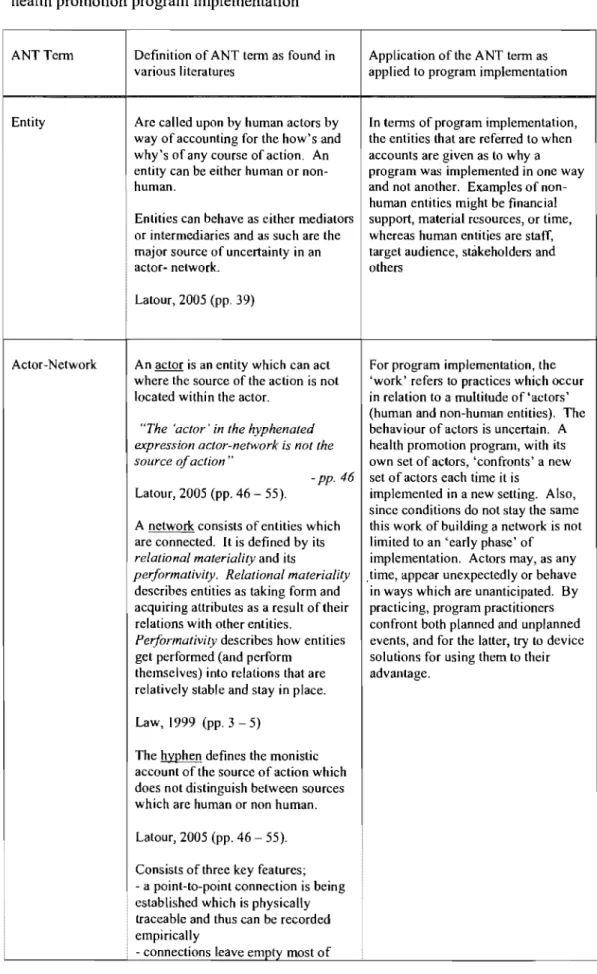
Table One. Actor-Network TheOl-y (ANT) tenninology as applied to a
case study of health promotion program implementation ... 60
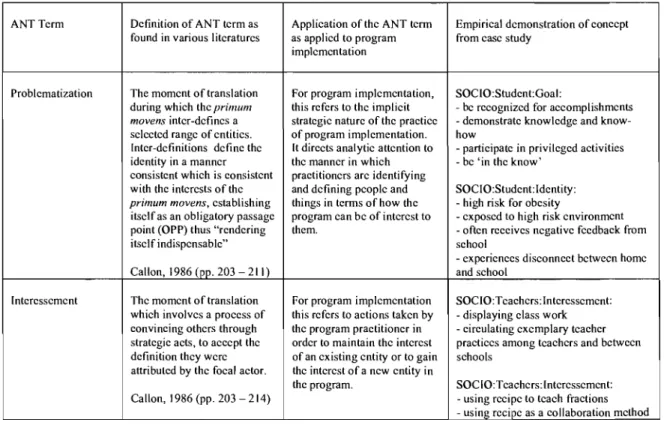
Table Two. Actor-Network TheOl-y (ANT) tenninology applied to
data analysis in a case study ofhealth promotion program implementation ... 83
As found in Article Three;
Table 1. Definition of practices to build alliances with students and school ... 161 Table 2. Examples of practices in response to the strategies employed by nutritionist to build alliances with students and school. ... 162 Table 3. Number ofpractices observed between schools confinning operation of
strategies to build alliances with students and schoo1s ... 163 Table 4. Between school variation in structural characteristics ofworkshop ... 164 Table 5. Social conditions across schools ... .165
LIST OF FIGURES
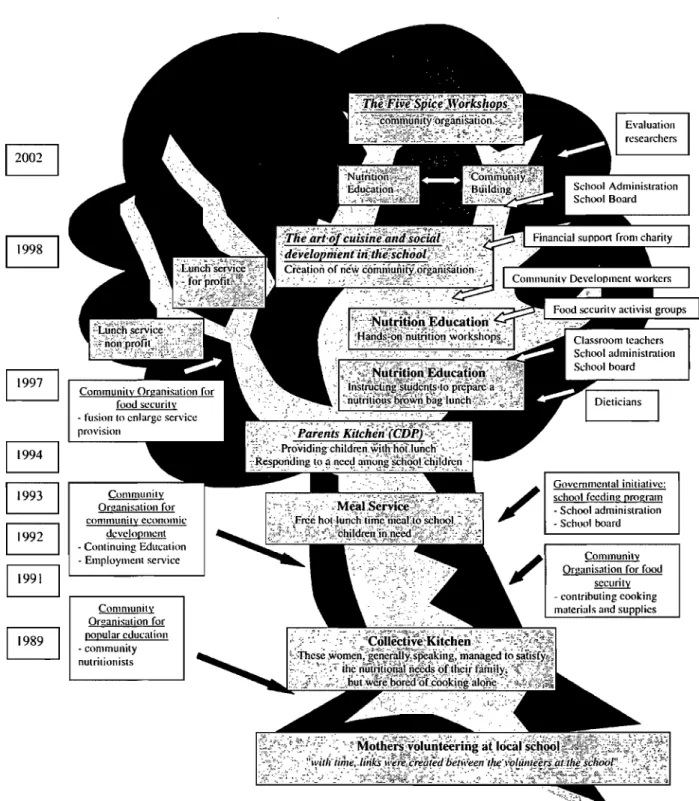
As found in Article One;
Figure 1. Evolution of Little CookslParental Networks ... 100
As found to Article Two;
Figure 1. Strategies identified by nutritionists to connect interests of participants
and stakeholders to the program ... 133
A program is public health's modus operandi and evaluation plays an
indispensable role in the legitimatization ofthese 'programmed actions' (Dab, 2005). More specifically, programs are identified as instrumental devices composed of resources which become mobilized to create activities and services in a particular context with the aim of improving the health of a targeted population over a set timeframe (Pineault & Daveluy, 1986). ln health promotion programming and evaluation, the program tends to be represented as a diagnosis of a public health problem, a state-of-the-art 'treatment' and an assessment to determine the effectiveness of the treatment (Green & Kreuter, 1991).
Embracing the participatory and emancipation values espoused by the Ottawa Charter (WHO, 1986), health promotion offers an approach which is distinctive to that typified by disease prevention (Rootman, Goodstadt, Potvin, & Springett, 2001). Following from the Ottawa Charter, health promotion programs aim to engage groups to participate in processes of change and development at the individual, organizational and policy levels (Kickbusch, 1994). Rather than being static and pre-defmed, health promotion programs are in a "dialectical relationship" (Potvin, Haddad, & Frohlich, 2001, p. 47) with the setting within which they aim to impart change. Health promotion programs are thus not invariably prescribed treatments to health problems and are not always dominated by professional expertise or
knowledge. Rather, in many cases, they develop from a plurality ofknowledge and approaches to address an issue in a collaborative process (Dab, 2005). In this light, health promotion programs are programmed social actions in which people create new meanings associated with health and negotiate their role in relation to the program's objectives. The general objective ofthis thesis is to examine the social processes inherent to health promotion program implementation.
The dialectical relationship between program in theory versus program in practice
Pro gram implementation places the 'essential' parameters of the program into action. While what is essential is based upon a subjective perception, the literature on health promotion program identifies the essential parameters of the program as the recognizable program actions including activities, services and resources (Potvin
et al., 2001). Implicit in its reference to activities, services and resources, program implementation implies that the actors who are delivering a program as well as those who are supporting or receiving it, will take on new roles and establish new
relationships with both new or familiar actors. Implementation of a program further implies the occurrence of change to people's interactions not only with other individuals but also with tangible (e.g., material, schedule) or intangible (e.g., knowledge, abilities) things or entities. For example, the implementation of a school based nutrition program implies that school actors are willing to participate in
various forms of change. ln addition to the explicit objectives related to students and
families (e.g., eating more fruits and vegetables, fewer snack foods), a nutrition pro gram imposes change among school personnel with respect to their regular activities and schooi routines. For example, the implementation of a nutrition program may require teachers to adjust a curriculum or timetable, or to undergo training, acquire new knowledge and teach new material (Johnson et al., 2003; Stevens et al., 2003). Nutrition programs may also change or introduce new
relationships within the school, by bringing in new people (e.g., parents, community members, health professionals) or by introducing new forms of interactions (and tensions) among students (e.g., peer leadership), teachers (e.g., role modeling) and between students and teachers (e.g., enforcing nutrition policy rules) (Anderson et al., 1998; Baranowski et al., 2000; Reynolds et al., 2000). These actions and interactions arguably give form to the program and as a result, the evaluation might capture the processes whereby groups and individuals collectively and individually make decisions regarding the ex te nt they are ready or willing to participate or contribute to this new program of action.
Although the contextualized nature of health promotion planning and evaluation is acknowledged (Green & Kreuter, 1999) and the rhetoric of
implementation implies that the program-in-action is dynamic and contingent upon the particularities of the setting (Love, 2004; Weiss, 1998), there is little empirical evidence to demonstrate program action in this light. Instead, implementation is overwhelmingly situated within a normative framework where the program-in-practice is expected to conform to the program-in-theory. That is, as a quintessential set ofpredetermined and limited 'essential' program operations which have been identified a priori as preconditions to specific set of outcomes. ln this light,
implementation evaluation reveals the program-in-practice in order to determine the degree to which the program-in-theory is operating, thus allowing the occurrence of program outcomes to be fairly judged. Thus program-in-practice either does or does not reflect the program-in-theory. In this sense, program implementation is a means
to an end. The dialectic of means and end is referred to as teleology (i.e. purposive development) among philosophers such as Hegel. Here, the means is the activity in which a subject engages with the intention ofbringing about a certain end.
However, the adequate means becomes itself an end, the discovery ofwhich entails certain means. Still, an adequate conception of the end is a powerful means in its own right. In this respect, program-in-theory can be understood as having an ideal
existence, which provides an essential conception of the end, but the actual outcome of the adopted means (i.e. program-in-practice) can be expected to be quite different from the abstract end for which the means are to be adopted in the first place.
Analogous to the means and ends dichotomy, a problematic practice of approaching process and outcome as two mutually exclusive concepts has similarly been challenged in health promotion evaluation (Rootman et al., 2001). Namely, in accordance with the definition proposed by the WHO Regional Office for Europe (Annonymous, 1984), and endorsed by subsequent events and publications (WHO, 1986), health promotion is "the process of enabling people to increase control over, and to improve, their health". Accordingly, the value of a health promotion program lies in its capacity to involve individuals, organizations or communities to participate in this process of change. Thus, it can be argued that while it is important to know the frequency and duration of an activity or how many people presented themselves at an event, evaluating the implementation ofhealth promoting principles requires gathering information on the programmed actions or processes which place an activity into operation, such as, how the activity was planned and implemented and why people made decisions to participate (or not).
The need to understand the pro gram through the relationships which develop between the context and the program has been longstanding (Weiss, 1972). Program implementation is the embodiment ofthis relationship. Implementation evaluation has predominantly been used for outcome evaluation by addressing the shortcomings of "black-box" evaluation by uncovering the otherwise hidden processes that cause a
set of program effects to occur (Love, 2004; Steckler & Linnan, 2002). In this respect, implementation evaluation is described as contributing to generalizable knowledge about how social programs work and the conditions and factors that enable or obstruct their success. This approach generally accompanies a research design which holds the program operations constant within a controlled setting. In so doing, it arguably places sorne limits on what can be learnt from the relationships which develop between the context and the program and may be at odds with the now decades-old calls for a "contextually realistic" theory of evaluation (Cronback,
1980; Weiss, 1972), as quoted in (Rootman et al., 200l, p. l8). Instead ofbeing held as an unattainable ideal, the program theory might become more 'realistic' if it is understood to be in a dynamic relationship with the practices as they unfold in context. We may learn from the quotation that there is "nothing as practical as a good theory" (Lewin, 1951; Weiss, 1995) for its suggestion that the ory is indeed practical and thus practiced, where practice can contribute to a theory building process. This argument parallels recent caBs for more practiced based evidence to build evidenced based practice (Green, 2006).
More comprehensively, implementation evaluation has three foci: l) to provide a surveillance of the program in order to compare the planned characteristics against those delivered and explain gaps between the two; 2) to evaluate the
components which relate to the observed effects in order to identify the critical elements of the program; and 3) to evaluate the specifics of the treatment in order to understand how the variations in the program's development influence the observed results (Fleury & Denis, 2000). Implementation can thus be described as tracing the prescribed program operations to ensure that they are operating as intended, and documents 'drift' from the prescribed plan. Program drift is generally understood to be undesirable, having the potential to lead to Type III errors, whereby the lack of pro gram effects is falsely attributed to an ineffective program (Basch, 1985). Program drift however can also be highly desirable leading to both individual and organizational advantages relative to programs that are highly controlled and characterized by a strict resemblance to their logical technocratic process (Fleury &
Denis, 2000). Lacking, however, is a role implementation evaluation can play to address the underlying mechanisms of a pro gram to explain these variations in a manner which is not restricted to a set of pre-determined propositions.
One barrier which prevents implementation evaluation to go beyond its rhetoric and produce generalizable knowledge about the processes which de scribe how programs work, lies in the nature of the theoretical frameworks which have guided implementation inquiry to date. The most pervasive frameworks used to direct implementation evaluation are the diffusion of innovation model (Rogers, 2002) and the ecological framework (Hawe & Riley, 2005; Richard et al., 2004; Scheirer, 1981, 1987). The definition of diffusion "is a special type of
communication concemed with the spread of messages that are perceived as dealing with new ideas, and necessarily represent a certain degree ofuncertainty to an individual or organization" (Rogers, 2002, p. 990). A health promotion program can be understood as a 'new idea' and the diffusion model proposes a set of factors which influence the rate at which the 'idea' is taken up by a set ofprogram adopters (i.e. the user system). The focus ofthis model is on the adopter's perception of the program with respect to a set of factors, including, its relative advantage, trialability, observability, complexity and compatibility (Rogers, 2002). The diffusion model has also been described as akin to a trajectory image of movement based upon inertia, whereby an innovation is inappropriately conceived as moving through time and space through a self-generated force (Latour, 1987). The ecological framework emerged out of a recognized limitation of the diffusion model and shifts attention from the individual adopters to the system in which a program may become integrated (Scheirer, 1987). The ecological model considers how the
implementation of a program maintains or disrupts the adopting system's core functioning and proposes that the Implementation of a new program consider how the system will adapt to maintain its organizational structures and institutional standards with the introduction ofnew operations (Hawe & Riley, 2005; Pluye, Potvin, & Denis, 2004).
These frameworks guide data collection, first, to the appropriate use of the program, and second to the contextual factors enabling or obstructing the successful implantation of a given set of program operations. Missing however is consideration for the interplay between the components of the program and the adopting system. Acknowledging interplay between the pro gram and adopting systems implies that a transformation in one system occurs in response to the other. Beyond disturbing the
equilibrium of an adopting system, as shown in the ecological framework, program Implementation arguably disturbs the equilibrium of the program. In this respect, by participating in the programmed action which de fines a public health program (Dab, 2005), individuals and collectives invest their material resources (e.g. personnel, workspace, money) or nonmaterial resources (e.g. time, energy, knowledge) and in so doing, may require the program to adjust. In fact, it is through these investments that innovations are understood to become relevant and thus take on meaning within an adopting system (Latour, 1987).
LiffiÎts of current conceptions of program Implementation
Concem with the capacity of current frameworks to account for what actually occurs du ring program operation and thus fairly judge the effectiveness of the program to bring about change is building within the evaluation literature in general (Friedman, 2001; MoreIl, 2005) and the public health literature in particular
(Glasgow et al., 2006; Hawe & Riley, 2005). An incompatibility between diffusion type models and observations of programs in operation has been acknowledged. As opposed to being pre-defined and static, program theory is described as emerging from the dynamic contexts where programs "interpret, translate, subvert, or deploy" (Hawe, Shiell, Riley, & Gold, 2004, p. 790) the official program rhetoric with the socio-environmental contexts of their practices (Hawe & Riley, 2005). Despite this recognition of an "inherent interactivity" (Glasgow, Lichtenstein, & Marcus, 2003, p. 1263) among a diversity of actors with a range of interests, expectations and values, Implementation research still tends to trace the idealized efficacy-to-effectiveness diffusion model whereby the movement of a new idea's trajectory is either facilitated or impeded by a set of socio-demographic or experiential
characteristics of the user system (Glasgow et al., 2003).
The limitations of diffusion and ecological implementation frameworks to capture the effectiveness of programs aiming to build healthy settings and engage local action is becoming increasingly apparent within a growing body of research on health promoting schools (Dooris, 2005; Inchley, Muldoon, & Currie, 2006;
Rowling & Jeffreys, 2006; St Leger & Nutbeam, 2000). Despite recognition of the inability of traditional fidelity criteria to capture the presence of health promoting
principles in the school (i.e. suitable indicators of effectiveness), without an alternative, researchers continue to call upon the very methods that have been identified as less suited to the objectives of health promoting school initiatives (Inchley et al., 2006; Mukoma & Flisher, 2004; St Leger & Nutbeam, 2000). Namely, one of the key features which captures the health promoting schools rhetoric resides in the school's engagement to devise strategies to promote health in a way which responds to local need and capacity. The processes by which schools engage a diversity of actors both internaI and external to the school to define a pro gram and devise strategies are however seldom documented. Instead, environmental changes such as the appearance of a new service or policy, or
individual change lifestyle indicators remain the valued program outcomes (Mukoma
& Flisher, 2004; St Leger, 1999), thus overlooking the social and structural change process which may or may not have permitted such change to occur.
Along similar lines, the limitations of CUITent implementation frameworks documenting pro gram operations uniquely through a lens of fidelity or integrity are beginning to appear within the broader he al th promotion program effectiveness literature as weIl. While black-box evaluations which neglect the implementation process altogether are still posing challenges to the identification of effective mechanisms (Contento, Randell, & Basch, 2002), systematic reviews of programs which pro vide implementation measures are revealing sorne unexpected associations between program fidelity and effectiveness (Doak, Visscher, Renders, & Seidell, 2006; Sharma, 2006). Namely, one review found no association between the intensity of the program and outcomes (Sharma, 2006), and another found that effective programs actually had lower fidelity to essential criteria than ineffective programs (Doak et al., 2006). Recommendations from these and other school-based health promotion program reviews (Summerbell et al., 2007) identify a need to shift attention away from the program mechanisms which uniquely represent a view of program-in-theory towards the 'why and how' a diversity of actors come together to address a particular issue. That is, there is an identified need to explain why and how various program actors' own needs and values inevitably become part of the program-in-practice. A methodological framework which responds uniquely to internaI monitoring (i.e. events and objectives found within the logic model), can actually be counter-productive by blocking and obscuring an opportunity to identify
and measure unplanned program accomplishments, which may in fact be of higher value to the actors involved in the program (Birkeland, Murphy-Graham, & Weiss, 2005).
Developing a novel program implementation conceptualization
This thesis responds to a need for an alternative framework through which the social processes that describe program implementation may be identified. That is, an alternative to that which holds a program as a fixed entity in anticipation that program operations will represent the plans and outcomes of a restricted number of 'interested' actors. The framework proposed by this thesis draws upon a sociology of action where actions are understood to arise out of the intrinsic qualities and values of a group of actors and their ability to negotiate with one another in
association with their goals and interests. Program implementation is thus proposed as a set of strategies by which a focal actor group builds connections between human (e.g. students, teachers) and non-human actors (e.g. curricular program, timetable) in ways which respond to their goals and interests. Namely the actions of
interventionists implementing a school-based nutrition program are understood in terms of their potential to connect objectives associated with the program to the objectives of school actors.
This study applies the sociology of translation or Actor-Network Theory (ANT) conceptual framework to the case of a nutrition program within the elementary school setting. More specifically, it suggests that implementing a program is a process of expanding and stabilizing a socio-technical network. By building a socio-technical network, human actors are building new connections between other human (social) and non-human (technical) entities (or actors) in order to advance and strengthen a collective which supports the pro gram goals. These connections are created through the establishment of aligned interests, where technical entities are used as strategic devices to stabilize these connections.
From this theory, three propositions are applied to this study ofprogram implementation. The first of three theoretical propositions posits that the program can be characterized as an emerging socio-technical network where its successive
translations reveal the movement in the program due to the inter-dependence of the human and non-human entities (i.e. socio-gram and techno-gram) (paper number one in the results section). The second theoretical proposition posits that even as the socio-technical network becomes more consolidated, the focal actor group remains actively involved in building new connections and stabilizing existing ones by making compromises and negotiating the use and utility ofnon-human actors. Finally, the third theoretical proposition posits that the work of building connections is a continuous negotiation and re-assessment of entities whose behavior as
mediators or intermediaries is often uncertain.
The pro gram, Petits cuistots parents en réseaux (translated as Little Cooks -Parental Networks) is planned and implemented by a non-profit community
organization, Les ateliers cinq épices. Petits cuistots - parents en réseaux (hereafter referred to as PC-PR) is targeted at elementary school children and their families living in disadvantaged Montreal neighborhoods and was implemented in a total of eight schools in kindergarten through grade five classes during the 2004/05 academic year. The program aims at the development of nutritional knowledge and culinary abilities of elementary schools children to favor their health and development. Also through the PC-PR pilot project, the community organization also opens to school children's parents for the development of social support networks through the bias of food and culinary art in order to favor their economic and parental responsibilities through a social integration. The Little Cooks component includes eight annual teacher and parent assisted monthly nutrition workshops, created and animated by community nutritionists (i.e. registered dieticians) offering concrete experiences with food, through food preparation and tasting activities. Each workshop includes: 1) didactic knowledge transmission on topics such as food transformation, food types, nutrition and health; 2) hands-on recipe completion using a cooperative learning approach; and 3) tasting of the fini shed recipe with samples to be taken home. The second component (Parental Networks) is organized by community development workers and aims to support the development of mutual support networks through parents' active involvement in the school. Parents are invited to participate with their child during the nutrition workshops and as well to attend collective dinners and family outings.
This thesis centers upon the nutrition workshop activity and the nutritionists who plan and implement this activity. This thesis does not treat the implementation of the parental component of the program (i.e. Parental Networks). This component of the program is planned and implemented by community development
interventionists. Still however, the nutrition workshop activity can be described as a juncture point between these two components as it is during this activity where parents first participate with the program. Hence, this the sis centers upon the work of the nutrition interventionists. In as much as that work might be to connect parents to the school, it touches upon the parental component of the program.
The over-riding research question asks how PC-PR transformed over time and between settings, and why such transformations occurred. Based upon this question and guided by the ANT theoretical framework, this study will address three empirical propositions. The first posits that the emergence of the nutrition
intervention will be characterized by many transformations in the over-riding goals of the program (as well as among the people and things associated with it), reflecting the need to become a recognized solution to a community/scho01 problem. The second and third propositions suggest that as program goals become less dispersed and more focused, program transformations are still occurring in terms of how the program becomes represented and operated in relation to the conditions across the various schools. More specifically, according to the second empirical proposition, program practitioners will represent the program activities as being an indispensable response to the needs identified by them within a particular school. Finally, the third empirical proposition posits that nutritionists will differentially represent school contexts and that the operation of program activities will occur in relation to this representation. Thus, as the represented needs differ between schools, so too will the nutritionists representations and operation of program activities.
The first of three articles proposed for this thesis follows the program from its roots in 1989 through several successive iterations to arrive at its present form in the early 2000's. By following the program's movement with an analysis of the social and technical entities into and out of the program, implementation is shown as an emerging socio-technical network. By emerging, the network is growing rapidly, but the stability of the connections that hold the network together are still being
worked out. This article highlights the reciprocal relationship between the social and the technical entities that hold the network together, whereby the technical entities are responsive and representative of the social entities within the network, and vice versa. Based upon historical documentation and interviews with two key
stakeholders with a long term involvement with the program, the analytic procedure re-traced the major adjustments that occurred during this program over time. This study contributes to the overall thesis by providing an illustration of network convergence and divergence. That is, when actors adjust to accommodate interests different from their own, interests are in alignment and the network is converging, however, wh en actors do not have an interest to make such accommodations, interests are not in alignment, and the network is diverging (i.e. a program can rupture or break apart).
The second article seeks to identify sorne of the micro-processes as described by ANT, within the focal actors' representations oftheir implementation activities. Essentially, the actor-network theory holds that networks are built through an alignment of interests, and as the focal actor group, nutritionists would be expected to identify a network of actors and devise strategies to align their interests to those of her own. Further, ANT maintains that strategies consist of compromises and
negotiations whereby the technical attributes in the network may become translated in response to these negotiations. This study sought to describe the overall
representation of the socio-technical network and the strategies used by nutritionists to stabilize this network. Data were derived from individual interviews with
nutritionists with the aim of building an overall representation of the program according to the ANT conceptual framework. This study contributes to the overall thesis by applying sorne of the notions from the moments of translation in order to de scribe the substance ofwhat lies 'in-between' connections.
Lastly, a third study aims to describe the practices corresponding to the nutritionists' representations of program implementation and explain their interplay with the school context. Guided by the collective representations which formed the results of article two, article three describes the operation of these strategies in terms of practices observed during the delivery of the nutrition workshop. Data are thus derived from the individual interviews, observations and audio-recordings from the
nutrition workshop activity. This article aims to highlight the interpretive nature of practice whereby interventionists strategize according to the conditions within a setting in order to obtain (or maintain) the interest of education stakeholders. This study contributes to the overall thesis by describing practices in terms of their interaction with particularities within a setting.
This literature review critically examines research evaluating health promotion program implementation in the school setting. Challenges facing this endeavor are reviewed with respect to the conceptualized nature of the health promotion program and the implementation frameworks which follow these conceptions. Due to the pervasiveness of the diffusion of innovation framework in public health intervention research (Love, 2004; Oldenburg & Parcel, 2002; E. Rogers, 1995; Steckler & Linnan, 2002), particular attention is attributed to evaluation models which objectif y the health promotion program as a pre-defined fixed 'technology' with health promoting potential. Sorne examples of this type of school based program which have been extensively researched include the Children and Adolescent Trial for Cardiovascular Health (CATCH) (Johnson et al., 2003; Nader et al., 1999), the Take Five (Anderson et al., 1998) or Five-a-Day programs (Baranowski et al., 2000). The aim of this review is to: 1) challenge the approaches which have dominated implementation evaluation of health promotion programs in general and school-based nutrition interventions in particular and; 2) identify the consequences of research based on implementation frameworks which neglect the central role of social actors and their agency during program implementation.
Implementation research which follows the diffusion of innovation models typically traces program practices in order to confirm the operation of the program's theory as represented in alogie model. ln this respect, research is limited to
identifying only those programmed actions which conform to pre-defined plans. As a result, implementation research may miss operations resulting from the adaptation practices necessary for pro gram implementation. The diffusion framework is problematic in that it suggests program actors are passively transmitting the program's innovation(s) without actively subscribing to an assigned role (Latour,
1987). While the potential that an actor may adapt an innovation or their role in it is sometimes (E. Rogers, 1995) but not always (E. Rogers, 2002) recognized, focus is clearly placed upon speed and extent of diffusion (Oldenburg & Parcel, 2002). Similarly, evaluation researchers remain divided on the need to consider program adaptation (Blakely et al., 1987; Castro, Marrera, & Martinez, 2004; Dusenbury, Brannigan, Falco, & Hansen, 2003). ln fact, sorne researchers reject the need for a pre-defined theory all together (Scriven, 1991). Thus while adaptation is a known
reality once programs enter 'real world' settings, it is nonetheless associated with a 'debate' or a 'tension' between maintaining strict integrity to the theoretical
proposition versus favoring adaptations in the operation of that theory in response to the context (Mowbray, Holter, Teague, & Bybee, 2003; Summerfelt, 2003). This review examines this debate as it relates to the settings approach and health promotion in schools. This review describes this tension as a form of paradox in program evaluation and attributes it to a 'default' reliance on an implementation framework which is devoid of actors. Although this framework does not conform to the theoretical principles of health promotion practice, or the 'reallife' experiences of program evaluation, it is selected due to a lack of a suitable alternative.
This review begins by exploring the evaluation literature specific to school health. The literature suggests that implementation models may not reveal effective strategies to build the school's capacity to promote health, and consequently, high quality programs may go unrecognized. Despite recognition that these models do not adequately respond to the particular evaluation needs of the settings approach to health promotion (Poland, Green, Rootman, 2000) we find few alternatives (Rootman, Goodstadt, Potvin, & Springett, 2001). Arguing further, the literature review turns to systematic reviews on health promotion programs in schools, and draws upon anomalous findings and the conclusions offered by authors, suggesting a need for a new implementation framework. Next, the review presents the two implementation frameworks which currently guide most health promotion evaluation, namely, the diffusion (E. Rogers, 1995) and ecological frameworks (Scheirer, 1981). While the two models each take a distinctive approach to program implementation, they remain within the diffusion model perspective. In this respect, one model centers upon the instrumental components of the program and the other, on the organizational systems which receive the pro gram. Both models however, are limited in that they do not capture the interplay between the program and the context, thus neglecting a program's dynamic. The final part of the review situates the conceptual framework and methodological approach used in this thesis within the social science and qualitative research literature specifie to program evaluation. By identifying the ontological and epistemological assumptions that underlie current approaches to evaluating the health promotion program, the review situates the present study within an alternative paradigm, known as critical realism.
1. School health promotion
School health promotion is generally distinguished between a health promotion in schools approach and a health promoting schools approach (Lister-Sharp, Chapman, & Stewart-Brown, 1999; Stewart-Brown, 2006). Identified as the Health Promoting Schools (HPS) or Comprehensive School Health Program (CS HP) (Deschesnes, Martin, & Hill, 2003), the health promoting schools approach is distinguished from the health promotion in schools approach by its ho lis tic,
integrative strategies which pay particular attention to the social environment of the school (Allensworth & Kolbe, 1987; Parsons, Stears, & Thomas, 1996). The HPS and the CSHP are underpinned by the settings approach endorsed by the Ottawa Charter, in particular, to build healthy environments and reinforce local action (Green, Poland, & Rootman, 2000; WHO, 1986). The health promoting schools approach reflects a conceptual shift from disease prevention focused on individual lifestyle factors to the broader social and environmental determinants of health. The settings approach can be identified by three key characteristics: 1) an ecological and holistic approach focusing on building health as a resource for daily living rather than for the prevention of disease risk factors through linear causality reasoning; 2) a systems approach where the setting is conceived as dynamic, interacting, complex and interconnected with other systems within a wider environment; 3) an
organizational development approach where the integration of new programs necessitates a recognition for, and integration of, the core operating and routine functions which characterize the setting (Dooris, 2005). As elaborated by others, success is associated with the integration of health promoting princip les into school routines in addition to the normative systems of operation over time (St Leger, Kolbe, McCall, & Young, 2007). The objectives of the health promoting schools approach are thus intimately connected with the social context of the school, and in this light, responsiveness to environment (i.e. adaptation) is essential (Poland, Frohlich, & Cargo, in press).
ln contrast, health promotion in schools eenters aetivities, usually classroom based instruction, on a particular topie related to physieal or mental health (Lister-Sharp et al., 1999; Stewart-Brown, 2006). Examples include nutrition, physical
activity, tobacco use, substance misuse, and social integration. This approach explicitly identifies a single population health problem and ai ms to change the prevalence of associated risk factors. As opposed to schools seen as settings where health is 'created and lived', schools are primarily viewed as venues or sites to instruct and/or motivate a large 'captive audience' towards healthy lifestyles or risk reduction behavior (Stewart-Brown, 2001). This approach is often valued as a program that produces short-term 'visible' changes in individual behavior and/or the factors which are thought to mediate this change, including individual knowledge, attitudes and capacities (St Leger, 1999). Programs ofthis nature have also been characterized among education scholars as representing a narrow and
decontextualized "programs and packages perspective" (Elias, Zins, Craczyk, &
Weissberg, 2003, p. 306) and among school health scholars as "add on extras" susceptible ofbeing excluded from constrained financial plans or timetables (Nader et al., 1999, p. 247). In this light, a successful school-based program is one which would have a positive eITect on student health or risk related behavior.
Demonstrating effectiveness also requires that school conditions be identified for their mediating role to influence program implementation and outcomes.
2. Beyond the rhetoric: distinguishing health promotion in schools and health promoting schools
Research evaluating the implementation and/or effectiveness of health promotion in schools and the health promoting schools approaches, reveals that in'
practice, the distinction between the two is not always clear. The health promoting schools approach (that is, HPS and CSHP) "has been legitimized more through an act of faith than through rigorous research and evaluation studies" (St Leger, 1997, p. 100). This sentiment continues to be re-iterated in the health promoting schools literature today (Deschesnes, Martin, & Hill, 2003; Inchley, Muldoon, & Currie, 2006; Leurs, Bessems, & Schaalma, 2007; Whitelaw, Martin, Kerr, & Wimbush, 2006). While specifie directives encourage planned actions directed at three domains, including: 1) a formaI health curriculum; 2) physical and social school environment, services and policies; and 3) partnerships between the community and the school (Allens worth & Kolbe, 1987; Parsons et aL, 1996), strategies
Hill, 2003; Stewart-Brown, 2006). Furthermore, despite being identified as a settings approach which values actions directed toward creating health promoting conditions, evaluations have tended to rely on individual measures of health
knowledge, attitude and capacity (Lee, St Leger, Cheng, & Team, 2007; Moon et al., 1999; Mukoma & Flisher, 2004; Schagen et al., 2005), often neglecting change in social conditions (Deschesnes, Martin, & Jomphe Hill, 2003). St. Leger (2007) concludes "most evaluations in the last decade appear to be focused on health behavior change" where "not many look at the changes in schools' policies and practices that enhance health" (St Leger et al., 2007, p. 121).
Most distinguishable in the health promoting schools approach is that schools are "encouraged to identify their priority areas ... depending upon local
circumstances" (Mukoma & Flisher, 2004, p. 359). Health promoting schools thus plan and implement one or more of the three health promoting school domains according to their particular circumstances. In contrast, the health promotion in schools approach tends to impose a pre-defined health topic. Sorne examples of disease prevention programs targeting elementary school children include: Chi Id and Adolescent Trial for Cardiovascular Health (CATCH) (Parcel et al., 2003); Pathways (Lytle et al., 2002); Take-Five (Anderson et al., 1998); Paths (Kam, Greenberg, &
Walls, 2003); Kahnawake Schools Diabetes Prevention Project (KSDPP) (Potvin, Cargo, McComber, Delormier, & Macaulay, 2003); and Planet Health (Wiecha et al., 2004). School-based disease prevention 'programs are often planned by expert committees and based on one or more behavior change theories which accompany a health education curriculum, new activities, and policy and food service change. Programs ofthis nature may also be multi-component, and include components which cross subject areas, link to family and/or community (Parcel et al., 2003) and target change at the school social or physical environment (Lister-Sharp et al.,
1999). Further, and perhaps more in line with what has been defined as the essential feature ofhealth promoting schools (Inchley et al., 2006), the planning and
implementation process of a topic-based program is collaborative (i.e. include community agencies and school personnel using a teamwork approach) and
described as proceeding through an iterative process (i.e. planning framework adapts to the implementation realities as they adapt to new planning frameworks) (lnchley
et al., 2006; Laurence, Peterken, & Burns, 2007; Naylor, Macdonald, Reed, &
McKay, 2006; G. Patton et al., 2006; Ward et al., 2006).
ln line with the distinctiveness ofthese approaches, distinguishing
implementation frameworks may be expected to follow. Namely, since the integrity of the planned activities is a key component to behavior change the ory,
implementation frameworks would likely consider the social, cultural and political issues of the school in order to determine their potential to interrupt the expression of the underlying theory. ln contrast, the implementation framework following the HPS and CHSP approaches would identify social, cultural and political contextual issues in terms of their influence on program formation and on environmental change and partnership-building which enhance health. However, as will be shown, this distinction is not clearly articulated or practiced across the two approaches to health promotion.
3. Implementing the health promoting schools approach
While the process of planning and implementing the health promoting schools approach is "critical to its success and sustainability" (Rowling & Jeffreys, 2006, p. 706), little knowledge has been generated in this respect (Deschesnes et al., 2003). Knowledge gaps particular to the health promoting schools strategies include the process of engaging school actors and negotiating the integration of health promotion and education goals (Deschesnes et al., 2003). Without such knowledge, the essential features which define the settings approach in theory are unlikely to be put into practice. Evaluations ofhealth promoting schools have tended to simplify, or edit out 'complex variables', relationships and structures and thus fall back on familiar health behavior indicators (Colquhoun, 2006; Dooris et al., 2007). Evaluations of this approach are particularly challenging when considering the ecological complexity of the setting, the level of integration and reduced visibility of the 'program' in question (Dooris et al., 2007). Dooris and colleagues (2007, p. 339) paraphrase McLaren & Hawe (2007) stating that "an ecological perspective focuses on the interactions and interdependence between different elements within
ecosystems, highlighting the relationships between people and settings". However, while the integration of goals and interests from health, educational and community
actors arguably lies at the heart of this approach, few studies report on the way planning and implementation processes negotiate interests among these actors.
Evaluation frameworks providing measures of the school environment with 'school he al th profiles' or 'quality practices' have been used for health promotion evaluation purposes (Lee, Cheng, & St Leger, 2005; Moon et al., 1999). These indices are based upon measures from social contexts of schools and are used to evaluate the degree to which the schools are implementing health promoting strategies (Lee et al., 2005). Measures of the social context are reportedly derived from the education literature on effective schools (Moon et al., 1999). Award schemes have been used to acknowledge accomplishments of schools to implement change in the "culture and organization of the school" with respect to building links with the wider community, teaching methods, student participation in decision making and school management practices (Lee, Cheng et al., 2007; Moon et al., 1999). Evaluation frameworks of this type include measures from multiple perspectives and account for the experiences of student, staff and parents with the implemented change processes (Lee et al., 2005). These approaches represent important advancements in evaluation research that go weIl beyond a restricted view of the classroom as a setting to de li ver health curriculum to a captive audience and the school environment as a setting where healthy policy or services allow 'healthier choices to become easier choices'.
Although these indices may point to indicators of success, it is also essential to identify the social processes which may have brought them about. Namely, this evaluation framework does little to respond to the gaps in knowledge as identified by Deschesnes (2003) with respect to the processes of engagement, negotiation and compromise in which program promoters must engage with key actors in the implementation context. Evaluations of the health promoting school social context have been based on check-lists and questionnaires with general inquiries about "family involvement in school activities" or the school social environment with respect to its "friendliness, care and trust(fullness)" (Lee, Cheng et al., 2007, p. 753). Such checklists may however limit understanding on the social process through which schools build healthy environments and engage local actors (Denman, 1999). These indicators may also be misleading. ln particular, the nature of 'collaborative
partnerships' may not truly reflect the health promoting princip les of
'empowerment' or the presence of actions in response to locally identified needs (Deschesnes, Martin, & Jomphe Hill, 2003; Marshall et al., 2000). For example, partnerships between community and school may be more oriented toward resource acquisition where 'partners' may not even be working together to carry out joint activities (St Leger, 1998). Further, the compatibility of actors' self-defined roles, and those of others, may be 'glossed' over as long as relationships remain
superficial. For example, teachers' perceptions of parents as playing a uniquely one-sided support role, may clash when parents are put in a position to voice their expectations of a reciprocal relationship with teachers (Shartrand, Weiss, Dreider, &
Lopez, 1997) as seen in the work of Deschesnes and colleagues (2003).
4. Implementing the health promotion in schools approach
Implementation oftopic-based programs is generally concemed with fidelity measures that trace 'program drift' as a threat to the program's potential to be
effective. Programs ofthis nature tend to be defined and implemented by actors from outside the school who attempt to impose or sell program objectives on school actors (usually teachers). The problems associated with these programs in terms of low implementation and sustainability are well known in both education (Tanya, 2007; Lochman, 2003; Elias et al., 2003) and health promotion (Gingiss, Roberts-Gray, &
Boerm, 2006; Parcel et al., 2003) literatures. However, little knowledge has been produced regarding what the program represents to the se actors, and why they may become involved at one point or cease to do so at another point. In this respect, the identity of actors during program implementation tends to be portrayed along a single dimension, namely as either conforming or not conforming to a newly program-defined role. In contrast, health promotion interventionists have been shown to interpret their role in relation to their areas of expertise and the social context oftheir school (MacDonald & Green, 2001). Often, the role of the program and how it responds to a need is similarly assumed to be consistent among all actors. However, school actors may differ on their views of the program's objectives and how these are expected to interact and bring about a change. For example, despite evaluations revealing the ineffectiveness of the substance misuse prevention program DARE, schools continued to implement the program, leading investigators to
question why school actors have an interest in an ineffective program. Findings revealed that school actors had very distinct ide as of 'effectiveness', what the program represented and 'essential' features of the program (Birkeland, Murphy-Graham, & Weiss, 2005). For example, school actors valued program objectives (i.e. developing relationships with community actors, such as police officers and other community service-providers) which were not part of the official program.
Several topic based programs addressing deviant and risk behavior (G. Patton et al., 2006) general healthy lifestyles (Naylor et al., 2006), nutrition (Inchley et al., 2006; Laurence et al., 2007) or physical activity (Ward et al., 2006) approach program planning and implementation as processes of integration. Implementation thus becomes a process whereby the program becomes interpreted and integrated into the school's core mission and value systems. For example, Inchley and
colleagues (2006) described the implementation process of a healthy eating strategy which was not based upon a pre-designed protocol. ln addition to taking into consideration changes resulting from healthy eating environments, the
implementation evaluation documented how schools came together to devise and implement plans. The study revealed differences among schools with respect to collaboration and described the successes and challenges due to the inclusion of a variety of actors (i.e. external professionals, pupils, parents). Schools which
succeeded in integrating the initiative with the daily life of the school were identified in order to build alliances with key players, allocate roles and establish effective communication channels. These schools were also more likely to increase the availability ofhealthy eating alternatives and improve awareness and attitudes concerning healthy eating among staff and pupils. Other 'packaged' nutrition education programs emerging from locally identified problems and strategies to address obesity issues among primary schools have also been associated with positive effects upon nutritional status (Veugelers & Fitzgerald, 2004).
Another topic based study (i.e. physical activity and adolescent girls) focused the implementation evaluation on the team building process among project
interventionists, school administration and teachers (Ward et al., 2006). Key to the findings of this study was a relationship between flexibility and the implementation of program components (e.g. curriculum could be integrated into PE classes, biology
classes, consumer science classes), school detennination of environmental changes, and positive perceptions among education stakeholders for the long tenn integration of the program. While the success of the program was attributed to the use of an implementation model which followed schools through their own transfonnations of the program, details on how the staff negotiated these transfonnations were not documented.
5. Identifying the need for a new implementation framework for health promoting schools
The need for an alternative implementation framework within school-based health promotion programming is apparent. CUITent implementation frameworks "fail to do justice to interventions" (Mukoma & Flisher, 2004, p. 365) by neglecting the change processes in schools (Mitchell, Palmer, & Oavies, 2000, p. 245). In their review assessing the effectiveness ofhealth promoting schools, Mukoma and Fisher (2004) identified the need for evaluation to use broad categories to address
outcomes, such as school structure and organization, communications, health-related policies, and school management. In their review, the authors found a great number of healthy behavior indicators at the individuallevel but measures of structural change were overwhelmingly absent, leading the authors to emphasize "the need for further research on evaluation methodologies for health promoting schools"
(Mukoma & Flisher, 2004, p. 366). In this respect, evaluation lacks a methodology to monitor the "synergy created by integrating components" (Rowling & Jeffreys, 2006, p. 708). In so doing, the evaluation ignores the culture and context within which schools as organizations operate, improve and change, how teachers judge and change practice, as well as the constraints imposed by the internaI structure of schools (Rowling & Jeffreys, 2006).
Beyond the particularities ofa program's conceptualization ofhealth, whether it be rooted in social detenninants, based simply upon one or several risk behavior topic(s), programs become part of the social relationships which exist within the context of the school, and thus require that people and their relationships change. It is these change processes which are at the heart of the settings approach to health promotion (Dooris, 2005) and pose unique challenges to evaluation
(Whitelaw et al., 2006). While no suitable implementation framework has been proposed for health promoting schools, CUITent frameworks that emphasize
individual health outcomes appear to be inappropriate to detect new "combinations and connections" arising from health promotion action in school settings (Rowling
& Jeffreys, 2006, p. 709). Consequently, wh en the program has not been sufficiently tested due to failed implementation (i.e. a Type III eITor), evaluations of the
effectiveness of health promotion programs risk producing false conclusions of program failure (Basch, 1985).
6. Effectiveness ofhealth promoting strategies
A large body of empirical evidence suggests that program adaptation may in fact be associated with positive effects on health related outcomes. A review of fifteen systematic reviews on health promotion practices in schools suggests that the process of implementing a program had more bearing on individual health indicators than the particular premises underlying the program theory (Stewart-Brown, 2006). The review's findings were based upon fifteen systematic reviews (n=760 'sound' controlled trials) on a range oftopic specific programs including mental health, substance misuse, healthy eating and physical activity, eating disorders, in jury prevention and a health promoting schools approach. The exact indicators used by the review to assess effectiveness were not specified nor were the details of
implementation indicators. However, authors concluded that "programs developed and implemented using approaches common to the health promoting schools approach, including, involvement of whole school, changes to the school
psychosocial environment, personal skill development, involvement of parents and the wider community, and implementation over a long period oftime" (Stewart-Brown, 2006, p. 16) are effective. Although the evidence as presented here (and available in the published report) is limited in detail, other reviews support the conclusions ofthis review; namely, programs implemented according to the health promoting schools model tend to demonstrate effectiveness (St Leger et al., 2007, p. 111):
"Recent evidence suggests that the way the school is led and managed, the experiences student have to participate and take responsibility for shaping