This is an author-deposited version published in:
http://oatao.univ-toulouse.fr/
Eprints ID: 7973
To link to this article: DOI:
10.1111/j.1469-8137.2012.04053.x
URL:
http://dx.doi.org/10.1111/j.1469-8137.2012.04053.x
To cite this version:
Deng, Wei and Yang, Yingwu and Ren, Zhenxin and
Audran-Delalande, Corinne and Mila, Isabelle and Wang, Xinyu and
Song, Hongli and Hu, Yinghong and Bouzayen, Mondher and Li,
Zhengguo The tomato SlIAA15 is involved in trichome formation and
axillary shoot development. (2012) New Phytologist, vol. 194 (n° 2). pp.
379-390. ISSN 0028-646X
!O
pen
A
rchive
T
oulouse
A
rchive
O
uverte (
OATAO
)
OATAO is an open access repository that collects the work of Toulouse researchers and
makes it freely available over the web where possible.
Any correspondence concerning this service should be sent to the repository
administrator:
[email protected]
!The tomato SlIAA15 is involved in trichome formation
and axillary shoot development
Wei Deng
1, Yingwu Yang
1, Zhenxin Ren
1, Corinne Audran-Delalande
2,3, Isabelle Mila
2,3, Xinyu Wang
1,
Hongli Song
1, Yinghong Hu
1, Mondher Bouzayen
2,3and Zhengguo Li
11Key Laboratory of Functional Gene and Regulation Technologies under Chongqing Municipal Education Commission, Bioengineering College, Chongqing University, Chongqing 400044,
China;2Universite´ de Toulouse, INP-ENSA Toulouse, Ge´nomique et Biotechnologie des Fruits, Avenue de l’Agrobiopole, BP 32607, Castanet-Tolosan, F-31326, France; 3INRA, Ge´nomique et Biotechnologie des Fruits, Chemin de Borde Rouge, Castanet-Tolosan, F-31326, France
Authors for correspondence:
Zhengguo Li Tel: +86 23 65 12 04 85 Email: [email protected] Mondher Bouzayen Tel: +33 5 62 19 35 71 Email: [email protected]
Key words: Aux ⁄ IAA genes, auxin, down-regulation, SlIAA15, tomato (Solanum
lycopersicum), trichome.
Summary
• The Aux ⁄ IAA genes encode a large family of short-lived proteins known to regulate auxin signalling in plants. Functional characterization of SlIAA15, a member of the tomato (Solanum
lycopersicum) Aux ⁄ IAA family, shows that the encoded protein acts as a strong repressor of auxin-dependent transcription. The physiological significance of SlIAA15 was addressed by a reverse genetics approach, revealing that SlIAA15 plays multiple roles in plant developmental processes.
• The SlIAA15 down-regulated lines display lower trichome number, reduced apical domi-nance with associated modified pattern of axillary shoot development, increased lateral root formation and decreased fruit set. Moreover, the leaves of SlIAA15-inhibited plants are dark green and thick, with larger pavement cells, longer palisade cells and larger intercellular space of spongy mesophyll cells.
• The SlIAA15-suppressed plants exhibit a strong reduction in type I, V and VI trichome for-mation, suggesting that auxin-dependent transcriptional regulation is required for trichome initiation. Concomitant with reduced trichome formation, the expression of some R2R3 MYB genes, putatively involved in the control of trichome differentiation, is altered.
• These phenotypes uncover novel and specialized roles for Aux ⁄ IAAs in plant developmental processes, clearly indicating that members of the Aux ⁄ IAA gene family in tomato perform both overlapping and specific functions.
Introduction
The phytohormone auxin controls many aspects of plant growth and development. These include cell division, apical dominance, lateral ⁄ adventitious root formation, shoot and root tropisms, fruit set and development, vascular differentiation and embryo-genesis (Friml, 2003). Recent genetic and molecular studies in Arabidopsis have revealed a crucial intracellular auxin signalling pathway in which a ubiquitin-dependent proteolytic system plays a key role in sensing and transducing the hormone signal into transcriptional programmes (Dharmasiri & Estelle, 2004). At the centre of the signalling cascade is the ubiquitin-ligase complex, SCFTIR1, which promotes the ubiquitin-dependent proteolysis of a family of transcriptional regulators known as Aux ⁄ IAAs in an auxin-dependent manner (Gray et al., 2001). Aux ⁄ IAAs and
auxin response factors (ARFs) are instrumental to auxin-dependent transcriptional regulation, and ARFs can be either transcriptional activators or repressors of primary ⁄ early
auxin-responsive genes (Ulmasov et al., 1997a; Ren et al., 2011),
among whichAux ⁄ IAAs are the best-known representatives (Abel et al., 1995). Aux ⁄ IAA genes encode short-lived nuclear proteins
comprising at least 29 members in Arabidopsis (Ulmasovet al.,
1997a; Remingtonet al., 2004; Overvoorde et al., 2005). Many
Aux ⁄ IAA proteins function as transcriptional repressors through interactions with ARF proteins. Aux ⁄ IAA proteins share four highly conserved domains (domains I, II, III and IV), each con-tributing to the functional properties of the protein. Domain I is responsible for the repressing activity of the protein (Tiwariet al.,
2004), whereas domain II confers instability to the Aux ⁄ IAA proteins (Worleyet al., 2000; Ouellet et al., 2001). Domains III
and IV are involved in homo- and heterodimerization with other Aux ⁄ IAA proteins (Kim et al., 1997; Ouellet et al., 2001) and
with ARFs (Ulmasovet al., 1997b; Ouellet et al., 2001).
Gain-of-function mutations inAux ⁄ IAA genes have been
iden-tified in Arabidopsis, which provide insight into the role played by these proteins in the mediation of auxin responses and plant
developmental processes. Mutants in at least 10 different Arabid-opsisAux ⁄ IAA genes show altered auxin response or morphology: IAA1 ⁄ AXR5 (Park et al., 2002; Yang et al., 2004), IAA3 ⁄ SHY2
(Tian & Reed, 1999), IAA6 ⁄ SHY1 (Kim et al., 1996), IAA7 ⁄ AXR2 (Nagpal et al., 2000), IAA12 ⁄ BDL (Hamann et al., 2002), IAA14 ⁄ SLR (Fukaki et al., 2002), IAA17 ⁄ AXR3
(Rouse et al., 1998), IAA18 (Reed, 2001), IAA19 ⁄ MSG2
(Tatematsu et al., 2004) and IAA28 (Rogg et al., 2001).
Strik-ingly, all these mutations are found in the highly conserved domain II and stabilize the Aux ⁄ IAA proteins, resulting in gain-of-function phenotypes. TheseAux ⁄ IAA mutants exhibit a
vari-ety of auxin-related developmental phenotypes, including altered phototropism ⁄ gravitropism, root formation, apical dominance, stem ⁄ hypocotyl elongation, leaf expansion and leaf formation in the dark. However, because the stabilization caused by these mutations may not mimic regulatory events actually occurring in wild-type plants, an accurate determination of the physiological significance of Aux ⁄ IAA proteins would benefit from the study of loss-of-function mutants. Unfortunately, in Arabidopsis, the null mutants fail to show visible phenotypes, probably as a result of extensive functional redundancy (Overvoorde et al., 2005). In
contrast with the absence of visible phenotypes associated with loss-of-function mutations in Arabidopsis, the down-regulation of severalAux ⁄ IAA genes in the Solanaceae results in clear and
dis-tinct phenotypes. In tomato, down-regulation ofSlIAA9 has been
reported to have an impact on leaf morphology, fruit set and development, apical dominance and many other aspects of vegetative and reproductive growth (Wang et al., 2005, 2009).
The down-regulation ofSlIAA3, another tomato Aux ⁄ IAA gene,
results in auxin- and ethylene-related developmental defects, including reduced apical dominance, reduced auxin response and exaggerated apical hook in etiolated seedlings (Chaabouniet al.,
2009a), supporting the hypothesis that SlIAA3 represents a
molecular link between ethylene and auxin signalling in tomato (Chaabouni et al., 2009b). Likewise, suppression of StIAA2 in
potato results in clear phenotypes, including increased plant height, petiole hyponasty and curvature of growing leaf primordia in the shoot apex (Kloostermanet al., 2006). Although phenotypes
associated with loss-of-function mutations in a single member of the Arabidopsis Aux ⁄ IAA gene family remain scarce, these data
suggest that, in the Solanaceae, Aux ⁄ IAAs can have specialized functions, stressing the need to widen the functional characteriza-tion of Aux ⁄ IAA genes beyond the Arabidopsis plant model in
order to gain more insight into their physiological significance. Adding to the roles already reported for Aux ⁄ IAAs, the present study describes the involvement ofSlIAA15 in trichome
forma-tion, thus uncovering new roles for Aux ⁄ IAAs in tomato. The
tomato SlIAA15 was initially isolated following differential
screening of gene expression during fruit development, and its expression was found to be positively regulated by exogenous auxin and negatively regulated by ethylene (Jones et al., 2002).
The phenotypes associated with the down-regulation of the
SlIAA15 gene described in the present study support the
hypothesis that trichome formation requires a functional auxin signalling pathway, and uncover new functionalities for Aux ⁄ IAAs in developmental processes.
Materials and Methods
Plant material and growth conditions
Tomato (Solanum lycopersicum L. cv Ailsa Craig) plants were grown
under standard glasshouse conditions. The conditions for the culture chamber room were as follows: 14 h day : 10 h night cycle; 25 : 20°C day : night temperature; 80% hygrometry; 250 lmol m)2s)1intense luminosity.
Sequence analysis
The DNA sequences were analysed with DNAstar software. A BLAST search was performed at http://www.ncbi.nlm.nih.gov/ blast/. Protein domains were searched for with the Pfam program (http://pfam.wustl.edu/) and the BLASTP program (Altschulet al.,
1997). Protein sequences were aligned with ClustalX version 2.0. Phylogenetic and molecular evolutionary analyses were constructed by the neighbour-joining (NJ) method using MEGA version 4 (Tamuraet al., 2007). The reliability of the tree was measured by
bootstrap analysis with 1000 replicates (Felsenstein, 1985). Accession numbers
GenBank accession numbers for the sequences analysed in the alignment and phylogenetic analysis are as follows: AtIAA1 (P49677), AtIAA2 (P49678), AtIAA3 (Q38822), AtIAA4 (P33077), AtIAA5 (P33078), AtIAA6 (Q38824), AtIAA7 (Q38825), AtIAA8 (Q38826), AtIAA9 (Q38827), AtIAA10 (Q38828), AtIAA11 (Q38829), AtIAA12 (Q38830), AtIAA13 (Q38831), AtIAA14 (Q38832), AtIAA15 (Q9C966), AtIAA16 (O24407), AtIAA17 (P93830), AtIAA18 (O24408), AtIAA19 (O24409), AtIAA20 (O24410), AtIAA26 (Q8LAL2), AtIAA27
(Q9ZSY8), AtIAA28 (Q9XFM0), AtIAA29 (Q93WC4),
AtIAA30 (Q9M1R4), AtIAA31 (Q8H174), AtIAA32
(Q8RYC6), AtIAA33 (Q9FKM7), AtIAA34 (Q9C5X0).
Tomato Solanaceae Genomics Network (SGN) unigene acces-sion numbers for the sequences analysed in the alignment and phylogenetic analysis are as follows: SlIAA1 (U579410), SlIAA2 (U599474), SlIAA3 (U577993), SlIAA4 (U579749), SlIAA9
(U568849), SlIAA12 (U579795), SlIAA14 (U579618),
U581524, U580151, U579168, U577682, U581702, U579607, U573372, U577813, U579354, U586760, U568970, U563561, U603679.
Transient expression using a single-cell system
To assess the nuclear localization of the SlIAA15 protein, the green fluorescent protein (GFP) sequence was fused in frame with the C-terminus of theSlIAA15 coding sequence, cloned into
the pGreen vector (Hellenset al., 2000) and expressed under the
control of 35S CaMV, a cauliflower mosaic virus promoter. Transformation assays were performed as described previously (Chaabouni et al., 2009a). To determine the ability of the
SlIAA15 protein to regulatein vivo the activity of either the
(Chaabouni et al., 2009a) auxin-responsive promoter, BY-2
protoplasts were co-transformed with reporter and effector con-structs as described previously (Chaabouni et al., 2009a). GFP
expression was then analysed and quantified by flow cytometry (FACS Calibur II, BD Biosciences, http://www.bdbiosciences.com) 16 h following protoplast transfection. For each sample, 100– 1000 protoplasts were gated on forward light scatter, and the GFP fluorescence per population of cells corresponds to the aver-age fluorescence intensity of the population of cells above the background. The data were analysed using Cell Quest software. Generation of transgenic lines
Forward primer P1 (5¢-CGAGACTATCTAAAAAGGGGG-3¢) and reverse primer P2 (5¢-TGGTAACTGTCGTACATCTCC-3¢) were used to amplify a partialSlIAA15 clone. This fragment
was then cloned into the pGA643 binary vector in the antisense orientation under the transcriptional control of the 35S CaMV promoter and the nopaline synthase (Nos) terminator. Trans-genic plants were generated via Agrobacterium
tumefaciens-mediated transformation according to Jones et al. (2002), and
transformed lines were selected as in Wang et al. (2005). All
experiments were carried out using homozygous lines from F2 or later generations.
RNA extraction and gene expression analysis by quantitative reverse transcription-polymerase chain reaction (qRT-PCR)
For expression analysis ofAux ⁄ IAA genes in trichomes, trichome
RNAs were obtained from tomato plants by scraping off stems of 3-month-old plants under liquid nitrogen. Total RNA was then extracted using a Plant RNeasy Mini kit (Qiagen, http://www.qiagen.com) according to the manufacturer’s instruc-tions. Total RNA was treated by DNase I to remove any genomic DNA contamination. First-strand cDNA was reverse transcribed from 2 lg of total RNA using the Omniscript kit (Qiagen) according to the manufacturer’s instructions. qRT-PCR analyses were performed as described previously (Pirrello et al., 2006).
Gene-specific primers were designed by Primer Express 1.0 soft-ware (PE-Applied Biosystems, Foster, CA, USA) and the primer sequences are listed in Supporting Information Table S1.
For the expression analysis of R2R3 MYB genes, RNAs were
extracted from young expanding leaves using an RNA extraction kit (Promega, http://www.promega.com). DNase-treated RNA (2 lg) was then reverse transcribed in a total volume of 20 ll using a reverse transcription kit (TakaRa, http://www.takara-bio.com). Real-time qPCR was performed using cDNAs corresponding to 2.5 ng of total RNA in a reaction volume of 10 ll using SYBR Green PCR Master Mix (Toyobo, http://www.toyobo.co.jp/e) on an ABI PRISM 7900HT sequence detection system (Applied Bio-systems, Foster, CA, USA). Primer 5 software was used to design gene-specific primers. Real-time PCR conditions were as follows: 50°C for 2 min, 95°C for 10 min, followed by 40 cycles of 95°C for 15 s and 60°C for 1 min, and, finally, one cycle at 95°C for 15 s and 60°C for 15 s. For all real-time PCR experiments, three
biological replicates were made and each reaction was run in triplicate. For each sample, a Ct (threshold constant) value was calculated from the amplification curves in the exponential portion of the amplification plot. Relative fold differences were calculated based on the comparative Ct method usingUbiquitin as internal
standard. To determine the relative fold differences for each sample in each experiment, the Ct value for theSlIAA15 gene was
normal-ized to the Ct value forUbiquitin and was calculated relative to a
calibrator using the formula 2)DDCt. The gene-specific primers used to assess transcript accumulation are listed in Table S1. Anatomic characterization and scanning electron microscopy
Leaf segments were dissected from midway between the margin and midrib of fully expanded leaves. Leaf segments were fixed in formaldehyde, dehydrated in an ascending alcohol series and embedded in LR White resin. Transverse sections were sectioned at 2 lm with a rotary microtome. The sections were stained with toluidine blue, and investigated under a Motic-Optic B5 micro-scope (Bender Associates, Inc., Tempe, AZ, USA). For scanning electron microscopy, the leaf and shoot samples were prepared as described previously (Sun et al., 2005). The samples were
examined and photographed with a Hitachi S-3000 N scanning electron microscope (Hitachi, Ltd., Shin-Kawasaki, Japan).
Results
SlIAA15belongs to a distinct clade of the Aux ⁄ IAA gene family
SlIAA15, formerly named DR8, was initially isolated from
tomato fruit using gene family-specific degenerate primers designed to conserved sequences in Aux ⁄ IAAs from different
plant species (Jones et al., 2002). This clone contains an open
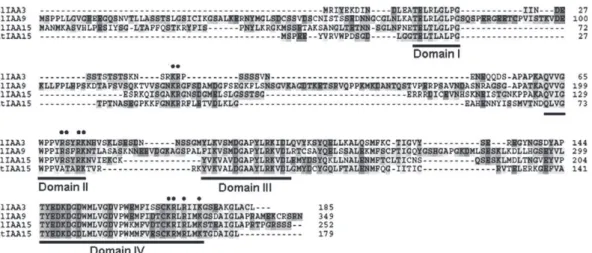
reading frame of 756 bp encoding a putative protein of 252 amino acids. The derived protein comprises the four conserved domains characteristic of the Aux ⁄ IAA gene family, domains
I–IV (Fig. 1), like the two other tomato Aux ⁄ IAA proteins iden-tified so far (Wanget al., 2005; Chaabouni et al., 2009a).
Phylo-genetic analysis was conducted to assess the relationship between
tomato SlIAA15 and members of the Arabidopsis Aux ⁄ IAA
family, indicating that this tomato gene belongs to a distinct clade which includes AtIAA15, its putative orthologue from
Arabidopsis (Fig. 2). A more comprehensive phylogenetic analy-sis extended to all members of the tomato Aux ⁄ IAA family (Solanaceae Genomics Network, http://www.sgn.cornell.edu/) confirmed thatSlIAA15 is more closely related to AtIAA15 than to
any other tomato gene (Fig. 2).
SlIAA15, a nuclear localized protein acting as a repressor of auxin-responsive promoters
In silico analysis of the predicted protein encoded by SlIAA15
indicated that, like most Aux ⁄ IAA proteins, SlIAA15 contains two types of putative nuclear localization signal: a bipartite
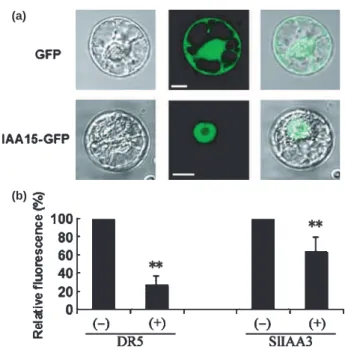
structure with a conserved basic doublet KR between domains I and II and basic amino acids in domain II, as well as a region rich in basic residues located in domain IV that resembles SV40-type nuclear localization signals (NLS) (Fig. 1). The nuclear targeting of the SlIAA15 protein was experimentally validated by transient expression assay in tobacco protoplasts coupled to fluorescence microscopy analysis. The data in Fig. 3(a) indicate that, in con-trast with control cells expressing GFP alone, where the fluores-cence spreads throughout the cell, the SlIAA15-GFP fusion protein is exclusively targeted to the nucleus.
Transient expression in a single-cell system was also used to test the ability of the SlIAA15 protein to regulate,in vivo, the activity
of the synthetic DR5 (Ottenschla¨ger et al., 2003) or native SlIAA3 (Chaabouni et al., 2009b) auxin-responsive promoters
fused to the GFP reporter gene. SlIAA15 protein repressed the auxin-induced expression of DR5 andSlIAA15 auxin-responsive
promoters by 75% and 40%, respectively (Fig. 3b). This is con-sistent with the presence of an LxLxL motif present in domain I of the SlIAA15 protein (Fig. 1), shown to confer repression activ-ity to Aux ⁄ IAAs in Arabidopsis (Tiwariet al., 2004). This is also
in line with the repressor activity reported so far for the Aux ⁄ IAA family members in various plant species.
SlIAA15is involved in vegetative developmental growth The physiological significance of SlIAA15 was addressed in planta using an antisense strategy. Ten homozygous transgenic
lines (AS-IAA15) corresponding to independent transformation
events were generated. All the transgenic lines showed substan-tially lower accumulation of SlIAA15 transcripts and common
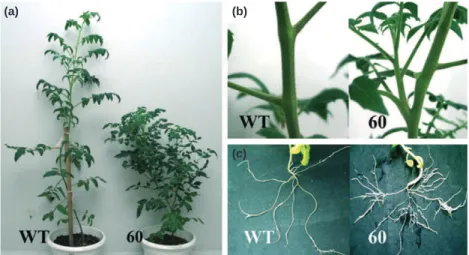
phenotypes related to vegetative growth. The phenotypes of two representative transgenic lines (lines 58 and 60) are shown in Figs 4, 5, including reduced plant height (Figs 4b, 5a) and weaker apical dominance associated with an altered pattern of axillary shoot development in all transgenic lines (Figs 4c, 5b). The number of lateral shoots is dramatically increased in
SlIAA15-suppressed lines and these shoots develop from the first
leaf node, whereas they develop only after floral transition in wild-type plants (Figs 4c, 5b). Root growth and architecture are also altered in SlIAA15 down-regulated lines, with significantly
enhanced lateral root development (Figs 4d, 5c). In addition,
SlIAA15 down-regulated lines display altered reproductive organs
with decreased number of flowers and reduced fruit set efficiency (Table 1). The mean number of flowers decreased from 99 in wild-type plants to 52 and 20 in SlIAA15-suppressed lines 58
and 60, respectively. Moreover, the efficiency of fruit set decreased from 92% in wild-type plants to 46% and 30% in lines 58 and 60, respectively (Table 1).
To rule out any potential lack of specificity of the antisense strat-egy, the expression of tomato Aux ⁄ IAA genes (SlIAA1, SlIAA2, SlIAA3, SlIAA4, SlIAA9 and SlIAA14 ) from the clades most closely
related toSlIAA15 in terms of sequence homology was performed.
The expression ofSlIAA12, which belongs to a more distant clade,
was also assessed. TomatoAux ⁄ IAA homologues were selected
fol-lowing BLASTN search of tomato unigenes (Solanaceae Genomics Network, http://www.sgn.cornell.edu/) using the corresponding Arabidopsis sequences. Real-time PCR experiments carried out using RNA samples from AS-IAA15 and WT hypocotyls revealed
no reduction in transcript level for any of these genes, indicating that the altered physiological processes observed in the transgenic lines are most probably a result of the down-regulation ofSlIAA15
(Fig. 6). Moreover, transcript accumulation ofSlIAA12 and SlIAA9
was even higher in AS-IAA15 lines than in wild-type plants (Fig. 6).
Down-regulation of SlIAA15 affects leaf thickness
Although the leaf size was similar in wild-type and AS-IAA15
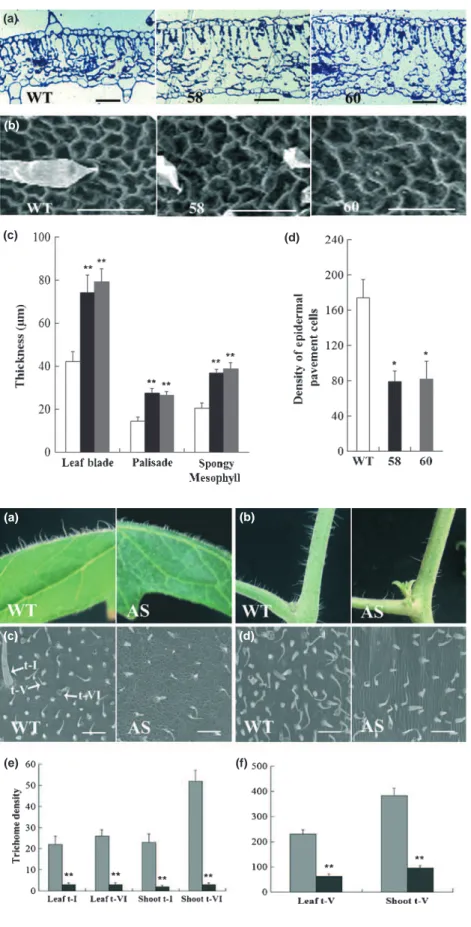
plants, the transgenic lines displayed thicker leaves. The examina-tion of leaf thickness in transverse secexamina-tions of embedded leaves confirmed the increased thickness of the leaf blade in AS-IAA15
relative to wild-type plants (Fig. 7a). Adaxial epidermal pave-ment cells of fully expanded fifth leaves, visualized by scanning electron microscopy, revealed a larger size of pavement cells in AS-IAA15 relative to wild-type plants (Fig. 7b). Further Fig. 1 Sequence comparison of SlIAA15 protein and its homologues in Arabidopsis and tomato (Solanum lycopersicum). Multiple alignments of SlIAA15, AtIAA15, SlIAA3 and SlIAA9 were obtained with ClustalX and manual correction. The dark and light shading indicate amino acids that are identical or similar, respectively. The four conserved domains I, II, III and IV are underlined. Conserved basic residues that putatively function as nuclear localization sig-nals are indicated by closed circles.
investigation indicated that the increase in leaf thickness resulted from an increase in the length of palisade cells and from a larger intercellular space of spongy mesophyll cells (Fig. 7c). The den-sity of epidermal pavement cells in AS-IAA15 lines was decreased
by 53% relative to wild-type plants (Fig. 7d).
SlIAA15down-regulated lines display reduced trichome number
Tomato trichomes are categorized into seven types, with types I, IV, VI and VII being glandular and types II, III and V being
nonglandular. Relative to wild-type plants, AS-IAA15 showed dark
green leaves and a dramatic reduction in trichome number in both leaves and shoots (Fig. 8). AS-IAA15 lines displayed a strong
reduc-tion in the density of hair-like glandular type I and VI and non-glandular type V trichomes present in leaves and shoots (Fig. 8a–d). In the wild-type, the densities of types I, V and VI trichomes reached 22, 231 and 26 units per 2.5 mm2, respectively, in 7-wk-old leaves, and 23, 383 and 52 units per 2.5 mm2, respectively, in shoots. Com-parable analysis performed with AS-IAA15 plants showed that the
densities of types I, V and VI trichomes were reduced to 14%, 27% and 12%, respectively, of their level in wild-type leaves, and 9%, 25% and 6%, respectively, of their density in wild-type shoots (Fig. 8e,f). Concomitantly, AS-IAA15 lines displayed up to a 53% decrease in
the density of epidermal cells relative to wild-type plants (Fig. 7d); however, the level of reduction in trichome density (up to 94%) is substantially higher than the decrease in epidermal cell density (53%). Expression of SlIAA15 in trichomes
Given the impact of the down-regulation of SlIAA15 on
tri-chome formation, the expression of SlIAA15 and other tomato Aux ⁄ IAA genes was assessed in trichome tissues. The tomato Fig. 2 SlIAA15 phylogenetic analysis. Phylogenetic analyses were
con-ducted in MEGA4 (Tamura et al., 2007) to reveal the relationship between Arabidopsis Aux ⁄ IAA proteins and Aux ⁄ IAA proteins extracted from tomato (Solanum lycopersicum) unigenes available at the SGN database (Solanaceae Genomics Network; http://www.sgn.cornell.edu/). Names and numbering of the tomato Aux ⁄ IAAs (given in parentheses) refer to the putative Arabidopsis orthologues.
(b) (a)
Fig. 3 (a) Subcellular localization of SlIAA15 protein. The SlIAA15::GFP (GFP, green fluorescent protein) fusion protein was transiently expressed in BY-2 tobacco protoplasts and the subcellular localization was analysed by confocal laser scanning microscopy. Merged pictures (right panels) of the green or yellow fluorescence channel (middle panels) and the correspond-ing bright field (left panels) are shown. Control cells expresscorrespond-ing GFP alone are shown in the top panels and cells expressing the SlIAA15::GFP fusion protein are shown in the bottom panels. Bar, 10 lm. (b) Effect of SlIAA15 protein on auxin-dependent transcriptional regulation. Protoplasts were co-transfected with the effector construct giving constitutive 35S-driven SlIAA15 protein expression (+) or without cDNA as a control ()), and the reporter construct consisting of either the DR5 promoter::GFP fusion gene or the SlIAA3 promoter::GFP fusion. Protoplasts were treated with 50 lM 2,4-Dicholrophenoxyacetic acid, and GFP fluorescence was quantified by flow cytometry. Bars indicate + SE of the mean. **, Significant difference between transgenic and wild-type (WT) plants with P < 0.05, as deter-mined by t-test.
homologue of Arabidopsis GASA4 was used as reference gene
based on its preferential expression in trichomes (Kryvychet al.,
2008). To this end, the tomato orthologue (unigene U569289) of GASA4 was isolated and its transcript level was assessed in
shoot trichomes by qRT-PCR, together with that of eight tomato
Aux ⁄ IAA genes. Although SlIAA14 transcripts were the most
highly abundant in trichome tissues, those corresponding to
SlIAA15 and SlIAA1 also displayed significant accumulation
rela-tive to that of other Aux ⁄ IAAs, such as SlIAA2 and SlIAA12
(Fig. 9). Of particular interest, the transcript accumulation of
SlIAA14, which showed the highest expression in trichomes, was
not altered in AS-IAA15 plants (Fig. 6), thus ruling out its direct
role in causing the trichome phenotype displayed by the trans-genic lines. To obtain further insight into what drives the expres-sion of SlIAA15 in trichome tissue, we performed in silico
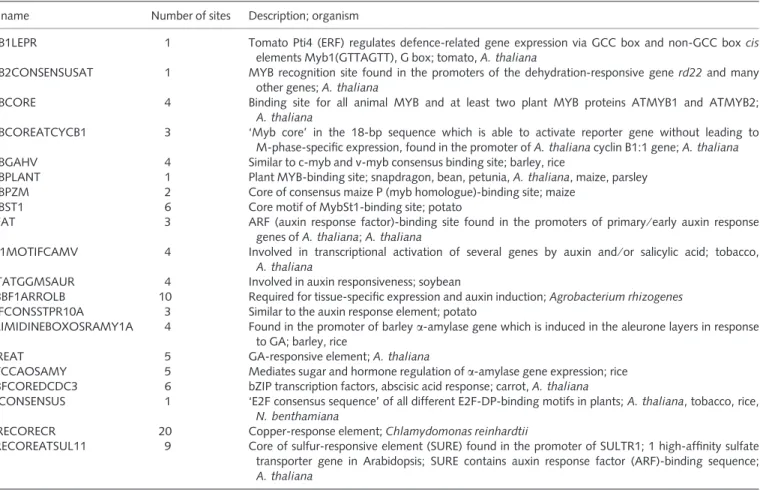
analysis of its promoter region using the PLACE program (http://www.dna.affrc.go.jp/PLACE/signalscan.html). A number of thecis-acting elements identified in the promoter region of the SlIAA15 gene (Table 2) correspond to regulatory elements found
in the promoter of Arabidopsis genes preferentially expressed in trichome initial cells (Kryvych et al., 2008). Among these,
various MYB-binding sites, regulatory elements involved in hormonal, metal, sulfur response and cell cycle regulation, are clearly present in theSlIAA15 promoter.
Expression of selected R2R3 MYB genes is altered in
SlIAA15down-regulated lines
To gain some clues into the mechanisms underlying the phenotypes observed in the AS-IAA15 lines, we assessed the expression of genes
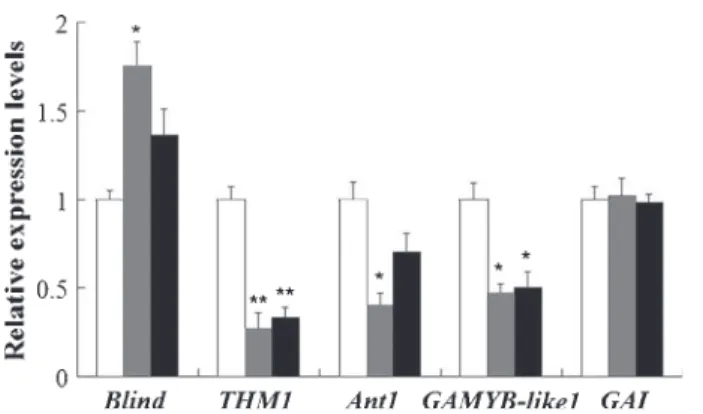
known to be involved in the developmental processes that are altered in the transgenic lines. Notably, the accumulation of tran-scripts corresponding to THM1 and Anthocyanin1 (Ant1) genes
from the R2R3 MYB family, known to play an important role in the regulation of trichome formation, was reduced significantly in
SlIAA15 down-regulated lines (Fig. 10). In addition, the expression
of the gibberellin (GA) signalling genes,GAMYB-like1 and GAI,
was investigated because of the role reported for GA signalling dur-ing trichome formation. Assessment of the transcript levels of these genes in transgenic tomato plants indicated that the expression at the transcriptional level ofGAMYB-like1 was decreased strongly in
AS-IAA15 lines, whereas that of the GAI gene was not affected
(Fig. 10). However, the expression of theblind gene, considered to
be a general regulator of axillary shoot development in tomato, was increased in SlIAA15 down-regulated lines (Fig. 10). This gene
encodes anotherMYB transcription factor belonging to the R2R3
class, and its up-regulation could be correlated with the enhanced secondary shoot development in transgenic lines.
Discussion
Most of our understanding of the role of Aux ⁄ IAA genes in
plant developmental processes has been achieved from the
Fig. 4 Morphological alterations exhibited by SIIAA15 down-regulated tomato (Solanum lycopersicum) lines. (a) Down-regulation of the SlIAA15 gene in transgenic tomato plants. The level of SlIAA15 transcripts in trans-genic antisense lines was assessed by real-time PCR. The data are mean values corresponding to three independent experiments. (b) The height of transgenic plants. (c) The number of lateral shoots in SIIAA15 down-regulated plants. (d) The number of lateral roots in SIIAA15 down-down-regulated plants. WT, wild-type plants; 58 and 60, two representative SlIAA15 down-regulated lines. Error bars, + SE. * and **, Significant differences between transgenic and WT plants with P < 0.05 and P < 0.01, respectively, as determined by t-test.
(a) (b)
(c)
Fig. 5 Morphological alterations of SIIAA15 down-regulated plants. (a) Down-regulation of SIIAA15 in tomato (Solanum lycopersicum) results in reduced plant height and reduced apical dominance. (b) SIAA15 down-regulated plants showing the development of axillary shoots from the first leaf node. (c) Down-regulation of
SIAA15in tomato improves lateral root development. WT, wild-type plants. 60, one representative SlIAA15 down-regulated line.
characterization of Arabidopsis gain-of-function mutations, as phenotypes associated with ‘null mutants’ in this plant species remain scarce, suggesting extensive functional redundancy among members of the Arabidopsis Aux ⁄ IAA gene family (Overvoorde et al., 2005). Indeed, the Arabidopsis T-DNA insertional
mutants characterized so far have not shown clear developmental defects, with the exception of the shy2 mutant (Tian & Reed,
1999). Moreover, double or triple mutants of closely related
Aux ⁄ IAA genes, such as iaa8-1 ⁄ iaa9-1 or iaa5-1 ⁄ iaa6-1 ⁄ iaa19-1,
also have subtle or indiscernible phenotypes. In contrast with the situation prevailing in the Arabidopsis model species, an increas-ing number of reports have indicated that the down-regulation of a singleAux ⁄ IAA gene in solanaceous species can be sufficient to
provoke visible and distinctive phenotypes. In tomato, under-expression of SlIAA9 triggers pollination-independent fruit set,
leading to parthenocarpy (Wang et al., 2005, 2009), whereas
down-regulation ofSlIAA3 results in auxin- and ethylene-related
phenotypes, including exaggerated apical hook curvature and reduced petiole epinasty (Chaabouni et al., 2009a). In potato,
the suppression of StIAA2 results in increased plant height,
petiole hyponasty and curvature of growing leaf primordia in the shoot apex (Kloostermanet al., 2006). The data described here
establish that the normal expression of SlIAA15 is critical for
trichome formation in tomato, thus uncovering new roles for Aux ⁄ IAAs. Although phenotypes, such as reduced apical domi-nance, are more commonly associated with the Aux ⁄ IAA gene
family, the altered trichome density phenotypes displayed by the down-regulated lines provide new insight on the physiological significance of the Aux ⁄ IAA genes. Taken together, these data
indicate that members of the Aux ⁄ IAA family can have both spe-cific and redundant functions.
Expression studies revealed no preferential accumulation of
SlIAA15 transcripts in all the tissues tested, and, in this regard,
the ubiquitous expression in roots, stems, leaves, seedlings, flow-ers and fruit failed to provide clues into the potential role of the
SlIAA15 gene in particular developmental processes. In support
of the idea that tomatoAux ⁄ IAA genes can play a common role
in maintaining certain vegetative growth processes, the SlIAA15
under-expressing lines display pleiotropic phenotypes, including reduced apical dominance, altered pattern of axillary shoot development and increased lateral root formation. Down-regulation ofSlIAA9, a tomato gene from a distinct clade of the Aux ⁄ IAA gene family, has been similarly reported to result in
pleiotropic phenotypes, including enhanced hypocotyl ⁄ stem elongation, increased leaf vascularization, reduced apical domi-nance and altered pattern of axillary shoot development (Wang
et al., 2005, 2009). Likewise, down-regulation of the tomato SlIAA3 also induces multiple phenotypes related to vegetative
growth, including a dramatically reduced apical dominance and altered pattern of axillary shoot development (Chaabouniet al.,
2009a). These phenotypes provide compelling evidence that the regulation of vegetative growth can be shared among different
Aux ⁄ IAA genes in tomato. Nevertheless, the trichome phenotype
of SlIAA15 down-regulated lines also supports the idea that
individual members of the Aux ⁄ IAA family can be involved in distinct developmental processes, consistent with both specific and overlapping functions ofAux ⁄ IAA genes. Moreover, the data
highlight the importance of enlarging the functional characteriza-tion of candidate genes to species beyond the Arabidopsis model plant in order to gain new insight into the biological roles of
Aux ⁄ IAA genes.
Tomato plants produce a variety of multicellular glandular and nonglandular trichomes that provide both physical and chemical barriers against insect invaders (Duffey, 1986; Kennedy, 2002). Tomato trichomes were first examined by Luckwill (1943) and categorized as types I–VII, with types I, IV, VI and VII being glandular and types II, III and V being nonglandular. In contrast with the detailed knowledge available on the molecular processes underlying the development of single-cell trichomes in Arabidopsis, relatively little is known about the genetic control of multicellular trichomes in tomato. Hormone signalling is likely to play an important role in trichome differentiation, and it has been reported that a tomato homologue of CORONATINE-INSENSITIVE1 (COI1), an F-box protein required for jasmonic acid (JA) signalled processes, is involved in the development of tomato glandular trichomes (Li et al., 2004). The altered Table 1 Numbers of flowers and fruits in wild-type (WT) and AS-SlIAA15
tomato (Solanum lycopersicum) plants
Plants Anthotaxy number Flower number Fruit number Set fruit rate (%) WT 3 ± 1 25 ± 3 23 ± 3 92.05 ± 6.6 58# 2 ± 1 13 ± 2** 6 ± 2** 46.85 ± 12.54* 60# 3 ± 1 5 ± 2** 2 ± 1** 30.52 ± 9.98** The data are mean values ± standard errors corresponding to four independent experiments. * and **, Significant differences between transgenic and WT plants with P < 0.05 and P < 0.01, respectively, as determined by t-test.
Fig. 6 Expression analysis of Aux ⁄ IAA genes in AS-SlIAA15 by tomato (Solanum lycopersicum) plants real-time PCR. SlIAA1 (U579410), SlIAA2 (U599474), SlIAA4 (U579749), SlIAA12 (U579795) and SlIAA14 (U579618) refer to unigene sequences identified in the Solanaceae Genomics Network (SGN) database. The relative mRNA level of individual
SlIAAgenes in hypocotyl tissues was normalized with respect to the
Ubiquitinhousekeeping gene. The results were expressed using wild-type plants as a reference expression level for each gene. WT (white bars), wild-type plants; 60 (grey bars) and 58 (black bars), two representative SlIAA15 down-regulated lines. The data are mean (+ SE) values corresponding to three independent experiments. **, Significant difference between trans-genic and WT plants with P < 0.01, as determined by t-test.
trichome development inSlIAA15 down-regulated lines uncovers
new biological roles forAux ⁄ IAAs that have not been reported for
any of theAux ⁄ IAA mutants. Notably, the level of reduction in
trichome density (up to 94%) is substantially higher than the
observed decrease in epidermal cell density (53%), which does not support the idea that the trichome phenotype is a simple con-sequence of the reduction in cell number, and clearly favours a direct effect ofSlIAA15 down-regulation on trichome formation.
(a)
(c) (d)
(b)
Fig. 7 Change in leaf anatomy in the AS-SlIAA15 plants. (a) Transverse sections through the leaf of tomato (Solanum lycopersicum) wild-type and AS-SlIAA15 plants. Semi-thin sections were stained with toluidine blue and viewed with a light microscope. (b) Adaxial epidermal pavement cells of fully expanded fifth leaves from wild-type and AS-SlIAA15 plants. Bars, 20 lm. (c) Thickness of leaf blade, the palisade and the mesophyll. Four differ-ent measuremdiffer-ents of the leaf blade, the palisade and the mesophyll thickness were taken into account. (d) Density of epidermal pavement cells of fully expanded fifth leaves. WT (white bars), wild-type plants; 60 (grey bars) and 58 (black bars), two representative SlIAA15 down-regulated lines. The epidermal pavement cells in four replications of an area of 0.01 mm2were counted. Error
bars, + SE. * and **, Significant differences between transgenic and WT plants with P < 0.05 and P < 0.01, respectively, as determined by t-test.
(a) (b)
(c) (d)
(e) (f)
Fig. 8 Down-regulation of SIIAA15 affects trichome development in tomato (Solanum lycopersicum) plants. (a) Leaf surface from wild-type and AS-SlIAA15 plants. (b) Shoot surface from wild-type and AS-SlIAA15 plants. (c) Scanning electron micrographs of the leaf surface from wild-type and AS-SlIAA15 plants. (d) Scanning electron micrographs of the shoot surface from wild-type and
AS-SlIAA15plants. Arrows denote type I (t-I), type V (t-V) and type VI (t-VI) trichomes. Bars, 100 lm. (e) Density of type I and type VI trichomes in leaves and shoots from wild-type (grey bars) and AS-SlIAA15 (black bars) plants. (f) Density of type V trichomes in leaves and shoots from wild-type (grey bars) and AS-SlIAA15 (black bars) plants. WT, wild-type plants. AS, SlIAA15 down-regulated plants. The trichomes in four replications of an area of 2.5 mm2were counted. Error bars, + SE. **, Significant
difference between transgenic and WT plants with
TheSlIAA15 under-expressing lines reveal that SlIAA15 is
instru-mental to normal trichome formation in addition to being involved in the control mechanisms underlying leaf and shoot development in tomato.
Because both trichome and axillary shoot formation have been reported to involve MYB-mediated regulation, the expression of selected representatives of this gene family was assessed in the transgenic lines. The MYB supergene family comprises three sub-families, MYB1R, R2R3 MYB and MYB3R, based on the
number of adjacent repeats in the MYB domain. R2R3 MYB is the largest subfamily and functionally the most diverse. Members of this subfamily are known to play important roles in the regula-tion of processes as diverse as anthocyanin biosynthesis (Aharoni
et al., 2001; Nesi et al., 2001), identity of cell shape and
forma-tion of plant organs (Schmitzet al., 2002; Suo et al., 2003) and
responses to GA (Gubler et al., 1995, 2002). In higher plants,
including the Solanaceae, the development of trichome structures has been shown to be regulated by MYB transcription factors. In
Table 2 Distribution of cis-acting elements in SlIAA15 promoter region (4.3 kb) compared with cis-acting elements found in the promoter regions of
Arabidopsisgenes preferentially expressed in trichome initial cells (including MYB element, sites involved in hormonal, metal, sulfur response and cell cycle regulation)
Site name Number of sites Description; organism
MYB1LEPR 1 Tomato Pti4 (ERF) regulates defence-related gene expression via GCC box and non-GCC box cis elements Myb1(GTTAGTT), G box; tomato, A. thaliana
MYB2CONSENSUSAT 1 MYB recognition site found in the promoters of the dehydration-responsive gene rd22 and many other genes; A. thaliana
MYBCORE 4 Binding site for all animal MYB and at least two plant MYB proteins ATMYB1 and ATMYB2;
A. thaliana
MYBCOREATCYCB1 3 ‘Myb core’ in the 18-bp sequence which is able to activate reporter gene without leading to M-phase-specific expression, found in the promoter of A. thaliana cyclin B1:1 gene; A. thaliana MYBGAHV 4 Similar to c-myb and v-myb consensus binding site; barley, rice
MYBPLANT 1 Plant MYB-binding site; snapdragon, bean, petunia, A. thaliana, maize, parsley MYBPZM 2 Core of consensus maize P (myb homologue)-binding site; maize
MYBST1 6 Core motif of MybSt1-binding site; potato
ARFAT 3 ARF (auxin response factor)-binding site found in the promoters of primary ⁄ early auxin response genes of A. thaliana; A. thaliana
ASF1MOTIFCAMV 4 Involved in transcriptional activation of several genes by auxin and ⁄ or salicylic acid; tobacco,
A. thaliana
CATATGGMSAUR 4 Involved in auxin responsiveness; soybean
NTBBF1ARROLB 10 Required for tissue-specific expression and auxin induction; Agrobacterium rhizogenes SEBFCONSSTPR10A 3 Similar to the auxin response element; potato
PYRIMIDINEBOXOSRAMY1A 4 Found in the promoter of barley a-amylase gene which is induced in the aleurone layers in response to GA; barley, rice
GAREAT 5 GA-responsive element; A. thaliana
TATCCAOSAMY 5 Mediates sugar and hormone regulation of a-amylase gene expression; rice DPBFCOREDCDC3 6 bZIP transcription factors, abscisic acid response; carrot, A. thaliana
E2FCONSENSUS 1 ‘E2F consensus sequence’ of all different E2F-DP-binding motifs in plants; A. thaliana, tobacco, rice,
N. benthamiana
CURECORECR 20 Copper-response element; Chlamydomonas reinhardtii
SURECOREATSUL11 9 Core of sulfur-responsive element (SURE) found in the promoter of SULTR1; 1 high-affinity sulfate transporter gene in Arabidopsis; SURE contains auxin response factor (ARF)-binding sequence;
A. thaliana
Fig. 9 Expression analysis of selected Aux ⁄ IAA genes in trichome tissues assessed by real-time PCR. SlIAA1 (U579410), SlIAA2 (U599474), SlIAA4 (U579749), SlIAA12 (U579795) and SlIAA14 (U579618) refer to unigene sequences identified in the Solanaceae Genomics Network (SGN) database. The relative mRNA levels of individual Aux ⁄ IAA genes were normalized with respect to the housekeeping gene, actin. The tomato (Solanum lycopersicum) orthologue (unigene U569289) of the Arabidopsis GASA4 gene, shown to be preferentially expressed in trichome tissues, was used as reference gene to estimate the relative levels of Aux ⁄ IAA transcripts. The data are mean (+ SE) values corresponding to three independent experiments.
Arabidopsis, several lines of evidence suggest that the duplication of a gene controlling anthocyanin production and subsequent divergence might be the major force driving trichome formation (Serna & Martin, 2006). Trichome initiation is regulated by the combinatorial action of the R2R3-MYB GLABRA1 (GL1) together with the bHLH GLABRA3 (GL3) and ENHANCER OF GLABRA3 (EGL3) transcription factors (Serna & Martin, 2006). Although the identity of the R2R3 MYB factors control-ling trichome formation in tomato remains unknown, the
expres-sion of THM1 and Ant1, two tomato R2R3 MYB genes,
displayed a marked decrease inSlIAA15 under-expressing lines,
suggesting their putative role in trichome formation. THM1 is
similar to the GLABROUS1 (GL1) gene, which promotes
tri-chome formation in Arabidopsis (Marks & Feldmann, 1989), andAnt1 is a transcriptional regulator reported to be involved in
anthocyanin biosynthesis, modification and transport (Mathews
et al., 2003). GAs are also known to influence trichome
develop-ment (Perazzaet al., 1998), and it has been shown in Arabidopsis
that the effect of GA is mediated by the GAMYB-like transcrip-tional regulators (Perazza et al., 1998; Gocal et al., 2001). The
lower expression of the tomatoGAMYB-like1 gene in transgenic
lines suggests its role as a positive regulator of trichome develop-ment. These data support the hypothesis that SlIAA15 controls
trichome formation and development in tomato via direct or indirect regulation of the MYB transcription factor.
Enhanced axillary shoot development is another remarkable phenotype exhibited by the SlIAA15 down-regulated lines. The
initiation of lateral meristems has been shown to be blocked
dur-ing shoot and inflorescence development in tomato blind
mutants, leading to a strong reduction in the number of lateral axes (Schmitzet al., 2002). The tomato blind mutation resides in
a R2R3MYB gene considered to be a general regulator of shoot
branching in tomato (Schmitz et al., 2002). The
SlIAA15-suppressed lines display enhanced axillary shoot proliferation and higher accumulation of the blind transcripts, suggesting that the
expression of the blind gene is negatively regulated by SlIAA15,
which may therefore act upstream of blind. This is consistent
with the suppressor activity of auxin-dependent gene transcrip-tion shown here for SlIAA15. Moreover, because the expression of the early auxin-responsive genes SlIAA9 and SlIAA12 is
increased significantly in the transgenic lines, it can be speculated that these mediators of auxin responses may also contribute to the phenotypes displayed by theSlIAA15 down-regulated lines.
SlIAA15 may therefore represent an important factor by which auxin impacts trichome formation in tomato. However, we can-not rule out the possibility that cumulative effects of theSlIAA15
loss-of-function may lead to downstream effects underlying some of the phenotypes displayed by the transgenic lines.
Overall, the data described here add to the roles of Aux ⁄ IAA
genes and provide new evidence supporting the hypothesis that different members of the Aux ⁄ IAA family can play distinct and specific roles, in addition to the shared redundant function. Fur-ther deciphering of the molecular mechanisms by whichSlIAA15
controls specific developmental processes will require the identifi-cation of its direct target genes. However, this task may prove to be difficult as Aux ⁄ IAA proteins have been shown not to bind directly to DNA but rather to interact with ARF transcription factors. Therefore, the search for the ARF protein partner(s) of SlIAA15 could be the initial step towards uncovering the primary target genes of this transcriptional regulator.
Acknowledgements
This work was supported by a Project from the National Natural Science Foundation of China (30471214, 30972002 and 31071798), the Natural Science Foundation of Chongqing (2011BA1024) and the European Integrated Project EU-SOL (FOOD-CT-2006-016214).
References
Abel S, Nguyen MD, Theologis A. 1995. The PS-IAA4 ⁄ 5-like family of early auxin-inducible mRNAs inArabidopsis thaliana. Journal of Molecular Biology
251: 533–549.
Aharoni A, Ric de Vos HC, Wein M, Sun Z, Greco R, Kroon A, Mol JNM, O’Conell AP. 2001. The strawberryFaMYB1 transcription factor suppresses
anthocyanin and flavonol accumulation in transgenic tobacco.Plant Journal
28: 319–332.
Altschul SF, Madden TL, Schaffer AA, Zhang J, Zhang Z, Miller W, Lipman DJ. 1997. Gapped BLAST and PSI-BLAST: a new generation of protein database search programs.Nucleic Acids Research 25: 3389–3402.
Chaabouni S, Jones B, Delalande C, Wang H, Li ZG, Mila I, Latche A, Pech JC, Bouzayen M. 2009a. TheSl-IAA3 tomato Aux ⁄ IAA gene is in the
cross-roads of auxin and ethylene signalling involved in differential growth.Journal of Experimental Botany 60: 1349–1362.
Chaabouni S, Latche´ A, Pech JC, Bouzayen M. 2009b. Tomato Aux ⁄ IAA3 and HOOKLESS are important actors of the interplay between auxin and ethylene during apical hook formation.Plant Signal & Behavior 4: 559–560.
Dharmasiri N, Estelle M. 2004. Auxin signaling and regulated protein degradation.Trends in Plant Science 9: 302–308.
Duffey SS. 1986. Plant glandular trichomes: their partial role in defence against insects. In: Southwood SR, Juniper B, eds.Insects and the plant surface. London,
UK: Edward Arnold, 151–172.
Felsenstein J. 1985. Confidence limits on phylogenies: an approach using the bootstrap.Evolution 39: 783–791.
Friml J. 2003. Auxin transport – shaping the plant.Current Opinion in Plant Biology 6: 7–12.
Fig. 10 Expression analysis of Blind, THM1, Ant1, GAMBY-like1 and GAI genes assessed by real-time PCR. WT (white bars), wild-type tomato (Solanum lycopersicum) plants; 58 (black bars) and 60 (grey bars), two representative SlIAA15 down-regulated lines. The data are mean (+ SE) values corresponding to three independent experiments. *, and **, Significant differences between transgenic and WT plants with P < 0.05 and P < 0.01, respectively, as determined by t-test.
Fukaki H, Tameda S, Masuda H, Tasaka M. 2002. Lateral root formation is blocked by a gain-of-function mutation in theSOLITARY-ROOT ⁄ IAA14 gene
of Arabidopsis.Plant Journal 29: 153–168.
Gocal GFW, Sheldon CC, Gubler F, Moritz T, Bagnall DB, MacMillan CP, Li SF, Parish RW, Dennis ES, Weigel D et al. 2001.GAMYB-like genes,
flowering and gibberellin signaling in Arabidopsis.Plant Physiology 127: 1682–
1693.
Gray WM, Kepinski S, Rouse D, Leyser O, Estelle M. 2001. Auxin regulates SCF(TIR1)-dependent degradation of AUX ⁄ IAA proteins.Nature 414: 271–
276.
Gubler F, Chandler PM, White RG, Llewellyn DJ, Jacobsen JV. 2002. Gibberellin signaling in barley aleurone cells. Control of SLN1 and GAMYB expression.Plant Physiology 129: 191–200.
Gubler F, Kalla R, Roberts JK, Jacobsen JV. 1995. Gibberellin-regulated expression of a myb gene in barley aleurone cells: evidence for Myb
transactivation of a high-pI [alpha]-amylase gene promoter.Plant Cell 7: 1879–
1891.
Hamann T, Benkova E, Baurle I, Kientz M, Jurgens G. 2002. The Arabidopsis
BODENLOS gene encodes an auxin response protein inhibiting MONOPTEROS-mediated embryo patterning. Genes & Development 16:
1610–1615.
Hellens RP, Edwards AE, Leyland NR, Bean S, Mullineaux P. 2000. pGreen: a versatile and flexible binary Ti vector forAgrobacterium-mediated plant
transformation.Plant Molecular Biology 42: 819–832.
Jones B, Frasse P, Olmos E, Zegzouti H, Li ZG, Latche A, Pech JC, Bouzayen M. 2002. Down-regulation of DR12, an auxin-response-factor homolog, in the tomato results in a pleiotropic phenotype including dark green and blotchy ripening fruit.Plant Journal 32: 603–613.
Kennedy GG. 2002. Tomato, pests, parasitoids, and predators: tritrophic interactions involving the genusLycopersicon. Annual Review of Entomology 48:
51–72.
Kim BC, Soh MS, Kang BG, Furuya M, Nam HG. 1996. Two dominant photomorphogenic mutations ofArabidopsis thaliana identified as suppressor
mutations ofhy2. Plant Journal 15: 441–456.
Kim J, Harter K, Theologis A. 1997. Protein–protein interactions among the Aux ⁄ IAA proteins.Proceedings of the National Academy of Sciences, USA 94:
11786–11791.
Kloosterman B, Visser RGF, Bachem CWB. 2006. Isolation and characterization of a novel potato auxin ⁄ indole-3-acetic acid family member (StIAA2) that is involved in petiole hyponasty and shoot morphogenesis.Plant Physiology and Biochemistry 44: 766–775.
Kryvych S, Nikiforova V, Herzog M, Perazza D, Fisahn J. 2008. Gene expression profiling of the different stages ofArabidopsis thaliana trichome
development on the single cell level.Plant Physiology and Biochemistry 46:
160–173.
Li L, Zhao Y, McCaig BC, Wingerd BA, Wang J, Whalon ME, Pichersky E, Howe GA. 2004. The tomato homolog of CORONATINE-INSENSITIVE1 is required for the maternal control of seed maturation, jasmonate-signaled defense responses, and glandular trichome development.Plant Cell 16:
126–143.
Luckwill LC. 1943.The genus Lycopersicon: historical, biological, and taxonomic survey of the wild and cultivated tomatoes. Aberdeen, UK: Aberdeen University
Press.
Marks MD, Feldmann KA. 1989. Trichome development inArabidopsis thaliana. I. T-DNA tagging of the GLABROUS1 gene. Plant Cell 1: 1043–
1050.
Mathews H, Clendennen SK, Caldwell CG, Liu XL, Connors K, Matheis N, Schuster DK, Menasco DJ, Wagoner W, Lightner J et al. 2003. Activation tagging in tomato identifies a transcriptional regulator of anthocyanin biosynthesis, modification, and transport.Plant Cell 15: 1689–1703.
Nagpal P, Walker LM, Young JC, Sonawala A, Timpte C, Estelle M, Reed JW. 2000.AXR2 encodes a member of the Aux ⁄ IAA protein family. Plant Physiology 123: 563–574.
Nesi N, Jond C, Debeaujon I, Caboche M. 2001. The ArabidopsisTT2
gene encodes an R2R3 MYB domain protein that acts as a key determinant for proanthocyanidin accumulation in developing seed.Plant Cell 13: 2099–
2114.
Ottenschla¨ger I, Wolff P, Wolverton C, Bhalerao RP, Sandberg G, Ishikawa H, Evans M, Palme K. 2003. Gravity-regulated differential auxin transport from columella to lateral root cap cells.Proceedings of the National Academy of Sciences, USA 100: 2987–2991.
Ouellet F, Overvoorde PJ, Theologis A. 2001. IAA17 ⁄ AXR3: biochemical insight into an auxin mutant phenotype.Plant Cell 13: 829–841.
Overvoorde PJ, Okushima Y, Alonso JM, Chan A, Chang C, Ecker JR, Hughes B, Liu A, Onodera C, Quach H et al. 2005. Functional genomic analysis of theAUXIN ⁄ INDOLE-3-ACETIC ACID gene family members in Arabidopsis thaliana. Plant Cell 17: 3282–3300.
Park JY, Kim HJ, Kim J. 2002. Mutation in domain II of IAA1 confers diverse auxin-related phenotypes and represses auxin-activated expression ofAux ⁄ IAA
genes in steroid regulator-inducible system.Plant Journal 32: 669–683.
Perazza D, Vachon G, Herzog M. 1998. Gibberellins promote trichome formation by up-regulatingGLABROUS1 in Arabidopsis. Plant Physiology 117:
375–383.
Pirrello J, Jaimes-Miranda F, Sanchez-Ballesta MT, Tournier B, Qaiser AK, Latche´ A, Pech JC, Regad F, Bouzayen M. 2006. LeERF2, a tomato Ethylene Response Factor involved in ethylene response and seed germination.Plant Cell & Physiology 47: 1195–1205.
Reed JW. 2001. Roles and activities of Aux ⁄ IAA proteins in Arabidopsis.Trends in Plant Science 6: 420–425.
Remington DL, Vision TJ, Guilfoyle TJ, Reed JW. 2004. Contrasting modes of diversification in theAux ⁄ IAA and ARF gene families. Plant Physiology 135:
1738–1752.
Ren ZX, Li ZG, Miao Q, Yang YW, Deng W, Hao Y. 2011. The auxin receptor homologue inSolanum lycopersicum stimulates tomato fruit set and leaf
morphogenesis.Journal of Experimental Botany 62: 2815–2826.
Rogg LE, Lasswell J, Bartel B. 2001. A gain-of-function mutation inIAA28
suppresses lateral root development.Plant Cell 13: 465–480.
Rouse D, Mackay P, Stirnberg P, Estelle M, Leyser O. 1998. Changes in auxin response from mutations in anAUX ⁄ IAA gene. Science 279: 1371–1373.
Schmitz G, Tillmann E, Carriero F, Fiore C, Cellini F, Theres K. 2002. The tomatoBlind gene encodes a MYB transcription factor that controls the
formation of lateral meristems.Proceedings of the National Academy of Sciences, USA 99: 1064–1069.
Serna L, Martin C. 2006. Trichomes: different regulatory networks lead to convergent structures.Trends in Plant Science 11: 274–280.
Sun Y, Veerabomma S, Abdel-Mageed HA, Fokar M, Asami T, Yoshida S, Allen RD. 2005. Brassinosteroid regulates fiber development on cultured cotton ovules.Plant Cell & Physiology 46: 1384–1391.
Suo J, Liang X, Pu L, Zhang Y, Xue Y. 2003. Identification ofGhMYB109
encoding a R2R3 MYB transcription factor that expressed specifically in fiber initials and elongating fibers of cotton (Gossypium hirsutum L.). Biochimica et Biophysica Acta 1630: 25–34.
Tamura K, Dudley J, Nei M, Kumar S. 2007.MEGA4: Molecular Evolutionary
Genetics Analysis (MEGA) software version 4.0.Molecular Biology and Evolution 24: 1596–1599.
Tatematsu K, Kumagai S, Muto H, Sato A, Watahiki MK, Harper RM, Liscum E, Yamamoto KT. 2004.MASSUGU2 encodes Aux ⁄ IAA19, an
auxin-regulated protein that functions together with the transcriptional activator NPH4 ⁄ ARF7 to regulate differential growth responses of hypocotyl and formation of lateral roots inArabidopsis thaliana. Plant Cell 16: 379–393.
Tian Q, Reed JW. 1999. Control of auxin-regulated root development by the
Arabidopsis thaliana SHY2 ⁄ IAA3 gene. Development 126: 711–721.
Tiwari SB, Hagen G, Guilfoyle TJ. 2004. Aux ⁄ IAA proteins contain a potent transcriptional repression domain.Plant Cell 16: 533–543.
Ulmasov T, Hagen G, Guilfoyle TJ. 1997a. ARF1, a transcription factor that binds to auxin response elements.Science 276: 1865–1868.
Ulmasov T, Murfett J, Hagen G, Guilfoyle TJ. 1997b. Aux ⁄ IAA proteins repress expression of reporter genes containing natural and highly active synthetic auxin response elements.Plant Cell 9: 1963–1973.
Wang H, Jones B, Li ZG, Frasse P, Delalande C, Regad F, Chaabouni S, Latche A, Pech JC, Bouzayen M. 2005. The tomatoAux ⁄ IAA transcription factor IAA9 is involved in fruit development and leaf morphogenesis. Plant Cell 17:
Wang H, Schauer N, Usadel B, Frasse P, Zouine M, Hernould M, Huang Y, Chaabouni S, Latche A, Pech JC et al. 2009. Regulatory features underlying pollination-dependent and independent tomato fruit set revealed by transcript and primary metabolite profiling.Plant Cell 21: 1428–1452.
Worley CK, Zenser N, Ramos J, Rouse D, Leyser O, Theologis A, Callis J. 2000. Degradation of Aux ⁄ IAA proteins is essential for normal auxin signalling.Plant Journal 21: 553–562.
Yang X, Lee S, So JH, Dharmasiri S, Dharmasiri N, Ge L, Jensen C, Hangarter R, Hobbie L, Estelle M. 2004. The IAA1 protein is encoded byAXR5 and is a
substrate of SCFTIR1.Plant Journal 40: 772–782.
Table S1 The accession numbers and primer sequences of the
Aux ⁄ IAA genes and R2R3 MYB family genes described in this