NOTE / NOTE
Impact of primary and secondary machinery tracks
on fine root growth of sugar maple after selection
cutting
Catherine Malo and Christian Messier
Abstract:Selection cutting, where approximately 30% of the trees are removed every 30 years, is the main silvicultural treatment used in temperate deciduous forests of Quebec (Canada). Concerns have been raised that the use of heavy machi-nery is creating soil disturbances that are negatively affecting the growth and survival of remaining trees. The aim of the study was to determine if heavy machinery is affecting the growth, morphology, and architecture of sugar maple (Acer sac-charum Marsh.) fine roots in and around machinery tracks left after selection logging. The study site, a sugar maple domi-nated stand, was located in southern Quebec. Root ingrowth bags and standard root cores were used to compare fine root growth, morphology, and architecture in and around machinery tracks one year after logging. Fine root growth of maple was reduced fivefold in both primary (multiple trip) and secondary (only one trip) machinery tracks compared with the con-trol. There was a nonstatistical reduction in fine root growth within 1 m of the tracks. Because machinery tracks cover be-tween 15% and 25% of a stand after selection logging, such reduction in fine root growth could be significant for the growth and survival of the remaining mature maple trees.
Résumé :La coupe jardinatoire, qui consiste à récolter environ 30 % du peuplement à tous les 30 ans, représente le traite-ment sylvicole le plus utilisé dans la forêt feuillue tempérée au Québec (Canada). Des inquiétudes ont été soulevées au sujet des effets néfastes que les perturbations du sol causées par la machinerie lourde pourraient avoir sur la croissance et la sur-vie des arbres résiduels. L’objectif de l’étude était de déterminer si la machinerie lourde affecte la croissance, la morpholo-gie et l’architecture des racines fines de l’érable à sucre (Acer saccharum Marsh.) dans et près des sentiers laissés par la machinerie lors d’une coupe jardinatoire. Une érablière ayant subi une coupe jardinatoire à la fin de l’été 2006 a été sélec-tionnée dans le sud du Québec. Des sacs de croissance ainsi que des carottes de sol ont été utilisés afin de comparer la croissance, la morphologie et l’architecture des racines fines dans et près des sentiers, au cours de l’année suivant la coupe jardinatoire. La croissance des racines fines de l’érable à sucre a été réduite de cinq fois, autant dans les sentiers primaires (utilisés plusieurs fois) que secondaires (utilisés une seule fois) par rapport au témoin. Une diminution non significative de la croissance racinaire à une distance d’un mètre et moins du sentier a été observée. Considérant que les sentiers primaires et secondaires couvrent habituellement 15 à 25 % d’un peuplement à la suite à d’une coupe jardinatoire, il est probable qu’une telle réduction de la croissance des racines fines affecte négativement la croissance et la survie des érables résiduels situés près des sentiers.
Introduction
Little is known about the impacts of heavy machinery used in usual forestry operations on the below-ground components of trees, particularly the fine roots. Yet, with the development of natural disturbance based forestry, new silvicultural sys-tems using partial cutting in parts or in whole are being pro-posed as a way to emulate natural small intensity disturbances such as gap dynamics, insect outbreaks, and par-tial windthrows. These new silvicultural systems make use of heavy machinery (e.g., cable skidders and feller bunchers) that need to operate around live trees, leaving tracks of
vary-ing degrees of intensity on the ground. Curiously, few studies have been done to evaluate the impact from heavy machinery operating extensively around live trees on the remaining live roots. This is particularly important for fine roots as most are found within the first 15 cm of the surface organic horizon (LFH) and the mineral A horizon (Fahey and Hughes 1994; Joslin and Wolfe 1999; Fitter 2002).
The passage of heavy machinery is known to induce high pressure on superficial roots, as well as compaction of the upper layers of the soil (Huggard et al. 1999; Nadezhdina et al. 2006). Roots that encounter mechanical stress during growth modify their morphology. They tend to increase in
di-Received 11 November 2009. Accepted 13 December 2010. Published at www.nrcresearchpress.com/cjfr on 8 April 2011.
C. Malo and C. Messier.Centre d’étude de la forêt (CEF), Département des sciences biologiques, Université du Québec à Montréal, C.P. 8888, Succursale Centre-ville, Montréal, QC H3C 3P8, Canada.
Corresponding author:C. Messier (e-mail: [email protected]).
Can. J. For. Res. Downloaded from www.nrcresearchpress.com by Université du Québec à Montréal on 11/28/11
ameter and produce a higher number of lateral roots (Ben-gough et al. 1997; Kozlowski 1999; Miller et al. 2004). Most studies that have investigated the use of heavy machi-nery in forestry have measured the impact on soil properties such as compaction (Williamson and Neilsen 2000; Miller et al. 2004; Page-Dumroese et al. 2006).
The aim of this study was to determine the possible impact of heavy machinery used during usual selection cutting oper-ations on root growth, root morphology, and root architecture of the remaining sugar maple (Acer saccharum Marsh.) trees. Selection cutting is the main silvicultural system used in tem-perate deciduous forests of Quebec (Canada) (Bureau des sous-ministres associés aux forêts (BSMAF) 2002). This method prioritizes trees for harvesting to include weak trees or those likely to die or decrease in quality during the next cutting cycle (Bédard and Majcen 2003). The purpose of this treatment is to recreate, to some extent, the natural gap dynamics that occur in this biome by removing approxi-mately 30% of the trees every 30 years.
Root ingrowth bags and soil cores were used to quantify fine root growth and compare root morphology and architec-ture in and around primary and secondary machinery tracks one year after selection logging. Primary logging tracks are created by the repeated movement of heavy machinery such as cable skidders, whereas secondary logging tracks are cre-ated by the feller buncher that cuts and moves trees around. Such a study is essential in helping us determine the possible impacts of using such heavy machinery around live trees in our forests.
Material and methods Study site
The study site was located near Saint-Ludger, Eastern Townships, Quebec, on Domtar Forest Company private land (45°38′N, 70°36′W; elevation 426 m). The total annual precipitation averages 1052.4 mm, and the mean annual tem-perature is 3.9 °C (Environnement Canada 2002). Approxi-mately 25% of the forest surrounding the site was cut by selective cutting during the summer of 2006. The site is do-minated by sugar maple (95%) with only a few yellow birch (Betula alleghaniensis Britton) (3.8%), American beech (Fa-gus grandifolia Ehrh.) (0.4%), and red spruce (Picea rubens Sarg.) (0.4%). The uneven-aged stand has a maximum height of 17 to 20 m. Mean basal area and tree DBH after partial cutting were 22.7 m2/ha and 24.8 cm, respectively. Average
stand density of trees greater than 7 cm DBH was 707 trees/ ha. The drainage was good to moderate and the slope was moderate (Domtar, unpublished data, 2006). The parent ma-terial was a glacial till, with a very dense and heterogeneous fraction of stones of various sizes (more than 50% of the soil) at a thickness of 50 cm to 1 m over bedrock (Domtar, unpub-lished data, 2006). The depth of the humus layer varied from 2 to 8 cm. We tried to estimate soil compaction among the various positions investigated in this study by using a pene-trometer, but this was rendered impossible by the very high amount of stones in the soil.
Experimental design
The heavy machinery (feller–buncher and grapple skidder) used to harvest trees compacts the soil and breaks the
super-ficial roots. In doing so, it creates logging tracks: primary and secondary tracks. Obviously, the soil is much more dis-turbed in primary tracks than in secondary tracks, often creat-ing some ruts. It has been estimated that between 15% and 25% of the area of the stand is disturbed by both primary and secondary tracks after selection cutting in deciduous for-ests of Quebec. The rest of the area is left relatively undis-turbed. Also, within machinery tracks, disturbance is highest where the wheels have had contact with the soil. In some cases, deep ruts are created, but they were not sampled. Tracks were not covered by logging residues.
Both primary and secondary tracks were investigated to determine the impact of tracks on fine roots. Primary and secondary tracks were the results of a John Deere model 748 grapple skidder (total weight of 17 000 kg) with 76 cm wide tires and a Caterpillar model 552 track feller–buncher (total weight of 36 000 kg) with 61 cm wide tracks, respectively. Seven different positions were investigated in and around pri-mary and secondary tracks. A disturbance gradient was in-vestigated by sampling in the middle of primary and secondary tracks (P1 and S1), near tracks (P2 and S2), 2 m away from tracks (P3 and S3), and in a totally undisturbed location at least 15 m away from any tracks (C). This gra-dient was repeated in six different locations along a gently sloping hill, two at the bottom, two in the middle, and two at the top of the hill. Only locations totally dominated by sugar maple trees were selected to isolate the effects of tracks on sugar maple roots.
All sugar maple trees greater than 7 cm DBH were meas-ured within a 10 m radius around each position where the roots were investigated. This information on the density and abundance of sugar maple trees around each position was used to develop a relative value of fine root growth (i.e., ratio of fine root growth to basal area) that takes into consideration the amount of sugar maple found in the surrounding area of the root sample. All understory vegetation, other than maple, was cut within a 1.5 m radius around each position to ensure that only sugar maple roots were left alive in the soil. The understory vegetation was cut every two weeks.
Ingrowth bags
Holes were dug in the soil with a 6.05 cm diameter corer to install the root ingrowth bags. The depth of the holes was approximately 30 cm. Mesh bags (50 cm in length with a 0.05 cm mesh) were placed in the hole so that the end of the bag stuck out the hole (Smit et al. 2000). Double bags were used to avoid bag breakage during the harvest. Ingrowth bags were filled with a mixture of one-third garden soil and two-thirds sand. The same mixture was used for all of the bags for uniformity (Finér et al. 1997; Smit et al. 2000). The soil was then slightly compacted by hand to ensure good contact between the bag and the soil (Finér and Laine 2000; Smit et al. 2000). Using ingrowth bags allowed us to compare root growth under similar soil conditions to isolate the impact of soil disturbance. Such assessments have been done in numer-ous studies (Finér et al. 1997; Vogt et al. 1998; Bauhus and Messier 1999; Smit et al. 2000; Polomski and Kuhn 2002; Campbell et al. 2002).
Four ingrowth bags were installed at each of the seven po-sitions in each of the six locations along the hill for a total of 168 ingrowth bags. Two bags were installed immediately
Can. J. For. Res. Downloaded from www.nrcresearchpress.com by Université du Québec à Montréal on 11/28/11
after selection logging in October 2006, at the end of the growing season, and harvested in July 2007. New holes were then dug in July 2007 to install the other two bags, and they were harvested in late September 2007. This sampling strat-egy allowed root growth to be followed for a full year while minimizing the possible root mortality and decay that could occur in ingrowth bags if they are left in the soil for too long. Once the ingrowth bags were harvested in July and Sep-tember 2008, the roots were washed several times with water to separate them from the soil. No attempt was done to dif-ferentiate between live and dead roots. The samples were soaked, and the roots floating on top of the water were poured into a sieve (1.0 mm mesh). This procedure was re-peated until only rocks were left in the soil sample (Bauhus and Messier 1999). Roots were dried in the oven for 48 h at 40 °C and then weighed (Neill 1992; Fahey and Hughes 1994).
Comparisons among the different positions and locations were made using both total root biomass and the ratio of total root biomass found in the bags to the total basal area of sugar maple found within the 10 m radius around each position. The second measure was used to adjust for the possible smaller amount of live maple trees found near the tracks since more trees were cut to allow the passage of the machi-nery.
Soil cores
A total of 84 soil cores, obtained while digging the holes for the July 2007 ingrowth bags, were brought to the labora-tory to determine root morphology and architecture of natu-rally occurring roots. Both total length – total biomass ratio and number of forks– total biomass ratio, as well as average diameter (i.e., root diameter was measured continuously by the WinRhizo), were determined for these 84 soil cores using WinRHIZO software (Regents Intruments, Quebec) (Bauhus and Messier 1999; Polomski and Kuhn 2002; Bernier and Robitaille 2004).
Statistical analysis
The effects of soil disturbance on total root biomass, root biomass – basal area ratio, length–biomass ratio, average root diameter, and number of root forks– biomass ratio were tested with a mixed-model two-way ANOVA (JMP 6, SAS Institute, Inc., Cary, North Carolina) in which the blocks were defined as random (six levels) and the positions as fixed (seven levels). Tukey’s honestly significant difference (HSD) post-hoc tests were performed to test for mean differences among the seven positions. To meet the requirements of AN-OVA, all data were log-transformed (Sokal and Rohlf 1995; Samuels and Witmer 2003).
Results
Fine root biomass from ingrowth bags
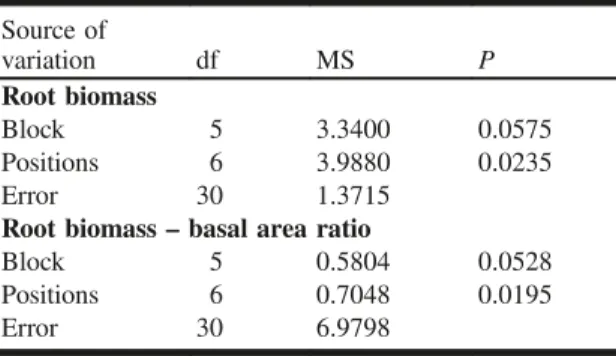
There were, on average, three times more roots in the July to September 2007 (96 mg) than in the October 2006 to July 2007 (31 mg) sampling periods (Table 1). The four ingrowth bags installed at each position were pooled together to pro-vide an estimation of root growth over one full year. The to-tal fine root biomass (absolute value) and ratio of toto-tal fine root biomass to basal area (relative value) varied from a low mean value of 45 mg and 72.17 mg·m–2of basal area of ma-ple, respectively, at P1 to a high value of 465 mg and 656.46 mg·m–2 of basal area of maple, respectively, at S3. There were no statistical differences (ata = 0.05) among the six locations along the slope for both absolute and relative root values, but there were statistical differences among the seven positions of the ingrowth bags for both absolute and relative root values (Table 2). Because both absolute and rel-ative root biomass measures gave similar statistical results (Table 2), only the absolute measure is shown (Fig. 1).
Among the seven positions, P1 (at a = 0.05) and S1 (at a = 0.10) were statistically different from C (Tukey’s HSD), and there was a clear increasing trend from P1 to P3 and S1 to S3 positions.
Root architecture from soil cores
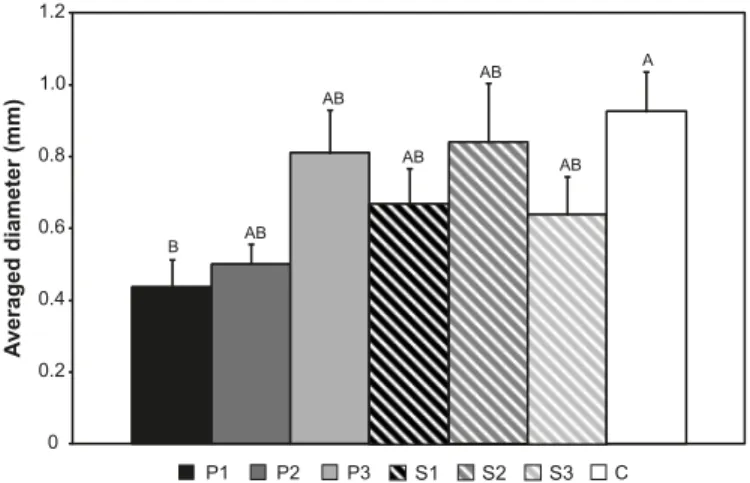
Neither length nor number of forks to total biomass dif-fered significantly (at both a = 0.05 and 0.10) among posi-tions or locaposi-tions along the slope (data not shown). For mean diameter, there was a trend for increasing mean diame-ter from positions P1 to C, but only positions P1 (a = 0.05) and P2 (a = 0.10) were significantly smaller than position C (Tukey’s HSD) (Fig. 2).
Discussion
As anticipated, the results show clearly that fine root growth is much lower in the middle of the primary tracks left by the repeated passage of the skid tractors. This was an-ticipated as primary tracks were clearly disturbed, with ruts of 1 to 8 cm in depth. What was more surprising was that the amount of fine root growth was very similarly reduced within the secondary tracks as well, although because of the high variability in the data, it was only statistically different than the control at a = 0.10. Those tracks are often almost invisible one year after selection cutting, and yet most of the
Table 1.Mean fine root biomass (g) per ingrowth bag and standard deviation (SD) for each sampling (July and Sep-tember 2007).
Sampling
Average root biomass
(g) SD
July 0.031 0.049
September 0.096 0.163
Table 2.Mixed-model analysis of variance (two-way ANOVA) summary for logarithm-transformed root bio-mass and root biobio-mass– basal area ratio.
Source of variation df MS P Root biomass Block 5 3.3400 0.0575 Positions 6 3.9880 0.0235 Error 30 1.3715
Root biomass– basal area ratio
Block 5 0.5804 0.0528
Positions 6 0.7048 0.0195
Error 30 6.9798
Can. J. For. Res. Downloaded from www.nrcresearchpress.com by Université du Québec à Montréal on 11/28/11
fine root’s growing capacity within the first 30 cm of the soil was affected after only one or two passes of the machinery. However, fine root growing capacity was much less affected in the soil adjacent to the tracks and not at all 2 m away from both primary and secondary tracks. These seemingly surpris-ing results could be explained by the fact that, accordsurpris-ing to Williamson and Neilsen (2000), an average of 62% of the compaction in the top 10 cm of soil occurs after only one pass of heavy machinery. For the next 10 to 20 cm, compac-tion increases until the third pass. This seems to be the case for most soil types (Williamson and Neilsen 2000; Souch et al. 2004; von Wilpert and Schäffer 2006).
We first thought that root growth would increase linearly with increasing distance from the tracks in relation to the proportion of soil being disturbed immediately around each position. The lack of significance for the position immedi-ately adjacent to the tracks is presumably due to the high var-iability in the root results normally found in such studies (Vogt et al. 1996). However, there is clearly a trend of a small reduction in fine root growth immediately adjacent to the tracks. The zone of negative influence of the track on fine root growth is therefore quite narrow, as there was no decrease in fine root growth 2 m away from the tracks. The lower mean diameter of live roots found in the intact soil in the middle of the primary tracks is another indication that the machinery inflicted severe damage to the roots in the soils. Presumably, mean diameter was lower because many large roots were killed during the passage of the machinery and many of the live roots measured were new fine roots that grew since harvesting. Roots that encounter mechanical re-sistance during growth adapt morphologically. Generally, root diameter, as well as the number of lateral roots, increase (Bengough et al. 1997; Kozlowski 1999; Miller et al. 2004), and roots also usually become more branched (Kozlowski 1999; Miller et al. 2004). Therefore we expected the number of forks– biomass ratio, as well as the length–biomass ratio
to be significantly different among positions. This was not the case in our study. The superficial material at our study site, a coarse till with many large rocks, is not considered very sensitive to soil compaction. We were not able to meas-ure soil compaction using a penetrometer because of the high rock content, so we cannot say if the negative effect recorded was due to any long-term compaction.
The study was conducted immediately after logging, and we do not know if the fine roots will fully recover and, if so, how long it will take. Clearly, if the live trees left after selection cutting are undamaged and healthy, the increased light, water, and nutrient availability created by partial cutting should favour a rapid recovery of the remaining trees. Re-cently, Hartmann et al. (2008) suggested that healthy sugar maple trees do indeed recover relatively rapidly after selec-tion cutting, and therefore the negative impact of machinery tracks on the long-term health of the forest may not be long lasting.
The amount of root growth found in ingrowth bags in the intact forest over one year can be compared with the results of similar studies. Considering only the control plots, total fine root production over one full year was 78.4 g·m–2 for our site, but this value did not include the potential growth of the understory shrub layer, Viburnum alnifolia (Marsh), as we systematically removed the vegetation for this experiment. This shrub was quite abundant at some sampling points. Fa-hey and Hughes (1994) reported a fine root production of 254 g·m–2 in a hardwood forest in northern USA over one full year using ingrowth bags. Tierney and Fahey (2001, 2002) estimated fine root production to be 303 g·m–2·year–1 using minirhizotrons in a northern hardwood forest in New Hampshire, USA. In another study, Aber et al. (1985) meas-ured 110 and 550 g·m–2·year–1 in a sugar maple dominated stand in southern Wisconsin, USA, using maximum– minimum and nitrogen budget methods, respectively, whereas they found 106 and 650 g·m–2·year–1, respectively, in a sugar maple dominated stand in central Wisconsin, USA, using the same methods. Vogt et al. (1996) men-tioned a belowground net primary production of 265 to 498 g·m–2·year–1for cold temperate broadleaf deciduous for-ests depending on soil types. Our results are on the low
Fig. 1.Mean fine root biomass (mg) for each position along the disturbance gradient. Seven different positions were investigated in and around primary and secondary tracks using ingrowth bags: the middle of both primary and secondary tracks (P1 and S1), near tracks (P2 and S2), 2 m away from tracks (P3 and S3), and in a to-tally undisturbed location at least 15 m away from any track (C). The four ingrowth bags installed at each position were pooled to-gether. Each bar is the mean ± SE. Position bars with the same let-ter are not significantly different (Tukey’s HSD, a = 0.05).
Fig. 2.Mean root diameter (mm) for each position of the distur-bance gradient. See Fig. 1 for a description of the seven positions. Each bar is the mean ± SE. Position bars with the same letter are not significantly different (Tukey’s HSD, a = 0.05).
Can. J. For. Res. Downloaded from www.nrcresearchpress.com by Université du Québec à Montréal on 11/28/11
side compared with the results of these other studies, but this could be explained by the removal of the shrub layer and the more northern position of our study forest.
Conclusion
The objective of this study was to determine if and how heavy machinery is affecting the growth, morphology, and ar-chitecture of sugar maple fine roots in and around machinery tracks left after selection logging. To our knowledge, to date, no attempt has been made to evaluate fine root growth within machinery tracks during the year after selection logging. Our results show that heavy machinery greatly affects the growth potential of fine roots in both primary and secondary tracks one year after selection logging. However, this negative influ-ence seems to be mostly restricted to root growth within the width of the track. These results are important as they shows that the heavy machinery used in forestry today can dramati-cally affect fine root growing capacity within the first 30 cm of the soil. This effect could be significant if we consider that between 15% and 25% of stands that have undergone selec-tion cutting are directly affected by both primary and secon-dary tracks. This clearly calls for guidelines to reduce, as much as possible, the passage of heavy machinery in forests subjected to partial logging. Our results are likely to apply to most soils as the study was done on a material (till with a large proportion of large stones) not considered particularly sensitive to damage by forest machinery.
Acknowledgement
The authors thank Maryse Desrochers, Léa Langlois, Eric Harvey, Isabelle Witté, Vincens Côté, Amélie Poitras-Lari-vière, and Maryse Marchand for assistance in the field and the laboratory, Stéphane Daigle for statistical help, and Lana B. Ruddick for English revision. Financial support was pro-vided by the Fonds Québécois de la Recherche sur la Nature et les Technologies (FQRNT, Programme des Actions con-certées) and the Natural Sciences and Engineering Research Council of Canada (NSERC).
References
Aber, J.D., Melillo, J.M., Nadelhoffer, K.J., McClaugherty, C.A., and Pastor, J. 1985. Fine root turnover in forest ecosystems in relation to quantity and form of nitrogen availability: a comparison of two methods. Oecologia (Berl.), 66(3): 317–321. doi:10.1007/ BF00378292.
Bauhus, J., and Messier, C. 1999. Soil exploitation strategies of fine roots in different tree species of the southern boreal forest of eastern Canada. Can. J. For. Res. 29(2): 260–273. doi:10.1139/ cjfr-29-2-260.
Bédard, S., and Majcen, Z. 2003. Growth following single-tree selection cutting in Québec northern hardwoods. For. Chron. 79: 898–905.
Bengough, A.G., Croser, C., and Pritchard, J. 1997. A biophysical analysis of root-growth under mechanical-stress. Plant Soil, 189(1): 155–164. doi:10.1023/A:1004240706284.
Bernier, P.Y., and Robitaille, G. 2004. A plane intersect method for estimating fine root productivity of trees from minirhizotron images. Plant Soil, 265(1–2): 165–173. doi:10.1007/s11104-005-0056-y.
Bureau des sous-ministres associés aux forêts. 2002. Plan d’action pour l’amélioration de l’aménagement des forêts feuillues du
domaine de l’État. Bureau des sous-ministres associés aux forêts, Ministère des Ressources naturelles, Faune et Parcs, Québec. Campbell, J., Messier, C., and Bauhus, J. 2002. Does soil
heterogeneity and compaction in ingrowth-cores affect the growth and morphology of black spruce fine-roots? Commun. Soil. Sci. Plant Anal. 33(7–8): 1027–1037. doi:10.1081/CSS-120003871. Environnement Canada. 2002. Normales climatiques au Canada
1971–2000. Available from http://climate.weatheroffice.gc.ca/cli- mate_normals/results_f.html?Province=QUE%20&StationNa- me=&SearchType=&LocateBy=Province&Proximity=25&Proxi- mityFrom=City&StationNumber=&IDType=MSC&CityNa- me=&ParkName=&LatitudeDegrees=&LatitudeMinutes=&Lon- gitudeDegrees=&LongitudeMinutes=&NormalsClass=A&Sel-Normals=&StnId=5889&.
Fahey, T.J., and Hughes, J.W. 1994. Fine root dynamics in a northern hardwood forest ecosystem at Hubbard Brook Experimental Forest, NH. J. Ecol. 82(3): 533–548. doi:10.2307/2261262. Finér, L., and Laine, J. 2000. The ingrowth bag method in measuring
root production on peatland sites. Scand. J. For. Res. 15(1): 75–80. doi:10.1080/02827580050160493.
Finér, L., Messier, C., and De Grandpré, L. 1997. Fine-root dynamics in mixed boreal conifer – broad-leafed forest stands at different successional stages after fire. Can. J. For. Res. 27(3): 304–314. doi:10.1139/cjfr-27-3-304.
Fitter, A. 2002. Characteristics and functions of root systems. In Plant roots: the hidden half. 3rd ed. Edited by Y. Waisel, A. Eshel, and U. Kafkafi. Marcel Dekker, New York. pp. 15–32.
Hartmann, H., Beaudet, M., and Messier, C. 2008. Using longitudinal survival probabilities to test field vigour estimates in sugar maple (Acer saccharum Marsh.). For. Ecol. Manage. 256(10): 1771– 1779. doi:10.1016/j.foreco.2008.02.045.
Huggard, D.J., Klenner, W., and Vyse, A. 1999. Windthrow following four harvest treatments in an Engelmann spruce – subalpine fir forest in southern interior British Columbia, Canada. Can. J. For. Res. 29(10): 1547–1556. doi:10.1139/cjfr-29-10-1547.
Joslin, J.D., and Wolfe, M.H. 1999. Disturbances during minirhizotron installation can affect root observation data. Soil Sci. Soc. Am. J. 63(1): 218–221. doi:10.2136/sssaj1999. 03615995006300010031x.
Kozlowski, T.T. 1999. Soil compaction and growth of woody plants. Scand. J. For. Res. 14: 596–619.
Miller, R.E., Colbert, S.R., and Morris, L.A. 2004. Effects of heavy equipment on physical properties of soils and on long-term productivity: a review of literature and current research. National Council for Air and Stream Improvement Technical Bulletin No. 887.
Nadezhdina, N., Cermak, J., Neruda, J., Prax, A., Ulrich, R., Nadezhdin, V., and Gasparek, J. 2006. Roots under the load of heavy machinery in spruce trees. Eur. J. For. Res. 125: 111–128. Neill, C. 1992. Comparison of soil coring and ingrowth methods for measuring belowground production. Ecology, 73(5): 1918–1921. doi:10.2307/1940044.
Page-Dumroese, D.S., Jurgensen, M.F., Tiarks, A.E., Ponder, F.J., Jr, Sanchez, F.G., Fleming, R.L., Kranabetter, J.M., Powers, R.F., Stone, D.M., Elioff, J.D., and Scott, D.A. 2006. Soil physical property changes at the North American long-term soil productiv-ity study sites: 1 and 5 years after compaction. Can. J. For. Res. 36 (3): 551–564. doi:10.1139/x05-273.
Polomski, J., and Kuhn, N. 2002. Root research methods. In Plant roots: the hidden half. 3rd ed. Edited by Y. Waisel, A. Eshel, and U. Kafkafi. Marcel Dekker, New York. pp. 295–321.
Samuels, M.L., and Witmer, J.A. 2003. Statistics for the life sciences. 3rd ed. Pearson Education, Inc., Upper Saddle River, New Jersey. Smit, A.L., Bengough, A.G., Van Noorwijk, M., Pellerin, S., and Van
Can. J. For. Res. Downloaded from www.nrcresearchpress.com by Université du Québec à Montréal on 11/28/11
De Geijn, S.C. 2000. Root methods: a handbook. Springer-Verlag, Heidelberg, Germany.
Sokal, R.R., and Rohlf, F.J. 1995 Biometry: the principle and practice of statistics in biological research. 3rd ed. W.H. Freeman and Company, New York.
Souch, C.A., Martin, P.J., Stephens, W., and Spoor, G. 2004. Effects of soil compaction and mechanical damage at harvest on growth and biomass production of short rotation coppice willow. Plant Soil, 263(1): 173–182. doi:10.1023/B:PLSO.0000047734.91437.26. Tierney, G.L., and Fahey, T.J. 2001. Evaluating minirhizotron
estimates of fine root longevity and production in the forest floor of a temperate broadleaf forest. Plant Soil, 229(2): 167–176. doi:10.1023/A:1004829423160.
Tierney, G.L., and Fahey, T.J. 2002. Fine root turnover in a northern hardwood forest: a direct comparison of the radiocarbon and minirhizotron methods. Can. J. For. Res. 32(9): 1692–1697. doi:10.1139/x02-123.
Vogt, K.A., Vogt, D.J., Palmiotto, P.A., Boon, P., O’Hara, J., and Asbjornsen, H. 1996. Review of root dynamics in forest ecosystems grouped by climate, climatic forest type and species. Plant Soil, 187(2): 159–219. doi:10.1007/BF00017088.
Vogt, K.A., Vogt, D.J., and Bloomfield, J. 1998. Analysis of some direct and indirect methods for estimating root biomass and production of forests at an ecosystem level. Plant Soil, 200(1): 71– 89. doi:10.1023/A:1004313515294.
von Wilpert, K., and Schäffer, J. 2006. Ecological effects of soil compaction and initial recovery dynamics: a preliminary study. Eur. J. For. Res. 125: 129–138.
Williamson, J.R., and Neilsen, W.A. 2000. The influence of forest site on rate and extent of soil compaction and profile disturbance of skid trails during ground-based harvesting. Can. J. For. Res. 30(8): 1196–1205. doi:10.1139/cjfr-30-8-1196.
Can. J. For. Res. Downloaded from www.nrcresearchpress.com by Université du Québec à Montréal on 11/28/11