A Multi-criteria Model for Electronic Auctions
Marie-Jo Bellosta
Im `ene Brigui
Sylvie Kornman
Daniel Vanderpooten
LAMSADE, Universit ´e Paris Dauphine Place du Mar ´echal De Lattre de Tassigny
75775 Paris Cedex 16, France
{
bellosta,brigui,kornman,vdp
}@lamsade.dauphine.fr
ABSTRACT
In this paper we present a multi-criteria model for electronic auctions, which is based on reference points. According to the model, the buyer must specify an aspiration point that expresses his desired values on the attributes of the item to be purchased and a reservation point that represents the minimal values required. Negotiation takes place between software agents that negotiate on behalf of their human own-ers. The multi-criteria model allows the buyer agent to con-trol the negotiation process on each attribute of the deal. We illustrate the use of this model by providing an auction mechanism based on an English reverse auction protocol.
Categories and Subject Descriptors
J.8 [Computer Applications]: Internet Applications—
Electronic commerce
Keywords
Electronic commerce, multi-attribute auction, software agents.
1.
INTRODUCTION
Auction theory has caught tremendous interest from both the economic side as well as the Internet industry. An auc-tion is a competitive mechanism to allocate resources to buy-ers based on predefined rules. These rules define the bid-ding process, how the winner is determined, and the final agreement. In electronic commerce transactions, auctions are conducted by software agents that negotiate on behalf of buyers and sellers [8, 9, 10, 11]. The various auction protocols include English, First-price Sealed Bid, Dutch, and Vickrey [18]. Besides price-only, single-item auctions that dominate the current landscape [4, 11, 14], other types of auctions have been defined and studied such as item auctions [1], combinatorial auctions [6, 16] and multi-attribute auctions [2, 3, 5]. Multi-item auctions are auctions in which an auctioneer wants to sell a set of indivisible items which may be identical or not. Combinatorial auctions are
Permission to make digital or hard copies of all or part of this work for personal or classroom use is granted without fee provided that copies are not made or distributed for profit or commercial advantage and that copies bear this notice and the full citation on the first page. To copy otherwise, to republish, to post on servers or to redistribute to lists, requires prior specific permission and/or a fee.
SAC’04, March 14-17, 2004, Nicosia, Cyprus
Copyright 2004 ACM 1-58113-812-1/03/04 ...$5.00.
multi-item auctions in which bidders can make bids for sub-sets of items. Multi-attribute auctions allow negotiating on multiple attributes, involving not only the price, but also other attributes such as quality, guarantee, delivery terms and conditions. Buyers reveal their preferences on the item to be purchased and sellers compete on both price and non-price attributes to win the contract. This paper is aimed at defining a buyer agent for multi-attribute auctions.
Multi-attribute auctions require several key components to automate the process:
• a preference model to let the buyer express his
prefer-ences,
• a multi-criteria aggregation model to let the buyer
agent select the best offer,
• a decision making component to let the buyer agent
formulate his asks.
Buyer’s preferences are expressed by defining a set of rel-evant attributes, the domain of each attribute, and criteria which are evaluation functions that allocate a score for every possible values of a relevant attribute. Most multi-criteria aggregation models used in multi-attribute negotiations are scoring functions based on a weighted sum. It is well-known, however, that the weighted sum, which is the simplest multi-criteria aggregation model, suffers from several drawbacks. First, it requires the specification of weights which are dif-ficult to obtain and to interpret. This is all the more im-portant that slight variations on these weights may change dramatically the choice of the best bid. This is partly due to the fact that the weighted sum is a totally compensatory aggregation model. In our context, a very bad value on a criterion can be compensated by a series of good values on other criteria. Such a bid could obtain a weighted sum sim-ilar to a bid with rather good scores on all criteria, while in many cases, the latter would be preferred. This suggests the use of non-compensatory or partially compensatory ag-gregation models. Finally, it can be shown that some of the non-dominated solutions, called non-supported, cannot be obtained as the best proposal using the weighted sum for any possible choice of weights. This is a very severe draw-back since these non-supported solutions, whose potential interest is the same as the other non-dominated solutions, are rejected only for technical reasons.
In order to address these shortcomings, we propose the use of an alternative multi-criteria model for the buyer’s pref-erences, based on reference points. We also propose an En-glish reverse auction mechanism based on this model where
buyer’s asks specify the values required on the attributes of the item at each step of the auction process. This mech-anism provides more control to the buyer agent over the bidding process than with the weighted sum model. In this approach, preference information and relative importance of criteria is not expressed in terms of weights, but more di-rectly in terms of required values on the criteria. Moreover, while in the weighted sum, any non-dominated solution can be obtained as the best proposal.
The remainder of this paper is structured as follows. Sec-tion 2 analyses related work on multi-attribute aucSec-tions. Section 3 presents the preference model and the multi-criteria aggregation model used by the buyer agent. Section 4 de-scribes the auction mechanism used to formulate the buyer agent asks. Section 5 shows an illustrative example of our approach. Section 6 summarizes our contribution.
2.
RELATED WORKS
Works on multi-attribute negotiations are generally based on the weighted sum aggregation model [2, 3, 12, 13]. Oliveira et al. define in [13] a multi-attribute peer-to-peer negoti-ation protocol, which is a modified version of the reverse English auction. Bids are evaluated by a scoring rule de-signed by the buyer. Negotiation starts when a buyer agent sends a request for an item to all the potentially interested sellers. The request defines the initial negotiable product together with information on the buyer’s preferences and the minimum evaluation required for a bid. Sellers evaluate the request and send out acceptable bids or retire from the competition. Once the buyer has received all the replies, he selects the best bid and sends out its value as a counter-proposal. The negotiation process goes on until all but one seller quit and ends with a commitment to the last seller. Oliveira et al’s protocol has been defined in order to take into account multi-attribute aspects of a deal. It can be adapted to any multi-criteria aggregation model, where bids evalua-tion is performed by some one-dimensional real-valued func-tion. We have adopted it as the basis of our experiments.
Bichler et al. [2, 3] have implemented multi-attribute auc-tions in a market place, which support negotiation on mul-tiple attributes. They introduce a virtual currency that ex-presses the overall utility of a bid. The buyer has to reveal at least a part of his utility function to suppliers in order to let them evaluate their bids. The bidding process can be conducted according to various auction schemes (English, Vickrey, First-Price, Sealed-Bid). Auction starts when the buyer specifies a Request For Bid (RFB) and submits it to the e-broker of the market place. The e-broker notifies suppliers with corresponding offers and collects their bids. After the auction closes, the e-broker computes the winning bid and compiles a contract. Some procedures are provided to help buyers to express their preferences on the purchase product and sellers to formulate their bids. In [2], Bichler claims that the utility scores achieved in multi-attribute auc-tions are significantly higher than those of single-attribute auctions. However, in [3] Bichler notes that the interpreta-tion of the weights associated to each attribute is not always clear. The model that we propose is based on elements that are easy to interpret (reservation levels and aspiration lev-els) and simplifies the elicitation phase of the buyer’s pref-erences.
Morris et al. [12] propose a multi-attribute aggregation model based on the definition of a weighted distance from
a preferred point. They have developed the SARDINE sys-tem (Syssys-tem for Airline Reservations Demonstrating the In-tegration of Negotiation and Evaluation) that uses software agents to coordinate the preferences and interests of each party involved in purchasing a plane ticket. Negotiation is a non-binding arrangement allowing the buyer to make multi-ple bids on multimulti-ple offers. The buyer’s preferences consist of a preferred value and a flexibility rating for each fly parame-ter. The flexibility rating is used to determine an acceptable range and a weight that mirrors the importance attached to the considered parameter. There are three possible values for the flexibility rating: ”very flexible”, ”somewhat flexi-ble” and ”not flexiflexi-ble”. Bids are ordered according to their distances from the preferred point. The buyer agent locates the best flights for the user by minimizing the distance func-tion shown above:
dist =X i weighti µ preferredi− actuali rangei ¶ ,
where actual denotes the value for a located airline fly. As the weighted sum model, the present multi-attribute aggregation model is a compensatory model. Moreover, it presents other shortcomings. The most significant one is that both values (preferredi - x) and (preferredi + x)
pro-vide the same contribution to the overall distance. For in-stance, considering the attribute hour and assuming that a preferred level of 8.am is given, bids with 6.am and 10.am will be deemed equivalent, which is certainly not the case. The model presented here makes use of a reference point that expresses the preferred values on each criterion like the SARDINE system, however it is not a compensatory model and does not suffer from the above shortcoming.
3.
THE MULTI-CRITERIA MODEL
In this section, we present the preference model that cap-ture the buyer’s preferences and the multi-criteria model used to select the best bid. Both models belong to the fam-ily of so-called reference point approaches [20, 21] which have been used in a large variety of contexts (see, e.g., [7, 15]) and make use of aspiration and reservation levels.
3.1
The preference model
The preference model is defined through the following con-cepts and notations:
- p, the number of attributes.
- D = D1× . . . × Dp, the decision space where Djis the
domain of values for attribute j (j = 1, . . . , p). - C = C1× . . . × Cpdefines the criterion space.
- vj, the value function defined from Djto Cj= [0, 100]
that corresponds to attribute j.
- Let x = (x1, . . . , xp) ∈ D denote a bid, bj = vj(xj), b = (b1, . . . , bp) ∈ C denotes the bid evaluated on all
criteria, (j = 1, . . . , p).
The preference model includes two reference points : - the aspiration point, denoted by a = (a1, . . . , ap) where
aj=vj(dvj) are aspiration levels and dvj ∈ Dj is the
- the reservation point, denoted by r = (r1, . . . , rp) where
rj=vj(mvj) are reservation levels and mvj∈ Djis the
minimal value required on criterion j.
We also recall the following classical concepts in multi-criteria decision analysis (see, e.g., [17, 19]):
- ∆, the dominance relation defined as follows :
b∆b0 ⇔ ∀j ∈ {1, . . . , p} bj≥ b 0 j and ∃l ∈ {1, . . . , p} : bl> b 0 l
- b is non-dominated iff there is no b0 such that b0∆b. - The ideal point over a given set of bids B⊂C consists
of the maximal scores separately reached on each cri-terion, denoted by
ideal = (ideal1, . . . , idealp)
where idealj= maxb∈B(bj).
- The anti-ideal point over a given set of bids B⊂C con-sists of the minimal scores separately reached in each criterion, denoted by
antiIdeal = (antiIdeal1, . . . , antiIdealp)
where antiIdealj= minb∈B(bj).
3.2
The multi-criteria aggregation model
The multi-criteria aggregation evaluates bids on the basis of a deviation from the aspiration levels that measures the maximum difference between the desired values and the bids values on each criterion. Considering aspiration point a and any bid b, this deviation is given by:
deviation(a, b) = max
j=1,...,p{λj(aj− bj)} (1)
where λj= 1/(idealj− antiIdealj).
Note first that dividing (aj− bj) by (idealj− antiIdealj),
(j = 1, . . . , p), reduces the scale differences on criteria. Sec-ond, note that the multi-criteria aggregation model is not a compensatory model. The model takes equally into account differences between the preferred value and the bid value on each criterion and retains the higher difference. Thus, a bad score on a criterion cannot be compensated by good scores on other criteria.
Using the deviation notion, we define a strict preference relation  on C × C as follows :
b  b0⇔ deviation(a, b) < deviation(a, b0)
3.3
Choice of the best bid
Let best denote the best bid among a given set of bids B and d = deviation(a, best). Let B∗ denote the set of bids
minimizing the deviation from the aspiration point a:
B∗= {b ∈ B : arg min
b∈B{deviation(a, b)}} (2)
If B∗contains only one bid, this bid best is non-dominated.
If B∗contains more than one bid, the best bid is selected
according to the following lexicographic algorithm: for each bid of set B∗ compute the deviation from the aspiration
point a without considering the criterion on which the de-viation is reached and determine the new set B∗∗ of bids
whose criterion values minimize the deviation. Repeat the process until B∗∗ contains only one bid which is recognized
as the best one, or until all criteria are eliminated, in which case best is selected arbitrarily. The use of this lexicographic algorithm ensures that best is non-dominated.
4.
THE AUCTION MECHANISM
In this section, we illustrate the use of the multi-criteria model presented in the last section on a multi-attribute re-verse English auction. A multi-attribute rere-verse English auction involves n seller agents, which are the bidders com-peting together to sell an item characterized by p attributes to a unique buyer agent, which is the auctioneer.
First, we define the counterproposal rule according to the
beat-the-quote rule introduced by Wurman [22] and we
out-line its properties. Then, we present the protocol used by the agents during the negotiation process. Finally, we detail the negotiation buyer agent’s algorithm.
4.1
Definition of counterproposals
At each round t of an English auction, the buyer agent collects all the bids, selects the best one as the reference bid for the next round and formulates the counterproposal. The definition of counterproposals is based on the beat-the-quote rule. In an English auction, this rule specifies that any new bid must beat the best bid received at the previous round. When the bid evaluation process can be summarized by some one-dimensional real-valued function, this rule can be implemented by communicating to the sellers the evalu-ation of the best current bid augmented by an increment ε. Sellers are then asked to send new bids whose evaluation is at least as good as this augmented evaluation. Observe that this requires that sellers know and implement the buyer’s evaluation model.
We show that our approach satisfies the beat-the-quote rule without revealing the buyer’s evaluation model to the sellers. This is achieved through the use of a reservation point as indicated by the following result.
Proposition 1. Assuming that the bidding process is led
using the reference point model described by relations (1) and (2). A sufficient condition for the bidding process to satisfy the beat-the-quote rule is to impose the following constraints on the reservation levels:
rjt+1≥ aj−(d t
−ε)/λj, ∀t ∈ {1, . . . , last−1}, ∀j ∈ {1, . . . , p} where ε denotes a specified increment and dt denotes the minimal deviation from the aspiration point at round t.
Proof. The beat-the-quote rule requires that any bid
bt+1 ∈ Bt+1 provided at round t + 1 should be better than bestt. Thus, we have: deviation(a, bt+1) < deviation(a, bestt)
and deviation(a, bestt) = dt ∀t ∈ {1, . . . , last − 1}, which is
satisfied whenever deviation(a, bt+1) ≤ dt− ε (ε > 0) i.e.
when maxj=1,...,p{λj(aj− bt+1j )} ≤ d t− ε which is equiva-lent to λj(aj− bt+1) ≤ dt− ε, ∀j ∈ {1, . . . , p}, equivalent to bt+1 j ≥ aj− (d t− ε)/λj.
Given this result, and in order to meet the requirements of the initial reservation levels defined by the buyer, we propose
to set reservation levels as follows:
rt+1
j = max{aj− (dt− ε)/λj, rj1}
∀t ∈ {1, . . . , last − 1}, ∀j ∈ {1, . . . , p} (3)
Thus, at round t + 1, the buyer agent sends out the reser-vation levels defined by (3) as a counterproposal to all the sellers which must provide a new bid.
4.2
Properties
The previous mechanism shows some interesting proper-ties. We first state two lemmas which are useful to establish these properties.
Lemma 1.
deviation(a, rt) ≤ dt ∀t ∈ {1, . . . , last} (4)
Proof. The definition of reservation levels implies that any bid must be greater than or equal to the reservation lev-els, which must hold in particular for the best bid. Thus we have: bestt
j≥ rtj, ∀t ∈ {1, . . . , last−1}, ∀j ∈ {1, . . . , p} which
is equivalent to λj(aj− besttj) ≤ λj(aj− rtj) which implies
maxj={1,...,p} λj(a − besttj) ≤ maxj={1,...,p}λj(a − rjt), ∀t ∈ {1, . . . , last−1}, hence deviation(a, bestt) ≤ deviation(a, rt),
corresponding to the result. Lemma 2.
deviation(a, rt+1) < dt ∀t ∈ {1, . . . , last − 1} (5) Proof. The definition of reservation levels at round t + 1 given by (3) implies rt+1
j ≥ aj− (dt− ε)/λj, ∀j ∈ {1, . . . , p}
hence λj(aj− rt+1j ) ≤ dt− ε. Thus, we have maxj∈{1,...,p} {λj(aj− rjt+1)} ≤ dt− ε < dt.
We give now four interesting properties.
Property 1. The sequence of reservation points rtis an increasing sequence for relation Â, i.e. we have
rt+1Â rt ∀t ∈ {1, . . . , last − 1} (6) Proof. From (4) and (5), we get deviation(a, rt+1) <
deviation(a, rt), ∀t ∈ {1, . . . , last − 1}.
Property 2. The sequence of best bids bestt is an in-creasing sequence for relation Â, i.e. we have
bestt+1Â bestt ∀t ∈ {1, . . . , last − 1} (7) Proof. From (4) and (5), we get dt+1< dt, ∀t ∈ {1, . . . ,
last − 1}.
Property 3. The sequence of reservation points rt, t ∈ {1, . . . , last}, is an increasing sequence for the dominance relation, i.e. we have
rt+1∆rt ∀t ∈ {1, . . . , last-1} (8) This property ensures that reservation levels get higher on each criterion at each round of the auction.
Proof. According to the definition of the dominance re-lation, we must prove rt+1
j ≥ r
t
j, ∀j ∈ {1, . . . , p} and ∃k ∈ {1, . . . , p} such that rt+1
k > rtk. Let us prove that rjt+1≥ rjt, ∀t ∈ {1, . . . , last − 1}, j ∈ {1, . . . , p}. For t = 1, we have
according to relation (3) r2 j = max{aj− (dt− ε)/λj, rj1} ∀t ∈ {1, . . . , last − 1}, ∀j ∈ {1, . . . , p} which implies r2 j ≥ rj1, ∀j ∈ {1, . . . , last}. For t > 1, we
have rt+1j = max{aj− (dt− ε)/λj, rj1} and rjt = max{aj−
(dt−1− ε)/λj, r1j}. According to (4) and (5) we have dt < dt−1, ∀t ∈ {2, . . . , last − 1} which implies a
j− (dt− ε)/λj > aj− (dt−1− ε)/λj. Hence max{a
j− (dt− ε)/λj, rj1} ≥
max{aj−(dt−1−ε)/λj, r1j} and thus rjt+1≥ r t
j. Let us prove
that ∃k ∈ {1, . . . , p} such that rt+1
k > rkt. According to (4)
we get d1≤ deviation(a, r1) = max
j={1,...,p}λj(aj−r1j). We
have d1> d1−ε, ε > 0, and hence maxj={1,...,p}λj(aj−r1
j) > d1−ε. Hence, ∃k ∈ {1, . . . , p} such that λk(ak−r1
k) > d1−ε.
Hence r1
k< ak− (d1− ε)/λk. Hence r2k= max{ak− (d1− ε)/λk, r1
k}=ak−(d1−ε)/λk>rk1. Thus, ∀t ∈ {1, . . . , last−1} rt+1
k = ak− (d
t− ε)/λk. Considering that dt+1< dt, we get ∀t ∈ {1, . . . , last − 1} rt+1
k > rkt.
4.3
The multi-attribute reverse English
auc-tion protocol
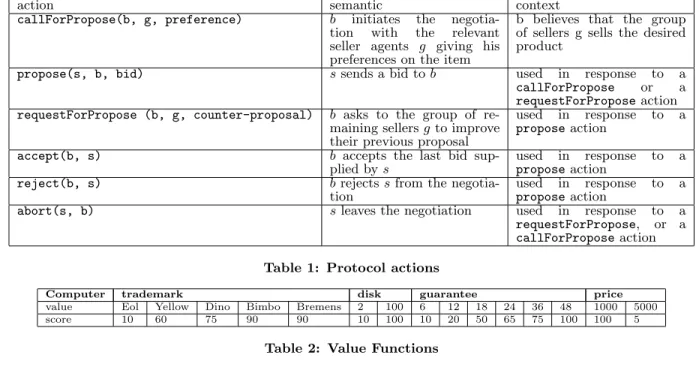
The protocol specifies the actions agents should take dur-ing a negotiation process and the rules indicatdur-ing what mes-sages should be sent. In a reverse English auction, the pro-tocol primitives are : callForPropose, requestForPropose, propose, accept, reject, and abort. Semantics of actions are defined in Table 1 where g refers to the group of seller agents, s refers to a seller agent and b refers to a buyer agent.
4.4
The negotiation buyer agent’s algorithm
The negotiation buyer agent’s algorithm is decomposed into four steps as follows. We assume that the auction starts with the name of the item to be purchased and the set of seller agents that provide the item.
Information collect The buyer agent collects the buyer’s preferences (the value functions, the aspiration levels and the reservation levels) and the closing time of the auction.
Call for propose The buyer agent defines the reference points using the value functions, specifies the incre-ment used to define counterproposals, the time dura-tion of a negotiadura-tion round and sends to the n seller agents a call for propose message with the value functions, the reservation points and the closing time as arguments.
Lambda definition The buyer agent receives the first bids (receiving propose messages and/or abort messages). He defines the lambda values associated with each cri-terion, which are used in the bids evaluation during the whole auction process.
Auction loop The buyer agent repeat the following oper-ations until the end of the auction, i.e the set of com-petitive sellers is empty or the closing time is reached: 1. he evaluates the received bids and selects the best one as the reference bid for the next round and states the corresponding seller as active;
action semantic context
callForPropose(b, g, preference) b initiates the
negotia-tion with the relevant
seller agents g giving his preferences on the item
b believes that the group of sellers g sells the desired product
propose(s, b, bid) s sends a bid to b used in response to a
callForPropose or a
requestForPropose action requestForPropose (b, g, counter-proposal) b asks to the group of
re-maining sellers g to improve their previous proposal
used in response to a
propose action
accept(b, s) b accepts the last bid
sup-plied by s usedpropose actionin response to a
reject(b, s) b rejects s from the
negotia-tion usedpropose actionin response to a
abort(s, b) s leaves the negotiation used in response to a
requestForPropose, or a callForPropose action Table 1: Protocol actions
Computer trademark disk guarantee price
value Eol Yellow Dino Bimbo Bremens 2 100 6 12 18 24 36 48 1000 5000
score 10 60 75 90 90 10 100 10 20 50 65 75 100 100 5
Table 2: Value Functions 2. he defines the next reservation levels;
3. he sends his new request to the remaining seller agents except for the active seller;
4. he waits for the seller bids (receiving propose messages and/or abort messages) and collects all the bids.
Auction end The auction fails if there is no seller in com-petition. Otherwise, the auction succeeds and the win-ner is chosen as follows: if the closing time is reached, then the buyer agent selects the best bid as the win-ning bid, sends an accept message to the winner and a reject message to the other sellers. Otherwise, the best bid of the previous round is the winning bid and the buyer agent sends an accept message to the cor-responding seller.
5.
AN ILLUSTRATIVE EXAMPLE
In this section, an application example is presented where the negotiation process is applied, explained and discussed. Then, the expected properties of the auction are outlined.
5.1
The buyer’s preferences
The negotiation situation is an auction where one buyer agent negotiates with seven seller agents (S1, . . . , S7) over a
computer described by four attributes (trademark, disk ca-pacity, guarantee conditions and price). Each seller identi-fies around twenty product references that match the buyer’s requirements. The buyer agent starts the auction with the following buyer’s preferences :
• the value functions defined in Table 2;
• the buyer aspiration is a computer from the Yellow
trademark, with a capacity of 8 giga octets, a guaran-tee of 6 months and a price of 2200 e, which corre-sponds to the aspiration point a = (60, 16, 10, 71.5).
• the initial reservation values correspond to the
Yel-low trademark, a minimum capacity of 7 giga octets,
seller bids evaluation dev
S1 (Bremens,26,12,3905) (90, 32, 20, 31) 1.82 S2 (Bimbo, 47, 12, 3274) (90, 51, 20, 46) 1.14 S3 (Yellow, 14, 18, 3568) (60, 21, 50, 39) 1.46 S4 (Bremens, 44, 18, 4000 ) (90, 49, 50, 29) 1.91 S5 (Bimbo, 11, 18, 3063) (90, 18, 50, 51) 0.91 S6 (Bimbo, 14 , 18, 3653 ) (90, 21, 50, 37) 1.55 S7 (Dino, 17, 12, 3737) (75, 24, 20, 35) 1.64
Table 3: Bids received at round 1
a minimum guarantee of 6 months and a maximum price of 4000 e, from which the reservation point r1=
(60, 15, 10, 29) is defined.
5.2
The first round
Table 3 presents the set of bids received at the first round. The lambda values are computed according to (1): λ1 =
1/(90 − 60) = 1/30, λ2= 1/(51 − 18) = 1/33, λ3= 1/(50 −
20) = 1/30, λ4 = 1/(51 − 29) = 1/22. S5’s bid b5 =(90,
18, 50, 51) is the best bid with deviation(a, b5) = 0.91. The
reservation levels for round 2, denoted by r2, are computed
according to relation (3) with an increment ε set to 0.15:
r2
1 = max(r11, 60 − (0.91 − ε)/λ1) = 60; r22 = max(r12; 16 −
(0.91 − ε)/λ2) = 15; r32= max(r13; 10 − (0.91 − ε)/λ3) = 10;
r2
4 = max(r14; 71.5 − (0.91 − ε)/λ4) = 54. Note that only the
reservation level for price has increased.
5.3
The auction process
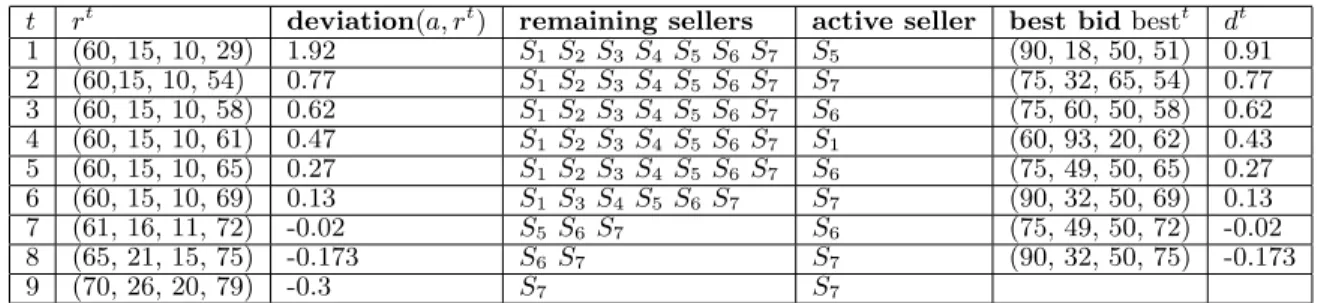
The auction takes place in 9 rounds reported in Table 4. Counterproposals in the form of reservation levels allow the buyer agent to control the auction process on each attribute of the item. During the six first rounds, requirements over non-price attributes are invariant, while improvements over the price attribute are asked at each round and each price reservation level corresponds to the lower price required. From round 7, all reservation levels increase at each round. The growing of the successive non-price reservation levels do not lead to require improvements at each round but only
t rt deviation(a, rt) remaining sellers active seller best bid bestt dt 1 (60, 15, 10, 29) 1.92 S1 S2 S3 S4S5 S6 S7 S5 (90, 18, 50, 51) 0.91 2 (60,15, 10, 54) 0.77 S1 S2 S3 S4S5 S6 S7 S7 (75, 32, 65, 54) 0.77 3 (60, 15, 10, 58) 0.62 S1 S2 S3 S4S5 S6 S7 S6 (75, 60, 50, 58) 0.62 4 (60, 15, 10, 61) 0.47 S1 S2 S3 S4S5 S6 S7 S1 (60, 93, 20, 62) 0.43 5 (60, 15, 10, 65) 0.27 S1 S2 S3 S4S5 S6 S7 S6 (75, 49, 50, 65) 0.27 6 (60, 15, 10, 69) 0.13 S1 S3 S4 S5S6 S7 S7 (90, 32, 50, 69) 0.13 7 (61, 16, 11, 72) -0.02 S5 S6 S7 S6 (75, 49, 50, 72) -0.02 8 (65, 21, 15, 75) -0.173 S6 S7 S7 (90, 32, 50, 75) -0.173 9 (70, 26, 20, 79) -0.3 S7 S7
Table 4: Auction process
seller best bid evaluation dev
S1 (Yellow, 14, 12, 1842) (60, 21, 20, 80) 0.0 S2 (Yellow, 97, 12, 2347) (60, 97, 20, 68) 0.16 S3 (Yellow, 90, 12, 2221) (60, 91, 20, 71) 0.02 S4 (Yellow, 92, 12, 1758) (60, 93, 20, 82) 0.0 S5 (Dino, 14, 18, 2010) (75, 21, 50, 76) -0.17 S6 (Dino, 44, 18, 2053) (75, 49, 50, 75) -0.16 S7 (Bremens, 26, 18, 2010) (90, 32, 50, 76) -0.2
Table 5: The best bids of each seller
after several rounds, when the reservation level gets over scores corresponding to values of the attributes. For ex-ample consider the trademark attribute, the growing of the successive reservation levels lead to ask improvements after several rounds: r7
1 = 61, r18 = 65, r19 = 70 corresponds to
a requirement of the Dino trademark. A new improvement would be required with a reservation level over 75 corre-sponding to the Bimbo or Bremens trademark. The auction ends with an agreement with Seller S7. The winning bid
(90, 32, 50, 75) corresponds to a computer from the Bre-mens trademark, with a capacity of 26 giga octets, a guar-antee of 18 months and a price of 2040 e, which is over the aspiration point.
5.4
Interpretation
The auction process can be interpreted considering the best bids of the competitive sellers (see Table 5) and the sequence of values deviation(a, rt), t ∈ {1, . . . , 9}, (see
Ta-ble 4). Let best(S) denote the best bid of Seller S.
1. At each round t, a seller S can provide a bid when his best bid is better than the active reservation levels rt,
i.e. when deviation(a, best(S)) ≤ deviation(a, rt). At
the first round, all the sellers can provide a bid. Seller
S2withdraws at the sixth round when deviation(a, rt) =
0.13 < 0.16. Sellers S1, S3and S4withdraw at the
sev-enth round, when deviation(a, rt) = −0, 02. They are
followed at the last round by Seller S5 and Seller S6.
2. Seller S7that minimizes deviation(a, best(S)) wins the
auction with a bid which is slightly better than the second best bid, which is proposed by Seller S5.
Tables 4 and 5 validate all the properties stated in 4.2. The sequence of reservation points rt, t ∈ {1, . . . , 9}, is an
increasing sequence for relations  and ∆. The sequence of best bids bestt, t ∈ {1, . . . , 9}, is an increasing sequence for
relation Â. Finally, efficiency is achieved in the sense that the seller with the best bid (Seller S7) wins the contract.
6.
CONCLUSIONS
This paper describes a multi-attribute auction mechanism based on reference points. As with the weighted sum model the buyer’s preferences include value functions. However, weights associated with attributes are replaced by aspiration levels that represent the required values on the attributes of the item to be purchased. Auctions are conducted using reservation levels that express the minimum values accept-able on the attributes. This way of defining counterpro-posal enforces a successive refinement of the best bids in each round and also ensures the efficiency of the auction (i.e. the seller with the best bid wins the contract).
This mechanism addresses the shortcomings of the weighted sum model and provides a direct control on the bidding pro-cess. Moreover, the fact that the buyer broadcasts coun-terproposal as new reservation points, allows him to keep private his aggregation model.
7.
REFERENCES
[1] H. Ben-Ameur, B. Chaib-draa, and P. Kropf. Multi-item auctions for automatic negotiation.
Journal of Information and Software Technology,
44:291–301, 2002.
[2] M. Bichler. An experimental analysis of
multi-attribute auctions. Decision Support Systems, 29:249–268, 2000.
[3] M. Bichler, M. Kaukal, and A. Segev. Multi-attribute auctions for electronic procurement. In First IBM IAC
Workshop on Internet Based Negotiation Technologies,
volume 44, pages 291–301, 2002.
[4] A. Chavez and P. Maes. Kasbah: An agent marketplace for buying and selling goods. In First
International Conference on the Practical Application of Inteligent Agents and Multi-Agent Technology,
London, Great Britain, 1996.
[5] E. David, R. Azoulay-Schwartz, and S. Kraus. An english auction protocol for multi-attribute items. In
AMEC 2002, pages 52–68, 2002.
[6] S. De Vries and R. Vohra. Combinatorial auctions: A survey. INFORMS Journal on Computing, 2003. [7] V. Gabrel and D. Vanderpooten. Enumeration and
interactive selection of efficient paths in a multiple criteria graph for scheduling an earth observing satellite. European Journal of Operational Research, 139:533–542, 2002.
[8] R.H. Guttman and P. Moukas, A.G. and. Maes. Agent-mediated electronic commerce: A survey.
Knowledge Engineering Review, 1998.
C. Sierra, and M. Wooldridge. Automated negotiation: prospects, method and challenges. International
Journal of Group Decision and Negotiation,
10(2):199–215, 2001.
[10] N.R. Jennings, C. Sierra, and P. Faratin. Negotiation decision functions for autonomous agents. Robotics
and Autonomous Systems, 24:159–182, 1998.
[11] K.Y. Lee, J.S. Yun, and G.S. Jo. Mocaas: auction agent system using a collaborative mobile agent in electronic commerce. Expert System with Applications, 24:183–187, 2003.
[12] J. Morris and P. Maes. Sardine: An agent-facilitated airline ticket bidding system. In 4th International
Conference on Autonomous Agents (Agents 2000),
Barcelona, Spain, 2000.
[13] E. Oliveira, J.M. Fonsesca, and A. Steiger-Garao. Multi-criteria negotiation in multi-agent systems. In
1st International Workshop of Central and Eastern Europe on Multi-agent Systems (CEEMAS’99), St.
Petersbourg, June 1999.
[14] D.C. Parkes and Ungar L. Preventing strategic manipulation in iterative auctions: Proxy-agents and price-adjusment. In Seventeenth National Conference
on Artificial Intelligence (AAAI’00), Austin, USA,
2000.
[15] P. Perny and D. Vanderpooten. An interactive multiobjective procedure for selecting medium-term countermeasures after nuclear accidents. Journal of
Multi Criteria Decision Analysis, 7(1):48–60, 1998.
[16] T.W. Sandholm. Approaches to winner determination in combinatorial auctions. Decision Support Systems, 28:165–176, 2000.
[17] R.E. Steuer. Multiple criteria optimization: theory,
computation, and application. Wiley, New York, 1986.
[18] W. Vickrey. Counterspeculation auctions and competitive sealed tenders. Journal of finance, 16:8–37, 1961.
[19] Ph. Vincke. L’aide multicrit`ere `a la d´ecision. Ellipses, Paris, 1989. english translation: Multicriteria
decision-aid, Wiley, 1992.
[20] A. P. Wierzbicki. The use of reference objectives in multiobjective optimization. In G. Fandel and T. Gal, editors, Multiple Criteria Decision Making: Theory
and Application, pages 468–486. Springer-Verlag,
Berlin, 1980.
[21] A.P. Wierzbicki. On the completeness and
constructiveness of parametric characterizations to vector optimization problems. OR Spektrum, 8(2):73–87, 1986.
[22] P.R. Wurman, M.P Wellman, and W.E Walsh. Specifying rules for electronic auctions. 23(3):15–23, 2002.