DISTINGUISHING KNOWLEDGE FROM INFORMATION
A Prerequisite for Elaborating KM Initiative Strategy
Michel Grundstein
MG Conseil, 4 rue Anquetil, 94130 Nogent sur Marne, France
Paris Dauphine University, Place du Maréchal De Lattre de Tassigny 75775 Paris, France [email protected]
Keywords: Information, Knowledge, Knowledge Management (KM), Individual’s tacit knowledge, Commensurability of Individual’s Interpretative Frameworks, KM initiative strategy, Enterprise’s Information and Knowledge System (EIKS).
Abstract: Although the technological approach of Knowledge Management (KM) is greatly shared, without awareness, when elaborating KM initiative’s strategy, we can confuse the notions of information and knowledge, and disregard the importance of individual’s tacit knowledge used in action. Therefore, to avoid misunderstanding during the strategic orientation phase of a general KM initiative development, it is fundamental to clearly distinguish the notion of information from the notion of knowledge. Further, we insist on the importance to integrate the individual as a component of the Enterprise’s Information and Knowledge System (EIKS). In this paper, we argue that Knowledge cannot be considered as an object such as data are in digital information systems. Consequently, we propose an empirical model enabling to distinguish the notions of information and knowledge. This model shows the role of individual’s interpretative frameworks and tacit knowledge, establishing a discontinuity between information and knowledge. This pragmatic vision needs thinking about the architecture of an Enterprise’s Information and Knowledge System (EIKS), which must be a basis of discussion during the strategic orientation phase of a KM initiative.
1. INTRODUCTION
Very often, Knowledge Management (KM) is considered from a technological viewpoint. That practice induces to consider knowledge as an object independent of individuals. In that way, as information, knowledge can be acquired, processed, stocked, transmitted and restored. However, we argue that as soon as knowledge is explicit, formalized and codified in a Digital Information System (DIS), it becomes information. We call that information “information source of knowledge for somebody.” Effectively, individual’s tacit knowledge is involved to enable the user to give a sense to that information in order to act. As noticed by Wiig (2008) “Without knowledge, intelligent and effective behaviour – the ability to interpret, assess, understand, innovate, decide, act, and monitor – will not be possible even if the best information is made available (p.2).” However, if information can be
acquired, processed, stocked, transmitted and restored, such is not the case for individual’s tacit knowledge used in action.
Although the technological approach is greatly shared, without awareness, when elaborating KM initiative’s strategy, we can confuse the notions of information and knowledge, and disregard the importance of individual’s tacit knowledge used in action. Therefore, to avoid misunderstanding during the strategic orientation phase of a Knowledge Management initiative, it is fundamental to clearly distinguish the notion of information from the notion of knowledge. Further, we insist on the importance to integrate the individual as a component of the Enterprise’s Information and Knowledge System (EIKS).
In this paper, after having put down background theory and assumptions, we propose an empirical model enabling to distinguish the notions of
information and knowledge. This model shows the role of individual’s interpretative frameworks and tacit knowledge, establishing a discontinuity between information and knowledge. This pragmatic vision needs thinking about the architecture of an Enterprise’s Information and Knowledge System (EIKS), which must be a basis of discussion during the KM initiative’s strategic orientations phase.
2. BACKGROUND THEORY AND
ASSUMPTIONS
2.1 Creation of Individual’s Tacit
Knowledge
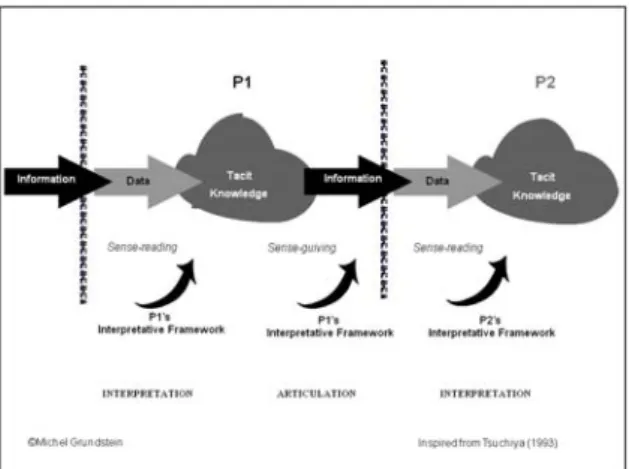
Our approach is built upon the assumption emphasized by Tsuchiya (1993) concerning knowledge creation ability. He states, “Although terms ‘datum’, ‘information’, and ‘knowledge’ are often used interchangeably, there exists a clear distinction among them. When datum is sense-given through interpretative framework, it becomes information, and when information is sense-read through interpretative framework, it becomes knowledge (p.88)”. Figure 1 represents our own interpretation of Tsuchiya’s assumption.
Figure 1: Creation of individual's tacit knowledge
In other words, we can say that tacit knowledge that resides in our brain results from the sense given, through our interpretative frameworks, to data that we perceive among the information transmitted to us. Or rather, Knowledge exists in the interaction between an Interpretative Framework (incorporated within the head of an individual, or embedded into an artefact), and data.
Consequently, we postulate that knowledge is not an object processed independently of the person who has to act. So, we can say that formalized and codified knowledge, that are independent from individual, are not more than information. Furthermore, as emphasized by Haeckel (2000) we must discern “the knowledge of knower and the codification of that knowledge (p. 295).”
2.2 Definition of Knowledge
Management (KM)
In 1990, the Initiative for Managing Knowledge Assets (IMKA, 1990) was initiated by a few companies (Carnegie Group, Inc., Digital Equipment Corporation, Ford Motor Company, Texas Instruments, Inc., and US WEST Advanced Technologies, Inc.). They defined for the first time the notion of knowledge assets: “Knowledge assets are those assets that are primary in the minds of company's employees. They include design experience, engineering skills, financial analysis skills, and competitive knowledge.”
Gradually, numerous research works were carried out, enterprise’s KM initiatives were deployed, and an abundant literature enriched the domain of Knowledge Management. So that the concept of KM highlighted a broad range of topics and became a fuzzy concept taking as many senses as people speaking about it. For instance, in his editorial preface, untitled “What is Knowledge Management?” Jennex (2005) has gathered some authors’ definitions that show that there is no common evidence about what KM is. Regan (2007) consolidates this observation. She states, “This lack of agreement on a definition of knowledge management seems atypical for an emerging discipline that traces its roots back at least two decades. Even the most recent textbooks in the field spend an entire chapter just explaining what knowledge management is and what it is not, and provide an entire page of definitions.”
The introduction to KMIS 2009 conference shows the same understanding: “There are several perspectives on KM, but all share the same core components, namely: People, Processes and Technology. Some take a techno-centric focus, in order to enhance knowledge integration and creation; some take an organizational focus, in order to optimize organization design and workflows; some take an ecological focus, where the important aspects are related to people interaction, knowledge and environmental factors as a complex adaptive system similar to a natural ecosystem.”
We can add that most of time, KM is considered from a technological viewpoint. For example, let’s consider the European Project Team in charge to elaborate The European Guide to Good Practice in Knowledge Management on behalf of the European Committee for Standardization Workshop on Knowledge Management. This Workshop was running from September 2002 till September 2003. The Project Team has collected, categorized and analyzed more than 140 KM Frameworks. It may be noted that this work has produced a high-quality practical outcome that can be used as a reference point to achieve a good understanding of KM (CEN-1, 2004). Nevertheless, as contributors to this project, we observed that few of them were “people-focused” as highlighted by Wiig (2004). We can underline the predominant positivist paradigm and the technological approach of KM that have inspired the project team. As a result, the authors consider a system of interrelated objects that can be described independently of individual. That has induced them to consider the knowledge as an object, and so to disregard the importance of people.
Furthermore we distinguished two main approaches underlying KM: (i) a technological approach that answers a demand of solutions based on the technologies of information and communication (ICT); and (ii) a managerial and sociological approach that integrates knowledge as resources contributing to the implementation of the strategic vision of the company. On the one hand, the technological approach leads to reduce knowledge to codified knowledge that is no more than information. In that case KM initiatives can be managed in the same way than Information System projects. On the other hand, the managerial and sociological approach that integrates knowledge as a resource is centered on the core business processes, and people.
In our research group, relying on Tsuchiya’s works (Tsuchiya, 1993) we argue that knowledge is dependent of the individual’s interpretative framework, and the context of his action. Consequently, knowledge resides primarily in the heads of individuals, and in the social interactions of these individuals. It cannot be consider as an object such as data are in digital information systems. Thus, it appears that KM addresses activities, which utilize and create knowledge more than knowledge by itself. With regard to this question, since 2001, our group of research has adopted the following definition of KM (Grundstein and Rosenthal-Sabroux, 2003): “KM is the management of the activities and the processes that enhance the
utilization and the creation of knowledge within an organization, according to two strongly interlinked goals, and their underlying economic and strategic dimensions, organizational dimensions, socio-cultural dimensions, and technological dimensions: (i) a patrimony goal, and (ii) a sustainable innovation goal (p.980).” The patrimony goal has to do with the preservation of knowledge, their reuse and their actualization; it is a static goal. The sustainable innovation goal is more dynamic. It is concerned with organizational learning that is creation and integration of knowledge at the organizational level.
3. DISTINGUISHING THE
NOTIONS OF INFORMATION AND
KNOWLEDGE
Numerous authors analyzed the notions of data, information and knowledge. Let us quote notably Davenport and Prusak (1998, pp.1-6)), Sena and Shani (1999), Takeuchi, and Nonaka, (2000), Amin, and Cohendet, (2004, pp. 17-30), Laudon and Laudon, (2006, p. 416). Besides, Snowden (2000,) makes the following synthesis: “The developing practice of knowledge management has seen two different approaches to definition; one arises from information management and sees knowledge as some higher-level order of information, often expressed as a triangle progressing from data, through information and knowledge, to the apex of wisdom. Knowledge here is seen as a thing or entity that can be managed and distributed through advanced use of technology…The second approach sees the problem from a sociological basis. These definitions see knowledge as a human capability to act (pp. 241-242).”
Here, one must think “Wisdom” as the level of the “collective, application of knowledge in action” (Sena 1999, p.8-4), or as “the collective and individual experience of applying knowledge to the solution of problems (Laudon and Laudon 2006, p. 416).”
In the following paragraphs, we clarify our approach.
3.1 Commensurability of
Interpretative Frameworks and
Individual Sense-Making
Tsuchiya emphases how organizational knowledge is created through dialogue, and highlighted how
“commensurability” of the interpretative frameworks of the organization’s members is indispensable for an organization to create organizational knowledge for decision and action. Here, commensurability is the common space of the set of interpretative frameworks of each member (e.g. cognitive models or mental models directly forged by education, experience, beliefs, and value systems). Tsuchiya states “It is important to clearly distinguish between sharing information and sharing knowledge. Information becomes knowledge only when it is sense-read through the interpretative framework of the receiver. Any information inconsistent with his interpretative framework is not perceived in most cases. Therefore, commensurability of interpretative frameworks of members is indispensable for individual knowledge to be shared (p. 89).”
Therefore, we consider information as knowledge when members having a large commensurability of their set of interpretative frameworks commonly understand it. In that case, we call it “information source of knowledge for someone.” Such is the case for members having the same technical or scientific education, or members having the same business culture. In these cases, formalized and codified knowledge make the same sense for each member. However, one must take into account that interpretative frameworks evolve in a dynamic way: they are not rigid mindsets. Especially, when considering that, as time is going on, contexts and situations evolve. Thus, the contribution of scientific results, techniques and new methods, the influence of young generations being born with Web (Y generation or Digital Native), the impact of identity crisis and multiple cultures, modify the interpretative frameworks, and create a gap between individuals’ commensurability of interpretative frameworks.
3.2 From Data to Individual’s Tacit
Knowledge
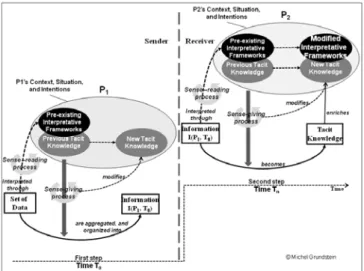
Let’s consider two individuals P1 and P2 acting in
different contexts and situations, at different points in time (Fig. 2).
While P1’s previous knowledge is necessary for
elaborating information from data gathered and filtered in the present time, once created this information becomes a frozen object. This static object is independent from P1, and time. Then, at
another time, when this information is captured by P2, only some data contained in the information are
selected and interpreted, taking sense for P2. In that
way, the P2’s tacit knowledge is modified.
Figure 2. From Data…to Individual’s Tacit Knowledge
In a first step, P1, in his context and situation,
gathers a set of data outside him. Then, during a sense-reading process that depends of his pre-existing interpretative frameworks activated depending of his context, his situation, and his intentions, he selects some of these data that take sense for him. In the same time, a sense-giving process using P1’s previous tacit knowledge enables
P1 to aggregate, and organize selected data he
perceived, into information. It is this information that is passed on by the individuals, or by means of the DIS where it is stored, treated and transmitted as a stream of digital data. During this process, P1’s
pre-existing interpretative frameworks are not changing; previous tacit knowledge can be reorganized and modified into new tacit knowledge.
In a second step, this information is captured by P2. According to his own context and situation, P2,
during a process of sense-reading, interprets this information filtering data through his pre-existing interpretative frameworks activated depending of his context, his situation, and his intentions. In the same time a sense-giving process that uses P2’s previous
knowledge operates, and engenders new tacit knowledge. That’s the way that changes P2’s
pre-existing framework and enriches P2’s previous tacit
knowledge enabling P2 to understand his situation,
identify a problem, find a solution, decide, and act. The results of these processes are modified interpretative frameworks, and new tacit knowledge.
The process of transformation of data into knowledge is a process of construction of knowledge. Created knowledge, can be very
different from one individual to another when the commensurability of their interpretative frameworks is small, whatever are the causes of it. There are large risks that the same information takes different senses for each of them, and consequently generates a construction of different tacit knowledge in the head of the decision process stakeholders. Unlike the information, knowledge is dynamic. Once constructed it cannot be considered as an object independent from the individual who built it, or the individual who appropriates it to make a decision and to act.
As a result one can understand the importance to clearly distinguish static factual information, which allows describing the context and the situation that raise a problem, from the knowledge of the individual who processes this information to learn and get knowledge he needs to carry out his tasks.
To answer this issue, distinguishing information from knowledge leads to conceive what we call Enterprise’s Information and Knowledge Systems (EIKS).
4. ENTERPRISE’S INFORMATION
AND KNOWLEDGE SYSTEM
(EIKS)
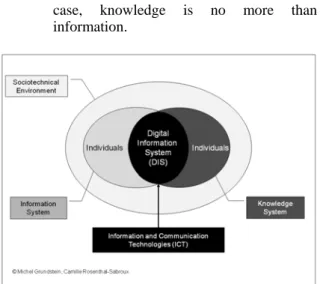
The enterprise’s information and knowledge system (EIKS) consists mainly in a set of individuals and digital information systems. EIKS rests on a socio-technical fabric, which consists of individuals in interaction among them, with machines, and with the very EIKS. It includes (Fig. 3):
• A Digital Information Systems (DIS), which are artificial systems, the artifacts designed from information and communication technologies (ICT)
• An information system constituted by individuals who, in a given context, are processors of data to which they give a sense under the shape of information. This information, depending of the case, is passed on, remembered, treated, and diffused by them or by the DIS.
• A knowledge system, consisting of tacit knowledge embodied by the individuals, and of explicit knowledge formalized and codified on any shape of supports (documents, video, photo, digitized or not). Under certain conditions, digitized knowledge is susceptible to be memorized, processed and spread with the DIS. In that
case, knowledge is no more than information.
Figure 3. The Enterprise’ s Information and Knowledge System (EIKS)
If “Technology provides the possibility of making information available across time and space” (Kautz and Kjaergaard 2008, p. 49 ) we always have to keep in mind, paraphrasing these authors, “the role of individual in the knowledge sharing process, but we do also pay attention to how individual use technology to share knowledge (p. 43).” So, considering EIKS, we insist on the importance to integrate the individual as a component of the system (Grundstein, 2007, pp. 243-247). Three natures of information must be distinguished: the Mainstream-Data, the Source-of-Knowledge-Data, and the Shared-Data (Grundstein and Rosenthal-Sabroux, 2003, pp. 980-981). Among the tools, the Information and Knowledge Portals supply a global access to the information, and can meet the needs of Knowledge Sharing. In that case, the functional software and the tools answering the aim of KM are integrated into the DIS.
5. PROSPECTS
When launching a KM initiative, the Strategic Orientation Phase is crucial and can avoid to get KM resources go unused as noticed by Stewart (Stewart, 2002) “One flaw in knowledge management is that it often neglects to ask what knowledge to manage and to what end (p.117).” We should add that KM is often oriented towards Information and Communication Technologies (ICT) that leads confusing notions of information and knowledge, and misunderstanding the goals: do we have to develop an Information System or do we have to
implement a KM System? Therefore, the Strategic Orientation Phase must help to build a general KM vision that makes a clear distinction between technology as a support to share individual’s tacit knowledge, and technology as a means to collect, store, and distribute explicit and codified knowledge that is no more than information (see § 2.1).
Distinguishing Information from Knowledge open our mind on a different view of information systems that leads to conceive what we call Enterprise’s Information and Knowledge Systems (EIKS). These systems include individuals and are based on Digital Information System (DIS). This pragmatic vision needs thinking about the architecture of an Enterprise’s Information and Knowledge System (EIKS), which must be a basis of discussion during the strategic orientation phase of a General KM Initiative.
ACKNOWLEDGEMENTS
I am grateful to Camille Rosenthal Sabroux and Virginie Goasdoue whose continuous contribution and relevant questioning encouraged me to clarify and improve the model presented in this paper.
REFERENCES
Amin, A., Cohendet P., 2004. Architectures of Knowledge, firms, capabilities, and communities. New York US: Oxford University Press Inc.
CEN-1, 2004. Knowledge Management Framework. In European Guide to Good Practice in Knowledge Management (Part 1). Brussels: CEN, CWA 14924-1:2004 (E). Retrieved June 19, 2004, from
ftp://cenftp1.cenorm.be/PUBLIC/CWAs/e-Europe/KM/CWA14924-01-2004-Mar.pdf
Davenport T. H., Prusak L., 1998. Working Knowledge. Harvard Business School Press, Boston.
Grundstein M., Rosenthal-Sabroux C., 2003. Three Types of Data For Extended Company’s Employees: A Knowledge Management Viewpoint. In M. Khosrow-Pour (Ed.), Information Technology and Organizations: Trends, Issues, Challenges and Solutions, 2003 IRMA Proceedings (pp. 979-983). Hershey, PA: Idea Group Publishing.
Grundstein M., 2007. Knowledge Workers as an Integral Component in Global Information System Design. In Wai K. Law (Ed.), Information Resources Management: Global Challenges (Chapitre XI, pp. 236-261). Hershey PA: Idea Group Publishing, 2007. IMKA, 1990. IMKA Technology Technical Summary,
July 30, 1990. IMKA project was formed by Carnegie
Group, Inc., Digital Equipment Corporation, Ford Motor Company, Texas Instruments Inc., and US West Advanced Technologies Inc.
Haeckel, S., H., 2000. Managing Knowledge in Adaptive Enterprises. In C. Despres and D. Chauvel (Eds), Knowledge Horizons (chap. 14, pp. 287-305). Woburn, MA: Butterworth-Heinemann.
Jennex, M. E., 2005. What is Knowledge Management? International Journal of Knowledge Management, Vol.1 No.4, pp. i-v. Hershey PA: Idea Group Publishing.
Kautz, K., Kjaergaard, A., 2008. Knowledge Sharing in Software Development. In P. A. Nielsen and K., Kautz (Eds), Software Processes & Knowledge. Beyond Conventional Software Process Improvement (Chapter 4, pp.43-68 ). Aalborg, Denmark: Software Innovation Publisher, Aalborg University.
KMIS 2009. International Conference on Knowledge Management and Information Sharing. Madeira, Portugal. Extracted, from http://www.ickm.ic3k.org/ April 2009
Laudon K C, Laudon J P., 2006. Management Information Systems; Managing the Digital Firm. Upper Saddle River, New Jersey: Pearson Education, Inc, (Ninth edition).
Regan, E.A., 2007. Knowledge Management: Evolving Concept and Practice. The International Journal of Knowledge, Culture and Change Management, Volume 6, Issue 9, pp.11-24).
http://www.Management-Journal.com
Sena J.A., Shani A.B., 1999. Intellectual Capital and Knowledge Creation: Towards an Alternative Framework. In J. Liebowitz (Ed.), Knowledge Management Handbook (chapter 6, pp. 6.1-6.29). Boca Raton, Florida: CRC Press LLC.
Snowden, D., 2000. The Social Ecology of Knowledge Management. In C. Despres & D. Chauvel (Eds) Knowledge Horizons (chap. 12, pp. 237-365). Woburn, MA: Butterworth-Heinemann.
Stewart, Th. A., 2002. The Wealth of Knowledge: Intellectual Capital and the 21tst century Organization. New York, USA: Currency Doubleday.
Takeuchi H., Nonaka, I., 2000. Theory of Organizational Knowledge Creation. In D. Morey, M. Maybury, B. Thuraisingham (Eds), Knowledge management, Classic and Contemporary Works (Chapter 6, pp. 139-182). Cambridge, MA: The MIT Press.
Tsuchiya S., 1993. Improving Knowledge Creation Ability through Organizational Learning. ISMICK'93 Proceedings, International Symposium on the Management of Industrial and Corporate Knowledge, UTC, Compiègne, October 27-28, 1993.
Wiig, K., 2004. People-Focused Knowledge Management. How Effective Decision Making Leads to Corporate Success. Burlington, MA: Elsevier Butterworth-Heinemann.
Wiig, K., 2008. Knowledge Management for the Competent Enterprise. Business Intelligence Vol. 8, No. 10. Cutter Consortium.