arXiv:1806.10963v4 [cs.DM] 10 Apr 2019
Graphs without a partition into two proportionally
dense subgraphs
Cristina Bazgana, Janka Chleb´ıkov´ab, Cl´ement Dallardb
aUniversit´e Paris-Dauphine, PSL Research University, CNRS, LAMSADE, Paris, France
b
School of Computing, University of Portsmouth, Portsmouth, United Kingdom
Abstract
A proportionally dense subgraph (PDS) is an induced subgraph of a graph such that each vertex in the PDS is adjacent to proportionally as many vertices in the subgraph as in the rest of the graph. In this paper, we study a partition of a graph into two proportionally dense subgraphs, namely a 2-PDS partition, with and without additional constraint of connectivity of the subgraphs. We present two infinite classes of graphs: one with graphs without a 2-PDS partition, and another with graphs that only admit a disconnected 2-PDS partition. These results answer some questions proposed by Bazgan et al. [Algorithmica 80(6) (2018), 1890–1908].
Keywords: graph partition, dense subgraph
1. Introduction
The problems of partitioning a graph into two parts have been intensively studied with various objective functions and constraints. Let’s mention at least two such NP-hard problems. The Satisfactory Partition problem [2] asks whether a graph can be partitioned into two parts such that every vertex is adjacent to more vertices in its own part than in the other. In the Maximally Balanced Connected Partitionproblem, the task is to partition a graph into two connected subgraphs such that the size of the smallest subgraph is maximised [5].
The notion of proportionally dense subgraph is closely related to the notion of community as introduced in [10]. Olsendefines a community structure as a partition of the vertices into communities, where a part, i.e. an induced sub-graph (with at least 2 vertices), is a community if and only if each vertex has proportionally as many neighbours in its community than in any other commu-nity. In [3], the authors investigate the notion of 2-community structure as a community structure with exactly two parts. We use the same definition (up to the special case where a community is of size one) to define a 2-PDS partition. So far, only few results are known about the existence of a 2-PDS partition in a graph, and the complexity of finding one. It has been proved in [6] that deciding if a graph contains a 2-PDS partition with both PDS’s of the same size
is NP-complete. On trees [3,6] and graphs with maximum degree 3 or minimum degree n − 3, (n the order of the graph) a connected 2-PDS partition always exists and can be found in polynomial time [3]. The results extensively use the connectivity of the PDS’s. To find a connected 2-PDS partition in a tree, one can prove that there exists an edge such that its removal yields two connected PDS’s. If a graph has a maximum degree at most 3, a greedy algorithm keeps decreasing the size of a cut under some constraints and the removal of the final cut describes two connected PDS’s.
Another problem related to the notion of PDS is the Max PDS problem. In this problem, the goal is to determine the size of a maximum PDS (with regard to the number of vertices) in a given graph. Hence, only the vertices inside the PDS must be satisfied. In [4], the authors prove that Max PDS is NP-hard on bipartite and split graphs, and propose a polynomial-time (2− 2
∆+1 )-approximation algorithm, where ∆ is the maximum degree of the graph. They also show that deciding if a subset of vertices can be a (proper) subset of the vertices of a PDS is co-NP-complete on bipartite graphs.
Our contributions. In Section2, we formally define the concepts of proportion-ally dense subgraphs and PDS partitions, and outline the known results about the 2-PDS partition problem. Then, we construct an infinite family of graphs without a 2-PDS partition in Section3.1. As far as we know, these are the first negative results regarding the existence of a 2-PDS partition. We also give ex-amples of graphs without a 2-PDS partition that do not belong to the family. In Section3.2we present another infinite family of graphs without a connected 2-PDS, but with a disconnected one.
2. Proportionally dense subgraphs
All graphs in this paper are simple. Given a graph G = (V, E) and a subset of vertices S ⊂ V , S refers to the set V \S. For a vertex u ∈ V , N (u) represents the set of neighbours of u, d(u) := |N (u)| is the degree of u, and dS(u) := |N (u)∩S| denotes the degree of u in S. We say that a vertex u ∈ V is universal if it is connected to all other vertices of the graph, that is, d(u) = |V | − 1.
The density of a subgraph on a vertex set S ⊆ V is usually defined as |E(S)||S| , where E(S) is the set of edges in the subgraph. The problem of finding a sub-graph of maximum density can be solved in polynomial time [8], but it becomes NP-hard when at least, or exactly, k vertices must belong to the subgraph [1,7,9].
In this paper, we introduce the notion of proportionally dense subgraph (PDS), which captures both the size of the subset and the number of
neigh-bours.
Definition 1. For a graph G = (V, E), a proportionally dense subgraph of G is an induced subgraph on a vertex set S ⊂ V such that each vertex u ∈ S is
satisfied in S, that is,
Note that if |S| ≥ 2, then we can rewrite the inequalities as dS(u) |S| − 1 ≥ dS(u) |S| or, equivalently, dS(u) |S| − 1 ≥ d(u) |V | − 1.
The proof of the equivalence can be found in [3]. Note that a subgraph con-taining a single vertex is also a PDS, but obviously a PDS cannot be the entire graph.
Definition 2. A 2-PDS partition of a graph G = (V, E) is a partition Π = {S1, S2} of V such that S1 and S2 induce two PDS’s in G.
In this paper, we address the problem of deciding if a graph admits a 2-PDS partition. Notice that a 2-PDS doesn’t necessarily need to be connected. Therefore we also consider the problem of deciding if a graph has a connected
2-PDS partition, that is, a 2-2-PDS partition whose 2-PDS’s are connected subgraphs.
If a graph is disconnected, both problems become trivial, hence we assume that all graphs are connected.
3. Infinite classes of graphs
3.1. Graphs without 2-PDS partition
The question about the existence of graphs without a 2-PDS was left open in [3]. To the best of our knowledge, no graphs without a 2-PDS partition were known. In this section we present an infinite class G (see Definition3) of graphs with even number of vertices without a 2-PDS partition.
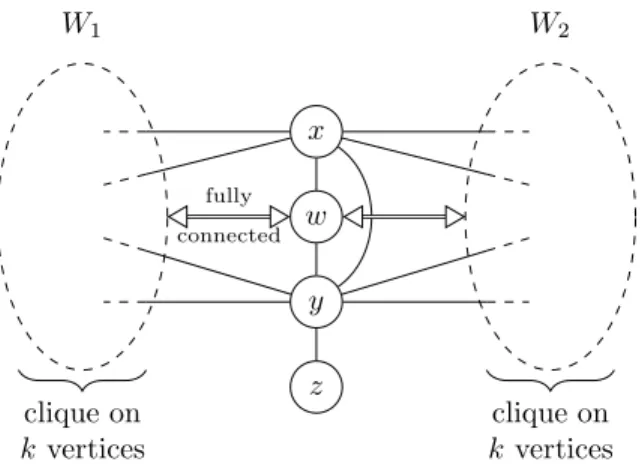
z y x w W1 clique on k vertices W2 clique on k vertices fully connected
Figure 1: A schematic representation of a graph in G.
Definition 3. Let G be the class of graphs such that, if G = (V, E) ∈ G, then • V = W1∪ W2∪ {w, x, y, z}, where W1, W2are cliques of the same size k,
• w is adjacent to all vertices in W1∪ W2, and z is only adjacent to y • 1 ≤ dW1(x) = dW2(x) ≤ k − 1 and 2 ≤ dW1(y) = dW2(y) ≤ k − 1;
• |Wi∩ (N (x) ∪ N (y)) | >k+33k for each i ∈ {1, 2};
• there exist vertices α, β ∈ W1 ∪ W2 such that α ∈ N (y) \ N (x), and β ∈ N (x) ∩ N (y);
• there is no edge between the vertex sets W1 and W2.
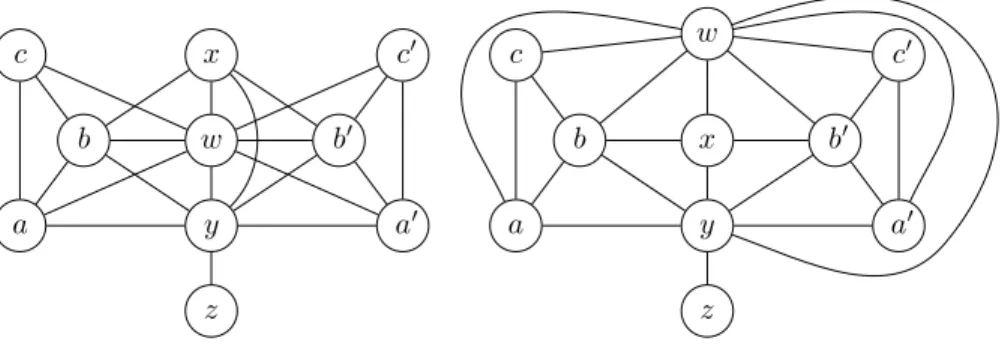
Note that the smallest graphs in G have 10 vertices, and one of them is planar (see Fig.2).
z y x w a b c a′ b′ c′ z y x w a b c a′ b′ c′
Figure 2: A planar graph from G with 10 vertices without a 2-PDS partition. On the left, its
schematic representation as in Fig.1; on the right, its planar representation.
Theorem 1. All graphs in G do not have a 2-PDS partition.
Proof. Let G = (V, E) be a graph in G. Firstly, notice that there is no 2-PDS
partition {A, B} in G such that |A| = 1 or |B| = 1. Without loss of generality, suppose by contradiction that A = {v} for some vertex v ∈ V , and notice that the neighbour of v in B must be a universal vertex in order to be satisfied. Since G does not contain a universal vertex, there is no 2-PDS partition {A, B} in G with |A| = 1 or |B| = 1. Hence, assume that |A|, |B| ≥ 2.
Observe that the vertex z is satisfied if and only if it belongs to the same PDS as the vertex y. Hence, without loss of generality, we assume that y, z ∈ B. In addition, the vertex w has degree |V | − 2 and is not connected to z ∈ B. Hence, necessarily w ∈ A.
Now we prove that for any partition {A, B} of V , where w ∈ A and y, z ∈ B, there is at least one vertex which is not satisfied, hence there is no 2-PDS partition in G. For any partition {A, B} of V , we denote by Ai and Bi the sets A ∩ Wi and B ∩ Wi, respectively, for i ∈ {1, 2}. We split the proof into two cases: In the first case, we suppose that B1or B2 is empty; in the second case, we assume that B1and B2are not empty.
Case 1: B1= ∅ or B2= ∅
• If B2= ∅, we have two possibilities:
– if x ∈ B, then B = {x, y, z} and β ∈ A is not satisfied since dA(β)
|A|−1 =2kk < 2
3 = dB(β)
|B| ;
– if x ∈ A, then B = {y, z} and α ∈ A is not satisfied since dA(α) |A|−1= k 2k+1 < 1 2 = dB(α) |B| . • If B26= ∅ and B26= W2, – Case x ∈ B.
∗ If there exists u ∈ A2 such that u ∈ N (x) ∪ N (y) and u is satisfied, then we have: |A2| k + |A2| = dA(u) |A| − 1 ≥ d(u) |V | − 1 ≥ k + 1 2k + 3,
which implies that |A2| · (k + 2) ≥ k · (k + 1), hence that |A2| > k − 1. A contradiction since |A2| ≤ k − 1.
∗ Otherwise, for all u ∈ A2, u /∈ N (x) ∪ N (y). Hence, for any u ∈ A2, if u is satisfied then: |A2| k + |A2| = dA(u) |A| − 1 ≥ d(u) |V | − 1 = k 2k + 3, which implies that |A2| · (k + 3) ≥ k2, hence that |A2| ≥ k
2 k+3. Due to our assumptions about the graph, |W2∩ (N (x) ∪ N (y)) | > k+33k . Thus, k −k+33k > |W2\ (N (x) ∪ N (y))| ≥ |A2| ≥ k
2
k+3 which implies k > k, a contradiction.
– Case x ∈ A. Let u ∈ A2.
∗ If u ∈ N (y) ∩ N (x) and u is satisfied, then we have: |A2| + 1 k + |A2| + 1 = dA(u) |A| − 1 ≥ d(u) |V | − 1 = k + 2 2k + 3,
which implies that |A2| ≥ k −k+11 , and then |A2| ≥ k, a contradiction since B26= ∅.
∗ If u ∈ N (y) \ N (x), then dA(u) = |A2| and d(u) = k + 1. Therefore, similarly to the previous case, we obtain that |A2| ≥ k + k+21 and so |A2| > k, a contradiction. ∗ If u ∈ N (x) \ N (y), then: |A2| + 1 k + |A2| + 1 = dA(u) |A| − 1 ≥ d(u) |V | − 1 = k + 1 2k + 3, which implies that |A2| · (k + 2) ≥ k2− 2, hence |A2| ≥ k
2−2
k+2 > k − 2. Since assuming that there is a vertex in A2∩ N (y) leads to a contra-diction (see previous cases), we can assume that A2∩N (y) = ∅. Then,
since dW2(y) ≥ 2, then |W2\ N (y)| ≤ k − 2. Thus k − 2 ≥ |A2| > k − 2,
a contradiction.
∗ If u /∈ N (x) ∪ N (y), then dA(u) = |A2| and d(u) = k + 1. Again, similarly to the previous case, we obtain |A2| > k, a contradiction since |B2| 6= ∅.
• If B2 = W2, then either B = {x, y, z} ∪ W2, and we have |A| + 2 = |B| but dA(x) = dB(x) thus x is not satisfied, or B = {y, z} ∪ W2, and since |A| = |B| we have: dB(y)
|B|−1 < dB(y)+1 |B| = dA(y) |B| = dA(y)
|A| , thus y is not satisfied. We conclude that if there is a 2-PDS partition in G, then B16= ∅. The case B2= ∅ is similar, therefore if there is a 2-PDS partition in G, then B26= ∅.
Case 2: B1, B26= ∅.
Without loss of generality, we suppose |B1| ≤ |B2|. Let u ∈ B1and suppose that u is satisfied in the partition {A, B}. We prove that in all cases, if u is satisfied then it implies a contradiction with |B1| ≤ |B2|.
• If x ∈ A
∗ If u ∈ N (x) ∩ N (y) is satisfied, then: |B1| |B1| + |B2| + 1 = dB(u) |B| − 1 ≥ d(u) |V | − 1 = k + 2 2k + 3,
which implies that |B1|·(k+1) ≥ (|B2|+1)·(k+2), hence that |B1| > |B2|. A contradiction with the assumption that |B1| ≤ |B2|, hence u is not satisfied.
∗ If u ∈ N (x)\N (y), we have dB(u) = |B1|−1 and d(u) = k+1 and similarly we obtain |B1|·(k+2) ≥ |B2|·(k+1)+(3k+4) ≥ |B2|·(k+1)+(|B2|+4) > |B2| · (k + 2), a contradiction since |B1| ≤ |B2|.
∗ If u ∈ N (y) \ N (x), we have dB(u) = |B1| and d(u) = k + 1 and similarly we obtain |B1|·(k +2) ≥ |B2|·(k +1)+(k +1) ≥ |B2|·(k +1)+(|B2|+1) > |B2| · (k + 2), a contradiction since |B1| ≤ |B2|.
∗ If u /∈ N (x) ∪ N (y), we have dB(u) = |B1| − 1 and d(u) = k and similarly we obtain |B1| · (k + 3) ≥ |B2| · k + 3(k + 1) ≥ |B2| · k + 3(|B2| + 1) > |B2| · (k + 3), a contradiction since |B1| ≤ |B2|.
• If x ∈ B
∗ If u ∈ N (x) ∩ N (y) is satsfied, then: |B1| + 1 |B1| + |B2| + 2 = dB(u) |B| − 1 ≥ d(u) |V | − 1 = k + 2 2k + 3,
which implies that |B1| · (k + 1) ≥ |B2| · (k + 2) + 1, thus that |B1| > |B2|. A contradiction with the assumption that |B1| ≤ |B2|, hence u is not satisfied.
∗ If u ∈ N (x) \ N (y) or u ∈ N (y) \ N (x), we have dB(u) = |B1| and d(u) = k+1 and similarly we obtain |B1|·(k+2) ≥ |B2|·(k+1)+2(k+1) ≥ |B2| · (k + 1) + 2(|B2| + 1) > |B2| · (k + 3), a contradiction since |B1| ≤ |B2|. ∗ If u /∈ N (x) ∪ N (y), we have dB(u) = |B1| − 1 and d(u) = k and similarly
we obtain |B1|·(k+3) ≥ |B2|·k+4k+3 ≥ |B2|·k+3k +4·|B2|+3 > |B2|·(k+4), a contradiction since |B1| ≤ |B2|.
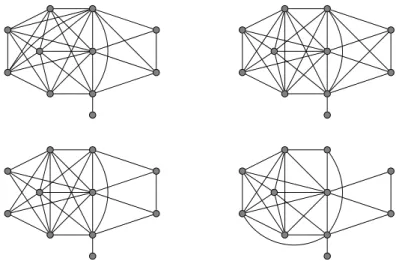
In Fig.3, we present four graphs with 11 vertices without a 2-PDS partition. These graphs have an odd number of vertices, hence they do not belong to G. To prove that they do not have a 2-PDS partition, one can notice that, like the graphs in G, they have a pendant vertex z connected to a vertex y, and a vertex w connected to all the vertices except the pendant vertex. As a result, the vertex z is satisfied if and only if it belongs to the same PDS as y, and thus w must be in the other PDS. The rest of the proof can be done by case distinction.
Figure 3: Four graphs with 11 vertices which do not have a 2-PDS partition
3.2. Disconnected 2-PDS partition
Now, we present an infinite family of graphs where each graph admits a disconnected 2-PDS partition, but not a connected one. The existence of such graphs was left as an open problem in [3].
Definition 4. We define the infinite class of graphs H such that, if G = (V, E) ∈ H, then
• V := W ∪ {α1, β1, α2, β2}, where W is a clique of odd size at least 7; • ∃x, y ∈ W such that {x, α1}, {x, β1}, {x, β2}, {y, α2}, {y, β2}, {y, β1} ∈ E; • {α1, β1}, {α2, β2} ∈ E.
α1 β1 β2 α2 x y clique on 2k + 1 vertices W
Figure 4: A schematic representation of a graph in H.
Compared to the graphs in G, each graph in H has an odd number of vertices, the smallest one has 11 vertices.
Theorem 2. All graphs in H do not have a connected 2-PDS partition, but have a disconnected one.
Proof. Let G = (V, E) ∈ H. Suppose that G has a connected 2-PDS partition
{A, B}. If A ⊆ W , then we have two cases: either A = W but then G[B] is disconnected, or A ⊂ W but then a vertex in W \ A is not satisfied in B. Hence, A* W and similarly B * W . Consequently, to guarantee the connectivity of G[A] and G[B], the vertices x and y must be in different parts of the partition. Therefore, we assume without loss of generality that x ∈ A and y ∈ B.
If α1 ∈ B, then y is not satisfied since it is connected to each vertex in A. Similarly, α2 cannot belong to A since otherwise x is not satisfied. As a result, we only have to consider the possible cases for β1and β2, knowing that x, α1∈ A and y, α2∈ B.
If β1 ∈ A and β2 ∈ B, then consider two vertices a ∈ (W \ {x}) ∩ A and b ∈ (W \ {y}) ∩ B. The vertex a is satisfied in A if and only if
dA(a) |A| − 1 = |A| − 3 |A| − 1 ≥ |B| − 2 |B| = dB(a) |B| ,
which implies that |A| ≥ |B| + 1. Similarly, the vertex b is satisfied in B if and only if |A| ≤ |B| − 1, which is a contradiction.
If β1, β2∈ A, then the vertex β2 is satisfied in A if and only if dA(β2) |A| − 1 = 1 |A| − 1 ≥ 2 |B| = dB(β2) |B| ,
which implies that |A| ≤ |B|2 + 1. Moreover, the vertex α2 is satisfied in B if and only if dB(α2) |B| − 1 = 1 |B| − 1 ≥ 1 |A| = dA(α2) |A| ,
which implies that |A| ≥ |B| − 1. We then obtain |B| − 1 ≤ |A| ≤ |B|2 + 1, and therefore |B| ≤ 4. Thus, |A| ≤ 3, which is not possible since |V | ≥ 11. Similar arguments can be used to prove that β1and β2 cannot both belong to B.
We conclude that G does not have a connected 2-PDS partition. However, it is easy to see that, if A := {α1, β1, α2, β2} and B := V \ A, then {A, B} is a disconnected 2-PDS partition of G.
4. Conclusion and further work
The definition of a proportionally dense subgraph is based on a combination of local and global properties, where each vertex has to satisfy a condition depending not only on its degree but also on the size of the subgraph. This property makes the problem complex from an algorithmic point of view and requires a novel approach.
Our infinite families of graphs bring a new insight into the existence of 2-PDS partitions in graphs, with and without constraint of connectivity. Further re-search may investigate the structural characterisations of graphs with or without a (connected) 2-PDS partition. These results can help to answer the following important question: what is the complexity of deciding whether a graph admits a (connected) 2-PDS partition?
References
[1] Y. Asahiro, R. Hassin, and K. Iwama. Complexity of finding dense sub-graphs. Discrete Applied Mathematics, 121(1-3):15–26, 2002.
[2] C. Bazgan, Z. Tuza, and D. Vanderpooten. The satisfactory partition prob-lem. Discrete Applied Mathematics, 154(8):1236–1245, 2006.
[3] C. Bazgan, J. Chleb´ıkov´a, and T. Pontoizeau. Structural and algorithmic properties of 2-community structures. Algorithmica, 80(6):1890–1908, 2018. [4] C. Bazgan, J. Chleb´ıkov´a, C. Dallard, and T. Pontoizeau. Proportionally dense subgraph of maximum size: complexity and approximation. arXiv
preprint arxiv:1903.06579, 2019.
[5] J. Chleb´ıkov´a. Approximating the maximally balanced connected partition problem in graphs. Information Processing Letters, 60(5):225–230, 1996. [6] V. Estivill-Castro and M. Parsa. On connected two communities. In
Pro-ceedings of the 36th Australasian Computer Science Conference (ACSC),
pages 23–30, 2013.
[7] U. Feige, D. Peleg, and G. Kortsarz. The dense k-subgraph problem.
Al-gorithmica, 29(3):410–421, 2001.
[8] A. V. Goldberg. Finding a maximum density subgraph. Technical Report UCB/CSD-84-171, EECS Department, University of California, Berkeley, 1984.
[9] S. Khuller and B. Saha. On finding dense subgraphs. In Proceedings of the
36th International Colloquium on Automata, Languages and Programming (ICALP), volume 5555 of LNCS, pages 597–608. Springer-Verlag, 2009.
[10] M. Olsen. A general view on computing communities. Mathematical Social