HAL Id: tel-02887289
https://pastel.archives-ouvertes.fr/tel-02887289
Submitted on 2 Jul 2020
HAL is a multi-disciplinary open access
archive for the deposit and dissemination of sci-entific research documents, whether they are pub-lished or not. The documents may come from teaching and research institutions in France or abroad, or from public or private research centers.
L’archive ouverte pluridisciplinaire HAL, est destinée au dépôt et à la diffusion de documents scientifiques de niveau recherche, publiés ou non, émanant des établissements d’enseignement et de recherche français ou étrangers, des laboratoires publics ou privés.
by orientation and two-step curing
Ludovic Feige
To cite this version:
Ludovic Feige. Introduction of anisotropy in double network elastomers by orientation and two-step curing. Material chemistry. Université Paris sciences et lettres, 2019. English. �NNT : 2019PSLET030�. �tel-02887289�
Préparée à l’Ecole Supérieure de Physique et de Chimie
Industrielles de la ville de Paris (ESPCI Paris)
Introduction of anisotropy in double network elastomers
by orientation and two-step curing
Introduction d'anisotropie dans des doubles réseaux élastomères par orientation et
réticulation en deux étapes
Soutenue par
Ludovic FEIGE
Le 18 Décembre 2019
Ecole doctorale n° 397
Physique et chimie des
matériaux
Spécialité
Chimie des Matériaux
Composition du jury :
Renaud, NICOLAY Professeur, Président ESPCI Paris Catherine, AMIEL Professeure, Rapportrice Université Paris 12 Julie, DIANIDirectrice de recherche, Rapportrice
CNRS / Ecole Polytechnique
Guillaume, MIQUELARD-GARNIER
Maître de conférences Examinateur
Conservatoire National des Arts et Métiers
Meredith, WISEMAN
Ingénieure de Recherche Examinatrice
DSM
Costantino, CRETON
Directeur de recherches Directeur de thèse
Table of contents ... iii
Substantial summary in French ... vii
Acknowledgments ... xv
List of Symbols ... xvii
List of abbreviations ... xix
General introduction ... 1
Chapter 1: From chemistry and physics to the design of new double network
elastomers ... 7
1. Introduction ... 11
2. Chemistry and physics of crosslinked elastomeric networks ... 13
2.1. Synthesis of permanent polymeric networks ... 13
2.2. From chain physics to network properties ... 19
3. Fracture of soft materials and how to reinforce them ... 27
3.1. Description of fracture in soft materials, a matter of dissipation ... 27
3.2. General guidelines for improving the fracture resistance of soft materials ... 32
4. The multiple network strategy: from the original concept to new properties ... 41
4.1. Double network hydrogels ... 41
4.2. From hydrogels to elastomers ... 47
4.3. The challenge of describing the reinforcing mechanism theoretically ... 52
4.4. Toward new properties for multiple network elastomers ... 55
5. Bringing anisotropy to double network elastomers ... 57
5.1. Example of anisotropic polymeric systems ... 57
5.2. Oriented chains in rubbers, a key element for some applications ... 60
5.3. Battle plan, or how to make double networks anisotropic ... 63
6. Conclusions ... 67
systems ... 85
1. Introduction ... 89
1.1. Overview of the requirements specifications ... 89
1.2. Presentation of the thermal system ... 89
1.3. Presentation of the UV system ... 90
1.4. Outline ... 91
2. Generalities about chemistry and material preparation ... 93
2.1. Chemicals and formulation ... 93
2.2. Materials synthesis ... 94
2.3. Characterization methods ... 96
3. Study of the thermal system ... 101
3.1. A kinetic study of the system ... 101
3.2. Variation of the initial formulation ... 106
3.3. Partial conclusion and identification of a working point formulation ... 112
4. Study of the UV system ... 115
4.1. Effect of crosslinker content ... 115
4.2. Effect of initiator content ... 116
4.3. Effect of allyl acrylate content ... 117
4.4. The issue of sample-to-sample variability ... 121
5. Conclusions ... 125
6. References ... 127
Chapter 3: Application of the dual-cure systems to the preparation of
prestretched filler networks ... 129
1. Introduction ... 133
2. Preparation process ... 135
2.1. Initial network formulations ... 135
2.2. Prestretching and second curing ... 135
2.3. Problems encountered during the thermal second curing ... 135
3. Preparation of prestretched samples and measurement of prestretching ... 139
3.1. Presentation of the results ... 139
4.1. Description of the approach ... 155
4.2. Derivation of the model ... 156
5. Conclusions ... 163
6. References ... 165
Chapter 4: Incorporation of prestretched filler networks into double
network structures ... 167
1. Introduction ... 171
2. Preparation process and additional characterization tools ... 173
2.1. Filler networks ... 173
2.2. Preparation of double networks ... 173
2.3. Step-cyclic tests ... 174
2.4. Fracture tests ... 176
3. Study of two examples of prestretched DN ... 181
3.1. Relative changes in dimensions ... 181
3.2. Mechanical characterization ... 183
3.3. Toward a more detailed characterization? ... 186
3.4. Partial conclusion ... 193
4. Systematic study of the UV system ... 195
4.1. Identification of typical trends and odd ones ... 195
4.2. Study of unprestretched double network samples ... 196
4.3. Study of prestretched DN using envelope curves ... 201
4.4. Exploitation of the entire cyclic test ... 207
4.5. Suggested physical picture ... 222
5. Influence of damage on mechanical properties for the UV system ... 231
5.1. Study of viscoelastic properties ... 231
5.2. Study of fracture properties ... 234
6. Conclusions ... 239
1. Introduction and context ... 247
2. Materials preparation and characterization ... 249
2.1. Overall presentation of the preparation strategy ... 249
2.2. Materials preparation ... 250
2.3. Dynamic Mechanical Analysis ... 254
2.4. Tensile tests ... 257
3. Results regarding the materials preparation... 259
3.1. Overall overview of the synthesis ... 259
3.2. Quantitative parameters associated to synthesis ... 260
4. DMA characterizations ... 263
4.1. Effect of the nature of the crosslinker ... 263
4.2. Effect of crosslinker content / UV synthesis / BDMA crosslinker ... 268
4.3. Effect of initiation type ... 269
5. Tensile characterizations ... 273
5.1. UV-polymerized DN with 0.75mol% BDMA ... 273
5.2. UV-polymerized DN with 1.5 mol% BDA ... 274
6. Conclusions ... 277
7. References ... 279
Chimie et physique au service de la conception de nouveaux doubles
réseaux élastomères
Les élastomères sont des matériaux qui combinent deux propriétés très importantes : d’un côté un module bas et de l’autre une grande capacité de déformation. Ces propriétés sont dues à l’origine statistique de la déformation caoutchoutique. La compréhension fine de ce phénomène permet la conception de matériaux qui peuvent être utilisés dans un nombre toujours croissant d’applications.
Pour ce faire, il est intéressant de dépasser le compromis classique qui existe entre rigidité et ténacité. Dans un réseau élastomère simple, ces deux propriétés sont fondamentalement opposées, de sorte que de gros efforts de recherche ont été fournis pour trouver des matériaux à la fois rigides et résistants à la rupture. Jusqu’à maintenant, ces stratégies se sont concentrées autour de l’utilisation de charges minérales et de l’incorporation de dissipation d’origine viscoélastique. Toutefois, ces deux solutions ne sont pas toujours satisfaisantes et présentent le gros désavantage de rendre les matériaux opaques et leurs propriétés fortement dépendantes de la température et de la vitesse de sollicitation.
Parmi les nombreuses stratégies de renforcement qui ont été décrites dans la littérature, les élastomères à réseaux multiples sortent du lot par le fait qu’ils permettent une amélioration des propriétés mécaniques en jouant sur l’architecture du réseau de polymère, indépendamment de sa nature chimique. Cette stratégie a tout d’abord été développée par le groupe de Gong au Japon, et a depuis été largement étudiée, puis transposée aux élastomères il y a quelques années dans notre groupe.
Un double réseau élastomère est un ensemble de deux réseaux de polymères interpénétrés qui présentent des architectures différentes l’un de l’autre (Figure 1). L’un des réseaux dit « de charge » est fortement réticulé et contient des chaı̂nes qui sont préétirées. Le deuxième réseau est dit « matrice » et présente au contraire une faible densité de réticulation. Ce réseau matrice est également présent en beaucoup plus grande quantité que le réseau de charge dans la structure en
Réseau de charge
Fortement réticulé
Chaines préétirées
Réseau matrice
Faiblement réticulé
En majorité
Figure 1: représentation schématique d’une structure de type “double réseau”. Le réseau de charge est représenté en bleu, et le réseau matrice en rouge. Les deux réseaux sont interpénétrés à l’échelle moléculaire.rupture du réseau de charge qui dissipe de l’énergie mécanique et redistribue sa contrainte aux chaines très extensibles du réseau matrice. Dans cette structure, l’étirement des chaines du réseau de charge est un paramètre clé puisqu’il contrôle la capacité des chaines à casser et donc à dissiper de l’énergie.
La compréhension des mécanismes de renforcement des doubles réseaux élastomères permet aujourd’hui de se concentrer sur des matériaux qui sont plus proches des applications industrielles. Ainsi, la question de l’anisotropie est un aspect encore peu étudié des doubles réseaux élastomères. Qu’elle soit désirée ou subie, la dépendance des propriétés mécaniques avec la direction de sollicitation est une réelle problématique industrielle qui nécessite d’être étudiée plus en détails.
Dans la littérature, les matériaux polymères et leurs applications en lien avec l’anisotropie utilisent souvent un système qui permet de préétirer les chaines dans une direction donnée et de bloquer cet étirement par l’intermédiaire d’une réaction chimique ou d’une transition de phase. Dans un double réseau élastomère, la présence de chaines préétirées dans une seule direction dans le réseau de charge devrait donner un comportement anisotrope à grandes déformations pour le double réseau, et peut-être aussi à petites déformations. Le principal objectif de ce projet de thèse est donc de réaliser de tels matériaux en pratique et d’étudier leurs propriétés, notamment mécaniques.
Le principal verrou scientifique de ce projet est de trouver un système chimique qui permette de préétirer le réseau de charge et de garder les chaines pré-orientées dans une seule direction pour ensuite polymériser le réseau matrice. Cela nécessite de trouver une méthode pour réticuler le réseau de charge en deux étapes, le seconde étant réalisée à l’état étiré. Ce système dit de « double réticulation » est donc la combinaison d’une réticulation simultanée pour la première étape (i.e. les chaines sont synthétisées et réticulées en même temps) et d’une réticulation séquentielle pour la deuxième (i.e. on tire profit de groupements réactifs sur les chaines pour les coupler entre elles).
Conception et étude préliminaire de deux systèmes de double-réticulation
Dans ce premier chapitre expérimental, deux systèmes de double-réticulation ont été conçus, testés puis optimisés dans l’objectif de préparer des réseaux de charge présentant un préétirement uniaxial permanent. Pour les deux systèmes, on prépare tout d’abord un réseau initial par polymérisation radicalaire conventionnelle initiée par UV, en partant d’une formulation contenant un monomère acrylique, un initiateur et plusieurs additifs. La réaction de seconde réticulation est ensuite activée et le changement des propriétés mécaniques est étudié, d’abord sans préétirement.
Le premier système utilise deux comonomères (l’acide acrylique - AA - et le méthacrylate de glycidyl - GMA -), un catalyseur (la triethylamine) et une synthèse en « one-pot ». Le réseau initial est mou et extensible, et peut être rigidifié significativement par chauffage et condensation des groupements acides et glycidyl qui ont été copolymérisés dans le squelette carboné lors de la première étape de réticulation (Figure 2). Une expérience de DMA à déformation et température
imposées est réalisée et comparée à un modèle cinétique. Un modèle du second ordre décrit bien nos mesures, et permet de déterminer une énergie d’activation de l’ordre de 70 kJ/mol. En utilisant ce modèle, des conditions optimales de chauffage ont pu être déterminées (2h de chauffage à 150 °C). Dans les formulations de ce premier système, le paramètre le plus utile pour piloter les propriétés des réseaux est la quantité de GMA et AA dans la formulation. Des mesures de gonflement à l’équilibre et des propriétés mécaniques ont permis de déterminer une formulation qui devrait être compatible avec une structure de type double réseau résistante à la rupture. Avec cette formulation, le module de Young du réseau de charge augmente typiquement de 0.20 à 0.82 MPa pendant la deuxième réticulation.
Le second système étudié utilise une formulation beaucoup plus simple avec un seul comonomère (l’acrylate d’allyle - ALA -). Ce comonomère contient deux fonctions avec deux réactivités différentes, ce qui permet d’envisager une réticulation en deux étapes (Figure 3). Afin d’assurer la réaction de toutes les unités allyle dans la deuxième étape, l’irradiation est effectuée avec une dose UV beaucoup plus élevée et est précédée par une étape d’infiltration d’initiateur. L’utilisation de BDA (le réticulant classique diacrylate utilisé dans nos synthèses) s’avère superfétatoire dans nos synthèses, alors que la baisse de la quantité de HMP s’avère néfaste pour le rendement de la réaction de polymérisation initiale. Le principal paramètre qui a été utilisé pour jouer sur les propriétés des réseaux est donc la quantité de ALA utilisée. Contrairement au système thermique, les propriétés des réseaux doublement réticulés préparés par le système UV sont beaucoup plus faciles à interpréter et à rapprocher des formulations qui ont été utilisées. Selon la formulation, le module de Young des réseaux réticulés une fois est de 0.56 à 0.89 MPa, alors que le module des réseaux doublement réticulés va de 0.86 à 1.5 MPa.
Au final, des points de fonctionnement ont été déterminés pour les deux systèmes de double-réticulation via l’étude des propriétés mécaniques de réseaux non préétirés. Ces propriétés sont cohérentes avec notre objectif d’utiliser ces systèmes pour préparer des doubles réseaux utilisant des réseaux de charges préétirés de façon permanente. Avant de se concentrer sur les doubles réseaux, le prochain chapitre s’intéresse d’abord aux réseaux de charge préétirés isolés et à la possibilité de modéliser leurs propriétés en petites et grandes déformations.
O HO
Δ
O Othermique. Les lignes en vague représentent des chaines de polymère préformées.
Figure 3: structure chimique de l’acrylate d’allyle. La molecule possède deux fonctions chimique, l’une (en vert) étant beaucoup plus reactive que l’autre (en rouge) vis à vis de la polymérisation radicalaire.
de charge préétirés
Dans ce chapitre, les conditions de double réticulation identifiées précédemment ont été appliquées à la préparation d’élastomères qui sont préétirés dans une direction de façon permanente.
D’emblée, la préparation de ces matériaux s’est révélée beaucoup plus compliquée que prévu. L’idée initiale (et naı̈ve) était de préétirer les réseaux initiaux et de les soumettre simplement aux conditions nécessaires à la deuxième réticulation. Cette idée ignorait toutefois que les matériaux ne sont pas capables de supporter de forts niveaux d’étirement pendant des durées ou des températures trop grandes. Après optimisation, des réseaux étirés ont tout de même pu être obtenus, mais dans des gammes de préétirement relativement faibles. Le préétirement final ∗, défini comme le changement relatif de longueur, augmente typiquement avec l’étirement imposé pendant la deuxième réticulation clamp.
Le reste du chapitre est dédié à la présentation, à l’extension et à la comparaison du modèle de Flory à nos données expérimentales. Ce cadre conceptuel permet la modélisation de réseaux doublement réticulés. Il repose sur l’hypothèse selon laquelle la deuxième étape de réticulation est équivalente à la superposition d’un deuxième réseau (virtuel) au réseau initial (réel). Ce réseau supplémentaire est à l’équilibre dans l’état préétiré et a une densité de réticulation différente, de sorte qu’en équilibrant les forces entre le premier et le deuxième réseau on puisse prédire le préétirement final ∗ du réseau doublement réticulé.
La comparaison du modèle de Flory aux données expérimentales donne des écarts quantitativement significatifs, pour le système thermique (Figure 4) comme pour le système UV (Figure 5). Même en tentant de prendre en compte la variabilité inter-échantillon, les prédictions de ∗ basées sur des chaines gaussiennes sous-estime systématiquement les valeurs observées de préétirement. Cela peut être dû à la présence d’enchevêtrements qui tendent à surestimer la densité effective de réticulation du réseau initial. Une autre explication vient du fait que nos réseaux sont probablement hétérogènes et contiennent probablement des défauts et des chaines pendantes.
80
60
40
P
in %
4.0
3.5
3.0
2.5
2.0
1.5
1.0
Clamped stretch ratio
Experimental data
– – – Model prediction
Figure 4: comparaison des données expérimentales au modèle de Flory pour le système thermique. est la fraction de l’étirement imposé lors de la deuxième réticulation qui est toujours présent dans l’état pré-étiré final. Les deux couleurs représentent deux formulations différentes. Les lignes sont les predictions du modèle et les points sont les données expérimentales (un point = un échantillon).
Des raffinements du modèle de Flory sont présentés et prennent en compte le caractère non-Gaussien des chaines. Toutefois, leur formalisme mathématique complexe et le fait qu’ils reposent toujours sur une approche de type champ moyen ne leur donne pas beaucoup de valeur ajoutée. A la place, nous proposons une approche basée sur une extension empirique du modèle de Flory et sur la prédiction des extensibilités limites des deux populations de chaines dans le réseau doublement réticulé. Ce modèle donne des résultats qualitativement similaires aux modèles rigoureux basés sur des chaines non-gaussiennes, et sera donc utilisé dans la suite du manuscrit pour interpréter les résultats expérimentaux.
Malgré l’incapacité du modèle de Flory à modéliser les réseaux de charge préétirés qui ont été obtenus, ces derniers peuvent tout de même être incorporés dans des structures de type double réseaux.
Incorporation des réseaux de charge préétirés dans des structures de type
double réseaux
Dans ce chapitre, les réseaux de charge préétirés uniaxialement de façon permanente ont été incorporés dans des structures de type double réseau. Les réseaux préétirés des deux systèmes (thermique et UV) ont été utilisés, et les matériaux finaux ont été étudiés principalement en traction uniaxiale (monotonique et cyclique) et plus occasionnellement par DMA et via des tests de fracture. La première conclusion immédiate est que les doubles réseaux obtenus à partir de réseaux de charge doublement réticulés sont tenaces et présentent un raidissement marqué à grande déformation (Figure 6). Cela rend nos matériaux similaires aux doubles réseaux traditionnellement étudiés au moins sur le plan qualitatif. La présence de préétirement ne semble donc pas empêcher l’activation du mécanisme de renforcement. Cette étude confirme donc le caractère universel de la stratégie à base de réseaux multiples et le fait qu’elle devrait pouvoir être appliquée à des élastomères industriels qui ne sont pas aussi parfaits que des matériaux modèles de laboratoire.
Dans nos matériaux, il y a une différence fondamentale entre le comportement à petites et à grandes déformations. Peu importe le système de double-réticulation utilisé (thermique ou UV), la réponse à petite déformation des doubles réseaux préétirés est globalement isotrope. Le
Figure 5: comparaison des données expérimentales au modèle de Flory pour le système UV. est la fraction de l’étirement imposé lors de la deuxième réticulation ( clamp) qui est
toujours présent dans l’état pré-étiré final. Les trois couleurs représentent trois formulations différentes. Les lignes sont les predictions du modèle et les points sont les données expérimentales (un point = un échantillon).
60
50
40
30
20
P
in %
3.5
3.0
2.5
2.0
1.5
1.0
préétirement n’est fondamentalement pas assez important pour changer la statistique des chaines qui demeure donc globalement gaussienne. A grande déformation par contre, l’effet du préétirement devient bien plus visible et induit par exemple une anisotropie au niveau de l’extensibilité limite des doubles réseaux préétirés. La séparation entre ces deux échelles de déformations différencie nos matériaux d’autres exemples d’élastomères résistants à la fracture. Bien que l’effet du préétirement sur le comportement à grande déformation soit plutôt immédiat à visualiser, il est beaucoup plus difficile de l’interpréter en utilisant un modèle de type champ
6
4
2
0
N
om
ina
l st
re
ss
in
M
Pa
2.6
2.2
1.8
1.4
1.0
Stretch ratio
0.1 0.0 1.10 1.05 1.00Longitudinal
Transverse
Unprestretched
Figure 6: réponse mécanique de doubles réseaux basés sur le système thermique. Tous les doubles réseaux testés proviennent du même réseau initial qui est ensuite doublement réticulé soit à l’état pré-étiré soit sans préétirement. Les courbes rouges et bleues correspondent au matériau préétiré dans la direction longitudinale et transverse respectivement. La courbe verte correspond à un double réseau dont le réseau de charge est doublement réticulé mais pas préétiré (pour comparaison). L’insert de la figure est un zoom à faibles déformations. Les échantillons sont testés à 100 µm/sec.8
6
4
2
0
N
omin
al
st
re
ss
in
M
Pa
3.5
3.0
2.5
2.0
1.5
1.0
0.5
Normalized stretch ratio
ϕ
Figure 7: comparaison des résultats expérimentaux sur le système UV au modèle de Flory étendu. La contrainte nominale est représentée en fonction d’un paramètre qui représente l’écart entre l’étirement du ré seau de charge et son extensibilité maximale modélisée ( = 1 correspond donc à l’extensibilité maximale prédite par notre modèle). Le type de trait correspond à la formulation utilisée (point = 1 mol% ALA, tirets = 1.5 mol% ALA, trait plein = 2% ALA) , et la couleur correspond à l’échantillon testé (rouge = direction longitudinale, bleu = direction transverse, vert = échantillon non préétiré). Les courbes correspondant aux formulations à 1.5 et 2% en ALA sont décalées vers la droite d’une et de deux unités respectivement.
moyen. L’extension du modèle de Flory proposée dans le chapitre précédent donne une assez bonne explication qualitative des résultats obtenus dans la direction préétirée, mais échoue à modéliser la direction transverse (Figure 7). Cela indique que les détails de l’effet du préétirement sur les propriétés mécaniques des matériaux ne sont pas encore compris. Plus fondamentalement, cette divergence résulte probablement d’effets de directions croisées et/ou de l’influence du caractère fortement non-Gaussien des chaines lorsqu’elles approchent leur extensibilité limite. Les deux systèmes de double-réticulation testés présentent des spécificités principalement visibles une fois que les réseaux préétirés sont incorporés dans des structures de type double réseau. Le système thermique est ainsi marqué par un très problématique manque de reproductibilité. Le système UV quant à lui présente un endommagement original et visible uniquement à grande déformation. Ce mécanisme d’endommagement est particulièrement visible en test cyclique et se traduit par un adoucissement et une augmentation de l’extensibilité maximale des doubles réseaux lorsque la déformation est augmentée (Figure 8). Cet endommagement est en partie similaire à l’effet Mullins traditionnellement observé dans les élastomères chargés. Il est également original dans le sens où il n’est normalement pas observé dans les doubles réseaux élastomères. Cette différence est attribuée à la présence d’une hétérogénéité importante dans nos matériaux.
L’effet de l’endommagement sur les propriétés des matériaux a également été étudié. L’endommagement n’affecte pas significativement le comportement des doubles réseaux, bien qu’il ait un effet évident sur les courbes de traction uniaxiale. Ni les propriétés viscoélastiques ni les valeurs d’énergies de fracture ne sont significativement affectées par l’endommagement. Cela s’explique par le fait qu’une toute petite fraction des chaines est en réalité cassée lors de l’endommagement cyclique. Ces chaines dissipent une quantité importante d’énergie mais ne sont pas assez nombreuses pour affecter les propriétés viscoélastiques du matériau ou sa capacité à résister à la propagation d’une fissure.
Vers des réseaux de charge vitreux
Ce chapitre correspond à un projet annexe et à un stage de master qui a été réalisé dans notre groupe. Jusqu’à maintenant, l’étude des doubles réseaux s’est focalisée sur des matériaux dans
8
6
4
2
0
Nominal stress in MPa
2.5
2.0
1.5
1.0
Stretch ratio
Figure 8: résultat d’un test cyclique sur la direction longitudinale d’un double réseau préétiré utilisant le système UV. Les courbes des deuxièmes et troisièmes cycles de chaque pallier de déformation ont été décalés de 0.4 et 0.8 respectivement vers la droite. En comparaison, la direction transverse ne montre aucun endommagement et toutes les courbes se superposent.
des (meth)acrylates et dans des gammes de températures de transition vitreuse proches. Il est toutefois intéressant d’explorer de nouveaux types de réseaux de charge dans lesquels la Tg est beaucoup plus élevée. Ces réseaux hybrides devraient permettre d’obtenir des matériaux élastomères qui contiennent plus de dissipation d’origine viscoélastique, ce qui devrait aider à les renforcer encore plus vis-à-vis de la fissuration.
Des réseaux de PMMA avec différentes types et quantités de réticulants ont donc été préparés et incorporés dans des structures de type double réseau. La synthèse de ces matériaux s’est avérée compliquée, principalement à cause de la faible réactivité des méthacrylates et de la nécessité de synthétiser les réseaux en solution.
La caractérisation en petites déformations des matériaux révèle que le mélange entre les réseaux de charge et matrice joue un rôle très important. Dans la plupart des cas, un mélange partiel est obtenu ce qui donne des matériaux très dissipatifs avec une transition vitreuse très large et une rigidité élevée à température ambiante. Les détails de la microstructure du réseau de charge influencent très fortement les propriétés viscoélastiques des doubles réseaux. Dans certains cas par exemple, la réponse en DMA de nos matériaux suggère l’existence de régions très riches en PMMA ou la présence de chaines courtes. L’hétérogénéité de la réticulation induit un gonflement hétérogène et donc une composition hétérogène dans la structure double réseau.
Pour un jeu de paramètres particulier, un double réseau dans lequel les deux réseaux sont particulièrement bien mélangés a été obtenu. Ce matériau est globalement mou et élastomérique, bien que sa réponse en grandes déformations montre des signes d’hystérèse mécanique et de déformation résiduelle. Des études plus poussées pourraient se focaliser sur cette formulation particulière pour tenter d’identifier la raison pour laquelle un si bon mélange est obtenu.
Aaaah, la page des remerciements… la fameuse… Parce que sans se mentir, les remerciements, c’est les pages qui doivent être le plus lues dans un manuscrit de thèse après la page de garde. Franchement, je crois qu’à certains moments pendant la thèse j’ai dû en rêver la nuit. Je me suis dit « tu verras, quand tu y seras, tu écriras un truc de fou, super original, pour vraiment remercier les gens qui ont compté pendant ces trois ans ». Oui, clairement, je me voyais écrire du Chateaubriand (rien que ça).
Et puis là, maintenant, devant mon ordi, je me rends compte que finalement je risque de pas être super original. Parce que bon, mes piètres qualités de poète m’empêchent d’écrire mes remerciements en alexandrins, et puis je ne vais pas faire une BD ou une estampe de remerciement non plus. Donc désolé, cher lecteur, mais ce sera des remerciements très classiques, neutres, sobres et sans fioritures. Zéro blague, zéro trait d’humour, un truc un peu chiant quoi. Quoique…
Déjà, un immense merci à mon directeur de thèse Costantino Creton pour m’avoir choisi comme thésard et m’avoir laissé autant de liberté pendant ces trois ans. J’ai vraiment énormément appris pendant ces trois ans et c’est grâce à ta supervision bienveillante (et jamais intrusive), à tes conseils avisés, et même à tes remarques un poil sarcastiques sur mes cheveux ou mes chemises (toujours respectables, évidemment). J’ai peut-être bien failli « remporter le titre de thésard le plus malchanceux » (sic), mais j’ai fini par m’en sortir et tu n’y es pas pour rien, loin de là. Et je jure que ce n’est pas (que) grâce aux soirées wine tasting et aux conférences à l’étranger Merci à DSM pour avoir financé ce projet et pour l’avoir suivi, toujours de façon bienveillante et stimulante, jamais de façon envahissante et directive.
Merci à Pierre Millereau qui m’a accepté en projet de recherche avant ma thèse et m’a fait découvrir les doubles réseaux et la vie quotidienne du thésard qui fait avec les moyens du bord (grâce à toi je sais qu’un sac à gants ne suffit pas à créer une atmosphère inerte, c’est toujours utile comme apprentissage). Merci aussi à Maeva Balima pour avoir accepté de venir en stage au SIMM avec moi et m’avoir permis de passer de l’autre côté du miroir (apparemment j’ai été à la hauteur et ne t’ai pas dégoutée de la thèse, donc ça va).
Merci aux membres du jury pour avoir pris le temps de lire mon manuscrit ainsi que pour les questions, suggestions et commentaires très constructifs et stimulants pendant la soutenance (et désolé pour le pavé, je jure qu’à la base je visais moins de 200 pages !).
Merci à tous les membres du groupe Soft Polymer Networks, permanents et non-permanents, pour leur aide, leurs suggestions et leur bienveillance. Merci à tout le laboratoire SIMM en général, en particulier aux directeurs successifs du laboratoire pendant ma thèse (Christian et Etienne) qui accomplissent un travail titanesque pour que le labo tourne, et aux personnels techniques et administratifs (les gars de l’atelier, Pierre, Gilles, les gestionnaires, Armand et bien sûr Freddy). Merci en particulier à Hélène Montes qui en plus de sa bonne humeur communicative m’a permis de faire les tutorats de physique des polymères à l’ESPCI.
labo une ambiance assez exceptionnelle et des gens qui se soutiennent les uns les autres. Ce n’est pas dans tous les labos qu’il y a des WE d’organisés tous les 6 mois par exemple, et sur une thèse qui se passe pas tous les jours de façon optimale ça fait très clairement la différence. Un merci particulier à mes co-bureaux successifs, en particulier ceux qui ont supporté le bruit tonitruant de mon clavier pendant la rédaction (enfin, je suis sûr qu’ils exagèrent). Mention spéciale également à tous les thésards qui ont soutenu la même année que moi et avec qui j’ai pu partager ces trois ans de thèse de A à Z, et en particulier Julie et Valoche (#TeamDerniersASoutenir). Un merci tout particulier à mes deux acolytes Juliette et Paul : vous avez été ma famille de thèse, mes cobayes de pâtisserie, l’Imperial Stout de ma carte des bières, le jour qui se lève sur ma jeunesse France, juste merci.
Merci à tous mes amis extérieurs au labo… et non, je vais pas me lancer dans une liste exhaustive, j’ai trop peur de me planter et en plus il y aurait une trace écrite. Je vais plutôt me contenter de remercier de façon générale les copains du Bar (de l’Amour, et de tous les autres bars moins bien que le nôtre), du groupe vocal, du BDE, de la JE, de la coloc (y compris monsieur Poney), de la promo 130 (un poil snobs mais assez sympas), de la promo 133 (globalement sympas aussi), de la promo 132 (moins sympas, sauf certains), de la CNJE, du club de natation (même les lâcheurs qui sont partis voir si l’eau est plus claire ailleurs), du lycée, et de tous les autres groupes que je pourrais oublier.
De façon générale, merci à toi qui as essayé de t’intéresser à mes histoires d’élastiques, merci à toi qui m’a écouter te raconter à quel point ma thèse avançait pas, merci à toi qui m’a permis de m’amuser et d’oublier un peu ma thèse pour mieux y revenir ensuite, merci à toi pour la musique, pour la bouffe, pour les soirées, pour les bières, pour les blagues, bref pour tous ces à-côtés qui font que je suis aujourd’hui docteur (comment ça claque d’écrire ça, je m’y fais pas encore). Et enfin, le plus important, merci à ma famille pour m’avoir toujours soutenu et encouragé. Merci à ceux qui étaient présents pour ma soutenance, y compris par la pensée, et merci à ceux qui ne sont plus là mais qui continuent de compter pour moi.
Et merci à Baby Shark (tu tu tudu tu). En espérant te l’avoir mise dans la tête 😈
Et merci d’avoir lu ces deux pages jusqu’au bout… et bon courage pour la suite cher lecteur : ça se lit bien, mais c’est pas une sinécure non plus
and Constants from Mooney-Rivlin’s model Characteristic ratio
Predicted extent of reaction based on the kinetic model Young’s modulus
Storage modulus / real part of the complex modulus Loss modulus / immaginary part of the complex modulus Arrhenius activation energy
Estimated yield of polymerization reactions
Ratio of stretch ratio over predicted maximum extensibility
Γ Fracture energy (or tearing energy)
Γ Threshold value of fracture energy from Lake and Thomas model Γvirgin Fracture energy of an undamaged double network sample Γdamaged Fracture energy of a damaged double network sample
Critical value of the strain energy release rate Shear modulus due to crosslinks
Reduced value of the first strain invariant ( − 3) Maximum value of in Gent’s model
Boltzman’s constant
app Apparent rate constant in kinetic models , , , Stretch ratio (current length over initial length)
swelling Stretch ratio due to swelling during the matrix network polymerization clamp or Stretch ratio at which the single-cured sample is clamped
∗ Final stretch ratio of the dual-cured sample / permanent prestretching Gauss
∗ Prediction of ∗ based on a Gaussian version of Flory’s model Λ∗ Overall stretch ratio due to prestretching in Flory’s model max Maximum extensibility of a network strand
Maximum stretch ratio of a material (as defined in Gent’s model) step Maximum applied stretch ratio during a step-cyclic test
C-C Length of a carbon-carbon bond
ℳ Molar mass of a monomer
ℳ Molar mass between two crosslinks
or mono Number of monomers between two crosslinks C-C Number of carbon-carbon bonds between crosslinks
Number density of elastic chains or crosslinks Extent of prestretching
mass or Mass swelling ratio Perfect gas constant
Average end-to-end distance of a Gaussian chain
max Maximum size of a polymer chain
Density
Nominal stress
Glass-transition temperature
tan Tangent of the loss angle / loss tangent Valence angle
Energy dissipated by a bond in Lake and Thomas model Strain energy density
Molar fraction of component
Quantity of crosslinker that gives elastically active network strands Ξ Ratio of to the total amount of crosslinker that is used
AA Acrylic acid
AcOEt Ethyl acetate
AIBN 2,2′-Azobis(2-methylpropionitrile)
ALA Allyl acrylate
BDA 1,4-Butanediol diacrylate
BDMA 1,4-Butanediol dimethacrylate
DMA Dynamic Mechanical Analysis
DN Double Network
EA Ethyl acrylate
GMA Glycidyl methacrylate
HEA 2-Hydroxyethyl acrylate
HMP 2-Hydroxy-2-methylpropiophenone
IPN Interpenetrated Network
LCE Liquid Crystal Elastomer
MA Methyl acrylate
MMA Methyl methacrylate
NEt3 Triethylamine
PAAm Poly(acrylamide)
PAMPS Poly(2-acrylamido-2-methyl-1-propanesulfonic acid)
PEA Poly(ethyl acrylate)
PEG Poly(ethylene glycol)
PET Polyethylene Terephtalate
PMA Poly(methyl acrylate)
PMMA Poly(methyl methacrylate)
General
introduction
Simple elastomers are either stiff or tough, but not both
Elastomers are materials that have a lot of industrial applications due to their original set of properties. They are very extensible, up to several times their initial length, and their deformation is often almost completely reversible. Beside their mechanical properties, they are also easy to manufacture and relatively inexpensive. As a result, they suit a variety of different applications, from tires and seals to sports and commodity goods.
From the chemical point of view, elastomers are networks of polymer chains that are linked together via chemical or physical bonds called crosslinks. The deformation of amorphous elastomers involves the unfolding and progressive extension of molecular chains. This deformation is primarily entropic and associated to a low energetic cost, thus explaining the relative softness of elastomers compared to crystalline or glassy materials. The stiffness of an elastomer is controlled by the density of elastic strands, which in turn is linked to the amount of crosslinks per unit volume in the material.
In most applications however, stiffness is not enough. As in most materials, there is a compromise in elastomers between stiffness and toughness. Basically, increasing the crosslinking density increases the modulus of the material but conversely decreases its maximum extensibility and resistance to crack propagation. A simple elastomeric network therefore cannot be stiff and tough at the same time, unless the material scientist finds a way to circumvent this compromise. The rupture of an elastomer is the result of the catastrophic failure of the polymer chains because of the excessive load that is applied. Schematically, there is an input of elastic energy that needs to be dissipated. In the absence of any dissipative process, the only way to do so it so break the chemical bonds that bear the load, leading to the propagation of a crack. The basic idea to toughen elastomers is therefore to channel part of the elastic energy into dissipative mechanisms that do not lead to the breakage of all the elastic strands at once.
The double network toughening strategy
Among the many possible dissipative mechanisms, our group has focused on a strategy inspired by the hydrogel community that involves the breaking of covalent bonds via a clever design of the polymeric network. Contrary to conventional elastomers, the ones we study are made of two interpenetrated polymeric networks, as depicted in Figure 1. The first network is referred to as “filler network” and made of relatively highly-crosslinked chains. The second network is referred to as “matrix network” and made of long and loosely crosslinked chains that are entangled within the mesh of the filler network. The matrix network is in vast majority compared to the filler network and plays the role of a “molecular stent” by filling the space in the filler network. As a result, the chains of the filler network are swollen and extended by the chains of the matrix network. The more matrix network there is in the double network structure, the lower the mass fraction of the filler network and the larger the isotropic swelling stretch ratio of the filler network chains.
Not only is the filler network intrinsically brittle because of the large crosslinking density, but the chains of the filler network are also extended by the presence of the matrix network. They are
therefore close to their maximum extensibility and may break when the material is stretched, thus dissipating energy. The trick that enables energy dissipation without breaking the entire material macroscopically is that the filler network chains are overall in minority and that the stress may be redistributed from the filler to the matrix network when the bonds break. Double networks therefore exhibit a much larger fracture energy, as quantified by the amount of energy necessary to propagate a crack in the material. Meanwhile, they are stiff thanks to the presence of the highly crosslinked filler network and the presence of a lot of entanglements between the filler and matrix networks.
The mechanical properties of double networks have been shown to primarily depend on the properties of the filler network. Namely, for a given crosslinking density, the level of prestretching is the main parameter that controls the distance of the filler network chains to their maximum extensibility. The large strain response of the material and the toughening effect of the double network structure therefore primarily depends on this parameter. The double network strategy to reinforce elastomers against fracture propagation is very original, in the sense that it relies on a specific network design and not on a specific polymer chemistry. Provided the filler network may be swollen by the matrix network, any type of polymer could be used. Until now, only simple acrylic networks have been used, but the wide applicability of the strategy makes it interesting for industrial and applicative purposes.
Toward more realistic situations
Now that the behavior of double network elastomers is fairly well understood at the lab-scale, it becomes interesting to evaluate their potential in light of real-life applications and materials. For instance, the toughening strategy could be appealing for the reinforcement of soft coatings against fracture. In this case however, the material to reinforce is going to contain defects and its structure is most likely not going to be homogeneous. More generally, usual elastomeric materials are not fabricated by solution molding as in our case, but rather by much more efficient techniques such as extrusion. In particular, most of these techniques yield polymer chains that are at least partly oriented during the process. Yet, the reinforcing mechanism of double network heavily relies on the state of stretch of the filler network.
Filler network
Highly crosslinked
Prestretched chains
Matrix network
Loosely crosslinked
Majority fraction
Figure 1: schematic representation of the double network architecture. The filler network is represented in blue, the matrix network is represented in red. Both networks are interpenetrated at the molecular scale.The present research project therefore focuses on new filler networks in order to expand the range of materials that can be obtained with a double network structure. In particular, filler networks in which the chains are not isotropically prestretched are studied in details. The idea is to start with a network structure that is already preoriented in a specific direction and to examine how it influences the properties of the final double network material. To this intent, permanently prestretched elastomeric filler networks first need to be prepared. Hopefully, polymer chemistry provides ways to prepare materials that can be crosslinked in two steps, using a so-called “dual-curing system”. These materials are initially soft and extensible and may be prestretched in one direction specifically. In the prestretched state, they can then be further crosslinked in order to prevent the material from returning to its original shape. The polymer chains therefore retain some of their orientation, thus resulting into a permanent stretch ratio. These prestretched filler network can then be incorporated in soft, extensible and isotropic matrix networks. The resulting double networks can then be studied and reveal the influence of the additional prestretching that has been applied.
Scientific questions and outline of the manuscript
The scientific challenges and conceptual questions that are raised by this research project may be roughly divided in two parts. The first one addresses the chemistry and fabrication of the materials, and the second part focuses on the characterization of their mechanical properties and the analysis of the physics behind them. More specifically, the present manuscript aims to answer the following questions:
1. How to prepare elastomers that can be crosslinked in the stretched state in order to obtain permanently prestretched filler networks? In other words, can we find dual-curing systems that can be adapted to the acrylate chemistry we traditionally use in the fabrication of double network elastomers?
2. What are the properties of the dual-cured and permanently prestretched filler networks that are obtained? Can we rationalize their properties by using usual models of dual-cured elastomers from the literature? Can we expand these models in order to have some insights about the possible mechanical properties of double network elastomers in large strains?
3. What are the actual properties in small and large strains of double networks that contain a filler network that has been non-isotropically prestretched? Can we relate these properties to the assumed molecular structure of the filler network? How is the behavior of double networks influenced by the presence of an additional unidirectional prestretching?
The present manuscript is therefore divided in five chapters. The first chapter gives a detailed review of the literature and state of the art. It is designed to give the reader a broad overview of the theoretical and practical background linked to the project. The three main scientific questions stated above are then treated sequentially in chapters two to four, following the fabrication process of these new prestretched double network elastomers.
Chapter two focuses on the design and optimization of two effective dual-curing systems. Chapter three presents the preparation and characterization of permanently prestretched filler networks as well as the modelling and prediction of their properties in large strains. The fourth chapter focuses on the actual prestretched double networks, from their preparation to the characterization of their properties and comparison to the models exposed in the previous chapter. The fifth and last chapter is a side-project and preliminary study of novel hybrid double networks in which the filler network is not purely elastomeric at room temperature. In this project, a glassy filler network is incorporated in a rubbery matrix, thus expanding further the range of materials that may be obtained with the double network architecture.
Chapter 1
From chemistry
and physics to the
design of new
double network
elastomers
Table of contents
1. Introduction ... 11 2. Chemistry and physics of crosslinked elastomeric networks ... 13 2.1. Synthesis of permanent polymeric networks ... 13 2.1.1. The simultaneous route: kinetics matters ... 13 2.1.2. The sequential route: chemistry matters ... 15 2.1.3. The mixed route using dual-curing systems ... 16 2.2. From chain physics to network properties ... 19 2.2.1. Physics of isolated polymer chains ... 19 2.2.2. Assembly of chains and network elasticity ... 20 3. Fracture of soft materials and how to reinforce them ... 27 3.1. Description of fracture in soft materials, a matter of dissipation ... 27 3.1.1. From LEFM to a modern description of soft material fracture ... 27 3.1.2. Measurement of fracture energy ... 29 3.1.3. Molecular description of fracture in polymeric materials ... 30 3.1.4. The case of cyclic fatigue ... 30 3.2. General guidelines for improving the fracture resistance of soft materials ... 32 3.2.1. Delaying the onset of fracture ... 33 3.2.2. Increasing the cost of propagation by adding dissipation ... 34 3.2.3. Specificities of elastomers ... 34 4. The multiple network strategy: from the original concept to new properties ... 41 4.1. Double network hydrogels ... 41 4.1.1. A seminal paper and its first results... 41 4.1.2. Toward the understanding of the toughening mechanism ... 42 4.1.3. Use of new characterization techniques ... 46 4.2. From hydrogels to elastomers ... 47 4.2.1. Translation of Gong’s concept by Ducrot ... 47 4.2.2. Finer understanding by Millereau and Chen ... 48 4.2.3. A not-so-new concept ... 50 4.3. The challenge of describing the reinforcing mechanism theoretically ... 52 4.4. Toward new properties for multiple network elastomers ... 55 5. Bringing anisotropy to double network elastomers ... 575.1. Example of anisotropic polymeric systems ... 57 5.1.1. In composite materials ... 57 5.1.2. In polymer glasses and hydrogels ... 57 5.1.3. In dual-cured elastomers ... 60 5.2. Oriented chains in rubbers, a key element for some applications ... 60 5.2.1. Shape-memory polymers ... 60 5.2.2. Liquid crystal elastomers ... 61 5.2.3. Dielectric elastomers ... 62 5.3. Battle plan, or how to make double networks anisotropic ... 63 5.3.1. The first naı̈ve idea: swelling in the stretched state ... 64 5.3.2. The more subtle strategy: dual-cure chemistry and then swelling ... 64 6. Conclusions ... 67 7. References ... 69
1. Introduction
Compared to other scientific fields, polymer science is a relatively recent research area, fueled in great part by the works of Pierre-Gilles de Gennes [1]. Although polymers were already man-made in the nineteenth century, the real understanding of their properties only began in the early twentieth century. Benefitting from the progress in statistical thermodynamics, modern polymer physics was developed progressively throughout the twentieth century to give what is now considered as an established theory. Among the many advantages of polymers, one that is particularly useful is their versatility. Use of organic chemistry in particular gives to the polymer scientist the ability to obtain virtually any final property by playing on the (macro)molecular architecture. The entire challenge is then to relate what is done with chemistry to what is obtained in terms of mechanical, optical, thermal or chemical properties to name only a few. The present chapter gives a broad overview of the theoretical, conceptual and practical tools that are used in this project. First, some fundamental aspects of polymer chemistry and physics are presented, starting from the preparation of a crosslinked elastomeric network to the study of its mechanical properties. The second part of this chapter gives more details on the study of fracture of elastomers and soft materials in general. Then, a third part focuses on a specific strategy that may be used to toughen elastomers, from its origins to its latest developments. A final part shows how this concept may be associated to new properties such as anisotropy, and how to design the material to reach this goal.
2. Chemistry and physics of crosslinked
elastomeric networks
2.1. Synthesis of permanent polymeric networks
A polymeric network is a set of macromolecules that are linked together to form a three-dimensional structure. The term “permanent” means that the attachment points cannot break and reform in normal use conditions. The most basic way to do so is to link the chains with covalent bonds, in which case the final material is a thermoset. There are basically two ways to prepare a chemically-crosslinked polymer network (see Figure 1). The first and simplest is to polymerize and crosslink the material at the same time by using a mix of mono and multi-functional monomers. The second consists in polymerizing the chains, and then couple them in a second step to get a three-dimensional network. In some specific cases, a combination of the two previous routes may also be needed.
2.1.1.
The simultaneous route: kinetics matters
The major advantage of this strategy is its simplicity, which comes at the expense of the control of the final architecture. Since the main monomer and the bifunctional crosslinking agent are polymerized at the same time, the final structure strongly depends on the details of the polymerization reaction.
Thermosets can be made by free radical polymerization. The network formation mechanism may roughly be described by three steps [2] (see Figure 2):
• First, the initiator decomposes and reacts with mono or multifunctional monomers (crosslinkers). Since the chains are diluted in the reactive medium, most of crosslinkers react in intramolecular reactions leading to chains with loops and defects.
Figure 1: schematic representation of network formation strategies. Blue circles represent monomers. Top: simultaneous route, light blue circles represent bifunctional monomers. Bottom: sequential route, red circles are reactive comonomers that are incorporated in the polymer chains during polymerization and then reacted together to give crosslinks (green circles).
• As the reaction proceeds, the polymer concentration increases and chains start overlapping. Intermolecular reactions become possible and crosslinked microgels form. • When the polymer concentration is high, microgels start to entangle and connect with
each other with their remaining pendent reactive groups. At this stage, a network is formed and keeps densifying as the reaction continues This mechanism obviously leads to networks that are intrinsically poorly defined. Other factors may add up and impair the network ideality. • First, the presence of two reactive groups makes the crosslinker roughly twice as reactive as a monomer, even if the functional groups are the same. The crosslinker is thus mainly incorporated in the first stages of the reaction leading to a heterogeneous distribution of crosslinker molecules in the final material.
• Second, different functional groups lead to differences in terms of kinetics of polymerization. This may be anticipated by studying the values of reactivity ratios [3] defined as follows:
= / Eq. 1
where is the rate propagation constant of the reaction of monomer with monomer . Based on the knowledge of the 4 propagation constants, several situations may occur, as shown in Table 1. In most cases however, the precise knowledge of reactivity ratios is not necessary since monomers from the same family (acrylates for example) usually exhibit reactivity ratios close to 1 [3,4].
• Third, when polymerization is performed without a large excess of solvent, transfer reactions occur and bring another level of complexity to the final macroarchitecture [5]. To sum up, the simultaneous route involves the polymerization of the network chains at the same time as their crosslinking. The resulting network necessarily contains defects for kinetic reasons and the final molecular architecture is thus heterogeneous. Figure 2: schematic representation of the gelation process in free radical polymerization. In the first stage, only intramolecular crosslinking occurs. In the second stage, microgels are formed. In the third stage, microgels are connected to yield the networks
2.1.2.
The sequential route: chemistry matters
By opposition to the simultaneous route, the sequential route involves the synthesis of the polymer chains first, and then their coupling in a second separate step. This second step may have different names depending on the type of chemistry: crosslinking, curing, vulcanization, etc. Although the simultaneous route is arguably more straightforward, the sequential route is usually applied in the rubber industry. In the case of unsaturated polymers in particular, the polymer chains contain reactive double bonds that can easily be reacted with sulfur (i.e. by vulcanization, as originally patented by Goodyear [6]) or peroxides [7].
Saturated chains like polyacrylates are more complicated to handle since usual crosslinking agents are not effective on the pristine polymer [8]. It is thus necessary to use comonomers to incorporate new reactive groups in the polymer chains in order to react them together in the second stage, using a crosslinking agent. Table 2 shows some traditional couples of comonomers and crosslinking agents that are used in the literature [8–11]. Note that the sequential route does not completely avoid kinetic issues since the way the comonomer incorporates strongly impacts the final material architecture.
More original strategies may be used to crosslink saturated polymer chains. For instance, the thiol-ene reaction is frequently encountered in the field of polymer chemistry [12,13]. This reaction enables the direct connection of double bonds that may be incorporated in the polymer backbone, using comonomer like allyl methacrylate [14,15]. Another interesting strategy consists in tethering a photoinitating group to the polymer backbone [16]. These units may then be activated by UV light and lead to crosslink points, either by hydrogen abstraction or direct coupling to another unit.
The sequential route therefore gives a lot of control to the polymer scientist provided the right chemical system can be found. The success of this approach relies on the choice of the adequate chemical reaction, comonomer, initiator and formulation. Better control usually means more complexity in the synthesis.
vs Interpretation Consequence
≈ ≈ 1 No preference for both monomers Statistical incorporation of the crosslinker and ≫ 1 Each monomer prefers to react on himself Blocky structure and ≪ 1 Each monomer prefers to react on the other one Alternated structure ≫ 1 and ≪ 1 Both monomers prefer to react with the same monomer Strong compositional drift: chains that formed first will contained much more preferred monomer than chains that formed later Table 1: recap of the effect of the relative values of reactivity ratios in the final polymeric network architecture.
2.1.3.
The mixed route using dual-curing systems
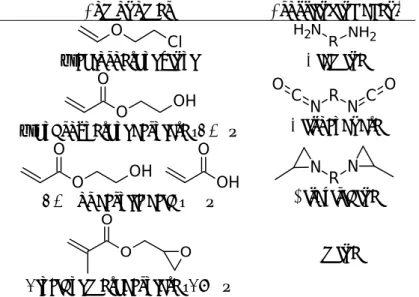
In some cases it becomes interesting to first prepare a crosslinked network, and then crosslink it further in a second separate step. This synthetic strategy may be called a “dual-curing system”, i.e. a chemical system that enables one to cure the material twice in two separate steps. Typical dual-cure mechanisms rely on reactions that are different in nature. The first reaction may for instance be cationic polymerization and the second one radical, or vice versa. First examples in the literature make use of the difference in reactivity of vinyl and acrylate carbon-carbon double bonds [17,18]. In the late 20th century, Decker and Decker studied a mixture composed of vinyl ethers and acrylates with radical and cationic photoinitiators [19]. They demonstrated a dual-cure behavior by first activating the radical initiator and then the cationic one using two different UV wavelengths. The idea of using two different reactions was also exploited using epoxies for the cationic reaction, using either a radical and a cationic initiator [20], or only a cationic initiator since the latter also generates free radicals when there are hydrogen donor molecules nearby [21–23]. In the field of adhesives, Kim’s group published a series of papers about epoxy-acrylate dual-curable pressure-sensitive adhesives [24,25]. Figure 3 gives a schematic representation of their system: acrylate functions are reacted in a first step, and epoxy functions are then reacted either together or with a carboxylic counterpart in a second cationic step. Interestingly, the series of papers from Kim’s group began with a dual-cure mechanisms relying on largely different chemistries (see Figure 4) [26]. In a first step, a copolymer comprising benzophenone (a photoinitiating unit) and alcohol pendent groups was synthesized and isolated. The copolymer was then coated with a multifunctional isocyanate and UV-cured to crosslink the benzophenone groups. In a third step, the material was heated up to 60°C for 6 hours to react the isocyanate with alcohol groups. In this paper, the authors demonstrated that the two steps are well-separated but also reported a large decrease in the extent of reacted benzophenone groups with thickness. Comonomer Crosslinking agent 2-chloroethyl vinyl Diamine 2-hydroxyethyl acrylate (HEA) Diisocyanate HEA or acrylic acid (AA) Bisaziridine Glycidyl methacrylate (GMA) AmineTable 2: some common strategies used for the crosslinking of polyacrylates using a sequential route. O Cl H2N R NH2 O O OH R N C O N C O O O OH OH O R N N O O O
More recent studies about dual-cure systems involving radical and cationic reactions are based on “click” chemistry [27], in link for instance with applications in shape-memory materials [28,29]. The aza-Michael addition between acrylates and amines may also be used. The main advantage of this reaction is that it proceeds at room temperature in oxygenated conditions without the use of any catalyst [30].
From these examples from the literature (summarized in Table 3), two general rules of thumb may be identified for efficient dual-curing systems. First, the two steps should rely on very efficient chemical reactions. For this, click chemistry is a great help and extensively used in the
Figure 3: simplified picture of the mechanism used by Kim et al. for the synthesis of dual-curable adhesives. Red dots represent epoxy functions and green dots represent acrylate functions. Initiator and curing agent are not represented. Also, the initial composition includes a triacrylate which react in the first step to bring additional crosslinks in the system.
Figure 4: schematic representation of Kim et al's dual cure system based on pendent benzophenones and isocyanate conjugation. The acrylic backbone is represented by a blue line, and each reactive group by a different shape/color (red dots: pendent benzophenone groups, green squares: alcohol groups, black forks: isocyanate group). The group R is either butyl, hydrogen or 2-ethylhexyl.
recent literature. Second, the two stages should be as well separated as possible, ideally using orthogonal chemistries in order to avoid any interference between the two reactions. All these synthetic strategies make a toolbox the chemist can use to prepare covalently crosslinked networks. Knowing the details of the preparation process is a key to precisely understand the final material properties. The next section will now focus on mechanical properties and how to relate them to the details of the molecular architecture. First step Second step Refs. Chemical
function(s) Reaction type function(s) Chemical Reaction type
Radical
photopolymerization photopolymerization Cationic
[17– 19,31,32]
Radical
photopolymerization Epoxy condensation via dicyandiamide 23,33] [20–
Radical
photopolymerization condensation Epoxy-acid [24,25]
Radical photopolymerization Cationic photopolymerization [34,35] Radical polymerization Urethane formation [26] Thiol-epoxy click reaction Epoxy condensation [27–29] Thiol-ene Michael addition Radical polymerization [36,37] Aza-Michael addition Radical polymerization [30,38,39] Aza-Michael addition Radical polymerization [38,40,41] Table 3: Recap of dual-cure system described in this review. Chemical functions as well as reaction types are given. In the schemes, wavy lines represent pre-existing polymer chains.
2.2. From chain physics to network properties
Polymeric materials are used in a large variety of applications because of their original mechanical properties. These properties stem from the basic physics of polymer chains, and several models have been developed throughout the years to understand the behavior of polymeric networks. These topics are extensively covered in a reference textbook from Colby and Rubinstein that is used throughout this part of the chapter [42].In this part, the physics of isolated polymer chains is first reviewed. From this basis, the mechanical properties of polymeric networks are modelled. Most basic models are useful since they contain all the physics of the problem, but they can also be refined to take more aspects of polymer mechanics into account.
2.2.1.
Physics of isolated polymer chains
A polymer chain is described as an assembly of C-C bonds of length C-C, as depicted in Figure 5. The most obvious characteristic length that comes in mind is the contour length of the chain:
= C-C C-C Eq. 2
This length represents the maximum size of the chain if all monomers were perfectly aligned. In practice, the maximum size of a chain is smaller than because the valence angle between consecutive monomers is fixed by quantum mechanics rules. Introducing the tetrahedral angle (see Figure 6), the maximum size of a chain is given by Rmax= cos 2 C-C C-C Eq. 3 For instance, in many usual polymers (polystyrene, polyacrylates, polyethylene to name only a few), the backbone of the chain is made of carbon-carbon bonds with hybridization states sp3. In these conditions, the valence angle is 109.5° and max = 0.82 . Figure 5: schematic representation of a polymer chain containing = 20 monomers. A force is applied at one end of the chain.



![Figure 11: two possible configurations to measure the fracture energy of soft polymeric materials. Left: single-edge notched test. Right: pure-shear test. Taken from [53].](https://thumb-eu.123doks.com/thumbv2/123doknet/2894818.74100/50.892.115.487.885.1154/figure-possible-configurations-measure-fracture-polymeric-materials-notched.webp)
![Figure 12 is taken from Mzabi’s PhD work [59] and shows a set of typical curves of fatigue testing (data are taken from [60]). Four typical regimes may be distinguished depending on the value of](https://thumb-eu.123doks.com/thumbv2/123doknet/2894818.74100/52.892.116.477.111.445/figure-typical-fatigue-testing-typical-regimes-distinguished-depending.webp)