Nitrification of vegetable waste using nitrifying
bacteria
Article
· July 2017
DOI: 10.1016/j.ecoleng.2017.07.003 CITATIONS0
READS25
4 authors
, including:
Some of the authors of this publication are also working on these related projects:
ATRAPP - Algal Blooms, Treatment, Risk Assessment, Prediction and Prevention through Genomics
View project
Occurrence of nano-particles in the environment
View project
Mitra Naghdi
Institut national de la recherche scientifique
13
PUBLICATIONS
23
CITATIONS
SEE PROFILE
Satinder Kaur Brar
Institut national de la recherche scientifique
211
PUBLICATIONS
2,984
CITATIONS
SEE PROFILE
Antonio Avalos Ramirez
Centre National en Electrochimie et en Techn…
47
PUBLICATIONS
410
CITATIONS
SEE PROFILE
All content following this page was uploaded by Mitra Naghdi on 09 July 2017.
Contents lists available atScienceDirect
Ecological
Engineering
j o u r n a l h o m e p a g e :w w w . e l s e v i e r . c o m / l o c a t e / e c o l e n g
Nitrification
of
vegetable
waste
using
nitrifying
bacteria
Mitra
Naghdi
a,
Maximiliano
Cledon
a,b,
Satinder
Kaur
Brar
a,∗,
Antonio
Avalos
Ramirez
a,caINRS-ETE,UniversitéduQuébec,490,RuedelaCouronne,QuébecG1K9A9,Canada
bCentrodeInvestigaciónAplicadayTransferenciaTecnológicaenRecursosMarinosAlmiranteStorni(CIMAS),UniversidadnacionaldelComahue-Provde
RioNegro-CONICET,Guemes1030,8520SanAntonioOeste,RıoNegro,Argentina
cCentreNationalenÉlectrochimieetenTechnologiesEnvironnementales(CNETE),2263,av.duCollège,Shawinigan,QCG9N6V8,Canada
a
r
t
i
c
l
e
i
n
f
o
Articlehistory:
Received3February2017
Receivedinrevisedform30June2017 Accepted3July2017 Availableonlinexxx Keyword: Nitrifyingbacteria Nitrite Nitrate
Organicfertilizersandvegetablewastes
a
b
s
t
r
a
c
t
Currentinorganicchemical-basedfertilizersforsoilshaveadverseimpactsonhumanhealthand envi-ronment.Inthepresentwork,twonitrifyingbacteria,i.e.Nitrosomonassp.DSM28437andNitrobactersp. DSM10236,wereexploredfortheproductionofnitrateinvegetablewastes.Forthispurpose,thenitrite productionbyNitrosomonassp.andnitrateproductionbyNitrobactersp.intwosyntheticmedia contain-ingammoniumandnitrite,respectivelywereinvestigated.Also,simultaneousgrowthofbothbacteria inasinglesyntheticmediumcontainingammoniumwasinvestigated.Finally,theperformanceofboth bacteriainamixtureofvegetablewastes,whereaconsortiaofmicroorganismspresentincattle-based compostproducedammonium,wereinvestigated.Highestconcentrationofnitrite(13.2ppm)andnitrate (1600ppm)inNitrosomonassp.andNitrobactersp.inoculatedsyntheticmediawereachievedafter12 and28days,respectively.Thesimultaneousgrowthofbothbacteriainsyntheticmediaandbothbacteria alongwithcompostmicroorganismsinvegetablewastesresultedin12and20ppmnitrate,respectively. Also,itwasobservedthatwithincreasingtime,theopticaldensityofNitrobactersp.populationincreased from0.04to0.72after35days,butforNitrosomonassp.,until12days,theopticaldensityincreased0.3 fromto0.6andthendecreasedto0.2onday21becauseofnitritetoxicitytothemicroorganism.The transformationofammoniumtonitrateusingNitrosomonassp.andNitrobactersp.insyntheticmedia andamixtureofvegetablewasteswasstudiedtodevelopaneworganicfertilizercontainingnitrogen source.
©2017ElsevierB.V.Allrightsreserved.
1. Introduction
Conventionalagriculturehasledtoanincreasingdependence onpesticidesandchemicalfertilizerstoaddressthefooddemands of theever-growinghumanpopulation(Santoset al.,2012; Tu etal.,2006).Pollutionofairand watermedia,suchas eutroph-ication of water bodies is caused by overuse of such chemical fertilizersenrichedwithknownquantitiesofnitrogen,phosphorus andpotassium,aswellasexcessivequantitiesofanimalmanure (Bhardwaj etal.,2014).Forexample, around13%–28% of nitro-genused for growingcrops is releasedto theatmosphere (Liu et al., 2014). Although chemical fertilizers may make a coun-try self-dependentin agricultural products, but it disturbsthe environmentwithitsharmfulimpactsonlivingorganisms. Fur-thermore,usingexcessamounts ofchemical fertilizersiscostly andcanleadtodepletionofwaterholdingcapacity ofsoilsand
∗ Correspondingauthor.
E-mailaddress:[email protected](S.K.Brar).
disparityinnutrients(Bhardwajetal.,2014;Raja2013;Youssef and Eissa 2014). Therefore, developing some affordable, effec-tiveandenvironmentally-benignfertilizershasbeenthefocusof researchers forlong time. Nowadays, somespecies of microor-ganismsarebroadlyusedduetotheirsignificantcontributionto providinganaturalsubstitutetochemicalfertilizers(Megalietal., 2014;Sahooetal.,2014).Encouragingorganicfarmingbyusing biofertilizersensuresfoodsafetyandimprovesthebiodiversityof soils(Araújoetal.,2008).
One ofthe mostimportant processesin natural fertilization processisnitrificationinwhichgaseousnitrogenistransformed intoammoniaandthentonitriteandfinallytonitratewhichis thepreferredformofnitrogenforplants.Thisprocessiscarried outthroughacomplex,sensitiveandslowsetofreactionsandthe involvedmicroorganismsrequirestrictaerobicconditions. There-fore,selectionofsuitablestrainsandprovidingrelatedconditions basedonthenatureofthesubstratearenecessary(Subbaraoetal., 2006,2009).
Nitrosomonas sp. and Nitrobacter sp. are important compo-nents of the soil microbial population that play major role in
http://dx.doi.org/10.1016/j.ecoleng.2017.07.003
2 M.Naghdietal./EcologicalEngineeringxxx(2017)xxx–xxx biologicalconversionof ammonia tonitriteand thentonitrate
(Nortonetal.,2002).Verhammeetal.,oxidizedammoniatonitrite bybothammoniaoxidizingarchaea(AOA)andammonia-oxidizing bacteria(AOB) byincubating soilsamples for28dayswith dif-ferentammoniumconcentrations(0–20gNH4+-Npergramof
soil).TheiranalysisshowedconsiderablegrowthofAOAatall con-centrations,whereas AOBgrowthwasimportantonly athigher concentration(Verhammeetal.,2011).GrunditzandDalhammar usedNitrosomonassp.andNitrobactersp.isolatedfromactivated sludge. The highest activity was reported tobe at pH 8.1 and 35◦CforNitrosomonassp.andpH7.9and38◦CforNitrobactersp. (GrunditzandDalhammar,2001).Blackburneetal.,investigated thecapabilityofNitrospirasp.andNitrobactersp.fortransformation ofnitritetonitrate.TheyfoundthatNitrospirahadlowerinhibition thresholdconcentrationsforfreenitrousacid(<0.03ppm)andfree ammonia(0.04–0.08ppm)comparedtoNitrobactersp.(Blackburne etal.,2007).
Agro-wastes,suchasmanures,hulls,leaves,plantstalksand vegetableresiduesareproducedfromdifferentagricultureandfood processingactivities,suchasdairyproduction,proteinextraction andbrewery.Theagro-wastes,suchasbreweryspentgrains,cheese processingresiduesandsoywasteareproducedinlargevolumes. Theyareoftenuselessforfarmersandcompaniesandtheywill oftenbediscardedrepresentingacostforproducers(LimandMatu 2015).Agro-wastescontainwatersolublecompoundse.g.,sugar andaminoacidsandinsolublecompoundse.g.,celluloseandlignin. Thesecompoundsarethemainnaturalsourceoforganicmatter insoil(Capraraetal.,2011).Therefore,duetotheirlowcost,no adverseenvironmentalimpactsbecauseoftheirbiodegradability andrichnessinwiderangeofnutrients,theagro-wasteshavea potentialtobeusedbyfarmerstoimprovethefertilityofsoil.
To thebest of our knowledge, there is no paper discussing theperformanceofnitrifyingbacteriainvegetablewastesamples. Inthis researchwork,theperformance ofNitrosomonas sp.and Nitrobactersp.intransformationofammoniumtonitriteandnitrite tonitratewereinvestigatedinsyntheticmediaandamixtureof vegetablewastes(acombinationofsoya,brewery,andwhey)in ordertodevelopaneworganicfertilizer.
2. Materialandmethods
2.1. Strainsandgrowthcondition
AnenrichedNitrosomonaseuropaea(DSM28437)and Nitrobac-ter vulgaris (DSM 10236) culture were obtained from Leibniz-Institut(DSMZ-DeutscheSammlung von).The compostedcattle manuremixedwithgardensoil(Nitrogen0.5%,Phosphate0.5%, Potash 0.5%)was purchased from Circle H Farms (USA). Nitro-somonas europaea was grown on 1583 medium for ammonia oxidizingbacteriathathadthefollowingcomposition:
Solution A: NH4Cl, 535mg; KH2PO4, 54mg; KCl, 74mg;
MgSO4×7H2O,49mg;CaCl2×2H2O,147mg;NaCl,584mg;Trace
elementsolution,1mL;Cresolredsolution,2mL;Distilledwater, 1000mL.
Trace element solution: Distilled water, 975mL; HCl, 1M 25mL; MnSO4×4H2O, 45mg; H3BO3, 49mg; ZnSO4×7H2O,
43mg; (NH4)6 Mo7O24×4H2O, 37mg; FeSO4×7H2O, 973mg;
CuSO4×5H2O,25mg.
Cresolredsolution:Cresolred,50mg;Distilledwater,100mL. ThepHwasadjustedto7.8byadditionof10%NaHCO3.
Nitrobactervulgariswasgrownon756Heterotrophicnitrobacter mediumthathadthefollowingcomposition:
SolutionA:2gNaNO2,Yeastextract,1.50g; Peptone,1.50g;
Na-pyruvate,0.55g;Traceelementsolution,1mL;Stocksolution, 100mL;Distilledwater,899mL.
Stocksolution:CaCO3,0.07g;NaCl,5g;MgSO4×7H2O,0.5g;
KH2PO4,1.5g;Distilledwater,1000mL;
Trace element solution: MnSO4×H2O, 33.8mg; H3BO3,
49.4mg; ZnSO4×7H2O, 43.1mg; (NH4)6Mo7O24, 37.1mg;
FeSO4×7H2O, 97.3mg; CuSO4×5H2O, 25mg; Distilled water,
1000mL.
ThepHwasadjustedto7.4withNaOHorKOH. 2.2. Growthinstandardmedia
TheculturemediawaspreparedasdescribedinSection2.1.Each strainwasrevivedtwotimesin150mLliquidstandardmediaat 28–30±1◦Cand150rpmfor3days.Also,compostwasinoculated intotwoculturemediatocomparewiththestrains. Theoptical density(OD600)andcolonyformingunits(CFU)permilliliterwere
measuredaftersecondrevivalforbothstrainsandcompostinthe twomedia.
2.3. Resistancetohighammoniaconcentration
Fiveflaskscontaining100mLofmedia1583withoutNH4Cland
withdifferentconcentrationofammoniai.e.100,250,500,750and 1000ppmwerepreparedandautoclavedat121±1◦Cfor20min. Later,theywereinoculatedwiththreemlofNitrosomonassp. inocu-lumandincubatedforsixdaysat37±1◦Cand175±1rpm.The concentrationofnitriteandammoniumweremeasuredafter6days andthetestsweredoneinduplicates.Thesetestswerecarriedout tofindmaximumconcentrationofammoniathatNitrosomonassp. cantolerate.
2.4. Kineticsstudyofnitrification
Media1583at150mLwithoptimizedconcentrationofNH4Cl
(obtainedfromSection2.3)waspreparedin250mLflasksand auto-clavedat121±1◦Cfor20minandthekineticsofgrowth,residual ammoniumandproduction ofnitritefor Nitrosomonassp.were studiedforthreeweeks.Similarly,150mLofmedia752was pre-paredin250mLflasks,autoclavedat121±1◦Cfor20minandthe kineticsofgrowthandproductionofnitrateforNitrobactersp.were studiedforfiveweeks.Also,kineticsofresidualammoniumand productionofnitriteinmedia1583inoculatedwithcompostand productionofnitrateinmedia756inoculatedwithcompostwere studiedforthreeandfiveweeks,respectively.
2.5. Vegetablewasteasgrowthsubstrate
In order to evaluate the potentialof vegetable waste tobe transformedintoausefulfertilizer,vegetablewasteswereused assubstratewithoutautoclaving.Thesubstratewascomposedof 36%soyawaste,54%brewerywasteand10%liquidwhey.Thetotal nitrogencontentofthesubstratewas2.98g/kg.Themediawere placedintwo2-Lflasksandtheirvolumeswereadjustedto1L usingmilli-Qwater.Oneflaskwasinoculatedwith10gcompost. Thesecondflaskwasinoculatedwith10gcompost,25mLof Nitro-somonassp.and25mLofNitrobactersp.Theprocedurewascarried outinduplicate.Duringfermentation,mediawereaerated.After1 week,thefinalconcentrationsofnitrateweremeasured.
2.6. Measurementofammonium,nitriteandnitrate concentrations
Tomeasure theammonium, nitriteand nitrate,colorimetric titrationwasemployed.Ammoniumwasdeterminedfollowingthe modifiedmethodofindophenolinwhichphenoliscombinedwith hypochloriteasit reactsinthepresenceof ammoniumtoform
Table1
Concentrationofammonium,opticaldensityandnitriteforNitrosomonassp. Parameter Unit Value
Initialammonium ppm 100 250 500 750 1000 Residualammonium ppm 80 240 480 740 980 Opticaldensity(660nm) – 0.362 0.072 0.056 0.008 0.002 Producednitrite ppm 0.3 0.1 0.1 0.1 0.1
indophenolblue.Thecolorintensityisproportionaltotheamount oftotalammoniumpresent.
Fornitrite,themethodofmodifieddiazotizationwasused.The samplereactedwith4-aminobenzensulfonicacidtoproduce vary-ingredshades.Thecolorintensitywasproportionaltotheamount of nitrite present. Similarly, nitrate concentrations were deter-minedbytransformingitbyusingareducingagent(NutrafinTM) toproduceacolorwiththeintensityproportionaltotheamount present.
3. Resultsanddiscussion
3.1. Resistancetoammonia
TheNitrosomonassp.wasgrownatsixlevelsofammonium con-centrationtoobserveitsnitrificationrate.Theconcentrationsof residualammoniumandproducednitriteagainstinitial concentra-tionofammoniumaregiveninTable1.Theresultsshowedhigher growth of Nitrosomonas sp. at lower ammoniumconcentration (100ppm) compared to intermediate or high levels of ammo-niumconcentration(250–1000ppm).Similarly,nitrificationrate washigheratlowerconcentrationofammonium.Itseemedthat freeammoniainhibitedtheactivityofNitrosomonassp.ata concen-trationhigherthan100ppm.Kimetal.,andYangetal.,observed similartrendsandreportedthathighfreeconcentrationof ammo-nia(NH3-N)inhibitedheterotrophic,nitriteoxidizingandammonia
oxidizingbacteria(Kimetal.,2006;Yangetal.,2004).Also, Vadi-veluet al.,observedthatfreeammonia upto16.0ppm,had no inhibitoryeffectoncatabolicoranabolicprocessesofthe Nitro-somonassp.(Vadivelu etal.,2006).Duetohighpermeabilityof freeammoniathroughcellmembrane,itwashypothesizedthat freeammoniamayaffectthecells bychanging intracellularpH, increasingenergyrequirements,orinhibittheirenzymatic reac-tions(GallertandWinter1997;Wittmannetal.,1995).
AccordingtoTable2,theinitialconcentrationofammonium wasadjustedto100ppmfortherestoftheexperiments.
Table2
NitriteandnitrateproductionusingNitrosomonassp.andNitrobactersp. Days NitriteProduction(ppm) NitrateProduction(ppm)
0 0.1 – 4 0.3 – 8 6.4 – 12 13.2 – 18 – 5 24 – 7 30 – 10 35 – 12
3.2. Nitriteandnitrateproduction
ThekineticsstudyofNitrosomonassp.andcompostinmedia 1583 and Nitrobacter sp.and compost in media756 were per-formed.Thetrendsofammoniumconsumptionandproductionof nitriteforbothcompostandNitrosomonassp.inmedia1583are shownin Fig.1AandB, respectively.AccordingtoFig.1A, con-centrationof nitritecontinuouslyincreasedupto8ppm within the test period in compost inoculated medium. However, for Nitrosomonassp.inoculatedmedium,amaximumnitrite concen-tration of 13.2ppm wasobserved after 12days. The maximum yieldofnitriteproductionafter12dayswascalculatedtobe0.9mg nitrite/mgammonium.Thereductioninproductionofnitritecanbe attributedtothetoxicityofnitriteforbacterialgrowth.Weonetal., observedsameinhibitoryeffectduringgrowthofAcinetobactersp. and theyreportedthatremoving nitritefromcultures reversed theinhibitoryeffect.Theyattributedthetoxicityofnitritetoits effectonbacterialmembranesandenergygeneration(Weonetal., 2002).AlsoitisreportedthatpHaffectsthistoxicitybyformation ofprotonatedspecieswithcapabilityofcrossingthemembrane (Anthonisenetal.,1976).
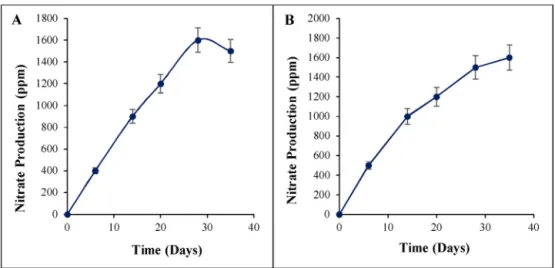
The variation of nitrate concentration within test period in media756inoculatedwithcompostandNitrobactersp.areshown inFig.2.Accordingtothisfigure,ittook35and28days respec-tivelyforcompostandNitrobactersp.inoculatedmediatoreach tothemaximum nitrateconcentrationof 1600ppm. The maxi-mumyieldofnitrateproductionafter28dayswascalculatedto be0.8mgnitrate/mg nitrite.Guo et al.,investigated the nitrifi-cation processin a10Lsequencingbatch reactorandobserved decreaseinammoniumandincreaseofnitriteandnitrate concen-trationsunderaerobiccondition.Finally,theyachieved25.7ppm nitrateand6.2ppmnitrite(Guoetal.,2009).Grigattietal., incu-bated soil,barkandmanurewithdifferentvolumeof activated sewage sludge for 72h. Theyfoundthat thenitrate
concentra-Fig.1.Concentrationofnitriteandammoniumatdifferenttimesfor:(A)compost;and(B)Nitrosomonassp.inmedia1583(Circleandsquarelegendsrepresentammonium consumptionandnitriteproduction,respectively).
4 M.Naghdietal./EcologicalEngineeringxxx(2017)xxx–xxx
Fig.2.Variationofnitrateconcentrationinmedia756inoculatedwith:(A)compost;and(B)Nitrobactersp.
tionincreasedwithincreasingamountsofaddedsewagesludge. Forsoil,barkandmanureincubatedwith10mLofsewagesludge, thetotal nitrateproduction was5073, 4801and 7530mgN/kg volatilesolids,respectively(Grigattietal.,2007).Accordingly,the obtainedresultfornitrateproductioninthisresearchwaswithin therangeobtainedbyotherresearchersthoughtheyuseddiverse microorganisms(presentinsewagesludge)insteadofusingsingle microorganism.
3.3. Growthrateofbacteria
The effect of time on the growth rate of Nitrosomonas sp. medium1583andNitrobactersp.inmedium756areillustratedin Fig.3.ForNitrosomonassp.(Fig.3A),amaximumbacterialdensity wasobtainedin12daysandsoonafter,thepopulationofbacteria decreasedsignificantly(p<0.03).ButforNitrobactersp.(Fig.3B), thebacterialpopulationreachedasaturationpointafter20days.
Thebacterial growth in batchsystem can bemodeled with fourdistinguishedphasesi.e.lagphase(A),exponentialphase(B), stationaryphase(C),anddeathphase(D).Inlagphase,cellsare adaptedtotheirnewenvironmentandinexponentialphase,the cellsmultiplyrapidly.Theexhaustionofnutrients(S≈0)and build-upofmetabolitesandwastematerialsleadtostationaryphasein whichthereisnonetgrowth.Indeathphase,thenumberofliving organismdecreases,duetotoxicmetabolitesandlackofnutrients
(Fargesetal.,2012).Forthisphase,thebalanceofcellmassina batchculturegives,byEqs.(1)and(2):
dX
dt =netX and X=X0(att=0) (1)
lnX
X0 =net(t−
t0) (2)
Wherenetisthemaximumspecificgrowthrate(1/time)andX0
andXarecellconcentrationattimet=0andt.Theparameternet
wascalculatedtobe0.1and1.1(1/day)forNitrosomonassp.and Nitrobactersp.,respectively.
3.4. Nitrificationinmedium1583withbothbacteria
According to Section 3.2, the maximum nitrite and nitrate productionwere13.2and1600ppminmedia1538and756, respec-tively.Thepossibilityofproductionofnitratewasinvestigatedin medium1583sothatafter12daysofinoculationofmedium1583 withNitrosomonassp.,Nitrobactersp.wasaddedtothemediumto convertnitritetonitrate.Theresultsofthisexperimentareshown inTable2.AccordingtothisTable,theconcentrationof nitrate reached12ppmafter35days.
For comparison, the nitrification test in medium 756 with Nitrobacter sp. was studied by setting the initialconcentration ofnitriteto13.2ppm anditwasobservedthatthenitrate con-centration reached16ppm after35days. Accordingly, theratio
Fig.3. Effectofstoragetimeonthegrowthof:(A)Nitrosomonassp.;and(B)Nitrobactersp.(Lagphase(A),logarithmicorexponentialphase(B),stationaryphase(C),and deathphase(D)).
Table3
comparativeperformanceofbacterialconsortiaintheproductionofsolublenitratestartingfromdifferentagroindustrialwastecombinations. Substratecomposition Strains Ammonium/
Nitrate(mg)
mgN/gsoil Reference Sorghumbagasse(88%)+pinebark(11%)+
Urea(1%)
Nitrobactersp.+Nitrosomonassp. 0.1 – Sánchez-Monederoetal.(2001)
Sorghumbagasse(86%)+pinebark(11%)+ brewerysludge(3%)
Nitrobactersp.+Nitrosomonassp. 0.4 – Sánchez-Monederoetal.(2001)
Ricestrawandcowdung(5:1:0.2) Geobacillus – 1.6 Sarkaretal.(2010)
Dairy-wastecompostorammoniumsulfate Geobacillus – 19.4 Sarkaretal.(2010)
Compost Unidentifiedconsortium 0.4 – Shietal.(2001)
Compost+ammoniumsulfate Unidentifiedconsortium 0.1 – Shietal.(2001)
Soybeanresidues+withleaves+sawdust (1:1:3)
Unidentifiedconsortium 25 – Josephetal.(2001)
Soyawaste+brewerywaste+whey (36%:54%:10%)
Nitrobactersp.+Nitrosomonassp. 0.35 20 Presentstudy Soyawaste+brewerywaste+whey
(36%:54%:10%))
Compost+Nitrobactersp.+Nitrosomonassp. 0.7 13 Presentstudy
ofnitriteconsumptiontonitrateproductionwas1.48mol/molN which is withintherange obtainedby otherresearchers. Trigo etal.,studiedoxidationofammoniuminasequencingbatch reac-torusingVandeGraafmedium.Theirresultsshowedthattheratio ofnitriteconsumedtonitrateproducedwas5.54mol/molN(Trigo etal.,2006).Inasimilarresearch,Fargesetal.,studiedthe per-formanceofNitrosomonaseuropaeaandNitrobacterwinogradskyi innitrificationandobserved thattheratioofnitriteproduction toammoniumconsumptionwas0.95mol/molNforNitrosomonas europaeaandtheratioofnitriteconsumptiontonitrate produc-tionwas0.975mol/molNforNitrobacterwinogradskyi(Fargesetal., 2012).Itseemed that thepresenceof Nitrosomonas sp.didnot interferetheconversionofnitritetonitratebyNitrobactersp. 3.5. Nitrificationinvegetablewaste
AsexplainedinSection2.5,thesyntheticmediawasreplacedby vegetablewastetostudythenitrificationperformanceofselected bacteria.Afteroneweek,thefinalconcentrationsofnitratewere 5ppmand20ppm(Fig.4)forsamplesinoculatedwithcompost andcompost/Nitrosomonassp./Nitrobactersp.,respectively.Atthis point, the process stopped due to simultaneous production of
Fig.4.ComparisonofNO3andSulfurproductioninppmbycommercialcompost
vscompost+Nitrobactersp.andNitrosomonassp.
solublesulfurouscompoundsthatreached11.8and30ppmineach medium,respectively.
AsshowninFig.4,thehigherthenitrateproduction,therewas higherthereleaseofsulfurfromtheselectedmediamixture.Inboth cases,thereleaseofsulfurwasslightlyhigherthanthenitrate.In thecaseofsoybean,itisreportedtohave5.7ppmofsulfur con-tent(Heetal.,2009)whilebrewerywastescontainsupto20ppm sulfate(Sudarjantoetal.,2011).Moreover,wheyisreportedto con-tainlargeamountofsulfur-containing aminoacids.Sincesulfur uptakebyplantsisapproximately0.25timesofnitrogen,itis rec-ommendedtoavoid wheyand maximizesoyawasteusein the mediainordertoobtainthebestnitratesulfurproportion. Accord-ingly,itisexpectedtoyieldupto60ppmnitrate.Thefinalsolution canbefurtherconcentratedtoincreasethenutrientsperliterto matchsyntheticfertilizers.However,furtherstudiesareneeded toachieveamaximumuptakebythetargetedplants,otherwise thenutrientswillendupintheenvironmentwhichcouldgenerate ecologicalproblemsforseveraldecadesasrecentlyreported(Meter etal.,2016).
FromTable3,itispossibletoseethattheadditionofcompost doesnotnecessarilyimplyanadvantage.Asseeninthetable,the highertheammonium/nitrate,thelessefficienttheresult.Sincethe usedmediawasnotsterilizedpriortouse,italreadycontained bac-teriathatwereabletocarryouttheammonificationstepneeded beforeNitrobactercanstartproducingnitrite.Moreover,the con-sortiumthatformscompostcontainsmanyotherlargebacterial populationsthancanleadtoundesiredresultslikethehighrelease ofsulfurcontainedintheamino-acidsofthemediathatleadsto nitrificationarrestduetotoxicity.Inthissense,itisvery impor-tanttoensurethatthesourceusedhasausefulproportionofN/S aswellastocontroltheparticipatingbacterialstrainsinorderto obtainaproperfinalconcentrationofnitratetobeusedasfertilizer andavoidingby-productsatthesametime.
4. Conclusion
Thetransformationofammoniumtonitriteandnitritetonitrate usingNitrosomonassp.andNitrobactersp.insyntheticmediaanda mixtureofvegetablewasteswasstudiedtodevelopaneworganic fertilizercontainingnitrogensource.Theresultsshowedthatthe highestconcentrationofnitrite(13.2ppm)andnitrate(1600ppm) insyntheticmediainoculatedwithNitrosomonassp.and Nitrobac-tersp.wereobtainedafter12and28days,respectively.Also,the presenceofbothbacteriainsyntheticmediaandbothbacteriawith compostmicroorganismsinvegetablewastesresultedin12and 20ppm nitrate,respectively.Therefore, vegetablewastescanbe consideredasapromisingcandidatefornitrogenrichbio-fertilizer.
Pleasecitethis article inpress as: Naghdi,M., etal., Nitrification ofvegetable wasteusingnitrifyingbacteria. Ecol.Eng.(2017), 6 M.Naghdietal./EcologicalEngineeringxxx(2017)xxx–xxx
Acknowledgments
TheauthorsaresincerelythankfultotheNaturalSciencesand EngineeringResearchCouncilofCanada(DiscoveryGrant355254) forfinancialsupport.Theviewsoropinionsexpressedinthisarticle arethoseoftheauthors.
References
Anthonisen,A.,Loehr,R.,Prakasam,T.,Srinath,E.,1976.Inhibitionofnitrification byammoniaandnitrousacid.J.WaterPollut.ControlFeder.,835–852.
Araújo,A.S.F.,Santos,V.B.,Monteiro,R.T.R.,2008.Responsesofsoilmicrobial biomassandactivityforpracticesoforganicandconventionalfarmingsystems inPiauístate,Brazil.Eur.J.SoilBiol.44,225–230.
Bhardwaj,D.,Ansari,M.W.,Sahoo,R.K.,Tuteja,N.,2014.Biofertilizersfunctionas keyplayerinsustainableagriculturebyimprovingsoilfertility,planttolerance andcropproductivity.Microb.CellFact.13(66),1–10.
Blackburne,R.,Vadivelu,V.M.,Yuan,Z.,Keller,J.,2007.Kineticcharacterisationof anenrichedNitrospiraculturewithcomparisontoNitrobacter.WaterRes.41, 3033–3042.
Caprara,C.,Colla,L.,Lorenzini,G.,Santarelli,C.,Stoppiello,G.,Zanella,D.,2011.
Developmentofamodelfortechnical-economicalfeasibilityanalysisof biomassandmudgasificationplants.Int.J.EnergyTechnol.3,5.
Farges,B.,Poughon,L.,Roriz,D.,Creuly,C.,Dussap,C.-G.,Lasseur,C.,2012.Axenic culturesofnitrosomonaseuropaeaandnitrobacterwinogradskyiin autotrophicconditions:anewprotocolforkineticstudies.Appl.Biochem. Biotechnol.167,1076–1091.
Gallert,C.,Winter,J.,1997.Mesophilicandthermophilicanaerobicdigestionof source-sortedorganicwastes:effectofammoniaonglucosedegradationand methaneproduction.Appl.Microbiol.Biotechnol.48,405–410.
Grigatti,M.,Pérez,M.D.,Blok,W.J.,Ciavatta,C.,Veeken,A.,2007.Astandardized methodforthedeterminationoftheintrinsiccarbonandnitrogen mineralizationcapacityofnaturalorganicmattersources.SoilBiol.Biochem. 39,1493–1503.
Grunditz,C.,Dalhammar,G.,2001.Developmentofnitrificationinhibitionassays usingpureculturesofnitrosomonasandnitrobacter.WaterRes.35,433–440.
Guo,J.H.,Peng,Y.Z.,Wang,S.Y.,Zheng,Y.N.,Huang,H.J.,Ge,S.J.,2009.Effectiveand robustpartialnitrificationtonitritebyreal-timeaerationdurationcontrolin anSBRtreatingdomesticwastewater.ProcessBiochem.44,979–985.
He,B.B.,VanGerpen,J.H.,Thompson,J.C.,2009.Sulfurcontentinselectedoilsand fatsandtheircorrespondingmethylesters.Appl.Eng.Agric.25,223–226.
Joseph,P.,Muchnok,T.K.,Klishis,M.L.,Roberts,J.R.,Antonini,J.M.,Whong,W.-Z., Ong,T.-m.,2001.Cadmium-Inducedcelltransformationandtumorigenesisare associatedwithtranscriptionalactivationofc-fos,c-jun,andc-myc
proto-oncogenes:roleofcellularcalciumandreactiveoxygenspecies.Toxicol. Sci.61,295–303.
Kim,D.-J.,Lee,D.-I.,Keller,J.,2006.Effectoftemperatureandfreeammoniaon nitrificationandnitriteaccumulationinlandfillleachateandanalysisofits nitrifyingbacterialcommunitybyFISH.Bioresour.Technol.97,459–468.
Lim,S.-F.,Matu,S.U.,2015.Utilizationofagro-wastestoproducebiofertilizer.Int.J. EnergyEnviron.Eng.6,31–35.
Liu,Q.,Guo,Y.,Giesy,J.P.,2014.Assessmentonecologicalsafetyoffarmland fertilizationofChina.Adv.Mater.Res.:TransTechPubl.962,2170–2174.
Megali,L.,Glauser,G.,Rasmann,S.,2014.Fertilizationwithbeneficial microorganismsdecreasestomatodefensesagainstinsectpests.Agron. Sustain.Dev.34,649–656.
Meter,K.J.V.,Basu,N.B.,Veenstra,J.J.,Burras,C.L.,2016.Thenitrogenlegacy: emergingevidenceofnitrogenaccumulationinanthropogeniclandscapes. Environ.Res.Lett.11,035014.
Norton,J.,Alzerreca,J.,Suwa,Y.,Klotz,M.,2002.Diversityofammonia monooxygenaseoperoninautotrophicammonia-oxidizingbacteria.Arch. Microbiol.177,139–149.
Raja,N.,2013.Biopesticidesandbiofertilizers:ecofriendlysourcesforsustainable agriculture.Biofertil.Biopest.4,1–2.
Sánchez-Monedero,M.A.,Roig,A.,Paredes,C.,Bernal,M.P.,2001.Nitrogen transformationduringorganicwastecompostingbytheRutgerssystemandits effectsonpH,ECandmaturityofthecompostingmixtures.Bioresour.Technol. 78,301–308.
Sahoo,R.,Ansari,M.,Dangar,T.,Mohanty,S.,Tuteja,N.,2014.Phenotypicand molecularcharacterisationofefficientnitrogen-fixingAzotobacterstrains fromricefieldsforcropimprovement.Protoplasma251,511–523.
Santos,V.B.,Araújo,A.S.F.,Leite,L.F.C.,Nunes,L.A.P.L.,Melo,W.J.,2012.Soil microbialbiomassandorganicmatterfractionsduringtransitionfrom conventionaltoorganicfarmingsystems.Geoderma170,227–231.
Sarkar,S.,Banerjee,R.,Chanda,S.,Das,P.,Ganguly,S.,Pal,S.,2010.Effectivenessof inoculationwithisolatedGeobacillusstrainsinthethermophilicstageof vegetablewastecomposting.Bioresour.Technol.101,2892–2895.
Shi,Y.,Parker,D.B.,Cole,N.A.,Auvermann,B.W.,Mehlhorn,J.E.,2001.Surface amendmentstominimizeammoniaemissionsfrombeefcattlefeedlots.Am. Soc.Agric.Biol.Eng.44,677–682.
Subbarao,G.V.,Ito,O.,Sahrawat,K.L.,Berry,W.L.,Nakahara,K.,Ishikawa,T., Watanabe,T.,Suenaga,K.,Rondon,M.,Rao,I.M.,2006.Scopeandstrategiesfor regulationofnitrificationinagriculturalsystems—challengesand
opportunities.Crit.Rev.PlantSci.25,303–335.
Subbarao,G.V.,Kishii,M.,Nakahara,K.,Ishikawa,T.,Ban,T.,Tsujimoto,H.,George, T.S.,Berry,W.L.,Hash,C.T.,Ito,O.,2009.Biologicalnitrificationinhibition (BNI)-istherepotentialforgeneticinterventionsintheTriticeae?Breed.Sci. 59,529–545.
Sudarjanto,G.,Sharma,K.R.,Gutierrez,O.,Yuan,Z.,2011.Alaboratoryassessment oftheimpactofbrewerywastewaterdischargeonsulfideandmethane productioninasewer.WaterSci.Technol.64(1),1–7.
Trigo,C.,Campos,J.L.,Garrido,J.M.,Méndez,R.,2006.Start-upoftheAnammox processinamembranebioreactor.J.Biotechnol.126,475–487.
Tu,C.,Ristaino,J.B.,Hu,S.,2006.Soilmicrobialbiomassandactivityinorganic tomatofarmingsystems:effectsoforganicinputsandstrawmulching.Soil Biol.Biochem.38,247–255.
Vadivelu,V.M.,Keller,J.,Yuan,Z.,2006.Effectoffreeammoniaandfreenitrous acidconcentrationontheanabolicandcatabolicprocessesofanenriched Nitrosomonasculture.Biotechnol.Bioeng.95,830–839.
Verhamme,D.T.,Prosser,J.I.,Nicol,G.W.,2011.Ammoniaconcentration determinesdifferentialgrowthofammonia-oxidisingarchaeaandbacteriain soilmicrocosms.ISMEJ.5,1067–1071.
Weon,S.-Y.,Lee,C.-W.,Lee,S.-I.,Koopman,B.,2002.Nitriteinhibitionofaerobic growthofAcinetobactersp.WaterRes.36,4471–4476.
Wittmann,C.,Zeng,A.-P.,Deckwer,W.-D.,1995.Growthinhibitionbyammonia anduseofapH-controlledfeedingstrategyfortheeffectivecultivationof Mycobacteriumchlorophenolicum.Appl.Microbiol.Biotechnol.44,519–525.
Yang,S.-F.,Tay,J.-H.,Liu,Y.,2004.Inhibitionoffreeammoniatotheformationof aerobicgranules.Biochem.Eng.J.17,41–48.
Youssef,M.M.A.,Eissa,M.F.M.,2014.Biofertilizersandtheirroleinmanagementof plantparasiticnematodes:areview.J.Biotechnol.Pharm.Res.5,001–006.