HAL Id: pastel-00004940
https://pastel.archives-ouvertes.fr/pastel-00004940
Submitted on 17 Apr 2009
HAL is a multi-disciplinary open access
archive for the deposit and dissemination of
sci-entific research documents, whether they are
pub-lished or not. The documents may come from
teaching and research institutions in France or
abroad, or from public or private research centers.
L’archive ouverte pluridisciplinaire HAL, est
destinée au dépôt et à la diffusion de documents
scientifiques de niveau recherche, publiés ou non,
émanant des établissements d’enseignement et de
recherche français ou étrangers, des laboratoires
publics ou privés.
César Kunz
To cite this version:
César Kunz. Proof preservation and program compilation. Mathematics [math]. École Nationale
Supérieure des Mines de Paris, 2009. English. �NNT : 2009ENMP1591�. �pastel-00004940�
ED n° 84: Sciences et technologies de l'information et de la communication
N° attribué par la bibliothèque
|__|__|__|__|__|__|__|__|__|__|
T H È S E
pour obtenir le grade de
DOCTEUR DE L’ECOLE NATIONALE SUPERIEURE DES MINES DE PARIS
Spécialité “Informatique temps réel, robotique et automatique”
présentée et soutenue publiquement par
César Darío KUNZ
le 3 Février 2009
PRÉSERVATION DES PREUVES ET TRANSFORMATION DE
PROGRAMMES
Directeur de thèse : Gilles Barthe
Jury
Thomas Jensen
Président
Martin Hofmann
Rapporteur
Xavier Leroy
Rapporteur
Peter Müller
Rapporteur
Gilles Barthe
Examinateur
Benjamin Grégoire
Examinateur
Pr´
eservation des Preuves et Transformation de Programmes
R´
esum´
e
Le paradigme du code mobile consiste `a la distribution des applications, telles que les applets ou les scripts Web, transfer´es `a travers un r´eseau non s´ecuris´e comme Internet, qui sont execut´ees dans des syst`emes distants, par exemple un ordinateur, un t´el´ephone mobile ou un PDA (Assistant personnel). Naturellement, cet environnement peut ouvrir la porte au d´eploiement de programmes malveillants dans des plateformes distantes. Dans certains cas, la mauvaise conduite du code mobile ne constitue pas un risque grave, par exemple lorsque l’int´egrit´e des donn´ees affect´ees par l’ex´ecution n’est pas critique ou lorsque l’architecture d’ex´ecution impose de fortes contraintes sur les capacit´es d’ex´ecution du code non s´ecuris´e.
Il y a cependant des situations dans lesquelles il est indispensable de v´erifier la correction fonctionnelle du code avant son ex´ecution, par exemple lorsque la confidentialit´e de donn´ees critiques comme l’information des cartes de cr´edit pourrait ˆetre en danger, ou lorsque l’environnement d’ex´ecution ne poss`ede pas un m´ecanisme sp´ecial pour surveiller la consommation excessive des res-sources.
George Necula a propos´e une technique pour garantir aux utilisateurs la correction du code sans faire confiance aux producteurs. Cette technique, Proof Carrying Code (PCC) [49, 51], consiste `a d´eploier le code avec une preuve formelle de sa correction. La correction est une propri´et´e inh´erente du code re¸cu qui ne peut pas ˆetre directement d´eduite du producteur du code. Naturellement, cela donne un avantage `a PCC quant-aux m´ethodes bas´ees sur la confiance `a l’autorit´e d’un tiers. En effet, une signature d’une autorit´e ne suffit pas `a fournir une confiance absolue sur l’ex´ecution du code re¸cu.
Depuis les origines du PCC, le type de m´ecanisme utilis´e pour g´en´erer des certificats repose sur des analyses statiques qui font partie du compilateur. Par cons´equent, en restant automatique, il est intrins`equement limit´e `a des propri´et´es tr`es simples. L’augmentation de l’ensemble des propri´et´es `a consi-derer est difficile et, dans la plupart des cas, exige l’interaction humaine. Une possibilit´e consiste `a v´erifier directement le code ex´ecutable. Toutefois, l’ab-sence de structure rend la v´erification du code de bas niveau moins naturelle, et donc plus laborieuse. Ceci, combin´e avec le fait que la plupart des outils de v´erification sont develop´es pour le code de haut niveau, rend plus appropri´ee l’id´ee de transferer la production de certificats au niveau du code source. Le principal inconv´enient de produire des certificats pour assurer l’exactitude du code source est que les preuves ne comportent pas la correction du code com-pil´e. Plusieurs techniques peuvent etre propos´ees pour transf´erer la preuve de correction d’un programme `a sa version ex´ecutable. Cela implique, par
exemple, de d´eployer le programme source et ses certificats originaux (en plus du code ex´ecutable) et de certifier la correction du processus de compilation. Toutefois, cette approche n’est pas satisfaisante, car en plus d’exiger la dis-ponibilit´e du code source, la longueur du certificat garantissant la correction du compilation peut ˆetre prohibitive.
Une alternative plus viable consiste `a proposer un m´ecanisme permettant de g´en´erer des certificats de code compil´e `a partir des certificats du pro-gramme source. Les compilateurs sont des algorithmes complexes compos´ees de plusieurs ´etapes, parmi lesquelles le programme original est progressive-ment transform´e en repr´esentations interm´ediaires. Barthe et al. [14] et Pav-lova [57] ont montr´e que les certificats originaux sont conserv´es, `a quelques diff´erences non significatives pr`es, par la premi`ere phase de compilation : la compilation non optimale du code source vers une repr´esentation non struc-tur´ee de niveau interm´ediaire. Toutefois, les optimisations des compilateurs sur les repr´esentations interm´ediaires repr´esentent un d´efi, car a priori les certificats ne peuvent pas ˆetre r´eutilis´es. Dans cette th`ese, nous analysons comment les optimisations affectent la validit´e des certificats et nous propo-sons un m´ecanisme, certificate translation, qui rend possible la g´en´eration de certificats pour le code mobile ex´ecutable `a partir des certificats au niveau du code source. Cela implique transformer les certificats pour surmonter les effets des optimisations de programme.
Certificate Translation alongside Program Transformations
Abstract
Software applications have gained a notable role in our everyday activities, mobile code applications being a significant portion of these software agents. The mobile code paradigm entails the distribution of applications from the code producer to heterogeneous client environments in which they are exe-cuted. An extended practice of this paradigm consists in the development of third party components that are transferred across an untrusted network such as the Internet and finally integrated in a host execution environment such as a PC or a cellular phone.
Naturally, this computational environment opens the door to the deploy-ment of malicious code in client workstations. In some cases a potential mis-behavior of the mobile code does not constitute a serious risk, for example when the integrity of the data affected by the execution is irrelevant, or when the execution architecture imposes strong constraints on the computational capabilities of the foreign application.
There still are, however, situations in which it is essential to verify the functional correctness of the code before executing it, for instance when the confidentiality of critical data such as credit card information could be com-promised, or when the execution environment does not have a special mech-anism to monitor excessive resource consumption.
George Necula proposed a technique to provide trust to code consumers about the program correctness without trusting the code producer side. The technique, Proof Carrying Code (PCC) [49, 51], consists in deploying code together with a formal proof of its correctness. Correctness is an inherent property of the received code that cannot be inferred from the identity of the code producer. That naturally puts PCC in advantage with respect to methods based on trusting a third party authority. Indeed, a signature from a trusted authority it is not sufficient to provide absolute trust on the execution of the received code.
From its origins, the typical mechanism of PCC to generate certificates relies on a certifying compiler, an extension of a standard compiler that au-tomatically produces certificates for decidable safety policies. Extending the set of enforceable properties is challenging and in the most general case it requires human interaction. One possibility is to verify the final executable code from scratch. However, the lack of structure makes low level code verifi-cation a less natural and, hence, more daunting task. This, together with the fact that verification environments target mostly high level code, makes more appropriate the idea of moving the generation of certificates at the source code level. The main drawback of producing certificates ensuring source code correctness is that they do not entail correctness of the final compiled code.
Several techniques may be proposed to transfer evidence of program correct-ness from the source code to the executable counterpart. That includes, for instance, deploying the source program and original certificates in addition to the executable code and certifying the correctness of the compilation process. However, this approach is not satisfactory, since in addition to require avail-ability of the source code, a certificate ensuring compiler correctness can be prohibitively large.
A more viable alternative is to provide a mechanism to generate certifi-cates for compiled code from certificertifi-cates of the original source program. Com-pilers are complex procedures composed of several steps, in which the original program is progressively transformed into intermediate lower level representa-tions. Barthe et al. [14] and Pavlova [57] have shown that original certificates are preserved, up to minor differences, along with the first compiler phase: a nonoptimizing compilation from source level to an unstructured intermedi-ate representation. However, compiler optimizations applied to the interme-diate representations represent a challenge since a priori certificates cannot be reused. In this thesis, we analyze how optimizations affect the validity of certificates and propose a mechanism, Certificate Translation, to transform certificates in order to overcome the effects of program transformations, ren-dering feasible the generation of certificates for executable mobile code at the source level.
Chapter 2 introduces certificate translation for common compiler opti-mizations applied in the context of an intermediate RTL language. The main difficulties are presented, and a classification of program transformations is given in terms of the effort required to transform the original certificates. A general scheme is provided to cover transformations that perform arithmetic simplifications such as constant propagation and common subexpression elim-ination. In addition, ad-hoc techniques are proposed for other standard opti-mizations that do not correspond to this classification. Chapter 3 studies the existence of certificate translators in a mild extension of an abstract interpre-tation framework that includes a notion of certificates. This abstract setting provides considerable advantages with respect to the approach of Chapter 2 since it allows us to extend certificate translation to diverse programming lan-guages and several analysis environments. Certificate transformation is stud-ied in this abstract setting for simple program transformations which can be composed to represent a wide variety of program optimizations, for instance those considered in Chapter 2. In a second part of the thesis, we extend cer-tificate translation to less typical settings, which can be of interest in PCC scenarios. More precisely, the chapters in the second part consider the as-pect oriented paradigm, hybrid verification methods, and parallel programs executing in memory hierarchies. For each setting, appropriate analysis and verification settings are provided. Then, the effect of common transformations over verification results are studied.
First, I would like to express my gratitude to my supervisor Gilles Barthe for all the scientific support and for giving me the chance to pursuit this project, and also to Daniel Fridlender for motivating me to continue my doc-toral studies at INRIA in France. To Benjamin Gregoire, for his technical discussions and demanding criticisms, and for the enthusiasm he showed and spread to me right after the first results on certificate translation. To the
dissertation reviewers, Xavier Leroy, Peter M¨uller and Martin Hoffman for
the time and effort spend when reading and criticizing the thesis, to Thomas Jensen for accepting being president of the jury, and the rest of the committee for participating on the thesis defense. It’s been an honor to count on them.
I would like to especially thank all the people that has made my PhD studies an enjoyable period of time. To Tamara Rezk, for helping me to take my first steps in my research career and, more importantly, for her supporting friendship along the road to my PhD title. To Jimena Costa, whose presence at INRIA was really valuable to help me integrate myself into a foreign en-vironment, and to Dante Zanarini and Jorge Sacchini, who have shared with me the first days in France. To the rest of my friends with whom I shared a lot of memorable moments: Gustavo Petri, Santiago Zanella, Mariela Pavlova, Fernando Pastawski, Andres Krapf; to Gabriela Gallegos, who let me enjoy her mexican traditions, my chilean friends, and the rest of the members of the INRIA Everest and Marelle teams. To Barbara Andr´e, for her especially enriching company during my last year in France, and all my other french friends that forced me to practice their native tongue. To Nathalie Bellesso, the Everest team project assistant, not only for her efficiency but for her warm kindness that made me feel welcome in the project. To the IMDEA Software Institute, for the financial support in the last months before the the-sis defense, but specially for the help received from Mar´ıa Alcaraz and Paola Huerta, which I really appreciate.
My doctoral research activities has been funded by the European project MOBIUS (FP6-015905).
R´esum´e . . . I Abstract . . . III Acknowledgments . . . V Dedication . . . VII
1 Introduction . . . 1
Part I Foundations of Certificate Translation 2 Certificate Translation alongside Standard RTL Optimizations . . . 13
2.0.1 Contents . . . 16
2.1 PCC Setting . . . 17
2.1.1 RTL Language . . . 17
2.1.2 Operational Semantics . . . 19
2.1.3 Verification Condition Generator . . . 19
2.1.4 Certified Programs . . . 21
2.1.5 Soundness of PCC Infrastructure . . . 22
2.2 Preservation of Proof Obligations . . . 24
2.2.1 Source Language . . . 24
2.2.2 Compilation . . . 26
2.2.3 Preservation of Proof Obligations . . . 27
2.3 Certificate Translation for Common Optimizations . . . 28
2.3.1 Overview . . . 28
2.3.2 Constant Propagation . . . 32
Description . . . 32
Certifying analyzer . . . 32
Certificate translation . . . 33
2.3.3 Loop Induction Variable Strength Reduction . . . 35
Certifying analyzer . . . 36
Certificate translation . . . 37
2.3.4 Common Subexpression Elimination . . . 39
Description . . . 39
2.3.5 Copy Propagation . . . 40
Description . . . 40
Certificate translation . . . 41
2.3.6 Dead Register Elimination . . . 42
Description . . . 42
Certificate translation . . . 44
2.3.7 Unreachable Code Elimination . . . 46
Description . . . 46 Certificate translation . . . 47 2.3.8 Register Allocation . . . 47 Description . . . 47 Certificate translation . . . 48 2.3.9 Function Inlining . . . 49 Description . . . 49 Certificate translation . . . 50 2.3.10 Summary . . . 51
3 An Abstract Interpretation Model of Certificate Translation 53 3.1 Introduction . . . 53
3.2 Program, Semantics, Abstract Interpretation . . . 55
3.2.1 Program, Semantics . . . 55
3.2.2 Abstract Interpretations of Program Semantics . . . 56
Solutions . . . 59 3.2.3 Certified Solutions . . . 60 3.3 Certifying Analyzers . . . 63 3.4 Certificate Translation . . . 66 3.4.1 Code Duplication . . . 66 3.4.2 Edge Transformation . . . 68
3.4.3 Program Representation Abstraction . . . 73
3.4.4 Second-Order Analysis-Based Optimizations . . . 78
3.4.5 Concurrency . . . 81
3.4.6 Example . . . 87
Part II Case Studies 4 Specification Preserving Advice Weaving . . . 97
4.1 Introduction . . . 97
4.2 A basic motivating example . . . 97
4.3 A simple AOP language . . . 99
4.3.2 Semantics . . . 99
4.4 Verification of baseline code . . . 101
4.5 Verifying AOP programs . . . 102
4.5.1 Specification-preserving advices . . . 102
4.5.2 Example . . . 103
4.5.3 Harmless advices . . . 104
4.5.4 Beyond harmless advices . . . 104
4.6 Compiling advices . . . 105 4.6.1 Target language . . . 105 4.6.2 Compiler . . . 106 4.7 Certificate translation . . . 107 4.7.1 Verification of SBL programs . . . 108 4.7.2 Preservation of validity . . . 109
4.8 Increasing the Power of Verification . . . 110
5 Preservation of Proof Obligations in Hybrid Verification Environments . . . 115
5.1 Setting . . . 116
5.2 Preservation of solutions . . . 118
5.3 Preservation of proof obligations . . . 125
5.4 From hybrid VCgen to VCgen . . . 130
6 Certified Analysis in Hierarchical Memory Models . . . 133
6.1 A primer on Sequoia . . . 133
6.2 Analyzing and reasoning about Sequoia programs . . . 137
6.2.1 Program Analysis . . . 137 6.2.2 Program Safety . . . 139 6.2.3 Program Verification . . . 142 6.2.4 Example Program . . . 145 6.3 Certificate translation . . . 145 6.4 General framework . . . 147 6.4.1 Certifying analyzers . . . 147 6.4.2 Certificate translation. . . 149
6.4.3 Copy propagation for arrays . . . 150
6.5 Sequoia Specific Optimizations . . . 151
6.5.1 SPMD Distribution . . . 151
6.5.2 Exec Grouping . . . 153
6.5.3 Copy Grouping . . . 155
Part III Related Work and Conclusion References . . . 171
Introduction
The mobile code paradigm entails the distribution of applications from the code producer to heterogeneous client environments in which they are exe-cuted. An extended practice of this paradigm consists in the development of third party components, which are transferred across an untrusted network such as the Internet and finally integrated in a host execution environment such as a PC or a cellular phone. Naturally, this computational environment opens the door to the deployment of malicious code in client workstations. In some cases a potential misbehavior of the mobile code does not consti-tute a serious risk, for example when the integrity of the data affected by the execution is irrelevant or when the execution architecture imposes strong constraints on the computational capabilities of the foreign application. In other cases, it is sufficient to automatically estimate a bound of the resource consumption or check whether confidential data is not leaked. There still are, however, situations in which it is essential to verify more complex properties. For instance when a downloaded component is required to follow a particu-lar functional specification in order to match a particuparticu-lar API, or when the program complexity renders hard to verify a simple confidentiality property.
George Necula proposed a technique to provide trust to code consumers about the program correctness, dispensing them from trusting code produc-ers (that are potentially malicious), networks (that may be controlled by an attacker), and compilers (that may be buggy). The technique, Proof Carry-ing Code (PCC) [49, 51], consists in requirCarry-ing mobile code to be sent along with verifiable evidence of their adherence to an appropriate policy that may involve requirements about their safety, security, or functionality.
PCCbenefits from a number of advantageous features. First, PCC is based
on verification rather than trust. Indeed, PCC focuses on correctness, which is an inherent property of the received code that cannot be directly inferred from trust in the code producer. Second, it is transparent for end users, since they are not required to build proofs. Rather, it requires code consumers to check proofs, which is fully automatic. Third, the principle of Proof Carrying Code is general; the only restriction on the security policy is that it should
be expressible in the formal logic, which is often very expressive. Finally, PCC technology does not sacrifice performance to security as it advocates for static verification at compile-time, and therefore does not incur in the overhead cost inherent to dynamic techniques based on monitoring.
A PCC infrastructure builds upon several elements: a logic, a verification condition generator, a formal representation of proofs, and a proof checker. Figure 1.1 shows a scheme of the client side of a PCC architecture. We briefly
Mobile Code Specification VCgen Proof Obligations Proof Checker Certificates OK Execution
Fig. 1.1. PCC Scheme - Client Side.
describe each component:
A formal logic for specifying and verifying policies. The specification is used to express the expected requirements on the incoming component. PCC adopts first-order predicate logic as a formalism to both specify and verify the correctness of components, and focuses on safety properties. Thus, requirements are expressed as a pre and postcondition relating the initial and final states of a function invocation.
A verification condition generator (VCgen). For each component, the VCgen produces a set of proof obligations whose validity will be sufficient to ensure that the component respects the safety policy. PCC adopts a VC-gen based on programming verification techniques such as Hoare-Floyd logics and weakest precondition calculi, and it requires that components come equipped with extra annotations, e.g., loop invariants that make the generation of verification conditions feasible.
Certificates. A certificate is a formal representation of proofs that conveys easy-to-verify evidence of the validity of proof obligations and, thus, that
the code is correct. Commonly, certificates are terms of the lambda calcu-lus, as suggested by the Curry-Howard isomorphism, and routinely used in modern proof assistants such as Coq and LF.
A proof checker. The objective of a proof checker is to verify that the cer-tificate does indeed establish the proof obligations generated by the VC Generator. Proof checking can be reduced to type checking by virtue of the Curry-Howard isomorphism, so that the proof checker only needs to verify that the certificate is of the correct type. One very attractive advan-tage of this approach is the simplicity of the proof checker, which forms part of the client environment.
The Trusted Computing Base (TCB) of a PCC environment is the set of components that must be trusted in order to ensure the soundness of a certified program. Any bug in the components outside the TCB does not affect the soundness of the code execution. For instance, in the overall scheme shown in Figure 1.1, it is essential and sufficient to rely on the correctness of the VCgen, the Proof Checker, and the execution environment.
Figure 1.2 shows an overall representation of a typical automatic certifi-cate generation. Certifying compilers [51] extend traditional compilers with a mechanism to automatically generate certificates for sufficiently simple safety properties, exploiting the information available about a program during its compilation. Note that the certifying compiler does not form part of the client TCB; nevertheless, it is an essential ingredient of PCC, since it reduces the burden of verification on the code producer side.
Source Code Compiler Mobile Code
VCgen Specification
Proof Obligations
Automatic Prover Certificates
Fig. 1.2. Code Producer Side - Typical Certificate Generation
While certificate checking is reasonably understood, certificate generation remains a challenging problem.
An early example of certifying compiler is the Touchstone compiler [51], which was intended to explore the feasibility of PCC. This compiler gener-ates, for programs written in a type-safe fragment of C, a formal proof for type-based safety and memory safety of the resulting program in DEC Alpha assembly language. The Touchstone compiler automatically inserts the loops invariants in the resulting program and generates the correctness proofs. Cer-tifying compilation is by design restricted to a specific class of properties and programs— in order to achieve automatic generation of certificates and, thus, to reduce the burden of verification on the code producer side. The counter-part of this approach is that the ensured properties are restricted to simple properties, namely typing predicates.
While it is possible to generate certificates automatically for properties that are enforceable by automated program analyses, and in particular type systems, certificate generation remains necessarily interactive in the general case. For instance, in situations where the functional correctness of the down-loaded code is essential, and where certificate issues such as size or checking time are not relevant.
In order to enforce arbitrary properties on arbitrary programs, there are several frameworks to verify low-level code but little work studying the link between reasoning at source and compiled levels. The essence of certificate translation is to extend standard compilers to automatically transfer the result of formal source code verification to a certificate for the compiled code.
Source code verification is increasingly being used to validate safety-critical or security-critical software [4, 25, 22, 15]. While automated theorem provers are useful to detect many common programming mistakes and sometimes to establish some simple policies, the use of interactive verification tools might be required for many policies, including basic safety policies for complex software (the complexity of the software may render relatively simple safety policies difficult to verify automatically), and complex policies that involve the func-tional behavior of software. Several program verification environments have been developed for popular programming languages such as Eiffel, Java or C [46, 31]. The focus on high level languages is beneficial for developers, since it enables them to gain increased confidence or feedback directly on their code, without the need to consider the particular runtime environment where the code shall be executed.
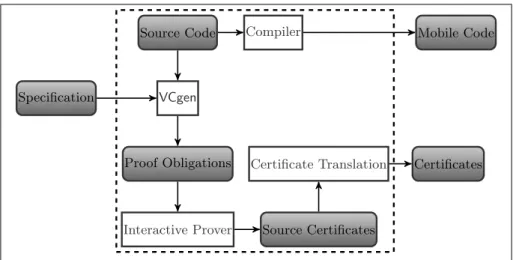
The primary objective of certificate translation is precisely to overcome the limitation of certifying compilers and extend the scope of PCC to complex policies. To this end, certificate translation transforms certificates of source-language programs into certificates of compiled programs and, thus, fills the gap between widely used interactive source code verification environments and PCC. An overall scheme of certificate generation by proof transformation is shown in Figure 1.3. In the figure, the code producer extracts a set of proof obligations from the source code and the policy specification. Then, certificates entailing source code correctness are generated. Finally, certificates for the
mobile code generated by compilation of the source code are obtained by certificate translation from the certificates of the source program.
Source Code Compiler Mobile Code
VCgen Specification
Proof Obligations
Interactive Prover Source Certificates
Certificate Translation Certificates
Fig. 1.3. Overall Scheme of Certificate Translation
Given a compiler represented by the function T·U, a function T·Uspec to
transform specifications, and certificate checkers (expressed as a ternary re-lation “c is a certificate that P adheres to φ” and written c : P |= φ), a certificate translator is a function T·Ucertsuch that for all programs p, policies
φ, and certificates c,
if c : p |= φ then TcUcert: TpU |= TφUspec
Building a certificate translator for nonoptimizing compilation is relatively simple since proof obligations are preserved (up to minor differences), and hence it is possible to reuse the certificates of source code programs for the compilation result; see e.g. the work of Barthe et al. [14] and Pavlova [57]. However, program optimizations successively applied at the intermediate com-piler phases do not preserve proof obligations and, hence, certificates cannot be reused. It is precisely the object of this thesis to study how to overcome the proof transformations that are needed to translate certificates in the presence of program optimizations. For each optimization step, we show how to appro-priately transform the certificates. Then, they can be combined to translate certificates for the complete compilation process.
Outline and Sources
Part I: Foundations of Certificate Translation
The first part focuses on the existence of certificate translation procedures for standard compiler optimizations.
Chapter 2: In Chapter 2, we study the existence of certificate translation procedures for standard program optimizations applied at intermediate compilation stages.
As a verification environment, we adopt a weakest-precondition-based VC-gen. Program verification consists in extracting from a partially annotated program a set of verification conditions, which must be discharged in or-der to prove the program correct. To represent the verification condition proofs that are subject to transformation, we propose an abstract notion of proof algebra. Then, certificate translators are defined from a set of functions, closed in the domain of certificates, which represent the appli-cation of logic rules, such as introduction and elimination for the ∧ and ∨ connective and for the ∀ quantifier.
As stated in common compiler textbooks, compilation proceeds by suc-cessive transformations that gradually translate the code into a series of lower level representations, bringing the program closer to the actual executable encoding. For each step, we build an appropriate certificate translator, paying special attention on standard optimizations applied to an intermediate Register Transfer Language (RTL) representation. The set of optimizations includes Constant Propagation, Loop Induction Variable Strength Reduction, Common Subexpression Elimination, Copy Propaga-tion, Dead Register EliminaPropaga-tion, Unreachable Code EliminaPropaga-tion, Register Allocation, and Function Inlining.
Commonly, compiler optimizations are performed in two phases: first, a static analyzer computes some information from the syntactic program representation and then, on the basis of this information, a semantics-preserving transformation is applied. For some optimizations that per-form arithmetic simplifications, the existence of a certificate translation procedure requires a formal proof ensuring the correctness of the result of the analysis. We show that, for the standard optimizations considered in this chapter, it is feasible to define an automatic procedure to construct a certificate for the logical interpretation of the result of the analysis. We leave for Chapter 3 a formalization of the set of requirements in order to define a certifying analyzer. For other optimizations that do not fit in this category, e.g. dead variable elimination, an ad-hoc certificate translator is proposed.
This work is an extension of the refereed paper Certificate Transla-tion for Optimizing Compilers [7], coauthored with Gilles Barthe,
Benjamin Gr´egoire and Tamara Rezk, presented at the 13th International
Static Analysis Symposium (SAS 2006). A large portion of this chapter has been accepted for publication in the ACM Transactions on Program-ming Languages and Systems (TOPLAS).
Chapter 3: In this chapter, we take a more general approach and formalize the results of Chapter 2 under an abstract interpretation framework, which is a unifying model for the two main components of a certificate translation procedure: the verification environment in which the original certificate
is produced and the static analysis that justifies a program optimization. The choice of an abstract framework provides a substantial leverage with respect to previous results, since it enables us to extend our results to a wider set of programming languages and verification environments. In the abstract setting, annotations are represented as partial labellings from program nodes to abstract values and verification consists in checking whether the labeling satisfies a set of inequalities in the abstract domain. To facilitate checking that the labeling bound to the program satisfies the required constraints, we provide a mild extension of the abstract interpre-tation model to incorporate a certificate infrastructure. One can see that the VCgen framework defined in Chapter 2 is a particular instance of the extended abstract interpretation framework.
As stated above, a certifying analyzer is a main component in the defini-tion of a certificate translator. We show in this chapter that proving the existence of a certifying analyzer boils down to discharging the verification conditions required to prove consistency of the analysis with respect to the verification environment.
Instead of considering specific program optimizations, we study certificate translation in the presence of basic transformations that, combined, can represent a wide range of program optimizations such as those presented in Chapter 2.
The contents of this chapter are an extension of the refereed paper Cer-tificate Translation in Abstract Interpretation [10] coauthored with
Gilles Barthe, presented at the 17th European Symposium on
Program-ming (ESOP 2008). Part II: Case Studies
In this part, we extend the application of certificate translation to less typical programming and verification scenarios.
Chapter 4: Aspect Oriented Programming (AOP) has an interesting applica-tion in the development of Proof Carrying Code scenarios, since it enables one to separate concerns such as resource control and security from the basic functionality of an application. In this incremental development pro-cess, the expected functionality can be provided by a baseline program, and successive refinements that improve non-functional concerns can be possibly provided by third parties.
In Chapter 4, we explore a PCC architecture that accommodates an in-cremental development process, based on aspect oriented programming, and extend the results of Part I to show, in the context of a Simple AOP Language (SAL), that it is possible to generate certificates of executable code from proofs of aspect oriented programs. To achieve this goal, we introduce a notion of specification preserving advice, and provide a veri-fication method for programs with speciveri-fication-preserving advice. Infor-mally, an advice a is specification-preserving for an annotated piece of
code {Φ}c{Ψ }, where Φ and Ψ denote the pre and postcondition for c, respectively, if the result of weaving the advise a with program c satisfies the same pre and postcondition.
A specification-preserving advice is natural in the context of PCC with intermediaries, since many aspects related to security (resource man-agement, logging, etc.) and efficiency (e.g., cached functions, optimized code, etc.) fall in this category. Another advantage is that a specification-preserving advice support “separate verification”, allowing intermediaries to treat correctness proofs of the baseline code and the advice as black-boxes.
We define a simple stack-based language (SBL) into which the simple AOP programs can be compiled, and a VCgen for SBL programs. We then show that correct SAL programs are compiled into correct SBL programs. Chapter 4 is based on the refereed paper Certificate translation for specification-preserving advice [9], coauthored with Gilles Barthe, presented at the Foundations of Aspect-Oriented Languages workshop (FOAL 2008).
Chapter 5: In order to reduce the verification effort, hybrid verification envi-ronments increasingly rely on combining static analyses and verification condition generation. The VCgen exploits the information of the analysis in two useful ways: on the one hand, verification conditions that originate from spurious edges in the control-flow graph are discarded. This leads to fewer and smaller proof obligations. Furthermore, the VCgen adds the results of the analysis as additional assumptions to help prove the verifi-cation conditions.
In Chapter 5, we introduce two hybrid verification frameworks for source code and low level bytecode, respectively. The objective of this work is to extend preservation of proof obligations to hybrid verification methods. One well-known difficulty with the preservation of static analysis results is the loss of precision incurred by compilation [45]. To solve this difficulty, we achieve preservation of solutions by defining at bytecode level a sym-bolic execution that decompiles stack instructions. Finally, we show that programs that are provably correct using the hybrid method are prov-ably correct using standard VCgen. To this end, we define a compiler that transforms a hybrid specification (merging logical assertions and analy-sis results) into a standard one by giving a logical interpretation of the analysis results. This result ensures soundness of the hybrid verification method from the soundness of the standard VCgen.
The contents of Chapter 5 are presented in the refereed paper Preser-vation of proof obligations for hybrid verification methods [11], coauthored with Gilles Barthe, David Pichardie, and Julian
Samborski-Forlese, published at the 6th IEEE International Conference on Software
Engineering and Formal Methods (SEFM 2008).
Chapter 6: As parallel programming languages for high-performance comput-ing are increascomput-ingly gaincomput-ing wide acceptance, there is a need to provide
analysis and verification methods to help developers write, maintain, and optimize their high-performance applications.
In Chapter 6, we propose a framework to specify and certify the behav-ior of parallel divide-and-conquer programs over hierarchical memories. Sequoia is a special purpose program representation to exploit the high-performance support offered by modern computer architectures. The lan-guage contains explicit constructions to successively fragment computa-tions into smaller tasks, which are executed down in the memory hierar-chy. We use the framework of abstract interpretation to design analysis and verification frameworks to reason about Sequoia programs. A main component of this framework is an analysis that checks whether subtasks operate over disjoint portions of the memory. In this setting, we study whether a certificate translator procedure can be defined for optimiza-tions that are typical for explicitly parallel tasks executing in hierarchical memories.
Chapter 6 is an extension of the paper Certified Reasoning in Mem-ory Hierarchies [12], coauthored with Gilles Barthe and Jorge Sacchini,
published at the 6thASIAN Symposium on Programming Languages and
Certificate Translation alongside Standard RTL
Optimizations
This chapter outlines the principles of certificate translation, and instanti-ates it in the context of an optimizing compiler from a high-level imperative language to an intermediate RTL representation. Compilation proceeds by successive transformations: imperative programs are first translated into RTL programs, then common program optimizations are successively applied to
RTLprograms in order to produce the final RTL program. For completeness,
we first state a well-known result for the first compilation phase [14, 8]: proof obligations are preserved, up to minor differences, by a nonoptimizing com-piler from the high-level to RTL representation. Then, for each of the succesive optimizations applied to the RTL program representation, we define an ap-propriate certificate translator.
The verification infrastructure builds upon verification condition gener-ators (VCgen), which are part of the standard PCC infrastructure and are also used in many interactive verification environments. A VCgen can be seen as an automatic strategy for applying Hoare logic rules; it generates from a program p and a specification φ a set of proof obligations PO(p, φ) whose va-lidity ensures that the program meets its specification. In this setting, c is a certificate that p satisfies φ (denoted c : p |= φ) iff c is a set of (logical) cer-tificates such that for every proof obligation ψ ∈ PO(p, φ), there is a (logical) certificate d ∈ c whose mere existence ensures the validity of ψ, denoted with the binary relation d |=poψ.
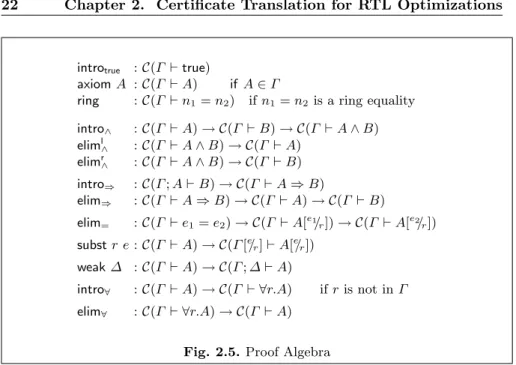
Of course, certificate translation also depends by definition on the format of certificates, and on the procedure to check that a certificate establishes a property ψ. Nevertheless, one does not need to commit to a particular cer-tificate infrastructure for proof obligations in order to study the existence of certificate translators. Instead, the existence of certificate translators for com-mon program optimizations is shown under the assumption that certificates are closed under a few logical rules that include introduction and elimination rules for the ∧ and ⇒ connectives and for the ∀ quantifier, as well as sub-stitution of the subexpressions e1 by e2 (or viceversa) under the hypothesis
Difficulties
Building a certificate translator for non-optimizing compilation is relatively simple since proof obligations are preserved up to minor differences. Dealing with optimizations is more challenging because:
- Optimizations that perform arithmetic simplifications such as constant prop-agation or common subexpression elimination, do not necessarily preserve verification conditions. Consider the following piece of code to which con-stant propagation is applied:
r1:= 1 {true} r2:= r1 {r1= r2} r1:= 1 {true} r2:= 1 {r1= r2}
Proof obligations for the assignment instruction to r2 are true ⇒ r1 = r1
and true ⇒ r1= 1 for the original and optimized version, respectively. The
second proof obligation is unprovable, since it is unrelated to the sequence of code containing the assignment r1:= 1.
Remark: Notice that, for the short code fragment above, proof obligations do not coincide due to our particular definition of wp. Consider a more complex V Cgen that propagates the computation of wp for the assignment
r1 := 1 over the proof obligations true ⇒ r1 = r1 and true ⇒ r1 = 1.
Such alternative V Cgen returns proof obligations that are identical when given the example above as input. Notice, however, there are still cases in which a more complex V Cgen also fails, for instance, when given as input an alternative example
c {true} r2:= r1
{r1= r2}
where c is a non-trivial loop from which the analysis can infer the postcon-dition r1= 1. End of Remark.
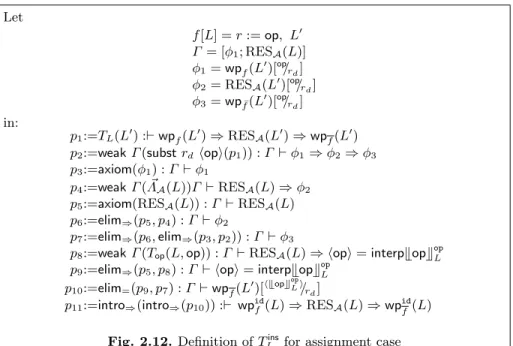
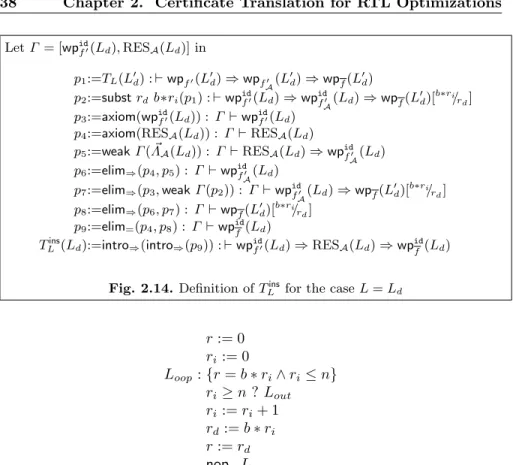
The conditions that justify an optimization opportunity must be prop-agated through every intermediate assertion. Therefore, typical analyzers must be extended into certifying analyzers, which justify analyses upon which the optimizations rely by expressing their results in the logic of the PCC architecture, and produce a certificate of the analysis for each pro-gram. Then, a function weaves the certificate of the original program and the certificate produced by the certifying analyzer, to produce the certificate of the optimized program. The process is presented in Figure 2.1;
- Optimizations that eliminate instructions without computational role (as-signments to dead registers, nop instructions) may also eliminate informa-tion that is required to prove the program correct. For example, eliminating
nopinstructions may lead to delete assertions attached to them, or dead reg-ister elimination may remove regreg-isters that occur in intermediate assertions of the program. Considering the following transformation:
x := n; .. . {x = n} y := x; .. . {x = y} −→ x := n; .. . {x = n} y := n; .. . {x = y}
After performing constant propagation, the variable x becomes dead. How-ever, one cannot simply remove the first assignment since proof obligations referring to dead registers ({x = n} in this case) cannot be proved because all hypotheses about these registers would be lost. Thus, in order to define a certificate translator for dead register elimination, we propose a different kind of transformation that performs simultaneously dead variable elimina-tion in instrucelimina-tions and in asserelimina-tions.
TCB Program Specification
Certifying Analyzer
Analysis Result Analysis ResultCertificate of
Interactive Verification Program Certificate Certificate Translator Optimization Optimized Program VCgen Proof Checker Certificate for Optimized Program
According to the characteristics of their certificate translators, optimiza-tions fall in one of the following categories:
— PPO (Preservation of Proof Obligations): PPO deals with transforma-tions for which the annotatransforma-tions are not rewritten, and where the proof obli-gations (for the original and transformed programs) coincide. This category covers transformations such as nonoptimizing compilation and unreachable code elimination;
— IPO (Instantiation of Proof Obligations): IPO deals with transforma-tions where the annotatransforma-tions and proof obligatransforma-tions for the transformed pro-gram can be described as a variable renaming of the annotations and proof obligations for the original program, thus certificates are translated by α-equivalence. This category covers dead register elimination and register allo-cation;
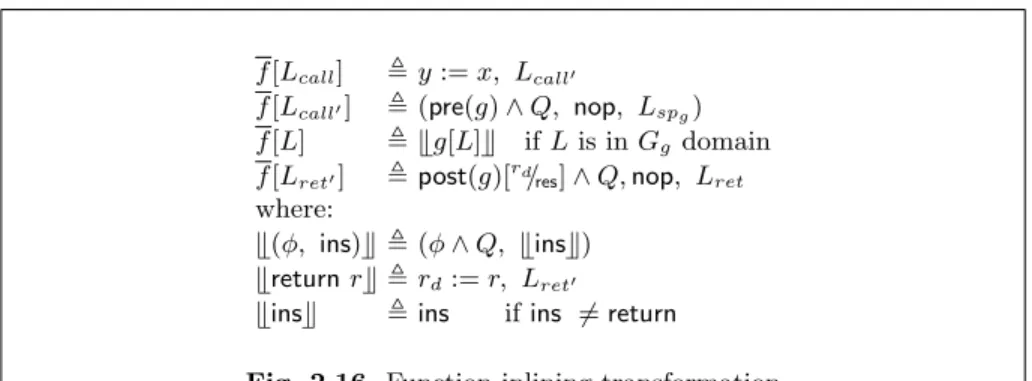
— SCT (Standard Certificate Translation): SCT deals with transforma-tions for which the annotatransforma-tions are not rewritten, but where the verification conditions do not coincide. This category covers transformations such as loop unrolling and function inlining;
— CTCA (Certificate Translation with Certifying Analyzers): CTCA deals with transformations for which the annotations need to be rewritten, and for which certificate translation relies on having certified previously the analysis used by the transformation, using certifying analyzers that produce a certificate that the analyzer is correct on the source program. This category covers constant propagation, common subexpression elimination, strength re-duction, and other optimizations that rely on arithmetic.
2.0.1 Contents This section:
• introduces certificate translation as a means to extend significantly the scope of PCC to complex security policies;
• classifies certificate translation for common optimizations, including con-stant propagation, loop induction variable strength reduction, dead reg-ister elimination, common subexpression elimination, copy propagation, unreachable code elimination, register allocation, and function inlining. We present each of the certificate translators for the RTL language. In Section 2.1, we introduce our proof carrying code setting, including a Register Transfer Language (RTL) and its verification infrastructure. In Sec-tion 2.2, we present certificate translaSec-tion for nonoptimizing compilers. In Section 2.3, we describe certificate translation for several standard optimiza-tions.
2.1 PCC Setting
2.1.1 RTL LanguageOur language RTL (Register Transfer Language) is a low-level, side-effect free, language with conditional jumps and function calls, extended with annota-tions drawn from a suitable assertion language. The choice of the assertion language does not affect our results, provided assertions are closed under the connectives and operations that are used by the verification condition gener-ator.
The syntax of expressions, formulas, and RTL programs (suitably extended to accommodate certificates, see Section 2.1.4), is shown in Figure 2.2, where n ∈ N and r ∈ R, with R an infinite set of register names. We let ϕ, φ, and ψ range over assertions. A program p is defined as a function from RTL
func-comparison ⊳ ::= < | ≤ | = | ≥ | >
expressions e ::= n | r | −e | e + e | e ∗ e | . . . assertions ϕ ::= true | e ⊳ e | ϕ ∧ ϕ | ¬ϕ | ∀r. ϕ | . . . comparisons cmp ::= r ⊳ r | r ⊳ n
operators op ::= n | r | n + r | . . . instr. desc. ins ::= rd:= op, L
| rd:= f (~r), L
| cmp ? Lt: Lf
| return r | nop, L instructions I ::= (φ, ins) | ins
fun. decl F ::= {~r; ϕ; G; ψ; λ; ~Λ} Fig. 2.2. Syntax of RTL
tion identifiers to function declarations. RTL functions return integer values. Every program comes equipped with a special function, namely main, and its declaration. The body of a function is defined as a mapping G from program labels to instructions, and instructions are equipped with explicit successors. Hence, the body of a function constitutes a (closed) directed graph. A mapping from program points to instructions is preferred, rather than an instruction sequence, to abstract from the details of label updating when modifying the function code. In the sequel, the distinguished label Lsp is used as an entry
point for every function body. A declaration F for a function f includes its formal parameters ~r, a precondition ϕ, a (closed) graph code G, a postcondi-tion ψ, a certificate λ, and a funcpostcondi-tion ~Λ from reachable labels to certificates (the notion of certificate is defined in Section 2.1.4). For clarity, we often use
a subscript f for referring to elements in the declaration of a function f , e.g., the graph code of a function f as Gf.
As will be defined below, the VCgen generates one proof obligation for each program point containing an annotation plus one proof obligation for the entry point Lsp. The component λ is a certificate that attests the validity
of the latter proof obligation and ~Λ maps every program point that contains
an assertion to the certificate of its associated proof obligation.
Formal parameters are represented as a list of registers, from the set R, which we suppose to be local to f . For specification purposes, we introduce for each register r in ~r a (pseudo)register r∗, not appearing in the code of the function, and which represents the initial value of a register declared as
formal parameter. We let R∗ denote the set {r∗ | r ∈ R} and ~r∗ denote a
sequence of registers in R∗. We also introduce, for specification purposes, a (pseudo)register res, not appearing in the code of the function, and which represents the result or return value of the function. The annotations ϕ and ψ in Figure 2.2 provide respectively the specification of pre and postcondition of the function, and are subject to well-formedness constraints. The precondition of a function f , also referred as pre(f ), is an assertion in which the only registers to occur are the function formal parameters, hereafter denoted ~rf;
in other words, the precondition of a function can only talk about the initial values of its parameters. The postcondition of a function f , also referred as post(f ), is an assertion1 in which the only registers to occur are res and the
formal parameters ~rf∗; in other words, the postcondition of a function can
only talk about its result and the initial values of its parameters.
A graph code of a function is a partial function from labels to instructions. We assume that every graph code includes a special label, namely Lsp,
corre-sponding to the starting label of the function, i.e., the first instruction to be executed when the method is called. Given a function f and a label L in the domain of its graph code, we will often use f [L] instead of Gf(L), i.e., the
application of graph code of f to label L.
An instruction is either an instruction descriptor ins or a pair (φ, ins) con-sisting of an annotation φ and an instruction descriptor ins. An instruction descriptor can be an assignment, a function call, a conditional jump, or a return instruction. Operations on registers are those of standard processors, such as movement of registers or values into registers rd:= r, and arithmetic
operations between registers or between a register and a value. Furthermore, every instruction descriptor carries explicitly its successor label(s); due to this mechanism, we do not need to include unconditional jumps, i.e., “goto” in-structions, in the language. Immediate successors of a label L in the graph of a function f are denoted by the set succf(L). We assume that the graph is closed;
and in particular, if L is associated with a return instruction, succf(L) = ∅.
1 Notice that a postcondition is not exactly an assertion in the sense that it uses
2.1.2 Operational Semantics
The operational semantics of RTL is standard. In particular, neither proofs nor assertions interfere with the semantics. The semantics is defined in Figure 2.3 as a big step relation between non terminal states and a terminal state. A non terminal state is defined as a tuple with two elements: the current instruction and a map ρ from local registers to values. The expression [ρ | x 7→ n] stands for the function ρ′ s.t. ρ′y = n if x = y and ρ′y = ρy otherwise.
hins, ρi f n h(ϕ, ins), ρi f n hf [L], [ρ | rd7→ JopKρ]i f n hrd:= op, L, ρi f n hf [Lt], ρi f n hcmp ? Lt: Lf, ρi f n if JhcmpiKρ hf [Lf], ρi f n hcmp ? Lt: Lf, ρi f n if ¬JhcmpiK ρ
hg[Lsp], [~rg7→ ρ~r]i g m hf [L′], [ρ | ret 7→ m]i f n
hret := g(~r), L′, ρi f n
hreturn r, ρi f ρr
Fig. 2.3. Operational Semantics
Let JK be a standard interpretation function that takes an assertion and a map from registers to values and returns a logical proposition. For clarity, the interpretation J.Kρ∗
ρ refers to two parameters ρ and ρ∗ with disjoint domains
R and R∗, respectively. When it is clear from the context that an assertion
φ does not contain registers in R∗, e.g., when φ is a precondition, we may
simply write JφKρ instead of JφKρ
∗
ρ .
We say that an assertion is valid, if for every assignments ρ and ρ∗, JφKρ∗
ρ is
a valid logical proposition. Similarly, we define an interpretation function J.K for expressions, which takes the assignments ρ and ρ∗respectively for registers
in R and R∗. When an expression e does not contain registers in R∗, e.g.,
when it is an expression of the programming language, we may simply write JeKρ instead of JeKρ
∗
ρ .
2.1.3 Verification Condition Generator
Verification condition generators (VCgens) produce the proof obligations that must be discharged in order to guarantee that the program meets its
specifica-tion. The predicate transformer wp is a partial function that computes, from a sufficiently annotated program, a fully annotated program in which all labels of the program have an explicit precondition attached to them. To ensure the computability of the wp function, its domain is restricted to well-annotated programs. This domain can be characterized by an inductive and decidable definition and does not impose any specific structure on programs.
Definition 2.1.
• The graph of a function f is closed if for every node all its successors are in the graph:
closed(f ) = ∀L ∈ Gf, succf(L) ⊆ Gf
• A label L′ is reachable from a label L in f , if L = L′, or if it is the
successor of a label reachable from L: L ∈ reachablef,L
L′∈ reachablef,L⇒ ∀L′′∈ succf(L′), L′′∈ reachablef,L
• A label L in a function f reaches annotated labels, if its associated in-struction contains an assertion, or if its associated inin-struction is a return instruction (in that case the annotation is the post condition), or if all its immediate successors reach annotated labels. More precisely, reachAnnotf
is defined as the smallest set that satisfies the following conditions: f [L] = (ϕ, ins) ⇒ L ∈ reachAnnotf
f [L] = return r ⇒ L ∈ reachAnnotf
(∀L′∈ succ
f(L), L′∈ reachAnnotf) ⇒ L ∈ reachAnnotf
• A function f is well annotated if it is closed and every reachable point from the starting point Lsp reaches annotated labels. A program p is well
annotated if all its functions are well annotated.
From the definition above, if every loop in the code graph of the function f is annotated, then f is well-annotated. It also follows from the definition above that, from a well-annotated program, one can compute an assertion for every label, i.e., the application of the function wp terminates for every program loop.
A fully-annotated function is computed from a partially annotated func-tion f , using the wpf transformer, using the preconditions and postconditions
of functions called by f . The definition of wpf(L) proceeds by case analysis:
if L points to an instruction that carries an assertion φ, then wpf(L) is set to
φ; otherwise, wpf(L) is computed by the function wpidf .
The formal definitions of wpf and wpid
f are given in Figure 2.4, where the
expression φ[e/
r] stands for the substitution in the assertion φ of all
occur-rences of register r by the expression e. The definition of wpid
f is standard for
assignment and conditional jumps, where hopi and hcmpi is the obvious inter-pretation of operators in RTL into expressions in the language of assertions.
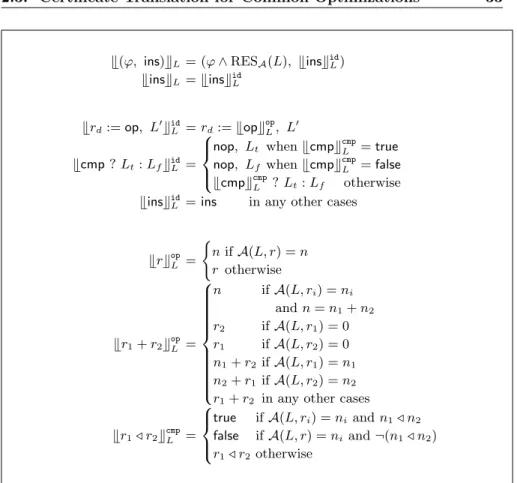
wpf(L) = ϕ if Gf(L) = (ϕ, ins) wpf(L) = wpidf (ins) if Gf(L) = ins wpid f(rd:= op, L) = wpf(L)[ hopi/ rd] wpid f (rd:= g(~r), L) = pre(g)[~r/~rg] ∧(∀res. post(g)[~r/ ~r∗ g] ⇒ wpf(L)[ res/ rd]) wpid f (cmp ? Lt: Lf) = (hcmpi ⇒ wpf(Lt)) ∧ (¬hcmpi ⇒ wpf(Lf)) wpid f(return r) = post(f )[ r/ res] wpid f(nop, L) = wpf(f [L])
Fig. 2.4. Verification condition generator
For a function invocation, wpid
f (rd := g(~r), L) is defined as a conjunction
of the precondition of g, where formal parameters are replaced by actual pa-rameters, and of the assertion ∀res. post(g)[~r/
~ r∗
g] ⇒ wpf(L)[
res/
rd]. The second
conjunct permits that information in wpf(L) about registers different from
rd be propagated to other preconditions. In the remainder of the chapter, we
shall abuse notation and write wpid
f (L) instead of wpidf (ins) if f [L] = ins.
2.1.4 Certified Programs
Certificates provide a formal representation of proofs, and are used to ver-ify that the proof obligations generated by the VCgen hold. For the purpose of certificate translation, we do not need to commit to a specific format for certificates. Instead, we assume that certificates are closed under specific op-erations on certificates, which are captured by an abstract notion of proof algebra.
Recall that a judgment is a pair consisting of a list of assertions, called con-text, and of an assertion, called goal. A proof algebra is given by a set-valued function C over judgments, and by a set of operations, all implicitly quantified in the usual way. The operations are standard (given in Figure 2.5), to the exception perhaps of the substitution operator that allows one to substitute a subexpression e by e′ from the hypothesis e = e′, and of the operator ring,
which establishes all ring equalities that will be used to justify the optimiza-tions.
In order to remain at an abstract level, we do not provide an algorithm for checking certificates. Instead, we take C(Γ ⊢ ϕ) to be the set of valid certificates of the judgment Γ ⊢ ϕ. In the sequel, we write λ : Γ ⊢ ϕ to express that λ is a valid certificate for Γ ⊢ ϕ, and use proof as a synonym of valid certificate. Furthermore, we require the certificate infrastructure to be sound, i.e., if C(Γ ⊢ φ) 6= ∅ then for all maps ρ, ρ∗, if for every ψ ∈ Γ , JψKρ∗ ρ
is valid, then JφKρ∗
introtrue : C(Γ ⊢ true)
axiomA : C(Γ ⊢ A) ifA ∈ Γ
ring : C(Γ ⊢ n1= n2) if n1= n2 is a ring equality
intro∧ : C(Γ ⊢ A) → C(Γ ⊢ B) → C(Γ ⊢ A ∧ B) eliml ∧ : C(Γ ⊢ A ∧ B) → C(Γ ⊢ A) elimr∧ : C(Γ ⊢ A ∧ B) → C(Γ ⊢ B) intro⇒ : C(Γ ; A ⊢ B) → C(Γ ⊢ A ⇒ B) elim⇒ : C(Γ ⊢ A ⇒ B) → C(Γ ⊢ A) → C(Γ ⊢ B) elim= : C(Γ ⊢ e1= e2) → C(Γ ⊢ A[e1/r]) → C(Γ ⊢ A[e2/r]) substr e : C(Γ ⊢ A) → C(Γ [e/r] ⊢ A[e/r]) weak∆ : C(Γ ⊢ A) → C(Γ ; ∆ ⊢ A)
intro∀ : C(Γ ⊢ A) → C(Γ ⊢ ∀r.A) if r is not in Γ
elim∀ : C(Γ ⊢ ∀r.A) → C(Γ ⊢ A)
Fig. 2.5. Proof Algebra
Finally, we define a certified program as one whose functions are certified, i.e., carry valid certificates for the proof obligations attached to them. Definition 2.2.
• A function f with declaration {~r; ϕ; G; ψ; λ; ~Λ} is certified if: – λ is a proof of ⊢ ϕ ⇒ wpf(Lsp)[~r/~r∗],
– ~Λ(L) is a proof of ⊢ ϕ ⇒ wpid
f (ins) for all reachable labels L in f such
that f [L] = (ϕ, ins).
• A program is certified if all its functions are. 2.1.5 Soundness of PCC Infrastructure
The verification condition generator is sound, in the sense that if a certified program p is called with registers set to values that verify the precondition of the function main, and it terminates normally, then the final state will verify the postcondition of main.
When considering mutually-recursive functions, special care must be taken to ensure soundness of the VCgen. In this case it is not hard to achieve since we are only interested in verifying the partial correctness of the program w.r.t. its specification, i.e., we only consider finite executions.
Lemma 2.3. Let p be a certified program. Then, for every function f with dec-laration {~r; ϕ; G; ψ; λ; ~Λ}, any initial mapping ρ∗with domain {r∗1, . . . , r∗k},
any label L in the domain of Gf and any state ρ, if Jwpf(L)Kρ
∗
ρ and hf [L], ρi f
Proof. Since wp and wpinsare defined each one in terms of the other, we prove
the goal of the lemma above simultaneously with a similar goal but under the hypothesis Jwpins
f (L)Kρ
∗
ρ . The proof proceeds by rule induction on the derivation
of hf [L], ρi f n. For simplicity, we rely on the following standard results
(where F V (ϕ) stands for the set of unbound variables in ϕ):
i) (Coincidence Lemma). For all states ρ1, ρ2, ρ∗1, ρ∗2 and assertion ϕ, if
for all x in F V (ϕ) ∩ R and y in F V (ϕ) ∩ R∗ we have ρ1x = ρ2x and
ρ∗ 1y = ρ∗2y then JϕK ρ∗1 ρ1 = JϕK ρ∗2 ρ2.
ii) (Substitution Lemma). For all x, c, ϕ and ρ, ρ∗, Jφ[e/ x]Kρ ∗ ρ = JφK ρ∗ [ρ|x7→JeKρ∗ρ ] and Jφ[e/ x∗]Kρ ∗ ρ = JφK [ρ∗|x∗7→JeKρ∗ ρ ] ρ .
• Consider the case s.t. the last rule applied is hins, ρi f n
h(ϕ, ins), ρi f n
then wpf(L) = φ and since f is certified, and the certificate infrastructure
is sound, we have that Jφ ⇒ wpins f (L)Kρ
∗
ρ is valid. Hence, from the
hypoth-esis Jwpf(L)Kρ
∗
ρ and definition of J.K, we have that Jwpinsf (L)Kρ
∗
ρ is valid.
By I.H. and the latter condition we get JψfKρ
∗
[res7→n]. Notice that this is the
only case where we need to distinguish the hypothesis Jwpins(L)Kρ∗
ρ from
Jwp(L)Kρ∗
ρ ; in any other case wp(L) = wpins(L).
• Assume the last rule applied is hf [L′], [ρ | r d7→ JopKρ ∗ ρ ]i f n hrd:= op, L′, ρi f n .
By hypothesis and definition of wpf, we have Jwpf(L′)[op/rd]K
ρ∗
ρ .
Equiva-lently, by substitution lemma Jwpf(L′)Kρ
∗
[ρ|rd7→JopKρ∗ρ ]
• Assume the last rule applied involves a function call, i.e., there is a func-tion g s.t. f [L] = ret := g(~r), L′ and the last rule applied is
hg[Lsp], [~rg7→ ρ~r]i gm hf [L′], [ρ | ret 7→ m]i f n
hret := g(~r), L′, ρi f n
for some value m. Let ϕg and ψg stand for the preconditions and
post-condition of g respectively. From Jwpf(L)Kρ
∗
ρ and definition of J.K, we
have Jϕg[~r/~rg]K
ρ∗
ρ . By coincidence lemma we have then Jϕg[~r/~rg]K
[r∗g7→ρr]
[r7→ρr] ,
and by substitution lemma JϕgK
[r∗g7→ρr]
[rg7→ρr]. Since g is certified, we have
a proof for ϕg ⇒ wpg(Lsp)[~rg/r~∗ g] and therefore Jwpg(Lsp)[ ~ rg/ ~ r∗ g]K [r∗g7→ρr] [rg7→ρr].
Again by substitution lemma, Jwpg(Lsp)K [r∗
g7→ρr]
[rg7→ρr]. Therefore, by
applica-tion of I.H., we know that JψgK [rg∗7→ρr]
[res7→m], and then by substitution lemma
Jψg[m/res]K [r∗
g7→ρr]
ρ . From the hypothesis Jwpf(L)Kρ
∗
ρ and definition of J.K,
we have that Jψg[~r/r~∗ g]K
ρ∗
[ρ|res7→m] ⇒ Jwpf(L′)[res/ret]Kρ
∗
[ρ|res7→m]. Equivalently
by substitution lemma, Jψg[m/res]K [r∗g7→ρr]
ρ ⇒ Jwpf(L′)K
ρ∗
[ρ|ret7→m], and hence
Jwpf(L′)Kρ
∗
[ρ|ret7→m]. From the latter condition and I.H., we get the desired
result.
As a corollary, we obtain the following theorem: Theorem 2.4 (Soundness of VCgen). Suppose that
a) P is a certified program containing a function main, with precondition Φ and postcondition Ψ ,
b) ρ is such that JΦKρ, and
c) hmain[Lsp], ρi n,
then the interpretation JΨK[ ~[res7→n]r∗7→ρ~r] is valid.
2.2 Preservation of Proof Obligations
The purpose of this section is to establish preservation of proof obligations for a nonoptimizing compiler from an imperative language with procedures to RTL. This result is inspired from earlier work by Barthe, Rezk, and Saabas [14].
In this section, we define a simple and structured high-level language, a standard verification condition generator for this language, and a nonoptimiz-ing compiler to the RTL language defined before. Then, we show that given the same program specification, proof obligations for the source program and for its compiled RTL version coincide.
2.2.1 Source Language
A program p in the source language is defined as a function from function iden-tifiers to function declarations. We assume that every program comes equipped with a special function identifier, namely main, and its declaration. The decla-ration of a function f in the source language has the form: { ~xf; ϕ; c; ψ; λ; ~Λ},
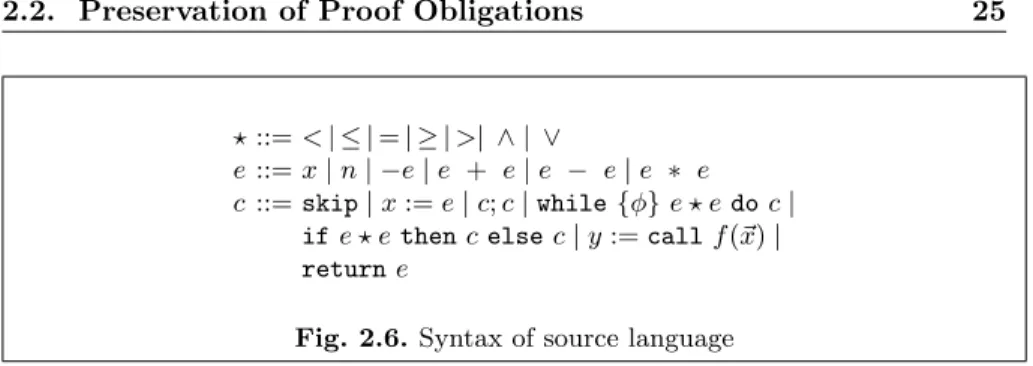
where c is a command whose syntax is shown in Figure 2.6. Every function returns integer values.
As in RTL programs, a function declaration includes its formal parameters ~x, a precondition ϕ, a postcondition ψ, a certificate λ, and a set of
⋆ ::= < | ≤ | = | ≥ | >| ∧ | ∨
e ::= x | n | −e | e + e | e − e | e ∗ e c ::= skip | x := e | c; c | while {φ} e ⋆ e do c |
ife ⋆ e then c else c | y := call f (~x) | returne
Fig. 2.6. Syntax of source language
However, the only command that has an annotation is the while command. Notice that all while commands hold annotations. The definition of the VC-gen is made in terms of the function wp, which is overloaded to denote as well a predicate transformer for the source code, and is given in Figure 2.7. Certificates for source level and RTL programs are represented by the same proof algebra.
wp(skip, ψ) = ψ wp(x := e, ψ) = ψ[e/x]
wp(c1; c2, ψ) = wp(c1, wp(c2, ψ))
wp(while {ϕ} e1⋆ e2 doc1, ψ) = ϕ
wp(if e1⋆ e2 thenc1 elsec2, ψ) = (he1⋆ e2i ⇒ wp(c1, ψ))∧
(¬he1⋆ e2i ⇒ wp(c2, ψ))
wp(y := call g(~x), ψ) = pre(g)[~x/ ~ xg]∧ ∀res.(post(g)[~x/ ~ x∗ g] ⇒ ψ[ res/ y]) wp(return e, ψ) = ψ[e/ res]
Fig. 2.7. wp for the source language
PO(skip, ψ) = ∅ PO(x := e, ψ) = ∅
PO(c1; c2, ψ) = PO(c2, ψ) ∪ PO(c1, wp(c2, ψ))
PO(while {φ} e1⋆ e2 doc1, ψ) =
PO(c1, φ) ∪ {φ ⇒ (e1⋆ e2⇒ wp(c1, φ)) ∧ (¬(e1⋆ e2) ⇒ ψ)}
PO(if e1⋆ e2 thenc1 elsec2, ψ) = PO(c1, ψ) ∪ PO(c2, ψ)
PO(y := call g(~x), ψ) = ∅ PO(return e, ψ) = ∅
Definition 2.5.
• A function f with declaration {~x; ϕ; c; ψ; λ; ~Λ} is certified if: – λ is a proof of ⊢ ϕ ⇒ wp(c, ψ)[~x/
~ x∗]
– ~Λ contains a proof of ⊢ ϕ for every proof obligation ϕ in PO(c, ψ), where PO is defined in Figure 2.8.
• A program is certified if all its functions are.
The semantics of the source language is standard and, thus, omitted. 2.2.2 Compilation
The compilation function to RTL is standard, except for the while command, and sketched in Figure 2.9. Note that the compilation function T.U takes, in addition to the command to compile, two additional parameters. Both are labels and respectively correspond to the label of the first instruction in the compilation and the label of the successor of the last instruction. For clarity, Figure 2.9 is just a scheme of the compiler because the compiler for expressions T.U is using a unique instruction LB : r1 := Te1U, L, while compilation of
the expression e1 might need more than one RTL instruction, and r1 will
be assigned with the result of the last register assigned to in the compiled instructions for e1. Twhile {ϕ} e1⋆ e2 docULH,LE = LH : (ϕ, nop, LB) LB : r2:= Te2U, L′B L′B : r1:= Te1U, L L : r1⋆ r2 ? LT : LE TcULT,LH TskipUL,L′ = L : nop, L′ Tx := eUL,L′ = L : x := TeU, L′ Tc1; c2UL,L′ = Tc1UL,L′′ Tc2UL′′,L′
Tif e ⋆ e then c1 elsec2UL,L′ = L : r1:= Te1U, L1
L1 : r2:= Te2U, L2
L2 : r1⋆ r2 ? LT : LF
Tc1ULT,L′
Tc2ULF,L′
Ty := call f(~x)UL,L′ = L : y := f (~x), L′