O
pen
A
rchive
T
OULOUSE
A
rchive
O
uverte (
OATAO
)
OATAO is an open access repository that collects the work of Toulouse researchers and
makes it freely available over the web where possible.
This is an author-deposited version published in :
http://oatao.univ-toulouse.fr/
Eprints ID : 14589
To link to this article : DOI:10.1016/j.clay.2015.04.025
URL :
http://dx.doi.org/10.1016/j.clay.2015.04.025
To cite this version : Rhouta, Benaïssa and Bouna, Lahcen and Maury,
Francis and Senocq, François and Lafont, Marie-Christine and Jada, Amane
and Amjoud, M'barek and Daoudi, Lahcen Surfactant-modifications of Na+
—beidellite for the preparation of TiO2–Bd supported photocatalysts: II—
Physico-chemical characterization and photocatalytic properties. (2015)
Applied Clay Science, vol.115. pp. 266-274. ISSN 0169-1317
Any correspondance concerning this service should be sent to the repository
administrator:
[email protected]
Surfactant-modifications of Na
+
–
beidellite for the preparation of TiO
2
–
Bd supported photocatalysts: II—Physico-chemical characterization and
photocatalytic properties
B. Rhouta
a,⁎
, L. Bouna
a, F. Maury
b, F. Senocq
b, M.C. Lafont
b, A. Jada
c, M. Amjoud
a, L. Daoudi
d aLaboratoire de Matière Condensée et Nanostructures (LMCN), Faculté des Sciences et Techniques Guéliz, Université Cadi Ayyad, BP 549, Marrakech, Morocco bCIRIMAT, Université de Toulouse, CNRS-UPS-INP, ENSIACET, 4 allée Emile Monso, BP 44362, 31030Toulouse cedex 4, FrancecInstitut de Sciences des Matériaux de Mulhouse (IS2M), LRC 7228—CNRS, 15 rue Jean Starcky, BP 2488, 68057Mulhouse cedex, France d
Laboratoire de Géosciences et Géoenvironnement, Faculté des Sciences et Techniques Guéliz, Université Cadi Ayyad, BP 549, Marrakech, Morocco
a b s t r a c t
Keywords: Beidellite TiO2 Photocatalysis SurfactantCethyltrimethylammonium bromide (CTAB) Nanocomposites
This work deals with the study of the effect of the amount of cethyltrimethylammonium bromide (CTAB) surftant, used in the preparation of starting organobeidellites, on physico-chemical properties and photocatalytic ac-tivity of TiO2supported beidellite (Bd) nanocomposites against the removal of Orange G (OG) dye from aqueous
media. A structural study of organobeidellites used as starting materials was reported in a companion paper. Here, physico-chemical characterizations of the nanocomposite photocatalysts show that TiO2supported on Bd
beforehand organomodified with an amount of CTAB equivalent to 3 CEC of smectite (3CTA+–Bd) exhibits
thin fine grained (≈10 nm) features which remarkably remained stable in the form of photoactive anatase up to 750 °C. Comparatively, the TiO2coating grown on Bd previously rendered organophilic by using an amount
of CTAB equivalent to 5 CEC of Clay mineral (5CTA+–Bd) appears thicker and more porous with larger
nanopar-ticles (≈25 nm) which is prone to be readily converted into less photoactive rutile as observed near 700 °C. This is likely due to its development mainly outside Bd interlayer spaces promoted by outer organophilic environment created by the adsorption of CTA+excess. In both cases, anatase is still present as minor phase up to 900 °C. As a
result of these differences a significant improvement of the photocatalytic activity of TiO2supported Bd
nano-composite prepared starting from 3CTA+–Bd is observed compared to that from 5CTA+–Bd. For instance, the
total elimination of the pollutant from the aqueous solution occurs within about 45 min when using the 3CTA+–Bd–TiO
2photocatalyst instead of 90 min using the 5CTA+–Bd–TiO2sample. Furthermore, the best
TiO2–Bd supported photocatalyst is also found more efficient than a pure TiO2xerogel sample.
1. Introduction
Owing to its ability to provide strong oxidant species (holes h+and
radicals.OH) upon UV irradiation of semiconductor oxides,
heteroge-neous photocatalysis emerges as an efficient alternative technique able to decompose and to mineralize bio-recalcitrant organic pollutants in the form of CO2 and H2O (Robertson, 1996; Herrmann, 1999;
Fujishima et al., 2000; Carp et al., 2004; Fujishima and Zhang, 2006; Paz, 2006). In this respect, commercial TiO2nanopowder as Degussa
P25, made up of anatase (80%) and rutile (20%), is considered as the most active photocatalyst used in wastewater treatment (Herrmann, 1999; Nieto-Suárez et al., 2009). Nevertheless, TiO2powder
nanoparti-cles easily agglomerate which reduces photonic efficiency for most deg-radation processes to less than 10% (Houari et al., 2005). Furthermore, due to their micrometric sizes, their use requires, for being recovered
from water decontaminated by TiO2 slurry, to implement costly
microfiltration processes (Herrmann, 1999; Carp et al., 2004; Houari et al., 2005; Liu et al., 2009). Therefore, researches recently have focused on improving photocatalytic activity via the development of TiO2
sup-ported photocatalysts.
Clay minerals are considered as promising supports due to their in-teresting inherent properties, namely their adsorption capacity, high surface area, multi-scale porosity and their ability to be bounded to chemical compounds (An et al., 2008; Aranda et al., 2008; Rhouta et al., 2008; Liu et al., 2009; Nieto-Suárez et al., 2009). In this respect, the immobilization of TiO2anatase nanoparticles (average size 10 nm)
onto stevensite particles by solvothermal method was recently reported (Bouna et al., 2014) and onto fiber surfaces of palygorskite via a colloidal sol–gel route (Bouna et al., 2011). In this last route in particular, TiO2
im-mobilization was promoted after the clay minerals were rendered organophilic by adsorption and/or intercalation of an amount of CTAB surfactant equivalent to 3 CEC of clay mineral. This amount of CTAB was not varied around the 3CEC value. Thus, there is no systematic ⁎ Corresponding author.
study depending on the clay material undertaken to establish the optimal amount of the surfactant yielding to an efficient supported photocatalyst, in terms of size and distribution of deposited TiO2
nanoparticles and consequently of photocatalytic efficiency.
In a first part of this work, the effect of surfactant modifications of Na+–Bd on the structure of these organobeillites has been investigated.
In this second part, the effects of CTAB loadings on Bd on the microstruc-ture of supported TiO2and afterwards on the photocatalytic activity of
this TiO2–Bd nanocomposite are investigated.
2. Experimental 2.1. Materials
Titanium isopropoxide (TTIP), isopropanol and anionic dye orange G (OG) chemicals were purchased from Aldrich and used without further purification. For comparing the effect of surfactant loads on the main features and properties of TiO2supported Bd nanocomposites, two
organomodified Bd were considered. They were obtained, as described in part I, with an amount of CTAB surfactant equivalent to 3 CEC (name-ly 3CTA+–Bd) and 5 CEC (3CTA+–Bd).
2.2. Preparation of TiO2supported beidellite nanocomposites
An amount of 5 cm3of TTIP was added to a dispersion of 1 g of either
3CTA+–Bd or 5CTA+–Bd in isopropanol (7 cm3). Afterwards, water was
added drop wise under stirring until the spontaneous formation of a gel. The corresponding gels, labeled 3CTA+–Bd–Ti and 5CTA+–Bd–Ti
re-spectively, were dried at 60 °C for 2 days and thereafter, as further jus-tified, air annealed at 600 °C for 1 h to promote the formation of TiO2.
The samples hence obtained were accordingly designated as 3CTA+–
Bd–TiO2and 5CTA+–Bd–TiO2respectively.
In parallel, TiO2xerogel was prepared according to the above
condi-tions, i.e. hydrolyzing a mixture of 5 cm3of TTIP and isopropanol (≈40%
v/v) by slow addition of increasing amounts of water. The TiO2xerogel
sample was dried at 60 °C for 2 days and heated in air at 600 °C for 1 h to give TiO2powder (designated as pure TiO2).
2.3. Characterizations
The structural changes of TiO2upon heating different gel samples, as
prepared in the presence or not of either unmodified Bd or organomodified Bd, were analyzed in situ versus the temperature by X-ray diffraction (XRD) through the two-theta range 2–60 deg using a Bruker D8 Advance diffractometer equipped with a Vantec Super Speed detector and a MRI radiation heating chamber (Bragg–Brentano configuration; Ni filtered Cu Kαradiation). The diffractograms were
re-corded every 50 °C from the room temperature to 950 °C. An isotherm was maintained at each level for 40 min to record the pattern then the temperature was increased using a ramp of 1 deg s−1. XRD at room
tem-perature was recorded on pure TiO2and TiO2–Bd samples, prepared
after air annealing of corresponding gels at 600 °C for 1 h, in the same angular range using a Seifert XRD 3000TT diffractometer equipped with a graphite monochromator (Bragg–Brentano configuration; Cu Kαradiation).
A JEOL JEM 2010 transmission electron microscopy (TEM) equipped with a TRACOR EDS analyzer was used for characterizing clay particles and performing local elemental composition. Fourier transformed infra-red (FTIR) spectroscopic studies were undertaken using a Nicolet 5700 spectrometer under ambient conditions in the frequency range of 400–4000 cm− 1using KBr pellets. The pellets contained a mixture of
2 mg of clay material with 198 mg of KBr (≈1 wt.%). The specific surface areas were determined by the Brunauer–Emmett–Teller (BET) method from nitrogen adsorption isotherms at 77 K using an adsorption analyz-er from Micromanalyz-eritics (ASAP 2020 V 3.01 H). In ordanalyz-er to investigate the effect of TiO2deposited on Bd on the electrical properties of the clay
aqueous dispersions, the Points of Zero Charge (PZC) of the various sam-ples were evaluated by titration of the aqueous dispersion of starting Na+-exchanged Bd (Na+–Bd), pure TiO
2and the two TiO2–Bd
nano-composites (3CTA+–Bd–TiO
2and 5CTA+–Bd–TiO2), with a cationic
sur-factant (cetyltrimethylammonium chloride, CTAC). For this purpose, the streaming induced potential (SIP) of various samples was measured by using an electrical potential device (Particle Charge Detection, PCD, Müteck instrument), as described elsewhere (Jada et al., 2006; Bouna et al., 2010).
TiO2amounts contained in both the supported photocatalysts were
determined by Induction Coupled Plasma (ICP) by mean of a unit of Thermo Electron Series X2 equipped with a Meinhard nebulizer and a detector type SimulScan FTE.
2.4. Photocatalytic activity
The photocatalytic activity of different samples was evaluated at pH around 6 by measuring the decomposition rate of the model pollutant OG (Orange G) in aqueous solutions containing the supported photocatalyst according to a procedure previously reported (Sarantopoulos et al., 2009) and adapted to the dispersion of supported powder photocatalysts in further papers (Rhouta et al., 2008; Bouna et al., 2013; Bouna et al., 2014). The degradation reaction was per-formed in a batch quartz reactor (40 × 20 × 36 mm3) placed in a
thermostated chamber (25 °C) under the UV light of a lamp (HPLN Philips 125 W) emitting at 365 nm. The reactor was irradiated with a photon flux of about 1 mW cm− 2by adjusting the distance to the
lamp so that it simulates the UV intensity of solar spectrum on the earth (Hofstadler et al., 1994). This lamp was chosen because the OG ab-sorption is negligible at this wavelength and, as a result, the direct pho-tolysis of the solution (i.e. without photocatalyst) was found negligible for more than 24 h. The photocatalyst powder of either TiO2–Bd
nano-composites or pure TiO2powders prepared from TTIP was added to
25 cm3of OG solution (10− 5M) in an amount equal to 0.8 g dm− 3.
This catalyst mass was found as optimum to avoid excess of catalyst and to ensure an efficient absorption of the photons (Bouna et al., 2013). The dispersion was agitated with an inert Teflon magnetic stirrer. To determine the dye concentration, aliquots were taken from the mix-ture at regular time intervals and centrifuged at 12,500 rpm for 5 min. The OG concentration in the supernatant was determined by measuring the absorbance at 480 nm using a UV–VIS-NIR spectrophotometer (Perking Elmer lambda 19).
3. Results and discussion 3.1. Phase identification
Fig. 1a and b represents in situ XRD patterns versus annealing tem-perature in air of gels leading to the samples 3CTA+–Bd–Ti and
5CTA+–Bd–Ti, respectively. In both cases, TiO
2begins to crystallize
be-yond 400 °C in the form of anatase (A) (JCPDS file 99-201-5379) as ev-idenced for instance by the (101) and (200) reflections at ca. 25 and 48°, respectively. Ambient XRD pattern of as-prepared 3CTA+–Bd–Ti
sam-ple, i.e. including a thermal treatment at 600 °C in air has further con-firmed the crystallization of TiO2 anatase as single phase upon
annealing at this temperature (Fig. 2). This is evidenced by the appear-ance of exclusively its characteristic reflections at 25, 38, 48, 54 and 55°. Furthermore, this pattern neatly revealed that the Bd remains stable at 600 °C as evidenced by the characteristic (001) basal reflection at 8.7° along with reflections at 20 and 26.7° pertaining to remaining quartz impurities (Fig. 2). The (001) basal reflection of the Bd appears attenu-ated as a result likely of the screening due to the coverage of its particles with the anatase coating.
It is worth noting that anatase begins to transform into rutile starting from 700 °C in the sample 5CTA+–Bd−Ti (Fig. 1b) and relatively lately
emergence of characteristic peaks (R) at 27.1, 35.7, 40.8, 43.6 and 53.7°. As the annealing temperature increases, the intensities of rutile reflec-tions increase at the expense of those of anatase more rapidly in the case of the sample 5CTA+–Bd–Ti in comparison with 3CTA+–Bd–Ti.
Al-though TiO2anatase reflections are always observed in the XRD pattern
recorded at 900 °C in both samples, hence traducing a good thermal sta-bility of this TiO2photoactive phase, the occurrence of anatase
transfor-mation into rutile is much more pronounced in the sample 5CTA+–Bd–
Ti with respect to 3CTA+–Bd–Ti as revealed by the intensity ratio of the
main peaks of both phases at 900 °C. This result denoted that the stabi-lization of anatase is much favored in the presence of the Bd beforehand organomodified with an amount of CTAB surfactant equivalent to 3 CEC rather than 5 CEC.
Unlike as-prepared titania functionalized CTA modified Bd samples (3CTA+–Bd–Ti and 5CTA+–Bd–Ti) that did not exhibit crystalline TiO
2
phase before calcinations at 400 °C (Fig. 1a and b), in situ XRD patterns versus the temperature of titania xerogel (TiO2xerogel) reveal the
pres-ence of nanocrystalline anatase with broad peaks at 25.2, 37.5, 47.9 and 54.4° at room temperature (Fig. 3), i.e. before any calcination. As the temperature increases, the crystallinity of anatase is improved as sup-ported by the higher intensity and lower full width at half maximum (FWHM) of the XRD peaks. It is worth noting that the anatase/rutile transition occurs in pure TiO2 at relatively lower temperature
(≈600 °C) with respect to TiO2 formed on organomodified Bd
(3CTA+–Bd–TiO
2, 5CTA+–Bd–TiO2) and the total transformation into
rutile was effective beyond 650 °C. This result demonstrates the benefi-cial effect of organobeideillite to stabilize the photoactive TiO2anatase
phase especially that prepared with an amount of CTAB surfactant equivalent to 3 CEC.
3.2. TiO2crystallite size variation versus annealing temperature
Fig. 4depicts the variations of crystallites sizes determined from the FWHM of (101) anatase and (110) rutile XRD reflections according to Scherrer's law versus annealing temperature of pure TiO2and TiO2
de-veloped in the presence of the organomodified Bd 3CTA+–Bd and
5CTA+–Bd. For pure TiO
2, the average crystallite size of anatase
contin-uously increases from 5 nm for as-prepared TiO2xerogel sample to
30 nm after annealing at 650 °C. Beyond this temperature, the rutile phase emerges with a crystallite size of ca.40 nm which rapidly grows with the annealing temperature to reach 130 nm at 900 °C while ana-tase is negligible above 700 °C. In contrast, in the case of TiO2supported
on Bd beforehand organomodified with amounts of CTAB surfactant Fig. 1. In-situ XRD patterns versus annealing temperature in air of TiO2–Bd
nanocompos-ites prepared starting from organobeidellnanocompos-ites 3CTA+–Bd (a) and 5CTA+–Bd (b). The
stackings show differences in the crystallinity of anatase (A) and its transformation into rutile (R) by increasing the temperature (Q: quartz; * alumina from the sample holder).
Fig. 2. XRD pattern recorded on TiO2–Bd nanocomposite prepared upon annealing in air at
600 °C for 1 h and starting from Bd organomodified as precursor with an amount of CTAB surfactant equivalent to 3 CEC of clay mineral. The (001) basal reflection of Bd clearly ap-pears near 9°.
Fig. 3. In situ XRD of a TiO2xerogel sample as a function of the annealing temperature in air
equivalent to 3 and 5 CEC, crystalline anatase begins to be detected around 400 °C with an average crystallites size of about 9 nm. Beyond this temperature, the crystallite size of anatase immobilized on the Bd organomodified with 5 CEC of CTAB continuously increases in a relative-ly faster way with respect to that developed on the Bd organomodified with 3 CEC of CTAB to reach approximately 33 nm at about 800 °C. In the presence of the Bd modified with 3 CEC of CTAB, it is noteworthy that the average crystallite size of anatase remains almost constant for tem-perature ranging from 400 to 550 °C at 9–10 nm and slightly increases to reach a plateau in the temperature range of 700–900 °C at ca.20 nm. Likewise, rutile formed beyond 700 °C in contact with 5CEC–Bd exhibits almost similar variation of the crystallite size than that described above for pure TiO2whereas rutile formed in the presence of 3CEC–Bd presents
significantly smaller changes with crystallite sizes ranging from 30 to 40 nm in temperature range of 750–900 °C. Interestingly, these results seem to demonstrate that organophilic surfaces, mainly interlayer
regions, offered by the Bd modified with an amount equivalent to 3 CEC of CTAB prevent the excessive growth of TiO2nanoparticles, especially
those of anatase, and thus delay its conversion into the less photoactive rutile phase.
3.3. Functional groups analysis
Fig. 5gathers FTIR spectra recorded on starting clay mineral (Na+–
Bd), pure TiO2and TiO2functionalized organobeidellites (3CTA+–Bd–
TiO2and 5CTA+–Bd–TiO2) formed upon air annealing at 600 °C for 1 h.
The stretching vibrations at 2924 and 2853 cm−1as well as their
corre-sponding deformations at 1490 and 1470 cm−1, which are fingerprints
of CTAB surfactant species, are no longer observed in both TiO2
function-alized Bd. This supports the quite complete removal of surfactant entities upon annealing at 600 °C and states their unique role in promoting the assembling of the Ti alkoxide precursor for generating the TiO2network
(Aranda et al., 2008). Furthermore, the spectra of the two TiO2
function-alized Bd somewhat exhibit, over most vibrations zones, bands shapes similar to that of TiO2synthesized in the absence of organobeidellite.
The large complex band extending over frequency range of 400– 800 cm−1could be due to vibrations of Ti\
\O and Ti\\O\\Ti bonds in the TiO2structure (Bezrodna et al., 2003; Tong et al., 2008). Nevertheless,
the bands at 3700 and 692 cm−1, corresponding to kaolinite impurity
(Bouna et al., 2012), as well as peaks at 3622 and 912 cm−1, ascribed
to stretching (ν) and deformation (δ) vibrations of hydroxyls in the [Al2-OH] configuration respectively (Bouna et al., 2012), are observed
in starting Bd (Na+–Bd) but are not clearly resolved in both TiO 2–Bd
nanocomposites (3CTA+–Bd–TiO
2 and 5CTA+–Bd–TiO2). Likewise,
amongst the intense and sharp bands at 420, 470 and 530 cm−1,
corre-sponding to SiO deformation vibrations in clay mineral, only the band at 470 cm−1is clearly visible. Also, the band at 1034 cm−1,
correspond-ing to stretchcorrespond-ing vibration of Si\\O constituting the skeleton of Bd (Bouna et al., 2012) which was not obviously detected in pure TiO2
spec-trum, appears more intense and resolved in the two TiO2functionalized
Bd. These FTIR results indicate that some characteristic vibration bands of Bd are likely weakened by the TiO2conformal coating or overlaid with
bands of the oxide in agreement with XRD results. Fig. 4. Variation of the average crystallite size of anatase (filled) and rutile (empty) for a
pure TiO2sample (square), 3CTA+–Bd–TiO2(star) and 5CTA+–Bd–TiO2(circles) as a
func-tion of annealing temperature. Crystallite sizes were determined from (101) and (110) of anatase and rutile, respectively.
Fig. 5. FTIR spectra recorded on starting Bd (Na+–Bd), pure TiO
2and TiO2supported Bd (3CTA+–Bd–TiO2and 5CTA+–Bd–TiO2) developed upon air annealing at 600 °C for 1 h starting from
3.4. Microstructural characterizations
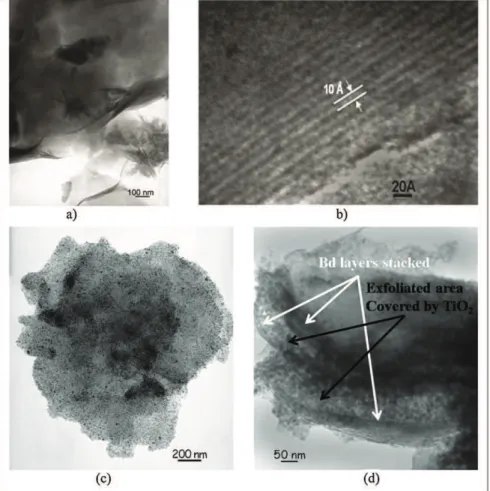
XRD and FTIR results were further supported by TEM observations. Indeed, with respect to micrographs of starting Bd (Na+–Bd) (Fig. 6a
and b), the TEM analysis of samples 3CTA+–Bd–TiO
2(Fig. 6c) and
5CTA+–Bd–TiO
2(Fig. 6d) showed clearly the deposition of anatase
onto the Bd particles. This was confirmed by EDS and by selected area microdiffraction (data not reported). Nevertheless, the microstructure of anatase coatings appeared different depending on the amount of CTAB used in the organomodification process. In fact, the anatase coat-ing grown on Bd particles beforehand modified with an amount of CTAB equivalent to 5 CEC appears thicker and highly porous due to the agglomeration of TiO2nanoparticles whose average size is about
25 nm (Fig. 6d). This coating appears to develop essentially on external surfaces of Bd particles by likely forming a matrix trapping Bd layers packets inside it. In contrast, the anatase coating directly grown on Bd previously modified by an amount of CTAB equivalent to 3 CECis thinner and it exhibits a homogeneous distribution of very fine and monodis-perse anatase nanoparticles with a lower average size of about 12 nm (Fig. 6c). In this case, anatase nanoparticles appear to be supported on surfaces of more or less delaminated Bd layers.
These differences could be ascribed to the difference in the amount of adsorbed organocation excesses at external surfaces of the clay min-eral particles in both the samples. Indeed, as evidenced from CHN and TG analyses in the companion paper of part I, although beidellite inter-layer spaces are much expanded by the arrangement of CTA+species
there in the form of bilayer paraffin upon Bd organomodification with amount equivalent to 5 fold CEC, they likely could not be fully acceded by titanium isopropoxide precursor entities. This access might be hin-dered by the adsorption of the important excess of CTA+entities
outside interlayer regions of the clay mineral which create organophilic environment suitable to the assembling of Ti alkoxide and afterwards to the development of outer TiO2network. In contrast, the amount of
CTA+on Bd particles external surfaces in 3CTA+–Bd organobeidellite
is relatively lower that Ti alkoxide could penetrate Bd interlayer regions, rendered organophilic due the disposition of CTA+entities in the form
of monolayer paraffin, where they could get hydrolyzed and condensed to promote Bd delamination and the organization of the formed nano-particles of TiO2(Letaïef et al., 2006; Manova et al., 2010; Ruiz-Hitzky
and Aranda, 2014). 3.5. Electrokinetic behavior
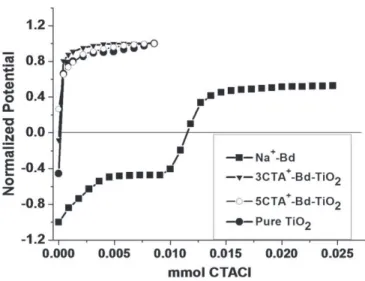
The conformal coating of Bd particles by a TiO2thin films was
further confirmed by monitoring the variation of the streaming induced potential (SIP) upon titration of dispersions of pure TiO2, starting Bd,
3CTA+–Bd–TiO
2and 5CTA+–Bd–TiO2with CTAC surfactant. Indeed,
Fig. 7reveals that the starting negative surface charge of the Bd is com-pensated progressively with increasing the amount of CTAC added to clay aqueous dispersion to reach a plateau extending from 5 × 10− 3
to 9 × 10⁻³mmol beyond which the increase of SIP starts again until
the neutral value at 11 × 10− 3mmol corresponding to Point of Zero
Charge (PZC). Afterward it stabilizes at positive values. The occurrence of an intermediate plateau can be explained by a transition in surfactant species arrangement inside Bd interlayer spaces from monolayer to bi-layer configuration as evidenced by XRD in the companion paper. The reversal of SIP sign beyond PZC is due to CTAC excess likely adsorbed on external surfaces of the clay mineral particles in agreement with CHN and TG analyses of part I. On the other hand, pure TiO2particles
were initially negatively charged, but with lower surface charge
Fig. 6. TEM micrographs of Na+–Bd showing (a) the petalloïd microstructure and (b) the 10 Å interlayer spaces characteristic of Bd. TEM of the nanocomposites (c) 3CTA+–Bd–TiO 2and
(d) 5CTA+–Bd–TiO
magnitude in comparison with the starting Bd, as evidenced by the de-tection of lower negative value of SIP. Furthermore, as can be seen in
Fig 7, the addition of CTAC to pure TiO2aqueous dispersion leads to
elec-trical surface charge reversal occurring at PZC value significantly lower than that observed for the non-modified Bd. Such difference in the elec-trokinetic behavior, between pure TiO2and Bd, results from the
differ-ence in the negative surface charge densities of the samples. At natural pH of the aqueous phase, the Bd particles have higher negative surface charge density as compared to pure TiO2.
As far as both the TiO2functionalized Bd (3CTA+–Bd–TiO2and
5CTA+–Bd–TiO
2) are concerned, SIP is initially slightly negative as
ob-served for pure TiO2, which likely denotes the presence of TiO2
parti-cles on Bd surface, but probably also of some uncoated Bd partiparti-cles, and rapidly reverses into positive values at relatively much lower PZC around 0.1 × 10− 3mmol of CTAC for afterwards behaving like
pure TiO2. These results confirm that permanent negative charges of
Bd particles are screened as a result of their coverage by TiO2
nanoparticles.
3.6. Textural characterizations
N2adsorption–desorption isotherms recorded on Na+–Bd, pure TiO2
and TiO2functionalized Bd exhibit a shape of type IV according to the
IUPAC classification which is a characteristic of porous adsorbents, with pore sizes in the range of 1.5–100 nm (Fig. 8). Specific surface areas determined from these isotherms in the relative pressure range of 0.05–0.33 are about 91 and 82 m2/g for both TiO
2supported Bd
pre-pared starting from 3CTA+–Bd and 5CTA+–Bd, respectively. With
re-spect to Bd whose specific surface area was assessed to be around 82 m2/g (Bouna et al., 2012), a slight increase in the specific surface
area is noted, especially for 3CTA+–Bd–TiO
2whereas that of 5CTA+–
Bd–TiO2remains at the same magnitude order. These results are in
con-cordance with that reported byManova et al. (2010)for TiO2–Gafsa
smectite nanocomposite. But, they are different from those ofChen et al. (2012)who reported a huge increase by a factor of 20 times of spe-cific surface area of TiO2-Mt with respect to starting Mt that the authors
accounted for a quite complete delaminated structure of the clay miner-al. Nevertheless, specific surface areas of both TiO2–Bd nanocomposites
are found higher than that of pure TiO2(≈68 cm2/g). In both the
situa-tions, it is worth noting that the beidellite acts a benefic role in increas-ing surface area of nanocomposite with respect to pure TiO2by being
dispersed in the TiO2matrix in the forms of likely predominantly
exfo-liated layers for 3CTA+–Bd or layers packets for 5CTA+–Bd as
before-hand evidenced by TEM observations. On the other before-hand, it should be noted that the observed hysteresis loops differ depending on the nature of the sample. Indeed, the hysteresis loop observed for the starting clay mineral (Na+–Bd) is of type H
4, revealing a narrow pore-size
distribu-tion (Bouna et al., 2012), whereas that occurring for pure TiO2is of
type H2, denoting the presence of interconnected mesopores. The
hys-teresis exhibited by the isotherms of both TiO2based Bd
nanocompos-ites are a mixture of H2/H4 in which the contribution of H4
component, observed beyond relative pressures P/P0of about 0.85,
seems more pronounced in 3CTA+–Bd–TiO
2. Concomitantly, the
contri-bution of the H2 component corresponding to TiO2 appears
predominating in 5CTA+–Bd–TiO
2. These results were further
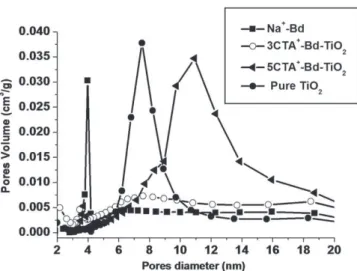
support-ed by depicting pores distribution of all samples investigatsupport-ed herein (Fig. 9). In fact, mesopores in starting Bd are narrow with an average di-ameter of about 4 nm whereas those of pure TiO2are larger around
7 nm in diameter. The pores distribution curves in TiO2functionalized
Fig. 7. Variation of the streaming induced potential with CTAC concentration for Na+–Bd, pure TiO2, 3CTA+–Bd–TiO2and 5CTA+–Bd–TiO2.
Bd presents two peaks. The first one is best resolved in both samples and centered at an average pore diameter quite similar to that of Bd. Howev-er, while the second one appears broad, diffuse and centered at the same pore diameter of pure TiO2, it is more intense, better resolved
and centered at relatively higher average pore diameter of about 11 nm. These results indicate that organomodification of Bd with an amount of CTAB equivalent to 3 CEC likely results in a supported thin and less porous TiO2layer whereas that formed in the presence of Bd
organomodified with an amount of CTAB equivalent to 5 CEC is probably thicker and more porous in agreement with TEM observations (Fig. 6c and d). These microstructural differences could be due to the fact that the dispersion of beidellite as exfoliated layers within TiO2matrix likely
allows to more compact and less porous material which seems to be more predominating in 3CTA+–Bd–TiO
2nanocomposites.
Neverthe-less, the dispersion of beidellite layers packets in the TiO2matrix,
pro-moted by organophilic environment due to the adsorption of important excess of surfactant entities on external surfaces of clay min-eral particles, probably yielded to a porous material which is likely more pronounced in 5CTA+–Bd–TiO
2nanocomposite in concordance with
TEM observations.
3.7. Photocatalytic activity
The photocatalytic decomposition kinetics of starting Bd, pure TiO2
and the set of TiO2supported Bd synthesized starting from all the
organobeidellites differing in CTAB loads were tested against the deg-radation of OG in aqueous solution.Fig. 10represents results obtained only on Na+–Bd and pure TiO
2along with the two TiO2supported Bd
(3CTA+–Bd–TiO
2 and 5CTA+–Bd–TiO2). Photocatalytic behavior
curves of all supported catalysts developed herein is given in supple-mentary data (see Fig. 1S). The pristine Bd (Na+–Bd) does not show
photocatalytic activity since no decrease of the OG concentration is ob-served. In contrast, both TiO2functionalized Bd exhibit significant
photoactivity as evidenced by the reduction of OG concentration as the UV irradiation time increases. TiO2supported on Bd beforehand
organomodified with an amount of CTAB equivalent to 3 CEC exhibits slightly higher photocatalytic activity compared to that of pure TiO2
and it is also much more efficient than that of TiO2immobilized on
Bd previously rendered organophilic with an amount of the surfactant equivalent to 5 CEC. This is evidenced on one hand by the strong de-crease of OG concentration for instance in the first 15 min, revealing a high initial degradation rate of the pollutant, and on the other hand by the total elimination of the OG dye from the solution within about 45 min when using 3CTA+–Bd–TiO
2catalyst instead of 90 min when
5CTA+–Bd–TiO
2sample is involved. This difference in photocatalytic
behavior of both TiO2supported Bd is due to their different structural,
textural and microstructural features as demonstrated above, which are induced by the effect of the surfactant amount used in preparing starting organobeidellite. The coupling of several parameters such as surface area, photocatalyst amount, … could give idea about the effi-ciency magnitude of a photocatalyst. As the difference between the specific surface area of both the supported photocatalysts investigated herein is not noticeable, their efficiencies and that of pure TiO2were
compared by normalizing Orange G proportion by mass of titanium converted by photocatalysis in 15 min. Hence,Fig. 11, shows that the supported sample 3CTA+–Bd–TiO
2is almost three times and four
times more efficient than TiO2alone and 5CTA+–Bd–TiO2,
respective-ly. On the other hand, the most photoactive supported catalyst (3CTA+–Bd–TiO
2) developed herein is more active than the most
one based on palygorskite reported elsewhere (Bouna et al., 2011). Nevertheless, it is worth noting that both the clay supported photocatalysts remained largely two times more active than the com-mercially available TiO2Degussa P25.
The different arrangement modes within beidellite interlayer spaces of these species as well as the importance of the adsorption of their excess on external surfaces of clay mineral particles upon Fig. 9. Porosity distribution of Na+–Bd, pure TiO2, 3CTA+–Bd–TiO2and 5CTA+–Bd–TiO2.
Fig. 10. Change in OG concentration (where C0and C are the OG concentrations,
respec-tively, at the initial time t = 0, and after an elapsed time t of the photocatalytic reaction) vs. UV irradiation time of Na+–Bd, pure TiO
2, 3CTA+–Bd–TiO2and 5CTA+–Bd–TiO2
samples.
Fig. 11. Orange G proportion normalized by mass of titanium converted by photocatalysis using different catalysts in 15 min.
modification with an amount equivalent to 3CEC or 5CEC evidenced in part I are likely responsible of the more or the less stabilization of TiO2
anatase and thus of the difference in catalytic activity of both the de-rivative supported photocatalysts. Indeed, although the bilayer paraf-fin disposition of CTA+species upon beidellite organomodification with 5CEC probably offers a very organophilic environment favoring the penetration of much Ti precursor (TTIP) between intercalated CTA+species as suggested by several authors (Letaïef et al., 2006;
Manova et al., 2010; Ruiz-Hitzky and Aranda, 2014), the adsorption of important amount of CTA+entities excess on external surfaces of
clay mineral particles likely prevents this to be occurred and instead promotes the development of much of TiO2assessed by ICP analysis
to be around 64.6 wt.% outside Bd interlayer regions. Thus, TiO2
parti-cles are so close each other that they could undertake sintering upon calcination at 600 °C to allow their size to grow and consequently to exceed critical size required for the transformation of anatase into ru-tile. Nevertheless, the amount of CTA+species adsorbed at external
surfaces upon organomodification of beidellite with 3CEC of CTAB is lower in comparison with 5CEC as evidenced by CHN (Table 3 given in the companion paper I: Organobeidellite precursor for nanocom-posites) and thermal analyses (Fig. 5) in part I to yield likely Ti alkox-ide to get predominantly hydrolyzed and condensed in interlayer spaces formed of monolayer paraffin structure of CTA+species. As
the amount of CTA+intercalated to compensate Bd layers charges is
limited and defined by clay mineral CEC, this probably creates an envi-ronment less but sufficiently organophilic where the amount of TiO2
developed was lower around 52.07 as determined by ICP analysis. Ac-cordingly, the contact between TiO2particles is relatively reduced so
that the occurrence of sintering upon heat treatment is less pro-nounced. Thereby, this likely yields to developed TiO2particles when
involving 3CTA+–Bd precursor to be kept smaller less than the critical
size inducing the stabilization of TiO2anatase. Based on results from
in-situXRD along with the variation of the average crystallite size, TEM observations and textural characterizations,Fig. 12schematically
summarizes microstructural features of TiO2developed starting from
3CTA+–Bd or 5CTA+–Bd.
4. Conclusion
This study has demonstrated the effect of CTAB surfactant amount, used for preparing organobeidellite starting materials, on physico-chemical features and photocatalytic properties of TiO2supported Bd
nanocomposites in the removal of OG dye from aqueous media. Organomodification of a Bd from Agadir basin (Morocco) with an amount equivalent to 3 CEC of the clay mineral was found to be the optimal amount to produce TiO2 supported Bd nanocomposites
exhibiting advantageous microstructural features in terms of amount of immobilized TiO2, particle size and distribution, anatase stability
and hence improved photocatalytic activity. Besides the valorization of the Bd as a Moroccan natural resource, this study contributed in the op-timization of synthesis conditions yielding to efficient TiO2supported
clay minerals photocatalysts.
Supplementary data to this article can be found online athttp://dx. doi.org/10.1016/j.clay.2015.04.025.
Acknowledgments
The financial supports from the “Convention de coopération CNRST-Maroc/CNRS-France” (chemistry project no04/13) and the “Programme d'Action Intégrée Toubkal” (no14/MS/14) are gratefully acknowledged.
References
An, T., Chen, J., Li, G., Ding, X., Sheng, G., Fu, J., Mai, B., 2008.Characterization and photo-catalytic activity of TiO2immobilized hydrophobic montmorillonite photocatalysts:
degradation of decabromodiphenyl ether (BDE 209). Catal. Today 139, 69–76.
Aranda, P., Kun, R., Martin-Luengo, M.A., Letaïef, S., Dékány, I., Ruiz-Hitzky, E., 2008. Tita-nia–sepiolite nanocomposites prepared by a surfactant templating colloidal route. Chem. Mater. 20, 84–91.
Fig. 12. Adapted schematic illustration fromLetaïef et al. (2006)showing the difference in microstructure of TiO2developed in different disposition modes of CTA+species within
Bezrodna, T., Puchkovska, G., Shimanovska, V., 2003.Pyridine–TiO2surface interaction as
a probe for surface active centers analysis. Appl. Surf. Sci. 214, 222–231.
Bouna, L., Rhouta, B., Amjoud, M., Jada, A., Maury, F., Daoudi, L., Senocq, F., 2010. Correla-tion between eletrokinetic mobility and ionic dyes adsorpCorrela-tion of Moroccan Stevensite. Appl. Clay Sci. 48, 527–530.
Bouna, L., Rhouta, B., Amjoud, M., Maury, F., Lafont, M.-C., Jada, A., Senocq, F., Daoudi, L., 2011.Synthesis, characterization and photocatalytic activity of TiO2supported
natu-ral palygorskite microfibers. Appl. Clay Sci. 52, 301–311.
Bouna, L., Rhouta, B., Daoudi, L., Maury, F., Amjoud, M., Senocq, F., Lafont, M.C., Jada, A., 2012.Mineralogical and physic-chemical characterisations of ferruginous Bd rich clay from Agadir basin (Morocco). Clay Clay Miner. 60, 278–290.
Bouna, L., Rhouta, B., Maury, F., 2013. Physicochemical study of photocatalytic activity of TiO2supported palygorskite clay mineral. Int. J. Photoenergyhttp://dx.doi.org/10.
1155/2013/815473(Article ID 815473, 6 pages).
Bouna, L., Rhouta, B., Maury, F., Jada, A., Senocq, F., Lafont, M.-C., 2014.Photocatalytic ac-tivity of TiO2/stevensite nanocomposites for the removal of Orange G from aqueous solutions. Clay Miner. 49, 365–376.
Carp, O., Huisman, C.L., Reller, A., 2004.Photoinduced reactivity of titanium dioxide. Prog. Solid State Chem. 32, 33–177.
Chen, D., Zhu, Q., Zhou, F., Deng, X., Li, F., 2012.Synthesis and photocatalytic performances of the TiO2pillared montmorillonite. J. Hazard. Mater. 235–236, 186–193.
Fujishima, A., Zhang, X., 2006.Titanium dioxide photocatalysis: present situation and fu-ture approaches. C. R. Chim. 9, 750–760.
Fujishima, A., Rao, T.-N., Tryk, D.-A., 2000.Titanium dioxide photocatalysis. J. Photochem. Photobiol. C 1, 1–21.
Herrmann, J.-M., 1999.Heterogeneous photocatalysis: fundamentals and applications to the removal of various types of aqueous pollutants. Catal. Today 53, 115–129.
Hofstadler, K., Rupert, B., Novalic, S., Heisler, G., 1994.New reactor design for photocata-lytic wastewater treatment with TiO2immobilized on fused-silica glass fibers:
photomineralization of 4-chlorophenol. Environ. Sci. Technol. 28, 670–674.
Houari, M., Saidi, M., Tabet, D., Pichat, P., Khalaf, H., 2005.The removal of 4-chlorophenol and dichloroacetic acid in water using Ti-, Zr- and Ti/Zr-pillared bentonites as photocatalyst. Am. J. Appl. Sci. 2, 1136–1140.
Jada, A., Debih, H., Khodja, M., 2006.Montmorillonite surface properties modifications by asphaltenes adsorption. J. Pet. Sci. Eng. 52, 305–316.
Letaïef, S., Angeles Martin-Luengo, M., Aranda, P., Ruiz-Hitzky, E., 2006.A colloidal route for delamination of layered solids: novel porous-clay nanocomposites. Adv. Funct. Mater. 16, 401–409.
Liu, J., Dong, M., Zuo, S., Yu, Y., 2009.Solvothermal preparation of TiO2/montmorillonite
and photocatalytic activity. Appl. Clay Sci. 43, 156–159.
Manova, E., Aranda, P., Martín-Luengo, M.A., Letaïef, S., Ruiz-Hitzky, E., 2010.New titania-clay nanostructured porous materials. Microporous Mesoporous Mater. 131, 252–260.
Nieto-Suárez, M., Palmisano, G., Ferrer, M.L., Concepción Gutiérrez, M., Yurdakal, S., Augugliaro, V., Pagliaro, M., del Monte, F., 2009.Self-assembled titania–silica–sepio-lite based nanocomposites for water decontamination. J. Mater. Chem. 19, 2070–2075.
Paz, Y., 2006.Preferential photodegradation—why and how? C. R. Chim. 9, 774–787.
Rhouta, B., Kaddami, H., Elbarqy, J., Amjoud, M'B., Daoudi, L., Maury, F., Senocq, F., Maazouz, A., Gerard, J.-F., 2008.Elucidation of the structure of the jbel rhassoul stevensite (morocco) by advanced physico-chemical study. Clay Miner. 43, 393–404.
Robertson, P.K.-J., 1996.Semiconductor photocatalysis: an environmentally acceptable al-ternative production technique and effluent treatment process. J. Cleaner Prod. 4, 203–212.
Ruiz-Hitzky, E., Aranda, P., 2014.Novel architectures in porous materials based on clays. J. Sol-Gel Sci. Technol. 70, 307–316.
Sarantopoulos, C., Gleizes, A.N., Maury, F., Puzenat, E., Guillard, C., Herrmann, J.-M., 2009.
Microfibrous TiO2supported photocatalysts prepared by metal–organic chemical
vapor infiltration for indoor air and waste water purification. Appl. Catal. B Environ. 91, 225–233.
Tong, T., Zhang, J., Tian, B., Chen, F., He, D., 2008.Preparation and characterization of an-atase TiO2microspheres with porous frameworks via controlled hydrolysis of