OATAO is an open access repository that collects the work of Toulouse
researchers and makes it freely available over the web where possible
Any correspondence concerning this service should be sent
to the repository administrator:
[email protected]
This is an author’s version published in:
http://oatao.univ-toulouse.fr/21093
To cite this version:
Kong, Pei San
and Cognet, Patrick
and Peres-Lucchese, Yolande
and Esvan, Jérôme
and Daud, Wan Mohd Ashri Wan and Aroua,
Mohamed Kheireddine
Development of a Novel Hydrophobic ZrO2–SiO2
Based Acid Catalyst for Catalytic Esterification of Glycerol with Oleic
Acid. (2018) Industrial & Engineering Chemistry Research, 57 (29).
9386-9399. ISSN 0888-5885
The heterogeneous acid catalyzed esterification route is
known to be more selective and cost effective compared to the
aforementioned routes.6 In addition, the heterogeneous acid
catalytic system is environmentally sustainable compared to homogeneous catalyst, due to less waste production, easier operation, and possible recycling. However, the catalytic activity of a heterogeneous catalyst is generally lower than that of a homogeneous one due to the poor accessibility of the embedded catalytic sites. The highly desirable selectivity of the product can be obtained using a heterogeneous catalyst system, as the textural property of catalyst, such as porosity, might influence product selectivity.11,12In fact, the use of glycerol as a starting material to produce glycerol derivatives is challenging. The high viscosity of glycerol could encounter a
diffusion problem in reaction media. Moreover, it has been
reported that the reaction, involving reactants in two different phases, is complicated; for instance, poor interaction of OA
and glycerol leads to low reactivity in the esterification
process13 as well as reaction of glycerol with poorly soluble acetone in the acetalization production of solketal.14,15Some of the researchers elucidate that hydrophobicity enhanced acid catalysts can improve reactivity as well as selectivity, especially
when one of the reactants is highly hydrophilic.7,16,17
Moreover, the presence of water byproduct in a typical esterification reaction can easily deactivate the acid sites of
solid acid catalyst and negatively affect the equilibrium of
reaction.18 Consequently, water tolerant solid acid catalyst
featuring a hydrophobic surface is vital for the esterification of glycerol with fatty acid.19
Ion exchange resins,20 zeolites,6 double metal cyanide
complexes,21 heteropolyacid supported catalysts,22 hydrotal cite,23,24 and metal oxide based acid catalysts10 have been
studied for catalytic glycerol esterification with OA. It was
reported that Sn−beta zeolite catalyzed esterification was
inefficient with only 4% OA conversion after 20 h reaction
at equimolar ratio, 150°C, and solvent added condition, even
below the conversion without adding any catalyst (20%) at identical reaction parameters.22 By contrast, hydrophobicity enhanced catalysts such as titanosilicate catalyst25 and ionic liquid grafted catalyst26were investigated and reportedly can
promote interaction of reactants and higher GMO selectivity can be achieved.
Therefore, this study aims to design a highly hydrophobic functional heterogeneous acid catalyst for catalytic esterifica tion of glycerol with OA at mild reaction condition. It was reported that mesoporous polystyrene sulfonic acid and inorganic oxide composites are favorable due to their tunable surface wettability (hydrophobicity and hydrophilicity), engineered textural properties, and acidity.19 Development of an organosulfonic acid functionalized on silica coated zirconia
(ZrO2−SiO2) is proposed in this work. To the best of our
knowledge, development of such a hydrophobic ZrO2−SiO2
based acid catalyst has not been reported in the available
literature. The intention to select zirconia (ZrO2) as the
catalyst’s support is due to its highly attractive support material
among various metal oxides. ZrO2 generally has low surface
area but moderate surface acidity. By contrast, silica (SiO2) has higher surface area but lower surface acidity. As such, coating
of SiO2 on ZrO2 eventually can increase the surface area,
stability, and acidity of the ZrO2−SiO2 system compared to
individual ZrO2 or SiO2. It has been reported that Si doping stabilizes the tetragonal ZrO2 phase.11,27 A recent study on
iron oxide supported SiO2 catalyst has successfully created
covalent Si−O bonds that minimize leaching of the ligand
moiety of the catalyst.28 Therefore, development of hydro
phobic silica supported sulfonic acid type catalysts is expected
favoring a better diffusion within the pore framework and
enabling shape selectivity effect.
In this work, the preparation and characterization of highly
hydrophobic organosulfonic acid functionalized ZrO2−SiO2
catalyst is investigated. Each catalyst modification step, from the preparation of ZrO2to functionalization, has been carefully
studied, and the obtained structures have been confirmed with
characterization results. Moreover, an original technique to control acidity and the hydrophobicity level of the designed catalyst is disclosed. The role of the hydrophobicity of the designed catalyst is studied herein by comparing the reaction
rate and yield of GMO in esterification of glycerol with OA.
The objective is to maximize the GMO yield; therefore, an equimolar ratio of reactants was employed. In addition, the Figure 1.Reaction scheme for esterification of glycerol with OA.
surface mechanism of the catalyst modification is proposed according to comprehensive characterization and catalytic activity results.
2. EXPERIMENTAL SECTION
2.1. Materials. Zirconia (97%), ethanol (99%), ammonia solution (25 wt %), tetraethyl orthosilicate (TEOS, 98%), trimethoxymethylsilane (TMMS, 98%), dry toluene (99%), and sulfuric acid (99.99%) were purchased from Sigma Aldrich. 2 (4 Chlorosulfonylphenyl)ethyltrimethoxysilane (CSPETS, 50% in dichloromethane) was purchased from
Fisher Scientific. Reactants glycerol (≥99.5%) and OA
(technical grade, 90%) were purchased from Sigma Aldrich. These reagents were used without purification unless otherwise
stated. All the analytical standard reagents such as GMO
(≥99%), GDO (≥99%), and GTO (≥99%) were purchased
from Sigma Aldrich. Analytical grade solvents such as acetonitrile (ACN), methanol (MeOH), and tetrahydrofuran
(THF) were used as mobile phase for quantification analysis.
Trifluoroacetic acid (TFA) was used as mobile phase additive
due to its high resolving power.
2.2. Catalyst Preparation. The coating of SiO2on ZrO2
was synthesized using hydrolysis and co condensation method.
A 2 g sample of ZrO2was added into 100 mL of ethanol under
vigorous mixing at ambient temperature for 30 min. A 12 mL
volume of 25% ammonia solution (NH4OH) and 4 mL of
TEOS were successively added into the mixture. The resulted solution was continuously stirred and aged for 24 h. The Figure 2.N2adsorption−desorption isotherms and BJH plots for ZrO2(a), ZrO2−SiO2(b), ZrO2−SiO2−Me&Et PhSO2Cl (c), and ZrO2−SiO2−
resulted powder (ZrO2−SiO2) was then filtered, rinsed with ethanol, and dried under vacuum at room temperature.
Turning of ZrO2−SiO2 into higher hydrophobicity level and
functionalization of sulfonic acid group on the support was
performed using TMMS and CSPETS, respectively.29Varied
amounts of CSPETS and TMMS were added into a 35 mL of
dry toluene that contained 1 g of SiO2−ZrO2 and was
continuously stirred for 24 h. Subsequently, the functionalized
catalyst (ZrO2−SiO2−Me&Et PhSO2Cl) was washed with
toluene (2× 15 mL) and distilled water. Lastly, the modified
solids were suspended in H2SO4aqueous solution for 2 h. The
final catalyst (ZrO2−SiO2−Me&Et PhSO3H) was washed with
water and dried overnight under vacuum at room temperature. 2.3. Catalyst Characterizations. The textural properties
of the catalysts were measured by N2adsorption−desorption
using a BELSORP max analyzer (Japan). The solid catalysts
were outgassed by vacuum at 200°C for 5 h. The particle size
distributions of samples were measured by a Malvern MS3000 particle sizer at 2 bar. The morphology of the surface catalyst
was captured by afield emission scanning electron microscope
(FESEM) at 1−30 kV acceleration voltage using model JSM
7100F. The hydrophobicity level of the catalyst was measured by the water contact angle method using a KRUSS DSA100 instrument. The catalyst was pressed into a pellet at 8 MPa prior to analysis. The acidity of the catalyst was determined by
acid−base titration with 8.38 × 10⁻³M NaOH solution.19 A
40−50 mg sample of catalyst was degassed at 120 °C for 3 h and then stirred in 25 mL of NaCl (2 M) for 24 h at room temperature. The resulting suspension was titrated with NaOH solution. Thermogravimetric analysis (TGA) technique was performed to ascertain the thermal stability of catalysts using a
Mettler Toledo system at a rate of 10°C/min from 25 °C to a
maximum temperature of 900 °C. Meanwhile, Fourier
transform infrared (FT IR) spectra were obtained using a
Bruker IR spectrometer in the range 200−4000 cm−1. X ray
photoelectron spectra (XPS) were performed using a
Thermoscientific Kalpha device. The samples were analyzed
at a pressure of approximately 5× 10⁻⁹Pa recorded by Al Kα radiation.
2.4. Catalytic Reaction and Analysis. The catalytic
esterification of glycerol with OA was performed in a batch
reactor connected to a condenser and a vacuum system at 100 °C for 8 h using three catalysts designed with different hydrophilicities: ZrO2−SiO2−Me&Et PhSO3H 50, ZrO2−
SiO2−Me&Et PhSO3H 70, and ZrO2−SiO2−Me&Et
PhSO3H 80 (values of 80, 70, and 50 at the ends of the
catalyst symbols indicate the mole percentage of TMMS utilized in tailoring the hydrophobicity level of the catalysts). The products were analyzed by high performance liquid chromatography with refractive index detection (HPLC RI)
and a Gemini C18 11OA column (100 mm× 2 mm × 3 μm).
Isocratic method was used in separation and quantitative determination. The OA and GMO groups of the sample were separated using a mobile phase consisting of ACN/water (80:20 v/v) with 0.1% TFA (v/v of total mobile phase); GDO and GTO groups were separated using ACN/MeOH/THF
(40:40:20 v/v/v).30The injection volume was 10μL, and the
diluted samples were eluted at a 220 μL/min flow rate. The
column and RI detector temperatures were set at 40°C. The
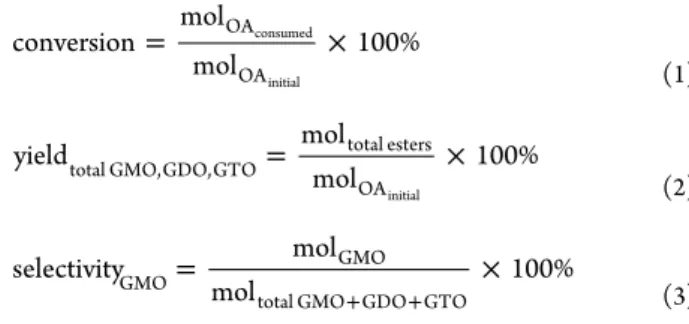
conversion, yield, and selectivity of the products were calculated according toeq 1,2, and3, respectively.
conversion mol mol 100% OA OA consumed initial = × (1) yield mol mol 100% total GMO,GDO,GTO total esters OAinitial = × (2) selectivity mol mol 100% GMO GMO total GMO GDO GTO
= ×
+ + (3)
3. RESULTS AND DISCUSSION
3.1. Catalyst Characterizations. 3.1.1. Physicochemical and Textural Properties of Catalysts. 3.1.1.1. Pore Size
Distribution. N2 physisorption was utilized to measure the
surface area, pore size distribution, and porosity of the
catalysts. Figure 2a shows the N2 adsorption−desorption
isotherm plots for ZrO2support. ZrO2showed a superposition of type IV isotherm with hysteresis loop at a relative pressure
range of 0.5−1.0. This result indicated that the pore size
distributions are given by nonrigid aggregates of plate like particles and mainly composed of mesopores and a minority of
macropores.31 Results also confirmed that the ZrO2 used in
this study possessed meso−macropore pore sizes, with pore
size ranging from 10.57 to 120 nm. The sintering process occurred at high calcination temperature, which resulted in the removal of OH−from ZiO2and formation of large pore size for
ZrO2. The obtained result is similar to that reported in Zhao et al.32; those authors indicated that the surface area of a solid material decreases, and its average pore diameter increases, with increased calcination temperature.
Figure 2b displays a sharp increase in the loading of the ZrO2−SiO2catalyst at low values of p/p0, which suggested a
high surface area support. The presence of hysteresis type IV isotherm in this plot showed that the obtained pore size distribution was consistent, with small pore size within the
mesoporous range. SiO2was mainly adsorbed on the inner wall
andfitted inside the ZrO2support, which significantly reduced the average pore diameter of ZrO2−SiO2from 120 to 3.71 nm.
Therefore, the SiO2active species were well deposited on the support, which was evidenced by its pore size distribution
curve. The increased surface area of ZrO2−SiO2 can be
explained by the adherence of new SiO2 phase on the ZrO2
support, which led to the formation of rough, heterogeneous, and well deposited small particles on the catalyst support.
The N2 adsorption isotherm of the catalyst functionalized
with TMMS and CSPETS, that is, ZrO2−SiO2−Me&Et
PhSO2Cl, is presented in Figure 2c. The obtained hysteresis plot of the ZrO2−SiO2−Me&Et PhSO2Cl catalyst indicated a
low porosity adsorbent because the adsorbent−adsorbate
interactions were relatively weak. Unlike the ZrO2support or
ZrO2−SiO2, the average pore diameter for the ZrO2−SiO2−
Me&Et PhSO2Cl catalyst was determined using the non
localized density functional theory (NLDFT)/grand canonical Monte Carlo (GCMC) method due to its incompatibility with
the Barrett−Joyner−Halenda (BJH) model. Notably, the
average pore diameter of the prepared catalyst in the third step (ZrO2−SiO2−Me&Et PhSO2Cl, 2.24 nm) was slightly
smaller than that of ZrO2−SiO2 (3.77 nm), which suggested
the grafting of agents on the surface of ZrO2−SiO2. The
TMMS−CSPETS hypothesis was proposed, and the function
alized ZrO2−SiO2support was proven in this characterization analysis.
The acidification of functionalized catalyst (ZrO2−SiO2−
Me&Et PhSO3H) exhibited a hysteresis loop at a relative
pressure range of 0.3−0.8, as shown in Figure 2d. The
hysteresis loop of the ZrO2−SiO2−Me&Et PhSO3H catalyst
ranged between those of ZrO2−SiO2−Me&Et PhSO2Cl and
ZrO2−SiO2. This result indicated that sulfonation removed
some of the agents of ZrO2−SiO2−Me&Et PhSO2Cl.
Comparison of the hysteresis curve and pore diameter plot of ZrO2−SiO2−Me&Et PhSO3H to ZrO2−SiO2 hysteresis
loop (Figure 2b) confirmed that ZrO2−SiO2−Me&Et
PhSO3H is a mesoporous catalyst.
3.1.1.2. Particle Size Distribution. The particle size distribution curves of the catalysts prepared at four different modification steps are shown inFigure 3. Results revealed that coating the ZrO2support with SiO2altered the particle size
distribution range from a broad wide range to a narrow range and bell shaped distribution. This result may be attributed to the incorporation of Si atom into the Zr support. Nevertheless, this work indicated that functionalization of hydrophobic agent and sulfonation process exerted no effect on the particle size distribution of the catalysts. Moreover, the particle size distributions of ZrO2−SiO2, ZrO2−SiO2−Me&Et PhSO2Cl,
and ZrO2−SiO2−Me&Et PhSO3H were identical.
3.1.1.3. Acidity. The catalyst acidity at four different
modification steps was measured. Table 1 summarizes the
physicochemical and textural properties of the functionalized
catalyst in each modification step. The original ZrO2showed
low acidity value (0.18 mmol/g) because ZrO2is naturally a
Brønsted base. Notably, the silication step reduced the ZrO2
acidity from 0.18 to 0.00 mmol/g. This effect can be explained
by the fact that the NH4OH used to catalyze the hydrolysis
and condensation reaction in the silication step changed the surface acidity of the original ZrO2due to neutralization and
silica coating. The zero acidity of SiO2−ZrO2 indicates that SiO2was well coated on the ZrO2support. The acidity of the
third step prepared SiO2−Me&Et PhSO2Cl catalyst was 0.16
mmol/g. The acidity of the ZrO2−SiO2−Me&Et PhSO3H
catalyst was increased to 0.62 mmol/g after the acidification
step.
3.1.2. Morphology Characterization. Images of the differ
ent development stages of the catalyst were captured by using
high resolution FESEM and are displayed in Figure 4. ZrO2
presented typical rough, meso−macropore space and irregular
surface morphology (Figure 4a). The uneven ZrO2surface can
be associated with material sintering during drying and calcination processes. Nevertheless, the presence of silica like
substance on ZrO2 support was supported by the latter
modified ZrO2−SiO2 (Figure 4b). The hydrolysis and
condensation processes used in the silica coating of this
work were according to the modified Stöber method. The
base catalyzed hydrolysis and successive condensation of TEOS result in the formation of monodispersed spherical Figure 3.Particle size distribution curves for ZrO2, ZrO2−SiO2, ZrO2−SiO2−Me&Et PhSO2Cl, and ZrO2−SiO2−Me&Et PhSO3H.
Table 1. Physicochemical Properties of Functionalized Catalysts in Each Modification Step
catalyst areaa(m2/g) pore volb(cm3/g) av pore diamb(nm) av particle diamc(μm) acidity (mmol/g)
ZrO2 18.77 0.13 10.70 100.00 0.18
SiO2 ZrO2 73.05 0.030 3.77 5.87 0.00
ZrO2 SiO2 Me&Et-PhSO2Cld 0.032 2.24 5.39 0.16
ZrO2 SiO2 Me&Et-PhSO3H 79.75 0.025 3.77 5.01 0.62
aTotal surface area was determined using BET equation.bPore volume and average pore diameter were determined using BJH method.cParticle
diameter was measured by Mastersizer.dPore volume and average pore diameter were determined using NLDFT/GCMC method.
Figure 4.FESEM morphologies of ZrO2(a), ZrO2−SiO2(b), ZrO2−
silica particle.33The spherical shape particles evolve when the chemical bond and van der Waals forces generate elastic and plastic deformations between two oligomers; eventually, two oligomers engulf each other to maintain the spherical shape.34 The addition of both TMMS and CSPETS agents resulted in no modification on the surface morphology of ZrO2−SiO2−
Me&Et PhSO2Cl. However, smearing of the silica like
substance was observed (Figure 4c). ZrO2−SiO2−Me&Et
PhSO3H catalyst (Figure 4d) significantly displayed uniform and smooth spherical particles with consistent sizes. The pore diameter of a single silica sphere was approximately 400 nm. The overnight aging in the silication process and using
excessive ethanol in washing of ZrO2−SiO2 has produced
porosity type particles because the hydrolysis of alkoxy groups
and condensation and re esterification of silanol groups upon
reimmersion in ethanol result in the formation of micro−
mesoporous silica.35 Thus, the morphology images are
correlated with the aforementioned Brunauer−Emmett−Teller
(BET) results.
3.1.3. Thermogravimetric Analysis (TGA). The TGA curves of ZrO2, ZrO2−SiO2, ZrO2−SiO2−Me&Et PhSO2Cl, and ZrO2−SiO2−Me&Et PhSO3H are shown inFigure 5. A weight
loss occurred in the ZrO2−SiO2−Me&Et PhSO3H catalyst at a
temperature range of 260−300 °C. This weight loss was 4 wt
% in ZrO2−SiO2−Me&Et PhSO3H compared with the third
step prepared ZrO2−SiO2−Me&Et PhSO2Cl, which indicated
the decomposition of the sulfate moiety.36The second weight
loss zone was observed at 560−570 °C for ZrO2−SiO2, ZrO2−
SiO2−Me&Et PhSO2Cl, and ZrO2−SiO2−Me&Et PhSO3H;
this loss was attributed to the decomposition of SiO2
material.17These weight losses were significant, especially for
functionalized ZrO2−SiO2−Me&Et PhSO2Cl and ZrO2−
SiO2−Me&Et PhSO3H. TGA analysis showed that ZrO2
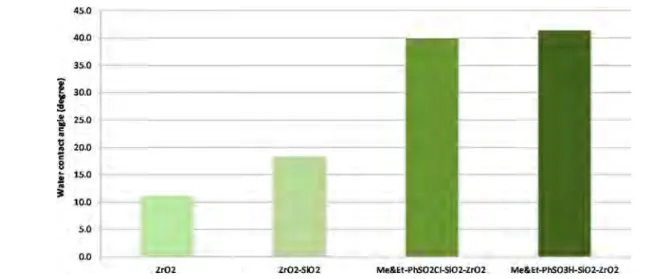
support possessed good thermal stability. Therefore, the catalytic reaction is within the thermal stability range of catalyst for the reaction temperature of approximately 250°C. 3.1.4. Hydrophobicity. The hydrophobicity of the devel oped catalyst should be measured when developing highly hydrophobic and heterogeneous acid catalyst. The hydro phobicity level of each developed catalyst was determined by contact angle analysis, and results are presented in Figure 6. The water contact angle of the catalyst was increased in the order ZrO2−SiO2−Me&Et PhSO3H > ZrO2−SiO2−Me&Et
PhSO2Cl > ZrO2−SiO2 > ZrO2. Noticeably, the lowest
hydrophobicity was shown by the original ZrO2 support.
Hydrophobicity was enhanced through coating ZrO2support
with SiO2; this effect was attributed to that the siliceous
material improved the hydrophobic environment because Si atom can increase the hydrophobicity of a compound. With the addition of hydrophobic organosilica moiety, TMMS considerably increased the hydrophobicity of the catalyst
surface. Superhydrophobic film chemical sensors and hydro
phobic polyester fabrics are successfully constructed by
TMMS.37 The present work revealed that the presence of
methyl groups on the silica surface caused the decrease in
surface hydrophilicity. The hydrophobicity of the ZrO2−
SiO2−Me&Et PhSO3H catalyst was also slightly improved
with the incorporation of sulfonic acid groups.
3.1.5. Chemical Composition of Catalysts. 3.1.5.1. Fourier Transform Infrared (FT-IR) Spectroscopy. The FT IR spectra
of the ZrO2−SiO2 catalyst are shown in Figure 7, and they
provide evidence for the formation of SiO2(red spectra). The
significant bands at 1061 and 576 cm−1are assigned to the Si−
O−Si asymmetric stretching vibrations.19,27Nonetheless, these bands did not appear in the spectra of blank ZrO2. The band at
1061 cm−1 was attributed to the asymmetric stretching
vibrations, such as those of Si−O and Si−O−Zr. The bands
Figure 5.TGA curves for ZrO2(a), ZrO2−SiO2 (b), ZrO2−SiO2−
Me&Et PhSO2Cl (c), and ZrO2−SiO2−Me&Et PhSO3H (d) on the
basis of the weight loss rate.
Figure 6.Hydrophobicity levels of ZrO2, ZrO2−SiO2, ZrO2−SiO2−Me&EtPhSO2Cl, and ZrO2−SiO2−Me&Et PhSO3H based on water contact
Figure 7.Fourier transform infrared spectra of ZrO2−SiO2(black, ZrO2; red, ZrO2−SiO2).
Figure 8.Energy dispersive X ray spectroscopy peaks of ZrO2(a), ZrO2−SiO2(b), ZrO2−SiO2−Me&Et PhSO2Cl (c), and ZrO2−SiO2−Me&Et
at approximately 791 and 730 cm−1 are associated with the formation of a condensed silica network.38,39The band located
around 950 cm−1 is given by the stretching vibrations of the
Si−O bond.38 The FT IR results confirmed the successful
coating of SiO2.
3.1.5.2. Energy-Dispersive X-ray Spectroscopy (EDX) Analysis. EDX analysis was performed to identify the surface composition change in each modification step of the catalyst.
As shown in Figure 8a, ZrO2 support displayed Zr and O
peaks, with averaged mass percentages of 74.2% Zr and 25.8%
O. In ZrO2−SiO2, the silica coated ZrO2 consisted of an
additional Si peak, as shown inFigure 8b. The averaged mass
percentages of Zr, O, and Si are 42.7, 42.8, and 14.5%, respectively. The increase in the O compound was in
agreement with the adherence of SiO2to the support.
The surface composition of ZrO2−SiO2−Me&Et PhSO2Cl
and ZrO2−SiO2−Me&Et PhSO3H showed no significant
change. The averaged surface composition of ZrO2−SiO2−
Me&Et PhSO2Cl comprised 39.77% Zr, 42.2% O, and 18.06%
Si (Figure 8c). The Si content of ZrO2−SiO2−Me&Et
PhSO2Cl was 3.5% higher than that of ZrO2−SiO2. The
discrepancy may be attributed to the ZrO2−SiO2 function
alized with TMMS and CSPETS. The ZrO2−SiO2−Me&Et
PhSO3H peaks with 44.7% Zr, 38.9% O, and 16.4% Si are
presented inFigure 8d. The sulfonated surface of the ZrO2−
SiO2−Me&Et PhSO3H catalyst showed 1.66% less Si content than that of ZrO2−SiO2Me&Et PhSO2Cl.
3.1.5.3. X-ray Photoelectron Spectroscopy (XPS). XPS
allows further insight analysis on the catalyst’s surface
composition. The surface composition of each modified
catalyst was investigated using XPS (Figure 9). The binding
energy in the interval range of 178−188 eV (Figure 9a)
indicated that the ZrO2material belonged to Zr−O (182 and
185 eV), Zr−Ox, or Zr−OH groups (181 and 184 eV). For
ZrO2−SiO2(Figure 9b), the large peak at 533.1 eV suggested a
high majority ratio mixture of SiO2 with two different
environments: Si−O−Si (533 eV) and Si−O−Zr (531
eV).40Meanwhile, the peak ranging from 160 to 170 eV was
assigned to C−SO2−Cl (168−169 eV) and sulfate groups
(168.5 eV) in Figure 9c. This result can be attributed to
CSPETS and TMMS agents on ZrO2−SiO2−Me&Et
PhSO2Cl. Nevertheless, for ZrO2−SiO2−Me&Et PhSO3H
Figure 9.X ray photoelectron spectra for ZrO2(a), ZrO2−SiO2(b), ZrO2−SiO2−Me&Et PhSO2Cl (c), and ZrO2−SiO2−Me&Et PhSO3H (d).
(Figure 9d), a limited percentage of the sulfonic group (silica
composites of the SO3H group) was detected at 168.5 eV in
correspondence with the peak at 160−170 eV.36
The obtained result may be attributed to the detection limit of XPS (about 10 nm) as it was inaccessible to a single monosphere particle with an approximate diameter of 400 nm. These results
suggested that the sulfonic acid sites for the ZrO2−SiO2−
Me&Et PhSO3H catalyst were mainly distributed within the
nanosphere pores of monosphere particle. This finding is
similar to that of the previous work, which reported that most of the acidic sites for silica prepared catalysts are buried in the bulk polymer beads.19
3.1.6. Schematic of Catalyst Synthesis. Scheme 1 shows
the schematic illustration for the synthesis of ZrO2−SiO2−
Me&Et PhSO3H catalyst. BET, FESEM, FT IR, EDX, and
XPS results proved the successful coating of SiO2 on ZrO2
support. The strong adherence of SiO2to ZrO2support was
mainly contributed by the OH− group of NH4OH as the
suspension of static repulsion against van der Waals attractive forces stabilizes the bonding of ZrO2−SiO2.34 Moreover, the
additional mass obtained in ZrO2−SiO2 confirmed the
formation of SiO2. The formation of covalent bonds on the
ZrO2−SiO2surface transformed the hydrophilic character to a
hydrophobic one using the hydrophobic organosilica moiety
TMMS was confirmed by contact angle analysis, BET, and
XPS. This observation was also reported by Markovska et al.41 Hydrophobization involved the attachment of methyl groups from TMMS to a silicon atom; CSPETS was used to initiate the conversion of the silica surface to sulfonic moieties by
exchanging Cl− with OH− during sulfonation. Sulfonic acid
sites are considerably important for catalysis, as it was proven by commercial application of Amberlyst 15 in esterification20 as well as production of solketal through acetalization of glycerol in the presence of sulfonic mesostructured silicas.42
The XPS and BET results suggested that SO3H was mainly
distributed in the mesopore of the nanospheres.
3.2. Control of the Hydrophobicity and Acidity of the
Catalyst. This part investigated the effect of the loading
amount of TMMS−CSPETS on ZrO2−SiO2 support toward
the hydrophobicity level of the catalyst. The total loading amount of both activation agents, which was expressed as the
molar ratio of TMMS−CSPETS to ZrO2−SiO2, was optimized
in the presence of a constant concentration of TMMS (80 mol %) to obtain the most suitable hydrophobicity level of the
catalyst. Subsequently, the optimized ratio of CSPETS−
TMMS to ZrO2−SiO2 was used to adjust the ratio of
TMMS hydrophobic agent in mole percentage. Solid catalysts
designed with different TMMS amounts, namely, ZrO2−
S i O2−Me&Et PhSO3H 5 0 , Z r O2−SiO2−Me&Et
PhSO3H 70, and ZrO2−SiO2−Me&Et PhSO3H 80, were
produced and applied in catalytic activity screening.
3.2.1. Effects of Loading Amount of TMMS−CSPETS on
Catalyst Hydrophobicity. The effects of the amount of
functionalization agents (TMMS−CSPETS) must be inves
tigated to obtain the highest possible hydrophobicity level of the designed catalyst. The molar ratio of activation agents to the ZrO2−SiO2support was initially optimized at a constant concentration (80 mol %) of TMMS. Afterward, the suitable CSPETS:TMMS ratio was optimized to obtain the most suitable catalyst acidity and hydrophobicity. In this study, the
loading weights of TMMS−CSPETS ranged from 0.2 to 1.2 g
to functionalize 1 g of ZrO2−SiO2. The loading amounts of
CSPETS and TMMS on ZrO2−SiO2are presented inTable S1
(Supporting Information).
The effects of the loading amount of TMMS on the
hydrophobicity level of the designed catalysts are illustrated in
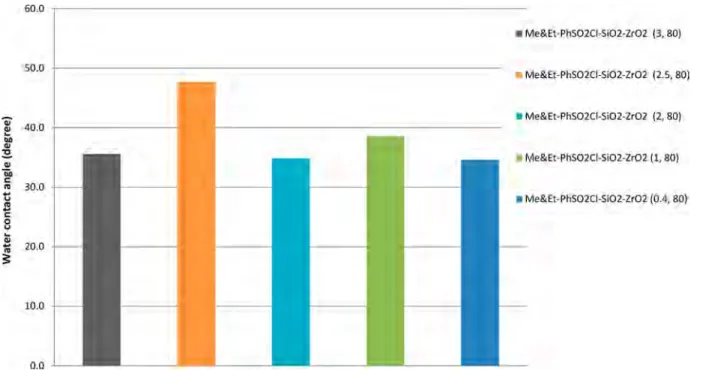
Figure 10. Results revealed that the 2.5:1 molar ratio of SiO2to
TMMS−CSPETS (ZrO2−SiO2−Me&Et PhSO2Cl (2.5, 80))
achieved the highest performance among the designed catalysts because it exhibited the highest hydrophobicity level. The experimental work also proved that the hydrophobicity level of the catalyst was unaltered by loading an excessive amount of total agents. For instance, the corresponding 1.6 g of CEPETS
and 1.6 g of TMMS were loaded excessively to 1 g of SiO2−
ZrO2to gain a highly hydrophobic surface catalyst in designing the ZrO2−SiO2−Me&Et PhSO2Cl (0.4, 80) catalyst, but the
highest hydrophobicity was not achieved. This work evidenced that further increase in the loading amount of CSPETS and TMMS will not improve the catalyst hydrophobicity. Furthermore, no direct relation existed between the amount of CSPETS and TMMS loading and the hydrophobicity level. This study confirmed that the best molar ratio of SiO2to the total agents was 2.5:1, and the catalyst with the highest hydrophobicity was ZrO2−SiO2−Me&Et PhSO2Cl (2.5, 80).
3.2.2. Effect of TMMS Loading on Catalyst Acidity.Section
3.2.1identified 2.5:1 as the most suitable molar ratio of SiO2to
the total agents. Different mole percentages of TMMS were
used to investigate the hydrophobicity level of each designed
catalyst at a constant molar ratio of SiO2:TMMS−CSPETS
(2.5:1). The mole percentages of TMMS utilized to adjust the hydrophobicity level of the designed catalysts, which were
ZrO2−SiO2−Me&Et PhSO3H 80, ZrO2−SiO2−Me&Et
PhSO3H 70, and ZrO2−SiO2−Me&Et PhSO3H 50, are
shown in Table S2 (Supporting Information). With consid
eration of the hydrophobicity and exchangeable capacity of CSPETS of the catalyst, this study used no TMMS ratio that is less than 50 mol % in preparing acid catalyst with good
hydrophobicity at more than 40° in contact angle analysis.
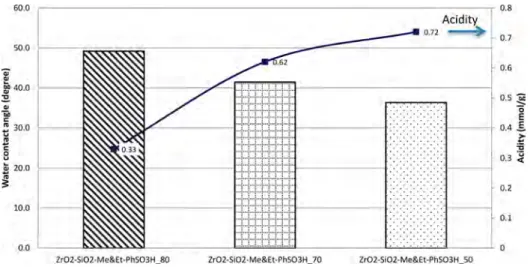
Results confirmed that ZrO2−SiO2−Me&Et PhSO3H 80
possessed a hydrophobicity level higher than those of ZrO2−
SiO2−Me&Et PhSO3H 70 and ZrO2−SiO2−Me&Et
PhSO3H 50, which reasonably agreed with the relative
amount of TMMS (i.e., the highest TMMS amount was utilized for ZrO2−SiO2−Me&Et PhSO3H 80) (Table S2). The experimental results also showed that the loading amount
of TMMS affected the acidity of the designed catalyst. The
relationship of the acidity and hydrophobicity of the designed catalysts is illustrated in Figure 11; increasing the catalyst hydrophobicity can decrease the catalyst acidity.
3.3. Effects of Hydrophobicity and Acidity of
Designed Catalysts on Catalytic Activities. 3.3.1. Catalytic
Activity: Influence on Conversion and Yield. The designed
catalysts with different hydrophobicity and acidity levels
(ZrO2−SiO2−Me&EtPhSO3H 80, ZrO2−SiO2−Me&Et
PhSO3H 70, and ZrO2−SiO2−Me&EtPhSO3H 50) were
used in comparative studies on glycerol esterification with
OA. All the reactions were conducted at an equimolar OA to
glycerol ratio, 100 °C reaction temperature, 3 wt % catalyst
concentration with respect to the OA weight, and solventless
reaction conditions for 8 h. Figure 12 shows the catalytic
Figure 11.Relationship of hydrophobicity level and acidity of designed catalysts.
catalytic reaction occurred within the silica pores. This result reasonably agreed with that reported by Jérôme et al.13 By
contrast, ZrO2−SiO2−Me&EtPhSO3H 50h with reduced
methyl groups did not benefit from the mesoporous structure
as catalysis can only take place at the pore entrance due to poor diffusion of OA within the silica pore structure, which resulted in lower catalyst activity. In brief, the results demonstrated that catalytic activity improved with the increase of hydrophobic methyl groups of the mesoporous framework.
Scheme 2illustrates the influence of surface hydrophobicity on catalytic activity.
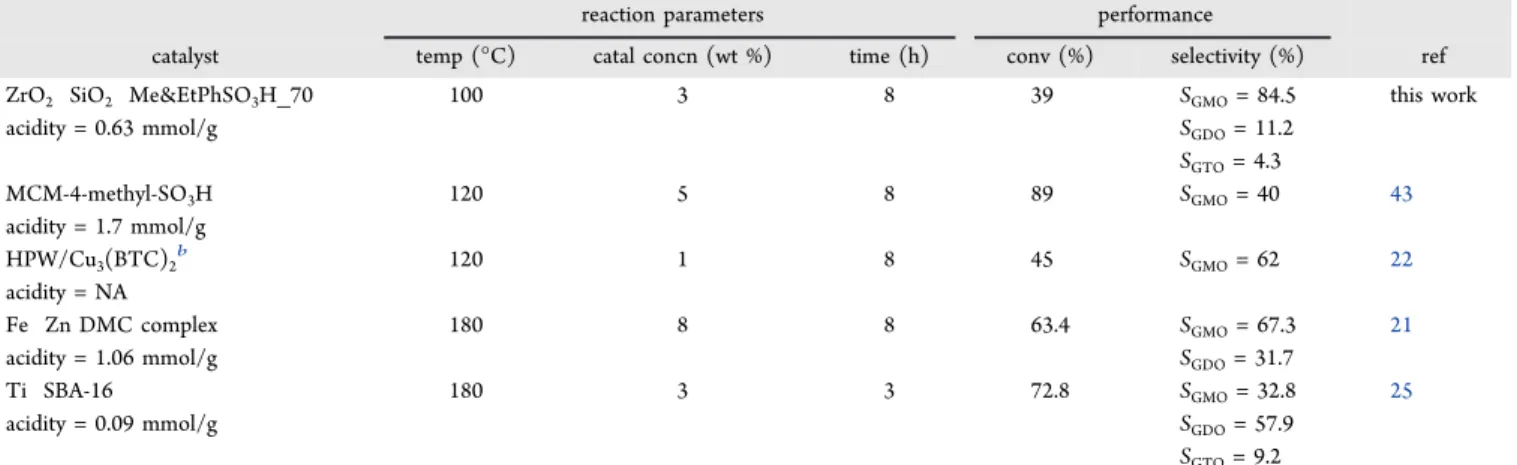
A comparison of catalytic activity between ZrO2−SiO2−
Me&EtPhSO3H 70 and several other catalysts reported in the
literature is summarized in Table 2. All the reactions were
conducted at an equimolar glycerol to OA ratio. The
conversion (40%) for ZrO2−SiO2−Me&EtPhSO3H 70 cata
lyst at 100°C reaction temperature was lower than that of the
MCM 4 methyl SO3H catalyst (89%) at 120 °C. This
discrepancy was mainly attributed to the acidity (1.7 mmol/
g) of the MCM 4 methyl SO3H catalyst. However, the GMO
selectivity for MCM 4 methyl SO3H was 40%, which is 2 times
lower than that of ZrO2−SiO2−Me&EtPhSO3H 70. The
catalyst developed in this work showed a better performance
than that of the tin−organic framework (HPW/Cu3(BTC)2)
catalyst with conversions of 45 and 62% GMO selectivity at
120°C.
Nonetheless, the catalyst activity of ZrO2−SiO2−Me&Et
PhSO3H 70 (40% conversion) was considered remarkable
compared with that of the Fe−Zn DMC complex subjected to
a high reaction temperature (Table 2). The Fe−Zn DMC
complex obtained conversions of 63.4 and 67.3% GMO selectivity despite being operated at a high reaction temper
ature (180°C) and high loading catalyst concentration (8 wt
%). The hydrophobicity enhanced titanium silicate type
catalyst (Ti−SBA 16) achieved a conversion of 72.8% at 180
°C and short reaction time (3 h) and showed the potential of
ZrO2−SiO2−Me&EtPhSO3H 70 to perform well at a long
reaction time.
3.3.3. Catalyst Stability Studies. The stability of the ZrO2−
SiO2−Me&EtPhSO3H 70 catalyst was studied by separating
the reaction mixture after reaction. The recovered catalyst was directly applied in the subsequent reaction cycle without any further treatment. The catalyst recyclability experiments were
performed under the following optimized operating parame
ters: 160 °C, temperature; 5 wt % catalyst concentration;
equimolar glycerol to OA ratio; 650 rpm stirring speed; 480 min reaction time. Catalyst recyclability and stability experi ment revealed that the yield decreased with the number of uses inFigure 14. The yield was reduced from 83, 74, and 69% in
accordance with the number of times of usage. Herein,“yield”
refers to the total GMO, GDO, and GTO in product mixtures, respectively. This trend may be attributed to that the GTO product blocks the active centers of the catalyst or the
hydrophobic properties are lost.8 The contact angle analysis
result of the spent catalyst was inferior (31.9°) to that of the
newly developed catalyst with 41.5°; this indicated leaching
possibilities of the functionalities attached on the surface of the catalysts. The decreased yield inFigure 14also indicated the formation of potential side products, such as acrolein, polyglycerol, or polyglycerol esters.13This result showed that the good hydrophobicity of a catalyst most probably minimized the undesirable side reaction.
4. CONCLUSIONS
A novel highly hydrophobic ZrO2−SiO2 based acid catalyst
was successfully developed in this work. Mesoporous organo sulfonic acid functionalized heterogeneous catalyst can be developed by following proper silication on zirconia and functionalization steps. It can be concluded that the loading
Table 2. Comparison of Catalytic Activity between ZrO2−SiO2−Me&EtPhSO3H 70 and Several Other Catalysts Reported in
the Literaturea
reaction parameters performance
catalyst temp (°C) catal concn (wt %) time (h) conv (%) selectivity (%) ref
ZrO2 SiO2 Me&EtPhSO3H_70 100 3 8 39 SGMO= 84.5 this work
acidity = 0.63 mmol/g SGDO= 11.2
SGTO= 4.3 MCM-4-methyl-SO3H 120 5 8 89 SGMO= 40 43 acidity = 1.7 mmol/g HPW/Cu3(BTC)2b 120 1 8 45 S GMO= 62 22 acidity = NA Fe Zn DMC complex 180 8 8 63.4 SGMO= 67.3 21
acidity = 1.06 mmol/g SGDO= 31.7
Ti SBA-16 180 3 3 72.8 SGMO= 32.8 25
acidity = 0.09 mmol/g SGDO= 57.9
SGTO= 9.2
aAll the reactions were conducted at equimolar ratio of glycerol to OA, catalyst concentration was with respect to OA, and solventless conditions. bTin−organic framework.
Figure 14. Catalyst stability study on ZrO2−SiO2−Me&Et
PhSO3H 70 catalyst at an equimolar glycerol to oleic acid ratio, 5
wt % catalyst concentration of OA, 160°C reaction temperature, 650 rpm speed, and 480 min reaction time.
(26) Isahak, W. N. R. W.; Ramli, Z. A. C.; Ismail, M.; Yarmo, M. A. Highly Selective Glycerol Esterification over Silicotungstic Acid Nanoparticles on Ionic Liquid Catalyst. Ind. Eng. Chem. Res. 2014, 53 (25), 10285−10293.
(27) Saravanan, K.; Tyagi, B.; Bajaj, H. C. Esterification of stearic acid with methanol over mesoporous ordered sulfated ZrO2−SiO2 mixed oxide aerogel catalyst. J. Porous Mater. 2016, 23, 937−946.
(28) Hirakawa, T.; Tanaka, S.; Usuki, N.; Kanzaki, H.; Kishimoto, M.; Kitamura, M. A Magnetically Separable Heterogeneous Deal lylation Catalyst: [CpRu(η3 C3H5)(2 pyridinecarboxylato)]PF6 Complex Supported on a Ferromagnetic Microsize Particle Fe3O4@SiO2. Eur. J. Org. Chem. 2009, 2009 (6), 789−792.
(29) Mobaraki, A.; Movassagh, B.; Karimi, B. Hydrophobicity enhanced magnetic solid sulfonic acid: A simple approach to improve the mass transfer of reaction partners on the surface of the heterogeneous catalyst in water generating reactions. Appl. Catal., A 2014, 472, 123−133.
(30) Lee, K. W. Y.; Porter, C. J. H.; Boyd, B. J. A Simple Quantitative Approach for the Determination of Long and Medium Chain Lipids in Bio relevant Matrices by High Performance Liquid Chromatography with Refractive Index Detection. AAPS PharmSci Tech 2013, 14, 927−934.
(31) Thommes, M.; Kaneko, K.; Neimark, A. V.; Olivier, J. P.; Rodriguez Reinoso, F.; Rouquerol, J.; Sing, K. S. W. Physisorption of gases, with special reference to the evaluation of surface area and pore size distribution (IUPAC Technical Report). Pure Appl. Chem. 2015, 87, 1051−1069.
(32) Zhao, H.; Chen, J.; Sun, Y. Effect Of Calcination Temperature on the Performance of Co/ZrO2 Catalysts for Fischer−Tropsch Synthesis. Prepr. Pap. Am. Chem. Soc., Div. Fuel Chem. 2003, 48 (2), 733.
(33) Rahman, I. A.; Padavettan, V. Synthesis of Silica Nanoparticles by Sol Gel: Size Dependent Properties, Surface Modification, and Applications in Silica Polymer Nanocomposites A Review. J. Nano mater. 2012, 2012, 132424.
(34) Wang, X. D.; Shen, Z. X.; Sang, T.; Cheng, X. B.; Li, M. F.; Chen, L. Y.; Wang, Z. S. Preparation of spherical silica particles by Stöber process with high concentration of tetra ethyl orthosilicate. J. Colloid Interface Sci. 2010, 341 (1), 23−29.
(35) Bazuła, P. A.; Arnal, P. M.; Galeano, C.; Zibrowius, B.; Schmidt, W.; Schüth, F. Highly microporous monodisperse silica spheres synthesized by the Stöber process. Microporous Mesoporous Mater. 2014, 200, 317−325.
(36) Fang, W.; Wang, S.; Liebens, A.; De Campo, F.; Xu, H.; Shen, W.; Pera Titus, M.; Clacens, J. M. Silica immobilized Aquivion PFSA superacid: application to heterogeneous direct etherification of glycerol with n butanol. Catal. Sci. Technol. 2015, 5 (8), 3980−3990. (37) Li, L.; Li, B.; Dong, J.; Zhang, J. Roles of silanes and silicones in forming superhydrophobic and superoleophobic materials. J. Mater. Chem. A 2016, 4 (36), 13677−13725.
(38) Faria, E. A.; Marques, J. S.; Dias, I. M.; Andrade, R. D. A.; Suarez, P. A. Z.; Prado, A. G. S. Nanosized and reusable SiO2/ZrO2 catalyst for highly efficient biodiesel production by soybean transesterification. J. Braz. Chem. Soc. 2009, 20, 1732−1737.
(39) Wang, P.; Liu, H.; Niu, J.; Li, R.; Ma, J. Entangled Pd complexes over Fe3O4@SiO2 as supported catalysts for hydro genation and Suzuki reactions. Catal. Sci. Technol. 2014, 4 (5), 1333− 1339.
(40) Rodríguez Castellón, E.; Jiménez López, A.; Maireles Torres, P.; Jones, D. J.; Rozière, J.; Trombetta, M.; Busca, G.; Lenarda, M.; Storaro, L. Textural and structural properties and surface acidity characterization of mesoporous silica zirconia molecular sieves. J. Solid State Chem. 2003, 175 (2), 159−169.
(41) Markovska, I.; Yovkova, F.; Minov, G.; Rusev, D.; Lyubchev, L. Investigation of Silane Modified Ceramic Surface of Porous Mullite Ceramics. Int. J. Environ. Ecol. Eng. 2013, 7 (7), 409.
(42) Vicente, G.; Melero, J. A.; Morales, G.; Paniagua, M.; Martin, E. Acetalisation of bio glycerol with acetone to produce solketal over sulfonic mesostructured silicas. Green Chem. 2010, 12 (5), 899−907.
(43) Díaz, I.; Mohino, F.; Pérez Pariente, J. n.; Sastre, E. Synthesis of MCM 41 materials functionalised with dialkylsilane groups and their catalytic activity in the esterification of glycerol with fatty acids. Appl. Catal., A 2003, 242 (1), 161−169.