OATAO is an open access repository that collects the work of Toulouse
researchers and makes it freely available over the web where possible
Any correspondence concerning this service should be sent
to the repository administrator:
[email protected]
This is an author’s version published in:
http://oatao.univ-toulouse.fr/24624
To cite this version:
Beyaz, Khaled and Vaca-Garcia, Carlos
and Vedrenne, Emeline
and
Haddadine, Nabila and Benaboura, Ahmed and Thiebaud-Roux, Sophie
Graft
copolymerization of hydroxyethyl cellulose with solketal acrylate: Preparation and
characterization for moisture absorption application. (2019) International Journal
of Polymer Analysis and Characterization, 24 (3). 245-256. ISSN 1023-666X
https://dol.org/10.1080/1023666X.2019.1567085
Graft copolymerization of hydroxyethyl cellulose with solketal
acrylate: Preparation and characterization for moisture
absorption application
Khaled Beyaza.b, Carlos Vaca-Garciac, Emeline Vedrennec, Nabi la Haddadinea, Ahmed Benabouraa, and Sophie Thiebaud-Rouxc
•université des Sciences et de la Technologie Houari Boumediene, USTHB, Alger, Algerie; bEcole Supérieure des Sciences Appliquées d'Alger, ESSA-Alger, Algerie; 'Laboratoire de Chimie Agro-Industrielle (LCA), Université de Toulouse, INRA, INPT, Toulouse, France
ABSTRACT
ln this work, we reported the preparation of a nove! biomaterial, by graft
polymerization of 2-2-dimethyl-1-3-dioxolan-4-yl methyl acrylate (solketala crylate, DMDMA) on hydroxyethyl cellulose (HEO using KPS as initiator. Severa! experiments were performed to found the optimum conditions for the preparation of this biopolymer, by varying the time of the reaction as well as the initiator and the monomer ratio. Results showed that the high est grafting yield was 25%, obtained after 72 minutes at 65 °(, using THF as solvent. The structure of the grafted copolymer was confirmed by X-ray diffraction patterns which showed, besides the characteristic peaks of HEC at 20= 31.74° and 44.63° a new peak at 20= 30.72° related to an organ ized structure of the grafted polymer on the HEC backbone. The DSC ana lysis showed a single glass transition temperature Tg, intermediate between the corresponding values for HEC and neat poly(solketal acrylate). Moreover, the graftecl biomaterial presented two-fold more moisture absorption ability by comparison with HEC, making this new synthetic bio material highly promising for dryness applications. ln our knowledge, the synthesized monomer: 2-2-dimethyl-1-3-dioxolan-4-yl methyl acrylate, (sol ketal acrylate, DMDMA), has never been grafted on the HEC backbones before that is what makes the novelty of the present work.
Introduction
KEYWORDS
Bio based acrylate; graft copolymerization; hydroxy ethylcellulose; synthetic biomaterials
Hydroxyl ethylcellulose, HEC, is a nonionic cellulosic derivative, with linear structure and high solubility either in aqueous or in several organic solvents. Moreover, HEC is used in particular applications as thickening, gelation, emulsifier, or lubricant agent, due to its specific properties suitable for paints, textiles, and cosmetics.11•21• During the last decades, there bas been a h
uge interest to the chemical modification of HEC to improve their bio- compatibility and expand the field of their applications. Grafting monomers on HEC remains a specific way to connect two dif ferent entities in a single macromolecule, with HEC as the main backbone and the side-chains consisting of oligomers that grow according to the synthesis conditions. The grafting method,
CONTACT Khaled Beyaz
O
[email protected] G) Faculté de Chimie, Laboratoire de Synthèse Macromoléculaire et Thio Organique Macromoléculaire, Université des Sciences et Technologie Houari Boumediene, B.P. 32, El Alia, Algiers, 16111, Algeria.+
�o
ClTEA
+ HCI
Figure 1. Synthesis of DMDMA_l161
either in homogeneous solution or in solid-liquid heterogeneous medium, leads to specific characteristics.f 31
The HEC modification with acrylic monomers bas been the subject of several works. f3-5I
Fekete et al.161 reported the hydrogel synthesis of hydroxyethyl-cellulose/acrylic acid that presents super-absorbent properties whereas pure or modified sodium alginate filins with hydroxyethyl cellulose and poly-glycerol, prepared by Russo et al.171 showed an improvement in the thermal
and mechanical properties of the HEC and an improvement in its water absorption properties. In the literature, various initiators have been employed to initiate the cellulose grafting process with vinyl or acrylic monomers. Even if they have not been used specifically for HEC, we considered interesting to report them as they were used on cellulosic molecules. For example, the ceric ammonium nitrate was used to carry out the graft polymerization of glycidylmethacrylate, ethyl acrylate, methylmethacrylate, butyl acrylate, and 2-hydroxyethylmethacrylate. Ceric ammonium sulfate and cobalt (III) acetylacetonate were also used with N-vinylpyrrolidone.18·91 Hydrogen per
oxide1101 and ammonium persulfate were used with acrylic acid to synthesize hydrogel composites
with carboxymethyl-cellulose. ru I Furthermore, azo-bis-isobutyronitrile,1121 and potassium perman ganate with acrylonitrile were used to develop antimicrobial graft cellulosic materials.1131 Also, benzoyl peroxide was performed to initiate the polymerization of glycidylmethacrylate grafted on cellulose. The obtained materials were selected for the removal of chromium(VI), from water waste solutions.f 14'151
In our previous work,1161 we reported a successful method to graft the pol
ymerization of
2,2-dimethyl-1,3-dioxolan-4-yl methyl acrylate (DMDMA, also called solketal acrylate), a derivative of glycerol and acrylic acid, on cellulose fibers. In this work, we grafted the same monomer DMDMA on the HEC fibers to improve the moisture adsorption properties, using the potassium persulfate (KPS) as initiator. The latter was chosen for its high efficiency,1171 and its high water
solubility.1181 The obtained bio-copol
ymers, polyDMDMA-graft-HEC, were synthesized by varying
several synthesis parameters, such as the initiator and the monomer concentrations and the dur ation of the reaction. The morphological properties were examined using SEM. The structural characterization was carried out by FTIR and DRX spectroscopies. The thermal properties were examined using TGA and DSC.
Experimental part
Materials and methods
Hydroxyethyl cellulose with 1.5 substitution degree, acryloyl chloride and 1,2-o-isopropylidene glycerol (solketal at 98% (100-79-81), potassium persulfate (99%), magnesium sulfate (97%), dichloromethane (99.8%), and the tetrahydrofurane (with free-radical inhibitor at 99.9%), were supplied by Sigma-Aldrich. Tri-ethylamine and sodium bicarbonate (99%) were supplied by Acros Organics. All reagents were used straightly without prior purification.
DMDMA (2,2-dimethyl-1,3-dioxolan-4 -yl methyl acrylate) was prepared by reacting solketal (racemic mixture) with acryloyl chloride and tri-ethylamine (Figure 1). The vinyl monomer obtained was purified by vacuum distillation as previously reported 1161 In order to obtain neat homo-polymer for comparison purposes, DMDMA was radically polymerized (yielding
CellO�
OH + CellO�o• +
Figure 2. Synthetic mechanism ci poly DMDMA g,aft HEC.
poly-DMDMA) using solid KPS, without THF whose free-radical inhibitor would have acted negatively. 1161 The polyrnerization mechanism is similar to the one described in Figure 2.
DMDMA graft-copolymerization on hydroxyethyl cellulose
The graft-copolyrnerization of DMDMA on HEC was performed as follows. A quantity of 500mg of HEC (7.9 meq OH), was dispersed in 20 ml of THF, in a 50 ml triple-neck flash glass equipped with nitrogen flow. After 3hours of magnetic stirring, KPS aqueous solution (25.2%) (amounts around 4 ml to obtain between 0.94 and 15.01 meq ofKPS), and adequate quantities ofDMDMA (0.88 to 4.43 meq), have been added into the reaction vessel. The triple-neck flash glass was then introduced into a thermo-regulated that 65 °C. In these experiments, KPS and the monomer quantity varied between 0.94 and 15.01 mmol/eq OH and 1 to 5 ml (i.e. 0.88 to 4.43 mol/eq OH), respectively. The copolyrnerization time varied between 2 to 24 hours. The resulting mixture is kept under a nitrogen flowall over the copolyrnerization reaction. The termination step of the copolyrnerization was performed by cooling the reaction flask into an ice-bath. The resulting graft-copolymerization reaction followed the chemical mechanism leaded to the poly-DMDMA
graft-HEC, as shown in Figure 2. After a filtration and several washes with THF; the copolyrner was dried at 50 °C for 12 hours and stored in desiccators until used.
In order to evaluate the grafting yield. we measured the weight gain (GP), defmed as follows:
( ) W1-Wo
GP % =---.100
Wo (1)
where W O and W1 are the cellulosic solid material weight before and after the grafting process, respectively.
Characterization of the poly-DMDMA-graft-HEC FTIR spectroscopy
The FTIR spectra of the poly-DMDMA-graft-HEC bio-materials were reco rded between 500 and 4000 cm 1 using a Perkin Elmer Spectrum with a resolution of 2 cm 1 and 64 scans. Dry powdered samples were mixed with spectroscopie KBrat a concentration of 5%. A background spectrum without any sample was subtracted from ail the spectra.
Differential scanning calorimetry (DSC)
The glass transition temperature (Tg) of the sample was measured with a TA Instrument 2010, DSC2 differential scanning calorimeter using a sample weight of 10 to 15 mg at a heating rate of 20 °
C/min under nitrogen flow between 4-0 and 300 °C. The initial onset of the change of slope in the DSC trace during the second heating scan was identified with the Tg.
Thermo-gravimetric analyses (TGA)
Thermo-gravimetric measurements were performed using a Mettler Toledo TGA (Stare system).
About 10 mg of sample was heated in a platinum crucible from ambient temperature to 600 °
C at a heating rate of 10 °
C/min under nitrogen atmosphere. X-Ray diffraction investigation
The structure of the biopolymers was investigated by X-ray powder diffraction (XRD). XRD pat terns were recorded by a X-ray diffractometer with graphite monochromatized Cul«< at scanning rate of 4°
/min. The diffraction angle was ranged from 5°
to 4-0° (0.05°
/min).
Scanning electron microscopy (SEM)
SEM images were recorded using a LEO 435VP scanning electron microscope. For SEM measure ment, a thin layer of the biopolymers were deposited on metal grids using an araldite epoxy resin. Surfaces were rendered conductive by silver layering of several nanometers thick with an Edwards Scanco SIX metalizing device.
Moisture adsorption measurements
Pristine HEC as well as the grafted materials were dried in an oven at 100 °C for about 12 h. Samples weighing 1 g, were placed into desiccators containing a sulfuric acid solution 18.5% v/v, introduced one day before at room temperature.r19I
After one or two days respectively, the samples were removed and weighed again. The experi ment was repeated three times at least. The moisture absorption ability (%Mabs) was evaluated following the weight percentage equation:f201
W1-W;
%Mabs
=
W; .100 (2)where Wi and Wr are the samples weights before and aftertheir input in the desiccators,
respectively.
Results and discussion
In order to make clear the impact of each pertinent parameter on the graft-copolymerization of the DMDMA monomer onto HEC, a series of poly-DMDMA-gra.ft-HEC copolymers were pre pared varying the concentration of KPS between 0.94 and 15.01 mmol/eq OH (Figure 3).
The increasing of KPS increases the grafting rate, up to a maximum value of 25.2%, obtained when KPS
=
7.51 mmol/eq OH. Higher amounts of KPS causes a fast decrease in the grafting rate. Such behavior can be explained by the fact that the increase in the KPS amount generates the creation of radicals also on the THF by radical transfer, at the expense of the graft reaction.f16,211The next parameter was studied by keeping the KPS amount at its optimum value (7.51 mmol/eq OH). The influence of the ration of monomer to HEC was then studied.
30 25 ! 20
É
15 10 1 5 0 -t----.--.--... -.--... -.--... -.--... -.--... -.--.... 0 2 4 6 8 10 12 14Amount of KPS (mmol/eq OH of HEC) Figure 3. Grafting yield (expressed as weight gain) evolution with the amount of KPS.
30 25
I
20 C> 15 10 16 5-t----.--�---... --�---... --�--.---.--� 0,5 1,0 1,5 2,0 2,5 3,0 3,5 4,0Amount of DMDMA (mol/eq OH HEC) Figure 4. Grafting yield (expressed as weight gain) evolution with the molar amount of DMDMA
4,5
Through this part, the amount of DMDMA was varied from 0.88 to 4.43 mol/eq OH (Figure 4).
Subsequently, a graduai increase in the grafting yield is observed as the DMDMA amount increases from 0.88 to 2.66 mol/eq OH reaching a weight gain of 25.2%. Beyond 2.66 mol/eq OH, the grafting yield barely changes.
30 25
1
20 -� � n.. (!) 15 10 5 +---.---.---.---.---.---.---.---.---.---.---.----, 20 40 60 80Reaction Time (min) Figure 5. Grafting yield (expressed as weight gain) evolution with the reaction time.
100 120
The KPS and the DMDMA amounts were fixed at 7.51 mmol/eq (OH) and 2.66mol/eq(OH) for the study of the reaction time. Five reactions conducted under identical conditions were car ried out. They were stopped at different durations going from 24 to 120minutes (Figure 5).
As shown in Figure 5, a graduai increase in the grafting rate is obtained as the reaction time increases. Beyond 72 minutes time, where the weight gain reaches 25.2%, the grafting yield reaches a plateau making fruitless the increasing of the reaction duration.
These experiments allowed us to conclude that an optimum grafting rate, equal to 2 5.2%, was obtained using a KPS concentration of 7.5lmmol/eq OH and 2.66mol/eq OH of DMDMA monomer, during 72 minutes of reaction time.
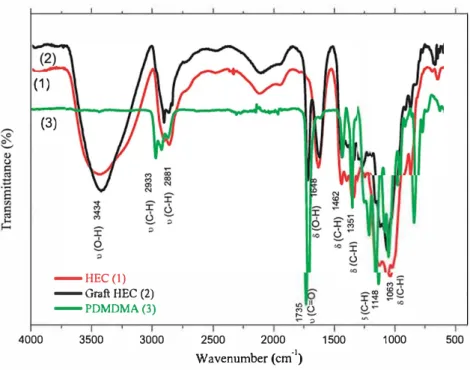
The comparison between the FTIR spectra of the pristine HEC and the grafted HEC (Figure 6) showed a new peak at 1735 cm 1, corresponding to the stretching vibration of the C
=
0 bond, which is related to the ester group grafted on the HEC chains.The detailed examination of the pristine HEC FTIR spectrum, showed a large band centered at 3434 cm 1; related to the stretching vibration of the associated hydroxyl bond OH. This band became sharper after grafting. The stretching vibration of methyne and methylene Ch and CH2 bonds appeared at 2933 cm 1 and 2 8 81 cm 1 respectively. The band centered at 1648 cm 1, is related to the water H20 absorption distortion vibration. The two bands centered at 1462 cm 1 and 1351 cm 1 respectively are related to the distortion vibration CH
2 and the CH bonds.
The DSC thermo-grams of the studied materials were recorded and gathered on Figure 7. The glass transition temperature of the grafted HEC showed a single glass transition Tg= 33 °C, which
is intermediate between the Tg values of the poly-DMDMA (Tg= 14 °C) and the pristine HEC (Tg= 12 2 °C), respectively. This finding confirmed the grafting process of the DMDMA on the
HEC resulting in a homo geneous biopolymer. The Tg of the poly-DMDMA was found to be less
than the ambient temperature. This result showed that this homo-polymer is supple and flexible. The TGA thermo-grams of the homo-polymer poly-DMDMA and the HEC before and after the grafting process are presented in Figure 8. The decomposition temperatures of HEC and the homo-polymer were found to be 350 °C and 400 °C, respectively (Table 1). Their thermal
(1) (3) -HEC(!) - Graft HEC (2) -PDMDMA(3) 4000 3500 3000 2500 2000 u, Il MO
...
--
::, Wavenurnber (cm.1)Figure 6. mR spectra of pristine HK, grafted HK and poly DMDMA.
122
°c
1500 1000 500 (2) HEC (1) 33°c ---
�---14°c
0 50 100 150 200 Temperature (0C) 250Figure 7. DSC thenno grarns (2nd scan) of samples of HK, grafted HK and poly DMDMA.
GraftHEC
PDMDMA
300 350
degradation occurred in one stage. On the other side, the thermal decomposition of the grafted HEC occurred in two stages: the first one appears at 312 °C followed by the second and intense stage at 363 °C related to a random break of C-C bonds over the main chains. This second max imum temperature of total decomposition of the grafted HEC is greater than that of the pristine
80 � 60 � � 40 20 -HEC(!) -Graft HEC (2) , --- (2) -PDMDMA(3) (1) (3) 0-+---0 100 200 300 400 Temperature (0C) (3) 200 400 Temperature (0C) Figure 8. TGA (A) and DTG (B) thermograms of the HEC, the graft HEC and the PDMDMA.
500 600
600
HEC. Such difference in the thermal properties between pristine HEC and the grafted HEC con firms the chernical modificati on of the HEC backbone. Furthermore, the increasing in the weight loss at 600 °C in the case of the grafted material (Table 1) might be attributed to the griffons' emergence on the HEC polymer.
The study of the crystallinity of the polymers was investigated by XRD analyses. Figure 9 gath ers the XRD patterns of the PMDMA and the HEC before and after the grafting pro cess. The presence of a peak centered at 20.7° ei ther in the HEC or in the gr afted HEC was attributed to the crystallinity of both bi opolymers. A new peak appeared on the grafted HEC pattern at 30.7°;
Table 1. Glass transition and decomposition temperatures of HEC, grafted HK and poly DMDMA. Onset decomposition Tg(°C)• temperature rob r ,,,..rqc HK 122 249 350 Grafted HEC 33 247 312 PDMDMA 14 325 400
•Glass transition temperatures obtained at the onset of the DSC thermo grarns. bDegradation temperature of the first step of decomposition obtained by TGA analyses. <Maximum degradation temperature c:J the last step of decomposition obtained by TGA. dResidual weight loss at 600°C.
0 5 10 15
Figure 9. ORX of HK and grafted HEC.
M -M 20 25 30 35 2 0 ( degrees) 40 363 HEC 45 Residual Wt(%)d 12 18 4 50 55 it might correspond to a new crystallinity induced by the presence of the side-chains of the poly
DMDMA on the HEC fibersP61 A reduction of 30% in the crystallinity index after grafting was
determined by Eq. (3).1221 Such results may confüm the crystal-structure modification of the
HEC in the grafted HEC.
Cl= loo2-Iam .100
1002 (3)
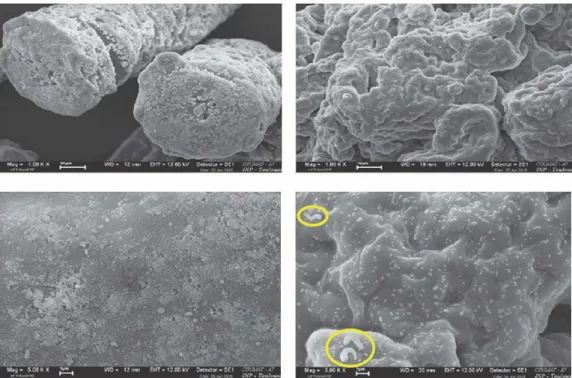
The examination of the SEM images, shown in Figure 10, proved a pronounced morphological variation between the two materials. The image of these group was completely different from the one represented by the grafted HEC. Such variety is due to the input of poly-DMDMA on the HEC surface. Consequently, SEM images showed clearly the morphological change before and
after the grafting process.
Finally, the moisture absorption properties of HEC and the grafted HEC materials were inves tigated and the corresponding values were gathered in Figure 11. As we can see, no significant difference in moisture absorption of HEC showed after 24 h and 48 h (i.e., 9.8% and 10.5% respectively). On the other band, the grafted HEC moisture absorption was 18.4% and 25% after 24 h and 48 h. Such behavior can be explained by the fact that water molecules were accessible to
Figure 10. MEB images of HK (left) and HEC graft PDMDMA (right). Upper row: magnification x 1000; lower row: x5000. 25 '----' 20 A ·.i:: � 15 � 10
-�
Q) 5 � �24H �48H HECFigure 11. Moisture absorption of HK and grafted HEC.
GraftHEC
the surface of the cellulose and read.ily developed hydrogen bond interactions1201 which increased two-fold the values of the moisture absorption in the grafted HEC by comparison to the ini tial HEC.
Conclusions
In this paper, we reported the grafting polymerization of 2,2-dimethyl-1,3-dioxolan-4-yl methyl
as initiator. The experimental protocol allowed us to condude that in the optimum conditions the grafting rate was equal to 25.2%, using 7.51 mmol/eq OH of KPS and 2.66mol/eq OH of the monomer DMDMA, during 72minutes at 65°C in the presence of THF. The SEM pictures showed a morphological modification of the HEC fibers. The obtained copolymer structure modi fication was confirmed by FfIR and X-Ray diffraction (XRD) analyses. Furthermore, the water adsorption tests showed that the grafted HEC bas increased hydrophilic characteristics. Furthermore, results showed the grafted biomaterial presented two-fold more moisture absorption ability by comparison with HEC, making this new synthetic biomaterial highly promising for dry ness applications .
References
[l) Dal Bo, A. G., R. Laus, A. C. Felippe, D. Zanette, and E. Minatti. 2011. Colloids and surfaces A: physico chemical and engineering aspects association of anionic surfactant mixed micelles with hydrophobically modified ethyl hydroxyethyl cellulose. Colloids Surf A. 380:100 106.
[2) Gorgieva, S., and V. Kokol. 2011. Synthesis and application of new temperature responsive hydrogels based on carboxymethyl and hydroxyethyl cellulose derivatives for the functional finishing of cotton knitwear.
Carbohyd. Polym. 85:664 673.
[3) Roy, A, B. Adhikari, and S. B. Majumder. 2013. Equilibrium, Kinetic, and thermodynamic studies of azo dye adsorption from aqueous solution by chemically modified lignocellulosic jute fiber. Ind. Eng. Œem Res. 52:6502 6512.
[4) Zhong, H., C. H. Liu, W. Ge, R. Sun, F. Huang, and X. Wang. 2017. Self assembled conjugated polymer/ chitosan graft oleic acid micelles for fast visible detection of aliphatic biogenic amines by a turn on fret.
ACS Appl. Mater. Interfaces. 9:22875 22884.
[SI Phan, H. T. T., K. Zhu, A. L. Kj0niksen, and B. Nystrom. 2011. Temperature responsive self assembly of charged and uncharged hydroxyethylcellulose graft poly(N isopropylacrylamide) copolymer in aqueous solution. Colloid Polym Sei. 289:993 1003.
[6) Fekete, T., J. Borsa, E. Takacs, and L. Wojnaro vits. 2017. Synthesis and characterization of superabsorbent hydrogels based on hydroxyethylcellulose and acrylic acid. Carbohydr. Polym. 166:300 308.
[7) Russo, R., M. Abbate, M. Malinconico, and G. Santagata. 2010. Effect of polyglycerol and the crosslinking on the physical properties of a blend alginate hydroxyethylcellulose. Carbohydr. Polym. 8:1061 1067. [8) Gupta, K. C., and S. Sahoo. 2001. Co (III) acetylacetonate complex initiated grafting of N vinyl pyrrolidone
on cellulose in aqueous media. J. AppL Polym Sei. 81:2286 2296.
[9) Ibrahim, M. M., E. M. Flefel, and W. K El Zawawy. 2002. Cellulose membranes grafted with vinyl mono mers in homogeneous system. J. Appl. Polym. Sei. 84:2629 2638.
[10) Witono, J. R, I. W. Noordergraaf, H. J. Heeres, and L. P. B. M. Janssen. 2012. Graft copolymerization of acrylic acid to cassava starch Evaluation of the influences of process parameters by an experimental
design method. Carbohyd. Polym. 90:1522 1529.
[11) Liu, Y., W. Wang, and A. Wang. 2010. Adsorption of lead ions from aqueous solution by using carboxy methyl cellulose g poly(acrylic acid)/attapulgite hydrogel composites. Desalination. 259:258 264.
[12) Ouajai, S., A. Hodzic, and R A. Shanks. 2004. Morphological and grafting modification of natural cellulose fibers. J. Appl. Polym. Sei. 94:2456 2465.
[13) El Khouly, A. S., E. Kenawy, A A. Safaan, Y. Takahashi, Y. A Hafiz, K. Sonomoto, and T. Zendo. 2011.
Synthesis characterization and antimicrobial activity of modified cellulose graft polyacrylonitrile with some aromatic aldehyde derivatives. Carbohyd. Polym. 83:346 353.
[14) Anirudhan, T. S., S. Jalajamony, and P. S. Suchithra. 2009. Colloids and surfaces A: physicochemical and engineering aspects improved performance of a cellulose based anion exchanger with tertiary amine func tionality for the adsorption of chromium(VI) from aqueous solutions. Colloids Surf. A. 335:107 113.
[15) Beker, G., F. S. Guner, M. Dizman, and A.T. Erciyes. 1999. Heavy metal removal by ion exchanger based on hydroxyethyl cellulose. J. Appl. Polym. Sei. 74:3501 3506.
[16) Beyaz, K, M. Charton, A. Rouilly, E. Vedrenne, C. Vaca Garcia, A. Benaboura, and S. Thiebaud Roux. 2017. Synthesis of graft copolymers from palm cellulose and solketal acrylate and their characterization.
Ind. Crops Prod. 97:32 40.
[17) Liu, S., and G. Sun. 2008. Radical graft functional modification of cellulose with allyl monomers: chemistry and structure characterization. Carbohydr. Polym. 71:614 625.
[18) Ghosh, P., and D. Das. 2000. Modification of cotton by acrylic acid (AA) in the presence of NaH2PO4 and K�O8 as catalysts under thermal treatment. Eur. Polym f. 36:2505 2511.
[19) Wilson, R E. 1921. Humidity control by means of sulfuric acid solutions, with critical compilation of vapor pressure data. J. Ind. Eng. Chem. 13:326 331.
[20) Wan, Z., Z. Xiong, H. Ren, Y. Huang, H. Liu, H. Xiong, Y. Wu, and J. Han. 2011. Graft copolymerization of methyi methacrylate onto bamboo cellulose under microwave irradiation. Carbohyd. Polym. 83:264 269. [21) Gevorgyan, V., E. Priede, E. Liepiqs, M. Gavars, and E. Lukevics. 1990. Radical addition of tetrahydrofuran
and tetrahydro4furanone to alkenylsilanes in the presence of di(t butyl) peroxide. J. Org. Chem. 393: 333 338.
[22) Kaushik, A., and M. Singh. 2011. Isolation and characterization of cellulose nanofibrils from wheat straw using steam explosion coupled with high shear homogenization. Carbohydr. Res. 346:76 85.