Official URL
https://doi.org/10.5220/0008978706340643
Any correspondence concerning this service should be sent
to the repository administrator: [email protected]
This is an author’s version published in:
http://oatao.univ-toulouse.fr/26340
Open Archive Toulouse Archive Ouverte
OATAO is an open access repository that collects the work of Toulouse
researchers and makes it freely available over the web where possible
To cite this version: Annane, Amina and Kamel, Mouna and
Aussenac-Gilles, Nathalie Comparing Business Process Ontologies for
Task Monitoring.
(2020) In: International Conference on Agents and
Artificial Intelligence (ICAART 2020), 22 February 2020 - 24 February
2020 (Valletta, Malta).
Comparing Business Process Ontologies for Task Monitoring
Amina Annane
1, Mouna Kamel
1and Nathalie Aussenac-Gilles
11IRIT - Paul Sabatier university, Toulouse, France {firstname, lastname}@irit.fr
Keywords: Business Process Monitoring, Business Process Modeling, Ontology, Industry 4.0
Abstract: Business process (BP) modelling is an active area of research due to its multiple applications. For systems that support/monitor operators to perform their tasks (i.e., tasks of a given BP), a formal representation is essential. Various BP ontologies are available to formally represent BP. In this paper, we review and compare a set of nine BP ontologies according to their ability to represent process specification and process execution in a fine-grained way to enable task monitoring. The comparison shows that, on the one hand, ontologies developed from scratch establish a clear distinction between process specification and process execution, but do not allow to represent workflow constraints required for process execution. On the other hand, most of the ontologies, that are ontological versions of existing BP modeling languages, focus only on process specifications but do not represent process execution, or mix the representation of BP specification and execution.
1
INTRODUCTION
A business process (BP) is a set of related tasks that have to be performed in a specific order, by some organization units and actors, to reach well de-fined business goals (Dumas et al., 2013). To main-tain a competitive position, industrial companies look permanently for improving their BPs. A research area has emerged from this need, known as Busi-ness Process Modeling (BPM) (van der Aalst, 2013). It aims at providing models and tools to analyze, improve, simulate and automate business processes (BPs). Business Process Models provide a more pre-cise definition of BPs by representing the enterprise activities and work-flows at an abstract level, includ-ing the description of the roles and responsibilities of its organization units for different tasks as well as task dependencies and used resources (goods, data and knowledge). In order to better evaluate BPs, and to assist their execution and management, in-formation technologies require formal representations of BP models. More recently, the Industry 4.0 vi-sion assumes an effective and high-quality commu-nication between systems (interoperability), which also relies on a formal representation of BPs (Vogel-Heuser and Hess, 2016). In this context, ontologies, defined as formal representation of domain knowl-edge at a conceptual level, are a good means to pro-vide standard and formal representations, and by this way, to reinforce interoperability and
communica-tion between systems (humans and machines) that use these BP models. Moreover, ontology formal languages allow to perform automatic reasoning on the knowledge that they represent. This capability contributes to check knowledge integrity and consis-tency (Rospocher et al., 2014). A deeper discussion about the benefits of representing BPs using ontolo-gies is available in (Lautenbacher et al., 2008).
Beyond BP description, another perspective can be to check BP execution and to perform reasoning on this execution, for instance to diagnose failures and to capture recovery procedures. This requires additional concepts that can keep track of each process run. In this paper, we examine the needs to be satisfied by an ontology that would support the execution of BPs and keep track of their executions.
By definition, ontologies should be shared and easily reusable models that facilitate knowledge mod-elling and to increase model interoperability (R. Gru-ber, 1995). So we examine the literature in order to find reusable ontologies that could contribute to de-fine a relevant BP ontology that would support the representation of both process specifications and pro-cess executions. We propose a review of nine of the most popular BP ontologies, and we evaluate their ability to explicitly represent BPs’ specification and their execution. The goal of this analysis is to guide us in selecting the most relevant ontologies among the existing ones.
AVIREX project that fits in Industry 4.0. AVIREX partners aim at developing an intelligent virtual as-sistant that should: (i) assist/monitor operators in the step-by-step execution of BPs; (ii) answer the opera-tor’s questions about the process execution; (iii) keep all related details to process execution, included the context in which an anomaly (i.e., unexpected event) may occur (so as to support the diagnosis process); (iv) save the solution if the operator succeeds in solv-ing the anomaly. To accomplish its mission, the vir-tual assistant relies on a formal and a fine-grained rep-resentation of the whole BP, hence the need for an ontology that enables such a representation. Further-more, the ontology should be generic to be specified and instantiated with the BPs of any company. In the two use cases given by the project industrial partner, the BPs describe how to assemble electronic, digital and physical components.
The following of the paper is organized as such: Section 2 identifies key concepts that should be cov-ered by an ontology to represent BP execution and specification; they will serve as comparison criteria of the nine studied ontologies sketched in Section 3. From this comparison and requirements, we selected several modelling options and discuss them in Section 4 before we conclude in Section 5.
2
REQUIREMENTS
We studied several knowledge sources: (i) re-search papers and technical documents, and (ii) com-petency questions, to identify the key concepts that should be covered by a core BP ontology.
2.1
Knowledge sources
Research Papers and Technical Documents: We studied a set of research paper that we cite and dis-cuss throughout this article. Moreover, we analyzed two corpora provided by AVIREX industrial partners with the help of their experts. One corpus includes 20 documents describing real BPs, and the other one contains 28 documents describing anomalies (or feed-back experiences) with/without their solutions.
We are interested in internal and executable BPs of industrial companies. They are imperative pro-cesses to be performed by human agents (i.e., oper-ators). The role of the virtual assistant is to monitor and support operators to improve their efficiency and effectiveness when performing these processes.
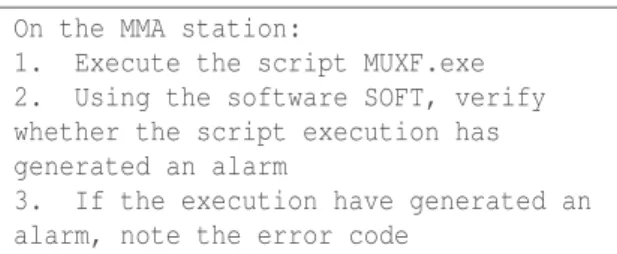
Figure 1 shows a sub-process (made anonymous for confidentiality reasons) to give an idea of what a BP looks like. As we can observe, the instructions ask
On the MMA station:
1. Execute the script MUXF.exe 2. Using the software SOFT, verify whether the script execution has generated an alarm
3. If the execution have generated an alarm, note the error code
Figure 1: Excerpt of a real Business Process.
the operator to perform a set of specific activities (”ex-ecute”, ”verify”, ”note”), on a specific place (”MMA station”), in a sequential order. Moreover, some ac-tivities are controlled by conditions (”if the execution has generated an alarm”), and require some resources (”the software SOFT”).
Competency Questions: Competency questions are recognized to be a good means to identify ontology specifications (Gr¨uninger and Fox, 1995). Thanks to our meetings with experts and related works (Hepp and Roman, 2007), (Abdalla et al., 2014), we col-lected a set of 26 competency questions: ”What are the sub-activities of a given process?”, ”Which ac-tivities must precede a given activity?”, ”Which re-sources are required for/produced by a given task?”, ”Who can perform/has performed a given activity?”, ”What is the context (i.e., task\agent\resource\..) of a given anomaly?”, etc.
2.2
Key Concepts
Based on the studied knowledge sources, we identi-fied the following key concepts:
Process Specification refers to the model that de-scribes the process and how it should be performed. It includes the following items:
a. Activity decomposition: Processes are complex procedures that are usually decomposed into atomic activities and complex activities (i.e., sub-processes). b. Workflow: It specifies the order (sequential or parallel) in which the activities should be performed.
c. Preconditions/Postconditions (PP): Beginning or ending some activities may be subject to condi-tions. Preconditions control the beginning of activi-ties, while Postconditions control their ending. Post-conditions usually are the prePost-conditions of the next activities. PP depend on the availability of (i) data or (ii) resources (agents, machines, raw materials, etc.), (iii) the execution of other activities, (iv) time con-straints, or (v) the occurrence of events. An Event is something that ”happens” during process execution e.g., a call phone or the arrival of an e-mail.
d. Place: It specifies where an activity should be performed: manufacturing facilities and the resources
located at each of them.
e. Anomaly: Unexpected values or/and errors may occur during process execution, giving rise to an anomalyto be tracked in the ontology. At the specifi-cation level, expected anomalies are represented with their repair activities.
Process Execution is about representing the actual execution of a given process specification (or process model), the activities actually performed, who (i.e., actual agent) performed them, and in which place. It also represents the events that triggered the execu-tion of activities, and the actual resources involved, consumed or produced during this execution. Hu-man agents may perform some activities that are not specified in the process model and which it is essen-tial to keep a trace of. A process specification may correspond to several executions. Process/Activity execution is mainly characterized by different states (e.g., ready, completed, aborted, ...) and time in-tervals(i.e., execution-start-time and execution-end-time). To help experts in diagnosing anomalies, ev-ery piece of information related to the anomaly oc-currence context should be saved. Moreover, if the operator succeeds in solving it, the solution should also be saved for re-use when the same anomaly ap-pears again.
Organizational Model and Resources define the hi-erarchy of professional roles and their relations, in other words, it defines who is subordinated by whom in the organization. This is important in validation workflows for example. Since both activity specifi-cation and execution refer to resources, it is essential to represent the different types of organizational re-sourcesheld by the enterprise, and that are involved in BPs.
3
STUDIED BP ONTOLOGIES
In this section, we briefly introduce a set of nine ontologies that deal with the semantic representation of BPs. Here, we try to give the reader a clear idea about the origin, the context of development, and the representation of the key concepts. If some key con-cepts (see Section 2) are not discussed for a given ontology, it means that they are not covered by this ontology. This is to avoid redundancy, and keep the overview of each ontology short.
To select relevant ontologies, we searched the Google Scholar database with various combinations of the key words: ”ontology”, ”business process”, ”formal model”, ”formal representation”. The search results were checked through a title and abstract screening to identify relevant works. Only
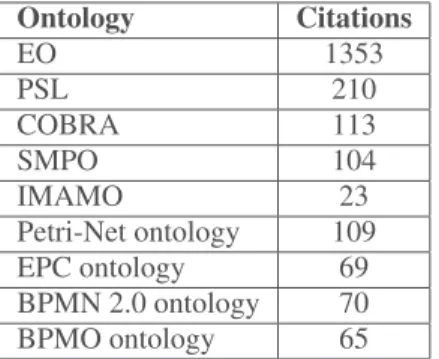
publica-tions with a number of citapublica-tions higher than 20 (see Tab. 1), and that explicitly mention the development of an ontology for representing BPs were considered as relevant. We used the number of citations to as-sess the popularity of ontologies. The search in the database was aborted when we noticed a significant amount of repetitions and loss of precision. In addi-tion, we performed a cross reference search. An
on-Table 1: Number of citations of the studied ontologies ac-cording to google scholar.
Ontology Citations EO 1353 PSL 210 COBRA 113 SMPO 104 IMAMO 23 Petri-Net ontology 109 EPC ontology 69 BPMN 2.0 ontology 70 BPMO ontology 65
tology is mainly composed of a set of concepts (i.e., class of things), a set of relations among these con-cepts, and a set of axioms that are used to formalize domain knowledge. For the sake of readability, we use the SMALL CAPITAL LETTERSfont when we re-fer to the actual concepts of an ontology.
Among the studied ontologies, we distinguish (i) ontologies developed from scratch, and (ii) ontolo-gies that formalize BPM languages.
3.1
Ontologies Developed From Scratch
The Enterprise Ontology (EO). The enterprise on-tology (Uschold et al., 1998) was developed within the Enterprise Project that aimed at designing a mod-eling framework that uses executable process models to help users perform their tasks. EO is composed of five sub-ontologies: (1) Meta-ontology and Time, (2) Activities and processes, (3) Organization, (4) Strat-egy, and (5) Marketing. In this paper, we consider only the three first sub-ontologies since they are re-lated to the key concepts that we have identified.
The sub-ontology of activities and processes is concerned with the representation of process speci-fication and execution; the central concepts are AC -TIVITY SPECIFICATIONand ACTIVITY.
Process specification is limited to the representa-tion of the process decomposirepresenta-tion, but the workflow is not represented: neither concepts, nor relationships are provided to represent the order in which the activ-ities should be performed.
representation of agents (human or software), and their organizational hierarchy.
Organization sub-ontology is linked to the activity sub-ontology via CAPABILITIES and AUTHORITIES concepts. On one hand, EO represents the capabilities and authorities of each agent. On the other hand, it represents the capabilities and authorities required for performing each activity.
An ACTIVITY is an execution of an ACTIVITY SPECIFICATION. It is performed by a DOER in a given TIME INTERVAL. In EO, an ACTIVITY may use/consume RESOURCES, be decomposed into SUB -ACTIVITIES, have PRECONDITIONS and EFFECTS (i.e., outcomes). EVENTSare considered as a specific type of ACTIVITY.
EO is formalized in Ontolingua which is an old formal language and is available at
https://tinyurl.com/y26su33t.
Process Specification Language ontology (PSL). PSL (Gruninger and Menzel, 2003) is an ISO standard for representing manufacturing pro-cesses (Pouchard et al., 2005) that was created at the National Institute of Standards and Technol-ogy (NIST1). It was designed to facilitate correct and complete exchange of process information among manufacturing systems. ACTIVITY concept denotes a specification of an activity. ACTIVITY -OCCURRENCE denotes the actual execution of one ACTIVITY. Except the decomposition of an activity into sub-activities, the representation of process specifications is made by applying constraints on the instances of ACTIVITY-OCCURRENCE (Gr¨uninger, 2009). Indeed, using PSL, it is not possible to define process specifications (e.g., order constraints, events, activity preconditions/postconditions) independently of process execution (i.e., activity occurrences).
PSL offers a set of concepts and relations to rep-resent for a given activity-occurrence (i.e., at the ex-ecution level) : sub-activity occurrences, beginning and ending time, states, preconditions and postcon-ditions, and the resources involved in its execution. There is no elaborated representation of anomalies, but the concept ATTEMPT(i.e., an activity occurrence that has been interrupted for some reason) may be a good starting point for adding an extension.
PSL is formalized in OWL and is available at https://tinyurl.com/y4annulm. In (Gr¨uninger, 2009), the authors explain how to represent process specifications using PSL with first order logic sen-tences.
Core Ontology for Business pRocess Analysis (COBRA). The SUPER (Semantics Utilized for Pro-cess management within and between EnteRprises)
1https://www.nist.gov/
project2is a European research project aimed at defin-ing a set of ontologies for Semantic Business Process Management (SBPM). In the context of this project, Hepp et al. (Hepp and Roman, 2007) have proposed eight ontologies (e.g., Upper-level Process Ontology (UPO)) and clarified their scopes with competency questions. Unfortunately, we were not able to ac-cess the SUPER ontologies except for COBRA and BPMO. COBRA (Pedrinaci et al., 2008) is a core on-tology that aimed at enhancing BP analysis. The core concepts of COBRA are BUSINESS ACTIVITY and BUSINESS ACTIVITY REALIZATION that represent process specification and process execution, respec-tively. COBRA represents the composition of activ-ities at the specification and execution levels. Fur-thermore, it reuses the time ontology3to represent the beginning and ending time-points of BUSINESSAC -TIVITYREALIZATIONS. A taxonomy of monitoring events has been defined to capture the different events related to process execution. These events change process or activity states (e.g., started, aborted, com-pleted, etc.). However, at the specification level, events are not represented. COBRA allows to spec-ify AGENTSor ROLESresponsible for the execution of each BUSINESSACTIVITY, as well as the actual AGENT that has performed a given BUSINESS AC -TIVITY REALIZATION. Different relations are pro-vided by COBRA to represent the resource/data re-quirements and produced of a given BUSINESS AC -TIVITYor BUSINESSACTIVITYREALIZATIONsuch as uses, consumes, produces and provides. These rela-tions link activities to PERSISTENTENTITYthat may be a PHYSICAL ENTITYor a NON-PHYSICAL EN -TITY. The categorization of these entities is inline with top level ontologies such as DOLCE (Masolo et al., 2003). COBRA has been formalized in OCML but it has no accessible link.
Software Maintenance Project Ontologies (SMPO). To decrease the efforts and costs of the software maintenance projects, an extended soft-ware engineering environment MANTIS has been implemented including the semi-formal ontology (SMPO) (Ruiz et al., 2003). This ontology deals with the representation of the static and dynamic aspects of software maintenance projects. SMPO is composed of three sub-ontologies: (1) Maintenance, (2) Workflow, and (3) Measurement. We do not discuss the measurement ontology since it represents metrics for assessing the quality of products and processes, which is out the scope of this paper.
Maintenance sub-ontology (i.e., the static aspect
2https://cordis.europa.eu/project/rcn/ 105285/factsheet/en
of the maintenance process) in turn includes four sub-ontologies describing: (i) PRODUCT and their com-position; (ii) AGENTs, their ROLEs and their orga-nizational model; (iii) ACTIVITY, its sub-types (i.e., MAINACTIVITY, SUPPORTACTIVITY, etc.), its in-puts/outputs, and the used RESOURCEs; and (iv) PROCESS ORGANIZATION allows to represent pro-cedures (activity specification) that may be used by activities. The content of these procedures is not represented. A maintenance Activity is triggered by a MAINTENANCE REQUEST (i.e., an internal docu-ment that describes the anomaly) communicated by an AGENT. Then, the maintenance request is man-ually studied by experts that produce an INVESTI -GATION REPORT that points out the CAUSE of the anomaly. The corrective actions are included in the maintenance request report, but are not represented.
Workflow sub-ontology (i.e., the dynamic aspect) deals with the representation of activity decomposi-tion, temporal constraints between activities and their execution order. It is surprising to observe that spec-ifications such as temporal constraints between activ-ities are represented at the execution level and not at the specification level, in the process organization sub-ontology. SMPO does not establish a clear dis-tinction between process specification and process ex-ecution. The same concept ACTIVITYis used to rep-resent both of them. Indeed, ACTIVITY is defined as the description of the work to be performed. At the same time, it comprises the STATEattribute that refers to execution states (e.g., not started, in execu-tion, etc.). SMPO has been semi-formalized in UML. Industrial MAintenance Management Ontol-ogy (IMAMO). IMAMO (Karray et al., 2012) has been developed within the scope of the SMAC (Se-mantic MAintenance and lifeCycle) project in col-laboration between academic and industrial organi-zations from France and Switzerland. The SMAC project aimed at providing a semantic platform of in-dustrial maintenance ensuring the capitalization and reuse of knowledge. Hence, it was essential to repre-sent maintenance process and its related concepts.
Process specification is represented mainly with the PROCESS PATTERN concept that is composed of a set of STEPs. A process workflow is described through several concepts (e.g., STEP, TRANSITION, etc.) and relations (e.g., has first step, next step, next transition, etc.). For more details, see the processes view in (Karray et al., 2012).
RESOURCEs are well covered in IMAMO since they are the central element in an industrial main-tenance process, especially material resources. In-deed, many details about material resources are rep-resented such as their composition, their functional
requirements, etc. In addition, IMAMO provides a rich taxonomy of industrial resources. However, for a given activity specification (i.e., PROCESSPATTERN or STEP), the required resources are not represented except agents who should perform the activity.
Key concepts for process execution are PROCESS and ACTIVITY. They are characterized by the at-tribute ”State”, related to a PERIOD (start and end dates), and an ACTORwho performs the activity. A PROCESS refers to a PROCESS PATTERN and com-posed of a set of ACTIVITY. An ACTIVITYis the exe-cution either an ACTIONor a STEP. ACTIONdenotes a task specification that aims at resolving a TROU -BLE. TROUBLEconcept refers to the Anomaly con-cept. IMAMO represents different types of anoma-lies, their causes, and the actions that may be per-formed to resolve them. Only the events triggering anomalies are represented.
IMAMO has been formalized in OWl and is ac-cessible at https://tinyurl.com/yyxjsryp
3.2
Ontologies Developed From BP
Modeling Languages
A process modeling language provides appropriate syntax and semantics to precisely specify BP require-ments, in order to support automated process veri-fication, validation, simulation and process automa-tion (Lu and Sadiq, 2007). To take advantage of an ontological representation of BPs, formal ontological descriptions of some BP languages have been pro-posed:
Petri-Net Ontology. In (Koschmider and Ober-weis, 2005), the authors have proposed an ontology that formalizes Petri-Net elements for BP representa-tion. Petri-Net is a mathematical and graphical mod-eling language that is utilized for modelling work-flows and simulating/analyzing their enactments. A Petri-Net is a directed graph that mainly consists of two different nodes, PLACESand TRANSITIONS. PLACESrepresent states, while TRANSITIONS repre-sent events and activities. The abstract concept ”to-ken” is used to simulate the move of the execution flow through the process graph. It is possible to repre-sent the different workflow patterns (e.g., AND-Split, OR-Split, Loops, etc.) (van der Aalst et al., 2003) with Petri-Net. Time constraints, data and resource requirements are not supported naively, but they may be represented with additional or customized tokens (e.g., colored tokens) (van der Aalst, 2015). Al-though this solution can be handled by computers, it requires a high expertise and generates complex Petri-Net graphs. Petri-Petri-Net ontology does not offer more elements, hence it offers the same representation
char-acteristics as Petri-Net. Moreover, petri-Net ontol-ogy does not offer a vocabulary for the domain of BP, which is a key element for a BP ontology. This is ex-plained by the fact that BP representation is just an ap-plication for Petri-Nets. Its strength is its mathemat-ical model that has clear execution semantics. In ad-dition, several process analysis algorithms exist (e.g. detecting deadlocks, reachability, etc.) and may be reused. The Petri-Net Ontology has been formalized in OWL, but we were not able to find its OWL file.
Event-driven Process Chain (EPC) ontology. EPC has been developed in a joint effort between SAP4 and the Institute of Information Systems of Saarbr¨ucken in the context of the Architecture of Integrated Information Systems (ARIS) frame-work (Keller et al., 1992). EPC is a graphical BP modeling language; its major strength is its simplic-ity and easy-to-understand notation. Originally, EPC does not include a formal definition, but several works have proposed formalized ontologies with or without extension over time (van der Aalst, 1999),(Thomas and Fellmann, 2007). EPC has been developed to represent enterprise workflows. It has five key con-cepts (Scheer et al., 2005): (i) FUNCTIONthat rep-resents an activity specification, (ii) EVENTto repre-sent preconditions and post-conditions of FUNCTION, (iii) CONTROL-FLOWthat refers to a transition from one EPC element to another, (iv) LOGICAL CONNEC -TOR, such as OR, AND, and XOR, that connects at least three FUNCTIONs, and finally (v) RESOURCE. A LOGICAL CONNECTORcan either join or split FUNC -TIONs. EPC does not support process execution. EPC is formalized in OWL but it is not available.
Business Process Model and Notation (BPMN) ontology. BPMN is a standard5widely adopted by companies that has been developed by the Object Management Group (OMG)6. BPMN has two main versions BPMN 1.0 and BPMN 2.0 (OMG, 2011). The first version has been published in 2008 while the second one in 2011. An ontology has been de-veloped from each version in (Rospocher et al., 2014) and (Natschl¨ager, 2011), respectively. In the follow-ing, we consider only the BPMN 2.0 version since it is the most recent and complete one. Indeed, it offers an execution logic for its elements and a mapping to the BP execution language (BPEL7)
BPMN meta-model offers a fine grained
represen-4Systems, Applications & Products in Data Processing (SAP): a German multinational software corporation that makes enterprise software to manage business operations and customer relations.
5https://www.iso.org/standard/62652.html 6https://www.omg.org/about/index.htm 7https://tinyurl.com/3xntz3
tation of process specification. A PROCESSis repre-sented as a container that includes four types of el-ements (or FLOW ELEMENTS): (i) ACTIVITY: an activity specification that may be atomic (TASK) or complex (SUB-PROCESS), (ii) EVENT: something that happens, (iii) GATEWAY: a flow control for synchronization, and (iv) SEQUENCE FLOW: transi-tions between the previous elements to complete the representation of the workflow. Transitions may be controlled with conditions. BPMN supports almost all workflow patterns (e.g., Simple Merge, Exclusive choice, loop) (van der Aalst et al., 2003), and repre-sents advanced BP modeling paradigms like excep-tion handling, transacexcep-tions, and compensaexcep-tion. In ad-dition, it allows to represent data requirements (i.e., DATAINPUTand DATAOUTPUT), and the agents or roles that are responsible of a given activity. However, it is not possible to define organizational or resource models with BPMN.
BPMN offers specific events to deal with anoma-lies such as theERROR EVENTfor interrupting errors andESCALATION EVENTfor non interrupting errors. In both cases, BPMN allows to represent the process to be performed when these events occur.
Process execution is represented only through a set of additional attributes for instances of process-specification concepts such as State (e.g., ”ready”, ”completed”, ”aborted”, etc.) for PROCESS, AC -TUALOWNER – the actual actor that is performing the activity – for ACTIVITY, etc. Thus, no ac-tual distinction is made between process specifica-tion and process execuspecifica-tion. Nevertheless, BPMN de-fines the life-cycle model of activity instances, with the events enabling transitions between them (OMG, 2011) (pp.428). To the best of our knowledge, the OWL version of BPMN2.0 (Natschl¨ager, 2011) is not available to the community. However, BPMN meta-model is available in BPMN specification (a docu-ment with more than 500 pages) as UML class dia-grams (OMG, 2011). An XML version of this meta-model is also available. However, BPMN tion includes a number of constraints (or specifica-tions) in natural language, that are represented neither in the UML diagrams, nor in the XML file.
Business Process Modeling Ontology (BPMO). BPMO was developed in the context of the SUPER project to represent highlevel BP workflow models, abstracting from existing BP notations and languages (Cabral et al., 2009). BPMO supports only the rep-resentation of process specification. A PROCESS has a WORKFLOW composed of WORKFLOW EL -EMENTs: TASKs, EVENTs, BLOCK PATTERNS in-spired from BPEL, and GRAPH PATTERNS inspired from BPMN 1.0. BLOCK PATTERNS and GRAPH
PATTERNSare both control flows representing work-flow decision points (van der Aalst et al., 2003). Block-structured control flows are defined similar to existing programming languages by using block-structures such as ”if” or ”while”. Conversely, graph-oriented language defines control flows through ex-plicit links between activities. For more details about the difference between BP graphical and block lan-guages, please refer to (Kopp et al., 2009). BPMO has no graphical language of its own. BPMO is for-malized in WSML-Flight which is an old formal lan-guage. We did not find an accessible link for BPMO.
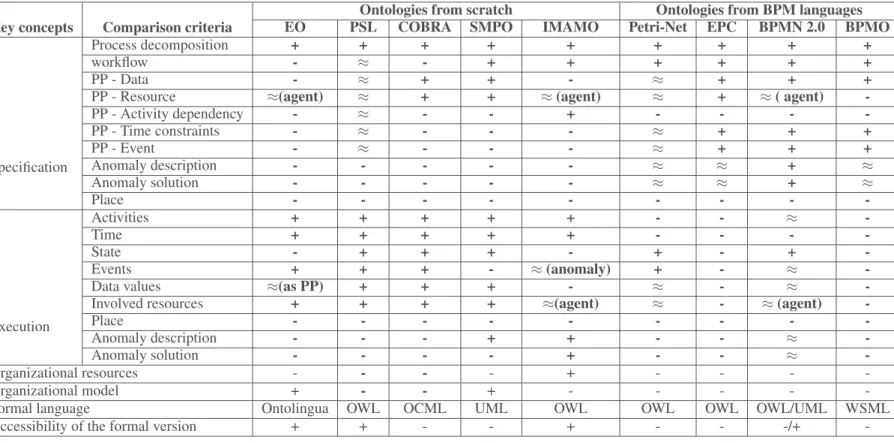
Table 2 sums up the previous descriptions where the symbols +, −, ≈ have the following meanings: (i) +: the ontology supports the element represen-tation, (ii)−: the ontology does not support the el-ement representation, and (iii) ≈ : the key concept is partially represented e.g.,≈ (agent) means among resources only agents are represented. Furthermore, for anomaly specification, we used the≈ symbol for Petri-Net, EPC and BPMO because it is possible to represent anomalies as events and activities, but there is no specific concepts/relations for representing them in these models. On the Data values line, ≈(as PP) means that data values can be represented as precon-ditions/ postconditions but not with a specific concept.
4
DISCUSSION
These ontologies and the project requirements guided our modeling choices, in particular for the rep-resentation of process specification and execution.
4.1
Process Specification
As we can observe in Tab. 2, among the ontologies developed from scratch, PSL is the one that covers the most BP specification elements. However, as ex-plained earlier, in PSL, the definition of specifications depends on the execution occurrences.
Ontologies obtained from existing BP languages offer a richer representation of process specifications. This may be explained by the maturity of BP lan-guages and their evolution over the years, in particular BPMN, the most recent and complete BP language. Indeed, even if Petri-Net, EPC, BPMO, and BPMN cover almost the same elements, BPMN stands out for its expressiveness. Compared to Petri-Net and EPC, BPMN offers much more concepts and relations to represent the BP domain. For instance, while ”event” is represented in EPC by a single general concept with no formal semantic other than its annotation with a
term, BPMN offers a set of 48 concepts represent-ing different event types with specific attributes and clear semantics (e.g., timer event, start event, error event, message event, etc.) that are classified into: (i) catching/throwing events, and (ii) interrupting/non-interrupting events.
4.2
Process Execution
Ontologies developed from scratch (except SMPO) establish a clear distinction between process specifi-cation and process execution. As we can see in Tab 2, the time perspective is covered by these ontologies, which allows to keep trace of the different executions. COBRA is distinguished by the fine grained repre-sentation of monitoring events, the different states and possible transitions between them within the life-cycle of processes/activities.
Ontologies extracted from BPM languages either do not represent process execution such as EPC and BPMO, or mix between process execution and pro-cess specification (i.e, no clear distinction) like Petri-Net and BPMN. Indeed, Petri-Petri-Net execution con-sists on the movement of the token over the net (i.e., the graph representing the process). Hence, the represented activities are considered as activity-specification and activity-execution at the same time. The BPMN developers propose to instantiate the pro-cess model than to add some attributes such as state to the instances (activity instance, process instance, etc.) without considering the time interval of any in-stance. Process-specification is an informational en-tity that describes what and how to do, while process-execution is a temporal entity that has a time interval (start-date; end-date). Thus, we believe it is semanti-cally more correct to differentiate these two concepts.
4.3
Vocabulary
One promising role of ontologies was to provide, for each domain, a shared vocabulary with precise and formal definitions that should improve the communi-cation between different actors of these domains (ei-ther humans or machines) (Gruber, 1991). However, we observed a high terminological heterogeneity in the studied ontologies. On the one hand, different terms are used to label the same concepts. For in-stance, the main concept denoting activity-execution is labeled differently from one ontology to another: (EO: ”Activity”), (PSL: ”Activity occurence”), (CO-BRA: ”Process instance”), and (IMAMO: ”Process”). Another example is the terms used to label the con-cept representing the move of the execution flow from one element to another: (IMAMO:
”Tran-Table 2: BP ontologies vs. key concepts
Key concepts Comparison criteria
Ontologies from scratch Ontologies from BPM languages
EO PSL COBRA SMPO IMAMO Petri-Net EPC BPMN 2.0 BPMO
Specification
Process decomposition + + + + + + + + +
workflow - ≈ - + + + + + +
PP - Data - ≈ + + - ≈ + + +
PP - Resource ≈(agent) ≈ + + ≈ (agent) ≈ + ≈ ( agent)
-PP - Activity dependency - ≈ - - + - - - -PP - Time constraints - ≈ - - - ≈ + + + PP - Event - ≈ - - - ≈ + + + Anomaly description - - - ≈ ≈ + ≈ Anomaly solution - - - ≈ ≈ + ≈ Place - - - -Execution Activities + + + + + - - ≈ -Time + + + + + - - - -State - + + + - + - + -Events + + + - ≈ (anomaly) + - ≈
-Data values ≈(as PP) + + + - ≈ - ≈
-Involved resources + + + + ≈(agent) ≈ - ≈ (agent)
-Place - - -
-Anomaly description - - - + + - - ≈
-Anomaly solution - - - - + - - ≈
-Organizational resources - - - - + - - -
-Organizational model + - - + - - - -
-Formal language Ontolingua OWL OCML UML OWL OWL OWL OWL/UML WSML
-sition”), (BPMN: ”Sequence flow”), and (BPMO: ”Control flow connector”), etc. On the other hand, the same terms are used to label non-equivalent con-cepts e.g., the term ”Process” is used to label activity-specification in COBRA, but activity-execution in IMAMO. Such a high terminological heterogeneity reflects the conceptual differences and makes it not feasible to automatically align these ontologies us-ing tools such as AML (Faria et al., 2013). Reusus-ing and combining these ontologies requires to manually study the ontologies one by one in order to estab-lish correspondences between equivalent/related con-cepts. In the future, it would be interesting to define a standard vocabulary that could be used as a pivot to interconnect existing BP ontologies.
4.4
Synthesis
Based on the elements discussed previously, none of the studied ontologies covers all the requirements of the core ontology that we need, but as we may no-tice they have common and complementary fragments (see Tab.2). BPMN seems to be the most relevant one for our project. In particular, because of its ex-pressiveness that allows to capture the most of details related to process specification, which is essential in our case since we aim at monitoring process execu-tion step by step. Unfortunately, BPMN ontology is not available. Hence, we will start by translating the BPMN meta-model into an ontological model using (OMG, 2011) and (Natschl¨ager, 2011) .
Despite the richness of BPMN, it has some lim-itations: (i) It does not represent the organizational model and resources. Furthermore, it does not al-low to specify the resource requirements (other than agents) of an activity. (ii) There is no way to rep-resent the place where the activities should be per-formed (absent in all models). (iii) There is no ex-plicit concept to represent process execution. To over-come these limitations, we decided to reuse fragments from the other ontologies such as the resource taxon-omy of IMAMO, relations that represent the resource requirements such as consumes, uses from COBRA and the organizational model from EO (with the def-inition of agent authorities and capabilities). Reusing together BPMN and these fragments is harder than expected due to (i) terminological heterogeneity and differences in the formal languages, and (ii) the lack of availability of the reused ontologies.
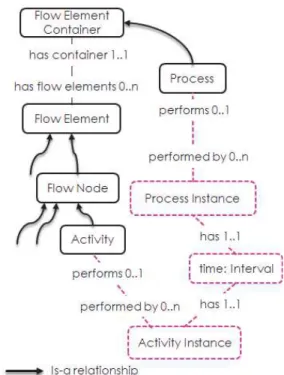
Furthermore, we will add concepts to represent process execution such as ”Activity instance”, ”Pro-cess instance” and ”time:interval” (from the Time on-tology) as shown in Fig 2. This enrichment is inspired from the COBRA ontology.
Figure 2: Example of enrichment with new concepts (those with dashed line).
5
CONCLUSION
In this paper, we highlighted the main concepts that should be covered by a BP core ontology, then we presented and compared nine popular business-process ontologies. In particular, we focused on how these ontologies deal with the representation of pro-cess specification and propro-cess execution.
Regarding our project, BPMN seems the best can-didate to start with. However, BPMN alone does not cover all the requirements, which leads us to reuse fragments from the other ontologies.
ACKNOWLEDGEMENTS
This work within the AVI-REX project is funded by a grant from region Occitanie, the FEDER-FSE Midi-Pyr´en´ees and Garonne 2014-2020 program un-der the label 2017-AVI-REX-IRIT-READYNOV IN-DUSTRIE DU FUTUR.
REFERENCES
Abdalla, A., Hu, Y., Carral, D., Li, N., and Janowicz, K. (2014). An Ontology Design Pattern for Activity Rea-soning. In 5th WS on Ontology and Semantic Web
Cabral, L., Norton, B., and Domingue, J. (2009). The busi-ness process modelling ontology. In 4th Int. WS on
semantic business process management, pages 9–16. Dumas, M., La Rosa, M., Mendling, J., and Reijers, H. A.
(2013). Introduction to Business Process Manage-ment, pages 1–31.
Faria, D., Pesquita, C., Santos, E., Palmonari, M., Cruz, I. F., and Couto, F. M. (2013). The agreementmak-erlight ontology matching system. In On the Move
to Meaningful Internet Systems OTM, Graz, Austria, pages 527–541.
Gruber, T. R. (1991). The role of common ontology in achieving sharable, reusable knowledge bases. In 2nd
International Conference on Principles of Knowledge Representation and Reasoning (KR). Cambridge, MA, USA, pages 601–602.
Gr¨uninger, M. (2009). Using the psl ontology. In Handbook
on Ontologies, pages 423–443. Springer.
Gr¨uninger, M. and Fox, M. S. (1995). The Role of Compe-tency Questions in Enterprise Engineering. In
Bench-marking Theory and practice, pages 22–31.
Gruninger, M. and Menzel, C. (2003). The process spec-ification language (psl) theory and applications. AI
magazine, 24(3):63–74.
Hepp, M. and Roman, D. (2007). An ontology frame-work for semantic business process management. In
8th Internationale Tagung Wirtschaftsinformatik (WI), Karlsruhe, Germany, pages 423–440.
Karray, M. H., Chebel-Morello, B., and Zerhouni, N. (2012). A formal ontology for industrial maintenance.
Applied ontology, 7(3):269–310.
Keller, G., N¨uttgens, M., and Scheer, A. (1992). Semantis-che prozeßmodellierung auf der grundlage ”ereignis-gesteuerter prozeßketten (epk)”. Ver¨o ffentlichungen
des Instituts f¨ur Wirtschaftsinformatik, (89).
Kopp, O., Martin, D., Wutke, D., and Leymann, F. (2009). The difference between graph-based and block-structured business process modelling languages.
En-terprise Modelling and Information Systems Architec-tures, 4(1):3–13.
Koschmider, A. and Oberweis, A. (2005). Ontology based business process description. In The Open Interop
Workshop on Enterprise Modelling and Ontologies for Interoperability, pages 321–333.
Lautenbacher, F., Bauer, B., and Seitz, C. (2008). Semantic business process modeling - benefits and capability. In AI Meets Business Rules and Process Management,
2008 AAAI Spring Symposium, Technical Report SS-08-01, Stanford, Cal., USA, pages 71–76.
Lu, R. and Sadiq, S. (2007). A Survey of Comparative Busi-ness Process Modeling Approaches. In BusiBusi-ness
In-formation Systems, pages 82–94.
Masolo, C., Borgo, S., Gangemini, A., Guarino, N., Oltra-mari, A., and Schneider, L. (2003). The wonderweb library of fundational ontologies and the DOLCE on-tology. The WonderWeb Library of Fundational
On-tologies and the DOLCE ontology. WonderWeb Deliv-erable D18, Final Report (vr. 1. 0.).
Natschl¨ager, C. (2011). Towards a BPMN 2.0 ontology. In
3rd Int. WS on Business Process Modeling Notation, pages 1–15, Lucerne, Switzerland.
OMG (2011). Business Process Modeling Notation, v2.0 -Specification. Technical report, Object Management Group.
Pedrinaci, C., Domingue, J., and de Medeiros, A. K. A. (2008). A core ontology for business process analysis. In 5th European Semantic Web Conference, ESWC,
Tenerife, Canary Islands, Spain, pages 49–64. Pouchard, L. C., Cutting-Decelle, A., Michel, J.-J., and
Gr¨uninger, M. (2005). Iso 18629 psl: A standardised language for specifying and exchanging process infor-mation. IFAC Proceedings Volumes, 38(1):37–45. R. Gruber, T. (1995). Toward principles for the design of
ontologies used for knowledge sharing? International
journal of human-computer studies, 43(5-6):907–928. Rospocher, M., Ghidini, C., and Serafini, L. (2014). An on-tology for the Business Process Modelling Notation. In 8th International Conference on Formal Ontology
in Information Systems (FOIS), pages 133–146. Ruiz, F., Garcia, F., Piattini, M., and Polo, M. (2003).
Envi-ronment for managing software maintenance projects. In Advances in software maintenance management:
technologies and solutions, pages 255–291.
Scheer, A.-W., Thomas, O., and Adam, O. (2005). Process modeling using event-driven process chains.
Process-aware information systems, pages 119–145.
Thomas, O. and Fellmann, M. (2007). Semantic EPC: en-hancing process modeling using ontology languages. In WS on Semantic Business Process and Product
Lifecycle Management (SBPM), Innsbruck, Austria. Uschold, M., King, M., Moralee, S., and Zorgios, Y. (1998).
The enterprise ontology. The knowledge engineering
review, 13(1):31–89.
van der Aalst, W. M. (1999). Formalization and verifica-tion of event-driven process chains. Informaverifica-tion and
Software technology, 41(10):639–650.
van der Aalst, W. M. (2013). Business process manage-ment: a comprehensive survey. ISRN Software
Engi-neering, 2013:1–37.
van der Aalst, W. M. P. (2015). Business process manage-ment as the “killer app” for petri nets. Software &
Systems Modeling, 14(2):685–691.
van der Aalst, W. M. P., ter Hofstede, A. H. M., Kie-puszewski, B., and Barros, A. P. (2003). Work-flow patterns. Distributed and Parallel Databases, 14(1):5–51.
Vogel-Heuser, B. and Hess, D. (2016). Guest Edito-rial Industry 4.0 Prerequisites and Visions. IEEE Transactions on Automation Science and Engineer-ing, 13(2):411–413.