HAL Id: tel-02906002
https://hal.archives-ouvertes.fr/tel-02906002
Submitted on 23 Jul 2020
HAL is a multi-disciplinary open access
archive for the deposit and dissemination of sci-entific research documents, whether they are pub-lished or not. The documents may come from teaching and research institutions in France or abroad, or from public or private research centers.
L’archive ouverte pluridisciplinaire HAL, est destinée au dépôt et à la diffusion de documents scientifiques de niveau recherche, publiés ou non, émanant des établissements d’enseignement et de recherche français ou étrangers, des laboratoires publics ou privés.
Towards a Definition of Antonin Raymond’s
”Architectural Identity” - A Study Based on the
Architect’s Way of Thinking and Way of Design
Yola Gloaguen
To cite this version:
Yola Gloaguen. Towards a Definition of Antonin Raymond’s ”Architectural Identity” - A Study Based on the Architect’s Way of Thinking and Way of Design. Architecture, space management. Kyoto University, 2008. English. �tel-02906002�
Title
TOWARDS A DEFINITION OF ANTONIN RAYMOND'S "ARCHITECTURAL IDENTITY" : A STUDY BASED ON THE ARCHITECT'S WAY OF THINKING AND WAY OF DESIGN( Dissertation_全文 )
Author(s) GLOAGUEN, Yola
Citation Kyoto University (京都大学)
Issue Date 2008-03-24
URL http://dx.doi.org/10.14989/doctor.k13809
Right
Type Thesis or Dissertation
TOWARDS A DEFINITION OF ANTONIN RAYMOND’S “ARCHITECTURAL IDENTITY”
-A STUDY BASED ON THE ARCHITECT’S WAY OF THINKING AND WAY OF DESIGN-
アントニン・レーモンドの建築的アイデンティティの解読 -建築家の思考方法と設計方法の研究-
February 2008
ACKNOWLEDGEMENTS
I would like to express my gratitude to the Japanese Ministry of Education 文部科 学省, and the Shadan-hōjin Kenchiku-gyō Kyōkai 社団法人建築業協会, for granting me the scholarships that allowed me to complete my doctor course at Kyoto University.
I would like to thank Professor Takamatsu 高松 伸 and Takeyama 竹山 聖 of Kyoto University for accepting me in their laboratories, where I was able to carry out my research on Antonin Raymond. I would like to express my gratitude to Professor Monnai 門内 輝行 of Kyoto University for his moral and technical support, and to Professor Maeda 前田 忠直 for his advice and for accepting to be part of my jury.
I would like to thank Raymond’s Architectural Design Office in Tokyo, for giving me access to their archives, in which I was able to find the invaluable material I needed for the analysis of Raymond’s residential designs. I would like to thank more particularly Matano Norisuke 的埜 教介 who provided precious assistance in the locating of the drawings that were relevant to my research and also for dealing with the practical matters of the drawings reproduction.
I would like to express my sincere gratitude to Mr and Mrs Kitazawa Koichi 北澤 興一 (former member of staff at Raymond’s Architectural Design Office and present owner of Shin Karuizawa Studio) for their hospitality during my trips to Karuizawa, where I collected the majority of the original photographs included in this thesis and in my database, as well as Raymond’s essays, which constitute the most valuable source of information on Antonin Raymond’s architectural discourse and philosophy of design.
I would like to express my sincere gratitude to Matsuoka Atsuhiko and Reiko 松岡 淳彦, 松岡 玲子, residents of Karuizawa and defenders of its architectural and natural heritage, for their genuine interest in my work and their kindness. I would like to thank them particularly for their hospitality and guidance around Raymond’s houses in Karuizawa.
I would also like to thank my dear friends Evelyne Mesnil and Kobayashi Tsuneyoshi 小林 恒義 for their kindness, encouragement and support, and Nakayama Yūmiko 中山 裕美子, for her invaluable help in the reading of Japanese material. I thank my family, Peter Hilary, and those who despite the distance have in whatever way contributed to this achievement. Thank you to my dear friends in Kyoto, and fellow researchers Benoit Jacquet and Andrea Yuri Flores Urushima, and their little Hanae, for being part of what turned out to be more than just an experience, a true piece of life.
ABSTRACT
This thesis presents a study on the way of thinking and way of design of the Czech born architect Antonin Raymond (1888-1976). The data used for this study was a series of lectures and articles written by Raymond between 1935 and 1967 and original architectural drawings and photographs. These documents were all collected personally by the author at Raymond’s former studio in Karuizawa and Architectural Office in Tokyo. These documents provide a new source of information on Raymond’s residential work and have been compiled in an electronic database available with the thesis. The database includes architectural drawings, original and contemporary photographs, and general information on a majority of the residential works designed by Raymond between 1920 and 1938.
The aim of this thesis is to answer the following question: what is the core quality or concept that identifies a work of architecture as Raymond’s? In order to answer this question, the thesis presents a study on the identity of Antonin Raymond as an architect, which the author has chosen to refer to as “Architectural Identity”. The essential quality of Raymond’s “Architectural Identity” is defined through the study of the architect’s way of thinking, way of design, and the relationship between the two. These three elements are considered by the author as the three components of “Architectural Identity”. For the study of Raymond’s way of design, the thesis focuses on one residential project, which is Raymond’s own summer house, built in Karuizawa in 1933.
The thesis is divided into five chapters:
Chapter 1 presents the field of study, explains the value of a research on Antonin Raymond
and provides an outline of the thesis.
The author explains her reasons for choosing the “private house” as field of study as follows:
1- Private residences represent the majority of Raymond’s commissions during his first eighteen years of practice in Japan (1920-1938). This period represents the most important period in the formation of Raymond’s “Architectural Identity”.
2- The private house occupies a particularly important place in the birth and development of modern architecture in Japan. Because of its reduced scale and private character it served as a medium through which the pioneers of modern architecture could experiment and express their new ideas with relative freedom.
3- Japan’s tradition for residential architecture occupies a key position in the development of Raymond’s way of thinking and design as a modern architect.
4- The private house provides the best material for the study of the architect’s way of design because of the level of intimacy that it involves between the architect and the built object. This is especially true in Raymond’s case since his most interesting residential works were designed for himself and his family.
To this day, the most important works dealing with the life and architecture of Antonin Raymond are those produced by Hiroshi Misawa in Japan and by Kurt G. Helfrich (PhD) and Ken T. Oshima (PhD) in the United States. These works have provided thorough and valuable information on Raymond’s life, career and design, without which the present study would not have been possible. By focusing on a limited period of time and on one particular work, this study represents a step forward towards a deeper understanding or “decoding” of Raymond’s way of thinking and of the creative process involved in his way of design. The concept of “Architectural Identity” which has been articulated in the present thesis also creates a potential for further research beyond the particular case of Antonin Raymond. Finally, the database presents graphic material that was until now lacking but is essential for any study in the field of architecture.
Chapter 2 deals with Antonin Raymond’s background. The purpose of this chapter is to
understand how Raymond’s early years and the time he spent with Frank Lloyd Wright at Taliesin shaped his sensitive and intellectual outlook on life and prepared him for his encounter with Japan. The author emphasises the idea that ultimately, it is this background that determined Raymond’s allegiance to the principles of traditional Japanese architecture.
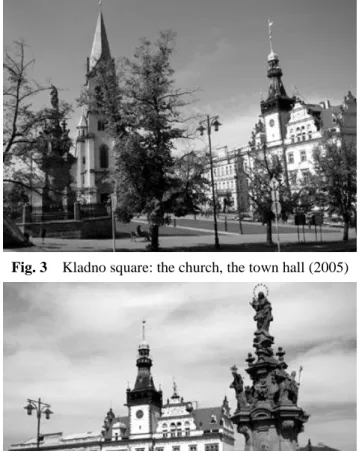
Raymond spent his childhood in a small town house standing on the corner of the main square of Kladno. Kladno was a small industrial town on the outskirts of Prague in Bohemia (contemporary Czech Republic). The young boy also spent a great amount of time at his grandparent’s farm in the countryside. In Kladno, Raymond became aware of the value of tradition communicated through examples of Renaissance, Roman and Baroque architecture. But the young boy also became aware of a growing gap between people’s lifestyles and the spaces in which they lived. This double feeling of respect and rejection towards the architecture of the passed further developed in Prague while Raymond was attending the Technical School. Raymond deeply admired Prague’s architectural heritage while witnessing the birth of the Czech cubist movement and discovering the works of Frank Lloyd Wright published in architectural journals. Modern architecture presented itself to Raymond as a necessity and a remedy for the future. Raymond’s awareness and connection with nature developed during time spent at his grandparents’ farm. The author points out that it is this period of his life that provides the
key to an understanding of his further relationship with Frank Lloyd Wright. This relationship was based on a common love of nature, a common ideal of agrarian life and a common taste for the arts, which both architects had acquired through their education.
Chapter 3 provides an insight into the architect’s “way of thinking”. This chapter first
discusses the nature of Raymond’s architectural discourse through the study of a series of essays, lectures and articles written by Raymond between 1935 and 1964. Based on criteria given in the field of Architecturology, the study points out that Raymond’s discourse is of a doctrinal nature. Architecturology deals with the creative process involved in architectural design and can be affiliated to the field of cognitive science. An architectural discourse is doctrinal when the architect uses various concepts with the purpose of promoting his ideas rather than discussing the definition or the value of the concepts themselves. Raymond’s writings testify for his will to play an active part in the debate on modern architecture, to share his experience as an architect in Japan, and to promote the principles of Japanese traditional architecture as a solution for modern architecture.
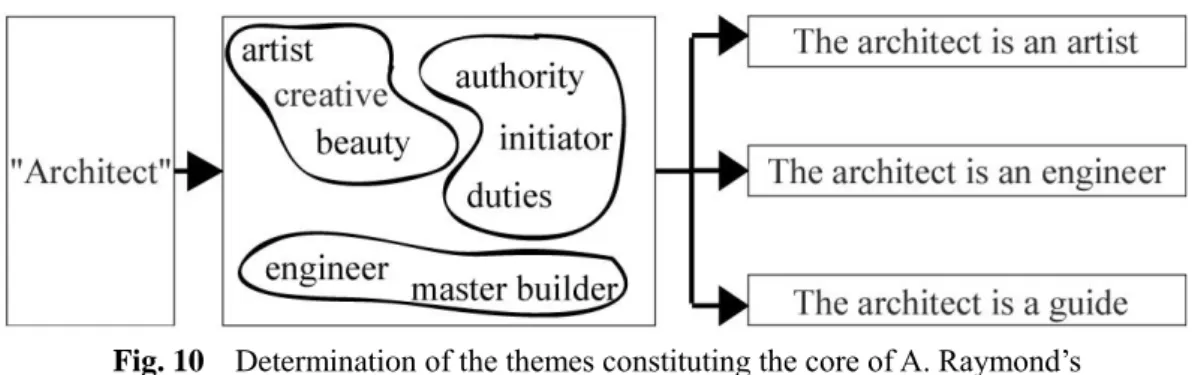
This chapter also presents Raymond’s point of view on the definition of the “Architect” as an “artist”, and “engineer/master-builder” and a “guide”. The author shows how Raymond’s conception of the architect as an “artist” was shaped by his own experience of art, which was at the center of the education he received at elementary school. Raymond further deepened his experience as an artist when he temporarily gave up his career as an architect to become a painter in New York and Italy (1914). The author shows that in Raymond’s way of thinking the purpose of the architect as an artist is emphasized as the expression of beauty. The architect must also combine the qualities of an engineer in order to secure freedom in design, and in order to achieve the most “economical” solution to a problem. The author points out the influence of Japan on this point of view, where traditionally the “architect” in the western sense of the word did not exist, and where the carpenter combined the qualities and the skill of architect, engineer and builder. Finally, the author points out the role of the “Architect” as a guide for other architects and for society. In the case of Raymond, this quality appears through his writings which are for the majority in the form of lectures given at architectural associations and articles published in newspapers and in lifestyle or architectural magazines.
Chapter 4 provides an insight into the architect’s “way of design”. The material used
general information on the development of architectural practice in Japan during the Taisho period and describes the composition and evolution of Raymond’s office in the inter war period.
The second part of the chapter presents a study on the use of tatami and its influence on plan composition in a selection of Raymond’s residential works designed in the inter war period. The author presents the results of a survey of the function and space given to tatami rooms in these residential works and the results of a comparison between houses designed for western clients and houses designed for Japanese clients. This survey reveals Raymond’s response to the transformation of lifestyles and it’s impact on residential design during the 1920s and early 1930s in Japan. It also partly reveals the design process through which Raymond operated a synthesis between western architecture and Japanese traditional architecture through the use of tatami as a proportion module.
The study of this synthesis is further deepened in the third part of the chapter, through the architectural analysis of Raymond’s Karuizawa house (1933). The author points out the western and Japanese elements that came into the composition of Karuizawa house, and the way they were combined. This study reveals a certain complexity in the design process of Karuizawa house. It shows the particular influence of Sukiya and Minka architecture on Raymond’s esthetic values and way of design. In parallel, it shows that by borrowing the plans of Le Corbusier’s unbuilt Errazuris house, Raymond made a strong and clear statement about his intention to be a modern architect and to be considered as a member of the modern movement. This analysis emphasizes the dialectic relationship between Western forms and Japanese way of design and construction in the case of Karuizawa house.
Chapter 5 focuses on the relationship between the architect’s way of thinking and way of
design in the case of Karuizawa house. The purpose of this chapter is to find out in what manner Karuizawa reflects Raymond’s way of thinking. On a theoretical level, this chapter thus explores the level of “coherence” in the relationship between Raymond’s way of design and way of thinking.
Through a survey of Raymond’s writings, the author lists a number of concepts which are at the center of Raymond’s architectural discourse. The author points out the connection between these concepts and the fact that these concepts in fact all relate to the “mother concept” of “simplicity”. “Simplicity” emerges as the core concept of Raymond’s architectural discourse.
with the principle of “simplicity”, emphasizing how Raymond translated this principle in his way of design. This study shows how Raymond achieved simplicity in his design by pursuing the most economical solutions in the design through use of natural materials left as close as possible to their original state. In the context of Japan, Raymond found an expression of the concept of simplicity at its best in Sukiya architecture.
The third part of the chapter places the principle of “simplicity” in perspective with ideas defended by the modern movement at the time of Raymond’s design. It points out the fact that “simplicity” as a principle was emphasized partly to a reaction against the architectural establishment which defended the practice of historical styles in architecture.
論文内容
本論文は、チェコ生まれの建築家アントニン・レーモンド(1888-1976)の建築理論 並びに建築作品に関する研究である。研究の目的は、レーモンドが日本で設計した住宅
作品を対象として、レーモンドの「建築的アイデンティティ」(Architectural Identity)が、
彼の「思考方法」(way of thinking)と「設計方法」(way of design)、及び「両者の相互関
連」の帰結であることを示すことにある。研究にはオリジナルの建築図面、写真、レー モンド自身が 1935 年から 1967 年に執筆した論考が用いられているが、これらの資料は かつて軽井沢にあったレーモンドのスタジオや東京の設計事務所が所有するものであ り、それを著者が独自に収集し、レーモンドの住宅作品に関する一次資料のデータベー スとして構築したものである。 本論文は 5 章、及び住宅作品のデータベースからなる。 第1章では、レーモンドに関する研究の意義を説明するとともに、論文の概要を提示 している。レーモンドは様々なビルディングタイプの設計を行っているが、本論文は住 宅作品に焦点を当て、東京で建築家として独立した 1920 年から第 2 次世界大戦前に日 本を離れるまでの期間を対象とする。研究対象を住宅作品に限定した理由は下記の通り である。 1.レーモンドが「建築的アイデンティティ」を形成する上で重要な意味を持つ日本にお ける最初の 18 年間のプロジェクトの大部分が、住宅作品であったこと。 2.小規模で私的な性格を持つ住宅作品は、建築家が自らの新しいアイデアを実験するの に適した媒体であり、それゆえに日本の近代建築の黎明期に重要な役割を果たしたこ と。 3.日本の住宅建築の伝統が、近代建築家としてのレーモンドの思考方法や設計方法の形 成に大きな影響を及ぼしたこと。 4.建築家の設計方法を分析する上で、住宅作品が最適な素材となること。建築家の思想 と住宅作品には密接な関係があり、特にレーモンドの場合、最も興味深い住宅作品が 自邸として設計されているために、そのことが当てはまる。
既往研究としては、日本では三沢浩が、アメリカでは Kurt G. Helfrich と Ken T. Oshima らが、レーモンドの生涯と建築について幅広く論じている。それに対し本論文は、レーモン ドの思考方法や設計方法に含まれる創造過程をより深く解読しようとするものである。 第2章では、アントニン・レーモンドが育まれた背景を扱っている。本章の目的は、 レーモンドの若き日々や、タリアセンでのフランク・ロイド・ライトとともに過ごした 日々が、レーモンドの感性や知性をいかに形づくり、また日本との出会いを準備してき たかを明らかにすることにある。ボヘミア(現チェコ共和国)の小さな街 Kladno でその
幼尐期を過ごしたレーモンドは、歴史建造物に敬意を払う一方、それらが人々のライフス タイルと乖離していることに気付いていた。そして、プラハの建築文化遺産を深く敬愛し つつ、チェコのキュビストの運動に関心を抱き、さらに建築雑誌を通してフランク・ロイ ド・ライトの作品を発見し、未来を改善する手段として近代建築のあるべき姿を見出して いたのである。 レーモンドの自然に対する気配りは、幼尐期の祖父母の農園での体験の中で育まれたもの であるが、本論文では、このことが、フランク・ロイド・ライトとの関係の理解やレーモ ンドの伝統的な日本建築の諸原理に対する理解にも大きく関係していると指摘してい る。 第3章では、レーモンドの「思考方法」を考察している。1935 年から 1964 年にかけて 執筆された随筆・講義・論文等の研究をふまえて、建築論(Architecturology)の観点か ら、レーモンドの建築的論述の教義的特性を明らかにしている。その中でレーモンドは、 近代建築に関する議論において積極的な役割を果たし、日本での建築家としての経験を ふまえて、日本の伝統建築の原理を近代建築に適用することを推奨しているのである。 また、レーモンドによる「建築家」の定義に注目し、「芸術家」、「エンジニア/マスタ ー・ビルダー」、「先導者」としての建築家のあり方が提示されていることを指摘してい る。すなわち、「芸術家」としての建築家は、「美」の表現をめざすことこと、「エンジ ニア/マスター・ビルダー」としての建築家は、美を最も経済的に実現するためにエン ジニアの資質を合わせ持つ必要があること、「先導者」としての建築家は、他の建築家 や社会の先駆者としての役割を担わなければならないことなどを明らかにしている。 第4章では、独自に収集した資料をもとに、レーモンドの「設計方法」を考察してい る。第1に、大正時代の日本の一般的な設計業務の実態とレーモンド事務所の設計活動 について説明している。第2に、その間に設計された住宅作品を対象に、畳の使用法と そのプラン構成への影響を分析している。この調査を通して、ライフスタイルの変化に 対するレーモンドの設計解と、それが 1920 年代から 1930 年前半の日本の住宅設計に及 ぼした影響を明らかにしている。具体的には、レーモンドが畳をモジュールとして使用 することにより、西欧建築と日本の伝統建築のシンセシスを行っていることを指摘して いる。第3に、レーモンドの軽井沢の自邸(1933 年)における設計過程を分析し、彼の 設計方法の本質が複雑なシンセシスを通して達成された西欧建築と日本建築の結合に あることや、レーモンドの美的価値や設計方法には数奇屋や民家の影響が認められるこ とを明らかにしている。また、この作品がル・コルビュジェの Errazuris 住宅をもとに 設計されていること、そしてそのことは彼が近代建築の建築家の一人であることの表明 であったことを指摘している。
第5章では、レーモンドの「思考方法」と「設計方法」の「関係」を探究している。 具体的には、軽井沢の自邸に焦点を結び、レーモンドの「思考方法」をどのくらい写し 出されているかを解読し、彼の「設計方法」と「思考方法」の関係に「一貫性」(coherence) のレベルが認められることを理論的に明らかにしている。すなわち、レーモンドの論考 の分析を通して、彼の建築的論述の中に認められる数多くの概念を抽出し、これらの概 念がいずれも「簡潔性」(Simplicity)という主導原理に関連していることを指摘してい る。 そして、「簡潔性」という点から軽井沢の自邸の住宅作品の再分析を行い、レーモン ドが設計過程においてこの原理をどのように翻訳しているかを示すとともに、「簡潔性」 という原理をより広い視点から近代建築運動がめざした概念と関連づけることにより、 当時の歴史主義的権威に対抗するために強調された側面もあることを指摘している。 以上をふまえて、西欧と日本の総合をめざしたユニークな建築家アントニン・レーモ ンドの「建築的アイデンティティ」を規定する諸要因を総括し、「思考方法」、「設計方 法」、及び両者の「関係」に関する考察をまとめている。
TABLE OF CONTENTS
Acknowledgements ………...……… III Thesis contents ………..……….... IV 論文内容 ………...….………... IX
CHAPTER 1 GENERAL INTRODUCTION AND OUTLINE OF THE THESIS.
1 Field of study ………...……….… 1
1.1 The private house ………...………….… 1
1.2 The private house as built object ………. 2
1.3 The private house in Japan ………..……… 2
1.4 The private house in Antonin Raymond‟s career ……….………..……. 3
2 The private house and modern architecture …………..………..……...……... 4
2.1 A notion of „modernity‟ ………..………..…………... 4
2.2 Modernity as a philosophy of design ………...……….…...……... 5
2.3 Common grounds of western modern architecture and Japanese traditional architecture? ………...……….……….………... 5
3 The work of Antonin Raymond in Japan as subject of study ……...……….…...… 6
3.1 Time spent in Japan ………...…...… 6
3.2 At the crossing of influences ………..…………....…... 7
3.3 A contribution to the definition of the basic principles of modern architecture………..……. 9
4 Aims of the thesis ………..…………..…. 9
4.1 Towards a definition of Antonin Raymond‟s „architectural identity‟ ……….. 9
4.2 A definition of “architectural identity”………... 10
4.3 Aim of the research on the academic level ………... 12
4.4 Raymond‟s work in the development of Japanese residential Architecture ... 12
5 Outline of the thesis and methodology ……….…..……… 13
5.1 Chapter 2: “Impressions” of space ……… 13
5.2 Chapter 3: An insight into Antonin Raymond‟s way of thinking ………….. 14
5.3 Chapter 4: An insight into Antonin Raymond‟s way of design …... 15
5.4 Chapter 5: A study of the level of coherence in the relationship between Antonin Raymond‟s way of thinking and way of design ……….. 16
CHAPTER 2 “IMPRESSIONS” OF SPACE
Introduction ………..…. 20
1 Early years in Bohemia…………..………..…………... 21
1.1 The initial shell: A town house ………... 21
1.2 The initial shell: A farmhouse ………...… 23
1.3 Prague: the value of tradition and a glimpse of the future……….….... 26
2 The presence of Nature……….……….……….. 27
2.1 In Prague ………..……. 27
2.2 In America with Frank Lloyd Wright ……….…………..…. 29
3 The awakening of Antonin Raymond‟s Artistic sensitivity ……..……….. 30
3.1 Early childhood: nature and art ………...….. 30
3.2 Painting in New York and Italy ……….…… 32
3.3 Introduction to Japan at Taliesin ……….………... 34
4 Modern architecture as a necessity ………. 34
4.1 The artistic and architectural intelligentsia in Prague…….………... 34
4.2 Modern architecture as a remedy ………...……... 35
4.3 Frank Lloyd Wright: a hope for the future ………...……. 36
Conclusion ………...….. 37
CHAPTER 3 AN INSIGHT INTO ANTONIN RAYMOND‟S WAY OF THINKING Introduction ………... 40
1 Regarding the nature of Antonin Raymond‟s architectural discourse ….…...…… 41
1.1 Approach ………...… 41
1.2 Purpose in writing ……….….... 42
1.3 Rhetoric ………..……... 43
1.4 Theory……….………... 44
2 The „Architect‟ in Antonin Raymond‟s way of thinking …………...……. 44
2.1 The architect is an “artist” ………..………...……. 44
2.1.1 Antonin Raymond and Art ………...………... 44
2.1.2 The architect and the artist ………..……… 45
2.1.3 The expression of beauty ………...……….. 46
2.1.4 The achievement of beauty ………...………..………. 47
2.2 The architect is an “engineer” ……….…………...…...… 48
2.2.1 The relationship between the architect and the engineer ……...…….. 48
2.2.2 A key to freedom ………...… 49
2.3 The architect is a guide ………...………..……… 52
2.3.1 Writing and purpose ………...………...…………..… 52
2.3.2 Guidance towards architects ………...………...…. 53
2.3.3 Guidance towards society ………..………..……… 54
Conclusion ………...………...…... 54
CHAPTER 4 AN INSIGHT INTO ANTONIN RAYMOND‟S WAY OF DESIGN Introduction ………...…………...……. 58
1 A modern architectural practice in Japan ………...… 59
1.1 The architectural profession in Japan ……..…………..……….... 59
1.1.1 The birth of the “architect” in Japan ……….………...… 59
1.1.2 Architects in the 1920‟s, an emerging category …………..………… 60
1.1.3 The birth of architectural practices ………..…………..……….. 60
1.2 Antonin Raymond‟s architectural office ……….……...………. 61
1.2.1 Composition ………...……….……… 61
1.2.2 Location ………... 62
1.2.3 Management ………...………...……. 63
2 A survey of the use of tatami and its influence in plan composition ……...…... 64
2.1 Tatami as an element of study ……….………..……… 64
2.1.1 House type ……….………..….…... 65
2.1.2 Number of tatami rooms ……….………. 65
2.1.3 Function ………...……….…... 67
2.1.4 Size ……….…..…………... 69
2.2 Impact of tatami on plan composition ………..………. 69
2.2.1 Measurement specifics ………...………. 69
2.2.2 Space division ……….…………. 71
3 An architectural analysis of Raymond‟s Karuizawa house ……….………... 94
3.1 Introduction to Karuizawa house ………...……... 72
3.2 Overall characteristics and composition ………... 73
3.2.1 The idea behind the design ……….………..…... 73
3.2.2 Setting ………..………...…... 73
3.2.3 Plan ………..………...………. 76
3.2.4 Volumes and proportions ………..……….….……. 78
3.3 Structure and materials ………..………...……. 81
3.3.1 Structure ……….………... 81
3.3.3 Space ……….…….. 83
Conclusion ………..………....………... 84
CHAPTER 5 A STUDY OF THE RELATIONSHIP BETWEEN ANTONIN RAYMOND‟S WAY OF THINKING AND WAY OF DESIGN Introduction ………...…….……...…. 90
1 Principles in writing …….……….………..…....…... 91
1.1 A survey of Raymond‟s writings ………....……... 91
1.2 “Simplicity” in the text ...…………..………..…….. 92
1.3 “Mother” and “peer” concepts ……….…..……….….. 94
2 Elements of a definition of “Simplicity” ………...…….. 95
2.1 Directness ………..………..…….. 95 2.2 Honesty ………...……….……. 96 2.3 Naturalness ………...…………... 98 2.4 Economy ……….…...………. 100 2.5 Functionality ………...…………...…………..…... 101 3 “Simplicity” as a tool ……….…………...…... 103
3.1 “Simplicity” in the context of the modern movement ………....…… 103
3.2 “Simplicity” in theoretical justification ……….………...….. 104
3.3 “Simplicity” in Karuizawa house ……….……….……….. 105
Conclusion ……….………...…… 107
THESIS CONCLUSION ………….……… 111
BIBLIOGRAPHY ………..………...………... 117
PUBLICATIONS ……….………...…………..……... 132
APPENDIX 1: Works by Antonin Raymond published in Japan ... 134
APPENDIX 2: Prewar houses designed in Japan between 1921 and 1938 …………. 143
APPENDIX 3: ANTONIN_RAYMOND_DATABASE ……….………...….... 148
Foreword ... 149
Acknowledgements ... 150
Introduction to the database ... 153
Instructions on the use of the ANTONIN_RAYMOND_DATABASE CD ROM ... 178
LIST OF FIGURES
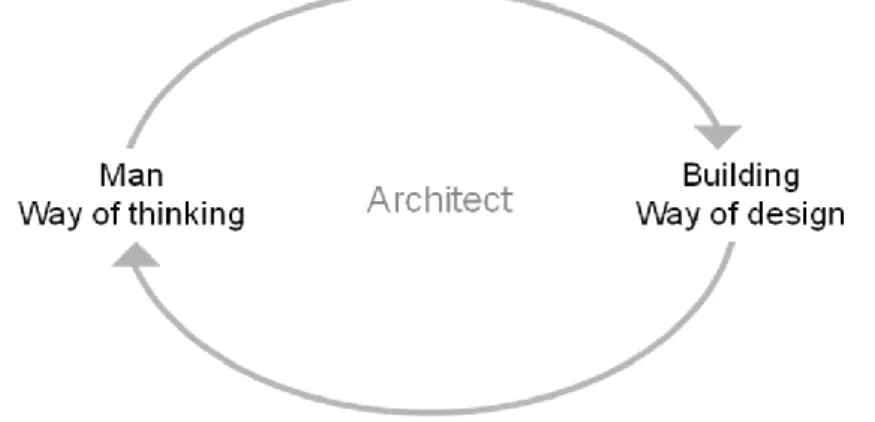
Fig. 1. Components of “Architectural Identity” ……….………. 11
Fig. 2. Antonin Raymond‟s house on the corner of Kladno‟s town square ………… 21
Fig. 3. Kladno square, the church,the town hall ………...…………. 23
Fig. 4. The town hall, and the baroque sculpture in the forefront …….……….. 23
Fig. 5. The plan of the farmhouse in Řenčov, drawn by Antonin Raymond ……….. 25
Fig. 6. Panoramic view of Prague from the park ……….…...… 27
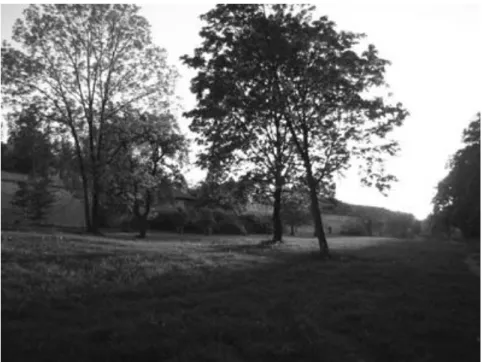
Fig. 7. Thepark ……….………...………... 28
Fig. 8. The park ……….………..……… 29
Fig. 9. Live sketches of country life by young Antonin Raymond …….………... 32
Fig. 10. Determination of the themes constituting the core of Antonin Raymond‟s definition of the “Architect” ……….……….…. 42
Fig. 11. Antonin Raymond in his studio in Anticoli Corrado, Italy, 1914 ……....….... 44
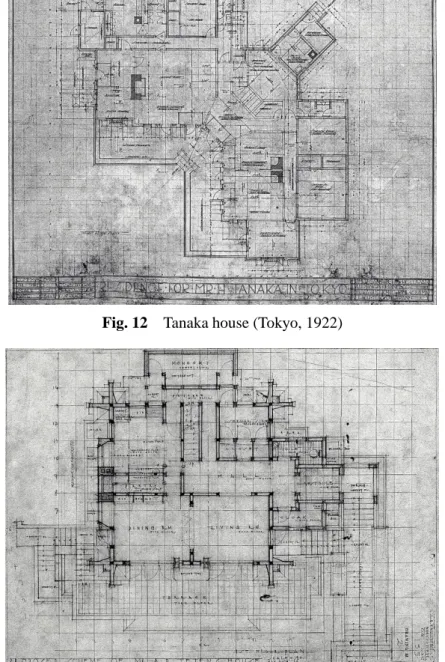
Fig. 12. Tanaka house plan …….………...…….... 70
Fig. 13. Tetens house plan …….………..…...……... 70
Fig. 14. Use of tatami module for Read house plan (1924) …….………...… 71
Fig. 15. Picture of Karuizawa house in its surroundings (1933) ……….…. 74
Fig. 16. Plans of Karuizawa house and Errazuris house 1/500 ………...….. 77
Fig. 17. T h e “ s t e p ” e f f e c t i n K a t s u r a I m p e r i a l Vi l l a a n d K a r u i z a w a house plans ………... 77
Fig. 18. Grid showing the proportion system based on the tatami module ……...…... 79
Fig. 19. The koshoin 古書院 of Katsura Imperial Villa and the bedroom of Karuizawa house ………...………...……….….. ..80
LIST OF TABLES Table 1. Minimum of 1 tatami room ……….………...….……. 66
Table 2. Ratio of tatami rooms for main rooms of the house ………….……...….…... 66
Table 3. Ratio of staff rooms and main rooms for tatami rooms …..………….…….... 67
Table 4. Distribution of tatami rooms in terms of public and private space ……..…... 67
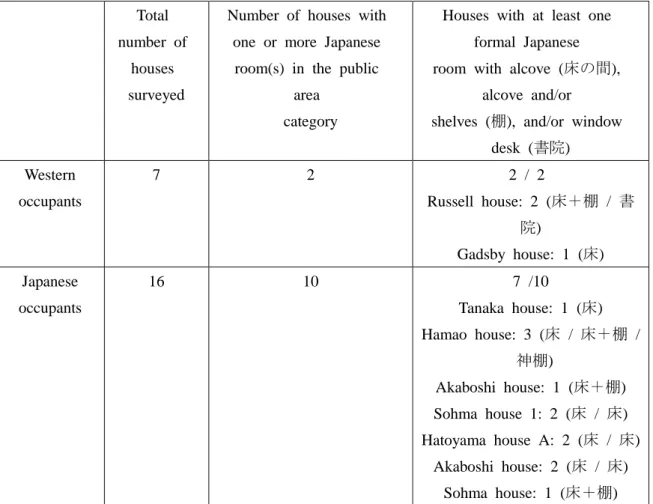
Table 5. Number of formal Japanese rooms ………... 68
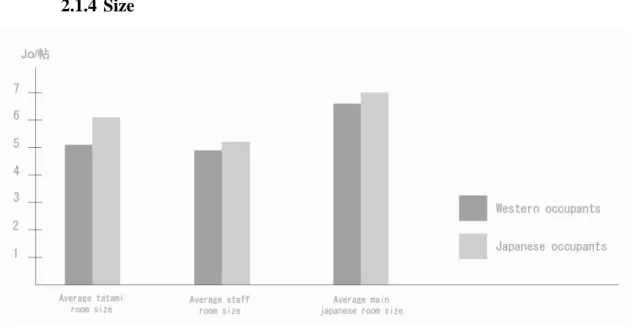
Table 6. Average tatami rooms sizes ………... 69
FIGURE SOURCES AND PHOTO CREDITS
Fig. 1. Antonin Raymond‟s house on Kladno square: photo by Yola Gloaguen. Fig. 2. Kladno square, the church,the town hall: photo by Yola Gloaguen.
Gloaguen.
Fig. 4. Plan Antonin Raymond‟s grandparents‟ farmhouse in Řenčov, drawn by Raymond: Antonin Raymond, An Autobiography, p.11.
Fig. 5. Panoramic view of Prague from the park: photo by Yola Gloaguen. Fig. 6. Thepark: photo by Yola Gloaguen.
Fig. 7. The park: photo by Yola Gloaguen.
Fig. 9. Live sketches of country life by young Antonin Raymond: Antonin Raymond, An Autobiography, p.11.
Fig. 10. Photo of Antonin Raymond in his studio in Anticoli Corrado, Italy 1914: Antonin Raymond, An Autobiography, p.33.
Fig. 11. Tanaka house plan (1922): courtesy of Raymond Architectural Design Office, Tokyo.
Fig. 12. Tetens house plan (1924): courtesy of Raymond Architectural Design Office, Tokyo.
Fig. 13. Read house plan (1924): courtesy of Raymond Architectural Design Office, Tokyo.
Fig. 14. Photo of Karuizawa house in its surroundings (south-east view, 1933): courtesy of Koichi Kitazawa, Karuizawa.
Fig. 15. Plans of Karuizawa house and Errazuris house: 1/500: plan of Karuizawa house: The Japan Architect, vol. 33, spring 1999, p. 28; plan of Errazuris house: Le Corbusier, Œuvres complètes, 1910-1929, p. 49.
Fig. 16. The “step” effect in Katsura Imperial Villa and Karuizawa house plans: photo: courtesy of Koichi Kitazawa, Karuizawa; plan of Katsura imperial villa: 桂離宮 Katsura rikyū, 1982, p. 315.
Fig. 18. The koshoin 古書院 of Katsura Imperial Villa and the bedroom of Karuizawa house: section of koshoin: 桂 離 宮 Katsura rikyū, 1982, p. 320; section of Karuizawa house: drawn by Yola Gloaguen.
CHAPTER 1
GENERAL INTRODUCTION AND OUTLINE OF THE THESIS
1 Field of Study
1.1 The private house
Upon arriving in Japan, my initial interest in the „private house‟ was soon aroused by the numerous examples of residential architecture I discovered in Kyoto and its surroundings. This introduction to the traditional and contemporary architectural culture of Japan was coupled with the discovery of the process through which houses made of “wood, straw and paper” built by carpenters, had evolved into raw concrete blocks designed by internationally acclaimed architects. As a consequence of my initiation to the birth and development of modern architecture in Japan, I began to develop a particular interest in the work of the Czech born architect Antonin Raymond, and more particularly in his residential works. It was this experience, added to my personal experience of the „private house‟ that prompted me to undertake the research presented in this thesis.
The philosopher Gaston Bachelard refers to the „house‟ as “our first universe”1. He wrote that: “A geographer or an ethnographer can give us descriptions of very
varied types of dwellings. In each variety, the phenomenologist makes the effort needed to seize upon the germ of the essential, sure, immediate well-being it encloses. In every dwelling, even the richest, the first task of the phenomenologist is to find the original shell.”2 Indeed, the house is something which responds to every human‟s need for shelter and where we first learn to be in the world. It is the place through which individuals and small groups simultaneously define and express connections and boundaries between their inner world, which Christian Norberg-Schulz3 calls „microcosm‟ in his phenomenology of architecture, and the outside world, or „macrocosm‟. It is also the means for man to identify with his environment, that is, to acquire and express a sense of belonging, which is essential to his equilibrium. That is why the outside world should be considered both in terms of natural and human environment. The house is a shelter for the physical body, but also for man‟s consciousness of being in the world and for his dreams. Therefore, through and beyond formal or functional considerations, any house can be expected to echo ones personal needs, conscious and unconscious.
1.2 The private house as built object
Now if the task of the phenomenologist is to “find the initial shell”, to observe and define how people manifest their “habitation”, what can we say about the task of the architect? The task of the architect should be to give physical form to this “initial shell”, this “castle”, that is, to give a physical body to the manifestation of habitation.
From a practical point of view, the „private house‟ is characterised by a detached structure designed for a family or small group of individuals, in response to their particular needs within a particular environment. The physical form of the “private house” is revealed in its architecture, and it is upon this dimension that the present dissertation focuses. Other dimensions of the house, such as the social and economical aspects, are nevertheless discussed when it contributes to the deepening of our knowledge of the private house as an architectural entity. Architecture is concerned with life, and therefore cannot be apprehended from a strictly unique point of view. This is clearly expressed by Frank Lloyd Wright, in one of his numerous speeches in defence of organic architecture: “Perfect correlation, integration, is life. It is the first principle of
any growth that the thing grown be no mere aggregation. Integration as entity is first essential. And integration means that no part of anything is of any great value in itself except as it be integrate part of the harmonious whole.”4 It is only for the sake of scientific accuracy demanded in the context of such a research that we are compelled to establish boundaries between the many dimensions of architecture and to choose to focus on one of them.
As far as the physical manifestation of architecture is concerned, the „private house‟ can be defined as: “the fundamental building block, the most irreducible
component, of the man-made environment, providing the most basic of daily needs, shelter.” 5 Phenomenology of architecture states that it can be considered as the way man physically „visualises‟ “how human life takes place between earth and sky”6.
1.3 The private house in Japan
In an interview, Professor Terunobu Fujimori reminded us that “In Japan, the
small home was the medium for the first expressions of modernist residential architecture.”7 Nowadays, Japan still provides examples of traditional, pre war period and contemporary modern private houses. Despite the massive destruction caused by the Second World War, the aftermath and the following economical boom, the country maintains its ancestral tradition for residential architecture. Japanese residential architecture has been a source of inspiration for modern architects since the beginnings of modern architecture in Europe and America. The most famous and earliest of its
advocates was undoubtedly Frank Lloyd Wright, who came in contact with Japanese architecture from 1890. He mainly drew his inspiration from Japanese prints for which he developed a consuming passion8. He started making regular visits to Japan from 1914. According to Wright‟s own words, the prints taught him “a lesson in elimination
of the insignificant and in the beauty of the natural use of materials.”9 Other testimonies in writing of the west in Japanese residential architecture are also to be found in the works of Edward S. Morse10 in 1885, Ralph Adams Cram in 190511 and more famously Bruno Taut in 193712, who introduced Katsura detached palace to the West in the perspective of modern architecture.
1.4 The private house in Antonin Raymond’s career
In Japan, Antonin Raymond is commonly well-known for post war buildings such as the Reader‟s Digest Building in Tokyo (1951) and the Gunma prefecture Music Centre (1961), which are mainly praised as examples of his effort and contribution to the development of concrete architecture in Japan. However, the architect applied a large part of his reflection and creativity to the architecture of the private house. During his 44 year career in Japan, more than 7013 of the private houses designed in his office were built, most of them in Tokyo or the relatively close summer retreat, Karuizawa. In Karuizawa Antonin Raymond built a series of house, the most famous of which is his own house designed in 1933. This particular house will be the object of a thorough analysis in the fourth chapter.
Raymond‟s clients were long term foreign residents, members of the Japanese aristocracy and business men. From a practical point of view, this meant designing houses which were on one hand adapted to a western way of life while taking into consideration the limited construction techniques of the times, other than wooden structures, the rather extreme climate and the permanent risk of earthquake. On the other hand, the architect had to design houses that would allow his clients to combine both Japanese and Western ways of life. This for example implied combining Japanese more or less formal tatami rooms as well as rooms in which western style furniture could be displayed. Either way, during the first stage of his stay, it is through the observation and the design of the private house in Japan that Antonin Raymond was able to experiment and refine his ideas regarding the application of the principles of modern architecture.
2 The private house and modern architecture 2.1 A notion of “modernity”
In the context of the present work, the reason for my choosing the private house as field of study contains two aspects, one being connected to Japan‟s own architectural culture for residential design as we have seen. The other reason is to be found in the very nature of modern architecture.
All the architects who have left a significant mark in the history of building and design have applied their creativity and thought to the private house. Beyond their nationality, their political beliefs, their intellectual and religious background, pioneers of modern architecture were unified by the common purpose of creating a new dwelling, one that would most appropriately fit and most faithfully reflect the life of the „modern man‟. Otto Wagner had formulated this idea as early as 1894, in the book written for the students at the Academy of Vienna: “our starting point for artistic creation is to be
found only in modern life.”14 Later, in the 1924 introduction to the second edition of his book, Towards a New Architecture, Le Corbusier talks of the modern man in the following terms: “The architecture of today is concerned with the house, the ordinary
and common house for the ordinary and common man. It has done away with palaces. This is a sign of our times.”15
These words, pronounced by two of the most important architects in the history of modern architecture, convey the idea that the concept of „modernity‟ should be understood as a state of mind, as an outlook on life. Consequently, the expression of modernity should always be rooted in this idea or vision. I will further develop this point in direct connection to the subject of this thesis, but for the time being, let us bear in mind that the „modern man‟, who is at the centre of modern architecture, is a man in phase with his time. If we apply this idea to architectural design, this means that the term „modern‟ refers to a certain „kind‟16 of architecture rather than an architecture primarily defined by form. It is in this sense that „modern architecture‟, as a concept, will be referred to in this thesis. In the most recent and complete book on the history of modern architecture, William J. R. Curtis reminds us that „modern architecture‟ “was an
invention of the late nineteenth and early twentieth centuries”17 and emphasizes the antagonistic stance upon which it was based, therefore reminding us that architectural creation should always be apprehended in the context of its era. He also continues by saying that “basic to the notion of a modern architecture was the notion that each age in
the past had possessed its own authentic style, expressive of the true tenor of the epoch.”18 It is precisely this notion of modern architecture to which I would like to follow in my thesis,and we will particularly look at the implications of such a choice in
the third and fourth chapter of this dissertation. Consequently, „modern architecture‟ will not be used specifically in reference to any given number of architectural works created between 1910 and 1930 by famous architects, nor will it be reduced to the style of buildings that have come to be grouped together under the appellation of „International style‟.
2.2 Modernity as a philosophy of design
Beyond their individual achievement in terms of architectural design, Frank Lloyd Wright, Le Corbusier, Mies van der Rohe and Alvar Aalto - to cite only a few among the pioneers of modern architecture – were united by a common purpose. That is as we have seen earlier, the will and desire to design a house in phase with its time. The outcome of their endeavour was embodied in beautiful works of architecture, but equally importantly for the sake of future generations of architects, in the establishment of a new line of approach, of a new philosophy of design. This particular point will be developed in the thesis. Such a philosophy of design is revealed in the architect‟s writings, although some were more inclined than others to lay their ideas on paper in the form or words as well as in the form of drawings. Frank Lloyd Wright and Le Corbusier are of course famous for this aspect of their work and we will have the opportunity to approach this dimension of the Antonin Raymond‟s work in the thesis. In any case, the pioneers of modern architecture formulated their philosophy of design and hoped it would guide younger generations of architects. If applied earnestly, it would enable them to design houses and buildings for the man of „today‟, whenever „today‟ may figure on a time scale. The pursuit of such a philosophy constitutes a timeless link between the pioneers of modern architecture and the architects of our contemporary era. With this work my intention is to make a modest contribution to the development and knowledge of such a philosophy of design, and to emphasize its timelessness.
2.3 Common grounds of modern and Japanese traditional architecture?
In echo to professor Fujimori‟s words quoted previously, we may say that the private residence also play a crucial role in the development of modern architecture in Europe and America. The reason for this lies in the existence of common points between some aspects of traditional Japanese residential architecture and the modes of expression of the core principles developed by the pioneers of modern architecture. This consequently makes the task of unveiling how the process of synthesis was carried out by Raymond all the more difficult but fascinating. For the time being, let us consider that these points were partly embodied in the five points of modern architecture, some
of them which were initiated by Frank Lloyd Wright, then completed and formulated by Le Corbusier in 1923. They include the free plan, the use of post and beam structure, and the free façade. Other common points include the particular care given to the treatment of the connection between the inside and the outside of the house or building, the standardization of structural and/or architectural elements, the rejection of ornamental and decorative elements, the simplification of form. However, although these similarities are undeniable, one must be cautious as to their origin, in the context of western culture and in the context of Japanese culture.
With this study, I hope to be able to give a better understanding of the common points and differences between the principles of Japanese traditional architecture and western modern architecture. This is necessary in order to grasp the process that underlies the birth and development of Japanese modern architecture.
3 The work of Antonin Raymond in Japan as subject of study
The tradition for residential architecture, and the common grounds of Japanese traditional architecture and Western modern architecture created a particularly fertile environment for the work of Antonin Raymond. The following paragraphs present a few characteristics that in my opinion make his work worthy of a research such as the one presented here.
3.1 Time spent time in Japan
One of a kind, Antonin Raymond, born Reimann (also spelled Rajman) in Bohemia on May 10, 1888, lived and practiced as an architect in Japan for 43 years (31rst Dec. 1919-Jan. 1938; Aug. 1948- June1973). The Czech born architect is the only western modern architect (according to the definition of modern given above) who stayed in Japan for a length of time that would allow him to become involved with its people and culture in a significant way. It is thanks to his long stay that he was truly able to deal with the problematic of the common grounds of traditional Japanese architecture and western modern architecture, and to operate the necessary synthesis to the creation of a modern architecture suited to Japan. In contrast, only few of his European peers19 actually visited the country, although many were those who acknowledged these common grounds, or were influenced by traditional Japanese architecture in their own work. Those who did were there only for relatively short periods of time20. Antonin Raymond consequently gained a rare insight into traditional building techniques, use of materials and on a wider scale into Japanese culture. Furthermore, his arrival in Japan in the middle of Taisho era conveniently enabled him
to be, one might say, “in the right place at the right time”, when Japan‟s pursuit of modernization was slowly shifting from being mainly based on a state-driven “westernization” to gradually returning towards the roots of Japanese tradition and culture.21 Like his Japanese peers, Raymond also benefited from the consequences of the great Kanto earthquake and the following period of reconstruction. This reconstruction did not only take place in the development of new forms and building techniques but also in new ways of thinking and design. As we will see further, it is also important to say that Japan gave Antonin Raymond the opportunity and time to develop qualities and ideas that he had long wished to express, but partly in vain, since his first contact with the architectural world while in Europe and America.
3.2 At the Crossing of influences
As far as the architect‟s cultural and architectural background is concerned, the early part of Antonin Raymond‟s life22
constitutes one of the architect‟s main particularities. Raymond was born and spent the early years of his life in Bohemia. His early childhood was spent in the small industrial town of Kladno, situated on the outskirts of Prague. The town of Kladno where the architecture was a mix of Baroque and Renaissance and Gothic, which played an important part in the future architect‟s disposition to operate a synthesis of various traditions and culture in the creation of architecture. Later, his widowed father remarried and established his family in Prague (1905), where young Raymond integrated the Realka school and then the Czech Polytechnic Institute (1906). Raymond‟s memories of the early years, prior to the move to Prague, were deeply imprinted with the atmosphere of Bohemia‟s countryside, characterised by its lush nature and romantic landscapes.
In his autobiography, the architect remembers these early days mainly as those of “the pleasures of coming into contact with the marvellous influences of nature”23
and says himself that these “earthy things […] are of tremendous importance, forming the
sub-soil of life”24 . In the present thesis we will look at Raymond‟s reminiscence of this early period of his life through his texts and discuss to what extent they might have contributed to his immediate connection with Japan.
In 1910, driven by a strong feeling of frustration and by personal problems that had aroused between him and his school and his family,25 the young undergraduate fled a politically tensed Bohemia before completing his course. He travelled shortly in Europe and finally to Italy where he embarked on a ship bound for America in the fall of 1910. This in effect, meant leaving the cradle of European modern architecture on the eve of its outburst. But although Raymond left Europe at this crucial time, he had time to get a
glimpse and a feeling of the revolution that was about to begin through the early works of Czech cubist architects in Prague26 and those of Frank Lloyd Wright, which were published in German architectural journals from 1910.27 It was actually the American master‟s works that seduced the young student and convinced him that America was the place to be for the creation of a new architecture:
“Wright had restated the principles of building, he had overcome the cell, liberated the plan, made space flow, given buildings a human scale and blended them with nature, all in a romantic, sensual and original way which left us breathless. He was what we had been longing for, a real revolutionary.”28
Antonin Raymond‟s arrival in America marked the beginning of a second phase in his life, during which he would be exposed to a new kind of influence. After difficult beginnings as an immigrant in New York, Raymond obtained a position in Cass Gilbert‟s office where he worked as a draftsman on drawings for the Woolworth building, the highest building in the world at the time. Yet the young architect was soon overrun by the same feeling of frustration that had driven him to fled Europe:
“I was unhappy about the absurdities, banality and childlessness of our efforts in the architectural part of the design, which principally consisted of poring over books in the library in search of suitable motifs and precedents for the design of the building as a whole and in all its details. […] The complete absence of a youthful or critical attitude or any searching or hungering for solid spiritual or philosophical ideas in design seemed normal. […] My dream about Wrightish influence and subsequent freedom and creative design was proving to be nothing but a dream.”29
However, what Raymond did gain from this experience were the skills of a first class draftsman as well as knowledge on how to run an architectural office.
In 1914 (April), he returned to Europe, and stayed in Italy for a while where he devoted himself to painting. It was upon his return to America that he was introduced to Frank Lloyd Wright and subsequently worked at Taliesin, in 1916 (May-December). This third phase was dominated by the sole figure of his master, who transmitted his ideas of a modern architecture to the still young and very receptive architect. These ideas will be discussed further along the thesis, in regards to Antonin Raymond‟s way of thinking and way of design.
These three main phases of Raymond‟s early years indicate that he arrived in Japan with a background already characterised by a certain plurality of cultures and references. In reference to this particular aspect of the architect‟s life, it is the purpose of this thesis to stress the fact that this background played an important part in Antonin Raymond‟s capacity to operate a synthesis between Japanese and Western architecture.
3.3 A contribution to the definition of the basic principles of modern architecture
Since he was far away from his native Europe when the modern movement was taking form theoretically and physically, Antonin Raymond was not only compelled to, but also felt the strong need to clearly define what he considered to be the principles of a true modern architecture. From his point of view, this had to be done in the context he was given, that is the context of Japan. Raymond was challenged to clarify his position as an architect, on one hand being confronted to a different culture, and on the other hand wanting to assert his position in the main stream European modern movement. The stance he took was based on the synthesis between his own experience and what he had grasped regarding the conception of space, structure and philosophy of Japanese traditional architecture.
The process of synthesis was also the process through which post Meiji Japan was defining its new direction. After a period of merely absorbing western trends, a new generation of architects became conscious of the value of Japanese assets and worked towards the development of a modern architecture that would highlight these assets. These changes revolved around the transformation of Japanese society and moreover the way of life, as research in the realm of Japanese Social Studies have shown: “Lifestyle becomes an object in itself, to be redesigned and articulated through a new
range of concepts and objects. These allow for a fascinating series of syntheses between culturally defined habits…”30 Antonin Raymond therefore found himself in a relationship with Japan which provided him with the best conditions in which to define, develop and experiment through his projects what he called “lasting values in design”.31 These values are embodied in a series of principles enounced by Raymond in a series of writings; they are embodied in the principles of “honesty”, “simplicity”, “economy”, “directness” and “naturalness”. In the third chapter, we will look at the definition of these principles based on Raymond‟s writings, with a particular focus on the principle of “simplicity”. We will also discuss its manifestation in a selection of residential works, as part of an effort to determine the main characteristics of the architect‟s particular approach to this concept.
4 Aims of the thesis
4.1 Towards a definition of Antonin Raymond’s “architectural identity”
In Japan, the name of Antonin Raymond is known by members of the architectural profession and those of the more general public who have interest in the history of modern architecture in Japan. While scholars and architects unanimously acknowledge
his role as one of the main actors of the development of Japanese modern architecture, little has in effect been written in Japan about Raymond‟s work from the perspective of his personal architectural development. One of the main reasons for this state of affairs could easily be explained by his position as a foreign architect in Japan, where he was always considered as an American architect, therefore as an outsider. We can also say that Raymond‟s various “stylistic” phases and his allegiance to Japanese traditional architecture not only in theory but in practice have made it impossible to designate him as the expatriate representative of any European or American architectural movement prevailing at the time. Equally, his position and development made it impossible to associate him with any Japanese group active in the field of modern architecture in Japan during the time of his stay. This is in my opinion the reason why until only recently, Raymond‟s work has only been approach in a very superficial manner in Japan.
The work undertaken with this thesis is therefore to explore the particularity and specificity of Antonin Raymond‟s work to see what characteristics of his designs may allow us to consider a given work as his own. Such a group of elements or system would be considered to embody his „architectural identity‟. It is purposely that I have chosen not to use the term “style”, a question that is developed further along this chapter.
What has been said previously about the qualities of the private house will explain why I have chosen to concentrate on this category of Raymond‟s work. The works chosen for analysis were selected among those designed during the first period of Antonin Raymond‟s practice in Japan (1921-1938), because they reveal the formative aspect of his architectural identity. Furthermore, I have chosen to base my study on the residential works of Antonin Raymond, because of the level of intimacy that it involves between the architect and the built object. The private residence, with its reduced scale is in my opinion the best study material for the definition of an architect‟s architectural development.
4.2 A definition of “architectural identity”
The characteristics that reveal, identify and unify the work of an artist or a group are commonly referred to as “style”. In his phenomenology of architecture, Christian Norberg Schulz‟s writes that the term „style‟ “designates a characteristic formal
organization”32, further writing that in the field of linguistics “style” and “formal
language are synonymous.”33 According to these definitions, “style” therefore stands out as a means of identifying formal characteristics, may these characteristics be
expressed in terms of physical “form”, “aesthetic values” and/or in terms of how elements are assembled together. The conflict that opposed the pioneers of the modern movement and the architectural establishment which promoted “historical styles” in architecture provides a perfect illustration of the formal implications of the term “style”. Thus the important point here is that the term “style” refers to formal characteristics.
In this thesis, we will also be looking at the characteristics that allow us to identify a work of architecture as Raymond‟s. To some extent, this therefore involves dealing with the formal question of style. However, the purpose of this study is to place emphasis on the process underlying these identifying characteristics rather than the formal result of the process itself. Now, if we ask the question: where do the identifying characteristics of an architect come from? We are faced with the necessity to explore the architect‟s architectural discourse and his approach to design, which are respectively referred to in this thesis as “way of thinking” and “way of design”. These two elements are the main elements pertaining to the process of architectural creation in regards to the architect and are directly linked to the architect‟s personal identity.
For this reason, in the context of the present study, the ensemble of characteristics that identify Raymond as an architect are designated as his “architectural identity”. “Architectural identity” encompasses more than the formal characteristics of the final architectural object as a means of identification of the architect‟s originality. It also encompasses the “creative process” through which the architectural object emerges, and therefore the characteristics of this process for a specific architect. In order to be examined and described, “architectural identity” can be considered as a “system” in which elements are considered, as well as the relationship between these elements. The architect‟s “architectural identity” results from the combination of his way of thinking, his way of design and the relationship between the two.
4.3 Aim of the research on an academic level
On the level of academic research, the aim of this thesis is to provide a study tool for researchers, scholars and anyone interested in deepening their knowledge of the realm of architecture. Not only for those interested directly in the work of Antonin Raymond in Japan, but for anyone with an interest in the formation and development of modern architecture, specifically in Japan, and on a wider scale, in the questions relating to the spreading and adaptation of the ideas and forms developed by European and American pioneers of modern architecture, in other parts of the globe. First of all, I hope this work will be considered useful for its analytical aspect, may the ideas expressed in it be discussed in the future. Secondly, I hope it will be appreciated for the corpus of first-hand documents that I have compiled into a database (see Annex), which constitute a valuable source of information and data. A restricted number of photographs and drawings have been published, but there is to this day no existing book or database compiling the architectural drawings of Antonin Raymond.
4.4 Raymond’s work in the development of Japanese residential architecture
The widespread and common use of the expression “the Japanese house” (although scientifically erroneous, for there are multiple examples of Japanese houses) presupposes the existence of set concepts, considered to embody the intrinsic qualities of the „private house‟ in Japan. However, in effect, there is still a lot to explore and discuss regarding the evolution process that separates Japanese traditional houses and there contemporary counterparts.
The residential designs of Antonin Raymond provide a very precious corpus of examples for the illustration of this evolution process, within the scope of modern architecture. It is not to say that his works mirror the development of Japanese residential architecture as a whole, since his designs always remained the privilege of a very specific and reduced section of society, composed of both foreign and Japanese clients. The interesting aspect of his work can also be attributed to the timing of his arrival in Japan, and to the fact that as a western architect, he was confronted with the challenge of grasping the essence of Japanese traditional residential architecture. If we accept the idea that only by acquiring such an understanding Raymond could have been able to operate some form of synthesis between Western and Japanese architecture, then we will have to look for elements that testify for this understanding. This question will particularly be examined in the third chapter, when we explore the architect‟s way of thinking.