
HAL Id: hal-01071394
https://hal.archives-ouvertes.fr/hal-01071394
Submitted on 21 Jan 2020
HAL is a multi-disciplinary open access
archive for the deposit and dissemination of
sci-entific research documents, whether they are
pub-lished or not. The documents may come from
teaching and research institutions in France or
abroad, or from public or private research centers.
L’archive ouverte pluridisciplinaire HAL, est
destinée au dépôt et à la diffusion de documents
scientifiques de niveau recherche, publiés ou non,
émanant des établissements d’enseignement et de
recherche français ou étrangers, des laboratoires
publics ou privés.
ALERT Doctoral School 2013, Soil-Structure Interaction
Panagiotis Kotronis, Claudio Tamagnini, Stéphane Grange
To cite this version:
Panagiotis Kotronis, Claudio Tamagnini, Stéphane Grange. ALERT Doctoral School 2013,
Soil-Structure Interaction. P. Kotronis, C. Tamagnini, S. Grange. ALERT Geomaterials INPG - 3SR,
pp.226, 2013, 978-2-9542517-4-5. �hal-01071394�
The Alliance of Laboratories in Europe for
Research and Technology
ALERT Doctoral School 2013
Soil-Structure Interaction
Editors:
Panagiotis Kotronis
Claudio Tamagnini
St´ephane Grange
Editorial
The twenty-third session of the ALERT Doctoral School = European Graduate School entitled Soil-Structure Interaction is organized by Panagiotis Kotronis, Claudio Tam-agnini and Stephane Grange. It proceeds with the tradition established last year and offers the school book as a freely downloadable pdf file from the ALERT website
.
The new ALERT website has become an attractive blog for the news in the field of geomechanics. Conference and workshop announcements, PhD positions or research prizes are being published regularly there. In the last 12 months there were more than 21 thousand visitors counted. Many of them downloaded the book from the ALERT Doctoral School 2012. I am sure that the present book will be equally successful. On behalf of the ALERT Board of Directors and of all the members of ALERT, I would like to thank the organizers of this School 2013 for their intensive work invested into the preparation of the published volume and the oral presentations during the event in the Paul Langevin Centre in Aussois.
Ivo Herle
Director of ALERT Geomaterials
Contents
Foreword
P. Kotronis, C. Tamagnini, S. Grange . . . 1 Soil-structure interaction under earthquake loading: Theoretical framework
C. G. Lai, M. Martinelli . . . 3 Centrifuge modelling of foundations subjected to cyclic loading
L. Thorel . . . 45 Centrifuge modeling of foundations subjected to earthquake loadings
S. Escoffier . . . 177 Using strong and weak motion to identify the dynamic characteristics and the response of buildings considering soil-structure interaction
P. Gueguen . . . 109 Discontinuous Deformation
R. I. Borja . . . 137 Modeling SSI on piled foundations: The effects of kinematic interaction
M. Martinelli, C. Tamagnini . . . 147 Simplified modeling strategies for soil-structure interaction problems: The multifiber beam concept
P. Kotronis . . . 173 Simplified modeling strategies for soil-structure interaction problems: The macro– element concept
Soil-Structure Interaction: Foreword
The contributions in the present volume have been prepared and collected to be used as lecture notes for students and researchers attending the 2013 ALERT Geomaterials Doctoral School devoted to “Soil-Structure Interaction”. The School has been orga-nized and coordinated by Panagiotis Kotronis (Ecole Centrale de Nantes), Claudio Tamagnini (University of Perugia) and St´ephane Grange (Universit´e Joseph Fourier, Grenoble). The coordinators would like to warmly acknowledge all the contributors for the work done in order to obtain papers of high quality in due time.
The volume is divided into 8 chapters: The first chapter, written by Carlo G. Lai and Mario Martinelli presents a general overview of the soil-foundation-superstructure in-teraction analysis and its importance when assessing the response of structures sub-jected to earthquake loading. Chapter 2, written by Luc Thorel, is specific to cen-trifuge modelling of foundations subjected to cyclic loading and chapter 3, by Sandra Escoffier, to earthquake loadings. In chapter 4 Philippe Gueguen uses strong and weak motions to study the dynamic characteristics and the response of buildings con-sidering soil-structure interaction. In the next chapter Ronaldo I. Borja shows the ca-pability of the extended finite element formulation to accommodate quasistatic crack propagation and spontaneous fault rupture dynamics. In chapter 6 Mario Martinelli and Claudio Tamagnini focus on the modeling of soil-structure interaction on piled foundations. The last two chapters, written respectively by Panagiotis Kotronis and St´ephane Grange, present simplified modelling strategies for soil-structure interaction problems based on the multifiber beam and the macro-element concepts.
We hope that all the papers collected herein will provide a good overview of the soil-structure interaction research field and will be a useful complement of the lectures given at the doctoral school.
Panagiotis KOTRONIS Claudio TAMAGNINI St´ephane GRANGE Foreword 1
_____________________________________________________________________________________
Soil-Structure Interaction Under
Earth-quake Loading: Theoretical Framework
Carlo G. Lai¹
,² and Mario Martinelli¹
¹
Department of Civil Engineering and Architecture,
University of Pavia, Italy
²
EUCENTRE, Pavia, Italy
____________________________________________________________________
This chapter presents a general overview of soil-foundation-superstructure interac-tion (SFSI) analysis. It focuses specifically on the importance of SFSI when as-sessing the response of structures subjected to earthquake loading. Both shallow and deep foundation typologies are examined. Two approaches are presented: the so-called direct method and the substructure method. Capabilities and shortcomings are highlighted for both techniques. To overcome the assumption of linearity under-lying the substructure approach, the macro-element approach is also briefly intro-duced. This technique is particularly suitable when certain nonlinear phenomena of SFSI like sliding at the soil-foundation interface, uplift and/or pile-soil relative dis-placement need to be taken into account. The chapter includes an illustration of the most common procedures used to calculate the frequency-dependent, dynamic im-pedances matrices in the application of the substructure method. The last section shows two applications of SFSI analysis conducted using the substructure method. The first example concerns with the seismic design of the foundation of EUCENTRE (Pavia, Italy) shake table, which is the Europe most powerful. The second example concerns with the seismic demand assessment of a long-span viaduct founded on large-diameter shafts.
1. Definition of the problem and historical sketch
The vast majority of structural design is performed under the assumption that the structural elements are fixed at the foundation level against translation, settlement, and in some cases, rotation. Structures excited by earthquake ground shaking devel-op inertial forces that introduce base shears and bending moments at the structure-foundation interface. If the structure-foundation system and supporting soil are not rigid, these internal forces induce displacements and rotations at the structural base. For highly flexible structural systems (e.g. slender towers), foundation displacements and
tions may be small compared to those in the superstructure and may be neglected. Vice versa, for stiff structural systems (e.g. buildings with shear-walls) the founda-tion movements may represent a significant contribufounda-tion to the flexibility of the overall system. Thus, ignoring these effects may lead to gross errors in the assess-ment of the response under earthquake loadings.
ATC-40 (1996) [ATC96] presented an example, shown in Figure 1, that repre-sents a shear wall connected to a flexible frame. This highlights how dramatically different are the results of the analysis if the system is considered connected to a strong and stiff supporting soil (where the SFSI can be neglected) or contrariwise to weak and flexible ground. In case of stiff supporting soil (Figure 1, left), the shear wall (sensible to loads) is completely cracked and the connected frame, subjected to small displacements, is perfectly intact. On the other hand, the shear wall rotation produced by the flexibility of the base, decreases the force demand inducing large displacements into the connected frame, thus, no damages will occur into the wall however significant cracks are developed into the frame (Figure 1, right).
Figure 1: Comparison between the response of a structural system characterized by either a stiff/strong (left) or flexible/weak foundation (right) (modified from
[ATC96]).
The above example highlights situations drawn from the real design practice when SFSI may be either important or negligible. However, a formal definition of what a soil-structure interaction (SSI) problem is, has yet to be given. This may not be a simple task, particularly if the definition pretends to be rigorous [Kau10]. Using an approximate description, it may be stated that the term soil-structure interaction (SSI) is often used to denote a particular category of contact problems where along the surface of a structural element (e.g. shallow/piled foundation, earth-retaining structure) in contact with the surrounding ground, the stresses acting along the inter-face cannot be defined without simultaneously determining the deformation and displacement fields along the very same interface.
SSI problems are thus coupled problems as there exist a coupling between the “action” (e.g. the contact pressure) and the “reaction” (e.g. the displacement of the soil-structure interface) along the contact surface by which the former can only be determined jointly with the latter. Mathematically, the SSI problem defined above may be formalized through an integral equation where the unknown function is for 4 Soil-structure interaction under earthquake loading: Theoretical framework
instance the contact pressure. The term “interaction” is instructive of the meaning of the phenomenon since the “action” depends upon the “reaction”.
Interaction problems are numerous in physics and engineering. Some of them may be fairly involved (e.g. the well-known three bodies problem of classical me-chanics). In engineering, solution of a SSI problem requires an idealization of the behaviour of two systems: “the structure” and the “soil” and also of the boundary conditions of the interface (e.g. unilateral constraint, glued/unglued, smooth inter-face, etc.). Linear elasticity is one natural assumption for the constitutive modeling of the structural material even though sometimes the structure is assumed rigid.
As far as soil modelling is concerned, the so-called Winkler model is one of the most common idealizations of soil response. In statics the Winkler model is com-posed by a continuous distribution of linear/nonlinear, non-connected, springs. Among the major shortcomings of Winkler model is its inability to account for the shear stiffness of soils a fact that is responsible of well-known paradoxes (e.g. a continuous, uniformly-loaded beam resting on a Winkler soil undergoes a uniform settlement, despite experimental evidence shows that settlement is larger at the cen-ter of the beam if compared with that at the edges).
In dynamics, the work by H. Lamb in 1904 can be considered the first attempt to study the response of an elastic, homogeneous, isotropic half-space to dynamic load-ings. Lamb actually extended the solution of the classical Boussinesq’s problem (i.e. that of finding the stress-strain-displacement fields induced in an elastic half-space by a concentrated, vertical force applied at the boundary of the half-space) to dy-namic loading. For this reason sometimes the Lamb’s problem is referred to as the
dynamic Boussinesq problem. Lamb in fact calculated the displacement field
in-duced in an elastic half-space by an oscillating vertical force applied at the free sur-face of the half-space.
However, only in 1936 the theory of dynamic Soil-Structure-Interaction (SSI) has been properly formulated for the first time through an article by Erich (Eric) Reiss-ner [Rei36] in which he examined the behavior of circular disks lying over elastic half-spaces subjected to time-harmonic, vertical loads. Actually, he did not solve a true mixed boundary value problem but he only assumed a uniform stress distribu-tion underneath a plate jointly with assumpdistribu-tion that the displacement at the center of the load equals the displacement of the plate. Soon after, in another paper Reissner (1937) [Rei37] dealt with the problem of an elastic half-space excited at the free surface by concentrated and distributed torsional loadings. He also took into consid-eration the case of a finite thickness soil layer and discussed the generalization to soils whose properties vary continuously with depth. Despite the simplifications adopted in either paper concerning the distribution of contact stresses, he introduced the concepts of radiation damping and that of an equivalent mass-spring-dashpot analogue system. Therefore, as suggested by Kausel [Kau10], Reissner can be con-sidered as the father of the dynamic SSI.
After Reissner contributions, several rigorous solutions of mixed boundary value problems have been provided, such as the Sagoci’s paper proposed in 1944 in which he examined a rigid circular plate loaded in torsion at arbitrary frequencies. A large number of papers dealing with dynamically loaded plates resting over elastic half-spaces and finite thickness layers have been studied. Some articles are remarkable
and deserve special citations. Among them the works by Quinlan (1953) [Qui53], Sung (1953) [Sun53] and Bycroft (1956) [Byc56], all listed in Kausel’s recent state-of-the art paper [Kau10].
Most of the papers mentioned above focus on the calculation of the dynamic re-sponse of a foundation where the source of vibration is located in the superstructure (e.g. wind turbines, off-shore platforms, turboalternators). However the elastic waves generated by an earthquake are transmitted to a structure from the ground through the foundations. Thus seismic excitation constitutes an alternative mecha-nism of dynamic loading. Once the seismic waves hit the structure, the input motion excites the superstructure and simultaneously it gets modified by the movement of the latter relative to the ground. This interaction phenomenon is called “soil-foundation-superstructure interaction” (SFSI).
The first attempt to study the phenomenon of dynamic SFSI was carried out in Japan in 1935 by Katsutada Sezawa and Kiyoshi Kanai [Sez35a, Sez35b, Sez35c]. In this work, the structure was modeled as a thin cylindrical rod with a hemispheri-cal tip at the base completely embedded in a homogeneous half-space. The model took into account the propagation of plane, vertical P-waves through the medium. They were scattered in all directions and partly transmitted into the rod, once they hit the foundation. Despite the simplifying assumptions, the results obtained from these Japanese researchers are considered a milestone in modern earthquake engi-neering. Among other things, they introduced the concept of energy loss due to geometrical spreading of the waves which tend to reduce the seismic demand on the superstructure, limiting resonance effects.
Several contributions were given after the work by Katsutada Sezawa and Kiyo-shi Kanai (1935). A complete account of the early-history of SSI is reported in the already cited paper by Kausel [Kau10]. One of the reasons why SSI has been studied over a period of more than eighty years is that the response of a structural system can be quite different if the supporting ground is not rigid. The actual difference will depend on the characteristics of the soil medium, the source of excitation and the particular type of foundation. Additional important factors influence the response. They include (a) non-vertically incident body waves; (b) presence of surface waves which induce coupled rotational and translational motion; (c) dissipation of strain energy through a combination of geometrical radiation and inelastic soil response; (d) relative displacements induced by a flexible foundation can cause high localized stresses; (e) in presence of a stiff embedded foundation, the free-field input motion transferred from the soil to the structure is modified by the interaction, rotational motion may arise and get transmitted to the superstructure; (f) in presence of un-symmetrical structures, coupling effects may occur such as torsional vibrations in-duced by horizontal excitations at the base; (g) the influence of surrounding build-ings may be significant in the sense that vibration of nearby foundations can act as additional wave sources for the structure under consideration.
The objective of this work is to investigate some of the phenomena mentioned above focusing on some approaches that have been adopted to solve the SSI prob-lem associated with earthquake loading.
6 Soil-structure interaction under earthquake loading: Theoretical framework
2. Kinematic and inertial interaction
In accordance with the concepts introduced in the previous section, there are two phenomena that occur due to the presence of a dynamically excited structure at a soil site. These phenomena are widely known as kinematic and inertial effects.
The term “kinematic interaction” represents the phenomenon by which the seis-mic input in the absence of the structure (also denoted as free-field motion) is differ-ent than that with the structure sitting at the site. Kinematic interaction is essdiffer-entially a scattering phenomenon due to a mismatch in the dynamic impedance between the foundation structure and the surrounding ground. In fact, the foundation stiffness is different from that of the adjacent soil and this causes reflection and refraction of the incoming seismic waves as these waves approach the soil-foundation interface.
Therefore, the kinematic interaction represents the difference between the struc-tural response due to the free-field ground motion in absence of the scattering effect and the response computed using the ground motion when the presence of the struc-ture is considered. The magnitude of the phenomenon depends on the geometry of the structure, the foundation size and embedment, the kinematics of the incident free-field motion and the angle of incidence of the seismic waves. As a special ideal case, no kinematic interaction occurs if the foundation is built at the ground surface (i.e. a shallow foundation) and is hit by a vertically propagating S wave (Figure 2).
Figure 2: Building with shallow foundation subjected to vertically propagating transversal (i.e. shear) waves.
The second phenomenon occurring when a structure lying on a soil deposit is dy-namically excited is the “inertial interaction”. This is the result of the dynamic cou-pling between a structure and its supporting ground. The deformability of the soil increases the kinematic degrees of freedom of the structure. In addition the ground can dissipate the vibrational energy through radiation of the seismic waves away from the structure and through inelastic deformation. In general, the inertial and dissipative properties of the soil-foundation system make the dynamic response of Lai & Martinelli 7
the foundation frequency-dependent. Figure 3 shows the inertial forces arising from the excitation of the ground.
Figure 3: Inertial forces arising in a structure from ground motion. If the deformability and energy dissipation of a supporting soil is accounted for, the response of a structure to a given ground motion would be substantially different from that of a fixed-base structure. The magnitude of this difference will depend on the mismatch between the stiffness of the superstructure-foundation system and the stiffness of the supporting ground. Thus, the inertial interaction would be negligible for structures founded on rock or very stiff soils, because in such cases the structural response would be almost identical of that of a fixed-base structure. On the other hand, the interaction effect could be quite significant for structures founded on high-ly-deformable, soft soils.
For example, the response of a single-degree of freedom (SDOF) system fixed at the base and composed by a mass M and a spring with flexural stiffness K (Figure 4) subjected to a horizontal displacement, is controlled by M and K. The fundamental period !"#$%& of the system is given by the following relation:
"#$%' 2)/+,/- (1) Instead, if the same SDOF system is connected at the (fixed) base through a rota-tional spring capturing soil compliance (Figure 4), the base can rotate and the global response of the system would then be obtained from the solution of the following pair of equations:
. ' ,/01 ' ,2341234' ,1#5/% (2) 1 ' 12346 1#5/% (3) 8 Soil-structure interaction under earthquake loading: Theoretical framework
Figure 4: Single-degree-of-freedom (SDOF) fixed at the base and connected at the (fixed) base through a rotational spring.
where the equivalent stiffness (,/0) and the fundamental period ("/0) of the system are given by the following relations:
,/0' 1/ 8:96:9
;<=> (4)
"/0' 2)/+,/0/- (5) From this simple example, it is worth noticing that accounting for the SSI effect typically amounts in lengthening the natural period of the structure. This is due to the deformability of the ground and by an increase of the damping coefficient due to geometric damping. However, it is not possible to a-priori determine whether iner-tial interaction has always a beneficial effect in the dynamic response of a structure. Gazetas and Mylonakis in 2000 [Gaz00] have in fact shown that for certain ground motions and soil types, an increase of the fundamental period due to SSI may be detrimental for it increases the displacement demand of the structure.
3. Methods of analyses
The general methods by which soil-structure interaction analyses are performed can be categorized as direct and indirect or substructure approaches. Some peculiari-ties of both methods will be described in the next sections. It will then follow a brief introduction of the notion of macro-element which is a relatively recent (in geotech-nical engineering) and innovative concept to solve SSI problems that takes ad-vantage of the individual merits of the direct and substructure approaches without however inheriting their shortcomings.
3.1. Direct approach
In the direct approach, the soil volume and the structure are both part of the same model (Figure 5) which is analyzed in a single step by using one of several numeri-cal discretization techniques (e.g. Finite Element Method, Spectral Element Method, Finite Difference Method, etc.). For example in the Finite Element Method (FEM), the soil can be modeled with solid 3D elements and the structure as beam and/or frame elements. The equation of motion can be written as follows:
-434?51 434?56 ,1434?5' −-434?5 1 #?$/ (6) where 1 #?$/ represents the input motion applied at the base of the model, -434?5 and , are respectively the mass and stiffness matrix of the global system, 1 434?5 and 1434?5 are respectively the acceleration and displacement vectors of the system.
Equation (6) can be integrated using standard explicit or implicit schemes (e.g. Newmark and Wilson-θ method) and is valid for linear as well as nonlinear analysis. The direct method allows for instance to take into account also geometrical nonline-arities like foundation uplift and gaps forming at the soil-pile shaft interface both under static and dynamic loading. With this technique soil-structure interaction and the associated phenomena are automatically taken into account.
However, the direct approach may be computationally very expensive depending on the size of the model, the constitutive laws adopted to describe the dynamic response of soils and structural elements, the type of kinematic boundary conditions at the soil-structure interfaces, in saturated soils whether the analysis is conducted under drained or undrained conditions. For the results to be meaningful, the direct method also requires a detailed geotechnical characterization of the soil deposit.
During the numerical simulation, once the structure is hit by the seismic waves, it becomes a vibrating system, so waves emitted from the soil-foundation interface will eventually propagate downward in the unbounded medium. Artificial, adsorbing boundaries are introduced at an appropriate distance from the structure to correctly simulate the radiation of energy in a deformable, unbounded continuum. Several techniques may be adopted to solve this problem including the so-called infinite elements that are a particular formulation of finite elements characterized by shape functions describing a displacement field which attenuate exponentially with the distance. Alternative methods include the introduction of non-reflecting boundaries (e.g. using local, consistent or integral formulation) or absorbing layers like PML (Perfectly Matched Layer). The adsorbing boundaries act as transmitting surfaces and reflections of the outwardly propagating waves are avoided (Figure 6).
10 Soil-structure interaction under earthquake loading: Theoretical framework
(a)
(b) Figure 5: Example of using the direct approach to model SSI for a bridge pier on piled-raft foundation. (a) Two-layer soil deposit: soft top layer (green colour) over-lying a stiff layer (brown colour). (b) Model view without top layer.(from [Mar12])
Figure 6: Boundary conditions imposed along the artificial borders of the model to simulate the radiation of energy in a deformable, unbounded continuum
(from [And04])
Despite the presence of the artificial boundaries, accurate calculations require the model to have a significantly large volume of soil next to the structure. As a result, the number of degrees of freedom of the combined soil-structure system is very large. Furthermore, the need to capture the response of the soil and of the structure at relatively large frequencies, requires a very fine discretization of the system which in turn implies an extraordinary computational effort, especially for 3D non-linear analyses. For this reason, the direct approach is not routinely used in the engi-neering practice and when it happens only for very important projects.
3.2. Substructure approach
The substructure approach or indirect method of analysis is a technique by which a SSI problem is solved by decomposing the superstructure-foundation-soil system into two subsystems whose response is determined independently, separating the effects caused by kinematic interaction from those due to inertial interaction. The response of the overall system is then obtained from the application of the superpo-sition’s theorem [Kau74].
Despite a rigorous application of the substructure approach is restricted only to linear or linear-equivalent systems, data from the literature show that the superposi-tion of the effects of kinematic and inertial interacsuperposi-tion assessed independently, is a reasonable engineering approximation also in cases where the response of soils is expected to be moderately non-linear (for example: [Myl97] and [CLT99]).
S S S S 1 ∞ 12 2 -f u + ub + ui b b + V + + f f b i -V 12 Soil-structure interaction under earthquake loading: Theoretical framework
From a design and practical standpoint, the substructure approach is routinely used for the computation of the foundation loadings due to external as well as earth-quake excitation. The method is computationally affordable and quite flexible as it does not require a re-implementation of the whole steps of the procedure should the changes occur only in the superstructure. The complete seismic response of the superstructure-foundation-soil system is computed through the implementation of the following three steps (Figure 7):
1. solution of the kinematic interaction (KI) problem, that is assessing the modifi-cations of the seismic wavefield induced by the presence of the foundation with respect to the free-field ground motion. This task allows to compute the so-called “Foundation Input Motion” (FIM) which is in general different from the free-field motion because the stiffness mismatch between the foundation and the surrounding soil makes the foundation unable to comply with the free-field soil deformation pattern;
2. calculation of the frequency-dependent, dynamic impedance matrix representing the dynamic response of the soil-foundation subsystem which is considered de-tached from the superstructure (Figure 7). The dynamic impedance matrix is complex-valued and in general fully populated because of the coupling existing between the six degrees of freedom of the foundation (three translational and three rotational). The real part of the elements of the impedance matrix reflect the compliance of the soil-foundation system and it may be represented by a spring with a frequency-dependent coefficient. The imaginary part captures the two forms of energy dissipation occurring in the soil as the foundation vibrates. They are represented by geometric or radiation damping and material attenua-tion due to the inelasticity of the ground when subjected to dynamic loading. A dashpot with a frequency-dependent coefficient may be used to denote the im-aginary part of the dynamic impedance. Various analytical and numerical meth-ods exist to compute all the elements of the impedance matrix. A brief account of some of these methods will be given in the next sections;
3. calculation of the dynamic response of the whole system constituted by the superstructure, the foundation and the surrounding soil subjected to the FIM computed at the step 1 above. This analysis is carried out by connecting the fi-nite element model of the superstructure with the foundation-soil subsystem through the frequency-dependent, dynamic impedance matrix computed at the step 2 above. Inertial interaction is taken into account in this step. The dynamic analysis of the whole system may be carried out using the so-called Response Spectrum Method (RSM) or the Time-History Method (THM). Because of the frequency-dependence of the dynamic impedance matrix, the analysis is carried out iteratively.
Figure 7: SSI using the substructure approach. (a) geometry of SSI problem; (b) decomposition of the problem into kinematic and inertial response; (c) two step analysis of inertial interaction (from [Myl06])
In step 1 above, it can be shown that the FIM due to kinematic interaction alone, can be computed by assuming a massless foundation and a massless superstructure (Figure 7). Thus, the equation of motion can be written as follows:
-$3$51 %$&6 ,1%$&' −-$3$51 #?$/ (7) where 1 #?$/ represents the input motion applied at the base of the model, -$3$5 is the mass matrix of the global system (i.e. superstructure-foundation-soil) after hav-ing assumed equal to zero the mass of the foundation and the mass of the superstruc-ture, , is the stiffness matrix of the global system and 1%$& is the vector of kinemat-14 Soil-structure interaction under earthquake loading: Theoretical framework
ic displacements that gives the FIM (Foundation Input Motion). The response of the global system (accounting for inertial interaction) is computed by solving the fol-lowing equation:
-434?51 $&6 ,1$&' −-$42'(4'2/!1 #?$/6 1 %$&& (8) where -$42('4'2/ is the mass matrix of the global system assuming the soil to be massless, !1 #?$/6 1 %$&& represents the FIM and 1$& is the vector of inertial dis-placements relative to the base motion.
A prove of the correctness (for linear systems) of the substructure approach is given by the following equation which combines the superposition of the effects repre-sented by Eq. (7) and (8):
-434?51 $&6 -$3$51 %$&6 ,[1%$&6 1$&] ' −[-$3$56-$42'(4'2/] 1 #?$/− -$42'(4'2/!1 %$&& (9) and, since [1%$&6 1$&] ' 1434?5 and -$3$5 6 -$42'(4'2/' -434?5, the equation get converted into the original equation of motion (6), namely:
-434?51 $&6 -$3$51 %$&6 ,1434?5' −-434?5 1 #?$/− -$42'(4'2/!1 %$&& (10) -434?51 $&6 [-$3$56-$42'(4'2/]1 %$&6 ,1434?5' −-434?5 1 #?$/ (11) -434?51 434?56 ,1434?5' −-434?5 1 #?$/ (12) It’s worth noticing that the FIM (Foundation Input Motion), in particular for embed-ded foundations, may include a non-negligible rotational part. Ignoring it, may lead to gross unconservative errors particularly in tall, slender structures [Vel75]. How-ever, if the foundation dimensions are small compared to the characteristic wave-length (determined from the frequency range of interest), the kinematic interaction has negligible effects in the response.
As shown in Figure 7, the inertial interaction response is obtained in two steps: the first one is devoted to the computation of the dynamic impedance matrix associ-ated with each mode of vibration. The second step consists in calculating the seismic response of the superstructure connected to the ground by means of the dynamic impedance matrix. Six are the modes of vibration: three translational (displacements along axes x, y and z) and three rotational (rotations around the same axes).
3.3. Macro-elements
The main limitation of the substructure approach is the assumption of linearity of the overall soil-structural system required for the application of Kausel’s superposi-tion theorem [Kau74]. Nonlinearities in SSI may arise in a variety of ways, from
geometrical non-linearity occurring along soil-structure interfaces, to soil non-linear hydromechanical response to nonlinear constitutive behaviour of structural materi-als. Non-linear effects may significantly influence the overall response of a structure sitting on the ground and they are likely to occur under both static and dynamic loadings. For instance sliding at the soil-foundation interface can occur in shallow footings if the horizontal force exceeds the soil-foundation frictional resistance. In deep foundations, pile-soil gaps and relative displacement can also occur along the shaft. Other examples include foundation uplift which occurs if the overturning moment yields tensile stresses at the soil-foundation interface. Under strong earth-quakes, foundation uplift can significantly modify the seismic response of slender structures. The bearing capacity mechanism is also characterized by non-linear ef-fects such as permanent displacements and rotations induced in shallow foundations, particularly during earthquake loading. The capacity design principles in structural engineering (see [Pau92]) allow the development of plastic hinges in the structural elements of the superstructure to reduce the seismic demand with respect to that of the elastic response. However to prevent geotechnical failure, large, widespread nonlinearities at the soil-foundation interface are not acceptable except perhaps for a limited amount of sliding and rotation. This may be beneficial to the overall struc-tural response as it may reduce the seismic demand and avoid over-sized founda-tions.
The inherent inability of the substructure approach to take into account strong nonlinear effects, poses severe restrictions upon the applicability of this technique for the solution of nonlinear SSI problems. For shallow foundations, an approach that can be adopted to overcome the above limitations and that have had a moderate success is the so-called Beam-on-Non-linear-Winkler-Foundation (BNWF) method. This approach is based on replacing the soil by a continuous distribution of inde-pendent, non-connected, nonlinear springs characterized by an appropriate constitu-tive relation (see for example Harden et al. 2005 [Har05]). Energy dissipation due to both radiation and material damping can be accounted for by introducing a continu-ous distribution of dashpots. The BNWF method is unable to properly take into account the coupling among the various degrees of freedom of the system. Further-more, the spring and dashpot parameters of the non-linear constitutive relations should be frequency-dependent and their determination is non-trivial.
An alternative, innovative approach to account for non-linear effects in SSI which is having considerable success, is that associated with the notion of macro-element, where the whole soil-foundation system is replaced by a single element at the base of the superstructure having in general six and three degrees of freedom (DOFs) for three-dimensional and two-dimensional problems respectively. The macro-element can properly describe foundation response under horizontal, vertical and rotational loadings. The first application of the concept of macro-element in geotechnical en-gineering was made by Nova and Montrasio in 1991 [Nov91] who proposed a new method to compute the settlements of a strip foundation (i.e. a 2D plane strain prob-lem) on cohesionless soils and quasi-static monotonic loading. In their work the authors represented the loading by a set of generalized forces which induced a set of generalized displacements of the foundation (Figure 8). Incremental, constitutive equations formally similar to the ones used in rate-independent plasticity theory, 16 Soil-structure interaction under earthquake loading: Theoretical framework
were then introduced to link the generalized forces to the generalized displacements. In the formulation of the macro-element, the overall domain of the SSI problem is divided into two sub-domains: the first one is named “far-field” and it refers to the portion of soil that is distant from the soil-foundation-structure. In the far-field, the nonlinearities induced by the soil-foundation interaction are assumed to be negligi-ble. The second sub-domain, called “near-field”, identifies the portion of the soil close to the foundation where the response is characterized by strong nonlinearities.
The notion of macro-element was first applied to seismic loadings by Paolucci in 1997 [Pao97] who adopted the same soil type and foundation configuration of Nova and Montrasio [Nov91] to study the response of a structure subjected to dynamic loading taking into account non-linear SSI. In this work the superstructure was rep-resented by a single-degree-of-freedom mass. Cremer et al. in 2001 and 2002 [Cre01, Cre02] proposed the first application of the macro-element for purely cohe-sive soils with no resistance to tensile stresses. A recent review of existing macro-element models for shallow foundations is illustrated in Chatzigogos et al. in 2009 [Cha09], Figini et al 2012 [Fig12] and in Grange 2013 [Gra13].
For the strip foundation, the macro-element formulation requires the definition of a set of generalized force and displacement vectors Q and q respectively (Figure 8). They are usually written in dimensionless form as follows:
+ ' ,ℎ -/0 ' 9 1234, 5 6 -/70 (13) 8 = , 9 : ;0 = * <= > . 7?@ displacement (14) where v, u and θ represent the vertical displacement, the horizontal displacement and the rotation respectively; Vmax is the maximum normal force applied at the founda-tion system under pure vertical loading; V, H and M are respectively the vertical force, the horizontal force and the moment. Finally B is the foundation width. The generalized force and displacement increments are related through a generalized non-dimensional stiffness matrix Cep:
+A = B4C8A (15) This stiffness matrix Cep is usually fully populated because of the coupling effect between forces and displacements The standard elasto-plasticity theory (or alterna-tive theories like hypo-plasticity) can be used to compute each element of Cep. The reader can refer to the work of Salciarini and Tamagnini [Sal09] as the first macro-element for shallow foundations on sands that has been developed based on the theory of hypoplasticity.
Figure 8: Macro-element formulation: generalized forces and displacements in case of a strip (shallow) foundation.
For piled foundations, macro-elements have been developed for connecting each node of the pile to the corresponding node of the soil in the far-field (free-field con-ditions). Taciroglu et al. (2006) [Tac06] and Rha & Taciroglu (2007) [Rha07] de-veloped a macro-element for piles subjected to quasi-static loading conditions whereas Boulanger et al. (1999) [Bou99], Curras et al. (2001) [Cur01], Gerolymos & Gazetas (2006) [Ger06a],[Ger06b] and Varun (2010) [Var10] for dynamic load-ings. Figure 9 below shows the macro-element developed by Varun (2010) for piles in liquefiable sites, which take into account the pore pressure build-up.
Figure 9: Macro-element formulation: sketch showing the various components for an application to pile foundations in liquefiable soils (from [Var10]).
4. Dynamic impedance functions (DIF)
4.1.Construction of DIF for shallow foundations
The key aspect of dynamic soil-structure interaction is the calculation of the force-displacement relationship at the nodes along the soil-structure interface. Under the assumption of linear soil response, rigid and mass-less foundation, the displace-ment of each node of the soil-structure interface, can be computed from the dynamic 18 Soil-structure interaction under earthquake loading: Theoretical framework
response of the global foundation system. For such a system, the steady-state re-sponse to harmonic external forces and moments can be computed once the matrix of dynamic impedance functions S(ω) is determined for the frequency (ω) of inter-est.
For each particular frequency of excitation, the dynamic impedance is defined as the ratio between the applied force (or moment) F(t) [or M(t)] and the resulting steady-state displacement (or rotation) u(t) [or θ( t)] at the centroid of the base of the
mass-less foundation. For example, for the vertical mode of oscillation (Figure 10), the harmonic force F(t) and the displacement u(t) can be written, using the complex number formalism, as follow:
6D8E: = 6DF<G> (16) .D8E: = .DF<G> (17) where .D and 6D are in general complex-valued numbers. The dynamic impedance is defined as by the following relation [Gaz91a]:
HD8I: ='JK8>:
K8>: (18)
HD8I: = DDE LIBD (19) where in general DD and BD are function of frequency. The term DD is the dynamic
stiffness and represents the stiffness and inertia of the soil. The dashpot coefficient
BD reflects the phenomenon of energy dissipation in the ground which is composed by two contributions. The first is the radiation damping generated by the spreading of the waves away from the excited foundation over increasingly large volume of soil. The second form of energy dissipation is due to the inelasticity of the soil which is called material damping.
Figure 10: Dynamic impedance function for a vertically oscillating mass-less foundation (modified from [Gaz91a])
The dynamic impedance functions associated to the other modes of vibration may be derived by following a similar approach, as it was shown by Gazetas [Gaz91a, Gaz91b]. Overall, in a shallow foundation there are a total of six different dynamic impedances corresponding to the six degrees of freedom (DOFs) which characterize its motion (Figure 11). The coefficients associated to the main diagonal of the dy-namic impedance matrix are defined as follows:
1. Sz = vertical impedance for the motion acting in the vertical direction;
2. Sy = transversal swaying impedance for horizontal motion in the short direction;
3. Sx = longitudinal swaying impedance for horizontal motion in the long direction;
4. Srx = rocking impedance for rotational motion around the x-axis;
5. Sry, = rocking impedance for rotational motion around the y-axis;
6. St, = torsional impedance for rotational oscillation around the vertical axis (z)
Figure 11: Modes of vibration of a shallow foundation and associated DOFs (modified from [Gaz91a])
In foundations embedded into the ground the 6 × 6 dynamic impedance matrix is a non-diagonal matrix because some DOFs of the foundation are cross coupled, for example swaying and rocking oscillations (Figure 12). This happens because the centroid of the foundation cannot be approximated with the corresponding point at the base. Any base reaction due to the application of an horizontal force at the cen-troid of the foundation generates a moment that induce rotation and vice versa. Therefore, the off-diagonal terms of the dynamic impedance matrix include two more coefficients called cross-coupled horizontal-rocking impedances. They are usually negligible in shallow foundations but their magnitude becomes more signifi-cant at large depths of embedment.
20 Soil-structure interaction under earthquake loading: Theoretical framework
Figure 12: Cross-coupling between horizontal and rocking modes of oscillation (modified from [Gaz91a])
The dynamic impedance matrix of a shallow or embedded foundation can be derived from analytical solutions which are available for simple foundation geometries and soil models (see for instance the works by Veletsos and Wei, 1971 [Vel71]; Luco, 1974 [Luc74]; Kausel and Roesset, 1975 [Kau75] ; Luco, 1976 [Luc76]; Wong and Luco, 1976 [Won76]; Kausel and Ushijima, 1979 [Kau79] just to name a few of them). Alternatively, the can be calculated through advanced numerical modeling using the boundary-element method, the finite element method and hybrid methods which combine analytical and finite-element approaches. However nowadays these methods are adopted to directly solve a given SSI problem with the so-called direct approach (see Section 3.1) which makes the computation of the dynamic impedance matrix a superfluous exercise particularly in case of nonlinear analyses. A more practical approach would be that of using empirical correlations that have been de-veloped based on rigorous and approximate analytical solutions and on the results of advanced numerical analyses (see Gazetas, 1991 [Gaz91a]). Computer programs implementing these solutions have also been made available (e.g. Novak et al., 1994 [Nvk94]). Section 4.3 will illustrate an original approach that has also been proposed to derive analytical dynamic impedance functions based on certain physical approx-imations that simplify the mathematical formulation of the problem.
4.2.Construction of DIF for pile foundations
The dynamic impedance functions of piled foundations are calculated from the im-pedance functions of a single pile which are modified through appropriate (dynamic) interaction coefficients to take into account the so-called group effects. The dynamic response of a head-loaded pile has been studied in the literature and the state-of-the-art paper by Novak [Nvk91] provides a comprehensive overview on the subject.
The dynamic impedances at the pile head may be derived using three different approaches: the viscoelastic continuum formulation, advanced numerical techniques and the modified Winkler method. In the viscoelastic continuum formulation the pile is embedded in a soil deposit idealized as a homogeneous, isotropic, elastic half-space. Radiation damping in this method is automatically taken into account in the
imaginary part of the pile impedance function. However, this approach is only appli-cable to viscoelastic materials and the nonlinear behavior of soils can only approxi-mately taken into account using strain-compatible deformability parameters.
Advanced numerical techniques such as the Finite Element Method (FEM), the Boundary Element Method (BEM) or the Finite Difference Method (FDM), can be used in a manner similar to that described in the previous Section for the construc-tion of dynamic impedance funcconstruc-tions for shallow and embedded foundaconstruc-tions.
The modified Winkler method is a modification of the standard Winkler model originally proposed by Winkler in 1867 [Win67] in which he considers that the deflection at any point of the soil in contact with the pile is linearly related to the corresponding contact pressure at that point (Figure 13). In the Winkler model the soil is assumed to have negligible shear stiffness and shear resistance. As a result, soil reaction along the shaft maybe considered equivalent to that of a continuous distribution of disconnected springs with constant Kh (Figure 13). In the modified Winkler model the springs may be characterized by a nonlinear, frequency depend-ent, constitutive relations. In addition dashpots may be added in parallel to the springs to represent energy dissipation (i.e. radiation and material damping). The method and its generalization is also known as the
Beam-on-Non-linear-Winkler-Foundation (BNWF) technique and it was briefly mentioned in Section 3.3 when
discussing the macro-element concept for shallow foundations.
z Kh(z)[uS(z,t)-u(z,t)] uS(z,t) u(z,t) Pile Displacement Kh Soil Deformation Induced by Seismic Excitation
Figure 13: Dynamic pile-soil interaction using the Winkler soil model. 22 Soil-structure interaction under earthquake loading: Theoretical framework
The main drawback of the BNWF model is the lack of connectivity within the soil mass caused by the assumption of negligible shear stiffness and strength. This im-plies that the soil reaction at one point is not influenced by the pressure at other points. However, the BNWF model has been widely used in the engineering practice because it is simple to implement, it is familiar to structural engineers and to a cer-tain extent, it can take into account soil non-homogeneity and nonlinearity.
Gazetas (1991) [Gaz91a] presented very useful graphs and tables containing simple, empirical formulas for the computation of the dynamic impedance of a single pile for different soil models. The formulas are valid only for “flexible” piles, that is piles with length larger than the active length defined as the length along the pile in which the displacement is non-negligible.
Figure 14: Pile head dynamic impedances as defined by Gazetas (modified from [Gaz91a])
In this formulation, the dynamic impedances for the single pile, shown in Figure 14, are assumed to have the following expression:
H8I: = DM E LIB̅ (20) where DM is the “dynamic” stiffness of the pile that and it is expressed as the product of the static stiffness K and a dynamic coefficient OP, assumed as a function of fre-quency:
DM8I: = D ∙ OP8I: (21) The global damping coefficient is composed of two parts, reflecting the contribu-tions of radiation and material damping. It is given by the following relation:
B̅>L>MN8I: = B̅OMR<M><L&8I: E 2DM8I:-/I (22) Lai & Martinelli 23
where ξ is the soil hysteretic damping coefficient.
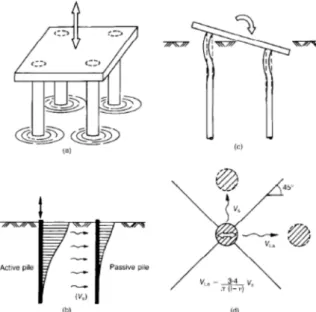
Figure 15: Simple analytical solution developed by Dobry & Gazetas (1988) to the problem of dynamic pile-soil-pile interaction in uniform soils: (a) analogy
be-tween the cylindrical wave assumption for group of piles and cylindrical water waves; (b) distribution of displacement amplitudes along the shaft of an active and a passive pile; (c) pile head deformation and reactions during rocking; (d) waves
radi-ating from a laterally oscillradi-ating pile (from [Dob88]).
Gazetas (1991) remarks that the real difficulty in using the above formulas is the selection of the proper soil profile and strain-compatible shear modulus for the soil. In fact, even considering a uniform soil deposit, the shear modulus will depend on the magnitude of the induced shear strain. Moreover, phenomena of geometric non-linearity like gap formation at the soil-pile interface close to the ground surface, may also occur, and this further complicates the analysis.
Another complication to the problem is the calculation of the dynamic impedance of a group of piles from the knowledge of the impedance of a single pile to account for pile-to-pile and soil-to-pile interaction. In fact, the dynamic impedance of a group of piles in any mode of vibration cannot be computed by simply adding the impedances of the individual piles, because each pile in addition to its own loadings, is affected by the response of the neighboring piles transmitted through transversal and longitudinal waves.
The pile-to-pile and soil-to-pile interaction is frequency-dependent and the inter-action coefficients can be determined by adopting the Poulos’ superposition
ap-proach (Poulos and Davis, 1990 [Pou90]) extended to dynamic loading. By this
approach the response of the pile group is obtained through the introduction of ap-24 Soil-structure interaction under earthquake loading: Theoretical framework
propriate interaction coefficients derived from the study of only two piles at a time. Dynamic impedances have been computed by Kaynia and Kausel in 1982 [Kan82] through rigorous approaches (using the boundary element method). Dobry and Gazetas (1988) [Dob88] (see Figure 15) and Makris and Gazetas (1992) [Mak92] provided a very simple analytical solution by using the results obtained by Wolf [Wol94] to the problem of dynamic pile-soil-pile interaction in uniform soils for vertical and horizontal modes of deformation. Lastly, Mylonakis (1995) [Myl95] extended this work to layered soil conditions.
4.3.Construction of DIF using the cone model
An original approach to define approximate relations for the dynamic impedance functions of shallow and deep foundations has been proposed by Wolf (1994) [Wol94]. It is named the cone model approach because it is based on replacing the soil deposit, for each degree of freedom of the foundation, by a truncated semi-infinite elastic cone with the apex located at a height z0 from the ground surface
(Figure 16). The cone is assumed homogeneous, linear-elastic, with mass density ρ. Initially material damping is neglected. The stress-strain relationship is specified by two independent elastic constants (e.g. the shear modulus G, and the Poisson ratio ν). The foundation is idealized by a rigid, circular, mass-less disk with area A0 and
radius r0 which imposes a displacement pattern in the material beneath.
With the cone model the complicated, exact formulation of three-dimensional elasto-dynamics is replaced by a simple, (strength of materials approach) one-dimensional description of the kinematics like assuming that plane sections remain plane. Figure 16 shows both translational and rotational cones that can be used to compute the vertical, horizontal, rocking and torsional dynamic responses of a shal-low foundation.
Figure 16: Representation of the cone models associated to various modes of vibration (from [Wol94]).
For each degree of freedom, only one type of body wave is postulated to exist: for horizontal and torsional motions, S-waves propagating with the shear-wave velocity whereas for vertical and rocking motions, P-waves propagating with the velocity of longitudinal P waves.
For example, the vertical response of a rigid, circular, mass-less disk with area A0
and radius r0, placed on a semi-infinite, perfectly linear elastic material (no internal
damping), can be obtained through the cone model represented in Figure 17. In the figure u represents the axial displacement, N the axial force, c denotes the appropri-ate velocity of longitudinal waves, ρ the mass density and STU is the corresponding constrained modulus. Writing the equation of motion of an infinitesimal element of cone taking into account the inertial forces, leads to:
−V E V EWXWDYZ − S[YZWWD\X\ = 0 (23) Substituting the force-displacement relationship:
V = STU[W'
WD (24) leads to the one dimensional wave equation in the zu variable:
W\8D': WD\ − W\ W>\` D' (\b = 0 (25)
For harmonic loading with frequency of excitation ω, the response is given by .8E: = .8I:F<G>, and substituting . 8I: = IU.8I: in the previous equation, leads to: W\8D'8G:: WD\ − G\ (\ W\ W>\8Z.8I:: = 0 (26)
The interesting solution of Eq. (26) is that corresponding to outward propagating waves. In fact because of the radiation condition the inward propagating waves may be neglected. Thus the solution is:
.8I: = B*DD^F_<
`
a8D_D^: (27)
where C1 is the integration constant. Enforcing the boundary conditions .8I:|DcD^= .d8I: and computing the global force 6d8I: acting on the rigid disk, yields:
6d8I: = −V8I:|DcD^ = −STU[d
W'8G:
WD |DcD^ = [DM E LIB̅].d8I: (28)
26 Soil-structure interaction under earthquake loading: Theoretical framework
where D =e(D\f^
^ and B = ST[d are respectively the spring and damping
coeffi-cients. Introducing the dimensionless frequency parameter a0 defined as: gd=GO(^
h (29)
where cs is the shear wave velocity, the dynamic impedance can be rewritten as a function of the static stiffness D and the dimensionless parameter a0 as follows:
H8gd: = D[OP8gd: E LgdT̅8gd:] (30) where in general OP8gd: and T̅8gd: are function of a0 however for this particular example the corresponding values are constant and equal to OP8gd: = 1 and T̅8gd: = D^(h
O^(.
It is worth noticing that the damping coefficient represents the dissipation of energy by radiation of the waves through infinity. The other source of energy dissipation is the material damping that to first approximation may be considered frequency inde-pendent because it involves frictional energy losses. It can be introduced into the solution for harmonic loading by multiplying the elastic constants by the factor 1 E 2L- where ξ is the material damping ratio.
The opening angle (Zd/id) of the cone is determined by equating the static-stiffness coefficient of the cone to that of a disk on a half-space determined using the three-dimensional theory of elasticity. In case of nearly-incompressible materials (i.e. materials with a Poisson’s ratio larger than 1/3), the model is still applicable if the velocity of longitudinal waves is limited to twice the shear-wave velocity and a trapped mass and mass moment of inertia are introduced for the vertical and rocking degrees of freedom, respectively.
Cone models can also be used to simulate the dynamic response of foundations resting on a half-space composed of several soil layers, in which reflected waves and refracted waves are taken into account through the introduction of their own cone. Fixed and free boundary conditions as well as embedded foundations may also be represented. The interested reader is referred to the already cited work by Wolf [Wol94].
Figure 17: Vertical response of a rigid, circular, mass-less disk using the cone model (modified from [Wol94]).
5. Applications using the substructure approach
In the following Sections two applications of SSI analysis are presented. The first one involves the seismic design of the foundation of EUCENTRE shake table in Pavia, Italy, which is the Europe most powerful shake table. The second example concerns with the seismic demand assessment of a prestressed concrete viaduct whose foundations are constituted by large diameter shafts. The evaluation of seis-mic response of large-diameters shafts is important for the dynaseis-mic behavior of bridge piers.
5.1.Design of shake table foundation at EUCENTRE
The high-performance of the shaking table at EUCENTRE has forced the design-ers to face the challenging problem of having a large reaction mass to control and possibly reduce the vibrational impact of the table. Therefore detailed analyses had to be performed in order to solve a complex dynamic soil-structure interaction prob-lem.
In the area of study, geotechnical investigation campaign was carried out to de-fine the stratigraphy and the static and dynamic properties of the soil deposit, such as the shear wave velocity profile illustrated in Figure 18.
28 Soil-structure interaction under earthquake loading: Theoretical framework
Figure 18: Shear wave velocity profile used for design. (from [Cal05]) The configuration shown in Figure 19 refers to a rigid block formed by the reaction mass and an additional mass constituted by 3.0 meters of concrete that have been added to the original precast system increasing the overall weight of the reaction mass.
The evaluation of the dynamic response of the shaking table and the founda-tion/soil mass has been performed through a three DOFs lumped mass model. A rigid block placed over a deformable and dissipative ground under harmonic and transient excitations was used to model the behavior of the dynamic testing facility. Considering the uniaxial motion of the shaking table, the three DOFs shown in Fig-ure 20 are: x-displacement (horizontal), z-displacement (vertical) and rotation in the x-z plane. These three DOFs may be defined either with reference to the centroid G or with respect to the center of the soil-structure interface O. The equation of motion is:
D. = 6 (31) Lai & Martinelli 29
Figure 19: Competing configurations studied for the reaction mass/foundation de-sign of the EUCENTRE shaking table. (from [Cal05])
Figure 20: Lumped model of the reaction mass/foundation for the EUCENTRE dynamic facility (from [Cal05])
where K is a symmetric complex-valued matrix and it represents the dynamic im-pedance matrix defined as:
D = DJ− IUr (32) where KF is the impedance matrix of the mass-less foundation and M is the mass matrix of the block:
30 Soil-structure interaction under earthquake loading: Theoretical framework
DJ= DM E LIB̅ (33) The stiffness DM and the damping coefficient B̅ are frequency-dependent functions obtained using the computer code DYNA4 [Nvk94] for the frequency range 0-20Hz. They are plotted in Figure 21 and Figure 22. The impedance functions refer to the case of a rectangular footing base resting on the surface of a shallow, non-uniform layer (top shear wave velocity of 200 m/s, bottom VS = 300 m/s).
Figure 21 shows the stiffness and damping coefficients for both vertical and hori-zontal motion whereas Figure 22 shows the contributions of the rocking around the y-axis and of the coupling between the rotation and the horizontal motion of the rigid block. Once the dynamic impedance matrix K is computed, the solution of the equation of motion is represented by the complex-valued displacement z-components, x-component and the rotation in the x-z plane of the rigid block. They are shown in Figure 23 and Figure 24.
Figure 21: Dynamic Impedance Functions (DYNA4): stiffness and damping coef-ficient for vertical and horizontal motion (from [Cal05])
Figure 22: Dynamic Impedance Functions (DYNA4): stiffness and damping coef-ficient for rocking and coupled motion (from [Cal05])
Figure 23: Response functions related to the horizontal DOF (harmonic excita-tions) of the 3.0 m thick rigid foundation (from [Cal05])
32 Soil-structure interaction under earthquake loading: Theoretical framework
Figure 24: Response functions related to the rotational DOF (harmonic excita-tions) of the 3.0 m thick rigid foundation (from [Cal05])
The foundation response was then assessed for earthquake loading. The strong-motion records were chosen with the criterion of reproducing the excitation that would be used in carrying out the experimental tests with the shaking table on a scaled (1:3-1:2) bridge pier specimen. The reader is referred to Pavese et al. [2004] [Pav04] for the geometrical data and reinforcement details of the full-scale bridge pier. The time-histories of base shear and overturning moment from the analysis of the short bridge pier S250 specimen under the Coalinga ground motion are shown in Figure 25. The horizontal acceleration and displacement time-histories are illustrated in Figure 26 with reference to both the base and the centroid of the reaction mass.
Figure 25: Excitation action time-histories (at the centroid of the reaction mass): Coalinga Earthquake, scaled 1:2 bridge pier S250 (from [Cal05])
(a)
(b) Figure 26: Response functions related to the translational DOF (Coalinga earth-quake): (a) horizontal acceleration, (b) horizontal displacement (from [Cal05]) 34 Soil-structure interaction under earthquake loading: Theoretical framework
5.2.Kinematic interaction effects of large-diameter shafts
foundations
The rigorous assessment of seismic SSI of a structure founded on deep foundations is an extremely complicated problem and the difficulties are mainly represented by the evaluation of kinematic interaction and scattering effects generated by the foun-dation system. The study illustrated in the following, summarizes the work done by Beltrami et al. [Bel05] in trying to evaluate the kinematic interaction effects and the FIM (Foundation Input Motion) at the base of a prestressed-concrete viaduct found-ed on large-diameter shaft foundations. These are essentially rigid cylinders that are not expected to induce very large nonlinearities in the surrounding soil during seis-mic shaking; therefore, they are well suited to be studied within the framework of the superposition’s theorem and the substructure approach.
The basic assumptions made in the study concerning the geometry of the founda-tion and soil constitutive model are as follows: (i) rigid circular cylinder of radius R embedded in a soil layer of constant thickness H and infinite extent in the horizontal plane (no topographic effects); (ii) the soil is modeled as a linear viscoelastic mate-rial with frequency-independent properties, and the damping and shear modulus are strain-compatible with the level of excitation by a preliminary equivalent-linear response analysis of the stratum; (iii) both the base of the cylinder and the layer are considered to undergo a space-invariant, uniform horizontal motion.
Furthermore the soil was assumed to deform according to the plane-stress hy-pothesis as it was originally proposed by Veletsos and Younan in 1995 [Vel95] for a better representation of the displacement field around a large-diameter pile. Their solution is based on the classical Baranov-Novak (BN) idealization of the medium, where the soil is represented by a series of independent thin layers with a circular hole placed at the center of the system. The shear stiffness of each thin layer is given by its dynamic impedance K. In the far-field the BN layers behave as a cantilever shear beam. The basic idea of the constrained layers is to add at each BN thin layer a system of mass-less linear springs (elastic constraints) equally directed along the two horizontal radial u and circumferential ν directions (Figure 27). Finally, a rota-tional and horizontal displacement impedance are added at the base of the shaft to represent the effect of deformable supporting layer rather than fixed base conditions. Lai & Martinelli 35
![Figure 16: Representation of the cone models associated to various modes of vibration (from [Wol94])](https://thumb-eu.123doks.com/thumbv2/123doknet/7780764.258463/32.892.240.670.716.943/figure-representation-cone-models-associated-various-modes-vibration.webp)
![Figure 17: Vertical response of a rigid, circular, mass-less disk using the cone model (modified from [Wol94])](https://thumb-eu.123doks.com/thumbv2/123doknet/7780764.258463/35.892.268.643.236.480/figure-vertical-response-rigid-circular-using-model-modified.webp)
![Figure 27: Schematic view of the model used to study the soil-foundation kine- kine-matic interaction problem (from [Bel05])](https://thumb-eu.123doks.com/thumbv2/123doknet/7780764.258463/43.892.218.691.223.520/figure-schematic-model-study-foundation-matic-interaction-problem.webp)

![Figure 20: Stability diagram for axial cyclic tests on model piles in the centrifuge – dense Fontainebleau sand – cast in place piles (from [Pue12])](https://thumb-eu.123doks.com/thumbv2/123doknet/7780764.258463/72.892.190.700.366.677/figure-stability-diagram-axial-cyclic-tests-centrifuge-fontainebleau.webp)
![Figure 24: Example of pile head displacements for large number of cycles [Rak09].](https://thumb-eu.123doks.com/thumbv2/123doknet/7780764.258463/76.892.242.643.533.775/figure-example-pile-head-displacements-large-number-cycles.webp)
![Figure 25: Relative bending moment versus the number of cycles for several load amplitudes [Ros07]](https://thumb-eu.123doks.com/thumbv2/123doknet/7780764.258463/77.892.230.668.225.496/figure-relative-bending-moment-versus-number-cycles-amplitudes.webp)
