Titre:
Title:
Levenshtein Edit Distance-Based Type III Clone Detection Using
Metric Trees
Auteurs:
Authors
: Thierry M. Lavoie et Ettore Merlo
Date: 2011
Type:
Rapport / ReportRéférence:
Citation
:
Lavoie, Thierry M. et Merlo, Ettore (2011). Levenshtein Edit Distance-Based Type III Clone Detection Using Metric Trees. Rapport technique. EPM-RT-2011-01.
Document en libre accès dans PolyPublie
Open Access document in PolyPublie
URL de PolyPublie:
PolyPublie URL: http://publications.polymtl.ca/2638/
Version: Version officielle de l'éditeur / Published versionNon révisé par les pairs / Unrefereed
Conditions d’utilisation:
Terms of Use: Autre / Other
Document publié chez l’éditeur officiel
Document issued by the official publisher
Maison d’édition:
Publisher: École Polytechnique de Montréal
URL officiel:
Official URL: http://publications.polymtl.ca/2638/
Mention légale:
Legal notice: Tous droits réservés / All rights reserved
Ce fichier a été téléchargé à partir de PolyPublie, le dépôt institutionnel de Polytechnique Montréal
This file has been downloaded from PolyPublie, the institutional repository of Polytechnique Montréal
EPM–RT–2011-01
LEVENSHTEIN EDIT DISTANCE-BASED TYPE III
CLONE DETECTION USING METRIC TREES
Thierry M. Lavoie, Ettore Merlo
Département de Génie informatique et génie logiciel
École Polytechnique de Montréal
EPM-RT-2011-01
LEVENSHTEIN EDIT DISTANCE-BASED TYPE III
CLONE DETECTION USING METRIC TREES
Thierry M. Lavoie, Ettore Merlo
Département de génie informatique et génie logiciel
École Polytechnique de Montréal
2011
Thierry M. Lavoie, Ettore Merlo Tous droits réservés
Dépôt légal :
Bibliothèque nationale du Québec, 2011 Bibliothèque nationale du Canada, 2011 EPM-RT-2011-01
Levenshtein Edit Distance-Based Type III Clone Detection Using Metric Trees par : Thierry M. Lavoie, Ettore Merlo
Département de génie informatique et génie logiciel École Polytechnique de Montréal
Toute reproduction de ce document à des fins d'étude personnelle ou de recherche est autorisée à la condition que la citation ci-dessus y soit mentionnée.
Tout autre usage doit faire l'objet d'une autorisation écrite des auteurs. Les demandes peuvent être adressées directement aux auteurs (consulter le bottin sur le site http://www.polymtl.ca/) ou par l'entremise de la Bibliothèque :
École Polytechnique de Montréal
Bibliothèque – Service de fourniture de documents Case postale 6079, Succursale «Centre-Ville» Montréal (Québec)
Canada H3C 3A7
Téléphone : (514) 340-4846
Télécopie : (514) 340-4026
Courrier électronique : [email protected]
Ce rapport technique peut-être repéré par auteur et par titre dans le catalogue de la Bibliothèque : http://www.polymtl.ca/biblio/catalogue.htm
Levenshtein Edit Distance-Based Type III Clone Detection Using Metric Trees
Thierry Lavoie, Ettore Merlo
Department of Computer and Software Engineering, ´Ecole Polytechnique de Montr´eal,
P.O. Box 6079, Downtown Station, Montreal, Quebec, H3C 3A7, Canada
{thierry-m.lavoie, ettore.merlo}@polymtl.ca
Abstract
This paper presents an original technique for clone de-tection with metric trees using Levenshtein distance as the metric def ned between two code fragments. This approach achieves a faster empirical performance. The resulting clones may be found with varying thresholds allowing type 3 clone detection. Experimental results of metric trees per-formance as well as clone detection statistics on an open source system are presented and give promising perspec-tives.
1 Introduction
Clone detection is a f eld concerned with f nding simi-lar patterns in source code as well as interpreting and using them in design, testing and other software engineering prob-lems, such as ones presented in [2, 5, 8]. Classif cation of clones is usually done in three categories, although it is not unheard to use more, as in [12]. Type 1 deals with identi-cal fragments of code, whereas type 2 deals with parametric fragments. For those types, different eff cient methods with varying precision and recall are known; the detection prob-lem is well addressed in the literature.
However, dealing with type 3 clones which are similar fragments, i.e., they can differ in their content according to some threshold or some similarity measure, is still a diff cult problem and some issues still need to be addressed. Cur-rent clone detection methods can f nd some type 3 clones, but with great restrictions of thresholds and high computa-tional cost. We propose an original clone detection method based on metric trees to reduce the search space and reduce the computational cost on any search done with a metric. Since the Levenshtein metric is the optimal mathematical edit distance between strings, we propose to combine met-ric trees, as introduced by [4], with the Levenshtein metmet-ric to compute clones with varying thresholds on that metric. The use of the Levenshtein metric is motivated by the
intu-itive induced interpretation of the results since it is related to the human behaviour behind text edition. Thus, we com-pute type 3 clones of a system based on the Levenshtein metric. Moreover, we achieve better execution time perfor-mance than the naive pairwise comparison of all fragments. The rest of the paper is organized as follow: section 2 presents a brief literature review; section 3 gives a detailed explanation of the algorithm; section 4, the experimental setup and results; section 5, a discussion of the results, and a conclusion.
2 Literature Review
Clone detection state of the art includes different tech-niques. For type 1 and type 2, AST-based detection has been introduced by [3]. Other methods for type 1 and type 2 include metrics-based clone detection as in [10], suff x tree-based clone detection as in [7], and string matching clone detection as in [6]. For a detailed survey of clone detection techniques, a good portrait is provided in [11].
Regarding type 3 clone detection, Tiarks et al. have pro-duced a study of the current state of the art in [13]. As de-f ned in this paper, type 3 clones de-fall in two subcategories:
• A structure-substituted clone is a copied fragment
where some program structures have been substituted.
• A modif ed clone is a copied fragment where code has
been deleted or added or both.
Of course, some type 3 clones may fall into both cat-egories. Tiarks et al. support the use of the Levenshtein distance to compute a clone oracle and gave some results of the distribution of the clones using that distance. However, the results were gathered from a small sample of clone can-didates and the cancan-didates were very small code fragments. An interesting evaluation of many clone detection tech-niques was done in [12]. This study def ned 16 cloning sce-narios and assessed the performance of many known detec-tion methods with respect to these 16 cases from which 9 1
cases were type 3 clones. According to that study, graph-based clone detection has the best potential to f nd type-3 clones. Metrics-based, tokens-based and text-based meth-ods may also handle type-3 clones. Although they can de-tect type-3 clones, AST-based methods seem to be much less effective. Nevertheless, this survey shows that no known method performs well on f nding all variants of type 3 clones.
In this paper, following the support of the Levenshtein distance from Tiarks et al., we build a clone detection method using the combination of metric trees and the Lev-enshtein distance. Since all 16 cases presented in [12] have small Levenshtein distance, the technique can easily f nd all clones in these categories and thus should perform better than the current state-of-the-art techniques. The next sec-tion presents the new algorithm.
3 Metric tree-based clone detection
First, it is necessary to def ne a metric. Let X be a topo-logical space and δ a function δ : X × X → R called a distance. The distance δ is a metric if and only if the fol-lowing properties hold for x, y, z ∈ X:
δ(x, y) ≥ 0 (non negativity) (1) δ(x, y) = δ(y, x) (symmetry) (2) δ(x, y) = 0 ⇔ x = y (3) δ(x, y) + δ(y, z) ≥ δ(x, z) (triangle inequality) (4) If a metric δ exists for a topological space X, then X is a metric space. In many cases, distances satisfy the f rst three axioms of a metric, but many don’t satisfy the fourth, the triangle inequality, which is the key to interesting space par-titioning. Many common distances are not proper metrics. For example, the overlap coeff cient and the Dice coeff -cient are useful distances for set similarity comparisons, but they fail to satisfy the triangle inequality. However, other common distances like the Jaccard coeff cient and the Lev-enshtein distance do satisfy the triangle inequality and are proper metrics. For this reason, the Levenshtein distance will be referred to as the Levenshtein metric in this paper. Since the construction of metric trees relies on the triangle inequality, it is hard to use approximation of the metric be-cause metric embeddings for approximation usually fail to respect the triangle inequality.
Now, suppose we have a metric δ on space X. We want to def ne a data structure that separates the search space to increase the performance on similarity queries, namely range queries. Let M be a tree and N the set of nodes {n0, n1, ..., nk}in M. Every ni ∈ N is def ned as the
4-tuple t =< x, y, d, c[4] >, where x, y ∈ X, d = δ(x, y), and c[i] is the node’s ith child. We call x and y the pivots
of node ni. According to the preceding def nitions, we can
now def ne an algorithm insert(f) which take an arbitrary f ∈ Xas a parameter and insert this element into tree M as the pivot x or y of some node ni. The complete def nition
of the insert(f) algorithm may be found in [4]. 1 detectClones(S, distance)
2 tree= new M etricT ree 3 f orall f ∈ S :
4 tree.insert(f ) 5 clones= ∅ 6 f orall f ∈ S
7 radius= distance ∗ len(f )
8 clones= clonesStree.rangeQuery(f, radius) 9 return clones
Figure 1: Clone detection algorithm
With the metric-tree built for clone candidates under the Levenshtein metric δl, it is easy to perform a range-query
for fragment f with radius r to f nd all fragments f′ for
which δl(f, f′) ≤ r. For a complete description of the
range-query algorithm as well as some possible optimiza-tions on the tree building operation, see [4].
Suppose we have a system S =
{f |f is a code f ragment of S}. Let tree be the metric tree built with all f ∈ S under metric δl. Also, let
len(f )be the length of f. Finding all clone fragments with respect to f is equivalent to searching for all fragments f′ for which dl(f, f′) ≤ r for a chosen radius r. This
is the exact def nition of a range query in metric trees; therefore, f nding all clones to fragment f is equivalent to a range-query on tree around f with radius r. All these steps are presented in the algorithm of f gure 1. The method rangeQuerytakes a fragment f as f rst parameter and the radius as second parameter; it returns the set of all clones to f. In this algorithm, the radius was chosen to be a function of len(f) and a constant parameter distance. As discussed in the next section, this was the chosen radius def nition for our experiments. However, there are no restriction to the def nition of the radius as long as r ∈ R.
4 Experimental setup and preliminary
re-sults
The main goal of the experiments was to f nd all code fragment pairs whose Levenshtein distance is less or equal to a specif c threshold. From now on, let all code frag-ments of a system be the strings of their corresponding to-kens as produced by the lexer of the chosen language. The use of tokens instead of strings is supported by [9]. Let 2
a, bbe two strings and len(a), len(b) be the length of those strings. Then the threshold ǫ for pair (a, b) is def ned as ǫ= d ∗ max(len(a), len(b)))where d ∈ (0, 1) is the coef-f cient ocoef-f desired maximum distance. Another meaningcoef-ful interpretation of d may be stated as: the desired similarity between fragments is 1 − d. The cloning criteria may be phrased as: the pair (a, b) is in a cloning relation iff the Levenshtein distance between a and b is smaller or equal to threshold ǫ where ǫ is the maximum length of a and b times the distance coeff cient (or times one minus the sim-ilarity coeff cient). Thus, there are two important points: the queries’ radius is proportional to the length of the frag-ments, and the experiments’ varying parameter is the dis-tance coeff cient and not directly the Levenshtein metric. Metric trees do not prohibit the use of f xed thresholds in-stead of proportional ones, but to recover more signif cant clones for larger fragments, it was more natural to specify the thresholds as a function of the size.
In fact, it is easy to build fragments for which f xed thresholds would falsely report them as clones or non-clones. For example, let fragment f be of size 10 000 and fragment f′be of size 13 000. Assume f and f′have
iden-tical f rst 10 000 tokens, but at the end of f′there is an
ap-pendage of 3 000 tokens. If threshold ǫ was below 3 000, the algorithm would miss such a clone candidate. In practice, this case could be represented by f being a class and f′
be-ing the same class with new methods added at its end. How-ever, ǫ = 3000 would report pairs that are not clones. For example, let f and f′ be of size 200 and δl(f, f′) = 200.
Now, δl(f, f′) ≤ ǫ, f and f′ would be reported as clones
even though they probably share no similarities. Hence, the query’s radius must be size-sensitive.
For type 3 clone detection, d must vary. For this reason, dwas chosen in {0.05, 0.15, 0.30} to assess the eff ciency of the method. We believe the chosen values of d to be reasonable. However, the exact def nition of an acceptable threshold is not specif ed in the literature. Therefore, more experiments should be done to determine an adequate inter-val to let d vary in.
Experiments have been performed on an open-source Java system, Tomcat, and have been executed on an Intel Core 2 Duo, 2.16 GHz clock, 4 GB RAM, under Linux Fe-dora 13. Code has been compiled with g++ 4.4.4. Tomcat [1] is an implementation of the Java Servlet and the Java Server Pages technologies and is widely used to power dif-ferent kinds of web-based systems.
The size, number of fragments and some interesting statistics on fragments size are presented in table 1. In this table and in all reported f gures and experiments, fragments refer to blocks larger than 70 tokens, which is a threshold that has been chosen as a lower bound of signif cance for blocks size. The literature suggests setting this lower bound at 7-10 LOCs. Since our size is expressed in number of
to-kens, we need to convert the generally accepted bound; 70 comes from the previous authors’ experience and is roughly equivalent to 7-10 LOCs. Also, blocks refer to logical blocks, functions and classes. Since the Levenshtein metric computation is quadratic on the size of the fragments, this table reports different statistics on the size of the fragments to assess the expected diff culty in computing the distance.
System Tomcat
Version 5.5
LOC 130K
Fragments 5084
Av. Length of fragments 341.29 Max. Length of fragments 19999
Table 1: System features
Preliminary results of the technique are presented in ta-ble 2. The total number of reported clones is very small compare to the total number of candidates, which is 14 311 250. The total number of candidates is the number of all possible fragment pairs. The execution time increases as the distance coeff cient increases.
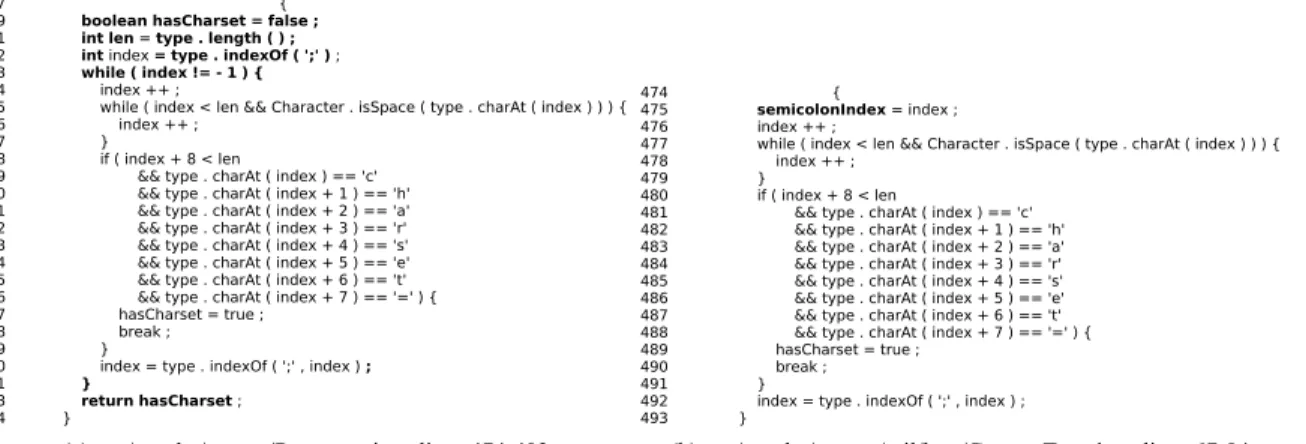
An example of the clone found with the technique is shown in f gure 2. The length of the fragments are respec-tively 177 for 2a and 145 for 2b. The reported Levenshtein distance is 34 or equivalently 0.192 according to our exper-iment’s def nition. This example exhibits many of the char-acteristics of a type 3 clone. First, there’s an added pref x in the longer fragment. Second, there’s an added suff x in the longer fragment. Finally, most of the code in the smaller fragment have been imbedded in a while loop in the larger fragment. These differences have been correctly identif ed by the alignment as shown in the f gure. It is interesting to see that the location of these two fragments are not only in different f les in the system but also at completely unrelated locations. This fact supports the benef ts of performing the analysis on the whole system and not only on subparts.
Distance d Execution time (s.) Clone pairs
0.05 6023 226
0.15 9401 963
0.30 13163 2933
Table 2: Algorithm performance for Tomcat with varying distance d
5 Discussion
The goal of the experiment was to assess the possibil-ity of detecting clones with the technique. Because of the 3
! "! # $ $ $ % & ' & "! # $ ( ( &) "! # $ ( ( & "! # $ ( ( & "! # $ ( ( & "! # $ ( ( & "! # $ ( ( & "! # $ ( ( & "! # $ ( ( $ & * && + , & % ) "! -' ( ( . $ %
(a) org/apache/coyote/Response.java lines 474-493
! " # !$ % ! !& ' ' !( & ' ' !) ( ' ' ! ) ' ' ! ' ' ! ' ' ! ' ' !! ' ' !" * "$ + , "& # "( -% ' ' . ") # (b) org/apache/tomcat/util/http/ContentType.java lines 67-94
Figure 2: A clone example from Tomcat with distance 0.192. Alignment differences are shown in bold. New lines were skipped.
Levenshtein metric’s def nition, we report 100% of type 1 clones. Moreover since we perform the detection on token-based strings instead of image-based strings, we re-port 100% of type 2 clones. Type 2 clones are def ned as parametric clones for which identif ers are replaced. There-fore, these clones have an intrinsic Levenshtein distance of 0 if the distance is computed on their token-based represen-tation and the algorithm will always report them as clones.
Apart from detecting all type 1 and type 2 clones, we report every Levenshtein-based type 3 clones in a system that would be reported by an exhaustive pairwise search, but at a lower computational cost. In other words, our method is equivalent to performing a search on all n∗ (n − 1)
2 clone
pair candidates of a system, where n is the total number of fragments in the system, and reporting all pairs for which their Levenshtein distance is below a specif c threshold.
Using metric trees, we achieved an interesting type 3 clone detection on Tomcat, while the pairwise technique couldn’t perform that computation in reasonable time. To estimate the required time for the pairwise method, we com-pared our algorithm to the pairwise technique on smaller samples of our target system. With a sample of 100 frag-ments, the pairwise approach completed its task in 181 s while our technique used 21 s, while for a sample of 500 fragments, the execution time were respectively 4080 s and 118s. Using those numbers, we project the required com-putation for the pairwise technique to be around 415 427 s. (roughly 5 days for the whole system). Based on that esti-mation, we project the total acceleration factor at around 30 times for our method. This acceleration factor is only valid for queries with similarity coeff cient 0.3 or less. However, based on the results of table 2, for distance coeff -cient smaller than 0.3, the runtime for our technique de-creases as the distance coeff cient dede-creases. Thus, the total acceleration factor with respect to the pairwise method in-creases with smaller distance coeff cient value. This is
con-sistent with the results provided by [4], which supported a reduction of the search space for range-queries. However, it seems that the radius of the range-queries also have a di-rect inf uence on the size of the search space. Although no experimental evidence is provided here, this claim is rea-sonable. Further researches will try to measure the exact in-f uence oin-f the radius on the perin-formance oin-f the range-query. This specif c result is of great interest for clone detec-tion, since we generally do not need to know the distance between non-clone fragments. While the pairwise method computes every pair’s distance, the metric tree approach computes only the relevant distances for the desired simi-larity between fragments. Thus, if the desired simisimi-larity is high, the search space may be pruned signif cantly leading to a high computational gain. Moreover, even if the cho-sen similarity is high, the resulting clones are still optimally aligned by the Levenshtein metric.
The method is scalable for systems up to hundreds of KLOCs. Systems in the order of MLOCs would still retain the acceleration factor over the pairwise technique. How-ever, those systems would require computational time over several days without an underlying parallel approach. Still, metric tree clone detection for huge systems may provide an opportunity to compute clones under the Levenshtein dis-tance, which would be practically unfeasible with the pair-wise approach (with computation time estimated to several years). Scalability will be investigated in future researches. A drawback of this method if used on all blocks of a system (see the def nition of block in section 4) is the possi-bility of f nding self-referring clones. Self-referring clones are def ned as follow: let a and b be fragments, then (a,b) is a self-referring clone iff a is properly contained in b or b is properly contained in a. This can occur frequently if all log-ical blocks are used but rarely if only functions and classes are used. This may be explained by the very low probability that a function may be a proper clone to a class (usually, pro-4
grammers do not make class from single method and vice versa). Nevertheless, self-referring clones may be f ltered easily and quickly after clone detection.
Because the tree is constructed using code fragments, the choice of using all blocks instead of restricting the blocks to functions and classes has a direct impact on the execu-tion time. The total number of nodes searched in the tree is dependant on the total node inserted in the trees. Con-sequently, the total running time is dependent on the num-ber of LOCs as well as the total numnum-ber of fragments in-serted and the average length of each fragment. In fact, the total number of nodes searched is dependant on the tree size as well as the average similarity between fragments, and the total time spent computing the Levenshtein distance is closely related to the average size of code fragments. Therefore, one must be careful when comparing the per-formance of the technique with respect to the size in LOCs (even though the preceding factors are related to the number of LOCs). Because of this presumed sensibility to system characteristics, we planned to validate the practical perfor-mances of our technique on many other systems.
6 Conclusion
This paper presented an original clone detection tech-nique based on the Levenshtein metric and metric trees. Running times of the method have been compared with the pairwise comparison approach and achieved an acceleration factor of 30. Since the clones are computed using the Lev-enshtein metric, the results are intuitive and interesting type 3 clone candidates. Future research will include a scalabil-ity study on even larger systems along with an exhaustive experimental validation on many systems. Other possible continuations are a study of the method under different met-rics and a comparison with existing type 3 clone detection techniques.
7 Acknowledgements
This research has been funded by the Natural Sciences and Engineering Research Council of Canada (NSERC) un-der the Discovery Grants Program.
References
[1] Tomcat. http://tomcat.apache.org.
[2] M. Balazinska, E. Merlo, M. Dagenais, B. Lagu, and K. Kontogiannis. Advanced clone-analysis as a basis for object-oriented system refactoring. In Proc. Work-ing Conference on Reverse EngineerWork-ing (WCRE), pages 98–107. IEEE Computer Society Press, 2000.
[3] I. Baxter, A. Yahin, l. Moura, M. Sant’Anna, and L. Bier. Clone detection using abstract syntax trees. In Proceedings of the International Conference on Soft-ware Maintenance - IEEE Computer Society Press, pages 368–377, 1998.
[4] P. Ciaccia, M. Patella, and P. Zezula. M-tree: An ef-f cient access method ef-for similarity search in metric spaces. In Proc. of 23rd International Conference on Very Large Data Bases, pages 1–1, 1997.
[5] F. Deissenboeck, B. Hummel, E. Juergens, B. Schaetz, S. Wagner, S. Teuchert, and J. F. Girard. Clone detec-tion in automotive model-based development. In Pro-ceedings of the International Conference on Software Engineering. IEEE Computer Society Press, 2008. [6] S. Ducasse, O. Nierstrasz, and M. Rieger. On the
effectiveness of clone detection by string matching. International Journal on Software Maintenance and Evolution: Research and Practice, 2006.
[7] N. Gode and R. Koschke. Incremental clone detec-tion. In European Conference on Software Mainte-nance and Reengineering, 2009.
[8] J. Guo and Y. Zou. Detecting clones in business appli-cations. In Proceedings of the Working Conference on Reverse Engineering, 2008.
[9] T. Kamiya, S. Kusumoto, and K. Inoue. Ccf nder: A multi-linguistic token-based code clone detection sys-tem for large scale source code. IEEE Transactions on Software Engineering, 28(7):654–670, 2002.
[10] J. Mayrand, C. Leblanc, and E. Merlo. Experiment on the automatic detection of function clones in a soft-ware system using metrics. In Proceedings of the International Conference on Software Maintenance -IEEE Computer Society Press, pages 244–253, Mon-terey, CA, Nov 1996.
[11] C. Roy and J. Cordy. A survey on software clone de-tection research. Technical Report Technical Report 2007-541, School of Computing, Queen’s University, November 2007.
[12] C. Roy, J. Cordy, and R. Koschke. Comparison and evaluation of code clone detection techniques and tools: a qualitative approach. 74(7):470–495, may 2009.
[13] R. Tiarks, R. Koschke, and R. Falke. An assessment of type-3 clones as detected by state-of-the-art tools. In Workshop on Source Code Analysis and Manipulation. IEEE Computer Society Press, 2009.