
TAILORING THE SURFACE CHARGE OF CELLULOSE NANOCRYSTALS (CNC) USING A POLYCATION
BAHAREH ZAKERI
DÉPARTEMENT DE GÉNIE CHIMIQUE ÉCOLE POLYTECHNIQUE DE MONTRÉAL
MÉMOIRE PRÉSENTÉ EN VUE DE L’OBTENTION DU DIPLÔME DE MAÎTRISE ÈS SCIENCES APPLIQUÉES
(GÉNIE CHIMIQUE) JUILLET 2017
UNIVERSITÉ DE MONTRÉAL
ÉCOLE POLYTECHNIQUE DE MONTRÉAL
Ce mémoire intitulé :
TAILORING THE SURFACE CHARGE OF CELLULOSE NANOCRYSTALS (CNC) USING A POLYCATION
présenté par : ZAKERI Bahareh
en vue de l’obtention du diplôme de : Maîtrise ès Sciences Appliquées a été accepté par le jury d’examen constitué de:
M. FRADETTE Louis, Ph. D. président
Mme HEUZEY Marie-Claude, Ph. D. membre et directrice de recherche M.TAVARES Jason-Robert., Ph. D. membre et codirecteur de recherche M.CARREAU Pierre, Ph. D. membre
DEDICATION
Dedicated To:
Alireza
My parents
ACKNOWLEDGEMENTS
Thanks to my supervisors Prof. Heuzey and Prof. Tavares for their direction and financial support. I would particularly like to thank to Prof. Bernard. Riedl and Prof. Theo van de Ven for their great discussions and comments.
I would like thanks to Natural Sciences and Engineering Research Council of Canada (NSERC), FPInnovations and the Centre de Recherche sur les Systèmes Polymères et Composites
à Haute Performance (CREPEC) for technical and financial support of this project.
I would like to thank all the staff and members of the laboratories of Polytechnique and university of Montreal specially Matthieu, Wendell and Vincent.
Thanks to all my friends and colleagues in Polytechnique specially; Faezeh, Helia, Changsheng, Ahmed,Donya and Bahareh.
Finally, I would also like to thank my parents, my brother and specially my husband for their love, patience, and encouragement.
RÉSUMÉ
Dans ce travail, la surface de nanocristaux de cellulose (CNC) a été modifiée en utilisant un polymère cationique, le polyéthylèneimine (PEI), pour améliorer leur compatibilité avec des milieux non polaires. La modification de surface, réalisée par un procédé simple et sans utiliser de solvants organiques, a été confirmée par différentes techniques analytiques : spectroscopie XPS, spectroscopie FT-IR et mesures de potentiel zêta. Une analyse thermogravimétrique (TGA) a été réalisée pour étudier la stabilité thermique des CNC séchés-modifiés (mCNC). La spectroscopie UV-Vis a également été réalisée pour étudier le taux de sédimentation des mCNC dans l'eau, ainsi que la stabilité du modificateur. Les charges de surface des mCNC ont été modifiées par les polycations, et les mCNC ont précipité dans l’eau ; ils pouvaient cependant être dispersés dans le toluène. On a également montré que les mCNC étaient stables sur une plage de températures adéquate (jusqu'à 200 °C), compatible avec la dispersion en polymère fondu. Être en contact avec un milieu neutre (l’eau et huile minérale) n'a pas affecté l'efficacité du modificateur de surface. De plus, une augmentation significative des propriétés viscoélastiques et du comportement gel est observée pour les suspensions aqueuses de mCNC, attribuée à l'effet électrovisqueux et à la formation d'une structure d’agglomérats du PEI/CNC en suspension aqueuse. Ces résultats indiquent que PEI a un grand potentiel pour être utilisé commercialement comme modificateur de surface des CNC grâce à un processus efficace, à faible coût et respectueux de l'environnement. Au-delà du traitement par PEI, la modification de surface de CNC a été préliminairement examinée utilisant deux grades de chitosanes. Les résultats obtenus ont démontré que le chitosane peut adsorber sur la CNC chargée négativement par interaction électrostatique et modifier ses propriétés de surface. Les CNC séchées-modifiées avec le chitosane (CHI-CNC) précipitent dans l'eau, mais se dispersent dans toluène. Les propriétés viscoélastiques de la suspension aqueuse CNC à une concentration de CNC de 1% massique augmentent de manière significative en ajoutant une faible quantité de chitosane (1% massique par rapport à la charge en CNC). Ceci est attribué à la structure du chitosane et une affinité élevée entre le chitosane et la CNC. En raison des propriétés bénéfiques du mélange CNC-chitosane, une étude plus approfondie de ce biopolymère en tant que modificateur de surface est proposée.
ABSTRACT
In this work, the surface of cellulose nanocrystals (CNC) was modified using a cationic polymer, polyethyleneimine (PEI), to improve their compatibility with non-polar media through a simple process without using any organic solvents. The successful surface modification was confirmed through different analytical techniques: XPS, FT-IR spectroscopy and zeta potential measurements. Thermogravimetric analysis (TGA) was carried out to investigate the thermal stability of dried-modified CNC (mCNC). UV-Vis spectroscopy was also performed to study the precipitation rate of mCNC in water, as well as the stability of the modifier. The surface charge of mCNC was changed through this modification and mCNC precipitated in fresh water; they could however be dispersed in toluene. The mCNC were also shown to be stable in an adequate temperature range (up to 200 °C) for polymer melt processing. Being in contact with a neutral media (water and mineral oil) did not affect the efficiency of the surface modifier. In addition, a significant increase in viscoelastic properties and gel-like behavior were observed for PEI/CNC aqueous suspensions, ascribed to the electroviscous effect and to the formation of an agglomerates structure resulting from the hydrophobic nature of PEI/CNC aqueous suspension. These results indicate that PEI has a great potential to be used commercially as a CNC surface modifier through an efficient, low cost and eco-friendly process.
In addition, the surface modification of CNC using two grades of chitosan was preliminary investigated. The obtained results showed that chitosan adsorbs on negatively charged CNC through electrostatic interaction and changes the surface properties of CNC. Dried-modified CNC with both chitosan grades (CHI-CNC) sedimented in water, however CHI-CNC dispersed in toluene. The viscoelastic properties of CNC aqueous suspension at CNC concentration of 1 wt.% significantly increased when adding a low amount of chitosan (1% wt.% respect to CNC) due to chitosan structure and high affinity between chitosan and CNC. Thanks to the beneficial properties of CNC and chitosan, the use of this biopolymer as a surface modifier of CNC is proposed for further investigation.
TABLE OF CONTENTS
DEDICATION ... III ACKNOWLEDGEMENTS ... IV RÉSUMÉ ... V ABSTRACT ... VI TABLE OF CONTENTS ...VII LIST OF TABLES ... X LIST OF FIGURES ... XI LIST OF APPENDICES ... XIII LIST OF ABBREVIATIONS ... XIV
CHAPTER 1 INTRODUCTION ... 1
CHAPTER 2 LITERATURE REVIEW ... 4
2.1. Cellulose nanocrystals (CNC) ... 4
2.2. The structure and properties of cellulose nanocrystals ... 7
2.2.1. The chemical structure of CNC ... 7
2.2.2. The morphology and surface properties of CNC ... 8
2.2.3. Mechanical properties of CNC ... 9
2.2.4. Thermal properties of CNC ... 10
2.3. The market and applications for CNC ... 11
2.4. Colloidal stability of particles ... 14
2.4.1. Theories of colloidal stability ... 14
2.4.2. Effect of polymer adsorption on the colloidal stability ... 17
2.6. Conclusion of the literature review and organization of the thesis ... 26
CHAPTER 3 CNC SURFACE MODIFICATON WITH PEI ... 28
3.1. Materials ... 28
3.2. Preparation of samples ... 28
3.3. Characterization of modified CNC ... 30
3.3.1.X-Ray Photoelectron Spectroscopy (XPS) ... 30
3.3.2. Fourier Transform Infrared spectroscopy (FTIR) ... 33
3.3.3. Particle size measurements through dynamic light scattering ... 35
3.3.4. Zeta potential measurements ... 37
3.3.6. Contact angle measurements ... 41
3.3.7. The dispersion of mCNC in fresh DI water and organic solvents ... 43
3.3.8. Precipitation rate and the stability of modifier using UV-Vis spectroscopy ... 44
3.3.9. Thermogravimetric Analysis (TGA) ... 48
3.4. Discussion ... 50
CHAPTER 4 CNC SURFACE MODIFICATION WITH CHITOSAN ... 54
4.1. Chitosan ... 54
4.2. Structure characterization of CHI-CNC ... 56
4.3. Zeta potential measurements ... 57
4.4. Thermogravimetric analysis of CHI-CNC ... 58
4.5. Dispersion of CHI-CNC in fresh DI water ... 59
CHAPTER 5 CONCLUSION AND RECOMMENDATIONS... 62 BIBLIOGRAPHY ... 65 APPENDICES………78
LIST OF TABLES
Table 2-1.The crystallinity and dimensions of CNC provided from different sources ... 6
Table 2-2. Modulus and tensile strength of CNC compare to other stiff materials ... 10
Table 2-3.The production capacity of cellulose nanocrystals in 2015 ("TAPPI Nanotechnolgy," December 2015) ... 11
Table 3-1. XPS analysis of CNC before and after surface modification with PEI ... 33
Table 3-2. Z-average hydrodynamic size and PDI of pristine CNC and mCNC at (T= 25 °C) ... 37
Table 3-3. ζ- potential of pristine CNC and mCNC at different pH (T=25 °C) ... 37
Table 3-4.Characteristic thermal degradation temperatures ... 50
Table 4-1.The properties of the two grades of chitosan used in this study ... 55
Table 4-2.The zeta potential value of CHI-CNC and neat chitosan ... 57
LIST OF FIGURES
Figure 2.1.The chemical structural of the cellulose components from tree to the anhydroglucose molecule
(Madhu Kaushik1, 2015). ... 4
Figure 2.2. The molecular structure of cellulose (adapted from (Moon R 2011)). ... 5
Figure 2.3.The isolation of cellulose nanocrystals through sulfuric acid hydrolysis (adapted from (Yujie Meng & Siqun Wang, 2016)). ... 5
Figure 2.4. The number of publications on cellulose nanocrystals in recent years (Web of Science). ... 7
Figure 2.5. Morphology of CNC: (a) Scanning electron microscopy (SEM); (b) transmission electron microscopy (TEM); (c) Atomic Force Microscopy (AFM) (Anuj Kumar1, 2014). ... 9
Figure 2.6.The variation of CNC specific surface area as a function of diameter(Mariano et al., 2014). ... 9
Figure 2.7.Global nanocellulose market ,2015-2021(adapted from (market, 2016)). ... 12
Figure 2.8.Forcasting of CNC demand in 2017 in different application fields (adapted from ("La nanocellulose,le nouvel or vert," 2017)). ... 13
Figure 2.9 a) Potential energy of the interaction; b) the schematic of electric double layer between two particles (adapted from (H. L. F. von Helmholz, 1880)). ... 15
Figure 2.10.Stabilization of a colloidal system by a polymer (adapted from (Xiangjun Gong a, 2014)). . 17
Figure 2.11.The different methods of CNC surface modification. ... 20
Figure 2.12. Esterification of CNC surfaces (adapted from (S. Lin, 2013)). ... 21
Figure 2.13. The etherification reaction of surface hydroxyl groups of CNC (Philippe Tingaut, 2010). ... 21
Figure 2.14. The surface oxidation of CNC to carboxylate groups by TEMPO oxidation in water(Akira Isogai *, 2011). ... 22
Figure 2.15. Schematic of polymer grafting on CNC surface (adapted from (Roy et al., 2009)). ... 23
Figure 2.16. Grafted PCL on CNC surface using stannous octoate (Dufresne, 2010). ... 24
Figure 3.1.Schematioc illustration of CNC surface modification with PEI ... 30
Figure 3.2. XPS survey spectra and decomposition of C1s signal into its constituent contributions for (a,b) pristine CNC and (c,d) mCNC with PEI/CNC 2% ... 31
Figure 3.3. FT-IR spectra of pristine CNC and mCNC with PEI/CNC ratio 1 and 2 % ... 34
Figure 3.4. The CNC particle size distribution in CNC water suspension at concentrations of 0.1 and 1 wt.% ... 36
Figure 3.5. a) Steady shear viscosity (open symbols), complex viscosity * (solid symbols) as a
function of shear rate and angular frequency , respectively b) Storage modulus G′ (solid
symbols) and loss modulus G″ (open symbols) as a function of angular frequency . ... 40 Figure 3.6.Prepared samples for contact angle measurements. ... 42 Figure 3.7 . Contact angles of: (a) pristine CNC and (b) mCNC ( PEI/CNC 2%). ... 42 Figure 3.8.Dispersion state of (a) pristine CNC (b) mCNC (PEI/CNC 2%) in (1) DI water (2) ethanol (3)
isopropanol (4) toluene (5) cyclohexane. ... 43 Figure 3.9.The dispersion of mCNC in DI water a) before ultrasonication b) 5 min c)15 min after applying ultra sonication energy. ... 44 Figure 3.10. UV-Vis transmittance (at 656.732 nm) for pristine CNC and mCNC (PEI/CNC 2wt.%) water
suspensions as a function of time and mineral oil cycling. ... 46 Figure 3.11. Percentage of the intensities of UV transmittance measured at maximum wavelength
(656.732 nm) for water suspension of pristine and modified CNC (at concentration 1 wt.%) as a function of time at different PEI ratio. ... 47 Figure 3.12 Weight loss as a function of a) temperature b) time at 220°C for pristine CNC, mCNC and
neat PEI... 49 Figure 3.13.Schematic drawing of CNC surface modification with polyethyleneimine. ... 52 Figure 4.1.The structure of chitosan and its characteristic properties (adapted from (Chinmayee Saikia,
2015))... 54 Figure 4.2. FTIR spectra of a) pristine CNC and b) CHI1000-CNC c) CHI87-CNC. ... 56 Figure 4.3. Weight as a function of temperature for pristine CNC, CHI-CNC, and neat CHI ... 58 Figure 4.4.The dispersion state of 1) pristine CNC and 2) modified CNC with Chitosan in DI water (a)
LIST OF APPENDICES
APPENDIX A: Survey N1s and O1s of pristine CNC and mCNC at different PEI ratios…..…78
APPENDIX B: Rheological behavior of PEI/CNC aqueous suspensions……...……….82
APPENDIX C: TGA analysis of mCNC in nitrogen………87
APPENDIX D: The dispersion state of mCNC in mineral oil……….….88
APPENDIX E: Rheological behavior of chitosan/CNC aqueous suspensions………....89
LIST OF ABBREVIATIONS
ASA Alkenyl succinic anhydride
CHI Chitosan
CNC Cellulose nanocrystals
CNT Carbon nanotube
CHI-CNC Dried-modified CNC with chitosan
DADMAC Polydiallyldimethylammonium-chlorides
DDA Degree of deacetylation
DI Deionized
DLS Dynamic light scattering
DLVO Deryagin, Landau, Vewey and Overbeek
DMF Dimethyl formamide
FTIR Fourier Transform Infrared spectroscopy
HDTMA Hexa-decyl-trimethylammonium bromide
kDa Kilodalton
mCNC Dried-modified cellulose nanocrystal with PEI
PCL Polycaprolactone
PDI Polydispersity index
PEI Polyethyleneimine
PICVD Photo-initiated chemical vapor deposition
PLA Polylactic acid
PLLA Poly (L-lactic acid)
ROP Ring Opening Polymerization
PP Polypropylene
PRI Relative Polarity Index
TEM Transmission electron microscopy
TEMPO (2,2,6,6-tetramethylpiperidin-1-yl)oxidanyl
TGA Thermogravymetric analysis
THF Tetrahydrofuran
CHAPTER 1
INTRODUCTION
Cellulose nanocrystals (CNC) are renewable and biodegradable materials that have unique properties such as low density, high aspect ratio, high mechanical properties as well as low cost [1-3]. This nanomaterial has a great potential to use in different industries (automobile, packaging etc.) [4] and received a great deal of attention in recent years.
CNC are produced through acid hydrolysis (with H3PO4, HCl, or H2S04 [5]) or periodic
oxidation [6, 7] of cellulosic material such as wood pulp ,cotton ,alga, tunicate[2, 5]. Commercial CNC are generally produced as stable aqueous suspensions mostly through sulfuric acid hydrolysis of wood pulp [8, 9]. The CNC surface is hydrophilic and negatively charged due to the presence of sulfate half-ester groups [2, 10]; This hydrophilic nature has restricted the use of CNC as nanofillers to hydrophilic [11] or water soluble polymers [12-14].
The major obstacle for using CNC in conventional polymer matrix and developing their application as an industrial nanofiller is their hydrophilicity nature and tendency to form agglomerates, which causes significant problems especially when dispersing into non-polar media such as polyolefins [15, 16]. Therefore, surface modification is necessary to improve the compatibility between the CNC surface and non-polar suspending media [17, 18].
In the other hand, CNC have highly reactive surfaces that can be readily functionalized. Hence,
the surface of CNC can be tuned by surface chemical modification. Several covalent and non-covalent modification approaches have been developed to functionalize CNC surface and to
improve their surface properties [19] including, acetylation [20], esterification [21], etherification [22], periodic oxidation [23], coupling agent treatment [24], polymer (copolymer) grafting [25] and gas phase treatments [26, 27]. Except for gas phase methods, most of these methods are tedious and involve the use of organic solvents, which can cause environmental issues and increase production expenses [27]. It is noteworthy that chemical modification may change the structure of cellulose to some extent and consequently decrease its mechanical and thermal properties [28].
The surface of CNC can also be modified using non-covalent approaches [29-35]. Cationic surface modification [30-32] is a traditional non-covalent method to modify the CNC surface due to the presence of half-ester groups (OSO3-) on most commercial CNC.
In terms of modification process, theadsorption of surfactants on CNC through a simple mixing with a surface modifier is easier and more economic compared to chemical surface modification. However, this method has some drawbacks: most studies reported that non-covalent surface modification of CNC is inefficient, namely due to incomplete surface modification and low thermal stability of non-covalent bonds [36]. This can negatively affect the thermal and mechanical properties of the final products. In addition, previous studies reported the desorption and low efficiency of surface modifiers with increasing the temperature (above 70 ℃) [37, 38].
The main challenge in industrial surface modification of CNC is to design an efficient, simple, thermally stable and low cost modification protocol without any negative effect on CNC or matrix properties [39].
Polyethyleneimine (PEI)1 is a cationic polymer composed of repeating units of amines groups
and two aliphatic carbons [40]. This polymer exists in both linear and branched molecular structures; a branched PEI contains all types of primary, secondary and tertiary amine groups while a linear PEI composed of only secondary and primary amine groups[41]. This cationic polymer exhibits one of the highest charge densities among polyelectrolytes when protonated in aqueous media [42]. Compared to common commercial surface modifiers, PEI has a higher density of amine groups [43] and a unique branched structure [44] that can interact with the negative groups on CNC at lower concentration, without the drawbacks associated with thermal stability of low molecular surfactant and incomplete surface coverage. Recent studies have demonstrated that PEI is an appropriate candidate to functionalize carbon fillers [45-48] to improve interfacial properties and their compatibility with polymer matrix.
1 H(NHCH
Objective
The main objective of this work is to modify CNC with PEI through a low-cost, efficient, and eco-friendly process, thereby increasing the hydrophobicity and compatibility with non-polar media. As a point of comparison, surface modification of CNC is also undertaken and studied with chitosan (CHI). CHI is produced through the partial de-acetylation of the second most abundant biopolymer (chitin) in nature after cellulose. CHI also possesses many interesting characteristics such as, biocompatibility and biodegradability as well as non-toxicity. The positive charges on CHI resulting from the presence of several amino groups can also allow the binding of anionic compounds, such as CNC surface treated by sulfuric acid.
Outline:
Chapter 1: Introduction; In this chapter, the challenges were described and the main objective of this work was presented.
Chapter 2 Literature review; This chapter presents a background of the research, leading to research objectives.
Chapter 3. CNC surface modification with PEI; In this chapter, CNC modification using polyethyleneimine (PEI) is described and the properties of modified CNC are characterized.
Chapter 4. CNC surface modification with chitosan; to complete the studied the modification of CNC surface using two grades of chitosan as another cationic polymer are briefly discussed. This chapter serves as a starting point for further investigation of CNC surface modification with chitosan.
Chapter 5. Conclusion and perspectives. The thesis closes with concluding remarks and recommendation for further studies.
CHAPTER 2
LITERATURE REVIEW
2.1. Cellulose nanocrystals (CNC)
Cellulose is one of the renewable biopolymer which is provided by nature and thanks to the production rate of cellulose (100 billion metric tons/year), this biopolymer can be used as a permanent and low cost source for more decades [49]. Nowadays, cellulose is used as a raw material in various applications such as paper industries, food, and pharmaceutical industries. Because of its and low cost, availability as well as its interesting chemical and physical properties [3].
The chains of this high molecular weight biopolymers are self-assembled into microfibrils and composed of amorphous and crystalline domains (Fig 2.1).
Figure 2.1.The chemical structural of the cellulose components from tree to the anhydroglucose molecule [50].
From a chemical point of view, cellulose is composed of 1,4-anhydro-D-glucopyranose units (Fig
Figure 2.2. The molecular structure of cellulose (adapted from [51]).
Commercial CNC are produced mostly through sulfuric acid hydrolysis of wood pulp. In this process, the disordered amorphous domains are released to the crystalline domains (Fig .2.3) [9, 52].
Figure 2.3.The isolation of cellulose nanocrystals through sulfuric acid hydrolysis (adapted from [52]).
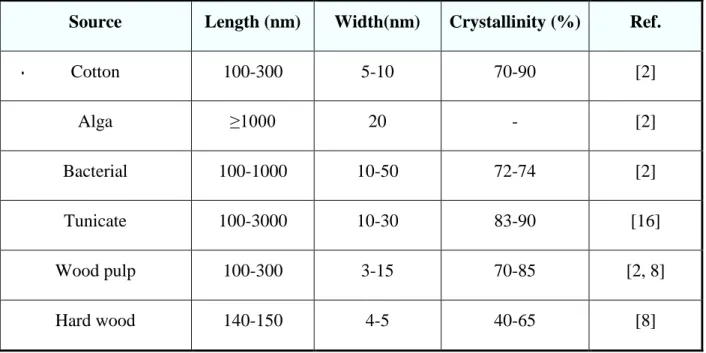
The source of cellulose materials affects the dimensions and the degree of crystallinity of produced CNC (Table 2.1) [1, 53, 54].
Table 2-1.The crystallinity and dimensions of CNC provided from different sources
Source Length (nm) Width(nm) Crystallinity (%) Ref.
Cotton 100-300 5-10 70-90 [2] Alga ≥1000 20 - [2] Bacterial 100-1000 10-50 72-74 [2] Tunicate 100-3000 10-30 83-90 [16] Wood pulp 100-300 3-15 70-85 [2, 8] Hard wood 140-150 4-5 40-65 [8]
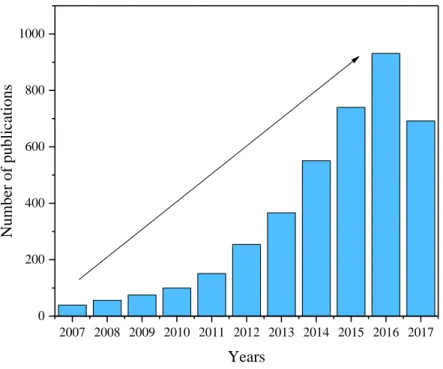
CNC has attracted significant interest of researchers during recent years, largely attributed to the potential of cellulose nanocrystals to be used as a renewable and rigid nanomaterial. The number of publications on cellulose nanocrystals considering all mentioned terms in recent years are presented in Fig 2.4. Several names and abbreviations have been used for this nanomaterial in literature; “rod-like cellulose microcrystals”,“nanocrystalline cellulose”, “cellulose nano whiskers” and “cellulose nanocrystals”. TAPPI’s International Nanotechnology Division recommended cellulose nanocrystals as standard term for this nanomaterial in 2011.
2007 2008 2009 2010 2011 2012 2013 2014 2015 2016 2017 0 200 400 600 800 1000 Years Number of publ ications
Figure 2.4. The number of publications on cellulose nanocrystals in recent years (Web of Science2).
2.2. The structure and properties of cellulose nanocrystals
2.2.1. The chemical structure of CNCOne of the most specific characteristics of CNC is the presence of three hydroxyl groups in each unit of CNC resulting a reactive surface with multiple active hydroxyl groups (Fig 2.2). These hydroxyl groups depending on their position act as a primary or secondary alcohol [55, 56]. Intermolecular and intramolecular hydrogen bonding occur between OH groups of CNC; Intramolecular hydrogen bonds occur between the oxygen of glucose unit (O) and OH group of the C3 carbon [56]. The intermolecular hydrogen bonds occur between the oxygen of glucose units and
other OH groups[57] (Fig 2.2).
As mentioned in Chap. 1, the sulfate half-ester groups are introduced on the CNC surface during sulfuric acid hydrolysis via an esterification reaction (sulfation) between surface hydroxyl groups and H2SO4 molecules. Therefore, the surface of CNC is highly negatively charged, which leads to
well-dispersed aqueous colloidal suspensions due to the presence of OSO3-. The surface charge of
CNC can be controlled through the duration time and temperature of acid hydrolysis [58, 59]. Phosphate [60] and carboxyl [61] groups can also be introduced on CNC surface during acid hydrolysis. However, commercial CNC are produced through sulfuric acid hydrolysis [58, 59]. The sulfate half-ester groups on the surface make CNC hydrophilic and, therefore, incompatible with hydrophobic matrix. This results in low mechanical properties and inefficient reinforcement because of poor dispersion induced by inferior interfacial interactions between CNC and non-polar polymer matrix [62] .
2.2.2. The morphology and surface properties of CNC
CNC have a rod-like or needle-like morphology (Fig.2.5). The morphology and geometrical dimensions of CNC are varied depending on its cellulosic source (Table 2.1) [2, 53, 63]. In addition, the dimensions of CNC also depend on the hydrolysis conditions [2, 64, 65]. The dimensions of commercial cellulose nanocrystals3 are 7 ± 3 nm diameter and 120 ± 8 nm long, giving a high geometric average aspect ratio in the range of 11 to 32. The dimensions and ion strength of CNC affect the CNC surface properties and play an important role in the behavior of CNC in different media [8, 66-69].
Figure 2.5. Morphology of CNC: (a) Scanning electron microscopy (SEM); (b) transmission electron microscopy (TEM); (c) Atomic Force Microscopy (AFM) [70].
The specific surface area of CNC (50-150 g/m2) is depend on its particle size. Dufresne et al. reported the variation of CNC specific surface area as a function of diameter ( Fig 2.6) [71].
Figure 2.6.The variation of CNC specific surface area as a function of diameter[71]. (Density of 1.5 g cm-3)
2.2.3. Mechanical properties of CNC
Cellulose nanocrystals possess attractive mechanical properties that can vary based on their source, morphology, geometrical dimensions, crystal structure, degree of crystallinity as well as
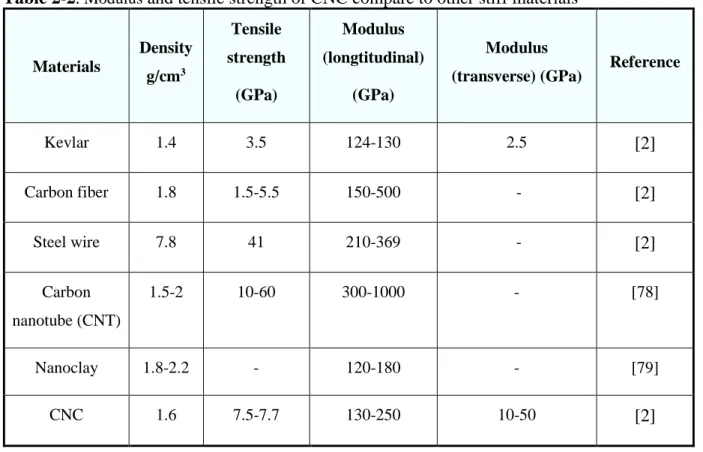
the synthesis process [2, 64, 72-74]. The mechanical properties of CNC are also varied in two directions attributed to rod-like shape of this nanomaterial; the tensile strength of CNC is in the range of 7.5–7.7 GPa while the axial modulus ranges from 110-220 GPa [2, 75-77]. These remarkable mechanical properties are within the range of other nanofillers, such as clay nanoplatelets or carbon nanotubes [2]. The modulusand tensile strength of CNC compared to other stiff materials are in the range that would qualify them for use as nanofillers in polymer matrix (Table 2.2). However, the low density , its high potential for surface modification, and its renewable and biodegradable nature distinguishes it from the other nanofillers [9].
Table 2-2. Modulus and tensile strength of CNC compare to other stiff materials
Materials Density g/cm3 Tensile strength (GPa) Modulus (longtitudinal) (GPa) Modulus
(transverse) (GPa) Reference
Kevlar 1.4 3.5 124-130 2.5 [2] Carbon fiber 1.8 1.5-5.5 150-500 - [2] Steel wire 7.8 41 210-369 - [2] Carbon nanotube (CNT) 1.5-2 10-60 300-1000 - [78] Nanoclay 1.8-2.2 - 120-180 - [79] CNC 1.6 7.5-7.7 130-250 10-50 [2] 2.2.4. Thermal properties of CNC
Many parameters influence the thermal stability of CNC, such as type, temperature and time of acid hydrolysis as well as the concentration of acid during the process [36, 80]. These parameters
also affect the degree of crystallinity of CNC [36, 80-83]. The onset temperature for CNC degradation was reported in literature in the range of 230–280°C [36, 80-83]. Moreover, the presence of acid sulfate groups decrease the thermal stability through the dehydration reaction [84]. Usually, the higher number of sulfate groups on the surface of CNC, the lower the degradation temperature [84]. If hydrochloric acid is used instead of sulfuric acid to hydrolyze the cellulose, the thermal stability of the prepared CNC improves, but the nanocrystals tend to aggregate due to a deficiency of electrostatic repulsion [85].
2.3. The market and applications for CNC
CNC have unique properties such as excellent mechanical properties, high aspect ratio, renewability, biodegradability, as well as lower cost versus common nanomaterials (carbon nanotubes, nanoclay, etc.), leading to an increase in the its applications in recent years. The production of CNC in industrial scale and the use of this nanomaterial in industrial application are the main subjects in this field.
Alberta Innovates-Technology Futures has constructed the first pilot plant to produce cellulose
nanocrystals in the world. The joint venture of Domtar Corp. and FPInnovations (CelluForce) built a large commercial-scale plant to produce cellulose nanocrystals in North America. The world production capacity of cellulose nanocrystals in 2015 are presented in Table 2.3.
Table 2-3.The production capacity of cellulose nanocrystals in 2015 [86]
Company Capacity (kg/day)
CelluForce, Canada American Process, U.S
Holmen, Sweden Alberta Innovates, Canada
US Forest Products
Blue Goose Bio-refineries, Canada India Council for AG Research
FPInnovations, Canada 1000 500 100 20 10 10 10 3
Figure 2.7.Global nanocellulose market 2015-2021(adapted from [87]).
North America will have the high demand for CNC and its end-user industries by 2020 [86]. The market size of CNC in terms of capacity and value will have large annual growth in the future years[87](Fig 2.7). On the other hand. it is predicted that more than 30% of CNC would be consumed in polymer composite to prepare polymer nanocomposites [88] due to their unique properties as well as its low cost4 compared to other nanomaterial such as carbon nanotube (Fig 2.8).
Figure 2.8.Forcasting of CNC demand in 2017 in different application fields (adapted from [88]). The properties of CNC surface affect the fabrication process as well as the properties of produced composite (nanocomposite)[2, 89]. The fabrication of nanocomposite using commercial polymers as matrix and CNC has been mostly unsuccessful due the hydrophilic properties and poor compatibility of this nanofiller with hydrophobic polymer, restricting it use in hydrophilic or water-soluble polymers [12-14, 90]. In other words, the one of the major blockade in industrial production of CNC/polymer nanocomposites and developing applications for CNC is to achieve a good dispersion of CNC in common polymers such as polyolefins. Therefore, modification is necessary to improve the compatibility between the CNC and host polymer [91].
The dispersibility of CNC in polypropylene (PP) and polylactic acid (PLA) was studied by
Khoshkava et al., [62]. They reported that, the interfacial surface properties of CNC and host
matrices strongly affect the dispersibility of CNC in polymer. They showed the effect of CNC surface modification on the dispersion level of CNC and resulting mechanical properties of polymer nanocomposite. In the other work, the dispersion level of modified CNC using polyethylene oxide in low density polyethylene (LDPE) was studied and the dispersibility improvement and reduced thermal stability of the CNC were demonstrated [82].
The effect of polypropylene molecular weight on dispersion and mechanical properties of CNC-PP composite in the presence of a compatibilizer using different processing methods was investigated by Sojoudiasli et al. [89]. They demonstrated that the low molecular weight PP
15% 7% [] 4% 7% 30% [] 8% 5%
[]% Film and coating
Medical science Filtration Construction Electronic Composite Oil industries Rheological modifier Aerogels
composite produced via twin-screw extrusion had higher mechanical properties than the composite produced through internal batch mixer due to the better dispersion of CNC in the PP matrix. In another study, the dispersion level of CNC in a solution of polylactide was investigated by
Bagheriasl et al. [92] using rheological methods.
The core of most of studies in fabrication of CNC/polymer nanocomposite is mechanical properties of nanocomposites. Nevertheless, the barrier properties of CNC composite are also interesting [93, 94]. The crystallinity nature of CNC as well as its compacted network can decrease permeability of CNC/polymer composites [93, 94].
Cellulose nanocrystals can also be used in medical applications:
• CNC was proposed as an agent for protein/enzyme immobilization due to its nonporous structure as well as its large surface area [95].
• CNC also was proposed for drug delivery due to biocompatibility and its unique properties [96].
• Due to high surface area and possibility of CNC functionalization, CNC was proposed to produce bio-sensors and bio-imaging systems [97].
2.4. Colloidal stability of particles
Colloidal stability is achieved through a balance between the attraction and repulsion forces between adjacent particles.
2.4.1. Theories of colloidal stability
The stabilization of particles against aggregation can occur through two main mechanisms, (depending to the type of repulsion force):
• Electrostatic stabilization • Steric stabilization
• Electrostatic stabilization
Balancing between attractive van der Waals forces and repulsive Coulomb forces of charged particles lead to electrostatic stabilization of colloids. Charged colloidal particles, for example, sulfated CNC, are stabilized by the electrostatic repulsive force between the particles. When two particles become close, the electric double layer (EDL) around the particles prevents their aggregation and keeping them apart [2, 10]. On the other hand, the charge of particles play an important role in the electrostatic stabilization of colloids. The schematic of electric double layer and the potential energy of the interaction between two particles are presented in Fig 2.9.
(a) (b)
Figure 2.9 a) Potential energy of the interaction; b) the schematic of electric double layer between two particles (adapted from [98]).
The maximum value of the electrical potential is on the particle surface. With increasing distance from the surface, this potential drops and reaches 0 at the boundary of EDL (Fig 2.9a) [98]. The electric potential at the slipping plane is called Zeta potential. This value has an important role in interaction and stabilization of colloidal particles.
A linear model between the electrical potential ψ on the surface of particle and the distance from the surface has been developed by Helmholtz's as classical electrical double-layer model [98] (Eq.2.1.):
ᴪ=
4𝜋𝛿𝜎𝜀 Eq. 2.1
where;
δ: the thickness of the fixed layer; σ: the density of surface charge;
ε: the dielectric constant of the solution.
Another theory about the stability of colloidal system was developed by Deryagin, Landau, Vewey and Overbeek (DLVO) in 1940. In the DLVO theory, some assumptions are considered:
• Very low concentration of the dispersed phase;
• Only van der Waals forces and electrostatic forces have role on the dispersed particles; • The distribution of charges is uniform on the surface of particles;
• Brownian motion, electrostatic forces and entropic dispersion determine the distribution of ions.
According to the DLVO theory, potential energy of particles (VT) including attractive interaction
due to van der Waals force (VA) and the potential energy of the repulsive electrostatic interaction
(VR) determine the stability of colloidal system (Eq.2.2)[98] .
VT = VA + VR Eq. 2.2
Considering spherical particles:
VA = - Ar/(12x) Eq. 2.3
where:
A: Hamaker constant r: radius of the particles
x: distance between the surface of particles
VR = 2πεε0rζ2e-kx Eq. 2.4
where:
ζ : zeta potential
k-1: the characteristic length of the electric double layer ε : dielectric constant of the solvent
ε0 : permittivity in vacuum
As shown in Eq.2.4, VR is proportional to square of the zeta potential and as a result VT is strongly
affected by the value of the zeta potential. On the other hand, the zeta potential is one of the main parameters known to affect the colloidal stability.
• Steric stabilization
Polymers can be adsorbed on particle surfaces and affect colloidal stability through the prevention of aggregation by repulsion in colloidal systems [99]. There are two types of polymeric stabilization [100, 101] (Fig 2.10);
• Steric stabilization of colloids: polymer attached to the particle surface and covering the particle, which produce a repulsive force and separates the particle from the neighbour particles.
• Depletion stabilization of colloids; free polymer (non-adsorbed molecules) separate the particles through repulsive forces between the particles.
Figure 2.10.Stabilization of a colloidal system by a polymer (adapted from [101]).
2.4.2. Effect of polymer adsorption on the colloidal stability
The adsorption of polymer molecules from solution is one of the common method for surface
modification of particles such as CNC. The polymers molecules can be adsorbed through non-covalent (physically) or covalent (chemically)) interaction onto the surface of particles [102].
• Polyelectrolytes
Polyelectrolytes are water soluble polymers, which are charged (positively or negatively) in aqueous media. Polyelectrolytes have a wide range of charge density and molecular weight. Depending on their charge, these polymers adsorb onto charged surfaces through electrostatic attraction [103]. Depending on their molecular weight and structure, these polymeric molecules can have several dimensions (a few to several hundred nm) and can make a thin layer around the particles, which affect their state of dispersion. Polyelectrolytes play different roles in the stability of colloidal particles depending on the thickness of the layer, molecular weight, degree of surface coverage and chemical structure [104]. Polyelectrolytes determine the behavior of colloidal system (such as CNC colloidal system) by two main mechanisms:
a) Charge neutralization
CNC produced through the acid sulfuric hydrolysis, is dispersed in aqueous suspensions due to repulsion between their negatively charged surfaces. According to the charge neutralisation mechanism, the adsorbed cationic polyelectrolyte neutralises the negative charges on the particle surface (zero charges). By increasing the amount of polyelectrolyte beyond what is required to reach zero charge, the particle charge can be reversed and the suspension stabilized (again) [38] as also described by the DLVO theory [104].
b) Bridging of particles by polymer chains
In this mechanism, the adsorbed polymer can make bridges between the particles. Flocculation through bridging is more likely at 50% (or less) particle surface converge [45, 46]. With increasing surface coverage, the possibility of steric stabilization increases. In addition, to induce bridging, the polymer chains should also extend beyond the EDL [47, 48].
Some parameters can affect the extension level of polymer chains such as molecular weight, polymer structure, kinetic effects, amount of surface coverage and polymer conformation (from equilibrium conformation to a flatter geometry) over time as well as ionic strength [105]. In addition, from bridging between the particles to occur, the adsorption density should not be too
high [106]. In other words, bridging can occur if there is a sufficient unoccupied surface on the particles to allow attachment of adsorbed polymer chains from other particles. The bridging mechanism is more likely to occur with linear and high molecular weight polymers with low or medium charges [107].
It should be mentioned that dispersion or stabilisation require a higher surface coverage of adsorbed polymer than what is needed for flocculation [99].
2.5. Surface modification of CNC
As mentioned in section 2.3, the main challenge of developing the CNC as nanofillers is its tendency to form agglomerates due to the strong interparticle hydrogen bonding [15, 16], particularly in non-polar media. The dispersion state or self-agglomerations states of CNC in their surrounding media will determine the properties of systems and predict the applications [108, 109]. In order to improve the dispersion of cellulose nanocrystals in organic solvents, several surface treatments or modifications can be performed [19]. CNC have a highly reactive surface that can be easily functionalized and, hence, tuned by chemical modification[19, 108, 109]. CNC surface modification can be divided into two main categories: covalent and non-covalent approaches (Fig .2.11).
Figure 2.11.The different methods of CNC surface modification.
2.5.1. CNC surface modification using covalent methods
Various covalent approaches have been developed to functionalize CNC surface and to improve its hydrophobic properties [19] such as; oxidation [23], esterification [21], etherification [22], silane treatment [110], acetylation [20, 111], polymer grafting [25] and gas phase treatments [26, 27].
• Esterification
Surface esterification is the most common method for the chemical modification of CNC surface [58, 112]. In this method through the condensation reaction, carboxylic acid group (COOH) and an alcohol groups are introduced on the surface of CNC. Acetylation is the one of the simple method of esterification [113] which in that acetyl groups are introduced on the surface of CNC (Fig 2.12).
Figure 2.12. Esterification of CNC surfaces (adapted from [113]). • Etherification
Nowadays, etherification is used as a chemical pre-treatment step for defibrillation of the cellulose fibers. This process is performed by the activation of fibers using alkali hydroxide (mostly sodium hydroxide) in aqueous media and converting of hydroxyl groups (Fig 2.13) using mono chloro acetic acid or sodium salt to carboxymethyl units (Fig 2.13) [114]. Nevertheless, this process has many drawbacks due to the use of toxic halocarbon reagents. In addition, the hydrophilicity level of the produced CNC increased compared to the original one, which can increase the problems of CNC dispersion in non-polar media and limit CNC applications.
Figure 2.13. The etherification reaction of surface hydroxyl groups of CNC [114].
• Oxidation
In this method through the oxidation reaction with the help of 2,2,6,6-tetramethylpiperidine 1-oxyl (TEMPO) and a secondary oxidant -sodium hypochlorite or sodium chlorite- (to recycle the TEMPO) carboxyl and aldehyde groups are introduced on the surface of CNC (Fig.2.14). The
efficiency of this reaction is strongly dependent on several parameters such as reaction conditions and the purity of raw materials [115]. In addition, the reaction is very sensitive to pH changes for example, at pH below 8.0 the reaction rate is very slowly and also selectivity between primary and secondary alcohols[115, 116].
Figure 2.14. The surface oxidation of CNC to carboxylate groups by TEMPO oxidation in water[116].
•
Isocyanate couplingIn this method of CNC surface modification, a chemical reaction occurs between the isocyanate groups and hydroxyl groups of CNC. This method of CNC functionalization is not common as much as the previous methods due to the high price and high toxicity level of raw materials, which restrict its application. However, it has some advantages compared to other chemical modification method namely; chemical stability of urethane unit, high reaction rate as well as the absence of by products during modification process [117] .
• Polymer grafting
Polymer (or copolymer) grafting is an another approach to chemical surface modification of CNC[118]. This method is preformed by the grafting (or in situ polymerization) of polymer chains
onto the surface of CNC(Fig 2.15) [119]. The methods of polymer grafting onto the surface of cellulosic materials can be divided on three main groups; (1)free radical polymerization, (2)ring-opening polymerization and (3)living radical polymerization [118, 120].
Figure 2.15. Schematic of polymer grafting on CNC surface (adapted from [118]).
As mentioned, ring opening polymerization (ROP) is used to graft and surface functionalize CNC [121]. Goffin et al. reported the grafting of poly L-lactic acid (PLLA) chains using ROP on the CNC surface without any impact on the crystallinity degree and morphology [122]. However, the thermal stability and mechanical properties of the functionalized CNC decreased due to the crystallization behavior and the presence of polymer short chains.
The grafting of polycaprolactone (PCL) on CNC (Fig 2.16) using stannous octoate (Sn(Oct)2) as
a catalyst was also reported [123]. In this work, the grafted PCL chains were long enough and they did not show negative effect on the properties of CNC. They reported the compatibility of PCL-g-CNC with PCL matrix. However, the compatibility of grafted PCL-g-CNC with another matrix has not been reported.
Figure 2.16. Grafted PCL on CNC surface using stannous octoate [123].
• Gas phase treatments
Gas phase treatments (solvent free approaches) are a new stream for surface functionalization. Heat, light and plasma can be used to functionalize substrates [27]. However, very little work has been conducted in the gas phase for CNC. Javanbakht et al. [26] modified the surface of CNC using gas-phase photo-initiated chemical vapor deposition (PICVD). In this study, the surface modification of the CNC was performed using a PICVD micro-reactor. In the process of surface modification, CNC was first mechanically dispersed in toluene and deposited onto polished copper, then, it was placed inside the tubular reactor. Afterwards, a gas mixture of H2 and CO was injected
and irradiated by two UV lamps. They demonstrated that this technique improves the compatibility of CNC surface with semi-polar and non-polar solvents. These methods are efficient and eco-friendly, However, in terms of process cost, this method requires specific equipment which may increase the production cost and hence, remain limited to higher value-added products.
Work conducted on cellulose in the gas phase may also be an interesting source of complementary information in this field. Couturaud et al. reported an increase in the compatibility of cellulose and poly(L-lactide) film as hydrophobic surface through plasma-induced grafting of L-lactide[124].
• Click chemistry
The clicking approach is also a new approach to surface engineering [125]. Recently,
Feese et al. used the Cu(I)-catalyzed Huisgen–Meldal–Sharpless 1,3-dipolar cycloaddition
performed using click chemistry [127]. However, due to overall cost of click chemistry methods, they will be limited to specific cases.
As highlighted in the various descriptions, covalent modification methods are often time-consuming and involve the use of organic solvents, which can cause major environmental
issues and increase the production expenses [27]. It is noteworthy that the chemical modification can change the structure of cellulose to some extent and consequently decrease the mechanical and thermal properties [28, 128].
2.5.2. CNC surface modification using non-covalent methods
Non-covalent surface modification through the physical adsorption of a surface modifier (surfactant) is another approach for CNC surface modification [30, 32]. Theoretically, coating the surface of CNC using a surfactant through simple mixing is the easiest method to increase the compatibility of CNC with non-polar media. Indeed, the adsorption of a surfactant (or polymer) on CNC should be easier to control than chemical reaction for modification [129]. Non-covalent surface modification of CNC can be done through cationic or non-ionic methods [28, 55].
Owing to the presence of negatively charged groups on commercial CNC surfaces, cationic surface modification is a more common non-covalent method to modify CNC surface [30-32]. However, non-ionic CNC surface modification has also been reported [130, 131].
The improvement of the CNC dispersion in organic solvents using a non-ionic surfactant (sorbitan monostearate) was reported by Kim et al. [132]. Based the results of turbidity analysis, they reported that the concentration of surfactant can determine the stability of the modified CNC in surrounding media. Recently, Zhou et al.[131] reported a new approach for non-ionic CNC surface modification based on the adsorption of saccharide-based amphiphilic block copolymers. They showed that the adsorption of xyloglucan oligosaccharide-poly (ethylene glycol)-polystyrene triblock copolymer onto the surface of CNC increases the dispersibility of CNC in non-polar solvents.
• Cationic surface modification
As mentioned in section 2.1, commercial CNC contain sulfate half-ester groups (OSO3-) on the
surface. These groups form an electrostatic layer around the particles leading to a stable CNC aqueous suspension. In the other hand, these negative charges promote the electrostatic adsorption of cationic groups on the surface of CNC.
Heux et al. [29] used a phosphoric ester of polyoxyethylene 9-nonylphenylether (Beycostat NA)
as a cationic surface modifier to prepare stable suspensions of CNC in non-polar solvents. They mentioned that a low weight ratio of surfactant to CNC (< 4 wt. %) in suspensions was not sufficient to obtain a good dispersion in organic solvents. The adsorbed amount of surfactant to achieve full coverage of CNC by the surfactant was determined to be 44-61%, corresponing to 0.79-1.56 g of surfactant per g of CNC. The method used by Heux et al. was a simple and effective technique to improve the dispersion level of CNC in non-polar media. However, to achieve efficient surface coverage a high amount of modifier was used, which affected the properties of final product. In a subsequent study, these modified CNC were nevertheless used to reinforce a polypropylene (PP) matrix [18] with improved dispersion. The enhancement of CNC dispersion in a low polarity solvent (tetrahydrofuran (THF)), through cationic surface modification with hexa-decyl-trimethylammonium bromide (HDTMA) as a cationic surfactant was also reported [33] . Ansari et
al. [133] modified CNC using a cationic surfactant (dedecyltrimenthylammonium chloride)
through interactions between the positively charged ammonium groups and the negatively charge half-ester sulphate group. They found that the modified CNC showed superior mechanical properties in poly vinyl acetate due to the improvement of interfacial interaction as well as the improved dispersion level in the polymer matrix.
2.6. Conclusion of the literature review and organization of the thesis
There are several obstacles to modify the interactions of CNC with host matrix and develop the applications for this nanomaterial to enter the market of commercial nanofillers.
Various studies have been performed to change the surface properties and increase the compatibility of CNC with non-polar matrix. As mentioned, each covalent and non-covalent approaches have some limitations and restrictions. In the most developed methods of CNC surface
modification through the non-covalent approaches, large amounts of surface modifier are required to cover the CNC surfaces, which can affect the properties of the prepared composite and increase the cost of the final products. Until now, no industrial CNC modification method to improve their use in polymer composites has been reported. Therefore, to develop the CNC market and CNC applications, it is necessary to find a novel and effective surface modification method, which can be easy applied in industrial scale with minimum cost.
In this work, a cationic polymer, polyethyleneimine (PEI), is used to modify the surface of CNC. PEI has a high density of amine groups and a unique branched structure capable of binding with negative groups of the CNC surface at low concentrations. Recent studies have already demonstrated that PEI is an appropriate candidate to functionalize carbon fillers and improve the mechanical interfacial properties of composites [134].
The main objective of this work is to modify CNC surface through a low cost, efficient and eco-friendly process using PEI, to change the surface properties and increase the compatibility of CNC with non-polar media. The results of CNC modification with PEI are discussed in Chapter 3. In addition, the modification of CNC surface properties using two grades of a bio cationic polymer (chitosan) were also preliminary investigated and their results are presented in Chapter 4.
CHAPTER 3
CNC SURFACE MODIFICATON WITH PEI
3.1. Materials
➢ Cellulose nanocrystals (CNC)
Spray-dried cellulose nanocrystals (CNC) obtained through sulphuric acid hydrolysis of commercial dissolved softwood pulp were supplied by CelluForce (Canada). TheCNC was used in samples modification without any treatment.
➢ Polyethyleneimine (PEI)
PEI exists in both linear and branched molecular structures; a branched PEI contains all types of primary, secondary and tertiary amine groups while a linear PEI contains only secondary and primary amine groups[41]. This cationic polymer exhibits one of the highest charge densities among polyelectrolytes when protonated in aqueous solution [42]. The study of intrinsic viscosity and small-angle neutron scattering of aqueous solutions of branched PEI showed that the conformation of this polymer does not change significantly over the pH range of 2 to 11, due to its highly branched structure [105, 135]. In this study, branched PEI purchased from Sigma Aldrich
Canada was used (99% purity, Mw 25,000 g mol-1, polydispersity 2.5, density 1.030 g mL-1).
3.2. Preparation of samples
In a typical batch of CNC modification, spray-dried CNC were added in deionized (DI) water at pH 6.8. An ultrasonic homogenizer (Cole-Parmer model CP505 500 W) was used to disperse CNC in DI water at a total energy dose of 2000 J/gCNC. Ultrasonication was carried out in an ice bath to
avoid local temperature increases and de-esterification of CNC surface groups [8]. To increase efficiency, ultrasonication was applied in three steps at progressively lower concentrations 1) 500 J/gCNC at CNC concentration of 2 wt. %; 2) diluting the suspension to 1.5 wt. % of CNC and
applying 500 J/gCNC and 3) decreasing the concentration to 1 wt. % and applying an additional
1000 J/gCNC.
PEI was separately dissolved in DI water (at a concentration of 0.001g.mL-1) at pH 6.8. To promote dissolution, it was heated at 50 °C and mechanically stirred using a magnetic stirrer for 30 min at
a speed of 300 rpm. Then, the PEI solution was diluted to concentrations of 0.0001, 0.0002 and 0.0005 g mL-1 . They were subsequently added dropwise to the CNC suspensions and mechanically stirred at 50 °C at a speed of 500 rpm for 4 h. Modified CNC suspensions with 1 wt. % CNC concentration and different PEI/CNC ratios were prepared. No pH adjustment was done. The PEI/CNC suspensions were quickly frozen at -20 °C for 48 h and then were put into a freeze-dryer (FreeZone 2.5 plus, Labconco, Kansas City, MO) for 72 h under vacuum (temperature of internal chamber -87 °C), yielding a white flaky dried modified CNC (mCNC). Modified CNC were used for characterization in further sections.
PEI (g) CNC (g)
• PEI/CNC 1% 0.01 1.00
Modified CNC samples • PEI/CNC 2 % 0.02 1.00
• PEI/CNC 5% 0.05 1.00
.
Figure 3.1.Schematioc illustration of CNC surface modification with PEI
3.3. Characterization of modified CNC
3.3.1.X-Ray Photoelectron Spectroscopy (XPS)XPS was used to characterize the surface of mCNC. C1s, O1s and N1s high-resolution spectra of the pristine CNC and mCNC were obtained by XPS model VG ESCALAB 3 MKII. A fine powder of pristine CNC and mCNC was used in XPS characterization. During the analysis, the pressure of chamber was kept at 5×10⁻⁹ Torr. The take-off angle was fixed at 90◦ with respect to the sample surface. All spectra were obtained with a source of Mg Kα at 300W and the analyzed depth was less than 10 nm. In high resolution scans, the energy pass and energy step size were 20eV and 0.05eV respectively. The Shirley method was used to correct the background contribution [136].
0 200 400 600 800 1000 1200 0 20000 40000 60000 80000 100000 120000 140000 Count/s
Binding energy (eV)
280 282 284 286 288 290 292 1000 2000 3000 4000 5000 6000 Counts / s (Res id. × 2)
Binding energy (eV)
C1 C3 C2 0 200 400 600 800 1000 1200 0 20000 40000 60000 80000 100000 120000 140000 Counts/s
Binding energy (eV)
280 282 284 286 288 290 292 1000 2000 3000 4000 5000 6000 Counts / s (Res id. × 2)
Binding energy (eV) C1
C2
C3
Figure 3.2. XPS survey spectra and decomposition of C1s signal into its constituent contributions for (a,b) pristine CNC and (c,d) mCNC with PEI/CNC 2%
No nitrogen signal was detected for the pristine CNC within the investigated range in the survey scan (Fig. 3.2a). After surface modification, a nitrogen peak appeared around 400 eV (Fig. 3.2c), indicative of PEI presence on the CNC surface. This result confirmed the successful modification and the presence of amine groups onto the CNC surface, the similar results was also reported in the case of CNC stabilized with the cationic surfactant 2,3-epoxypropyl trimethylammonium chloride (EPTMAC) [35]. The high-resolution C1s peaks for pristine and mCNC were resolved into three Gaussian component peaks, giving further information about the structure of bonded carbons before and after surface modification (Fig. 3.2b and 3.2d): C-C or C-H at 285.0 eV (C3),
C-O at 286.6 eV (C1) and O-C-O at 288.1 eV (C3) [137]. The ratio between the area under the peaks representing C-O (C1) and O-C-O (C2) bonds within cellulose chains, remained approximately constant before (1.04) and after (0.97) surface modification. This indicates that the modification did not change the nature of underlying cellulose. However, a substantial increase in the percentage of C-C or C-H (C3) was observed due to the presence of alkane chains from PEI, further in agreement with Li et al. [35]. The nitrogen level gives an indication of the PEI affinity for surface adsorption. The successful surface modification was also confirmed through the increase of both C and N, as well as the decrease in the O/C ratio in the case of mCNC (Table 3.1).
Table 3-1. XPS analysis of CNC before and after surface modification with PEI
Name Binding Energy (eV) Identification
Relative atomic % Pristine CNC mCNC PEI/CNC 1 % PEI/CNC 2 % C1s 285.0 286.6 288.1 C-C or C-H (C3) C-O in cellulose (C1) O-C-O in cellulose (C2) 6.4 40.2 6.3 17.3 35.0 6.8 17.2 36.7 7.2 TOTAL 53.0 59.1 61.1 N1s 399.2 400.1 401.7 Amine Amide Protonated N - - - 2.4 1.1 0.3 2.1 0.9 0.3 TOTAL 0 3.8 3.4 O1s 531.4 532.6 533.2 O=C-N C-OH in cellulose C-O-C - 28.2 18.8 3.5 20.2 13.5 2.1 20.6 13.1 TOTAL 47.0 37.2 35.8
BE: Binding energy of corresponding atomic orbital
Survey O1s and N1s for pristine CNC and mCNC are presented in appendix A.
3.3.2. Fourier Transform Infrared spectroscopy (FTIR)
FTIR was used to chemically characterize the CNC before and after surface modification. A fine powder of dried pristine CNC and modified CNC (mCNC) was used in FTIR characterization. A
Perkin Elmer Spectrum 65 FTIR spectrometer equipped with a Zn/Sr crystal, in the range of 650–4000 cm−1 was used. For each sample 32 scans were recorded at a resolution of 4 cm−1.
Fig. 3.3 presents the FTIR spectra of pristine CNC and mCNC for different PEI/CNC ratios. All characteristic peaks of cellulose were observed in FTIR spectra of both pristine CNC and mCNC: at 1109 cm-1, 1162 cm-1, between 1300 and 1440 cm-1 and between 3100 and 3600 cm-1, related to O-H association, C-O-C stretching vibration, C-O stretching vibration, O-H bending vibration and O-H stretching vibration, respectively[138]. All these peaks showed the typical bonds of cellulose molecules and indicated that the surface modification did not affect the nature of CNC [139]. Moreover, two peaks at 2985 cm-1 and 1480 cm−1 (pointed by arrows on Fig. 3.3) appeared in the spectra of mCNC, which correspond to RxNH and NH3+ groups, respectively. The successful
surface modification of CNC was hence confirmed by the appearance of these two peaks in FTIR spectra of mCNC. The same peaks were observed for chemical grafting of PEI onto cellulose nanofiber [134].
4000
3500
3000
2500
2000
1500
1000
Pristine CNC
Absorbance [a.u]
Wavenumber (cm
-1)
Pristine CNC PEI/CNC 1 % PEI/CNC 2 %3.3.3. Particle size measurements through dynamic light scattering
Dynamic light scattering (DLS) was used to determine the equivalent hydrodynamic diameter of mCNC. Pristine CNC and mCNC were dispersed in DI water (pH 6.8) at a very low CNC concentration ( 0.05 wt.% ) [140, 141].Ultrasonication energy (2000 J/gCNC)was applied to the
suspensions. Particle size distribution of pristine CNC after applying 2000 J/gCNC ultrasonication
energy) is presented in Fig 3.4. DLS measurements were preformed using Malvern Zetasizer Nano-S (ZS) instrument with a detection angle of 173°. The non-invasive backscatter detection of light at an angle of 173° improved the sensitivity, reduced multiple scattering issues, and minimized the effects of large particle contaminants. All the measurements were performed at 25 °C and repeated three times to obtain the average values.
The equivalent hydrodynamic size (Z-average) and polydispersity index (PDI)5 of pristine CNC and mCNC are presented in Table 3.2. In this method, the diffusion of particles moving under Brownian motion are measured and converts to size using the Stokes-Einstein relationship:
D= KBT/6πηR Eq.3.1 D : Diffusion constant KB: Boltzmann's constant T: Temperature η: Solvent viscosity
R: The radius of equivalent spherical particle
Knowing that CNC particles are rod-like and Stokes Einstein equation is for the diffusion of spherical particles, the size of CNC particles measured by DLS is not the exact size of particle.
5 PDI is 0.0 for a perfectly uniform sample and PDI ≥ 0.7 (very broad distribution) indicates that sample is
However, the results can be used for comparison between different samples (before and after surface modification). 10 100 1000 10000 0 20 40 60 80 100 X Intensity (% ) Average diameter (nm) CNC/water 0.05 wt.%
Figure 3.4. The CNC particle size distribution in CNC water suspension at concentration of 0.05 wt.%
Table 3-2. Z-average hydrodynamic size and PDI of pristine CNC and mCNC at (T= 25 °C)
Sample Average diameter (nm) PDI
Pristine CNC 121 ±1 0.29 mCNC PEI/CNC 1% PEI/CNC 2 % 189 ±5 319 ±6 0.38 0.51
The hydrodynamic diameter of CNC increased after surface modification (Table 3.2). This is attributed to PEI adsorption onto CNC surface via strong electrostatic interactions and possible hydrogen bonding. Similar results were also reported by Huang et al. [81] for CNC modification with quaternary ammonium.
3.3.4. Zeta potential measurements
Zeta potential measurements were performed using Malvern Instruments Zetasizer (Nano ZSP). The samples were prepared as for DLS measurements at CNC concentration of 0.05 wt.%. The electrophoretic mobility of particles was measured and using the Smoluchowski equation, electrophoretic mobility values were converted to zeta potential values (ζ-potential). ζ-potential was measured at different pHs, adding solutions of HCl 0.1 M and NaOH 12 M. All measurements were done at 25 °C and the reported values were an average of 15 measurements.
The ζ- potential as a function of pHs for pristine CNC and mCNC are presented in Table 3.3.
Table 3-3. ζ- potential of pristine CNC and mCNC at different pH (T=25 °C)
Semple ζ- potential (mV) without pH adjustment ζ- potential (mV) pH 3.0 ζ- potential (mV) pH 7.0 Pristine CNC -52.0±2.1 (pH 6.7) -33.0±0.1 -54.0±5.2 mCNC PEI/CNC 1 % PEI/CNC 2 % -23.0±0.6 (pH 7.1) -20.0±2.7(pH 7.3) -2.0±1.5 18.0±0.7 -24.0±0.2 -20.0 ±4.2
![Figure 2.1.The chemical structural of the cellulose components from tree to the anhydroglucose molecule [50]](https://thumb-eu.123doks.com/thumbv2/123doknet/2352509.36590/19.918.111.808.546.860/figure-chemical-structural-cellulose-components-tree-anhydroglucose-molecule.webp)
![Figure 2.3.The isolation of cellulose nanocrystals through sulfuric acid hydrolysis (adapted from [52])](https://thumb-eu.123doks.com/thumbv2/123doknet/2352509.36590/20.918.113.803.569.817/figure-isolation-cellulose-nanocrystals-sulfuric-acid-hydrolysis-adapted.webp)
![Figure 2.6.The variation of CNC specific surface area as a function of diameter[71]. (Density of 1.5 g cm -3 )](https://thumb-eu.123doks.com/thumbv2/123doknet/2352509.36590/24.918.230.698.568.883/figure-variation-cnc-specific-surface-function-diameter-density.webp)
![Figure 2.8.Forcasting of CNC demand in 2017 in different application fields (adapted from [88])](https://thumb-eu.123doks.com/thumbv2/123doknet/2352509.36590/28.918.109.808.141.459/figure-forcasting-cnc-demand-different-application-fields-adapted.webp)
![Figure 2.9 a) Potential energy of the interaction; b) the schematic of electric double layer between two particles (adapted from [98])](https://thumb-eu.123doks.com/thumbv2/123doknet/2352509.36590/30.918.108.806.412.647/figure-potential-energy-interaction-schematic-electric-particles-adapted.webp)
![Figure 2.10.Stabilization of a colloidal system by a polymer (adapted from [101]).](https://thumb-eu.123doks.com/thumbv2/123doknet/2352509.36590/32.918.141.729.560.792/figure-stabilization-colloidal-polymer-adapted.webp)
![Figure 2.14. The surface oxidation of CNC to carboxylate groups by TEMPO oxidation in water[116]](https://thumb-eu.123doks.com/thumbv2/123doknet/2352509.36590/37.918.223.698.284.590/figure-surface-oxidation-carboxylate-groups-tempo-oxidation-water.webp)
