HAL Id: hal-00002221
https://hal.archives-ouvertes.fr/hal-00002221
Submitted on 16 Jul 2004
HAL is a multi-disciplinary open access
archive for the deposit and dissemination of
sci-entific research documents, whether they are
pub-lished or not. The documents may come from
teaching and research institutions in France or
abroad, or from public or private research centers.
L’archive ouverte pluridisciplinaire HAL, est
destinée au dépôt et à la diffusion de documents
scientifiques de niveau recherche, publiés ou non,
émanant des établissements d’enseignement et de
recherche français ou étrangers, des laboratoires
publics ou privés.
Observations of the State Transition of the X-ray
Transient and Black Hole Candidate XTE J1720-318
Marion Cadolle Bel, Andrea Goldwurm, Jerome Rodriguez, Paolo Goldoni,
Stephane Corbel, Patrick Sizun, Arvind Parmar, Eric Kuulkers, Fiamma
Capitanio, Melania Del Santo, et al.
To cite this version:
Marion Cadolle Bel, Andrea Goldwurm, Jerome Rodriguez, Paolo Goldoni, Stephane Corbel, et al..
INTEGRAL, XMM-Newton and Rossi-XTE Observations of the State Transition of the X-ray
Tran-sient and Black Hole Candidate XTE J1720-318. The 5th INTEGRAL Workshop: ”The INTEGRAL
Universe”, February 16-20, 2004, 2004, Munich, Germany. �hal-00002221�
ccsd-00002221, version 1 - 17 Jul 2004
INTEGRAL, XMM-NEWTON AND ROSSI-XTE OBSERVATIONS OF THE STATE TRANSITION OF THE X-RAY TRANSIENT AND BLACK HOLE CANDIDATE
XTE J1720-318
M. Cadolle Bel1, A. Goldwurm1,2, J. Rodriguez1,3,4, P. Goldoni1,2, S. Corbel1, P. Sizun1, A.N.
Parmar5, E. Kuulkers5, F. Capitanio6, M. Del Santo6, A. Tarana6, P. Ubertini6, J.P. Roques7, L. Bouchet7, R. Farinelli8, F. Frontera8, and N.J. Westergaard9
1Service d’Astrophysique, DAPNIA/DSM/CEA - Saclay, 91191 Gif-sur-Yvette Cedex, France 2F´ed´eration de Recherche APC, 11 place M. Berthelot, 75231, France
3Integral Science Data Center, Chemin d’Ecogia, 16, CH-1290 Versoix, Switzerland 4CNRS FRE 2052, France
5Research and Scientific Support Department, ESA, ESTEC, NL-2200 AG Noordwijk, The Netherlands 6IASF-CNR, via del Fosso del Cavaliere 100, 00133 Roma, Italy
7Centre d’Etude Spatiale des Rayonnements, CNRS, Toulouse Cedex 4, France 8Physics Department, University of Ferrara, 44-100, Ferrara, Italy 9Danish Space Reasearch Institute, DK-2100 Copenhagen 0, Denmark
ABSTRACT
We report the results of extensive high-energy ob-servations of the X-ray transient and black hole can-didate XTE J1720-318 performed with INTEGRAL, XMM-Newton and RXTE. The source, which un-derwent an outburst in January 2003, was observed in February in a spectral state dominated by a soft component with a weak high-energy tail. The XMM-Newton data provided a high column density NH of
1.2 × 1022 cm−2 which suggests that the source lies
at the Galactic Center distance. The simultaneous RXTE and INTEGRAL Target of Opportunity ob-servations allowed us to measure the weak and steep tail, typical of a black-hole binary in the so-called High/Soft State.
We could follow the evolution of the source outburst over several months using the INTEGRAL Galac-tic Center survey observations. The source regained activity at the end of March: it showed a clear tran-sition towards a much harder state, and then de-cayed to a quiescent state in summer. In the hard state, the source was detected up to 200 keV with a typical power law index of ∼ 1.8 and a peak lumi-nosity of 7.5×1036 ergs s−1 in the 2-100 keV band,
for an assumed distance of 8 kpc. We conclude that XTE J1720-318 is indeed representative of the class of the black hole X-ray novae which populate our Galactic bulge and we discuss its properties in the frame of the spectral models used for transient black hole binaries.
Key words: Black hole physics; accretion; X-rays bi-naries; gamma-rays: observations; stars: individual: XTE J1720-318.
1. INTRODUCTION
X-ray Novae (XN) are low mass X-ray binaries where a compact object normally accretes at very low rate from a late type companion star (Tanaka & Shibazaki 1996). Although they are usually in quiescent state (and therefore nearly undetectable), they undergo bright X-ray outbursts, with recurrence times of sev-eral years, which last sevsev-eral weeks or even months before the source returns to quiescence again. Most of the XN are associated to dynamically proven Black Holes (BH) and indeed the great majority of the known 18 Black Hole Binaries (BHB) as well as of the 22 binary Black Hole Candidates (BHC) are tran-sients (McClintock & Remillard 2003). Because of large changes in the effective accretion rates that occur during the XN outbursts and the very hard spectra they usually display, these sources are very useful to study accretion phenomena and radiation processes at work in BH, and are primary targets for high-energy instruments.
Since XN probably follow the Galactic stellar dis-tribution, they are concentrated in the direction of the bulge of our Galaxy (with a higher concentra-tion towards the center). The SIGMA gamma-ray telescope onboard the GRANAT satellite, and later the hard X-ray instruments onboard CGRO, RXTE and Beppo-SAX indeed discovered and studied sev-eral (about 10) BHC XN in the bulge. INTEGRAL, the INTErnational Gamma-Ray Astrophysical Lab-oratory (Winkler et al. 2003) is a European Space Agency observatory that began its mission on 2002 October 17, carrying four instruments: two main gamma-ray instruments, IBIS (Ubertini et al. 2003) and SPI (Vedrenne et al. 2003), and two monitors, JEM-X (Lund et al. 2003) and OMC (Mas-Hesse
et al. 2003). The IBIS coded mask instrument is characterised by a wide Field of View (FOV) of 29◦×29◦ (9◦×9◦ fully coded), a point spread
func-tion of 12’ FWHM and a sensitivity over the energy range between 20 keV and 8 MeV. Thanks to its in-struments performances and to the survey program specifically dedicated to the Galactic Center (GC) region, INTEGRAL is expected to allow the detec-tion and the study of BH XN at a large distance and at weaker flux levels than before.
XTE J1720-318 was discovered on 2003 January 9 with the ASM monitor onboard RXTE as a tran-sient source undergoing an X-ray nova like outburst (Remillard et al. 2003). The source flux increased to the maximum value of ∼430 mCrab in 2 days, and then its flux started to decay slowly. Follow up observations of the PCA array onboard RXTE, have shown the presence of a 0.6 keV thermal com-ponent and a hard tail. The spectral parameters and the source luminosity suggested a BH (Mark-wardt 2003) in a High/Soft State (HSS). Soon after, a radio counterpart was identified with the VLA and ATCA radio telescopes (Rupen et al. 2003; O’Brien et al. 2003), leading to the estimate of the most precise position αJ 2000 = 17h19m58.985s, δJ 2000 =
−31◦45′01.109′′(uncertainty± 0.25′′). The detection
of its infrared counterpart (Nagata et al. 2003) im-plies an extinction compatible with the location of XTE J1720-318 at large distance.
XTE J1720-318 was observed by XMM-Newton, RXTE and INTEGRAL in February during dedi-cated Target of Opportunity (ToO) observations. It was then observed by INTEGRAL during the sur-veys of the GC region performed in March and April and again from August to October 2003. We report in this paper the results based on these observations, starting with the description of the available data and of the analysis procedures employed (Section 2). We then report the analysis results in Section 3 and we will discuss them in Section 4.
2. OBSERVATIONS AND DATA REDUCTION XTE J1720-318 was observed by XMM-Newton on 2003 February 20, during a public 18.5 ks ToO. Preliminary analysis of these data provided an im-proved X-ray position of the source (Gonzalez-Riestra et al. 2003) confirming the association with the radio and IR source. One week after, we performed an INTEGRAL ToO observation of XTE J1720-318 which started on 2003 February 28 for a 176 ks exposure. The latter was conducted in coordination with a RXTE ToO observation which lasted about 2 ks. The source was further observed during the INTEGRAL Core Program during a se-ries of exposures dedicated to the GC survey, from March 25 to April 19 for a total of 551 ks observing time. Another 75 ks exposure on the source has been accumulated during a ToO observation of H 1743-322 (Parmar et al. 2003) in April 2003. The field containing XTE J1720-318 has also been extensively monitored in the fall of 2003 during the second part
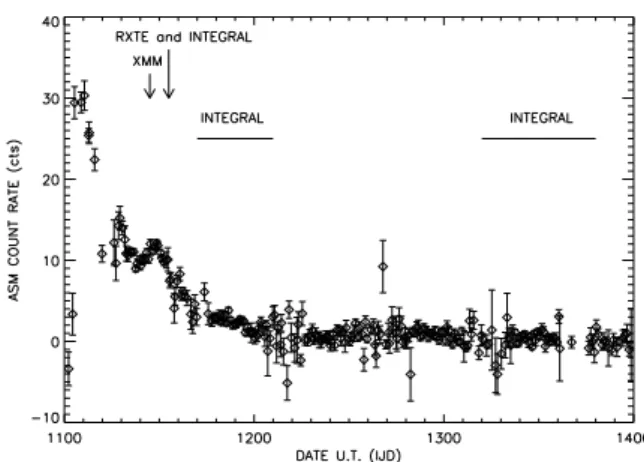
Figure 1. RXTE/ASM light curve (2-12 keV) of the outburst of XTE J1720-318. The arrows show the dates of the XMM-Newton, RXTE and INTEGRAL simultaneous observations. The approximate periods of later INTEGRAL observations are indicated by horizontal lines. The universal time is in units of INTEGRAL Julian Days (IJD) where IJD = MJD-51544 days.
of the 2003 INTEGRAL GC survey.
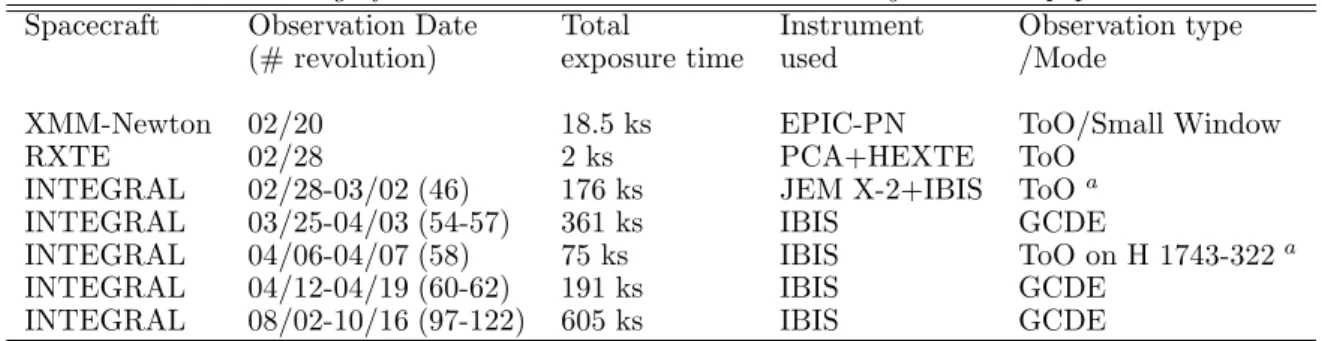
The log of the observations and data used in this work is summarized in Table 1. The ASM light curve (2-12 keV) of XTE J1720-318, showing the transient source outburst and the following X-ray flux decay, is presented in Figure 1. We also indicate the sequence of the observations discussed in this work.
2.1. XMM-Newton Data Analysis
We present here only the data taken with the EPIC-PN camera on board XMM-Newton. The PN camera was operating in Small Window mode. We processed the data using the Scientific Analysis System v.5.4.1 and the calibration files updated at the end of March 2003. We first filtered our data for background flares. Since XTE J1720-318 was bright at the date of the observation (resulting in a strong pile up in the PN camera), we adopted the selection criteria suggested by Guainazzi (2001) to obtain the source spectrum. We extracted the events from an annulus with an internal radius of 15′′, and an outer
radius of 29′′around the position of XTE J1720-318.
As we only used single events, the effective exposure time of the extracted spectrum was about 6 ks. We obtained the background spectrum from a sky region far from the source and we built the response matrix (RMF) and ancillary response (ARF) files consistent with the selections. The resultant spec-trum was then fitted with XSPEC v11.3.0 (Arnaud 1996) between 0.5 and 12 keV.
Table 1. Log of the XTE J1720-318 observations analysed in this paper.
Spacecraft Observation Date Total Instrument Observation type (# revolution) exposure time used /Mode
XMM-Newton 02/20 18.5 ks EPIC-PN ToO/Small Window
RXTE 02/28 2 ks PCA+HEXTE ToO
INTEGRAL 02/28-03/02 (46) 176 ks JEM X-2+IBIS ToOa
INTEGRAL 03/25-04/03 (54-57) 361 ks IBIS GCDE
INTEGRAL 04/06-04/07 (58) 75 ks IBIS ToO on H 1743-322a
INTEGRAL 04/12-04/19 (60-62) 191 ks IBIS GCDE INTEGRAL 08/02-10/16 (97-122) 605 ks IBIS GCDE Note a: 5×5 dithering pattern around the target.
2.2. RXTE Data Analysis
We reduced and analysed the RXTE data with the LHEASOFT package v5.2. We reduced the data from PCA and HEXTE following the standard ways explained in the ABC of RXTE and the cook book. The good time intervals (GTI) were defined when the satellite elevation was > 10◦ above the
Earth limb, and the offset pointing <0.02◦. We
also chose to retain the data taken when most of the Proportional Counter Units (PCU) were turned on (a maximum of 5 here). We extracted the spectra from the standard two data groups, from the top layer of each PCU. Background spectra were produced with pcabackest v3.0, using the latest calibration files available for bright sources. RMF and ARF were generated with pcarsp v8.0. Due to uncertainties in the PCA RMF, we included some systematic errors in the spectra. To estimate the level of those systematics, we reduced and analysed a contemporary Crab observation. To obtain a reduced χ2 of 1 when fitting the Crab spectra, we
set the level of systematics as follows: 0.6% between 2 and 8 keV and 0.4% above 8 keV.
We extracted source and background spectra for both clusters (0 and 1) of HEXTE from the archive mode data, after separating on and off-source pointings. We corrected the spectra for dead-time, and produced the RMF and ARF with hxtrsp v3.1. Due to dubious spectral information, we avoided detector 2 of cluster 1 in the spectral extraction. We fitted the spectra between 3-25 keV for PCA and 20-40 keV for HEXTE, due to poor statistics in the HEXTE high spectral bands (detection at a level greater than 3σ is achieved only up to 30 keV).
2.3. INTEGRAL Data Analysis
An INTEGRAL observation is made of several point-ings (science windows, hereafter SCW) each having ∼2200 s exposure, following a special pattern on the plane of the sky (Courvoisier et al. 2003). Except for the 5 × 5 dithering mode for revolutions 46 and 58, the entire GC region was observed in the framework of the Galactic Center Deep Exposure (GCDE) pro-gram (Winkler 2001). Deep exposures in the GC
radian (±30 deg in longitude, ±20 deg in latitude centered at l =0, b=0) are obtained with a set of in-dividual pointings lasting 30 min each on a regular pointing grid.
All the INTEGRAL instruments are operating si-multaneously. We describe here mainly results ob-tained from the data recorded with the ISGRI detec-tor (Lebrun et al. 2003) of the IBIS telescope cover-ing the spectral range from 20 to 800 keV. For the first observation set, when the source was very soft, we also present data from the JEM-X instrument (3-25 keV). More complete results from the JEM-X and the SPI data will be presented elsewhere (Cadolle Bel et al. 2004, accepted for publication in A&A). The IBIS data have been reduced with the Offline Scien-tific Analysis (OSA) v3.0, to produce images and ex-tract spectra for each SCW (Goldwurm et al. 2003). We selected SCW for which the source was within 8◦ from the telescope axis. For the spectral
analy-sis, we used a 10 linearly rebinned channel RMF and a recently preliminary corrected ARF on the Crab. The resultant spectrum was fitted between 20 and 200 keV, since above 200 keV the source is not sig-nificantly detected and below 20 keV systematic un-certainties are still very high. Systematics errors of 10% were applied to account for the residual effects of the response matrix. For the image analysis, the background derived from empty fields was subtracted before deconvolution and we used a catalog of about 41 sources to analyse the images. The total amount of IBIS data we processed was equivalent to about 1400 ks of exposure time, however due to selections performed and the fact that the source was very of-ten off-axis, the effective exposure time is reduced to 522 ks.
We reduced the JEM-X data with the latest avail-able software version OSA v3.0. Only the JEM-X2 monitor was turned on during our observation. We selected the SCW were the source was closest to the center of the field of view, from which we extracted the spectra for an effective exposure time of 21 ks. We fitted the resultant averaged spectrum between 3 and 26.5 keV, with the standard RMF and ARF.
3. RESULTS 3.1. The High Soft State
The XMM and INTEGRAL/RXTE observations of February 2003 caught the source in a very soft state. The source appeared bright at low energies, with a daily-averaged flux between 100 and 140 mCrab in the 2-12 keV band. The JEM-X and PCA in-struments detected the source at very high signifi-cance and we could derive significant spectra up to 20 keV. On the other hand, the high-energy emis-sion was quite weak. IBIS only marginally detected the source at a level of 0.4 cts s−1 or 1.9 mCrab in
the 20-60 keV band, providing only few data points at energies higher than 20 keV. RXTE/HEXTE also provided low significant data points at energy ≥ 20 keV. The individual and combined spectra are de-scribed in section 3.3.
3.2. The Transition to Hard State
Starting from March 25 (IJD=1180, revolution 54), the source appeared to brighten in the INTEGRAL energy band. Since a similar behavior was not seen in the ASM light curve, Goldoni et al. (2003) pro-posed that the source was entering in a hard state. In the combined IBIS/ISGRI images obtained from the data of revolutions 46 to 64 (see Figure 2), XTE J1720-318 is detected at 35 σ in the 20-40 keV range. The best position found with IBIS from the 20-40 keV image is αJ 2000 = 17h20m01s, δJ 2000 =
−31◦45′18′′with an accuracy of 0.9′ at 90% of
confi-dence level (Gros et al. 2003). This position is consis-tent with the most precise position of XTE J1720-318 derived from radio data.The high-energy source is therefore unambiguously associated to the transient. We derived the source light curve in different en-ergy bands. The IBIS light curve of XTE J1720-318
Figure 2. The IBIS/ISGRI reconstructed sky im-age of the region around XTE J17318 in the 20-40 keV band, using data from revolution 46 to 64. XTE J1720-318 appears at a significance level of 35σ over the background.
Figure 3. The IBIS/ISGRI light curve of XTE J1720-318 in the 20-60 keV band, with time bins of 2 days, from revolution 46 to 122. The dashed line represents the average flux over the whole period.
covering the whole year 2003 is shown in Figure 3. It was marginally detected during the ToO observa-tion of February 28 (revoluobserva-tion 46, IJD=1155). The source decreased below the detection level when re-observed with INTEGRAL about 10 days later, be-tween March 9 and 20. XTE J1720-318 became vis-ible again above 20 keV after March 25 (IJD=1180, revolution 56) as shown on Figure 4 where we focus on the flare period: its 20-200 keV flux, was then around 3.3 cts s−1 or 15.5 mCrab and increased to
a maximum level of 7.4 cts s−1 (∼ 37.5 mCrab) on
April 6 (revolution 58, IJD=1192). After this, the flux gradually decreased to the value of 5.5 cts s−1
(revolution 62). When the INTEGRAL GC survey included the source again in the IBIS field of view in mid-August 2003, the transient was not detected and remained under the detection level for the rest of 2003.
Figure 5 reports the hardness ratio (HR) measured during the observed increase in the high-energy source flux. There is no significant variation in the HR around its mean value of 0.75, only a slight indi-cation of a softer HR (∼ 0.5) at the beginning of the flare. We therefore used the whole data of this hard flare to build up an average spectrum.
3.3. Spectral Results
3.3.1. The High/Soft State Spectrum We have fitted the XMM-Newton EPIC-PN data with a model composed of an absorbed multi-colour black-body disc (MCD, Shakura & Sunyaev 1973 and Mitsuda et al. 1984) plus a power law. A single ab-sorbed MCD model leads to a poor fit, as does a sin-gle absorbed power law. The best-fit parameters de-rived from our analysis are given in Table 2. We have found for NH the value of (1.24±0.02) × 1022 cm−2.
The unabsorbed flux in the 0.5-10 keV range was 7.31 × 10⁻⁹ ergs cm−2 s−1. Assuming a distance of
Table 2. XTE J1720-318 best-fit spectral parameters for the XMM-Newton ToO, for the simultaneous RXTE/INTEGRAL ToOs of February and for the INTEGRAL detected hard flare (revolutions 55 to 62), with their 90% confidence level errors.
Instrument Date Disc Tempe- Disc Photon χ2
red Flux
b
(U.T.) rature(keV) Radius(km)a
Index (dof) ×10−9ergs s−1 cm−2
XMM-Newton 02/20 0.67±0.01 48.9±0.4 2.69+0.44−0.57 1.2(1102) 2.36 RXTE+INTEGRAL 02/28-03/02 0.59±0.01 84±4 2.63+0.34−0.22 0.9(94) 3.26
INTEGRAL 03/27-04/19 - - 1.84±0.11 1.6(7) 0.98
Notes: a: Disc radius R in units of km is given by K = (R
D)
2×cos θ where K is the disc normalisation, D is
the distance to the source in units of 10 kpc and θ the inclination angle of the disc. b: Unabsorbed 2–100 keV flux.
Figure 4. The IBIS/ISGRI light curve of XTE J1720-318 in the 20-200 keV band during the hard flare (from revolution 46 to 62), with time bins grouping each revolution separately. The dashed line represents the average flux over the whole period.
Figure 5. IBIS/ISGRI source hardness ratio, defined as the ratio between the source count rate in the 40-80 keV band and in the 20-40 keV band, during the XTE J1720-318 flare (revolutions 55 to 62). The time bins are 3.5 days and the dashed line represents the average hardness ratio.
Figure 6. XMM-Newton/EPIC-PN spectrum of XTE J1720-318. The best-fit model, an absorbed MCD plus a power law, is over plotted as a solid line. Residuals (in counts s−1 keV−1) are also shown.
8 kpc (see discussion), the luminosity in the 0.5-10 keV range is then 5.57 × 1037 ergs s−1. The disc
component accounts for 82% of the total luminosity. If we assume a line of sight inclination angle of 60◦,
we find an internal disc radius of 48.9 ± 0.4 km. The spectrum is shown on Figure 6.
We have applied the same absorbed MCD plus power law model to a simultaneous fit of the RXTE/PCA, RXTE/HEXTE, INTEGRAL/JEM-X and INTE-GRAL/IBIS data taken about 8 days later and we obtained the best-fit parameters reported in Table 2. To account for uncertainties in relative instruments calibrations, we let a multiplicative constant to vary in the fit of the different data sets. Taking the RXTE/PCA spectrum as the reference, the derived constants are all found very close to 1 for each in-strument, except for RXTE/HEXTE for which we got a factor of 0.7. This is compatible with the level of cross-calibration normalization between the two RXTE instruments. As RXTE and JEM-X are not suited to determine interstellar absorption (energy lower boundary is ∼ 3 keV), we fixed the NH to the
value obtained from the XMM-Newton fits. We also added a gaussian line at the iron fluorescent line en-ergies to account for a feature present in the RXTE
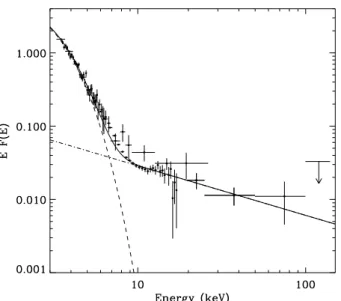
Figure 7. Unabsorbed EF(E) spectrum of XTE J1720-318 (units of keV cm−2 s−1) along
with the best-fit model MCD plus powerlaw. Dashed: MCD. Dotted dashed: power law. Thick: total model.
data. The line centroid was found to be 6.45+0.16 −0.35
keV with an equivalent width of 572+307
−178 eV.
How-ever, this line was not present in the data obtained with XMM-Newton. To check the reality of this line, we reperformed the fit of the EPIC PN spectrum by adding to the best fit continuum model an iron line at a fixed energy and width equal to the ones found from the RXTE data. We obtained an upper limit for such a line of 74.4 eV equivalent width at the 90% confidence level. This upper limit suggests that the line seen with RXTE is probably due to an incorrect background substraction and not to XTE J1720-318. For example, it may be due to contamination by the Galactic ridge emission (Revnivtsev 2003). For this reason, we did not included the line for the fit of the JEM-X data. In spite of the low significance level of the detection, the IBIS/ISGRI data allow us to study the source up to higher energies than with RXTE/HEXTE alone because of the higher sensi-tivity of ISGRI and the longer exposure time. The derived spectrum is shown on Figure 7.
According to the value of the photon-index, we found that the source was clearly in the HSS, where the thermal component from the disc dominates. The internal radius is now given by 84 ± 4 km and the disc flux contribution around 93% of the total luminosity in the 2-100 keV range. Indeed, there is a slight evolution between the XMM-Newton parame-ters (internal radius and temperature) and the same parameters found one week after by RXTE and IN-TEGRAL. But all these data taken during the last week of February are consistent with the BH XN XTE J1720-318 being in the HSS.
Figure 8. IBIS/ISGRI (20-200 keV) spectrum of XTE J1720-318 using data from the end of March to mid-April. The best-fit power law model is over-plotted as a solid line. Residuals (in σ units) are also shown.
3.3.2. The Low/Hard State Spectrum As discussed above, the IBIS data from revolutions 55 to 62 are consistent (i.e. no variation of HR) and can be summed to derive the average spectrum re-ported in Figure 8. We fitted this spectrum with a simple power law model between 20 and 200 keV. Above 200 keV the source is not significantly de-tected. Again, 10% systematics were applied. The best-fit photon-index returned from the fits is 1.8 (see Table 2), which reveals that the spectrum of XTE J1720-318 is much harder than observed in February. In addition to the power law model, we have tried to fit the data set with a comptonisation model (Sunyaev & Titarchuck 1980). The derived parameters are 49+51−20 keV for the temperature and 2.6+1.4−1.2for the optical depth, with a reduced χ2of 1.8
(6 degrees of freedom). The χ2 is not significantly
better than the one obtained with the single power law and our results do not allow to choose between the two models, i.e. it seems that no high-energy cut off is clearly detected. On the other hand, the derived thermal comptonisation parameters are very much consistent with those found in BHB in the so-called Low/Hard State (LHS).
4. DISCUSSION
The high equivalent absorption column density de-rived from the XMM-Newton data suggests that XTE J1720-318 lies at the GC distance or even fur-ther. This would place the source in the Galac-tic bulge and we will, therefore, assume a source distance of 8 kpc. When observed with XMM-Newton, about 40 days after the outburst peak, XTE J1720-318 was in a HSS, characterized by a strong soft (thermal) component, well modeled by a disc emission model with an inner disc temperature of kT ∼ 0.6 keV, and a weak power law tail. The
source was found in HSS also at the end of Febru-ary, when we could measure, with higher precision with INTEGRAL and RXTE, the steep power law slope index of 2.6. In both observations, the disc component accounted for more than 80% of the 2-100 keV source luminosity, estimated at the end of February at 2.5 × 1037ergs s−1. The source did not
change state during the decay phase which started after the outburst peak and lasted till about mid-March, although slightly different spectral parame-ters of the soft component were measured during the INTEGRAL/RXTE observations (i.e. a lower tem-perature and a larger inner-disc radius). This could indicate that the cool accretion disc was receding from the BHC, in agreement with certain interpreta-tion of the outburst evoluinterpreta-tion in XN, but could also be linked to a specific spectral variation of a sec-ondary flare. Indeed the XMM-Newton observation took place during a weak secondary peak which oc-curred in the decay phase (see Figure 1), which was also observed in infrared (Nagata et al. 2003). A more dramatic change in the source behaviour was observed with INTEGRAL at the end of March. We observed a soft to hard spectral state tran-sition of the X-ray transient about 80 days from the outburst peak. The luminosity increased in about 10 days from below the INTEGRAL detec-tion level to an extrapolated 2-100 keV luminosity of ∼7.5×1036ergs s−1, without any similar increase in
the low-energy flux measured by RXTE/ASM. The spectrum was hard and well described by a power law of index 1.8 or a thermal comptonisation model with a (weakly constrained) plasma temperature of 49 keV and an optical thickness of 2.6. No clear spec-tral break was observed.
The high peak luminosity, the fast rise and slow de-cay time scales, the high soft spectral state and the late transition to a LHS with spectral parameters typically observed in other (dynamically confirmed) BH transients, like e.g. XTE J1550-564 (Sobczak et al. 2000; Rodriguez et al. 2003), GRO J1655-40 (Sobczak et al. 1999, see also McClintock & Remil-lard 2003) or XN Muscae 1991/GRS 1124-68 (Gold-wurm et al. 1992, Grebenev et al. 1992 and Ebisawa et al. 1994) show that XN XTE J1720-318 is proba-bly a new XN and BHC of the Galactic bulge. Although there is little doubt about the origin of the soft thermal component and its modeling, the inter-pretation of the high-energy tail and its connection to the spectral states remain rather controversial. In the HSS, most of the X-rays are radiated by the ac-cretion disc. The decay phase of XN in the HSS is clearly linked to the decrease of the effective accre-tion rate. The standard Shakura & Sunyaev (1973) α-disc, however, cannot produce hard radiation (in either of the spectral states). In the LHS, the hard component is generally attributed to thermal comp-tonisation of the disc soft radiation by a hot plasma (Sunyaev & Titarchuk 1980, Titarchuk 1994) located above the disc or in the inner part of the system, around and very close to the BH. However, the de-tails of the geometry and of radiation mechanisms at work are still not understood; the processes which lead to the spectral transition and the possible role
of non-thermal (synchrotron) radiation are still very uncertain. For example, one set of models which explain the above geometry and the comptonisation origin of the hard emission in LHS are those based on Advection Dominated Accretion Flows (ADAF). Al-ternatively, comptonisation on a population of (ther-malised) electrons with bulk motion (e.g. Titarchuk et al. 1997) may be responsible for the presence of the high-energy tail in HSS or in intermediate states. The detection and study of the XN of the Galactic bulge with INTEGRAL will possibly provide more data on this kind of objects and will thus improve our understanding of the physics of BHB.
Thanks to the high sensitivity of INTEGRAL, it has been possible to study a faint source in the Galac-tic bulge, to detect a spectral transition confirming the probable BH nature of the object and to obtain a spectrum up to 200 keV. Further analysis of the INTEGRAL data of XTE J1720-318 are in progress and are reported in Cadolle Bel et al. 2004 (accepted for publication in A&A).
ACKNOWLEDGEMENTS
MCB thanks J. Paul and P. Ferrando for careful reading and commenting the manuscript. JR ac-knowledges financial support from the French Space Agency (CNES). The present work is based on ob-servations with INTEGRAL, an ESA mission with instruments and science data center funded by ESA member states (especially the PI countries: Den-mark, France, Germany, Italy, Switzerland, Spain, Czech Republic and Poland, and with the participa-tion of Russia and the USA) and with XMM-Newton, an ESA science mission with instruments and contri-butions directly funded by ESA member states and the USA (NASA).
REFERENCES
Arnaud K.A., 1996 in ASP Conf Series 101, As-tronomical Data Analysis Software and Systems V, eds. Jacoby G.H. & Barnes J. (San Francisco: ASP), 17
Cadolle Bel M., Rodriguez J., Sizun P., et al. 2004, accepted for publication in A&A.
Courvoisier T.J.-L., Walter R., Beckmann V., et al. 2003, A&A, 411, L53
Ebisawa K., Ogawa M., Aoki T., et al. 1994, PASJ, 46, 375E
Goldoni P., Goldwurm A., Kuulkers E., et al. 2003 ATel 153
Goldwurm A., Ballet J., Cordier B., et al. 1992, ApJ 389, L79
Goldwurm A., David P., Foschini L., et al. 2003, A&A, 411, L223
Gonzalez-Riestra R., Rodriguez-Pascual P.M., Santo-Lleo M., et al. 2003, IAUC 8080.
Grebenev S.A., Sunyaev R.A., Pavlinsky, M.N. 1992, SvAL, 18, 5G
Gros A., Goldwurm A., Cadolle Bel M., et al. 2003, A&A, 411, L179
Guainazzi M., XMM-Newton Science Analysis Workshop 2001, WA3
Lebrun F., Leray J.P., Lavocat P., et al. 2003, A&A, 411, L141
Lund N., Budtz-Jorgensen C., Westergaard N.J. et al. 2003, A&A, 411, L231
McClintock J.E., Remillard R.E. 2003, astro-ph 0306213
Markwardt C.B. 2003, Atel 115
Mas-Hesse J.M., Gim´enez A., Culhane J.L., et al. 2003, A&A, 411, L261
Mitsuda K., Inoue H., Koyama K., et al. 1984, PASJ, 36, 741
Nagata T., Kato D., Baba D., et al. 2003, astro-ph/0312012, to appear in PASJ
O’Brien K., Clarke F., Fender R.P., et al. 2003, ATel 117
Parmar A.N., Kuulkers E., Oosterbroek T., et al. 2003, A&A, 411, L421
Remillard R.E., Levine A.M., Morgan E.H., et al. 2003, IAUC 8050
Revnivtsev M. 2003, A&A, 410, 865
Rodriguez J., Corbel S. and Tomsick J.A. 2003, ApJ, 595, 1032
Rupen M.P., Brocksopp C., Mioduszewski A.J., et al. 2003, IAUC 8054
Shakura N.I., Sunyaev R.A. 1973, A&A, 24, 373 Sobczak G.J., McClintock J.E., Remillard R.R. 1999, ApJ, 520, 776
Sobczak G.J., McClintock J.E., Remillard R.R. 2000, ApJ, 544, 993
Sunyaev R.A., Titarchuk L. 1980, A&A, 86, 21 Tanaka Y., Shibazaki N. 1996, ARA&A, 34, 607 Titarchuk L. 1994, ApJ, 434, 570
Titarchuk L., Mastichiadis A., Kylafis N.D. 1997, ApJ, 487, 834
Ubertini P., Lebrun F., Di Cocco G., et al. 2003, A&A, 411, L131
Winkler C. 2001, in Exploring the Gamma-Ray Universe, Proceedings of the Fourth INTEGRAL Workshop, ESA SP-459, p.471
Winkler C., Courvoisier T.J.-L., Di Cocco G., et al. 2003, A&A, 411, L1
Vedrenne G., Roques J.-P., Sch¨onfelder V., et al. 2003, A&A, 411, L63