Impacts of Fed’s Decisions on Emerging
Countries: An Empirical Analysis &
Investment Solution
Bachelor Project submitted for the degree of
Bachelor of Science HES in International Business Management
by
Simon AMIGO WEIDEMANN
Bachelor Project Advisor:
Kurt STERCHI, Lecturer
Jury:
Ali ALTINSOY, Piguet Galland
Geneva, August 23rd, 2019
Haute école de gestion de Genève (HEG-GE)
International Business Management
Declaration
This Bachelor Project is submitted as part of the final examination requirements of
the Haute école de gestion de Genève, for the Bachelor of Science HES-SO in
International Business Management.
The student accepts the terms of the confidentiality agreement if one has been
signed. The use of any conclusions or recommendations made in the Bachelor
Project, with no prejudice to their value, engages neither the responsibility of the
author, nor the adviser to the Bachelor Project, nor the jury members nor the HEG.
“I attest that I have personally authored this work without using any sources other
than those cited in the bibliography. Furthermore, I have sent the final version of
this document for analysis by the plagiarism detection software stipulated by the
school and by my adviser”.
Geneva, August 23
rdAcknowledgments
First of all, I would like to use this opportunity to thank SingAlliance (Switzerland)
SA and SingAlliance Pte Ltd for their unlimited support and absolute trust.
Furthermore, I would like to express my gratitude to my supervisor Mr. Kurt Sterchi,
who allowed me to explore the subject without barriers nor constraints. As a result,
I could learn solidly and comprehensively from all areas of interest wanted. I would
also like to thank Mr. Ali Altinsoy, who was quickly interested in the project and
took on his precious time to follow and advise this paper.
Moreover, I am deeply grateful to the people who have allowed me to debate and
discuss the fundamentals of financial analysis in this ever-changing industry.
Mrs. Lanhua Yu, who helped me to formulate my first hypothesis. Mr. Edouard de
L'Espée, who shared all his economic knowledge and financial experience.
Without forgetting, Mr. Laurent Perusset, who with his precise and always relevant
comments allowed me to understand and correct ideas that were sometimes too
abstract or too succinct. Their experience, opinions, and insights were an
incredible source of inspiration and knowledge.
I also would like to thank Dr Aftab Kahn for his advice. Thanks to these, I was able
to come back on a subject which I am passionate about, which lead me to continue
studying and analysing this exciting area, which is Economy.
Finally, I would like to acknowledge Mr. Nicolas Montandon, who showed great
understanding and allowed me to change the subject of a previous project when I
was in a dead-end situation.
All the people and companies mentioned above have been essential for this paper,
and I would like to thank them one last time for their collaboration and investment.
Executive Summary
On July 13
th, 2019, the Fed decided to reduce its interest rates by 25 basis points.
Its first since October 2008. A decision that could be thought of as a good thing for
the emerging countries’ economies. Indeed, according to economic theories and
history, they would benefit from a significant breath of fresh air. Legend has it that
the Fed's will have a significant impact on emerging countries, whether positive or
negative.
One could, therefore, question why did Argentina’s stock exchange – just a few
weeks after the so-called beneficial decision of the US central bank – lose 48% in
one trading session. The second-largest stock market sell-off in history after Sri
Lanka’s civil war outbreak in 1989 (-61.7%). Obviously, the reasons for this
Argentine air gap have endogenous roots, mostly political, but it is then interesting
to investigate if the Fed’s decisions impact the emerging regions of the world. Do
this relation still exists today? Have emerging countries emancipated themselves
from the American game? And finally, depending on the answers, what would be
the most efficient ways to invest in these regions, rationally and professionally.
This paper, therefore, tries to demonstrate whether the impact on emerging
markets of the Fed's decisions on rates still exists. More precisely, the approach
here is to investigate the reactions of emerging currencies against the US dollar
when interest rates vary. Through a statistical analysis over two periods (1997-
2008 and 2008-2019), using tools such as linear regression and correlation
observation, and adding the time-lag component, interesting results emerge.
Indeed, depending on the period chosen, they are diametrically opposed. As things
stand, the study shows a causal relationship and a correlation between interest
rate decisions and emerging currencies. However, the change in US rates does
not explain all the variation in the analysed currencies. The economic cycle in
which the analysis was made must also be considered, it is likely that the latter is
a significant component. The addition of variables would improve the performed
statistical model, thus allowing a better understanding of their behaviour and so
facilitate the investment process.
On this basis, adjusted with informed insights and experience of professionals, but
also with the attempt to reduce cognitive biases to a minimum, this paper
concludes with an investment solution. More specifically, a quantitative stock
selection tool based on the mixed implementation of fundamental and technical
analysis, which now shows encouraging results.
Contents
Impacts of Fed’s Decisions on Emerging Countries: An Empirical Analysis
& Investment Solution ... 1
Declaration ... i
Acknowledgments ... ii
Executive Summary ...iii
Contents...iv
List of Tables ...vi
List of Figures ...vi
Abbreviations and acronyms ...vii
1.
Introduction ... 1
1.1
Literature review ... 1
1.2
US Federal Reserve ... 2
1.2.1
Fed’s history ... 2
1.2.2
Fed’s structure & functioning ... 3
1.2.3
Fed’s roles ... 4
1.2.4
Fed’s toolbox ... 5
1.2.5
Fed’s independence ... 7
1.3
Emerging markets ... 8
1.3.1
Definition ... 8
1.3.2
Investing in emerging markets ... 9
1.4
Current economic context ...10
1.5
Latest comments ...11
2.
Analysis ...14
2.1
Hypothesis ...14
2.2
Methodology ...14
2.2.1
Objective ...14
2.2.2
Linear regression ...15
2.2.3
Economic time lags ...16
2.3
Results...18
2.3.1
Comments ...24
3.
Discussion ...25
3.1.1
Interviews ... 25
3.1.2
Interviewees biographies ... 25
3.1.3
Interviews summary ... 28
3.2
Investment tool ... 30
3.2.1
Financial analysis ... 30
3.2.2
Methodology ... 35
3.2.3
Application ... 38
3.2.4
Performance ... 40
3.2.5
Comments ... 41
4.
Conclusion ... 42
5.
Bibliography ... 46
Appendix 1: Observed data ... 48
Appendix 2: STATA code (.dofile) ... 53
List of Tables
Table 1 – Regression summary 1997-2007 period ... 19
Table 2 – Regression summary 2008-2019 ... 20
Table 3 – Regression summary 1997-2007 with current account variable ... 21
Table 4 – Regression summary 2008-2019 with current account variable ... 22
Table 5 – Comparison avg. Current Acc. (% GDP) and avg. Coefficient ... 23
Table 6 - Correlation between Fed rate and EM Currency ... 23
Table 7 – Virtual portfolio EM – Holdings (March 11th, 2019) ... 38
Table 8 – Risk Scenarios – Bloomberg ... 41
List of Figures
Figure 1 – Economic cycles ... 6
Figure 2 – Emerging & Frontier markets repartition ... 9
Figure 3 – Virtual portfolio EM – Currency Allocation (March 11th, 2019) .... 39
Figure 4 – Virtual portfolio EM – Sector Allocation (March 11th, 2019) ... 39
Figure 5 – Virtual portfolio EM – Performance vs. MSCI EM ... 40
Figure 6 – Virtual portfolio EUR – Performance vs. EurxStoxx50 ... 42
Figure 7 – Virtual portfolio CHF – Performance vs. SMI ... 43
Abbreviations and acronyms
(in alphabetical order)
CEPII
Centre d'Etudes Prospectives et d'Informations Internationales
GDP
Gross Domestic Product
IMF
The International Monetary Fund
MTD
Month-to-Date
OECD
Organisation for Economic Co-operation and Development
PE ratio
Price-to-Earnings ratio
RSI
Relative Strength Index
S&P 1200
Standard & Poor’s 1200
S&P 500
Standard & Poor’s 500
WACC
Weighted Average Cost of Capital
YTM
Year-to-date
1. Introduction
Does the Fed’s decisions impact emerging markets currencies? The current
empirical literature seems to show that, indeed, when the Fed decides to move
rates, it comes with an emerging market’s reaction.
This first section will provide an overview on emerging markets reacting to Fed’s
decisions. Then, for a global understanding, it will present the Fed’s background
with some of its essential aspects, define what emerging markets are and finally
contextualize current economic situation.
1.1 Literature review
In order not to deprive oneself of a voluminous and quality literature, it is necessary
to understand that a significant in- or outflow of capital result a reaction of the value
of a country’s currency. So basically, the focus of this paper is on, if or if not,
emerging currencies react to the Fed’s rate, or, by extension, on if a variation in
the US rate changes the geographical allocation of capital.
Some studies support the view that US rates have a role to play in the
behaviour of emerging markets. For example, Fernandez-Arias (1996) states that
low interest rates can, for a short period of time, improve a country's
creditworthiness by lowering its borrowing rates, thereby creating an increase in
demand for foreign capital. In another context, Taylor & Sarno (1997) write that the
most affected asset class remains the emerging bonds, in the sense that Fed
decisions are a significant factor in short-term investment flows to emerging
economies.
In a more behavioural aspect, Koepke (2015) shows that capital flows to
emerging markets are impacted by changes in market expectations. The study
provides strong evidence that the unexpected is a key factor in an investor's
decision to invest or withdraw and that the application of the decision itself
– to
raise or lower rates
– does not cause a change in capital flows to emerging
markets. This raises the question of how the Fed, by virtue of its primary role as
an economic stabilizer, should communicate to minimize the consequences on
capital flows to emerging countries and therefore by extension on their currencies
as well.
Conversely, some studies have failed to provide evidence that capital flows
from emerging markets are affected by US rates, but the conclusion allowed to drift
to new suggestions
– Hernandez, Mellado & Valdes (2001). They argue that the
impact on emerging markets is only felt over a very short period after the decision.
This observation reinforces the importance of the unexpected component,
especially since evidence is brought that the reaction of emerging economies is
weak in the long term, because market anticipation cancels out the surprise effect.
So, this paper will investigate how the emerging currencies react to a Fed’s
decision over time, by implementing 0-, 3-, 6-, 9- and 12-months time-lags.
The next section looks at the Fed's historical foundations, its role in the global
economy and the fears that accompany this powerful institution.
1.2 US Federal Reserve
1.2.1
Fed’s history
The Federal Reserve System or often shortened Fed is the central bank of the
United States. In 1791, the US government created the First Bank of the United
States. For twenty-five years was this bank then responsible for the issuance of
money and the regulation of credit. In 1816, after the war against the United
Kingdom from 1812 to 1815, the bank was replaced by the Second Bank of the
US, which was supposed to put an end to the galloping inflation that hit the country
after the war. In 1830, President Andrew Jackson, who wanted to rebuild the
banking and the monetary systems, dissolved the Second Bank. Since then, for
several decades, the United States has had to contend with a complex monetary
system that was based on barter between many regional currencies, known as
"green papers." This decentralized situation made any regulation impossible,
provoking numerous bankruptcies and crises.
In 1907,
happened one of the biggest banking crises in the US’s financial
history. This led to the foundation of the National Monetary Commission, which
was asked to define and implement a banking and monetary reform. This
commission responded to the Congress and was led at that time by Republican
Senator Nelson Aldrich. The report from this commission laid the foundation for the
Federal Reserve Act that was passed by Congress on December 23, 1913 and
promulgated by President Woodrow Wilson the same day. Then, the Congress set
three monetary policy goals in the Owen-Glass Act: full employment, price stability,
and moderate long-term interest rates. It is often referred to the first two factors
grouped under the term "dual purpose" or "dual mandate" of the Fed. Until today,
in addition with preventing financial and banking crises, these objectives still are
the sole purpose of the Fed.
1.2.2
Fed’s structure & functioning
The institution publishes numerous reports, such as the beige book, a summary of
the economic conditions in each state and in each region of the United States. The
Federal Reserve consists of a board of governors, the Federal Open Market
Committee (FOMC), twelve regional banks (Federal Reserve Banks), several
banks, and some advisory boards. The FOMC Committee is responsible for the
Fed's monetary policy. Today, this committee is made up of the seven members
of the board of governors and the twelve presidents of regional banks, where only
five have the right to vote at any given time.
Even though the Fed is a Federal institution, its structure is quite complicated
and tries to meet both the public’s interest and the banks. In the United States, all
commercial banks licensed to operate in more than one state are required to be
claim membership to the Federal Reserve in the region where their headquarters
are located. These commercial banks own shares of their regional central bank,
which allows to participate in the election of the Federal Reserve’s board members.
In all cases, the Fed's authority is defined by the US Congress and the latter
can exercise its congressional oversight right over the System. However, the
members of the Board of Governors, including the President and Vice-President of
the Fed, are appointed by the US President and confirmed by the Senate. It is also
the government that appoints the bank's senior officials, sets their salaries,
bonuses and other compensations. It is the federal government that receives the
Fed's profits, except for a 6% dividend that is paid to the banks member of the
system.
The federal government places the new institution under its authority by
appointing the Secretary of the Treasury (Minister of Finance) and the Controller
of the Currency as members, ending, the era of regional finance. Indeed, the
purpose of the new organization is to promote currency management and the
economy throughout the country, to allow the discounting of commercial paper and
to monitor the operation of US banks.
This system proved its worth during the 1929 crash: the solution envisaged by the
New York Federal Reserve, a monetary stimulus, would have made it possible to
emerge from the crisis. However, a serious reorganization was required and in
1935, the Federal Reserve Board became the Governor's Board. The new body
acquires control over the regional banks through the Banking Act. The Federal
Open Market Committee (FOMC) was also created. This committee is responsible
for overseeing national monetary policy and for regulating and controlling interest
rates.
In theory, these measures ensure that the Fed stays independent for
monetary policy. In practice, the Fed is continuously under pressure. And its
independence is often disputed. In 1978, the Humphrey-Hawkins Full Employment
Act redefined the Fed's mandate in terms of its even broader autonomy.
Today, the Federal Reserve or the US central bank is financially
independent. It receives no budget from either the government or the US
Congress. The Fed finances itself through the interest of public loans; commissions
on bank deposit benefits and interest on foreign exchange. This is how the Fed
manages to pay hundreds of millions of dollars to its shareholders and more billions
of dollars of surplus to the US Treasury.
1.2.3 Fed’s roles
The role of the Federal Reserve has evolved since then, and today this institution
generally acts as an independent or independent institution that does not depend
on other levels of government (as in many other countries). Like all central banks,
the Fed is responsible for developing, implementing, and controlling the state's
monetary policy. Also, the Fed has the important responsibility for maintaining full
employment conditions (generally considered to be around 4 to 5 %
unemployment) while keeping inflation at an acceptable level (usually below 2%).
It is also responsible for maintaining the stability of the country's financial system,
overseeing and regulating the banking system, providing financial services to d
posit-taking institutions, the Federal government, and foreign financial institutions.
A peculiarity of the US monetary system is that it is not the central bank (Fed) but
the Federal Treasury Department that creates the currency, unlike most other
countries.
Although, all these roles may sound simple in theory, it shows to be a delicate
balancing act when it comes to practice. Indeed, to achieve its monetary policy
objectives, the Federal Reserve has in its possession four tools, it can use at its
discretion (see figure 1).
1.2.4 Fed’s toolbox
The Fed uses four tools to reach its monetary policy objectives: reserve
requirements, the discount rate, interest on reserves and open market operations.
The most used and recent tool was given to the Fed after the 2008 financial
crisis. Interest on reserves is what is paid to banks when there is an excess of
reserves. Banks are required, by the Fed, to hold a certain percentage of their
deposits, so when this percentage is higher than that required by the Fed, the banks
receive interest on the surplus. So, depending on the rate decided by the Fed on
reserves, banks have more or less incentive to keep or lend their reserves. Thus,
by managing this rate, the Fed can increase or reduce the circulation of money.
Totally linked to the previous tool, reserve requirements set the deposit limit
that banks must keep. Thus, a decrease in the limit on the Fed's part would mean
the implementation of an expansionary policy. The opposite would logically explain
why the Fed wants to introduce a more restrictive policy.
The discount rate is the interest rate at which Reserve Banks lends to commercial
banks. Once again, by deciding at what rate the Fed wants commercial banks to
borrow from it in the short term, it decides its monetary policy: a low rate will tend
to see loan demand increase, demonstrating that the Fed’s choice to expand its
monetary policy. A higher rate would mean the opposite.
Finally, the open market operations tool is very simply used to buy or sell
government financial instruments, always according to the same monetary policy
management model.
Figure 1: Economic cycles
Growth:
-
Growth Domestic Product (GDP) growth rate raises
-
the Fed lowers interest rates, reserve requirements or acquires treasury
bonds.
-
Growing level of investments
-
Unemployment rate decreases
Inflation:
-
Abnormal GDP growth rates
-
Borrowing becomes too cheap
-
General price increase
-
Unemployment rate decreases
Slow down:
-
GDP growth rate stabilizes
-
the Fed raises interest rates, reserve requirements or sells treasury bonds.
-
Reduced investments
-
Borrowing becomes more expensive
Recession:
-
GDP growth rates decline substantially
-
Borrowing becomes too expensive
-
General price decrease
-
Unemployment rate increases
Gr ow th Inf l at ion S lo w do w n Recession Gr ow th Inf l at ion
Growth: the Fed lowers interest rates, reserve requirements or acquires treasury bonds. - Growing level of investments
- GDP growth rate raises - Unemployment rate decreases
Inflation : the Fed lowers interest rates, reserve requirements or acquires treasury bonds. - Unormal GDP growth rates
- Borrowing becomes too cheap - Unemployment rate decreases - General price increase
1.2.5 Fed’s independence
Due to is role, the Fed is supposed to be independent and should act, above all,
for the better of the US economy. However, for some time now and more recently
Fed’s independence is disputed.
For example, some authors have, in the past, questioned its independence.
Indeed, some developed the thesis that the Fed would, in fact, be controlled by the
leading American private banks that could effectively defend their own interests to
the detriment of the general interest. The Fed has also recently been questioned
in several cases in which it is suspected of having been unresponsive to
questionable practices by certain major banks. It did not launch an investigation
against Goldman Sachs even though the information had been sent to it on a
contentious operation carried out at the beginning of 2012. The Fed would not have
acted on a recommendation from its 2009 team to conduct an in-depth review of
the London branch of JP Morgan bank, while it found itself in 2012 at the heart of
the financial scandal known as the "London whale."
More recently, concern about the Fed's independence has never been so
acute. Analysts, economists, and academics have been worried about this
independence, which they believe is threatened by the growing political pressure
exerted by Donald Trump. In fact, the Republican President has consistently
criticized the institution since his election. In particular, he criticizes it for
maintaining interest rates that he considers too high.
Relatively recent, the independence of the major central banks was
introduced in the aftermath of the oil shocks of the 1970s. Unelected, central
bankers are free to take unpopular measures to avoid price hikes and limit
excesses in the financial system. This freedom is essential to establish their
credibility with the markets; otherwise their measures won't work. A famous
example remains the German Bundesbank after World War II, which then obeyed
to politics, massively printed money to pay off the war debt, which triggered severe
hyperinflation for the Germans.
The following section introduces the definition of what emerging markets are and
what characterises them.
1.3 Emerging markets
1.3.1 Definition
What is emergence? Or what is an emerging country?
Simply put, emergence is a concept to describe the growing attractiveness of
developing countries with a middle-income population. With growth starting in its
own financial market, until it becomes big enough to be considered as an emerging
economy, to, finally, mature and become a developed country.
Although there is no unanimously accepted definition, the emergence concept
contains the following three elements according to the CEPII
1definition:
-
a level of income below the OECD
2average
-
sustained economic growth accompanied by increasing openness over a
relatively long period
-
attractiveness for international investors
Thus, this paper will define a country as emerging with the following criteria. To
understand the emergence and capacity of a country to emerge, it is necessary to
highlight the competitive capacity of its economy and being a member of the
OECD, is not enough to be categorized as a developed country.
An emerging country must be able to sustain rapid economic growth over a
significant period without jeopardizing its balance or stability. Indeed, many
candidates in the past have demonstrated legitimate growth in a short period of
time but have nevertheless found it impossible to replicate this development
capacity in the medium or long term. This has often led to a crash in the value of
the currency, periods of inflation and even hyperinflation. In the recent weeks,
Argentina has been the perfect example of this situation, a real case study.
The emergence therefore highlights the competitive capacity of the
economy. In short, it must apply the foundations of capitalist theory, which states
that when in a liberal economy, a society or, here, a country, it must know how to
allocate and use its resources as long as open and free, market and competition,
without deception nor fraud, is possible.
1
Centre d’Etudes Prospectives et d’Informations Internationales
2Organisation for Economic Cooperation and Development
1.3.2 Investing in emerging markets
Investing is something one can do it anywhere in the world. The choice of
investment products that make it possible to invest in the most diverse sectors,
companies, themes, and countries of interest are vast. Emerging markets offer
particularly attractive investment opportunities. But what exactly is it about? What
are their particularities for investors?
Before making an investment in this area and including emerging market
securities in your portfolio, it is therefore recommended to get a first impression of
this sector. The easiest way to do this is to look at the "MSCI Emerging Markets"
index (see figure 2). This equity index reflects the performance of the stock markets
of 24 emerging countries. It, therefore, makes it possible to see which countries
are precisely considered emerging and how their markets are evolving.
But first, a distinction must be made between an emerging country and an
emerging economy. Korea and Taiwan are the best examples. For some
indicators, such as GDP per capita, Taiwan is considered more developed than
France or the UK. Not to mention, that both have world leaders in their field
–
Taiwan Semiconductor and Samsung - and that despite this, they still categorize
themselves as emerging markets.
For investors, these markets offer additional opportunities but also present higher
risks than industrialized countries. However, investing in emerging markets also
involves a, and often higher, risk. Political insecurity and less monetary stability
lead to increased volatility on the stock markets. As local currencies can quickly
lose value, the exchange rate risk is also higher. As it has been statistically
demonstrated, the situation in other countries also plays a role: in emerging
markets, local currencies are often highly dependent on the US monetary policy.
Similarly, the decisions taken by world powers in the context of their foreign policy
may have a greater or lesser influence on these currencies.
Moreover, in these countries, the risk of a company being nationalized cannot be
ruled out. Other additional risks include the lack of transparency in these markets.
Market regulation does not always work or is subject to slow adaptation; intellectual
property is poorly protected; these factors that can also influence the economic
and financial development of emerging markets.
1.4 Current economic context
Despite the August’s recent rollercoaster movements and the uncertainty of the
current events (US-China trade war, Iran tensions, Brexit, etc.), shares have risen
since January, and according to the experts, they should continue. So far, nothing
has seemed to derail the rise in markets since January: +15% for the S&P 500,
+16% for the SMI (data observed August 8
th,2019), stock market indices have
risen in the developed and emerging world despite several threats to the global
economy, particularly the trade war between China and the United States.
The question now would be to know if the second half will be as bullish as
the first one as growth seems to be weakening, and trade tensions are picking up
again. Credit Suisse believes so: "We believe that the upside potential is intact,
although the risks of temporary corrections after the recent rally have increased,"
says Burkhard Varnholt, Head of Investments, in a note assessing market
performance in the first half of the year and setting out the outlook for the second.
On the other hand, UBS is a little more cautious, reducing its equity allocation
from "overweight" to "neutral" for the second half of the year. Isn't this year's
rebound "too good to last"? Political risks - commercial or Brexit - could fuel
volatility, they warn, also in a 2019 mid-term study. "Investors need to be agile and
diversify their investment strategy in order to generate risk-adjusted returns," they
recommend. It is in China, above all, that they see the most opportunity on the
equity markets. Its economy is stable, investors are increasingly positive, and the
inclusion of this market in the MSCI index will make it even more critical.
Nevertheless, the bank also believes that diversification into real assets and
related alternative investments is likely to continue. For many, the rise in stock
markets should, therefore, continue, while being subject to some probable ups and
downs depending on political events. This will provide new purchasing
opportunities. Especially since the signals from the US Federal Reserve, which
seems to be considering another reduction in its interest rates, are favourable to
the markets.
Most specific to this paper’s question, Fed’s latest rate cut (25bps reduction)
could give emerging economies a breath of fresh air. Emerging economies, which
are suffering from the slowdown in world trade and, above all, the decline in
Chinese demand in goods and services, could benefit from a breath of fresh air
thanks to the Fed which recently re-opened the door to a rate cut.
1.5 Latest comments
3Following are some interesting comments from professionals of the industry that
will be investigated in this paper.
After leaving rates unchanged a week ago, Fed boss Jerome Powell
explained on Tuesday that he did not want to "overreact" by
immediately easing the bank's monetary policy in response to fears
about trade tensions between Washington and Beijing.
Even if his speech was less accommodating than expected, he
distanced the prospect of a further rate increase, which would have
strengthened the transfer of capital to the United States, where
investments are less risky or increased the price of servicing their debt
in dollars.
"As the normalization of monetary policy in the United States is halted
or even reversed, it may ease markets and financing conditions for
emerging countries," Sébastien Jean, director of the Centre for
Prospective Studies and International Information (CEPII), told AFP.
"For some countries, there may, therefore, be some windfall effect," he
added, referring to emerging economies that can afford it. Because
3
they have the flexibility to boost their growth by financing themselves
on the markets without fear of rising interest rates.
A welcome breath of fresh air at a time when emerging economies are
experiencing growth rates driven by "low investment and the sharp
slowdown in world trade," as recently explained by World Bank
President David Malpass.
"A low rate in the United States is, a priori, good news for emerging
countries because it creates slightly stronger incentives for flows" to
these countries, Jens Arnold, head of the OECD's Department of
Economics for Argentina and Brazil, told AFP.
There is also the "risk aversion" that currently characterizes markets,
as Sean Darby, of the American investment bank Jefferies, pointed out
at a conference in Paris. "What is happening in China is necessarily
harmful to emerging countries," he told AFP about the decline in raw
material exports to the Asian giant, which have long supported
emerging economies. For Mr. Faure, the rates are too high anyway for
emerging countries to be able to finance themselves on the markets,
especially Argentina, which is in recession. "Not only do the
Argentinians not want to, but they couldn't. This is better because they
are already very heavily indebted," he said.
However, Mr. Darby noted that central banks in emerging countries are
distancing themselves from the Fed. "This time, long before the Fed
moved, several central banks in emerging countries lowered their
rates, such as Malaysia, the Philippines, and India," he said. "The
divorce between the emerging countries and the Fed has become quite
clear," said the Jefferies analyst, citing the case of Russia.
These comments could be the headlines of all the stereotypes and/or common
literature when it comes to defining emerging markets reactions to the Fed’s rate
changes. So, using statistical analysis - a linear regression - this paper will try to
unravel some of these affirmations anchored in the collective imagination.
The rest of the paper is organized as follows. Section 2. performs a statistical
model to measure Fed’s rate impact on emerging currencies. Section 2.3. shows
the results obtained by the linear regression and explains if and how emerging
currencies react to changes in US rates.
Section 3.1. explains investing in emerging markets and introduces discussions
with professionals of the financial industry about the statistical model (Section 2.)
and how investment decisions are made.
Based on financial analysis theories such as fundamental, technical and
behavioural, a quantitative investment solution for emerging markets equities is
proposed in Section 3.2. Section 4. concludes.
2. Analysis
2.1 Hypothesis
It is commonly known and said that when the Fed flaps its wings, the emerging
markets suffer an earthquake. Recently, James O’Neill, former chief economist at
Goldman and inventor of the BRIC name, said that high deficit countries would get
impacted heavily by the reduction of Fed’s quantitative easing.
The first step is the attempt to prove that emerging currencies are heavily impacted
by Fed rates. In a second step, the article wants to show that the more the current
account of a country is negative, the more the elasticity of the currency with respect
to the Fed is large.
2.2 Methodology
2.2.1 Objective
The objective of this analysis will be to analyse how the eight following emerging
countries’ currencies react to the decisions taken by the US Federal Reserve. To
achieve this, the method used will be linear regression through STATA, a
general-purpose statistical software.
The selection of currencies was based on the following reasons: First, we opted for
the selection of currencies emanating from the countries represented by the
association of the five largest emerging economies, more commonly known by the
acronym BRICS. The latter includes Brazil, Russia, India, China, and South Africa,
the latest country to join the alliance in 2010. Then, in order to identify a potential
variation originating from the geographical location, we selected additional
currencies coming from different continents, namely:
•
For Africa: Nigerian Naira (NGN)
•
For South America: Mexican Peso (MXN)
So, the observed pairs of currency are:
•
USDTRY (Turkish Lira / US Dollar)
•
USDRUB (Russian Ruble / US Dollar)
•
USDCNY (Chinese Yuan / US Dollar)
•
USDINR (Indian Rupee / US Dollar)
•
USDBRL (Brazilian Real / US Dollar)
•
USDMXN (Mexican Peso / US Dollar)
•
USDNGN (Nigerian Naira / US Dollar)
•
USDZAR (South African Rand / US Dollar)
Also, we will take two distinct periods into consideration in order to conduct our
analysis. The first, from 1997 to 2019, and the second, from 2008 to 2019, which
represents the start of the after-crisis US quantitative easing.
2.2.2 Linear regression
We will continue with our model that tries to explain the variation of the emerging
currencies (our dependent variable "Y") according to explanatory variables (X1).
Variable X1 corresponds to the Fed’s rate. So, our model looks like this:
where:
Y = the log (USDXXX) pair
X
1= the Fed rate
The last term corresponds to the error term, which represents the deviation
between the models’ predictions and reality. As previously our goal here will be to
determine the significant variables, i.e., whether the different coefficients are
different from 0, the constant value of the alpha and the different "beta" coefficients
that minimize the error between our estimated linear regression line and the real
values of Y and finally the accuracy of our model, using, among other things, the
"R-squared".
Within this model, the EM currency is put to the log in order that the results are
expressed in percentage terms. In other words, to find out how much is the
percentage of changes in Y for a change in 1 unit of X.
2.2.3 Economic time lags
Those who follow the market will have noticed that economists often announce a
recession long after it has started. Indeed, time-lags or recognition lags can,
depending on the strength and nature of the economic shock, be from several days
to several months.
This economic characteristic exists because it takes time to measure the economic
activity of a country, region or larger. Data is rarely available live, and it may take
several months or quarters for some information to be collected and published. So
that they can then be analysed and correctly interpreted by decision makers. It
takes between three and six months, on average, for a lag to be seen, and it is
difficult to reduce this window, mainly due to variables presenting economic health
that are only presented monthly or quarterly.
As a result, monetary authorities are often not quick to respond to published
figures. The initial estimates reported are often incomplete and inaccurate. Indeed,
a variation in one direction or the other is often temporary and may return to normal
by the time of the next publication. This gives the government more time to analyse
trends more accurately and, if necessary, act to correct the situation. Time lags
play an essential role in the effectiveness of the economic policy. There is an
estimation of 18 months for interest rate cuts to have their full effect. This means
that the rate cuts in the US of the past few weeks, may not have their full effect
until mid-2020.
On the other hand, time lags make it very difficult for economists to try to
boost the economy. For example, if the economy is in recession, the Fed will most
likely cut its rates and the government may even lower taxes. But where it hurts is
that by the time the economy acknowledges the government's actions, the
recession will have lasted for some time, and, what is certain, the negative effects
such as rising unemployment will have already had time to be felt. The other risk
is that the government will go too hard on economic recovery and that in a year's
time it will face the onset of inflationary pressure due to the economic air call
created twelve months earlier. In other words, the main challenge for governments
is not to find out how the economy is doing but how it will do. Everything is based
on the past to establish forecasts, and every action is actually an anticipation to
control future economic conditions. They try to read the past to navigate the future
between bandwidths.
Managing time-lags could be seen as one was manoeuvring a cargo ship, where
one could only look out of the back window as economists can only see the past,
not the future. Meaning that, when you try to change sides, it takes dozens of
minutes (time Lag) for the cargo to show a response to the decision made some
time ago. Therefore, accidents could happen quickly as you are always trying to
compensate right and left to find out the correct navigation route or for
governments, the right temperature for their pressure cooker they call Economy.
Nearly every issue in economic can be subject to time-lags. An example of time
lag could be if there is a shortage of nurses. This, in theory, should push up the
wages of nurses. In the very long run, this may encourage more people to train as
a nurse. A shortage of nurses may put pressure on the government to alter its
immigration policies.
Coming back to our question and as we now understood that the economy
could be compared to a cargo ship. We decided to implement time-lags in our
analysis as well. Thus, the paper introduces time lags of 0, 3, 6, 9, and 12 months
on each regression. In doing so, we will be able to bring consistency to the analysis.
Then, to verify the second hypothesis, the current account in % of the GDP will be
added to the first regression as a new independent variable. Once with linked with
the same timeline than the Fed rate, once with the exchange rate. This will allow
us to find out if the model is improved by checking an increase in the adjusted R2.
To conclude this analysis, this paper will investigate the correlation between
the rate of the Fed and the currencies in both periods. And a last linear regression
is performed on the coefficients previously with the average current accounts of
their respective periods. This will allow a thorough check to see if the current
account’s value of a country has an impact on the sensitivity of the Fed rate and
the EM currencies.
where:
Y = the log (USDXXX) pair
X
1= the Fed rate
2.3 Results
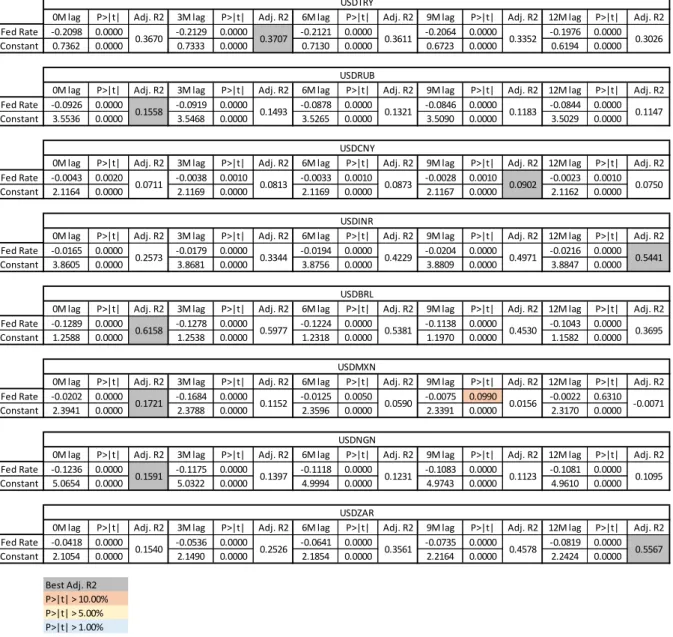
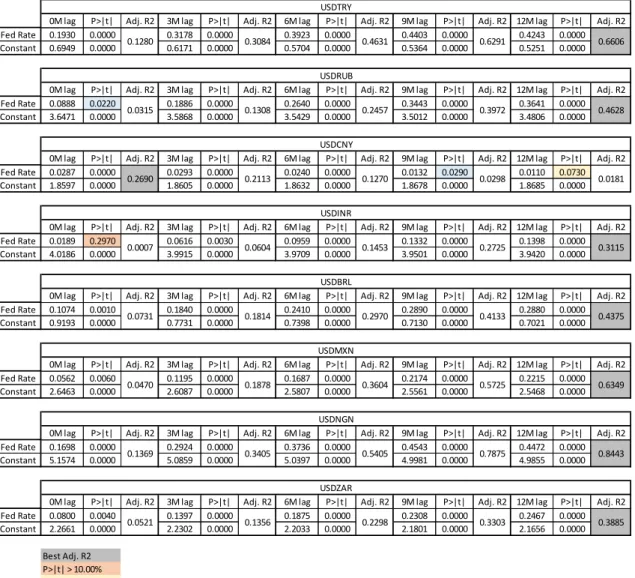
First, we can see that overall, the regression of emerging currencies relative to the
Fed rate is statistically significant for both periods (Table 1 and Table 2), despite
the simplicity of the model.
For the period 1997-2007, the first hypothesis can be refuted for all currencies. All
coefficients are negative, which means that a change in US rates would bring down
a pair of currencies, meaning a strengthening of the emerging currency. Also, there
is no consensus on the best model used. The adjusted R2s are scattered over four
of the five time-lag models.
About the second period (2008-2019), there is relevancy in the numbers. Also, we
can finally see how a hike in the US rates will impact the currencies. With all
coefficients being positive, one can highlight the fact that low-interest rates result
to a capital outflow in dollars to countries with higher rates, here emerging
countries. So, when the attractiveness of the US is coming back with a rate hike,
the money will return and thus peg the countries indebted in dollars.
Another interesting observation is that the twelve-months lag is the best model for
the period except for China. China that could already be considered as an outlier
since although it is officially an emerging country, one could ask oneself, if it is
behaving like it.
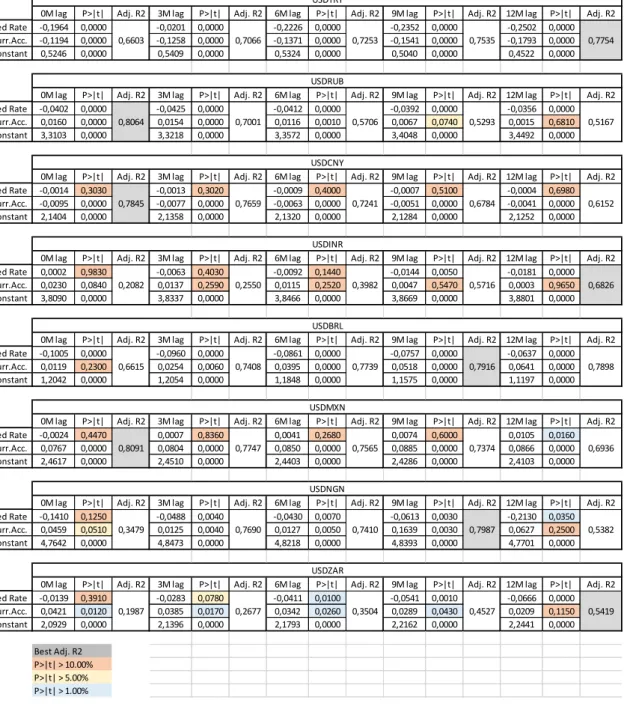
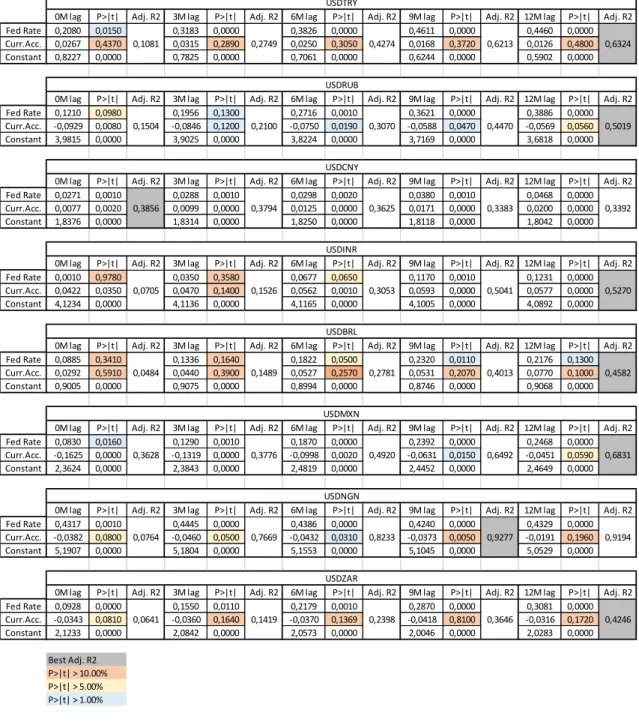
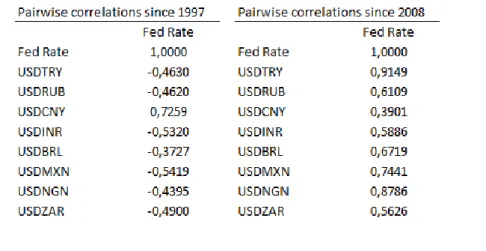
Considering the debt, when we add the variable of the current account as a
percentage of the GDP in the linear regression, we obtain a better model (Table 3
– 4). Even if some of the coefficients become statistically irrelevant, the adjusted
R2 is noticeably improved. I am proving again that the country's debt has a role to
play in the sensitivity of emerging currencies to US rates.
The models, where we linked the current account variable to the same quarter
than the exchange rate, were also better than the first ones but did not bring a better
understanding nor a better-adjusted R2.
Table 1 – Regression summary 1997-2007 period
0M lag P>|t| Adj. R2 3M lag P>|t| Adj. R2 6M lag P>|t| Adj. R2 9M lag P>|t| Adj. R2 12M lag P>|t| Adj. R2 Fed Rate -0.2098 0.0000 -0.2129 0.0000 -0.2121 0.0000 -0.2064 0.0000 -0.1976 0.0000 Constant 0.7362 0.0000 0.7333 0.0000 0.7130 0.0000 0.6723 0.0000 0.6194 0.0000
0M lag P>|t| Adj. R2 3M lag P>|t| Adj. R2 6M lag P>|t| Adj. R2 9M lag P>|t| Adj. R2 12M lag P>|t| Adj. R2 Fed Rate -0.0926 0.0000 -0.0919 0.0000 -0.0878 0.0000 -0.0846 0.0000 -0.0844 0.0000 Constant 3.5536 0.0000 3.5468 0.0000 3.5265 0.0000 3.5090 0.0000 3.5029 0.0000
0M lag P>|t| Adj. R2 3M lag P>|t| Adj. R2 6M lag P>|t| Adj. R2 9M lag P>|t| Adj. R2 12M lag P>|t| Adj. R2 Fed Rate -0.0043 0.0020 -0.0038 0.0010 -0.0033 0.0010 -0.0028 0.0010 -0.0023 0.0010 Constant 2.1164 0.0000 2.1169 0.0000 2.1169 0.0000 2.1167 0.0000 2.1162 0.0000
0M lag P>|t| Adj. R2 3M lag P>|t| Adj. R2 6M lag P>|t| Adj. R2 9M lag P>|t| Adj. R2 12M lag P>|t| Adj. R2 Fed Rate -0.0165 0.0000 -0.0179 0.0000 -0.0194 0.0000 -0.0204 0.0000 -0.0216 0.0000 Constant 3.8605 0.0000 3.8681 0.0000 3.8756 0.0000 3.8809 0.0000 3.8847 0.0000
0M lag P>|t| Adj. R2 3M lag P>|t| Adj. R2 6M lag P>|t| Adj. R2 9M lag P>|t| Adj. R2 12M lag P>|t| Adj. R2 Fed Rate -0.1289 0.0000 -0.1278 0.0000 -0.1224 0.0000 -0.1138 0.0000 -0.1043 0.0000 Constant 1.2588 0.0000 1.2538 0.0000 1.2318 0.0000 1.1970 0.0000 1.1582 0.0000
0M lag P>|t| Adj. R2 3M lag P>|t| Adj. R2 6M lag P>|t| Adj. R2 9M lag P>|t| Adj. R2 12M lag P>|t| Adj. R2 Fed Rate -0.0202 0.0000 -0.1684 0.0000 -0.0125 0.0050 -0.0075 0.0990 -0.0022 0.6310 Constant 2.3941 0.0000 2.3788 0.0000 2.3596 0.0000 2.3391 0.0000 2.3170 0.0000
0M lag P>|t| Adj. R2 3M lag P>|t| Adj. R2 6M lag P>|t| Adj. R2 9M lag P>|t| Adj. R2 12M lag P>|t| Adj. R2 Fed Rate -0.1236 0.0000 -0.1175 0.0000 -0.1118 0.0000 -0.1083 0.0000 -0.1081 0.0000 Constant 5.0654 0.0000 5.0322 0.0000 4.9994 0.0000 4.9743 0.0000 4.9610 0.0000
0M lag P>|t| Adj. R2 3M lag P>|t| Adj. R2 6M lag P>|t| Adj. R2 9M lag P>|t| Adj. R2 12M lag P>|t| Adj. R2 Fed Rate -0.0418 0.0000 -0.0536 0.0000 -0.0641 0.0000 -0.0735 0.0000 -0.0819 0.0000 Constant 2.1054 0.0000 2.1490 0.0000 2.1854 0.0000 2.2164 0.0000 2.2424 0.0000 Best Adj. R2 P>|t| > 10.00% P>|t| > 5.00% P>|t| > 1.00% USDZAR 0.1540 0.2526 0.3561 0.4578 0.5567 USDNGN 0.1591 0.1397 0.1231 0.1123 0.1095 USDMXN 0.1721 0.1152 0.0590 0.0156 -0.0071 USDBRL 0.6158 0.5977 0.5381 0.4530 0.3695 USDINR 0.2573 0.3344 0.4229 0.4971 0.5441 USDCNY 0.0711 0.0813 0.0873 0.0902 0.0750 USDRUB 0.1558 0.1493 0.1321 0.1183 0.1147 USDTRY 0.3670 0.3707 0.3611 0.3352 0.3026
Table 2 – Regression summary 2008-2019
0M lag P>|t| Adj. R2 3M lag P>|t| Adj. R2 6M lag P>|t| Adj. R2 9M lag P>|t| Adj. R2 12M lag P>|t| Adj. R2
Fed Rate 0.1930 0.0000 0.3178 0.0000 0.3923 0.0000 0.4403 0.0000 0.4243 0.0000
Constant 0.6949 0.0000 0.6171 0.0000 0.5704 0.0000 0.5364 0.0000 0.5251 0.0000
0M lag P>|t| Adj. R2 3M lag P>|t| Adj. R2 6M lag P>|t| Adj. R2 9M lag P>|t| Adj. R2 12M lag P>|t| Adj. R2
Fed Rate 0.0888 0.0220 0.1886 0.0000 0.2640 0.0000 0.3443 0.0000 0.3641 0.0000
Constant 3.6471 0.0000 3.5868 0.0000 3.5429 0.0000 3.5012 0.0000 3.4806 0.0000
0M lag P>|t| Adj. R2 3M lag P>|t| Adj. R2 6M lag P>|t| Adj. R2 9M lag P>|t| Adj. R2 12M lag P>|t| Adj. R2
Fed Rate 0.0287 0.0000 0.0293 0.0000 0.0240 0.0000 0.0132 0.0290 0.0110 0.0730
Constant 1.8597 0.0000 1.8605 0.0000 1.8632 0.0000 1.8678 0.0000 1.8685 0.0000
0M lag P>|t| Adj. R2 3M lag P>|t| Adj. R2 6M lag P>|t| Adj. R2 9M lag P>|t| Adj. R2 12M lag P>|t| Adj. R2
Fed Rate 0.0189 0.2970 0.0616 0.0030 0.0959 0.0000 0.1332 0.0000 0.1398 0.0000
Constant 4.0186 0.0000 3.9915 0.0000 3.9709 0.0000 3.9501 0.0000 3.9420 0.0000
0M lag P>|t| Adj. R2 3M lag P>|t| Adj. R2 6M lag P>|t| Adj. R2 9M lag P>|t| Adj. R2 12M lag P>|t| Adj. R2
Fed Rate 0.1074 0.0010 0.1840 0.0000 0.2410 0.0000 0.2890 0.0000 0.2880 0.0000
Constant 0.9193 0.0000 0.7731 0.0000 0.7398 0.0000 0.7130 0.0000 0.7021 0.0000
0M lag P>|t| Adj. R2 3M lag P>|t| Adj. R2 6M lag P>|t| Adj. R2 9M lag P>|t| Adj. R2 12M lag P>|t| Adj. R2
Fed Rate 0.0562 0.0060 0.1195 0.0000 0.1687 0.0000 0.2174 0.0000 0.2215 0.0000
Constant 2.6463 0.0000 2.6087 0.0000 2.5807 0.0000 2.5561 0.0000 2.5468 0.0000
0M lag P>|t| Adj. R2 3M lag P>|t| Adj. R2 6M lag P>|t| Adj. R2 9M lag P>|t| Adj. R2 12M lag P>|t| Adj. R2
Fed Rate 0.1698 0.0000 0.2924 0.0000 0.3736 0.0000 0.4543 0.0000 0.4472 0.0000
Constant 5.1574 0.0000 5.0859 0.0000 5.0397 0.0000 4.9981 0.0000 4.9855 0.0000
0M lag P>|t| Adj. R2 3M lag P>|t| Adj. R2 6M lag P>|t| Adj. R2 9M lag P>|t| Adj. R2 12M lag P>|t| Adj. R2
Fed Rate 0.0800 0.0040 0.1397 0.0000 0.1875 0.0000 0.2308 0.0000 0.2467 0.0000 Constant 2.2661 0.0000 2.2302 0.0000 2.2033 0.0000 2.1801 0.0000 2.1656 0.0000 Best Adj. R2 P>|t| > 10.00% P>|t| > 5.00% P>|t| > 1.00% USDTRY 0.1280 0.3084 0.4631 0.6291 0.6606 USDRUB 0.0315 0.1308 0.2457 0.3972 0.4628 USDCNY 0.2690 0.2113 0.1270 0.0298 0.0181 USDINR 0.0007 0.0604 0.1453 0.2725 0.3115 USDBRL 0.0731 0.1814 0.2970 0.4133 0.4375 USDMXN 0.0470 0.1878 0.3604 0.5725 0.6349 USDNGN 0.1369 0.3405 0.5405 0.7875 0.8443 USDZAR 0.0521 0.1356 0.2298 0.3303 0.3885
Table 3 – Regression summary 1997-2007 with current account variable
0M lag P>|t| Adj. R2 3M lag P>|t| Adj. R2 6M lag P>|t| Adj. R2 9M lag P>|t| Adj. R2 12M lag P>|t| Adj. R2 Fed Rate -0,1964 0,0000 -0,0201 0,0000 -0,2226 0,0000 -0,2352 0,0000 -0,2502 0,0000 Curr.Acc. -0,1194 0,0000 -0,1258 0,0000 -0,1371 0,0000 -0,1541 0,0000 -0,1793 0,0000
Constant 0,5246 0,0000 0,5409 0,0000 0,5324 0,0000 0,5040 0,0000 0,4522 0,0000
0M lag P>|t| Adj. R2 3M lag P>|t| Adj. R2 6M lag P>|t| Adj. R2 9M lag P>|t| Adj. R2 12M lag P>|t| Adj. R2 Fed Rate -0,0402 0,0000 -0,0425 0,0000 -0,0412 0,0000 -0,0392 0,0000 -0,0356 0,0000
Curr.Acc. 0,0160 0,0000 0,0154 0,0000 0,0116 0,0010 0,0067 0,0740 0,0015 0,6810
Constant 3,3103 0,0000 3,3218 0,0000 3,3572 0,0000 3,4048 0,0000 3,4492 0,0000
0M lag P>|t| Adj. R2 3M lag P>|t| Adj. R2 6M lag P>|t| Adj. R2 9M lag P>|t| Adj. R2 12M lag P>|t| Adj. R2 Fed Rate -0,0014 0,3030 -0,0013 0,3020 -0,0009 0,4000 -0,0007 0,5100 -0,0004 0,6980 Curr.Acc. -0,0095 0,0000 -0,0077 0,0000 -0,0063 0,0000 -0,0051 0,0000 -0,0041 0,0000
Constant 2,1404 0,0000 2,1358 0,0000 2,1320 0,0000 2,1284 0,0000 2,1252 0,0000
0M lag P>|t| Adj. R2 3M lag P>|t| Adj. R2 6M lag P>|t| Adj. R2 9M lag P>|t| Adj. R2 12M lag P>|t| Adj. R2 Fed Rate 0,0002 0,9830 -0,0063 0,4030 -0,0092 0,1440 -0,0144 0,0050 -0,0181 0,0000
Curr.Acc. 0,0230 0,0840 0,0137 0,2590 0,0115 0,2520 0,0047 0,5470 0,0003 0,9650
Constant 3,8090 0,0000 3,8337 0,0000 3,8466 0,0000 3,8669 0,0000 3,8801 0,0000
0M lag P>|t| Adj. R2 3M lag P>|t| Adj. R2 6M lag P>|t| Adj. R2 9M lag P>|t| Adj. R2 12M lag P>|t| Adj. R2 Fed Rate -0,1005 0,0000 -0,0960 0,0000 -0,0861 0,0000 -0,0757 0,0000 -0,0637 0,0000
Curr.Acc. 0,0119 0,2300 0,0254 0,0060 0,0395 0,0000 0,0518 0,0000 0,0641 0,0000
Constant 1,2042 0,0000 1,2054 0,0000 1,1848 0,0000 1,1575 0,0000 1,1197 0,0000
0M lag P>|t| Adj. R2 3M lag P>|t| Adj. R2 6M lag P>|t| Adj. R2 9M lag P>|t| Adj. R2 12M lag P>|t| Adj. R2
Fed Rate -0,0024 0,4470 0,0007 0,8360 0,0041 0,2680 0,0074 0,6000 0,0105 0,0160
Curr.Acc. 0,0767 0,0000 0,0804 0,0000 0,0850 0,0000 0,0885 0,0000 0,0866 0,0000
Constant 2,4617 0,0000 2,4510 0,0000 2,4403 0,0000 2,4286 0,0000 2,4103 0,0000
0M lag P>|t| Adj. R2 3M lag P>|t| Adj. R2 6M lag P>|t| Adj. R2 9M lag P>|t| Adj. R2 12M lag P>|t| Adj. R2 Fed Rate -0,1410 0,1250 -0,0488 0,0040 -0,0430 0,0070 -0,0613 0,0030 -0,2130 0,0350
Curr.Acc. 0,0459 0,0510 0,0125 0,0040 0,0127 0,0050 0,1639 0,0030 0,0627 0,2500
Constant 4,7642 0,0000 4,8473 0,0000 4,8218 0,0000 4,8393 0,0000 4,7701 0,0000
0M lag P>|t| Adj. R2 3M lag P>|t| Adj. R2 6M lag P>|t| Adj. R2 9M lag P>|t| Adj. R2 12M lag P>|t| Adj. R2 Fed Rate -0,0139 0,3910 -0,0283 0,0780 -0,0411 0,0100 -0,0541 0,0010 -0,0666 0,0000 Curr.Acc. 0,0421 0,0120 0,0385 0,0170 0,0342 0,0260 0,0289 0,0430 0,0209 0,1150 Constant 2,0929 0,0000 2,1396 0,0000 2,1793 0,0000 2,2162 0,0000 2,2441 0,0000 Best Adj. R2 P>|t| > 10.00% P>|t| > 5.00% P>|t| > 1.00% USDTRY 0,6603 0,7066 0,7253 0,7535 0,7754 USDRUB 0,8064 0,7001 0,5706 0,5293 0,5167 USDCNY 0,7845 0,7659 0,7241 0,6784 0,6152 USDINR 0,2082 0,2550 0,3982 0,5716 0,6826 USDBRL 0,6615 0,7408 0,7739 0,7916 0,7898 USDMXN 0,8091 0,7747 0,7565 0,7374 0,6936 USDNGN 0,3479 0,7690 0,7410 0,7987 0,5382 USDZAR 0,1987 0,2677 0,3504 0,4527 0,5419
Table 4 – Regression summary 2008-2019 with current account variable
0M lag P>|t| Adj. R2 3M lag P>|t| Adj. R2 6M lag P>|t| Adj. R2 9M lag P>|t| Adj. R2 12M lag P>|t| Adj. R2
Fed Rate 0,2080 0,0150 0,3183 0,0000 0,3826 0,0000 0,4611 0,0000 0,4460 0,0000
Curr.Acc. 0,0267 0,4370 0,0315 0,2890 0,0250 0,3050 0,0168 0,3720 0,0126 0,4800
Constant 0,8227 0,0000 0,7825 0,0000 0,7061 0,0000 0,6244 0,0000 0,5902 0,0000
0M lag P>|t| Adj. R2 3M lag P>|t| Adj. R2 6M lag P>|t| Adj. R2 9M lag P>|t| Adj. R2 12M lag P>|t| Adj. R2
Fed Rate 0,1210 0,0980 0,1956 0,1300 0,2716 0,0010 0,3621 0,0000 0,3886 0,0000
Curr.Acc. -0,0929 0,0080 -0,0846 0,1200 -0,0750 0,0190 -0,0588 0,0470 -0,0569 0,0560
Constant 3,9815 0,0000 3,9025 0,0000 3,8224 0,0000 3,7169 0,0000 3,6818 0,0000
0M lag P>|t| Adj. R2 3M lag P>|t| Adj. R2 6M lag P>|t| Adj. R2 9M lag P>|t| Adj. R2 12M lag P>|t| Adj. R2
Fed Rate 0,0271 0,0010 0,0288 0,0010 0,0298 0,0020 0,0380 0,0010 0,0468 0,0000
Curr.Acc. 0,0077 0,0020 0,0099 0,0000 0,0125 0,0000 0,0171 0,0000 0,0200 0,0000
Constant 1,8376 0,0000 1,8314 0,0000 1,8250 0,0000 1,8118 0,0000 1,8042 0,0000
0M lag P>|t| Adj. R2 3M lag P>|t| Adj. R2 6M lag P>|t| Adj. R2 9M lag P>|t| Adj. R2 12M lag P>|t| Adj. R2
Fed Rate 0,0010 0,9780 0,0350 0,3580 0,0677 0,0650 0,1170 0,0010 0,1231 0,0000
Curr.Acc. 0,0422 0,0350 0,0470 0,1400 0,0562 0,0010 0,0593 0,0000 0,0577 0,0000
Constant 4,1234 0,0000 4,1136 0,0000 4,1165 0,0000 4,1005 0,0000 4,0892 0,0000
0M lag P>|t| Adj. R2 3M lag P>|t| Adj. R2 6M lag P>|t| Adj. R2 9M lag P>|t| Adj. R2 12M lag P>|t| Adj. R2
Fed Rate 0,0885 0,3410 0,1336 0,1640 0,1822 0,0500 0,2320 0,0110 0,2176 0,1300
Curr.Acc. 0,0292 0,5910 0,0440 0,3900 0,0527 0,2570 0,0531 0,2070 0,0770 0,1000
Constant 0,9005 0,0000 0,9075 0,0000 0,8994 0,0000 0,8746 0,0000 0,9068 0,0000
0M lag P>|t| Adj. R2 3M lag P>|t| Adj. R2 6M lag P>|t| Adj. R2 9M lag P>|t| Adj. R2 12M lag P>|t| Adj. R2
Fed Rate 0,0830 0,0160 0,1290 0,0010 0,1870 0,0000 0,2392 0,0000 0,2468 0,0000
Curr.Acc. -0,1625 0,0000 -0,1319 0,0000 -0,0998 0,0020 -0,0631 0,0150 -0,0451 0,0590
Constant 2,3624 0,0000 2,3843 0,0000 2,4819 0,0000 2,4452 0,0000 2,4649 0,0000
0M lag P>|t| Adj. R2 3M lag P>|t| Adj. R2 6M lag P>|t| Adj. R2 9M lag P>|t| Adj. R2 12M lag P>|t| Adj. R2
Fed Rate 0,4317 0,0010 0,4445 0,0000 0,4386 0,0000 0,4240 0,0000 0,4329 0,0000
Curr.Acc. -0,0382 0,0800 -0,0460 0,0500 -0,0432 0,0310 -0,0373 0,0050 -0,0191 0,1960
Constant 5,1907 0,0000 5,1804 0,0000 5,1553 0,0000 5,1045 0,0000 5,0529 0,0000
0M lag P>|t| Adj. R2 3M lag P>|t| Adj. R2 6M lag P>|t| Adj. R2 9M lag P>|t| Adj. R2 12M lag P>|t| Adj. R2
Fed Rate 0,0928 0,0000 0,1550 0,0110 0,2179 0,0010 0,2870 0,0000 0,3081 0,0000 Curr.Acc. -0,0343 0,0810 -0,0360 0,1640 -0,0370 0,1369 -0,0418 0,8100 -0,0316 0,1720 Constant 2,1233 0,0000 2,0842 0,0000 2,0573 0,0000 2,0046 0,0000 2,0283 0,0000 Best Adj. R2 P>|t| > 10.00% P>|t| > 5.00% P>|t| > 1.00% USDTRY 0,1081 0,2749 0,4274 0,6213 0,6324 USDRUB 0,1504 0,2100 0,3070 0,4470 0,5019 USDCNY 0,3856 0,3794 0,3625 0,3383 0,3392 USDINR 0,0705 0,1526 0,3053 0,5041 0,5270 USDBRL 0,0484 0,1489 0,2781 0,4013 0,4582 USDMXN 0,3628 0,3776 0,4920 0,6492 0,6831 USDNGN 0,0764 0,7669 0,8233 0,9277 0,9194 USDZAR 0,0641 0,1419 0,2398 0,3646 0,4246