The Return of Geopolitics
Albert J. Bergesen and Christian Suter (Eds.)
Albert J. Bergesen and Christian Suter
(Eds. for the World Society Foundation)
The Return of Geopolitics
Printed version :
Albert J. Bergesen and Christian Suter (eds.) (2018): The Return of Geopolitics. Wien/Zürich/Münster: Lit.
World Society Studies
A series edited by
the World Society Foundation
Zurich, Switzerland
www.worldsociety.ch
Volume 2018
The Return of Geopolitics
Albert J. Bergesen and Christian Suter
(Eds. for the World Society Foundation)
Graphics: Nora Linder.
This book has been published with the financial support of the Faculté des lettres et sciences humaines of the University of Neuchâtel.
About the World Society Foundation vii
Preface ix
1 The Return of Geopolitics in the Early 21st Century: The Globalization/
Geopolitics Cycles 1
Albert J. Bergesen and Christian Suter
2 The Problem with Unipolarity 9
William R. Thompson
3 Sovereignty in the Millennial World-System 31 Salvatore Babones
4 Pre-emptive Decline: The Weakening of Great Powers and Geopolitical
Volatility 49
Robert A. Denemark
5 Political Economy of Secession: Global Waves of State-Seeking
Nationalism, 1492 to Present 69
Sahan S. Karatasli
6 “Fortress-Russia”: Geopolitical Destiny, Unintended Consequences,
or Policy Choices? 97
Andrei Melville
7 Democracy, Crisis and Geopolitics: Emergence and Transformation of
Anti-Kurdish Riots in Turkey 113
Şefika Kumral
8 African Islamist Terrorism and the Geopolitical Fracturing of
Postcolonial Borders 137
9 Geopolitics in the Anthropocene 151 Simon Dalby
10 From Geopolitics to Astropolitics 169
Albert J. Bergesen
The World Society Foundation (WSF) was established in 1982 by Peter Heintz with the aim of encouraging and supporting research on world society, that is, its emergence and historical evolution, its structure, its dynamics, and current transformation. Until 2003, the main purpose of the Foundation’s sponsoring activities was to finance entire research projects focusing on the various processes of social integration and disintegration within worldwide systems—world culture, world economy, world politics, and intergovernmental systems—and on how global processes affect the perceptions and actions of individual and collective actors worldwide. Its current sponsoring policy is to provide award programs for research papers and to support international conferences on world society topics. In accordance with this new policy, the Foundation has introduced its WSF Award Program for Research Papers on World Society and held a series of international conferences (2007, 2008, 2010, 2013, 2015, 2016, 2017) in order to maintain a network of excellent scholars interested in transnational and global research topics. The World Society Foundation Award honors outstanding research papers on world society that address a specific topic announced by the Foundation in its Award Program. The World Society Foundation also publishes the book series “World Society Studies.” The World Society Foundation is domiciled in Zurich, Switzerland. The current members of the Board are: Volker Bornschier, Mark Herkenrath, Hans-Peter Meier, and Christian Suter (President). Former members of the Board included: Peter Heintz, Karl W. Deutsch, Hans-Joachim Hoffmann-Nowotny, and Bruno Fritsch. More detailed information on past research projects sponsored, the topics and recipients of the 2007–2013 WSF Awards, the WSF book series “World Society Studies,” and the call for papers of the current WSF conferences (2018– 2019) can be found on the Foundation’s website at www.worldsociety.ch.
In April 2016, the School of Sociology of the University of Arizona, the Institute of Sociology of the University of Neuchâtel, and the World Society Foundation (WSF) organized an international conference on “The Return of Geopolitics” within the framework of the WSF program for research papers on world society. The confer-ence was cosponsored by the International Studies Association and took place at the University of Arizona, Tucson. The conference brought together about fifty re-searchers and participants to investigate and debate the causes and consequences of the increasing global political and economic conflict in different world regions of today’s world society—in five plenary presentations, five panel discussions and four workshop sessions. The aim of the conference was to contribute to a more compre-hensive understanding of the reemergence of geopolitical rivalry in the early 21st
century, characterized by increasing political and economic tensions, and the rise in nationalism. This “return to geopolitics” has been analyzed from historical, com-parative and interdisciplinary perspectives. This volume contains a selection of ten contributions presented and discussed at the 2016 conference.1
Many people have contributed to the realization of this volume and of the 2016 conference. First and foremost, the World Society Foundation and the editors would like to thank the authors for their stimulating contributions and their patience dur-ing the reviewdur-ing and copyeditdur-ing process. A big thank-you is due to the staff and the students at the University of Arizona, notably to Allyson L. McAdams, Ryan Byrne, Andrew Davis, Erin Heinz, Kelly Huff, Beksahn Jang, and Heidi Reynolds-Stenson, for helping to prepare and organize the conference. Our thanks also go out to Thomas J. Volgy (University of Arizona) for help in selecting names of par-ticipants and contacting the office of the International Studies Association (ISA) to seek their sponsorship and support. In that regard we also want to thank ISA Executive Director Mark A. Boyer for his support and Jeanne White, ISA Director
1 More details on the 2016 conference, the World Society Foundation, and the WSF confer-ence and research paper sponsoring program are available on the WSF website at http://www. worldsociety.ch.
of Conventions and Meetings, for help in negotiating a contract with the conference hotel in Tucson. For their excellent work on the editing and proofreading we are indebted to Nora Linder, Marilyn Grell-Brisk and Diana Luna. We should also like to thank Gabriel Robert for the cover image and the conference poster. Finally, we are very grateful to the Faculté des Lettres et Sciences Humaines at the University of Neuchâtel for providing generous financial support for the organization of the 2016 conference and the publication of this volume.
Neuchâtel/Zurich and Tucson, January 2018
Christian Suter, President of the World Society Foundation Zurich and Director of the Institute of Sociology, University of Neuchâtel
The Return of Geopolitics in the Early 21
stCentury: The Globalization/Geopolitics Cycles
Albert J. Bergesen and Christian SuterIntroduction
The dramatic expansion of the world-economy after 1945 came to be characterized as one of “globalization.” Similarly, we have resurrected the older term of geopoli-tics to characterize the re-rise of nationalism, border disputes, economic protec-tionism and declining multilateral trade. Geopolitics had appeared before, and it soon became apparent that so had globalization, if that were to mean accelerating cross border flows capital, labor, product and ideas. And while different moments of world history can be so characterized, it also becomes apparent that such repeti-tions point toward a more cyclic dynamic, which we will call here the Globalization/ Geopolitics Cycle (GGC). From this point of view, the so-called return of geopoli-tics of the early 21st century is but the latest cyclic turn of a larger and much longer
world historical process. While the GGC is not fully understood, we can identify a few of its properties and historical instances.
Being cyclic in nature GGC theory has no starting point and so for an example of how the reasoning goes let us begin with the mid-19th century economic expansion
which we could call an earlier globalization moment. By the last quarter of the cen-tury though, British led economic expansion was slowing and Imperial Germany and the United States were emerging as new economic powers.1 The emergence
of geopolitical rivalry as seen in both the second wave of colonialism and the then great depression of 1873–1896 marks a transition from globalization to geopoli-tics as the dominant international logic governing the behavior of nations. It would seem a world of full blown nationalist imperative geopolitical motives is an unstable situation for by 1914 the system breaks down into World War One. The two world wars can be considered a single thirty years war—the Second Thirty Years War— running from 1914–1945. At this point, we transition to another phase of economic
1 The standard account does not include Imperial Russia as a rising power but international economic statistics on the rate of growth of the Russian economy suggests that it should also be included. When the origin of the war itself is more closely examined the importance of Russia is made clearer.
expansion and globalization under the hegemony of the 20th Century United States
which has now replaced the 19th century hegemony of Britain.
Late 20th century globalization seemed to confirm the obsolescence of national
borders. But as we move further into the 21st century it is increasingly clear that
nationalism has not only not gone away but is resurgent. From the Scots to the self-styled Islamic State, groups want their own nations and Japan’s Shinzo Abe, China’s Xi Jinping, Russia’s Vladimir Putin, Turkey’s Recep Tayyip Erdoğan, India’s Narendra Modi and Donald Trump of the United States all have nationalistic agendas. At the regional level, the transnational experiment that was the European Union is also suffering from economic tensions between its southern periphery and northern core along with the withdrawal of the United Kingdom. And, on the national front, again, there is the rise of right wing parties such as France’s National Front, Greece’s Golden Dawn, and even in Germany the most prosperous of European Union coun-tries, the Alternative for Germany argues that German interests have been subordi-nated to those of Europe. Within Eastern Europe there is a similar rise in national-ism, with the Russian annexation of Crimea and support for pro-Russian separatists in eastern Ukraine. In the Middle East, there is continuing chaos and in the Far East there are disputes over islands and air space in the South and East China Seas. All of this compels us to recognize that world events are increasingly driven by the ancient forces of geopolitics.
The globalization/geopolitics cycle while not completely understood, has a number of distinctive properties that can be identified and on the basis of research better understood. We can identify a few of them here.
Globalization
It remains a somewhat ironic fact of international life, that periods of economic glo-balization are also periods of hegemonic dominance by a single state politically. One thinks of mid-19th century Britain and mid-20th century United States. Multi-lateral
trade agreements, for instance, appear under the condition of a uni-polar interna-tional state system. And of course, the opposite is true; periods of multi-polarity, or hegemonic decline and increased equality between the great powers is also one of an increase in bi-lateral trade agreements. Uni-polar politically and multi-lateral economically and multi-polar politically and bi-lateral economically seems to fly against common sense reasoning that a uni-polar world would have others to the hegemon trade deals (eg. bi-lateral) while the multi-polar political world should be one characterized by more multi-lateral trade agreements. But it is not.
At the more general level of determining the ingredients of hegemony/uni-po-larity the Thompson chapter argues that hegemony, or dominance, is based upon both economic and military power and that there can be a decline in one or in both dimensions of international power. Utilizing empirical data Thompson finds a
great-er relative economic than military decline for the United States today. These find-ings point to the complexity of international power and dominance, for if it were not for the rapid economic growth of Japan, China, and other east Asian economies the absolute American economic advantage would probably still be quite large. Also, the dynamic documented by Thompson seems general. It was not so much that Spartan military power had declined as Athenian economic power had so dra-matically grown, and turn of the century British naval power was still quite large but relative to the economic growth of Imperial Germany and the United States it was in decline.
That hegemony is comprised of economic and political/military components seems reasonable. A second question arises as to exactly how it works? Meaning, how does a state or national economy actually exercise dominance over other states and their economies. As to economics there is a long literature dealing with the economic dependence of developing countries, or the third world, the global south, or the periphery in world-system theoretic terms. Exchanges of raw materials for manufactured goods, international agreements that favor the powerful rich coun-tries (the core in world-system terms) and varieties of trade concentrations of both type of export and number of partners, often listed as a dominance mechanism of hegemonic economic states.
There is also something like Global Gramscianism that no doubt operates as well, where the hegemon poses as not so much the universal class, but as the uni-versal state—but not an empire—that others buy into, such that hegemonic pow-er is masked and thpow-ereby legitimated. As a process, this is not well undpow-erstood at all and little studied. In response to the more conflict orientation of the origi-nal Wallersteinian idea of the operations of the political economy of the capital-ist world-system, a more Durkheimian and Weberian cultural perspective also emerged in sociological theory. Variously called the world-society or world-culture perspective associated with John Meyer and the Stanford School of world-system theorists, it studies global cultural templates, but not as agents of specific powers. As such world society/world culture perspectives are not Gramscian in nature; they are not concerned with the legitimation and normalization of power differentials but more Durkheimianly concerned with something like the collective representa-tions of world society.
The Babones Chapter adds a very provocative perspective on how hegemony works in today’s world. As an example, he argues that the United States does not necessarily pose as the universal nation thereby masking its own power, but instead, in some global Gramscian way, other states come to feel that their society is a part of American society. Babones nicely notes the similarity of international influence, rule, hegemony—call it what you want—of the imperial Chinese system of tianxia: “all under heaven,” with that of American hegemony. Here of course it is all under the United States, and historically no doubt all under Rome, or Athens, or Britain,
and whoever else exercised such imperial systems.2 Tianxia hegemony has
impor-tant implications for the traditional Westphalian state system in existence since 1648. It is less a system of equality amongst states and more one of deference and subservience to a single state (our idea of the hegemon) and to China in what was earlier the East Asian world-system. The analogy with the Chinese system then and an American Tianxia now is interesting and will no doubt open eyes and further discussions about the distinctive side of hegemony within the international system.
There is a broader issue here. It may be that the earlier Sino-Centric East Asian World-System operated in its cultural aspects as a Tianxia system and the Euro-Centric Western World-System operated economically in as dependency core-pe-riphery hierarchy system. The wedding of East and West into a unified world-system may combine both the distinctive cultural contributions of the Chinese with the hierarchic economic structure of the West to produce a fully rounded economic, social, political, and cultural totality. This, of course, is at this point largely specula-tive and certainly something that with future empirical research will be sorted out one way or another.
As with the notion that the alternating globalization and geopolitical currents shift back and forth constituting a unique world-systemic cycle, it may also be the case that the hint of global hegemony may also not be unique with America. For as there have been earlier “globalization” epochs so too have great powers always sought to meddle in the internal affairs of those they seek to influence. And iden-tification of the weak with the strong, something like an international Stockholm Syndrome3 also seems a universal in human history.
In some sense, it was the distinctive geography of Europe, that gave rise to Westphalian like entities, from classic Greek city states to the European state sys-tem. But would a Westphalian world of equal, separate, states have emerged on the Eurasian steppes? If not, it is not entirely clear how generalizable the Westphalian state system is, such that intervention in the affairs of other states might not be as radically different as the Babones chapter suggests. Or put another way, perhaps the world-system cycle of real interest is not so much globalization to geopolitics and back again, but Asian Western to Asian originated logics which govern the operat-ing principles of the world-system as a whole. So, if in some sense, we see the rise or re-rise of east Asian dominance, then with it may very well come, the Tianxia model of interstate relations and its accompanying social psychology.
2 Almost all cultural aspects of the modern world-system have come out of non-Wallersteinian traditions, and Babones, trained at Hopkins with Chase-Dunn, has added a distinctly non-Meye-rian perspective on the culture accompanying political economic dominance.
Between globalization and geopolitics
Historical movement is sometimes clear cut but often one set of logics slowly gives way to another, and we can see this in the present transition from a period of glo-balization under American hegemony toward a more multi-polar world operating under more classic geopolitical logic. As in all social liminal periods the transition zone is one of uncertainty when numerous paths seem possible, but as time passes and larger logics click into place historical direction becomes more easily identified. As historians often say, we are best at predicting the past, and while social scientists are prone to generalization, trend identification, and pointing out cyclic behavior, it turns out that most of that is about what has already happened. At the height of either globalization or geopolitics the nature of the epoch is very clear. But these in between times are no doubt shrouded in the fog of transition.
The Denemark chapter is very much a contribution to the hegemonic decline literature with its thesis of pre-emptive decline experienced in late hegemony. The chapter argues that hints of decline can lead to overreactions which if anything ac-celerates actual decline. The chapter provides examples from British preemptive re-sponses to decline in the latter 19th and American ones in the latter 20th century. If
these preemptive reactions are general enough one should find them in the declines of the Netherlands and Spain in earlier world-system history, and perhaps with an-cient Rome as well. Again, depending upon the level of generality that can be ex-tracted from his examples, one could also image the preemptive process operating on almost any kind of social entity that experiences rise and fall cycles. Interestingly, and perhaps a stretch, but one naturally wonders if there is, somehow, a kind of pre-emptive decline activity that can be found in the later stages of the historical epoch of different styles of art, music, architecture, or drama.
Geopolitics
Almost by definition the return to geopolitics represents a rise in nationalism. The Karatasli chapter focuses upon state seeking secessionist movements since the late 16th century within the context of the larger cyclical dynamics of the world-system,
as groups involved in revolution, civil war, and secessionist activity in the name of seeking statehood appear with conjunctures of different world-systemic cyclic cri-ses. This is an important observation and accompanying empirical research, for up till now, by and large, the consequences of disorder and hegemonic decline have been on the possibilities of great power conflicts. While hierarchical order is foun-dational for economic exploitation (core-periphery hierarchies in political economy of the world-system [PEWS] theory) it is also foundational peace amongst the great powers. It is a double hierarchy, where the states of the core dominate those of the periphery economically, but within the core the hegemonic state dominates the other core powers, e.g. the Great Powers. And that yields periods of peace (Bergesen
and Schoenberg, 1980). Hegemonic breakdown, or multi-polarity, though, is also associated with state seeking social movement activity, which is nicely document-ed in the Karatasli chapter, which also includes a reference to a unique data set Karatasli assembled, the State-Seeking Nationalist Movements (SSNM) database (1492–2013). This should be of great use to scholars interested in social movements over long historical periods.
While the nationalism generated by geopolitics, or perhaps said nationalism is that which constitutes geopolitics, manifests in social movements, it is also pres-ent in established states. The return of nationalism has been dramatic and seen ev-erywhere. It is conventionally noted in nationalist poll results in Britain (Brexit); nationalist election themes in Europe and the United States; national claims and counter claims in Ukraine/Russia; civil war in Syria; and the jostling over who owns, controls, what aspects of the South China Sea.
Fitting into this trend, the Melville chapter highlights contemporary nationalist sentiment in Russia. Of particular interest is Melville’s discussion of the ideology of Eurasianism and the societal location from which various strands of Russian na-tionalist sentiments arise. Taken together the Karatsali and Melville chapters nicely highlight the range of social and cultural movements that accompany the geopoliti-cal turn in early 21st century world politics. In some sense, when the trans-national
fades, evaporates or recedes, what is left is country, nation, state, which is culturally emphasized as in Russian and other countries of course, nationalism, and in move-ments of various groupings to themselves realize a nation of their own.
More specifically, Eurasianist ideas reflect the fundamental observation of Weber that the modern state is a distinctly territorial entity, and for Russia as the United States, or any other country, it is land, on which have existed peoples and societies, that together constitute a clear geo and political mix; geopolitics. These sentiments are also expressed in the United States (Kaplan, 2017) and clearly articu-lated in a review of the book with the title, “Geography Made America Great. Has Globalization Undone Its Influence?” (Rauch, 2017). One can easily imagine a simi-lar title, “Geography Made Russia Great. Has Globalization Undone Its Influence,” and for that matter substitute any number of other countries and one can see the more universalist aspects of the tendencies highlighted by Melville.
The return of geopolitics is hegemonic decline, episodes of pre-emptive decline, rising nationalism in major powers and social movements within states. In some sense, a mix of this geopolitical stew is nowhere better seen than in the politics of today’s turbulent Middle East and North Africa, which is the focus of the Kumral and the Miles chapters.
The topic of the Kumral chapter is a case study of the continuing Turkish/Kurdish violence set in the context of the geopolitics of the Syrian Civil War, which acts as an ethnic violence accelerator. Kumral argues that the Turkish state of Erdogan devised a plan to incorporate the Kurdish minority through a democratic opening along with an accompanying repression. The effort, though, turned more toward
repres-sion with the internationalization of the Syrian Civil War. As the Kurds fought the Islamic State group (IS), the Turks reacted by aiding the IS as a way to counter the Kurds. The issues are complex and this chapter does a good job outlining the twists and turns of how the return of geopolitics in the form of the internationalization of the Syrian Civil War affected the relations between Turkey and its Kurdish minority.
The Miles chapter argues that, “[r]adical Islamist organizations in Africa . . . constitute branches of a transcontinental movement aimed at replacing a basically secular geopolitical order with a fundamentally faith-based (qua Islamic) one” (p. 147). In explicating this thesis he focuses upon such jihadi groups as Al Qaeda in the Islamic Maghreb (AQIM), El-Mourabitoun, Boko Haram, Al Shabab, and Al Qaeda in the Arabian Peninsula (AQAP).
The idea of Muslim Umma, the community of all believers, is an alternative model of global order to the Westphalian idea of the sovereign independent na-tion-states where each one is allowed to pursue their own religious persuasion. This chapter focuses upon insurgent groups on the ground, but the idea of a “transcon-tinental” as opposed to a “transnational” movement highlights differences between the Western and Islamic model of global political order.
The final two chapters address the very meaning of geopolitics; but from two different perspectives. The Dalby chapter is concerned with the idea of geopolitics from the perspective of what professional geographers call “critical geopolitics.” Classic geopolitical theory argues for the effects of the geographic upon the po-litical; but in what is called critical geopolitics the reasoning is reversed. It is the political which affects the geographic. Using the idea of the Anthropocene (the idea of human effects upon the environment as a distinguishable geologic epoch Dalby argues that it is the political that affects the geographic (e.g. the environment). There is, of course, a possible feedback model here that would allow for classic and critical geopolitical effects. Human economy, politics, capitalism, and so forth affect the environment (critical geopolitics) but said altered environment acts back upon poli-tics in one way or another (classic geopolipoli-tics).
Finally, the Bergesen chapter takes a different perspective on the idea of geopoli-tics. It begins with the traditional emphasis upon the constraining influences of the earth’s geography upon politics. It then notes that any study of geopolitics is also one of state power and, that in turn, is one of military capacity which has to include orbiting satellites. In effect, land and sea power not only is supplemented by air power, but also increasingly by space power, such that one has to ask if one needs an astropolitical perspective to accompany that of geopolitics. Bergesen goes on to discuss potential problematic aspects of traditional international relations when the political is exported into orbit, such that, for instance, an armed satellite circling the earth every ninety minutes would make any number of countries face the military presence of any number of other countries (through their military satellites) almost constantly. While it is clearly too early for actual studies of space politics, nonethe-less, there is enough politicization and militarization of space today, with a good
chance of its weaponization tomorrow, that any serious discussion of geopolitics must be accompanied by one of astropolitics as well.
References
Bergesen, Albert, and Ronald Schoenberg. 1980. “Long Waves of Colonial Expansion and Contraction, 1415–1969.” In Albert Bergesen (ed.), Studies of the Modern World-System (231–277). New York: Academic Press.
Kaplan, Robert D. 2017. Earning the Rockies: How Geography Shapes America’s Role in the World. New York: Random House.
Rauch, Jonathan. 2017. Geography Made America Great. Has Globalization Undone Its Influence? New York Times, January 24, 2017. URL: https://www.nytimes. com/2017/01/24/books/review/earning-the-rockies-robert-d-kaplan.html?_r=0 (accessed August 25, 2017).
The Problem with Unipolarity
William R. ThompsonWith the end of the Cold War, the United States is said to have entered a unipolar era in which it had no real competition, thereby encouraging the Afghanistan and Iraq involvements. I argue that this categorization of the post-Cold War era as unipolar is something of an error based on six types of analytical problems: a univariate emphasis, operationalization disagreements, the absence of threshold definitions, the conflation of relative power and the absence of challengers, the adoption of static over dynamic views, and privileging military over economic capabilities. After discussing these issues, a new metric is developed that combines energy and power projection resources. From this perspective, the United States has been unipolar since the end of World War II and its relative power position has been declining since the 1950s. It remains more powerful than its rivals but its edge has been slipping for some time. From this vantage point, the explanatory utility of the unipolarity concept is much less than it might seem. Relative decline and the ambitions of major power challengers are more useful.
Introduction
One of the reasons the world seems confusing to onlookers, especially in the United States, is that it was not very long ago that a very large number of people were con-vinced that the United States had won the Cold War, ideological history was dead, and a new era of the United States’ predominance in a unipolar world had emerged. Then came 9-11, along with wars in Afghanistan and Iraq, and an almost return to world depression on a scale not seen since the 1930s. How can these disparate impressions be reconciled? Is/was the United States’ triumphalism warranted or was it a matter of misreading the structure of world politics? My argument is that the United States’ triumphalism was not justified and the world did not really turn unipolar over night with the collapse of the Soviet Union. What happened after the end of the Cold War, more accurately, was a temporary deviation from a longer sequence of protracted relative decline by the system’s lead economy—the United States. Starting from a very high level of power concentration vis-à-vis other states in the interstate system, the United States has a long way to go to fall out of first place in this global hierarchy. Yet that does not mitigate its gradually weakening foundation for power and influence. Some of that relative decline is natural and
inevitable; some of it is traceable to poor U.S. decision-making that privileges the short term over long term considerations.
Part of the misinterpretation of systemic structure of power can be traced to the way in which we study polarity or distributions of power. collective approach is characterized by six problems that lead to debatable conclusions about how world politics works. After a discussion of the problem set, some solutions are advanced and a new operationalization of global power is developed. The new metric is used to both characterize polar distributions since 1816 and to assess the durability and conflict-proneness of variations in power distributions. In the end analysis, power concentrations come and go. Whether it is associated with differential propensities to conflict remains an open question given the empirical outcome established in this chapter.
Six problems
The study of unipolarity is characterized by six problems—some of which are dis-tinctive to the topic while others are more generic to the study of international re-lations.1The two generic problems are a tendency to exaggerate the impact of any
single variable, that is, a univariate explanation and the absence of any consensus about how to go about measuring the distribution of power—something that is fun-damental to arguments about what difference greater or lesser concentrations of power might make. The four non-generic problems are related to the generic ones. One is the absence for any threshold for the attainment of polar status. As a con-sequence, weaker and stronger candidates are lumped together. The second prob-lem is the conflation of relative power and the presence or absence of challengers. People who study unipolarity assume that high relative power is accompanied by the absence of significant opposition when in fact that has not been the case. It may be that the presence or absence of challenges to leading states is actually more important than the actual distribution of power. But, it will be argued, it is difficult to talk about one without considering the other. Yet the third non-generic problem overlaps with the second one. Polarity is strongly static.2 If a slice of time is coded
as possessing the attributes on one type of polarity, it is assumed to be so character-ized equally throughout the designated time period. Such stationarity seems highly
1 For the unipolarity literature, see, among others, Krauthammer (1990/91), Layne ( 1993), Owen (2003), Buzan (2004), Mowle and Sacko (2007), Brooks and Wohlforth (2008; 2015), Ikenberry et al. (2011), and Hansen (2012).
2 See, for instance, the older polarity literature: Deutsch and Singer (1964); Waltz (1964; 1979); Bueno de Mesquita (1975); Siverson and Sullivan (1983); Wayman (1984); Sabrosky (1985); Hopf (1991); Wayman and Morgan (1991); and Kegley and Raymond (1994). Not all of the analyses of this earlier era were static—see, for instance, Thompson (1986), Spiezio (1990), and Mansfield (1993).
unlikely, especially over a long period such as a century or even a half century. The alternative is to focus more on dynamics. How the distribution of power is changing may be more important than identifying the category in which it falls roughly over some specific interval. Finally, the fourth non-generic problem is the tendency to view power distributions solely through a military lens. Military power is certainly important but it hardly operates in a vacuum. The economic foundation that pays for military power is just as important. To examine one dimension while ignoring the other is simply distortional. Polarity needs to be examined in the context of its military-economic base.3
Each of these problems deserves some elaboration and resolution if we are to figure out what to make of unipolarity claims. However, since the question of power metrics, thresholds, and military-economic considerations are readily linked, it is most convenient to collapse these three problems under one heading, leaving us with four clusters to discuss.
Univariate explanations
The entire history of polarity analysis has been plagued by the tendency to assume or to proceed as if the only thing that matters is the distribution of power. Waltz’s (1979) structural realism framework is the leading example. Even if one wished to privilege structural factors over others, how, one might ask, is it possible to reduce structure to a single variable? The irony is all the more complete since most stu-dents of international relations are quick to claim great complexity for their subject matter. Yet, even when we know better, we proceed to promote univariate explana-tions. Power distributions do this. Arms races or alliances make decision-makers do things they might not have done otherwise. Living on islands encourages the development of navies while surrounding mountains make people more insular. Democratic regime types do a great deal of that. The presence or absence of group-think makes all the difference in crisis outcomes. Without Hitler, there would have been World War II. If Archduke Ferdinand had not been assassinated, no World War I would have occurred.
While we need to advance generalizations linking variables, we should be cau-tious in taking any two-variable generalization too seriously. If one variable could explain a great deal of variance, would we not have stumbled on this magic elixir by now? Of course, many analysts think we have found powerful univariate explana-tions. The only problem is that if one holds their breath long enough, significant objections are usually forthcoming. The reason is simple. International relations is more complex than many other fields of inquiry. Even Albert Einstein knew that.
3 Lest one dismiss this perspective as overly materialistic, there is certainly more involved in establishing and maintaining a foundation for power. Cultural and ideational factors can play a role but soft power does not lend itself readily to an empirical examination of power distribution.
The problem is that we tend to overlook complexity when assembling our explana-tions. Maybe we have to do this lest the sheer complexity of world politics paralyze us from advancing any explanations. But, in doing so we need to keep in mind just how limited is the probability that any one variable is going to account for a consid-erable amount of variance in whatever it is that we are trying to explain.4
Polarity, in general, is usually relied upon to explain system stability and levels of conflict. The distribution of power should possess some link to these topics. It does not seem implausible that a system in which power is highly concentrated might be more stable and less conflictual than one in which power is widely dispersed. What happens in between the two ends of the concentration continuum may be less eas-ily predicted. Even within the polarity literature, there is some recognition of com-plexity in the occasional tendency to differentiate between polarity and polarization (Rapkin et al., 1979). A bipolar world, for instance, need not be highly bipolarized with all or most of the population adhering to one pole versus the other. It follows that a bipolar system that is also highly bipolarized could very well be more conflic-tual than a bipolar system which is not particularly bipolarized. We do not have to travel very far back in international history to find an example in the waning years of the Cold War.
That some analysts persist in assuming that polarity and polarization mean the same thing is unfortunate and perhaps part of the more general analytical problem. Here, however, it is only invoked to suggest that one does not have to go very far to find qualifications to the power of information about power distributions.
Static versus dynamic interpretations
The 16th through much of the first half of the 20th century are often described as
mul-tipolar in structure. Is it conceivable that 445 some years were equally mulmul-tipolar? At various points in time, Spain, France, and Germany held predominant positions within Western Europe. Did that not alter the way in which a multipolar distribu-tion of power might be expected to work? Alternatively, the following bipolar era in the second half of the 20th century was characterized by a long period in which the
United States held a monopoly on the capability to deliver nuclear bombs/missiles over sufficient distances to reach its main opponent. At some point in the 1960s this began to change and by the 1970s the United States was according nuclear parity with the Soviet Union. Should we expect bipolarity to have the same impact in the 1950s as in the 1980s? Of course, other processes such as learning to avoid full-fledged confrontations may have intervened as well. But the initial bipolarity was at the very least highly asymmetrical at the global level in the early years of the Cold
4 One of the ultimate ironies in the polarity literature is that Waltz (1979) devoted some space to criticizing reductionist theories and then proceeded to develop a univariate, structural realist explanation based on polarity.
War. It became less asymmetrical in terms of relative capabilities after the 1970s but remained lop-sided in favor of the United States nonetheless.
Kirshner (2015) attributes the emphasis on static structure to the development of Waltz’s (1979) structural realism but static polarity arguments were of course quite common in the 1960s. Structural realism may have further reinforced static structural arguments but it certainly did not invent them. Yet Kirshner is correct to stress that classical realists such as Gilpin have argued for looking at how power distributions change as a more important factor than how we might code structure at any given point in time. The question, of course, remains an empirical one but the dynamic interpretation certainly sounds more plausible if we have to make a choice.5
Power metrics, thresholds, and military-economic
foundations
International relations analysts have never done well at measuring one of our most central variables. To be sure, measuring power is not simple. Ideally, we would like to be able to assess who influences whom to do what but we usually have to settle for identifying who possesses varying shares of resources that are thought to provide foundations for influencing other people and states. Unfortunately, we do not agree precisely on which resources are thought to be most important. Waltz (1979, 131) threw out a long list of possible resources: population size, territorial size, resource endowment, economic capability, military strength, political stability and compe-tence. The Correlates of War power concentration index (CINC) enthrones six indi-cators as something akin to an industry standard: iron and steel production, military expenditures, military personnel, energy consumption, total population, and urban population.6 Other scholars, especially those working in the power transition
re-search program, emphasize gross domestic product as the best single indicator of national strength.
The multiple indicator indexes represent the most prevalent approach to mea-suring power distributions. When in doubt, hedge your bet by combining a number of different indices and hope that something works.7 Of course, this interpretation
is more than a bit cynical. An argument can be made for focusing on each and
ev-5 See, as well, Thompson (1986) which demonstrates the advantages of looking at structural change over structural statics.
6 Despite the widespread and professed dissatisfaction with the index, it is used repeatedly if for no other reason that it is readily available and intermittently updated. But it is fair to say that some of the components are quite attractive indicators—the real question is whether they should all be combined and combined in an unweighted fashion.
7 It is not clear that anyone has ever followed Waltz’s advice in operationalizing his list of power indicators.
ery one of the indicators found in the Waltz and Correlates of War (COW) menus. The question, however, is whether an argument can be made to look at all of the indicators at the same time with equal weight given to each one. This type of argu-ment, in fact, is usually missing altogether. Once one lists the factors that observers have thought to be relevant, it is just assumed that we can throw them together and see what happens. Yet what tends to happen is that bulk is privileged over quality. Large populations, economies, and armies can be useful resources. Their utility can also be exaggerated if the population is undereducated and impoverished or if the economy or army lacks cutting edge technology. By and large, bulk resources are more useful in local or regional defensive situations in the sense that large countries are hard to occupy and control. Alternatively, large countries can overwhelm small neighbors. Historically, states that have dominated their home regions (think India in South Asia, China in East Asia, Russia in Eastern Europe, or France in early mod-ern Westmod-ern Europe) have often depended on bulk predominance. Other things be-ing equal, the bulk resources are less useful in global contexts because they are hard to mobilize for power projection purposes. Large populations can provide ample cannon fodder but not necessarily much else. Large underdeveloped economies generate little surplus that can pay for complex weapon platforms. This liability has long been a problem and was certainly manifested when India and China’s gross domestic products were the largest in the world prior to the Industrial Revolution. Their large economies did not prevent their defeats by relatively small forces with advanced cohesion and technology. For large armies to be effective they need ap-propriate firepower and relatively scarce (historically) naval and aerospace capabili-ties to be transported over long distances.
When one looks only at bulk resource indicators, the outcome can be mislead-ing. When one combines bulk resources with non-bulk resources (for instance, energy consumption, gross domestic product per capita, or naval size), they either cancel one another if they are equal in number or the bulk resources trump the non-bulk factors because bulk indicators tend to lead to concentrated outcomes. States with large economies also tend to have large populations and armies. Thus, our indexes of power give too much weight to bulk considerations and not enough to qualitative considerations.
Some of this problem is intertwined with problems in interpreting “great pow-ers.” Since most international relations analysts assume that the history of interna-tional relations should be equated with regional internainterna-tional relations in Western Europe, we begin with a checkered understanding of which states have been major powers—and thus potential poles. If 18th century Prussia or 19th century Italy can
be counted as great powers, it becomes clear that the standards for major power status have not been uniform historically. This practice has been maintained by the Correlates of War codification of post-1816 major power status which ignores the non-European world prior to the mid to late 19th century and awards status
as major powers. France and Britain retain their major power status after World War II dubiously. Germany and Japan regain their major power status after 1990 for reasons that are not altogether clear. In general, we simply lack consensual under-standing of what counts for power purposes or where the threshold for promotion might lie even though we have proceeded as if we have agreed to something when we adopt COW standards.
A more defensible position is to suggest that there are three classes of states in international relations. Most states are minor powers with restricted military and/ or economic capabilities. They may be stronger in one sphere than in the other but they do not rank highly in both spheres. There are states that do rank relatively high-ly in military and economic capabilities but their ability to project economic and military power are restricted for the most part to their home region. Then there are the few states that have the capability to project power beyond the home region to other regions. These states are global powers.
While we cannot assume that this alternative framework will find widespread appeal, it does have clear implications for how one goes about measuring the dis-tribution of power. If the tripartite classification is adopted, measurement of power distributions must be careful about mixing regional and global powers or, alterna-tively, bulk and non-bulk resource capabilities. If we are addressing the global dis-tribution of power, global powers should take precedence over regional powers. To make this distinction, some threshold distinguishing regional from global powers is necessary.
But there is another way in which the absence of thresholds becomes problem-atic. Let us assume for the sake of argument that we can count the number of global powers accurately. If there is only one, must the system be unipolar? Yet what about bipolar, tripolar, and multipolar situations? Where do we draw the lines between and among these categorizations. Too often, polarity discussions proceed as if there is no problem in moving back and forth among these designations when that is sim-ply not the case. Take the following example. What should we make of a system with two global powers, one of which claims 75% of the total capabilities that count and the other states possesses only 25%. Is the system unipolar or bipolar? If it is bipolar, is it bipolar in the same sense that a system with a 50:50 split in capabilities could be said to be bipolar?
Another illustration of the problem is to imagine two systems with three or more global powers. In one system, the capability distribution of the three leading states is 50, 25, and 25%. In the other, it is 36, 34, and 30%. How should we code system 1 or system 2? System 1 might be unipolar or maybe it is tripolar/multipolar but certainly not tripolar/multipolar in the same sense that system 2 is. Putting aside for the moment the categorization problem, how should we view a system in which the leading state has declined in relative position from a 25% lead over its nearest rival (as in 50% versus 25%) to a 2% lead (as in 36% versus 34%)? Most polarity dis-cussions have no answer for these questions because they choose to ignore precise
thresholds. A state that leads by 2% is still considered the leader even if in reality such a lead amounts to rough equivalence with other leading states. Yet no matter how these situations are construed, there can be little question that a lop-sided edge over rivals is different from not much of an edge.
An alternative approach is to talk about algebraic qualifications of unipolarity. Buzan (2004) and Brooks and Wohlforth (2015) have talked about a single super-power (i.e. unipolarity) but accompanied by one or more relatively weak challeng-ers—as in 1 + X or 1+ X + Y. The X and Y qualifiers suggest that the predominance of the single leading state is somehow qualified or in the process of becoming quali-fied. X and/or Y are significant actors but not yet in the “superpower” category. The problem here is that not much more information is conveyed beyond the caveat that unipolar leaders are confronted by challengers. At what point do these challengers rise to high enough status to change 1 into 2 or more great or super powers?8 In the
absence of any explicit thresholds, the X and Y will remain nominal qualifiers for some time to come. But what if X and Y are allied or act in concert? Do we aggre-gate their combined resistance? It is good to highlight the presence of challengers. Yet leaving them as X or Y remains awkward for operationalizing the distribution of power, just as forgoing the application of explicit thresholds leaves us in a subjective limbo when it comes time to estimate degrees of change.
The third problematic dimension of this cluster is the proclivity to differentiate between military and economic capabilities. For most polarity analysts (but not all), only military capabilities count. This tendency may reflect disciplinary preferences for analysts to specialize in one domain or the other. Thus, many international rela-tions scholars have chosen to do security or international political economy (IPE) exclusively. Not surprisingly, it is the people who have taken the security path who are most likely to stress the significance of military capabilities alone. Similarly, IPE analysts are the ones who are most likely to argue that it is difficult to focus on one sphere and to ignore the other.
Yet it seems hard to deny that some states have economic clout but little mili-tary technology. Others have milimili-tary technology but weak economies. Both types of states are handicapped in what they can do in world politics. In extreme cases, former superpowers cannot afford to send their submarines to sea for fear that they will never return. Major economies with limited military capability have to rely on allies to defend them from military attack. States moving up the hierarchy have to
8 This approach is reminiscent of the older, Cold War tendency to refer to the Asian balance of power as a 2.5 power configuration. The Soviet Union and the United States were counted as 2 powers. China was the 0.5 power. Yet at least this approach had the merit of implying two states were roughly equal and the third was not equal to the first two. What was left open-ended was whether China’s relative position was closer to 0.25 or 0.75 the weight of the other two states? Or, perhaps it would have been more accurate to say that the capability distance between China and the Soviet Union was less than the distance between China and the United States?
make choices between expanding military capabilities or economic investments. They also have to decide what kind of military platforms they can afford or figure out how to build. Even singular superpowers have significant problems financing their military activities abroad. It seems unlikely, therefore, that we can divorce discus-sions of military capabilities from the context of economic limitations. Nor should we overlook the economic motivations for improved military capabilities. Moving up the economic hierarchy puts pressure on decision-makers to expand their mili-tary arsenal to better advance and protect their expanding interests. Polarity needs to be measured in both military and economic terms.
Conflating power concentration and the presence or
absence of challengers
The mention above of the 1+X+Y practice raises an additional problem. In unipolar-ity discussions it is only natural to stress the dominance of the single leading state. But we need to combine the absence of thresholds and the temporary vicissitudes of world politics in order to generate a cautionary note. The absence of explicit thresh-olds means that if the challengers are temporarily absent from the picture, the state left standing, almost regardless of its relative capability position, can be said to qual-ify as the unipole. In the interval most celebrated as a unipolar era—from the end of the Cold War to some indefinite time thereafter—the United States was said to be at the apex of a unipolar hierarchy in large part because the Soviet Union had dis-integrated and China had adopted a strategy stressing domestic development over foreign adventures. If the United States was catapulted to the top of the heap by de-fault—that is, by the temporary absence of strong competition—it is not surprising that that situation did not last long or that the unipole did not manage to get much accomplished. The question remains, however, just how predominant the United States was in that unipolar interlude? Was it a genuinely unipolar interval or just a passing fluke of world politics? Must a unipolar state have no real competition to be able to claim unipolarity? However unlikely that may be, the moral of the story is not to ignore what else is going on besides the perceived predominance of the lead-ing state. Thresholds or no thresholds, the systemic situation is apt to be different when the unipole is very strong and uncontested than when it is moderately strong and challenged. Thus, we need to know not only how high up the hierarchy the leading state is but also just how far ahead the leading state is from the competition.
Problems that deserve resolution and attempts to do so
Polarity discussions continue to be too subjective—who counts, what counts, and how much counts? Explicit criteria for delineating different types of, and changes in, power distributions should be desirable. Explicit thresholds for rank are also necessary. Otherwise, we will continue to talk around each other with varying but
ambiguously defined notions of what we are talking about. We probably also need to consider different data bases than those that are conventionally relied upon. It is not clear that the “industry standards” have served us well. Moreover, we need to integrate military and economic capabilities in assessing how power is distributed in the international system.
A possible solution for explicit polarity criteria (Modelski, 1974; Rapkin et al., 1979) has been around for some time but has never caught on. Whether this reflects a resistance to explicit criteria, disapproval of the specific criteria, or some combi-nation is not clear. One criticism that has been broached (Brooks and Wohlforth, 2015) is that the threshold for unipolarity is too high because no state has ever ex-ceeded it is simply wrong as long as one calculates the threshold in terms of the pooled capabilities of the most likely elite culprits as opposed to using world capa-bilities as the denominator.9 It also depends, of course, on what specific capabilities
are examined—an issue we will examine shortly.
The polarity rules or critieria are simple and can be expressed in one complex sentence:10 In a unipolar system, one state holds more than 50% of available power;
in a bipolar system, two states combined hold at least 50% of available power, and each holds at least 25%; in multipolar systems, power is concentrated in three or more states with each possessing at least 5% of available power but no two states holding more than 25%. The logic is that a state that can match the capabilities of any com-bination of elite opponents (50%+) is a highly concentrated power configuration that can qualify as unipolar. This type of logic harks back to the original 19th century
interpretation of great powers qualifying for their elite status by being perceived as capable of defeating another great power. In this case, however, the configuration allows for the possibility that one state could defeat a coalition of all of the other elite powers in the system. Bipolarity needs power to be concentrated in the capabilities of the leading two states and some semblance of symmetry between the two is most desirable. Consider an extreme alternative. Two states control 60% of the capabilities but one state claims 45% and the other 15%, giving one state a 3:1 advantage. Highly asymmetrical bipolarity is unlikely to work exactly as whatever effects are attributed to symmetrical bipolarity. For multipolar systems, some asymmetry is tolerable but not too much lest the system move towards a genuinely non-multipolar system in which a number of states more or less are equal in their relative capability positions.
Nonetheless, there are a few possible holes in the schedule. One that was en-countered earlier is that it is conceivable that one state could possess an impressive lead that still fell short of the 50% threshold. If one state controlled a capability share
9 Interestingly, the criticism did not move the critics to suggest a threshold that they thought was more realistic.
10 These rules have been slightly modified at the multipolar level from the original specifica-tions.
in the 1940s (40–49%) and no other state controlled as much as 25% (otherwise the system might be unevenly bipolar), it is not clear what to designate such a con-figuration. “Near unipolarity” was the category used earlier and it seems useful to retain this in between structural situation. It is also possible to imagine an excep-tional multipolar system in which there are only three states with one or more states exceeding a 25% share. The question would then be whether such a clearly tripolar system would be expected to function differently than a typical multipolar (or bi-polar) system.11 That seems to be a question that can be put off until it is actually
encountered or becomes a theoretical puzzle.
The polarity schedule provides concise instructions on how to tell the difference among various polarity types. It does not tell us how to construct the percentage shares which are needed for identification purposes. For that purpose, a new, three indicator index is proposed which combines economic and military resources for distinguishing systemic-level power distributions. It relies on energy consumption to substitute for more conventional economic indicators in part because it does not require extensive manipulation to create a series back to 1816. The data are already available and do not have to be converted into a common currency or adjusted for parity purchasing equivalence or inflation. But, beside their convenience, energy consumption captures the very heart of modern economic development. The first two industrial revolutions, usually dated from the later 18th and 19th centuries,
re-spectively, ushered in revolutionary new technology for production and transpor-tation purposes that were fueled by coal, petroleum, and electricity. Up to a point, those economies that adapted best to these new expectations became increasing-ly heavy consumers of the new sces of energy that now powered their economic growth.12
Energy consumption, therefore is a good indicator of modern economic and technological development. Yet it has its bulk and qualitative dimensions just like GDP. The first two proposed indicators, thus, are energy consumption and energy consumption per capita. Total energy consumption tells us how powerful the over-all economy is, assuming that the energy is consumed in an efficient manner. Energy consumption per capita tells us how complex the energy package is. Moreover, one of the more attractive features of an energy consumption focus is that it captures perhaps the main way in which the world changed as it began to modernize after the first industrial revolution’s transformations in new technology and energy sources.13
11 Schweller (1998) once thought tripolarity was or could be distinctive.
12 Advanced industrial economies eventually level off in their energy consumption.
13 Buzan and Lawson (2015) contend that international relations scholarship has not fully rec-ognized the significance of changes introduced in the 19th century. In terms of the energy shifts
associated with the two industrial revolutions (coal, petroleum, electricity), I would certainly agree.
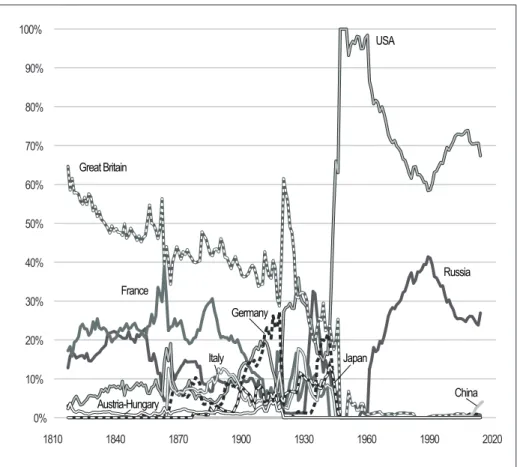
Figure 1 depicts the fluctuations in relative energy consumption for the past two centuries.14 Total consumption and per capita shares are combined in one
in-dex. Britain’s energy lead as the first economy to commit to coal and steam engines was phenomenal and its lead was clearly maintained through the 19th century as
long as COW major power rules are observed for entry into the elite pool. The fig-ure shows an abrupt transition at the turn of the century with the inclusion of the United States as newly-minted great power. The United States went on to peak in the late 1940s before beginning its own relative decline in position. The decline was interrupted by the collapse of the U.S.S.R. in 1991 but, interestingly, the “bounce” in the United States’ position did not rise above the 0.5 threshold. As China rises, the United States has resumed its positional decline trajectory.
The third indicator focuses on power projection capabilities. The leadership long cycle research program (Modelski and Thompson, 1988) committed early to what Posen (2003) later called “command of the commons” capabilities. For cen-turies the only way to project force beyond one’s home region involved ships. Up to World War I and the advent of militarized air power, only navies could provide inter-continental reach. But leadership long cycle capability concentration hitherto has focused predominately on sea power measures. Beginning with state-owned vessels at the tail end of the 15th century and moving through the escalating
num-ber of guns required to serve a ship of the line in the 17th and 18th centuries, to the
20th century development of heavy aircraft carriers, nuclear attack submarines, and
nuclear ballistic submarines with long range missiles of varying number, lethality, and accuracy.
All of these naval resources for projecting force at distance need to be accom-panied by their land and space equivalents. Land missiles have different numbers of warheads of varying lethality and accuracy. Non-US aircraft carriers tend to be relatively light and small vessels most useful for carrying helicopters or a few verti-cal take-off and landing (VTOL) planes. So far, only the United States has invested in heavy carriers. But other states have invested in nuclear missiles, both at land and sea. Air forces also emerged in World War I. These weapons need to be measured as well. The power projection index treats land missiles the same way it treats ballis-tic missiles at sea (warhead lethality and accuracy). Strategic bombers are counted from 1916. Military satellites in service are also indexed to go beyond land, air, and sea to include space.15
The final operationalization decision involves which states to include in the pool. If the modern world were not so concentrated in power capabilities, this
deci-14 It seems more straightforward to rely directly on the percentages at the expense of the polar-ity categories. This approach has always been the hallmark of leadership long cycle analyses. See, as well, Mansfield (1993).
sion would be more significant than it is now. Given high capability concentration, it does not make too much difference whether one adds or subtracts comparatively weak states. As a matter of operational conservatism, the power capability data are pooled using the Correlates of War rules for great power status. This decision means that Britain, France, and Russia are included for the entire period. Austria-Hungary drops out in 1918. Prussia-Germany drops out in 1945. Italy enters in 1860 and leaves in 1943. Japan and the United States enter the system in 1895 and 1899, respectively, with Japan bowing out in 1945. China begins its great power status in 1950. The Correlates of War approach also brings Germany and Japan back into elite subsystem in 1990 but that seems an easy change to ignore. Using this inter-pretation of elite powers does not imply that the author is endorsing the wisdom or
Figure 1: Energy consumption shares (combined total and per capita shares)
Source: Data based on Correlates of War (COW). 0% 10% 20% 30% 40% 50% 60% 70% 80% 90% 100% 1810 1835 1860 1885 1910 1935 1960 1985 2010 Great Britain USA Germany France Austria-Hungary Russia China Japan Italy
accuracy of the operational specifications. Utilizing what is the industry standard simply eliminates one possible source of perceived bias.
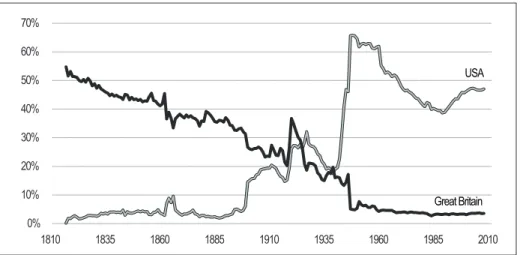
Figure 2 portrays the fluctuations in relative power projection capabilities over nearly the past two centuries. A maximal list of elite actors is adopted on the pre-sumption that their relative shares will help sort them out. That is, marginal power projectors will show up in the figure towards the bottom of the scale, as in the cas-es of Austria-Hungary or China. What comcas-es through most clearly in Figure 2’s crowded array is Britain’s long slide, the United States abrupt ascent and relative decline that is less linear than Britain’s, and the Soviet Union’s abortive challenge in the mid-to-late 20th century.
What remains is to integrate the three series (shares of total energy consump-tion, energy consumption per capita, and power projection) into one index. There
Figure 2: Power projection shares
Source: Data based on Correlates of War (COW). 0% 10% 20% 30% 40% 50% 60% 70% 80% 90% 100% 1810 1840 1870 1900 1930 1960 1990 2020 USA Russia Great Britain Germany France Austria-Hungary China Italy Japan
are different ways of going about computing this combination. All three indicators capture power potential—the power to produce or do damage at distance. If that potential is highly concentrated in one state economic-military inventory, it may not really matter all that much how one combines the three indicators. Yet the two spheres—economic and military—are very different. Imagine a state with high ener-gy scores but limited military capabilities. Contemporary Germany and Japan come quickly to mind. They are important actors but highly dependent on others to do their fighting for them. Reverse the combination—low energy scores but advanced military capabilities. Such states are also handicapped in the extent to which they can engage in world politics but they can punch above their weight from time to time. Contemporary Russia is a good illustration of this phenomena. For this reason, one could argue that power projection capabilities deserve more weight in the ag-gregated index than the energy indices—of which there are already two—do. Thus, the two energy indices are given equal weight while the power projection shares are doubled in terms of their input so that the resulting index is based half on the two energy shares and half on the power projection shares.
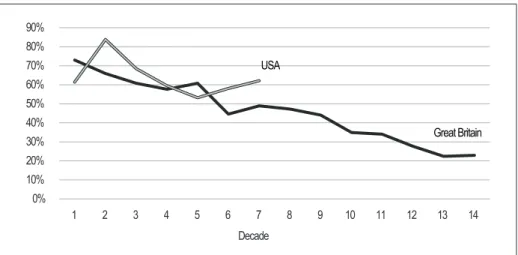
Figure 3 shows the outcome for an 1816–2007 depiction of the two leaders share. Britain emerged from the Napoleonic Wars at its high point and declined more or less continuously for the next 130 years. The only departure from this trend line was the brief and restricted revival of Britain’s relative fortunes in the interwar years due to the defeat of some of its rivals in World War I. The United States’ ascent was quick and towering after World War II. But it also began to lose relative share position fairly quickly and more or less continuously as well, with two exceptions. The United States’ relative share of power capabilities rebounded after the end of
Figure 3: British and U.S. relative power capability shares
Source: Based on data discussed in Lee and Thompson (2018). 0% 10% 20% 30% 40% 50% 60% 70% 1810 1835 1860 1885 1910 1935 1960 1985 2010 USA Great Britain