HAL Id: hal-01928708
https://hal.archives-ouvertes.fr/hal-01928708
Submitted on 22 Jan 2019
HAL is a multi-disciplinary open access
archive for the deposit and dissemination of sci-entific research documents, whether they are pub-lished or not. The documents may come from teaching and research institutions in France or abroad, or from public or private research centers.
L’archive ouverte pluridisciplinaire HAL, est destinée au dépôt et à la diffusion de documents scientifiques de niveau recherche, publiés ou non, émanant des établissements d’enseignement et de recherche français ou étrangers, des laboratoires publics ou privés.
Biró, Isabel de Maria Mourão, Edoardo Costantini, Maria Teresa Dell’Abate,
Silvia Dietz, Stéphane Follain, et al.
To cite this version:
Dimos Anastasiou, Miquel Aran, Jérôme Balesdent, Gottlieb Basch, Borbala Biró, et al.. Soil Organic Matter in Mediterranean regions. [Research Report] EIP-AGRI. 2015. �hal-01928708�
EIP-AGRI Focus Group
Soil Organic Matter in
Mediterranean regions
FINAL REPORT
MARCH 2015
Table of contents
Table of contents ... 2
List of acronyms ... 3
1. Summary ... 4
2. Introduction ... 6
3. Brief description of the process ... 6
4. Soil organic matter content in Mediterranean regions ... 7
4.1. What are the peculiarities of Mediterranean regions? ... 8
4.2. How to properly assess soil organic matter content? ... 9
4.3. What are the ultimate targets in terms of soil functions and ecosystem services? ... 9
5. Results and recommendations from the Focus Group ... 10
5.1. Existing practices to improve soil organic matter content in Mediterranean regions ... 10
5.1.1. Application of C-rich inputs ... 10
5.1.2. Soil management - tillage and mulching practices ... 11
5.1.3. Crop management ... 12
5.1.4. Other practices for improving the biological quality of soils ... 12
5.2. Reasons why some existing practices are not broadly adopted ... 12
5.2.1. Lack of awareness and education of practitioners about SOM and soil quality ... 13
5.2.2. Societal, regulatory and cultural constraints ... 13
5.2.3. Economic uncertainties about the cost-efficiency of novel practices ... 13
5.2.4. Knowledge gaps in science and practice ... 14
5.3. Overview of research topics and methodologies to be further developed – Corresponding recommendations ... 14
5.3.1. Novel concepts - research topics that miss implementation, that are novel or poorly explored ... 14
5.3.2. Novel data - additional research data that are needed or that miss testing, and new datasets ... 15
5.3.3. Novel methodologies - research methodologies that are missing and innovative approaches that need further refining ... 16
5.4. Recommendations for implementing of proposals for innovative actions and Operational Groups ... 17
6. Next steps and proposals for raising awareness, dissemination of results and solutions ... 19
7. Annexes... 22
7.1. Starting paper ... 22
7.2. Mini-papers ... 22
7.3. List of relevant research topics to be further developed ... 22
7.4. List of members of the Focus Group ... 24
7.5. List of relevant research projects ... 25
7.6. List of potential topics for Operational Group projects ... 28
7.7. List of documented best practices ... 32
List of acronyms
C: CarbonCAP: Common Agricultural Policy C/N ratio: Carbon-Nitrogen ratio
DG-AGRI: Directorate-General for Agriculture and Rural Development DSS: Decision Support Systems
EC: European Commission
EIP-AGRI: European Innovation Partnership Agricultural Productivity and Sustainability EU: European Union
FG: Focus Group
GAECs: Good Agricultural and Environmental Conditions GPS: Global Positioning System
NGOs: Non-Governmental Associations OC: Organic Carbon
OG: Operational Groups OM: Organic Matter
MEA: Millenium Ecosystem Assessment N: Nitrogen
NIRS: Near-Infrared Reflectance Spectroscopy P: Phosphorus
S: Sulfur
SOM: Soil Organic Matter
1. Summary
This report is the result of the EIP-AGRI Focus Group (FG) on Soil organic matter (SOM) content in Mediterranean regions, which was launched under the European Innovation Partnership Agricultural Productivity and Sustainability (EIP-AGRI). The Focus Group brought together 19 experts with different backgrounds and experiences (Annex 7.4) to make recommendations on transferable innovative solutions for the purpose of improving soil organic matter content in the Mediterranean region in a cost-effective way while securing soil functionality and soil fertility in the specific context of Mediterranean regions.
The Focus Group produced five clusters of practices to increase soil organic matter content: 1) Optimised use of resources of organic carbon; 2) Optimised soil management; 3) Optimised crop selection and management; 4) Possible use of bioeffectors and microbial inoculants; and 5) Development of tools to properly assess the soil organic matter (SOM) content and soil quality, with a special focus on its biological component.
Across all these topics, it was stressed that there was an overarching need to: 1) better define adequate indicators and reference values; 2) improve knowledge sharing and dissemination, including education about the functions of soil organic matter and soil biota; 3) develop a systems approach and long-term evaluation rather than single, simple technical solutions (‘recipes’) with short-term efficiency.
The group produced a cluster of proposals to contribute to the practical solutions of existing problems. These proposals included:
1. a comprehensive list of practical solutions which have already been well implemented or are rather novel, together with their pros and cons;
2. a gap analysis to understand the reasons why possible solutions are not implemented, and to identify research needs;
3. recommendations for future research topics and methodologies to measure/monitor the soil organic matter content and soil biological quality;
4. a list of proposals for action, including possible topics for Operational Groups (OG) and innovative actions;
5. suggestions for knowledge sharing and dissemination, training and educational programmes.
1. Regarding the list of practical solutions, the Focus Group made a comprehensive survey of all the potential techniques and analysed their pros and cons for the purpose of either increasing SOM content or securing soil functionality and fertility. It was stressed that several functionalities (or ecosystem services) can be targeted, possibly requiring some trade-offs (e.g. between carbon sequestration and providing nutrients to crops).
2. A gap analysis was conducted in relation to the comprehensive list of practical solutions to a) identify the reasons why they are not implemented at all or not sufficiently; b) propose how they could be further promoted; c) identify important knowledge gaps and d) propose the areas that need further research to find novel solutions.
3. The recommendations for future research topics were deduced from the gap analysis and from a collective exercise to define the top 16 priorities. Some of these were also considered when identifying potential Operational Groups (see point 4):
1. Evaluating the long-term economic benefits of SOM improvement.
2. Establishing agronomic references for manure application in Mediterranean agriculture. 3. Defining quality standards for manure inventory.
4. Evaluating the pros and cons of domestic resources or food waste compost in the long term. 5. Establishing agronomic references for plant residues.
6. Selecting/breeding crops and genotypes, combining increased production of residues (to increase SOM) and income (to increase the crop yield and/or quality).
7. Evaluating the impacts of intercropping and proper crop management on soil biota and SOM: which combination of crops (in rotation or association) is better in Mediterranean agriculture?
8. Designing weed control approaches that are less herbicide-dependent, based on improved crop rotations and residue management in Mediterranean agriculture.
9. Evaluating the interactions between SOM, crop rotation, input efficiency and yields under conservation agriculture in Mediterranean regions.
10. Assessing the impact of irrigation on the dynamics of SOM in Mediterranean agriculture. The following research topics are more related to methodological issues:
11. Defining SOM reference values related to soil types and functions. 12. Designing organic carbon analysis standards and databases.
13. Developing techniques to study the improvement and/or the fate of SOM in soils, related to carbon inputs from different sources.
14. Collecting NIRS (Near-Infrared Reflectance Spectroscopy) libraries and implementing chemometry to optimise the calibration of SOM measurement in Mediterranean soils.
15. Developing monitoring techniques to study how bioeffectors are functioning in soils. 16. Developing simple techniques to self-check soil quality at farm level.
4. Possible topics for Operational Groups for the management of SOM in Mediterranean regions were identified. Four case studies, chosen to orient the group towards practical problem-solving, were discussed in more detail, followed by a discussion on ways to set up an Operational Group and implement its activities. Then, a longer list of potential topics was collected. These are all listed below:
Diagnostic procedure and recommendations for SOM management. Optimising the use of fertilisers and pesticides in conservation agriculture. Identifying the best crop rotations to improve SOM content.
Organic resources from tree-based cropping systems.
Improvement of SOM in Mediterranean regions as a systems approach.
Defining SOM origin and quality: dependence of organic matter quality on origin of composting (bacteria, fungi…).
Benchmarking for SOM.
Shifting to conservation agriculture (when possible) in order to improve SOM and soil quality. Introducing conservation agriculture in organic farming systems.
Assessment and technical recommendations of conservation agriculture practices in perennial crops. Economic evaluation of conservation agriculture practices in perennial crops.
Organic animal production and horticulture: how can they be more integrated, and better connected. Vegetable crop and organic matter management: how to change, what alternatives exist.
Irrigation: water quality, re-use of treated waste water, reducing negative impacts. Biomass production: bioenergy crops and SOM content.
Application of microbial inoculants to soils, to accelerate organic carbon production.
Carbon footprint and environmental certification of good practices related to SOM by farmers, to be known/recognised by consumers (labelling).
Economic evaluation for carbon footprint / environmental certification. Biochar and SOM.
5. Proposals for dissemination, training and educational programmes, including the suggestion to make use of established or newly developed organisations or networks of farmers, Operational Groups and novel practical tools, information and decision support systems.
The next step for the Focus Group is the dissemination of its results and recommendations through the EIP-AGRI Network and by each expert in the Focus Group, and by the adoption of related topics by Operational Groups or other innovative project formats. The year 2015 being declared the International Year of the Soil by UNESCO is a unique opportunity to communicate with a broader audience about the crucial importance of soils and soil functionalities for ecosystem services, and for the well-being of farmers and the whole of humanity.
2. Introduction
The Focus Group (FG) on Soil organic matter content in Mediterranean regions was launched by DG-AGRI of the European Commission in late 2013 as part of the activities carried out under the European Innovation Partnership on Agricultural Productivity and Sustainability (EIP-AGRI). The specific issues to address were formulated as follows: How can we improve soil organic matter content in the Mediterranean region in a cost-effective way? and What new solutions to secure soil functionality and soil fertility can be proposed in this regard? This report summarises the context (what is at stake), and the outcomes (what are the major conclusions) of this Focus Group, with the ultimate goal to support the EIP-AGRI implementation at different levels, and the emergence of Operational Groups under Rural Development Programmes in various Mediterranean regions in the European Union (EU).
The EIP-AGRI Focus Group on Soil organic matter content in Mediterranean regions brought together 19 experts from the EU (see Annex 7.4) to explore practical, innovative solutions and best practices to problems or opportunities in the field and to give recommendations for interactive innovation projects that can be carried out by Operational Groups or other project formats. Building on a Starting paper written by the Coordinating expert (see Annex 7.1), the group also discussed and documented research needs that can help to solve the problems related to soil organic matter content, while securing soil functionality and fertility, in the context of the Mediterranean regions of Europe.
3. Brief description of the process
A Starting paper (see Annex 7.1), written by the Coordinating expert, was circulated by early January 2014 to all the experts, prior to the first meeting of the EIP-AGRI Focus Group. It served as a starting point for the Focus Group discussions. This paper summarised the key functions of SOM, provided background information about SOM in Mediterranean regions and the specific issues related to this part of Europe, and provided an overview of the practical options to improve SOM content:
(i) using exogenous sources of organic matter,
(ii) minimising the use of practices known to accelerate the decay of SOM (especially ploughing) and (iii) implementing agro-ecological approaches to make better use of ecological processes and drivers of
the fate of SOM.
The Starting paper was completed by the inclusion of suggestions and examples produced by the experts during the course of the first meeting of the EIP-AGRI Focus Group, which was held by end of January 2014 near Venice and Padova, Italy, including a field visit to the Universita degli Studi di Padova (Dipartimento di Agronomia Animali Alimenti Risorse Naturali e Ambiente). The meeting aimed to (i) take stock of the state of the art of practice, including a summary of problems and issues and (ii) take stock of the state of the art of research, including a summary of possible solutions for the problems listed. Interactive exercises and break-out sessions in smaller groups were organised to evaluate the pros and cons of the various options in management practices (either ongoing practices or possible innovations to be further developed) for enhancing SOM content in Mediterranean regions in arable and permanent crops:
sources of input of organic carbon of agricultural origin, sources of input of organic carbon of non-agricultural origin,
other techniques and practices (not based on applying Carbon sources).
At the end of the first meeting, the group developed a short list of specific topics to be further addressed. These topics were then elaborated in ‘mini-papers’, produced in between the two EIP-AGRI Focus Group meetings. Based on all of these documents, a grid analysis was developed prior to the second meeting. This grid aimed to identify why good existing practices were underused and how they could be further promoted, and aimed to summarise the research gaps and needs for innovations (both in research and practice).
The second meeting was held in September 2014 in Lisboa, Portugal, and aimed to (i) identify needs from practice and propose directions for further research and (ii) identify priorities for innovative actions. The group short-listed the most relevant research gaps and cooperative projects related to:
practices designed to enhance soil organic matter content of Mediterranean soils,
techniques designed to monitor the SOM content of Mediterranean soils, and related, relevant soil properties,
knowledge transfer and adoption of novel techniques for improving the SOM content of Mediterranean soils either for arable or permanent crops.
The EIP-AGRI Focus Group produced a list of 16 high-priority research topics, considered to be highly relevant for improving the SOM content of soils in Mediterranean regions of Europe. Furthermore, the group explored ways to improve knowledge transfer and adoption and to conduct collaborative research projects involving different types of stakeholders. Finally the group worked on the concept of Operational Groups as defined by DG AGRI, and produced a list of potential topics for Operational Group projects. All the documents produced during these two meetings and in between can be found on the EIP-AGRI website:
https://ec.europa.eu/eip/agriculture/en/content/soil-organic-matter-content-mediterranean-regions.
4. Soil organic matter content in Mediterranean regions
Soil organic matter (SOM) plays several key roles in agro-ecosystems, related to the three dimensions of soil quality and fertility:
Chemical: SOM significantly contributes to the nutrient storage and supply capacity of soils, to pH buffering capacity and retention of pollutants or toxic elements.
Physical: SOM is crucial in determining soil structure and thereby in ultimately controlling soil erosion, water infiltration and water holding capacity, habitat provision for plant roots and soil organisms. Biological: SOM is a primary source of carbon/energy for soil microorganisms and thus for the whole
soil biota, which are key players in soil functionalities, while soils are one of the largest reservoirs of biodiversity.
Soil organic matter therefore influences several ecosystem services (MEA, 2005), such as primary production (and provision of food, fibers,…), soil formation, biogeochemical cycles and the regulation of water quality and climate (see mini-paper 1 in Annex 7.2). At a global level, soils are a major reservoir of carbon (C) in terrestrial ecosystems; SOM contains more than 3-fold the amount of C that can be found in the atmosphere or in terrestrial vegetation. Soil organic matter can thus play a major role in mitigating climate change but the decline of its content, as a consequence of changes in land use or in agricultural practices, can substantially contribute to emissions of C-CO2 to the atmosphere (Kotroczó et al. 2014).
There is clear evidence of decline in SOM content in many soils as a consequence of the unprecedented expansion and intensification of agriculture during the 20th century (Lal, 2009). This decline in SOM content is
a threat to the sustainability of agricultural production systems, because SOM is a major component of soil fertility and quality. The Communication ‘Towards a Thematic Strategy for Soil Protection’ (CEC, 2002), adopted in April 2002, has identified eight main threats to soils, and considered declining SOM as one of the most serious processes of soil degradation, especially in Southern Europe.
The map of organic C (OC) content of European soils (Jones et al. 2003; Zdruli et al. 2004) shows that the Mediterranean regions of Europe exhibit distinctively smaller values of OC than those of other regions, with substantial areas showing very low OC (≤1%) or low OC (≤2%). For the various Mediterranean countries of Southern Europe about 75% of the whole land surface area falls under these categories (Figure 1). Such values stand for all land uses together.
Figure 1. Map of organic carbon (OC) content in topsoils (0-30 cm) of Europe (Jones et al. 2003). Note that the scale stands only for the mapped European countries.
`
Nevertheless, while there is a general agreement in the scientific literature that too low a content of SOM is undesirable for most soil functions, it is still a matter for debate as to what are the acceptable threshold values. In addition, it is not just a matter of organic C content: the location and quality of the SOM should also be taken into account, as well as other key components of soil quality that strongly determine the fate of SOM (Schmidt et al. 2011), such as the biological properties of soils (Bastida et al. 2008). Adequate sets of indicators and ad hoc guidelines are urgently needed to make substantial progress in the understanding and management of SOM.
The review by Lal (2009) summarises the various strategies that can be used to preserve or increase the content of SOM in soils. These consist of increasing the inputs of C or decreasing the losses, in both cases with several conventional and more novel options. Two types of inputs can be distinguished: the plant residues derived from the biomass grown on-site, and various types of biosolids that are most often exogenous materials, including those of urban origin. Three types of losses of SOM can be addressed and these are related to decomposition, leaching and erosion.
4.1. What are the peculiarities of Mediterranean regions?
Mediterranean regions of Europe are best defined by their distinct climate, with cold humid winters and warm dry summers. This entails higher soil temperatures than in Northern Europe, with an expected negative impact on SOM content as elevated temperatures are known to accelerate SOM decay rate. This is of increasing concern in the context of global warming. Research results have demonstrated that SOM in Mediterranean countries is somewhat affected by the current climate change and that land uses such as permanent pasture and cropland are more sensitive than forests (Fantappiè et al. 2011). In addition, large losses of SOM may be caused by erosion as promoted by the torrential storms that frequently occur in Mediterranean regions. The landscape of Mediterranean regions is much dissected, often rugged and thus prone to erosion. This is further influenced by
the incomplete coverage of the soil by the vegetation as a consequence of drought or land uses (e.g. vineyards). Irrigation is widely utilised in drought-prone agricultural areas, to allow the adoption of intensified cropping systems, but this practice can induce an overall decrease in SOM (Costantini and Lorenzetti, 2013), unless combined with specific soil management techniques (Boulal et al. 2010, 2011 and 2012). In addition, the use of machinery for ploughing at different soil moisture conditions may impact soil aggregate stability (Dell’Abate et al. 2011) with potential effect on soil erosion and related SOM losses. Geologically diverse, Mediterranean regions also exhibit a large diversity of soil types, shallow on slopes, often associated with rock outcrops, but deep and fertile in the valleys, where most of the crops are grown. Calcareous soils with neutral to slightly alkaline pH values are more abundant than in Northern Europe, offering conditions that favour a rapid decay of SOM. The issue of low SOM is of particular concern in perennial systems such as orchards and vineyards (Meersmans et al. 2012), which play a more important role in Southern than in Northern Europe. The recent meta-analysis of Maetens et al. (2012) showed that bare soils, vineyards and orchards in Europe are prone to high mean soil losses (10-20 tons ha-1 yr-1), while cropland and fallow show smaller values (6.5 and 5.8 tons
ha-1 yr-1) largely because the latter occupy land exhibiting little or no slope. Grasslands and associated stock
rearing are of limited extent in Mediterranean regions, so the accumulation of SOM associated with such land uses is severely restricted. Overgrazing is a potential threat though. In addition, wildfires, which are rather common in Mediterranean regions, can also have a negative impact on SOM, but they normally affect forests and rangelands and are thus of limited concern in cultivated agro-ecosystems.
4.2. How to properly assess soil organic matter content?
France (Meermans et al. 2012), Italy and Spain (Romanya and Rovira 2011) have large data sets on SOM content in soils, although not properly organised, whereas most other Mediterranean countries of Europe have only limited data, or data from field surveys that are either insufficiently georeferenced or not accessible outside the country of origin. There is also a lack of standard procedures for determining SOM, both at the sampling and analytical steps. This is a serious obstacle to using the existing datasets to define baseline SOM status at European level (Jones et al. 2003 ; Zdruli et al. 2004) and in particular for Mediterranean regions of Europe. Spatial heterogeneity of soil properties, including SOM content, is the rule at various scales. While vertical gradients are well known, lateral variability of SOM at a metric or sub-metric scale is rather common in soils, including in agro-ecosystems. Such heterogeneities challenge the sampling strategies, and are particularly at stake when assessing temporal changes or comparing agricultural practices, e.g. no-till versus tilled systems (Balesdent et al. 2000). Many soils in Mediterranean regions of Europe are developed on calcareous parent material and still contain large amounts of carbonates, i.e. inorganic C. Care must thus be taken, depending on the analytical soil testing method used, not to overestimate the actual content of OC. Whatever the analytical technique, conventional methods of determination of SOM content in soils are robust, but rather tedious and quite expensive (either the direct combustion method, with CHN elemental analyser, or the wet digestion method, using dichromate as oxidising agent). Alternatively, Near and Mid Infrared Reflectance Spectroscopy have recently proved that, in many soil types (including those commonly found in Mediterranean regions), SOM content can be accurately predicted, especially in the lower range (e.g. Grinand et al. 2012). These inexpensive techniques are highly promising, with the potential development of portable devices for direct measurement in field conditions (see mini-paper 6 in Annex 7.2). NIR spectroscopy was suggested also as an appropriate tool to assess the C content of organic C sources such as sewage sludge prior to their application on soils (Biró et al. 2006).
4.3. What are the ultimate targets in terms of soil functions and ecosystem
services?
When raising the issue of enhancing the SOM content of Mediterranean regions, one should first of all figure out what the targeted benefits are in terms of soil functions or ecosystem services, such as the nutrient cycling, regulation, filtering and buffering of water quality, physical stability and support, provision of habitat and support for a large biodiversity, including soil microbial resources, which are more directly both influencing and influenced by the amount and quality of SOM (Benedetti et al. 2013). Practices that favour a slow decay rate of SOM need to be implemented for the purpose of increasing C sequestration in soils. However, a reduced decay rate of SOM may restrict the supply of nutrients and thus the agricultural production. The nutrient content of SOM and their elemental ratios are key properties that determine the fate of SOM, as these nutrients alter the
activity of soil organisms that differ in C, N, P and S requirements along the soil food web. This has been well known and accounted for by agronomists for many years in the case of the C/N ratio. Improving soil fertility, however, may not be systematically relevant as an ultimate goal. Once again, the concept of soil quality seems appropriate to pursue, as it is a less restrictive concept than soil fertility. In many wine-growing areas, it is observed that the best quality wines (often linked with small yields) are produced in vineyards corresponding to poorly fertile soils. Besides the C and nutrient content of SOM, its quality at large is of utmost agro-ecological relevance. Soil organic matter comprises a broad range of pools, which are characterised by very different decomposition kinetics (with turnover rates from hours to millennia) or recalcitrance. Nevertheless, indices of the quality and potential turnover rates of SOM pools add much value to the sole knowledge of the SOM content of a soil. The decomposition of SOM is also largely controlled by numerous physical/chemical protection mechanisms and by the nature and activity of soil microorganisms and fauna. Therefore, beyond SOM content and quality, a broader understanding of soil quality, in all its dimensions – biological, chemical and physical – is definitely at stake (Bastida et al. 2008; Coll et al. 2011).
5. Results and recommendations from the Focus Group
5.1. Existing practices to improve soil organic matter content in Mediterranean
regions
Increasing or maintaining soil fertility is a concern that farmers have had since the very start of agriculture. However, the intensification of agriculture has been distorting the perception of fertility, with a greater focus on its chemical component, reinforced by the use of chemical fertilisers as a major option to manage soil fertility. Given that SOM plays a major role in soil functioning, not only at a chemical level, but also at the physical and biological levels, managing SOM requires a more holistic perception of soil quality (Bastida et al. 2008; Coll et al. 2011) and relies on a broad range of practices than can be used either separately or combined for the sake of optimising the SOM content of agricultural soils (Kassam et al. 2013). As a result of discussions in the EIP-AGRI Focus Group, practices were clustered in four types:
(i) application of C-rich inputs,
(ii) soil management - tillage and mulching practices, (iii) crop management and
(iv) other practices for improving the biological quality of soils.
5.1.1. Application of C-rich inputs
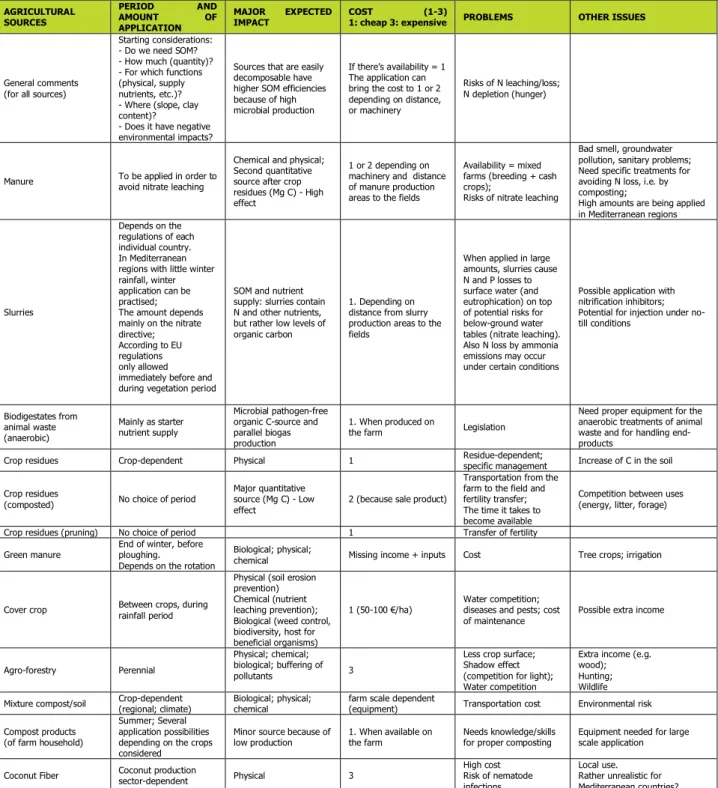
The EIP-AGRI Focus Group has drawn up a comprehensive list of C-rich inputs that are already used in agriculture, based on their origin: plant or animal waste produced on-farm, organic by-products of the agro-industry and of food processing, organic waste and other C-rich products of urban or industrial origin (see Tables 1 and 2 in Annex 7.7 and mini-papers 4, 5 and 7 in Annex 7.2).
It is rather difficult to get data about the amounts that are available for the Mediterranean regions of Europe, but animal waste produced on-farm, especially animal manure and slurries and their derivatives (composted manure, digested slurries or manure) are most likely the largest resource of organic C suitable for application in agriculture. However, given the large amounts needed for application (tons per ha), the cost of transportation is a major issue (see Tables 1 and 2 in Annex 7.7). Promoting the use of sources that are locally available (ideally on the farm or at rather short distances) is thus critical for improving the cost-efficiency of the application of C-rich inputs. Using dehydrated or composted materials (see mini-paper 7 in Annex 7.7) is another way to decrease the cost of transportation, thus improving the cost-efficiency of the application of C-rich inputs. Intensification having resulted in considerable specialisation of agriculture, vast areas of land, especially in Mediterranean regions, have become virtually devoid of animal production, being specialised in cereal production, horticulture (vegetables or orchards), olive production or viticulture. In such cases, the use of C-rich inputs of animal origin are limited or restricted to high-value crops (e.g. in horticultural production systems) for which farmers can afford expensive inputs. In contrast, cereal-based agro-ecosystems cannot make use of such expensive inputs, unless produced on the farm or in the vicinity of the farm.
On the other hand, some regions are highly specialised in animal production, and over-produce animal waste, sometimes resulting in excess application rates in arable land in the vicinity, with negative impacts on the environment (e.g. Makádi et al. 2007). This is typically the case for regions that have high concentrations of intensive piggeries, e.g. Catalonia. In the ‘vulnerable zones’ defined by the EU Nitrate Directive 91/676/EEC, it is mandatory to implement ‘Action Plans’, limiting the amount of N added to agricultural soils as manure applications. Technologies are being developed to reduce the water content of animal waste, through dehydration and/or composting, to reduce their transportation costs and facilitate their handling and long-distance transportation. For most of these products, data about their quality (organic C and nutrient content, contaminant concentrations, and stability) are clearly lacking, which further limits their proper use in agriculture. This concern is even greater for the many other sources of organic C related to the (agro-)industry or domestic activities, such as sewage sludge and urban green waste. Peri-urban agriculture could benefit from these sources. More work is needed to allow a further reduction of their concentrations in all types of contaminants (inorganic, organic and biotic, i.e. human pathogens) and to assess their long-term impact on SOM and soil quality. For instance, the application of sewage sludge on agricultural soils raises the issue of food safety when containing human pathogens, which might have a potential risk in the soil-plant-microbe-animal-human food chain (Beczner et al. 2004; Biró et al. 2004; Makádi et al. 2007) or in the environment at large (Tyrrel and Quinton 2003).
The Focus Group considered that, in spite of the considerable amount of research recently devoted to biochars (e.g. Cross and Sohi 2011, Lehmann et al. 2011), there is still a lack of information about their inherent properties, about how this type of soil amendment can affect soil properties over long periods of time, and about the fact that they cannot be directly considered as a valuable input for increasing SOM, being essentially composed of inorganic C (elemental C).
Costs: The Focus Group estimated that the overall costs for such measures ranged from low (when available on the farm or at immediate proximity) to medium or high, given the high cost of transportations of most of these products (see Tables 1 and 2 in Annex 7.7).
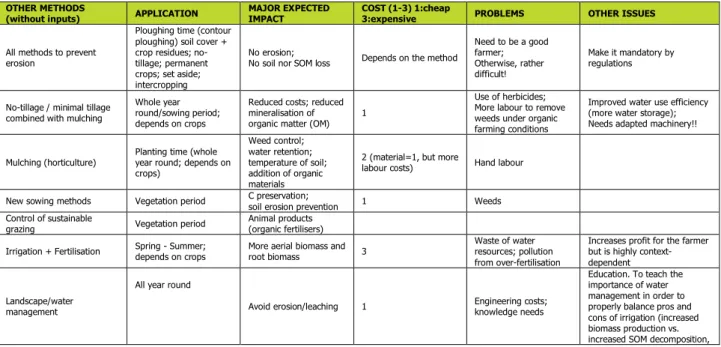
5.1.2. Soil management - tillage and mulching practices
Tillage is known to enhance the decay of SOM as widely documented (e.g. Balesdent et al. 2000), including in the context of dryland agriculture of Mediterranean regions (e.g. Álvaro-Fuentes et al. 2008, Basch et al. 2012 and 2015). Reduced tillage or no-till practices therefore appear as alternatives worth considering when aiming to maintain or increase the SOM content of agricultural soils (Soane et al. 2012). This is only one of the three pillars of conservation agriculture and, to be effective and not counterproductive, no-till practices must be accompanied by adequate mulching and crop rotation (see mini-paper 8 in Annex 7.2) (Basch et al. 2010). Conservation agriculture is however poorly adopted in Europe, including the Mediterranean regions (Kassam et al. 2012). Tillage has been so much practised for centuries in agriculture, that reducing tillage or completely stopping this practice becomes a considerable shift, and only few farmers are ready to try it, depending on their practices and systems. There are some incentives encouraging the use of proper tillage practices, e.g. the Good Agricultural and Environmental Conditions (GAECs) established for Cross Compliance implementation under EC Regulation 1782/2003. Tillage has, however, a number of benefits and, in some soils, can favour the infiltration at the expense of runoff, thereby reducing the risks of erosion losses. On the other hand, under reduced tillage or no-till practices, soil surface cover by mulching can efficiently reduce the runoff and subsequent erosion. Mulching can also help to combat weeds and improve the trafficability (ability of the soil to bear the impact of vehicles such as tractors, without damaging the soil structure), as practised in Mediterranean agriculture, particularly in viticulture and horticultural crops or orchards.
Costs: The Focus Group estimated the overall costs for such measures to be low for the no-till or reduced tillage practices, and low to medium for mulching techniques (see Table 3 in Annex 7.7). The cost may become higher however if yields are significantly depressed when shifting to reduced tillage practices.
5.1.3. Crop management
The choice of a crop species or genotype is seldom considered to be part of the strategy to manage SOM and soil quality, although crop residues are a major component of the organic inputs in agriculture. Kell (2011) recently stressed that crops play a major role in the mitigation of climate change via C sequestration, and pleaded for the need to revise our breeding programmes accordingly. Considering simultaneously the maintenance (or increase) of crop yield and C stocks in the soil as a dual target means that crops should not be selected for their harvest index, but rather for their ability to produce large amounts of residues, both above- and belowground, notably extensive and deep root systems that also help plants to better cope with drought (Kell 2012). This makes sense especially in dry-land Mediterranean agriculture and in adapting to climate change, which predicts increasing risks of drought episodes.
Another major component of crop management that plays a key role in securing soil functionalities is the way crops are managed in space and time. More diverse rotations and longer coverage of the soil by living plants (cover crops for instance) are favoured in the context of conservation agriculture (see mini-paper 8 in Annex 7.2). However, these principles of more diverse crop rotations (including green manures and species that are used as catch crops) to produce more diverse organic residues can be generalised to any other systems, and lead to even more diverse systems such as those based on growing several plant species at the same time in a field (Gaba et al. 2015), such as intercropping (cereal/legume intercrops for instance) or agro-forestry systems. These are however seldom practised in Europe, except for the case of grassed orchards or vineyards. Fearing the competition for water resources, these practices are less common in Mediterranean regions, in spite of their positive impact on soil fertility and even on water conservation (increased infiltration and reduced runoff/erosion compared to bare soil in the inter-rows).
Costs: The Focus Group estimated the overall costs for such measures to be low to medium (see Table 3 in Annex 7.7).
5.1.4. Other practices for improving the biological quality of soils
While all of the previously mentioned practices can potentially impact (positively or negatively) the biological quality of soils, some techniques are directly targeting this aspect. Two types of techniques fall in this category. The first one consists in inoculating the soil (or the plant material) with beneficial microorganisms, while the second is based on the use of products – the so-called bioeffectors – that stimulate plant roots or other biological activities in the soil. These practices are not common at present, and still need to demonstrate their real benefit at field scale. There are only few success stories of microbial inoculants demonstrating a measurable benefit such as improved plant performance or soil fertility in field conditions. Notable exceptions are bradyrhizobium inoculation of soybean (without which this legume species would not be able to fix nitrogen symbiotically outside of its region of origin in Asia) or the use of inoculants in sterilised soils (as can be achieved in some horticultural crops). The reason for the poor success of microbial inoculants is the strong competition between the newly applied microorganisms and those already residing in the soil. The use of bioeffectors (see mini-paper 9 in Annex 7.2), such as root growth stimulants for instance, is still largely under development and mostly targets high-value horticultural crops (www.biofector.info). The link with improved soil quality still needs to be evidenced, as most trials have been rather focused on their ultimate effect on crop performance. This topic generated some discussion within the Focus Group, most probably because of the large lack of reliable references, as already stressed above.
Costs: The Focus Group estimated the overall costs for such measures to be low (see Table 3 in Annex 7.7).
5.2. Reasons why some existing practices are not broadly adopted
Few of the potential solutions are actually novel, strictly speaking, as many of the above-mentioned practices were rather common before the intensification of agriculture in the 1950s, such as the integration of animal production (and re-use of their waste) and crop production at farm scale or the use of diversified rotations or intercropping systems at plot scale. They are however to be considered as innovations as they raise the same issues of poor adoption by many practitioners nowadays. The EIP-AGRI Focus Group exchanged different points of view on the factors of failure in the adoption of innovative techniques or approaches, in particular for the
case of conservation agriculture (see mini-paper 8 in Annex 7.2).
5.2.1. Lack of awareness and education of practitioners about SOM and soil quality
A first important factor to be considered is that many practitioners, including farmers, have little concerns or expectations about SOM and soil quality, or even soils in general. This might be surprising at first sight as it is an essential component of the capital (land) that they are making use of. However, this is largely due to a lack of education about soils, soil quality and functionalities and to a lack of immediate economic benefit. In the context of intensive agriculture, soils have long been considered as a physical substrate, of which the properties could be neglected with adequate use of inputs, e.g. irrigation water or chemical fertilisers to overcome soil resource limitations and maximise crop yields. There is thus a need to further educate a large number of farmers and farm advisers about what the key soil functionalities are, the importance of its biological functioning and the roles of SOM in that respect, as well as a need to continue raising public awareness about the need to preserve soil quality and reduce soil threatening practices, which may lead to erosion, losses of fertility and biodiversity, pollutions, etc. In addition, some simple techniques can be demonstrated and presented to farmers during relevant conferences/workshops (Monori et al. 2009) or other communication events. Novel techniques are currently available to further disseminate such knowledge to end-users or to the public at large, through the internet, social media or cell phone apps (see recommendations in section 6 below).5.2.2. Societal, regulatory and cultural constraints
Our societies in the ‘Old Europe’ tend to be not so prone to innovation, compared to those in many parts of the ‘New World’, in the American continent or in Australia (Brouder and Gómez-Macpherson 2013), and there is possibly more conservatism in Mediterranean cultures than in those of Northern European regions. The adoption of conservation agriculture is nevertheless more substantial in Southern Europe. These cultural differences (either at national, regional or local level) must be taken into account because they act as major factors governing the adoption of innovations. Farmers will not adopt an innovation if the benefit associated to it does not compensate any disadvantage also associated, e.g. a greater time demand (Gómez-Macpherson et al. 2014). It is not just a matter of farmer's sociology, as many other actors are to be included in the process. In addition, socio-economists have shown that the ‘lock-in’ theory (that is largely documented in diverse sectors of industry) can also largely be applied to explain the difficulty of innovations being picked up by practitioners in the agricultural sector. While studying the whole durum wheat value chain in Southern France, Fares et al. (2012) showed that grain collectors and other actors along the value chain were reluctant to change their practices (e.g. sorting the grain mixtures as needed in intercropping systems) to make the adoption possible, even when the benefit of some agro-ecological innovations (e.g. the use of intercropped legumes to improve the protein content of the durum wheat grains in the present case) was demonstrated at field level.
On top of the above-mentioned limitations related to actors of the value chain, a number of restrictions are regulatory, or linked to the CAP rules for subsidies in the agricultural sectors. Until now, intercropping is raising the issue of which crop to declare, as one is not expected to produce two different crops (or more) at a time in a single plot, according to the present CAP principles. There are also lots of regulatory constraints for the use of novel inputs (e.g. organic by-products of the industry or microbial inoculants). These regulations are meant to prevent the associated risks (e.g. soil contamination), which is definitely important, but they can also represent major obstacles for companies to invest in the development of such products. Conversely, governmental incentives or EC directives could be very efficient tools to promote the fast adoption of some of the proposed innovations, as long as they have been proving their efficiency, at least in some specific regions, productions or domains. Participatory approaches are another major tool to facilitate the adoption of innovations, as has already been shown for other areas, e.g. participatory selection of novel varieties (Desclaux et al. 2008; Wissuwa et al. 2009). Indeed, involving the actors in the early stages of the process of innovation (selecting, testing and assessing the innovation) can make a very substantial difference.
5.2.3. Economic uncertainties about the cost-efficiency of novel practices
For a number of proposed innovations, there is a lack of proper economic evaluation of the costs and benefits compared to business-as-usual practices. On the cost side, there is a need for more information about the actual costs of all the potential sources of organic C that can be applied, including the costs of transportation and application, the distance to the source being rather critical given the large application rates that are commonly
needed. Such economic evaluation is even more difficult to conduct on the benefit side. First of all, this is so because a number of benefits may become visible/measurable only in the medium- or long-term. Secondly, some of the benefits are rather difficult to evaluate in euros such as the improvement of soil structure and the biological quality of soils, or benefits associated with some ecosystem services (e.g. reduced erosion risk or improved C sequestration). Thus, the cost-efficiency is seldom fully accounted for, in spite of being of key importance for the adoption of novel practices by farmers.
5.2.4. Knowledge gaps in science and practice
For a number of proposed innovations there is a need to obtain references. The actors must assume the risk of not being sure that the novel practice will be beneficial in their own context, and actually realise that they should be part of the reference construction process. A key principle in agro-ecology is that knowledge is not just in the hands (or heads) of scientists. It is rather that farmers and all other actors are holding a lot of knowledge and know-how, and should be key players in the generation of new knowledge, as typically required when designing or testing innovations. Once more, this militates for further development of participatory approaches, involving a close collaboration between scientists and other stakeholders, in order to design proper innovations and ultimately facilitate the adoption of such novel techniques, to assess and improve SOM and soil quality management.
5.3. Overview of research topics and methodologies to be further developed –
Corresponding recommendations
The topics recommended by the Focus Group for future innovative research projects are numerous, about forty in total (see Tables in Annex 7.3). The experts were asked to define priorities, and in the marking process that occurred to achieve this, the farmers and farm advisers were given twice the weight of the other experts to ensure that practical considerations were included, as well as economic considerations such as the cost-effectiveness of the proposed innovations. A shorter list of the top 16 research priorities is further developed below, sorted in three categories, namely: novel concepts, novel data and novel methods.
5.3.1. Novel concepts - research topics that miss implementation, that are novel
or poorly explored
Evaluating the long-term economic benefits of SOM improvement. Many studies have been concentrating on a single dimension of the benefit, crop yield benefit in many cases, and few of these have been considering long-term time scales (5-10 years or more), while it is expected that significant improvement of SOM contents can hardly be observed over short-term time scales (<3 years). The economic evaluation should account for the various benefits (including reduced input costs whenever relevant), which makes it complicated as the economic value of some ecosystem services is difficult to estimate.
Selecting/breeding crops and genotypes combining increased production of residues (to increase SOM) and income (to increase the crop yield and/or quality). There is a paradigm shift to be achieved, in the first place considering that past breeding schemes and farmers' decisions have been concentrating more on increased yields and harvest index. Dual purpose crops or genotypes need to be elaborated when aiming for sustainable production in the long term, achieving high yields while maintaining or possibly increasing soil fertility. Plant residues, both above- and below-ground are indeed unique, locally-produced sources of organic matter, and deserve being better accounted for in sustainable farming systems, whatever the crop (annual or perennial).
Evaluating the impacts of intercropping and proper crop management on soil biota and SOM: which combination of crops (in rotation or association) is better in Mediterranean agriculture? Making better use of the diversity of plant species or of diversified crop rotations is one of the three pillars of conservation agriculture and a basic principle of ecology or sustainable intensification of agro-ecosystems. Modern agriculture, specialisation and intensification have resulted in a more restricted diversity of plants being grown in a given field, farm or region, while agro-ecological approaches of farming systems and landscapes are now moving the other way around (e.g. Wissuwa et al. 2009; Gaba et al. 2015). In
many cases, a single species (and a single genotype) is grown at a time or, even over time in the case of monocultures, possibly for long periods in the case of perennials (e.g. viticulture). It can be expected to reduce the diversity of residues and the resulting SOM, as well as, ultimately, to simplify the soil food web, and to increase the risk of soil biota being less resilient. The opposite effects are expected to occur when using diverse crop species in time (crop rotation, use of cover crops) or space (intercropping or agro-forestry systems). These hypotheses need to be evaluated in the broad range of conditions of Mediterranean agro-ecosystems.
Designing weed control approaches that are less herbicide-dependent, based on improved crop rotations and residue management in Mediterranean agriculture. This research topic is somewhat interconnected with the two previous ones. In the past, weed control has been largely depending on the use of herbicides, with negative impacts on ecosystem health. Novel production systems or practices designed to preserve soils and SOM such as conservation agriculture or the use of cover crops are still largely reliant on herbicides. Environmentally-sound alternatives need to be identified and tested in diverse systems. For this topic and the previous ones, the development of site-specific Decision Support Systems (to be further developed) can help farmers to make proper decisions on farm management, e.g. the use of herbicides, C inputs and crop rotation (see mini-paper 2 in Annex 7.2).
5.3.2. Novel data - additional research data that are needed or that miss testing,
and new datasets
Establishing agronomic references for manure application in Mediterranean agriculture. Given the different climate, the different types of soils, and possibly also crops and animal production, it is questionable whether references that have been predominantly established in northern regions of Europe can be transposed to Mediterranean regions. There is thus a need to compile the geographically-relevant, existing datasets (many of which are being published in non-academic literature) and to elaborate research schemes (multi-local farm trials, notably) to produce new data to fill the identified gaps of agronomic references about proper rates and types of manures (sensu lato, incl. slurries and composted manures) to be applied.
Defining quality standards for manure inventory. As stressed above, manure stands for a large diversity of products, including manures (in stricto sensu), slurries and composted products (Brito et al. 2012), that vary according to the animals they originate from, as well as the conditions in which these animals are bred (more or less intensive systems, with more or fewer risks of contamination by metals, pharmaceutical compounds, human pathogens, etc.). Therefore, there is a need to define quality standards for this diversity of products. This also stands for indicators on their potential benefits (C and nutrient contents, potential fate of decomposition, etc.) (Biau et al. 2012). However, this is not a typical need for all Mediterranean regions of Europe.
Evaluating the long-term pros and cons of domestic sources / food waste composts. This is a somewhat similar issue as that raised above for animal manures, but with a greater emphasis on the potential drawbacks with respect to the potential contaminants (inorganic/organic contaminants and pathogens) in these types of sources of organic C, which can be extremely diverse. This is a limitation for designing a proper research strategy to evaluate their long-term effect in a large diversity of situations (across soil types and agricultural systems).
Establishing agronomic references for plant residues. Plant residues are by far the most commonly available resource of organic C in all agricultural systems, although they are often underused for the purpose of improving SOM status and soil fertility (Biau et al. 2013). For this reason and because of their diversity, there is a lack of agronomic references for most types of plant residues. There is thus a need to compile the existing datasets in Mediterranean regions (many of which are being published in non-academic literature) and to elaborate research schemes (notably multi-local farm trials) to produce new data to fill the identified gaps of agronomic references. It should be noted that there are virtually no data on belowground plant
residues (roots) although they can make a substantial contribution to SOM, especially at depth and in low-input agriculture.
Evaluating the interactions between SOM, crop rotation, input efficiency and yields under conservation agriculture in Mediterranean regions. While conservation agriculture appears as an efficient strategy for maintaining or increasing SOM and soil fertility (Verhulst et al. 2010), it is still infrequently adopted in Mediterranean regions of Europe, compared to other regions of the world exhibiting the same climatic conditions (e.g. Australia, southern countries of Latin America). Additional research is needed to determine the best combinations of practices in various types of soils and agricultural productions of the Mediterranean regions of Europe, in order to optimise SOM and yields, while minimising inputs such as mineral fertilisers. These trials should not be conducted in experimental stations only, but should involve farmers and other practitioners in a participatory research approach, in order to significantly increase the adoption rate while embracing a broad range of conditions and practices, including both rainfed and irrigated systems.
Assessing the impact of irrigation on the dynamics of SOM in Mediterranean agriculture. There are controversial reported effects, either positive or negative, of irrigation on the fate of SOM in the context of Mediterranean regions of Europe. Meta-analyses of published results (incl. non-academic literature) as well as additional trials are needed to better understand the conditions (soil type and management, irrigation technology, crop type and management) under which irrigation can yield a positive effect on SOM content and soil fertility.
5.3.3. Novel methodologies - research methodologies that are missing and
innovative approaches that need further refining
Defining SOM reference values related to soil types and functions. Levels of SOM considered as adequate or too low have been established for soils and conditions of northern parts of Europe, and they may not be valid for Mediterranean regions. In addition, threshold values are expected to differ depending on soil types and targeted soil functions, agricultural production systems and ecosystem services. For these numerous reasons, reference values and corresponding guidelines need to be defined for the particular conditions of Mediterranean soils and agriculture, and for their diversity.
Designing organic carbon analysis standards and databases. A first source of variation is related to the sampling strategy, as SOM content can largely vary both horizontally and vertically in most soils. There is thus a need to further standardise the sampling schemes, in order to facilitate the compilations of data from various studies (for building consistent databases and references) and enable inter-year comparisons (for monitoring long-term changes for instance). The same holds true for the analytical determination of the organic C content of soils in the laboratory. There is a limited number of analytical methods and operation conditions, but standardising them further would be of great added value. Unless this is fully achieved, databases will contain an explicit description of the techniques of sampling and analysis used. It should be noted that, when the ultimate goal is to estimate C sequestration in soils, proper C stocks can be calculated only if measurements of the soil bulk density are achieved on top of the organic C determination. In the first place a soil sampling scheme should be established, determining the precise depth of sampling and the whole sampling methodology.
Designing techniques for studying the fate of SOM in soils, related to carbon inputs from different sources. A key issue is the kinetics of decay of SOM and/or that of the added organic C sources, but there are technical drawbacks for its quantitative assessment in soils. Isotopic biogeochemistry and stable isotopes such as 13C provide unique tools in this respect, but the need for labelling and the analytical
costs are important restrictions for their extensive use. For the appraisal of the decomposition rate of freshly applied organic C sources, there are simple techniques based on weight loss of mesh bags containing the C source, which are buried in the soil of the field plot of interest. Standardising these techniques better could facilitate inter-site or year-to-year comparisons.
Collecting NIRS (Near-Infrared Reflectance Spectroscopy) libraries and implementing chemometry to optimise the calibration of SOM measurement in Mediterranean soils. This technique has been shown to adequately predict SOM content in many soils in various regions of the world (Brunet et al. 2007; Reeves 2010). The quality of the prediction can be greatly improved when calibration is made on a narrow range of soil types, which suggests the need to design ad hoc spectral libraries and chemometry prediction models for a given region. Another recommendation is to combine the use of NIRS with soil proximal sensors that are able to detect lithological changes. This combination of techniques offers a tremendous potential for SOM content in the laboratory, and even more so in field conditions, as portable devices are now commercially available. Their size and cost shall rapidly decrease, which opens up the perspective of being able to read the estimated SOM content directly, in the near future. The main technical challenge is to increase the accuracy of the prediction of untreated soil samples, given the potential interferences of the water content and surface roughness of the sample.
Developing monitoring techniques to study how bioeffectors are functioning in soils. Bioeffectors have been little studied so far, and even less so in field conditions. Some may be used in rather small amounts and the determination of their concentration in environmental samples may thus be rather challenging from a purely analytical point of view. Novel techniques should be developed to either improve the detection limits of existing analytical methods or to probe these compounds (with any type of tracers) prior to application.
Developing simple techniques to self-check soil quality at farm level. There is a lack of methods that can be directly used in field conditions for the appraisal of soil quality, especially for SOM and for the biological components of soil quality. Most indicators that have been developed so far need laboratory determination and expert skills and are therefore rather expensive. Research should be devoted to designing portable, analytical techniques (portable NIRS for instance, or colorimetry-based techniques), simple kits, or sets of indicators, possibly based on observations (e.g. in the case of macrofauna, the abundance of earthworms can be quite easily determined with rather straightforward, standardised approaches in situ).
5.4. Recommendations for implementing of proposals for innovative actions and
Operational Groups
An important outcome of the EIP-AGRI Focus Group on Soil Organic Matter content in Mediterranean regions was to make some recommendations for innovations, to address the issue of the need to increase SOM content. The group drew up a list of tentative topics for Operational Groups, and made suggestions for an efficient dissemination plan, to raise awareness for the problem and to stimulate additional work on the topic (see point 6.), in the context of the Mediterranean regions of Europe.
Operational Groups are developed by the European Union as part of its strategy to achieve the EU priorities for rural development. The aims of Rural Development Programmes (set up under the European Rural Development Policy) are to:
Set up ‘Operational Groups’ (different actors working on a concrete innovation project) Combine project funding (investment, knowledge transfer, advisory services)
Establish "innovation support services"
These programmes are the other main tool for implementing the EU Policy in agricultural/agro-industry domains, aside from H2020 research programmes. Operational Groups are best defined as:
Action- and result-oriented ‘hands-on’ groups
Built around concrete innovation projects (no group without project – no “discussion clubs”) Established on the initiative of innovation actors such as farmers, foresters, scientists, advisers,
agri-business, and NGOs, adopting a bottom up approach
Combining practical and scientific competencies that are needed for the implementation of a certain project
can try out ideas that have been developed by researchers
Funding: Existing Union policies (Rural development regulation and interaction with ‘Horizon 2020’) EIP-AGRI Operational Groups can be funded under the Rural Development Programmes. They are project-based and tackle a certain (practical) problem or opportunity, which may lead to an innovation. Each Operational Group is composed of those key actors (e.g. farmers, advisers, researchers, businesses, NGOs) that are in the best position to realise the project's goals, to share implementation experiences and to disseminate the outcomes to a broader audience. The Operational Group approach makes the best use of different types of knowledge (practical, scientific, technical, organisational, etc) in an interactive way.
Here below are the most significant outcomes of the EIP-AGRI Focus Group on this matter. Four topics for possible Operational Groups were used in a practical exercise during the second meeting of the EIP-AGRI Focus Group, while a longer list was elaborated through a brainstorming exercise with the whole group. The first 4 topics were:
Diagnostic procedure and recommendations for SOM management
Formulation of the problem: How to evaluate the status of the soil regarding SOM? Which tools could be used in the field for diagnosing the status of the soil? Which system could be used to evaluate the present status of the soil, with the particular case of irrigated areas?
Optimising the use of fertilisers and pesticides in conservation agriculture
Formulation of the problem: How to optimise the use of inputs (fertilisers, herbicides, etc.) in conservation agriculture? Or, more specifically, how to decrease the quantity of fertilisers (to achieve a lower cost of inputs while maintaining the results in terms of yield/quality)?
Identifying the best crop rotations to improve SOM content in the context of conservation agriculture (no-till) and irrigated cropping systems
Formulation of the problem: How to find the perfect crops that match in a rotation? Which should be the third crop in a cereal-based system such as maize-wheat-third crop, in order to increase the profit and achieve proper weed, pest and disease control while optimising SOM?
Organic resources from tree-based cropping systems
Formulation of the problem: The branches, cuttings and other organic material produced by trees in such systems (orchards notably), which represent large areas in Mediterranean regions, are often transported off-site or burnt. How to develop a cost-effective way for farmers to incorporate residues on-site in tree-based cropping systems? How to estimate the available resources at the wider local or regional level, with cost-efficient technological means?
Hereafter is the broader list of potential topics for Operational Groups and innovative actions (that are further detailed in Annex 7.6):
Improvement of SOM in Mediterranean regions as a systems approach.
Defining SOM origin (especially for organic resources used as inputs) and quality. Benchmarking for SOM.
Shifting to conservation agriculture (when possible) in order to improve SOM and soil quality. Introducing conservation agriculture within organic farming systems.
Assessment and technical recommendations of conservation agriculture practices in perennial and cover crops.
Economic evaluation of conservation agriculture practices in perennial crops.
Organic animal production and horticulture: how can they be more integrated and better connected? Vegetable crop and organic matter management: how to change, what alternatives are there? Irrigation: water quality, re-using treated waste water, reducing negative impacts.
Biomass production: bioenergy crops and SOM content.
Carbon footprint and environmental certification of good practices related to SOM by farmers, to be known/recognised by consumers (labelling).
Economic evaluation for carbon footprint / environmental certification. Biochar and SOM.
The experts in the EIP-AGRI Focus Group also formulated some general recommendations for the implementation of Operational Groups and innovative actions:
An important point is that many farmers are not aware of the major issues related to soils, securing their functionality and maintaining or increasing SOM. The broader public is even less aware of issues related to soils and SOM.
Given that Operational Groups rely on a bottom-up approach, and therefore involve several types of actors and not only farmers, much progress needs to be made on raising public awareness about the need for a more sustainable management of soils in agro-ecosystems.
Efforts need to be done to communicate and educate (see also 6.) on the strong links between soils and environmental sustainability (including climate change vulnerability, water quality, loss of biodiversity), food security and safety.
Operational Groups rely on various stakeholders working collaboratively to solve practical issues. However, this may be quite problematic to achieve as the distance between researchers and farmers has been progressively increasing for a number of reasons, in a large number of countries. Primarily, this is due to the fact that scientists need to produce scientific papers, as this forms the basis for their evaluation. In addition, they increasingly rely on funding of rather short-term research projects. Therefore, many scientists are less invested in applied research than they used to be, and are reluctant to get involved in long-term projects requiring to spend much time in field plots, in networks of farms or farmers' associations.
The greater specialisation of many scientists makes the communication with farmers and other stakeholders less straightforward, while sharing the same language is definitely a prerequisite.
Educational programmes for farmers and farm advisers urgently need to be revised, to incorporate more knowledge about soils and about the need to move towards an ecological approach of agro-ecosystem management.
The Focus Group stressed the need to get the various actors involved in the different steps of the projects, to elaborate participatory approaches (see also 6.) and not just "conduct trials in farmers' fields". This means that farmers and other actors along the production chain need to be involved straight from the beginning:
in identifying and formulating the problem to be solved (the Focus Group considers this to be a key step for defining the contours of Operational Groups),
in the formulation and implementation of the project, in the dissemination of the project results.
The Focus Group also raised the issue of evaluating the success of Operational Groups. Criteria could be the effectiveness of the involvement of farmers and/other actors in the project, and finding practical solutions to specific problems.
6. Next steps and proposals for raising awareness,
dissemination of results and solutions
The various points below are important statements that were collected from the various discussions and documents elaborated by the experts, during and after each of the two meetings.
Networks of on-farm trials, farmers' organisations and farmers' days
Existing networks of farmers and farmers' organisations shall be instrumental for the acquisition of further knowledge, knowledge sharing and dissemination of concepts, practical tools and recommendations for innovative practices. In many areas where such organisations are lacking, practitioners that have