1
Sciascia S., Mazzola P. and Chirico F. (2013). Generational involvement in the top management
team of family firms: Exploring non-linear effects on entrepreneurial orientation.
Entrepreneurship Theory and Practice.
GENERATIONAL INVOLVEMENT
IN THE TOP MANAGEMENT TEAM OF FAMILY FIRMS:
EXPLORING NON-LINEAR EFFECTS ON ENTREPRENEURIAL ORIENTATION
ABSTRACT
The present study contends that an inverted U-shaped relationship exists between generational
involvement – i.e. the number of family generations simultaneously involved in the family firm
top management team (TMT) – and entrepreneurial orientation (EO). Drawing on the upper
echelons theory, we conceive generational involvement as a proxy of knowledge diversity in
multigenerational family TMTs. We argue that while moderate levels of generational
involvement stimulate task-related constructive conflicts for EO, increased kinship distance and
relationship conflicts led by high levels of generational involvement are likely to undermine this
potential advantage by damaging the relational context for EO.
Entrepreneurial Orientation (EO) – i.e. the sustained exhibition of firm-level entrepreneurial
behavior (Covin & Lumpkin, 2011) - is a construct of central interest in management studies
since the seminal work of Miller (1983). Its importance to firms’ survival and prosperity
(Lumpkin & Dess, 1996; Rauch, Wiklund, Lumpkin & Frese 2009) opens up a quest for the
identification of its determinants (Covin & Slevin, 1991; Zahra 1993). In particular, given that
entrepreneurship is recognized to be a process of opportunity identification and exploitation
carried out by those individuals holding managerial positions (Shane, 2003), much effort has
been devoted to the identification of top management team (TMT)-related factors as antecedents
of a firm’ entrepreneurial behavior. Specifically, scholars argue that TMT diversity or
heterogeneity has the potential to provide a firm with positive outcomes, but prior studies have
found mixed support for its effect on entrepreneurial activities (e.g. Ancona & Caldwell, 1992;
Boeker, 1997a, 1997b). It is, thus, relevant to question whether increasing TMT diversity is a
beneficial policy for EO.
2
In this study, we focus on TMT diversity and EO in family firms. As argued by Ling and
Kellermanns (2010: 323), the family firm indeed offers “a rich avenue for research on diversity,
since the family provides an additional layer of complexity and unique sources of TMT diversity
not found in non-family firms.” Yet, although the world economy is dominated by this form of
organization (La Porta, Lopez-de-Silanes & Shleifer, 1999) and EO is recognized to be a
determinant of family firm resilience and long-term survival (Chrisman, Chua & Steier, 2011;
Sharma & Salvato, 2011), only a few studies have empirically explored the effects of TMT
diversity on family firms’ EO. Indeed, most of the family business literature focused on the
effects of TMT diversity on behavioral dynamics (e.g. Ensley & Pearson, 2005) and financial
performance (e.g. Ling & Kellermanns, 2010) rather than EO. In addition, most of the family
business scholars considered the horizontal distance among family members (e.g. Ensley &
Pearson, 2005) and between family and non-family members (Naldi, Nordqvist, Sjöberg &
Wiklund, 2007; Cruz & Nordqvist, 2012) as major source of TMT diversity.
Following Ling and Kellermanns (2010), we focus on the vertical distance among family
members as source of TMT diversity: Generational involvement, i.e. the number of family
generations simultaneously involved in the firm TMT (Kellermanns & Eddleston, 2006; Ling &
Kellermanns, 2010). Specifically, generational involvement produces knowledge diversity (cf.
Jehn, Northcraft & Neale, 1999; Milliken & Martins, 1996) due to the different expertise and
perspectives that family members belonging to different generations bring to the team (Chirico,
Sirmon, Sciascia & Mazzola, 2011; Ling & Kellermanns, 2010). Salvato (2004), Zahra (2005),
Kellermanns and Eddleston (2006) and Kellermanns, Eddleston, Barnett and Pearson (2008)
argue that generational involvement is positively related to entrepreneurial behavior. However,
they hold a position that is somewhat in contrast with most literature, according to which family
3
firms are risk-averse and resistant to change (Jones, Makri & Mejia, 2008;
Gomez-Mejia, Haynes, Nunez-Nickel, Jacobson & Moyano-Fuentes, 2007; Naldi et al., 2007; Short,
Payne, Brigham, Lumpkin & Broberg, 2009).
The present research intends to advance this debate and understand if and to what extent
generational involvement fosters or hinders the family firm EO. Specifically, drawing on the
upper echelons theory (Hambrick & Mason, 1984), we hypothesize an inverted U-shaped
relationship between generational involvement – a proxy of knowledge diversity in
multigenerational family TMTs – and EO. We argue that moderate levels of generational
involvement yield task-related constructive conflicts that foster knowledge integration and thus
EO. However, high levels of generational involvement are likely to undermine this potential
advantage because of increased kinship distance and disruptive relationship conflicts.
With supportive empirical results, our research offers two main contributions. First, this
study contributes to the debate on whether family involvement is conducive or not for EO, based
on the level of generational involvement. Second, we cautiously
add some knowledge to the
TMT diversity literature by proposing a nonlinear relationship between an additional source of
TMT diversity and entrepreneurship, thus shedding some light on previous mixed findings.
TOP MANAGEMENT TEAM DIVERSITY AND
ENTREPRENEURIAL ORIENTATION
Upper echelon theory asserts that firm outcomes are a “reflection” of the actions of its
TMT (Hambrick & Mason, 1984; Finkelstein & Hambrick, 1990). The theory assumes that
managers act on the basis of their cognitive frames, through which situations are differently
interpreted and different actions are taken. These construals are a function of TMT members’
different education, experience, perspectives, values, affiliations and demographic
4
characteristics. It is argued that TMT diversity shapes the ideas and opportunities that are
eventually pursued (Beckman, 2006), thus influencing a firm’s entrepreneurial activities and
performance (Barkema & Shvyrkov, 2007; Beckman et al., 2007; Finkelstein & Hambrick, 1990;
Williams & O’Reilly, 1998). Accordingly, a wide literature on the effects of TMT diversity on
strategic behaviors and outcomes has been developed (Zimmerman, 2008; Boone & Hendriks,
2009). In particular, prior studies have addressed the effects of TMT diversity on innovation and
EO, but this literature has not yet reached consistent results (e.g. Ancona & Caldwell, 1992;
Boeker, 1997a, 1997b; Miller, Burke &Glick, 1998; O’Reilly, Snyder & Boothe, 1993; Talke,
Salomo & Kock, 2011). From the different existing conceptualizations of EO, in this research,
we adopt the seminal definition developed by Miller and Friesen (1982) and Miller (1983), that
is the firm’s orientation towards product innovation, proactiveness and risk-taking.
Some scholars support the idea that TMT diversity leads to the consideration of many
alternatives and that this enhances the likelihood that innovative decisions will be made (Bantel
& Jackson, 1989; Wiersema & Bantel, 1992). TMT diversity should indeed lead to better
problem solving and higher creativity and innovation because of the constructive dialogue built
around top manager’s multiple ideas, knowledge and perspectives not available in homogeneous
TMTs (Talke, Salomo & Rost, 2010; Talke et al., 2011). The most prominent benefit of a
heterogeneous group is thus related to knowledge diversity (Milliken & Martins, 1996), defined
as the different expertise and perspectives possessed by individuals in a given domain to perform
a task or activity in a team (cf. Jehn et al., 1999; Postrel, 2002). Knowledge diversity highly
stimulates task-related conflicts, i.e. productive debate and criticism about the content of the task
being performed (Jehn, 1995; 1997; Jehn et al., 1999), which promote knowledge integration
(Grant, 1996; Nonaka, 1994) and thus entrepreneurial action (Boeker, 1997a, 1997b). For
5
instance, Talke et al. (2011: 823) found that “top managers with diverse educational, functional,
industry, and organizational backgrounds will combine different views of the world and have
more constructive task conflicts, which encourages…a proactive innovation orientation of firm.”
Also, Boeker (1997a, 1997b) found that heterogeneous TMTs are more likely to be
entrepreneurial and enter new product markets than homogeneous teams. Similarly, Simons,
Pelled and Smith(1999) suggest diversity in educational background and tenure can create
alternative views and foster innovative choices.
However, despite its merits, TMT diversity is also accompanied by costs. For instance,
TMT diversity can produce high levels of relationship or emotional conflicts, i.e. “interpersonal
incompatibilities among group members, which typically includes tension, animosity, and
annoyance” (Jehn, 1995: 258) that undermine consensus and agreement, and thereby the
potential entrepreneurial advantages of having a group with different knowledge and
perspectives. Miller et al. (1998) for example found that more diverse TMTs make less
comprehensive evaluations of opportunities and threats; and Knight et al. (1999) and Hambrick,
Cho and Chen (1996: 664) showed that team heterogeneity is negatively related to strategic
consensus and leads to “dispersion in the group’s perspective”, thus constraining or delaying
entrepreneurial action. Also, Ancona and Caldwell (1992) and O’Reilly et al. (1993), among
others, found that TMT diversity decreases entrepreneurship.
Such mixed results have induced most scholars to argue that TMT diversity is a
‘double-edged sword’ (cf. Milliken & Martins, 1996) in which the “effect of TMT diversity on
innovativeness [and entrepreneurship]” is “mixed and ambiguous because of the dual impact of
the benefits and costs associated with TMT diversity” (Auh & Menguc, 2005: 250). TMT
diversity apparently brings the necessary knowledge to bear on complex strategic issues, but it is
6
also likely to promote dysfunctional rivalries, impair social integration, and restrict knowledge
flows – all of which serve to inhibit EO. In this research we aim to achieve a better
understanding of this complexity and of the circumstances in which “potential benefits of diverse
teams appear to be highly vulnerable to certain liabilities.” (Michie, Dooley & Fryxell, 2006:
131).
As such, we address this controversial topic by examining how EO is affected by the
involvement in the TMT of managers who, although closely related through kinship ties, differ in
their knowledge and perspectives based on the family generation they belong to. Specifically, we
study TMT diversity and EO in family firms by focusing on an important source of knowledge
diversity: generational involvement– i.e. the number of family generations simultaneously
involved in the firm TMT (Kellermanns & Eddleston, 2006). Building on the work of Barkema
and Shvyrkov (2007), we argue that generational involvement offers not only cognitive benefits
(cf. task conflicts) but also relational obstacles (cf. relationship conflicts) for the development of
EO. Accordingly, we adopt a nonlinear approach to the analysis of the relationship of interest,
thus incorporating both cognitive and relational perspectives.
HYPOTHESIS DEVELOPMENT
Generational involvement has been recently depicted as “the family’s human capital spread
across generations” (Chirico et al., 2011: 308) and thus as an important proxy of knowledge
diversity in multigenerational family TMTs (Ling & Kellermanns, 2010). As discussed earlier,
previous literature suggests that generational involvement in the TMT favors entrepreneurial
behavior (Zahra, 2005; Kellermanns et al., 2008). Instead, we argue that the entrepreneurial
potential of different degrees of generational involvement can be either realized or inhibited
depending on the cognitive and relational dynamics existing in multigenerational family TMTs.
7
The advantage of generational involvement has a cognitive nature rooted in the different
knowledge and perspectives of family managers belonging to different generations: Increased
generational involvement yields groups of family managers with heterogeneous knowledge, as
the knowledge and perspectives across generations tend to be more different than those within
each generation, thus promoting constructive debate and entrepreneurship. This knowledge is
also complementary as the individuals share some understandings of both the family and the
business (Sirmon & Hitt, 2003). Family members’ common affiliation to the family and the
business is also likely to create a ‘unified’ family group (cf. Ling & Kellermanns, 2010) and thus
an ideal social context that supports knowledge integration (Chirico & Salvato, 2008; Patel &
Fiet, 2011). Thus, although generational involvement may incorporate (and lead to) a certain
degree of relationship conflicts, it more importantly provides a resource with the potential to
stimulate task-related constructive conflicts that foster entrepreneurial initiatives (Kellermanns et
al., 2008; Jehn, 1995; Zahra, 2005).
In fact, while one generation “alone may find it difficult to have innovative ideas”
(Salvato, 2004: 73), multiple generations are found to enhance knowledge diversity, animate
debate and thus entrepreneurial behavior (Zahra, 2005; Kellermanns et al., 2008) through their
constant “push for new ways of doing things” (Kellermanns & Eddleston, 2006: 813). For
instance, Ling and Kellermanns (2010: 326) argue that when “younger generations enter the
family firm, there is an increase in more entrepreneurial orientations.” Specifically, this potential
is based on how heterogeneous knowledge in multigenerational family TMTs supports
differences in the noticing and interpretation of cues for opportunities in the marketplace (Cruz
& Nordqvist, 2012) as well as in the response needed to exploit these opportunities (Chirico,
Ireland & Sirmon, 2011). When managers use heterogeneous knowledge and experience, they
8
can see problems from different angles and consequently arrive at more creative and innovative
ideas through productive discussions around the tasks to be performed (Burgelman & Hitt, 2007;
Fiol, 1994; Jehn, 1995).
Accordingly, Kellermans, Zahra and colleagues (Ling & Kellermanns, 2010;
Kellermanns & Eddleston, 2006; Kellermanns et al., 2008; Zahra, 2005; Zahra et al., 2007) argue
that increased generational involvement opens up a wider range of strategic options to be
considered, so as to increase the novelty of strategic decisions. As a result, multigenerational
family TMTs “become aware of more issues, perceive those issues differently, and are more
likely to propose alternative courses of action.” (Barkema & Shvyrkov, 2007: 666). Hence, task
conflict leads TMT family groups to develop new ideas and perspectives (Jehn, 1995), which
foster innovation and reduce the likelihood that strategic decisions will follow familiar
path-dependent patterns (Hambrick et al., 1996). To sum up, generational involvement provides
knowledge diversity with the potential to increase the effective identification and assessment of
opportunities as well as creative approaches to exploit them.
On the other hand, when generational involvement in the TMT reaches high levels,
family relationships may become more complicated, with conflicting family members’ business
objectives, so as to inhibit and constrain the potential advantages of knowledge diversity among
family members belonging to different generations. The disadvantage of generational
involvement thus has a relational nature rooted in increased relationship conflicts among family
members of different generations, which hamper constructive debate (i.e. task conflicts) and
innovation. For instance, Kellermanns and Eddleston (2004) argue that not only do high levels of
relationship conflicts have a devastating effect on a family firm’s outcomes, but they also
9
therefore less likely that novel strategic options are proposed or considered by the entire TMT
(Barkema & Shvyrkov, 2007).
Basically, the co-presence of many generations employed together increases the kinship
distance among family managers, thus worsening not only the relational context but also the
cognitive context –both needed for knowledge integration (Grant, 1996; Jehn, 1995, 1997). As
Ensley and Pearson (2005: 269) explain “the greater kinship distance and dispersion of the
family members in the familial teams will serve to dilute the strong central beliefs and ties of a
more closely knit social group”. Such a situation prevents TMT members from integrating
diverse sources of knowledge into innovative products making it increasingly difficult to assess,
accept, and incorporate others’ ideas into successful innovative efforts. Relationship conflicts
impede the building of consensus around organizational goals that is needed for a collaborative
exchange of divergent points of view (Michie et al., 2006).
In such a relational context, a reasonable strategic posture is to maintain the status quo, a
course of action that does not require debate and provides familiarity for decision makers
(Barkema & Shvyrkov, 2007). Indeed, as generational involvement increases, each generation is
likely to create its own comfort zone, such that path dependency along with resistance to
flexibility will inhibit risk-taking and innovation. Building on the work of Miller (1993), Zahra
(2005) suggests for instance that a family firm often evolves toward simplicity, in which
“routines that worked well in the past are used again and again regardless of the strategic
challenges facing the family firm” (Zahra, 2005: 24). This increases the risk of familiarity traps,
which tend to convert a formula for success into a path toward failure (Ahuja & Lampert, 2001;
Miller, 1993). Thus, the emphasis shifts more to taking decisions and addressing problems based
on past behaviors rather than identifying and exploiting new opportunities. Family firms
10
replicate inherited organizational routines and strategic perspectives, especially if the resources
in question contributed to prior success (Sirmon & Hitt, 2003). This rigidity prevents the
business from having the flexibility to adapt when situations change, so that the family firm
tends to view entrepreneurial behavior as a threat (Kellermanns & Eddleston, 2006).
Consequently, we argue that while moderate levels of generational involvement in the
TMT provide the cognitive condition for entrepreneurship, increased kinship distance and
relationship conflicts led by high levels of generational involvement are likely to undermine this
potential advantage by damaging the relational context. Our argument leads us to assume the
existence of a U-shaped relationship between generational involvement in the TMT and EO. In
formal terms:
Hypothesis: An inverted U-shaped relationship exists between the number of generations
involved in the top management team and entrepreneurial orientation. Moderate levels of
generational involvement are associated with the highest level of entrepreneurial
orientation.
METHODOLOGY
Data for this study were collected by means of a survey of 199 Swiss family firms. To
select firms for the survey, we identified all the companies registered with the Chamber of
Commerce in Canton Ticino, located in Switzerland’s Italian-speaking region. This provided a
sampling frame of 967 firms. Then, following Zahra (2005) and Miller, Le Breton-Miller &
Scholnick (2008), we determined whether the firms were family-owned by multiple family
members of the same family (the majority of equity owned by the family) or not. A total of 592
firms were family firms. We sent the survey to these firms, and we received 199 usable
responses, a response rate of 33.61%. We compared the respondents’ size, age, and industry with
those of non-respondents, and found no statistically significant differences.
11
The survey targeted the firms’ two highest executives (the CEO and the next-highest senior
position). We addressed inter-respondent reliability by correlating the responses per firm. The
result indicates significant inter-respondent reliability (Interclass Correlation Coefficient = .776;
p < 0.001). Regarding generational involvement, we found differences in only a few cases. When
a mismatch occurred, we personally called the firm to obtain the accurate data. Next, we
addressed the issue of common methods bias in several ways. First, we used the first
respondent’s data regarding EO for our analysis. Also, we ran the regression analysis by using
the second respondent’s data of EO and results did not differ substantially from our reported
analyses. We also took two additional steps to mitigate any remaining concerns related to
common methods bias. First, we used Harman’s one-factor test on items included in our
regression model. The results showed six factors with eigenvalues higher than 1, accounting for
65.130% of the variance. The first factor explained 24.498% of the variance, and the remaining
factors accounted for 40.63%. This analysis shows that the factors structure is not an artifact of
the measurement process (Podsakoff & Organ, 1986). Second, we used objective secondary data
for size, age and industry.
We developed the survey in a series of steps. The questionnaire was first pilot-tested on
six senior executives belonging to three family firms (two from each firm), and on five
academics, whose expertise focuses on research methodology and family firms. Next, the refined
instrument was piloted again on a larger convenience sample of 53 family firms, and final
revisions were made. These revision efforts created an instrument that provides high reliability.
While several measures of EO exist, we relied on the widely used instrument developed
by Miller (1983). The 7-item scale accounts for product innovation, risk taking and proactiveness
(= 0.87). This choice increases the comparability of our findings, given that the majority of
12
empirical research has employed this approach (Covin & Lumpkin, 2011). In order to measure
generational involvement, we asked the respondents to report the number of generations (one,
two, three, or more than three) simultaneously involved in the management of the firm (see
Kellermanns & Eddleston, 2006; Zahra, 2005).
We controlled for eight variables (age, size, number of family members on the TMT,
percentage of family members on the TMT, environmental dynamism, R&D Investments,
industry and performance). First, because the age of a firm may affect its entrepreneurial efforts
(Leonard-Barton, 1992), we controlled for age by measuring the number of years the firm had
been in existence
1. Second, because access to external resources is easier for larger firms, and
this access can affect entrepreneurship (Zahra & Nielsen, 2002), we controlled for size by
measuring the number of full-time employees. Third, we controlled for the number of family
members on the TMT given that the difficulties associated with increasing generational
involvement could be related with the number of family members on the TMT (Zahra, 2005). In
fact, the minimum number of family members automatically rises when there is one, two, three,
or more generations involved. Fourth, we controlled for percentage of family members on the
TMT, given that it is recognized that non-family professional managers may bring more
objectivity to the decision-making process and thereby encourage entrepreneurial decisions
(Salvato, Chirico & Sharma, 2010). Fifth, because firms that operate in dynamic environments
are likely to be technology-intensive and thus need to systematically explore entrepreneurial
opportunities, we controlled for dynamism (Zahra & Bogner, 2000), and measured it with a
1 Additionally, given that the level of a family-firm EO may differ according to the generation in charge of the
business (Salvato, 2004; Kellermanns & Eddleston 2006), as robustness check, we also ran the analyses controlling for generation in control. This variable was not statistically significant and its inclusion did not change the other results. Yet, as expected, generation in control was highly correlated with firm age (0.841; p<0.001). As an additional check, we again ran the analysis excluding firm age, while keeping generation in control. Again,
generation in control was not statistically significant and its inclusion did not substantively change our results. These additional analyses reveal that generation in control does not have a significant impact on family firm EO and, therefore, it was not included as a control variable in the analyses we report.
13
three-item index (see Jansen, Van Den Bosch & Volberda, 2005: 1006) (= 0.80). Sixth, we also
controlled for R&D investment, which reflects a company’s ability to acquire external knowledge
and exploit it internally for entrepreneurial proposes (Cohen & Levinthal, 1990) (= 0.79).
Seventh, because industries may differentially encourage companies to develop new and
innovative products, take risks, and be more proactive, we controlled for industry type. Finally, a
firm’s performance is expected to increase entrepreneurship (Zahra & Nielsen, 2002), so, we also
controlled for performance through four related financial items regarding net profit, sales
growth, cash flow, and growth of net worth (= 0.85). Respondents were asked to compare their
level of performance relative to their main competitors in the last three years. We used a 5-point
scale ranging from 'much lower' to 'much higher (Naldi et al., 2007; Wiklund & Shepherd,
2003)
2.
RESULTS
Regression analysis was utilized for hypothesis testing and the descriptive statistics and
correlations of the study’s variables are presented in Table 1. Inspection of the variance inflation
factors showed that multicollinearity was not a concern (lower than 5; Hamilton, 2006). Also, to
test for heteroscedasticity, we screened the data with the help of the
Breusch-Pagan/Cook-Weisberg test (
2(1)=2.02; prob>
2=0.1530) and the White test (
2=74.83; p=0.3554). Both tests
indicated that heteroscedasticity was not an issue in our study (Hamilton, 2006).
Additionally, we also controlled the potential for endogeneity in our model by using a
two-stage least squares (2SLS) approach in STATA with multiple instrumental variables (Sirmon &
Hitt, 2009). Instrumental variables are used to compute estimated values of the problematic
predictor(s) (generational involvement) in the first stage, and then those computed values are
2 EO, performance and dynamism were operationalized by adding the scale items of each construct and then
14
used to estimate a linear regression model of the dependent variable (EO) in the second stage.
However, to be effective (i.e., not weak) an instrumental variable should not be correlated with
the dependent variable(s) predicted in the second stage, but should be correlated with the
potential endogenous variable(s) predicted in the first stage (Kennedy, 2008; Wooldridge, 2002).
We identified ‘generational ownership dispersion’ and ‘generation in control’ as instrumental
variables meeting these criteria.
2SLS approach with our data yielded similar results to the ordinary least squares approach.
However, the results of STATA’s ‘ivendog’ command – which tests for endogeneity through the
Durbin-Wu-Hausman chi-sq test and the Wu-Hausman F test (Kennedy, 2008; Wooldridge,
2002) – showed that endogeneity was not a concern in our study (Durbin-Wu-Hausman chi-sq
test: 0.98373 Chi-sq(1), p-value = 0.32128; Wu-Hausman F test: 0.90335 F(1,180), p-value =
0.34316)
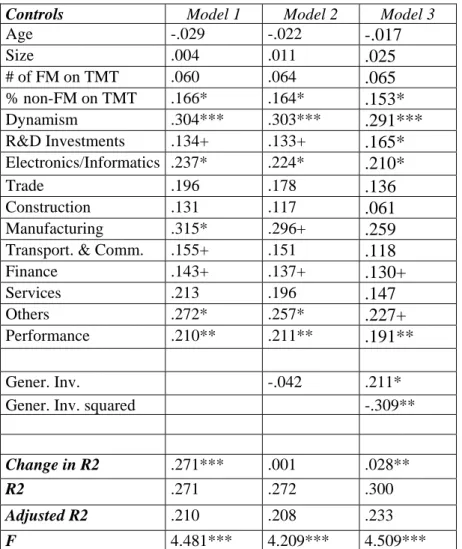
3. We finally tested our hypothesis in three models (Table 2).
“Insert Tables 1 and 2 here”
Model 1 includes only the control variables. In model 2, EO was also regressed on
generational involvement in the TMT. In model 3 generational involvement squared was added
in order to test our hypothesis, which predicted a non-linear relationship between generational
involvement and EO in family firms. Although generational involvement appeared not to be
significantly related to EO in Model 2 (-.042; ns); in Model 3 generational involvement revealed
a positive and significant coefficient (.211; p<.05), while generational involvement squared was
negative and significant(-.309; p<.01). Thus, the analytical results supported our hypothesis.
Further, to check for the robustness of this significant non-linear effect, we also performed the
joint F-test that assesses whether generational involvement and generational involvement
3 The two instrumental variables also individually (see Makri, Hitt & Lane, 2010; Morrow, Sirmon, Hitt &
15
squared jointly have a significant effect on EO. The joint F-test further supported our hypothesis
(F(2,179)=3.71; Prob> F =0.0263) (Hamilton, 2006).
Lastly, because the components of EO are often tested separately, we ran a post-hoc
analysis to assess the robustness of our results. Specifically, we separately tested the effect of
generational involvement and each of the components of EO (i.e. product innovation,
proactiveness, and risk taking). Results were substantively similar for both product innovation
(generational involvement: .279, p<.05; generational involvement
2: -.430, p<.001) and
proactiveness (generational involvement: .253, p<0.05; generational involvement
2: -.319, p<.01);
but not for risk taking (generational involvement: -.007, ns; generational involvement
2: -.007,
ns).
DISCUSSION
TMT diversity is something of a double-edged sword to be approached through a cognitive
and a relational perspective. Where there is diversity, teams enter into debate due to their
different perceptions and the range of possible strategic options. Rather than accepting existing
strategies, heterogeneous teams are likely to engage in task conflicts (cf. cognitive perspective),
fuelled by their different knowledge and perspectives. However, task conflict is difficult to
manage productively, especially when increased relationship conflicts are at stake. When people
are faced with high TMT diversity, they must work with individuals who they do not easily
interrelate with or understand (cf. relational perspective), which increases the uncertainty
associated with their entrepreneurial actions (cf. Barkema & Shvyrkov, 2007).
We focus on generational involvement – a proxy of knowledge diversity in
multigenerational family TMTs – and adopt a nonlinear approach to better explicate both the
cognitive and relational perspectives associated with TMT diversity. Specifically, our empirical
16
results confirm that there is an inverted U-shaped relationship between generational involvement
and EO. The highest level of EO is achieved when two generations are involved, rather than only
one. Indeed, involving a second generation in the TMT enriches family managers’ knowledge
and perspectives, thus promoting constructive debate, knowledge integration and EO.
Apparently, while relationship conflicts are mitigated, task conflicts are promoted when two
generations are simultaneously involved in the TMT. For instance, Ensley and Pearson (2005)
argue that the presence of parents – as usually happens when two generations are involved –
inhibits relationship conflicts and promotes cohesion. However, when three generations are
involved and thus the kinship distance increases further, the cognitive advantages are overcome
by increased social relational conflicts and path dependent behaviors that undermine
entrepreneurial efforts. As Gersick, Davis, Hampton and Lansberg (1997) contend, as familial
distance increases, the values, beliefs and consensus of the family become more diluted and thus
family relationships become more complicated.
Our result thus confirms that knowledge diversity among family members belonging to
different generations may enhance some beneficial dynamics but impair others depending on the
number of generations involved in the TMT. Put differently, the cognitive endowment can
become a liability when the relational context decays, with EO suffering as a result. Accordingly,
Beckman et al. (2007: 154) clearly explain that team diversity produces negative outcomes
“when the potential conflict in group dynamics [i.e. relationship conflicts] outweighs the
information benefits from different perspectives [i.e. task conflicts]”. Thus, unless the costs
associated with relationship conflicts are attenuated, the benefits of task conflicts on
17
Furthermore, a closer look at the control variables in our model shows that the percentage
of non-family members on the TMT significantly and positively impacts on EO. This finding
confirms that having non-family members on the TMT, besides increasing the TMT diversity,
offers some more “rationality” and “objectivity” in decision making that may mitigate potential
family relationship conflicts, increase the level of professionalization in the business, and thus
promote change and innovation
4(Cruz & Nordqvist, 2012). As Salvato et al. (2010) argue,
non-family managers dramatically improves the quality of strategic decisions and the likelihood of
entrepreneurial behaviors. In addition, under the light of agency theory, family owner-managers
tend not to risk the family’s wealth and jeopardize the financial and social well-being of future
generations (Naldi et al., 2007). Therefore, limiting their involvement by opening the TMT to
non-family members may be beneficial for EO.
Finally, although our hypothesis is supported for both product innovation and
proactiveness, it is not for risk-taking. This confirms that risk-taking is a distinct dimension of
family firms’ entrepreneurial behavior – as Naldi et al. (2007) hold. Such a position is in line
with more recent theorizing according to which the dimensions of EO may occur in different
combinations, each representing a different and independent aspect (e.g., Covin, Green & Slevin,
2006).
Two important contributions emerge from the present research. First, our study
contributes to the literature of entrepreneurship in family firms, by clarifying the effect of
generational involvement on EO. We show how generational involvement in the TMT – often
identified as a positive correlate of entrepreneurship (e.g. Kellermanns & Eddleston, 2006;
Zahra, 2005), not always has a positive effect on EO. .As such, our work sheds some light on
previous studies that offered conflicting results regarding the effect of generational involvement
18
on EO. More generally speaking, we contribute to the debate on the implications of family
involvement on EO, by analyzing the effects of a specific form of family involvement – i.e.
generational involvement – on entrepreneurial behavior and by looking for non-linear effects,
rather than simple linear relationships.
Second, we cautiously add some knowledge to the literature on TMT diversity by
proposing a non-linear approach to explain the relationship between TMT diversity and
entrepreneurship. In fact, we use both the cognitive and relational perspectives to elucidate
previous research showing mixed effects of TMT diversity on entrepreneurial activities (e.g.
Ancona & Caldwell, 1992; Boeker, 1997a, 1997b). Results further support and extend recent
literature concluding that “it is impossible to assume a pure, simple relationship between TMT
diversity and firm” outcomes (Talke et al., 2011: 908). With respect to this literature stream we
also analyze a specific source of diversity in the TMT, i.e. the vertical distance among family
members, thus complementing previous research that focused on the horizontal distance among
family members (e.g. Ensley & Pearson, 2005).
Several future research routes can be traced on the basis of the limitations of this
research. First, we do not directly measure task and relationship conflicts, but argue that they are
crucial for EO efforts. Future studies should incorporate these constructs in a multi-level research
design. Second, we limit our study to only generational involvement as source of TMT
knowledge diversity and assume that family members’ knowledge is more similar within a
generation rather than between generations. Future research may investigate if also other sources
of TMT diversity impact EO in a non-linear way. We limited our study to the vertical distance
among family members but horizontal distance as source of TMT diversity in family firms may
affect EO in a similar vein. Further investigation is clearly required. Third, the TMTs of our
19
firms are mainly dominated by family members (the average percentage of non-family managers
in our sample was only 24.1%; see Table 1). This condition raises some relevant provocative
questions: for instance, would our result be different if the percentage of family and non-family
managers was more balanced in our sample? Or if the TMT was dominated by non-family
managers? Future research clearly needs to be channeled also towards these directions. Fourth,
the validity of the analysis is limited by the cross-sectional nature of the study. A longitudinal
research design could provide further evidence on the causal relationships between dependent
and independent variables. Fifth, our data were collected exclusively in Switzerland: Given that
EO is specifically bounded to cultural contingencies (Arbaugh, Cox & Camp, 2005), a
multi-country study that investigates the contingency effects of cultural influences is desirable.
In conclusion, our results suggest that generational involvement is essential for family firm
EO, which implies that family generations must accept each other’s knowledge to be successful
over time. Also, our work suggests family owners and managers to limit the involvement of
family generations to two, given the relational inefficiencies that three generations involved in
the TMT may generate.
20
REFERENCES
Ahuja, G., & Lampert, C.M. (2001). Entrepreneurship in the large corporation: A longitudinal
study of how established firms create breakthrough inventions. Strategic Management
Journal. 22, 221–238.
Ancona, D.G., & Caldwell, D.C. (1992). Demography and design: predictors of new product
team performance. Organization Science, 3 321–341.
Arbaugh, J.B., Cox, L.W., & Camp, S.M. (2005). Nature or nurture? Testing the direct and
interaction effects of entrepreneurial orientation, national culture, and growth strategy on
value creation. Frontiers of Entrepreneurship Research. Babson College, Wellesley, MA.
Auh, S., &Menguc, B.(2005). Top management team diversity and innovativeness: The
moderating role of interfunctional coordination. Industrial Marketing Management, 34,
249–261.
Bantel, K.A., & Jackson, S.E. (1989). Top management and innovations in banking: does the
composition of the top team make a difference? Strategic Management Journal, Summer
Special Issue, 10, 107–124.
Barkema, H.G.,& Shvyrkov, O. (2007).Does top management team diversity promote or hamper
foreign expansion? Strategic Management Journal,28, 663–680.
Beckman, C.M. (2006). The influence of founding team company affiliations on firm behavior.
Academy of Management Journal, 49 (4), 741–758.
Beckman, C.M., Burton, M.D., &O'Reilly, C. (2007). Early teams: The impact of team
demography on VC financing and going public. Journal of Business Venturing, 22(2),
147– 173.
Boeker, W. (1997a). Executive migration and strategic change: the effect of top manager
movement on product market entry. Administrative Science Quarterly, 42, 231–236.
Boeker, W. (1997b). Strategic change: the influence of managerial characteristics and
organizational growth. Academy of Management Journal, 40, 152–170.
Boone, C., & Hendriks, W. (2009). Top Management Team diversity and firm performance:
Moderators of functional-background and locus-of-control diversity. Management Science,
55(2), 165–180.
Burgelman, R.A., & Hitt, M.A. (2007). Entrepreneurial actions, innovation, and appropriability.
Strategic Entrepreneurship Journal, 1, 349–352.
Chirico F., & Salvato C. (2008). Knowledge integration and dynamic organizational adaptation
in family firms. Family Business Review, 21, 169–181.
21
Chirico F, Ireland RD & Sirmon DG. (2011). Franchising and the family fi rm: creating unique
sources of advantage through ‘familiness.’ Entrepreneurship Theory and Practice, 35(3),
483–501.
Chirico F., Sirmon D., Sciascia S., & Mazzola P. (2011). Resource orchestration in family firms:
Investigating how entrepreneurial orientation, generational involvement and participative
strategy affect performance. Strategic Entrepreneurship Journal, 5(4), 307-326.
Chrisman, J. J., Chua, J. H., & Steier, L. P. (2011). Resilience of family firms: An introduction.
Entrepreneurship Theory and Practice, 35, 1107–1119.
Cohen, M. D., & Levinthal, D. A. (1990). Absorptive capacity: A new perspective on learning
and innovation.Administrative Science Quarterly, 35(1), 128–152.
Covin, J.G., & Slevin, D.P. (1991). A conceptual model of entrepreneurship as firm behavior.
Entrepreneurship Theory and Practice, 16(1), 7–25.
Covin, J.G., Green, K.M., &Slevin, D.P. (2006). Strategic process effects on the entrepreneurial
orientation-sales growth rate relationship. Entrepreneurship Theory & Practice, 30, 57–81.
Covin, J.G., & Lumpkin, G.T. (2011). Entrepreneurial orientation theory and research:
Reflections on a needed construct. Entrepreneurship Theory and Practice, 35, 5,
1042-2587.
Cruz, C., &Nordqvist, M. (2012). Entrepreneurial orientation in family firms: A generational
perspective. Small Business Economics 38(1), 33-49.
Ensley, M. D., & Pearson, A. W. (2005). An exploratory comparison of the behavioral dynamics
of top management teams in family and nonfamily new ventures: Cohesion, conflict,
potency, and consensus. Entrepreneurship Theory & Practice, 29, 267-284.
Finkelstein, S., & Hambrick, D. C. (1990). Top management team tenure and organizational
outcomes: The moderating role of managerial discretion. Administrative Science Quarterly,
35, 484–503.
Fiol, C.M. (1994). Consensus, diversity, and learning in organizations. Organization Science,5:
403–420.
Gersick, K.E., Davis, J.A., Hampton, M.M., & Lansberg, I. (1997). Generation to generation:
Lifecycles of family business. Boston, MA: Harvard Business School Press.
Gomez-Mejia, L.R., Haynes, K.T., Nunez-Nickel, M., Jacobson, K.J.L., & Moyano-Fuentes, J.
(2007). Socioemotional wealth and business risks in family-controlled firms: Evidence
from Spanish olive oil mills. Administrative Science Quarterly 52, 106–137.
22
Grant, R. (1996). Prospering in dynamically competitive environments: organisational capability
as knowledge integration. Organization Science, 7(4), 375-387.
Hambrick, D.C., Cho, S.T.,& Chen, M.J. (1996). The influence of TMT heterogeneity on firm’s
competitive moves. Administrative Science Quarterly, 41, 659–684.
Hambrick, D.C.,& Mason, P.A. (1984). Upper echelons: The organization as a reflection of its
top managers. Academy of Management Review, 9(2), 193–207.
Hamilton, L.C. (2006). Statistics with Stata. Belmont, CA: Cengage.
Jansen, J.J.P., Van Den Bosch, F.A.J., & Volberda (2005). Managing potential and realized
absorptive capacity: How do organizational antecedents matter? Academy of Management
Journal,48 (6), 999–1015.
Jehn, K.A. (1995). A multimethod examination of the benefits and detriments of intragroup
conflict. Administrative Science Quarterly, 40, 256–282.
Jehn, K.A. (1997). A qualitative analysis of conflict types and dimensions in organizational
groups. Administrative Science Quarterly, 42, 530–557.
Jehn, K.A., Northcraft, G.B.,& Neale, M.A. (1999). Why differences make difference: a field
study of diversity, conflict, and performance in workgroups. Administrative Science
Quarterly, 44, 741–763.
Jones, C.D., Makri, M., & Gomez-Mejia, L.R. (2008). Affiliate directors and perceived risk
bearing in publicly traded, family-controlled firms: The case of
diversification. Entrepreneurship Theory and Practice, 32(6), 1007-1026.
Kellermanns, F. W., & Eddleston, K. (2004). Feuding families: When conflict does a family firm
good. Entrepreneurship Theory and Practice, 28(3), 209-228.
Kellermanns, F.W., & Eddleston, K.A. (2006) Corporate entrepreneurship in family firms: a
Family perspective. Entrepreneurship Theory and Practice, 30(6), 809-830.
Kellermanns, F.W., Eddleston, K.A, Barnett, T., & Pearson, A. (2008). An exploratory study of
family member characteristics and involvement: Effects on entrepreneurial behavior in
family firms. Family Business Review, 21(1), 1-14.
Kennedy, P. (2008). A guide to econometrics (6
thedition ). Hoboken, NJ: Wiley-Blackwell.
Knight, D., Pearce, C.L., Smith, K.G., Olian, J.D., Sims, H.P., Smith, K.A., & Flood, P. (1999).
Top management team diversity, group process, and strategic consensus. Strategic
Management Journal, 20(5), 445–465.
23
La Porta, R., Lopez-de-Silanes, F., & Shleifer, A. (1999). Corporate ownership around the world.
The Journal of Finance, 54(2), 471–517.
Leonard-Barton, D. (1992). Core capabilities and core rigidities: A paradox in managing new
product development. Strategic Management Journal,13, 111–125.
Ling, Y., & Kellermanns, F.W. (2010). The effects of family firm specific diversity: The
moderating role of information exchange frequency. Journal of Management Studies,47,
332–344.
Lumpkin, G.T, & Dess, G.G. (1996). Clarifying the entrepreneurial orientation construct and
linking it to performance. Academy of Management Review, 21, 135–72.
Makri, M., Hitt, M.A., & Lane, P. (2010). Complementary technologies, knowledge relatedness
and invention outcomes in high technology mergers and acquisitions. Strategic
Management Journal, 31, 602–628.
Michie, S., Dooley, R.S., & Fryxell, G.E. (2006). Unified diversity in top-level teams: Enhancing
collaboration and quality in strategic decision making. International Journal of
Organizational Analysis,14, 130–149.
Miller, C.C., Burke, L.M., & Glick, W.H. (1998). Cognitive diversity among upper-echelon
executives: implications for strategic decision process. Strategic Management Journal,
19(1), 39–58.
Miller, D. (1983). The Correlates of entrepreneurship in three types of firms. Management
Science, 29(7), 770-791.
Miller, D. (1993). The architecture of simplicity. Academy of Management Review, 18, 116–139.
Miller, D. & Friesen, P.H. (1982). Innovation in conservative and entrepreneurial firms: Two
models of strategic momentum. Strategic Management Journal, 3, 1–25.
Miller, D., Le Breton-Miller, I., & Scholnick, B. (2008). Stewardship vs. stagnation: An
empirical comparison of small family and non-family businesses. Journal of Management
Studies, 45, 51-78.
Milliken, F.J., & Martins, L.L. (1996). Searching for common threads: Understanding the
multiple effects of diversity in organizational groups. Academy of Management Review, 21,
402-433.
Morrow JL, Sirmon DG, Hitt MA, Holcomb TR. (2007). Creating value in the face of declining
performance: firm strategies and organizational recovery. Strategic Management Journal
28(3): 271–283.
24
Naldi, L., Nordqvist, M., Sjöberg, K., & Wiklund, J. (2007). Entrepreneurial orientation, risk
taking, and performance in family firms. Family Business Review, 20 (1), 33-48.
Nonaka, J. (1994). A dynamic theory of organizational knowledge creation. Organization
Science,1, 14–37.
Patel, P. C.,& Fiet, J. O. (2011). Knowledge combination and the potential advantages of family
firms in searching for opportunities. Entrepreneurship Theory and Practice, 35, 1179–
1197.
Podsakoff, P. M., & Organ, D.W. (1986). Self-reports in organizational research: Problems and
perspectives. Journal of Management, 12, 531–544
Postrel, S. (2002). Islands of shared knowledge: Specialization and mutual understanding in
problem-solving teams. Organization Science, 13, 303–320.
Rauch, A., Wiklund, J., Lumpkin, G.T., &. Frese, M. (2009). Entrepreneurial orientation and
business performance: Cumulative empirical evidence. Entrepreneurship Theory and
Practice, 33(3), 761-788.
Salvato, C. (2004). Predictors of entrepreneurship in family firms. Journal of Private Equity,
7(3), 68-76.
Salvato C., Chirico F., & Sharma, P. (2010). A farewell to the business: championing exit and
continuity in entrepreneurial family firms. Entrepreneurship & Regional Development, 22,
1–28.
Shane, S. (2003). A General Theory of Entrepreneurship. The Individual-Opportunity Nexus.
Cheltenham: Edward Elgar.
Sharma, P.,& Salvato, C. (2011). Commentary: exploiting and exploring new opportunities over
life cycle stages of family firms. Entrepreneurship Theory and Practice, 35, 1199–1205.
Short, J.C., Payne, G.T., Brigham, K.H., Lumpkin, G.T., & Broberg, C. (2009). Family firms and
entrepreneurial orientation: A comparative analysis of the S&P 500. Family Business
Review, 22(1), 9-24.
Sirmon, D.G., & Hitt, M.A. (2003). Managing resources: Linking unique resources, management
and wealth creation in family firms. Entrepreneurship Theory and Practice 27, 339–358.
Sirmon, D.G, & Hitt M.A. (2009). Contingencies within dynamic managerial capabilities:
Interdependent effects of resource investment and deployment on firm performance.
Strategic Management Journal,30,1375–1394.
25
Simons, T., Pelled, L. H., & Smith, K. A. (1999). Making use of difference: Diversity, debate,
and decision comprehensiveness in top management teams. Academy of Management
Journal, 42, 662–673.
Talke, K., Salomo, S., & Rost, K. (2010). How top management team diversity affects
innovativeness and performance via the strategic choice to focus on innovation fields.
Research Policy, 39, 907-918.
Talke, K., Salomo, S., & Kock, A. (2011). Top Management Team diversity and strategic
innovation orientation: The relationship and consequences for innovativeness and
performance. Journal of Product Innovation Management, 28, 819–832.
Wiersema, M.F., & Bantel, K. (1992). Top management team demography and corporate
strategic change. Academy of Management Journal, 35, 91–121.
Wiklund, J., & Shepherd, D. (2003). Knowledge-based resources, entrepreneurial orientation,
and the performance of small and medium-sized businesses. Strategic Management
Journal, 24(13), 1307–1314.
Williams, K.Y., & O’Reilly III Ch.A. (1998). Demography and diversity in organizations: a
review of 40 years of research. In B.M. Staw & L.L. Cummigs (Eds) Research in
Organizational Behavior, Vol. 20 (77–140). Greenwich, CT: JAI Press.
Wooldridge, J. (2002). Introductory econometrics: A modern approach. 2nd ed. New York:
South-Western College Publishing.
Zahra, S. A. (1993). A conceptual model of entrepreneurship as firm behavior: A critique and
extension. Entrepreneurship Theory and Practice, 17(4), 5-21.
Zahra, S.A. (2005). Entrepreneurial risk taking in family firms. Family Business Review,18,23–
40.
Zahra, S.A, & Bogner, W.C. (2000). Technology strategy and software new venture's
performance: exploring the moderating effect of the competitive environment. Journal of
Business Venturing, 15,135–173.
Zahra, S., & Nielsen, A.P. (2002). Sources for capabilities, integration and technology
commercialization. Strategic Management Journal, 23, 377–398.
Zahra SA, Neubaum DO, Larraneta B. 2007. Knowledge sharing and technological capabilities:
the moderating role of family involvement. Journal of Business Research, 60, 1070–1079.
Zimmerman, M. A. (2008). The influence of top management team heterogeneity on the capital
raised through an initial public offering. Entrepreneurship Theory & Practice, 32(3),
391-414.
26
Table 1: Descriptive Statistics and Correlations
Mean SD 1 2. 3. 4. 5. 6. 7. 8. 9. 10. 11. 12. 13. 14. 15. 16. 1. Age 46.270 39.385 1 2. Size 92.332 738.39 .82 1 3. # of FM on TMT 1.909 0.949 .088 -.061 1 4. % non-FM on TMT 0.241 0.301 .38 0.125 -.235** 1 5. Dynamism 3.266 .722 -.064 -.166* -.016 -.105 1 6. R&D Investments 3.688 .818 -.095 -.026 -.082 .114 .118 1 7. Electronics/Inf. .040 .196 -.102 -.023 -.034 -.054 .102 -.110 1 8. Trade .246 .431 .175* -.052 -.032 .021 .080 -.010 -.117 1 9. Construction .140 .348 .117 -.035 .130 -.113 -.002 -.023 -.083 -.231** 1 10. Manufacturing .196 .397 .150* -.028 .087 .117 -.106 .080 -.101 -.282** -.200** 1
11. Transp. & Comm. .030 .171 .033 -.013 -.076 -.060 .016 .031 -.036 -.101 -.071 -.087 1
12. Finance .015 .122 -.064 -.014 -.075 -.031 -.027 -.054 -.025 -.071 -.050 -.061 -.022 1 13. Services .211 .409 -.233** .164* -.107 .052 .014 .001 -.106 -.296** -.209** -.255** -.091 -.064 1 14. Others .090 .287 -.128 -.033 -.044 -.010 -.003 .035 -.065 -.180* -.128 -.156* -.056 -.039 -.163* 1 15. Performance 3.918 .563 -.038 -.069 .036 -.110 .075 .303** -.243** -.031 .046 -.092 .065 .201* .064 .100 1 16. EO 3.596 .639 -.083 .009 -.016 .119 .329** .254** .078 -.077 -.110 .083 .059 .088 -.020 .129 .252** 1 17. Generational Invol. 1.540 .548 .217** -.043 .181* -.061 -.066 -.019 -.155* .057 .078 .001 .095 -.046 -.058 -.118 .053 -.103
N= 199; * p<.05; ** p<.01; *** p<.001
27
Table 2: Results of Regression on Entrepreneurial Orientation
N= 199
+ p<.10 * p<.05; ** p<.01; *** p<.001
Controls Model 1 Model 2 Model 3
Age -.029 -.022
-.017
Size .004 .011.025
# of FM on TMT .060 .064.065
% non-FM on TMT .166* .164*.153*
Dynamism .304*** .303***.291***
R&D Investments .134+ .133+.165*
Electronics/Informatics .237* .224*.210*
Trade .196 .178.136
Construction .131 .117.061
Manufacturing .315* .296+.259
Transport. & Comm. .155+ .151
.118
Finance .143+ .137+
.130+
Services .213 .196
.147
Others .272* .257*
.227+
Performance .210** .211**
.191**
Gener. Inv. -.042 .211*
Gener. Inv. squared -.309**
Change in R2 .271*** .001 .028**
R2 .271 .272 .300
Adjusted R2 .210 .208 .233