Magnetic Resonance
9 Springer-Verlag 1997 Printed in AustriaQuantitative Time-Resolved E P R C I D E P Study
o f t h ePhotodecomposition of
trans-Azocumene in Solution
A. N. Savitsky and H. Paul
Physikalisch-Chemisches Institut, Universitfit Zª Zª Switzerland
Received January 31, 1997
Abstract. The cumyl radical system, which is created after laser flash irradiation o f t r a n s - a z o c u m e n e in benzene solution at room temperature, is investigated using time-resolved EPR spectroscopy. From the quantitative analysis o f EPR time-profiles at different microwave powers the spin relaxation times T~ = 3.5+0.3 ~ts and T 2 = 2.5_+0.1 ~ts are evaluated as well as the magnitude o f the chemically in- duced electron pola¡ (CIDEP), which is generated by the radical pair mechanism (RPM). The geminate RPM polarization is found to be considerably smaller than the F-pair one, 32_+2 and 48_+5 in units o f the Boltzmann pola¡ respectively. This is attributed to ah initial radical separation in the geminate pair, caused by the cleavage reaction. Besides cleavage, the photoexcited trans- azocumene also decays via isomerization to the thermally unstable cis-isomer, the lifetime o f which is found to be 14_+3 ~ts at 293 K in benzene, three times longer than in cyclohexane. The quantum yield o f free radicals, escaping from the primary cage, is determined as 0.28_+0.06 for the decay o f the excited t r a n s - a z o c u m e n e and 0.18_+0.04 for the thermal cleavage o f the cis-isomer. The self-ter- mination o f cumyl radicals proceeds with a rate constant 2k t = (7_+1). 10 s M-Xs -l in benzene at RT.
I. Introduction
The electron spin system of reactive radicals in solution, a s a rule, exhibits chemi- cally induced dynamic electron polarization (CIDEP), which can arise from a variety of mechanisms like the triplet mechanism (TM), the radical pair mecha- nism (RPM), the radical-triplet pair mechanism (RTPM), or via electron-nuclear cross relaxation [1-3]. A large amount of information on these polarizations has been gathered during the past 25 years, and the CIDEP phenomenon has been utilized in numerous studies to get insights into details of radical generation and radical reactions. However, one of the basic physical quantities involved, the magnitudes of the induced polarizations, have remained unknown in the vast majority of investigations. As they are difficult to measure, accurate information about them is still scarce [1, 2, 4-8].
Usually, CIDEP studies employ time-resolved EPR measurements after pulse radi- olytic or flash photolytic radical generation [8]. The EPR intensity in dependence
on time then contains all information about the spin dynamics as well as the chemi- cal kinetics o f the system and, therefore, is determined by a variety o f parameters which are all more or less unknown. In one o f the simplest cases already, when identical radicals are generated by flash photolysis and their magnetization is de- tected by time-resolved cw-EPR spectroscopy, at least eight parameters are influ- encing the time-profile, ir the RPM only is operative: the initial concentration o f radicals, their initial z-magnetization, their spin-lattice and spin-spin relaxation times, their rate constant for bimolecular termination, the polarization they gain in non- reactive encounters, as well as the amplitude of the resonant microwave tŸ and the sensitivity factor o f the EPR detection system. Evaluation o f all these quanti- ties via a multiparameter least-squares flt of the relevant Bloch type differential equations to the experimental data is a hopeless undertaking, as errors in the pa- rameters are mutual compensating and the tŸ are anything but unequivocal, even if a few o f the parameters can be measured separately or be taken from literature [6] and (Bl~ittler C., Paul H., unpubl.). Moreover, previous investigations have shown, that the same experimental time-profile may be described about equally well even with different kinetic schemes and CIDEP mechanisms [9, 10]. Therefore, in order to evaluate accurate magnitudes o f CIDEP from EPR time-profiles, as many as possible o f the other parameters should be determined precisely in separate experiments, and, o f course, the kinetics must be known. Though this is basically true for cw-EPR as well as FT-EPR detection, the problem seems to be less se- vere in the latter technique [6, 11, 12].
Under suitable conditions, the time-resolved cw-EPR (TREPR) signal after pulsed radical generation can show transient Torrey oscillations [13-15], and it is well known that their analysis, in principle, should yield several o f the above men- tioned parameters [8]. Hitherto, this possibility seems to have been exploited for CIDEP measurements only partially in a few investigations [16-19]. In this work, we report on a TREPR study o f cumyl radicals, generated from t r a n s - a z o c u m e n e by laser flash photolysis. It is shown that analysis o f Torrey oscillations, EPR time-profiles and lineshapes, as well a s a sensitivity calibration o f the EPR de- tection system, allows a complete determination o f the kinetics, spin dynamics, and the magnitude o f the CIDEP with good accuracy.
The photolysis of t r a n s - a z o c u m e n e (tAC) is a well defined, clean radical source and, therefore, an ideal model system. The following scheme gives the reaction sequence o f tAC upon uv irradiation [20-22]:
Ph Ph
Ph~ hv a ~, L~N=N/V_.-
N = N'q " b
Direct photolysis (step c) and isomerization (step a) are the competing primary steps after excitation. The cis-isomer (cAC) decays by a kinetics of first order (steps b and d) with a mean lifetime of 5 ixs at room temperature in cyclohex- ane solution [21]. The lifetime of the cumyldiazenyl radical (step e) is not ex- actly known, but an upper limit of less than 20 ns has been suggested [21]. In inert solvents the resulting cumyl radicals terminate in in-cage and out-of-cage processes to combination and disproportionation products [23, 24].
2. Experimental
Our experimental setup for time-resolved EPR measurements after laser flash pho- tolytic radical generation has been described previously [25]. It comprises an Nd- YAG laser (355 nm, 6 ns pulse width) a n d a cw-EPR detection system without fleld modulation (80 ns response time). All experiments were carried out at room temperature with benzene solutions. After deoxygenation by purging with helium or argon, they were exposed to laser irradiation (5-15 mJ per pulse on sample surface, 10 Hz repetition rate) while slowly flowing (50-100 laser shots per ir- radiation volume) through a quartz cell (2 mm optical path length) inside a TE103 EPR cavity. To avoid large concentration gradients across the sample volume an initial tAC concentration of 27 mM (OD = 0.2) was chosen for all experiments. Sample depletion was controlled by absorption spectroscopy and kept below 20%. Spectra were recorded at microwave powers ranging from 0.1 to 100 mW. Steady- state EPR spectra and calibration experiments were performed on a commercial EPR-spectrometer (Bruker ESP300).
Trans-azocumene was synthesized as described by Stowell [26]. All other chemi- cals were purchased from Fluka and Aldrich in their purest commercially avail- able forms and used as supplied.
3. Results
After laser flash irradiation of tAC (e355 = 37.3+0.1 M-lcm -1) in benzene solution, the EPR spectra given in Fig. 1 are observed. They are unambiguously assignable to the cumyl radical because of the hyperfine couplings 6H(CH3): 1.623(1) mT, 2H(o): 0.476(1) mT, 2H(m): 0.161(1) mT, and H(p): 0.551(1) mT, which agree with literature data [27]. As the photolysis of tAC occurs from an excited singlet state, the spectnma at short times, Fig. la, exhibits an A/E polarization pattern due to the RPM in the geminate radical pair. At longer times, Fig. lb, the F-pair polar- ization dominates, giving rise to an E/A multiplet polarization. No initial net po- larization is observed, i.e., there is no noticeable geminate pair polarization due to the different g-values of the cumyl and diazenyl radical. This agrees well with previous CIDNP results on the photolysis of symmetric azoalkanes, which also did not flnd any nuclear polarization due to the primary unsymmetrical radical pair, indicating a lifetime of the diazenyl radical in the picosecond range [20].
1
aFig. 1. Time-resolved EPR spectra of cumyl radicals generated by laser flash photolysis of t r a n s -
azocumene in benzene 3 ixs (a) and 50 q (b) after laser excitation. Spectrum b i s given with eight times larger amplification than a. The high- and low-field resonance marked by arrows have been
used for detailed analysis.
Two arrows in Fig. 1 mark a high- and low-field line positioned symmetrically to the center o f the spectrum. Their overlap with neighboring resonances is neg- ligibly weak and, therefore, their EPR time-profiles have been chosen to inves- tigate the CIDEP and chemical kinetics o f the radical system. The time-profiles on resonance o f these two lines were analyzed in terms o f Bloch equations, modified by additional terms to allow for chemical kinetics and electron spin polarization, as proposed by Pedersen [28] and Fessenden [16],
with d - - u = -T2-1u + A c o v , d t d d t v = - A c o u - T2-1v -I- (_D l M z , d d t M~ = - o ~ v - TI-1Mz + f ~ ( t ) (1)
f~(t)
= TI-Ipr + 2kt[R] 2 PFP~ + 2 k l f l [cAC]P~P~q , (2) and d d t - - [R] = -2kt[R] 2 + 2k~fl [cAC] ,d
-d---t-[cAC] = -kl[cAC ] , (3)
where u and v represent the perpendicular magnetization in the rotating frame, Ao9 the offset from resonance, T 1 and T z the relaxation times, o) 1 the microwave magnetic field amplitude, IR] the cumyl radical concentration, P~q[R] the equi- lib¡ z-magnetization, and PF the polarization factor for F-pair polarization (in units of the Boltzmann polarization P,q). The last term on the right-hand side of Eq. (2) takes into account the production o f z-magnetization due to thermal de- cay of cAC. There, PG describes the polarization generated in the geminate pair, and fl measures the fraction of tbermal cAc decay, which leads to radicals. Re- garding the initial condition, it is assumed that on the time-scale of the TREPR experiment the direct photolysis of tAC is yielding a cumyl radical ensemble with no initial perpendicular magnetization (u(0) = v(0) = 0) and an initial z-magne- tization Mz(0 ) = PGPoq[R](0). The latter is determined by the generated radical concentration IR](0) and the polarization Po, which these radicals gain via the RPM in the geminate pair. Finally, it is noted that the above moditŸ of the Bloch equations for chemical reaction and CIDEP are purely phenomenologi- cal." They are thought to hold as long as the chemical decay of the radical en- semble is slow in compa¡ with the spin relaxation time T 1 [28].
In what follows, we will first fix a variety of the parameters in Eqs. (1)-(3) via separate experiments, and will then determine the others by least square fits of the equations to the EPR time-profiles.
3.1. Transient N u t a t i o n s a n d L i n e w i d t h M e a s u r e m e n t s
The solution of Eq. (1) is well known and has been presented several times [29]. For the on-resonance case (Ao9 = 0) it reads
with
v ( t ) = og__AL Mz (0) exp(-ert) - sin cort + o91 fa (t) | (exp(-trt) 9 sin ogT t)
Car CO T 1 1 ,~ = ~ _ ( ~ - + ~ - 1 ) , ogT -- o97 - ~ - ( r ~ - - r~-l) ~
(4)
(5)
The second term on the right-hand side of Eq. (4) involves all parameters of the system because o f the convolution integral with f~(t). However, if 21 col l > > [1/T~ - 1/T2I, the first term leads to transient nutations, which are determined by only the four parameters o91, T 1, /'2, and Mz(0 ). As ah example, Fig. 2a gives
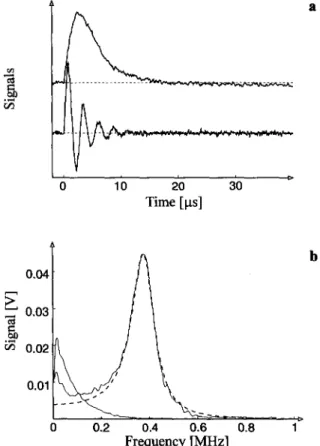
two EPR time-profiles on resonance o f the low-field line (marked in Fig. 1), taken at low and high m i c r o w a v e power. In the latter case, where above condition for
21co~1
is futfilled, the E P R signal appears essentially as an exponentially dampedoscillation. Figure 2b shows both E P R time-profiles after Fourier transformation in the frequency space. There, the Torrey oscillations b e c o m e separated from the
slower chemical kinetics, involved in fa(t) o f the second term in Eq. (4), and ap-
pear as a strong line at co x ( ~ 3 8 0 k H z in Fig. 2b). Analysis o f position, ampli- tude, and shape o f this line at different incident m i c r o w a v e powers, according
to the first term on the right-hand side o f Eq. (4), yielded cr = ( 1 / T 1 + 1/I"2)/2 =
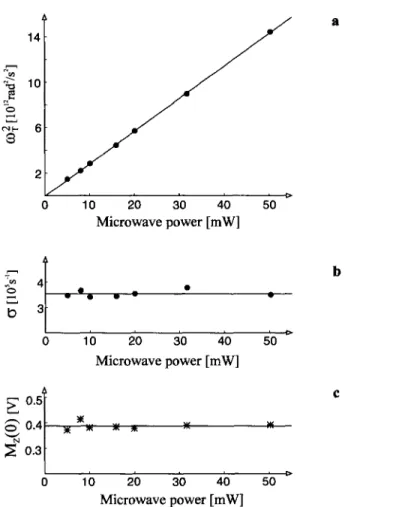
= (3.5---0.2). 105 s -1 and, for our experimental conditions, co z = 2 . 8 6 . 1 0 u rad2/s 2
per 1 m W incident m i c r o w a v e p o w e r as well as Mz(O ) = P~Peq[R](0) = 0.38___
+0.01 V for the investigated E P R transition at 10 mJ/pulse light intensity on probe. The results obtained for these three parameters at different m i c r o w a v e powers are shown in Fig. 3. The b r o k e n line drawn in Fig. 2b gives the nuta-
o~ 0 10 20 30 Time [~ts] ~ 0 , 0 3
~~176
/I,
0 0.2 0.4 0.6 0.8 i~ Frequency [MHz]Fig. 2. Torrey oscillations, a Low-field EPR time-profiles after laser flash irradiation of trans-
azocumene recorded at microwave powers 0.2 mW (upper trace) and 20 mW (lower trace), b Fou- rier transforms of the EPR time-profiles a anda simulation by Eq. (4) with neglect of the reaction
14 10 o m ["-' 6 $ Microwave power [mW] a o 10 2'0 30 40 50 ~ 10 2 0 3 0 4 0 5 0 Microwave power [mW] 0.5~ N o 3 20 3'0 40 5'0 Microwave power [mW]
Fig. 3. a Evaluation of frequency, b exponential damping, and c amplitude of the Torrey oscilla- tions at various microwave powers, via simulation of the Fourier transforms by Eq. (4) with neglect
of the reaction term.
tions as calculated with the above parameters for the condition used in that experiment (20 mW incident microwave power).
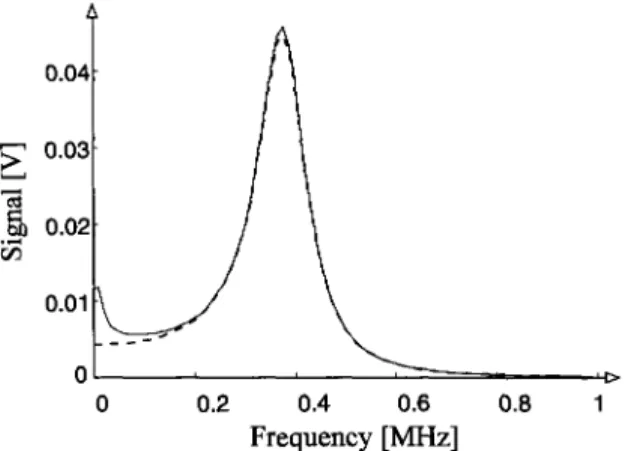
It has to be mentioned that this simple evaluation o f the Torrey oscillations in frequency space is an approximation, which requires the two terms on the right- hand side o f Eq. (4) to be sufficiently separated. For this to be the case we found as adequate condition cox/4 > ty > 4r, where r denotes the mean chemical life- time o f the radicals. Another problem is associated with the second term in Eq. (4) in that ir also contains a damped oscillation at the Torrey frequency co T. Fortu- nately, the amplitude o f this oscillation is roughly proportional to 1/co T [29], so that it can always be made small by increasing the microwave power. In our mea- surements its contribution was estimated to be negligibly small. We checked for this point once again at the end o f the evaluation, when all the parameters of the
system were known (vide infla), by calculating the Fourier transform o f Eq. (4) with and without its second term. The result, given in Fig. 4, clearly demonstrates the nutation line in frequency space to be nearly exclusively determined by the first term o f Eq. (4). FinaUy, it is noted that all these analyses, of course, require the response function o f the EPR detection system to be taken into account. In principal, the spin-spin and spin-lattice relaxation times can also be obtained separately from the Torrey oscillations. However, we found it to be more con- venient and accurate to use, besides the damping parameter ty, the linewidth in order to determine T~ and T 2 separately. At times t > 50 ~ts, much longer than the relaxation times, the two EPR lines under investigation showed Lorentzian lineshapes with a dependence on the incident microwave power following
ABrŸ 2 = (AB~ + (o? TIT2) , (6)
with ABl~ = 2/(yT2). Therefore, the linewidth ABI/2 a t times 60 ~ts < t < 100 ~ts was determined at various microwave powers, and the relaxation times were cal- culated from 2 o - = 1/T 1 + I / T 2 and
-~crABª A B 2 2 y 2 + c o Ÿ T 2 2 - 2 c r T 2 + l = 0 . (7)
Taking into account the errors o f the linewidth measurement, the numerical so- lution yielded T 2 = 2.49+0.11 ~ts and T I = 3.5___0.3 ~ts for cumyl radicals in ben- zene at room temperature.
Finally, we have checked the accuraey of the above results by analyzing a 2- cyano-2-propyl radical system (photolysis of AIBN in benzene at 355 nm) and
0.0 z E o.oa ~ 0.02 r~ 0.01 0 0 0.2 0.4 0.6 0.8
Frequency [MHz]
,1> 1Fig. 4. Simulation of the Fourier transform of Torrey oscillations, observed at 20 mW microwave
the cumyl radical system, which is created after photolysis o f dicumyl ketone (benzene, 308 nm). The values obtained for ro I differed b y less than 2% from the above one, and in the latter system the same relaxation times as before were found for the cumyl radicals.
3.2. Equilibrium Polarization and Sensitivity Factor
A quantitative analysis o f the EPR time-profiles requires determination o f the sensitivity factor o f the detection system. Multiplication o f this factor with the equilib¡ polarization allows a conversion o f P~q from its unit ( J . T 1.M -1) into the unit o f the measured signal voltage per radical concentration (V. M ~). Then, the Bloch equations can be used directly in units o f the signal voltage. In order to measure the sensitivity factor, separate EPR experiments were car- ried out with a solution o f the persistent nitroxyl radical TEMPO (1 mM) in benzene. Its EPR spectrum consists o f three lines due to the nitrogen hfs. The total EPR absorption o f the sample is calculated from the Bloch equations as:
co
O t a l
/theor = V((-O) dm = n M~ o9, = Ÿ ptq [TEMPO] m 1 .
- a o
(8)
In order to measure this total absorption, we have connected a sawtooth voltage to the Helmholtz coils o f the resonator and have swept the B0-field over one o f the three TEMPO resonances within about 20 ~ts (the timescale o f our time-re- solved experiments). The experimental EPR absorption was then calculated from the observed m a x i m u m signal height according tooo
Iexp = S S(co) dco = 3Sm~ x AO)I/2 gr , (9)
where A(-O1/2 and ta are the width and lineshape factor, respectively, which have been derived from a careful simulation o f the steady-state EPR spectrum o f the TEMPO solution. Because o f the proportionality S = Cv we have Iexp = Cltheor
and hence Iexp/(rc ro I[TEMPO]) = Cptq ~ in [V/M] for the TEMPO experiment. For
the TREPR experiment this factor has to be rescaled by taking into account the ratio o f the irradiated volume and that o f the TEMPO experiment, as well as the co 1 distribution along the cell height in the cavity, yielding
(~d~+Sh)/2Ah sin 2 x dx r
lexp 5W ~ (t~-~h)/2ah
C Ÿ p,,tal _ 9 ~ (10)
PR'eq n o)I[TEMPO ] Aw ~ sin2x dx
in [V/M] for the TREPR experiment. Here, 8w, 6h and Aw, Ah are width and height of the irradiated surface and the total cell surface in the cavity, respec- tively. From the errors o f the measurements and geometrical determinations, and Eq. (10), we finally obtained r' VTREPR--eq pto~l = 64.5+3.1 kV/M for our experimen- tal arrangement. For the analysis o f the two cumyl radical resonances under con- sideration, this number was multiplied with the relative weight 20/2048 o f the two resonances in the cumyl radical EPR spectrum, because Eq. (10) refers to the z-component o f the total Boltzmann polarization o f all hfs states. The result, 630_+30 V/M, was used for Peq in the analysis o f the time-profiles by fitting them with Eqs. (1)-(3).
3.3. Reaction Rate Constants and Initial Transient Concentrations
After having determined (91,
T1, T2, Mz(0),
and P~q, the remaining unknown pa-rameters of the system are the rate eonstants k~ and 2k t, the initial radical con- centration [R](0), as well as the parameter fl[cAC](O) and the F-pair polariza-
tion PF" A variety o f data and restrictions with respect to some o f these param- eters can be found in the literature. A rate constant k 1 ~ 2 " 1 0 5 s -1 has been es- timated for the decomposition o f cis-azocumene in cyclohexane [21]. Thus, k 1
can only be varied around this value. For the self-termination o f cumyl radicals, rate constants 2k t = 1.6- 10 ~o M-ls -I [30] and 3.6- lO s M-:s -1 [31] have been re- ported. The first one is certainly too large, and the second one seems to be based on an incorrect kinetic scheme [21]. However, for a variety o f radicals having similar structure and size as the cumyl radical, termination rate eonstants in the range 5 . 1 0 s < 2k t < 9 . 1 0 s M-~s -~ are known [32] for solvents with viscosities comparable to that o f benzene. Therefore, 2k t was varied within this range only. The initial concentrations [R](0) and fl[cAC](0) as well as the F-pair polarization PF were left as free fit parameters. In order to fmd reasonable starting values for the initial transient concentrations we have estimated the sum [R](0) + fl[cAC](0) from the absorbed laser light intensity per sample volume, the known quantum yield 0.36 of nitrogen formation [33], a n d a probability of 0.4 for geminate cage recom- bination as reported by Nelsen and Bartlett [34]. In addition, we have checked our value for the absorbed laser light per sample volume, by measuring spectrophoto- metrically the depletion of trans-azocumene, from which we calculated a quantum
yield of 0.374-0.01, in good agreement with the above N 2 quantum yield.
3.4. Computer Simulations
The system o f Eqs. (1)-(3) was numerically integrated, and the solution was fit with a SIMPLEX routine to the time-profiles o f 20 high/low-field resonance line pairs (marked in Fig. 1), which had been taken at va¡ microwave powers and laser light intensities. In each case, only the three parameters [R](0), fl[cAC](0), and Pr were fit, but the procedure was repeated several times with different values
for k 1 and 2k t. It w a s also c h e c k e d that the fits w e r e u n i q u e b y starting the S I M P L E X algorithm with different initial p a r a m e t e r sets. The b e s t agreement with the e x p e r i m e n t a l traces (Zr2d = 1.2) w a s f o u n d for the f o l l o w i n g p a r a m e t e r set: 2k t = (7_+1) 9 108 M - l s -1, k 1 = (7.5___1). 104 s -1, PF = 48-+5, and P6 = 32-+2. The other p a r a m e t e r s d e t e r m i n e d above, co 1 = 5.35- 105 rad/s p e r 1 mW, T~ = 3.5-+0.3 ~ts, T 2 = 2.5-+0.1 ~ts, a n d P~q = 6 3 0 + 3 0 V / M , w e r e left u n c h a n g e d , as their variation within the error limits did not i m p r o v e the fits, but rather impaired them. It is this p a r a m e t e r set, w h i c h has b e e n t a k e n to c a l c u l a t e Fig. 4. A c o m p a r i s o n o f e x p e r i m e n t a l t i m e - p r o f i l e s and their fits is s h o w n in Fig. 5 for two different m i c r o w a v e powers. Finally, from the a b s o r b e d laser light, the initial r a d i c a l con- c e n t r a t i o n ( ~ 2 0 ~tM for 10 rnJ laser p u l s e e n e r g y on p r o b e ) , and the quantity
0.1 ~=~_ 0.05
~o
-0.05 -0.1 i i i i 0 20 40 60 80Time [gs]
0.2 0.1>
.~
o -0.1 -0.2/
0 i L t L 10 20 30 40Time [gs]
Fig. 5. High- and low-field EPR time-profiles of cumyl radicals after laser flash irradiation of t r a n s -
azocumene, recorded at microwave powers 0.2 mW (a) and 2 mW (b), as well as their simulations by Eqs. (1)-(3).
fl[cAC](0) ( ~ 7 ~tM at the same laser pulse energy) the quantum yield for free radicals, escaping from the primary cage, was estimated as 0.28___0.06 for the decay of the excited trans-azocumene and 0.18___0.04 for the thermal decay o f the cis-isomer.
4. Diseussion
The EPR time-profiles of the cumyl radicals, generated by photolysis of azocumene, involve ten unknown or not accurately known parameters, which determine the spin dynamics, the CIDEP, and the chemical kinetics of the system. All these param- eters have been obtained with reasonable accuracy via a consequent analysis o f the transient Torrey oscillations, a thorough sensitivity calibration o f the EPR detec- tion system, and least-square fits to the experimental traces. The analysis has prof- ited mainly from the relatively long spin relaxation times T 1 and T 2 o f cumyl radi- cals in benzene at RT. This allows a rather accurate evaluation of co 1, /'1, TE, and especiaUy the crucial parameter M~(0). It also provides a good signal/noise ratio despite the intensity distribution on many resonances and the relatively low initial radical concentration, which is mandatory for an accurate separation o f the Torrey oscillations from a slow chemical kinetics in frequency space. Another special fea- ture of the system is its cleavage into radicals from a singlet molecular precursor, which results in opposite phases of the geminate and F-pair CIDEP and, hence, makes the time-profiles very sensitive to the magnitudes P~ and PE" Therefore, it remains to be seen to what extent the analysis presented here can also be applied to other, less favorable photochemical systems.
4.1. Rate Constants and Quantum Yields
The rate constant 2k t = (7___ 1)- 108 M ~s -1, which we have obtained for the self- termination of cumyl radicals in benzene at RT lies well in the expected range [32] and needs no further discussion. More interesting is the thermal decay rate of cis-azocumene, k 1 = (7.5+1)-104 s -~. In a previous flash photolysis investi- gation, Boate and Scaiano [21] found a lifetime o f ~ 5 ~ts for the cis-isomer in cyclohexane at RT. The EPR time-profiles, which we obtained using benzene as solvent, turned out to be incompatible with such a short lifetime but rather yielded 14 ~ts. We have checked this point by taking EPR time-profiles after photolysis of azocumene in some other solvents and found that in benzene the thermal decay of cis-azocumene is definitely slower than in alkane solvents. The reason for this is not quite clear, nor, ir the cis-trans isomerization, the cleavage, or both pro- cesses are affected by the solvent.
The quantum yields for free radical formation, 0.28+0.06 for the decay o f the excited trans-azocumene and 0.18+0.04 for the thermal decay of the cis-isomer, are novel informations about the photochemistry of this molecule. For the direct photocleavage (step c in the scheme of the reaction sequence o f tAC upon uv ir-
radiation, see Section 1) leading to free radicals, Boate and Scaiano [21] have es- timated a quantum yield <0.1. Our value agrees with this estimate and substanti- ates it. Further it is noted that hall the sum of both yields (0.23___0.04) is in sat- isfactory agreement with the total nitrogen quantum yield 0.36 [33], reduced by 40% cage recombination [34].
4.2. Spin Polarizations from Geminate and F-Pairs
The CIDEP observed after photolysis of azocumene is generated during reencounter sequences of the radicals forming the geminate and F-pairs. It results from differ- ent hyperfine energies of the species and the exchange interaction between them, which mix and split, respectively, the singlet and triplet states o f the pair. From the observed polarization pattem, a pure emission/absorption antiphase polarization, it can be concluded that under our conditions the radical pair mechanism (RPM) is dominated by S-T 0 mixing [1, 29]. The theoretical description o f the polariza- tion, created in this process, is well established [35-37]. Its predicted magnitude depends on several molecular parameters:
1. The diffusion coefficient Dre I = D 1 + D z for relative translational motion o f the two radicals forming the pair.
2. A parameter 2Qo = ~nAlnM~n - ZmA2mM~m describing the S-T 0 mixing fre- quency, where M~n is the magnetic quanturn number o f the nth nucleus o f radi- cal 1 in an overall nuclear spin state i and Al, its isotropic hfs constant (M~m and Azm have the analogous meaning for radical 2).
3. The distance dependent exchange interaction J(r) between the species, which causes the splitting of the S and T O states o f the radical pair. It is assumed to be spherical symmetric and desc¡ by J(r) = J0exp{-, 91 - d)}, where d denotes the distance of closest approach o f the species. The decay o f J with inter-radical separation, measured by ~, is often specified by a distance fox = 51n10-2 1, within which J diminishes by five orders o f magnitude. This distance is expected to lie in the range between r,x ~ d and ~ 2d. The exchange amplitude J0 is unknown. For two cumyl radicals a distance o f closest approach o f d ~ 6.2 A can be es- timated from their van der Waals volume [38], a n d a coefficient for relative trans- lational diffusion of Dre 1 = 2D R ~ 2.4" 10 _9 m 2 s -1 from the Stokes-Einstein equa- tion and the viscosity o f benzene at RT. The values for Qo are known from the hyperfine splittings o f this radical. With these parameters we have calculated the theoretically predicted F-pair polarization PF for the two cumyl resonances un- der consideration a s a weighted sum over all hyperfine states (Eq. (7.9c) in [35]). The result and the experimental value are compared in Fig. 6 in dependence on the exchange amplitude J0.
The experimentally determined F-pair polarization with its error is represented by a shadowed bar and the theoretical predictions by several lines. Figures 6a and 6c refer to weak exchange (J0 < 1011 rad/s) for the cases r~x = d and rex = 2d, respec-
200 150 5O 0 200 15O 50 Jo=D.~..d ' t i li +o + 10'o +0",
Exchange intcraction Jo [ rad's't]
120 100 80 60 40 20 0 C tJ / x ' jo=D.X.d_ x " t i i q 109 1010 1011 120 100 80 60 40 20 I b J0=D.~, 2 10 TM 1013
Exchange interaction Jo [ rad's'+]
lO" I
;, J*=D'Z2 d
IIII
0 +o10 +o10 +,4
Fig. 6. Theorctical predictions for the F-pair polarization o f cumyl mdicals in benzene (D~l = 2.4- 10 -9 m2s -~, d = 6.2 A) in dcpendcnce on the exchange amplitude J0. a Weak exchange limit (J0 y D A d - l ) and r~~ = d, according to Eq. (3.17) in [35] (dashed line) and Eq. (40) in [37] (solid line), c Dito, but for rex = 2d. b Strong exchange limit (J0 > D27) and r a = d, according to Eq. (3.17) in [35] (dashed line), Eq. (35) in [37] (solid line), and Eq. (21) in [36] (dotted line), d Dito, but for re~ = 2d.
The experimental value (shadowed bar) and the exchange interaction limits ate also given.
tively, and Figs. 6b and 6d to strong exchange (J0 > 1011 rad/s) for the same two values of rex. The theoretical predictions have been calculated from different ana- lytie approximations to the integral of the stochastie Liouville equation desc¡ the RPM. The full lines in Fig. 6 are based on analytical results obtained by Shushin [37], which, for the regions Jo y D2d-I and J0 > D+91 have been shown [39] to pmctically coincide with the exact nume¡ solution [35]. The dotted lines have been obtained from an approximation given by Adrian [36] for the strong exchange region. Finally, the broken lines in Fig. 6 are based on an equation proposed by Pedersen [35], which should qualitatively describe the magnitude of the F-pair po- la¡ over the whole range of possible exchange amplitudes. Obviously, the CIDEP created in cumyl radical F-pairs in benzene is compatible with two inter- pretations. Either the exchange interaction is strong (1012 < J0 < 1014 rad]s) and decays with rex ~+ 2d, or it is weak (3.109 < J0 < 101~ rad/s) and decays with an r~x bctween r~x ~ d and ~ 2d. To decide, which of both situations is tnm, needs additional information, e.g., the dependence of PF on the diffiJsion eoefficient. Ex- perimental results on this dependence will be reported later.
A result o f particular interest is the magnitude o f the geminate pair pola¡ Pa in comparison to the F-pair polarization PF" For the system investigated here,
the ratio o f both polarizations turns out to be
IPF/P~I
= 1.5___0.2, i.e., the gemi- nate polarization is definitely smaller than the F-pair one. As we have not ob- served any net emissive polarization, we believe that the geminate pair can be considered to be made up o f two c u m y l radicals, at least on the time scale the R P M is operative. Then, geminate and F-pairs are identical radical pairs under identical reaction conditions, except for a certain initial separation the radicals in the geminate pairs might have because o f the nitrogen loss and/or the exo- thermicity o f the cleavage reaction.In a previous investigation [40], a ratio
I PF/Pol
-- 1 has been measured for 2-pro-pyl-2-ol radicals, generated by photoreduction o f acetone with 2-propanol in aque- ous solution. This reaction proceeds from the acetone triplet state, and for triplet geminate pairs the initial separation o f the species hardly affects the evolution o f CIDEP, as long as this separation remains within the exchange region. However, the situation changes drastically for singlet geminate pairs, for which a strong de- pendence o f the CIDEP on the initial inter-radical distance would not be unexpected [39]. In fact, analysis o f the geminate CIDEP in dependence on the viscosity and comparison with the cage recombination offers a unique possibility to get a clearer picture o f the primary events and the initial distance distribution after the cleavage reaction o f azoalkanes (Savitsky A.N., Paul H., Shushin A.I., unpubl.).
Acknowledgements
The authors thank I. Verhoolen for the preparation o f t r a n s - a z o c u m e n e and product
analyses, A. I. Shushin (Moscow) f£ helpful discussions, and gratefully acknowl- edge financial support by the Swiss National Foundation for Scientific Research. The investigation was undertaken in the frame o f an INTAS project (93-1626- ext) on magnetic spin effects in chemical reaction.
References
[1] Salikhov K.M., Molin Yu.N., Sagdeev R.Z., Buchachenko A.L.: Spin Polarization and Magnetic Effects in Radical Reactions (Molin Yu.N., ed.). Amsterdam: Elsevier 1984.
[2] McLauchlan K.A., Yeung M.T.: Specialist Periodical Report "Electron Spin Resonance" 14, 32- 62 (1994)
[3] Goudsmit G.-H., Jent F., Paul H.: Z. Phys. Chem. 180, 51-64 (1993)
[4] Trifunac A.D., Lawler R.G., Bartels D.M., Thurnauer M.C.: Prog. React. Kin. 14, 45-156 (1986) [5] Wan J.K.S., Depew M.C.: Res. Chem. Intermed. 18, 227-292 (1992)
[6] van Willigen H., Levstein P.R., Ebersole M.H.: Chem. Rev. 93, 173-197 (1993) [7] Hirota N., Tominaga K., Yamauchi S.: Bull. Chem. Soc. Jpn. 68, 2997-3010 (1995) [8] McLauchlan K.A.: Modero Pulsed and Continuous-Wave Electron Spin Resonance (Kevan L.,
Bowman M.K., eds.), pp. 285-363. New York: John Wiley & Sons 1990. [9] Bl~ittler C., Paul H.: Res. Chem. Intermed. 16, 201-211 (1991)
[10] Mukai M., Yamauchi S., Hirota N.: J. Phys. Chem. 96, 3305-3311 (1992) [11] Steren C.A., van Willigen H., Dinse K.-P.: J. Phys. Chem. 98, 7464-7469 (1994) [12] Shkrob I.A., Trifunac A.D.: Radiat. Phys. Chem. 46, 83-96 (1995)
[13] Torrey H.C.: Phys. Rev. 76, 1059-1068 (1949)
[15] Atkins P.W., Dobbs A.J., McLauchlan K.A.: Chem. Phys. Lett. 25, 105-107 (1974) [16] Verma N.C., Fessenden R.W.: J. Chem. Phys. 65, 2139-2155 (1976)
[17] Beckert D., Mehler K.: Ber. Bunsenges. Phys. Chem. 87, 587-591 (1983); ibid. 88, 1013-1021 (1984)
[18] Beckert D., Fessenden R.W.: J. Phys. Chem. 100, 1622-1629 (1996) [19] McLauchlan K.A., Yeung M.T.: Mol. Phys. 89, 1423-1443 (1996) [20] Engel P.S.: Chem. Rev. 80, 99-149 (1980)
[21] Boate D.R., Scaiano J.C.: Tetrahedron Lett. 30, 4633-4636 (1989) [22] Scott T.W., Doubleday C., Jr.: Chem. Phys. Lett. 178, 9-18 (1990) [23] Nelsen S.F., Barlett P.D.: J. Am. Chem. Soc. 88, 137-143 (1966)
[24] Skinner K.J., Hochster H.S., McBride J.M.: J. Am. Chem. Soc. 96, 4301-4306 (1974) [25] Jent F., Paul H.: Chem. Phys. Lett. 160, 632-639 (1989)
[26] Stowell J.C.: J. Org. Chem. 30, 2360-2364 (1967)
[27] Landolt-Brrnstein: Magnetic Properties of Free Radicals, New Series, Group II, v. 9b (Fischer H., Hellwege K.-H., eds.). Berlin: Springer 1977.
[28] Pedersen J.B.: J. Chem. Phys. 59, 2656-2667 (1973)
[29] Hore P.J., Joslin C.G., McLauchlan K.A.: Specialist Periodical Report "Electron Spin Resonance" 5, 1-45 (1979)
[30] Weiner S.A., Hammond G.S.: J. Am. Chem. Soc. 91, 986-991 (1969)
[31] Sumiyoshi T., Kamachi M., Kuwae Y., Sclmabel W.: Bull. Chem. Soc. Jpn. 60, 77-81 (1987) [32] Landolt-Brrnstein: Radical Reaction Rates in Liquids, New Series, Group II, v. 13 (Fischer H., ed.). Berlin: Springer 1984; Landolt-B6rnstein: Radical Reaction Rates in Liquids, New Series, Group II, v. 18 (Fischer H., ed.). Berlin: Springer 1994.
[33] Engel P.S., Steel C.: Acc. Chem. Res. 6, 275-281 (1973) [34] Nelsen S.F., Barlett P.D.: J. Am. Chem. Soc. 88, 143-149 (1966) [35] Freed J.H., Pedersen J.B.: Adv. Magn. Reson. 8, 1-84 (1976) [36] Adrian F.J.: Res. Chem. Intermed. 16, 99-125 (1991) [37] Shushin A.I.: Chem. Phys. 144, 201-222, 223-239 (1990) [38] Edward J.T.: J. Chem. Ed. 47, 261-270 (1970)
[39] Shushin A.I., Pedersen J.B., Lolle L.I.: Chem. Phys. 177, 119-131 (1993) [40] Paul H.: Chem. Phys. 40, 265-274 (1979); ibid. 43, 294 (1979)
Author's address: Prof. Dr. H. Paul, Physikalisch-Chemisches Institut, Universitiit Zª Winter- thurerstr. 190, CH-8057 Zª Switzerland