DOI 10.1515/humor-2013-0026
Humor 2013; 26(3): 441 – 460
Andrea C. Samson, Oswald Huber and Willibald Ruch
Seven decades after Hans Asperger’s
observations: A comprehensive study of
humor in individuals with Autism Spectrum
Disorders
Abstract: The aim of the present study was to better understand humor in indi-viduals with Asperger’s syndrome. Therefore, various humor and laughter related phenomena were investigated by means of various standardized humor instru-ments. Forty individuals with AS and 113 controls filled out several self-report questionnaires and tests. The results revealed that individuals with AS scored significantly lower on trait cheerfulness and higher on trait seriousness (both describing the susceptibility to humor). Furthermore, they scored low on scales related to social communication (affiliative humor, humor entertainment) and portrayed a more socially cold humor style. In addition, individuals with AS scored low on mean-spirited humor, and used less adaptive (self-enhancing) and more maladaptive humor styles (self-defeating humor). Finally, they preferred incongruity-resolution humor, representing a more reality-oriented processing style. These findings add to previous studies on humor and expand the knowl-edge of components associated with successful humor appreciation.
Keywords: Asperger’s syndrome, autism, humor, sense of humor, self-assessment, cheerfulness, emotion
Andrea C. Samson: Department of Psychology, Stanford University, 450 Serra Mall, Bldg 420,
Stanford, CA, 94305. Email: [email protected]
Oswald Huber: Department of Psychology, University of Fribourg, Switzerland.
Email: [email protected]
Willibald Ruch: Department of Psychology, University of Zurich, Switzerland.
E-mail: [email protected]
1 Introduction
Asperger’s syndrome (AS) belongs to the high-functioning autism spectrum dis-orders. Individuals with AS show marked deficiencies in their social skills, and also have difficulties with transitions or changes and prefer sameness. They often
442
Andrea C. Samson et al.
have obsessive routines and may be preoccupied with a particular subject of in-terest (Frith 1991, 2003).
Hans Asperger (1944) drew attention to the “humorlessness” of the “autistic psychopaths”, as individuals with the syndrome were once called. He claimed that humorlessness is one of their essential characteristics: they do not “get jokes”, are unable to be cheerful in a relaxed manner and do not understand the world in a “peaceful” way, which is the basis of genuine humor. If they are occa-sionally in a cheerful mood, then it is portrayed in an awkward way (e.g., aggres-sive or without appropriate distance to others). In contrast, they are often very competent in wordplays based on sound similarities and related to witty sentences.
Interestingly, none of the studies conducted so far has attempted to empiri-cally verify the descriptions made by Asperger referring to “humorless” or “cheer-ful mood” using standardized assessments of humor. Rather, the studies focused on comprehension and appreciation of humorous stimuli, with some evidence suggesting that individuals with AS have difficulties in understanding jokes (Baron-Cohen 1997; Emerich et al. 2003; Ozonoff and Miller 1996; see also Lyons and Fitzgerald 2004). This is not surprising, as they generally have problems understanding non-literal speech, such as irony or sarcasm (e.g., Happé 1995). However, several experimental and case report studies showed that they enjoy certain forms of humor to the same extent as typically developing individuals. Individuals with AS enjoy slapstick and simple jokes (e.g., Ricks and Wing 1975; St. James and Tager-Flusberg 1994; Wing 1981) and are able to tell jokes that are on a lower humor stage than their actual age (e.g., pre-riddles or jokes based on lexical and phonological incongruities; Van Bourgondien and Mesibov 1987). Moreover, children with autism laugh when they are tickled and confronted with slapstick humor, but less in response to socially inappropriate acts (Reddy et al. 2002). A recent study showed that impairments in humor processing in individu-als with AS depend strongly on the stimulus material. Humor appreciation is not reduced as long as attributing mental states of others is not needed to understand the punch line (Samson and Hegenloh 2010).
Impressive as these results might be, these studies do not refer fully to what Hans Asperger observed. Asperger (1944, see Frith 1991: 81) wrote that they are “rarely relaxed and carefree and never achieve that particular wisdom and deep intuitive human understanding that underlie genuine humor”. Thus, what he ob-served goes way beyond the mere deficit of processing jokes and cartoons.
A further shortcoming of previous research is that the studies conducted so far did not make use of well-validated and widely used humor instruments. To the best of our knowledge, most prior experimental studies investigating humor in individuals with AS used “canned” humor (i.e., jokes or cartoons) and asked for a humor response on rating scales and sometimes for explanations why the
stimu-Humor in individuals with Autism Spectrum Disorders
443 lus was funny. However, by using such experimental tasks, several phenomena related to humor are not carefully explained or disentangled. If one is not laugh-ing at a joke, there could be several reasons why, such as reduced cognitive abili-ties, reduced motivation, or emotional or mood states that are diametrically op-posed to humorous behavior and make it impossible to laugh at a joke.
1.1 Facets of Humor
Humor can be seen as an umbrella term designating many different laughter and humor related phenomena (e.g., as communication tool, coping strategy, or per-sonality characteristic) serving different functions. So far, no clear definition of humor or an all-encompassing measurement tool of humor exists (Ruch 2007). However, there are several approaches that describe different facets of humor. Examples include, the temperamental basis of humor and humorlessness, actual everyday humorous conduct, the use of different humor styles, humor vocabulary used in everyday conversations by laypeople (when they talk about humorous or humorless people), and the preference for types of humor. In humor research, several reliable and valid humor instruments in the form of questionnaires and tests have been developed to assess these various humor and laughter related phenomena (e.g., Martin 2007; Ruch 2007).
1.1.1 Preference for different joke structures
One way to view humor is as the ability to understand and appreciate humorous material. Humor research repeatedly has shown that the structure of a joke influ-ences the perception of funniness at least to the same extent as its content. In the context of the structure of humor, two types can be distinguished. In
incongruity-resolution humor, the incongruity can be resolved (almost) completely.
How-ever, in nonsense humor the incongruity is only partially or not at all resolvable (McGhee et al. 1990; Ruch 2007). Several studies demonstrated the enormous im-pact of personality characteristics on the preference of incongruity-resolution or nonsense humor (e.g., Ruch and Hehl 2007). For example, high experience seekers prefer nonsense humor, while conservative people prefer incongruity-resolution humor. A recent study on humor processing showed individuals with AS to men-tion more often elements portrayed in a cartoon to be “impossible” or “not realis-tic”, which might be related to greater difficulty to switch from a reality modus (bona fide) to a joke modus (non-bona fide, see Samson and Hegenloh 2010). As nonsense humor might be even more distant from reality, impossible and absurd (e.g., speaking animals, Hempelmann and Ruch 2005; Samson and Hempelmann
444
Andrea C. Samson et al.
2011), we expect individuals with AS to prefer incongruity-resolution over non-sense humor.
1.1.2 Temperamental basis of humor
Ruch and co-workers presented a state-trait theory of humor and postulated that cheerfulness, seriousness, and bad mood for both state and trait account for inter- and intra-individual variations in humor (Ruch et al. 1996, 1997). Cheerful-ness as a mood state and temperamental trait lowers the threshold for induction of amusement, while seriousness and bad mood predict that people are less in-clined to feel or act humorously albeit for different reasons. Serious people do not
want to be amused and sad people cannot be cheered up. The analysis of trait
cheerfulness, seriousness, and bad mood allows us to test a few of the observa-tions made by Asperger: namely, whether individuals with AS will be lower in trait cheerfulness and higher in the seriousness or bad mood as variants of being humorless. We expect individuals with AS to score lower on cheerfulness and higher on seriousness and bad mood. Trait seriousness was negatively related to switching from a reality modus to a joke modus (Ruch and Köhler 2007), which might lessen the perception of humor (see also Raskin 1989; Svebak and Apter 1984). Individuals with AS seem to switch less often between these two modes (Samson and Hegenloh 2010), which strengthens our hypothesis for higher seri-ousness in individuals with AS.
1.1.3 Humor behavior
Individual differences in humorous behavior were also conceptualized as differ-ent styles of humor, which can be organized along five bipolar factors: socially warm vs. cold, reflective vs. boorish, competent vs. inept, earthy vs. repressed, and benign vs. mean-spirited humor (Craik et al. 1996). It is expected that indi-viduals with AS engage in cold humor behavior rather than socially warm humor behavior, and describe themselves as having an inept humor style. No hypo-theses are put forward regarding reflective vs. boorish, earthy vs. repressed, or benign vs. mean-spirited humor behaviors.
1.1.4 The use of different humor styles
Anther approach is theoretically driven and distinguishes between four different unipolar humor styles, two of which are assumed to be adaptive (i.e., affiliative, self-enhancing) and two assumed to be maladaptive (aggressive, self-defeating: see Martin et al. 2003). The adaptive humor styles are related to psychological
Humor in individuals with Autism Spectrum Disorders
445 health and well-being, while the maladaptive styles are connected to negative moods. It is expected that individuals with AS engage less in affiliative humor, as they generally have difficulties in social interaction. No hypotheses are formu-lated on self-enhancing, aggressive and self-defeating humor.
1.1.5 Humor language
Finally, language provides terms that describe people as either having an extra-ordinary sense of humor or lack thereof. Asking people how a certain word (nouns, verbs, or adjectives) describes their personality or attitudes has been proven to be fruitful in personality research for a comprehensive sampling of traits (i.e., psycho-lexical approach). A compiled list of German words exists for the domain of humor (HUWO, Humor Words, Ruch 1995b) circumscribing several humor-related domains, but also including cheerfulness and seriousness as main factors. Individuals with AS are expected to describe themselves as less cheerful and more serious.
1.2 The present study
In order to get a deeper insight into the possible difficulties of individuals with AS in the humor domain, several self-report questionnaires and tests of humor and laughter related aspects were used in the present study. This approach will shed more light on possible underlying mechanisms, e.g., the interplay between social skills and humor, and the potential functions of humor. While the results will be discussed for each of the instruments separately, a joint analysis would be bene-ficial to reveal whether the instruments are partly redundant.1
2 Method
2.1 Participants
170 individuals started to fill in the questionnaires. The data of fourteen partici-pants (8.25%) were not included for the analysis due to incompletion. Three out
1 For example, trait cheerfulness is considered to underlie the socially warm (vs. cold; HBQ) and
affiliative (HSQ) humor styles, and to be at least related to competent (vs. inept, HBQ) and self-enhancing (HSQ) humor (Ruch et al. 2011). Furthermore, it will be related to the positive humor words in the HUWO. Similarly, trait seriousness is underlying a variety of scales relating to voli-tional humor behavior and was shown to predict appreciation of humor (Ruch and Köhler 2007; Ruch et al. 2011).
446
Andrea C. Samson et al.
of the 43 individuals with AS had a score of 16 on the Autism-Spectrum quotient (AQ-k; Baron-Cohen et al. 2001). Since 17 is defined as the cut-off for autism, they were excluded for further analyses. Finally, our sample consisted of 40 indi-viduals with AS and 113 control participants who completed the questionnaires online.
Individuals with AS scored significantly higher on the AQ (M = 26.10,
SD = 5.68, range 18–31) than the control group (M = 5.68, SD = 3.54, range 0–16, F[1, 152] = 930.79, p < .001, η = .93, large).
The control group consisted of 64% females and the AS group of 53%. Males and females were equally distributed over the two groups (χ²[1] = 1.56, p = .21). The control participants (age M = 27.47, SD = 8.74, range from 18 to 64) and the in-dividuals with an AS diagnosis (age M = 34.10, SD = 10.55, range from 17 to 58) differed in age (F[1,152] = 15.22, p < .001). Furthermore, the two groups differed on the educational level. Fifty-five percent of the individuals with AS and 80% of the control group were students or had a university degree (χ²[1] = 9.15, p < .01). Fifty-three percent were recruited in Switzerland, 44% in Germany, and 3% in Austria.
2.2 Questionnaires and tests
The 3 Witz (Joke) Dimension (3WD) Humor Test (Ruch 1992, 1995a) was designed to assess funniness and aversion to jokes and cartoons that differ in their struc-ture: incongruity-resolution (INC-RES) and nonsense (NON) humor and on a third, content-related factor (sexual humor). Here, only the funniness and aver-sion ratings of INC-RES and NON humor were of interest, as well as the relative preference for nonsense over incongruity-resolution humor, i.e., the Structure Preference Index (SPI-f; obtained by subtracting funniness scores of INC-RES from NON). The test consists of 10 jokes and cartoons in each category and 5 warm-ups, which are rated for funniness and aversiveness using two seven-point scales from “not funny”/“not aversive” (= 0) to “very funny”/“very aversive” (= 6; in total 24 humorous stimuli).
The State-Trait-Cheerfulness Inventory (STCI-T, Ruch et al. 1996, 1997) as-sesses cheerfulness, seriousness, and bad mood as habitual traits. The distinc-tiveness of cheerfulness, seriousness, and bad mood has recently been demon-strated in self and peer data as well as aggregated mood states (Carretero Dios et al. 2011). We used a 30-item version in a four-point answering format from 1 = “strongly disagree” to 4 = “strongly agree”.
The HBQ Rating Form (i.e., rating form containing 100 items of the Humorous Behavior Q-Sort Deck – HBQD, Craik et al. 1996) asks for 100 statements
describ-Humor in individuals with Autism Spectrum Disorders
447 ing humor-related behaviors or behavior tendencies in a seven-point answering format (see also Müller and Ruch 2011; Ruch et al. 2009). It measures five bipolar styles of humorous conduct. Each factor is characterized by two contrasting styles: (i) socially warm vs. cold (the tendency to use humor to promote good will vs. an avoidance or aloofness regarding mirthful behavior), (ii) reflective vs.
boor-ish (discerning the spontaneous humor found in doings of oneself, other persons
or everyday occurrences vs. an uninsightful, insensitive and competitive use of humor), (iii) competent vs. inept (active wit, the capacity to convey humorous anecdotes effectively vs. the lack of skill and confidence in dealing with humor), (iv) earthy vs. repressed (a harsh delight in joking about taboo topics vs. an in-hibition concerning macabre, sexual or scatological modes of humor), and (v)
benign vs. mean-spirited (having pleasure in mentally stimulating and innocuous
humor-related activities vs. having the tendency to use humor to attack or belittle others).
The Humor Styles Questionnaire (HSQ, Martin et al. 2003) measures four unipolar styles of humor, two of them adaptive (self-enhancing and affiliative humor) and two maladaptive (aggressive and self-defeating humor) with a total of 32 items. Respondents rate the items on a seven-point scale in terms of agreement (“totally agree” = 7) vs. disagreement (“totally disagree” = 1).
The Humor Words (HUWO, Ruch 1995b) is a compendium of 97 types of nouns extracted from German dictionaries depicting persons characterized by humor (e.g., wit, joker) and lack thereof (e.g., grump, party pooper). Factor scores for playful vs. serious and grumpy vs. cheerful are derived by means of factor analy-sis. Furthermore, category scores are computed by summing up nouns for each of 12 categories (grumpiness, sadness, touchiness, dissatisfaction, seriousness, cheerfulness, composedness, laughter, entertainment, fun, mocking and acting silly). Participants rate the degree to which the term describes them using a four-point scale from 1 = “strongly disagree” to 4 = “strongly agree”. Furthermore, in an adaptation of the original version of the HUWO, participants could indicate if they were not familiar with the word.
Autism-Spectrum Quotient (AQ, Baron-Cohen et al. 2001): The German short
version of the AQ (AQ-k, with 33 items; Freitag et al. 2007) was used as an addi-tional measure to check the AS diagnosis (it has to be mentioned that it is not a sufficient assessment tool for autism, but it was used as a screening instrument). It is a questionnaire that covers domains connected with the autism spectrum, such as social and communication skills, imagination, and attention switching/ tolerance of change. The participants had to answer how strongly they agree on a four-point scale. One point to the overall score was given if the answer was on the upper half of the scale. A score of at least 17 postulated an indication of Asperger syndrome (Freitag et al. 2007).
448
Andrea C. Samson et al.
2.3 Procedure
Individuals with AS were recruited in several ways: (i) individuals who partici-pated in a previous study (Samson and Hegenloh 2010) were invited to take part in the online study on humor, and (ii) an information packet about this study was sent to several clinical institutions and consulting centers in Germany, Austria, and the German speaking part of Switzerland, who were asked to recruit individ-uals with AS. Only individindivid-uals with a confirmation (e.g., psychotherapist or psy-chiatrist) of the diagnosis (ICD-10: F84.5) were included in the study (N = 40). It has to be mentioned that individuals with AS can also be described as individuals with high functioning autism without an early history of language abnormalities. The control group was recruited through mailing lists and by distributed pam-phlets at German-speaking universities. People interested in participating in the study were invited to email us in order to access the online humor survey.
In the online survey, participants received general instructions about the study and instructions for each of the questionnaires and tests. Participants self-administered the questionnaires at home and could take breaks whenever they wanted. The whole procedure lasted approximately one hour. At the end, the par-ticipants were asked to include their email address. If the parpar-ticipants filled in the questionnaires completely, they were compensated with CHF 30.- (approximately $26). Local ethical standards were fulfilled.
3 Results
3.1 Group differences
The mean or sum scores for each subscale of the questionnaires are presented in Table 1. Cronbach’s α showed good reliability (α ≥ .69) with the exception of the competent vs. inept CO, .64) and earthy vs. repressed humor styles (HBQ-EA, .67). Therefore, these two questionnaires should only be considered with caution.
For each questionnaire, the group of AS were compared with the control group by means of repeated measure analyses of variances (RMANOVA) with the subscales as within-subject variables, and education level and age as covariates. Next, multivariate analysis of variance (MANOVA) were carried out to compare the AS and control group on each subscale with age or education level as covari-ates in case they showed a significant effect in the first step.
Humor in individuals with Autism Spectrum Disorders
449
Preference for incongruity-resolution over nonsense humor (3WD, Ruch 1992,
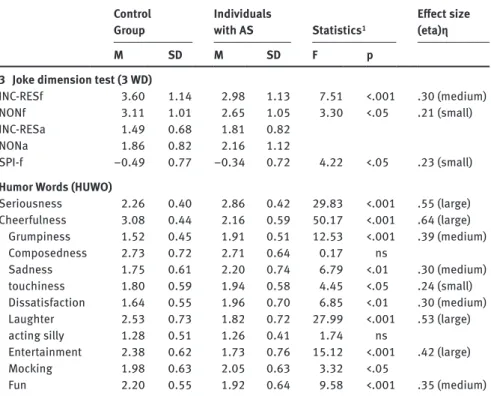
1995a): The 3WD test was mainly used to measure the preference for incongruity-resolution over nonsense humor. A univariate analysis of variance (ANOVA) with age and education level as the covariates revealed a significant difference be-tween the two groups (F[2,159] = 2.79, p < .05, η = .18, small). This difference indi-cates that individuals with AS prefer incongruity-resolution humor over nonsense humor, which coincides with our hypothesis. Furthermore, we analyzed positive and negative affect induced by humorous stimuli. RMANOVAs with age as the covariate were computed for funniness and aversion separately. The results re-vealed that there was no effect for funniness (F[1, 150] = .33, ns), but a significant
Table 1: Means and Standard deviations on the 3WD and the HUWO for the individuals with AS
(N = 40) and the control group (N = 113) and the multivariate variance analysis results, controlled for age
Control
Group Individuals with AS Statistics1 Effect size (eta)η
M SD M SD F p
3 Joke dimension test (3 WD)
INC-RESf 3.60 1.14 2.98 1.13 7.51 <.001 .30 (medium)
NONf 3.11 1.01 2.65 1.05 3.30 <.05 .21 (small)
INC-RESa 1.49 0.68 1.81 0.82
NONa 1.86 0.82 2.16 1.12
SPI-f −0.49 0.77 −0.34 0.72 4.22 <.05 .23 (small)
Humor Words (HUWO)
Seriousness 2.26 0.40 2.86 0.42 29.83 <.001 .55 (large) Cheerfulness 3.08 0.44 2.16 0.59 50.17 <.001 .64 (large) Grumpiness 1.52 0.45 1.91 0.51 12.53 <.001 .39 (medium) Composedness 2.73 0.72 2.71 0.64 0.17 ns Sadness 1.75 0.61 2.20 0.74 6.79 <.01 .30 (medium) touchiness 1.80 0.59 1.94 0.58 4.45 <.05 .24 (small) Dissatisfaction 1.64 0.55 1.96 0.70 6.85 <.01 .30 (medium) Laughter 2.53 0.73 1.82 0.72 27.99 <.001 .53 (large) acting silly 1.28 0.51 1.26 0.41 1.74 ns Entertainment 2.38 0.62 1.73 0.76 15.12 <.001 .42 (large) Mocking 1.98 0.63 2.05 0.63 3.32 <.05 Fun 2.20 0.55 1.92 0.64 9.58 <.001 .35 (medium)
Notes: M = Mean, SD = Standard Deviation, Min = Minimum, Max = Maximum. INC-RESf =
funniness of incongruity-resolution humor, NONf = funniness of nonsense humor, INCRESa = aversion of incongruity-resolution humor, NONa = aversion of nonsense humor. SPI-f = Structural
preference index (funniness).
450
Andrea C. Samson et al.
interaction with age (F[1, 150] = 7.11, p < .01, η = .21, small) and a tendency for the effect of the group (AS vs. control; F[1, 150] = 3.62, p = .06, η = .15, small). Also, the between-subjects factor was significant (F[1, 150] = 1 0.95, p < .001, η = .26, medium), indicating that both types of humor were less appreciated by individu-als with AS (see individu-also Table 1). This is in line with previous studies that found lower humor appreciation (e.g. Emerich et al. 2003; Reddy et al. 2002; Samson and Hegenloh 2010). A RMANOVA for aversion revealed no effect of the types of humor or the interaction with age or group (F[1,150] = 1.65, ns). Since the between-subjects factor reached no significance (F[1,150] = .29, ns), we did no further anal-ysis with aversion.
State-Trait-Cheerfulness Inventory (STCI-T, Ruch et al. 1996): The RMANOVA
revealed a significant main effect (F[2, 298] = 7.88, p < .001, η = .22, small) and a significant interaction in the STCI (F[2, 298] = 59.04, p < .001, η = .50, large). Edu-cation had no effect (F[2, 298] = .39, ns), but age significantly interacted with the STCI (F[2, 298] = 4.70, p < .05, η = .17, small). Further multivariate variance analyses with age as the covariate revealed that individuals with AS differ from the control group on all three subscales of the STCI: They described themselves to be less cheerful (F[2,150] = 73.89, p < .001, η = .70, large ), higher in bad mood (F[2,150] = 13.84, p < .001, η = .39, medium) and more serious (F[2,150] = 22.66, p < .001,
η = .48, large, see Figure 1).
HBQ Rating Form (Craik et al. 1996; Ruch et al. 2009): A RMANOVA revealed a
significant main effect (F[4, 596] = 18.58, p < .001, η = .45, large), and a significant interaction in the HBQ (F[4, 596] = 29.64, p < .001, η = .53, large). Education had no
Fig. 1: Mean cheerfulness, seriousness and bad mood for the individuals with AS (N = 40) and
Humor in individuals with Autism Spectrum Disorders
451 significant effect (F[4, 569] = 1.95, ns), but age significantly interacted with the HBQ (F[4, 569] = 5.85, p < .001, η = .27, medium). Further multivariate variance analyses with age as the covariate revealed that individuals with AS described their humor styles to be more socially cold (F[2,150] = 40.89, p < .001, η = .59 large), to have a more inept humor style (F[2,150] = 5.54, p < .01, η = .26, medium), and to have a more repressed humor style (F[2,150] = 9.45, p < .001, η = .33, medi-um). However, due to low reliability, the latter two scales have to be interpreted with caution. Finally, individuals with AS showed a more benign/less mean- spirited humor than controls (F[2,150] = 8.95, p < .001, η = .33, medium). However, further analyses showed that this difference is due to the fact that controls have significantly higher scores than individuals with AS on the items that count as mean-spirited humor (F[2,150] = 17.15, p < .001, η = .43, large). In contrast, no dif-ference between the two groups was found on the items that assess benign humor. Finally, no differences were found in reflective vs. boorish humor (see Figure 2).
Humor Styles Questionnaire (HSQ, Martin et al. 2003): A RMANOVA revealed
a significant main effect (F[3, 447] = 11.34, p < .001, η = .27, medium), and a sig-nificant interaction in the HSQ (F(3, 447) = 13.87, p < .001, η = .29, medium). Age (F[3, 447] = 1.83, ns) and education (F[3, 447] = 1.25, ns) had no effect. Multivariate variance analyses showed that individuals with AS described themselves to have a less affiliative (F[1, 150] = 53.51, p < .001, η = .51, large) and self-enhancing
Fig. 2: Mean scores on the subscales of the rating form of the Humorous Behavior Q-Sort Deck
(HBQD, Craik et al. 1996) for the individuals with AS (N = 40) and the controls (N = 113)
Note: SW = socially warm vs. socially cold, RF = reflective vs. boorish, CO = competent vs. inept, EA = earthy vs. repressed, BN = benign vs. mean-spirited
452
Andrea C. Samson et al.
humor style (F[1, 150] = 21.21, p < .001, η = .35, medium). However, no differences in hostile humor and self-defeating humor were found between individuals with AS and the control group (see Figure 3).
Humor Words (HUWO, Ruch 1995b): First, the number of non-understood
words was analyzed. Individuals with AS (M = 7.73, SD = 8.80) understood the humor terms equally well as the control group (M = 6.92, SD = 6.38; F[1, 152] = .38, ns). The number of non-understood terms correlated negatively with age (r[153] = −.22, p < .01). Those with a lower educational level (M = 9.01, SD = 7.58) indicated knowing fewer of the terms than those with a higher educational level (M = 6.19, SD = 6.66, F[1, 152] = 7.77, p < .01, η = .22, small). The non-understood terms did not enter the mean scores of the categories for any participant. A RMANOVA revealed a significant main effect (F[11, 1540] = 6.04, p < .001, η = .20, small), and a significant interaction in the HUWO (F[11, 1540] = 19.79, p < .001,
η = .35, medium). Education had no significant effect (F[11, 1540] = 1.75, ns), but
age significantly interacted with the HUWO (F[11, 1540] = 3.23, p < .001, η = .15, small). Further multivariate variance analyses with age as the covariate revealed that individuals with AS described themselves as: not humorous entertainers, more serious, less cheerful and less of a laughing person, to be more grumpy, more sad and to see themselves as less “fun” people. Finally, individuals with AS score higher on the dissatisfaction and touchiness scale. No differences were found in the domains of composedness, acting silly and mocking (see Table 1).
Fig. 3: Mean ratings of the subscales of the humor styles questionnaire (HSQ, Martin et al.
Humor in individuals with Autism Spectrum Disorders
453
3.2 Discriminant function analysis
In order to determine which of the questionnaires discriminated best between the AS and the control group, a stepwise discriminant function analysis was under-taken with the two groups (AS vs. controls) as the classification variable and with 29 subscales of the tests as dependent variables. The AQ-k did not enter the anal-ysis because it is not a humor-related questionnaire and it is a questionnaire de-signed to distinguish between individuals with AS and controls. A forward step-wise analysis was utilized (criterion to enter the function: F > 3.84, p < .01) and yielded a Wilks’ Lambda of .37 (F[7, 136] = 32.94, p < .001). Seven tests entered the function (trait cheerfulness and seriousness (STCI), fun words (HUWO), benign vs. mean-spirited humor (HBQ-BN), entertainment and serious words (both from the HUWO), self-defeating humor (HSQ) and funniness of incongruity-resolution humor (3 WD) and contributed significantly to the separation. The resulting axis was highly significant (Eigenvalue = 1.70; canonical correlation = .79; Wilks’ Lambda = .37; χ2 [7] = 137.33, p < .001).
Pooled within-groups correlations between discriminating variables and canonical discriminant functions showed that all scales were involved in the dis-crimination of the groups along this axis; the correlations were −.27 (funniness incongruity-resolution humor, 3WD), −.98 (trait cheerfulness, STCI), .51 (trait seriousness, STCI), .52 (benign vs. mean-spirited, HBQ-BN), .34 (self-defeating humor, HSQ), −.54 (HUWO entertainment), and .89 (HUWO fun).
The traits that differentiated best between individuals with AS and the con-trol group were cheerfulness and seriousness, which are understood as the tem-peramental bases of the sense of humor. Trait cheerfulness was highly correlated with affiliative and self-enhancing humor and with the socially warm vs. cold humor styles (Ruch et al. 2011). Interestingly, the cheerful type nouns (HUWO) had incremental validity in the discriminant function analysis indicating that not all variance in the cheerfulness words was covered by the trait cheerfulness measure. Benign vs. mean-spirited humor formed an independent predictor. An-other cluster of variables included mock/ridicule. The low zero-order correlation showed that trait cheerfulness was a suppressor variable. Taken together, the individuals with AS were low in trait cheerfulness and high in trait seriousness and in benign humor (HBQ-BN). Finally, high self-defeating humor and a prefer-ence for incongruity-resolution over nonsense add to the picture on humor in in-dividuals with AS. Again seriousness, but also fun and entertainment represented in the type nouns (HUWO) added additional discrimination.
According to this discriminant function analysis, 94.1% of the participants were correctly classified into the groups: 99.1% of the controls and 80% of the individuals with AS.
454
Andrea C. Samson et al.
4 Discussion
Most of the previous studies investigating the sense of humor in individuals with AS used performance tests in the form of rating humorous stimuli. This is the first study on humor in individuals with AS that takes into account commonly used and reliable self-assessment questionnaires, instead of testing humor by appre-ciation and comprehension of jokes and cartoons only. These questionnaires cover a broader range of humor- and laughter-related phenomena.
Differences between individuals with AS and the control group were detected in most scales and subscales. Individuals with AS can be best described as low in cheerfulness and high in seriousness as a habitual frame of mind, having a low affiliative humor style, a more socially cold and more benign (though not mean-spirited) humor, less use of humor as form of entertainment and fun, and finally, a preference for incongruity-resolution over nonsense humor.
These scales could appropriately discriminate individuals with AS from the controls, and this corresponds with Hans Asperger’s description of individuals with AS (1944) as having a lower understanding for genuine humor and being less cheerful. People with low cheerfulness scores are less likely to be exhilarated when confronted with stimuli that are supposed to provoke laughter. Likewise, they are also less likely to partake in joking behavior, particularly related to non-sense humor. It was repeatedly shown that both bad mood and seriousness are negatively correlated to cheerful mood (Ruch et al. 1996). What does this mean in the context of other studies on humor in relation to AS? We assume, at least in part, that lower appreciation and comprehensibility of humorous material could be affected by lower cheerfulness and higher seriousness in individuals with AS. Therefore, not only cognitive restrictions related to Theory of Mind processes (i.e., the ability to attribute mental states such as beliefs, intents, desires, etc.) or a weak central coherence (or other common factors that might cause these deficits) influence humor. Lower cheerfulness might reduce the motivation to search for a possible funny explanation when confronted with humorous materials. The findings by Samson and Hegenloh (2010) show that individuals with AS are more reality-oriented in the humor domain which is in line with the finding of lower trait cheerfulness with higher seriousness, but also with the preference for incon-gruity-resolution over nonsense humor.
As expected, scales that assess humor related to social components were strongly affected in individuals with AS. Literature has shown that humor has many functions in interpersonal interaction. Therefore, the social component can be considered extremely important in humor (as a communication tool, a social corrective, a mood enhancer etc., Martin 2007). Individuals with AS are known to have deficits in social communication and cognition (Theory of Mind), which
Humor in individuals with Autism Spectrum Disorders
455 might explain why so many facets of humor related to social cognition and com-munication are affected, resulting in lower scores in, e.g., humor entertainment (HUWO), affiliative humor (HSQ), socially warm vs. socially cold humor (HBQ-SW), and a competent vs. inept humor style (HBQ-CO).
Hans Asperger described the humor style of individuals with AS to be more aggressive. In contrast, we found lower scores in one scale assessing hostile and aggressive forms of humor (items measuring mean-spirited humor, HBQ). How-ever, differences were not found when using other scales to assess hostile and aggressive humor (e.g, from the HSQ and HUWO). This is in line with a previous study showing no difference between individuals with AS and the control group on the joy of laughing at others (katagelasticism, see Samson et al. 2011). One might argue that there is always an interpersonal component in hostile humor since it is always directed towards another person. As we have seen that individu-als with AS score lower on scales related to social (benevolent, positive) humor (HSQ, HBQ subscales), individuals with AS might also score lower on hostile forms of humor due to the interpersonal component. However, we assume that less cognitive empathy (e.g., Dziobek et al. 2008) and interpersonal sensitivity might counteract this possible effect and lead to the relatively higher scores in hostile humor compared to positive social humor in individuals with AS. How-ever, this is only speculative and needs further clarification.
Another interesting finding was that individuals with AS scored significantly lower on self-enhancing humor. Self-enhancing humor not only could be seen as an adaptive humor style, but also as a very highly developed skill, closely related to emotion regulation. The lower scores in self-enhancing humor in individuals with AS suggest that they are probably not effective at regulating their own emo-tions. Furthermore, as revealed by the discriminant function analysis, indi viduals with AS are more likely to use self-defeating humor, which is one of the maladap-tive humor styles.
4.1 Limitations
Despite these intriguing findings, the present study has limitations to discuss. First, this is an online study, which implies risks of uncontrollability of the envi-ronment where the questionnaires are taken. However, online studies have been shown to produce valid and trustworthy data (e.g., Gosling et al. 2004) and good results were obtained in previous data collections with autism (e.g., Samson and Hegenloh 2010). Second, besides the confirmation of the diagnosis, we did not collect any information on comorbidity, socio-economic status, or symptom se-verity. However, the assessment of symptom severity in relation to such complex
456
Andrea C. Samson et al.
skills, such as humor appreciation or sense of humor, would help to better under-stand the phenomenon. Third, we did not assess literal interpretation bias that might influence humor skills. However, individuals with AS did not significantly differ from the typically developed individuals on knowledge of humorous terms in the HUWO, which contains metaphoric expressions such as “party pooper”, “sniveler”, and “Mr. and Ms. Sunshine”. Fourth, individuals with AS were reported to have difficulties with introspection which might have affected self-report abili-ties on the humor questionnaires. However, recent studies showed that they were able to well report their experiences well (e.g., Berthoz and Hill, 2005). Finally, humor competence of individuals with AS might be related to their experiences made in previous interventions and therapies. Data was not collected regarding therapy exposure, which remains a weakness of the study.
4.2 Future directions
Although the present study is able to shed more light on different facets of humor, it is still not well understood how humor and its different components are related to symptom severity in individuals on the autism spectrum. While some of the previous studies assumed that individuals with AS have a general humor- processing deficit, others claim that the underlying cause is a Theory of Mind deficit (see, for an overview, Lyons and Fitzgerald 2004). However, other alterna-tives should be considered, especially trait seriousness or the inability to switch to a playful thinking mode. A future study could examine symptom severity in cognitive flexibility and restrictions, Theory of Mind (or a common factor that leads to difficulties in all of these symptoms) in relation to the different domains of humor. Further studies might also examine whether cheerfulness or playful-ness trainings (McGhee 2010; Papousek and Schulter 2008) are effective in en-hancing cheerfulness and decreasing seriousness in individuals with AS.
4.3 Concluding comments
This is the first study that takes into account many different facets of humor in order to address Hans Asperger’s observations on genuine humor and cheerful-ness in individuals with AS. The present study illustrates several phenomena re-lated to humor, laughter, and sense of humor in individuals with AS. Interestingly, not only types of humor related to social communication are affected in individu-als with AS who are known to have deficits in Theory of Mind and social commu-nication in general. There seems to be a strong difference in mood related aspects
Humor in individuals with Autism Spectrum Disorders
457 of humor (such as cheerfulness) and also a playful frame of mind or non-bona fide mode of communication (i.e., seriousness). This, and a more reality-oriented processing style, might be associated with less involvement in jocular behavior or less humor appreciation, which was described by Hans Asperger almost 80 years ago.
Acknowledgement
We would like to thank Christina Kwock, Adriana Zaccone and Kathryn Kalaf for proofreading and Sandra Utz for comments on a previous version of the manu-script. The study was financially supported by the Research fund (Project num-ber: 321) of the University of Fribourg.
Data of an additional questionnaire collected in the same study are published elsewhere (Samson et al. 2011).
References
Asperger, Hans. 1944. Die „Autistischen Psychopathen“ im Kindesalter [The autistic psychopaths in childhood]. Archiv für Psychiatrie und Nervenkrankheiten 117. 76–136. Baron-Cohen, Simon. 1997. Hey! It was just a joke! Understanding propositions and
propositional attitudes by normally developing children and children with autism. Israel
Journal of Psychiatry and Related Science 34(3). 174–178.
Baron-Cohen, Simon, Sally Wheelwright, Richard Skinner, Joanne Martin & Emma Clubley. 2001. The Autism-Spectrum quotient (AQ): Evidence form Asperger syndrome/high-functioning autism, males and females, scientists and mathematicians. Journal of Autism
and Developmental Disorders 31(1). 5–17.
Berthoz, S., & E. L. Hill (2005). The validity of using self-reports to assess emotion regulation abilities in adults with autism spectrum disorder. European Psychiatry 20(3), 291–298. Carretero-Dios, Hugo, Michael Eid & Willibald Ruch. 2011. Analyzing multitrait-multimethod data with multilevel confirmatory factor analysis: An application to the validation of the State-Trait Cheerfulness Inventory. Journal of Research in Personality 45. 153–164. Craik, Kenneth H., Martin D. Lampert & Arvalea J. Nelson. 1996. Sense of humor and styles of
everyday humorous conduct. In Willibald Ruch (ed.), Measurement of the Sense of Humor [special issue]. Humor: International Journal of Humor Research 9(3–4). 273–302. Dziobek, Isabel, Kimberley Rogers, Stefan Fleck, Markus Bahnemann, Hauke R. Heekeren,
Oliver. T. Wolf & Antonio Convit. 2008. Dissociation of cognitive and emotional empathy in adults with Asperger syndrome using the Mulitfaceted Empathy Test (MET). Journal of
Autism and Developmental Disorders 38(3). 464–473.
Emerich, David M., Nancy A. Creaghead, Sandra M. Grether, Donna Murray & Carol Grasha. 2003. The comprehension of humorous materials by adolescents with high-functioning
458
Andrea C. Samson et al.
autism and Asperger’s syndrome. Journal of Autism and Developmental Disorders 33(3). 253–257.
Freitag, Christine M., Petra Retz-Junginger, Wolfgang Retz, Christiane Seitz, Haukur Palmason, Jobst Meyer, Michael Rösler & Alexander von Gontard. 2007. Evaluation der deutschen Version des Autismus-Spektrum-Quotienten (AQ) – die Kurversion AQ-k [Evaluation of the German Version of the Autism Spectrum Quotient (AQ) – the short version AQ-k]. Zeitschrift
für Klinische Psychologie und Psychotherapie 36(4). 280–289.
Frith, Uta. 1991. Autism and Asperger Syndrome. New York: Cambridge University Press. Frith, Uta. 2003. Autism: Explaining the enigma. 2nd edn. Oxford: Blackwell Publishing.
Gosling, Sam D., Simine Vazire, Sanjay Srivastava & Oliver. P John. 2004. Should we trust web-based studies? A comparative analysis of six preconceptions about internet questionnaires. American Psychologist 59(2). 93–104.
Happé, Francesca. 1995. Understanding minds and metaphors: Insights from the study of figurative language in autism. Metaphor and Symbol 10(4). 275–295.
Hempelmann, Christian F. & Willibald Ruch. 2005. 3 WD meets GTVH: Breaking the ground for interdisciplinary humor research. Humor: International Journal of Humor Research 18(4). 313–387.
Lyons, Viktoria & Michael Fitzgerald. 2004. Humor in Autism and Asperger Syndrome. Journal of
Autism and Developmental Disorders 34(5). 521– 531.
McGhee, Paul E. 2010. Humor as survival training for a stressed-out world: The 7 humor habits
program. Bloomington: AuthorHouse.
McGhee, Paul E., Willibald Ruch & Franz-Josef Hehl. 1990. A personality-based model of humor development during adulthood. Humor: International Journal of Humor Research 3(2). 119–146.
Martin, Rod A. 2007. The psychology of humor: An integrative approach. London: Academic Press.
Martin, Rod A., Patricia Puhlik-Doris, Gwen Larsen, Jeanette Gray & Kelly Weir. 2003. Individual differences in uses of humor and their relation to psychological well-being: Development of the humor styles questionnaire. Journal of Research in Personality 37(1). 48–75.
Müller, Liliane & Willibald Ruch. 2011. Humor and strengths of character. The Journal of Positive
Psychology 6(5). 368–376.
Ozonoff, Sally & Judith N. Miller. 1996. An exploration of right-hemisphere contributions to the pragmatic impairments of autism. Brain and Language 52. 411–434.
Papousek, Ilona & Schulter Günter. 2008. Effects of a mood-enhancing intervention on subjective well-being and cardiovascular parameters. International Journal of Behavioral
Medicine 15(4). 293–302.
Raskin, Victor. 1998. The sense of humor and the truth. In Willibald Ruch (ed.), The Sense of
Humor, 95–108. Berlin: Mouton de Gruyter.
Reddy, Vasudevi, Emma Williams & Amy Vaughan. 2002. Sharing humour and laughter in autism and Down’s syndrome. British Journal of Psychology 93. 219–242.
Ricks, Derek M. & Lorna Wing. 1975. Language, communication and the use of symbols in normal and autistic children. Journal of Autism and Childhood Schizophrenia 5. 191– 221.
Ruch, Willibald. 1992. Assessment of appreciation of humor: Studies with the 3 WD humor test. In James.N. Butcher & Charles.D. Spielberger (eds.), Advances in personality assessment, Vol. 9, 27–75. Hillsdale, NJ: Erlbaum.
Humor in individuals with Autism Spectrum Disorders
459 Ruch, Willibald. 1995a. Humor-Test 3 WD, Unpublished manuscript. University of Düsseldorf,
Düsseldorf, Germany.
Ruch, Willibald. 1995b. A psycholexical study of the “sense of humor”: Taxonomizing German humor-related nouns. The Thirteenth International Humor Conference, Birmingham, July 31– August 4.
Ruch, Willibald. 2007. The sense of humor: Explorations of a personality characteristic. Berlin: Mouton de Gruyter.
Ruch, Willibald, Ursula Beermann & René T. Proyer. 2009. Investigating the humor of gelotophobes: Does feeling ridiculous equal being humorless? Humor: International
Journal of Humor Research 22(1–2). 111–143.
Ruch, Willibald & Gabriele Köhler. 2007. A temperament approach to humor. In Willibald Ruch (ed.), The sense of humor: Explorations of a personality characteristic, 203–228. Berlin: Mouton de Gruyter.
Ruch, Willibald, Gabriele Köhler & Christoph van Thriel. 1996. Assessing the “humorous temperament”: Construction of the facet and standard trait forms of the State-Trait-Cheerfulness-Inventory – STCI. In Willibald Ruch (ed.), Measurement of the sense of humor [Special issue]. Humor: International Journal of Humor Research 9(3–4). 303–339. Ruch, Willibald, Gabriele Köhler & Christoph van Thriel. 1997. To be in good or bad humour:
construction of the state form of the state-trait-cheerfulness-inventory-STCI. Personality
and Individual Differences 22(4). 477–491.
Ruch, Willibald & Franz-Josef Hehl. 2007. A two-mode model of humor appreciation: Its relation to aesthetic appreciation and simplicity-complexity of personality. In Willibald Ruch (ed.),
The sense of humor: Explorations of a personality characteristic, 109–142. Berlin: Mouton
de Gruyter.
Ruch, Willibald, René T. Proyer, Claudia Esser & Otilia Mitrache. 2011. Cheerfulness and everyday humorous conduct. In Romanian Academy (ed.), Yearbook of the “George Baritiu”
Institute of History in Cluj-Napoca, Series Humanistica, Vol. IX, 67–87. Bucharest,
Romania: Romanian Academy Publishing House.
Samson, Andrea C. & Michael Hegenloh. 2010. Stimulus characteristics affect humor processing in individuals with Asperger syndrome. Journal of Autism and Developmental
Disorders 40(4). 438–447.
Samson, Andrea C. & Christian F. Hempelmann. 2011. Humor with background incongruity: Does more required suspension of disbelief affect humor perception? International Journal
of Humor Research 24(2). 167–186.
Samson, Andrea C., Oswald Huber & Willibald Ruch. 2011. Teasing, ridiculing and the relation to the fear of being laughed at in individuals with Asperger’s syndrome. Journal of Autism
and Developmental Disorders 41. 475–483.
St. James, Paula & Helen Tager-Flusberg. 1994. An observational study of humor in children with autism and Down syndrome. Journal of Autism and Developmental Disorders 24(5). 603–617.
Svebak, Sven & Michael J Apter. 1984. Type A behaviour and its relation to serious-mindedness (telic dominance). Scandinavian Journal of Psychology 25(2). 161–167.
Van Bourgondien, Mary E. & Gary B. Mesibov. 1987. Humor in highfunctioning autistic adults.
Journal of Autism and Developmental Disorders 17. 417–424.
Wing, Lorna. 1981. Asperger syndrome: a clinical account. Psychological Medicine 11. 115–129. Wing, Lorna. 1996. The autistic spectrum: A guide for parents and professionals. London:
460
Andrea C. Samson et al.
Bionotes
Andrea Samson completed her PhD in Psychology (University of Fribourg,
Switzer-land) on cognitive humor processing, Theory of Mind and its neuronal correlates. She is currently a postdoctoral researcher at the Department of Psychology, Stanford University. Her research interests focus on neural correlates of humor, emotion regulation, Autism, and mixed emotions.
Oswald Huber is Emeritus Professor of General Psychology at the University of
Fribourg, Switzerland. His scientific interests include risky decision-making. He is also a successfully published cartoonist.
Willibald Ruch completed his PhD in Psychology (University of Graz, Austria) on
a three-mode model of humor appreciation and personality. He is currently a full Professor of Personality and Assessment in the Department of Psychology, Zurich University. His research interests are in the fields of humor, laughter, emotions, facial expression and positive psychology.