HAL Id: hal-00297087
https://hal.archives-ouvertes.fr/hal-00297087
Submitted on 9 Apr 2008
HAL is a multi-disciplinary open access
archive for the deposit and dissemination of
sci-entific research documents, whether they are
pub-lished or not. The documents may come from
teaching and research institutions in France or
abroad, or from public or private research centers.
L’archive ouverte pluridisciplinaire HAL, est
destinée au dépôt et à la diffusion de documents
scientifiques de niveau recherche, publiés ou non,
émanant des établissements d’enseignement et de
recherche français ou étrangers, des laboratoires
publics ou privés.
Iberian autumnal precipitation characterization through
observed, simulated and reanalysed data
A. Morata, M. Y. Luna, M. L. Martín, M. G. Sotillo, F. Valero
To cite this version:
A. Morata, M. Y. Luna, M. L. Martín, M. G. Sotillo, F. Valero. Iberian autumnal precipitation
characterization through observed, simulated and reanalysed data. Advances in Geosciences, European
Geosciences Union, 2008, 16, pp.49-54. �hal-00297087�
Adv. Geosci., 16, 49–54, 2008 www.adv-geosci.net/16/49/2008/
© Author(s) 2008. This work is distributed under the Creative Commons Attribution 3.0 License.
Advances in
Geosciences
Iberian autumnal precipitation characterization through observed,
simulated and reanalysed data
A. Morata1, M. Y. Luna1, M. L. Mart´ın2, M. G. Sotillo3, and F. Valero4
1Instituto Nacional de Meteorolog´ıa, Leonardo Prieto Castro, 8, 28040 Madrid, Spain
2Dpto. Matem´atica Aplicada, Escuela Universitaria de Inform´atica, Campus de Segovia. Universidad de Valladolid, Pza. Sta.
Eulalia, 9–11, 40005 Segovia, Spain
3Area de Medio F´ısico, Organismo P´ublico Puertos del Estado (PdE), Av. Parten´on, 10, 28042 Madrid, Spain´
4Dpto. Astrof´ısica y CC, de la Atm´osfera, Facultad de CC F´ısicas, Universidad Complutense de Madrid, 28040 Madrid, Spain
Received: 31 August 2007 – Revised: 7 February 2008 – Accepted: 24 February 2008 – Published: 9 April 2008
Abstract. A 44-year (1958–2001) homogeneous
Mediter-ranean high-resolution atmospheric database was gener-ated through dynamical downscaling within the HIPOCAS Project framework. The present work attempts to pro-vide a validation of the monthly 41-autumnal (1961–2001) HIPOCAS precipitation over the Iberian Peninsula, being also provided an evaluation of its improvement versus current global reanalysis data sets. A statistical comparative analysis between observed, HIPOCAS and global reanalyses precip-itation data sets was carried out, highlighting the noticeable agreement existing between the observed and the HIPOCAS precipitation data sets in terms of not only time and spatial distribution, but also in terms of total amount of precipita-tion. A principal component analysis is carried out showing that the patterns derived from the HIPOCAS data largely cap-ture the main characteristics of the studied field. Moreover, it is worth to note that the HIPOCAS patterns reproduce accu-rately the observed regional characteristics linked to the main orographic features of the study domain.
1 Introduction
In the Mediterranean Basin, the major methodological draw-back for a long-term assessment of regional climate and its variability comes from the lack of suitable observa-tions or simulated data. A number of instituobserva-tions (such as NCEP/NCAR, ECMWF, NASA, and others) have made ef-forts to produce the so-called global reanalysis (Kalnay et al., 1996; Gibson et al., 1997) by generating global coverage databases. However, the coarse spatial resolution of global reanalysis make these data sets a not completely adequate tool to characterize regional, prevailing atmospheric
condi-tions over areas where orography and land-sea contrasts are not worthless at all. The creation of a Mediterranean long-term (1958–2001) homogeneous high resolution atmospheric database by the Spanish Department of Puertos del Estado within the HIPOCAS (Hindcast of Dynamic Processes of the Ocean and Coastal Areas of Europe) Project framework has appeared to overcome the afore mentioned shortcom-ings providing a useful data set for regional studies. Sotillo et al. (2005, 2006b) and Ratsimandresy et al. (2008) have shown that the HIPOCAS hindcast data are able to reason-ably well reproduce the Mediterranean atmospheric state and the wave and sea level climate of the Mediterranean Basin. These works were mainly focused on oceanic parameters and surface atmospheric variables such as mean sea level pres-sure, 2-m temperature, 10-m wind field and winter precipita-tion.
Although the most important precipitation in the Iberian Peninsula is recorded during the winter season, at the end of summer and at the beginning of autumn, strong and unstable phenomena show up over both land and sea. Most of these disturbances usually affect the Mediterranean Iberian coast and the Balearic Islands and cause the heaviest and most portant precipitation from September to November. The im-portance of the autumn rainfall analysis is beyond the pure scientific domain since socioeconomic impacts of such ex-treme episodes are far from negligible (IPCC Technical Sum-mary, 2001) being the Spanish scientific community aware of the importance of autumn precipitation. The purpose of this work is to make an analysis of the monthly autumnal precip-itation in order to characterise the autumnal rainfall regime and its variability over Iberia and the Balearic islands. An evaluation of the HIPOCAS autumn precipitation database improvement versus current global reanalysis data sets is provided. In order to fulfil the purpose, a long term high-resolution precipitation data base, derived from the in-situ
50 A. Morata et al.: Iberian autumnal precipitation characterization
a)
b)
c)
d)
e)
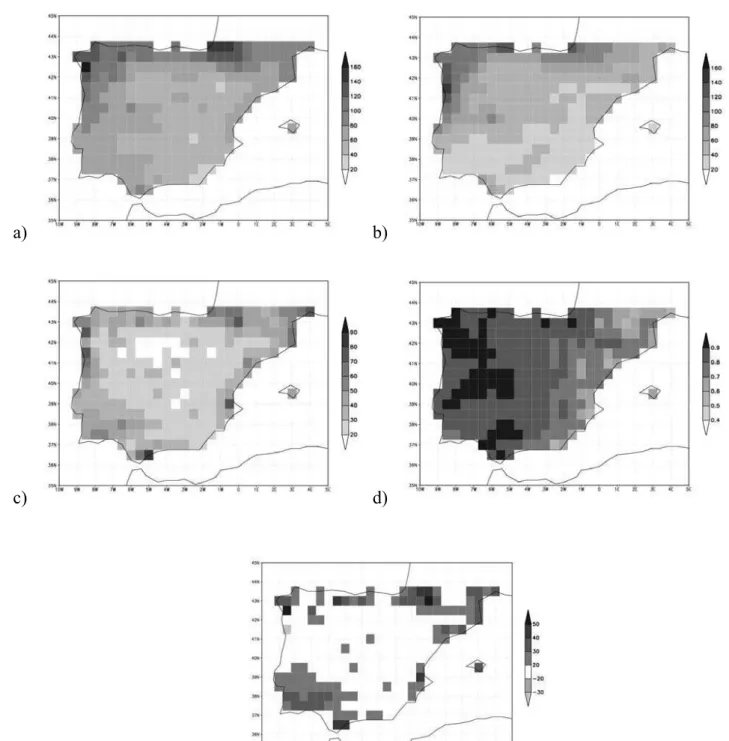
Fig. 1. Spatial distributions of: (a) Monthly mean IPD autumn precipitation field (mm); (b) Monthly mean HIPOCAS
Fig. 1. Spatial distributions of: (a) Monthly mean IPD autumn precipitation field (mm); (b) Monthly mean HIPOCAS autumn precipitation
field (mm); (c) Root mean squared error (mm), (d) Temporal correlation and (e) Bias (mm) between IPD and HIPOCAS precipitation fields.
A. Morata et al.: Iberian autumnal precipitation characterization 51 precipitation. This database provides a useful comparative
tool to undertake an evaluation of the different existing long-term hindcasted and reanalyzed products.
2 Precipitation data description and methodology
The HIPOCAS long-term data base is the result of an atmo-spheric hindcast performed over the whole Mediterranean Basin. In order to produce the 41-year (1961–2001) hind-cast the regional atmospheric model REMO was used. The whole Mediterranean basin was covered by a grid with hor-izontal resolution of 0.5◦×0.5◦(roughly 50×50 km2).
Fur-ther information on the HIPOCAS Mediterranean data base and its generation can be found in Sotillo et al. (2005). A high-resolution daily precipitation data base derived from in-situ measurements coming from the rain gauge station net-work of the Spanish Meteorological Service (Instituto Na-cional de Meteorolog´ıa, INM) have been used to validate the HIPOCAS precipitation. This Iberian Precipitation Dataset (hereafter, IPD) was generated with in-situ measurements from more than 4000 stations, irregularly distributed over the Iberian Peninsula and the Balearics, covering a 41-yr period (1961–2001). Further information about the observed pre-cipitation data set can be found in Luna and Almarza (2007) and in Sotillo et al. (2006a). Monthly precipitation from NCEP/NCAR and ERA global reanalyses were used in or-der to complete the HIPOCAS validation. Further informa-tion on the NCEP precipitainforma-tion data can be found on Kalnay et al. (1996). Concerning ERA, Gibson et al. (1997) provide information on the reanalysis performed by the ECMWF and its averaged databases.
In order to compare the different precipitation datasets several products were derived. A general description of HIPOCAS, NCEP, ERA and IPD datasets was made by means of statistics such as precipitation means, variances, spatial distribution of the bias and root mean squared error (RMSE). Other statistic parameters such as correlation in-dices, as well as temporal evolution of the spatial average bias and RMSE were derived to evaluate the different model performance ability. A principal component analysis (PCA) with a Varimax orthogonal rotation procedure was applied in order to evaluate the different model performance ability in reproducing the observed spatial precipitation patterns, as well as their temporal evolution. A wavelet multiresolution analysis has been carried out over the time series of principal components in order to get information of temporal scales of variability and the time evolution of their spectra (Groosman and Morlet, 1984).
3 Results
while the minimum values are localized along the south-eastern flank of Mediterranean coast. The HIPOCAS precip-itation field (Fig. 1b) shows a noticeable agreement, not only in spatial distribution but also in the absolute precipitation values. Similar comparisons were performed using NCEP and ERA reanalyses (not shown). Both reanalyses reproduce very similar spatial precipitation distributions but the maxi-mum values are lower than the observed IPD and hindcasted HIPOCAS ones. This behaviour in the reanalysed precipi-tation patterns was noticed in winter precipiprecipi-tation (Sotillo et al., 2006b).
Most of the Iberian Peninsula show RMSE values lower than 40 mm (Fig. 1c). The most noticeable differences be-tween IPD and HIPOCAS in terms of RMSE are obtained over coastal areas in contrast with the Iberian inland areas. A strong agreement between both fields is clear in the spa-tial distribution for time correlations between the observed and the simulated precipitation fields (Fig. 1d). Values higher than 0.80 over most of Iberia are obtained. Whereas the high-est values are located over the whigh-estern side of the Iberian Peninsula, the lowest ones are located along the Mediter-ranean coast. The autumn precipitation regime of these Mediterranean coastal areas is characterized by heavy rain-fall episodes brought about by a cold cut-off low situation in which a mid-upper-tropospheric cut-off cyclone advects cold air over the eastern Iberia, overlain warmer and moister flows at low level. Thus, the lower correlations obtained over these particular areas can be related to the lack of realism of the simulation of this kind of heavy rainfall events in terms of total precipitation amount. The bias between the observed IPD and simulated HIPOCAS fields (Fig. 1e) is lower than 20 mm in absolute value over most of the Iberian Peninsula, pointing out that the HIPOCAS precipitation field realisti-cally reproduces the observed values. However, there are zones, mainly coastal areas, with higher bias values. The absolute maximum and minimum bias (absolute values of the order of 50 mm and 30 mm, respectively) are localized over the northwestern Iberia where both observed and simu-lated fields present a maximum of precipitation. Rather than a non-realistic HIPOCAS simulation, the existence of these neighbouring high biased areas seems to have more to do with a displacement toward the south of the hindcasted pre-cipitation maximum (located in the northwestern Iberia, as it can be seen in Fig. 1b) than with the observed IPD one (Fig. 1a).
Identical statistics of the skilfulness in reproducing IPD precipitation for NCEP and ERA reanalyses were calculated and the obtained average values are shown in Table 1.These values clearly show the prevalence of HIPOCAS data over the reanalysed fields.
In order to pick up the regional differences between ob-served and HIPOCAS precipitation fields, a rotated PCA was carried out. Six significant PCs explaining more than 90% of
52 A. Morata et al.: Iberian autumnal precipitation characterization
a)
b)
c)
d)
e)
f)
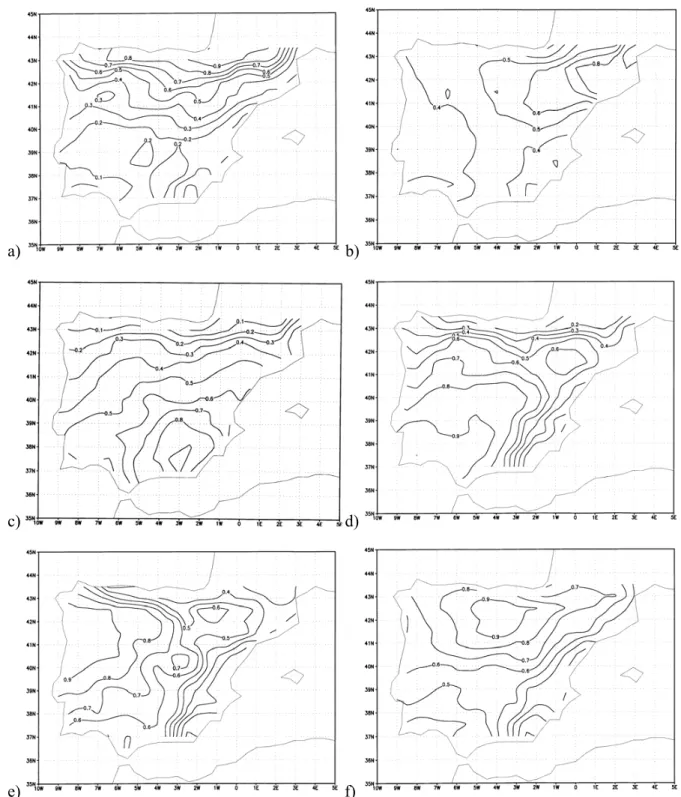
Fig. 2. Patterns of the selected Varimax rotated PCs corresponding to the HIPOCAS precipitation field for the: a)
Fig. 2. Patterns of the selected Varimax rotated PCs corresponding to the HIPOCAS precipitation field for the: (a) Cantabrian (CAN);(b)
Catalonia (CAT); (c) Levante (LEV); (d) Southwestern Atlantic (SWA); (e) Northwestern Atlantic (NWA); and (f) Plateau (PLT).
A. Morata et al.: Iberian autumnal precipitation characterization 53
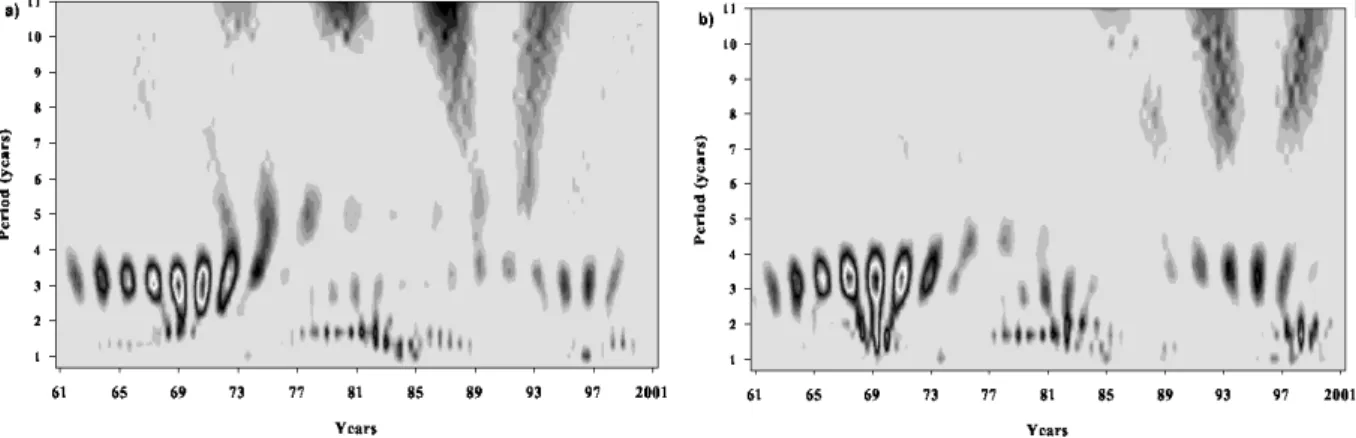
Fig. 3. Wavelet power spectra of the first Varimax rotated PC time series of: (a) IPD and (b) HIPOCAS fields for the LEV pattern. The
y-axis represents the period (years) and the x-axis corresponds to the time period (year).
Table 1. Average values of bias (mm), RMS (mm) and temporal
spatial correlation (r) between observed IPD and the three fields: hindcasted HIPOCAS, NCEP and ERA reanalyses.
IPD-HIPOCAS IPD-NCEP IPD-ERA
Bias 22 35 42
RMS 35 44 48
r 0.86 0.80 0.73
mainly marked by the Peninsula complex orography. The Iberian autumn precipitation is mainly configured by the PC patterns (Cantabrian, Catalonia, Levante, Southwestern At-lantic, Northwestern Atlantic and Plateau) which produce a regionalization of the Iberian rainfall regime based on the highest loading regions (Fig. 2). These patters are very sim-ilar to the corresponding IPD data (not shown) as it can be deduced from the high spatial correlation values, 0.95 in av-eraged value, between HIPOCAS and IPD patterns. Also, these patterns are identified by other authors such as Serrano et al. (1999). These results indicate that the HIPOCAS hind-casted data largely captures the main characteristics of the observed precipitation field.
The PC time series are analysed in detail by means of wavelet methodology. Only the power spectra of LEV pat-tern, as representative of the Iberian Mediterranean regimes, is depicted in Fig. 3. If panels (a) and (b) are compared, it can be observed that the time location of IPD and HIPOCAS maxima and minima matches. Spectra show zones with sim-ilar power for the same time scales. This coincidence in terms of time, period and intensity of the HIPOCAS and IPD wavelets, emphasizes that the HIPOCAS is able to capture the main features of the signal involved in the observed
pre-tween 2 and 5 years throughout the whole time period, and reveal higher intensity along specific time periods (1963– 1975 and 1989–1999). Some specific time periods, such as those centred on the years 1981, 1987 and 1994, additionally show a noticeable contribution of low-frequency scales with time periods higher longer than 6 years.
4 Conclusions
A general description of the Iberian autumnal precipitation reproduced by the Mediterranean HIPOCAS data base is shown in this paper. The main conclusions extracted from this study could be summarized as:
– The HIPOCAS precipitation field matched in spatial
distribution and in the absolute precipitation values with IPD field.
– NCEP and ERA reanalyses provided very similar
spa-tial precipitation distributions but not the absolute val-ues.
– The bias, RMS and correlation values showed the
preva-lence of HIPOCAS data over the reanalysed NCEP and ERA fields.
– The worse results of the comparative analysis between
IPD and HIPOCAS data are obtained along the Mediter-ranean coast of the Iberian Peninsula due to the poorer model simulations of the observed autumnal heavy rain-fall events.
– The PC HIPOCAS patterns reproduced the
regionaliza-tion of the Iberian rainfall regime.
These results comes to strength the confidence on the Mediterranean HIPOCAS hindcasted database in
reproduc-54 A. Morata et al.: Iberian autumnal precipitation characterization regime. Furthermore, it is remarkable that the HIPOCAS
performance outstandingly improves global reanalysis per-formances, offering thus a useful tool in Mediterranean cli-mate studies focussed on regional scales.
Acknowledgements. The authors wish to thank the following
institutions which provided us with data: HIPOCAS data set was provided by Puertos del Estado (Spain), the Iberian Precipitation Dataset from the Spanish Meteorological Service (INM), the European Climate Assessment & Dataset project from their Web site at http://eca.knmi.nl, NCEP Reanalysis data by the NOAA-CIRES Climate Diagnostics Center, Boulder, Colorado, USA from their Web site at http://www.cdc.noaa.gov, and ERA40 from the European Centre for Medium-range Weather Forecast (ECMWF). This work has been partially supported by the research projects CGL2004-01584/CLI, CGL2005-06966-C07-04 and CGL2007-61328.
Edited by: S. C. Michaelides
Reviewed by: two anonymous referees
References
Gibson, J. K., Kallberg, P., Uppala, S., Hernandez, A., ˜Nomura, A., and Serrano, E.: ERA description, Technical Report Re-analysis Project Report Series 1, ECMWF, Reading, UK, 1997.
Grossmand, A. and Morlet, J.: Decomposition of Hardy functions into square integrable wavelets of constant shape, SIAM J. Math. Anal., 15, 732–736, 1984.
IPCC Technical Summary: Climate Change, Impacts, Adaptation and Vulnerability, in: A Report of Working Group II of the Inter-governmental Panel on Climate Change, edited by: McCarthy, J. J., Canziani, O. F., Leary, N. A., Dokken, D. J., and White, K. S., Cambridge University Press, 1000 pp., 2001.
Kalnay, E., Kanamitsu, M., Kistler, R., Collins, D., Deaven, D., Gandin, L., Iredell, M., Saha, S., White, G., Woolen, J., Zhu, Y., Chelliah, M., Ebisuzaki, W., Higgins, W., Janowiak, J., Mo, K. C., Kopelewski, C., Wang, J., Leetmaa, A., Reynolds, R., Jeene, R. and Jsoseph, D.: The NCEP/NCAR 40-years Reanaly-sis, Project, B. Am. Meteorol. Soc., 77(3), 437–471, 1996. Luna, M. Y. and Almarza, C.: Interpolation of 1961–2002 daily
climatic data in Spain. Spatial Interpolation in Climatology and Meteorology, Proceedings from the Conference on Spatial Inter-polation in Climatology and Meteorology. Budapest, 25–29 Oc-tober 2004, edited by: Szalai, S., Bihari, Z., Szentimrey, T., and Lakatos, M., COST Office (ISBN 92-898-0033-X), 189–196, 2007.
Ratsimandresy, A. W., Sotillo, M. G., Carretero, J. C., ´Alvarez, E., and Hajji, H.: A 44-year high-resolution ocean and Atmo-spheric hindcast from the Mediterranean basin Developed within the HIPOCAS Project, Coastal Engineering, accepted, 2008. Serrano, A., Garc´ıa, J. E., Mateos, V. L., Cancillo, M. L., and
Gar-rido, J.: Monthly modes of variation of precipitation over the Iberian Peninsula, J. Climate, 12, 2894–2919, 1999.
Sotillo, M. G., Ratsimandresy, A. W., Carretero, J. C., Bentamy, A., Valero, F., and Gonz´alez-Rouco, J. F.: A high-resolution 44-year atmospheric hindcast for the Mediterranean Basin: Contribution to the regional improvement of global reanalysis, Clim. Dyn., 25, 219–236, 2005.
Sotillo, M. G., Martin, M. L., Valero F., and Luna, M. Y.: Vali-dation of a homogeneous 41-year (1961–2001) winter precipi-tation hindcasted dataset over Ibserian Peninsula: assessment of the regional improvement of global reanalysis, Clim. Dyn., 27, 627–645, 2006a.
Sotillo, M. G., Martin, M. L., Valero, F., and Luna, M. Y.: Regional improvement of global reanalyses by means of a new long-term Mediterranean hindcasted precipitation dataset: a first study over the Iberian Peninsula, Adv. Geosci., 7, 307–311, 2006b, http://www.adv-geosci.net/7/307/2006/.