HAL Id: hal-02329906
https://hal.archives-ouvertes.fr/hal-02329906
Submitted on 29 Jan 2020
HAL is a multi-disciplinary open access
archive for the deposit and dissemination of
sci-entific research documents, whether they are
pub-lished or not. The documents may come from
teaching and research institutions in France or
abroad, or from public or private research centers.
L’archive ouverte pluridisciplinaire HAL, est
destinée au dépôt et à la diffusion de documents
scientifiques de niveau recherche, publiés ou non,
émanant des établissements d’enseignement et de
recherche français ou étrangers, des laboratoires
publics ou privés.
The P2 promoter of the IGF1 gene is a major epigenetic
locus for GH responsiveness
M Ouni, M Belot, A. L. Castell, Delphine Fradin, P Bougnères
To cite this version:
M Ouni, M Belot, A. L. Castell, Delphine Fradin, P Bougnères. The P2 promoter of the IGF1 gene
is a major epigenetic locus for GH responsiveness. Pharmacogenomics Journal, Nature Publishing
Group, 2016, 16, pp.102-106. �10.1038/tpj.2015.26�. �hal-02329906�
ORIGINAL ARTICLE
The P2 promoter of the IGF1 gene is a major epigenetic locus
for GH responsiveness
M Ouni1, MP Belot1, AL Castell2, D Fradin1and P Bougnères1,2
Short children using growth hormone (GH) to accelerate their growth respond to this treatment with a variable efficacy. The causes of this individual variability are multifactorial and could involve epigenetics. Quantifying the impact of epigenetic variation on response to treatments is an emerging challenge. Here we show that methylation of a cluster of CGs located within the P2 promoter of the insulin-like growth factor 1 (IGF1) gene, notably CG-137, is inversely closely correlated with the response of growth and circulating IGF1 to GH administration. For example, variability in CG-137 methylation contributes 25% to variance of growth response to GH. Methylation of CGs in the P2 promoter is negatively associated with the increased transcriptional activity of P2 promoter in patients' mononuclear blood cells following GH administration. Our observation indicates that epigenetics is a major determinant of GH signaling (physiology) and of individual responsiveness to GH treatment (pharmacoepigenetics).
The Pharmacogenomics Journal advance online publication, 14 April 2015; doi:10.1038/tpj.2015.26
INTRODUCTION
Tens of thousands of children affected by various causes of short stature currently receive recombinant growth hormone (GH) to improve their final height. However, the high variability of individual GH responsiveness results in unequal growth improve-ment. The large individual variability of the therapeutic response to GH has puzzled pediatric endocrinologists for decades. The causes underlying such variability have until now been searched in the aetiologies of short stature, treatment regimens, patients’ compliance1 and genetic polymorphisms.2 This individual
varia-tion is partly due to the variable insulin-like growth factor 1 (IGF1) production under GH treatment, reflected by circulating IGF1 concentration,3 thus serum IGF1 measurement can be used to adjust GH dosage in treated children.3Despite its importance to therapeutics, the variation of GH responsiveness across treated patients has prompted few studies in search of biological mechanisms.4 The increment in growth rate induced by GH treatment in healthy children with ‘idiopathic’ short stature is normally distributed and can thus be modeled as a continuous quantitative trait. Genetic factors certainly have a role.4Notably, the deletion of exon 3 within the GH receptor (GHRd3) gene has been recognized as a significant pharmacogenetic predictor of GH growth-promoting effects in children with idiopathic short stature.2 Children carrying GHRd3 also show higher circulating IGF1 in response to GH injection.5Despite thisfirst advance, the variability of GH responsiveness in children with‘idiopathic’ short stature has yet received limited molecular explanation.
Pharmacoepigenomics is a nascent field of clinical medicine that holds many promises, but has not yet produced tangible results.6The methylation of the cytosine within CG dinucleotides is the simplest component of DNA epigenetics that can be studied in patients receiving a treatment. Among the millions of CG residues in the human genome sequence, a yet unknown number of regions were found to show individual variation of CG
methylation in a given cell population. These regions contain CG residues that are expected to contribute to the individual variability of human phenotypes, provided that such CGs are significantly involved in the regulation of neighboring gene transcription. In many experimental studies, the methylation of CG residues located within low CG-rich promoters has been recognized as a potentially major factor for gene regulation.7
To explore the epigenetic component of the individual variability of growth and circulating IGF1 responses to treatment with GH, we thought there was no better physiological candidate than the IGF1 gene, a key player in postnatal growth, and GH signaling. Inactivating mutations in IGF1 alter postnatal growth in humans8and mice.9In contrast, common genetic variation in IGF1 gene does not contribute significantly to adult height variation in Caucasians10but do so in Asians11in whom minor allele frequency is greater. Estimates of the proportion of variance in circulating IGF1 that is genetically determined vary between 38% and480% according to twin studies.12 The association of circulating IGF1 with several genetic variants is debated,13 but variants at the IGF1 locus do not seem to influence circulating IGF1 levels in Caucasians.13
Our working hypothesis was that epigenetic marks located in regulatory regions might have a role in modulating IGF1 gene expression, as observed for many genes, and could therefore contribute to the individual variation of IGF1 production and child’s growth. We therefore focused on the two promoters that are directly involved in the regulation of IGF1 gene expression14
and are CG-poor promoters expected to exhibit inter-individual variation.15 The choice of a candidate gene approach instead of
commercially available arrays made us able to quantify the methylation of each CG of the IGF1 promoters. Indeed, individual CG may have a significant functional role possibly different from its CG neighbors. GH has been shown to directly stimulate transcription of the IGF1 gene in rats and mice.16,17GH exerts its
effects through the JAK/Stat pathway with translocation of
1
Institut National de la Santé et de la Recherche Médicale U986, Paris Sud University, Bicêtre Hospital, Le Kremlin-Bicêtre, France and2
Department of Pediatric Endocrinology and Diabetes, Paris Sud University, Bicêtre Hospital, Le Kremlin-Bicêtre, France. Correspondence: Professor P Bougnères, Department of Pediatric Endocrinology and Diabetes, Paris Sud University, Bicêtre Hospital, 80 avenue du Général Leclerc, Le Kremlin-Bicêtre 94276, France.
E-mail: [email protected]
Received 24 November 2014; revised 2 February 2015; accepted 9 February 2015
activated Stat5b transcription factor to the nucleus where it regulates IGF1 transcription.18GH-induced transcription promotes accumulation of all classes of IGF1 mRNA.16,17,19Class 1 transcripts have their initiation sites on exon 1 and are driven by P1 promoter, whereas class 2 transcripts use exon 2 as a leader exon (P2) and are driven by P2 promoter.20,21
In growing children, GH responsiveness is important to both physiology and therapeutics. To explore the relation between IGF1 promoter methylation and response to GH in growing children, we selected children who have not entered puberty to avoid the confounding effect of the variable tempo of sexual maturation, which adds to the variability of growth and circulating IGF1. We used the long-studied‘generation test’5to test the direct effect of GH on circulating IGF1 and transcription of IGF1 gene in blood cells of 40 children with idiopathic short stature yet naive to GH treatment. Whether P2 CG methylation could influence the therapeutic efficacy of GH was our next question. To study whether the therapeutic response to GH differs across the various levels of promoter P2 methylation, 136 children with so called ‘idiopathic’ short stature were studied during their first year of GH administration for both increment in growth rate and in circulating IGF1.
MATERIALS AND METHODS Participants
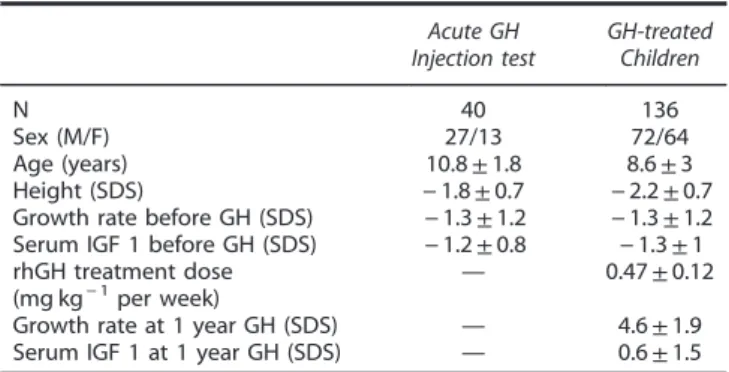
136 children who had varying degrees of‘idiopathic short stature’ were treated with recombinant GH (Table 1). All of them were healthy, had normal clinical examination and no signs of puberty (girls showed no breast development and boys had unmeasurable testosterone levels). GH deficiency was excluded with a stimulated GH peak 415 ng ml− 1. All subjects had normal TSH levels. Subtle chondrodysplasia were excluded by forearm, pelvis and spine radiographs. Trained nurses performed height measurements in duplicate using the Harpenden stadiometer. Blood samples were obtained before onset of GH treatment. We did not carry out this study using GH deficient children because the causes for this deficiency are highly heterogeneous (mutations of pituitary transcription factors, irradiation for cancer, hypothalamic tumors and so on) and are often associated with other hormone deficits or medical problems.
At onset of treatment, an acute test was performed by injecting 100μg kg− 1 of recombinant GH intramuscularly to 40 children and sampling blood before and 12 h after the injection. Thereafter, children were all followed by a pediatric endocrinologist for the management of GH treatment. Height (Harpenden stadiometer) and serum IGF1 measure-ments were performed at 6, 9 and 12 months of treatment.
For methylation and transcript measurements, 10 ml peripheral blood samples were obtained, from which white blood cells and/or PBMC (peripheral blood mononuclear cells) were purified immediately. White and mononuclear cell were counted at the time of sampling. For measuring
transcripts, PBMC were collected at the clinical center close to the laboratory and mRNA was extracted immediately.
Parents of all studied children gave their written informed consent for the current study and for using surgical specimens, according to the French rules of bioethics in biomedical research checked by our Institutional Review Board.
Serum IGF1 concentrations
Serum IGF1 concentration was measured around 0700 to 0800 hours before breakfast in 136 children using an immune-radiometric assay after ethanol-acid extraction using DSL-5600 Active (Diagnostic System Laboratories, Webster, TX, USA) or Cisbio reagents. Intra- and inter-series coefficients of variation were 1.5% and 3.7% at 260 ng ml− 1and 3.9% at 760 ng ml− 1. The sensitivity was 4 ng ml− 1. IGF1 SDS were calculated using the norms of Alberti et al.22in French children.
DNA methylation at CpG resolution in IGF1 promoters 1 and 2
For promoter P1, we studied nine CGs located over a 800 bp distance, the closest CG being 225 bp upstream from the corresponding major transcription start site23(Figure 1). For promoter P2, we studied 7/8 CGs located upstream from the major transcription start site within the proximal part of the promoter and one CG located 97 bp downstream this transcription start site (Figure 1). CGs are denominated according to their position versus each promoter transcription start site. The methylation of CG-22 could not be measured for technical reasons. Nucleic acids were extracted from white blood cells or PBMC using Gentra Puregene blood kit (Qiagen, Hilden, Germany). A bisulfite-PCR-pyrosequencing technique24 was used to measure the methylation of the CGs. We improved the resolution of this method from a handful of bases to up to 100 nucleotides, with the ability to quantify methylation in the same sample of blood with a coefficient of variation (s.d./mean) as little as 1–5%. Briefly, 400 ng of genomic DNA were treated with EZ DNA Methylation-Gold Kit, according to manufacturer’s protocol (Zymo Research Corporation, CA, USA). The bisulfite-treated genomic DNA was PCR-amplified using unbiased IGF1 primers (Supplementary Methods Table 1) and performed quantitative pyrosequencing using a PyroMark Q96 ID Pyrosequencing instru-ment (Qiagen). Pyrosequencing assays were designed using MethPrimer (http://www.urogene.org/methprimer/index1.html). Biotin-labeled single stranded amplicons were isolated according to protocol using the Qiagen Pyromark Q96 Work Station and underwent pyrosequencing with 0.5μM
primer. The percent methylation for each of the CGs within the target sequence was calculated using PyroQ CpG Software (Qiagen).
Study of IGF1 transcripts in PBMC
Methods are detailed in Supplementary Methods Table 2.
Calculations and statistical methods
IGF1 levels and height were expressed as SDS to adjust for age and sex. The growth rate response to GH administration was expressed as increment in growth rate, the difference between growth rate during GH treatment (in cm per year) and previous growth rate (evaluated during the whole year before onset of GH administration). We chose this quantitative criterion because spontaneous growth in children with idiopathic short stature is linear during this period of childhood. Correlations were calculated as adjusted R square that measures the proportion of the variation in the dependent variable accounted for by the explanatory variables. The fraction of explained variance is calculated under the linear regression model, using the usual definition: r2× 100. We fitted a multivariate linear model to the data to estimate the proper effect of CG methylation on response to GH, adjusted for the effect of the other covariates contributing to the growth under treatment, such as age at diagnosis, sex and the received dose of GH. This approach is suitable for estimating the association between the variable of interest, here the methylation level, and the trait in the presence of correlation between the covariates. We carried out tests of independence of each covariate one at a time, keeping the others in the model. Statistics and estimations of effect given in the tables are thus adjusted for the others whenever appropriate and are not subject to marginal association. We checked the normality of the residuals, and the residuals versus thefitted values did not show any trend, indicating that there was no noticeable deviation from the assumption of the linear model. All statistics and linear model were computed using R 2.10.1. Results are expressed as mean ± s.d.
Table 1. Main baseline characteristics of the studied children. Acute GH Injection test GH-treated Children N 40 136 Sex (M/F) 27/13 72/64 Age (years) 10.8± 1.8 8.6± 3 Height (SDS) − 1.8 ± 0.7 − 2.2 ± 0.7 Growth rate before GH (SDS) − 1.3 ± 1.2 − 1.3 ± 1.2 Serum IGF 1 before GH (SDS) − 1.2 ± 0.8 − 1.3 ± 1 rhGH treatment dose
(mg kg− 1per week) —
0.47± 0.12 Growth rate at 1 year GH (SDS) — 4.6± 1.9 Serum IGF 1 at 1 year GH (SDS) — 0.6± 1.5 Abbreviations: F, female; GH, growth hormone; IGF1, insulin-like growth factor 1; M, male; SDS, standard deviation score.
IGF1 promoter methylation M Ouni et al
2
RESULTS
Relationship between CG methylation and response of circulating IGF1 and IGF1 transcripts to afirst GH injection
The methylation levels for the CGs located within the two promoters of IGF1 is given in Supplementary Table S1.
Following the acute injection of GH, the increase in circulating IGF1 was inversely related with CG-137 methylation (P = 3 × 10− 7), which accounted for as much as ~ 49% of the variability of this increase (Figure 2a and Supplementary Table 2) and with the methylation of 3/8 other P2 CGs (Figure 1 and Supplementary Table 2).
In order to test whether methylation at the P2 promoter affects the transcriptional response of the IGF1 gene to GH, we measured P1-driven, P2-driven and total IGF1 transcripts in PBMC before and 12 h after the GH injection. We found a variable increase in IGF1 transcripts across the studied children. The increase in P2-driven transcripts showed a very strong inverse correlation with CG-137 methylation (P = 5 × 10− 11; Figure 2b) and with 4/8 other P2 CGs (Supplementary Table 3). Among the CGs of P1 promoter, only CG-611 showed an inverse correlation with P1-driven transcripts (Supplementary Table 3). Methylation was unchanged by this brief exposition to GH (not shown). We were not able to assess direct GH effects on cultured PBMC from the patients, because when these cells are submitted to short culture conditions, they show an unreliable response of IGF1 expression to stimulation by GH. IGF1 and growth response to GH treatment
As expected, GH-induced growth responses were variable, closely fitting the normal distribution (Supplementary Figure 1a) and were correlated with circulating IGF1 (P = 3 × 10− 5; Supplementary Figure 2). A strong inverse relationship was observed between the methylation of 8/8 CGs of the P2 promoter and growth accelera-tion in response to GH administraaccelera-tion (Supplementary Table 4). Again, the correlation was maximal for CG-137 methylation (P = 2.7 × 10− 10; Figure 3a and Supplementary Figure 1a), which accounted for ~ 25% of the variability in the response to GH. We confirmed this finding by building a general linear model for regression of age, sex, GH dose and CG-137 methylation on growth rate increment (Table 2). Comparable patterns of correla-tion were found for the increase in serum IGF1 (P = 1.7 × 10− 10for
CG-137; Figure 3b and Supplementary Figure 1b, Supplementary Table 5).
DISCUSSION
The consistency and statistical strength of the observed correla-tions support that the CG methylation of the P2 promoter of the IGF1 gene is a major determinant of the individual response to GH treatment across children with idiopathic short stature. The effect size of this association is comparable with the association previously reported between growth rate response and the common GH receptor d3 deletion variant.2 Furthermore, our observations suggest that the epigenetic association reported herein has functional relevance since methylation of CG-137, as well as methylation of the other CGs of the P2 promoter, is associated with the transcriptional effects initiated at the P2 promoter following GH injection. Mice models have revealed that GH effects on skeletal growth are mediated by IGF1 produced in situ by growth plate chondrocytes, not by circulating IGF1.25 Like other studies before,26 we found a strong correlation
Figure 1. Schematic representation of the human IGF1 gene with its two promoters (P1, P2). The three closest Stat5b binding sites are figured as black triangles ( ). The studied CGs are shown as lollypops within the two promoters. Mean methylation levels are figured as
( 475%; 40-75%; o20%). TSS are shown as broken arrows. The horizontal bar encompasses the eight CGs that show the strongest
association with response to GH.
Table 2. General linear model for regression of sex, age, GH dose and CG-137 methylation on increment in growth rate (cm per year) induced by GH treatment
Estimates s.e. t-value Pr(4|t|)
Intercept 13.21 1.7 7.8 2 × 10-12
Age at GH onset (years) 0.13 0.05 2.46 0.015
Sex 0.03 0.28 0.12 0.91
GH dose (mg kg− 1per week) 0.014 6.7 × 10− 3 2.04 0.04 CG-137 methylation (%) − 0.22 0.032 − 6.8 4 × 10⁻¹⁰
Figure 2. (a) CG-137 methylation correlates negatively with the increment in serum IGF1 after thefirst GH injection (N = 40; R = − 0.7, P= 3.4 × 10− 7); (b) CG-137 methylation correlates negatively with the increment in P2-driven IGF1 transcripts in PBMC in response to acute GH injection in 40 children (R= − 0.82, P = 5 × 10− 11).
between the increase in height and the increase in circulating IGF1. As circulating IGF1 originates mostly in the liver,27the latter correlation suggests that the GH-induced levels of IGF1 expression in liver and chondrocytes are proportional in a given individual, and could share some of the epigenetic regulation reported in the current study.
Clearly however, a weakness of our study is that we could not study the association of P2 methylation with transcription or GH responsiveness in liver and growth plates, the physiological tissues regulating GH effects on IGF1 production and skeletal growth. Hepatocytes and chondrocytes have their own epigenome. Such lack of availability and analysis of epigenomes in specific cells of physiological tissues is a common but major limitation of epigenetic epidemiology,28–30 which most often has to rely on blood cells. Herein the observations made in PBMC can only be extrapolated to liver and growth plate through physiological speculation.
Other questions left unanswered include the molecular mechanisms taking place at the P2 promoter locus under GH effect and correlating CG methylation with the regulation of gene transcription. This correlation was observed in the mononuclear blood cells of our patients following thefirst GH injection. Liver expression of the IGF1 gene is mainly controlled at the transcriptional level by GH from the pituitary.31 In mammals including humans, the IGF1 gene is composed of six exons and five introns that span 480 kb of chromosomal DNA32,33
which are located in 12q23.2 in humans. Tandem promoters direct IGF1 gene transcription through unique leader exons. Promoter 1, which uses heterogeneous transcription initiation sites, is active in multiple animal tissues,34 while the smaller and simpler promoter 2 is
primarily but not exclusively active in the liver of cattle,19unlike in
rodents where promoter 2 activity seems exclusively hepatic.14
Although the biochemical mechanisms responsible for different tissue-specific patterns of IGF1 promoter activity are unknown, the DNA sequences of both proximal promoters are relatively well-conserved in mammals based on analyses of available genomic databases (74% over 420 nucleotides for promoter 1, 58% over 404 nucleotides for promoter 2 between rat and human IGF1),14 suggesting that functional properties of each promoter have been maintained during speciation as essential aspects of the biology of IGF1 gene regulation.14GH exerts its effects through the JAK/Stat pathway with the translocation of activated Stat5b transcription factor to the nucleus where it regulates IGF1 transcription.18 Recent results suggest that GH-induced Stat5 activation of IGF1 gene expression in mouse liver might be collectively mediated by at least eight Stat5 binding sites located in distal intronic and
5′-flanking regions of the IGF1 gene, distantly from the IGF1 promoter.35The identification of multiple distal Stat5 binding sites underscores the complexity of the mechanism that mediates GH regulation of IGF1 gene expression. Active Stat5b interacts with multiple DNA binding sites in chromatin within the IGF1 locus, and through mechanisms not yet characterized, promotes the rapid transmission of information to the two IGF1 promoters, culminat-ing in induction of IGF1 gene transcription and production of IGF1 mRNAs and protein.14In the liver of hypophysectomised rats, GH induces dramatic changes in chromatin at the IGF1 locus and activates IGF1 transcription by distinct promoter-specific epige-netic mechanisms.17,36The proximal part of rat P2 is an important site of transcriptional regulation by GH via Stat5b.14In rat liver, GH
induces rapid and dramatic changes in chromatin at the P2 promoter and activates IGF1 transcription by specific epigenetic mechanisms.17,36At promoter P2, GH facilitates recruitment then activation of RNA Pol II to initiate transcription, whereas at promoter P1, GH causes RNA Pol II to be released from a previously recruited poised and paused pre-initiation complex.17
These recent advances on epigenetic mechanisms involving chromatin landscape in rodent liver,17as well as our observation of a relationship between DNA methylation variation and IGF1 transcripts in PBMC, provide an impetus to address fundamental mechanistic questions that will help decipher the epigenetic regulation of IGF1 gene expression in baseline conditions and in response to GH. Yet, not only CG location and composition are different in human and rat IGF1 promoters (personal observation) but the pattern of methylation and its transcriptional effects on rat promoters are still unknown.
To our knowledge, the current study offers the first clinical evidence of a link between DNA methylation and the response to a treatment in humans, illustrating the role of epigenetic variation as a potent contributor to personalized therapeutics.
CONFLICT OF INTEREST
The authors declare no conflict of interest
ACKNOWLEDGMENTS
We thank Pfizer France for supporting the GH pharmacoepigenomics program. We are grateful to their colleagues of the Department of Pediatric Endocrinology for allowing the study of their GH-treated patients, and to the nurses who help carry clinical research.
REFERENCES
1 Rosenfeld RG, Bakker B. Compliance and persistence in pediatric and adult patients receiving growth hormone therapy. Endocr Pract 2008;14: 143–154. 2 Dos Santos C, Essioux L, Teinturier C, Tauber M, Goffin V, Bougnères P et al.
A common polymorphism of the growth hormone receptor is associated with increased responsiveness to growth hormone. Nat Genet 2004;36: 720–724. 3 Cohen P, Germak J, Rogol AD, Weng W, Kappelgaard AM, Rosenfeld RG et al.
Variable degree of growth hormone (GH) and insulin-like growth factor (IGF) sensitivity in children with idiopathic short stature compared with GH-deficient patients: evidence from an IGF-based dosing study of short children. J Clin Endocrinol Metab 2010;95: 2089–2098.
4 Rosenfeld RG. The pharmacogenomics of human growth. J Clin Endocrinol Metab 2006;91: 795–796.
5 Toyoshima MTK, Castroneves LA, Costalonga EF, Mendonca BB, Arnhold IJ, Jorge AA et al. Exon 3-deleted genotype of growth hormone receptor (GHRd3) posi-tively influences IGF-1 increase at generation test in children with idiopathic short stature. Clin Endocrinol (Oxf) 2007;67: 500–504.
6 Ivanov M, Kacevska M, Ingelman-Sundberg M. Epigenomics and interindividual differences in drug response. Clin Pharmacol Ther 2012;92: 727–736. 7 Weber M, Hellmann I, Stadler MB, Ramos L, Pääbo S, Rebhan M et al. Distribution,
silencing potential and evolutionary impact of promoter DNA methylation in the human genome. Nat Genet 2007;39: 457–466.
Figure 3. (a) CG-137 methylation correlates negatively with the GH-induced increment in growth rate in 136 children treated with GH (R= − 0.50, P = 2.7×10− 10); (b) CG-137 methylation correlates negatively with the GH-induced increment in serum IGF1 concen-tration in children treated with GH R= − 0.52, P = 1.7 × 10− 10).
IGF1 promoter methylation M Ouni et al
4
8 Woods KA, Camacho-Hübner C, Savage MO, Clark AJ. Intrauterine growth retar-dation and postnatal growth failure associated with deletion of the insulin-like growth factor I gene. N Engl J Med 1996;335: 1363–1367.
9 Lupu F, Terwilliger JD, Lee K, Segre GV, Efstratiadis A. Roles of growth hormone and insulin-like growth factor 1 in mouse postnatal growth. Dev Biol 2001;229: 141–162.
10 Lettre G, Butler JL, Ardlie KG, Hirschhorn JN. Common genetic variation in eight genes of the GH/IGF1 axis does not contribute to adult height variation. Hum Genet 2007;122: 129–139.
11 Okada Y, Kamatani Y, Takahashi A, Matsuda K, Hosono N, Ohmiya H et al. A genome-wide association study in 19 633 Japanese subjects identified LHX3-QSOX2 and IGF1 as adult height loci. Hum Mol Genet 2010;19: 2303–2312. 12 Kao PC, Matheny AP, Lang CA. Insulin-like growth factor-I comparisons in healthy
twin children. J Clin Endocrinol Metab 1994;78: 310–312.
13 Palles C, Johnson N, Coupland B, Taylor C, Carvajal J, Holly J et al. Identification of genetic variants that influence circulating IGF1 levels: a targeted search strategy. Hum Mol Genet 2008;17: 1457–1464.
14 Rotwein P. Mapping the growth hormone--Stat5b--IGF-I transcriptional circuit. Trends Endocrinol Metab 2012;23: 186–193.
15 Bock C, Walter J, Paulsen M, Lengauer T. Inter-individual variation of DNA methylation and its implications for large-scale epigenome mapping. Nucleic Acids Res 2008;36: e55.
16 Bichell DP, Kikuchi K, Rotwein P. Growth hormone rapidly activates insulin-like growth factor I gene transcription in vivo. Mol Endocrinol 1992;6: 1899–1908.
17 Chia DJ, Young JJ, Mertens AR, Rotwein P. Distinct alterations in chromatin organization of the two IGF-I promoters precede growth hormone-induced activation of IGF-I gene transcription. Mol Endocrinol 2010;24: 779–789. 18 Heim MH. The Jak-Stat pathway: cytokine signalling from the receptor to the
nucleus. J Recept Signal Transduct 1999;19: 75–120.
19 Wang Y, Price SE, Jiang H. Cloning and characterization of the bovine class 1 and class 2 insulin-like growth factor-I mRNAs. Domest Anim Endocrinol 2003;25: 315–328.
20 Yang H, Adamo ML, Koval AP, McGuinness MC, Ben-Hur H, Yang Y et al. Alternative leader sequences in insulin-like growth factor I mRNAs modulate translational efficiency and encode multiple signal peptides. Mol Endocrinol Baltim Md 1995;9: 1380–1395.
21 Adamo ML, Ben-Hur H, Roberts CT, LeRoith D. Regulation of start site usage in the leader exons of the rat insulin-like growth factor-I gene by development, fasting, and diabetes. Mol Endocrinol 1991;5: 1677–1686.
22 Alberti C, Chevenne D, Mercat I, Josserand E, Armoogum-Boizeau P, Tichet J et al. Serum concentrations of insulin-like growth factor (IGF)-1 and IGF binding protein-3 (IGFBP-3), IGF-1/IGFBP-3 ratio, and markers of bone turnover: reference values for French children and adolescents and z-score comparability with other references. Clin Chem 2011;57: 1424–1435.
23 Jansen E, Steenbergh PH, LeRoith D, Roberts CT, Sussenbach JS. Identification of multiple transcription start sites in the human insulin-like growth factor-I gene. Mol Cell Endocrinol 1991;78: 115–125.
24 Tost J, Gut IG. DNA methylation analysis by pyrosequencing. Nat Protoc 2007;2: 2265–2275.
25 Liu JL, Yakar S, LeRoith D. Conditional knockout of mouse insulin-like growth factor-1 gene using the Cre/loxP system. Proc Soc Exp Biol Med 2000;223: 344–351. 26 Kriström B, Lundberg E, Jonsson B, Albertsson-Wikland K. & study group. IGF-1
and growth response to adult height in a randomized GH treatment trial in short non-GH-deficient children. J Clin Endocrinol Metab 2014; 99: 2917–2924. 27 Yakar S, Pennisi P, Wu Y, Zhao H, LeRoith D in Endocrine Development, (eds)
Cianfarani S, Clemmons DR, & Savage MO 11–16. KARGER: S Karger AG, Basel, 2005 atohttp://www.karger.com.gate2.inist.fr/Article/FullText/857184. 28 Rakyan VK, Down TA, Balding DJ, Beck S. Epigenome-wide association studies for
common human diseases. Nat Rev Genet 2011;12: 529–541.
29 Murrell A, Rakyan VK, Beck S. From genome to epigenome. Hum Mol Genet 2005; 14 Spec No 1: R3–R10.
30 Mill J, Heijmans BT. From promises to practical strategies in epigenetic epide-miology. Nat Rev Genet 2013;14: 585–594.
31 Daughaday WH, Rotwein P. Insulin-like growth factors I and II. Peptide, messenger ribonucleic acid and gene structures, serum, and tissue concentrations. Endocr Rev 1989;10: 68–91.
32 Rotwein P, Pollock KM, Didier DK, Krivi GG. Organization and sequence of the human insulin-like growth factor I gene. Alternative RNA processing produces two insulin-like growth factor I precursor peptides. J Biol Chem 1986;261: 4828–4832. 33 Rotwein P. Structure, evolution, expression and regulation of insulin-like growth
factors I and II. Growth Factors 1991;5: 3–18.
34 Hall LJ, Kajimoto Y, Bichell D, Kim SW, James PL, Counts D et al. Functional analysis of the rat insulin-like growth factor I gene and identification of an IGF-I gene promoter. DNA Cell Biol 1992;11: 301–313.
35 Eleswarapu S, Gu Z, Jiang H. Growth hormone regulation of insulin-like growth factor-I gene expression may be mediated by multiple distal signal transducer and activator of transcription 5 binding sites. Endocrinology 2008;149: 2230–2240. 36 Chia DJ, Rotwein P. Defining the epigenetic actions of growth hormone: acute
chromatin changes accompany GH-activated gene transcription. Mol Endocrinol 2010;24: 2038–2049.
This work is licensed under a Creative Commons Attribution-NonCommercial-NoDerivs 4.0 International License. The images or other third party material in this article are included in the article’s Creative Commons license, unless indicated otherwise in the credit line; if the material is not included under the Creative Commons license, users will need to obtain permission from the license holder to reproduce the material. To view a copy of this license, visit http:// creativecommons.org/licenses/by-nc-nd/4.0/
Supplementary Information accompanies the paper on the The Pharmacogenomics Journal website (http://www.nature.com/tpj)