Publisher’s version / Version de l'éditeur:
Proceedings of the 6th Workshop on Statistical Machine Translation, pp. 71-77, 2011-08-01
READ THESE TERMS AND CONDITIONS CAREFULLY BEFORE USING THIS WEBSITE.
https://nrc-publications.canada.ca/eng/copyright
Vous avez des questions? Nous pouvons vous aider. Pour communiquer directement avec un auteur, consultez la première page de la revue dans laquelle son article a été publié afin de trouver ses coordonnées. Si vous n’arrivez pas à les repérer, communiquez avec nous à [email protected].
Questions? Contact the NRC Publications Archive team at
[email protected]. If you wish to email the authors directly, please see the first page of the publication for their contact information.
NRC Publications Archive
Archives des publications du CNRC
This publication could be one of several versions: author’s original, accepted manuscript or the publisher’s version. / La version de cette publication peut être l’une des suivantes : la version prépublication de l’auteur, la version acceptée du manuscrit ou la version de l’éditeur.
Access and use of this website and the material on it are subject to the Terms and Conditions set forth at
AMBER : A modified BLEU, enhanced ranking metric
Chen, Boxing; Kuhn, Roland
https://publications-cnrc.canada.ca/fra/droits
L’accès à ce site Web et l’utilisation de son contenu sont assujettis aux conditions présentées dans le site LISEZ CES CONDITIONS ATTENTIVEMENT AVANT D’UTILISER CE SITE WEB.
NRC Publications Record / Notice d'Archives des publications de CNRC: https://nrc-publications.canada.ca/eng/view/object/?id=493f767b-84cf-4ecb-b6f9-2f779e258000 https://publications-cnrc.canada.ca/fra/voir/objet/?id=493f767b-84cf-4ecb-b6f9-2f779e258000
AMBER: A Modified BLEU, Enhanced Ranking Metric
Boxing Chen and Roland Kuhn
National Research Council of Canada, Gatineau, Québec, Canada [email protected]
Abstract
This paper proposes a new automatic ma-chine translation evaluation metric: AMBER, which is based on the metric BLEU but incorporates recall, extra penal-ties, and some text processing variants. There is very little linguistic information in AMBER. We evaluate its system-level cor-relation and sentence-level consistency scores with human rankings from the WMT shared evaluation task; AMBER achieves state-of-the-art performance.
1 Introduction
Automatic evaluation metrics for machine transla-tion (MT) quality play a critical role in the devel-opment of statistical MT systems. Several metrics have been proposed in recent years. Metrics such as BLEU (Papineni et al., 2002), NIST (Dodding-ton, 2002), WER, PER, and TER (Snover et al., 2006) do not use any linguistic information - they only apply surface matching. METEOR (Banerjee and Lavie, 2005), METEOR-NEXT (Denkowski and Lavie 2010), TER-Plus (Snover et al., 2009), MaxSim (Chan and Ng, 2008), and TESLA (Liu et al., 2010) exploit some limited linguistic resources, such as synonym dictionaries, part-of-speech tag-ging or paraphrasing tables. More sophisticated metrics such as RTE (Pado et al., 2009) and DCU-LFG (He et al., 2010) use higher level syntactic or semantic analysis to score translations.
Though several of these metrics have shown bet-ter correlation with human judgment than BLEU, BLEU is still the de facto standard evaluation me-tric. This is probably due to the following facts:
1. BLEU is language independent (except for word segmentation decisions).
2. BLEU can be computed quickly. This is im-portant when choosing a metric to tune an MT system.
3. BLEU seems to be the best tuning metric from a quality point of view - i.e., models trained using BLEU obtain the highest scores from humans and even from other metrics (Cer et al., 2010).
When we developed our own metric, we decided to make it a modified version of BLEU whose rankings of translations would (ideally) correlate even more highly with human rankings. Thus, our metric is called AMBER: “A Modified Bleu, En-hanced Ranking” metric. Some of the AMBER variants use an information source with a mild lin-guistic flavour – morphological knowledge about suffixes, roots and prefixes – but otherwise, the metric is based entirely on surface comparisons.
2 AMBER
Like BLEU, AMBER is composed of two parts: a score and a penalty.
penalty score
AMBER= × (1)
To address weaknesses of BLEU described in the literature (Callison-Burch et al., 2006; Lavie and Denkowski, 2009), we use more sophisticated formulae to compute the score and penalty.
2.1 Enhancing the score
First, we enrich the score part with geometric av-erage of n-gram precisions (AvgP), F-measure de-rived from the arithmetic averages of precision and recall (Fmean), and arithmetic average of F-measure of precision and recall for each n-gram (AvgF). Let us define n-gram precision and recall as follows:
) ( # ) ( # ) ( T ngrams R T ngrams n p = ∩ (2) ) ( # ) ( # ) ( R ngrams R T ngrams n r = ∩ (3)
where T = translation, R = reference.
Then the geometric average of n-gram preci-sions AvgP, which is also the score part of the BLEU metric, is defined as:
N N n n p N AvgP 1 1 ) ( ) ( =
∏
= (4)The arithmetic averages for n-gram precision and recall are:
= = N n n p N N P 1 ) ( 1 ) ( (5) = = M n n r M M R 1 ) ( 1 ) ( (6) The F-measure that is derived from P(N) and R(M), (Fmean), is given by:
) ( ) 1 ( ) ( ) ( ) ( ) , , ( M R N P M R N P M N Fmean α α α − + = (7)
The arithmetic average of F-measure of preci-sion and recall for each n-gram (AvgF) is given by:
= + − = N n p n r n n r n p N N AvgF 1 ( ) (1 ) ( ) ) ( ) ( 1 ) , ( α α α (8)
The score is the weighted average of the three values: AvgP, Fmean, and AvgF.
) , ( ) 1 ( ) , , ( ) ( ) ( 2 1 2 1
α
θ
θ
α
θ
θ
N AvgF M N Fmean N AvgP N score × − − + × + × = (9) The free parameters N, M,α
,θ
1 andθ
2 were manually tuned on a dev set.2.2 Various penalties
Instead of the original brevity penalty, we experi-mented with a product of various penalties:
∏
= = P i w i i pen penalty 1 (10) where wi is the weight of each penalty peni.Strict brevity penalty (SBP): (Chiang et al.,
2008) proposed this penalty. Let tibe the
transla-tion of input sentence i, and let ribe its reference (or if there is more than one, the reference whose length in words |ri| is closest to length |ti|). Set
− = i i i i i r t r SBP |} | |, min{| | | 1 exp (11)
Strict redundancy penalty (SRP): long
sen-tences are preferred by recall. Since we rely on both recall and precision to compute the score, it is necessary to punish the sentences that are too long.
− = i i i i i r r t SRP | | |} | |, max{| 1 exp (12)
Character-based strict brevity penalty (CSBP) and Character-based strict redundancy penalty (CSRP) are defined similarly. The only
difference with the above two penalties is that here, length is measured in characters.
Chunk penalty (CKP): the same penalty as in
METEOR: β
γ
× − = ) ( # # 1 word matches chunks CKP (13)γ
andβ
are free parameters. We do not compute the word alignment between the translation and reference; therefore, the number of chunks is com-puted as#chunks=#matches(bigram)−#matches(word). For example, in the following two-sentence trans-lation (references not shown), let “mi” stand for a matched word, “x” stand for zero, one or more unmatched words:S1: m1 m2 x m3 m4 m5 x m6 S2: m7 x m8 m9 x m10 m11 m12 x m13
If we consider only unigrams and bigrams, there are 13 matched words and 6 matched bigrams (m1
m2, m3 m4, m4 m5, m8 m9, m10 m11, m11 m12), so there are 13-6=7 chunks (m1 m2, m3 m4 m5, m6, m7, m8 m9,
m10 m11 m12, m13).
Continuity penalty (CTP): if all matched
words are continuous, then
segment R T grams n R T ngrams # ) ( ) 1 ( # ) ( # − ∩ − ∩ equals 1. Example: S3: m1 m2 m3 m4 m5m6 S4: m7 m8 m9m10 m11 m12 m13
There are 13 matched unigrams, and 11 matched bi-grams; we get 11/(13-2)=1. Therefore, a conti-nuity penalty is computed as:
− ∩ − ∩ − − = = N n n gramsT R segment R T ngrams N CTP 2#( 1) ( ) # ) ( # 1 1 exp (14)
Short word difference penalty (SWDP): a
good translation should have roughly the same number of stop words as the reference. To make AMBER more portable across all Indo-European languages, we use short words (those with fewer than 4 characters) to approximate the stop words.
) ) ( # | | exp( r unigram b a SWDP= − − (15)
where a and b are the number of short words in the translation and reference respectively.
Long word difference penalty (LWDP): is
de-fined similarly to SWDP. ) ) ( # | | exp( r unigram d c LWDP= − − (15)
where c and d are the number of long words (those longer than 3 characters) in the translation and ref-erence respectively.
Normalized Spearman’s correlation penalty (NSCP): we adopt this from (Isozaki et al., 2010).
This penalty evaluates similarity in word order be-tween the translation and reference. We first de-termine word correspondences between the translation and reference; then, we rank words by their position in the sentences. Finally, we compute Spearman’s correlation between the ranks of the n words common to the translation and reference.
) 1 ( ) 1 ( 1 2 − + − = n n n d i i
ρ
(16)where di indicates the distance between the ranks of the i-th element. For example:
T: Bob reading book likes R: Bob likes reading book
The rank vector of the reference is [1, 2, 3, 4], while the translation rank vector is [1, 3, 4, 2]. The Spearman’s correlation score between these two vectors is ) 1 4 ( 4 ) 1 4 ( ) 4 2 ( ) 3 4 ( ) 2 3 ( 0 1 2 2 2 − ⋅ ⋅ + − + − + − + − =0.90.
In order to avoid negative values, we normalized the correlation score, obtaining the penalty NSCP:
2 ) 1
( /
NSCP= + (17)
Normalized Kendall’s correlation penalty (NKCP): this is adopted from (Birch and
Os-borne, 2010) and (Isozaki et al., 2010). In the pre-vious example, where the rank vector of the
translation is [1, 3, 4, 2], there are C42 =6 pairs of integers. There are 4 increasing pairs: (1,3), (1,4), (1,2) and (3,4). Kendall’s correlation is defined by:
1 # # 2× − = pairs all pairs asing incre
τ
(18)Therefore, Kendall’s correlation for the transla-tion “Bob reading book likes” is 2×4/6−1=0.33.
Again, to avoid negative values, we normalized the coefficient score, obtaining the penalty NKCP:
2 ) 1 ( / NKCP= +
τ
(19) 2.3 Term weightingThe original BLEU metric weights all n-grams equally; however, different n-grams have different amounts of information. We experimented with applying tf-idf to weight each n-gram according to its information value.
2.4 Four matching strategies
In the original BLEU metric, there is only one matching strategy: n-gram matching. In AMBER, we provide four matching strategies (the best AMBER variant used three of these):
1. N-gram matching: involved in computing precision and recall.
2. Fixed-gap n-gram: the size of the gap be-tween words “word1 [] word2” is fixed; involved in computing precision only. 3. Flexible-gap n-gram: the size of the gap
between words “word1 * word2” is flexi-ble; involved in computing precision only. 4. Skip n-gram: as used ROUGE (Lin, 2004);
involved in computing precision only.
2.5 Input preprocessing
The AMBER score can be computed with different types of preprocessing. When using more than one type, we computed the final score as an average over runs, one run per type (our default AMBER variant used three of the preprocessing types):
= = T t t AMBER T AMBER Final 1 ) ( 1 _
We provide 8 types of possible text input: 0. Original - true-cased and untokenized.
1. Normalized - tokenized and lower-cased. (All variants 2-7 below also tokenized and lower-cased.)
2. “Stemmed” - each word only keeps its first 4 letters.
3. “Suffixed” - each word only keeps its last 4 letters.
4. Split type 1 - each longer-than-4-letter word is segmented into two sub-words, with one being the first 4 letters and the other the last 2 letters. If the word has 5 letters, the 4th letter appears twice: e.g., “gangs” becomes “gang” + “gs”. If the word has more than 6 letters, the middle part is thrown away
5. Split type 2 - each word is segmented into fixed-length (4-letter) sub-word sequences, starting from the left.
6. Split type 3 - each word is segmented into prefix, root, and suffix. The list of English prefixes, roots, and suffixes used to split the word is from the Internet1; it is used to split words from all languages. Linguistic knowledge is applied here (but not in any other aspect of AMBER).
7. Long words only - small words (those with fewer than 4 letters) are removed.
3 Experiments 3.1 Experimental data
We evaluated AMBER on WMT data, using WMT 2008 all-to-English submissions as the dev set. Test sets include WMT 2009 all-to-English, WMT 2010 all-to-English and 2010 English-to-all sub-missions. Table 1 summarizes the dev and test set statistics.
Set Dev Test1 Test2 Test3
Year 2008 2009 2010 2010
Lang. xx-en xx-en xx-en en-xx
#system 43 39 53 32
#sent-pair 7,861 13,912 14,212 13,165 Table 1: statistics of the dev and test sets.
1
http://en.wikipedia.org/wiki/List_of_Greek_and_Latin_roots_ in_English
3.2 Default settings
Before evaluation, we manually tuned all free pa-rameters on the dev set to maximize the system-level correlation with human judgments and de-cided on the following default settings for AMBER:
1. The parameters in the formula
) , ( ) 1 ( ) , , ( ) ( ) ( 2 1 2 1
α
θ
θ
α
θ
θ
N AvgF M N Fmean N AvgP N score × − − + × + × = are set as N=4, M=1,α
=0.9,θ
1= 0.3 andθ
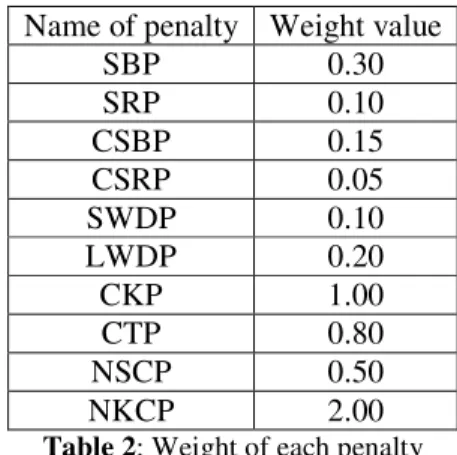
2= 0.5.2. All penalties are applied; the manually set penalty weights are shown in Table 2. 3. We took the average of runs over input text
types 1, 4, and 6 (i.e. normalized text, split type 1 and split type 3).
4. In Chunk penalty (CKP),
β
=3 , andγ
=0.1.5. By default, tf-idf is not applied.
6. We used three matching strategies: n-gram, fixed-gap gram, and flexible-gap n-gram; they are equally weighted.
Name of penalty Weight value
SBP 0.30 SRP 0.10 CSBP 0.15 CSRP 0.05 SWDP 0.10 LWDP 0.20 CKP 1.00 CTP 0.80 NSCP 0.50 NKCP 2.00
Table 2: Weight of each penalty
3.3 Evaluation metrics
We used Spearman’s rank correlation coefficient to measure the correlation of AMBER with the hu-man judgments of translation at the system level. The human judgment score we used is based on the “Rank” only, i.e., how often the translations of the system were rated as better than the translations from other systems (Callison-Burch et al., 2008). Thus, AMBER and the other metrics were eva-luated on how well their rankings correlated with
the human ones. For the sentence level, we use consistency rate, i.e., how consistent the ranking of sentence pairs is with the human judgments.
3.4 Results
All test results shown in this section are averaged over all three tests described in 3.1. First, we com-pare AMBER with two of the most widely used metrics: original IBM BLEU and METEOR v1.0.
Table 3 gives the results; it shows both the version
of AMBER with basic preprocessing, AMBER(1) (with tokenization and lowercasing) and the default version used as baseline for most of our experi-ments (AMBER(1,4,6)). Both versions of AMBER perform better than BLEU and METEOR on both system and sentence levels.
Metric Dev 3 tests average ∆ tests
BLEU_ibm (baseline) sys sent 0.68 0.72 N/A 0.37 0.40 N/A METEOR v1.0 sys sent 0.80 0.80 +0.08 0.58 0.56 +0.17 AMBER(1) (basic preproc.) sys sent 0.83 0.83 +0.11 0.61 0.58 +0.19 AMBER(1,4,6) (default) sys sent 0.84 0.86 +0.14 0.62 0.60 +0.20 Table 3: Results of AMBER vs BLEU and METEOR
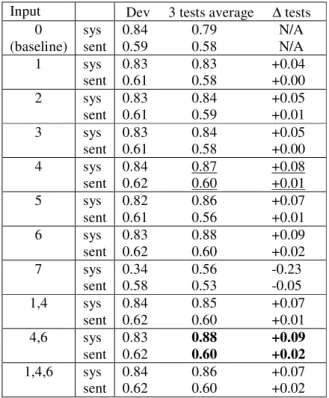
Second, as shown in Table 4, we evaluated the impact of different types of preprocessing, and some combinations of preprocessing (we do one run of evaluation for each type and average the results). From this table, we can see that splitting words into sub-words improves both system- and sentence-level correlation. Recall that input 6 pre-processing splits words according to a list of Eng-lish prefixes, roots, and suffixes: AMBER(4,6) is the best variant. Although test 3 results, for target languages other than English, are not broken out separately in this table, they are as follows: input 1 yielded 0.8345 system-level correlation and 0.5848 sentence-level consistency, but input 6 yielded 0.8766 (+0.04 gain) and 0.5990 (+0.01) respectively. Thus, surprisingly, splitting non-English words up according to non-English morpholo-gy helps performance, perhaps because French, Spanish, German, and even Czech share some word roots with English. However, as indicated by the underlined results, if one wishes to avoid the use of any linguistic information, AMBER(4)
per-forms almost as well as AMBER(4,6). The default setting, AMBER(1,4,6), doesn’t perform quite as well as AMBER(4,6) or AMBER(4), but is quite reasonable.
Varying the preprocessing seems to have more impact than varying the other parameters we expe-rimented with. In Table 5, “none+tf-idf” means we do one run without tf-idf and one run for “tf-idf only”, and then average the scores. Here, applying tf-idf seems to benefit performance slightly.
Input Dev 3 tests average ∆ tests
0 (baseline) sys sent 0.84 0.79 N/A 0.59 0.58 N/A 1 sys sent 0.83 0.83 +0.04 0.61 0.58 +0.00 2 sys sent 0.83 0.84 +0.05 0.61 0.59 +0.01 3 sys sent 0.83 0.84 +0.05 0.61 0.58 +0.00 4 sys sent 0.84 0.87 +0.08 0.62 0.60 +0.01 5 sys sent 0.82 0.86 +0.07 0.61 0.56 +0.01 6 sys sent 0.83 0.88 +0.09 0.62 0.60 +0.02 7 sys sent 0.34 0.56 -0.23 0.58 0.53 -0.05 1,4 sys sent 0.84 0.85 +0.07 0.62 0.60 +0.01 4,6 sys sent 0.83 0.88 +0.09 0.62 0.60 +0.02 1,4,6 sys sent 0.84 0.86 +0.07 0.62 0.60 +0.02 Table 4: Varying AMBER preprocessing (best linguistic = bold, best non-ling. = underline)
tf-idf Dev 3 tests average ∆ tests none (baseline) sys sent 0.84 0.86 N/A 0.62 0.60 N/A tf-idf only sys sent 0.81 0.88 +0.02 0.62 0.61 +0.01 none+tf-idf sys sent 0.82 0.87 +0.01 0.62 0.61 +0.01 Table 5: Effect of tf-idf on AMBER(1,4,6)
Table 6 shows what happens if you disable one
penalty at a time (leaving the weights of the other penalties at their original values). The biggest sys-tem-level performance degradation occurs when LWDP is dropped, so this seems to be the most
useful penalty. On the other hand, dropping CKP, CSRP, and SRP may actually improve perfor-mance. Firm conclusions would require retuning of weights each time a penalty is dropped; this is fu-ture work.
Penalties Dev 3 tests average ∆ tests All (baseline) sys sent 0.84 0.86 N/A 0.62 0.60 N/A -SBP sys sent 0.82 0.84 -0.02 0.62 0.60 -0.00 -SRP sys sent 0.83 0.88 +0.01 0.62 0.60 +0.00 -CSBP sys sent 0.84 0.85 -0.01 0.62 0.60 +0.00 -CSRP sys sent 0.83 0.87 +0.01 0.62 0.60 -0.00 -SWDP sys sent 0.84 0.86 -0.00 0.62 0.60 +0.00 -LWDP sys sent 0.83 0.83 -0.03 0.62 0.60 -0.00 -CTP sys sent 0.82 0.84 -0.02 0.62 0.60 -0.00 -CKP sys sent 0.83 0.87 +0.01 0.62 0.60 -0.00 -NSCP sys sent 0.83 0.86 -0.00 0.62 0.60 +0.00 -NKCP sys sent 0.82 0.85 -0.01 0.62 0.60 +0.00 Table 6: Dropping penalties from AMBER(1,4,6) –
biggest drops on test in bold
Matching Dev 3 tests avg ∆ tests
n-gram + fxd-gap+ flx-gap (default) sys sent 0.84 0.86 N/A 0.62 0.60 N/A n-gram sys sent 0.84 0.86 -0.00 0.62 0.60 -0.00 fxd-gap+ n-gram sys sent 0.84 0.86 -0.00 0.62 0.60 -0.00 flx-gap+ n-gram sys sent 0.83 0.86 -0.00 0.62 0.60 -0.00 skip+ n-gram sys sent 0.83 0.85 -0.01 0.62 0.60 -0.00 All four matchings sys sent 0.83 0.86 -0.01 0.62 0.60 0.00 Table 7: Varying matching strategy for AMBER(1,4,6)
Finally, we evaluated the effect of the matching strategy. According to the results shown in Table
7, our default strategy, which uses three of the four
types of matching (n-grams, fixed-gap n-grams,
and flexible-gap n-grams) is close to optimal; the use of skip n-grams (either by itself or in combina-tion) may hurt performance at both system and sentence levels.
4 Conclusion
This paper describes AMBER, a new machine translation metric that is a modification of the widely used BLEU metric. We used more sophisti-cated formulae to compute the score, we developed several new penalties to match the human judg-ment, we tried different preprocessing types, we tried tf-idf, and we tried four n-gram matching strategies. The choice of preprocessing type seemed to have the biggest impact on performance. AMBER(4,6) had the best performance of any va-riant we tried. However, it has the disadvantage of using some light linguistic knowledge about Eng-lish morphology (which, oddly, seems to be help-ful for other languages too). A purist may prefer AMBER(1,4) or AMBER(4), which use no linguis-tic information and still match human judgment much more closely than either BLEU or METEOR. These variants of AMBER share BLEU’s virtues: they are language-independent and can be computed quickly.
Of course, AMBER could incorporate more lin-guistic information: e.g., we could use linlin-guistical- linguistical-ly defined stop word lists in the SWDP and LWDP penalties, or use synonyms or paraphrasing in the n-gram matching.
AMBER can be thought of as a weighted com-bination of dozens of computationally cheap fea-tures based on word surface forms for evaluating MT quality. This paper has shown that combining such features can be a very effective strategy for attaining better correlation with human judgment. Here, the weights on the features were manually tuned; in future work, we plan to learn weights on features automatically. We also plan to redesign AMBER so that it becomes a metric that is highly suitable for tuning SMT systems.
References
S. Banerjee and A. Lavie. 2005. METEOR: An auto-matic metric for MT evaluation with improved corre-lation with human judgments. In Proceedings of ACL
Workshop on Intrinsic & Extrinsic Evaluation Meas-ures for Machine Translation and/or Summarization.
A. Birch and M. Osborne. 2010. LRscore for evaluating lexical and reordering quality in MT. In Proceedings
of the Joint Fifth Workshop on Statistical Machine Translation and MetricsMATR, pages 302–307. C. Callison-Burch, C. Fordyce, P. Koehn, C. Monz and
J. Schroeder. 2008. Further Meta-Evaluation of Ma-chine Translation. In Proceedings of WMT.
C. Callison-Burch, M. Osborne, and P. Koehn. 2006. Re-evaluating the role of BLEU in machine transla-tion research. In Proceedings of EACL.
D. Cer, D. Jurafsky and C. Manning. 2010. The Best Lexical Metric for Phrase-Based Statistical MT Sys-tem Optimization. In Proceedings of NAACL. Y. S. Chan and H. T. Ng. 2008. MAXSIM: A maximum
similarity metric for machine translation evaluation. In Proceedings of ACL.
D. Chiang, S. DeNeefe, Y. S. Chan, and H. T. Ng. 2008. Decomposability of translation metrics for improved evaluation and efficient algorithms. In Proceedings
of EMNLP, pages 610–619.
M. Denkowski and A. Lavie. 2010. Meteor-next and the meteor paraphrase tables: Improved evaluation sup-port for five target languages. In Proceedings of the
Joint Fifth Workshop on Statistical Machine Transla-tion and MetricsMATR, pages 314–317.
George Doddington. 2002. Automatic evaluation of machine translation quality using n-gram co-occurrence statistics. In Proceedings of HLT.
Y. He, J. Du, A. Way, and J. van Genabith. 2010. The
DCU dependency-based metric in
WMT-MetricsMATR 2010. In Proceedings of the Joint
Fifth Workshop on Statistical Machine Translation and MetricsMATR, pages 324–328.
H. Isozaki, T. Hirao, K. Duh, K. Sudoh, H. Tsukada. 2010. Automatic Evaluation of Translation Quality for Distant Language Pairs. In Proceedings of
EMNLP.
A. Lavie and M. J. Denkowski. 2009. The METEOR metric for automatic evaluation of machine transla-tion. Machine Translation, 23.
C.-Y. Lin. 2004. ROUGE: a Package for Automatic Evaluation of Summaries. In Proceedings of the
Workshop on Text Summarization Branches Out (WAS 2004), Barcelona, Spain.
C. Liu, D. Dahlmeier, and H. T. Ng. 2010. Tesla:
Trans-lation evaluation of sentences with
linear-programming-based analysis. In Proceedings of the
Joint Fifth Workshop on Statistical Machine Transla-tion and MetricsMATR, pages 329–334.
S. Pado, M. Galley, D. Jurafsky, and C.D. Manning. 2009. Robust machine translation evaluation with en-tailment features. In Proceedings of ACL-IJCNLP. K. Papineni, S. Roukos, T. Ward, and W.-J. Zhu. 2002.
BLEU: a method for automatic evaluation of ma-chine translation. In Proceedings of ACL.
M. Snover, B. Dorr, R. Schwartz, L. Micciulla, and J. Makhoul. 2006. A Study of Translation Edit Rate with Targeted Human Annotation. In Proceedings of
Association for Machine Translation in the Americas. M. Snover, N. Madnani, B. Dorr, and R. Schwartz. 2009. Fluency, Adequacy, or HTER? Exploring Dif-ferent Human Judgments with a Tunable MT Metric. In Proceedings of the Fourth Workshop on Statistical