Publisher’s version / Version de l'éditeur:
Vous avez des questions? Nous pouvons vous aider. Pour communiquer directement avec un auteur, consultez la première page de la revue dans laquelle son article a été publié afin de trouver ses coordonnées. Si vous n’arrivez pas à les repérer, communiquez avec nous à [email protected].
Questions? Contact the NRC Publications Archive team at
[email protected]. If you wish to email the authors directly, please see the first page of the publication for their contact information.
https://publications-cnrc.canada.ca/fra/droits
L’accès à ce site Web et l’utilisation de son contenu sont assujettis aux conditions présentées dans le site LISEZ CES CONDITIONS ATTENTIVEMENT AVANT D’UTILISER CE SITE WEB.
Rule-Based Modeling and Computing on the Semantic Web: 5th International
Symposium, RuleML 2011– America, Ft. Lauderdale, FL, Florida, USA, November
3-5, 2011. Proceedings, Lecture Notes in Computer Science; no. 7018, pp.
298-312, 2011-11-10
READ THESE TERMS AND CONDITIONS CAREFULLY BEFORE USING THIS WEBSITE. https://nrc-publications.canada.ca/eng/copyright
NRC Publications Archive Record / Notice des Archives des publications du CNRC :
https://nrc-publications.canada.ca/eng/view/object/?id=9037f70f-cd1f-4cab-9ca1-36f4d952016d
https://publications-cnrc.canada.ca/fra/voir/objet/?id=9037f70f-cd1f-4cab-9ca1-36f4d952016d
NRC Publications Archive
Archives des publications du CNRC
For the publisher’s version, please access the DOI link below./ Pour consulter la version de l’éditeur, utilisez le lien DOI ci-dessous.
https://doi.org/10.1007/978-3-642-24908-2_30
Access and use of this website and the material on it are subject to the Terms and Conditions set forth at
LegalRuleML: XML-based rules and norms
Palmirani, Monica; Governatori, Guido; Rotolo, Antonino; Tabet, Said; Boley,
Harold; Paschke, Adrian
M. Palmirani1, G. Governatori2, A. Rotolo1, S. Tabet3, H. Boley4, A. Paschke5 1
CIRSFID, University of Bologna, Italy
{monica.palmirani, antonino.rotolo} AT unibo.it
2
NICTA, Brisbane, Australia guido.governatori AT nicta.com.au
3
EMC Corporation, Office of the CTO, Hopkinton, MA, USA said.tabet AT emc.com
4
Institute for Information Technology, National Research Council Canada Fredericton, NB, Canada
harold.boley AT nrc.gc.ca
5
Computer Science Department, Freie Universitaet Berlin, Germany paschke AT inf.fu-berlin.de
Abstract. Legal texts are the foundational resource where to discover rules and norms that feed into different concrete (often XML-based) Web applications. Legislative documents provide general norms and specific procedural rules for eGovernment and eCommerce environments, while contracts specify the condi-tions of services and business rules (e.g. service level agreements for cloud computing), and judgments provide information about the legal argumentation and interpretation of norms to concrete case-law. Such legal knowledge is an important source that should be detected, properly modeled and expressively represented in order to capture all the domain particularities. This paper pro-vides an extension of RuleML called LegalRuleML for fostering the character-istics of legal knowledge and to permit its full usage in legal reasoning and in the business rule domain. LegalRuleML encourages the effective exchange and sharing of such semantic information between legal documents, business rules, and software applications.
Keywords. Legal Rules, Legal XML Standards, Semantic Web, Legal Reason-ing, LegalRuleML.
1
Rationale
The AI & Law community dedicated a good part of the last twenty years to model legal norms using different logics and formalisms [30]. The methodology used starts with a re-interpretation of a legal text by a Legal Knowledge Engineer who extracts the norms, applies models and a theory within a logical framework, and finally repre-sents the norms using a particular formalism. In the last decade, several Legal XML standards were proposed to describe and represent legal texts [23; 35; 4] with XML based rules (RuleML, SWRL, RIF, LKIF, etc.) [12; 7]. In the meantime, the Semantic Web, in particular Legal Ontology research combined with semantic norm extraction
based on Natural Language Processing (NLP) [10; 8; 25; 24], gave a great impulse to the modeling of legal concepts [7]. In this paramount scenario, there is urgent need to find a robust and expressive XML annotation, compliant with the Semantic Web technologies, able to meet all the unique particular aspects rising from the legal do-main and in the same time close the gap between legal text descriptions, using XML techniques, and norms modeling, in order to realize an integrated and self-contained representation of legal resources available on the Web [26; 22]. This integration is fundamental for fostering Semantic Web advantages applied to legal norms like: NLP, IR, graph representation, Web ontologies and rules, etc.
The second requirement is to capture the processes description embedded into the norms for extracting the business rules and for passing them to other important appli-cations like workflow or business rule engines. There is a gap currently between the norms modeling and business rules, even if the latter are strongly influenced by the former. This knowledge is an important input for several applications in Cloud com-puting, eGovernment, eCommerce [20; 14; 31], eHealth, etc. Of particular importance in such scenario, the requirement for compliance checking [32; 16; 18; 19] theory and applications.
The third aspect is to permit an agile annotation of all the instruments necessary to capture the legal norms [11] that usually the normal rule XML standard doesn’t in-clude. Our goal is to have an expressive XML standard for modeling normative rules that will satisfy the legal domain requirements. This will enable a legal reasoning level on top of the ontological layer, following the Tim Berners-Lee semantic web stack1. Finally, particular attention is paid to the Linked Open Data [3] approach to modeling, regarding not only the semantics of raw data (act, contracts, court files, judgments, etc.), but also of rules in conjunction with their functionality and usage. Without rules or axioms, legal concepts represent nothing more than a taxonomy [35].
Fig. 1. LegalRuleML position in the current RuleML architecture (adapted from [5]).
1
In this scenario we have extended RuleML [5; 6; 38; 34] to include, in orthogonal way (see Fig. 1), a new dialect capturing all those requirements, not fully incorporated in the original version of RuleML. We call this new dialect LegalRuleML. It is posi-tioned between the Deliberation rules and the Reaction Rules facilitating the modeling of either norms or business rules. This approach provides support for the implementa-tion of reasoning engines combining both norms and business rules.
2
Characteristics of Legal Norms
RuleML provides a good framework to start working towards the above-mentioned goals. We define the main characteristics needed for modeling norms and the essential features needed to apply legal reasoning in effective and computable way. We can divide the characteristics in three main groups: semantic features, logic features, and legal process features.
2.1 Semantic Features
ISOMORPHISM [1] To ease validation and maintenance, there should be a one-to-one correspondence between the rules in the formal model and the units of natural lan-guage text which express the rules in the original legal sources, such as sections of legislation. This entails, for example, that a general rule and separately stated excep-tions, in different sections of a statute, should not be converged into a single rule in the formal model.
REIFICATION [13] Rules are objects with properties, such as:
Jurisdiction. The limits within which the rule is authoritative and its effects are binding (of particular importance are spatial and geographical references to model jurisdiction).
Authority [29] Who produced the rule, a feature which indicates the ranking status of the rule within the sources of law (whether the rule is a constitu-tional provision, a statute, is part of a contract clause or is the ruling of a precedent, and so on).
Temporal properties [28, 15, 27] Rules usually are qualified by temporal properties, such as: the time when the norm is enforced and/or has been en-acted; the time when the norm can produce legal effects; the time when the normative effects hold.
RULE SEMANTICS. Any language for modeling legal rules should be based on precise and rigorous semantics, which allow for the correct computation of legal effects that should follow from a set of legal rules.
NORMATIVE EFFECTS. There are many normative effects that follow from applying rules, such as obligations, permissions, prohibitions and also more articulated effects such as those introduced, e.g., by Hohfeld (see [36]). Below is a rather comprehensive list of normative effects [33]:
Evaluative indicates that something is good or bad, is a value to be opti-mized or an evil to be miniopti-mized. For example, ''Human dignity is valuable'', ''Participation ought to be promoted'';
Qualificatory describes a legal quality to a person or an object. For example, ''Joe is a citizen'';
Definitional specifies the meaning of a term. For example, ''Tolling agree-ment means any agreeagree-ment to put a specified amount of raw material per pe-riod through a particular processing facility'';
Deontic typically imposes the obligation or confers the permission to do a certain action. For example, ''x has the obligation to do A'';
Potestative assigns powers. For example, ''A worker has the power to termi-nate his work contract'';
Evidentiary establishes the conclusion to be drawn from certain evidence. For example, ''It is presumed that dismissal was discriminatory'';
Existential indicates the beginning or the termination of the existence of a legal entity. For example, ''The company ceases to exist'';
Norm-concerning effects states modifications of norms such as abrogation, repeal, substitution, and so on.
VALUES [2] Usually, some values are promoted by legal rules. The modeling of rules sometimes needs to support the representation of values and value preferences, which can also play the role of meta-criteria for solving rule conflicts (given two conflicting rules r1 and r2, value v1, promoted by r1, is preferred to value v2, promoted by r2, and so r1 overrides r2).
2.2 Logic Features
DEFEASIBILITY [13; 29; 37] When the antecedent of a rule is satisfied by the facts of a case (or via other rules), the conclusion of the rule presumably holds, but is not necessarily true. The defeasibility of legal rules breaks down into the following is-sues:
Conflicts [29] Rules can conflict, namely, they may lead to incompatible le-gal effects. Conceptually, conflicts can be of different types whether two conflicting rules: i) are such that one is an exception of the other (i.e., one is more specific than the other); ii) have a different ranking status; iii) have been enacted at different times.
Exclusionary rules [13; 29; 37] Some rules provide one way to explicitly undercut other rules, namely, to make them inapplicable.
CONTRAPOSITION [29] Rules do not counterpose. If the conclusion of a rule is not true, the rule does not sanction any inferences about the truth of its premises.
CONTRIBUTORY REASONS OR FACTORS [37] It is not always possible to formulate precise rules, even defeasible ones, for aggregating the factors relevant for resolving a legal issue. For example: ''The educational value of a work needs to be taken into consideration when evaluating whether the work is covered by the copyright doctrine of fair use.''
RULE VALIDITY [17] Rules can be invalid or become invalid. Deleting invalid rules is not an option when it is necessary to reason retroactively with rules, which were valid at various times over a course of events. For instance: The annulment of a norm is usually seen as a kind of repeal, which invalidates the norm and removes it from the legal system as if it had never been enacted. The effect of an annulment applies ex tunc: annulled norms are prevented from producing any legal effects, also for past events. An abrogation on the other hand operates ex nunc: The rule continues to apply for events that occurred before the rule was abrogated.
2.3 Legal Process Features
LEGAL PROCEDURES. Rules not only regulate the procedures resolving legal conflicts (see above), but also are used for arguing or reasoning about whether or not some action or state complies with other, substantive rules. In particular, rules are required for procedures which regulate methods detecting violations of the law; determine the normative effects triggered by norm violations, such as reparative obligations, name-ly, which are meant to repair or compensate violations. Note that these constructions can give rise to very complex rule dependencies, because the violation of a single rule can activate other (reparative) rules, which in turn, in case of their violation, refer to other rules, and so forth.
PERSISTENCE OF NORMATIVE EFFECTS [15] Some normative effects persist over time unless some other and subsequent event terminates them. For example: ''If one causes damage, one has to provide compensation.'' Other effects hold on the condition and only while the antecedent conditions of the rules hold. For example: ''If one is in a public office, one is forbidden to smoke''.
An interesting question is whether rule interchange languages for the legal domain should be expressive enough to fully model all the features listed above, or whether some of these requirements can be met at the reasoning level, at the level responsible for structuring, evaluating and comparing legal arguments constructed from rules and other sources.
3
LegalRuleML
To extend RuleML into LegalRuleML, we have defined two more XML-schemas: LegalMeta.xsd module and Legal_operators.xsd module (see Fig.2). Legal_meta.xsd is devoted to model all the legal metadata concerning the legal rules. Le-gal_operators.xsd defines the legal operators: deontic operators and behaviours. It is also necessary to have a module to connect derivation rules with reaction rules, in order to foster the potentiality of the reaction rules. This paper is a preliminary pro-posal for testing the rational presented in the § 1 and 2, so in the future we intend to modularize better the schemas in order to improve scalability and maintenance over the time. This proposal aims to open a debate, not to fix a solution, and make possible the mark-up of some pilot cases in order to evaluate the correctness of the solution in the RuleML community.
Fig. 2. legal_metadata module included in the datalog component (adapted from [34])
3.1 Legal Meta Data
The root tag of Legal_metadata.xsd is metaInfo that includes the following op-tional metadata:
Fig. 3. metaInfo module organization.
─ references block provides identification of the textual fragments involved in the rules modeled;
─ sources block models the connections with the textual fragments and the rules; ─ events block provides the definition of any temporal event;
─ timesInfo block adds semantic information to the events;
─ rulesInfo block models the meta information concerning the rules; ─ hierarchy block defines the ranging of the rules in the defeasibility logic.
Identification of the Annotators
This part of metadata is modeled to allow a multiple annotation of the rules coming from different authors. In the legal domain it is common to find different interpreta-tions of the norms and equally legitimate under the legal point of view. So the identi-fication of the authors permits to define a trust policy on the base of the context or of the authoritativeness of the annotator. If a constitutional judge annotates a rule, the trustiness is higher rather than an interpretation of a Ph.D. student of a law school. On the other side sometime the rules could be slightly different from the context and the inference engine could take in consideration a particular set of rules on the base of the role expressed by the author (e.g. regional vs. state interpretation). For this reason, we have the attribute as for identifying the role of the author in the annotation of the rule.
<identifications>
<identification id="aut1"
uri="http://www.cirsfid.unibo.it/monica.palmirani.owl"
as="author"/>
<identification id="aut2"
uri="http://www.nicta.com.au/guido.governatori.owl"
as="editor"/> </identifications>
In this section two authors (aut1, aut2) are defined and connected with their on-tology and role (aut1 is the author of the rule, aut2 is the editor of the rule). The same could be applied to the authorities, institutions, legal entities, juridical persons.
Sources and References for Isomorphism
The references and sources blocks are strictly connected together and they provide a solution to the isomorphism requirement. The references block defines the entire textual fragment involved in the rules modeling, and the sources block connects rules with the appropriate references. Because we have some time N:M rela-tionship with text and rules, this mechanism permits the redundancy of the text re-source URI and in the meantime connects one rule to multiple part of the text or vice versa multiple rules to the same fragment of text.
<references>
<reference id="customerContract" uri="http://text1#art1"/> <reference id="customerContract2" uri="http://text1#art2"/> </references>
<sources>
<source element="#rule1" refersTo="#customerContract"/> <source element="#rule1" refersTo="#customerContract2"/> <source element="#rule2" refersTo="#customerContract2"/> </sources>
This is particularly true in case of penalty-reparation rule. Usually the definition of the penalty is expressed in one clause and the conditions of reparation in another clause, but together they determine the body and the header of a unique normative rule. In the following fragment we have two citations (clauses 8 and 5) that constitute the body of the rule and the header is in the clause 10.
Clause 10, point 1, letter c)
If Google does not meet the Google Apps SLA (clause 8), and if Customer meets its obligations under this Google Apps SLA (clause 5), Customer will be eligible to receive the Service Credits of X days.
This rule is modeled in such way:
<references>
<reference id="GoogleSLA" uri="http://text1#clouse8"/> <reference id="GoogleSLA" uri="http://text1#clouse5"/> <reference id="GoogleSLA" uri="http://text1#clouse10"/> </references>
<sources>
<source element="# rule1_body " refersTo="#GoogleSLA8"/> <source element="#rule1_body" refersTo="#GoogleSLA5"/> <source element="#rule1_header" refersTo="#GoogleSLA10"/> </sources>
Events and Temporal Parameters
The events block detects the events related to a set of norms, in neutral way, with-out any semantic interpretation. The timesInfo block assigns the legal semantic to each group of events. In this way we could connect each atom, body, header, rule with the appropriate timesInfo block without any redundancy of data, preserving a compact annotation and high expressiveness. Next, we use attributes not elements in order to avoid both temporal predicates and arbitrary nomenclature to the functions. Consider now the following clause coming from a SLA contract:
A customer is “Premium” if their spending has been min 5000 dollars in the previous year
We have at least four temporal events in this provision: a) the time when the text cre-ates rights, duties and obligations (e.g. time of enter into force, after the signature of the contract); b) the time when the provision is effective (e.g. the time when the ser-vice starts, 1 Jan 2012); c) the time when the provision is applicable (e.g. after at least one year from the efficacy time); d) the temporal conditions included in the provision that is a dynamic dimension (e.g. “previous year”). A new question arise concerning the continuity of the temporal condition: i) the customer have to spend at least one order min 5000 dollars (only one event is sufficient); ii) the customer could aggregate several spending for min 5000 dollars (set of events create the condition); iii) the customer have to maintain their orders min 500 dollars (continuity of condition). For this reason we have introduced an attribute (perdurant) with several parameters: and (true for all ti of an interval), or (true if at least one ti satisfies the condition), xor
(true if only one ti satisfies the condition) , agg (true if the aggregation of a set of ti
satisfies the condition).
We can model those events as follow:
<events>
<event id="e1" value="2011-08-25T01:01:00.0Z"/> <event id="e2" value="2012-01-25T01:01:00.0Z"/> <event id="e3" value="2013-01-25T01:01:00.0Z"/> </events>
<timesInfo>
<times id="t1">
<time start="#e1" timeType="efficacy"/> <time start="#e1" timeType="inforce"/> <time start="#e3" timeType="application"/> </times>
<times id="t2">
<time duration="-P01Y" timeType="internal" timeType
="application" perdurant="agg"/> </times>
</timesInfo>
Note the time of application “previous year” is modeled as internal event of the norm and represented using the negative period of duration (-P1Y, following the standard syntax of xsd).
The mechanism presented for modeling the temporal parameters connects times to norms and rules and it fosters effective legal reasoning algorithm about facts occurred in the past, or that happen in the future, with uncertain events and with complex con-ditionals.
Hierarchy and Type of Norms
The non-monotonic legal reasoning needs to manage the hierarchy of rules [see § 2]. The hierarchy block defines the superiority relationship between two rules: it is a binary operator that creates a meta-rule among existing rules.
Because the superiority relationship depends to some conditions we have several attributes that anchor the association to specific parameters: author and time. It is so possible to have the same rule with different superiority relationship, made in a dif-ferent time, by a difdif-ferent author.
<hierarchy>
<range id="rng1" function="superior" from="#rule1" to="#rule2" timesBlock="#t1" author="#aut2"/>
</hierarchy>
Semantic Qualification of Rules
In the rulesInfo block, we define some properties of the rule like the ruleType (e.g. defeasible, defeater, strict, metaRule), the author and qualification using the attribute refersTo. Fostering the referesTo attributes we could connect any external legal concept defined with a given ontology.
<rulesInfo>
<ruleInfo source="#rule1" ruleType="defeasible" refersTo ="/ontology/usaJurisdiction.owl" author="#aut2"/>
<ruleInfo source="#rule1" ruleType="strict"
refer-sTo="/ontology/definition.owl" author="#aut2"/>
</rulesInfo>
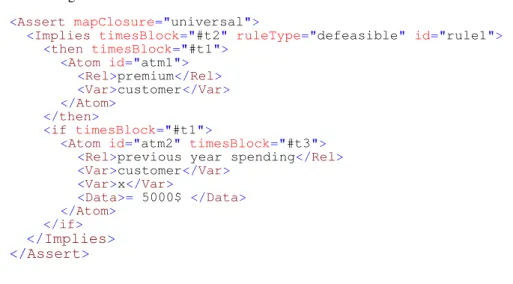
Let us come back to our example:
A customer is “Premium” if their spending has been min 5000 dollars in the previous year.
The above is modeled as follow in enriched way, ready for legal reasoning base don defeasible logic.
<Assert mapClosure="universal">
<Implies timesBlock="#t2" ruleType="defeasible" id="rule1">
<then timesBlock="#t1">
<Atom id="atm1">
<Rel>premium</Rel>
<Var>customer</Var>
</Atom>
</then>
<if timesBlock="#t1">
<Atom id="atm2" timesBlock="#t3">
<Rel>previous year spending</Rel>
<Var>customer</Var>
<Var>x</Var> <Data>= 5000$ </Data> </Atom> </if> </Implies> </Assert> 3.2 Legal Operators
In the module Legal_operators.xsd we have defined all the operators needed for managing deontic logic and behaviors like violation and reparation.
Behavior represents a particular sequence of deontic operators that starts with an obligation or a prohibition and ends with a permission.
The violation is a unary relationship that refers to the obligation/prohibition
subject of the violation. The reparation is a unary relationship providing a link to the relevant penalty.
For a better understanding of their usage, we describe an example coming from the US Code related to the infringement of the copyright, Title 18, Chapter 6:
§ 602 (b) In a case where the making of the copies or phonorecords would have constituted an infringement of copyright if this title had been applicable, their impor-tation is prohibited.
To model this example, we first start with the rule 602b where we find in the con-clusion a prohibition to import material that infringes the copyright law:
<Implies id="rule602b"> <then>
<prohibition>
<Atom id="rule602b-prh1-atm1">
<Rel>importation is prohibited</Rel>
<Var>z</Var> </Atom> </prohibition> </then> <if> <And>
<Atom id="rule602-if-atm1">
<Rel>copies or phonorecords</Rel>
<Var>z</Var> </Atom>
<Atom id="impl602-1-if-atm2">
<Rel>without the authority of the owner of copyright
</Rel> <Var>x</Var> </Atom> </And> </if> </Implies>
After that, we assume as a fact the penalty statement in case of a copyright in-fringement following the 504 (c)(1):
§ 504. Remedies for infringement: Damages and profits (c) Statutory Damages.—
(1) Except as provided by clause (2) of this subsection, the copyright owner may elect, at any time before final judgment is rendered, to recover, instead of actual damages and profits, an award of statutory damages for all infringements involved in the action, with respect to any one work, for which any one infringer is liable individually, or for which any two or more infringers are liable jointly and severally, in a sum of not less than $750 or more than $30,000 as the court considers just. For the purposes of this subsection, all the parts of a compilation or derivative work constitute one work.
<penalty id="atm504-pnl1">
<obligation id="obl2" subject="z" beneficiary="y" timesBlock="#t2">
<Atom id="atm504-pnl1-atm1">
<Rel>award of statutory damages to</Rel>
<Var>z</Var>
<Data>min $750 </Data>
<Data>max $30,000 </Data>
</Atom> </obligation> </penalty> </Atom>
Finally we define a new rule that connects the reparation with the violation of the rule602b, and the reparation with the penalty (see the penalty=" #atm504-pnl1" attribute). We have reparation only if the subject violated the rule602 and has paid the award of statutory damages to the copyright owner.
<Implies id="rule602b-rep"> <then>
<reparation id="rule602b-rep1" penalty="#atm504-pnl1"/> </then>
<if>
<violation source="#rule602b"/> </if>
</Implies>
3.3 Semantic Qualification of Negation
One of the main problems in legal reasoning is to qualify the negation. To solve this problem, we have customized the module neg_module.xsd and naf_module.xsd in order to include a link to the semantic meaning. The attribute refersTo permits to link the markup to specific concept ontology.
<xs:attributeGroup name="Neg.attlist"> <xs:attributeGroup ref="refersTo"/> </xs:attributeGroup>
<xs:attributeGroup name="Naf.attlist"> <xs:attributeGroup ref="refersTo"/> </xs:attributeGroup>
3.3 Extension of the RuleML Modules
To support the application of that metadata, we have extended several modules, like atom_module.xsd that could host the time parameters and the id attribute:
<xs:attributeGroup name="Atom.attlist">
<xs:attributeGroup ref="closure.attrib"/> <xs:attributeGroup ref="timesBlock"/> <xs:attributeGroup ref="idReq"/> </xs:attributeGroup>
The connective_module.xsd is extended in order to define, apart from the time parameters and the id, the type of rule, following the defeasible classification: strict, defeasible, defeater, metaRule.
<xs:attributeGroup name="Implies.attlist"> <xs:attributeGroup ref="closure.attrib"/> <xs:attributeGroup ref="direction.attrib"/> <xs:attributeGroup ref="material.attrib"/> <xs:attributeGroup ref="timesBlock"/> <xs:attributeGroup ref="idReq"/> <xs:attributeGroup ref="ruleTypeDef"/> </xs:attributeGroup>
In legal_metadata.xsd we define the list of values:
<xs:simpleType name="ruleTypeValue"> <xs:restriction base="xs:token">
<xs:enumeration value="strict"/> <xs:enumeration value="defeasible"/> <xs:enumeration value="defeater"/> <xs:enumeration value="metaRule"/> </xs:restriction>
</xs:simpleType>
4
Conclusion
This paper presents an extension of RuleML customized to support legal require-ments. The goal is to have a clear and expressive XML language integrated as part of the RuleML family capable to support the modeling and the representation of legal norms and rules. In this first step we have implemented the following features:
Table 1. List of LegalRuleML features and the extended modules.
Features LegalRuleML RuleML extension
Isomorphism sources and references legal_meta.xsd
Jurisdiction refersTo legal_meta.xsd
Authority author legal_meta.xsd
Temporal parameters event and timesInfo legal_meta.xsd
connective_module.xsd atom_module.xsd Qualification/Definitional/
Valuable
refersTo legal_meta.xsd
Semantic of Negation refersTo Neg_module.xsd
Naf_module.xsd
Deontic operators legalOperator legal_operators.xsd
connective_module.xsd atom_module.xsd
Defeasible logic hierarchy and typeRules legal_meta.xsd
Behaviors legalOperator legal_operators.xsd
connective_module.xsd atom_module.xsd
LegalRuleML language aims to interoperate with Reaction RuleML modules. Our next steps include a better modularization of the main features from a syntactical point of view, extend the modularization to all the modules of the Declarative Rules and Reactive Rules, and develop a proof of concept implementing a sample set of acts
and contracts. The LegalRuleML Initiative has been working with OASIS, especially the LegalXML Technical Committee, on organizing future efforts.
5
References
1. Bench-Capon T. and Coenen F.: Isomorphism and legal knowledge based systems.
Artifi-cial Intelligence and Law, 1(1):65–86, (1992).
2. Bench-Capon T.: The missing link revisited: The role of teleology in representing legal
argument. Artificial Intelligence and Law, 10(1-3):79–94, (2002).
3. Berners-Lee T.: Long Live the Web: A Call for Continued Open Standards and Neutrality,
Scientific America, (2010).
4. Boer A., Radboud W., and Vitali F.: MetaLex XML and the Legal Knowledge Interchange
Format, in Computable Models of the Law, Springer, (2008).
5. Boley H., Paschke A., and Shafiq O.: RuleML 1.0: The Overarching Specification of Web
Rules. RuleML 2010: 162-178, Springer (2010).
6. Boley H., Tabet S., and Wagner G.: Design rationale for RuleML: A markup language for
Semantic Web rules. In I. F. Cruz, S. Decker, J. Euzenat, and D. L. McGuinness, editors, Proc. SWWS’01, The first Semantic Web Working Symposium, pages 381–401, (2001).
7. Breuker J., Boer A., Hoekstra R., and Van Den Berg C.: Developing Content for LKIF:
Ontologies and Framework for Legal Reasoning, in Legal Knowledge and Information Systems, JURIX 2006, pp.41-50, ISO Press, Amsterdam, (2006).
8. De Maat E. and Winkels R.: Automated Classification of Norms, in Sources of Law.
Se-mantic Processing of Legal Texts 2010, pp. 170-191, 2010Francesconi E., Montemagni S., Peters W., Tiscornia D.: Semantic Processing of Legal Texts: Where the Language of Law Meets the Law of Language , Springer (2010).
9. Francesconi E., and Passerini A.: “Automatic Classification of Provisions in Legislative
Texts. In ICAIL 2007, vol. 15, pp. 1–17, ACM, (2007).
10. Francesconi E., Montemagni S., Peters W.,Tiscornia D.: Semantic Processing of Legal
Texts: Where the Language of Law Meets the Law of Language, Springer (2010).
11. Gordon T. F., Governatori G., Rotolo A.: Rules and Norms: Requirements for Rule
Inter-change Languages in the Legal Domain. RuleML 2009: pp. 282-296, Springer (2009).
12. Gordon T. F.: Constructing Legal Arguments with Rules in the Legal Knowledge
Inter-change Format (LKIF). Computable Models of the Law, Languages, Dialogues, Games, Ontologies 2008, pp. 162-184, ,Springer, (2008).
13. Gordon T. F.: The Pleadings Game; An Artificial Intelligence Model of Procedural
Jus-tice. Springer, New York, 1995. Book version of 1993 Ph.D. Thesis; University of Darm-stadt, (1993).
14. Governatori G. and Pham D. H.: Dr-contract: An architecture for e-contracts in defeasible
logic. International Journal of Business Process Integration and Management, 5(4), (2009).
15. Governatori G. and Rotolo A.: Changing legal systems: Legal abrogations and annulments
in defeasible logic. The Logic Journal of IGPL, (2010).
16. Governatori G., Milosevic Z., and Sadiq S.: Compliance checking between business
proc-esses and business contracts. In Proc. EDOC 2006, pages 221–232. IEEE, (2006).
17. Governatori G., Rotolo A., and Sartor G.: Temporalised normative positions in defeasible
logic. In Proc. ICAIL’05, pages 25–34. ACM Press, (2005).
18. Governatori G., Rotolo A.: Norm Compliance in Business Process Modeling. RuleML
2010: pp. 194-209, (2010).
19. Governatori G.: Representing business contracts in RuleML. International Journal of
Co-operative Information Systems, 14(2-3):pp. 181–216, (2005).
20. Grosof B.: Representing e-commerce rules via situated courteous logic programs in
21. Hage. J. C.: Reasoning with Rules – An Essay on Legal Reasoning and its Underlying Logic. Kluwer Academic Publishers, Dordrecht, (1997).
22. Hu Y.-J. and Boley H.: SemPIF: A Semantic Meta-policy Interchange Format for Multiple
Web Policies. Web Intelligence 2010: 302-307, (2010).
23. Lupo C., Vitali F., Francesconi E., Palmirani M., Winkels R., de Maat E., Boer A., and
Mascellani P.: General xml format(s) for legal sources - Estrella European Project IST-2004-027655. Deliverable 3.1, Faculty of Law, University of Amsterdam, Amsterdam, The Netherlands, (2007).
24. Mazzei A., Radicioni D. P., and Brighi R.: NLP-Based Extraction of Modificatory
Provi-sions Semantics. ICAIL 2009, pp. 50–57, New York: ACM Press, 2009.
25. Palmirani M. and Brighi R.: Model Regularity of Legal Language in Active
Modifica-tions., AICOL Workshop 2009, pp. 54–73 Springer, (2010).
26. Palmirani M., Contissa G., and Rubino R.: Fill the Gap in the Legal Knowledge
Model-ling. RuleML 2009: 305-314, (2009).
27. Palmirani M., Governatori G., Contissa G.: Modelling temporal legal rules, ICAIL2011
Proceedings, ACM, (2011).
28. Palmirani M.: Time Model in Normative Information Systems. In proceedings of the
workshop The Role of Legal Knowledge in eGovernment, ICAIL2005, (2005).
29. Prakken H. and Sartor G.: A dialectical model of assessing conflicting argument in
legal-reasoning. Artificial Intelligence and Law, 4(3-4):331–368, (1996).
30. Proceeding of the 13th International Conference on Artificial Intelligence and Law,
Pitts-burgh 6-10 June, 2011, ACM, NY, (2011).
31. Rotolo A., Sartor G., and Smith C.: Good faith in contract negotiation and performance,
International Journal of Business Process Integration and Management, 5(4), (2009).
32. Rotolo A.: Rule-based agents, compliance, and intention reconsideration in defeasible
logic, RuleML2011@IJCAI, Springer, (2011).
33. Rubino R., Rotolo A., and Sartor G.: An OWL Ontology of Fundamental Legal Concepts.
JURIX 2006: 101-110, IOS (2006).
34. RuleML. The Rule Markup Initiative. http://www.ruleml.org, 20th August 2009.
35. Sartor G., Palmirani M., Francesconi E., Biasiotti M.: Legislative XML on Semantic web,
Springer, (2011).
36. Sartor G.: Legal concepts as inferential nodes and ontological categories. Artif. Intell. Law
17 (3): pp. 217-251, (2009).
37. Sartor G.: Legal reasoning: A cognitive approach to the law. In E. Pattaro, H. Rottleuthner,
R. Shiner, A. Peczenik, and G. Sartor, editors, A Treatise of Legal Philosophy and General Jurisprudence, volume 5. Springer, (2005).
38. Wagner G., Antoniou G., Tabet S., and Boley H.: The abstract syntax of RuleML –
to-wards a general web rule language framework. In Proc. Web Intelligence 2004, pages 628–631, IEEE Computer Society, (2004).
![Fig. 1. LegalRuleML position in the current RuleML architecture (adapted from [5]).](https://thumb-eu.123doks.com/thumbv2/123doknet/14128032.468674/3.892.241.652.686.966/fig-legalruleml-position-current-ruleml-architecture-adapted.webp)
![Fig. 2. legal_metadata module included in the datalog component (adapted from [34])](https://thumb-eu.123doks.com/thumbv2/123doknet/14128032.468674/7.892.225.684.212.559/fig-legal-metadata-module-included-datalog-component-adapted.webp)