Design of a Sodium-cooled Epithermal
Long-term Exploration Nuclear Engine
By Peter Yarsky
B.S. Nuclear Engineering and Engineering Physics Rensselaer Polytechnic Institute, 2002
SUBMITTED TO THE DEPARTMENT OF NUCLEAR ENGINEERING IN
PARTIAL FULFILLMENT OF THE REQUIREMENTS FOR A DEGREE OF
MASTER OF SCIENCE IN NUCLEAR ENGINEERING
AT THE
MASSACHUSETTS INSTITUTE OF TECHNOLOGY
September 2004
( 2004 Massachusetts Institute of Technology. All rights reserved.
Author
.
..
...
...
Peter Yars
Department of Nular En ering
June 28, 2004
Certified by ... Professor Andrew C. Kadak
Thesis Advisor
C er ertified... ed by ... ... ... ... ... .... ... ... Professor Michael J. Driscoll
(J
Thesis Reader
A cc ep ted b y ... .... ... ... ... Professor Jeffrey A. Coderre <
Chairman, Department Committee on Graduate Students MASSACHUSETS INS
Design of a Sodium-cooled Epithermal Long-term Exploration Nuclear Engine
By
Peter Yarsky
Submitted to the Nuclear Engineering Department on June 28, 2004 in partial fulfillment of the requirements for a degree of Master of Science in Nuclear Engineering at the Massachusetts Institute
of Technology.
Abstract
To facilitate the mission to Mars initiative, the current work has focused on conceptual designs for transformational and enabling space nuclear reactor technologies. A matrix of design alternatives for both the reactor core and the power conversion unit were considered. Based on a preliminary screening of technologies using simplified analyses, a conceptual design was established for more detailed design work.
The boiling sodium Rankine cycle was selected for the power conversion unit, and the reactor core is an ultra high power density core with highly enriched uranium fuel. The sodium Rankine cycle has many advantages, lending to a highly efficient radiator and compact reactor core. The sodium-cooled, epithermal long-term exploration nuclear engine (SELENE) is designed to be scalable to meet many differing mission requirements.
The SELENE core is a comprised of Nb-lZr clad, lead bonded, UC plates in a honeycomb pattern. The fuel plates are arranged into a rectangular grid, roughly 25cm on each end. The fuel is in two zones, one is 97 a/o enriched in 235U and the other is 70 a/o enriched in 235U. The core is a fast spectrum reactor, BeO reflected, and ex-core controlled.
Three designs are proposed, the first is for a 10 MWth / 1.0 MWe Low Temperature (1300 IK) system (SELENE-10-LT) and the second for a 10 MWth / 1.2 MWe High Temperature (1500 K) system (SELENE-10-HT) and the third for a 27 MWth / 2.6 MWe system (SELENE-30).
All of these designs utilize essentially the same system architecture. Three designs are proposed so that low power variants can be used to verify the technology and develop experience. The reactor systems may then by uprated to a higher power level. The system lifetime is 9 effective full power months, corresponding roughly to a single trip from Earth to Mars and back.
Thesis Supervisor: Dr. Andrew C. Kadak
Table of Contents
1.0 INTRODUCTION ... 9
1.1 BACKGROUND ... ... 1.2 SCOPE OF THE CURRENT WORK ... 11
1.3 ORGANIZATION OF THIS THESIS ... 12
2.0 ARGON BRAYTON CYCLE ... 13
2.1 METHODOLOGY
... .
...
13
2.2 THEORY ... ... 14
2.3 R E SULT S ... ... 16
2.4 DISCUSSION ... 18
3.0 THERM IONIC POW ER CONVERSION ... 21
3.1 SINGLE LAYER DESIGN ... 21
3.2 DUAL LAYER DESIGN ... 23
3.3 DIRECT CONTACT SINGLE LAYER ... 24
3.4 COMPARISONS ... 25
3.5 CONCLUSIONS ... 25
4.0 SIM PLIFIED SODIUM RANKINE CYCLE ... 27
4.1 SIMPLE RANKINE CYCLE SPECIFICATIONS ... 27
4.2 IDEAL ANALYSIS ... 27
4.3 REAL ANALYSIS ... 31
4.4 HIGH TEMPERATURE CYCLE ... 31
4.5 DISCUSSION ... 32
5.0 RADIOISOTOPE DOPING TO PREVENT COOLANT FREEZING ... 33
5.1 RADIOISOTOPES ... 33
5.2 ANALYSIS ... ... 33
5.3 CALCULATIONS ... 35
5.4 CONCLUSIONS ... 36
6.0 HEU FUELED ULTRA HIGH POWER DENSITY CORE ... 37
6.1 DESIGN CHANGES ... 37
6.2 CORE SIZE...38
6.3 CORE LIFE STUDIES ... 39
6.4 CONTROL MECHANISM ... 39
6.5 VOID REACTIVITY ... 40
6.6 CONCLUSIONS ... 40
7.0 SUMMARY AND SELENE OVERVIEW ... 43
8.0 SODIUM RANKINE CYCLE ... ... ... 47
8.1 BASIC CYCLE ... 47
8.2 TWO-PHASE FLOW IN MICRO GRAVITY ... 50
8.3 VAPOR SEPARATION ... 50
8.4 JET PUMP ... 50
9.0 THERM AL HYDRAULIC ANALYSIS ... ... 51
9.1 AVERAGE CHANNEL FINITE ELEMENT METHODOLOGY ... 51
9.2 LIQUID REGIME ... 54
9.4 VAPOR REGIME ... 59
9.5 SELENE-10-LT ... 60
9.6 SELEN E-10-HT ... 61
9.7 SELEN E-30 ... 62
10.0 REACTOR PHYSICS AND BURNUP ... 65
10.1 REACTIVITY LIMITED BURNUP ... 68
10.2 BURNABLE POISONS ... 71
10.3 POWER PEAKING FACTORS ... 73
10.4 FUEL SWELLING AND FISSION GAS ... 78
11.0 HOT CHANNEL ANALYSIS ... 79
12.0 OVERPOWER CONDITION AND REACTIVITY FEEDBACK ... 81
12.1 SPECTRUM HARDENING ... 82
12.2 LEAKAGE ... 83
12.3 DOPPLER FEEDBACK ... 83
13.0 LAUNCH ACCIDENTS ... 85
13.1 SODIUM REACTION WITH WATER ... 85
13.2 WATER MODERATION AND CRITICALITY ... 86
14.0 CONCLUSIONS AND RECOMMENDED FUTURE WORK ... 87
15.0 REFEREN CES ... 89
16.0 A PPEN D ICES ... 91
16.1 APPENDIX A: SELENE-30 MCNP4C2 INPUT DECK ... 92
16.2 APPE NDIX B: SELENE-10-HT MCODE INPUT DECK . ... 105
16.3 APPENDIX C: SELENE-30 AVERAGE CHANNEL THERMAL HYDRAULIC DATA ... 106
LIST OF FIGURES
FIGURE 1: BRAYTON CYCLE SCHEMATIC ... 14
FIGURE 2: NET USEFUL WORK AS A FUNCTION OF MINIMUM CYCLE TEMPERATURE ... 17
FIGURE 3: DIAGRAM OF THE SINGLE LAYER THERMIONIC CONVERSION POWER PACKAGE ... 22
FIGURE 4: CONCEPTUAL FUEL PLATE FOR SINGLE LAYER, DIRECT CONTACT TIC ... 25
FIGURE 5: SODIUM SATURATION PROPERTIES ... ... 28
FIGURE 6: EXIT QUALITY VS. OUTLET PRESSURE ... 29
FIGURE 7: NET WORK VS. OUTLET PRESSURE ... ... 30
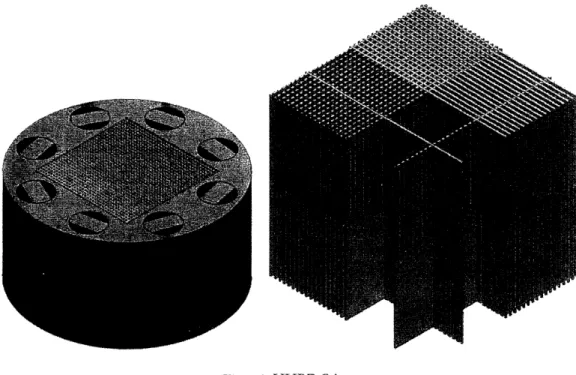
FIGURE 8: UHPDC LAYOUT ... 37
FIGURE 9: CORE MULTIPLICATION FACTOR AS A FUNCTION OF CORE DIMENSION ... 38
FIGURE 10: REACTIVITY HISTORY FOR THE HEU UHPDC . ... 39
FIGURE 11: EFFECT OF CONTROL DEVICE ON BOL EIGENVALUE ... 40
FIGURE 12: SIMPLIFIED SELENE SCHEMATIC (NOT-TO-SCALE) ... 45
FIGURE 13: IDEAL SODIUM RANKINE CYCLE (EXTRAPOLATED) [TODREAS, ET AL.] ... 49
FIGURE 14: UNIT CELL SCHEMATIC ... ... 52
FIGURE 15: AXIAL UNIT CELL MODEL ... 66
FIGURE 16: RADIAL PLANE CORE MODEL ... 67
FIGURE 17: ISOMETRIC VIEW OF FUEL PLATE ASSEMBLY ... 67
FIGURE 18: PARTIAL REACTIVITY HISTORY FOR SELENE-IO10 ... 68
FIGURE 19: REACTIVITY HISTORY FOR SELENE-30 ... 70
FIGURE 20: NORMALIZED FLUX PER UNIT LETHARGY FOR SELENE-10-HT ... 73
FIGURE 21: AXIAL POW ER SHAPE ... 74
FIGURE 22: VARIATION OF THE SODIUM DENSITY WITH AXIAL POSITION ... 75
FIGURE 23: ZONED FULL CORE RADIAL SLICE ... 76
FIGURE 24: RADIAL POWER DENSITY VARIATION ... ... 77
LIST OF TABLES
TABLE I: CYCLE CHARACTERISTICS ... 17
TABLE II: SENSITIVITY ANALYSIS ... 18
TABLE III: PERFORM ANCE M AP ... 31
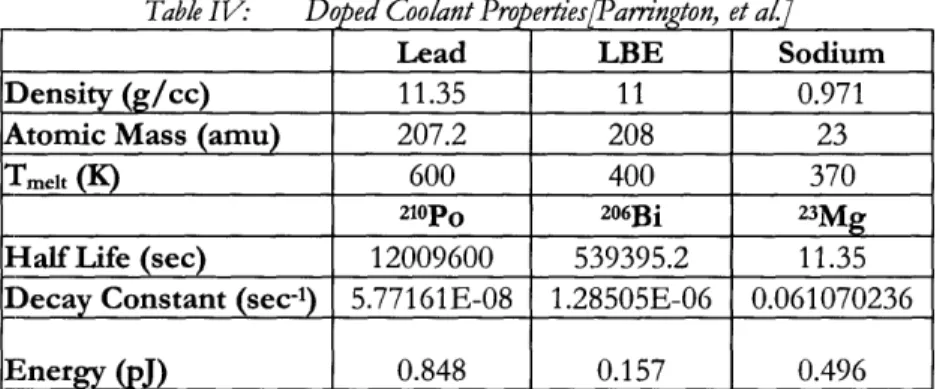
TABLE IV: DOPED COOLANT PROPERTIES[PARRINGTON, ET AL.] ... 35
TABLE V: RGP AND HEU COMPARISON ... 41
TABLE VI: POWER CONVERSION TECHNOLOGY COMPARISON ... 43
TABLE VII: SATURATED SODIUM PROPERTIES ... ... 54
TABLE VIII: SELENE- O-LT OPERATIONAL PARAMETERS ... 61
TABLE IX: SELENE-10-HT OPERATIONAL PARAMETERS ... ... 62
TABLE X: SELENE-30 OPERATIONAL PARAMETERS ... 62
TABLE XI: SELENE LIFETIME SU MMARY . ... 70
TABLE XII: RADIAL PEAKING FOR UNIFORM ENRICHMENT ... 76
TABLE XIII: RADIAL POWER PEAKING IN THE ZONED CORE ... 77
TABLE XIV: HOT CHANNEL RESULTS FOR VARIOUS RADIAL POWER PEAKING FACTORS ... 79
Author's Note
The author would like to thank Professor Andy Kadak and Professor Michael Driscoll for their guidance and support in
completing this thesis. Thanks are also extended to Professor Mujid Kagimi, Professor Neil Todreas, Professor Jeffey Hoffman, and Dr.
1.0 Introduction
For future space exploration initiatives, large power systems will be required. Specifically for a manned mission to Mars, systems capable of generating several megawatts of electric power will be required. The goal is to develop space nuclear power technologies that will facilitate these initiatives.
1.1 Background
As part of a design course at MIT, an ultra high power density plutonium fueled nuclear reactor core was developed for use in an electric powered propulsion system. The reactor was cooled with molten salt, which was passed through an internal radiator. The power conversion unit was based on next generation thermo-photovoltaic (TPV) technology. The core lifetime was approximately 600 EFPD and the system produced 4 MW of electric power [Dostal, et al.].
For several reasons, this technology will not be implemented in the short term for space exploration. Firstly, it requires TPV to operate at temperatures 100 K higher than what they have been demonstrated to operate at on Earth, and they must operate at higher efficiencies, requiring very high coolant temperatures; hence, the corrosive aspects of the molten salt would require development of next generation structural materials for the radiator.
To facilitate the mission to Mars initiative, a lower power system based on more conventional or state of the art technologies is desired. The scope of the current body of work examines the use of more traditional power conversion technologies to achieve a mid-range power system for short-term space exploration applications that are scalable to high power operations with incremental improvements.
This thesis examines both the thermal hydraulic and physics aspects of designing a nuclear electric power system for space applications. In the physics area, work was done to design a highly enriched uranium (HEU) fueled ultra-high-power-density core (UHPDC). In the area of thermal-hydraulics, the front end of the current work has been to evaluate alternative power conversion schemes. Gas and liquid metal coolants were evaluated in a matrix of power conversion options. Based on simplified analyses, the most promising power conversion strategies were identified.
In any space application, minimizing reactor mass is an ever present objective. However, mass is not the only concern. The motivations behind designing the plutonium core were twofold. Plutonium has a lower critical mass than uranium, and therefore, allows for a smaller core. Reactor Grade Plutonium (RGP), or the spent fuel plutonium from a LWR, was the proposed fuel material, in the form of PuC. RGP is comprised primarily of 239pu, 240Pu, and 241Pu. 239Pu and 241Pu have very large fission cross sections at both thermal and fast neutron energies. 240Pu, while fissionable in a fast spectrum, is also a fertile material. The RGP core had a relatively shallow reactivity swing through life because uneventful capture in the plutonium isotopes did not reduce the effective inventory of "fissionable" materials.
With HEU fuel, the BOL core must be loaded with excess reactivity to accommodate for the burnup of fissionable 235U, and though this is also the case with RGP fuel, the excess reactivity required is greater. This is because 235U capture produces 236U, which is not as likely to fission as the fertile plutonium isotopes. The greater BOL reactivity complicates the control mechanism design. The design of the HEU core will focus on core dimension requirements, lifetime studies, and design of the reactivity control mechanisms.
The thermal-hydraulic analyses conducted were simplified. Comparisons of potential power cycles were carried out. Previous work has looked a plethora of different options. Static and dynamic power conversion alternatives were explored.
Static conversion refers to power conversion units (PCU) without moving parts. These include thermionic converters (TIC) and thermo-photo-voltaics (TPV). Aside from being simpler, these PCU options also generate DC power.
Dynamic conversion refers to PCUs with moving parts. The primary examples are Stirling, Rankine, and Brayton cycles, which convert the working fluid heat to mechanical energy, which is then converted to AC power.
Since most devices rely on DC power, and moving parts typically reduce system reliability, space reactors will most likely rely on some form of static, direct power conversion technologies. However, static conversion technology is not very mature. TIC have been demonstrated to operate at -15% efficiency at temperatures of -1200 K, whereas TPV converters have shown -20% efficiency at much lower temperatures. In either case the efficiency is heavily dependent on temperature.
For high power applications it is not certain that low efficiency static conversion systems will work, or that the space power system can operate in the required temperature regimes. Therefore, dynamic options such as those listed above must be considered.
The overall objective was to develop a conceptual design of a nuclear space power "package." The package is the reactor and the PCU. The reactor is a HEU fueled UHPDC similar to the RGP fueled UHPDC designed previously at MIT. The PCU options were compared and a promising technology was selected for application in a package capable of producing at least 400 kWe with the ability to be scaled to the multi-megawatt regime.
The scalability of the different power packages was assessed and a conceptual design established based on the transformational nature of the more promising technologies.
Three power conversion technologies were evaluated and their properties are discussed in this thesis. TPV technology was already employed in a space reactor design conducted at MIT. TIC is similar to TPV in that TIC is also static and direct. Therefore the tradeoffs between TIC and TPV were evaluated to understand the range of applicability for TIC.
Dynamic power conversion approaches were also evaluated. A reference Brayton cycle (argon working fluid) and a reference Rankine cycle (sodium working fluid) were compared. These two cycles in particular were examined because of their scalability. Each of these dynamic cycles offers potential for multi-megawatt power as the temperature and pressure of the cycles are increased.
This thesis will describe the simple argon Brayton cycle, as well as power regimes where the cycle is competitive. The scalability of the cycle is assessed by determining the work that can be attained from the cycle with temperatures of the order of 1200 K. Higher temperatures require research into materials development to assure systems reliability. The cycle temperatures required to attain approximately 3 or 4 MW are also assessed. For the argon Brayton cycle, analysis has shown that temperatures of the order of 2200 K are required to reach the multi-megawatt regime.
The simple sodium Rankine cycle is a more promising alternative in terms of dynamic power conversion. Analysis of this cycle shows very promising results at low temperature and pressure (as much as 1 MW can be achieved in the 1200 K temperature range). The distinctive properties of
sodium allow for easily scaling the power to -3 MW with coolant temperatures on the order of 1500 K at - 10 atm of pressure.
The body of this thesis will describe the argon Brayton cycle. The Brayton cycle is the proposed power conversion technology employed for the SAFE 400 program. Secondly TIC are described with respect to novel approaches for implementation. Thirdly, the sodium Rankine cycle is examined. The promising results of the sodium Rankine cycle analysis motivate work on enabling technologies to avert problems with liquid/vapor metal coolants with regards to reactor startup.
Particularly, coolant freezing was identified as a potential concern with regards to reactor startup. The reactor must be launched to achieve a "nuclear safe" orbit before operation can begin. A "nuclear safe" orbit is defined as an orbit where the orbit will not degrade. The reactor should not be operational, thus not producing radioactive fission products, until it is a sufficient distance from the Earth to ensure that the system will not reenter the atmosphere.
In delivering a liquid metal cooled system to this orbit, and assembling the power package with other components, steps must be taken to ensure that the coolant does not freeze before the reactor can be started. The novel approach of radioisotope doping was considered and evaluated to assess the applicability to the sodium Rankine cycle as well as its applicability to other liquid metal cooled systems.
The UHPDC is considered for use with any of these systems. Though in the case for next-generation TIC the core will undergo major design changes, it is worthwhile to examine the reference core. RGP is already radioactive, as higher isotopes of plutonium undergo spontaneous fission, therefore, the reactor fuel poses a safety concern prior to launch.
Analyses conducted at MIT confirm that the radiotoxicity hazard of the UHPDC is comparable to the Cassini Radioisotope Thermoelectric Generator (RTG) powered probe. However, if HEU can be used as an alternative fuel form with little or no penalty in performance and mass, then it is worthwhile to use HEU fuel.
This thesis discusses the design changes made to the UHPDC core with sodium coolant to facilitate operation and control with HEU fuel as opposed to RGP fuel. Along with the design changes, there are details as to the changes made to the ex-core control mechanism. As a result of the design changes, the benefits of using RGP fuel can be assessed numerically in terms of mass, radiotoxicity, and simplicity of reactor control.
1.2 Scope of the Current Work
Based on the aforementioned analyses, the most promising power conversion technology and the adapted HEU UJHPDC were combined to form the basis for the SELENE design. The Sodium-cooled Epithermal Long-term Exploration Nuclear Engine (SELENE) is designed specifically to be scalable from low to high power with little or no changes to the system architecture. The low power variants are meant to act as transformational test beds to develop program experience and
technology demonstration.
Three variants on the SELENE concept were designed based on thermal hydraulic and physics models for the reactor core. Thermal hydraulic models were used to evaluate the core under accident conditions and coupled with physics codes to determine a variety of nuclear design products and operational parameters for the various systems.
Lastly, the core was analyzed to determine power reactivity feedback coefficients and response to potential launch accidents. Overall, the goals for system scalability and safety are simulataneously met by designing the core with a reactivity-power coefficient of essentially zero.
1.3 Organization of this Thesis
This thesis will first describe in detail the simplified analysis used to compare the competing power conversion technologies in Chapters 2, 3, and 4. Based on the results of the simplified analyses, the sodium Rankine cycle appears very promising. To address the concerns with coolant freezing, radioisotope doping was evaluated and will be discussed in Chapter 5. Chapter 6 discusses the trade-offs between RGP and HEU fuel and discusses the required design changes to use HEU fuel.
The first eight chapters form the basis of the conceptual design of the SELENE system: the sodium Rankine cycle combined with the HEU UHPDC. The conceptual design is summarized in Chapter 7. The remainder of this thesis then describes more specifically the sodium Rankine cycle (Chapter 8) and the models used for thermal hydraulic analysis of the core (Chapter 9). The thermal hydraulics models are then used iteratively with the reactor physics models to evaluate design alternatives. The physics of the reactor core are discussed in detail in Chapter 10. Based on the power profiles and thermal hydraulics model, hot channel analyses were conducted to ensure fuel integrity under steady state operation as shown in Chapter 11.
Chapters 12 and 13 discuss the system response to accidents. The reactivity-power coefficient was calculated and verified to be essentially zero. Potential launch accidents were also evaluated, specifically for the case where the system is immersed in water. Chapter 14 provides a summary of the key aspects of the project, and the Appendices are included in Chapter 16.
2.0 Argon Brayton Cycle
A simple model was developed to explore the applicability of argon gas Brayton cycles for space reactor applications. Simple analyses were conducted to explore the power limitations for the cycle and establish power regimes were the cycle has competitive advantages verses direct energy conversion schemes.
Midrange power reactor applications are of current interest for supporting the Mission to Mars initiative. To support these applications, the current work examines the applicability of a simple argon Brayton cycle for space reactor power conversion. Midrange refers to power levels between 200 kWe to 1 MWe.
Brayton cycles are of particular interest because of the possibility of operating at very high temperature. Cycle heat rejection is limited to radiation losses, and therefore, higher fluid temperatures in the cold leg are preferred to maximize the useful work.
Ultimately, any cycle is limited by the Carnot efficiency, and therefore, cycles that operate at high cold leg temperatures relative to the hot leg will operate at low efficiencies. Cycle analysis, therefore, is aimed at arriving at maximum net work, which is often far from optimum efficiency. Additionally, to ensure lightweight and high system reliability, simple cycles are preferred.
2.1 Methodology
The argon simple Brayton cycle is analyzed based on a list of simplifying assumptions. Firstly, no consideration is currently given to the size or mass of components. In most space reactor applications the radiator and associated armor accounts for a large fraction of the total PCU mass. Secondly, an ideal gas approximation is used to determine the fluid thermodynamic properties.
To give a basis for the heat rejection limitations for the cycle, a radiator surface area of 180 m2 is assumed, and the armor emissivity is assumed to be 0.85. The cycle contains both a compressor and a turbine. In Brayton cycles the overall efficiency is fairly sensitive to these component efficiencies; each of these components is assumed to have an efficiency of 0.90.
Further assumptions are made to simplify the thermodynamic analysis, firstly, an ideal gas approximation is used. Secondly, constant specific heat is assumed. Fluid properties (k = 1.68 and cp = 520.5 J/kgK) are taken at a temperature of 700 K, though the fluid will likely be at temperatures in excess of 1400 K in the hot leg of the cycle. Since this analysis is meant to explore the applicability of the argon Brayton cycle, such simplifying assumptions will yield results that, while not being completely accurate, give an order of magnitude for achievable net work.
Pressure losses are also dealt with approximately using a 3-factor approach. In this case is assumed to be 1.05, though in a compact system with high velocity flows, this is likely to be somewhat higher. The simple Brayton cycle with losses is shown in Figure 1. Reference points are labeled 1-4.
Brayton Cycle
Using
Constant Specific Heats
w IM c Q) E a)D-entropy
Figure 1: Brayton Cycle Schematic
The pressure losses are accounted for using the following 3-factor formulation shown in Equation 1.
k-I
= P(1)
-PiP
3where, k is the ratio of specific heats for the gas, and p is the pressure at a particular state point.
2.2 Theory
Using simple relations, we can derive expressions for the net work from the cycle as a function of the hot and cold temperatures of the cycle. To achieve this, we calculate the cycle efficiency as a function of the temperature. Then, multiply the radiation loss term by a function of the efficiency to determine the net work from the system.
A hot temperature (T3) is then specified. By differentiating the net work equation, one can find the cold temperature (T1) where the maximum net work is produced.
Let us first discuss the calculation of the cycle efficiency in terms of the turbine and compressor work per unit mass flow. The turbine and compressor specific work terms are given by Equation 2 for an ideal gas.
= WT = qTTp 3,_
=
c, T 1),h
-IP3
k
P~(rp--k'
k (Ip3)-T-
(2)
, k
P4J
CP cp =WCP th2 -1 = 1 CPI7c
where, cp is the specific heat of the gas at constant pressure, assumed constant, V1is the component efficiency, and
rp is the cycle pressure ratio.
One can likewise define the specific reactor power, or reactor power per unit mass flow, given in Equation 3
qRX
=C
(T3
- T2)=c
pT3
T
- 1r k (3)The net work is defined as the difference between the turbine and compressor work. The cycle efficiency is the ratio of the net work to the reactor power.
WNET = WT WCP
14NET (4)
7=
qRxThe efficiency and the total heat rejection can be used to establish the actual net work and the mass flow rate. The heat rejection is given by a formulation of gray-body radiation shown in Equation 5.
Qrej =
o-A&4
Tc4WNET = 1 Qr
(
where, Tc is the average temperature of the fluid in the radiator, o is the Steffan-Boltzmann constant,
s is the emissivity, and A is the radiator surface area.
The mass flow rate is the ratio of the net work to the specific net work. The system has not been closed yet. First, the average fluid temperature in the radiator has not been established, and whereas this typically involves integrating over the flow, a simplistic approach to approximating this temperature is shown in Equation 6.
TC
2(T +
)=
2T3
1-7 1' r k-k1T-
(6)
The system has three remaining degrees of freedom, though two of these are the high and low cycle temperatures, the last is the operating pressure ratio. We can determine the optimum pressure ratio by maximizing the specific net work. For an ideal cycle the result is well known and is shown in Equation 7.
k
(,,
)ideal
=T
3)2(k-1)When the component efficiencies and pressure losses are included, the pressure ratio can be determined using the same procedure; the final result is slightly different, as shown in Equation 8.
k
(raP I 1T77CP,63
I
(8)Though the product of the component efficiencies will reduce the optimum pressure ratio, the inclusion of the pressure loss factor increases the optimum pressure ratio. Together these effects will reduce the optimum pressure ratio slightly. The real treatment is used for the current analysis.
The previous equations can be combined to give the net work as a function of the hot and cold temperatures and the pressure ratio. By using the optimum pressure ratio, one has an equation that gives the net work for a given hot temperature as a function of the cold temperature.
2.3 Results
A computer is used to solve the system of equations numerically. Though one can manipulate the formulas to achieve a single closed form equation eliminating all variables besides the temperature limits and the net work, this approach allows one to simultaneously calculate a host of other parameters of interest.
The approach also allows for quick sensitivity analyses by changing temperatures and other input parameters. Ideally, the cycle should be relatively insensitive to small perturbations in the input parameters. The susceptibility of the net work is of particular interest once temperature limits are established.
Based on the input parameters, such as gas properties and component efficiencies, discussed above, the net work is calculated for hot leg fluid temperatures of 1200 K, 1400K, and 1600 K as a function of the cold leg temperature; the results are shown in Figure 2.
The low (1200 K) hot leg temperature (LTH) cycle is analyzed for comparison purposes. The most promising option here is near the mid (1400 K) hot leg temperature (MTH) cycle. The high (1600 KI) hot leg temperature (HTH) cycle is analyzed as a potential option for future application.
1000
800
600
F
&-II-w
z:
400
200
n300
400
500
600
700
800
900
T1
[K]
Figure 2: Net useful work as afunction of minimum cycle temperature.
The figure clearly summarizes the achievable power for each temperature limit. For the LTH cycle, the maximum useful work is approximately 300 kW; for the MTH cycle, 550 kW; and for the HTH cycle, 950 kW.
The cycle characteristics for each of the proposed temperature limits are summarized in Table I.
Table I: Cycle Characteristics
T1 (low) T2 T3 (high) T4 Net Work Thermal Efficiency
Mass Flow Rate Reactor Power Pressure Ratio 400 K 665 K 1200 K 830 K 300 kW 0.20 5.5 kg/s 1.5 MW 3.18 473 K 780 K 1400 K 970 K 560 kW 0.19 9.1 kg/s 3.0 MW 3.13 533 K 890 K 1600 K 1100 K 950 kW 0.20 13 kg/s 4.9 MW 3.18
A quick sensitivity analysis is conducted on the MTH work to small changes in the assumed parameters.
cycle to determine the susceptibility of the net
Table II: Sensiivitv Analysis
Nominal
Parameter Value New Value Wnet Susceptibility
k 1.68 2 559.1 %/A Wnet / %/ k 0.00 cp 520.5 550 559.1 %A Wnet/ % cp 0.00 Y]T 0.90 0.85 467.2 %A Wnet / %A T 2.96 -]CP 0.90 0.85 485.6 %/a Wnet / %A r]CP 2.37
r3
1.05 1.1 378.7 %A Wnet / %A -6.78 A 180 170 528.0 %/ Wnet / % A 1.00 T1 473 463 559.0 %/ Wnet / %A T1 0.01As can be deduced from the sensitivity study, the net work is most susceptible to changes in the component efficiencies and the pressure losses. Though the specifics of the design will dictate the final performance, in any case, it appears that the argon Brayton cycle can produce net work output on the order of several hundred kW.
2.4 Discussion
The results summarized by Figure 2 show a general trend in the net work as a function of the minimum cycle temperature. The curves are initially positively sloped. In the low temperature ranges, the improvement in heat rejection from raising the temperature trumps the loss in efficiency with increasing cold leg temperature.
Above the maximum point, the efficiency is reduced dramatically with increasing temperature, eventually yielding negative work. This decline occurs because the turbine work becomes increasingly small compared to the compressor work.
The formula for the optimum pressure ratio sets a maximum cold leg temperature. The ratio of pressures at the turbine inlet and outlet must be at least unity for there to be any turbine work. Therefore, the range of T1is specified in terms of T3as shown in Equation 9.
T
< r/TcP T (9)
When this condition is met, there is no turbine work. For the "maximum" temperature, the cycle has negative efficiency because of compressor work.
The results also indicate that increasing the high temperature of the cycle by 200 K approximately doubles the attainable net work from the cycle. This being the case, the argon Brayton cycle offers the potential to produce greater than 1 MW of power at very high temperatures (- 1700 K). However, more technology development in the area of high temperature materials will be required to deploy such a system.
The LTH and MTH cycles may both be deployed. The LTH cycle will be a demonstration of the Brayton cycle that can eventually be scaled up in power from 300 kW to 550 kW.
For precursory unmanned mars missions PCU requirements are on the order of 200 kWe. This is comfortably achievable with the LTH cycle, at potentially even lower temperatures. For future
mission plans, if the argon Brayton cycle is adopted as the key power conversion option, improvements must be made in materials research such that the cycle temperature can be increased dramatically without loss of structural integrity.
To achieve net work on the order of 3 to 4 MW, the high temperature of the cycle must be greater than 2000 K. With a high temperature of 2200 K, the maximum net work is 3.4 MW with a low cycle temperature of 740 K and 19% thermal efficiency.
Based on the sensitivity analysis, component efficiencies on the order of 90% are required and fractional pressure losses must be kept to a minimum. This motivates the use of a high pressure cycle.
3.0 Thermionic Power Conversion
Thermionics refers to the direct conversion of heat to electric current. Thermionic converters (TIC) work by using a high temperature source to liberate electrons from an emitter, which then preferentially flow towards a cooler collector. Though these devices operate at relatively low efficiencies up to temperatures near 1200 K, the potential to achieve efficiency on the order of 25% seems reasonable at emitter temperatures on the order 2200 K.
Previous analysis of a simple Brayton cycle for potential deployment with space reactors shows that 2200 K is the hot leg temperature required to generate 3 - 4 MW of electric power. Thermionics are compared with the Brayton cycle to establish the limits of useful work. Two scenarios are evaluated. A small power unit using a liquid metal cooled reactor is proposed. The first system will operate with a single layer thermionic power conversion system. A second, larger power unit is proposed, though without giving thought to the coolant, as thermionics can be utilized with direct contact with the fuel cladding. The second system makes use of dual layer thermionic converters where the collector of the first layer heats the emitter of the second layer.
The first system will operate between temperatures of 1200 K and 750 K. For these temperature ranges, lead efficiencies of 12.4% or higher have been demonstrated experimentally using closed space cesium converters [Fitzpatrick, et al.]. For higher emitter temperatures (2200 K) barium-cesium converters have been demonstrated to operate in excess of 12% efficiency at a collector temperature on the order of 1200 K. The second scheme layers the converters so that the barium-cesium collector acts as the heat source for the emitter for a closed space barium-cesium converter.
In either case the heat rejection for a given radiator surface area will be the same. Therefore, the useful work of the dual layer system will be approximately 2.5 times the useful work from the single layer system. Since two designs are being proposed, they will be discussed separately, extrapolating the results from the single layer design to a dual layer design.
3.1 Single Layer Design
The single layer design uses a liquid metal cooled fast reactor to act as a heat source for a thermionic emitter. The hot coolant at the reactor outlet will flow through an inner annulus near the periphery of a cylindrical power package.
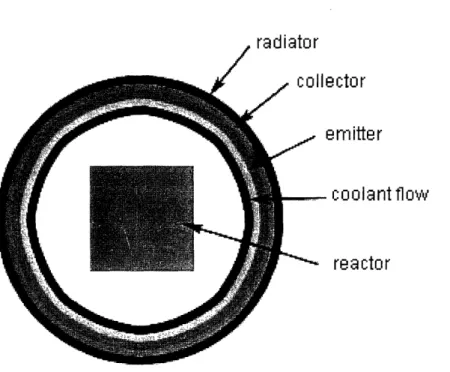
The power package is the combined reactor, radiator, piping, and shielding. The power package is armored with a high emissivity material that duals as a radiator. The reactor is located in the center of the cylindrical package. The collector of the thermionic conversion is located along the inner wall of the radiator. Figure 3 shows a simple schematic of the power package.
/ radiator
collector
/
emitter
coolant flow
- I ,U , a Lu I
Figure 3: Diagram of the Single Layer Thermionic Conversion Power Package.
At atmospheric pressure, lithium has a boiling temperature of 1600 K. Since lithium has been proposed as an alternative coolant for the MSFR in previous work done at MIT, it is a reference coolant for this design. As an initial reference, closed space cesium converters are selected because they operate in the collector temperature range of interest.
The coolant temperature varies between 1200 K and 1300 K. The temperature range is selected firstly to be compatible with the converters, but secondly such that the difference between the coolant temperature at the core outlet and the boiling temperature of the coolant is - 3 ATcore.
Thermoelectric-Electromagnetic (TEM) pumps are the reference liquid metal pumps for the power package. They are self regulating and self powered; these type of pumps have been tested for high temperature lithium (1400 K) and were suggested for the MIT space reactor design (MSFR) [Dostal, et al.].
Assuming negligible losses to pumping power, we can use the lead efficiency as the conversion efficiency. The assumption is reasonable because increasing the coolant temperature slightly will not compromise the relatively large margin, and the pumps operate directly from the heat in the molten metal flow. Therefore, increasing the temperature at the outlet will compensate for pumping losses.
We can calculate the radiated heat based on the assumed radiator surface area, which is the same as ]?proposed for the argon Brayton cycle (180 m2). The emissivity is assumed at 0.85 and the radiator
temperature is assumed to be the same as the collector temperature (750 K). The radiated heat is given by Equation 10.
Qrad = c,
AT4
where a is the Steffan-Boltzmann constant, s is the radiator emissivity,
A is the radiator area, and T is the radiator temperature.
Since we have assumed that pumping power can be easily compensated for, it is neglected in the current analysis, and the conversion efficiency is given by the lead efficiency. For closed space cesium converters operating between 1200 K and 750 K the demonstrated efficiency is 12.4%.
The radiated heat is calculated to be 2.7 MW. The net work available from the converter is given in Equation 11, with the efficiency given as 12.4%. In this scenario the net work is the electrical power generated by the flow of electrons from the emitter to collector.
Wet W t Q,,d = 0.382MW
(11)
where W is the work, either net or turbine, and
vIL is the thermionic lead efficiency.
The thermionics look particularly attractive for the mid-range power applications. The single layer thermionic converter appears to be able to produce nearly 400 kWe of useful work with no need for moving parts or AC to DC conversion.
The thermionic: converter has a given maximum thermal power density of 2.2 W/sq-cm [Fitzpatrick, et al.]. To ensure that this limit is not breached we assume a converter area approximately equal to the radiator area and then add the radiated heat to the net work and assume that is the thermal power. The resultant density is approximately 1.7 W/sq-cm. Though this is below the limit, the margin is questionable given the simplifying assumptions.
:3.2 Dual Layer Design
The dual layered thermionic conversion system will look very different from the current system, though many aspects will remain the same. The dual layered approach "stacks" one thermionic material on another such that the high temperature collector heats the low temperature emitter of the second layer.
Barium-cesium converters operate a very high temperatures, yielding lead efficiencies of 12% - 15% with emitter temperatures of 2200 K and collector temperatures on the order of 1200 K. The high temperatures require novel approaches for heat removal from the reactor. Though this temperature was proposed for a high power argon cycle application, the need for ultra-high temperature materials may preclude the use of either scheme in the near future.
However, the high temperature collector of the barium-cesium can be near direct contact with the fuel inside the core. In that case, the fuel will exceed temperatures of 2200 K, however most ceramic fuel forms, UC in particular, have melting temperatures greater than 2600 K.
Pu--UC is the reference fuel form from the MSFR design, however, fuels with less egregious swelling properties are preferred in this application, so US and UN are proposed as alternatives.
The fuel heats the high temperature emitter directly; the rejected heat from the collector then heats the emitter for a low temperature layered converter. In this scenario, effective lead efficiencies of 25% are achievable, approximately double the efficiency in the single layered design.
Though the core and structures will be very different between the two designs, the radiator surface area limit still applies. Fuel elements will need to be designed to ensure that thermal power density limits of the barium-cesium and closed space cesium converters are not exceeded, additionally, fuel elements should be smaller to keep the fuel centerline temperature below the melting point with some margin.
A liquid metal coolant, most likely, will be used to cool the collector of the closed-space cesium converter. The coolant will then flow through a radiator. Ideally, the liquid metal will be near the liquid / vapor transition so that heat may be radiated with a near constant temperature.
Mercury, with a boiling temperature of 630 K at atmospheric pressure, should be considered as a heat rejection media. The liquid mercury coolant can enter the reactor core near the saturation
temperature, remove heat from the collectors at near constant temperature, and then radiate the heat through a standard radiator similar to the one described for the single layered design. However, to maintain collector temperatures near 750 K, the mercury coolant will most likely be pressurized.
If we are limited to the same radiator area and temperature, the radiated heat will be the same, however, since the efficiency has at least doubled, the useful power increases from 400 kWe to 900 kWe.
3.3 Direct Contact Single Layer
Since the work output is intimately related to the radiated heat, and the radiated heat is heavily dependent on the temperature of the heat rejection, a single layer, direct contact TIC may also prove useful. To this end, we analyze a single barium-cesium converter in direct contact with the fuel cladding. In doing so, if a coolant with a phase transition near 1200 K (sodium near atmospheric pressure) could be used, then the effective temperature of the heat rejection would be 1200 K. The heat rejected becomes 18 MW. The efficiency drops to -12 - 15%. If we assume 15% lead efficiency and neglect pumping losses, the net cycle work can be approximated by Equation 12.
Wnet " Wout = Qrad = 0185 (18MW) 3MW (12)
1 - rL 0.85
If a lead efficiency of 12% is assumed, the work output drops from roughly 3 MW to 2.5 MW. This indicates that the direct contact, single layered concept can yield multi-megawatt work.
The core must be redesigned to fit these specifications. A honeycomb fuel design may prove impossible to couple with this concept. Therefore, the core will most likely be an array of plates with the cladding of each plate coated with TIC. The collectors of the TIC layers form the channel walls for coolant flow. Figure 4 illustrates a conceptual unit cell for the single layer core fuel plate.
coolant (satuaturated
sodium)
PuC liiel
Figure 4: Conceptual Fuel Platefor Single Layer, Direct Contact TIC
The collector of the barium-cesium TIC will most likely require some cladding. Ideally this cladding will have good thermal conductivity to maintain the collector temperature at 1200 K and the TIC cladding may require two layers, each being good thermal conductors, while only one is a good electrical conductor. SiC for instance, may prove a necessary coating material for the TIC / Coolant interface cladding.
3.4- Comparisons
Fuel swelling will be a concern when it comes to the integrity of the thermionic converters, so work must be done to evaluate potential fuel materials and cladding candidates if thermionic conversion is to be pursued for higher power applications.
Compared with the Brayton cycle, the work output is higher for a comparable coolant temperature, however, there are concerns about the direct contact with the fuel, and the required fuel operating conditions. There is also a concern about the TIC efficiency after irradiation. The heat flux limit on tile TIC materials means, particularly for a UHPDC, the TIC will be distributed through the core, in most likely a plate or pin configuration. The materials are therefore exposed to a hard neutron flux.
Additionally, some attention must be paid to the temperature profile in the radiator and along the collector of the TIC. In core, the power profile is relatively flat, and the TIC emitter will most likely have a relatively flat temperature profile axially. The collector of the TIC at the core outlet may have an increased temperature that inhibits its operation.
3.5 Conclusions
In the mid-range power applications thermionics are competitive with Brayton cycles. The thermionic conversion schemes have the benefit of no moving parts and direct energy conversion. Whereas coolant freezing may pose a concern for a liquid metal cooled or liquid/vapor metal cooled reactor, Brayton cycle startup for the power package may prove to be a complicated procedure.
In the mid-power range, either system is limited by the temperature of materials. At gas temperatures of 2200 K, the argon Brayton cycle appears capable of producing useful work in the multi-megawatt range. However, little consideration was given to the heat removal aspects of high temperature gas coolant in the MIT UHPDC concept. The thermionic dual layered concept, while requiring similar fuel temperatures, does not appear to pose an insurmountable core design problem.
The single layered, direct contact, high temperature scheme, though less efficient than the dual layered concept appears to be able to produce power in the multi-megawatt range. This is an initially unexpected phenomenon. If the heat rejection temperature is roughly isothermal throughout the
radiator, as may be the case for a coolant at saturation, then this concept seems very promising. Sodium may be employed as a potential coolant in this case, Sodium has a saturation temperature of nearly 1200 K at approximately 1.05 atm.
4.0 Simplified Sodium Rankine Cycle
Sodium Rankine cycles are proposed for advanced space power applications. Particularly, sodium is useful because of the high boiling temperature at low system pressure, its neutronic inertness, and its heat removal properties.
For midrange power applications (several hundred kilowatts), it is advantageous to utilize the phase transition temperature in the radiator. When rejecting heat at a constant temperature, one makes the most effective use of the radiator area. Metals, historically, have been proposed for Rankine cycles for power conversion units in space applications. Both sodium-potassium eutectic (NKE) and mercury cycles have been proposed as early as 1950 [Deickamp].
This analysis is meant to form a basis for comparison with Brayton and thermionic power conversion options and establish the limiting amount useful work based on simple assumptions about the space power package.
4.1 Simple Rankine Cycle Specifications
The upper pressure limit is set such that sodium bulk boiling will occur near 1100 K. This pressure is slightly greater than atmospheric pressure. The lower pressure in the cycle will be established by the analysis, particularly given a limit to the turbine exit quality.
The turbine is assumed to have a component efficiency of 0.85 and the pumps are not explicitly treated in the analysis of the efficiency. For sodium, TEM pumps or a similar variation may be employed that will draw heat directly from the flow. At the current stage, no consideration is given to the exact design of these components.
Heat is rejected via a radiator with a high emissivity coating (0.85) and a surface area of 180 m2. The temperature of the surface at steady state is assumed to be approximately equal to the saturation temperature of the sodium coolant at the low pressure end of the cycle.
Calculations will be performed for an ideal turbine, then the effect of real components will be assessed by varying the turbine efficiency between 0.95 and 0.80. Though 0.85 is the assumed efficiency for the design, the susceptibility of the design reference to this parameter is of key interest.
4.2 Ideal Analysis
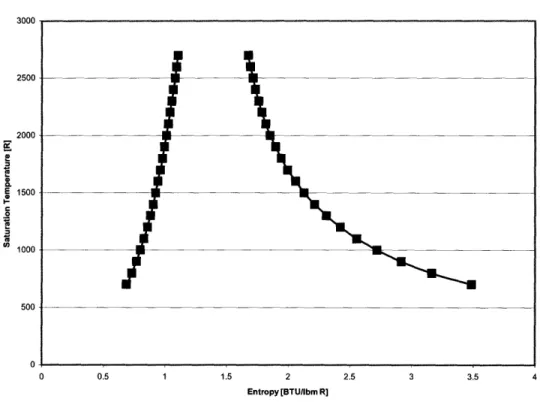
Sodium saturation properties are plotted in Figure 5. The range of interest is the temperature range below 2100 R (1167 K). Some simplifications are made in the calculation of the net work. Firstly, we assume that only a small fraction of the net work is used for pumping, therefore, the reactor inlet enthalpy is assumed to be the same as the radiator exit enthalpy. Calculations of the pumping power will be used to justify this assumption, though for liquid metals pumping power tends to be small.
Saturation Lines for Sodium dUuu 2500 2000 E 1500 1000 500 0 0 0.5 1 1.5 2 2.5 3 3.5 4 Entropy [BTU/Ibm R]
Figure 5: Sodium Saturation Properties
As an initial design iteration, the components are assumed to be ideal, in other words, the entropy of the coolant does not change when pressurized in the pump or expanded in the compressor. A real analysis will be done to show the sensitivity of the cycle to the efficiency of components.
Without details of vapor metal turbine design being accounted for, we set a limit to the exit quality of the turbine at -80%. However, this refers only to a design space, ideally the turbine exit quality will be in excess of 90%.
To calculate the heat rejected, one assumes a fixed radiator area of 180 m2, and that the surface temperature is the same as the coolant saturation temperature at the low pressure of the cycle. The heat is then rejected at a constant temperature at steady state. By making use of the phase transition in the radiator, one makes the fullest use of the area of the radiator.
The heat rejected is therefore a function of the low pressure of the cycle, and likewise the exit enthalpy of the turbine. The limit on the exit enthalpy sets a limit for the minimum pressure and likewise on the saturation temperature. Equation 13 gives the heat rejected from the cycle (assuming an effective heat sink temperature of 0 K).
Qrej = cGA(TL ) (13)
where c is the Steffan-Boltzmann constant, s is the radiator emissivity,
A is the radiator area, and T is temperature.
----Here the LP denotes the low pressure of the cycle, and SAT denotes saturation.
Figure 6 shows a plot of the turbine exit quality for a turbine inlet pressure of 15 psia as a function of the turbine outlet pressure.
Turbine Exit Quality as a Function of Turbine Outlet Pressure
1.2 0.8 7i (J0.6 0.4 0.2 0 0 1 2 3 4 5 Pressure (psia) 6 7 8 9 6 7 8 9
Figure 6: Exit Quality vs. Outlet Pressure.
By demanding exit qualities in excess of 80%, the design space is immediately limited to pressure in excess of 1 psia. If we further limit the exit quality to 90%, the design space is limited to turbine outlet pressures of 5 psia or greater. For the purposes of further analysis, the design space of short term interest will be for turbine outlet pressures on the order of 5 psia or slightly lower (depending on turbine efficiency).
The ratio of the turbine work to the reactor power is also calculated; for low pumping power this ratio is approximately equal to the cycle efficiency. This ratio can be directly calculated from the saturation properties of the sodium at the inlet and outlet pressures. The turbine work is then calculated given the heat rejected from the cycle.
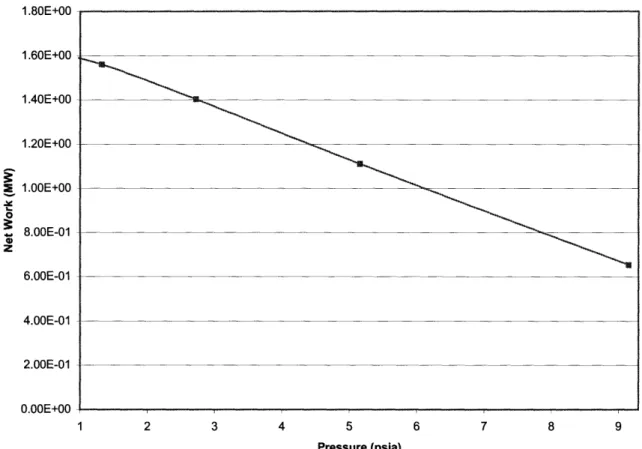
Given the enthalpy drop across the turbine, and the turbine work, the mass flow rate can be calculated. The required pumping power, neglecting any losses, can then be calculated as the product of the volumetric flow rate and the pressure rise through the pump. The pressure rise is assumed to be approximately equal to the pressure drop across the turbine (neglecting losses). Subtracting the pumping power from the turbine work yields the net work. Figure 7 shows the net work as a 10
I 1____1 1_______11^___I _1__·1__1_____l__l 1
0
function of the outlet pressure, over a range from 1 psia to 15 psia (roughly turbine outlet qualities > 80%).
Turbine Work lest Pumping Power as a Function of Turbine Outlet Pressure
- -- -. no 1 .uI-t+uu 1.60E+00 1.40E+00 1.20E+00 E 1.00E+00 0 8.00E-01
z
6.00E-01 4.00E-01 2.00E-01 0.00E+00 1 2 3 4 5 6 7 8 9 Pressure (psia)Figure 7: Net Work vs. Outlet Pressure
The net work decreases linearly with the pressure, which is expected. The exit quality is not very sensitive to outlet pressure for high pressures, however, the turbine work is incredibly sensitive; therefore, we define the minimum pressure acceptable given a limit by the turbo-machinery. Therefore, two potential cycles are proposed: a dry and a wet cycle. The dry cycle exit quality is taken at - 91% and the wet cycle exit quality is taken at - 78%.
For this scenario (the dry cycle) the cycle has a relatively small efficiency of only 9%, the net work is 1.1 MW, the turbine outlet pressure is 5.15 psia and the pumping power accounts for only 200 W (0.02% of the turbine work). The pumping power is calculated as the product of the saturated liquid specific volume, the pressure rise, and the mass flow rate. The radiator rejects approximately 10 MW of heat at a temperature of 1055 K. The core power is therefore approximately 11 - 12 MWth.
If the limit of the exit quality is relaxed to slightly lower than 80%, the wet cycle may be employed. The efficiency of the wet cycle is approximately 22%, and the net work is 1.6 MW. The radiator rejects 5.4 MW of heat at 890 K and the reactor power is reduced to 7 MWth. In the real analysis, accounting for turbine efficiencies, the exit quality will be higher than calculated for the ideal turbine.
Therefore, the limits given by the wet cycle establish an expected range of values for the work attainable from the real cycle.
The saturated vapor line on the T-s diagram is relatively steeply sloping, so given a limit on the turbine exit quality, increasing the system pressure can give an increase in the work. If the system temperature can be increased above the artificially imposed limit of 1167 K the attainable work can be increased with little concern to the turbine exit quality limit.
4.3 Real Analysis
Turbine efficiencies between 0.85 and 0.95 were tested. Comparisons were carried out on the basis of constant turbine exit quality. A limit of turbine exit quality of 0.90 was assumed. The pumping power for the sodium is neglected. The efficiency and turbine work are smoothly varying with quality; therefore, the turbine work and efficiency are calculated based on a linear interpolation on exit quality.
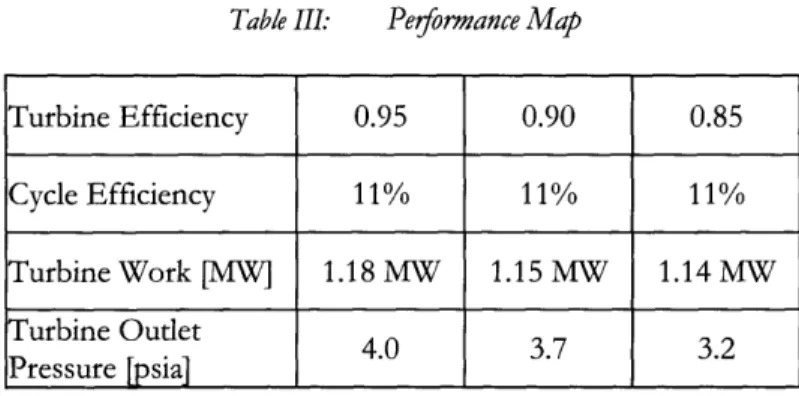
Table III summarizes a performance map for the turbine efficiency. In each case the upper temperature limit of 1167 K is assumed.
Table III: Perfrmance Map
In each case, the turbine work varies between 1.14 and 1.18 MW. The calculation shows that the cycle output is not strongly dependent on the turbine efficiency; however, the turbine outlet pressure is more sensitive to the turbine efficiency and varies between 4 and 3 psia.
In all cases for 1 MW of power, the reactor power is approximately 10 MWth. This is inside the design envelope of the MIT UHPDC.
4.4 High Temperature Cycle
If we allow the cycle to go to higher temperatures, and thus higher pressures, one can harness more net work from the cycle. The sodium Rankine system is highly scalable because of the vapor saturation line, therefore, higher turbine inlet temperatures can be used with greater pressure drops and still maintain the turbine exit quality above 0.90.
A simple case is taken with the turbine inlet temperature equal to 1500 K (saturated) and the turbine efficiency is 0.90. If one expands from 150 psia (-10 atm) to 56 psia (-4 atm) in the turbine, the saturation temperature of sodium at the turbine outlet is approximately 1300 K. The exit quality in this case is 89.7/o. The turbine work is 3.4 MW.
The high temperature cycle efficiency is 12.8%. This is better than the TIC single layer, direct contact scheme. The temperature of heat rejection is higher, and the efficiency is comparable.
Turbine Efficiency 0.95 0.90 0.85
Cycle Efficiency 11% 11% 11%
Turbine Work[MW] 1.18MW 1.15MW 1.14 MW
Turbine Outlet 4.0 3.7 3.2
4.5 Discussion
Additional problems must be addressed before applying the sodium-cooled reactor. Sodium has a violent exothermic reaction with water; therefore special attention must be paid to H20 immersion
accidents. Previous work at MIT showed that H20 immersion for the UHPDC had a positive
reactivity effect, and coupled with the potential for a sodium-water chemical reaction, this accident may have implications that preclude the use of this cycle.
If the power package and armor are designed to mitigate this particular accident, then the sodium Rankine cycle appears at least on par with the argon Brayton cycle. Though the two seem to be competitive at relatively low temperature (1200 IK), the liquid metal coolant more easily facilitates the use of a UHPDC type reactor, because of the superior heat removal properties of the liquid / vapor metal.
In the higher temperature regime (1500 K), the sodium cycle outperforms the high temperature TIC concept. However, this marginal benefit may not outweigh the TIC advantage in terms of system reliability. The TIC concept requires neither moving parts nor AC to DC power conversion.
5.0 Radioisotope Doping to Prevent Coolant Freezing
One of the transformational technologies identified for space nuclear power conversion is a liquid/vapor metal Rankine cycle. A potential difficulty with deployment of such a technology is the startup of the reactor where the coolant may be frozen. To this end, a potential approach for averting coolant freezing is explored. A proposed solution to this problem is radioisotope doping, whereby the liquid metal coolant is mixed with radioactive isotopes to concentrations on the order of a few percent. The heat released by the decay of these isotopes may be sufficient to ensure the coolant does not freeze for a given time in space.
Specific examples are explored using simple analyses to determine if such a preventive measure is practical. Two types of metal coolants are examined, first lead or lead-bismuth eutectic (LBE) and secondly sodium or sodium-potassium eutectic (NKE).
5.1 Radioisotopes
For internal heating from radioactive decay, either
3P+
or a emitters are preferred. These two decay products will deposit most of their energy directly in the coolant. The isotopes that decay by means of' 3+ emission may be less effective than a emitters; however, in metal coolants the electron density is relatively high and an effective fraction may still be deposited. Furthermore, a emitters typically release more energy per decay than3+
emitters and have longer half lives.For lead cooled reactors, polonium 210 (210Po) is of particular interest for three reasons. First, it has relatively long half life (139 days) Second it emits a high energy a (5.3 MeV), and third, the decay product is 206Pb [Parrington, et al.].
Several isotopes of bismuth decay through 13+ emission. Bismuth isotopes may be of particular use in doping lead or LBE coolant. 206Bi and 205Bi are both of interest. Each emits positrons with 0.98 MeV of energy. The half lives are 6.243 days and 15.31 days, respectively [Parrington, et al.].
For sodium-cooled reactors, magnesium 23 (23Mg) is of interest. This isotope of magnesium 3+ decays to 23Na with a half life of 11.3 seconds. The
f3+
energy is 3.1MeV [Parrington, et al.].5.2 Analysis
To evaluate the effectiveness of a particular isotope, a heat balance is established where the radioisotope heating exactly balances radiation losses when the coolant is at the melting temperature. From this relationship, the break-even concentration of the doping radioisotope can be established..
The initial concentration of the radioisotope can then be inferred as a function of the time to freezing. In other words, if a time window is set, then the initial concentration of the radioisotope can be calculated.
The radiation losses are calculated the same as before assuming that the temperature of the radiator is the melting temperature at atmospheric pressure for either coolant, and a given radiator size of 180 m2. This condition is true at the onset of freezing. Atmospheric melting temperatures are used because liquid metal cooled systems tend to operate at pressures near atmospheric.
(14) Qloss = O'EA(Tm )4
where o is Steffan-Boltzmann constant, e is the radiator emissivity,
A is the radiator area, and Tm is the melting temperature.
The heat added by the decay of the radioisotope can be calculated based on the particle energy, the decay constant, the number density, and the coolant volume in Equation 15.
Qdecay = EVNV (15)
where E is the particle energy, X is the decay constant, N is the number density, and V is the coolant volume.
At breakeven these two quantities are the same. The number density of the radioisotope at breakeven is easily calculated in Equation 16.
N cA(Tm )4 (16)
EVA
However, the doping fraction, which is the ratio of the number density of the radioisotope to the number density of the nominal coolant, is the quantity of interest (given in Equation 17).
N
UA(Tm)4 M(C4
M(Tm)4 (17)= (17)
Ncoo° EVA pN,,1 VN APE)
where p is the density, M is the atomic mass, and Nav is Avagadro's number
The volume of the coolant is not yet known. The radiator dimensions may be specified. The radiator is a cylinder encapsulating the reactor and BOP. One can establish an upper bound of the break-even doping fraction by assuming that the coolant volume is as much as 50% of the volume bound by the surface of the cylindrical radiator, as shown in Equation 18.
fQ
fVN-'
J)
M (pE ,RNJ
T )4Q
4C)
M(Tm)4pE
(18)where R is the radiator radius.
We will assume that the radiator radius is 3 m. The parenthetical term in the expression is constant, and the second term contains all of the coolant properties. The first term is calculated to be 0.107 x 10⁻³⁰W/m3/K4. If the doping fraction is higher than the limit specified in the equation above, then coolant freezing will not occur.