HAL Id: hal-03047926
https://hal.sorbonne-universite.fr/hal-03047926
Submitted on 9 Dec 2020
HAL is a multi-disciplinary open access
archive for the deposit and dissemination of
sci-entific research documents, whether they are
pub-lished or not. The documents may come from
teaching and research institutions in France or
abroad, or from public or private research centers.
L’archive ouverte pluridisciplinaire HAL, est
destinée au dépôt et à la diffusion de documents
scientifiques de niveau recherche, publiés ou non,
émanant des établissements d’enseignement et de
recherche français ou étrangers, des laboratoires
publics ou privés.
Comptes Rendus Mécanique
Marc Brachet
To cite this version:
Marc Brachet. Comptes Rendus Mécanique. Comptes Rendus Mécanique, Elsevier Masson, 2020, 348
(6-7), pp.501-508. �10.5802/crmeca.41>�. �hal-03047926�
Comptes Rendus
Mécanique
Marc Brachet
Vortex filaments and quantum turbulence
Volume 348, issue 6-7 (2020), p. 501-508. <https://doi.org/10.5802/crmeca.41>
Part of the Thematic Issue: Tribute to an exemplary man: Yves Couder
Guest editors: Martine Ben Amar (Paris Sciences & Lettres, LPENS, Paris, France),
Laurent Limat (Paris-Diderot University, CNRS, MSC, Paris, France), Olivier Pouliquen (Aix-Marseille Université, CNRS, IUSTI, Marseille, France) and Emmanuel Villermaux (Aix-Marseille Université, CNRS, Centrale Marseille, IRPHE, Marseille, France)
© Académie des sciences, Paris and the authors, 2020.
Some rights reserved.
This article is licensed under the
Creative Commons Attribution 4.0 International License. http://creativecommons.org/licenses/by/4.0/
LesComptes Rendus. Mécanique sont membres du Centre Mersenne pour l’édition scientifique ouverte
Comptes Rendus
Mécanique
2020, 348, n 6-7, p. 501-508
https://doi.org/10.5802/crmeca.41
Tribute to an exemplary man: Yves Couder
Turbulence / Turbulence
Vortex filaments and quantum turbulence
Marc Brachet
aaLaboratoire de Physique de l’École Normale Supérieure, ENS, Université PSL, CNRS,
Sorbonne Université Université de Paris, 24 Rue Lhomond, 75005 Paris, France
E-mail: [email protected]
Abstract. After giving my personal recollections of my collaboration in the early 90’s with Yves Couder on the
subject of vortex filaments in classical turbulence I argue that current insights in quantum turbulence can be used to shed some light on the problem of classical filaments blowup.
Résumé. Après avoir donné mes souvenirs personnels de ma collaboration au début des années 90 avec Yves
Couder sur le sujet des filaments vortex dans la turbulence classique, je soutiens que les connaissances actuelles sur la turbulence quantique peuvent être utilisées pour éclairer le problème de l’explosion des filaments classiques.
Keywords. Turbulence, Superfluidity, Counterflow, Vortex breakdown, Reconnection.
Mots-clés. Turbulence, Superfuidité, Contre-Écoulement, Eclatement tourbillonaire, Reconnexion.
1. Introduction
In my contribution to this special issue of Comptes Rendus de Mécanique in the honor of Yves Couder, I would like to do two things. First I will give my personal recollections of the situation and events surrounding our collaboration in the early 90’s on the subject of vortex filaments in classical turbulence. Second, coming to the present day after the remembrances of things past, I will argue that current insights in quantum turbulence can be used to shed some light on the problem of filaments blowup.
Our collaboration took place at the start of the 90’s. Both Yves Couder and myself were then members of the Laboratoire de Physique Statistique (LPS) that had been established in 1988 at the ENS by Pierre Lallemand. Yves Couder had his own experimental team at the LPS and I was a member of Y. Pomeau’s theoretical team.
This note is organized as follows. I will first recall in Section 2.1 the numerical results that were obtained previously and then turn to the subject of our collaboration in Section 2.2. The new approach to filament blowup and a short introduction to the subject of quantum turbulence is covered in Section 3. Finally, Section 4 is my conclusion.
502 Marc Brachet
2. Vortex filaments in classical turbulence
Following the seminal 1941 work of Kolmogorov [1–3], the main part of the theoretical and experimental activity consisted in the comparison of the statistical properties of velocimetry time series obtained experimentally with various theoretical models without direct link with the 3D viscous incompressible Navier–Stokes equations that control the evolution of the velocity field v:
∂v ∂t+ v · ∇v = − 1 ρ∇p + ν∇ 2v (1) ∇ · v = 0, (2)
where p is the pressure,ρ the (constant) mass density and ν the kinematic viscosity.
Nevertheless, this period of research made it possible to establish various scaling laws (in par-ticular the famous k−5/3, see e.g. [4] as well as phenomenological characterizations of the
inter-mittency of velocimetry signals. However, the physical structures producing this intermittence, and their link with the Navier–Stokes equations, remained fairly obscure.
2.1. Depressions in the Taylor–Green vortex
The situation began to change in the early 1980s with the rise of computing power. At this time, during my postdoc with S. Orszag at M.I.T., I was able to obtain direct numerical simulations (DNS), carried out in the geometry of the so-called Taylor–Green (TG) vortex [7], which is a numerical solution of (1), (2) corresponding to the initial data
vTG=
+ sin(x) cos(y) cos(z) − cos(x) sin(y) cos(z)
0
. (3)
The TG vortex obeys a number of special symmetries that allow to optimize the use of computa-tional resources. Making use of the symmetries, our DNS reached a resolution of 2563on a Cray-1 machine and were the first simulations of Navier–Stokes equations to clearly show k−5/3scaling of the energy spectrum [8, 9].
During the 1980s, DNS made it possible to characterize the small-scale structures of turbu-lence fairly finely. In particular, many authors noted the tendency of vorticity (the curl of velocity: ω = ∇ × v) to concentrate in quasi-2D layers and quasi-1D filaments [10].
Towards the end of the 1980s, my own simulations (by now performed at resolutions up to 8643 on a Cray-2) led me to draw the attention of theorists and experimentalists to the consequences on the spatial structure of the pressure field of these concentrations of vortices. An elementary calculation show that the pressure field p obeys the equation
2∆p/ρ + σ2− ω2= 0. (4)
This equation shows that the vorticity concentrationsω2= 1/2P
i j(∂ivj− ∂jvi)2are sources of
low pressure and the concentrations of energy dissipationρνσ2, withσ2= 1/2P
i j(∂ivj+ ∂jvi)2,
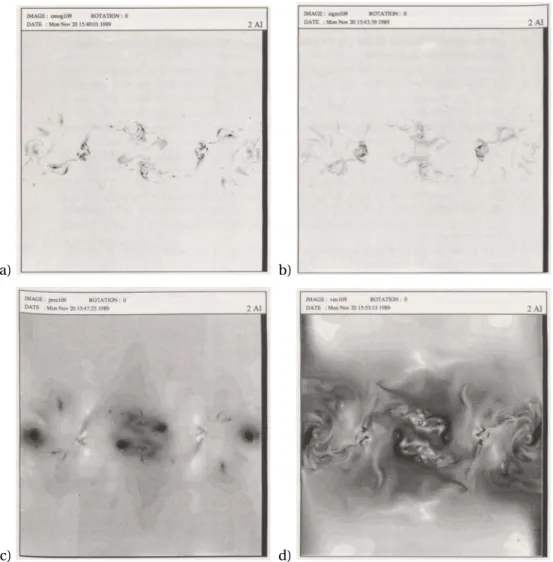
are sources of high pressure (by analogy with electrostatics). One consequence, that was well verified in my Taylor–Green simulations, is the existence of very strong depressions on the vortex filaments: see Figure 1, that is extracted from Ref. [5]. These concentrations cause a strong asymmetry in the histogram of the pressure field, with a large tail for negative excursions [6].
My results on the structure of the pressure field were quite unorthodox: indeed, in the standard phenomenological version of Kolmogorov’s theory, pressure is a quantity ’dominated by the large scales’ while the filaments being structures ’on a small scale’, the general prejudice was that they could have no significant importance on the statistical properties of the pressure field.
Yves Couder, fortunately, did not share this prejudice.
Marc Brachet 503
Figure 1. Raster visualization in the plane y = π/4 inside the impermeable box 0 < x < π,
0 < z < π at t = 9 of the 8643Taylor–Green DNS of Ref. [5]: (a): square of vorticityω2= 1/2P
i j(∂ivj− ∂jvi)2; (b) energy dissipationσ2= 1/2Pi j(∂ivj+ ∂jvi)2; (c) pressure and (d)
magnitude of velocity |v|. Note that the complete colormap is given in Ref. [6] that also contains pressure histograms from the same DNS.
2.2. Filaments in the French washing machine
After many discussions at the LPS about the best way to proceed, it was decided to try to visualize the regions of low pressure and therefore the vortex filaments in an experimental setting. The experiment was carried out at the end of 1990 in Y. Couder’s team by S. Douady. It used a cell comprised of a vertical cylindrical container filled with water with a free surface near the top. Immersed at each end of the cylinder, disks with protruding rims were rotated at exactly the same velocity in opposite direction.
It should be noted that this experimental flow and the numerical TG vortex share the same basic geometry: both consist of a shear layer between two counter-rotating circulation cells. The
504 Marc Brachet
Figure 2. Experimental visualisation of filaments (extracted from Ref. [11]). Note that very
high quality visualizations and quantitative measurements were later reported in Ref. [12].
TG vortex, however, is periodic with impermeable free-slip boundaries (present as mirror sym-metries) while the experimental flow takes place between two counter-rotating coaxial impellers and is confined inside a cylindrical container.1
Following a method introduced before by Hopfinger et al. [13], the visualization were per-formed by using the migration of micro-bubbles under the effect of pressure gradients and their concentration on the filaments [11], see Figure 2. The identification of these structures in an ex-perimental device without the limitations (in particular in Reynolds number) of numerical sim-ulations made it possible to discover new properties such as the very brutal nature of the appear-ance of the filaments, and their disappearappear-ance through explosive instabilities.
The success of this experiment, and the interest of its results, motivated the realization of sev-eral other experiments. S. Fauve, at the time in Lyon at the ENSL, used the so-called von Kàrmàn (VK) swirling flow: a device similar to the Douady/Couder device (but the cylinder was horizon-tal and the disks were flat, without protruding rims). Experiments were performed in water and mercury at very large Reynolds numbers and pressure field histograms were obtained [14, 15]. Concerning the strong asymmetry in the histogram of the pressure field obtained in my DNS and confirmed experimentally, a careful numerical study by A. Pumir, later demonstrated the pre-ponderant role played by the filaments in the pressure field, contrary to standard prejudices [16]. P. Tabeling at the ENS used cryogenic helium, obtaining velocimetry data at Reynolds numbers comparable to those of the largest wind tunnels [17]. The team of Y. Couder latter produced im-proved versions of the basic experiment and obtained very high quality visualizations and quan-titative measurements [12].
Since the 90’s there has been so many experiments involving similar devices that it is impossi-ble for me to review them. I will just mention the VKS Dynamo (in liquid sodium) [18, 19] and the SHREK device (in cryogenic helium) [20].
3. Quantum turbulence and filaments blowup
Classical turbulence is a challenging problem. It is usually stated mathematically as a problem related to the statistical behavior of the solutions of the Navier–Stokes equations: Equations (1), (2) at high Reynolds number [21]. However, there is a physically related problem: quantum turbu-lence (in the co-flow regime) that is known to behave in a similar (if not identical) manner [22,23].
1Colleagues have been known to affectionately call this generic device: “the French washing machine”.
Marc Brachet 505
The interesting mathematical point is that low-temperature superfluid turbulence is described by the Gross–Pitaevskii equation (GPE) [24–26] and thus the turbulence problem (and fluid me-chanics in general [27]) can be exposed to a different mathematical light.
3.1. Gross–Pitaevskii equation
As stated in the introduction, I will now try to see if current insights in quantum turbulence can be used to shed some light on the problem of filaments blowup that is perhaps related to vortex breakdown [28]. To wit I will play with DNS of the GPE using recent methods that are detailed in [29]. The GPE reads
iħ∂ψ
∂t = −
ħ2 2m∇
2ψ + g|ψ|2ψ, (5)
whereψ is a complex field and m denotes the mass of the condensed particles. The particle density is given by n = ψψ, and the velocity field by
v =P n, (6) where Pj= ħ m Ψ∂jΨ − Ψ∂jΨ 2i , (7)
is the unit mass momentum density. This flow matches the behavior of a classical, ideal, and compressible potential fluid, except along theψ = 0 lines that are topological defects: the so-called quantum vortices with circulation given byΓ = HCv(`)d` = h/m.
The vorticityω of the flow corresponding to a single quantum vortex line reads ω(r) = ΓZ dsdr0
dsδ
(3)
(r − r0(s)) , (8)
where r0(s) denotes the position of theψ = 0 centerline, and s is the arclength.
The total energy can be decomposed into different components among which the classical kinetic energy density defined as Ek= 1/2ρv2, that can itself be decomposed into a compressible
and incompressible part. A spectrum can then be assigned to the incompressible part, that is called the incompressible kinetic energy spectrum, see Refs. [30, 31] for details.
Also, a special preparation method for GPE initial data corresponding to any given vortex line shape r(s) (see (8)) is detailed in Ref. [29]. This methods allows for the minimization of sound emission and the study of quantum vortex dynamics.
We will now use this method to study the stability of a given vortex filament. The idea is to define a vortex line that will locally look as a classical vortex filament. To wit we thus use the knot defined by r(s) = (π + x(s),π + y(s),π + z(s)) where
x(s) = cos³s n
´µ
2rmin+ (rmax− rmin)
q δθ2+ sin2(s) µ tanhµ sin(s) δθ ¶ + 1 ¶¶ y(s) = sin³s n ´µ
2rmin+ (rmax− rmin)
q δθ2+ sin2(s) µ tanhµ sin(s) δθ ¶ + 1 ¶¶ z(s) = 2cos(s) (9)
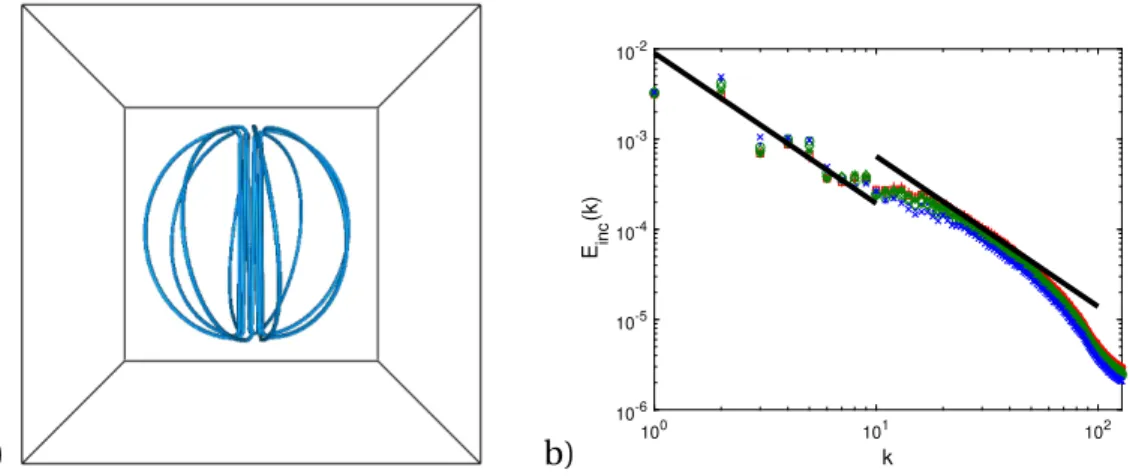
with rmin= 0.1, rmax= 1, δθ = 0.1 and n = 8. The knot is shown on Figure 3(a), using VAPOR [32].
It is apparent by inspection of the figure that, along a line in the middle, several (actually 8) quantum vortex lines are in close proximity. The idea is that these several lines will emulate the behavior of a classical vortex filament.
The time-evolution of the incompressible kinetic energy spectrum of a GPE run starting from the initial data shown in Figure 3(a) is displayed in Figure 3(b). It is apparent that, between t = 3
506 Marc Brachet
Figure 3. (a) Visualization of densityρ = |ψ|2isosurfaces corresponding to the GPE initial data (t = 0) at resolution 2563(see (9)); (b) time-evolution of the corresponding incom-pressible kinetic energy spectrum from t = 3 to t = 6. The 2 solid black lines indicate Kol-mogorov k−5/3scaling.
and t = 6, there are 2 regions present in the spectra that could be considered compatible with a scaling close to the Kolmogorov one: k−5/3. The large scales scaling zone is compatible with a
classical cascade and the second range, at scales smaller than the intervortex scale, is compatible with a Kelvin wave cascade.
Note that a similar behavior with two scaling zones is known to be present in quantum turbulence at much higher resolutions [33].
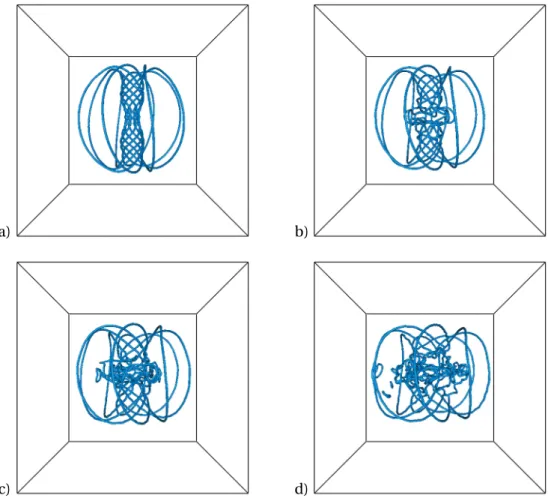
The time evolution of the quantum vortices corresponding to the incompressible kinetic energy spectra displayed in Figure 3(b) is shown on Figure 4 for t = 1.5, t = 3, t = 4.5 and t = 6. It is apparent that a complex evolution, first involving a growth in the diameter of the filament: see Figure 4(a) that leads to the creation of a kink-like structure near the center of the filament in Figure 4(b). Subsequently, vortex reconnections take place: see Figure 4(c) and turbulence develops: Figure 4(d).
4. Conclusion
In conclusion I would like to say that, in my opinion, the discovery of the brutal appearance and subsequent blowup of vortex filament in turbulence is an important part of Yves Couder scientific legacy. Several of the related problems that were discussed by Uriel Frisch in his turbulence book [21] on pages 184–192 are still actual and, in my opinion, unsolved.
The current trend towards very high resolution in Navier–Stokes DNS: 81923[34] and, the last time I checked, 163843[35] is not helping this problem: at these resolutions the datasets are so huge that it is practically impossible to follow any time-evolution.
I hope that the preliminary results I have obtained using the GPE will be useful to study the fascinating problem of vortex blowup in classical turbulence.
Acknowledgment
This work was supported by the French ANR grant ANR-18-CE46-0013 QUTE-HPC.
Marc Brachet 507
Figure 4. Visualization time-evolution of the GPE quantum vortices, same conditions as in
Figure 3 but at (a) t = 1.5; (b) t = 3; (c) t = 4.5 and (d) t = 6.
References
[1] A. N. Kolmogorov, “The local structure of turbulence in incompressible viscous fluid for very high Reynolds num-bers”, Dokl. Akad. Nauk SSSR 30 (1941), p. 9-13.
[2] A. N. Kolmogorov, “Decay of isotropic turbulence in an incompressible viscous fluid”, Dokl. Akad. Nauk SSSR 31 (1941), p. 538-540.
[3] A. N. Kolmogorov, “Energy dissipation in locally isotropic turbulence”, Dokl. Akad. Nauk SSSR 32 (1941), p. 16-18. [4] H. L. Grant, R. W. Stewart, A. Moilliet, “Turbulence spectra from a tidal channel”, J. Fluid Mech. 12 (1962), no. 2,
p. 241-268.
[5] M. Brachet, “Géométrie des structures à petite échelle dans le vortex de Taylor–Green”, C. R. Acad. Sci. Paris II 311 (1990), p. 775.
[6] M. E. Brachet, “Direct simulation of three-dimensional turbulence in the Taylor–Green vortex”, Fluid Dyn. Res. 8 (1991), no. 1–4, p. 1-8.
[7] G. I. Taylor, A. E. Green, “Mechanism of the production of small eddies from large ones”, Proc. R. Soc. Lond. A 158 (1937), p. 499.
[8] M. Brachet, “Intégration numérique des équations de Navier–Stokes en régime de turbulence développée”, C. R.
Acad. Sci. Paris 294 (1982), p. 537-540.
[9] M. E. Brachet, D. I. Meiron, S. A. Orszag, B. G. Nickel, R. H. Morf, U. Frisch, “Small-scale structure of the Taylor–Green vortex”, J. Fluid Mech. 130 (1983), p. 411-452.
[10] Z.-S. She, E. Jackson, S. A. Orszag, “Intermittent vortex structures in homogeneous isotropic turbulence”, Nature 344 (1990), no. 6263, p. 226-228.
508 Marc Brachet
[11] S. Douady, Y. Couder, M. E. Brachet, “Direct observation of the intermittency of intense vorticity filaments in turbulence”, Phys. Rev. Lett. 67 (1991), p. 983.
[12] O. Cadot, S. Douady, Y. Couder, “Characterization of the low-pressure filaments in a three-dimensional turbulent shear flow”, Phys. Fluids 7 (1995), no. 3, p. 630-646.
[13] E. J. Hopfinger, F. K. Browand, Y. Gagne, “Turbulence and waves in a rotating tank”, J. Fluid Mech. 125 (1982), p. 505-534.
[14] S. Fauve, C. Laroche, B. Castaing, “Pressure fluctuations in swirling turbulent flows”, J. Phys. II France 3 (1993), no. 3, p. 271-278.
[15] P. Abry, S. Fauve, P. Flandrin, C. Laroche, “Analysis of pressure fluctuations in swirling turbulent flows”, J. Phys. II
France 4 (1994), no. 5, p. 725-733.
[16] A. Pumir, “A numerical study of pressure fluctuations in three-dimensional, incompressible, homogeneous, isotropic turbulence”, Phys. Fluids 6 (1994), no. 6, p. 2071-2083.
[17] P. Tabeling, G. Zocchi, F. Belin, J. Maurer, H. Willaime, “Probability density functions, skewness, and flatness in large Reynolds number turbulence”, Phys. Rev. E 53 (1996), p. 1613-1621.
[18] R. Monchaux, M. Berhanu, M. Bourgoin, M. Moulin, P. Odier, J.-F. Pinton, R. Volk, S. Fauve, N. Mordant, F. Pétrélis, A. Chiffaudel, F. Daviaud, B. Dubrulle, C. Gasquet, L. Marié, F. Ravelet, “Generation of a magnetic field by dynamo action in a turbulent flow of liquid sodium”, Phys. Rev. Lett. 98 (2007), 044502.
[19] M. Berhanu, R. Monchaux, S. Fauve, N. Mordant, F. Pétrélis, A. Chiffaudel, F. Daviaud, B. Dubrulle, L. Marié, F. Ravelet, M. Bourgoin, P. Odier, J.-F. Pinton, R. Volk, “Magnetic field reversals in an experimental turbulent dynamo”, Europhys.
Lett. 77 (2007), no. 5, 59001.
[20] B. Rousset, P. Bonnay, P. Diribarne, A. Girard, J. M. Poncet, E. Herbert, J. Salort, C. Baudet, B. Castaing, L. Chevillard, F. Daviaud, B. Dubrulle, Y. Gagne, M. Gibert, B. Hébral, T. Lehner, P.-E. Roche, B. Saint-Michel, M. Bon Mardion, “Superfluid high Reynolds von Kármán experiment”, Rev. Sci. Instrum. 85 (2014), no. 10, 103908.
[21] U. Frisch, Turbulence, the Legacy of A. N. Kolmogorov, Cambridge University Press, Cambridge, 1995.
[22] M. Abid, M. Brachet, J. Maurer, C. Nore, P. Tabeling, “Experimental and numerical investigations of low-temperature superfluid turbulence”, Eur. J. Mech. (B)/Fluids 17 (1998), no. 4, p. 665-675.
[23] J. Maurer, P. Tabeling, “Local investigation of superfluid turbulence”, Europhys. Lett. 43 (1998), no. 1, p. 29-34. [24] M. Abid, C. Huepe, S. Metens, C. Nore, C. T. Pham, L. S. Tuckerman, M. E. Brachet, “Gross–Pitaevskii dynamics of
Bose–Einstein condensates and superfluid turbulence”, Fluid Dyn. Res. 33 (2003), no. 5–6, p. 509.
[25] M. Brachet, “Gross–Pitaevskii description of superfluid dynamics at finite temperature: a short review of recent results”, C. R. Phys. 13 (2012), no. 9, p. 954-965.
[26] N. G. Berloff, M. Brachet, N. P. Proukakis, “Modeling quantum fluid dynamics at nonzero temperatures”, Proc. Natl
Acad. Sci. USA 111 (2014), p. 4675-4682.
[27] C. Nore, M. Brachet, S. Fauve, “Numerical study of hydrodynamics using the nonlinear Schrödinger equation”,
Physica D 65 (1993), p. 154-162.
[28] O. Lucca-Negro, T. O’Doherty, “Vortex breakdown: a review”, Progr. Energy Combust. Sci. 27 (2001), no. 4, p. 431-481. [29] P. Clark di Leoni, P. D. Mininni, M. E. Brachet, “Helicity, topology, and Kelvin waves in reconnecting quantum knots”,
Phys. Rev. A 94 (2016), 043605.
[30] C. Nore, M. Abid, M. E. Brachet, “Decaying Kolmogorov turbulence in a model of superflow”, Phys. Fluids 9 (1997), no. 9, p. 2644-2669.
[31] C. Nore, M. Abid, M. Brachet, “Kolmogorov turbulence in low-temperature superflows”, Phys. Rev. Lett. 78 (1997), no. 20, p. 3896-3899.
[32] J. Clyne, P. Mininni, A. Norton, M. Rast, “Interactive desktop analysis of high resolution simulations: application to turbulent plume dynamics and current sheet formation”, New J. Phys. 9 (2007), p. 301.
[33] P. Clark di Leoni, P. D. Mininni, M. E. Brachet, “Dual cascade and dissipation mechanisms in helical quantum turbulence”, Phys. Rev. A 95 (2017), 053636.
[34] K. P. Iyer, K. R. Sreenivasan, P. K. Yeung, “Reynolds number scaling of velocity increments in isotropic turbulence”,
Phys. Rev. E 95 (2017), 021101.
[35] K. P. Iyer, K. R. Sreenivasan, P. K. Yeung, “Scaling exponents saturate in three-dimensional isotropic turbulence”,
Phys. Rev. Fluids 5 (2020), no. 5, 054605.
![Figure 2. Experimental visualisation of filaments (extracted from Ref. [11]). Note that very high quality visualizations and quantitative measurements were later reported in Ref](https://thumb-eu.123doks.com/thumbv2/123doknet/14678459.558656/6.816.144.686.121.309/experimental-visualisation-filaments-extracted-visualizations-quantitative-measurements-reported.webp)