HAL Id: hal-03098573
https://hal.archives-ouvertes.fr/hal-03098573
Submitted on 5 Jan 2021HAL is a multi-disciplinary open access
archive for the deposit and dissemination of sci-entific research documents, whether they are pub-lished or not. The documents may come from teaching and research institutions in France or abroad, or from public or private research centers.
L’archive ouverte pluridisciplinaire HAL, est destinée au dépôt et à la diffusion de documents scientifiques de niveau recherche, publiés ou non, émanant des établissements d’enseignement et de recherche français ou étrangers, des laboratoires publics ou privés.
New Fourier CGH coding using DMD generated masks
Frédéric Zamkotsian, Giorgio Pariani, Patrick Lanzoni, Luca Oggioni, Chiara
Bertarelli, Andrea Bianco
To cite this version:
Frédéric Zamkotsian, Giorgio Pariani, Patrick Lanzoni, Luca Oggioni, Chiara Bertarelli, et al.. New Fourier CGH coding using DMD generated masks. Emerging Digital Micromirror Device Based Sys-tems and Applications XII, Feb 2020, San Francisco, United States. pp.12, �10.1117/12.2547970�. �hal-03098573�
New Fourier CGH coding using DMD generated masks
Frederic Zamkotsian
1, Giorgio Pariani
2, Patrick Lanzoni
1,
Luca Oggioni
2, Chiara Bertarelli
3, Andrea Bianco
21 Aix Marseille Université, CNRS, CNES, LAM (Laboratoire d'Astrophysique de Marseille), 13388, Marseille, France 2 INAF – Osservatorio Astronomico di Brera, Via Bianchi 46, 23807 Merate, Italy
3 Politecnico di Milano, Dipartimento di Chimica, Materiali e Ingegneria, p.zza L. Da Vinci 32, 20133, Milano, Italy
e-mail: [email protected] ABSTRACT
Computer Generated Holograms (CGHs) are powerful optical elements used in many fields, such as wavefront shaping, quality testing of complex optics and anti-counterfeiting devices. Lee algorithm is the most used to generate binary amplitude Fourier holograms. Grayscale CGHs are known to give a higher reconstruction quality than binary holograms, but they usually require a cumbersome production process. A very simple and straightforward method of manufacturing rewritable grayscale CGHs is here proposed by taking advantage of two key components: a Digital Micro-mirror Device (DMDs) and a photochromic plate. An innovative algorithm, named Island algorithm, able to generate grayscale amplitude Fourier CGHs, is reported and compared with the standard Lee approach, based on 9 levels. A crucial advantage lies on the fact that the increase or decrease of the quantification does not affect the spatial resolution. In other words, the new coding leads to a higher spatial resolution (for a given CGH size) and a reconstructed image with an order of magnitude higher contrast with respect to the classical Lee-coded hologram. In order to show the large potential of our approach, a 201 levels Island hologram is designed, produced and reconstructed, pushing the contrast to values higher than 10^4. These results reveal the high potential of our process as well as our algorithm for generating programmable grayscale CGHs. Grayscale objects are also studied in order to be produced with our new coding scheme: simulations show a much better reconstruction (resolution, fidelity, contrast) thanks to the quantification of the transparency than the Lee algorithm commonly used.
Key words: Computer Generated Hologram, CGH, Fourier coding, programmable CGH, photochromic material, optical testing, wavefront shaping, DMD.
1. INTRODUCTION
Wavefront shaping, complex optics testing, including aspherical and free-form optics or optical instrument alignment techniques will greatly benefit from Computer Generated Holograms (CGHs) [1]. They are classified in two groups:
1- phase holograms, which are obtained by recording a phase variation in a material having a modulated refractive index or thickness;
2- amplitude holograms, where an intensity pattern is recorded in a material whose transparency can be locally controlled. Phase and amplitude holograms provide the same performances in terms of image reconstruction quality, but different diffraction efficiency. For instance, binary phase holograms, show 40% diffraction efficiency in the first order, whereas efficiency is limited to 10% for binary amplitude holograms [2]. Therefore, amplitude holograms are usually applied in interferometry, which is not intensity limited.
Grayscale amplitude and grayscale phase holograms are known to give a higher reconstruction quality than binary holograms [2], but they require a more complex production process. Specifically, the production of phase grayscale CGHs is complex since a series of masks has to be consecutively aligned very precisely, and a developing step is required after each exposure step to obtain the final hologram.
To our best knowledge, only grayscale phase CGHs have been obtained so far by micro-lithography [3], the uniformity of the material thickness being the main limiting parameter for these components [4]. Concerning amplitude CGHs, they are nowadays produced in chrome on glass by means of lithographic techniques, either mask or maskless (by direct
writing) lithography. Due to the binary nature of the chrome developing process, these techniques allow for easily writing binary CGHs, but they cannot provide grayscale CGHs.
We previously demonstrated an original recording technique, which makes use of a programmable mask and a non-threshold photosensitive material, to produce ready to use grayscale CGHs in a one exposure process without requiring any developing step [5,6]. Indeed, a set-up based on a Digital Micro-mirror Device (DMD), which has been originally developed to generate programmable slit masks in multi-object spectrographs [7], is considered. DMDs are programmable devices, composed of millions of micro-mirrors reconfigurable in real time. Actually, DMDs have been extensively used to generate dynamic binary or grayscale holograms [8], by exploiting the fast switching of the mirrors at frequencies higher than the human vision frame rate. The grayscale originates as a dynamic effect and not as a steady state effect. However, the discrete structure of the device induces a high scattering and background noise from the mirrors edges when illuminated with laser light [9], making such holograms useless for interferometry and metrology. Nevertheless, DMDs perfectly reproduce binary masks to be projected with incoherent light on photosensitive plates, thus producing amplitude CGHs. In this work, such plate consists in a photochromic film that can be reversibly converted from an opaque and colored form to a transparent form upon exposure with light of suitable wavelengths [10]. Actually, reversible holograms have been already obtained with photochromic materials [11, 12] and real-time photochromic holograms were shown, by exploiting the fast transition of imidazole dimers [13, 14]. Moreover, photochromic binary CGHs for optical testing have been recently demonstrated [15]. In photochromic materials, a ready to use hologram is generated just after the light exposure, and the reversibility of the photoconversion makes devices rewritable. Even more interesting, the transparency of a photochromic layer can be tuned by the dose of light absorbed, which opens to the development of grayscale patterns [16]. In fact, the DMD set-up allows for easily recording grayscale CGHs in a single exposure process. The lower diffraction efficiency of grayscale amplitude holograms with respect to binary amplitude holograms (6% vs. 10% [2]) is here compensated by a better image reconstruction quality, an easy exposure process and no developing steps, which are the limiting factors in the production of grayscale phase holograms. Previously, we have successfully recorded the very first amplitude grayscale CGH, in equally spaced levels, so called
stepped CGH. We recorded up to 1000x1000 pixels CGHs with a contrast greater than 50, using Fresnel coding scheme.
Fresnel’s CGH are obtained by calculating the inverse Fresnel transform of the original image at a given focus, ranging from 50cm to 2m. The reconstruction of the recorded images with a 632.8nm He-Ne laser beam leads to images with a high fidelity in shape, intensity, size and location. These results reveal the high potential of this method for generating programmable/rewritable grayscale CGHs, which combine DMDs and photochromic substrates. [5,17]
In this paper, we report innovative results for Fourier holograms: a new family of Fourier holograms named Island CGHs, including an original coding algorithm, leading to higher spatial resolution and a reconstructed image with a much higher resolution, a better compacity and an increased throughput, in comparison with the classical Lee-coded holograms. Grayscale objects are also studied in order to be produced with our new coding scheme.
2. RECORDING AND RECONSTRUCTION OF A CGH
Two set-ups have been developed for the recording of the calculated CGH and for the reconstruction of the original encoded images.
2.1 Recording set-up
Figure 1 shows our recording set-up, dedicated to the CGH recording on the photosensitive plate. The DMD, controlled by the formatter board [18] is illuminated by a collimated beam from a white source, and redirects the light toward the plate. The beam is illuminating the entire DMD and the light power is homogeneous on the plate. The pattern reproduced by the DMD has to be projected onto the plate as precisely as possible, so the plate is illuminated through an Offner relay with a magnification of 1:1. This relay provides a nearly aberration free beam and has the advantage of being compact. The unit magnification means that the maximum size of CGH is directly limited by the size of the DMD; the micro-mirrors of the DMD therefore correspond to the “pixels” of the CGH. Finally, a post-CGH imaging system located right after the CGH plate consists of two lenses, a filter around 600 nm and a CCD camera. This system in an afocal assembly allows imaging of the CGH during writing, in situ and in real time. Magnification is tuned by changing properly the pair of lenses, from a value of 1 up to 4.
DMD, CGH micro-mirror This effect is 2.1.1 Mask g Digital Micro DMD chip de switched betw studied in the applications ( been develop in space surv tests, thermal vibration and do not reveal and camera p array: each m reproduced a Fig. 1: P toward generator omirror Devic eveloped by T ween an ON e framework o (for example ed. Our tests vey conditions
l cycling (ove d shock tests h l any concern
planes are the micro-mirrors s well at the p Picture of the se ds the DMD, an from the DMD ces (DMD) fr TI features 20 (+12°) positi of an ESA tech in EUCLID m reveal that the s (-40°C and
r 500 cycles b have also been ns regarding Fig. 2: DMD en conjugated. s tilts out of t post-CGH ima et-up dedicated n imaging optic D plane to the C
rom Texas Ins 48 x 1080 mi on and an OF hnical assessm mission). Spec e DMD remai vacuum) has between room n done; no deg the ability of
chip from Tex
. Note that D the array plan aging camera l
to CGHs record cal system based CGH plane, and struments cou irrors on a 13 FF (-12°) pos ment of using cialized drivin ins fully opera been success m temperature gradation is ob f the DMD to xas Instruments DMD plane is ne by 12°, lea level (the cam
ding; it is based d on a 1:1 magn d a post-CGH im
uld act as rec .68µm pitch, sition (Fig. 2) this DMD com ng electronics ational at -40° sfully complet and cold tem bserved from meet environ (2048 x 1080 m a tilted focal ading to a glo mera plane is ti d on an illumina nification Offne maging system. onfigurable m where each m ). This compo mponent (204 s and a cold te °C and in vacu ted. Total Ion
perature, on a the optical me nmental spac micromirrors). l plane due to obal 24° tilte ilted by 24°). ation unit er relay mask generato mirror can be onent has bee 48 x 1080 mirr emperature te uum. A 1038 nizing Dose (T a non-operatin measurements. ce requiremen o the nature o d focal plane
or. The larges independently en extensively rors) for space est set-up have hours life tes TID) radiation ng device) and These results nts [18]. f e. st y y e e st n d s
2.1.2 DMD m A simple ima mirror (Fig. curvature. On mechanical a mirrors with curvature. [19 This optical l Delivered im spot diameter 2.2 R The reconstru Ne laser. The section, the F focus. It is th Fourier holog collimation ca Fig. 4: Pictu mask projecti aging Offner-3). Indeed, sp ne mirror only and operationa a diameter o 9] layout will ma mage quality on rs are <20µm Reconstructio uction set-up, e camera, plac Fresnel hologr hus not necess grams. This i
an displace th
ure of the set-up lo ion -type layout h pherical mirro y could be us al constraints of 160mm and
ake the system nto the CGH over the whol on set-up
shown in Fig ced at the dist rams are direc sary to add a s why the sou he focal plane
p dedicated to im ocated at the hol
For Fourie
has been set u ors belong to ed instead of can lead to s d a radius of Fig. 3: Optical m simple and e plane is high le FOV for wa . 4, is dedicate tance z from t ctly calculated lens between urce should b along the opti
mage reconstru logram projecti er holograms, a up, based on t o the same m two separate split these tw curvature of l layout of the i efficient. Add h enough to n avelengths bet ed to CGH re the plate, is il d from the pr the plate and be rigorously ical axis and c
uction, including ion distance (2m an additional co two identical mother mirror, ones, helping wo mirrors. W 438mm. The imaging set-up. ditionally it wi not degrade sp tween 400nm construction. luminated thr opagation equ d the camera t collimated, b change the siz
g a 632.8 nm H m in this case) f ollimating lens i spherical con sharing the g the alignmen e have prefer e convex mirr
ill not suffer f patial resolutio and 800nm. The source is rough the CGH uations of ligh to reconstruct because a var ze of the encod
He-Ne laser, the for Fresnel CGH is required.
ncave mirrors same radius ent of the syst rred two iden ror has a 224 from chromat on. Typical m s a collimated H. As describ ht, and they a t the image, u riation in the ded image. CGH plane an Hs. and a convex and center o tem. However tical spherica 4mm radius o tic aberrations monochromatic 632.8 nm He bed in the nex are for a given unlike with the quality of the d the camera x f r, al f s. c -xt n e e
The photosen large content uncolored for transparent fo in terms of tr to the opaqu previously de illumination c Figure Fourier holog reproduced. T calculated, th the used alg quantification reference for of pixels of a limiting the r necessary to a and display th 4.1 T The algorithm instead of the foresees a 4x times two col plus the zero
Fig. 6:
nsitive materia of photochro rms, also for orm upon exp ransparency an ue state by a etermined by conditions [16 e 5: Transmissi showing grams are ob These algorith he complex inf gorithm. Lohm n of informati the current w Fourier holog resolution and
add a lens afte he image. The Lee algor m proposed b e phase and am x4 elements ce lumns (separa position), as s (a) (a) Complex nu al is a diaryle omic units (i.e thin films. T osure with lig nd scattering UV exposure a kinetic mod 6]. on (Optical De the opaque to t btained using hms [21, 22, formation con mann, Lee a ion at differen work. Only bin
gram is theref d size of image er the CGH in rithm by Lee is enc mplitude [24]. ell for each p ating the posit shown in the F
umber to be en
3. PHOTO
ethene-based p e. 50% wt. in This layer can ght of suitable
is very good. e. The conver del that provid
nsity) of the ph he transparent s 4. F g algorithms 23] are oper ntained in eac and Burkhard nt levels. The nary Fourier h fore necessaril es to be encod n the reconstru
coding the rea The binary v ixel and enco tive and the n Fig. 6b. (b) coded; (b) corre OCHROMIC polyurethane this work) th n be reversibl e wavelengths, The photochr rsion under li des the degre
hotochromic ma states, accordin FOURIER C encoding the rating in a c ch pixel is enc dt algorithms Lee algorithm holograms hav ly larger than ded. Since the uction set-up,
al and imagin version of the a odes the real a negative value
espondent cell
C PLATES
[20]. Such ki hat turns into ly converted , around 600n romic plate is ight illuminat e of transpare aterial used in th ng to the illumin CGH e inverse Fou ommon way. coded in a cell , all generat m is the most ve been produ the number o ese holograms for applying t nary parts of algorithm, wh and the imagin es), leading to
(c)
of the Lee algo
nd of photoch a high contra from an opaq nm (Fig. 5). M s 3µm thick an tion of the ph ency as functi he UV-Visible r nation amount o urier transform Once the in l of WxH pixe e binary CG widely used a uced using the
f pixels defini s are based on the optical Fou
the complex hich is the only
nary part of t 9 quantificati
rithm; (c) exam
hromic substr ast between th que and colo Moreover, the o
nd the film is hotochromic ion of the film
range of the sp of the plate m of the wa nverse Fourier els, W and H GH with com and will be co ese algorithms ing the image n the Fourier t urier transform Fourier func y one develop the complex n ion levels (8 mple of a Lee ho rate contains a he colored and red form to a optical quality set uniformly film has been m features and ectrum avefront to be r transform is depending on mpactness and onsidered as a s. The numbe e. This leads to transform, it is m to the CGH ction (Fig. 6a ped up to now number in two discrete levels ologram a d a y y n d e s n d a r o s H, a) w, o s
The only way 33 levels, and provided in F
4.2 T The grayscale and hence the Our first new information o composed by complex func quantification The number o levels. This is An example o 4.3 T In order to ov new coding s imaginary pa transparency anamorphism The number o these levels. 129 quantific a 2x2 elemen 129 quantific An example o Fig. 8: (a) y to increase d 16x16 eleme Fig. 6c. The Lee-comp e approach pr e reconstructio wly proposed of a quadrant y 2x2 element ction. Lee-com n levels, but sh of discrete lev s done withou of a Lee-comp (a) Fig. 7: (a) The Island al vercome the li scheme (nam arts of the com
levels (Fig. m in the recons of discrete lev This is done ation levels; a nt cell with t ation levels. of an Island ho (a) ) Complex num the number o ents cell for 1 pact algorith roposed in thi on fidelity aga algorithm us of the compl ts, representin mpact algorith hows small di vels available ut changing the pact hologram Complex numb gorithm mitation due t med Island), w mplex number 8b). Howev structed image vels available without chan a 256-element the Island cod ologram is pro ( mber to be encod of quantificati 129 levels, inc m is paper opens ainst binary ho ses the graysc lex plane into ng the positiv hm gives bette iffraction effic with this algo e size of the e m is provided in
(b)
ber to be encode (c) example
to the two intr where the cell
r. An offset is ver, we still
e.
with this alg nging the size ts pixel is requ de; this is the ovided in Fig. (b) ded; (b) corresp ion levels is t creasing then s to new poss olograms of th cale approach o a single elem ve and negativ er results than ciency since tw orithm is infin elementary cel in Fig. 7c. ed; (b) correspo of a Lee-comp rinsically blac is composed s added to obt keep coding gorithm is also e of the elem uired with the erefore 64 tim . 8c. pondent cell of t to increase th the hologram sibilities to in he same size a h to pop-up th ment (Lee-Co ve component the binary Le wo pixels are nite, limited b ll. (c) ondent cell of th act hologram ck pixels of th d by 2x1 elem tain positive v the informa o infinite, lim mentary cell. F e Lee-code, w mes more com
(c)
the Island algor
he size of the m size. An exa
crease the hol and resolution he columns o mpact). As sh ts of the real ee algorithm in intrinsically b by the recordin he Lee-compact e Lee-compac ments corresp values only th ation in a 2x ited by the re For example, hile the size o mpact than th rithm; (c) examp cell, 8x8 ele ample of a Le logram inform n. of Lee cells, hown in Fig. and imaginar n terms of com black. ng medium to t algorithm; ct algorithm, w ponding to the
hat can be tra x2 elements ecording medi let’s consider of the pixel alw he Lee-code i mple of an Island ments cell fo ee hologram i mation density squeezing the 7b, the cell is ry parts of the mpactness and o display these we introduce a e real and the ansformed into cell to avoid ium to display r a CGH with ways relies on in the case o d hologram r s y e s e d e a e o d y h n f
5.1 I We chose as 256 x 256 pix the size of the be smaller tha we set a ratio reconstructed Fig. 9: (a) BA Simulations w 1. the L comp 2. the I In both cases be reconstruc We applied a frequencies o complex imag Original imag and 10(b). Th together with the Island hol
Island CGH f s object the lo xels, for a CGH e DMD devic an the size of o of one third d image as far ATMAN logo were performe Lee coding, w mplex Fourier f Island coding , we kept con cted was set to a random phas of the image. T
ge. The comp ges for the Le he holograms h the simulated logram. 5. IS for binary im ogo of the as H of 1000x 10 e used for the f the image to d between the as possible fr original image; ed to evaluate with 4 by 4 e function and 9 with the same nstant the size o 128 by 128 p se between 0 a The complex lete descriptio e 4 by 4 (128 encoded with d reconstructe SLAND CG mages calculat stronomical in 000 pixels, wi CGH recordi be encoded. e object size a om the 0th ord regions where the performan elements cell 9 for the imagi e number of gr of the hologr pixels for the L
and 2 to the hologram is c on of our calcu by 128 pixels h the Lee and
d images in F
GH FOR BIN
tion
nstrument BA ith an actual s ing, see parag For a better b and the image der signal, incr
parameters are nces of the tw , correspondi inary part, ray tones. ram at 512 by Lee coding, an image before calculated by ulation proced s) and the Isla Island algorith Fig. 10(e) and
NARY IMAG
ATMAN proje size of 14mm. graph 2. The si balance betwe
e size; the log reasing the SN e calculated, in r wo different co ng to 9 quan y 512 pixels. T nd 256 by 256 e the hologram the Inverse Fa dure is given i and 2 by 2 (25 hms are repor 10(f). Note th GES ect as shown The actual siz ize of the obje en the frequen go is not cent NR. red: neighborho oding strategie ntification leve To be consiste 6 pixels for the m calculation t ast Fourier Tr in [6]. 56 by 256 pixe rted in Fig. 10 he average val in Fig. 9a [ ize of the CGH ect to be recon ncy and the sp tered in order
ood (b), and ba
es. We consid els for the re ent, the size o he Island codin
to reconstruct ransformation els) are shown 0(c) and 10(d)
lue at the mid
19], coded on H is limited by nstructed mus patial domain r to locate the ckground (c). ered: eal part of the of the image to
ng.
t all the spatia n (IFFT) of the n in Fig. 10(a ), respectively -gray level fo n y st n, e e o al e a) y, r
For a compar - the l calcu 1.5 t - the g calcu The Island co is reconstruct the image is reported in Ta Fig. 10: Orig an
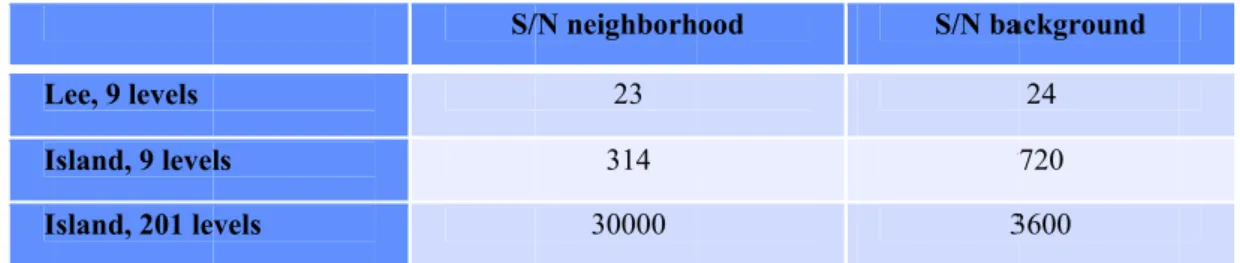
rison of the rec local contrast, ulated as the r times that of th global contras ulated as the r oding behaves ted fairly well better defined able 1. With th ginal images, h nd the Island 2 b constructed im , defined as th ratio between he object; st, defined as t ratio between s much better in any case), d and the con he increase of olograms, and r by 2 with f = 2 ( mage quality, w he signal to no the average in the signal to n the average in than the Lee
the S/N is lar ntrast between f the quantific reconstructed im (b, d, f), both co we considered oise ratio (S/N ntensity of the noise ratio (S/ ntensity of the coding under rger than two o
n light and da cation levels, t
mages for the L oded with 9 qua
d the followin N) between the e object and th /N) between th e object and of all aspects: w orders of mag ark regions is the S/N ratios Lee 4 by 4 with antification leve ng parameters: e object and it he background he object and f the backgrou while the corre gnitude in the I s greater. The dramatically r f = 4 (a, c, e) vels. : ts neighborho d in a circle w the backgrou und; elation is simi Island coding e summary of rise. od (Fig. 9(b)) with a diamete und (Fig. 9(c)) ilar (the image
, meaning tha f the results is ), r ), e at s
Table 1: perfo L I I 5.2 I The BATMA generated by nonlinear resp mask is proje required leve 201 masks. The plates us active comp perfluorocycl 5.3 I The image w and it is show and the 1st or the DMD stru ormances of th Lee, 9 levels Island, 9 level Island, 201 le Island CGH f AN logo is re a set of mas ponse of the ected for a dif el of transpar sed to record t ponent is a lopentene disp Island CGH f was reconstruc wn in Fig. 11. rder diffracted ucture (tilting Fig he two differe ls vels for binary im ecorded using ks applied to photochromic fferent time in rency for eac the CGH cons a diarylethen persed in CAB for binary im cted with the r The reconstru d beams (reco
mirrors along
g. 11: Reconstru
ent codings for S/ mages recordin g the set-up a the DMD, an c material, a c n order to get ch pixel of th sisted in a pho ne molecule B (cellulose ac mages reconstr reconstruction ucted image is onstructed ima g their diagona ucted image of t r 9 levels and /N neighborh 23 314 30000 ng
and the proce nd sequential calibration cu t a linear gray he CGH. The otochromic th e [20], nam cetate butyrate ruction n set-up (para s including th ages). The das als). the Island CGH 201 levels. hood dure discusse ly projected o urve of the ph yscale. The ad e BATMAN hin film depos mely the 1 e) polymer ma agraph 2), by he 0th order (co
shed lines tilt
H (object: BATM
S/N ba
7 3
ed in paragrap onto the recor otosensitive p ddition of all logo has bee sited on 3 mm ,2-bis(2-methy atrix, with a co means of a co ontinuum, hor ed by 45° are MAN project lo ackground 24 720 3600 ph 2. Graysc rding plate. B plate is measu masks permit en recorded m thick glass s hyl-5-dimethyl oncentration o ollimated bea rizontal and v e diffraction p ogo) ale CGHs are Because of the ured, and each ts to reach the with a set o substrates. The laminophenyl of 16.6 % wt. am at 632.8nm vertical spikes patterns due to e e h e f e ) m ) o
The Fig. 12 is Fig. 12: ( Speckles are image is eno reproduced p out of a bigg pixel wide lin lines of black These results Lee algorithm the transparen Island coding of simulated r We chose as hologram at 5 for the Lee co 1- Lee 2- Islan 3- Islan In Fig. 13a an resulting ima quantification In Fig. 14a an resulting ima grayscale CG In Fig. 15a an The resulting thanks to the as well as a d s a comparison a) Original and Sin inevitable sin ough to make ixel by pixel ger structure is nes of white p k pixels inside show that ou m commonly u ncy. g for grayscale reconstructed object a dune 512 by 512 pi oding, and 256 coding with 9 nd coding with nd coding with nd Fig. 13b a age is noisy n of the hologr nd Fig. 14b ar age is closer t GH as well as a nd Fig. 15b a g image is nea high number detail are in Fig
n of the origin
(a) d (b) reconstruct ngle pixels and
nce the sourc e the edge lo
as the red cir s visible on th pixels are cle
structures. ur Island algor used, and a b 6. ISLA e images may images with L s image includ ixels. To be c 6 by 256 pixe 9 levels h 9 levels h 201 levels are shown the
with a low ram. The bina re shown the I to the origina a detail are in are shown the arly identical of quantifica g. 15c,d. Note
nal image (Fig
ted images. Red
one pixel wide
e is coherent ook round an cles on the Fi he reproductio arly reproduc rithm generate etter reconstru AND CGH F y also exhibit a Lee and Island ding the entire onsistent, the ls for the Islan
Lee coding 9 dynamical r ary CGH as w Island coding l, but the dyn
Fig. 14c,d. N Island coding with the orig tion levels. Th e the average v
g. 9a) and the
d marks show t e lines appear cl
t but the brigh nd not pixila ig. 12a bring on. The ellips ced, and the o es grayscale h uction (resolu FOR GRAY a much better d coding is pr e range of gra size of the im nd coding. Le 9-levels origin range for the well as a detail 9-levels origi namical range Note the averag g 201-levels o ginal, with a f he contrast of value at the m reconstructed hat every detail learly on the rec
htness is almo ated. Structure
out. The two se that surroun other ellipse sh olograms that ution, fidelity, YSCALE IM r result with r resented in thi aylevels. In bo mage to be rec t’s consider 3
nal image and reconstructe are in Fig. 13 inal image and e for the recon ge value at the original image full dynamica f the image is mid-gray level d one (Fig. 11) (b) ls of the image constructed ima ost homogene es are remark little circles s nds the top of hows the sam t give much m contrast) than MAGES espect to the L s paragraph. oth cases, we k constructed w cases: d the simulated ed grayscales c,d. d the simulate nstructed gray e mid-gray lev e and the simu
l range for th as well maxi for the Island
).
are perfectly re age.
eous. The res kably faithful show that one f the image s me result for o more compact anks to the qu Lee algorithm kept constant was set to 128 d reconstructe due to the ed reconstruct yscales is stil vel for the Isla ulated reconst he reconstruct imized. The g d hologram. eproduced. solution of the l to originals e pixel coming
hows that one one pixel wide CGH then the uantification o
m. Comparison the size of the by 128 pixel ed image. The only 9-levels ed image. The ll limited. The and hologram. tructed image ted grayscales grayscale CGH e s, g e e e f n e s e s e e e. s, H
(a Fig. 13: L (a) Fig. 14: Isl a) (c) Lee-coded 9 lev ) (c) land-coded 9 le vels hologram; ( evels hologram;
(a) Original ima
; (a) Original im (b) (d) age, (b) reconst (b) (d) mage, (b) recon tructed image, ( structed image, (c) hologram, (d (c) hologram, d) detail of the (d) detail of the hologram. e hologram.
(a Fig. 15: Isla Simulation o fidelity, contr Computer ge holograms ha of stepped ho We have pro 1000 within a visiting very 1000x1000 p with a perfec much higher Grayscale obj fidelity, contr These results be to code mo create beam s This work ha a) and-coded 201 l f grayscale im rast) thanks to enerated holo ave only been olograms with posed a new a smaller cell different spa ixels hologram ct fidelity in s resolution, a jects have bee rast) than the L
reveal the hig ore complex h shapers includ s been partly f (c) levels hologram mages with o o the quantific ograms are w n recorded in b discrete gray Fourier CGH l size of 2x2 atial frequenc m written on shape and inte better compac en simulated w Lee algorithm gh potential o holograms as w ding apodizers funded by the m; (a) Original i
our new Island ation of the tr 7. C well suited fo binary format, levels. H coding sche pixels. This c cies. The CG a photochrom ensity, for any city and an in with our new m commonly u of this method well as wavef s, using the sam
ACKN e European Un (b) (d) image, (b) recon d coding sch ransparency th CONCLUSI or optical test , and our met eme, called Is code has been GH has been
mic plate. The y single pixel ncreased throu coding schem used. d for generatin fronts containi me protocol a NOWLEDGM nion FP7-OPT nstructed image eme shows a han the Lee alg
ION
ting and wav thod increases land algorithm n implemented recorded with e reconstructio l of the origin ughput, in com me, and show
ng programma ing phase info as for stepped MENTS TICON 2 prog e, (c) hologram much better gorithm comm vefront shapin s their quality m, leading to d for the BAT h our DMD-b on of the reco nal object. Ou mparison with a much better able/rewritable ormation. We CGHs. gram. m, (d) detail of th reconstructio monly used. ng. Up to n by enabling a quantificat TMAN-instru -based set-up, orded CGH le ur proposed c h the current F r reconstructio e CGHs. The
will also use
he hologram. on (resolution ow amplitude the realization tion exceeding ument logo fo , leading to a eads to image ode exhibits a Fourier CGHs on (resolution next step wil our method to n, e n g r a s a s. n, ll o
REFERENCES
[1] C. Pruss, S. Reichelt, H. J.Tiziani and W.Osten, ”Computer-generated holograms in interferometric testing, “ Opt. Eng. 43 (11), 2534-2540 (2004)
[2] Brown, B. R. and Lohmann, A. W., “Computer-generated Binary Holograms,” IBM J. Res. Dev. (1969)
[3] Y-T. Lu, C-S. Chu, H-Y. Lin, ”Characterization of the gray-scale photolithography with high-resolution gray steps for precise fabrication of diffractive optics, “ Opt. Eng. 43(11) 2666-2670 (2004)
[4] N. Luo, Y. Gao, S. He, Y. Rao, “ Research on exposure model for DMD-based digital gray-tone mask ,” Proc SPIE Vol. 7657, 7657 12-1 (2010)
[5] Romain Alata, Giorgio Pariani, Frederic Zamkotsian, Patrick Lanzoni, Andrea Bianco, Chiara Bertarelli, "Programmable CGH on photochromic plates coded with DMD generated masks", Optics Express, Vol. 25, n° 6, (2017), https://doi.org/10.1364/OE.25.006945
[6] Frederic Zamkotsian, Giorgio Pariani, Romain Alata, Luca Oggioni, Patrick Lanzoni, Chiara Bertarelli, Andrea Bianco, "The island CGH, a new coding scheme: concept and demonstration", Optics Express, Vol. 27, Issue 19, pp. 26446-26458, (2019) https://doi.org/10.1364/OE.27.026446
[7] F. Zamkotsian, P. Spano, P. Lanzoni, H. Ramarijaona, M. Moschetti, M. Riva, et al., ”BATMAN: a DMD-based Multi-Object Spectrograph on Galileo telescope, ” in Proceedings of the SPIE conference on Astronomical Instrumentation 2014, Proc. SPIE 9147, Montréal, Canada, (June 2014)
[8] R.S. Nesbitt, S.L. Smith, R.A. Molnar, S.A. Benton, ”Holographic recording using a digital micromirror device,” Proc. SPIE 3637, Practical Holography XIII, 12 (March 25, 1999); doi:10.1117/12.343767
[9] Park, M.-C., Lee, B.-R., Son, J.-Y., Chernyshov, O., “Properties of DMDs for holographic displays,” J. Mod. Opt. 62(19), 1600– 1607 (2015)
[10] C. Bertarelli, A. Bianco, R. Castagna and G. Pariani, ”Photochromism into optics: Opportunities to develop light-triggered optical elements, “ Journal of Photochemistry and Photobiology C: Photochemistry Reviews 12(2), 106-125 (2011) doi: 10.1016/j.jphotochemrev.2011.05.003
[11] Nan Xie, Yi Chen, Baoli Yao, Ming Lie, ”Photochromic diarylethene for reversible holographic recording, “ Materials Science and Engineering: B, 138(3), 210-213 (2007)
[12] Yi Chen, Congming Wang, Meigong Fan, Baoli Yao, Neimule Menke, ”Photochromic fulgide for holographic recording, “ Optical Materials, 26(1), 75-77 (2004)
[13] Y. Kobayashi and J. Abe, “Real-Time Dynamic Hologram of a 3D Object with Fast Photochromic Molecules, ” Adv. Opt. Mater.
4(9), 1354–1357 (2016)
[14] N. Ishii, T. Kato, and J. Abe, ”A real-time dynamic holographic material using a fast photochromic molecule“ Sci. Rep. 2, 819 (2012)
[15] G. Pariani, C. Bertarelli, G. Dassa, A. Bianco, G. Zerbi, ”Photochromic polyurethanes for rewritable CGHs in optical testing, “ Optics Express 5 (19), 4536-4541 (2011)
[16] G. Pariani, A. Bianco, R. Castagna and C. Bertarelli, ”Kinetics of photochromic conversion at the solid state: Quantum yield of dithienylethene-based films,” Journal of Physical Chemistry A 115(44), 12184-12193 (2011) doi: 10.1021/jp207210p
[17] Romain Alata, Frédéric Zamkotsian, Patrick Lanzoni, Giorgio Pariani, Andrea Bianco, Chiara Bertarelli, "Programmable CGH on photochromic material using DMD generated masks", Proc. SPIE 10546, (2018); https://doi.org/10.1117/12.2292075
[18] F. Zamkotsian, P. Lanzoni, E. Grassi, R. Barette, C. Fabron, K. Tangen, L. Valenziano, L. Marchand, L. Duvet “ Successful evaluation for space applications of the 2048x1080 DMD, “ in Proceedings of the SPIE conference on MOEMS 2011, Proc. SPIE 7932, San Francisco, USA (2011)
[19] Frederic Zamkotsian, Patrick Lanzoni, Nicolas Tchoubaklian, Harald Ramarijaona, Manuele Moschetti, Marco Riva, Marc Jaquet, Paolo Spano, William Bon, Mathieu Vachey, Luciano Nicastro, Emilio Molinari, Rosario Cosentino, Adriano Ghedina, Manuel Gonzalez, Walter Boschin, Paolo Di Marcantonio, Igor Coretti, Roberto Cirami, Filippo Zerbi, Luca Valenziano, "BATMAN @ TNG: Instrument integration and performance", in Proceedings of the SPIE conference on Astronomical Instrumentation 2018, Proc. SPIE 10702, Austin, USA, (2018), https://doi.org/10.1117/12.2315222
[20] G. Pariani, R. Castagna, G. Dassa, S. Hermes, C. Vailati, A. Bianco and C. Bertarelli, ”Diarylethene-based photochromic polyurethanes for multistate optical memories, “ Journal of Materials Chemistry 21(35), 13223-13231 (2011) doi: 10.1039/c1jm11870f
[21] A. W. Lohmann and S. Sinizinger, “Graphic codes for computer holography,” Appl. Opt. 34, 17 (1995)
[22] C. B. Burckhardt, “A simplification of Lee’s method of generating holograms by computers,” Appl. Opt. 9, 1949-1959 (1970) [23] C. K. Hsueh and A. A. Sawchuk, “Computer-generated double-phase holograms,” App. Pot. 17, 3874-3883 (1978)