Kenneth Grahame and Maxfield Parrish:
Impressionism and Impressions in The
Golden Age and Dream Days
Francesca Orestano
Biography
Francesca Orestano, Full Professor of English Literature at the University of Milan, is the author of books on John Neal and the American Renaissance (Dal Neoclassico al Classico); on William Gilpin and the
picturesque (Paesaggio e finzione); on visual culture and 19th-century literature (La parola e lo sguardo). She
has edited Dickens and Italy; New Bearings in Dickens Criticism; History and Narration; has written on Dickens, Virginia Woolf, John Ruskin’s aesthetics and fin de siècle taste. She edited Not Just Porridge: English Literati at Table (2017) – a gastronomic history of English literature.
She has edited three books on children’s literature, and many articles on the visual in children’s texts, American children’s literature, children’s literature and World War One. She is editor of the website Children’s literature in Italy. Her essay on Little Dorrit appears in the recent Oxford Handbook of Charles Dickens (2018); on literature and chemistry in Cahiers Victoriens et Edouardiens; on Tomasi di Lampedusa in Europe (n. 1077-1078-2019); on “Evolution of Reading: The Case of ‘Dungeons & Dragons’, a fantasy tabletop role-playing game” in Publije 1 (2019).
Biographical line
From American studies, Francesca Orestano moved on to English garden history, the picturesque, visual studies, Victorian studies and comparative literature.
Abstract
This essay focuses on those English writers who chose to foreground childhood as the vehicle of strong visual impressions within the broader context of Impressionism keeping in view at once its verbal and visual vocation, and on the strategy that sought to represent the world through an eye deeply affected by colours and light. These impressions, offered as reminiscences or memoirs, would work as a shuttle between the verbal and the visual domain. The essay considers, as a case in point, the work of Kenneth Grahame (1859-1932) and Maxfield Parrish (1870-1966), the former a writer, the latter an illustrator. Their respective art fields intersect when Parrish illustrates Grahame’s stories The Golden Age (1895) and Dream Days (1898). In the illustrated editions of these books about childhood, issued in 1899 and 1902, text and images blend together in ways that suggest that while Impressionism in literature colours Grahame’s vivid reminiscences, Parrish’s illustrations refashion the stories and impress the reader’s eye owing to the impressions obtained through a complex colour glazing process, and the subtle use of photography.
Résumé
Dans le contexte de la dimension visuelle et verbale de l’Impressionnisme où le monde est l’effet d’une stratégie de représentation portée par un regard profondément affecté par les couleurs et la lumière, cet article s’attache aux auteurs et aux illustrateurs anglais concevant l’enfance comme un moment d’impressions visuelles intenses. Apparaissant par le truchement de souvenirs ou de mémoires, de telles impressions fonctionnent comme moyen de lier le verbal et le visuel. C’est le cas de l’œuvre de l’écrivain Kenneth Grahame (1859-1932) et de celle de l’illustrateur Maxfield Parrish (1870-1966), ce dernier ayant illustré les nouvelles du premier parues sous le titre The Golden Age (1895) et Dream Days (1898) respectivement en 1899 et 1902. Dans ces écrits sur l’enfance, texte et image se mêlent pour suggérer que si l’impressionnisme littéraire imprègne les souvenirs vifs de Grahame, les illustrations de Parrish trans-forment les textes pour
impressionner l’œil du lecteur grâce aux représentations obtenues par une technique très élaborée du glacis et l’utilisation subtile de la photographie.
Keywords
Impressionism – literature – childhood memories – verbal impressions – visual impressions
List of Illustrations
Figure 1: Maxfield Parrish, “Out into the brimming sun-bathed world I sped”. Illustration for The Golden Age (London: John Lane, 1900), p. 14. Public domain.
URL: http://www.gutenberg.org/files/32501/32501-h/images/ill03.jpg (accessed 28 October 2019).
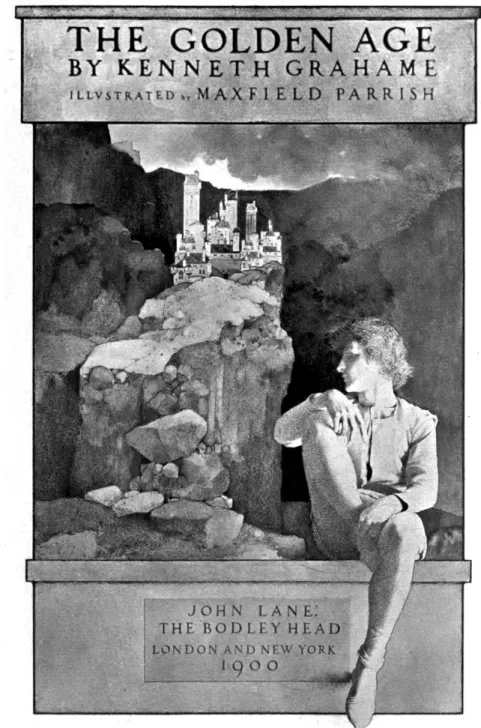
Figure 2: Maxfield Parrish, frontispiece for Kenneth Grahame, The Golden Age (London: John Lane, 1900). Wikimedia Commons.
URL:
https://en.wikisource.org/wiki/The_Golden_Age#/media/File:Title_illustration_to_The_golden_age.png (accessed 28 October 2019).
Impressionism: from Paris to England
There can be no doubts about Impressionism’s birthdate, nor can there be any doubts about the day of its demise. It all started with the 1874 Paris exhibition, held in rooms occupied by the photographer Nadar, a cheap affair, but one nevertheless conducive to its christening:
Monet, Pissarro, Sisley, Boudin, Renoir, Degas, Cézanne and Berthe Morisot […] were principal exhibitors. It was now that they acquired a name, Monet contributed a little picture of the sun rising over water which he called Impression. The Parisian journalists seized on the word “the Impressionists”. Le Charivari described them thus and the term stuck. (Gaunt 69)
Impressionism ended its short life in 1910, the proper funeral coinciding with another exhibition held at the Grafton Galleries in London. The Post-Impressionist Exhibition displayed paintings by Van Gogh, Cézanne, Matisse and Picasso to an incredulous, amused, laughing British public. The very term Post-Impressionism, as Roger Fry argued, was meant to emphasize a new, radical departure from the former school of painting (Fry 1961a, 1961b). Virginia Woolf would subscribe that “on or about December 1910” not only art, but human character had undergone a dramatic change (Woolf 70; Stansky). Thus, the story of Impressionism in painting can be traced with reliable confidence: the dates are known, and so are the names, as well as the dissemination of the aesthetic formula from France to England, owing especially to George Moore’s accounts
of his Parisian experience among the artists (Flint). In Reminiscences of the Impressionist Painters (1906),1 a
personal and idiosyncratic memoir, Moore dwells on the difference between the modernity of the Impressionists and the conventional schools of painting; he also discusses the use of colours and glazing, arguing that the whole method of painting has changed:
[…] we moderns no longer feel and see like the ancient masters. […] all pictures painted before the nineteenth century were painted first in black and white, and were then glazed. […] “glazing” means the use of transparent colours without any admixture of white. However much the artists of Italy, Spain, Holland, and France differed, they all painted alike in this respect; their pictures were painted in black and white and then the natural colours were applied. (22)
Against the old method, Moore claimed that “we are interested in detail, and we are eager to note every passing effect of rain or shine; we desire light above all things, and chiaroscuro bores us […]” (23). The artist would paint what he saw: “Manet saw Nature rapidly, and in full contour” (19); according to Kenneth Clark, Monet was “the member of the group who trusted most unreservedly to visual sensations” (Clark 172). Intent on capturing the most fleeting visual perceptions, “the subject which united them was the sparkle and reflection of light on water” and the “representation of light by the rainbow palette” (173, 176). While Moore moved to England after his youthful Paris experience, painters and writers in Paris and London were equally fascinated by “the final liberation of colour” (178). To remove the idea that colour was “some particularly dangerous and disreputable form of vice” (178) was one of the Impressionists’ great achievements.
Paul Smith reminds us that Impressionist painters regarded their treatment of colour as more realistic and more scientific, in comparison with the art of the past (19). Michel-Eugene Chevreul’s De la loi du contraste simultané des couleurs (1838) and Hermann Helmholtz’s Treatise on Physiological Optics (1867) dwelt scientifically on colour juxtaposition, and the effects of light and shadow on colour. Insisting at once on the Impressionists’ use of colours and their psychologic effect, Moore would explain the art of Pissarro – the painting “Apple Picking at Eragny-sur-Epte” (1888) that represents a group of girls gathering apples in a garden – by giving prominence to colours, and then to their psychological, evocative potential:
1 In addition to his Reminiscences, Moore’s novel A Modern Lover (1883) portrays the life of a painter; see Anna Gruetzner Robins (“‘A Modern Lover’: Introducing the French Impressionists to London”). Moore’s Confessions of a Young Man (1888), Impressions
Sad greys and violets, beautifully harmonized. The figures seem to move as in a dream; we are on the thither side of life, in a world of quiet colour and happy aspiration. Those apples will never fall from the branches, those baskets that the stooping girls are filling will never be filled, that garden is the garden that life has not for giving, but which the painter has set in an eternal dream of violet and grey. (Moore 40)
In this description of suspended action, frozen in an eternal imaginary frieze, marked by the anaphoric rhythm of the word “never”, we find Keats’s “cold pastoral”, as evoked in his Ode on a Grecian Urn (1819), being resuscitated. In fact, when sensuous impressions gather under the aesthetic flag of Impressionism, they are meant to affect an inner deposit of memory that is timeless, via pure colour effect on the retina and also through it, inasmuch as it resides with the everlasting impressions that the senses leave on the mind from early childhood. This focus on subjectivity certainly looks back to Romanticism, and its “recollections”, although it is imbued with a wholly modern sense of nostalgia, one not only generated by the apparent decay of nature, but also by the fin-de-siècle awareness of a deeper taint of degeneration that affects the social and individual mind. The joined elements of visual perception, childhood and memory are dialectically connected not only within Wordsworth’s romantic yearnings, but imbued with new epistemic weight within the horizon of contemporary science. As described by Jonathan Crary in his Techniques of the Observer, contemporary findings in optical physiology included research into retinal afterimages and the retinal permanence of strong visual impressions. At the fin de siècle, Henry Bergson’s Matter and Memory (1896) would argue for a theory of pure perception operating in dualistic unison with memory.
Impressions
The word “impressions”, although obviously linked with Impressionism, has much wider currency, both in time and space. On the one hand, it is used as a keyword for artistic perception and intention on the one hand, by the Romantic poets in particular; it recurs among the techniques of the observer, as the fleeting trace left on the retina by the dissolving views used in magic lantern slides. On the other hand, impression is a definite object of material culture: it refers to the printing and engraving technique, and subsequently to the visible impressions captured by new printing techniques, as well as by photography and its chemical process. Granted, the term would be relevant to those who described impressionist art as the product of images that meant to fix in paint the most fleeting and evanescent aspects of nature when caught en plein air; it also conveyed a critique of realism, even though we find Emile Zola among those who consorted with the painters in Paris in the 1870s. Well prior to Impressionism, however, the practice of transcribing visual perceptions caught by excursionists in a spontaneous, unpremeditated and rapid way, generated a fashion for recording subjective impressions that found its elective genre in the sketch, in pencil or ink, as well as in short compositions in verse and prose. The official investiture of the genre of the sketch within the aesthetics of the picturesque in the visual arts coincides with William Gilpin’s Three Essays: On Picturesque Beauty: On Picturesque Travel: And on Sketching Landscape: To Which Is Added a Poem on Landscape Painting (1792). Gilpin’s Essays would run through several impressions and teach painters and writers alike the virtue of a rapid, yet effective, rendering of the relevant details of a scene. Many landscape sketches were then printed by using the recently perfected aquatint process which allowed a moderate use of colours – usually sepia and indigo – and the realization of subtle monochrome shades. It is my point that by perfecting the aquatint technique, Gilpin also conferred the artistic afterlife of technological reproduction to the picturesque sketch (Orestano 2000). As argued by Richard Sha, the connection between the sketch as a genre and the poetics of Romanticism is relevant and lasting: together with the flow of visual impressions, fixed on the page in a spontaneous, quick, unpremeditated way, the stored images of memory – emotions recollected in tranquillity – would also come to the foreground.
When the sketch occurred in the verbal domain, the word impressions meant the transcription of elements of visual interest – natural scenery, ruins, dilapidation, poverty – that acquired further depth and significance
from their associations with memory. Childhood, invoked within the poetics of Romanticism, is the most fertile depository of impressions and, as such, it would appeal to fin-de-siècle writers – among them Ford Madox Ford, Robert Louis Stevenson, Kenneth Grahame. These figures, like the Impressionist painters, had become tired and wary of realism and naturalism. The escape route from the staged morality of Victorian fiction unfolded through childhood memories, a territory in which facts could be diluted into visions, dreams or nightmares, and where the hackneyed way of describing things would revert to a clean slate, awaiting innocent perceptions and spontaneous artistic impressions.
Impressionism, from the canvas to the page
The transition between impressionism on canvas and impressionism on the written page, or rather the artistic shuttle between these two dimensions, comes from the movement that originated within the visual arts, but bears significant consequences for the art of fiction. Like the sketch, it provides a poetics that could straddle visual and verbal texts all at once through the power of retinal impressions, and the act of recording them in their spontaneity (Parkes 2010; Fried). In 1873, in the “Preface” to The Renaissance, Pater used “impressions” as a keyword both for the virtues of the artistic object and for the response of the aesthetic critic, bent on “the original facts” and not on abstract formulas of beauty:
And the function of the aesthetic critic is to distinguish, analyse, and separate from its adjuncts, the virtue by which a picture, a landscape, a fair personality in life or in a book, produces this special impression of beauty or pleasure, to indicate what the source of that impression is, and under what conditions it is experienced. (Pater 1980, xx-xxi)
In Pater’s case, the impression sparks the response of the viewer, who discards all abstract formulas of beauty in favour of a visual appreciation of sensuous forms. In Appreciations, moreover, Pater would remark that “the elementary particles of language will be realised as colour and light and shape” (Pater 1927, 17). Pater would be the absent father not just for Virginia Woolf, but for a whole generation of writers dwelling on significant form. His lesson validates the aesthetic fruition of material qualities outside the metaphysics realm; it acknowledges formal values both in the original and the copy; it brings memory to the fore, thereby stressing the powers of the subjective mind, beyond correct chronology and full intentionality; it extricates childhood at once from strict Victorian rules and Romantic fallacies, as his “The Child in the House” (1878) suggests. In this autobiographical composition, which verges on the imaginary portrait, the child Florian’s impressions that form the bulk of his early memory and which are loaded with vivid colours – the red hawthorn, the yellow crab apples – occupy the foreground of the picture. Pater would consider this record as relevant to the origin of the entirety of his works in literary portraiture (see Monsman).
Robert Louis Stevenson has to be mentioned alongside Pater for his emphasis on visual perception forming “the plastic part of literature”; the true mark of good stories is “to obey the ideal laws of the day-dream” (Stevenson 178). In his essay “‘A Penny Plain and Twopence Coloured’”, Stevenson dwells on the lasting impressions that toy theatres printed on cardboard sheets, especially when coloured, would engrave on the memory of a child, whetting an appetite for adventure, melodrama and romance that would also shape the psychological response of the adult to landscape and literature.
Ford Madox Ford is another author whose contribution to literary impressionism seems most worthwhile in the present context: not only because of his free handling and admixture of genres – criticism and personal
reminiscence, biography and fiction2 – but because of the use of time-shift as a technique that validates the
contamination of impression with memory and desire:
2 By Ford Madox Ford (Ford Madox Hueffer until 1918), see Ancient Lights and Certain New Reflections (1911), published in the US as Memoirs and Impressions (1911); Thus to Revisit (1921); Return to Yesterday (1931); and also “Impressionism: Some Speculations” and “On Impressionism”.
It is, however, perfectly possible that a piece of Impressionism should give a sense of two, of three, of as many as you will, places, persons, emotions, all going on simultaneously in the emotions of the writer. It is, I mean, perfectly possible for a sensitised person, be he poet or prose writer, to have the sense, when he is in one room, that he is in another, or when he is speaking to one person he may be so intensely haunted by the memory or desire for another person that he may be absent-minded or distraught. […] The point is that any piece of Impressionism, whether it be prose, or verse, or painting, or sculpture, is the record of the impression of a moment; it is not a sort of rounded, annotated record of a set of circumstances, it is the record of the recollection in your mind of a set of circumstances that happened ten years ago or ten minutes. It might even be the impression of the moment but it is the impression, not the corrected chronicle. (Ford 1914, 173-74)
The passage insists on several points. The source of the impressions may be a moment close or distant in time, but its effect depends on its impact on the senses, and on the subsequent unclenching of memory or desire. Such effects belong to the arts in general, and once again the category of spontaneity seems the preferred modus operandi for the artist, granting the genuine force of his impressions. It is through this category that the element of childhood becomes prominent and strategic, as Ford argues in the “Dedication” of Ancient Lights and Certain New Reflections (1911) to his young daughters Christina and Katharine. In this text, he reproduces an engraving from an oil painting made in 1877 by his grandfather, the painter Ford Madox Brown. The painting portrayed the writer, then four-year-old, as “William Tell’s Son”:
Their growing mutual intimacy was apparent […] in the unswerving gaze four-year-old Ford returned to Madox Brown when he posed as William Tell’s Son. In this picture legendary childhood innocence and trust is pointed up by the detail of blood-red arrow marks, incised at the centre of the split apple. (Thirlwell 2009, 29-30)
In the context of the present essay, it should be remarked that the oil portrait of the grandchild of the famous pre-Raphaelite painter (today housed at the Fitzwilliam Museum in Cambridge) is turned into an engraving by the writer and is used again with a different purpose, suggested by the new title: “I Seem to Be Looking at Myself from Outside” (Hueffer 1911, vii). The historical character has disappeared: in his place we now find the writer who recycles an old image of himself in order to argue in favour of the lasting value of childhood impressions.
The emphasis authors like Ford place on childhood, as the repository of impressions refashioned within an explicit artistic effort, leads by easy transition to the works of Kenneth Grahame, and especially The Golden Age (1895) and Dream Days (1898). These works both provide a case in point for the embodiment of such poetics. Grahame’s works represent the artist’s response to the special emphasis on colour that literary impressionism would distil from the theme of childhood memories, and the emotions arising therefrom. Such handling of childhood as the strongest repository of visual experience can be seen again in Marcel Proust’s Du côté de chez Swann (1913), where the narrator’s first impressions, vividly etched in the child’s memory, through taste, hearing, eyesight, are bound to become the vehicles that lead him towards his temps retrouvé – toward the final retrieval of sense across the span of a whole life. The magic lantern, with its effects of colour that seem to project a gothic stained-glass window on the wall, plays a relevant role for the child narrator.
These impressions would affect and colour the peculiar relationship with childhood that characterizes fin de siècle children’s literature, at once luminous and sombre, distantly realistic, savage and solitary, by no means aligned to the expectations of the adult world. The period between 1865 and 1914 would be described as the first Golden Age of children’s literature: between the publication of Lewis Carroll’s Alice’s Adventures in Wonderland (1865) and World War One, children’s literature in England underwent a kind of Renaissance,
opening up a territory of fantasy, entertainment and transgression, where the child’s duties – moral, religious, generational – were temporarily forgotten (Hunt 59; Sorby 96-99; Shuttleworth). No longer fettered by rules forming the bulk of early Victorian fiction, the child would become the protagonist of adventures, a depository of sensations and lasting impressions, the creator of his own fantasy world (Gavin).
Nostalgia for the Golden Age of his own lost childhood is indeed a feature of Grahame’s eponymous book, perhaps of all of his books; however, the so-called Golden Age of children’s literature is a different affair, given that it colours his adult reminiscences with an exhilarating sense of freedom, an unprecedented sense of power.
Kenneth Grahame’s Golden Age
Kenneth Grahame (1852-1932), after an orphaned childhood, would become a reserved city banker who was involved in an arid marriage and in a sad fatherhood, culminating in the loss of his son (Grahame 2010, xvii-xx). His first book, Pagan Papers (1893), is described by Hunt as a collection of “fashionably whimsical pieces, scattered with classical tags, extolling the life of the week-end countryman” (xviii); parts of it would flow into The Golden Age (1895), the book that, alongside the following Dream Days (1898), cemented his reputation. His idiosyncratic animal story, The Wind in the Willows (1908), “the rural idyll of a worried generation” (xii), would appeal to adult and child readers alike.
The Golden Age and Dream Days, however, just like the successful story of friendly animals living on the romantic riverbank, do not fit comfortably into the format of children’s literature. The first two books are a mixture of personal reminiscences and vivid descriptions of episodes set in a distant time of life. Indeed, the Golden Age is there from the very title, and in many allusions to classical lore; but the reader perceives that the time-shift and the viewpoint ordering the scenes are managed by an adult mind, adding at once selfish empathy and superior irony to the episodes. The parentless children live in a house ruled by aunts, by the governess, and occasional uncles: they are free to play in a vast garden, ignored by the adults, the so-called “Olympians,” except for the material needs of their life. The children are in perpetual warfare against the Olympians, described as stupid, incapable, colourless, hopeless creatures. These works mark a late-Victorian search for Arcadia according to Humphrey Carpenter (Carpenter 114-25). Indeed, Grahame’s upbringing included a sound classical education, already visible in his Pagan Papers (1893); Grahame mixed with the Decadents when he contributed to The Yellow Book; and generally manifested a nostalgic paganism that Carpenter defines as “not remotely priapic, but simply epicurean in the old classical way” (122). Such paganism would be content with tramping in the sunny countryside, eschewing city life, going in search of “the Good Place, the Golden City, an Arcadia that can be reached in imagination” (123). Such Arcadia would admit a few quotes from Latin (“Exit Tyrannus”, “Lusisti Satis”), and the mention of Greek characters such as Perseus, Apollo, Psyche, in the chapter on “The Argonauts.” The Golden Age stands upon the skilful compromise between adult memory and desire, in which the adult and the child, albeit from different positions, are fully aligned; it is steeped in late nineteenth-century neo-paganism, to which the figure of Pan provides at once the emblem and cultural icon of sexual freedom (Orestano 2017). Described as a writer who wants to escape the machine age, Grahame shares this late post-industrial pastoral sentiment with the French painters who chose to work en plein air. The vivid colours are there and the technique recalls indeed the plein air situation of several Impressionist paintings. For instance, when the children’s game is to pretend that they are Cavaliers and Roundheads, a game steeped in the knowledge of history, the garden simply charms them away with its saturated colours, its yellows and greens:
We three younger were stretched at length in the orchard. The sun was hot, the season merry June, and never (I thought) had there been such wealth and riot of buttercups throughout the lush grass. Green-and-gold was the dominant key that day. Instead of active “pretence” with its shouts and its perspiration, how much better – I held – to lie at ease and pretend to one’s self, in green and golden fancies, slipping the husk and passing, a careless lounger, through a sleepy imaginary world all gold and green! (Grahame
1932, The Golden Age 19).3
The development of a technique that emulates the effects of painting also seems to function within the author’s literary workshop: to start in medias res, to dwell on time-shift and juxtaposition, to heed the progression d’effet, and choose le mot juste, are all aspects that characterize Grahame’s page and his artistic viewpoint (Lamberti 34). Grahame is keen on resting his eye on sudden atmospheric effects, such as those that occur after a tempest:
But now a glance through the window told me that the rain had entirely ceased, and that everything was bathed instead in a radiant glow of sunlight, more golden than any gamboge of mine could possibly depict. […] In the glorious reaction of the sunshine after the downpour, with its moist warm smells, bespanglement of greenery, and inspiriting touch of rain-washed air, the parks and palaces of the imagination glowed with a livelier iris, and their blurred beauties shone out again with fresh blush and palpitation. (Grahame 1932, Dream Days 148)
Critics argued about Grahame’s stories from the very beginning: Professor Sully called them “a dishonour to the sacred cause of childhood” owing to the “tone of cynical superiority that runs through the volume”; Algernon Charles Swinburne wrote that The Golden Age was “a book well-nigh too praiseworthy for praise” (Carpenter 125). In time, the former’s judgement would gain critical support: Grahame’s “anecdotal essays rather than short stories – were addressed to adults” (Wall 134). The children are indeed ensconced within the frame of the description; they are the necessary actors, but the adult narrator addresses an adult narratee. Thus Grahame offers “a nostalgic ridiculing of childhood. […] few attitudes are more patronizing and condescending than those which trivialize children’s behaviour and feelings in order to amuse adults” (134). Grahame is indeed the literary impressionist handling the brush and choosing the right colours by pretending innocence: “what was really new in Grahame’s work was the rapidity and the skill with which his narrator shifted perspective between child and adult […] the chief point of these stories lies in the tension that is created when an adult consciousness can be seen slyly pretending to view matters from a child’s standpoint” (Wall 135).
The innocent eye of the child gets crystallised by the adult’s skills: in similar fashion, Impressionism, with all its emphasis on light and retinal perception, engages a studious shuttle between the realistic conventions fettering the gaze, and a new theory of juxtaposition of colours, dispensing with chiaroscuro, but not wholly with perspective. This tension is indeed remarkable when Grahame’s stories are illustrated by Parrish. However, there is also a shuttle that is intrinsic to the text, when Grahame fills his scene with visual, aural and olfactory perceptions, and with the emotions rising from the sensuous condition that affects the child with a panicked sense of Nature that can only find adequate description in the words of an adult:
I waited […], and then I slipped through the hedge out of the trodden highway, into the vacant meadow spaces. […] the passion and the call of the divine morning were high in my blood. Earth to earth! That was the frank note, the joyous summons of the day; and they could not but jar and seem artificial, these human discussions and pretences, when boon nature, reticent no more, was singing that full-throated song of hers that thrills and claims control of every fibre. The air was wine, the moist earth-smell wine, the lark’s song, the wafts from the cow-shed at top of the field, the pant and smoke of a distant train— all were wine—or song, was it? or odour, this unity they all blent into? I had no words then to describe it, that earth-effluence of which I was so conscious; nor, indeed, have I found words since. I ran sideways, shouting; I dug glad heels into the squelching soil; I splashed diamond showers from puddles with a stick; I hurled clods skywards at random, and presently I somehow found myself singing. The words were mere nonsense—irresponsible babble; the tune was an improvisation, a weary, unrhythmic thing of rise and fall: and yet it seemed to me a genuine utterance, and just at that moment the one thing fitting and right and perfect. Humanity would have rejected it with scorn. Nature, everywhere singing
3 All subsequent quotations are from this edition. The Golden Age was first published in book form in 1895 by The Bodley Head in London and by Stone & Kimball in Chicago. The “Prologue” and six of the stories had previously appeared in the National Observer.
in the same key, recognised and accepted it without a flicker of dissent. (Grahame 1932, The Golden Age 10-11)
Improvisation, genuine utterance, the song of Nature: these are elements that even if they are reminiscent of a Romantic stage in the age of the child protagonist still belong to a vision that, although described as recollections with the poetics of the past tense, avails itself of devices of colouring and light, as in the diamonds sparkled by water, as well as in notions of sound and perfume that function with the intensity of colours in an impressionist painting.
Maxfield Parrish’s illustrations: impressions and technical reproducibility
Figure 1: Maxfield Parrish, “Out into the brimming sun-bathed world I sped”. Illustration for The Golden Age (London: John Lane, 1900), p. 14. Public domain. URL: http://www.gutenberg.org/files/32501/32501-h/images/ill03.jpg (accessed 28 October
This illustration by Maxfield Parrish provides the visual counterpoint to the above-quoted passage (figure 1). Parrish was born on July 25, 1870 in Philadelphia. Trained at the Pennsylvania Academy of the Fine Arts and Drexel Institute of Art, he was the highest-paid commercial artist and muralist in the U.S. during the 1920s. He died in 1966 (Yount 1999). Parrish illustrated several books for children during his life, starting with L. Frank Baum’s Mother Goose in Prose (1897), Eugene Field’s Poems of Childhood (1904); The Arabian Nights (1909); Hawthorne’s A Wonder Book and Tanglewood Tales (1910) (Skeeters; Cutler and Goffman). Impressions of childhood are a leitmotif of his art.
Elements such as the child in full sunlight, running toward nature, away from the village community in the background and a caption in which a first-person narrator speaks in the past tense, conspire to extract the mixture of memory and desire connected with strong early sensuous impressions. This figure is one in the first series of images that Parrish, then a young American illustrator, made for The Golden Age. The 1895 edition was not illustrated: the edition published by John Lane featured Parrish’s halftone black-and-white illustrations; in 1899 there were a total of 19 full-page pictures, one for each chapter; in 1900, Lane published another edition with new photogravure reproductions of the Parrish pictures; then the first illustrated edition of Dream Days (1902) was also commissioned to Parrish.
The relationship between Grahame’s child protagonists of The Golden Age and Dream Days, and Parrish’s illustrations touches literary Impressionism, across the mixed genres of reminiscence, autobiography, anecdote and sketch on the one hand, and the achievement of a technique of subtle and ambiguous visual realism on the other, in part respectful of distances and atmospheric effects, but carefully filling the visible dark contour line with subtle shades, that, while heightening the impact of the image, tend to diminish its realistic effect. A frequent compositional strategy adopted by Parrish is to place – as in the frontispiece of The Golden Age – the figure of the child protagonist halfway between the outside frame and the scene to be entered, loitering on the elusive threshold, between memory and desire (figure 2). The effect of a shuttle – but also a gap, an inconsistency, a blank spot, an intentional interval – between the narrating eye and the contemplated scene is, thus, achieved.
Figure 2: Maxfield Parrish, frontispiece for Kenneth Grahame, The Golden Age (London: John Lane, 1900). Wikimedia Commons. URL: https://en.wikisource.org/wiki/The_Golden_Age#/media/File:Title_illustration_to_The_golden_age.png
(accessed 28 October 2019).
The interaction between Grahame’s nostalgic time capsule and Parrish’s treatment of the stories, from his conception and design to the last stages of the printing process, provides a curious instance of the method leading from memory’s recorded perceptions to the final rendering. The impressions registered in Grahame’s text, expressive of the huge distance between the adult narrator and the child he remembers, are captured by Parrish with the image of a child sitting between two spaces – one the actual book, the other the distant enchanted grounds through which the child could lead the reader. This process is heightened by Parrish’s recourse to several printing techniques, as the first steps towards the finished illustration. In his finished images, the word “impression” is not only descriptive of the materiality of the printing process: it also acquires, as Walter Benjamin would argue in his memorable essay, the added aesthetic value attributed to works
produced in the age of technological reproduction4: “Parrish investigated almost every medium, from etching to photography” (Ludwig 189). He added remarkable skills in the area of printmaking to his early art of sketching and drawing. Parrish’s modern technique included the projection of the photographic negative silhouette onto paper or canvas, in order to trace the contours of architectures, rocks and trees, decorative patterns. Colours were then gradually added by hand within the contours, through a succession of layers, and were highlighted with a glazing technique that made each of them brilliant and deep in the final stage of the process. Varnish added a luminous finish to each layer. The dark line marking the contours generates a cloisonné effect – thus offering a formal statement toward distance and abstraction. Parrish would add colours to his previous black and white illustrations, perfecting his own method. Parrish explained his technique in a letter written in 1950:
Well – this method is very simple, very ancient, very laborious, and by no means original with me. It is somewhat like the modern reproductions in four-color half tone, where the various gradations are obtained by printing one color plate over another on a white ground of paper. […] Colors are applied just as they come from the tube, the original purity and quality is never lost. […] One does not paint long out of doors before it becomes apparent that a green tree has a lot of red in it. You may not see the red because your eye is blinded by the strong green, but it is there never the less. So if you mix a red with the green you get a sort of mud, each color killing the other. But by the other method, when the green is dry and a rose madder glazed over it you are apt to get what is wanted, and have a richness and
glow of one color shining through the other, not to be had by mixing.5
Parrish was aware of the technique adopted by the Impressionist painters, and had carefully studied the effect of primary colours in their mutual interaction and under the agency of light. In an interview where he describes his technique he states:
I used to begin a painting with a monochrome of raw umber, for some reason: possibly read that the ancient ones often began that way. But now the start is made with a monochrome of blue, right from the tube, not mixed with white or anything. Ultramarine or the Monastral blues, or cobalt for distance and skies. […] The rest is a build-up of glazes until the end. The only time opaque color is used is painting trees. The method of early Corots and Rousseau is a good one, suggested by nature herself, where a tree is first painted as a dark silhouette and when dry the outside or illuminated foliage is painted over it (qtd in Ludwig 193).
Parrish seems to fix the alpha and omega of his own art by invoking at once Jean-Baptiste-Camille Corot (1796-1875), the French landscape and portrait painter, and printmaker, whose art moved toward Impressionism, and Henri Julien Félix Rousseau (1844-1910), whose manner is described as neo-impressionist, naïve, infused with Symbolism and Cloisonnism as his models. Thus, he encompasses Impressionism in his visual shuttle and with the impressions ensconced in his printmaking technique; his colour diagram shows the scientific use of primary colours; finally, he can translate the suggestions contained in Grahame’s literary reminiscences into his visual text, where childhood is a part of the strategy adopted by artists working within the area of literary impressionism. In order to escape the machine age, albeit in different fashions, artists like Ford, Stevenson, Grahame, seemed to share a preference for things viewed through a virgin, naïve, primitive eye – as if they would acquire the visual power and poignancy of a child who discovers the world for the first time through this verbal device. For Grahame it was the eye of an adult who pretended to see things like a child; while for Parrish the world of primitive wonder and enchantment would be portrayed by perfecting sophisticated modern art techniques which, through a sequence of layers of colour and glazing, allowed the artist to make the impression materially deeper, and the finished image immensely evocative.
4 “The history of every art form has critical periods in which the particular form strains after effects which can be easily achieved only within a changed technical standard – that is to say, in a new art form” (Benjamin “The Work of Art in the Age of Technological Reproducibility. Second Version”, 38).
5 This is letter written by Maxfield Parrish in 1950 in response to an interviewer and it is also quoted in Ludwig (191-93). See Anon. “Maxfield Parrish, A Mechanic Who Painted Fantastically”. URL: www.newenglandhistoricalsociety.com/maxfield-parrish-mechanic-painted-fantastically/ (accessed 2 October 2019).
Works Cited
Anon. “Maxfield Parrish: A Mechanic Who Painted Fantastically”. New England Historical Society (30 March 2014). URL: http://www.newenglandhistoricalsociety.com/maxfield-parrish-mechanic-painted-fantastically/ (accessed 2 October 2019).
Benjamin, Walter. The Work of Art in the Age of its Technological Reproducibility and Other Writings on Media. Eds. Michael W. Jennings, Brigid Doherty and Thomas Y. Levin. Cambridge MA: The Belknap Press of Harvard University Press, 2008.
Carpenter, Humphrey. Secret Gardens: A Study of the Golden Age of Children’s Literature. London: Unwin, 1985.
Clark, Kenneth, Landscape into Art. London: John Murray, 1986.
Crary, Jonathan. Techniques of the Observer: On Vision and Modernity in the Late Nineteenth Century. Cambridge MA: MIT Press, 1990.
Cutler, Laurence Stephan and Judy Goffman. Maxfield Parrish: A Retrospective. San Francisco: Pomegranate Artbooks, 1995.
Flint, Kate (ed.). Impressionists in England: The Critical Reception. London: Routledge, 1984. Fried, Michael. What Was Literary Impressionism? Harvard, MA: The Belknap Press, 2018. Fry, Roger. “Retrospect”. Vision and Design. 1920. London: Pelican, 1961a.
—. “The French Post Impressionists”. Vision and Design. 1912. London: Pelican, 1961b. Gaunt, William. The Aesthetic Adventure. London: Sphere Books, 1988.
Gavin, Adrienne E. and Andrew F. Humphries (eds.). Childhood in Edwardian Fiction: Worlds Enough and Time. Basingstoke: Palgrave Macmillan, 2009.
Grahame, Kenneth. The Kenneth Grahame Book: The Golden Age. Dream Days. The Wind in the Willows. London: Methuen, 1932.
—. The Wind in the Willows. Ed. with an Introduction and Notes by Peter Hunt. Oxford: Oxford University Press, 2010.
Gruetzner Robins, Anna. “A Modern Lover: Introducing the French Impressionists to London”. French Studies 61:1 (1 Jan. 2007): 47-56.
Hueffer, Ford Madox. Ancient Lights and Certain New Reflections: Being the Memories of a Young Man. London: Chapman and Hall, 1911.
—. “Impressionism: Some Speculations”. Poetry 2 (August-Sept. 1913): 323-334. —. “On Impressionism”. Poetry and Drama 2 (June-Dec. 1914): 161-175.
Hunt, Peter. An Introduction to Children’s Literature. Oxford: Oxford University Press, 1994.
Lamberti, Elena. “La poetica impressionista come laboratorio di scrittura”. Il senso critico. Saggi di Ford Madox Ford. Eds. Vita Fortunati and Elena Lamberti. Bologna: Alinea Editrice, 2001.
Ludwig, Coy L. Maxfield Parrish. New York: Watson-Guptill Publications, 1973.
Menges, Jeff A. Worlds of Enchantment: The Art of Maxfield Parrish. Mineola, NY: Dover Publications, 2010.
Monsman, Gerald. “Pater’s ‘Child in the House’ and the Renovation of the Self”. Texas Studies in Literature and Language 28:3 (1986): 281-295.
Moore, George. Reminiscences of the Impressionist Painters. Dublin: Maunsel & Co., 1906.
Orestano, Francesca. Paesaggio e finzione: William Gilpin, il pittoresco, la visibilità nella letteratura inglese. Milano: Unicopli, 2000.
—. “Pan between Renaissance and Fin-de-siècle: The Lesson of Jacob Burckhardt”. Literature and Cultural Memory. Eds. Mihaela Irimia, Dragos Manea and Andrea Paris. Leiden; Boston: Brill Rodopi, 2017: 203-217. Parkes, Adam. A Sense of Shock: The Impact of Impressionism on Modern British and Irish Writing. Oxford: Oxford University Press, 2010.
Pater, Walter. Appreciations. With an Essay on Style. London: Macmillan, 1927.
—. “The Child in the House” (1878). Miscellaneous Studies: A Series of Essays. Ed. Charles L. Shadwell. London: Macmillan, 1900.
—. The Renaissance: Studies in Art and Poetry. The 1893 Text. Ed. Donald L. Hill. Berkeley: University of California Press, 1980.
Sha, Richard. The Visual and Verbal Sketch in British Romanticism. Philadelphia: University of Pennsylvania Press, 1998.
Shuttleworth, Sally. The Mind of the Child: Child Development in Literature, Science, and Medicine, 1840-1900. Oxford: Oxford University Press, 2010.
Skeeters, Paul W. Maxfield Parrish: The Early Years. Los Angeles: Nash Publishing, 1973. Smith, Paul. Impressionism: Beneath the Surface. London: Weidenfeld and Nicholson, 1995.
Sorby, Angela. “Golden Age”. Keywords for Children’s Literature. Eds. Philip Nel and Lissa Paul. New York: New York University Press, 2011. 96-99.
Stansky, Peter. On or About December 1910 Human Character Changed: Early Bloomsbury and its Intimate World. Cambridge, MA: Harvard University Press, 1996.
Stevenson, Robert Louis. Memories and Portraits. Glasgow, Richard Drew, 1990.
Laura Colombino. Amsterdam: Rodopi, 2009. 29-38.
Wall, Barbara. The Narrator’s Voice: The Dilemma of Children’s Fiction. Basingstoke: Macmillan, 1991. Woolf, Virginia. “Mr Bennet and Mrs Brown”. 1924. A Woman’s Essays. Ed. Rachel Bowlby. London: Penguin, 1992. 69-87.
Yount, Sylvia. Maxfield Parrish, 1870-1966. New York: Harry N. Abrams, 1999.
Francesca Orestano