AUG 17 1960
L IBRA
R-A DIRECT-COUPLED MULTIPLIER FOR R-ACOUSTIC SONR-AR by
DAVID ALLEN CAHLANDER
SUBMITTED IN PARTIAL FULFILLMENT OF THE REQUIREMENTS FOR THE DEGREE OF
MASTER OF SCIENCE at the
MASSACHUSETTS INSTITUTE OF TECHNOLOGY
June, 1960
1 I
Signature of Author o.t
Department of Electrical Engineering, May 23, 1960
Certified by
I
/ Thesis Supervisor
ica N 1 6
Accepted by
I
Chairman, Department Committee on Graduate(~5tients
F
') ,
A DIRECT- COUPLED MULTIPLIER FOR ACOUSTIC SONAR
by
DAVID ALLEN CAHLANDER
Submitted to the Department of Electrical Engineering on May 23, 1960 in partial fulfillment of the require-ments for the degree of Master of Science.
ABS TRACT
A high-speed multiplier was needed as an essen-tial part of an electronic model of a Bat. Since no such device was found to be commercially available I undertook the project of designing one that would fit the needs.
The resulting device is a four-quadrant multiplier with a frequency response of DC to 500 KC. The method of multiplication, reasons for the particu-lar design used, accuracy, and the stability of the multiplier are discussed.
Thesis Supervisor: SamuAl J. Mason Title: Professor of Electrical Engineering
Plate 1 Electronic Multiplier
_~~_ --_.--- _____ 11_·___1__~~_1_________ ... _1 · 1~1 ~_ _ ~.~I~ C~~ __ I_ ~__~_~ ___~~
-I-ACKNOWLEDGMENT
The author wishes to acknowledge the encouragement and motivation that has been provided by Mr. Fredrick A. Webster and Dr. Donald R. Griffen along the lines of the Acoustic Sonar model of a Bat; Dr. Donald L. Clark, who originally suggested
this project; Dr. J. J. Gerald McCue, who has been very helpful in procuring necessary equipment; Dr. Samual J. Mason, who has been extremely patient and helpful; Mr. Bruce DePalmer, who
suggested several good schemes for the multiplier; Dr. Walter A. Rosenblith, who suggested the quarted square multiplication technique; Mr. David G. Kocher, Mr. William H. Levison, and Mr. Albert C. Schell, who made many helpful suggestions.
Thanks are due to Mrs. Deanne F. Sferrino for the rapid and efficient typing of this thesis and the staff at Lincoln Laboratory who produced this thesis.
The writer is especially grateful to Marjorie Mills Cahlander for her infinite patience, consideration, and encouragement throughout the preparation of this thesis.
TABLE OF CONTENTS
I. Introduction 1
II. The "Building Blocks" of the Multiplier
A. The Input Difference Amplifiers 3
B. Output Difference Amplifier 10 C. The Squaring Operation 11
D. The Output Cathode Follower 23
E. Power Supply 28
III. Interconnections of the "Building Blocks " 30
IV. Over-all Specifications 36
V. Concluding Remarks 38
VI. Bibliography 39
VII. Appendix
A. Analysis of a Difference Amplifier 40 B. Electronic Multipliers that are Commercially
Available 43
ILLUSTRATIONS
I. Drawings
1. Difference Amplifier 4
2. Ideal Model for Odd Mode in Difference Amplifier 6
3. Incremental Ideal Model for the Even mode in a
Difference Amplifier 8
4. Hybrid Connection of the 5725's to Obtain the
Squaring Function 12
5. Circuit for Biasing and Adjusting the Gain for
Squaring Element Simultaneously 17 6. Cathode Follower Output Stage 25 7. Ideal Model for the Cathode Follower Output Stage 26
8. Power Supply 29
9. Block Diagram for the Multiplier 31 10. Resistive Summing Network Between the Input
Difference Amplifier and the Squaring Element 32
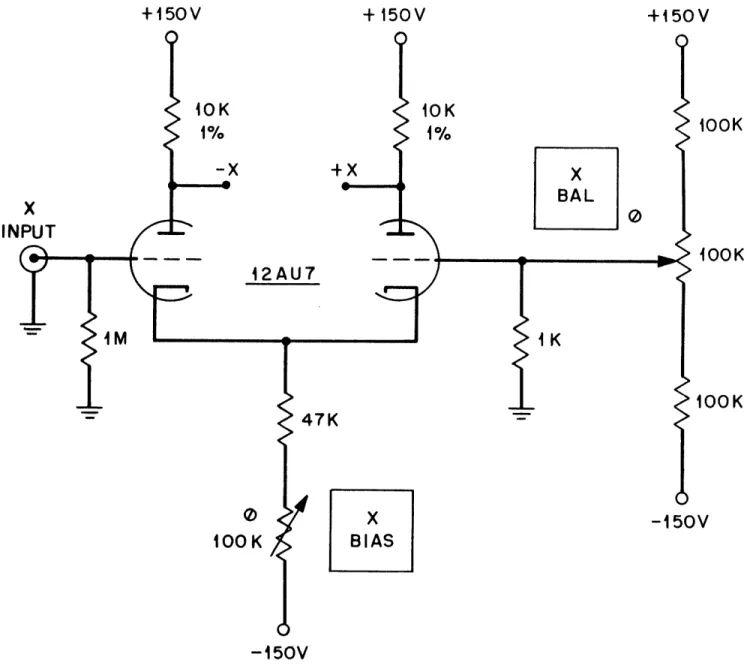
11. Input Difference Amplifier Circuit 33
12. Output Difference Amplifier 35 13. Ideal Model of a Difference Amplifier 41 14. Wiring Diagram of Multiplier 46 II. Graphs
1. Characteristic Curve for a 5725 Vacuum Tube and a
Parabolic Fit 13
2, Characteristic Curve for a 5725 Vacuum Tube and 5 -er cent Accuracy Limits
ILLUSTRATIONS (continued)
3. Characteristic Curves for 4 Different 5725's Connected as in Figure 5 with
3
Adjustedsuch that i = 70 lamp. 19 o
4. Transfer Characteristics for Two 5725's
Connected in the Hybrid Connection of
Push-Pull and Parallel Described in Figure 4. 21
5. "Infant Drift" in e0 for a Typical 5725. eo
is Adjusted so that i = 70 Vamp. 22
P
6. Drift in eo for a Typical, Aged 5725, After Being off for 24 Hours. eo is Adjusted so that
i = 70 Ilamp.
23
III. Plates
1. Electronic Multiplier
2. Top View of Multiplier 47
-1-I. Introduction
The ability of the Bat to navigate by means of acoustic sonar, even in the presence of relatively intense noise, has been
extensively investigated by zoologist Donald R. Griffin of Harvard. Dr. Griffin has found that the bat Plecotus Rafinesquii is able skillfully to avoid wires even when the energy of the bat's echo from the wire is perhaps as much as 20 db below the noise power per unit bandwidth of the jamming noise. This is indeed remarkably
good receiver performance and makes the study of the bat a matter of great interest to communications engineers.
Many of the parameters in a jamming experiment are difficult to calculate but should be easy to measure. An artificial "bat sonar"
is being built for experimental investigation of parameters affecting anti-jamming capabilities of such systems. According to information theory, the best processing of a signal contaminated by addative
gaussian noise is a cross-correlation with the same signal. Cross-correlation techniques may also be used to simulate the
pulse-compression of an FM signal that is fed through a matched filter.(1) It is evident that a multiplier is needed for these operation. The requirements for this multiplier are: a frequency response of
DC-100 KC and an accuracy of 5 per cent. An extensive search of
the available literature indicated that it is highly unlikely that
multipliers satisfying these requirements are commercially available. Many different multiplication methods were considered and
several were tried. The method that is used in the multiplier described below utilizes the quarter-square principle.
-2-That is:
(x
+
y)
-
(x-
y)
2
xy
=
(1)
The nearly parabolic plate current vs. grid voltage characteristics of two 5725 pentode vacuum tubes operating in a hybrid' combination of push-pull and parallel is used to generate the squaring function. Difference amplifiers with high common mode rejection are used for the inverting operations and resistive networks are used for the summing operations.
-3-II. The "Building Blocks" of the Multiplier
A. The Input Difference Amplifiers
In.. a uiiiltiplier built by Holmes and Dukes and copied by
Barlow and Brown( 3 ), which also uses the quarter-square principle, the input to the multiplier is AC coupled to a pair of phase splitters (triodes with similar cathode and plate resistors) and a resistor summing matrix is used to obtain the sum and difference inputs to the squaring elements. This method of obtaining the sum and difference signals is disadvantagous for a direct-coupled multiplier
since the plate and cathode of the phase splitter are at different
DC potentials. High frequency AC operation is also impa red since the impedence level of the plate and cathode outputs of the phase
splitter are different. This difficulty is overcome by the use of two difference amplifiers (see Fig. 1) as the iriput stages of the multi-plier. The x signal to the multiplier is fed into one of the inputs of
one difference amplifier and the y signal is feed into one of the inputs of the other difference amplifier. The second input of each difference amplifier is grounded. The output voltages on the four plates of the two difference amplifiers are proportional to +x, -x,
+y, and - y respectively (disregarding the DC bias). These outputs are combined using a resistive adding matrix to form (x + y),
-(x + y), (x - y) and -(x - y).
The operation of a difference amplifier can be analyzed with
the use of symmetry arguments.
Considering two different
-4-Ebb
RL
RL
12AU7
eg2
'RK
FIG. 1: DIFFERENCE
_ mAMPLIFIER
-5-equivalently the even and the odd modes ( 4 ), the grid and plate voltages are written:
e +e
e" = ge go0 (2a)
e -e e =g2 e go (2b) if we define: e + ie 9g e1 g2 (3a)
ge
2
e -e e egl - e2 (3b) go 0 and e +e e pl e po (4a) e -ee
=
pe
po
(4b)
if we define: e +e e = epl 2 (5a) pe 2 e epo
2
The gain for the odd mode can be determined by inspection from the incremental model, Fig. 2. The cathode resistor is replaced by a short circuit because of the anti-symmetry in the odd mode.
epo
2
eg,
2
epo
2
ego
2
FIG. 2: IDEAL MODEL FOR
DIFFERENCE AMPLIFIER.
ODD MODE IN
-7-e R
L
r +R
p L
Rearranging terms, the gain for the odd mode is:
go
p
L
The gain for the even mode is determined from the incremental model, Fig. 3. and
e
c=
-i
Er+R
LP
L
- 2iRk+ 2Rj
(6)(7)
(8)
(9) ande
=-iR
LCombining equations (8), (9),
and
(10):
(10) = ec
+ RL + 2Rk]
Ep
eeP
e + 2 LRk]
(11)Rearranging terms, the gain for the even mode is:
R R
Lr + R
+ Z (t
+I)
R
JLJ K
The input voltage to the multiplier is:
ein gl
[rp
ePe
ItL
pe
e and (12) (13a)-epe
2
epe
2
ege
2
ege
2
FIG 3: INCREMENTAL IDEAL MODEL FOR THE EVEN
MODE IN A DIFFERENCE AMPLIFIER.
-9-eg =0
Therefore, from equations (3a) and (3b): e =e
=
e.ge go in
By substituting equation (14) into equations (7) and (12), from
equations (4a) and (4b) we find: e 1 e. in
4 (r + RL)
p LE
lr + R
L+
p
L
r +R
+2
•( + I) Rk
(13b)
(14) (15) or equivalently:pRL
-4 (r + RL) p L=
+
V RL
e.
in 4(r + RL)
p 1 1 +R S+ r +Rp
L
Z(
1j + )R
k
1r +,R p L If we define:1
S(p
+ 1) Rk
r
+RL
PL
= RLG =
4 (r + R )
RL
PL
equations (16a) and (16b) become: e
:-n
e. In and(16a)
(16b) and (17) (18)-
10-ep. = - G (1 +E) (19a)
e. In
e 1
= + G (1
-
()
(19b)
e. inWhen Rk
>> (r
+ RL),
E
< < 1, and the output signals of the
difference amplifier are very nearly equal and opposite. When
E
<.01 the accuracy of the difference amplifier is limit ed bythe accuracy of the load resistors (RL)(one per. cent deposited carbon resistors are used for the load resistors,
(
c~.0027.) A morecomplete analysis of the difference amplifier, considering different
. and r for the two triodes is given in Appendix 1.
By symmetry considerations, the output impedance and the
potential of the two outputs of the difference amplifier are to a
first order the same. All things considered, the difference amplifier seems to be a very adequate input state for this multiplier.
B. Output Difference Amplifier
The output difference amplifier is quite similar to the input difference amplifier. The only difference is that in the output difference amplifier the output is taken from only one of the two plates and inputs are supplied to both grids. Using the same
analysis that was used for the input difference amplifiers, the output signal is, from equation (4b):
e -e
e = pe po (20)
-
11--
i
R
Li
R
L e + +e
+ RL
=
+ Z( + 1)
Rk ge
r + R
Lgo
o
2
substituting equations (3a) and (3b) into (21)
-
LR
r +R
e
e
p
L
p
L L
e e
(
(22) Rearranging terms and substituting from equations (17) and (18):e = G [eg (1 - ) - eg (1 + ()] (23)
Since the absolute value of the gain is of little interest here, and the output is taken from only one of the plates, 5 per cent
resistors are used in the plate circuit (RL). If
<<
1,
this circuit actually does take the difference in the voltage on the two grids and amplifies this difference by G.C. The Squaring Operation
The squaring operation is performed with two 5725 tubes connected in a hybrid combination of push-pull and parallel (see Fig. 4). When the control and suppresser grids of a single tube are tied together, the plate current-grid voltage characteristic curve is parabolic over a wide range (see Graph.l). Replotting graph 1 on log-log graph paper, Graph 2, we see that the 5725 tube characteristics fall well within 5 per cent of the desired second power characteristics.
(X+y)
5725
(6AS6)
-y)
2
-(x+y)
5725
(6AS6)
FIG.
4:
HYBRID CONNECTION OF THE 5725's
OBTAIN
THE SQUARING FUNCTION.
J
-
7.0
- 6.0
- 5.0
- 4.0
- 3.0
- 2.0
-1.0
0
eg
(volts)
GRAPH
1
-
13
-10.0
9.0
8.0
7.0
0E
z
cr
tar5.0
w0-4.0
3.0
2.0
1.0
.3
.4 .5 .6 .7
.8.9 1.0
3
4
5
6 78910
SIGNAL VOLTAGE
(eg-e
0
)(volts)
GRAPH 2
- 14-10
9
8
7
6
5
4
3
2
1.0
.9
.8
.7
.6
.5
.4
.3
d ciE
0_a
Iw
_a
cr.a:
z
ILU U o• C, I-4 0J- 15
-The main disadvantage of using the characteristics of a
vacuum tube to accomplish the squaring operation is the necessity of biasing each tube individually to the point near cutoff around which the plate current-grid voltage curve is parabolic. Even after
this bias point is reached, it would seem, the gain must be
adjusted. Selecting tubes for this operation is unreasonable since the tube characteristics should fall within several per cent of of each other. Even after the bias and gain of the tube have been set by some means, what is to assure us that the tube won't drift with time ?
Fortunately things are not as bad as they seem. The plate current-grid voltage characteristics for a 5:725 can be approximated by a
Taylor series: i i + i (e - e ) +i (e - e ) + . (24) p o 1 g
o
)g
By changing variables:(e -e ) =
pe
(25)
g o oThe Taylor series becomes:
ip =io + i (e + i2 (e s) ) + ". (26)
It follows that there are two conditions that must be satisfied, for satisfactory operation of the multiplier.
Condition 1.. e must be chosen such that i = 0.
o 1
Condition 2 i2 2 must have the same value for all the
-
16
-Experimentally, it was found that with 5 tubes that were carefully tested; i = 70 p.amp when Condition 1 is satisfied and
2
i2 e = y is a constant for all of the tubes tested when Condition 2
is satisfied.
These experimental facts suggest a method of biasing the tube -and setting the gain at the same time (see Fig. 5). Let:
R
2 (27)
R1 + R2 than:
e =j (e
s- a)
(2'8)
where es is the signal Vltage, and -a is a fixed bias. Approxi-mating the Taylor series, equation (24), with the first three terms and subject to Condition 1:
ip = i +
i
(e
- e
2
(29)
Substituting equation (28) into (29):
ii
=i +
i2
(e - a) - e ]
2
(30)
But P is chosen )when es = 0:i =i .(31) p o Therefore
i
2[A (0
-
a)- e
2
=
0
(32)
which means: e = - a 0(33)
(es
FIG. 5: CIRCUIT FOR BIASING AND ADJUSTING THE
GAIN FOR SQUARING ELEMENT SIMULTANEOUSLY
-17
- 18
-or
e
0 (34)
substituting into equation (30)
i
p
i +i
02
2
[--- (e -a)- e
a
s
0
(35)
or
e
2
i = i + i ( e 2 (36) p o -2 s but i2 eo = (37)is the same for all tubes, so finally
i = +4( ) e
(38)
p o sa
In words, this means that if the circuit in Fig. 5 is used to couple the signal voltage to the grids of the squaring element,
when 0 is adjusted such that i = 70 jIamp when es = 0, both Condition 1 and Condition 2 are satisfied !
This result is not unreasonable. Essentially all that is said is that the expansion for i may be approximated with the first three terms of equation (24), and that when the grid voltage is equal to zero, the plate current for any 5725 is approximately the same. Graph 3 illustrates the accuracy of equation (38) for various 5725 tubes.
Two of the 5725 tubes a.re connected in :the hybrid combination of push-pulland 'paraliel shown in Fig. :4. The input to each pair of
.3
.4 .5 .6
.7 .8 .9 .1
SIGNAL
VOLTAGE
3
4
5
6 7 891
(arbitrary units)
GRAPH 3
5725'S
CHARACTERISTIC
CONNECTED
CURVES
AS IN FIGURE
FOR 4 DIFFERENT
5 WITH
(8
ADJUSTED
SUCH THAT
io =
70
p.
amp.
19
-10
9
8
7
6
5
4
3
2
.1
.9
.8
.7
.6
.5
.4
.3
.2
0E
z
w
---
cr-Z LI.(-z
w
cr-c:: 0
w
H =,, I-0Z -- ---~I-~'- 20
-grids is the connection described in Fig. 5, with 0 adjusted so that i = 70 Lamp. When the input signal voltages to the two sides of this circuit are equal and opposite, a two-sided parabolic plate current-signal voltage characteristic is obtained (Graph 4).
A drawback that tubes in general have for use as non-linear
elements, is their inherent drift of characteristics with time. In the case of the difference amplifier, the effects of the temporal instability in the triodes characteristics tend to be cancelled due
to the symmetry of the circuit. With the squaring device, some of the drift effects cancel due to the symmetry of the circuit, but even so, the effect of drift in the squaring amplifier is much more pronounced than it is in the difference amplifier. Fortunately, the 5725's seem to have very nice drift characteristics. When turned on for the first time, their characteristics drift for a period of a day or so. (See Graph 5). After this initial "Infant drift", the characteristics of the 5725 seem to be stabilized. In other words, if the tube is turned off and then turned back on, at some later time, after a short warm-up period, the characteristics assume the value that they had at the
time the tube was turned off. These characteristics are then quite stable (see Graph 6).
This property of the 5725 suggests that when first adjusting the multiplier, one should age the 5725's at least 40 hours before
attempting to allign the unit. Experimentally it was found that the tubes would "age" just as well with heater voltage applied as they would with both the heater and plate voltages on. It is therefore
- 21
--10
-8
-6
-4
-2
0
2
4
6
8
10
e
s(arbitrary
units)
GRAPH 4
TRANSFER
CHARACTERISTICS
TWO 5725 TUBES CONNECTED IN THE HYBRID
CONNECTION OF PUSH-PULL AND PARALLEL
DESCRIBED
FOR
IN FIGURE
4.Ebb =
120
volts
eg
2=
120
volts
eg
1 = eg2=
e
oip =
70
oa mp
I
I
I
I I I I I I.001
.002
)2
.05
.4
.2
.5
4
2
5
10
20
50
100
TIME (hours)
GRAPH 5. "INFANT
DRIFT"
IN
e
o
FOR A TYPICAL
5725.
e
o
Imp.
IS
ADJUSTED
7.0
6.8-6.6
F-6.4
6.2
6.0
--05.8
5.6 H
5.4
H-5.2 FH
5.0
I
1111
.-
T
6.8
6.6
6.4
6.2
6.0
5.8
5.6
5.4
5.2
5.0
I
I
I
.004 .002
.005
.01
.02
I
I
I
.05
.1
.2
I
I
I
.5
1
2
-4
4
20 volts
120 volts
eg = eg
3= e
oip
= 70p.amp
I
I
I
5
10
20
TIME (hours)
GRAPH 6. DRIFT IN
e
o
FOR A TYPICAL,
AGED
5725, AFTER BEING OFF FOR
SO
THAT ip
= 70/•amp.
(.U1L---T
50
100
c v m SI I IEbb =
eg2 =
24 HOURS.
IS ADJUSTED
- 2-4
-p ossible :'to. build a uni-t:specifiplly'rtoq age the 5725- tube s.a This
unit would consis:t.-of ncthing riore :t:han. A: tube socket, and a. filament transformer.
D. The Output Cathode Follower
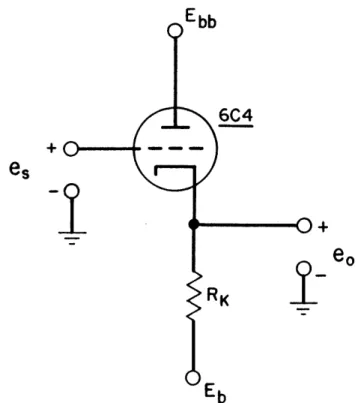
For low impedance output, a cathode follower Fig. 6 was used. This is the only section of the multiplier where symmetry is not used to give stability. The gain of the cathode follower along with the dependence of the output on the DC supply voltage can be computed from the ideal model, Fig. 7. By inspection:
e -0 eC +ir p =Ebb (39) e = Eb + iR k (40) or e -E i = Rk b (41) e +e =e (42)
substituting equation (41) and (42) into (39) r
e
-
i (e
- eo) + (e
- Eb) R
= Ebb
(43)
k
rearranging terms: r re (1 +
L+
- )R =Ebb +Eb
P
+ es
(44)
k k and finally: r I (Ebb +_ Eb) + e bb Rk b se
r
(45)
I +
(1 + P )]
SR kmema
L, _ _ ----
-25-E a.
6C4
+ +tb
FIG. 6: CATHODE FOLLOWER OUTPUT STAGE
26
-Ebb
+RK
Eb
FIG.
7:
IDEAL IV
OUTPUT STAGE.
IODEL FOR THE CATHODE FOLLOWER
- 27
-The output voltage eo, is divided into two terms; the signal term and the bias term. In this circuit, since symmetry is not used, both the gain for the signal term and the value of the bias term muse be investigated for instability. The incremental gain of the cathode follower is:
Ae
0 e 1 (46)
Aes
1 +- ( +
V
R
kThe change in the gain due to a change in V is:
ALe r
a(
o )
(1 +- )
s
k
(
= + r P 2 Z (47) 1 + 1 rJR
Rk
or approximately: Ae Aes
=1
1 (48)In this multiplier the tube used in the cathode follower is a
6GC4, which has a V of 20. Equation (48) indicates that a 20 per cent change in V causes less than a 1 per cent change in the gain of the cathode follower.
The change in the bias term may be calculated by differentiating equation (45). This is approximately:
E r
o
1
V
bb
V Rk
b
-28-Ebb and Eb are 150 volts in magnitude and are regulated within 1 volt. r is approximately 7K, V = 20, and Rk = 150 K. Therefore,
a 5 per cent change in . will change e only by 0.3 volts, a 1-volt
0
change in Ebb will change eo by 50 mv, and a 1-volt change in Eb
will change e by & 5 mv. This cathode follower circuit appears
to be an adequate output circuit for the multiplier.
E. Power Supply
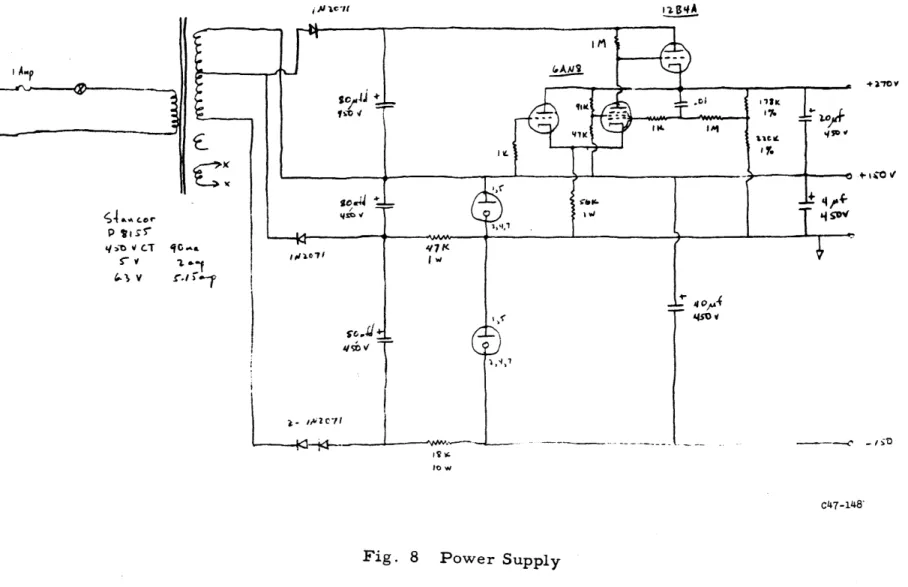
Power is provided by a regulated power supply of standard design. (See Fig. 8). The plus and minus 150 volt supplies are controlled with shunt gas diode regulator tubes. The +270 volt supply uses a series regulator tube controlled by a high gain DC amplifier, with the +150 volt supply as the reference standard for this supply.
I A..mpr P cge;~ q~ciarT ji SAl 1c01 +•-7oY -/ C47-148
Fig. 8 Power Supply
_ .~l~i--·-
i--
30-III. Inteconnections of the "Building Blocks"
Now that all the building blocks have been assembled and
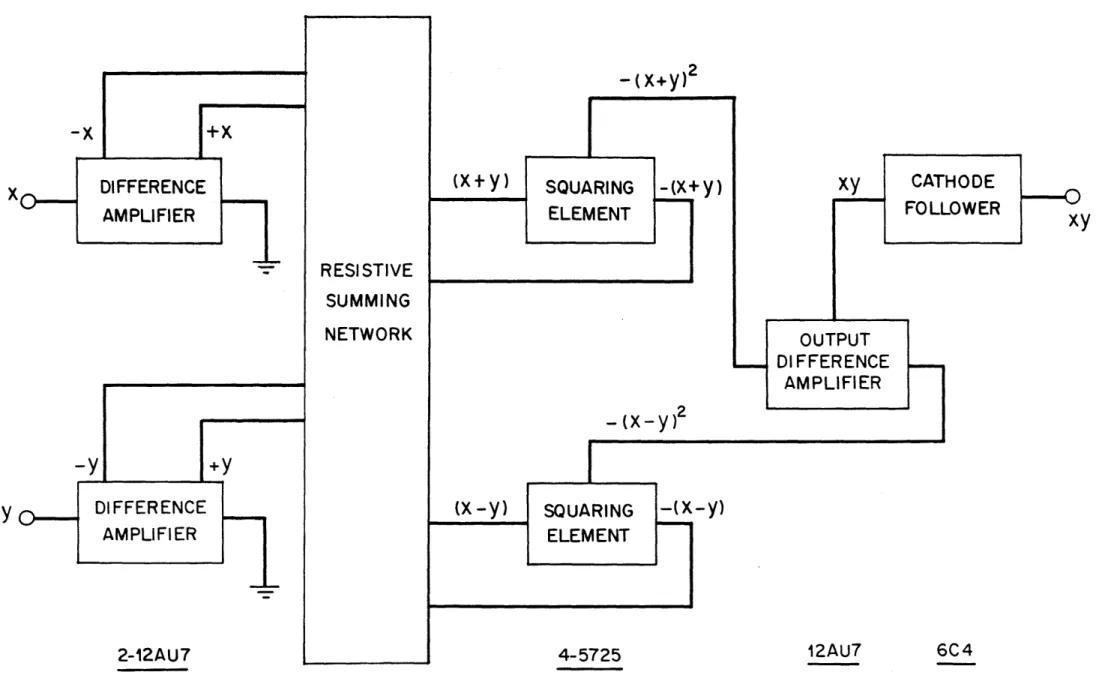
analyzed, we are ready to interconnect them to realize the complete multiplier. The block diagram for the multiplier is shown in Fig. 9.
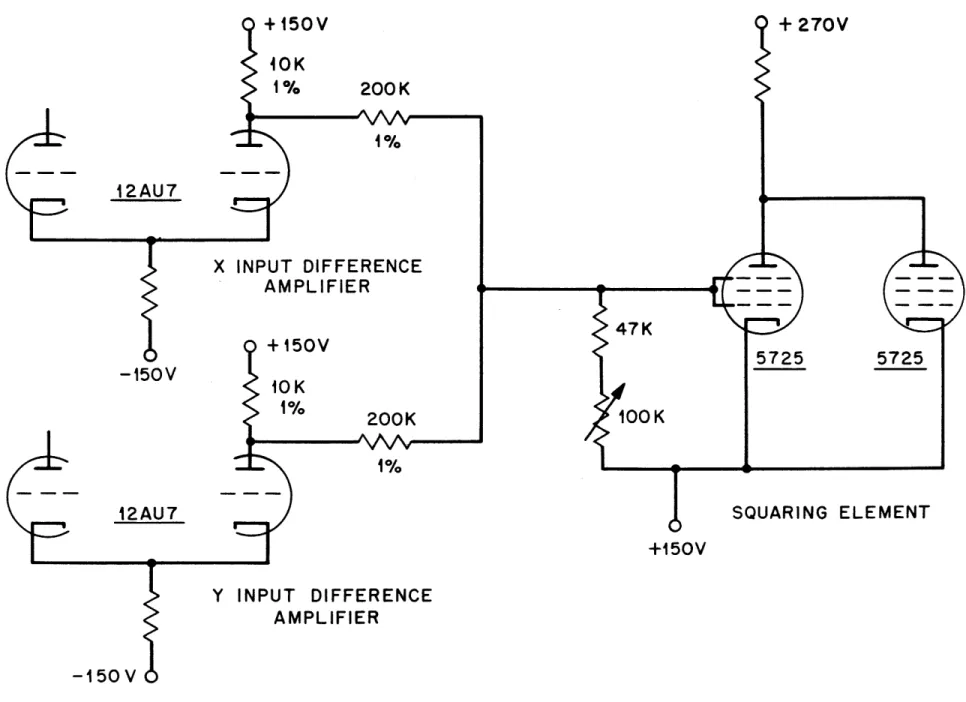
The input difference amplifier must be connected to the squaring elements through some adding network such that the bias for the squaring element can be correctly adjusted by the.:method stated earlier (see Fig. 5). This is done by direct coupling the plates of the two difference amplifiers to the grid of the proper squaring element through resistors with a variable resistor connected
between the grid and cathode of the squaring element (see Fig. 10). If the bias voltages on the plates of all the difference amplifiers are
the same, the gain and bias point of the 5725 squaring element are both adjusted correctly when the variable resistor is adjusted so that the plate current through the 5725 is 70 lamp.
It'. is unreasonable to expect the characteristics of the triodes
used in the input difference amplifier to be exactly alike. Adjustable
resistors are added to the input circuit so that the plate voltages of the tubes in the input circuit may be adjusted to be identical
(see Fig. 11). The "x bal. " control is adjusted so that both plates are at the same potential, and then the "x bias" control is adjusted so that the potential on both plates is 12 volts less than the 150-volt supply voltage with the input shorted. Both adjustments
are then repeated for the y input amplifier.
In order to obtain high frequency response, 10 Vtif capacitors are added in parallel to the 200 K summing resistors, and an
-I
RESISTIVE
SUMMING
NETWORK
xy
y
-
(X
-y
12AU7
6C4
FIG. 9: BLOCK DIAGRAM FOR THE MULTIPLIER
-x
-y
-(x+y)
2
+
270V
40K
1%
200
K
1%
12AU7
X INPUT DIFFERENCE
AMPLIFIER
+
150V
1OK
1%
200K
1%
5725
SQUARING ELEMENT
+150V
Y INPUT DIFFERENCE
AMPLIFIER
-150 V
FIG. 10 RESISTIVE SUMMING
DIFFERENCE AMPLIFIER AND
NETWORK BETWEEN THE
THE SQUARING ELEMENT
-150V
12AU7
5725
INPUT
_I, 1 ,3·-- r.-l1·- ;-_ir;--·- -··--··-_-l·--·r_.--·--- --·~.i'-~-.-.'*"-~-i~-~~~.~l~l-I -~.^.--pll" "i-~-E'"~~li~·· ·~i-~-I---,~,~ ..~I~I~
+150 V
1OK
1%
+ 150V
1OK
1%
-X
IN
I2AU7
1K
47K
00 K
lOOK
-150V
FIG.
11
INPUT DIFFERENCE
33
-+150 V
00OK
100K
100K
)V
- "~ IAMPLIFIER
CIRCUIT
-
34-adjustable 20 ý+f capacitor is connected betwern.ithe grid and cathode of the squaring element. The adjustable capacitor is adjusted, after the bias point for the squaring elements, has been adjusted, so
that the RC time constant for the 10 V±f capacitor in parallel with the 200 K resistor is equal to the RC time constant for the parallel
combination of the input capacitance of the squaring element, the adjustable capacitor, and the variable resistor.
The output difference amplifier uses a similar resistive divider network for its input. (See Fig. 12.) The capacitors are adjusted to cancel the effects of stray capacitance in the circuit. In this circuit the balance of potential on the two plates is not essential since the output signal is taken from only one of the two plates. Since the plate of the second half of the output difference amplifier is connected directly to the output cathode follower, the value of the plate voltage is critical. The plate voltage is adjusted by means of the variable resistor in the cathode circuit. This resistor is mounted on the panel of the multiplier for accessibility.
SQUARING AMPLIFIER
1OK
-1OK
500
K
1%
12AU7
OUTPUT
DIFFERENCE
AMPLIFIER
7/L fIoo0
6C4
150 K
1%
OUTPUT
CATHODE
FOLLOWER
47K
-150 V
OUTPUT
0
BAL.
0OOK
-150 V
FIG.
12
OUTPUT DIFFERENCE
7Hpýf
500 K
1%
150K
1%
-150V
-bcls~i~tp~lisrari~in;rrt~-AMPLIFIER
QnITO PLATES OF
-
36
-IV.
Over -all Specifications
Up to this point, accuracy and frequency response have been
referred to without
mentioning what they mean or how they were
measured.
Determining a good working definition of accuracy and
frequency response for a multiplier is a problem. With an amplifier,
the terms frequency response and accuracy, or linearity, if you
wish, both have well defined meanings.
With a multiplier, this is
not the case. The output signal is
in
general at a different frequency
than the input signal, and linearity has little meaning for a non-linear
device. A simple definition for frequency response, is the frequency
response of the multiplier with one of the inputs connected to a DC
source and the other input connected to a sine wave signal generator.
Using this definition both the frequency response and the rise time
of the multiplier can be measured.
They are:
Frequency Response
DC-5 00 KC
Pulse Rise Time
0.6 Vsec
x input - Signal Generatory input - DC Source
However, the main use of this multiplier is for multiplying two
signals that have about the same frequency. For this use, the
frequency response that is of interest is the response of the multiplier
with both inputs connected to a sine wave oscillator.
This response
characteristic is:
x
input DC-200
KC
lv RMS:
yinput DC-200
KC
lvrRMS
- 37
-With an amplifier one measures dynamic range. With a multiplier dynamic range measurements have to be made for the inputs and output separately. The dynamic range for this multiplier is:
inputs 3 v RMS maximum or + 4.5 v peak output 2 v RMS maximum or + 3 v peak
To avoid clipping, both the input and the output voltage must be within these limits at all times.
A useful measurement of the noise level of the multiplier can be obtained by shorting one of the inputs and applying the maximum signal to the other input. A common way of expressing this figure is to compare it to the maximum allowable output signal. For this multiplier, this "noise level" is -35 DB.
- 38
-V. Concluding Remarks
This multiplier is actually better than I had hoped it would be. The Acoustic Sonar requires a multiplier with a frequency
response of only 100 KC. This multiplier has an almost flat frequency response out to 500 KC. Several models of this multiplier were built and they already have been used successfully in an Acoustic Doppler Radar and an Ultrasonic communication link. The operation of the multiplier seems to be very stable and entirely satisfactory for our us e.
For improvements the only thing that I might suggest, is the use of two 6AR8 vacuum tubes as the multiplication element. I built a rough circuit using one of these tubes, and was bothered by the non-linear grid voltage:-plathe cuir'ene transfer characteristics. If two of these tubes were operated in push-pull with a cennr.t&tionjsiihdilar to that used in this multiplier, with enough cathode feedback to
linearize the grid voltage-cathode current transfer characteristics, it is quite possible that one could design a multiplier substantially better than this multiplier.
- 39
-BIBLIOGRAPHY
1. CharleA E.. Cook, "Pulse Compr ession-Key to More Efficient Radar Transmission", IRE Proc., March 1960, p. 310.
2. J. N. Holmes and J. M. C. Dukes, "A Speech-Waveform Correla-tor with Magnetic Tape-Delay and Electronic Multiplication",
Proc. IEE, 101 Part III 225-237, (1954).
3. John S. Barlowand Robert M. Brown. "An Analog Correlator System for Brain Potentials ", MIT, RLE, Technical Report 300. 4. T. S. Gray, Applied Electronics, 2nd ed., New York, John
Wiley and Sons, Inc., 1954. Difference Amplifier p. 505. 5. K. W. Goff, "Analog Electronic Correlator for Acoustic
VII. Appendix
A.
Analysis of a Difference Amplifier
The incremental gain of a difference amplifier can be
computed from the ideal incremental model, Fig. 13.
The
equations for the voltages around the current loops are:
(il + i2) Rk + 1 ecl + i (rpl + RL) = 0
(il + i2) Rk +
LEc2
+i2 (rp + RL) = 0
The grid voltages are:
ecl = esl +(i + i2) Rk
ec2 = es2 + (i
1+i
2) Rk
Combining equation (Al) with equation (A3) and
equation (A4) and rearranging terms:
equation (A2) with
(i + i
2) Rk (1 + il) + il (rpl + RL) +
l
es
= 0
(il + i
2) Rk (1 + L2) + i
2(rp
2+ RL) +
2es
2= 0
Rearranging terms in equation (A5):
2
il [(rl
1+RL) +Rk (
+1
•
1)
+ li
esl
Rk (1 + •i)
(A5)
(A6)
(A7)Substituting equation (A7) into equation (A6) and rearranging terms:
-[i
[(rl, +RL)
k(l+
l
Isl]
[.+:+
[Rk (1+~2)+rpZ+R =0
ilRk(1 +
)
+V.e2
(1L
+1
(A8)
- 40 -(Al)(AZ)
(A3)
(A4)
1-j
-ft
2zec2
- ec
4-c2
FIG. 13
IDEAL INCRIMENTAL
DIFFERENCE AMPLIFIER
MODEL OF A
- 41-1i
RL
RL
§L
,2
rpi.
rp2
si
+e
02
+Es2
RK
-
-- I
- 42
-Rk
(1
+e2e
)
+L
2
+RL
i =
es2
s
sl1Rkkl + l
)(A9)
Rk (I +I±)
+
r
J+ +RL
S RkR fi1
p2 L (r)pl ( +RL)R But the outputs are:eol =ilRL (Al1
eo2 = i2 RL (Al
Substituting equation (A9) into equation (A10) and rearranging terms:
0)
1)
117 R e
·
2
-.
+
•zL s.2 "i..
.
..L
...,1
eol =
1 +I 2 rp2 +RL +( + 1 pl(r
p
+RL
)(r 2 +RL
)+ R
L )+
p
k
p+
Rk (1+ 1
) or finally(1 F+2 +2Z
) R Le
=
ol 1sand similarly
(A 12)
*1
(1 +I 1) (rp +RL) +( +Z)(rpl +RL) +(rpl +RL) (r +RL)Rk
(A13)
_ __ I -Y+pl) [-Rk(1 +~p)
k(1 ,\ r +R k.:.p . L , . .R,
k'j'"
2
- 43
-e
=-o2 (A14)
This result is very interesting and needs some interpretation.
Notice that the denominators in both expressions are the same. The gain is proportional to (ýl1 1ý2 + 2) in equation (A13) and is proportional
to
(ý1
ýl + :L) in equation (A14), therefore t
1and ý2 can be
substantially different, and the gain for both sides will be the same. The term:
1+
1 (.A 15:)
1
+-can be approximated by: i.2 - 1
1 (A 16)
++1
which is also very -nearly: equal to: 11.. The term pl +L
is also very small compared to 1. This means
Rk
(-+
)
that most of the parameters in the difference amplifier can change by
noticeable amou:nts: and:with no noticeable! effect. on the performance of the circuit B. Electronic Multipliers that are Commercially .vailable
There are many schemes that have been used for the multiplication of electrical signals. This appendix is only a
- 44
to multiply two electrical signals.
1. .. Time Dimension type multiplier
The time dimension multiplier makes use of the principle:
yT
xy = - x dt
if neither x or y change during the integration. The x input is integrated over an interval proportional to y over some set period. This method is capable of extreme accuracy for low frequency signals, but is vertially- no good for signals above 10 KC.
Accuracy: 2 per cent - .025 per cent
Frequency Response: DC to 100 cycles or 10 KC
Price: $750 and up
2. . Carrier Type Multiplier
A carrier signal is phase modulated with the x input,
amplitude modulated with the y input, then demodulated with a syncronous demodulator.
Accuracy: .35 per cent
Frequency Response: DC to over 5 KC Price: $1550
3. : . Diode Quarter Square Multiplier
This unit works on the principle:
(x +y) 2 - (x - y)Z
xy
=
4
The squaring function is generated by biasing a number of
semi-conductor diodes to have break points along a parabola.
- 45
-Accuracy: .5 per cent
Frequency Response: DC - 100 cy
Price: $9875
4. . Existing Tabe Quarter Square Multiplier.
The squaring function is generated with the parabolic characteristics of 6B8 pentodes biased near cutoff.
Accuracy: not given r5 per cent
Frequency Response: 20 cy - 20 KC
Price: Not commercially available
5. . Hall Effect Device
The x input is a magnetic field, the y input is the current
through the device, and the output is the Hall effect voltage. The main difficulty with this device is the problem of establishing a magnetic field rapidly.
Static Accuracy: 3 per cent
Frequency Response: DC - 100 cy
Price: not presently available commercially
6. . 6AR8 Beam Pentode
The x input controls the current in the tube, the y input
controls the voltage on the deflection plates that deflect the
electrons to one or the other of two plates. The output is the difference in:the: plate: cur rt;nt fldwing' thr.ough :.ach .hal .of the tube.
No Information Available
7. ' 5725 Quarter Square Multiplier
Accuracy: 5 per cent
Frequency Response: DC - 500 KC
V
S I -A
S 5 7LC-
i
-i -*1
4 15o
4' lv
Fig. 14 Wiring Diagram of Multiplier
I*f.j .-// V looM - I •o
V, 1
.-ZA.142
-4 I.r4 V, 4'4
11),ul OJP-It~
-"-47 0 0 p 41
Plate 3 Under-chassis View of Multiplier