Publisher’s version / Version de l'éditeur:
APT Bulletin, 30, 2-3, pp. 67-73, 1999
READ THESE TERMS AND CONDITIONS CAREFULLY BEFORE USING THIS WEBSITE. https://nrc-publications.canada.ca/eng/copyright
Vous avez des questions? Nous pouvons vous aider. Pour communiquer directement avec un auteur, consultez la Questions? Contact the NRC Publications Archive team at
[email protected]. If you wish to email the authors directly, please see the first page of the publication for their contact information.
NRC Publications Archive
Archives des publications du CNRC
This publication could be one of several versions: author’s original, accepted manuscript or the publisher’s version. / La version de cette publication peut être l’une des suivantes : la version prépublication de l’auteur, la version acceptée du manuscrit ou la version de l’éditeur.
Access and use of this website and the material on it are subject to the Terms and Conditions set forth at
Designing a test blasting program for an underground building on
Parliament Hill
Subercaseaux, M. I.; Pernica, G.; Van Bers, M. V.
https://publications-cnrc.canada.ca/fra/droits
L’accès à ce site Web et l’utilisation de son contenu sont assujettis aux conditions présentées dans le site LISEZ CES CONDITIONS ATTENTIVEMENT AVANT D’UTILISER CE SITE WEB.
NRC Publications Record / Notice d'Archives des publications de CNRC:
https://nrc-publications.canada.ca/eng/view/object/?id=76c50329-0633-4722-aed6-412e9e89a249
https://publications-cnrc.canada.ca/fra/voir/objet/?id=76c50329-0633-4722-aed6-412e9e89a249
HU
http://www.nrc-cnrc.gc.ca/irc
UDe signing a t e st bla st ing progra m for a n unde rground building on
Pa rlia m e nt H ill
N R C C - 4 1 5 3 2
S u b e r c a s e a u x , M . I . ; P e r n i c a , G . ; V a n B e r s ,
M . V .
D e c e m b e r 1 9 9 9
A version of this document is published in / Une version de ce document se trouve dans:
APT Bulletin, 30, (2-3), pp. 67-73, 1999
The material in this document is covered by the provisions of the Copyright Act, by Canadian laws, policies, regulations and international agreements. Such provisions serve to identify the information source and, in specific instances, to prohibit reproduction of materials without written permission. For more information visit http://laws.justice.gc.ca/en/showtdm/cs/C-42
Les renseignements dans ce document sont protégés par la Loi sur le droit d'auteur, par les lois, les politiques et les règlements du Canada et des accords internationaux. Ces dispositions permettent d'identifier la source de l'information et, dans certains cas, d'interdire la copie de documents sans permission écrite. Pour obtenir de plus amples renseignements : http://lois.justice.gc.ca/fr/showtdm/cs/C-42
Designing a Test Blasting Program for an
Underground Building on Parliament Hill
MARiA INES SUBERCASEAUX, GERRY PERNICA, and MARCUS V. VAN BERSThe need for a service building in Canada's Parliamentary Precinct. requiring removal of rock adjacent to existing structures, prompted the development of a program to characterize the dynamic response of Parliament Hill to blasting.
Fig. 2. A nineteenth-century view of the existing library lIeft! and the old Centre Block building, which was deS1royed by fire in February 1916. Courtesy of National Archives of Canada.
Fig. 1. Overview of Parliament Hill from Hull, Quebec. OpeningsInthe cliffs are ventilation shafts from the new CBUS building. Photo-graph by Jean-Pierre Jerome
Introduction
The Parliament Buildings of Canada sit on Parliament Hill in Ottawa. An escarpment that overlooks the Ottawa River, the hill is located in the down-town core of the city justtothe west of the northern terminus of the 150-km-long Rideau Canal (Fig. 1). When Ottawa was designated the capital of the United Canadas in 1858, the hill was purchased from the ordnance de-partment for the site of the Parliament Buildings. The buildings were con-structed from 1859to 1868 and called East Block, Centre Block, the Parliamen-tary Library, and West Block. The exist-ing Centre Block, which contains both chambers of Parliament (House of
Com-mons and Senate), was constructed between 1916 and 1927. It replaced the original structure, which was destroyed by fire in February 1916. The Parlia-mentary Library, which adjoins the Centre Block, was saved by the iron doors that still separate the two buildings (Fig. 2).
The rebuilt Centre Block was de-signedtorespect the stylistic character of the original High Gothic Revival building. The rebuilt structure is, how-ever, an original building, whose plan, structural design, and architectural decoration belong to the twentieth century. The conceptual clarity of the building plan has its roots in the
Ecole
des Beaux-Arts in Paris. In the CentreBlock the architects combined Gothic
68 APT BULLETIN
---lCSlJSイoサIャj^セiQGLGt
c=JHOARDfNGolitセinセ
C:JOCI"""rrONsヲtHセ
Selection of blast sites.Two sites, each • a literature survey ro retrieve
informa-tion (expenence and standards) on blasting adjacent ro heritage structures • discussions with architectural and
engineering consultants to ascertain the extent, depth, and location of the excavation
• a survey of the buildings with the maintenance and operational staff to establish the overall state and condi· tion of building components and acceptable procedures for monitoring both the interior and exterior of the buildings
review of historical and modern documents on the structural and architectural makeup of the various buildings on Parliament Hill and on the condition of the escarpment • tour of the Parliamentary Library
and Centre Block with a House of Commons curator to examine the most historically, politically, and architecturally sensitive areas within the Library and along the perimeter of the Centre Block adjacenttothe CBUS site.
Objectives and Initial Considerations Controlled bbstl11g was considered the only practical methodtoremove the majority of the estimated 25,000 m' of bedrock from the CBUS site duetothe very restrictive ten-week excavation window I]uly-August) permitted by the Speaker of the House of Commons. A test blast program was initiated to estab-lish safe blasting criteria and procedures for the excavation of CBUS during the summer of 1997; ro evaluate the response of all heritage structures on Parliament Hill affected by the CBUS blasts; and to determine attenuation characteristics of blast-induced ground vibrations on Parliament Hill. The program was con-ducted during August 1996.
The followmg preliminary steps were undertakentoimplement the test blast program while respecting the heritage designation of Parliament Hill. These included
.'
-about 25,000 m' of horizontally bedded limestone rock, some situated within 3m of the Centre Block foundation wall. The volume of rock required that blast-lI1g be used, since only a ten-week pe-riod during the Parliament's summer recess was allotted for the entire excava-tion.
In early 1996 the Parliamentary Precinct Directorate (PPD) of Public Works and Government Service Canada (PWGSC) asked the Heritage Conserva-tion Program (HCP), an architectural and engineering conservation group within PWGSC, to participate in a test blast program with Golder VME Ltd. (GVME), a member of the CBUS con-sultant team, and the National Research Council Canada (NRC), a government research and development organization, ro characterize the dynamic response of Parliament Hillto blasting. The pro-gram was designed to obtain this vital information whilst protecting Parlia-ment Hill from the effects of the test blasts.
Revival and Beaux-Arts classicism into a single modern building and created 45 spel'ially designed rooms, each with unique architectural features and era fts-manship.
The Senate occupies the east half of the building and the House of Com-mons the west half. The two sectors are separated by primary public areas, the Hall of Honour and Confederation Hall, both situated on the central axis. These areas lead to the Parliamentary Library, also located on the central axis at the north end of the building. Centre Block has been designated a National Historic Site and Classified, the highest designation under the Federal Heritage Review policy.
After nearly eighty years, space and services within Centre Block became inadequate for an expanded Parliament. In the late 1980s, a Centre Block Under-ground Services (CBUS) facility was proposedtomitigate pressure on service space within the building. Construction of this two-story building at the rear of Centre Block required the removal of
CBUS footptint for the test blasts. Site locations were chosen so that theイ・セ
sponse to blasting of portions of Parlia-mentHill adjacent to the excavation could be suitably captured and charac-terized (Fig. 3). In addition, each site was positioned within the footprint to ensure that pedestrian paths along the perimeter of the escarpment were not
obstructed, accesstothe House of
Com-mons loading dock on the north side of the Centre Block was maintained, and emergency vehicles had access to the Centre Block building. All statues were
removed to sites outside the areas
hoarded for thetesiS,and underground services sustained only minimal disrup-tions. Existing tunnels running from the rear of the Centre Blockto the escarp-ment were outside the test areas. Pre-blast surveys. Two condition
surveys were conducted prior to the test blasts. The first, a detailed examination of the Centre Block and Parliamentary Library, was performed by GVME. Pre-blast condirion of the two buildings was established by photographing and video-taping interior corridors, stairwells, rooms, officesl chambers along the
perimeter of the buildings nearest the blast sites, and exterior masonry walls and window frames overlooking the sites. Walls, floors, ceilings and windows cracks, and other defects were noted and recorded. Areas susceptible toュッカ・セ
mem, which would require monitoring during the test blasts, were identified. At the conclusion of the blasts the survey was repeated, and theーイ・セ and post-blast conditions were compared.
On the second survey an archeologist examined the thin layer of soil (about
l-m thick I overlaying the bedrock at the two blast sites and the condition of a small air-intake tunnel justtothe east of the CBUS footprint, which connected the Ceotrc Block and Library to the face of the escarpment. The survey indicated that the foundation of a ョゥョ・エ・・ョエィセ
century military barracks had been located near the blast site, directly be-hind the Centre Block. The masonry tunnel was in relatively good condition, although its opening to both the Library and Centre Block had been bricked over,
Monitoring Program
The monitoring program was designed to minimize the likelihood of blast-induced building damage during the test blast program, to characterize the re-sponse of the ground, buildings, and building components and contents on Parliament HilltotechnicaUy feasible levels of blasting, and to establish safe blasting levels (velocity criteria) for buildings on Parliament Hill during the excavation of bedrock for CBUS. Instrumentation. A comprehensive monitoring network was designed, assembled, and installed by GVME and NRC, comprising about 135 velocity and accelerometer sensors attached at 55 locations on the grounds and build-ings (Fig. 4). Sensors were mounted on the Parliamentary Library and Centre and West Blocks, in a pedestrian tunnel connecting West and Centre Blocks, on the promontory slope, and on entrances to several。ゥイセゥョエ。ォ・ tunnels just below the top of the escarpment. Twenty-four subsurface sensors were grouted into the bedrock at eight locations between the two blast sites and the Centre Block and Library.tキ・ョエケセウ・カ・ョ cracks, identified during the pre-blast survey and consid-ered representative of the crack set, were monitored for differential movement using pins, tape, and glass telltales. Sensor layout. Because the supply of sensors and recording channels was limited, a survey of rooms and offices in the Parliamentary Library and Centre and West Blocks was undertaken to select the most appropriate interior locations for the sensors. Several factors were reviewed:
engineering considerations: the need to characterize building and compo-nent responses by determining the extent, amplitude, and frequency content of blast-induced vibrations 'heritage considerations: the need to
protect architectural, cultural, histori-cal, and political elements of building fabric and the grounds or objens housed within the buildings or on the grounds
political considerations: the need to be mindful thar the program falls
DESIGNING A TEST BLAST PROGRAM 69
Fig. 4. Sensors installed on the sidewalk near the Centre Block building assessed the effects of blasting on the ground. Photograph by Marfa Ines Subercaseaux,
under the watchful gaze of senior politicians and their staff who work on Parliament Hill.
Building locations. About one-hundred sensors, attached at fifty locations, were selected in the Parliamentary Library and Centre and West Blocks to assess the effects of the blasts on buildings and to assist in the design of theイッ」ォセイ・ュッカ。ャ
program by establishing safe parameters for blasting. About half the sensors mon-itored the overall vertical and horizontal motions of the buildings, and halfュッョゥセ
tored the response ofカゥ「イ。エゥッョセウ・ョウゥエゥカ・
building components and components supporting significant heritage objects. For example, to monitor buildingイ・セ
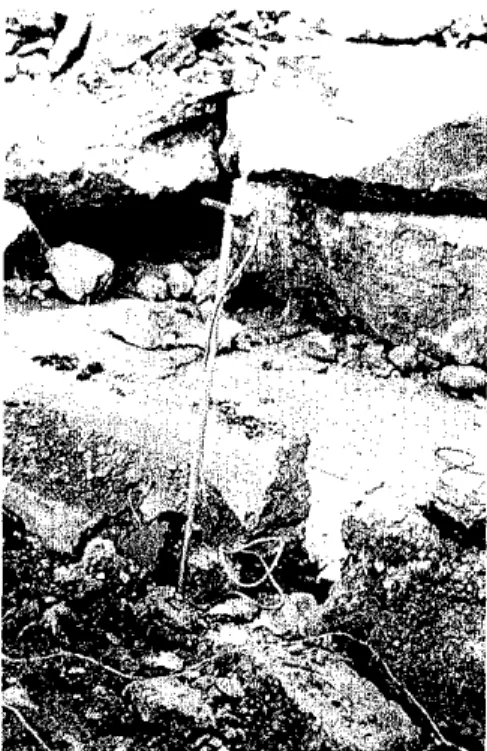
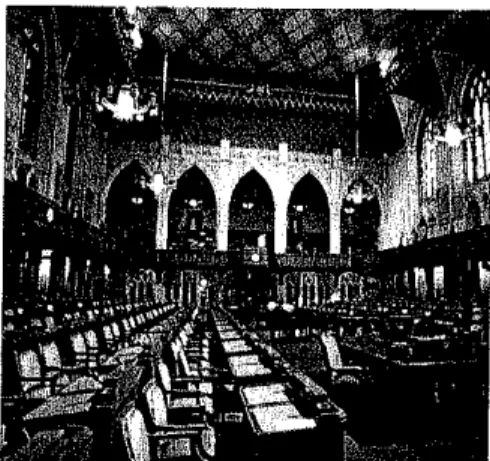
sponse, sensors were installed on the basement floor slab and foundation wall of the Centre Block; to monitor objects, sensors were mounted on the masonry wall of the House Chamber just below the large,エキッセウエッイケ ウエ。ゥョ・、セァャ。ウウ win-dows (Fig. 5). Most sensors in each building were placed along the perime-ter, either adjacent to or nearest the CBUS footprint.
70 APT BULLETIN
Fig. 5. The interior of the House of Commons, Centre Block, Parliament Hill, 1998. During the test blasting, stained-glass windows and decorative elements had to be monitored by NRC and Golder VMC for blast impact. Photo-graph by Jean-Pierre Jerome.
Several monitoring/recording stations were set up in the three buildings to minimize the length of cables connecting sensors to data-acquisition systems. Because the buildings were operational, cables were attached towalls and ceil-ings away from pedestrian traffic and normal maintenance activities. Vinyl tape, which would not mark painted or stone surfaces, held the cables in place.
Ground locations. Sensors were mounted at several locations on the promontory slopetogauge the response of the escarpmenttothe test blasts. The concern focused on the stability of the slope, especially the top thin layer of soil. Past soil slides had left areas void of green vegetation.
Twenty-four subsurface sensors were also grouted into the bedrock at eight locations between the two blast sites and the Centre Block and Library to deter-mine the attenuation rate for blast-induced vibrations within the bedrock.
Attachment of building sensors. Sen-sors attached to finished interior (walls and floors) and exterior (stone masonry) surfaces were firmly connected to ob-jects, so asto measure their responses accurately. But strong mechanical
de-surfaces could not be used. Sensors were either taped or glued to the interior surfaces using two-sided tape or non-staining glues, (these products were pre-tested in the laboratory). Sensors placed on exterior masonry surfaces were attached by screws placed into the mortar joints.
Blast Methodology
Ten controlled blasts were detonated at each blast site between August 12 and 23,1996. Each blast involved detonat-ing between 10 and 15 50-mm diameter holes in lifts (depth of blast) of 1.0 to 2.0m. Each blast consisted of a series of smaller blasts, produced by the action of delay detonators attached to each of the holes. Non-electric millisecond detona-tors were used because of the presence of radio towers, wireless radios, and cellular phones and to minimize charge weights (amount of explosive material) per delay. Various timing delays were tried to determine the influence of delay time on the vibrational response of adjacent structures. Cartridge explosive products were also used to avoid inaccu-racies in the accounting of explosive material within each blast delay (Fig. 6).
Each blast was covered with a mini-mum of three layers of イオ「「・イセエゥイ・ blast-ing matstocontain the blast and sup-press any potential flyrock. A thin geosynthetic filter fabric was also placed over the mats tocontain any small rock fragments that may have been trapped within the rubber mats from previous blasts, Just prior to each blast, the im-mediate area around the hoarded site was cleared of all pedestrian traffic, and a sequence of warning whistles was sounded.
Data Collection and Analysis
Sensor signals were collected and stored on multi-channel, computer-based data acquisition and analysis systems. About thirty seconds of data, commencing about three seconds prior to the start of each test blast, were collected. Recorded signals were analyzed and displayed immediately after each blasttoobtain the response levels at all building loca-tions; tomodify, if necessary, previously developed blast parameters; and to set more appropriate data-collection param· eters. Vibration data and masonry crack measurements were reviewed after each blast toevaluate the impact on all
struc-DESIGNING A TEST BLAST PROGRAM 71
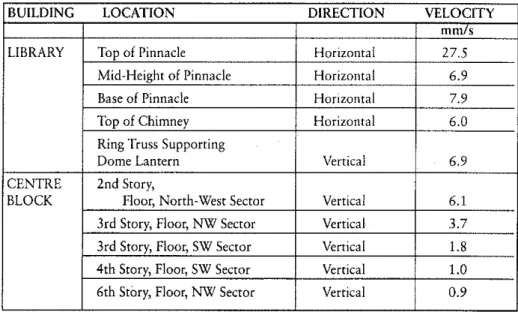
Table 1. Summary of Maximum Velocities Induced by the Test Blasts in Centre Block and Parliamentary Library
BUILDING LOCATION DIRECTION VELOCITY
mm/s
LIBRARY Top of Pinnacle Horizontal 27.5
Mid-Height of Pinnacle Horizontal 6.9
Base of Pinnacle Horizontal 7.9 Top of Chimney Horizontal 6.0
Ring Truss Supporting
Dome Lantern Vertical 6.9
CENTRE 2nd Story,
BLOCK Floor, North-West Sector Vertical 6.1
3rd Story, Floor, NW Sector Vertical 3.7
3rd Story, Floor, SW Sector Vertical 1.8 4th Story, Floor, SW Sector Vertical 1.0
6th Story, Floor, NW Sector Vertical 0.9
95' LINE EQUATION: v · 2104.5842 • (SOIAr-l.'88)
Fig, 7, Ground vibration attenuation characteristics. Courtesy of VME limited
100.0
STANDARD DEVIATION· 0.315
10.0
SQUARE ROOT SCALED DISTANCE (1ll/)(;crl/2)
,
,
"-
1'--""
.
\:'
.
" "!
.
.
.
'.
'"
iセ
I ".
" ".
.
".
.
".
'.
" ,"-i'r---I
..
":
I,
'"
1.00 0.10 1.0 OOEFICIENT or DETERMINATION - 0.633 1000.00 50' V E L 100.00 0 C I T 10.00 ytures and structural components. While this constant review limited the number of blasts to two per day, it was consid-ered integraltothe testing program. Test Blast Protocol
A test blast protocol was developed for the buildings nearest the blast sitesto
minimize the likelihood of any blast-induced damage going unnoticed. The protocol was modified following the second blast at Site 2 to take into ac-count the responses measured in the masonry pinnacles (freestanding vertical cantilevers) of the Parliamentary Library facing rhe blast site. The following actions comprised the protocol:
visual inspection of building compo-nents and areas adjacent to the blast site following the first blast at each site, each blast producing vibration levels of concern within the build· ings, and each day of blasting monitoring of existing cracks in the masonry walls of a stairwell at the northwest corner of the Centre Block review of blast-induced vibrations and crack measurements after each test blast
re-evaluation。ョ、セ if necessary, ad-justment of blast parameters previ-ously developed for the next blast. The following actions were added to the protocol for blasts at Site 2.
monitoring of existing cracks in the exterior masonry walls and pinnacles of the Library
up close visual inspection (using a crane) of the exterior masonry walls and pinnacles of the Library facing the blast site.
Results
A summary of the maximum velocities induced by the test blasts in the Centre Block and Parliamentary Library is given in Table 1, using a few locations, in various portions of the two buildings, which were mosr affected by the blasts. West Block responses are not given since velocities at monitored locations were less than 1 mm/s and therefore posed no
72 APT BULLETIN
threattothe fabric of that structure. Blast-induced velocities in the Centre Block and Library indicated that the pinnacles, vertical cantilevers on the exterior of the Library, underwent the largest motions (upto28 mm/s) tothe test blasts, These sensitive masonry elements were, therefore, chosentolimit the size and closeness of blaststothe Library during the planned excavation for CBUS, The largest responses within the Centre Block were recorded in its northwest corner, the portion of the building nearest the two blast sites. Responses within the Centre Block decreased rapidly with distance from the top of the foundation wall closest to the blast site. To limit blast· induced effects on the building, the foundation wall was selected as the Centre Block element that would, in conjunction with theーゥョョ。セ
des, govern the design of blasts in the CBUS footprint. Finally, because blast-induced responses for the Centre Block and Library contained primarily high-frequency components, vibration criteria for these buildings could be set at eco-nomically feasible levels for blasting. Delay intervals. While a 25 ms delay was used for all ten blasts at Site 1, different intervals were tried at Site 2to
speed up the blast (shorter duration), as well as toslow it down. Increasing the duration of the blast by increasing the delay between groups of holes did not appeartohave any noticeable beneficial effect on the vibration intensities or frequencies recorded in the adjacent structures.
It
was evident, however, thar a minimum delay interval of 25 ms should be incorporated into the blasting operations for CBUS due to the scatter in delay times that was recorded be-tween successive detonations by the array of subsurface sensors.Crack monitoring. Lateral and diagonal displacements measured across selected cracks, typically less than 0.1 mm wide, were no greater than those measured between control points, indicating that movements across cracks were compara-ble to those occurring elsewhere in the
Table 2. Recommended Vibration Criteria for Blasting for Buildings Adjacent to the CBUS Excavation
FREQUENCY VIBRATION L1MITSt RANGE, Hz mm/s Centre Library of Block Parliament <10 5 3 10 to 40 5 to 40 3t017.5 >40 40 17.5
tVibration limits (peak particle velocity) for the two heritage structures are specified for the bed-rock direcdy in front of the foundation wall.
during the blasting program. Measure-ments taken during a three-day period priortothe commencement of blasting also showed similar amounts of move-ment. However, no attempt was made to determine the effect of environmental conditions (namely, temperature and humidity) on measured crack、ゥウーャ。」・セ
ments either priortoor during the test blast progtam.
Ground attenuation. A scaled-distance relationship, which describes the rate at which ground vibration levels at the CBUS site decay with increasing distance from a blast, was established from the monitored subsurface responses (Fig. 7). The regression line, which was obtained from the set of bedrock responses, was expressed as PPV = 2104(SD)-1.488, where PPV=:;peak particle velocity
(mmls), SD = scaled distance (dIW0.5), d=distance in meters from blast, W =charge weight (weight in kg of explosive material per delay).
Recommendations for
CBUS Excavation
Vibration criteria.Table 2 shows vibra-tion criteria recommended for the Cen-tre Block and Parliamentary Library, based on the ground attenuation charac-teristics and the response of the struc-tures during the test blast program.
exhibited high-frequency characteristics at both ground and building locations, prudence dictated establishing
frequency-dependent vibration criteria due to the possibility of producing substantial and potentially more damag-ing lower·frequency responses (<20 Hz) at some locations in both buildings. Velocity limits for all other structures, and underground services and tunnels were set at 50 mm/s.
Blast parameters and procedures. Using the established ground attenua-tion characteristics and building vibra-tion criteria, minimum blast to building distances were calculated for the excava-tion of the CBUS site adjacent to the Centre Block and Library. A charge weight of 0.5 kg/delay was assumed, based on the minimum weight required to remove a 1.0-m lift (thickness of rock) during the test blast program. The minimum distances determined the amount of bedrock along the perimeter of the two buildings that needed to be removed by methods other than blast-ing, such as hoe ramming. Calculations also indicated that about half of the CBUS site could be removed in 2.0-m lifts.
The scaled-distance equation was also used in 1997 by the CBUS blasting contractor to calculate acceptable charge weights for various blast distancestothe two buildings from within the CBUS footprint. Three zones, using different blast depths and charge weights, were ultimately established by the contractor.
Itwas further recommended that: blasts should be designed using a minimum delay interval of 25illS
blast hole diameters should be lim· ited to 64 mm
only cartridge explosives and non-electric initiators should be used hydraulic drills equipped with oper· ating dust collectors and noise sup-pressors should be used
a minimum of three layers of blasting mats should be placed over each blast area
DESIGNING A TEST BLAST PROGRAM 73
• blasting mats should be covered with a filter fabric similar to that used during the test blast program • the perimeter of the excavation
should be line drilled and wall-control blasting techniques, such as buffer blasting, smooth-wall blasting, or cushion blasting, should be em-ployed in perimeter locations.
Blasting contractor. The blasting con-tractor should submit, for approval, a complete blasting plan describing pro-posed blast methodology. This should include details on patterns, hole diame-ter, explosive products, initiation sys-tems, size of blasts, and matting details. The blasting contractor should be pre-approved at the tendering stage. The contractor should include details of
prior experience in similar sensitive environments and provide references. Conclusion
Blasting parameters and procedures were re-evaluated at the conclusion of the test blast program and refined blast-ing parameters were developed. The final excavation plan was designed by the blasting contractor using these pa-rameters and procedures and executed during the summer of 1997. Monitoring indicated that vibration limits, estab-lished for the excavation, were exceeded by only one of the 279 blasts that were neededtoremove the 25,000 m' of rock from the CBUS footprint. The excava-tion was completed in just under eight weeks. The work was finished two weeks before the September 15, 1997
deadline, safely, within budget, and with no apparent damage to the historic fabric of Parliament Hill. The test blast program cost tess than 10% of the cost of the excavation and proved to be a useful means by which to achieve a safe and practical blasting operation, safe-guard the heritage features of Parliament Hill, and minimize the impact to politi-cians, sta ff, and visitors.
MARIA INES SUBERCASEAUX, M.Sc.A.,
is a conservation architect with the Heritage Conservation Program,RPSCH/EC.
GERRY PERNICA, B.A.Sc., M.A.Sc., Ph.D.,
is with the National Research Council Canada.
MARCUSV. VAN BERS, B.Sc., M.Eng., IS
with Golder VME Limited Canada.
ENGINEERING/DESIGN SERVICES
LFG
LANDMARK FACILITIES GROUP,
INC.
Offering engineering & design
services for the special needs
of collections and the facilities
that house them.
• Precision Climate Control
• Electrical Systems
• Lighting Design
• Fire Safety
• Humidistatic Systems
• Plumbing Systems
The Christman Company
National Historic Preservation Services Specialists in the Planning and Management of Complex Preservation Projects - $5 to $100 Million
CONTROL,
&
DESIGN
CLIMATE
ANALYSIS
For further information. contact:
Landmark Facilities Group, Inc.
252 East Avenue
East Norwalk, CT 06655
(203) 866-4626
fax
(203) 866-8019Cost Estimating Ph as ing/Seh eduling Construction&Program Management
408 Kalamazoo Plaza, lansing. MI 48933
Phone 517.482.1488 fax 517.482.3520
Email [email protected]