©
by
R.Oldenbourg Verlag,
-0044-3336/89
Valence
Transition
in Yb
Hydrides*
Stefan
Biichler,
Rene Monnier and LeoDegiorgi
Laboratorium fur
Festkorperphysik,
ETH Zurich,CH-8093Zurich,Switzerland LouisSchlapbach
Universite de
Fribourg,
Perolles,CH-1700Fribourg,
SwitzerlandYbexhibitsanunstable4f
configuration
in certaincompounds.
Ithas been shownexperimentally
andtheoretically
that 3d core-levelspectra
ofsome rareearthions exhibit satellite features which canbequantitatively
relatedtothe4foccupancyin theground
state. We
present
3dphotoelectron
spectra of variousYb-hydrides,
measured with Si Kcc radiation at 1740 eVphoton
energy. The results indicate divalent Yb inYbHi.8<x<2and mixed
valency
in thetrihydrides
(YbH2<x<2.6)-Introduction
At moderate pressure and temperature Yb forms a solid solution
phase
withhydrogen,
anonmetallicdihydride phase
(YbHi g<x<2.o)
andametallictrihydride
phase
(YbH.j02.5n).
Thedihydride
is orthorhombic andnonmagnetic,
whereas thetrihydride
hasbeen
reported
tobe of feestructureandmagnetic
/l/.
Apparently
theamountofhydrogen
uptake
is relatedtovalencechanges,
which havenotbeen studiedpreviously.
Photoelectron spectroscopy has been shown to be a
powerful
tool forstudying
valence transitionsinrareearthmaterials/2,3,4,5,6,7/
including hydrides
/8,9,10,11/.
Photoemissionspectraof valence band andcorelevels ofsome rareearth ions(La,
Ce,
Sm, Yb,
Lu)
show features whichcan be understood inamany-electron
picture
only.
* Presentedatthe International
Symposium
onMetal—
Hydrogen
Systems,
Fundamen-tals andApplications,
Stuttgart,
FRG,September
4—9, 1988.Model calculations
11,5,61
based on thedegenerate
Andersonimpurity
hamiltonian describespectroscopic
dataquite
well. These models involve initial and final states ofmixed 4f occupancy andas
important
interaction ahybridisation
termbetween 4fand valencestates. Inthecaseof Yb thegroundstate lg>
is thesuperposition
oftwo stateswith13 and 14 4f
electrons,
respectively:
The firstterm
corresponds
todivalent,
the secondtodivalent Yb.Similarly,
the final statelf> of the 3dphotoemission
process is writtenas :For the sake of
brevity
we usethe obvious abbreviations4f13
and4f14,
respectively,
for thetwocontributionstothe final and theground
state.Alocalized4felectronscreensa3d holemuchbetter thanacontinuumstate.Inthe
photoemission
process theoutgoing
electron is much strongercoupled
to apoorly
screened ion thantoonewithafull 4f orbital. Therefore the kineticenergyof the former is lower andin the 3d
photoemission
experiment
the4f13
finalstateappearstobemorestrongly
bound than the4f14.
In thecaseof the Ybhydrides
the difference inbinding
energyis almost 10eV,
making
itpossible
toseparatethetwocomponentsof the final statein thespectra. Acomparison
ofexperimental
intensities of the4f13
and4f14
finalstates with model calculations allowstheextraction of theparametersof the modified Anderson
hamiltonian,
inparticular
the4fbinding
energyand thehybridisation strength.
With theseparametersone cancalculate theground
statelg>
and thusthe 4f occupancy.The relative intensities of the different 4P final states contributions in the
photoemission
spectraare adirectmeasureof the 4f occupancyintheground
state asGunnarsson and Schonhammer/3/have shown in thecaseof
Ce,
and Monnieretal.161inthecaseof Yb
/12/.
InYb themissing
ofafinalstatecontributionimplies
themissing
of thecorresponding ground
state. Therefore 3dphotoemission
is a strong tool fordetermining
the Ybvalency.
Experimental
The XPS spectra were taken in a VG Escalab 5 spectrometer ata base pressure 1 •
10"lu
mbar. Si Ka radiationwasused and the overall resolutionwas 1.6 eV FWHM
lg>
=ocg
I4fl33dl°val3>
+(3g
Ufl43dl°val2>
(1)
of the Au
4fj/2
peak
at 84.0 eV.Kcc3
4 satellites werenumerically
corrected in thespectra. The nonmetallic
YbH.2.0
showeda shift inbinding
energy due tocharging
effects. The
energies
werecalibrated withagold
wireonthe surface of thehydride.
Yb metal
(99.9%,
ResearchChemicals)
wascleanedinthepreparation
chamber of the spectrometerby repetitive
Ar+bombardement,
filing
andoutgassing
at 400°Catp=
10"9
mbar.Hydrogenation
wasperformed
in aspecially designed high
pressurecell inside the spectrometer. The
hydriding
conditions are summarized in Table 1.Hydrogen
wasfirst cleanedby
aLN2
cooledtrapandagetterstation downtoaboutlppm
contamination level. Table 1:
Hydride
YbHi.g
YbH2.Q
YbH2.2
YbH2,6
YbD2,6
pressure(bar)
50-->1 50 50 50 50 temperature(°C)
4004C0.12°C/h>375
400.1.0°C/h>350
4002A°9/.i1>
2504002l°_9/_h>
250 exposure time(hours)
10 24+4Hydridingconditionsofseveral hydrides. InYbHjjjthepressurewas50 barsduring30 minutes. The hydrideswerepreparedinahighpressurecell inside thespectrometer,the deuteride inaseparate reaction
cell.
The
samples
wereofcylindrical shape
with about 1 cmof diameter. Thehydride
samples
wereof dark grey colour andbrittle,
but didnotdisintegrate
intopowder.
Toreduceoxygendiffusiontothe surface the
samples
werecooled withliquid nitrogen
to=100K in the
analyzing position.
Thehydrides
werecleaned with adiamond file in situimmediately
beforetaking
thespectra. Thecontaminationasdetermined fromOls, Cls,
andYb4p peaks
measured withMgKa
radiationwasbelow 2%.Structure,
composition
andhomogeneity
of thesamples
werechecked afterphotoemission
measurementsby
X-ray diffraction and volumetric determination of the
hydrogen
liberated upon dissolution of partsof thesamples
in dilute acid.The deuteridewas
prepared
intwosteps.Afterafirst deuteration of the Ybmetal,
it waspulverized
inanargonatmosphere
and deuteratedagain.
Thepowder
wasthen filledin a copper coated vanadium vessel. Neutron measurements were
performed
at the multidetectorpowder
diffractometer DMCatS APHIR. Thewavelength
was 1.708A.
Results
Fig.
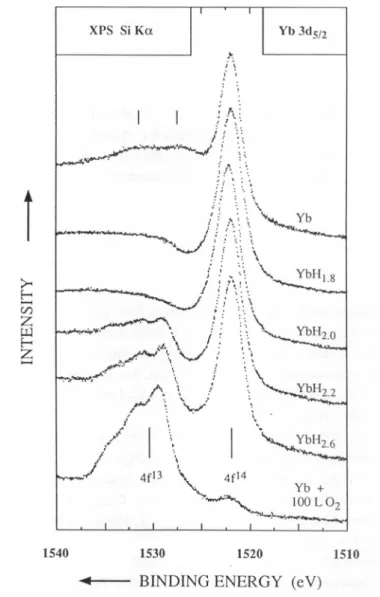
1 shows the Yb3ds/2
XPS spectra of Ybmetal,
several Ybhydrides
and Yb+ 100LO2 (1
L= 1 s at10~6 Torr).
Thehydride
spectra arecharacterizedby
twomain features. The first is at about 1522 eV
binding
energy andcorresponds
to aUfl43d9val2>
finalstate(4f14).
It isasingle
line and is broadenedonly by
lifetime and instrumental effects. The second is centered around 1530 eV andcorresponds
mainly
toaI4f133d9val3>
finalstate(4f13).
The3d and 4f holesproduce
amultiplet
structure,whichsignificantly
broadens this contribution. Thismultiplet
ismostclearly
seen asthestrongpeak
in the Yb+100LO2
spectrum, which is included in thefigure
as areference .Yb2C>3
is knowntobe divalenthaving
4f13
configuration.
The small4f14
finalstatesignal
is due to
remaining
divalentYb,
resulting
from poor oxidation kinetics at roomtemperatures.
Themost
interesting
andclearest result is the increase of theweight
ofthe4f13
peak
fromaboutzeroin the
dihydrides
toabout 50 %inYbH2.6-
The intermediatecompound
YbH2.2,
which isatwophase
mixture ofYbH.2
andYbH.2.5,
shows somescatterof the4f13
finalstaterelativeintensity
arounda meanvalue of 30%.Thespecdaof thetwo
dihydrides,
YbHi.g
andYbH.2.0,
aredominatedby
the4f14
finalstate.Intheregion
of the4f13
finalstatethere isaverybroadpeak
of lowintensity.
Thecenterof this feature is at
significantly
higher binding
energythan that ofthe4f13
final state,suggesting
avery low4f13
finalstateintensity.
This broadpeak
may be causedby
banddansition losses of the4f14
finalstate.Thebackscattering
elecdon energyloss specda(EELS)
ofthedihydrides
show broad lossesstarting
4.5eV below the elasticline,
withamaximumat 14eV.The divalent Yb metal exhibitsa
pronounced
4f14
finalstatepeak.
Between 1525 and 1535 eV elecdon losses from the4f14
finalstatedominate thespectrum.Abulkandasurface
plasmon
5.4eV and 9.4eV,
respectively,
below the4f14 line,
overlap
withabroad
peak
causedby
band dansition losses.Again
these losses have beenseeninrecentEELS
experiments
/13/.
The
experimental
resultsclearly
showavalence dansition from divalentYbH.2
with4f14
configuration
tomixed valentYDH2.6
with4f13/4f14
configuration.
Our calculations of the 3d core levelspectrum
ofYbH.2.6
based on the Gunnarsson-Schonhammer formulation of thedegenerate
Andersonimpurity
model agreesqualitatively
andquantitatively
very well witha50 %4f13
/ 4f14
mixed valentconfiguration
/l 1/.
Magnetic properties, specially
the absence ofmagnetic ordering
atlowtemperatureXPS SiKrx
I
I
1540 1530 1520 1510
M-
BINDING ENERGY
(eV)
fig.1: Yb-W5/2corelevel spectraofYbmetal. Ybhydridesand Yb+100LO2.A cleartransitionfrom
divalent Ybll2
(4f14)
tomixed valenlYbll2.6{4fl3l4f14)
occurs.SiKC134
satellitestructureshave beennumericallysubtracted.4findicatesa
4fx3d9val3
finalstaleconfiguration.Indie Yb spectrumabulk andInorderto
clarify
thequestion
ofhomogeneous
orinhomogeneous
mixed valenceastructurerefinement ofneutrondiffractionpatternsof
YDD2.6
wasstarted. Somepeaks
inaddition to the pattern of the fee structure suggest a
larger
unit cell due to smalldisplacements
of the Yb ions andapossible
smearing
outofsomeoctahedralDsites/14/. It isapleasure
tothank J. Schefer and P. Fischer from theneutrondiffraction group at Paul Scherrer Institut for thepreliminary
structureresults,
T. Greber andH.C.
Siegmann
for fruitfuldiscussions,
the Swiss NationalEnergy
Research Foundation(NEFF)
and the National ScienceFoundation(NF)
for financialsupport.References
1 P.
Knappe,
andH.Miiller,
J. Less-Common Met.124,
263(1986)
2 J. W.
Allen,
S.J.Oh,
O.Gunnarsson,
K.Schonhammer,
M. B.Maple,
M.S.Torikachvili and I.
Lindau,
AdvancesinPhysics
35,
275(1986)
3 O. Gunnarsson andK.Schonhammer,
Phys.
Rev. B28,
4315(1983)
4 W. D.
Schneider,
B.Delley,
E.Wuilloud,
J.M. ImerandY.Baer,
Phys.
Rev. B21,
6819(1985)
5 J.C.
Parlebas,
T. Nakano andA.Kotani,
J.Physique
48 , 1141(1987)
6 R.
Monnier,
L.Degiorgi
and D.D.Koelling,
Phys.
Rev. Letters56,
2744(1986)
7 J. C.Fuggle,
F. U.Hillebrecht,
Z.Zolnierek,
R.Lasser,
Ch.Freiburg,
O.
Gunnarsson,
K.Schonhammer,
Phys.
Rev. B22,7330
(1983)
8 J.Osterwalder,
T.Riesterer,
L.Schlapbach,
F. VaillantandD.Fruchart,
Phys.
Rev. B31,
8311(1985)
9 J.
Osterwalder,
Z. furPhysik
B6_L
113(1985)
10 M.
Gupta
and L.Schlapbach,
inTopics
inApplied
Physics,
Vol.63,
L.Schlapbach,
ed.,
Springer
Heidelberg
(1988),
p. 13911 St.
Biichler,
L.Schlapbach,
R.Monnier,
L.Degiorgi,
J.Physique
12,
C9
-947
(1987)
12 seealso
fig.7
,p. 4322 of Ref.313 A.