Cleavage of C3 by Neutral Proteases from Granulocytes in Pleural Empyema
S. Suter, U. E. Nydegger,L. Roux, andF. A. Waldvogel
From the Departments of Medicine, Pediatrics, and Microbiology, University Hospital, Geneva, Switzerland
The possibility of direct inactivation of C3 by granular enzymes from polymor-phonuclear leukocytes (PMNLs) in pleural empyema was examined. As a group, pleural empyema from 10 patients with purulent effusions and a positive bacteriologic culture cleaved significantly more 125I-labeled C3 bound to Sepharose (18.4070 ± 7.3070) than did 19 sterile pleural effusions (2.4070 ± 0.9070;P« 0.001) and sonicates from bacterial strains commonly found in empyema (1.4070 ± 0.2070). Granular enzymes from 7 x 10⁶
PMNLs cleaved 78.5070 of 125I-labeled C3 bound to Sepharose. When proteolysis of 125I-labeled C3 after incubation with pleural empyema or PMNL granular enzymes was examined with polyacrylamide gel electrophoresis, breakdown products were similar. Granulocyte elastase-like activity was detected in four samples of pleural empyema. Granulocyte elastase inhibitors, as well as 10070 human serum, effectively suppressed cleavage of C3 and elastase-like activity. In pleural empyemas, granular enzymes from PMNLs, especially elastase, apparently contribute to low complement-mediated op-sonic activity by direct inactivation of C3.
Pleural empyema is a closed-space infection de-fined by the simultaneous presence of large numbers of live microorganisms and polymor-phonuclear leukocytes (PMNLs). The disease is further characterized by its chronic evolution and its poor response to medical and sometimes even surgical therapy.
Work from our laboratory [1] has shown that the persistence of live microorganisms despite the presence of large numbers of PMNLs in pleural empyemas can be partially explained by a marked decrease in complement-mediated opsonic activity in culture-positive pleural effusions. This deficien-cy in opsonic activity was further shown to be accompanied by the local generation of increased amounts of C3d, the inactive breakdown product of C3.
Serum complement is of major importance in the humoral immune response to pyogenic infec-tions, and C3 is currently viewed as the target molecule of both the classical and the alternative pathways of complement activation [1-3]. Its
ac-Received for publication March 10, 1981, and in revised form June 22, 1981.
This work was supported in part by grant no. 3.836-0.79 from the Swiss National Research Foundation.
We thank Drs. M. Baggiolini and B. Dewald for advice, sug-gestions, and revision of the manuscript and F. Michaud for secretarial assistance.
Please address requests for reprints to Dr. F. A. Waldvogel, Department of Medicine, University Hospital, 121I Geneva 4, Switzerland.
499
tivation leads to the production of the biologically active fragment C3b, and the coating of mi-croorganisms with C3b promotes their recogni-tion by PMNLs. Activarecogni-tion proceeds through the cleavage of native C3 by either the classical (C42) or the alternative (C3b, Bb) pathway convertase of C3 or both [2, 3]. Recently it has been shown in vitro [4-8] that C3, as well as C5, can be split by complement-unrelated enzymes, such as purified neutral proteases from PMNLs. These reports have shown that the purified granular enzymes elastase, collagenase, and cathepsin G can act on C3 and C5 by splitting small fragments similar in size to C3a and C5a from the native molecules. Because these enzymes, especially elastase, act on a broad spectrum of substrates [9-12], 1 it is con-ceivable that they could split C3 extensively and thus generate inactive breakdown products. Such a mechanism has already been demonstrated in vitro [8] and could account for our observations of low complement-mediated opsonic activity, low complement levels, and high levels of C3d in em-pyema [1]. We therefore tried to demonstrate C3-cleaving activity in pleural empyema using a re-producible in vitro test with purified, radiolabeled C3 covalently bound to Sepharose as a substrate.
I W. Schmidt, "Neutrale Proteasen aus menschlichen Leukozyten: Isolierung, charakterisierung und biologische Wirkungen," inaugural-dissertation, Fachbereich Chemie der Philipps-Universitat Marburg/Lahn, Federal Republic of Ger-many, 1975, p. 66.
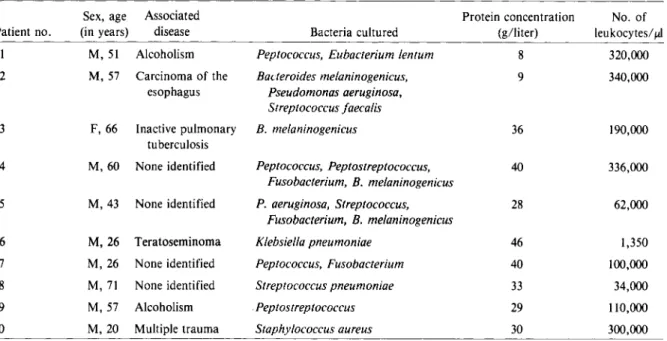
Table 1. Characteristics of 10 patients with pleural effusions and positive bacteriologic cultures (empyema) in group 1.
Sex, age Associated Protein concentration No. of
Patient no. (in years) disease Bacteria cultured (g/Iiter) leukocytes/j.tl
I M,51 Alcoholism Peptococcus, Eubacterium lentum 8 320,000
2 M,57 Carcinoma of the Bacteroides melaninogenicus, 9 340,000
esophagus Pseudomonas aeruginosa, Streptococcus faecalis
3 F,66 Inactive pulmonary B. melaninogenicus 36 190,000
tuberculosis
4 M,60 None identified Peptococcus, Peptostreptococcus, 40 336,000
Fusobacterium, B. melaninogenicus
5 M,43 None identified P. aeruginosa, Streptococcus, 28 62,000
Fusobacterium, B. melaninogenicus
6 M,26 Teratoseminoma Klebsiella pneumoniae 46 1,350
7 M,26 None identified Peptococcus, Fusobacterium 40 100,000
8 M,71 None identified Streptococcus pneumoniae 33 34,000
9 M,57 Alcoholism .Peptostreptococcus 29 110,000
10 M,20 Multiple trauma Staphylococcus aureus 30 300,000
Patients and Methods
Patients. Twenty-nine patients hospitalized with pleural effusions at the University Hospital, Geneva, Switzerland, were divided into two groups. Group 1 (empyemas) consisted of 10patients with purulent effusions and a positive bacterio-logic culture. Information about these patients and the bacteriologic results are presented in table 1. Associated diagnoses included alcoholism, inac-tive pulmonary tuberculosis, carcinoma of the esophagus, and multiple trauma. The mean age of the patients was 50 years (range, 20-71 years). Their pleural fluid had a mean protein concentra-tion of30 ± 4g/liter and a mean leukocyte count of172,000 ± 40,000 cells/f.ll.
Group 2 (culture-negative effusions) consisted of 19 patients with pleural effusions for whom bacteriologic cultures were negative. Eight pa-tients had parapneumonic effusions accompany-ing acute pneumonia. The diagnosis of pneumonia was established by clinical findings, appropriate cultures of sputum and/or blood, and chest roent-genograms. Six patients had pleural effusions drained after surgery for multiple trauma, cor-onary heart disease, mitral valve replacement, or carcinoma of the lung or the esophagus. Three other patients had metastatic cancer with pleural effusions, and two patients had transudates associated with congestive heart failure. Their mean age was 54 years (range, 32-91 years). The
mean protein concentration in their pleural effu-sions was 32 ± 3 g/liter, and the mean leukocyte count was 2,175 ± 1,030 cells/f.ll. The leukocyte counts in the two groups were significantly dif-ferent (P« 0.001).
Collection of pleural fluids. Thirty-nine samples of pleural fluid were collected from these 29 patients. Each sample was processed within 1 hr of thoracocentesis and was separated into two specimens: one was immediately mixed with EDTA (final concentration, 20 mu) and the other was processed without additive. They were centrifuged (Heraeus-Christ, Osterode, Federal Republic of Germany) at 1,000gfor 10 min; the supernatants were separated from the sediment, frozen im-mediately, and stored at -70 C until used. Leukocyte counts and protein concentrations were determined before centrifugation.
Preparation of granular enzymes from PMNLs. Blood freshly obtained from adult volunteers was treated with heparin (45 units/ml). PMNLs were isolated by Ficoll-Hypaque centrifugation and subsequent dextran sedimentation [13]. In some preparations Ficoll-Hypaque centrifuga-tion was omitted because the contaminating lym-phocytes and monocytes did not modify the enzy-matic activity measured in our tests. PMNLs were washed three times with 0.9<IJ0 NaCl, and contam-inating red blood cells were removed by hypotonic lysis (addition of 9 ml of ice-cold distilled water for 30 sec and reconstitution of isotonicity by the
addition of 3 ml of 0.6 M KCI). The resulting cell pellet was resuspended in 0.2 M sucrose, and the cell concentration was adjusted to 108/ml. All subsequent steps were carried out in the cold (4C). The cell suspension was homogenized (Braun, Melsungen, Federal Republic of Germany) at 1,500 rpm for 5 min, and cellular debris was removed by centrifugation at 12,500 g for 10 min. The supernatant was used for the isolation of granules according to the method of Baggiolini [14]. The supernatant was centrifuged at 12,500 g for 20 min in an ultracentrifuge (model L5-65; Beckman Instruments, Palo Alto, Calif.), and the resulting pellet was extracted with 0.2 M acetate, pH 4.4, at 4 C for 2 hr with gentle stirring. The precipitated proteins were removed by ultracentri-fugation at 100,000 g for 30 min. The supernatant (volume, 5 ml) containing the granular enzymes was stored at - 70 C in small aliquots and neutralized to pH 7.0 with NaOH before use. The enzymatic activity of different batches extracted from 450 ml of blood varied over a twofold range.
Purification of human C3 and preparation of 125I-labeled C3 bound to Sepharose. C3 from human plasma was purified to homogeneity using the method of Tack and Prahl [15].Itwas labeled with 125 1 (Radiochemical Centre, Amersham, England) by the chloramine-T method [16]. About 1.5 x 10⁷ cpm were incorporated into 10 fJ.g of purified C3. Labeled C3 was coupled to cyanogen bromide-activated Sepharose 4B (Pharmacia Fine Chemicals, Uppsala, Sweden).
Assessment of C3-cleaving activity. 1251_ labeled C3 bound to Sepharose was washed with Dulbecco's phosphate-buffered saline, pH 7.3, withoutCa"orMg"to remove unbound radioac-tivity. Samples of 1251-labeled C3 bound to Sepharose corresponding to 1.5 x 10⁶cpm, deter-mined by counting in a gamma counter (Beck-man), were incubated at 37 C with EDT A-mixed supernatants of pleural effusions, with granular enzymes, or with bacterial sonicates and their culture supernatants. Aliquots were drawn at timed intervals over 9 hr, and 1251-labeled C3 cleaved from Sepharose was separated from un-cleaved material by centrifugation at 8,000 g for 10 min. Cleavage of C3 was expressed as percent-age of cpm in the supernatant divided by the cpm of the total sample.
Measurement of elastase-like activity. Elas-tase-like activity was tested with the artificial substrate
succinyl-Ala-Ala-Pro-7-amino-4-methyl-coumarin (TGP 928), a gift from M. Baggiolini, Wander Research Institute, Bern, Switzerland. Granulocyte elastase selectively cleaves the 7-aminoA-methyl-coumarin part of the molecule, which has an extinction coefficient of 12,200 at 360 nm. Because the specificity of this substrate has been tested with purified enzymes and is not demonstrable in our biologic system, the term "elastase-like" was chosen to describe its activity. Various samples of pleural fluid, granular en-zymes, or bacterial sonicates were mixed with TGP 928 (final concentration, 10-3 M) in 0.5 M phosphate buffer, pH 7.5, and the change in OD at 360 nm in a spectrophotometer (Beckman) was observed over a 4-min period. Over this interval, the enzymatic reaction was linear for all samples tested. Enzymatic activity was expressed as the in-crease in OD over 4 min.
Demonstration of proteolysis by culture-positive pleural effusions of 125l-labeled C3 by
polyacrylamide gel electrophoresis. 1251-labeled C3 was combined with either the EDT A-mixed supernatant of a culture-positive effusion from patient no. 2 or a batch of granular enzymes. A control aliquot without additive was always as-sayed simultaneously. After incubation at 37 C for 6 hr, samples withdrawn at timed intervals were suspended in sodium dodecyl sulfate sample buf-fer (10,10 2-mercaptoethanol, 20,10 sodium dodecyl sulfate, 80 mM Tris-HCl [pH 6.8], 100,10 glycerol, and 0.050,10 bromphenol blue) and heated at 100 C for 3 min. They were electrophoresed on discon-tinuous slab gels, with 50,10 (wt/vol) acrylamide in the stacking gel and 12.50,10 (wt/vol) acrylamide in the resolving gel [17]. Labeled proteins were revealed by autoradiography (Xiomat'" S film; Kodak S.A., Lausanne, Switzerland), with ex-posure at - 70 C for two days. Molecular weights were determined by comparison with marker pro-teins from Sendai virus and vesicular stomatitis virus [18, 19] labeled with [35S]methionine.
Inhibition experiments. The effects of three inhibitors of serine proteases were tested on C3-cleaving activity and elastase-like activity of culture-positive pleural effusions and granular en-zyme preparations. Phenyl methyl sulfonylfluo-ride- was purchased from Sigma Chemical Co., St. Louis, Mo. A peptide carbazate inhibitor [20] was provided by Merck Sharp and Dohme Re-search Laboratories, Rahway, N.J., and
tyl-(Alakchloromethylketone [21] was a gift from J. Powers, Georgia Institute of Technology, Atlanta.
In some experiments, 10070 human serum mixed with 20 mu EDT A was used as an inhibitor; in others, samples of pleural fluids or granular en-zymes were inactivated by heating at 80 C for 10 min.
Preparation of bacterial sonicates and culture supernatants. Clinical isolates of Streptococcus pneumoniae, Streptococcus faecalis, group A (3-hemolytic Streptococcus, Pseudomonas aerug-inosa, Klebsiella pneumoniae, and Bacteroides
fragilis were obtained by overnight culture in the
appropriate medium. An average of 5 x 10⁹ microorganisms was sedimented by centrifugation at 3,300 g for 15 min, washed three times in Dulbecco's phosphate-buffered saline, and resus-pended in 5 ml of Dulbecco's phosphate-buffered saline without Ca" or Mg". The bacteria were lysed by sonication (Sonifer"; Branson, Danbury, Conn.) on crushed ice for 3 min (intensity, 50 W). Residual intact bacteria and membranes were sedimented by centrifugation at 3,300 g for 15 min, and the supernatant was stored at - 20 C un-til used (always within three days of preparation). There was a decrease in cfu of >95% in all lysed bacterial preparations tested, assessed by serial dilution and plating of the preparations before and after sonication. The culture supernatant (5 ml), which was obtained after the first sedimenta-tion of the bacteria, was studied at the same con-centration as the sonicate.
Complement studies. Complement studies were all carried out on EDT A-mixed fluids. C3 and (3-1 H levels were measured by single radial immunodiffusion using monospecific antibodies to these proteins [22]. The results were expressed as a percentage of the levels in a pool of normal human plasma. C3d levels were quantitated in a two-step procedure [23]. In the first step, native C3 and the high-molecular-weight fragments C3b and C3c were precipitated with polyethylenegly-col. Then the C3d level was measured in the poly-ethyleneglycol supernatant by single radial im-munodiffusion with antiserum to C3d. The results were expressed as a percentage of levels in an inulin-activated serum. The value for normal pooled human serum was 9.9%.
Statistics. Results were expressed as means ± SEM.C3-cleaving activity in culture-positive and culture-negative effusions was compared using the
rank-sum test. Student's t-test was used to com-pare levels of complement components, protein concentrations, and leukocyte counts in infected and sterile pleural effusions.
Results
C3-cleaving activity. C3-cleaving activity was evaluated by incubating the EDT A-mixed super-natants of effusions from patients in group 1 and group 2 with 125 I-labeled C3 bound to Sepharose (figure 1). The amount of C3 cleaved by culture-positive effusions increased with time, reaching a level of 18.4% ± 7.3% (range, 0.9%-67.2%), whereas culture-negative - effusions cleaved only 2.4% ± 0.9% of the labeled, bound C3 (range, 1.1%-3.4%) after incubation for 9 hr (P
«
0.001). 1251-labeled C3 bound to Sepharose was in-cubated alone with each experiment as a control;30
Incubation at 37 C (minutes) Figure 1. Percentage cleavage of WI-labeled C3 bound to Sepharose by effusions from 10 patients with positive bacterial cultures(0)and 19 patients with nega-tive bacterial cultures (.). Labeled, bound C3 (1.5 x
106cpm) in 1.2 ml of Dulbecco's phosphate-buffered sa-line, pH 7.3, without Ca'" and Mg" was incubated at 37 C with 0.3 ml of EDT A-mixed supernatant of pleural ef-fusions, and timed sampling of 0.2-ml aliquots was per-formed over 9 hr. The data are mean ± SEMcpm in the supernatant/cpm in the total sample x 100. At 540 min, the difference in cleavage was statistically significant(P
Table 2. Cleavage of 1'51-labeled C3 bound to Sepha-rose by sonicates of clinical bacterial isolates.
Microorganism Klebsiella pneumoniae Streptococcus faecalis Streptococcus pneumoniae Group A f3-hemolyticStreptococcus Pseudomonas aeruginosa Staphylococcus aureus Bacteroides fragilis Mean ± SEM Percentage cleavage 1.3 2.3 l.l 1.0 1.3 1.3 1.3 1.4 ± 0.2 80 : 60 o
..
tV a40 Gl II) I C') 20o
Is:
N 0 Empyema ...---,37 C ~t/'
-.---
e JSee footnoteI.Figure 2. Percentage cleavage of I"J-labeled C3
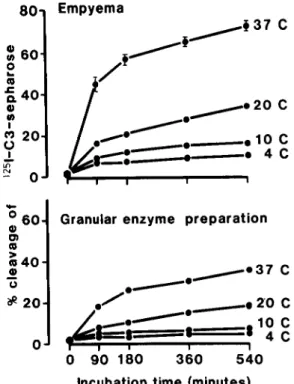
bound to Sepharose by(top) a culture-positive pleural effusion from patient no. 2 and (bottom)a preparation (batchI)of granular enzymes from normal human poly-morphonuclear leukocytes. Labeled, bound C3(1.5 x
106cpm) in 1.2 ml of Dulbecco's phosphate-buffered
sa-line, pH 7.3, without CaH and MgH was incubated at various temperatures with 0.3 ml of either EDTA-mixed supernatant of empyema or granular enzyme prepara-tion without EDTA, and timed sampling of 0.2-ml ali-quots was performed over9hr. The data for empyema tested at 37 C are mean ± SEM cpm in the super-natant/cpm in the total sample x lOO for triplicate determinations.
buffer of pH 8.2 than of pH 6. These findings agree with those of Schmidt," who defined an op-timal pH of 8 for granulocyte elastase when tested against a protein substrate.
The proteolytic nature of C3 cleavage by culture-positive effusions and preparations of PMNL granular enzymes was studied (figure 3). 1251-labeled C3 bound to Sepharose was mixed with a culture-positive effusion and a granular en-zyme preparation and incubated for 6 hr. Samples were tested by polyacrylamide gel electrophoresis at timed intervals for proteolytic breakdown, and the a-chain and (3-chain of C3 [8] were located in reference to the marker proteins. 125I-labeled C3 bound to Sepharose was also incubated alone as a control. In the mixtures of 125I-labeled C3 bound NOTE. Bacterial sonicates (300iii)corresponding to 1-2 x
10' lysed organisms were incubated for 24 hr with "'I-labeled C3 bound to Sepharose (1.5 x 10⁶cpm) in 1.2 ml of
Dulbec-co's phosphate-buffered saline, pH 7.3, without Ca " and Mg". Data are percentage of cpm in the supernatant/cpm added to the suspension for triplicate determinations.
spontaneous breakdown or release of iodine was only 0.3070 ± 0.2070 over a 9-hr period. Thus, significant cleavage of bound C3 was observed in the culture-positive group as compared with the culture-negative group. In further experiments, granular enzymes from PMNLs were incubated with 1251-labeled C3 bound to Sepharose; cleavage of bound C3 occurred with similar kinetics to the reaction with effusions. After in-cubation for 9 hr, the granular enzyme prepara-tion from 7 x 10⁶ PMNLs (batch 3) cleaved
78.5070 of 125I-labeled C3 bound to Sepharose. Cleavage was 34070 at 90 min, 54070 at 180 min, and 70070 at 360 min (data not shown).
In contrast to the C3-cleaving activity of culture-positive effusions and the granular enzyme preparation, none of seven bacterial sonicates cleaved bound C3 significantly more than did cul-ture-negative (control) effusions (table 2). Even after incubation for 24 hr, only 1.4070 ± 0.2070 (range, 1.0070-2.3070) of the I25I-labeled C3 bound
to Sepharose was cleaved. No significant C3-cleaving activity was observed with the culture su-pernatants except for that ofP. aeruginosa, which cleaved 15070 of the labeled, bound C3.
Enzymatic nature of C3-cleaving activity. To explore more precisely the mechanism responsible for C3 cleavage in empyemas, the cleavage of 125I-labeled C3 bound to Sepharose by culture-positive effusions and PMNL granular enzymes (batch 1) was assessed in parallel at various temperatures and at different pH values of the reaction buffer. C3-cleaving activity was optimal at 37 C, compared with 20 C, 10 C, and 4 C (figure 2). C3-cleaving activity was greater at 37 C in a
°60 Gl Cl tV ~40 .! (,) ?P- 20
o
Granular enzyme preparation
____ e37 C _ e e -. / __ 2'0 C
~
_ . - - - . - 10 C-=,
i~
·
i 4 Co
90 180 360 540Granular enzymes Empyema C3 alone SV VSV Incubation time at 37 C(min) number 1 1 0 3 2 -2 5 = = = 23 1 8 - Front--2 30 150 360 2 30 150 360 2 360
2 3 4 5 6 7 8 9 10 11 12 Figureacrylamide gel electrophoresis of3. Autoradiogram after
poly-(lanes1-4)20fllof a granular enzyme preparation (batch I) from normal human polymorphonuclear leuko-cytes and (lanes 5-8) 20/AI of pleural empyema from a patient with posi-tive bacterial cultures mixed with ]lSI-labeled C3 bound to Sepharose. Labeled, bound C3 was electro-phoresed alone (lanes 9 and 10) as a control, and Sendai virus (lane II) and vesicular stomatitis virus (lane 12) were used to determine molecular masses. The a-chain and the (3-chain of C3 appear at 110 and 74 x 103 daltons, respectively. The estimated molecular masses of the breakdown products of C3 are 32,25,23, and 18
x 103daltons.
to Sepharose with a granular enzyme preparation and with a culture-positive effusion, the amount of a-chain decreased gradually as a function of length of incubation, while, simultaneously, breakdown products with smaller molecular masses appeared: 32,25, and 18 x 103daltons with the empyema and 32, 23, and 18 x 103 daltons with the granular enzymes. After incubation for 6 hr, the amount of {3-chain also slightly decreased. In contrast, none of these small breakdown prod-ucts appeared in the control incubation. Thus, both the EDTA-mixed supernatant of the culture-positive effusion and the granular enzyme preparation have proteolytic activity on C3, par-ticularly on its a-chain.
To explore the nature of the C3-cleaving activity in empyema, we used human serum mixed with EDTA (final concentration, 20 msr) as a source of aI-antitrypsin and az-macroglobulin, the two natural inhibitors of PMNL granular enzymes in serum [24]. EDTA-mixed 100/0human serum was added to pleural effusions from patients no. 1 and no. 2 (with the highest C3-cleaving activity) in group 1 and to granular enzyme preparations, and the specimens were preincubated at room temperature (about 20 C) for 10min. When they were tested after incubation for 6 hr at 37 C,
C3-cleaving activity was almost totally inhibited (table 3).
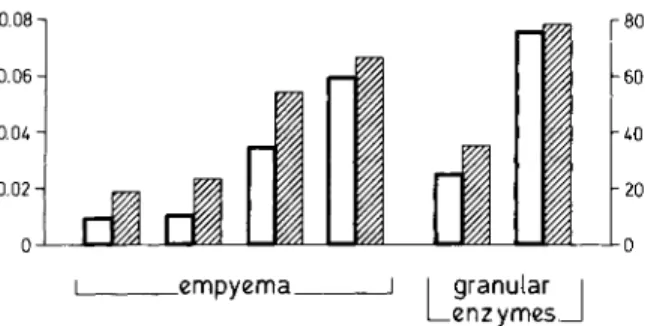
Elastase-like activity. Because the preceding results suggested that granulocyte elastase was a candidate for the neutral proteases responsible for breakdown of C3 [4, 5, 8], we tried to compare the C3-cleaving activity in empyema with that in a granular enzyme preparation using an elastase-specific substrate (TGP 928) and three inhibitors known to inhibit specifically serine proteases such as granulocyte elastase [20, 21].4 Elastase-like ac-tivity, as measured with the substrate TGP 928, could be detected in the granular enzyme prepara-tions and all of the CUlture-positive effusions that cleaved >18% of the lz5I-labeled C3 bound to Sepharose in our test. There was a linear correla-tion between the amount of C3-cleaving activity and the amount of elastase-like activity in the four samples of empyema that gave positive results with the assay for elastase-like activity and the two preparations of granular enzymes used (figure 4). No elastase-like activity was detected in the bacterial sonicates or in the culture supernatants. Inhibition experiments. Phenyl methyl sul-fonylfluoride (2 mu), a peptide carbazate
hibitor (2.5 rna), and N-acetyl-(Alakchloro-methylketone (2.5 rna) were analyzed for their ability to inhibit the C3-cleaving activity and elastase-like activity of two culture-positive effu-sions and a granular enzyme preparation (table 3). The degree of inhibition ranged from 610,10 to 1000,10. The peptide carbazate inhibitor and the chloromethylketone were more potent inhibitors of elastase-like activity than of C3-cleaving activi-ty for both the granular enzyme preparation and the culture-positive effusions.
Concentrations of C3, C3d, and~-lHin pleural fluids. Pleural effusions from patients in group 1 had a level of C3 of 450,10 ± 90,10, of C3d of 800,10 ± 120,10, and of~-IHof 970,10 ± 290,10. Ineffusions of the control patients (group 2), the level of C3 was 340,10 ± 60,10, of C3d was 250,10 ± 60,10, and of ~-IH was 780,10 ± 130,10. Between the two patient groups the levels of C3 and ~-1H were not signifi-cantly different, whereas levels of C3d were signif-icantly higher in the culture-positive group than in the culture-negative group(P
<
0.02).Discussion
The most significant finding of the present study is the demonstration of an enzymatic activity that cleaved C3 in pleural effusions from patients with
empyema, whereas culture-negative effusions of various etiologies were devoid of such activity. The breakdown of C3 through activation of the classical and/or the alternative pathways of com-plement as a trivial explanation of our findings was eliminated because the experiments were per-formed in the absence of divalent cations. The enzymatic nature of the C3-cleaving activity was substantiated by its temperature-dependence, its destruction by heat, and its inhibition by the addi-tion of EDTA-mixed 100,10 normal human serum as a source of the natural inhibitors a I-antitrypsin and az-macroglobulin [24].
We have tried to assign the origin of this en-zymatic activity either to bacteria or to PMNLs by, respectively, studying bacterial sonicates from a variety of strains which are classically isolated as the causative agents of empyema and a granular enzyme preparation of human PMNLs. None of the bacterial sonicates cleaved C3 significantly, whereas activities of the granular enzyme prepara-tions and culture-positive effusions were similar: the time curves and the optimal pH for cleavage with the same amount of substrate were essentially the same. It is conceivable that a proteolytic en-zyme of bacterial origin contributed to C3 cleav-age in the effusions of patients no. 2 and no. 5, from whom P. aeruginosa was isolated. This
Table3. Characterization of C3-cleaving activity in pleural empyema and preparations of granular enzymes from normal human polymorphonuclear leukocytes.
-Inhibition(070)of
----_._---_. ---_._--- - - ~ _ . ~
Cf-cleaving activity Elastase-like activity - - - _ .
Empyema Empyema Granular Empyema Empyema Granular
Inhibitor no. \ no. 2 enzymes no. 1 no. 2 enzymes
_ . _ _ . -Human serum (10070) +EDTA
(20 msr) 97 98 98 \00 \00 90
Phenyl methyl sulfonyl fluoride
(2 rna) 77 96 99 80 100 80
Peptide carbazate inhibitor
(2.5 rna) 80 69 64 90 97 94
Chloromethylketone (2.5 mu) 66 62 61 70 69 90
NOTE. C3-cleaving activity and its inhibition were quantitated by incubation of 40/-11 of granular enzyme preparation or pleural effusion (from patient no. 1 or no. 2) in 200 /-II of Dulbecco's phosphate-buffered saline (pH 7.3) without Ca" or Mg" containing 200,000 cpm of '''I-labeled C3 bound to Sepharose for 6 hr with and without inhibitor. The empyema specimens and granular en-zymes were preincubated with the inhibitor for 10min at room temperature (about 20C)and then incubated at 37 C except for chloromethylketone and peptide carbazate inhibitor (Merck Sharp and Dohme Research Laboratories, Rahway, N.J.), which were tested at room temperature. Elastase-like activity was tested at room temperature in l-rnl samples of 0.5Mphosphate buffer (pH 7.5) containing 100 /-II of empyema or granular enzymes. The substrate succinyl-Ala-Ala-Pro-7-amino-methyl-coumarin (TGP 928) was added (final concentration,10-3M),and each sample was tested with or without inhibitor. The samples were preincubated with
the inhibitor as described above. Inhibition is expressed as 100 - (jactivity of sample with inhibitor/activity of sample without in-hibitor] x 1(0).
tic activity of other granular enzymes such as cathepsin G.
The results of our experiments therefore suggest that elastase is one of the proteases involved in the cleavage of C3. Indeed, elastase and collagenase are present in large amounts in granulocytes, representing ""5% of the dry weight of the cell [26], in comparison to cathepsin G, which is pres-ent in much smaller quantities. Elastase and cathepsin G are located in the primary granules and collagenase in the secondary granules of granulocytes [27]. Upon phagocytosis, these granules, in addition to fusing intracellularly with the phagosome, may be released into the sur-rounding medium [26, 28]. Thus, it is conceivable that these enzymes may be detected extracellularly in a purulent infection with high bacterial concen-trations, such as empyema. Three neutral pro-teases from PMNLs have been shown to cleave C3 in vitro [4, 5, 8]: elastase, collagenase, and cathep-sin G. Collagenase is calcium-dependent and in-hibited by EDTA [26]; it cannot be involved in the C3-cleaving activity of our culture-positive pleural effusions because all experiments were carried out in the absence ofCa". Cathepsin G may be partly responsible for the C3-cleaving activity observed in our tests, despite the fact that this enzyme has only minimal activity on the elastase-specific substrate used in our experiments. Another en-zyme, present in the cytosol of PMNLs, is the plasminogen activator described by Granelli-Piperno et al. [29]; the activity of this enzyme can only be detected if cell lysates are prepared in the presence of elastase inhibitors, presumably be-cause it is otherwise exposed to proteolytic degradation by elastase. Because we detected elastase-like activity in several culture-positive ef-fusions, the plasminogen activator was probably destroyed.
The pattern of proteolysis of C3 could be fur-ther established by polyacrylamide gel electro-phoresis for both a culture-positive effusion and granular enzymes (figure 3). The pattern of the breakdown products obtained in our experiments indicates that the cleavage of the molecule C3 pro-ceeds beyond cleavage in C3a and C3b, both frag-ments with biologic activity. The fragfrag-ments ob-served in our experiments had molecular masses of 32, 25, 23, and 18 x 103daltons. The presence of these small fragments and the simultaneous disap-pearance of the a-chain indicate that, at the end of the incubation period of 6 hr, no C3b was present 20 40 80 60 o L - empyema ~ 0.06 0.08 o 0.04 0.02
microorganism is known to secrete a proteolytic enzyme that cleaves C3 and other complement components [25]. However, patient no. 2 had a very high C3-cleaving activity (67070), whereas the amount of enzyme secreted under optimal condi-tions by 1-2 x 10⁸ P. aeruginosa cleaved only 15% of the labeled, bound C3.In addition, the ef-fusion from patient no. 2 had the highest elastase-like activity observed, whereas the culture super-natant ofP.aeruginosahad no detectable activity on this substrate. The effusion from patient no. 5 had no elastase-like activity and a C3-cleaving ac-tivity of 5.8%. An elastase-like acac-tivity could be demonstrated by means of an elastase-specific, synthetic substrate in some of the most "active" culture-positive effusions, and a correlation of C3-cleaving and elastase-like activity was observed in these cases. Both C3-cleaving and elastase-like activities were inhibited by EDTA-mixed 10% normal human serum and by three serine protease inhibitors. The peptide carbazate inhibitor and the chloromethylketone are considered to be specific inhibitors of granulocyte elastase [20, 21].In both systems tested - that is, granular enzymes and culture-positive effusions - these two compounds were more potent inhibitors of elastase-like activi-ty than of the C3-cleaving activiactivi-ty. There are two possible explanations for these findings. First, both inhibitors may be more efficient inhibitors of the esterolytic activity (TGP 928 is an ester sub-strate) than of the proteolytic activity (with C3 as substrate) of the enzyme(s). Alternatively, the resi-dual C3-cleaving activity may reflect the
proteoly-L
granularJ
enzymesFigure 4. Linear correlation between C3-cleaving ac-tivity(Zl) and elastase-like activity (D) in two batchesof granular enzymes from normal human polymor-phonuclear leukocytes and four samples of pleural em-pyema from patients with positive bacterial cultures with elastase-like activity. C3-cleaving activity is given as percentage cleavage of 125I-labeled C3 bound to Sepharose after incubation for 9 hr at 37 C, and elastase-like activity is given as change in OD at 360nm over a 4-minperiod with the substratesuccinyl-Ala-Ala-Pro-7-amino-4-methyl-coumarin (TOP 928).
(this fragment has a molecular mass estimated at 180 x 103daltons) [3].
That high levels of C3d in culture-positive effu-sions were found in two other studies of empyema [1, 30] further supports the proposal of increased breakdown of C3 in empyema. Because, accord-ing to Taylor et al. [8], uncontrolled digestion of C3 with granulocyte elastase also leads to a frag-ment similar to C3d, it can be postulated that these high levels of C3d reflect not only comple-ment-mediated breakdown of C3 but also the ac-tion of granulocyte elastase.
No significant difference in the levels of C3 and
~-1H could be found between effusions from pa-tients in group 1 and group 2. The lack of differ-ence in C3 levels between the two groups may be explained by the cross-reaction of breakdown products of C3 with antibody and thus may not re-flect biologically active C3. This suggestion is sup-ported by the finding of Lew et al. [1] that, despite the presence of high levels of immunoreactive C3, levels of total hemolytic complement were low in empyema specimens.
In earlier reports conversion of C3 and C5 by neutral proteases in vitro has been demonstrated in conditions where aI-antitrypsin and armacro-globulin were absent [5-8]. When measured in serum [4], conversion of C3 and C5 by elastase and collagenase did not occur until the molar ratio of the enzyme to the inhibitor was> 1. Our dem-onstration of C3 cleavage in empyema clearly indi-cates that the inhibitor potential of empyema samples is too low to inactivate all of the enzyme present. This explanation is further supported by the fact that enzymatic activity in empyema fluid was almost totally abolished when EDT A-mixed 10070 normal human serum was added. What are the possible mechanisms influencing the inhibitor concentration in the pleural space? Insufficient in-flux or synthesis in the infected pleural space may be one explanation. Another is that bacteria might be implicated in the reduction of the local inhibi-tor potential. Indeed, P. aeruginosa and Proteus mirabilis, both of which are occasionally re-covered from the pleural space, have been ob-served to destroy ai-antitrypsin [31, 32].Itmay be that these bacteria, as well as other species of bacteria, might destroy this inhibitor in empyema specimens.
The finding of a "permissive" environment for the activity of neutral proteases from PMNLs in pleural empyema suggests that a broad spectrum
of substrates may be considered as potential targets for these enzymes. Among the important factors responsible for humoral immunity, IgG and IgM are known to be cleaved by elastase in vitro [11, 12]. Also, previous work has shown that 125I-Iabeled IgG was hydrolyzed by empyema fluids and that levels of IgG and IgM in these fluids were low [30].
In conclusion, the present study describes the presence of a C3-cleaving enzymatic activity in empyema. Our results show that the local inhibi-tor potential in empyema is too low to inactivate the C3-cleaving activity. This activity is not identi-cal with that of complement-derived enzymes, and its characteristics are very similar to those of granular enzymes from human granulocytes. From studies of substrate and inhibitor specificity, we conclude that granulocyte elastase is one of the granular enzymes involved in the independent C3 cleavage. Because complement-mediated opsonic activity has been shown to be strikingly reduced in empyema [1] and because the enzymatic activity described in the present study promotes a thorough breakdown of C3, an insuf-ficient quantity of C3b, the biologically active compound of C3, may be one of the consequences of this enzymatic activity. Therefore, the coating of microorganisms with C3b could be deficient. In turn, this result could impair their recognition by PMNLs and thus be one of the factors conducive to the persistence of bacteria in empyema. References
1. Lew, P. D., Zubler, R., Vaudaux, P., Farquet, J. J., Waldvogel, F. A.• Lambert. P.-H. Decreased heat-labile opsonic activity and complement levels associated with evidence of C3 breakdown products in infected pleural effusions. J. Clin. Invest. 63:326-334, 1979.
2. Fearon, D. T., Austen, K. F. The alternative pathway of complement - a system for host resistance to microbial infection. N. Engl. J. Med. 303:259-263, 1980. 3. Harrison, R. A., Lachmann, P. J. The physiological
breakdown of the third component of human comple-ment. Mol. Immunol. 17:9-20, 1980.
4. Johnson, U., Ohlsson, K., Olsson, I.Effects of granulo-cyte neutral proteases on complement components. Scand. J. Immunol. 5:421-426, 1976.
5. Venge, P., Olsson,I. Cationic proteins of human granu-locytes. IV. Effects of the complement system and medi-ation of chemotactic activity. J. Immunol. 115:1505-1508,1975.
6. Brozna, J. P., Senior, R. M., Kreutzer, D. L., Ward, P. A. Chemotactic factor inactivators of human granu-locytes. J. Clin. Invest. 60:1280-1288, 1977.
lysosomal enzyme-releasing activity (C5a) by Iysates of leukocyte Iysosomes. J. Immunol. 113:1583-1588, 1974. 8. Taylor, J. C., Crawford,I.P., Hugli, T. E. Limited deg-radation of the third component (C3) of human com-plement by human leukocyte elastase (HLE): partial characterization of C3 fragments. Biochemistry 16:3390-3396, 1977.
9. Egbring, R., Schmidt, W., Fuchs, G., Havemann, K. Demonstration of granulocytic proteases in plasma of patients with acute leukemia and septicemia with coagu-lation defects. Blood 49:219-231, 1977.
10. Starkey, P. M., Barrett, A. J., Burleign, M. C. The deg-radation of articular collagen by neutrophil pro-teinases. Biochim. Biophys, Acta 483:386-397, 1977. II. Prince, H. E., Folds, J. D., Spitznagel, J. K. Proteolysis
of human IgG by human polymorphonuclear leukocyte elastase produces an Fe fragment with in vitro biological activity. Clin. Exp. Immunol. 37:162-168, 1979. 12. Prince, H. E., Folds, J. D., Spitznagel, J. K. Interaction
of human polymorphonuclear leukocyte elastase with human IgM. In vitro production of an Fabu-like frag-ment. Mol. Immunol. 16:301-306, 1979.
13. Boyum, A. Isolation of mononuclear cells and granulo-cytes from human blood. Isolation of mononuclear cells by one centrifugation, and of granulocytes by com-bining centrifugation and sedimentation at I g. Scand. J. Clin. Lab. Invest. 21(Suppl. 97):77-89, 1968. 14. Baggiolini, M. The isolation of granules from neutrophil
polymorphonuclear leukocytes (PMN's). Methods En-zymol. 31:345-353, 1974.
15. Tack, B. F., Prahl, J. W. Third component of human complement: purification from plasma and physiochem-ical characterization. Biochemistry 15:4513-4521, 1976. 16. McConahey, P. J., Dixon, F. J. A method of trace iodina-tion of proteins for immunologic studies. Int. Arch. Allergy Appl. Immunol. 29:185-189, 1966.
17. Laemmli, U. K. Cleavage of structural proteins during the assembly of the head of bacteriophage T4. Nature 227:680-685, 1970.
18. Lamb, R. A., Mahy, B. W. J., Choppin, P. W. The syn-thesis of Sendai virus polypeptides in infected cells. Virology 69:116-131, 1976.
19. Wagner, R. R., Prevec, L., Brown, F., Summers, D. F., Sokol, F., MacLeod, R. Classification of rhabdovirus proteins: a proposal. J. Virol. 10:1228-1230, 1972. 20. Dorn, C. P., Zimmerman, M., Yang, S. S., Yurewicz,
E. C., Ashe, B. M., Frankshun, R., Jones, H. Pro-teinase inhibitors. I. Inhibitors of elastase. J. Med. Chern. 20:1464-1468, 1977.
21. Powers, J. C., Gupton, B. F., Harley, A. D., Nishino, N., Whitley, R. J. Specificity of porcine pancreatic elastase,
human leukocyte elastase and cathepsin G: inhibition with peptide chloromethyl ketones. Biochim. Biophys. Acta 485:156-166, 1977.
22. Perrin,L.H., Lambert, P. H., Nydegger, U. E., Miescher, P. A. Quantitation of C3PA (properdin factor B) and other complement components in diseases associated with a low C3 level. Clin. Immunol. Immunopathol. 2:16-27, 1973.
23. Perrin, L.H., Lambert, P. H., Miescher, P. A. Comple-ment breakdown products in plasma from patients with systemic lupus erythematosus and patients with mern-branoproliferative or other glomerulonephritis. J. Clin. Invest. 56:165-176, 1975.
24. Ohlsson, K. at-Antitrypsin and a,-macroglobulin. Interac-tions with human neutrophil collagenase and elastase. Ann. N.Y. Acad. Sci. 256:409-419,1975.
25. Schultz, D. R., Miller, K. D. Elastase of Pseudomonas aeruginosa: inactivation of complement components and complement-derived chemotactic and phagocytic factors. Infec. Immun. 10:128-135, 1974.
26. Smolen, J. E., Weissman, G. The granulocyte: metabolic properties and mechanisms of lysosomal enzyme re-lease. In K. Havemann and A. Janoff [ed.]. Neutral proteases of human polymorphonuclear leukocytes: biochemistry, physiology and clinical significance. Ur-ban and Schwarzenberg, Baltimore, 1978, p. 56-76. 27. Baggiolini, M., Schnyder, J., Bretz, U. Lysosomal
en-zymes and neutral proteinases as mediators of inflam-mation. Advances in Inflammation Research 1:263-272, 1979.
28. Stossel, T. P. Phagocytosis [part 2]. N. Engl. J. Med. 290:774-780, 1974.
29. Granelli-Piperno, A., Vassalli, J.-D., Reich, E. Secretion of plasminogen activator by human polymorphonuclear leukocytes: modulation by glucocorticoids and other ef-fectors. J. Exp. Med. 146:1693-1706, 1977.
30. Lew, D. P., Despont, J.-P., Perrin,L.H., Aguado, M.-T., Lambert, P. H., Waldvogel, F. A. Demonstration of a local exhaustion of complement components and of an enzymatic degradation of immunoglobulins in pleural empyema: a possible factor favouring the persistence of local bacterial infections. Clin. Exp. Immunol. 42:506-514, 1980.
31. Moskowitz, R. W., Heinrich, G. Bacterial inactivation of human serum alpha-I antitrypsin. J. Lab. Clin. Med. 77:777-785, 1971.
32. Morihara, K., Tsuzuki, H., Oda, K. Protease and elastase of Pseudomonas aeruginosa: inactivation of human plasma ai-proteinase inhibitor. Infec. Immun. 24:188-193, 1979.