OrganizatiOnal
Determinants Of Wage
mODeratiOn
By LUCIO BACCARO and MARCO SIMONI*
t
His article deals with one of the founding themes in thelitera-ture on comparative political economy—the impact of industrial relations institutions on cross-country differences in macroeconomic performance—and focuses on the internal governance characteristics of trade union confederations. the literature on the economic effects of industrial relations structures is large and spans several decades. Yet most of it, particularly the newest, ignores internal governance condi-tions and implicitly assumes that once the structure of collective bar-gaining is coordinated or centralized, no other organizational factor
needs to be in place for wage moderation to materialize.1 recent
po-litical economic studies either disregard the internal decision-making process of trade unions2 or take at face value the conclusions of neocor-poratist studies from the 1980s.3
We argue that the internal governance processes within trade union confederations are important for wage moderation but that the rela-tionship is very different from the one hypothesized by classic neo-corporatist studies. Controlling for a number of factors, including the degree of collective bargaining coordination, the organizational variable that correlates with moderate wage growth is the degree to which trade union confederations engage in a democratic organizational process that directly involves workers in collective bargaining approval; it is not the leaders’ ability to impose their decisions upon lower-level structures and affiliates. furthermore, the evidence indicates that the
coordina-*the authors wish to thank Joseph Doyle, thomas Kochan, Peter Hall, Bob Hancké, rickard locke, steve Pischke, Kenneth scheve, David soskice, and Peter swenson for helpful comments on previous versions. marco simoni gratefully acknowledges financial support from the British acad-emy.
1 layard, nickell, and Jackman 2005; Blanchard 2006. 2 e.g., mares 2006.
3 iversen 1999; traxler and Kittel 2001. World Politics 62, no. 4 (October 2010), 594–635
Copyright © 2010 trustees of Princeton University doi: 10.1017/s0043887110000201
4 Przeworski and Wallerstein 1982; eichengreen 1996; eichengreen and iversen 1999.
tion of collective bargaining and a process of democratic ratification are complements that magnify each other’s wage-dampening effect.
We engage in an econometric analysis to document the existence of a relationship of robust dependence between wage moderation and worker involvement in contract approval, and then, through a historical reconstruction of developments in ireland and italy, illustrate the causal mechanisms that undergird this statistical association. these are the two countries in our sample in which both the involvement of work-ers in decision making and the coordination of collective bargaining increased the most, and thus provide an opportunity to investigate in greater detail the uncovered complementarity between wage coordina-tion and rank-and-file involvement and its effect on wage moderacoordina-tion. the case-study analysis suggests that the process of contract approval contributes to wage moderation by strengthening the legitimacy of top union leaders vis-à-vis both individual rank-and-file members and contrarian organized factions. as such, leaders can resolve conflicting claims inside their organizations at lower wage levels than would be achieved (all other things being equal) by a less participatory gover-nance process.
the article is divided into four parts. it begins with an analysis of the theoretical links between the internal organization of collective actors and bargaining outcomes. next, it moves to an econometric analysis of the determinants of wage growth in sixteen Organization for
eco-nomic Cooperation and Development (OeCd) countries between 1974
and 2000. then, through case studies of ireland and italy, it illustrates the causal mechanisms by which worker involvement in contract rati-fication leads to more moderate union demands. finally, it concludes with remarks on the relationship between wage moderation and em-ployment growth.
wAge MOdeRAtIONANd ORgANIzAtIONAL PROCeSSeSwIthIN
tRAde UNIONS
a key theme in the comparative political economy literature is the ex-ploration of the institutional conditions that allow wages to grow closely in line with or even below productivity increases. Wage moderation is generally regarded as an important driver of a country’s economic per-formance. some literature links it to rapid capital accumulation and
re-cent literature argues that the ability of countries such as ireland or the netherlands to achieve lower unemployment rates than other eu-ropean countries in the 1990s and early 2000s is linked to their capac-ity (associated with effective collective bargaining institutions) to keep
wage growth in check.5
Political economists seem to have reached a consensus, increasingly shared by macroeconomists, that coordinated or centralized bargaining leads to wage moderation and through that channel to lower unem-ployment—either directly or by moderating the impact of restrictive
monetary policies implemented by independent central banks.6
inter-estingly, this literature pays little to no attention to the organizational characteristics of the collective actors who participate in bargaining, and therefore implicitly assumes that centralized or coordinated bar-gaining needs no other condition to deliver wage restraint.
to the extent that organizational factors are taken into account at all, the problem they pose is conceptualized as a horizontal problem of coordination among different unions. for example, where multiple unions try to coordinate on a single wage policy, an individual union is tempted to defect from the agreement especially if it is small enough to reap the benefits of its action (a higher wage) without paying the costs
of defection (an increase in consumer prices).7 Hence bargaining
coor-dination and the associated wage restraint should be more difficult to achieve where the representational structure is more fragmented and, conversely, easier where it is more concentrated.
in addition to issues of horizontal collaboration or competition among unions, the vertical relationship between peak-level and decen-tralized structures and between leaders and members also seems rel-evant to the ability of trade unions to deliver wage moderation. this theme is virtually ignored in the most recent literature but was dis-cussed extensively in the neocorporatist literature of the 1980s. that literature concludes that the most propitious organizational context for wage moderation is one in which trade union confederations are highly centralized, decision-making power is concentrated in the hands of a limited number of peak leaders, and the influence of rank-and-file
workers is kept to a minimum.8
5 Visser and Hemerijck 1997; Blanchard and Philippon 2004; Baccaro and simoni 2007. 6 see, in a very long list, Cameron 1984; Calmfors and Driffill 1988; soskice 1990; scharpf 1991; garrett 1998; Hall and franzese 1998; iversen 1999; soskice and iversen 2000; traxler and Kittel 2001; franzese 2002; layard, nickell, and Jackman 2005; nickell, nunziata, and Ochel 2005; mares 2006.
7 golden 1993; iversen 1999; Carlin and soskice 2006. 8 schmitter 1974.
the literature accepts mancur Olson’s argument9 that more broadly representative (or encompassing) union organizations are more likely to voluntarily agree to wage restraint than small and sectoral ones. However, the literature does not stop there; it also specifies the in-ternal conditions that protect large, encompassing organizations from potentially disruptive centrifugal tendencies. this further specification is necessary because in formally democratic countries trade unions are voluntary associations. even when wage restraint is in the unions’ orga-nizational interests, it is more than likely to conflict with the interests of at least some rank-and-file groups. these groups may conceivably react to this discrepancy either by demanding a shift in union bargain-ing policy from moderate to more aggressive, or by leavbargain-ing the more responsible, encompassing organization and joining—or establishing
ex novo—other, less encompassing associations better capable of
satis-fying their specific interests.
Half-descriptively, half-prescriptively, the neocorporatist literature argues that to ensure internal compliance with centralized wage stipu-lations, decision-making power needs to be concentrated in the hands of a limited number of national leaders (assumed to be more long-term oriented than their rank-and-file counterparts). in addition, these leaders need to be effectively insulated from the disruptive influence of their base. Based on these premises, the neocorporatist literature un-derscores the importance of monopolistic associations and compulsory or semicompulsory membership.10 readily apparent at least in some portion of the literature is also a less-than-enthusiastic stance in re-gard to trade union democracy; enabling the rank-and-file to influence union choices through elections and worker referenda threatens to sub-vert centralized wage restraint.11
the literature’s widely held view that achieving wage moderation re-quires union organizations with a capacity to impose leaders’ decisions
on members12 has rarely been submitted to empirical testing. When it
has been, results have seemed contradictory. a small number of country
studies appear to corroborate it,13 but other studies—including large-n
ones—find no systematic link between the success of centralized wage
regulation and a lack of internal democracy.14
9 Olson 1965; 1982.
10 schmitter 1974; Panitch 1979; Offe 1981.
11 schmitter 1974; streeck 1988; 1994; Pemberton 1988; Przeworski 1991, 12; stepan-norris and zeitlin 1995.
12 this view is found for example in garrett and Way 1999, 414–15; golden, Wallerstein, and lange 1999, 195; iversen 1999, 48; traxler and Kittel 2001, 65.
13 streeck 1982; Wolfe 1985; Hardiman 1988.
We contend that the neocorporatist argument is crucially dependent on two dubious assumptions and a fallacious practical conclusion as-sociated with them. the assumptions are that the rank-and-files’ policy preferences are determined outside of the organizational process and are systematically more extreme than the leaders’. the fallacious con-clusion is that the only organizational mechanisms available to leaders to ensure worker compliance with centralized agreements are those of hierarchical authority and control, including, for example, the power to sign an agreement independently of workers’ consensus, direct appoint-ment of workers’ representatives, centralized control over strike funds, and veto power over wage agreements signed by lower-level structures.
assuming that preferences are exogenous and fixed, it must be noted that if members are systematically more extreme than leaders, then di-rect rank-and-file control over organizational policy (through proce-dures like ratification of collective agreements or reelection of union representatives) may indeed lead to militancy and/or unwillingness to compromise. this situation, however, is far from being the norm. for example, in the U.K. in the thatcher/major era, union governance re-forms that introduced compulsory balloting prior to strikes as a way of limiting union militancy were motivated by exactly the opposite view, namely that leaders have systematically more extreme preferences than
members.15
in addition, alessandro Pizzorno’s classic account of workers’ mili-tancy in italy16 suggests that one should not take for granted that union policy will automatically reflect the preferences of the majority of workers. the unions’ power is largely based on their ability to mo-bilize workers in strikes. Without democratic mechanisms for register-ing worker preferences, leaders may take their cues from the revealed preferences of a biased subsample—the workers who participate in or promote collective actions. in this way, in the absence of democratic decision-making procedures, extreme preferences may prevail even when the majority is moderate. Within trade unions, this situation would alter the internal balance of power in favor of vocal factions pur-suing more militant agendas because workers who identify with these factions are more likely to participate in strikes than workers with less intense preferences.17
furthermore, although it is customary in economic and political eco-nomic research to model trade union behavior as if workers’ preferences
15 see Undy and martin 1984, and Undy et al. 1996. 16 Pizzorno 1978.
were given and fixed and leaders’ choices as reflecting the exogenous preferences of the median worker,18 these assumptions seem
empiri-cally untenable. a paper presented in 2010 based on microdata19 shows
that even when the issue at stake is highly salient and workers can be expected to have made up their minds about it in advance, more than 30 percent of workers are uncertain about the options being con-sidered before the ratification process is initiated. these workers form their preferences during the ratification process by heeding the advice of union leaders. in particular, they become favorable or unfavorable toward the agreement at stake depending on the way it is presented to them by leaders in assemblies. the resulting aggregate effects are large enough to transform an initially unfavorable majority into a favorable one. in other words, a democratic ratification process does not just reg-ister a positive majority but helps to shape it.
the claim about the endogeneity of worker preferences resonates with the growing literature on the preference-shaping effects of de-mocracy.20 this literature is no longer just normative or theoretical. there is by now ample empirical evidence that discourse and delibera-tion have net effects on preference formadelibera-tion and not solely aggrega-tive effects.21
in light of the discussion above, neocorporatism’s practical conclu-sion that hierarchical control is the only mechanism available for
com-pliance seems untenable.22 We hypothesize that democratic processes,
such as assemblies and ratification of agreements, may lead to wage moderation through two mechanisms that are not mutually exclusive. first, if the majority of workers has moderate preferences, union de-mocracy may help this group emerge and prevail against a vocal minor-ity whose mobilization capacities may be greater. second, to the extent that union leaders manage to persuade their members that their true interests are better served by moderate wage policies, the communi-cative processes associated with union democracy may contribute to
constructing the moderate majority in question.23
18 farber 1978; Kaufman and martinez-Vazquez 1990; Booth 1995. 19 Baccaro 2010.
20 Habermas 1984; Cohen 1989; Habermas 1996; gutmann and thompson 1996; Cohen 1996; Bohman 1996.
21 luskin, fishkin, and Jowell 2002; Druckman and nelson 2003; Barabas 2004; Druckman 2004; Humphreys, masters, and sandbu 2006; luskin, fishkin, and Hahn 2007; farrar et al. 2010.
22 see also Dunleavy 1991.
23 the relationship between the preferences of leaders and the initial preferences of followers could conceivably take other forms. if leaders and followers are negatively inclined there should not be any union engagement in wage moderation. alternatively, if they are both favorably inclined, the opposite should happen. in the hypothetical case in which followers are initially favorably inclined, but leaders
We also hypothesize that the importance of internal democratic processes may have increased over time due to the waning of classic
political exchange.24 in earlier years a democratic process of decision
making was probably less important because unions engaging in wage restraint could show their members that they were delivering the goods in other forms (e.g., welfare-state expansion, working-time reductions, or other side payments), and thus had a lesser need to worry about
pro-cedural legitimacy.25 as time progressed and financial problems limited
the further expansion of the welfare state,26 it became more difficult for unions to exchange wage moderation with more favorable welfare
pro-visions, or, more generally, increased public spending.27 this resonates
with the recent literature on new social pacts, i.e., forms of centralized
bargaining in which there is no longer a clear quid pro quo.28 reliance
on democratic procedures for legitimation may have become more im-portant than in the past. to use fritz scharpf ’s vocabulary, there may have been a transition over time from legitimation through outcomes
to legitimation through procedures.29
in sum, most of the literature (especially economic) ignores the or-ganizational features of trade unions engaged in centralized or coor-dinated bargaining and therefore assumes that these features do not matter for wage moderation. some of the literature argues that only the impact of concentration versus fragmentation of union representa-tion matters. an older neocorporatist literature argues that a union or-ganization in which rank-and-file workers can voice their preferences on wage outcomes is less propitious for wage restraint than a more hierarchical organization. a newer literature however, which we have
contributed to,30 argues that democratic processes help union leaders
mobilize consensus for controversial and potentially unpopular choices. in the next section we test all these hypotheses through multivariate analysis.
are against, we would expect that leaders may be able to change the followers’ attitudes through delib-erative mechanisms. in this paper we focus on the configuration that has most intrigued the literature on wage moderation, namely the one where confederation leaders are favorably inclined towards wage moderation but have to ensure the compliance of an initially reluctant follower base.
24 Pizzorno 1978b; mares 2006. 25 Pizzorno 1978b; Katzenstein 1985. 26 Pierson 2001.
27 mares 2006.
28 regini 1997; Wallerstein, golden, and lange 1997; Perez 2000; Compston 2002; Culpepper 2002; molina and rhodes 2002; traxler 2004; Hassel 2006; Hamann and Kelly 2007; avdagic 2010.
29 scharpf 1999.
AN eCONOMetRIC ANALySISOfthe deteRMINANtSOf
wAge MOdeRAtION
MeASURINg UNION gOveRNANCe ChARACteRIStICS
in order to measure the extent of the peak levels’ hierarchical control of union confederations over affiliates and members, we followed lane
Kenworthy31 and aggregated available information on whether or not
the confederation: 1) has the power to appoint affiliates; 2) can veto wage agreements of affiliates; 3) can veto strikes; and 4) has its own strike funds. in this way we obtained a 0–4 index of confederation hi-erarchy.32
Because no cross-country indicator was available to measure the extent of rank-and-file involvement in collective bargaining by union confederations, we created our own. in doing so, we were faced with two problems. first, we found a dearth of secondary sources detailing the internal procedures of trade unions—a sign that, until recently, the construct was not thought to be particularly relevant for wage behavior. thus we relied primarily on interviews with trade union leaders. sec-ond, we found union democracy to be a loaded and slippery concept. if one talks with trade unionists about it, one finds that virtually all trade unions may be considered democratic (or non) according to some definition. those on the left of the union spectrum seem to consider democracy visible in its outcomes. When unions are not vocal and mil-itant it is interpreted as a sign that workers have been hoodwinked by
their leaders and that therefore a democratic deficit is present.33
Oth-ers argue that to the extent that the formal procedures and guarantees included in the constitutions of major trade union confederations— namely the fact that workers are allowed to affiliate freely; have free-dom of expression; elect their floor-shop representatives; and elect, either directly or indirectly, the delegates to higher-level structures in-cluding the confederation congress—can be likened to those existing in many democratic polities, trade unions are at least as democratic as
national governments.34
We do not address here the normative issue about what constitutes
a genuine union democracy. Our indicator, contract ratification (CR), is
31 Kenworthy 2003.
32 Data from golden, lange, and Wallersten 2006 (henceforth referred to as the gLw database). We updated the measure from 1993 to 2000 and coded ireland based on the same sources used to construct the measure of contract ratification (see below in this article).
33 see Bertinotti 1991; minkin 1991, 159–65; Cremaschi 1993. 34 Willey 1971.
less ambitious and seeks to capture the extent to which rank-and-file workers are involved in the process of approving collective bargaining
outcomes at the sectoral and/or national levels. CR varies from 0 to 2.
the score is 2 when national collective agreements, in particular the most politically divisive ones, are adopted through secret ballots among
members (or, a fortiori, workers). an intermediate case (CR = 1) is
re-corded when union leaders only consult workers informally on collective agreements, asking either for a show of hands or for opinions in open
assemblies. CR is null when the leadership never consults members over
collective agreements or, alternatively, when there are no sectoral or
national collective bargaining agreements in the country in question.35
the latter rule creates a linkage between contract ratification and bar-gaining centralization. the correlation between the contract ratification index and a measure of collective bargaining centralization is positive,
but far from perfect (ρ = 0.41).36 additionally, it should be emphasized
that the measures of confederation hierarchy and contract ratification are orthogonal, not negatively correlated (ρ = 0.07). this means that a union confederation could involve the rank-and-file in contract rati-fication while simultaneously retaining authority to veto contract and strike decisions, make appointments within affiliate organizations, and keep its own strike funds.37
all other things being equal, a union that involves the rank-and-file in contract approval should be considered more democratic than one that does not. However, we cannot assess the normative quality of the organizational processes involved and therefore do not mean to imply that a union confederation scoring higher on our index is necessarily more democratic than another scoring lower. Organizational processes within trade union confederations are known to reflect national cultural
specificities.38 this might contribute to the explanation of why the
no-tion of union democracy is controversial among union practino-tioners. like other existing indicators of industrial relations institutions,39 the
CR index focuses on objective formal characteristics rather than
subjec-tive interpretations of substance.
the CR index was created for sixteen OeCd countries between 1974
and 2000. the country scores are based on two waves of interviews
35 this second instance refers to, in our database, Canada and the U.s. the econometric results presented below are robust to alternative or simultaneous dropping of these countries.
36 this is the variable BARgLev2 in the gLw database.
37 an example is the norwegian LO, which scores 2 out of 2 on contract ratification and 3 out of 4 on confederation hierarchy.
38 Crouch 1992; Hyman 2001. 39 Kenworthy 2003.
with trade union leaders participating in the international labor
Or-ganization’s (ILO) international labor Conference (in June 2004 and
2007) and governing Body (in 2004) in geneva, switzerland.40 the
information was cross-checked with national industrial relations ex-perts as well as with secondary sources, leading to the scores presented in table 1.41
the 0 –2 indicator reveals some interesting differences across coun-tries, including among those that are traditionally considered to have similar trade union structures. among the nordic countries, for
exam-ple, worker ratification is never practiced in sweden (CR = 0). the
con-stitution of the swedish trade union confederation (LO) has stated since
1941 that the power to decide over collective agreements and industrial action must be vested in the executive committee of the national union
as a condition for membership in the confederation.42 the situation is
the same in the other two swedish confederations, the swedish
con-federation of professional employees (tCO) and the swedish
confed-eration of professional associations (SACO). in contrast, the
constitu-tion of the norwegian confederaconstitu-tion of trade unions (norwegian LO)
explicitly requires that workers vote on collective agreements through referenda. if less than two-thirds of workers affected by the issue par-ticipate in the ballot, the outcome of the referendum is advisory only. if a collective agreement involves more than one union, the confederation may decide to organize a joint ballot with the explicit permission of the unions in question. similar rules apply to the two other norwegian
confederations, the yS (a confederation of vocational unions) and the
Af (a confederation of norwegian professional associations).
in Denmark, ballots are also regularly organized and workers voting on collective bargaining agreements is tightly linked with the institu-tion of state mediainstitu-tion. When collective bargaining reaches an impasse, the state mediator is entitled by law to propose the terms of a solution that is then voted upon by the unions concerned. most unions, and particularly the largest ones, organize secret ballots of their member-ship prior to voting on a proposed solution. Participation rates in these ballots are generally quite low and rejection of the terms is rare though it has happened.
Other interesting differences emerge when comparing Belgium and the netherlands. in Belgium, the act of 5 December 1968 presumes
40 see also simoni 2007.
41 a complete list of interviewees and secondary sources is available from the authors upon re-quest.
that the delegates of the organizations involved in collective bargaining have the power to conclude agreements on behalf of those organiza-tions. therefore decisions concerning collective agreements are left to leaders. for an agreement to be adopted, the leaders need to obtain the approval of their organization’s governing body: no rank-and-file vote is required. the largest Belgian union, ACv, justifies its governance
system as follows:
“in the heroic times of the trade union movement . . . leaders were nominated directly by the members, who selected . . . those who displayed the greatest dynamism and the liveliest zeal for trade union interests . . . . But with the fur-ther development of membership, the growing complexity of trade unions and the centralization of trade union action caused by changes in industrial life, it
tABLe 1
CONtRACt RAtIfICAtION INdex
Country Period Score
australia 1974–2000 1 austria 1974–2000 0 Belgium 1974–2000 0 Canada 1974–2000 0 Denmark 1974–2000 2 finlanda 1974–1984 1985–2000 1974-2000 2 (SAk)b 1 (SAk) 1 (Sttk and AkAvA) france 1974–2000 0 germany 1974–2000 0 ireland 1974–1987 1988–2000 12 italy 1974–1992 1993–2000 12 netherlands 1974–2000 1 norway 1974–2000 2 spain 1974–2000 0 sweden 1974–2000 0 U.K. 1974–2000 1 U.s. 1974–2000 0
a to obtain a single country score, each score is weighted by
confederation membership using the data in golden, lange, and Wallerstein (2006). a list of sources is available from the authors upon request.
b SAk is the confederation of salaried employees, Sttk is
the confederation of professional employees, and AkAvA is the
proved no longer possible for the leaders to be elected directly by the members. . . .[O]rdinary members are not always capable of forming a sound judgment of the aptitudes required of possible leaders. Direct election therefore, was replaced by appointment, by delegation and by co-optation.”43
in the netherlands, worker participation in collective bargaining nego-tiation and approval had always been greater than in Belgium. in the period covered by our cross-country indicator, ratification of collective agreements by workers happened in large meetings and not by secret ballot. in november 2003, however, the Dutch trade union federation
(fNv, the largest Dutch confederation) ran a ballot of its membership
in an effort to ratify a social-pact compromise with an unfriendly gov-ernment. the referendum was used to outflank radical groups (officials and militants of the main industrial union) and resulted in a narrow
victory for the fNv leadership. Balloting has been employed on a
num-ber of occasions since then.
in austria and germany, union confederations use similar proce-dures, in both cases allowing for little direct rank-and-file influence. in austria collective bargaining agreements are generally approved by the leaders of the unions in question without consulting the rank-and-file. Workers are merely informed of the negotiation process and notified of the outcomes of bargaining. if the leaders sense discontent that could undermine their ability to achieve their declared bargaining goals, however, they may consult the members and then make a decision. in germany collective agreements are approved by the executive bargain-ing committees and there is no ballot of the members.
the CR measure varies the most across countries and little over time
between 1974 and 2000. indeed, it is time-variant for only three of the sixteen countries, finland, italy, and ireland. it increases in italy and ireland and decreases in finland. although we cannot exclude mea-surement error, the near time-invariance of this organizational variable is likely to reflect the reality of the phenomenon we seek to measure. Decision-making procedures within union confederations are likely to change little over time because they are shaped by deeply ingrained orga-nizational practices. Confirming this impression, the measure of confed-eration hierarchy coded by miriam golden, Peter lange, and michael
Wallerstein44 is also predominantly cross-sectional. indeed, its
longi-tudinal variation is less than that of the contract ratification measure.45
43 reported in Blanpain 2004, 222. 44 golden, lange, and Wallerstein 2006.
45 the ratio of within variation to total variation is 26 percent for the contract ratification variable and 9 percent for the confederation hierarchy variable. the indicator of hierarchical power of employer
However, the near time invariance of the contract ratification variables suggests that the results of any time-series cross-sectional analysis should be interpreted with care.
the dePeNdeNt vARIABLe: wAge gROwthIN effICIeNCy UNItS
to understand whether or not union governance and other institutional features affect economic outcomes, a dependent variable that is likely to be influenced by them must be defined and measured. Different from most previous analyses, which focus on a proxy outcome, e.g., unem-ployment, we use a direct measure of wage moderation, or, conversely,
wage militancy—the measure of wage in efficiency units (weU)
devel-oped by Olivier Blanchard.46 in our measure, the real (product) wage is
divided by an index of total factor productivity (tfP or solow residual),
which captures technical progress, and then further normalized by the labor share.47 the resulting index is a measure of unit labor costs where wages are compared with a steady-state rate of labor productivity that depends solely on technological progress and not also on changes in capital intensity. if the index is greater (smaller) than zero, wages grow faster (slower) than technologically determined productivity increases, and there is wage militancy (moderation).
Different from other possible measures of wage moderation, e.g.,
unit labor costs, the weU controls for the endogenous impact that real
wage militancy may have on labor productivity. in the short to me-dium run, firms may react to wage militancy by substituting labor with capital, which is likely to lead to increased labor productivity. through this channel, then, wage militancy may generate its own compensating
productivity increases.48 By using Blanchard’s measure of weU we avoid
these potential problems of endogeneity.49
tables 2 and 3 begin the analysis with descriptive statistics and sim-ple cross-tabulations. table 2 displays the average change in the wage in efficiency units (1974–2000) by average level of contract ratification. the country/years with no ratification procedure in place display the highest level of wage militancy (0.38 percent). an intermediate level of wage militancy (0.14 percent) is associated to intermediate levels of
centralization (see below) also coded by golden, lange, and Wallerstein (2006), has no temporal variation at all.
46 Blanchard 1997; Blanchard 2000, 300–304; Blanchard and Philippon 2004, 3. 47 formally, this is
48 Hellwig 2004.
49 a full discussion of the rationale for the choice of the weU measure and of the assumptions underlying it (within the framework of the solow-swan growth model: Harrod-neutral technological progress and economies on the balanced growth path) is beyond the scope of this paper. We refer to Blanchard 2006, ch. 12; and Carlin and soskice 2006, 470–81, for details.
TFP weu = w/ ——— .
ratification procedure. Considerable wage moderation (-0.46 percent) is associated to intense ratification procedures. these preliminary results suggest that ratification procedures within trade unions do matter.
table 3 shows a cross-tabulation of weU changes by different levels
of contract ratification as well as coordination of wage bargaining (wB
-COOR).50 the cross-tabulation contradicts the hypothesis that a highly
coordinated collective bargaining structure is sufficient for wage mod-eration and that organizational processes have no impact on it. indeed,
at the same levels of highly coordinated collective bargaining (wBCOOR
= 2), there is considerable variation in wage militancy/moderation by contract ratification regimes. there is no wage moderation in an insti-tutional configuration characterized by highly coordinated bargaining
and no contract ratification, ΔweU = 0.37 percent (e.g., in sweden up
to the early 1980s and in Belgium in some years of the 1990s), and considerable moderation where bargaining is highly coordinated and
contract ratification is at the maximum score, ΔweU = -1.83 percent
(e.g., in norway and Denmark and in ireland in the 1990s).
this cross-tabulation also suggests that contract ratification and wage coordination are complements with respect to the capacity to attain
50 the latter index, a five-point scale, was created by lane Kenworthy (2003) and is the combina-tion of four factors: the degree of bargaining centralizacombina-tion, the extent to which governments intervene in wage settlements, informal coordination through powerful associations, and pattern setting.
tABLe 2
CORReLAtIONBetweeN CONtRACt RAtIfICAtIONANd wAgeIN
effICIeNCy UNItS Countries Contract Ratification Average Score (1974–2000) Wage in Efficiency Units Average Year-on-Year % Change Frequency
austria, Belgium, Canada, france, germany, spain, sweden, United states
Cr=0 0.380
(3.441)
216
australia, netherlands,
United Kingdom Cr=1 (4.717)0.145 81
Denmark, finland, ireland, italy, norway
1<Cr<=2 –0.466–
(5.880)
135 the overall bivariate correlation coefficient between average values of contract ratification and average annual change of wage in efficiency units is r = – 0.64, p-value = 0.008, n = 16; standard
wage moderation. at low levels of wage coordination, which means decentralized bargaining, weak government intervention, no informal
coordination, and low pattern-setting (i.e., wBCOOR less than or equal
to 1), an increase in ratification procedures does not seem to have an impact on wage moderation (rows 1 to 3). rows 2 and 3 suggest that, if anything, more democratic procedures may lead to wage militancy if they are associated with a low level of bargaining coordination. On the contrary, at a higher level of wage coordination (rows 4 and 5), the effects of contract ratification on wage moderation becomes stronger— increasing ratification procedures increases wage moderation. these preliminary findings are further and more systematically explored in the next subsection through multivariate analysis.
A tIMe-SeRIeS CROSS-SeCtIONAL ANALySIS
the theoretical framework underpinning our statistical model is that of a negative relationship between the real wage and unemployment
in an imperfectly competitive labor (and product) market.51 Wages in
efficiency units, i.e., real product wages scaled by a technologically de-termined measure of labor productivity, are assumed to be set through
51 Carlin and soskice 1990; layard, nickell, and Jackman 2005. tABLe 3
PeRCeNtAge ChANgeOf wAgeIN effICIeNCy UNItSAt
dIffeReNt COMBINAtIONSOf CONtRACt RAtIfICAtIONANd
wAge BARgAININg COORdINAtIONa
Index of Wage Bargaining Coordination (wbcoor)
Contract Ratification Index(cr)
0 1 2 0 0.200 51 0.12933 0 0.5 0.193 42 0.88720 0 1 0.630 13 0.3321 1.10722 1.5 0.384 49 0.05044 –0.63123 – 2 0.371 58 –0.90512 – –1.83041 –
a Cells report the average percentage change in wage in efficiency units year-on-year and
nonmarket mechanisms. against this backdrop, we estimate a model in which the yearly growth rate of the wage in efficiency units responds to movements in aggregate demand (captured by the lagged unemploy-ment rate) and to structural, supply-side factors, including the insti-tutional and organizational conditions in which collective bargaining takes place.
the estimated equation is
gweu,it = b0 +
Σ
n sn zn,it +
Σ
j gj, x j,it +Σ
p hph p,it + at + eitwhere gweu,it is the yearly growth rate of the wage in efficiency units in
country i at time t relative to t-1 ( gweu,it = (weuit – weuit–1) / weu it–1)); the
zs are n institutional and organizational variables; the xs are j
macro-economic and policy controls; the hs are p institutional interactions; the
αts are (t-1) time dummies, capturing time-varying shocks affecting all
countries simultaneously; and εi,t is the stochastic residual. the basic vector of institutional and organizational variables is
Σ
n sn zn,it = s1CRit + s2WCOORi,t.CR is the measure of contract ratification discussed above. wBCOOR is
the wage bargaining coordination index. Using this index instead of a wage centralization index allows us to control for the additional in-stitutional characteristics of the wage determination system that are incorporated in the coordination construct, i.e., the coordination
ca-pacities of employer associations, as underscored by David soskice.52
Bargaining coordination has been shown to lead to wage moderation because it helps collective actors internalize the consequences of their wage policies,53 thus a negative sign is expected.
We add to this specification, one by one, additional institutional and organizational variables that have been argued to affect wage pressure. We first add the confederation hierarchy index illustrated above. if the neocorporatist hypothesis were true, the coefficient of this variable would be negative. By including the indicator of contract ratification and the indicator of union hierarchy in the same specification, the two competing hypotheses about the optimal internal structure of union confederations seeking to moderate wage demands are tested simulta-neously and their relative weight assessed.
52 soskice 1990.
another model includes the union density rate, which should be positively associated to wage militancy to the extent that it captures the monopoly power of unions. as an alternative measure of union power we use the collective bargaining coverage rate, which can be very high even when the density rate is low (as in the paradigmatic case of france) due to legal provisions for contract extension. this variable, too, should be positively correlated with wage growth.
an organizational feature that may also affect wage behavior is the level of interconfederation concentration. it has been argued that the more concentrated the membership of trade unions (ideally within a single union confederation), the lower the likelihood that the
confed-erations will engage in leapfrogging and cause a wage-wage spiral.54 a
negative sign is therefore expected.
another model includes a measure of the hierarchical power of em-ployer associations, capturing whether emem-ployer associations have the power to impose particular settlements or decisions on their affiliates. the rationale behind including this variable is that wage moderation may not only be a function of the unions’ capacity to exercise internal discipline, but is also, if not more, a function of the employers’ ability to do likewise
within their own ranks.55 still another specification includes a
compos-ite index capturing the extent of government intervention in collective bargaining—from noninvolvement, to the setting of minimum wages, all the way to the imposition of wage freezes and prohibition of supple-mentary local bargaining. the expectation is that higher government involvement in wage determination will slow down wage growth.
the last institutional variable we add is a measure of central bank independence. Various scholars have suggested that a central bank that is not accountable to political authorities can induce trade unions to moderate wages at given levels of unemployment by credibly
threaten-ing to deflate the economy.56 Based on this argument, we hypothesize
a negative sign.
the vector of macroeconomic and policy controls includes
Σ
j gj, x j,it = g1URi,t–1 + g2 ΔURi,t–1 + g3UNBENi,t + g4 ΔTAXi,t + g5 TOTSi,twhere ur is the lagged unemployment rate; Δur is the lagged yearly
change in unemployment; Δtax is the change in taxes, including
in-54 Carlin and soskice 1990, 113; golden 1993; iversen 1999.
55 martin 1984; swenson 1991; swank 2001; swank and martin 2001; thelen 2001; swenson 2002; martin and swank 2004.
come and indirect taxes as well as social security contributions on
la-bor, expressed as percentage of gross domestic product (gdP); unben is
a measure of the generosity of unemployment benefits; tots captures
terms of trade shocks measured as changes in terms of trade (ratio of export prices to import prices) weighted by the openness of the
econ-omy (defined as the ratio between imports plus exports to gdP).
We expect both higher levels of unemployment rate as well as change in unemployment to be conducive to wage moderation (negative sign). the inclusion of the latter term captures the possible nonlinearity of the relationship, which implies that the trade-off between unemploy-ment and wage growth should become steeper as unemployunemploy-ment
in-creases.57 more generous unemployment benefits (replacement rates)
should lead to higher wage outcomes (positive sign) at given levels of unemployment by increasing the reservation wage of workers and thus strengthening their bargaining power.58 the effect of changes in taxes is a priori unclear. if there is real wage resistance, i.e., if workers respond to changes in labor taxes that lower the take-home wage by pushing up the pretax wage, then there should be a positive relationship with
gweı. if there is no wage resistance, then the pretax product wage should be unaffected. along similar lines, changes in terms of trade should have a negative sign if there is wage resistance.59
We also include two types of interactions. first, we interact contract
ratification with wage bargaining coordination (CR*wBCOOR). this
tests the hypothesis of complementarity that emerged in the previous cross-tabulation of data. We expect a negative sign for the interacted coefficient. the second interaction explores the impact of contract rati-fication changes over time. as hypothesized above, the need to demo-cratically legitimate the outcomes of peak-level agreements may have increased over time due to the declining availability of side payments
that could compensate union members for their short-term losses.60 to
test this hypothesis we interact the contract ratification variable with a
linear time-trend term (tIMe). We expect this interaction to be
nega-tive, meaning that the wage-moderating effect of contract ratification should increase over time.61
We run various specification and robustness checks in a separate subsection.
57 layard, nickell, and Jackman 2005, 365. 58 layard, nickell, and Jackman 2005, 76.
59 Carlin and soskice 1990, 294–300; layard, nickell, and Jackman 2005, 209–10. 60 mares 2006.
61 a section describing variables and data sources is omitted due to space constraints. it is available from the authors upon request.
eCONOMetRIC ReSULtS
Ordinary least squares (OLS) with panel-corrected standard errors is our
estimator of choice.62 it allows us to correct for both country-specific
heteroskedasticity and spatial correlation of the errors.63 table 4 reports regression results.64
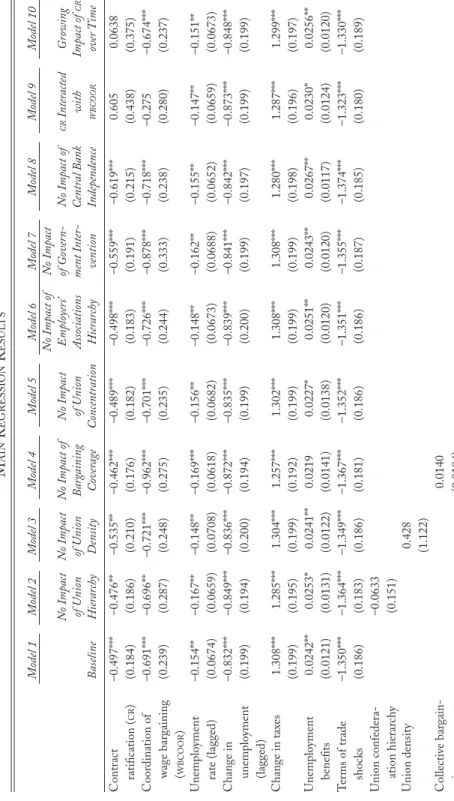
the regression results fully corroborate our hypotheses. across all models, the macroeconomic and policy-related variables perform as ex-pected: high levels of unemployment and of changes in unemployment depress wage growth, while a decline in the price of exports relative to imports, high levels of unemployment benefits, and increases in labor taxes push wages (in efficiency units) up.
Our measure of contract ratification is robustly negatively correlated
with the dependent variable (weU), indicating that the more workers
are involved in ratifying collective agreements, the greater the wage moderation. additionally, and confirming a standard result in the lit-erature, wage bargaining coordination is robustly negatively associated with wage militancy. it seems that the more coordinated the bargain-ing system, the easier it is, all other thbargain-ings bebargain-ing equal, to ensure wage moderation.
the clear impact of contract ratification is paired with the absence of an impact of union hierarchy (model 2). the coefficient is negative, as corporatist theory would predict, but not significantly different from 0. similarly insignificant are the coefficients of other institutional and organizational variables, which might be hypothesized to affect wage pressure: union density (model 3); the degree of collective bargaining coverage (model 4); the concentration of union confederations (model 5); the degree of centralization of employer organizations (model 6); the degree of government intervention in wage bargaining (model 7); and the degree of central bank independence (model 8).
62 the hypothesis of no cross-sectional dependence of the errors is rejected (Breusch-Pagan LM test: chi2(120) = 159.392, p = 0.0094). similarly rejected is the hypothesis of homoskedasticity (modi-fied Wald test: chi2(16) = 231.51, p = 0.000). We estimate static models because the null hypothesis of no serial correlation cannot be rejected at standard levels of confidence. since the result of the Wool-dridge test was borderline—f(1, 15) = 3.802, Prob > f = 0.0701—as a further check we estimated a dynamic model with the lagged dependent variable among the predictors; the coefficient of this vari-able was not significantly different from 0. results are omitted for reasons of space and are availvari-able from the authors upon request.
63 Beck and Katz 1995.
64 We did not estimate a two-way fixed-effects model with country dummies as well because an f-test of joint significance could not reject the hypothesis that the country fixed effects were jointly equal to zero: f(15, 380) = 0.80, Prob > f = 0.6809. the time dummies were instead jointly highly significant: f(27, 380) = 6.75, Prob > f = 0.0000.
models 9 and 10 include interaction terms. the complementarity between contract ratification and wage bargaining coordination emerg-ing by the cross-tabulation of data is confirmed in model 9. the coef-ficient of the interaction term (CR*wBCOOR) is negative and significant.
at the same time, the marginal effect of each variable is not signifi-cantly different from zero when the value of the other is zero. in other words, in a hypothetical country where no ratification procedures are in place and wage bargaining is not coordinated, our estimates suggest that neither a unit increase in wage coordination nor a unit increase in contract ratification would have any significant impact on wages. in this model the sign of the contract ratification coefficient is positive— thus providing some support for the corporatist view that worker in-volvement may lead to greater wage militancy, but only when collective bargaining is uncoordinated.
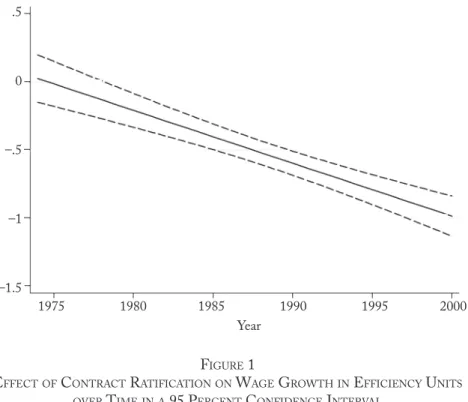
in model 10, we relax the assumption of a constant contract ratifica-tion coefficient and explore how it may vary over time. interestingly, both the time trend variable and the interaction between time trend and contract ratification (CR*tIMe) are negative and significant. the
time trend, which proxies for all trended omitted variables, suggests that there is linear decline in wage militancy over time when other de-terminants are controlled for. the interacted coefficient suggests that the wage-moderating effect of contract ratification becomes stronger over time. 65
figure 1 shows in a 95 percent confidence-level band how the effect of contract ratification on wage growth changes over time. this effect is significantly negatively different from zero (at 5 percent) starting from around 1980. We interpret this finding as suggesting that demo-cratically legitimating collective agreements become more important as welfare state expansion and other side payments are no longer much of
an option.66 Procedural legitimation becomes a substitute for outcome
legitimation.67
65 We estimated two further models (not reported for reasons of space, but available from the authors): a model including a dummy variable for european monetary Union (eMU ) countries, and
a model with an interaction between wage coordination and central bank independence. the eMU
dummy (scoring 1 for eMU members between 1992 and 2000, and 0 otherwise) is not significant.
sim-ilarly, and surprisingly given previous results (Hall and franzese 1998; iversen 1999), the interaction between wage coordination and central bank independence was not only insignificant but also wrongly (i.e., positively) signed. this finding seems interesting and worthy of further investigation, as it sug-gests that controlling for the previously overlooked process of contract ratification (which according to our argument helps union confederations moderate their wage demands), the much discussed wage-dampening effect of the combination between independent central bank, and coordinated bargaining disappears.
66 Pizzorno 1978b; Katzenstein 1985; Pierson 2001; mares 2006. 67 scharpf 1999.
t A B L e 4 M A IN R e g R e SS IO N R e SU Lt S a Mode l 1 Base line Mode l 2 N o Impa ct of Union H ie rar chy Mode l 3 N o Impa ct of Union Densit y Mode l 4 N o Impa ct of Barg aining Cov er ag e Mode l 5 N o Impa ct of Union Concent ration Mode l 6 N o Impa ct of Emplo ye rs’ A ssociations Hierar chy Mode l 7 N o Impa ct of Gov er n-ment Int er -vention Mode l 8 N o Impa ct of Cent ral Bank Independence Mode l 9 c r Int er act ed with w b c o o r Mode l 10 G rowing Impa ct of c ov er T ime Co ntr act –0.497*** –0.476** –0.535** –0.462*** –0.489*** –0.498*** –0.559*** –0.619*** 0.605 0.0638 ratific atio n ( C R ) (0.184) (0.186) (0.210) (0.176) (0.182) (0.183) (0.191) (0.215) (0.438) (0.375) Coor dinatio n of wage bargaining (wB C O O R ) –0.691*** (0.239) –0.696** (0.287) –0.721*** (0.248) –0.962*** (0.275) –0.701*** (0.235) –0.726*** (0.244) –0.878*** (0.333) –0.718*** (0.238) –0.275 (0.280) –0.674*** (0.237) Unemplo yment –0.154** –0.167** –0.148** –0.169*** –0.156** –0.148** –0.162** –0.155** –0.147** –0.151** rate (lagged) (0.0674) (0.0659) (0.0708) (0.0618) (0.0682) (0.0673) (0.0688) (0.0652) (0.0659) (0.0673) Change in unemplo yment (lagged) –0.832*** (0.199) –0.849*** (0.194) –0.836*** (0.200) –0.872*** (0.194) –0.835*** (0.199) –0.839*** (0.200) –0.841*** (0.199) –0.842*** (0.197) –0.873*** (0.199) –0.848*** (0.199) Change in tax es 1.308*** 1.285*** 1.304*** 1.257*** 1.302*** 1.308*** 1.308*** 1.280*** 1.287*** 1.299*** (0.199) (0.195) (0.199) (0.192) (0.199) (0.199) (0.199) (0.198) (0.196) (0.197) Unemplo yment 0.0242** 0.0253* 0.0241** 0.0219 0.0227* 0.0251** 0.0243** 0.0267** 0.0230* 0.0256** benefits (0.0121) (0.0131) (0.0122) (0.0141) (0.0138) (0.0120) (0.0120) (0.0117) (0.0124) (0.0120) t er ms of tr ade –1.350*** –1.364*** –1.349*** –1.367*** –1.352*** –1.351*** –1.355*** –1.374*** –1.323*** –1.330*** shoc ks (0.186) (0.183) (0.186) (0.181) (0.186) (0.186) (0.187) (0.185) (0.180) (0.189) Unio n co nf eder a-atio n hier ar ch y –0.0633 (0.151) Unio n densit y 0.428 (1.122) Col lectiv e bargain -ing co ver age r ate 0.0140 (0.0104)
Unio n co ncentr atio n –0.236 (0.631) Hier ar chic al po wer of emplo yers’ associatio ns 0.0634 (0.104) g ov er nment inter ventio n 0.0579 (0.0611) Centr al bank independence –1.280 (0.867) C R * w B C O O R –0.790** (0.308) t ime tr end ( t IM e ) –0.155*** (0.0257) C R * t IM e –0.0389* (0.0212) Co nstant 4.256*** 4.296*** 4.114*** 3.651*** 4.469*** 4.208*** 4.182*** 4.943*** 3.780*** 4.015*** (0.579) (0.579) (0.636) (0.662) (0.854) (0.580) (0.569) (0.809) (0.562) (0.616) O bser vatio ns 429 426 429 426 429 429 429 429 429 429 n umber of countr ies 16 16 16 16 16 16 16 16 16 16 r -squar ed 0.517 0.521 0.518 0.523 0.518 0.518 0.519 0.520 0.524 0.520 Dependent var iable: gr ow th of wages in efficienc y units; coefficients of t -1 time dummies o
mitted due to space co
nstr aints, but inc luded in al l estimatio ns; standar err ors in par entheses; *** p<0.01, ** p<0.05, * p<0 aa ll models ar e O L S with panel-corr ected standar d err ors.
SPeCIfICAtIONANd ROBUStNeSS CheCkS
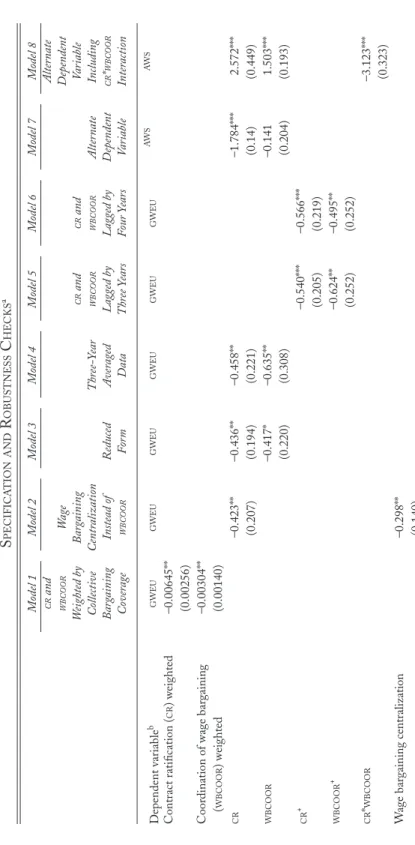
table 5 reports additional regression results. first, we estimate models that include different operationalizations of our key independent vari-ables, contract ratification and wage bargaining coordination (models 1 and 2). second, we estimate a reduced-form model by omitting macro-economic controls that could be endogenously related to the dependent variable (model 3). third, we estimate the model with averaged data (model 4). fourth, we estimate two models (5 and 6) in which our key independent variables are lagged. and fifth, we consider models with a different operationalization of the dependent variable: model 7 does not include the interaction between contract ratification and wage co-ordination; model 8 does.
Our conclusions hold even if we weigh both contract ratification and wage coordination by the degree of collective bargaining cover-age (model 1). the reasoning behind this choice is that the impact of particular institutional features is likely to be contingent on the overall importance of collective bargaining in a particular country (captured by the bargaining coverage rate). the impact of the contract
ratifica-fIgURe 1
effeCtOf CONtRACt RAtIfICAtIONON wAge gROwthIN effICIeNCy UNItS OveR tIMeINA 95 PeRCeNt CONfIdeNCe INteRvAL
1975 1980 1985 1990 1995 2000 Year .5 0 –.5 –1 –1.5
68 traxler, Blaschke, and Kittel 2001. 69 formally, this is wage share = wL
Y = w / YL = unit labor costs, where w (wage), L (labor), Y
(product).
tion and wage bargaining coordination variables on wage growth may be different between countries with high and low coverage. However, the two institutional measures remain significant predictors of wage trends. in model 2 we substitute the measure of wage coordination with a measure of wage centralization. the contract ratification coef-ficient is still significant but its magnitude is smaller and the standard error larger. While the measures of wage bargaining centralization and
wage coordination are highly correlated (r = 0.80), contract ratification
is (by construction) more highly correlated with wage centralization
(r=0 .41) than with wage coordination (r = 0.24). it is therefore more
difficult for OLS to sort out the respective contributions of wage
cen-tralization and contract ratification to movements in wages.
We then estimate a reduced-form model, omitting the two controls for the unemployment rate (model 3). this is intended as a further check on possible endogeneity problems (in addition to using one-year lags of the unemployment controls). in other words, it may be sus-pected that the unemployment rate responds to wage growth in ef-ficiency units. after omitting these terms the two institutional pre-dictors (contract ratification and wage coordination) continue to have negative and significant coefficients. model 4 runs an estimate using three-year averaged data.68 all results are confirmed.
Our results are likewise confirmed if we lag contract ratification and wage coordination by three or four years (model 5 and model 6, re-spectively). these tests rule out the possibility of reversed causation between wage moderation and the institutional variables, i.e., that the need to reduce wage militancy leads to an increase in bargaining coor-dination and contract ratification rather than vice versa.
We then estimate the model with macroeconomic controls and in-stitutional predictors using a different operationalization of the depen-dent variable—the wage share. the reason for this choice is twofold. first, the wage share is essentially a measure of unit labor costs; it is a standard (albeit less refined) proxy for wage militancy.69 second, the measure allows us to estimate a model where both the left-hand side and the right-hand side of the equation are expressed in levels. Unfor-tunately, data on wages in efficiency units are only available as an index number, thus making it inevitable to express the dependent variable as change. regression coefficients support our previous conclusions. in
t A B L e 5 S P e C If IC A t IO N A N d R O B U St N e SS C h e C k S a Mode l 1 c r and w b c o o r W eight ed by Collecti ve Barg aining Cov er ag e Mode l 2 W ag e Barg aining Cent raliz ation Inst ea d of w b c o o r Mode l 3 Reduced For m Mode l 4 Thr ee-Y ear A ve rag ed Dat a Mode l 5 c r and w b c o o r Lag ged by Thr ee Years Mode l 6 c r and w b c o o r Lag ged by Four Years Mode l 7 A lte rnat e Dependent Var iab le Mode l 8 A lte rnat e Dependent Var iab le Including cr*w b c o o Int er action Dependent var iable b g w e U g w e U g w e U g w e U g w e U g w e U A w S A w S Co ntr act r atific atio n ( C R ) weighted –0.00645** (0.00256) Coor dinatio n of wage bargaining –0.00304** ( w B C O O R ) weighted (0.00140) C R –0.423** –0.436** –0.458** –1.784*** 2.572*** (0.207) (0.194) (0.221) (0.14) (0.449) w B C O O R –0.417* –0.635** –0.141 1.503*** (0.220) (0.308) (0.204) (0.193) C R + –0.540*** –0.566*** (0.205) (0.219) w B C O O R + –0.624** –0.495** (0.252) (0.252) C R * w B C O O R –3.123*** (0.323) W
age bargaining centr
aliz
atio
n
Unemplo yment r ate (lagged) –0.143** –0.130** –0.155* –0.136** –0.121* –0.145*** –0.118*** (0.0632) (0.0646) (0.0826) (0.0615) (0.0625) (0.0448) (0.0427) Change in unemplo yment (lagged) –0.841*** –0.822*** –0.694** –0.720*** –0.675*** 0.155 –0.00774 (0.196) (0.200) (0.337) (0.209) (0.217) (0.182) (0.150) Change in tax es 1.320*** 1.338*** 1.421*** 1.629*** 1.278*** 1.229*** 0.434** 0.353** (0.198) (0.201) (0.206) (0.388) (0.211) (0.218) (0.202) (0.174) Unemplo yment benefits 0.0215 0.0237* 0.0177 0.0240* 0.0213 0.0186 0.0270*** 0.0223** (0.0136) (0.0138) (0.0127) (0.0129) (0.0138) (0.0146) (0.00857) (0.0106) t er ms of tr ade shoc ks –1.347*** –1.350*** –1.419*** –0.925** –1.352*** –1.350*** –0.558** –0.450** (0.186) (0.190) (0.201) (0.360) (0.212) (0.219) (0.268) (0.208) Co nstant 4.235*** 4.282*** 3.526*** 4.756*** –0.45 –0.561 72.21*** 70.33*** (0.576) (0.587) (0.529) (0.584) (0.697) (0.706) (0.595) (0.511) O bser vatio ns 426 429 429 143 381 365 429 429 n umber of countr ies 16 16 16 16 16 16 16 16 r -squar ed 0.516 0.514 0.477 0.620 0.459 0.455 0.473 0.584 Coefficients of t -1 time dummies ar e o
mitted due to space co
nstr aints, but ar e inc luded in al l the estimates; standar d err ors in par entheses; + thr ee- or four-y ear lag; *** p<0.01, ** p<0.05, * p<0.1 a a ll models ar e panel corr ected standar d err ors O L S estimatio ns. b g ro w th of wages in efficienc y units ( g w e U
) or adjusted wage shar
e (
A
w
S
model 7, which examines direct effects, both contract ratification and wage coordination are negatively signed and contract ratification is highly significant. in model 8, with both direct and interactive effects, the interaction term is negative and significant while the direct effects are positive and significant. in other words, when the value of the other variable is zero, neither variable has a negative impact on the wage share, i.e., on unit labor costs. On the contrary, it seems to increase the wage share. it is only the combination of the two variables that matters for labor cost containment. this confirms that wage coordination and contract ratification are complements.
finally, in table 6 we estimate a number of purely cross-sectional specifications.70 the “between estimator” is in all likelihood not the most appropriate for testing a model in which contract ratification is interacted with wage coordination, which varies more within countries than between. nevertheless, this extreme test addresses the problem of the nearly time-invariant contract ratification variable. the dependent variable is the average annual change of wage in efficiency units. Our independent variables are also averaged. With only sixteen observa-tions, one per country in the sample, we include only our most impor-tant institutional predictors: contract ratification, wage coordination, and their interaction. the macroeconomic controls are not expected to have any impact on the long-run rate of growth of the wage in ef-ficiency units, so they are excluded. We estimate models for the overall period 1974–2000 (models 1 and 2); for 1974–89 (models 3 and 4); and for 1989–2000 (models 5 and 6). in other words, we distinguish between the period of classic political exchange following the two oil crises (1974–89) and the age of new social pacts (1990–2000) in which trade unions were no longer compensated for wage moderation through side payments.71
the results of cross-sectional regressions are less straightforward than those of the time-series cross-sectional analysis, but overall are in line with them. even with only sixteen observations, contract ratification emerges as the most important institutional predictor of wage mod-eration. its coefficients for the entire period 1974–2000 are negative and significant (models 1 and 2). Controlling for contract ratification,
70 We also performed (but do not present here) a jackknife analysis (excluding one country at a time) on the model presented in table 4, column 1. this suggested that the model is robust to pres-ence or abspres-ence of particular countries in the sample. in particular, the two institutional variables, wage coordination and contract ratification, do not depend on any particular country for statistical significance.
71 regini 1997; Wallerstein, golden, and lange 1997; Perez 2000; Compston 2002; Culpepper 2002; molina and rhodes 2002; traxler 2004; Hassel 2006; Hamann and Kelly 2007; avdagic 2010.
the degree of wage bargaining coordination (i.e., the institution all previous literature has focused on) is not significantly associated with wage moderation in the 1974–2000 regressions. the coefficients of both contract ratification and wage coordination are positive albeit in-significant in the 1974–89 period (models 3 and 4). this is strange but not completely unexpected since the results shown in figure 1 (which is derived from table 4, model 10) indicate that the impact of contract ratification becomes significantly different from zero only in the 1980s. the same coefficients are negative and significant in the period 1990–
2000 (the era of new social pacts).72 additionally, in the 1990–2000
72 in the interacted models, each of the variables in the interactive term is expressed as deviation from the sample mean. this allows one to interpret the direct effects of contract ratification and co-ordination of wage bargaining in the interacted models as referring to the average country (for which the interacted term is zero).
tABLe 6
CROSS-SeCtIONAL RegReSSIONSIN dIffeReNt PeRIOdSa
Model 1 Baseline 1974–2000 Model 2 1974–2000 with cr*wbcoor Interaction Model 3 Baseline 1974–1989 Model 4 1974–1989 with cr*wbcoor Interaction Model 5 Baseline 1990–2000 Model 6 1990–2000 with cr*wbcoor Interaction Contract –0.430** –0.381* 0.0638 0.0588 –1.030*** –0.700** ratification (CR) (0.171) (0.199) (0.119) (0.149) (0.288) (0.248) Coordination of wage bargaining (wBCOOR) 0.0368 (0.135) –0.0404 (0.175) 0.211 (0.149) 0.219 (0.196) –0.388 (0.283) –0.675** (0.250) CR*wBCOOR –0.197 0.0190 –1.011*** (0.241) (0.250) (0.325) Constant 0.330** 0.405* 0.140 0.133 0.727** 0.987*** (0.143) (0.190) (0.158) (0.208) (0.325) (0.243) Observations 16 16 16 16 16 16 r-squared 0.407 0.425 0.130 0.130 0.652 0.790
Dependent variable: growth of wages in efficiency units yearly average; all models are robust to a jackknife test done by excluding one country at the time; each of the variables interacted is expressed as deviation from the sample mean, i.e., the direct effects of contract ratification and coordination of wage bargaining in the interacted models can be interpreted as referring to the average country; (White-) robust standard errors in parentheses; *** p<0.01, ** p<0.05, * p<0.1