. . . .
. . . .
Carbamylated low-density lipoprotein induces
endothelial dysfunction
Thimoteus Speer
1,2,3, Frederick O. Owala
1,2, Erik W. Holy
1,2, Stephen Zewinger
3,
Felix L. Frenzel
3, Barbara E. Sta¨hli
1,2, Marjan Razavi
2, Sarah Triem
3, Hrvoje Cvija
3,
Lucia Rohrer
4, Sarah Seiler
3, Gunnar H. Heine
3, Vera Jankowski
5, Joachim Jankowski
5,
Giovanni G. Camici
2, Alexander Akhmedov
2, Danilo Fliser
3, Thomas F. Lu¨scher
1,2,
and Felix C. Tanner
1,2*
1
University Heart Center, Cardiovascular Center, University Hospital Zurich, Ra¨mistrasse 100, 8091 Zurich, Switzerland;2
Center of Molecular Cardiology, Schlieren Campus, University of Zurich, Zurich, Switzerland;3
Department of Internal Medicine 4, Saarland University Hospital, Homburg/Saar, Germany;4
Institute of Clinical Chemistry, University Hospital Zurich, Zurich, Switzerland; and5
Department of Internal Medicine IV, Charite´-Universita¨tsmedizin, Berlin, Germany Received 24 August 2013; revised 29 January 2014; accepted 20 February 2014; online publish-ahead-of-print 21 March 2014
This paper was guest edited by Prof. Fililppo Crea, Rome.
See page 2996 for the editorial comment on this article (doi:10.1093/eurheartj/ehu122)
Aims Cardiovascular events remain the leading cause of death in Western world. Atherosclerosis is the most common under-lying complication driven by low-density lipoproteins (LDL) disturbing vascular integrity. Carbamylation of lysine resi-dues, occurring primarily in the presence of chronic kidney disease (CKD), may affect functional properties of lipoproteins; however, its effect on endothelial function is unknown.
Methods and results
Low-density lipoprotein from healthy donors was isolated and carbamylated. Vascular reactivity after treatment with native LDL (nLDL) or carbamylated LDL (cLDL) was examined in organ chambers for isometric tension recording using aortic rings of wild-type or lectin-like-oxidized LDL receptor-1 (LOX-1) transgenic mice. Reactive oxygen species (ROS) and nitric oxide (NO) production were determined using electron spin resonance spectroscopy. The effect of LDL-carbamyl-lysine levels on cardiovascular outcomes was determined in patients with CKD during a median follow-up of 4.7 years. Carbamylated LDL impaired endothelium-dependent relaxation to acetylcholine or calcium-ionophore A23187, but not endothelium-independent relaxation to sodium nitroprusside. In contrast, nLDL had no effect. Carbamylated LDL enhanced aortic ROS production by activating NADPH-oxidase. Carbamylated LDL stimulated endothelial NO synthase (eNOS) uncoupling at least partially by promoting S-glutathionylation of eNOS. Carbamylated LDL-induced endothelial dysfunction was enhanced in LOX-1 transgenic mice. In patients with CKD, LDL-carbamyl-lysine levels were significant predictors for cardiovascular events and all-cause mortality.
Conclusions Carbamylation of LDL induces endothelial dysfunction via LOX-1 activation and increased ROS production leading to eNOS uncoupling. This indicates a novel mechanism in the pathogenesis of atherosclerotic disease which may be patho-genic and prognostic in patients with CKD and high plasma levels of cLDL.
-Keywords Endothelial function † Lipoprotein † Carbamylation † Reactive oxygen species † Nitric oxide
Introduction
Cardiovascular disease is the leading cause of death in industrialized countries. In the USA, cardiac and cerebrovascular disease ac-counted for almost one-third of all deaths in 2006.1 Although
mortality declined during the last years, the morbidity associated with atherosclerosis and its consequences remains high, particularly in patients with diabetes and/or chronic kidney disease (CKD).2,3
Besides other cardiovascular risk factors such as hypertension, obesity, diabetes, and smoking,4hypercholesterolaemia is strongly
*Corresponding author. Tel:+41 442559997, Fax: +41 442554904, Email:[email protected]
associated with the incidence of cardiovascular events.5There is a growing body of evidence indicating that lipid-lowering therapy con-siderably reduces cardiovascular event rate after the occurrence of a first event as well as in primary prevention.6,7Despite of such bene-ficial effects, the incidence of cardiovascular events remains high. Notably, half of all the patients with a myocardial infarction display normal plasma lipid levels,8 and biomarkers such as C-reactive protein seem to be stronger predictors of cardiovascular events than low-density lipoprotein (LDL)-cholesterol plasma levels.9 Recent evidence suggests that not only the absolute LDL-cholesterol plasma level, but functional properties of the lipoproteins may play an important role in the pathogenesis of atherosclerosis.10It is well established that posttranslational modifications of LDL particles such as oxidation (oxLDL) crucially deteriorate its functional proper-ties leading to a pro-atherogenic phenotype.11,12Plasma levels of oxLDL correlate well with the vulnerability of atherosclerotic lesions13and are strong predictors for cardiovascular events.14,15
Carbamylation of LDL-cholesterol was recently discovered as a novel modification of this lipoprotein in patients with CKD.16,17 Urea-derived cyanate induces the carbamylation of lysine residues leading to the formation of 1-carbamyl-lysine (homocitrulline).18 Additionally, myeloperoxidase catalysed lipoprotein carbamylation was identified as an alternative for cyanate-mediated protein carba-mylation, which is particularly important in smokers.19
Recent data suggest that carbamylated LDL (cLDL) may promote the formation of atherosclerotic lesions.20However, the underlying mechanisms, in particular the role of cLDL in endothelial dysfunction as a first critical step in the pathogenesis of atherosclerosis, have not been well understood yet. We therefore conducted the present study to examine the effect of cLDL on endothelial function.
Methods
Detailed description of methods is presented on Supplementary material online.
Detection of reactive oxygen species and nitric
oxide using electron spin resonance
spectroscopy
Production of ROS in aortic rings, human aortic endothelial cells (HAECs), and whole blood was measured using electron spin resonance (ESR) spectroscopy, as described previously.21Details are described in Supplementary material online.
Statistics
All data are expressed as means + SEM. Statistical comparisons were performed with Student’s t-test for simple comparisons between two groups. For multiple comparisons, results were analysed by one-way ANOVA followed by Tukey’s post hoc test. A value of P , 0.05 was con-sidered statistically significant.
In the clinical study, patients were stratified into two categories according to the median of carbamylated-lysine in LDL (≤ 28.1 or . 28.1 mg/mg LDL protein). Continuous data are presented as means + SD when normally distributed or as median and inter-quartile range for variables with skewed distribution. Categorical data are presented as per-centage. Statistical differences between continuous variables were deter-mined using the one-way ANOVA or Kruskal – Wallis test or x2test for categorical variables. To examine the effect of LDL-carbamyl-lysine
levels on all-cause mortality and cardiovascular events, Kaplan – Meier curves were built for LDL-carbamyl-lysine levels divided into two cat-egories at median. Differences between both groups were analysed by using the Log-rank test. Moreover, Cox-proportional hazard models were built, including LDL-carbamyl-lysine levels in a crude model as well as adjusted for age, sex, diabetes mellitus, pre-existing coronary artery disease, hs-C reactive protein, and eGFR.
All P-values were adjusted for multiple comparisons where appropri-ate. All statistical calculations were carried out using the PRISM software (GraphPad Prism for MacOSX, 5.0d) or SPSS software (Version 20.0).
Results
Low-density lipoprotein carbamylation
Immediately after ex vivo carbamylation, the degree of carbamoyl-DL-lysine was determined. Carbamylation of LDL yielded 27.4 + 0.9 nmol/mg carbamoyl-DL-lysine, whereas no carbamoyl-DL-lysine was detectable in native LDL preparations (Figure 1A and B). Neither cLDL nor LDL preparations contained relevant lipid perox-idation (Figure1C).
Carbamylated low-density lipoprotein
impairs endothelium-dependent
relaxation
To determine the effect of LDL carbamylation on endothelial func-tion, organ chamber experiments using aortic rings from wild-type (WT) C57BL/6J mice were performed. Treatment with cLDL inhibited acetylcholine-induced endothelium-dependent relaxation (P ¼ 0.002), whereas nLDL did not affect the response (P ¼ 0.99) (Figure2A). Neither cLDL nor nLDL altered vascular contraction of aortic rings in the presence of norepinephrine (Figure 2B). Similar to acetylcholine, endothelium-dependent relaxation to the calcium-ionophore A23187 was impaired after cLDL treatment (P , 0.001; Figure2C). In contrast, relaxations to sodium nitroprus-side remained unaltered by cLDL (P ¼ 0.92, Figure2D), indicating that cLDL inhibits dependent, but not endothelium-independent relaxations to both dependent and receptor-independent agonists.
Carbamylated low-density lipoprotein
induces endothelial reactive oxygen
species production
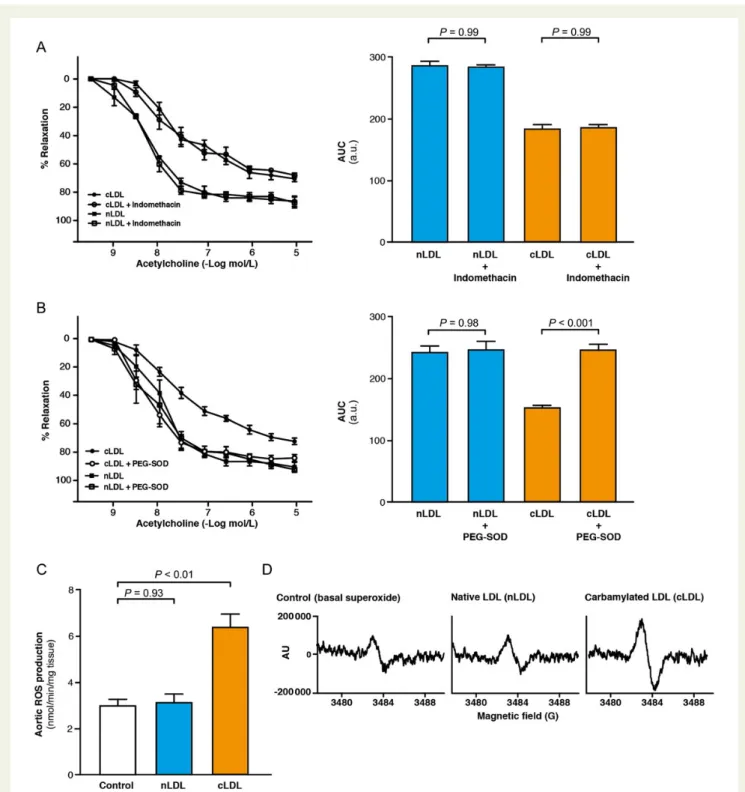
To gain further insights into the mechanism of cLDL-induced endothe-lial dysfunction (ED), we tested the vascular reactivity of aortic rings in the presence of indomethacin, an inhibitor of cyclooxygenase. Indo-methacin did not alter the inhibitory effect of cLDL on vasodilation ruling out the involvement of vasoactive prostaglandins as a cause of the impaired endothelium-dependent relaxations (Figure3A).
Enhanced production of reactive oxygen species (ROS) is known to reduce the bioavailability of endothelium-derived nitric oxide (NO) leading to ED.22Addition of the ROS scavengers PEG-SOD/ PEG-catalase restored endothelium-dependent relaxation to acetyl-choline in cLDL-treated aortic rings (P , 0.001; Figure3B), indicating a pivotal role of ROS in cLDL-induced ED. Accordingly, in aortic rings, cLDL significantly induced aortic ROS production (P , 0.01), while nLDL had no effect (P ¼ 0.93; Figure3C and D).
T. Speer et al.
Carbamylated low-density lipoprotein
induces uncoupling of endothelial nitric
oxide synthase
Human aortic endothelial cells were incubated with cLDL to quantify endothelial NO production. Carbamylated LDL, but not nLDL, sig-nificantly reduced basal NO production in HAEC (Figure4A and B) confirming the functional data of the organ chamber experiments.
Enzymatic activity of endothelial NO synthase (eNOS) is modu-lated by phosphorylation at different regulatory sites.23 Carbamy-lated LDL treatment reduced eNOS phosphorylation at the activating residue Ser1177 and concomitantly enhanced phosphoryl-ation of eNOS at the inhibitory site Thr495 (Figure4C – D). Thus,
inhibition of endothelium-dependent relaxation through cLDL is in part mediated by a reduced activity of eNOS.
Since cLDL stimulated ROS production in aortic rings, we analysed whether the endothelium is the prevailing source for ROS produc-tion in response to the modified lipoproteins. Carbamylated LDL induced production of ROS in HAEC, whereas nLDL had no effect (P ¼ 0.016, Figure4E).
Besides its role as NO producing enzyme, eNOS can act as a source of ROS when its dimer is uncoupled.24Therefore, we quanti-fied eNOS uncoupling using a western blot technique. Carbamylated LDL increased the ratio of monomeric to total eNOS compared with untreated cells 10 min after stimulation, while nLDL did not affect this ratio (Figure4F).
Figure 1 (A) Representative amino acid analysis of native and carbamylated low-density lipoproteins after ex vivo carbamylation by HPLC, arrow indicates carbamoyl-DL-lysine peak. (B) Carbamoyl-DL-lysine content in low-density lipoprotein preparation after ex vivo carbamylation (n ¼ 10). (C )
Malondialdehyde content of low-density lipoprotein preparations determined by TBARS assay (n ¼ 10 per group). Results are presented as means + SEM.
Figure 2 (A) Endothelium-dependent relaxations to acetylcholine in aortic rings treated with native density lipoprotein or carbamylated low-density lipoprotein (100 mg/mL; n ¼ 8 per group) and calculated AUC. (B) Contractions to norepinephrin in aortic rings (n ¼ 6 per group) and calculated AUC. (C ) Endothelium-dependent relaxations to A23187 (n ¼ 6 per group) and calculated AUC. (D) Endothelium-independent relaxations to sodium nitroprusside (n ¼ 5 per group) and calculated AUC. Results are presented as means + SE and P-values were adjusted for multiple comparisons where appropriate.
T. Speer et al.
S-glutathionylation of eNOS may induce eNOS uncoupling.25
Therefore, we visualized co-localization of S-glutathionylation and eNOS in HAEC treated with nLDL, cLDL, and 1,3-bis (2-chloroethyl)-1-nitrosourea (BCNU), an inhibitor of glutathione reductase, by immunofluorescence microcopy (Figure 4G).
Carbamylated LDL, but not nLDL, up-regulated endothelial S-glutathionylation, which co-localized with eNOS comparable with cells treated with BCNU. Thus, S-glutathionylation of eNOS may be at least partially responsible for cLDL-induced eNOS uncoupling.
Figure 3 (A) Endothelium-dependent relaxations to acetylcholine in aortic rings + indomethacin (n ¼ 5 per group) and calculated AUC. (B) Endothelium-dependent relaxations to acetylcholine in aortic rings + PEG-SOD/PEG-catalase (n ¼ 7 per group) and calculated AUC. (C ) Reactive oxygen species production in aortic rings treated with native low-density lipoprotein or carbamylated low-density lipoprotein (100 mg/mL, 1 h, n ¼ 10 per group) determined by electron spin resonance spectroscopy. (D) Representative electron spin resonance spectra of reactive oxygen species production in aortic rings. Results are presented as means + SE and P-values were adjusted for multiple comparisons where appropriate.
Figure 4 (A) Nitric oxide production in human aortic endothelial cells treated with native low-density lipoprotein or carbamylated low-density lipoprotein (100 mg/mL, 1 h, n ¼ 4 per group) determined by electron spin resonance spectroscopy. (B) Representative electron spin resonance spectra of nitric oxide production in human aortic endothelial cells and human aortic endothelial cells treated withL-NAME (0.3 mM) as a
control. (C ) Endothelial nitric oxide synthase-activating phosphorylation at Ser1177 in human aortic endothelial cells treated with native low-density lipoprotein or carbamylated low-density lipoprotein (100 mg/mL, 10 min, n ¼ 5 per group). (D) Endothelial nitric oxide synthase -inhibiting phos-phorylation at Thr495 in human aortic endothelial cells treated with native low-density lipoprotein or carbamylated low-density lipoprotein (100 mg/mL, 10 min, n ¼ 5 per group). (E) Reactive oxygen species production in human aortic endothelial cells treated with native low-density lipoprotein or carbamylated low-density lipoprotein (100 mg/mL, 1 h, n ¼ 4 per group) determined by electron spin resonance spectroscopy. (F ) Endothelial nitric oxide synthase uncoupling in human aortic endothelial cells treated with native density lipoprotein or carbamylated low-density lipoprotein (100 mg/mL, 10 min, n ¼ 6 per group) determined by western blot analysis quantifying endothelial nitric oxide synthase monomer/total endothelial nitric oxide synthase, H2O2(5 mmol/L) served as a control. (G) Immunofluorescent staining for endothelial nitric
oxide synthase (green) and S-glutathionylation (red). Nuclei are stained with 4′,6-diamidino-2-phenylindole (blue). Overlay is performed in human aortic endothelial cells treated with native low-density lipoprotein, carbamylated low-density lipoprotein (100 mg/mL), or 1,3-bis(2-chloroethyl)-1-nitrosourea (25 and 80 mM) as a control for 4 h. Images are representative for three independent experiments. Results are presented as means + SE and P-values were adjusted for multiple comparisons where appropriate.
T. Speer et al.
Lectin-like-oxidized low-density
lipoprotein receptor-1 mediates
carbamylated low-density
lipoprotein-induced ED
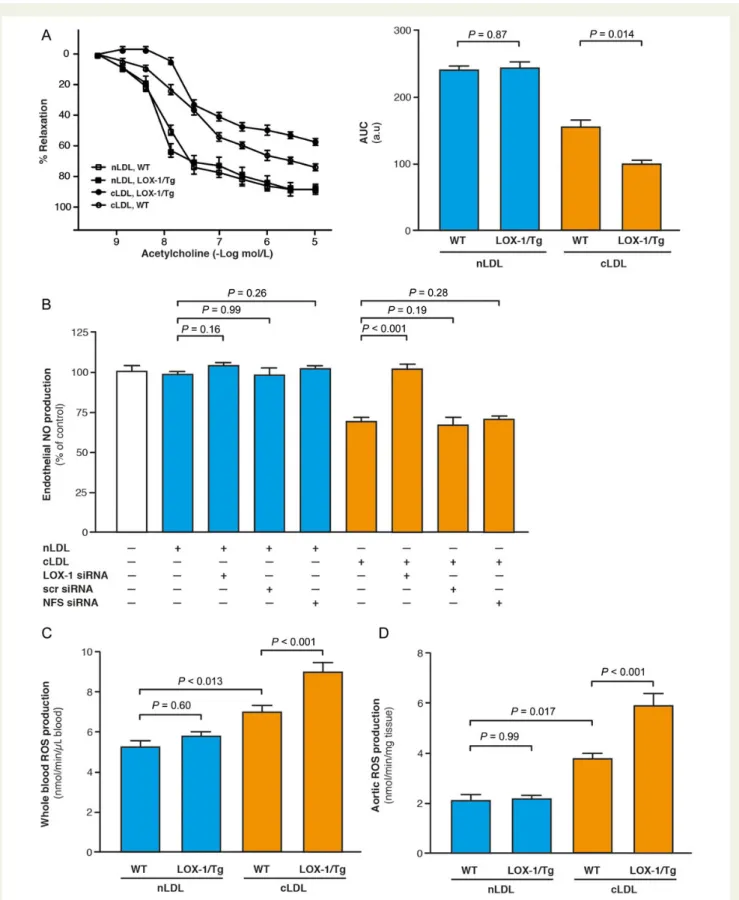
Recent evidence suggests that cLDL may interact with the endothelial lectin-like-oxidized LDL receptor-1 (LOX-1).26Lectin-like-oxidized LDL receptor-1 is known to mediate adverse endothelial effects of oxLDL and other agents by inducing oxidative stress.27To examine the impact of LOX-1 on cLDL-induced ED, transgenic mice over-expressing endothelial LOX-1 were generated (LOX-1/Tg) and organ chamber experiments using aortic rings from these mice were performed. Under control conditions, endothelium-dependent relaxation in response to acetylcholine did not differ between WT and LOX-1/Tg mice. In contrast, the inhibitory effect of cLDL on vaso-dilation was significantly enhanced in LOX-1/Tg mice when compared with WT control mice (Figure5A).
To confirm LOX-1 as the receptor-mediating cLDL-induced ED, we quantified the effect of cLDL on endothelial NO production in the presence or absence of siRNA targeting LOX-1. Silencing of LOX-1 abrogated the inhibitory effect of cLDL on endothelial NO release (P , 0.001), whereas siRNA targeting LOX-1 did not change the effect of nLDL on endothelial NO production (P ¼ 0.16; Figure5B).
Accordingly, in vivo, 24 h after injection of cLDL or nLDL into WT and LOX-1/Tg mice, cLDL-induced ROS production in whole blood, and in aortic rings was further augmented in LOX-1/Tg mice when compared with WT animals (Figures5C and D). These in vivo findings confirm our results obtained in vitro in HAEC and in ex vivo-treated aortic rings.
Lectin-like-oxidized low-density
lipoprotein receptor-1 stimulated
activation of NADPH-oxidase
We next aimed at determining the molecular mechanisms by which activation of LOX-1 by cLDL increases endothelial ROS production. Since LOX-1 activation has been shown to increase endothelial NADPH-oxidase activity,28we measured endothelial ROS produc-tion in response to cLDL in the presence of the NADPH-oxidase inhibitor diphenylene iodinium (DPI) or captopril. Indeed, cLDL-induced endothelial ROS production was almost completely pre-vented in the presence of DPI or captopril, indicating a crucial role of NADPH-oxidase for cLDL-induced ROS production (Figure6A).
Moreover, we studied the role of different mitogen-activated protein kinases (MAPK), which have been documented as down-stream factors of LOX-1,28 in mediating the adverse endothelial effects of cLDL. In these experiments, we found that the inhibitor of p38-MAPK SB202190 significantly attenuated the effect of cLDL on endothelial ROS production (Figure6B). We also observed that cLDL substantially increased phosphorylation of p38-MAPK in HAEC in a time-dependent manner (Figure6C). These results indicate that the effects of cLDL on endothelial ROS production may at least in part be mediated by LOX-1-induced p38-phosphorylation.
It has been reported that several amino acids may attenuate carba-mylation of albumin.29Therefore, we determined ROS of HAEC treated with LDL, which was carbamylated in the presence of distinct
amino acids (Figure6D). Notably,L-arginine,L-cysteine, andL-histidine present during incubation of LDL with potassium cyanate significantly reduced the effect of such prepared cLDL on endothelial ROS production.
Carbamylated low-density lipoprotein in
patients with chronic kidney disease
To examine the relevance of these findings in patients, we quantified the number of post-translationally carbamylated-lysine residues in LDL isolated from healthy subjects and patients with CKD by using matrix-assisted laser desorption/ionization time-of-flight mass-spectrometry (Figure7A). In ex vivo cLDL, which was used for the experiments in the present study, we could detect posttranslational carbamylation of 34 lysine residues. Notably, in CKD patients an average of 54 + 4 lysine residues of LDL was carbamylated, whereas no carbamylated sites were detected in LDL isolated from healthy control subjects.
Notably, in HAEC treated with isolated LDL from the same patients and healthy controls, we observed a significant reduction of endothelial NO production after incubation with LDL from CKD patients (P , 0.001) when compared with LDL from healthy subjects (Figure7B).
Finally, to examine whether carbamylation of LDL may affect CV outcome in patients with CKD, we isolated LDL from 96 patients with proven CKD and determined the concentration of carbamyl-lysine in the LDL fractions. The baseline characteristics of the study cohort are shown in Supplementary material online, Table S1. The cohort was divided into two categories at the median of LDL-carbamyl-lysine levels. Patients with LDL-carbamyl-lysine .28.1 mg/mg LDL protein had a significantly higher all-cause mortality (P ¼ 0.002, Figure 7C) as well as a significantly shorter cardiovascular events (CVE)-free survival (P , 0.001, Figure 7D). Notably, even after adjustments for potential confounders, LDL-carbamyl-lysine remained a powerful predictor for all-cause mortality and CVE in Cox-proportional hazard models (Supplemen-tary material online, Table S2).
Discussion
This study demonstrates for the first time that cLDL induces endo-thelial dysfunction via LOX-1 activation leading to p38-MAPK and NADPH-oxidase activation, eNOS uncoupling, increased endothe-lial ROS production, reduced NO bioavailability, and finally impaired endothelium-dependent vasodilation. Moreover, in patients with CKD, carbamyl-lysine levels in LDL were associated with increased cardiovascular events and all-cause mortality.
Nitric oxide is a key regulator of endothelial function since the free radical does not only regulate vascular tone, but also prevents endo-thelial inflammatory and pro-coagulatory pathways.30Not surpris-ingly, endothelial dysfunction represents a crucial initial step in the pathogenesis of atherosclerosis and predicts future cardiovascular events.31Endothelial dysfunction is mainly characterized by a dysba-lance between the production of NO and that of ROS resulting in a vicious circle, as ROS react with NO to form peroxynitrite leading to a further reduction in NO bioavailability and posttranscriptional modification of cellular proteins.30,31
Figure 5 (A) Endothelial-dependent relaxations to acetylcholine in aortic rings from wild-type and endothelial lectin-like-oxidized low-density lipoprotein receptor-1/Tg mice (n ¼ 6 per group) and calculated AUC. (B) Nitric oxide production in human aortic endothelial cells stimulated with native low-density lipoprotein or carbamylated low-density lipoprotein after silencing of lectin-like-oxidized low-density lipoprotein receptor-1 (n ¼ 6 per group). NFS, nanoparticle forming solution. Reactive oxygen species production in whole blood (C ) and aortic rings (D) of wild-type and lectin-like-oxidized low-density lipoprotein receptor-1/Tg mice 24 h after injection of native low-density lipoprotein or carbamy-lated low-density lipoprotein (15 mg/kg, n ¼ 4 per group) determined by electron spin resonance spectroscopy. Results are presented as mean + SE and P-values were adjusted for multiple comparisons where appropriate.
T. Speer et al.
Lipoproteins are important regulators of endothelial function. Whereas high-density lipoprotein (HDL) mainly exerts protective effects,32LDL promotes endothelial dysfunction and in turn athero-sclerosis once it has been modified by ROS induced oxidation.33 Re-cently, novel forms of lipoprotein modification have been described. Urea- or myeloperoxide-driven carbamylation of lipoprotein lysine residues indeed impairs the functional integrity of HDL and LDL par-ticles.16,19Of note, serum levels of carbamylated proteins and in par-ticular lipoproteins are elevated in patients with coronary artery disease and particularly in those with CKD.16,17,19
In the present study, LDL isolated from healthy donors was carbamylated ex vivo using potassium cyanate in order to generate well-defined experimental conditions. Notably, the number of carba-mylation sites in LDL from CKD patients was even higher when compared with the ex vivo cLDL used for the experiments. This
underscores the clinical relevance of the present findings and we assume an enzymatic carbamylation process in vivo. The detrimental effects of cLDL observed in this study may well occur in such patients as well as in those with a high myeloperoxidase activity.
In organ chamber experiments using aortic rings from C57Bl/6J mice, we observed that cLDL impaired acetylcholine- and calcium-ionophore induced endothelium-dependent relaxation, while nLDL did not affect vascular reactivity. Thus, the effect is specific for the carbamylated form of the lipoprotein and must involve a mechanism other than the muscarinic receptor and its signal transduction, since the response to the calcium-ionophore was equally affected. Because the relaxation to the NO donor sodium nitroprusside was not affected by cLDL, the latter specifically impairs the function of the endothelium, but not the vasodilating capacity of vascular smooth muscle cells. The effect of cLDL on vascular relaxation was Figure 6 (A) Reactive oxygen species production in human aortic endothelial cells treated with carbamylated low-density lipoprotein (100 mg/mL, 1 h) after preincubation with the NADPH-oxidase inhibitor diphenylene iodinium (5 mM, 30 min) or captopril (10 mM; n ¼ 3 – 5 per group). (B) Reactive oxygen species production in human aortic endothelial cells treated with carbamylated low-density lipoprotein (100 mg/mL, 1 h) after pre-incubation with the p38 mitogen-activated protein kinase inhibitor SB202190 (5 mM, 30 min; n ¼ 3 – 5 per group). (C ) Time course of phosphor-ylation of p38 mitogen-activated protein kinase at Thr180/Tyr182 in human aortic endothelial cells after treatment with carbamylated low-density lipoprotein (100 mg/mL, n ¼ 4). (D) Reactive oxygen species production in human aortic endothelial cells treated with carbamylated low-density lipoprotein (100 mg/mL, 1 h) carbamylated in the presence of amino acids (each 10 mM, n ¼ 4 per group) as indicated. **P , 0.01 and ***P , 0.001 for comparison with carbamylated low-density lipoprotein alone. Results are presented as means + SE and P-values were adjusted for multiple comparisons where appropriate.
comparable with that of oxLDL, indicating that different modifications of LDL can exert a similar effect on vascular function possibly via similar pathways.12Moreover, the findings that LDL from healthy subjects did not altered endothelium-dependent vasodilation as well as endothelial NO and ROS production suggests that the effect of LDL on endothelial function is mainly determined by modifications of the LDL particle such as carbamylation or oxidation.34,35
A recent study revealed that LOX-1 may be the receptor predom-inantly mediating cellular effects of cLDL at least in endothelial cells.26 Thus, the effect of cLDL on endothelium-dependent relaxation to acetylcholine was determined in aortic rings from transgenic mice exhibiting endothelium-specific overexpression of LOX-1. Endothe-lial dysfunction in response to cLDL was indeed enhanced in LOX-1/ Tg, but not in WT mice. In contrast, nLDL did not affect the relaxation
of aortic rings from LOX-1/Tg or WT mice. The involvement of the LOX-1 receptor was confirmed using genetic silencing in HAEC, since down-regulation of LOX-1 by siRNA prevented the cLDL-induced inhibition of NO production in HAEC. Notably, in vivo experiments clearly confirmed the role of LOX-1 in mediating the effect of cLDL on ED. This is of relevance since LOX-1 is crucially involved in atherosclerosis and highly expressed in human athero-sclerotic lesions.36Furthermore, activation of LOX-1 with oxLDL has been documented to enhance endothelial oxidative stress and in-flammatory activation.27Therefore, the detrimental effects of cLDL may not only be important for endothelial dysfunction, but also for the development of atherosclerotic lesions.
The specific activation pattern of the endothelial LOX-1 receptor by cLDL together with the absence of any effect of the cLDL on Figure 7 (A) Quantification of carbamylated sites in low-density lipoprotein isolated from chronic kidney disease patients and healthy subjects (n ¼ 9 per group). The left bar represents the number of carbamylation sites in low-density lipoprotein carbamylated ex vivo by incubation with po-tassium cyanate for 4 h as a positive control. Each bar represents an individual subject. (B) Effect of low-density lipoprotein (100 mg/mL, 1 h) isolated from the same patients as in (A) on endothelial nitric oxide production in human aortic endothelial cells (n ¼ 9 per group). (C ) Kaplan – Meier curve for all-cause mortality and (D) cardiovascular events of patients with chronic kidney disease (n ¼ 96) divided into two categories according to median low-density lipoprotein-carbamyl-lysine levels. Results are presented as means + SE and P-values were adjusted for multiple comparisons where appropriate.
T. Speer et al.
vascular smooth muscle cells suggest that either NO production or NO bioavailability or, alternatively, vasoconstrictor prostaglan-dins must be involved in cLDL-induced endothelial dysfunction. However, unselective inhibition of cyclooxygenase using indometh-acin did not alter endothelium-dependent relaxations to acetylcho-line in response to cLDL.
Contrarily, scavenging of ROS using PEG-SOD /PEG-catalase pre-vented cLDL-induced endothelial dysfunction. Therefore, cLDL must stimulate the endothelial production of ROS. Consistent with this interpretation, cLDL induced ROS production both in aortic rings and in cultured HAEC. These findings are in line with a recent study demonstrating that cLDL induces oxidative stress in endothelial progenitor cells.37
Reactive oxygen species production in endothelial cells may origin-ate from NADPH oxidases, mitochondria, or eNOS itself if it is uncoupled. The data generated with the NADPH-oxidase inhibitor DPI indicate that activation of NADPH-oxidase occurring down-stream of the MAPK p38 may contribute to ROS formation in re-sponse to cLDL.
Several agents are known to induce eNOS uncoupling.22,24 In marked contrast to dimeric eNOS which oxidizesL-arginine result-ing in the formation ofL-citrulline and NO, uncoupled eNOS loses its ability to produce NO and instead generates ROS. We observed that cLDL leads to eNOS uncoupling as indicated by a higher ratio of monomeric to total eNOS. Recently, S-glutathionylation of eNOS has been shown to induce eNOS uncoupling.25Here, we found that cLDL up-regulated eNOS S-glutathionylation, which can at least partially explain the molecular mechanisms leading to eNOS un-coupling in response to cLDL.
Several amino acids such as cysteine, histidine, and arginine are known to inhibit carbamylation of albumin.29Here, we observed that cysteine, histidine, and arginine present during ex vivo carbamyla-tion of LDL prevented cLDL-induced endothelial ROS produccarbamyla-tion.
This indicates that dietary supplementation of these amino acids may provide a potential treatment strategy to preclude cLDL-induced endothelial dysfunction in patients with increased protein carbamylation such as CKD.
Finally, in the clinical part of the study, we documented a significant association between LDL-carbamyl-lysine levels and all-cause mor-tality and cardiovascular events in patients with CKD. These findings point to an important role of cLDL in the development of cular disease in CKD patients and highlight cLDL as a novel cardiovas-cular risk factor in these patients.
In summary, our data indicate that cLDL induces ED via activation of the endothelial LOX-1 receptor leading to p38-dependent NADPH-oxidase activation, ROS production, S-glutathionylation-dependent eNOS uncoupling, and reduced NO bioavailability. In addition, cLDL inhibits eNOS activation in a direct manner by affect-ing eNOS phosphorylation (Figure8). These findings represent a novel pathomechanism of endothelial dysfunction potentially im-portant for initiation of atherosclerotic vascular disease in patients with CKD and in smokers, notably patient groups with a very high-cardiovascular risk.
Supplementary material
Supplementary material is available at European Heart Journal online.
Acknowledgements
We thank Stephan Keller, Helen Greutert, and Claudia Noll for their excellent technical support.
Funding
This work was supported by Deutsche Forschungsgemeinschaft (DFG), Deutsche Hochdruckliga, Swiss National Science Foundation (Grant 310030_135781), HOMFOR, FP7-HEALTH-2009-2.4.5-2 to SYSKID
(241544), HEALTH 2011.2.4.2-2 to Mascara (278249) from the European Union, and an unrestricted research grant by MERCK, Rahway, New Jersey, USA.
Conflict of interest: none declared.
References
1. Heron M, Hoyert DL, Murphy SL, Xu J, Kochanek KD, Tejada-Vera B. Deaths: Final Data for 2006. National vital statistics reports. Hyattsville, MD: National Center for Healthy Statistics; 2009.
2. Fox CS, Matsushita K, Woodward M, Bilo HJ, Chalmers J, Heerspink HJ, Lee BJ, Perkins RM, Rossing P, Sairenchi T, Tonelli M, Vassalotti JA, Yamagishi K, Coresh J, de Jong PE, Wen CP, Nelson RG. Associations of kidney disease measures with mor-tality and end-stage renal disease in individuals with and without diabetes: a meta-analysis. Lancet 2012;380:1662 – 1673.
3. Tonelli M, Muntner P, Lloyd A, Manns BJ, Klarenbach S, Pannu N, James MT, Hemmelgarn BR. Risk of coronary events in people with chronic kidney disease com-pared with those with diabetes: a population-level cohort study. Lancet 2012;380: 807 – 814.
4. Dietary supplementation with n-3 polyunsaturated fatty acids and vitamin E after myocardial infarction: results of the GISSI-Prevenzione trial. Gruppo Italiano per lo Studio della Sopravvivenza nell’Infarto miocardico. Lancet 1999;354:447 – 455. 5. Ridker PM, Hennekens CH, Buring JE, Rifai N. C-reactive protein and other markers
of inflammation in the prediction of cardiovascular disease in women. N Engl J Med 2000;342:836 – 843.
6. Cannon CP, Braunwald E, McCabe CH, Rader DJ, Rouleau JL, Belder R, Joyal SV, Hill KA, Pfeffer MA, Skene AM. Intensive versus moderate lipid lowering with statins after acute coronary syndromes. N Engl J Med 2004;350:1495 – 1504. 7. Randomised trial of cholesterol lowering in 4444 patients with coronary heart
disease: the Scandinavian Simvastatin Survival Study (4S). Lancet 1994;344: 1383 – 1389.
8. Braunwald E. Shattuck lecture—cardiovascular medicine at the turn of the millen-nium: triumphs, concerns, and opportunities. N Engl J Med 1997;337:1360 – 1369. 9. Ridker PM, Rifai N, Rose L, Buring JE, Cook NR. Comparison of C-reactive protein
and low-density lipoprotein cholesterol levels in the prediction of first cardiovascu-lar events. N Engl J Med 2002;347:1557 – 1565.
10. Libby P, Ridker PM, Maseri A. Inflammation and atherosclerosis. Circulation 2002;105: 1135 – 1143.
11. Boulanger CM, Tanner FC, Bea ML, Hahn AW, Werner A, Luscher TF. Oxidized low density lipoproteins induce mRNA expression and release of endothelin from human and porcine endothelium. Circ Res 1992;70:1191 – 1197.
12. Tanner FC, Noll G, Boulanger CM, Luscher TF. Oxidized low density lipoproteins inhibit relaxations of porcine coronary arteries. Role of scavenger receptor and endothelium-derived nitric oxide. Circulation 1991;83:2012 – 2020.
13. Nishi K, Itabe H, Uno M, Kitazato KT, Horiguchi H, Shinno K, Nagahiro S. Oxidized LDL in carotid plaques and plasma associates with plaque instability. Arterioscler Thromb Vasc Biol 2002;22:1649 – 1654.
14. Meisinger C, Baumert J, Khuseyinova N, Loewel H, Koenig W. Plasma oxidized low-density lipoprotein, a strong predictor for acute coronary heart disease events in ap-parently healthy, middle-aged men from the general population. Circulation 2005; 112:651 – 657.
15. Toshima S, Hasegawa A, Kurabayashi M, Itabe H, Takano T, Sugano J, Shimamura K, Kimura J, Michishita I, Suzuki T, Nagai R. Circulating oxidized low density lipoprotein levels. A biochemical risk marker for coronary heart disease. Arterioscler Thromb Vasc Biol 2000;20:2243 – 2247.
16. Ok E, Basnakian AG, Apostolov EO, Barri YM, Shah SV. Carbamylated low-density lipoprotein induces death of endothelial cells: a link to atherosclerosis in patients with kidney disease. Kidney Int 2005;68:173 – 178.
17. Koeth RA, Kalantar-Zadeh K, Wang Z, Fu X, Tang WH, Hazen SL. Protein carbamy-lation predicts mortality in ESRD. J Am Soc Nephrol 2013;24:853 – 861.
18. Kraus LM, Kraus AP Jr. Carbamoylation of amino acids and proteins in uremia. Kidney Int Suppl 2001;78:S102 – S107.
19. Wang Z, Nicholls SJ, Rodriguez ER, Kummu O, Horkko S, Barnard J, Reynolds WF, Topol EJ, DiDonato JA, Hazen SL. Protein carbamylation links inflammation, smoking, uremia and atherogenesis. Nat Med 2007;13:1176 – 1184.
20. Apostolov EO, Ray D, Savenka AV, Shah SV, Basnakian AG. Chronic uremia stimu-lates LDL carbamylation and atherosclerosis. J Am Soc Nephrol 2010;21:1852 – 1857. 21. Speer T, Rohrer L, Blyszczuk P, Shroff R, Kuschnerus K, Kra¨nkel N, Kania G, Zewinger S, Akhmedov A, Shi Y, Martin T, Perisa D, Winnik S, Mu¨ller MF, Sester U, Wernicke G, Jung A, Gutteck U, Eriksson U, Geisel J, Deanfield J, von Eckardstein A, Lu¨scher TF, Fliser D, Bahlmann FH, Landmesser U. Abnormal high-density lipoprotein induces endothelial dysfunction via activation of toll-like receptor-2. Immunity 2013;38:754 – 768.
22. Landmesser U, Dikalov S, Price SR, McCann L, Fukai T, Holland SM, Mitch WE, Harrison DG. Oxidation of tetrahydrobiopterin leads to uncoupling of endothelial cell nitric oxide synthase in hypertension. J Clin Invest 2003;111:1201 – 1209. 23. Dimmeler S, Fleming I, Fisslthaler B, Hermann C, Busse R, Zeiher AM. Activation of
nitric oxide synthase in endothelial cells by Akt-dependent phosphorylation. Nature 1999;399:601 – 605.
24. Forstermann U, Munzel T. Endothelial nitric oxide synthase in vascular disease: from marvel to menace. Circulation 2006;113:1708 – 1714.
25. Chen CA, Wang TY, Varadharaj S, Reyes LA, Hemann C, Talukder MA, Chen YR, Druhan LJ, Zweier JL. S-glutathionylation uncouples eNOS and regulates its cellular and vascular function. Nature 2010;468:1115 – 1118.
26. Apostolov EO, Shah SV, Ray D, Basnakian AG. Scavenger receptors of endothelial cells mediate the uptake and cellular proatherogenic effects of carbamylated LDL. Arterioscler Thromb Vasc Biol 2009;29:1622 – 1630.
27. Cominacini L, Pasini AF, Garbin U, Davoli A, Tosetti ML, Campagnola M, Rigoni A, Pastorino AM, Lo Cascio V, Sawamura T. Oxidized low density lipoprotein (ox-LDL) binding to ox-LDL receptor-1 in endothelial cells induces the activation of NF-kappaB through an increased production of intracellular reactive oxygen species. J Biol Chem 2000;275:12633 – 12638.
28. Dandapat A, Hu C, Sun L, Mehta JL. Small concentrations of oxLDL induce capillary tube formation from endothelial cells via LOX-1-dependent redox-sensitive pathway. Arterioscler Thromb Vasc Biol 2007;27:2435 – 2442.
29. Berg AH, Drechsler C, Wenger J, Buccafusca R, Hod T, Kalim S, Ramma W, Parikh SM, Steen H, Friedman DJ, Danziger J, Wanner C, Thadhani R, Karumanchi SA. Carbamylation of serum albumin as a risk factor for mortality in patients with kidney failure. Sci Transl Med 2013;5:175ra129.
30. Pacher P, Beckman JS, Liaudet L. Nitric oxide and peroxynitrite in health and disease. Physiol Rev 2007;87:315 – 424.
31. Cai H, Harrison DG. Endothelial dysfunction in cardiovascular diseases: the role of oxidant stress. Circ Res 2000;87:840 – 844.
32. Mineo C, Deguchi H, Griffin JH, Shaul PW. Endothelial and antithrombotic actions of HDL. Circ Res 2006;98:1352 – 1364.
33. Galle J, Hansen-Hagge T, Wanner C, Seibold S. Impact of oxidized low density lipo-protein on vascular cells. Atherosclerosis 2006;185:219 – 226.
34. Hein TW, Liao JC, Kuo L. oxLDL specifically impairs endothelium-dependent, NO-mediated dilation of coronary arterioles. Am J Physiol Heart Circul Physiol 2000; 278:H175 – H183.
35. McNeill KL, Fontana L, Russell-Jones DL, Rajman I, Ritter JM, Chowienczyk PJ. Inhibi-tory effects of low-density lipoproteins from men with type II diabetes on endothelium-dependent relaxation. J Am Coll Cardiol 2000;35:1622 – 1627. 36. Kataoka H, Kume N, Miyamoto S, Minami M, Moriwaki H, Murase T, Sawamura T,
Masaki T, Hashimoto N, Kita T. Expression of lectinlike oxidized low-density lipo-protein receptor-1 in human atherosclerotic lesions. Circulation 1999;99: 3110 – 3117.
37. Carracedo J, Merino A, Briceno C, Soriano S, Buendia P, Calleros L, Rodriguez M, Martin-Malo A, Aljama P, Ramirez R. Carbamylated low-density lipoprotein induces oxidative stress and accelerated senescence in human endothelial progeni-tor cells. FASEB J 2011;25:1314 – 1322.
T. Speer et al.