M A J O R A R T I C L E
Transmission Dynamics of Extended-Spectrum
β-lactamase–Producing Enterobacteriaceae in
the Tertiary Care Hospital and the Household
Setting
Markus Hilty,1,aBelinda Y. Betsch,2,aKatja Bögli-Stuber,1,bNadja Heiniger,1,bMarkus Stadler,1Marianne Küffer,1 Andreas Kronenberg,1Christine Rohrer,2Suzanne Aebi,1Andrea Endimiani,1Sara Droz,1and Kathrin Mühlemann1,2 1Institute for Infectious Diseases, University of Bern, and2Department of Infectious Diseases, University Hospital of Bern, Switzerland
Background. Studies about transmission rates of extended-spectrum β-lactamase (ESBL)–producing Entero-bacteriaceae in hospitals and households are scarce.
Methods. Eighty-two index patients with new carriage of ESBL-producing Escherichia coli (ESBL-Ec; n = 72) or ESBL-producing Klebsiella pneumoniae (ESBL-Kp; n = 10) and their hospital (n = 112) and household (n = 96) contacts were studied prospectively from May 2008 through September 2010. Isolates were phenotypically and molecularly characterized (sequencing of bla genes, repetitive extragenic palindromic polymerase chain reaction, pulse-field gel electrophoresis, and multilocus sequence typing). Transmission was defined as carriage of a clonally-related ESBL producer with identical blaESBLgene(s) in the index patient and his or her contact(s).
Results. CTX-M-15 was the most prevalent ESBL in ESBL-Ec (58%) and ESBL-Kp (70%) in the index patients. Twenty (28%) ESBL-Ec isolates were of the hyperepidemic clone ST131. In the hospital, transmission rates were 4.5% (ESBL-Ec) and 8.3% (ESBL-Kp) and the incidences of transmissions were 5.6 (Ec) and 13.9 (Kp) per 1000 exposure days, respectively. Incidence of ESBL-Kp hospital transmission was significantly higher than that of ESBL-Ec (P < .0001), despite implementation of infection control measures in 75% of ESBL-Kp index patients but only 22% of ESBL-Ec index patients. Detection of ESBL producers not linked to an index patient was as frequent (ESBL-Ec, 5.7%; ESBL-Kp, 16.7%) as nosocomial transmission events. In households, transmission rates were 23% for ESBL-Ec and 25% for ESBL-Kp.
Conclusions. Household outweighs nosocomial transmission of ESBL producers. The effect of hospital infection control measures may differ between different species and clones of ESBL producers.
Since the late 1980s, extended-spectrum β-lactamase (ESBL)–producing Enterobacteriaceae, mainly Klebsiella
pneumoniae, have been recognized as a major cause of nosocomial infections and outbreaks [1]. However, during the late 1990s, blaESBL genes have increasingly
been identified within the community setting in the context of urinary tract infections (UTIs) caused by Es-cherichia coli [2,3]. Currently, the CTX-M-15 is recog-nized as the most widely distributed blaESBL among
Enterobacteriaceae [4,5], and the worldwide spread of the E. coli hyper-epidemic clone of sequence type (ST) 131 represents one of the major challenges for the healthcare systems [6,7].
An important strategy for controlling the spread of these multidrug-resistant pathogens is the identification of patients with risks for acquisition [2,8]. In addition, active surveillance and isolation precautions are recom-mended (http://www.premierinc.com/safety/topics/guide Received 21 February 2012; accepted 30 May 2012; electronically published 20
June 2012.
a
M. H. and B. Y. B. contributed equally to this work.
b
Present affiliation/address: Swissmedic, Hallerstrasse 7, 3000, Bern, Switzerland (K. B.-S.); Division of Infectious Diseases, University of California, San Francisco, USA (N. H.).
Correspondence: Kathrin Mühlemann, MD, PhD, Institute for Infectious Diseases, University of Bern, Friedbühlstrasse 51, CH-3010 Bern, Switzerland (kathrin. muehlemann@ifik.unibe.ch).
Clinical Infectious Diseases 2012;55(7):967–75
© The Author 2012. Published by Oxford University Press on behalf of the Infectious Diseases Society of America. All rights reserved. For Permissions, please email: [email protected]. This is an Open Access article distributed under the terms of the Creative Commons Attribution Non-Commercial License (http://crea tivecommons.org/licenses/by-nc/3.0), which permits unrestricted non-commercial use, distribution, and reproduction in any medium, provided the original work is properly cited.
lines/cdc_guidelines.jsp). However, proposed guidelines refer to the outbreak situations only and data about the efficiency of in-fection control measures in the endemic hospital setting or even in the community are currently not available [9,10].
Community spread of ESBL producers indicates that person-to-person transmission may occur outside the hospital but data regarding household spread and risk factors thereof are still limited [11,12]. Prolonged carriage of ESBL producers in the gastrointestinal tract of patients after hospital discharge may enhance such transmission [13]. Thus, a better under-standing of the transmission dynamics of ESBL producers in this setting is warranted in order to guide measures for the control of ESBL producers in the community.
In the present study, we prospectively evaluated transmis-sion rates of producing E. coli (Ec) and ESBL-producing K. pneumoniae (ESBL-Kp) from hospital index patients to hospital roommates and to household persons. Our data indicate that the transmission rate is significantly higher within households than in our non-outbreak hospital scenario.
METHODS
Study Setting and Recruitment of Patients
A prospective, longitudinal study was conducted from 1 May 2008 through 30 September 2010. Index patients and their hospital contacts were recruited from 1 May 2008 through 30 September 2009 at the University Hospital of Bern (Bern, Switzerland), a 1033-bed tertiary-care hospital with a 30-bed mixed intensive care unit (ICU), and more than 35 000 admis-sions resulting in 280 000 patient-days per year. Index patients included pediatric (age, <10 years) and adult patients hospital-ized or treated as outpatients at the study center presenting with a newly detected carriage or infection with ESBL-Ec or ESBL-Kp. The study was conducted in accordance with local requirements of the ethics committee.
Definitions
Patients were categorized as inpatients if they required admis-sion to the hospital for >24 hours. An index patient was defined as an inpatient or outpatient with a newly recognized infection or colonization with ESBL-Ec or ESBL-Kp isolates. Hospital contact patients were defined as roommates who shared the same wardroom, ICU room, or immediate care room for≥48 hours with an index patient. Household contact persons were defined as persons who shared the same house-hold with the index patient on a regular basis. Transmission was assumed when the index patient and contacts shared a clonally-related (see below) ESBL-Ec or ESBL-Kp isolate with identical blaESBLgene(s).
Data Collection
For inpatients and outpatients included in the study, the pres-ence of the following risk factors for ESBL carriage active during the previous 3 months were considered: previous hos-pitalization, ICU stay, surgical procedures, use of indwelling devices (ie, intravascular and urinary catheters, endotracheal and naso-gastric tubes, tracheostomy, and drainages), perito-neal- or hemodialysis, urinary or fecal incontinence, recurrent UTI, intermittent self-catheterization or other chronic urologic conditions, presence of skin lesions, domestic or livestock animal husbandry, antibiotic treatment, immunosuppressive therapy (ie, ≥20 mg/d of prednisone, radiotherapy, chemo-therapy, or immunomodulators). The presence and severity of comorbidity was assessed at recruitment by calculating the Charlson comorbidity index [14]. The patient setting (eg, long-term care facility, acute care hospital, or private house-hold) was recorded at recruitment (see below).
Infection Control Policy
According to local infection control guidelines, patients with ESBL carriage were put in contact isolation if they presented with any of the above-mentioned risk factors. The isolation protocol involved use of gloves by medical personnel during any physical contact and medical procedure. Occupation of a 2-bed room was possible if the neighboring patient did not present any of these risk factors (which are assumed to enhance the risk of transmission). For ICU patients, isolation measures were implemented in 4-bed rooms. Hospital-wide hand hygiene compliance is monitored on a yearly basis since 2005 using the SwissNOSO methodology. Overall, compliance was 62% in 2008, 63% in 2009, and 68% in 2010 (http://www. swissnoso.ch).
Screening and Follow-up Program
The follow-up period for inpatients and outpatients and their contacts was 12 months except for death or stay abroad. For index inpatients, screening samples were obtained at time of first detection of the ESBL-producing organism and weekly thereafter until hospital discharge. After discharge of the index patient, samples were also collected from the household contact persons at 3-month intervals. Screening samples in-cluded a fecal sample and, for index patients only, urine samples in the case of a Foley catheter, respiratory samples in case of intubation or tracheostomy and, if applicable, drainage fluid samples and swabs from skin lesions. Screening was stopped if the index patient and his or her household contacts tested negative in 2 consecutive screenings. For index outpa-tients, a fecal sample was obtained at time offirst detection of the ESBL producer and trimonthly thereafter. In addition, screening samples were obtained in case of hospitalization at the study center during the follow-up period. Hospital contact
patients were screened weekly until 1 week after physical sepa-ration from the index patient and at hospital discharge if the last screening was performed >7 days before discharge.
Detection and Phenotypic Analysis of Isolates
Stool samples were analyzed with different selective culture media designed to detect cephalosporin-resistant isolates: ChromID ESBL agar, BLSE agar, a bi-plate with 2 selective media (MacConkey agar plus ceftazidime and Drigalski agar plus cefotaxime at a concentration of 2 and 1.5 mg/L, respec-tively), and CHROMagar ESBL. Growing colonies were subject to species identification by use of standard biochemical methods and the Vitek 2 system. Phenotypic confirmation of ESBL production was obtained by using the double-disk synergy test with ceftazidime, cefpodoxime, and aztreonam in combination with amoxicillin-clavulanate [15]. Coresistance to other antibiotics was assessed by disk diffusion and interpret-ed according to the Clinical Laboratory Standards Institute criteria [16]. Multidrug-resistant isolates were resistant to at least 1 representative of ≥3 antimicrobial classes as described elsewhere [6].
Molecular Characterization of ESBL-Producing Isolates
Polymerase chain reaction (PCR) for blaTEMand blaSHVgenes
was performed as reported elsewhere [17, 18]. For blaCTX-M
genes, universal primers were used as an initial screen reveal-ing the distinct CTX-M groups 1, 2, and 4 [19]. Subsequently, blaCTX-M group specific primers were used for amplification
and sequencing CTX-Ms of group 1 (CTX-M_F_Grp1, TGG TTAAAAAATCACTGCGYCA; CTX-M_R_Grp1, GTYGGT GACGATTTTAGCC; CTX-M_R2_Grp1, ACAGAYTCGGTT CGCTTTCA), group 2 (CTX-M_F_Grp2, AATGTTAACGGT GATGGCGA; CTX-M_R_Grp2, GATTTTCGCCGCCGCA), and group 4 (CTX-M_F_Grp4, AGAGARTGCAACGGAT
GATGT; CTX-M_R_Grp4, CCCYTYGGCGATGATTCTC;
CTX-M_F2_Grp4, CAGACGTTGCGTCAGCTTAC).
DNA sequencing was done according to the manufacture’s instructions using the ABI 3130 sequencer. Sequences were analyzed using MEGA 4 [20], translated into protein sequenc-es, and compared with those previously described (http:// www.lahey.org/Studies/). Two new TEM types were identified (ie, TEM-191 and TEM-192; accession numbers JF949915 and JF949916, respectively).
Analysis of Clonal Relatedness
Phylogenetic groups (ie, A, B1, B2, and D) of ESBL-Ec were determined as reported elsewhere [21]. Multilocus sequence typing for selected ESBL-Ec and ESBL-Kp isolates was per-formed according to the Achtman and Pasteur schemes, re-spectively [22,23]. Furthermore, all ESBL-Ec of phylogenetic
group B2 were tested for the pabB allele to detect those of ST131 according to the Achtman scheme [24].
The relatedness of ESBL-Ec and ESBL-Kp isolates was also analyzed by pulse-field gel electrophoresis (PFGE) using the XbaI restriction enzyme and the repetitive extragenic palin-dromic PCR (rep-PCR) [25,26]. Resulting rep-PCR and PFGE fingerprints were analyzed using bioanalyzer and GEL-COMPAR II software. The cosine coefficient and unweighted pair group method with arithmetic means was used for cluster analysis. ESBL-Ec isolates were defined as clonally-related when they shared the same phylogenetic group, >85% genetic related-ness by rep-PCR and similar PFGE band patterns as defined by the Tenover criteria (ie, differing by≤3 bands) [26]. Clonally-related ESBL-Kp isolates were defined as those of ESBL-Ec but the rep-PCR cutoff was >90%.
Statistical Analysis
Using STATA version 10, continuous and categorical variables were tested by the Student t test and the Fisher exact test (2-tailed), respectively. Kaplan–Meier curves were derived by Prism software and differences calculated using the log-rank test.
RESULTS AND DISCUSSION
Molecular Characteristics and Antibiotic Resistance Patterns of ESBL-Producing Isolates of Index Patients
A total of 82 index patients (48 inpatients and 34 outpatients) with an infection or colonization due to ESBL-Ec (n = 72) or ESBL-Kp (n = 10) were included into the study (Table1). New index cases were detected with a median frequency of 4.8 (range, 1–9) patients per month but there was no outbreak sit-uation (Figure1). The mean incidence of index inpatients was 0.12 cases per 1000 patient-days (48 index inpatients for a total of 400 000 patient-days) in accordance with a recent German study in which an incidence of 0.12 cases per 1000 patient-days was observed [27].
Overall, the CTX-M-15 producers were the most prevalent ESBL-Ec (n = 42) and ESBL-Kp (n = 7) isolates (Table 1). ESBL-Ec clustered mainly within phylogenetic groups A, B2, and D. Twenty (28%) isolates were of ST131 according to the Achtman scheme (Table1). Presence of blaCTX-M-15was
asso-ciated with resistance to ciprofloxacin and gentamicin (P < .001 and P < .001, respectively). As previously observed, ciprofloxacin resistance was highly prevalent among ESBL-Ec of ST131 [6].
Characteristics of Index Patients and Sampling of ESBL-Producing Isolates
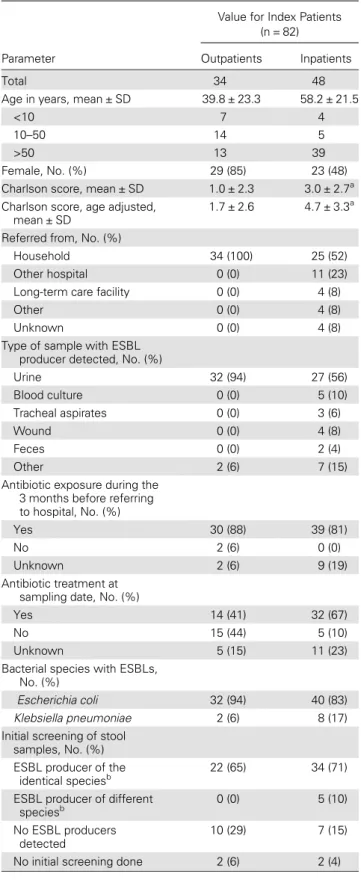
As shown in Table2, 13% of index patients were children. An earlier Swiss study had already indicated that this population
Table 1. Molecular Characteristics and Antibiotic Resistance Patterns of Extended-Spectrum β-Lactamase–Producing Escherichia coli and Klebsiella pneumoniae Isolates
Species and Phylogenetic Group, No. (%)
Parameter Ec A Ec B1 Ec B2 (pabB−) Ec B2 (pabB+)a Ec D Ec (all) Kp (all) Total
Total 21 7 3 20 21 72 10 82
ESBL genes
blaCTX-M-1 4 (19) 1 (14) 0 (0) 0 (0) 1 (5) 6 (8) 0 (0) 6 (7)
blaCTX-M-14 1 (5) 0 (0) 0 (0) 3 (15) 3 (14) 7 (10) 1 (10) 8 (10)
blaCTX-M-15 12 (57) 2 (29) 1 (33) 14 (70) 13 (62) 42 (58) 6 (60) 48 (59)
blaCTX-M-15andblaSHV-5 0 (0) 0 (0) 0 (0) 0 (0) 0 (0) 0 (0) 1 (10) 1 (1)
blaCTX-M-27 0 (0) 1 (14) 0 (0) 1 (5) 1 (5) 3 (4) 0 (0) 3 (3)
blaSHV-2/-2A/-5/-12 1 (5) 0 (0) 1 (33) 1 (5) 0 (0) 3 (4) 2 (20) 5 (6)
Other 1 (5) 3 (43) 1 (33) 1 (5) 2 (10) 8 (11) 0 (0) 8 (10) UnknownblaESBL 2 (10) 0 (0) 0 (0) 0 (0) 1 (5) 3 (4) 0 (0) 3 (4)
Resistance phenotypeb Gentamicin 8 (38) 2 (29) 2 (67) 11 (55) 13 (62) 36 (50) 10 (100) 46 (56)c Ciprofloxacin 15 (71) 4 (57) 0 (0) 17 (85) 12 (57) 48 (67) 8 (80) 56 (68)d Trimethoprim-sulfamethoxazole 17 (81) 6 (86) 2 (67) 12 (60) 17 (81) 54(75) 9 (90) 63 (77) Piperacillin-tazobactam 10 (48) 2 (29) 0 (0) 5 (25) 1 (5) 18 (25) 7 (70) 25 (30) MDR isolatese 10 (48) 3 (43) 0 (0) 9 (45) 7 (33) 29 (40) 9 (90) 38 (46)
Abbreviations:Ec, Escherichia coli; ESBL, extended-spectrum β-lactamase; Kp, Klebsiella pneumoniae; MDR, multidrug-resistant.
a
Phylogenetic group B2 withpabB gene are indicative for sequence type 131 according to the Achtman multilocus sequence typing scheme.
b
Intermediate susceptibility was grouped as resistant.
c
Thirty-six of 46 isolates carriedblaCTX-M-15(P < .001). d
Forty-one of 56 isolates carriedblaCTX-M-15(P < .001). e
MDR isolates were resistant to at least 1 representative of≥3 antimicrobial classes as described elsewhere [6].
Figure 1. Number of new patients with extended-spectrumβ-lactamase–producing Klebsiella pneumoniae or Escherichia coli isolates detected from May 2008 through September 2009. Data onE. coli are stratified according to the phylogenetic groups A, B1, B2, and D. E. coli isolates of group B2 which are positive for thepabB gene are indicative for sequence type 131 according to the Achtman multilocus sequence typing scheme [24]. Abbrevi-ations:Ec, Escherichia coli; Kp, Klebsiella pneumoniae.
may be an important reservoir of ESBL producers [28]. In ac-cordance with the literature, the urinary tract was the most frequent source of ESBL producers [2]. Index inpatients had more severe underlying disease and were more frequently re-ferred from a hospital setting compared with the index outpa-tients. Almost all index patients had received antibiotic treatment during the 3 months prior to the detection of ESBL producers (Table2).
The mean (± SD) time between collection of the initial sample and the first screening was 18.4 days (± 29.7). Fecal carriage of an identical ESBL producer as found in the clinical sample was detected in the initial screening in 65% of outpa-tients and 71% of inpaoutpa-tients, which is comparable with a pre-vious study [11]. Index inpatients stayed in the hospital for a mean (± SD) of 34.6 days (± 37.1). Carriage of an ESBL pro-ducer was detected within 48 hours after hospital entry in 20 (42%) of the index inpatients (data not shown).
Transmission Dynamics in the Hospital
A total of 88 hospital patients were exposed for 715 days to the 40 index in patients with ESBL-Ec for a mean (± SD) of 8.1 days (± 5.8). The mean (± SD) follow-up time of the hos-pital contacts was 27.6 days (± 40.0). An ESBL-Ec was found in 9 of 88 (10.2%) contact patients (Supplementary Figure 1). According to the study definition, transmission from the index patient was assumed for 4 contacts (ie, patients 36, 16, 110, and 70; Figure2). The overall transmission rate for ESBL-Ec was therefore 4.5% (4 of 88 exposed contacts), correspond-ing to an incidence of transmission of 5.6 cases per 1000 exposure days. The observed transmission rates were consis-tent with a report with a transmission rate of 2.8% and 4.2 cases per 1000 exposure days [29].
A total of 24 hospital patients were exposed to the 8 index in patients with ESBL-Kp during 144 days for a mean (± SD) of 6.0 days (± 4.3). ESBL-Kp was found in 7 of 24 (29.1%) hospital contacts (Supplementary Figure 1) but transmission was plausible for only 2 contacts (8.3%; incidence, 13.8 cases per 1000 exposure days; Figure2). Therefore, the transmission rate was higher for ESBL-Kp (8.3%) than for ESBL-Ec (4.5%), albeit the difference did not reach statistical significance. However, the incidences of ESBL-Ec (5.6 cases per 1000 expo-sure days) and ESBL-Kp (13.8 cases per 1000 expoexpo-sure days) transmission resulted in a significantly higher incidence of ESBL-Kp transmission (P < .0001). This suggests that ESBL-Kp has a higher transmission potential than ESBL-Ec, in accordance with the frequency of ESBL-Kp nosocomial outbreaks being reported in the literature (Supplementary Data). Notably, the ESBL-Kp STs involved in transmission events were ST11 and ST323, which have been identified as frequently detected clones also carrying blaKPC[30].
Table 2. Characteristics of the 82 Index Patients Carrying Extended-Spectrumβ-Lactamase–Producing Isolates
Value for Index Patients (n = 82)
Parameter Outpatients Inpatients
Total 34 48
Age in years, mean ± SD 39.8 ± 23.3 58.2 ± 21.5
<10 7 4
10–50 14 5
>50 13 39
Female, No. (%) 29 (85) 23 (48) Charlson score, mean ± SD 1.0 ± 2.3 3.0 ± 2.7a
Charlson score, age adjusted, mean ± SD
1.7 ± 2.6 4.7 ± 3.3a
Referred from, No. (%)
Household 34 (100) 25 (52) Other hospital 0 (0) 11 (23) Long-term care facility 0 (0) 4 (8) Other 0 (0) 4 (8) Unknown 0 (0) 4 (8) Type of sample with ESBL
producer detected, No. (%)
Urine 32 (94) 27 (56) Blood culture 0 (0) 5 (10) Tracheal aspirates 0 (0) 3 (6) Wound 0 (0) 4 (8) Feces 0 (0) 2 (4) Other 2 (6) 7 (15) Antibiotic exposure during the
3 months before referring to hospital, No. (%)
Yes 30 (88) 39 (81)
No 2 (6) 0 (0)
Unknown 2 (6) 9 (19) Antibiotic treatment at
sampling date, No. (%)
Yes 14 (41) 32 (67) No 15 (44) 5 (10) Unknown 5 (15) 11 (23) Bacterial species with ESBLs,
No. (%)
Escherichia coli 32 (94) 40 (83) Klebsiella pneumoniae 2 (6) 8 (17) Initial screening of stool
samples, No. (%) ESBL producer of the
identical speciesb 22 (65) 34 (71)
ESBL producer of different speciesb
0 (0) 5 (10) No ESBL producers
detected
10 (29) 7 (15) No initial screening done 2 (6) 2 (4)
Abbreviations: ESBL, extended-spectrumβ-lactamase; SD, standard deviation.
a
Data were not available for 3 index patients.
b
Effect of Isolation Precautions in the Hospital
Most of the index patients with ESBL-Ec (75%) were not under isolation precautions during exposure of the contacts (537 of 715 exposure days). In contrast, only 22% of ESBL-Kp index patients (32 of 144 exposure days) were not in isolation (P < .001). Therefore, one might have expected a higher trans-mission rate for ESBL-Ec than ESBL-Kp, whereas the opposite was observed, in agreement with a higher transmission poten-tial of ESBL-Kp as discussed above. However, the interpreta-tion of this result requires some cauinterpreta-tion. In this study, index patients were only isolated if they had risk factors for trans-mission. Therefore, index patients with ESBL-Kp were likely more prone to serve as a source of transmission than index patients with ESBL-Ec. Furthermore, ESBL-Kp-colonized index patients were more often in the ICU for at least 1 day (n = 4; 50%) than the ESBL-Ec-colonized index patients (n = 11; 27.5%) and might therefore have been undergoing more clinical procedures leading to transmission.
Transmission Dynamics in the Household Setting
ESBL-Ec carriage was found in 31 (35.2%) of 88 household contacts, but based on the molecular analysis, transmission was plausible for only 20 (22.7%) contacts (20 transmissions within 17 Ec-household clusters; Figure 3). A Spanish study revealed a lower rate of transmission among household mem-bers of 6 of 54 contacts (11.1%), but this may be explained by the different methodology of the studies [11]. Interestingly, in our study, there were 6 mother-to-child and 2 child-to-child pairs, which again suggest an important role for children in the ESBL epidemiology (Figure3). With regard to the ESBL-Ec, the phylogenetic groups B2 (8 of 28 contacts) and D (9 of 34 con-tacts) tended to be more often transmitted within households
than groups A (3 of 19 contacts) and B1 (0 of 7 contacts), although this difference did not reach statistical significance (P = .1). Nevertheless, the result is in accordance with groups B2 and D being more transmittable and virulent [21,31].
Comparable with ESBL-Ec, the household transmission rate of ESBL-Kp was 25% (2 of 8 contacts). Because previous stu-dies were limited to ESBL-Kp transmission in hospitals [32,33], we are unable to compare our results with other studies, but we note that the ESBL-Kp STs involved in household trans-mission were of ST15 and ST147, which have been described elsewhere as epidemic [34].
Overall, for both ESBL-Ec and ESBL-Kp the net transmis-sion rate was higher within the household than in the hospital, although this difference reached statistical significance only for ESBL-Ec (P < .001). One of the explanations for this difference could be related to the longer exposure times in the outpatient household compared with the hospital setting.
Detection Dynamics of ESBL Producers Not Linked to Transmission
A considerable number of ESBL producers detected by screen-ing of hospital contact patients or household contacts could not be explained by transmission to an index patient (Supple-mentary Figure 1). In the hospital setting, this proportion was slightly higher than the prevalence of nosocomial transmis-sions for both ESBL-Ec (5.7% vs 4.5%) and ESBL-Kp (16.7% vs 8.3%). In particular, the dynamics of detection of ESBL pro-ducers in contact patients was quite similar for transmission and nontransmission events (Figure4A). Probably, detection of ESBL producers requires some selection process (eg, expo-sure to antibiotics), which fluctuates during hospitalization. Thus, standard screenings (eg, selective agar plates) performed
Figure 2. Characteristics of hospital transmissions from index patients to hospital contacts of extended-spectrumβ-lactamase (ESBL)-producing Kleb-siella pneumoniae and Escherichia coli. Sequence types (ST) are shown according to Pasteur (K. pneumoniae) and Achtman (E. coli ) multilocus se-quence typing (MLST) scheme. Furthermore,E. coli isolates of group B2 that are positive for the pabB gene are indicative for ST131 according to Achtman MLST scheme. Initial screening of feces samples revealed identical results for 8 patients. For the remaining, 2 ESBL-producingE. coli instead of initial ESBL-producingK. pneumoniae were detected (ie, index patients 186 and 115), whereas 1 negative stool sample results was obtained (ie, patient 110). Abbreviations:Ec, Escherichia coli; HC, hospital contact; ICU, intensive care unit; Kp, Klebsiella pneumoniae; PFGE, pulse-field gel electro-phoresis; rep-PCR, extragenic palindromic polymerase chain reaction; ST, sequence type.
at one time point only (eg, at hospital entry) might therefore not identify all ESBL carriers. In the household setting, chance findings of ESBL carriage were less frequent than transmission events (ESBL-Ec, 12.5% vs 22.7%; ESBL-Kp, 0% vs 25%). However, the dynamics of ESBL detection over time were again quite similar for both groups (Figure4B).
Limitations of This Study
Our study has several limitations. First, the criteria for trans-mission in this study did not address the possibility of hori-zontal transmission of common plasmids among different Enterobacteriaceae species [35]. Thus, transmission rates might have been underestimated, but this hypothetical bias should have affected both household and hospital transmis-sions to the same extent. Second, our study could not address whether household transmission occurred from the index patients to other household members or by acquisition
from a common source. In fact, several studies have sug-gested that common sources such as food may contribute to the dissemination ESBL producers [12,36]. However, for 2 household contacts (household contacts 118 and 158) person-to-person transmission was likely, because in both cases the corresponding patients ( patients 110 and 70) ac-quired the ESBL producer during their hospital stay and transmitted it probably subsequently to their household con-tacts (Figure3). In addition, the high prevalence of CTX-M-15-producing EBSL-Ec of ST131 also indicates person-to-person transmission because humans are the main reservoir of this clone [6,37]. Overall, based on our data, we speculate that patients recently discharged from a hospital or cared for as outpatients may be a more efficient source of transmission in the community than healthy carriers. Whether such trans-mission can be controlled by preventative measures has to be evaluated.
Figure 3. Characteristics of household transmissions of extended-spectrumβ-lactamase–producing Escherichia coli and Klebsiella pneumoniae. Index patients, hospital contacts, and household contacts are indicated. Household clusters are shown in boxes. Presence of pabB gene is illustrated. Sequence types were determined according to Pasteur (K. pneumoniae ) and Achtman (E. coli ) multilocus sequence typing scheme. Abbreviations: Ec, Escherichia coli; HC, hospital contact; HHC, household contact; Kp, Klebsiella pneumoniae; PFGE, pulse-field gel electrophoresis; rep-PCR, extragenic palindromic polymerase chain reaction; ST, sequence type.
Conclusions
To our knowledge, this is the first epidemiological study ana-lyzing the transmission rates of ESBL producers in the house-hold and the hospital setting simultaneously (ie, within the same period, within the same geographic area, and with the same index patients). Our data indicate that household trans-mission outweighs hospital transtrans-mission in a non-outbreak scenario and household transmission is enhanced in the pres-ence of index patients recently discharged or cared for in a hospital. Furthermore, in the non-outbreak setting, importa-tion of ESBL producers into the hospitals seems to be at least as frequent as transmission events during hospital stay. Our data also suggest that ESBL-Kp may be more efficiently trans-mitted within the hospital than ESBL-Ec and question the effect of infection control measures among different species. Further studies are needed to address the last issue.
Supplementary Data
Supplementary materials are available at Clinical Infectious Diseases online (http://cid.oxfordjournals.org) Supplementary materials consist of data
provided by the author that are published to benefit the reader. The posted materials are not copyedited. The contents of all supplementary data are the sole responsibility of the authors. Questions or messages regarding errors should be addressed to the author.
Notes
Financial support. This work was supported by internal funds of the Institute for Infectious Diseases, University of Bern, Bern, Switzerland.
Potential conflicts of interest. All authors: No reported conflicts. All authors have submitted the ICMJE Form for Disclosure of Potential Conflicts of Interest. Conflicts that the editors consider relevant to the content of the manuscript have been disclosed.
References
1. Podschun R, Ullmann U. Klebsiella spp. as nosocomial pathogens: ep-idemiology, taxonomy, typing methods, and pathogenicity factors. Clin Microbiol Rev1998; 11:589–603.
2. Ben-Ami R, Rodriguez-Bano J, Arslan H, et al. A multinational survey of risk factors for infection with extended-spectrum β-lactamase-producing Enterobacteriaceae in nonhospitalized patients. Clin Infect Dis2009; 49:682–90.
3. Pitout JD, Nordmann P, Laupland KB, Poirel L. Emergence of Enter-obacteriaceae producing extended-spectrum β-lactamases (ESBLs) in the community. J Antimicrob Chemother2005; 56:52–9.
Figure 4. Identification of extended-spectrum β-lactamase (ESBL) producers by Kaplan–Meier curves for the hospital contacts (A) and household contacts (B). “ESBL transmission” includes those contacts which were found to carry the same ESBL strain as the index patient, and “ESBL no transmission” describes contacts with ESBL carriage but without a match to the index patients’ strain (according to the definition given in the Methods). ESBL-producingEscherichia coli and Klebsiella pneumoniae are grouped together. Differences between the curves were calculated using the log-rank test. Abbreviations:Ec, Escherichia coli; ESBL, extended-spectrum β-lactamase; Kp, Klebsiella pneumoniae.
4. Coque TM, Novais A, Carattoli A, et al. Dissemination of clonally related Escherichia coli strains expressing extended-spectrum β-lactamase CTX-M-15. Emerg Infect Dis2008; 14:195–200.
5. Bush K, Fisher JF. Epidemiological expansion, structural studies, and clinical challenges of newβ-lactamases from gram-negative bacteria. Annu Rev Microbiol2011; 65:455–78.
6. Johnson JR, Johnston B, Clabots C, Kuskowski MA, Castanheira M. Escherichia coli sequence type ST131 as the major cause of serious multidrug-resistant E. coli infections in the United States. Clin Infect Dis2010; 51:286–94.
7. Rogers BA, Sidjabat HE, Paterson DL. Escherichia coli O25b-ST131: a pandemic, multiresistant, community-associated strain. J Antimicrob Chemother2011; 66:1–14.
8. Marchaim D, Gottesman T, Schwartz O, et al. National multicenter study of predictors and outcomes of bacteremia upon hospital admis-sion caused by Enterobacteriaceae producing extended-spectrum β-lactamases. Antimicrob Agents Chemother 2010; 54:5099–104. 9. Laurent C, Rodriguez-Villalobos H, Rost F, et al. Intensive care unit
outbreak of extended-spectrum beta-lactamase-producing Klebsiella pneumoniae controlled by cohorting patients and reinforcing infection control measures. Infect Control Hosp Epidemiol2008; 29:517–24. 10. Lucet JC, Decre D, Fichelle A, et al. Control of a prolonged outbreak
of extended-spectrum beta-lactamase-producing Enterobacteriaceae in a university hospital. Clin Infect Dis1999; 29:1411–8.
11. Valverde A, Grill F, Coque TM, et al. High rate of intestinal coloniza-tion with extended-spectrum-β-lactamase-producing organisms in household contacts of infected community patients. J Clin Microbiol 2008; 46:2796–9.
12. Rodriguez-Bano J, Lopez-Cerero L, Navarro MD, Diaz de Alba P, Pascual A. Faecal carriage of extended-spectrum β-lactamase-producing Escherichia coli: prevalence, risk factors and molecular epidemiology. J Antimicrob Chemother2008; 62:1142–9.
13. Zahar JR, Lanternier F, Mechai F, et al. Duration of colonisation by Enterobacteriaceae producing extended-spectrumβ-lactamase and risk factors for persistent faecal carriage. J Hosp Infect2010; 75:76–8. 14. Charlson ME, Pompei P, Ales KL, MacKenzie CR. A new method of
classifying prognostic comorbidity in longitudinal studies: develop-ment and validation. J Chronic Dis1987; 40:373–83.
15. Jarlier V, Nicolas MH, Fournier G, Philippon A. Extended broad-spectrum β-lactamases conferring transferable resistance to newer β-lactam agents in Enterobacteriaceae: hospital prevalence and susceptibility patterns. Rev Infect Dis1988; 10:867–78.
16. Clinical and Laboratory Standards Institute. Performance Standards for Antimicrobial Susceptibility Testing: Eighteenth Informational Supplement M100-S18. Wayne, PA, USA: CLSI,2008.
17. Leverstein-van Hall MA, Fluit AC, Paauw A, Box AT, Brisse S, Verhoef J. Evaluation of the Etest ESBL and the BD Phoenix, VITEK 1, and VITEK 2 automated instruments for detection of extended-spectrum beta-lactamases in multiresistant Escherichia coli and Klebsi-ella spp. J Clin Microbiol 2002; 40:3703–11.
18. Sabate M, Miro E, Navarro F, et al.β-lactamases involved in resistance to broad-spectrum cephalosporins in Escherichia coli and Klebsiella spp. clinical isolates collected between 1994 and 1996, in Barcelona (Spain). J Antimicrob Chemother2002; 49:989–97.
19. Pitout JD, Hossain A, Hanson ND. Phenotypic and molecular detec-tion of CTX-M-β-lactamases produced by Escherichia coli and Klebsi-ella spp. J Clin Microbiol 2004; 42:5715–21.
20. Tamura K, Dudley J, Nei M, Kumar S. MEGA4: Molecular Evolution-ary Genetics Analysis (MEGA) software version 4.0. Mol Biol Evol 2007; 24:1596–9.
21. Clermont O, Bonacorsi S, Bingen E. Rapid and simple determination of the Escherichia coli phylogenetic group. Appl Environ Microbiol 2000; 66:4555–8.
22. Diancourt L, Passet V, Verhoef J, Grimont PA, Brisse S. Multilocus sequence typing of Klebsiella pneumoniae nosocomial isolates. J Clin Microbiol2005; 43:4178–82.
23. Wirth T, Falush D, Lan R, et al. Sex and virulence in Escherichia coli: an evolutionary perspective. Mol Microbiol2006; 60:1136–51. 24. Clermont O, Dhanji H, Upton M, et al. Rapid detection of the
O25b-ST131 clone of Escherichia coli encompassing the CTX-M-15-producing strains. J Antimicrob Chemother2009; 64:274–7. 25. Endimiani A, Hujer KM, Hujer AM, et al. Acinetobacter
baumannii isolates from pets and horses in Switzerland: molecular characterization and clinical data. J Antimicrob Chemother 2011; 66:2248–54.
26. Tenover FC, Arbeit RD, Goering RV, et al. Interpreting chromosomal DNA restriction patterns produced by pulsed-field gel electro-phoresis: criteria for bacterial strain typing. J Clin Microbiol 1995; 33:2233–9.
27. Kola A, Holst M, Chaberny IF, Ziesing S, Suerbaum S, Gastmeier P. Surveillance of extended-spectrum beta-lactamase-producing bacteria and routine use of contact isolation: experience from a three-year period. J Hosp Infect2007; 66:46–51.
28. Lartigue MF, Zinsius C, Wenger A, Bille J, Poirel L, Nordmann P. Extended-spectrum beta-lactamases of the CTX-M type now in Swit-zerland. Antimicrob Agents Chemother2007; 51:2855–60.
29. Fankhauser C, Zingg W, Francois P, et al. Surveillance of extended-spectrum-β-lactamase-producing Enterobacteriaceae in a Swiss Tertia-ry Care Hospital. Swiss Med Wkly2009; 139:747–51.
30. Giakkoupi P, Papagiannitsis CC, Miriagou V, et al. An update of the evolving epidemic of blaKPC-2-carrying Klebsiella
pneu-moniae in Greece (2009–10). J Antimicrob Chemother 2011; 66: 1510–3.
31. Karisik E, Ellington MJ, Livermore DM, Woodford N. Virulence factors in Escherichia coli with CTX-M-15 and other extended-spectrum beta-lactamases in the UK. J Antimicrob Chemother2008; 61:54–8.
32. Harris AD, Perencevich EN, Johnson JK, et al. Patient-to-patient transmission is important in extended-spectrum β-lactamase-produc-ing Klebsiella pneumoniae acquisition. Clin Infect Dis 2007; 45:1347–50.
33. Asensio A, Oliver A, Gonzalez-Diego P, et al. Outbreak of a multire-sistant Klebsiella pneumoniae strain in an intensive care unit: antibiot-ic use as risk factor for colonization and infection. Clin Infect Dis 2000; 30:55–60.
34. Damjanova I, Toth A, Paszti J, et al. Expansion and countrywide dis-semination of ST11, ST15 and ST147 ciprofloxacin-resistant CTX-M-15-type β-lactamase-producing Klebsiella pneumoniae epidemic clones in Hungary in 2005–the new ‘MRSAs’? J Antimicrob Chemo-ther2008; 62:978–85.
35. Woodford N, Turton JF, Livermore DM. Multiresistant Gram-negative bacteria: the role of high-risk clones in the dissemination of antibiotic resistance. FEMS Microbiol Rev2011; 35:736–55.
36. Calbo E, Freixas N, Xercavins M, et al. Foodborne nosocomial out-break of SHV1 and CTX-M-15-producing Klebsiella pneumoniae: epi-demiology and control. Clin Infect Dis2011; 52:743–9.
37. Geser N, Stephan R, Korczak BM, Beutin L, Hachler H. Molecular identification of extended-spectrum-beta-lactamase genes from Enter-obacteriaceae isolated from healthy human carriers in Switzerland. Antimicrob Agents Chemother2012; 56:1609–12.