Heart valve replacement with the Bjork-Shiley and
St Jude Medical prostheses: A randomized comparison
in 178 patients
S. VOGT, A. HOFFMANN, J. ROTH, P. DUBACH, W. BERTSCHMANN, J. HASSE, E. GRADEL, P. STULZ
AND D. BURCKHARDT
Division of Cardiology, Department of Internal Medicine and Division of Cardiac and Thoracic Surgery, Department of Surgery, University Hospital Basel, Switzerland
KEY WORDS: Valve replacement, St Jude Medical prosthesis, Bjork-Shiley prosthesis, randomized comparison, prosthetic heart valve.
In 178 patients, a randomized prospective comparison between the 60° spherical disc Bjork-Shiley (BS) and the St Jude Medical (SJM) heart valve prostheses was performed. Four-week perioperative mortality was zero in the BS (n = 84) and 4-3% in the SJM group (n = 94). During a mean ( ± SD) follow-up of 52 ± 20 months or 778patient-years, late cardiac mortality per year was 2-4%> in the BS and 2-2% in the SJM group.
The yearly thromboembolic rates were 1-4% in the BS and 20% in the SJM group. There was no mechanical valve failure or haemolytic anaemia. Paravalvular leaks and major bleeding complications occurred at low rates in both groups (1-1% and2-2% per year in BS; 0-7% and 1-7% per year in SJM). Functional results were similarly good with 96% of patients with BS valves and 95% of patients with SJM prostheses being in NYHA classes landII, respectively.
We conclude that heart valve replacement with mechanical prostheses can be performed with equally good results using either the Bjork-Shiley spherical disc valve or the St Jude Medical bileqflet prosthesis.
Introduction made in 178 patients. These included 112 men and Manufacturers of mechanical heart valve prostheses M w o m e n a«e d >-76 ye a r s' I n 8 4 Pa t i e n t s 9 5 B S claim advantages such as improved haemodynamic P™stheses were implanted, and 94 patients received performance, low thrombogenicity and a lower 1 0 9 S J M P™stheses. Detailed patient character-mechanical failure rate because of specific design i s t i c s a r e &ven i n T a b l e ' • The t w 0 Pa t i e n t 8r o uPs characteristics!'-2-"-12'. Whether this is of clinical w e r e comparable as to age and sex distribution, importance is largely unknown. Therefore a series l o c a t i o n a n d n u m b e r of implants as well as cardiac of 178 patients were followed closely after valve diagnosis. All candidates for a mechanical valve replacement for an average 52 ±20 m o n t h s - a substitute were randomized and all accepted the total of 778 patient-years; in this series, either the v a l v e suggested. In order to give comparable Bjork-Shiley (BS) 60° spherical disc valve or the St «r o uPs' randomization was performed according Jude Medical (SJM) bileaflet valve were selected for t o underlying heart disease, pre-operative cardiac implantation in a randomized fashion. r hyt h m a n d concom.tant surgery.
Methods
PATIENTS OPERATIVE TECHNIQUES
From January 1981 until October 1983, a ran- All patients were operated on by the same surgi-domized allocation of BS or SJM prostheses was cal t e a m w h o h a d previous extensive experience
with both types of prostheses. All were operated on ™ PubliCiti0n °" 4 My l989> and in reviied form 2 by stemotomy, using cardio-pulmonary bypass and
cold potassium cardioplegia or coronary perfusion S^^^^'S^u1^^ f o r "yocaidial protection. The prostheses were
Basel/Switzerland. implanted with the interrupted suture technique.
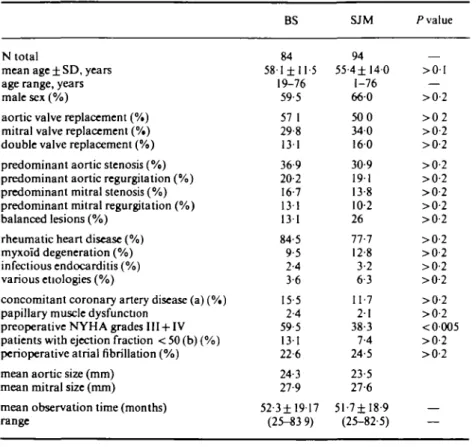
Table 1 fashion
Characteristics of 178 patients receiving a BS or SJM prosthesis in a randomized
BS SJM
N total
mean age ± SD, years age range, years male sex (%)
aortic valve replacement (%) mitral valve replacement (%) double valve replacement (%) predominant aortic stenosis (%) predominant aortic regurgitation (%) predominant mitral stenosis (%) predominant mitral regurgitation (%) balanced lesions (%)
rheumatic heart disease (%) myxold degeneration (%) infectious endocarditis (%) various etiologies (%)
concomitant coronary artery disease (a) (%) papillary muscle dysfunction
preoperative NYHA grades III + IV patients with ejection fraction < 50 (b) (%) perioperative atrial fibrillation (%) mean aortic size (mm)
mean mitral size (mm)
mean observation time (months) range P value 84 58-1 ±11-5 19-76 59-5 57 1 29-8 131 36-9 20-2 16-7 131 13 1 84-5 9-5 2-4 3-6 15-5 2-4 59-5 131 22-6 24-3 27-9 52-3± 19 17 (25-83 9) 94 55-4±140 1-76 660 500 340 160 30-9 191 13-8 10-2 26 77-7 12 8 3-2 6 3 11-7 2 1 38-3 7-4 24-5 23-5 27-6 5 1 - 7 ± I 8 - 9 (25-82-5) — >0-l — >0-2 > 0 2 >0-2 >0-2 >0-2 >0-2 >0-2 >0-2 >0-2 >0-2 >0-2 >0-2 >0-2 >0-2 >0-2 <0005 >0-2 >0-2
(a) defined as a > 75% luminal narrowing of one or more major coronary vessels, (b) measured in all patients.
FOLLOW-UP
The patients were followed up at a specialized outpatient clinic, where at each visit a complete his-tory, physical examination, chest X-ray, 12-lead resting ECG and laboratory parameters for haemo-lysis were taken. Echocardiography and Doppler sonography were not routinely used in these patients. A thromboembolic event was denned as any new transient or permanent neurological deficit or other peripheral arterial embolic episode1141. The patients were seen 3 months postoperatively and yearly thereafter during a mean ( ± SD) of 52 ± 20 months (BS) and 52 ±19 months (SJM). The follow-up duration ranged from 25 to 84 months. The number of patient-years in aortic valve replace-ment was 209 (BS) and 203 (SJM); in mitral valve replacement, 109 (BS) and 138 (SJM). All patients were on oral anticoagulants with coumarin deriva-tives, with INR values aimed at 2-8-4-3. A total of five patients were lost to follow-up (four in the
Bjork-Shiley group and one in the St Jude Medical group).
STATISTICAL ANALYSIS
Randomization was performed within subgroups of patients according to concomitant surgery, underlying disease, valve position and heart rhythm. For comparison between the groups, the chi-square test was used. Actuarial survival was calculated accordingto Kaplan and Meier1'01. Results
OPERATIVE AND EARLY MORTALITY
In the BS group, there was no death during operation or within the first 4 postoperative weeks. In the SJM group there were four deaths during the perioperative period (4-3%). One patient died during operation of an intractable aortic tear. During the 4-week postoperative course one patient
o 00< 8 0 6 0 4 0 20 -i l -i l -i -i -i -i -i 94% 93%
Years after operation
—«— 84 81 79 76 74 74 71 66 60 47 36 B-S —•— 94 88 87 87 86 B4 82 75 64 50 36 SJM
Figure I Actuarial survival curves in two groups of patients randomly receiving Bjork-Shiley (BS) or St Jude Medical (SJM) heart valve prostheses. The small numbers below the time axis indicate patients at risk. The sections indicated in the curves show 95% confidence limits. The curves are age-and sex-adjusted for an expected survivorship in Switzerlage-and (1982).
S
9 3 % 9 0 %
Years after operation
—•— 84 81 78 75 72 72 69 63 58 46 35 B-S —«— 94 86 85 85 84 82 78 71 60 48 33 SJM
Figure 2 Actuarial incidence rates of thromboembolic com-plications in two groups of patients randomly receiving Bjork-Shiley (BS) and St Jude Medical (SJM) prostheses. The small numbers below the time axis indicate patients at risk. The sections indicated in the curves show 95% confidence limits.
died from intractable sepsis, one patient from pump failure and one patient from renal failure.
LATE MORTALITY
Survival curves were virtually identical (/*>0-2) in patients receiving BS and SJM prostheses (Fig. 1). During follow-up there were nine cardiac deaths in the BS group, resulting in a yearly cardiac mor-tality of 2-4%. There were five witnessed sudden deaths, two cases of pump failure and two patients with fatal haemorrhage. In addition there were three non-cardiac deaths (one suicide, carcinoma, pulmonary embolism in metastatic cancer). In the SJ M group there were nine cardiac deaths, resulting in a yearly cardiac mortality of 2-2%. There were three witnessed sudden cardiac deaths, two patients with pump failure, one patient with endocarditis, two patients with fatal haemorrhages and one further patient with aortic rupture.
MECHANICAL VALVE FAILURE AND HAEMOLYSIS There were no cases of mechanical valve dysfunc-tion or thrombotic obstrucdysfunc-tion in either the BS or the SJM group. Anaemia with a haemoglobin value below 12g% and a reticulocyte count of > 10%o was observed in none of the patients. An LDH level exceeding 500 U 1~' was seen in one
patient with a BS-valve with a para valvular leak. In the two patients with SJM valves and paravalvular leaks, the LDH levels were normal.
THROMBOEMBOLISM
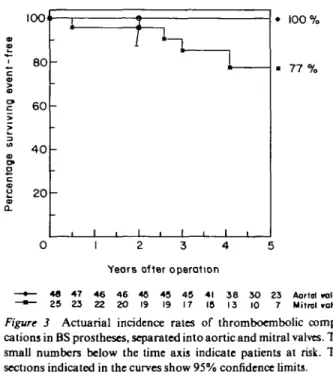
Thromboembolic event rates were 1 -4% per year and 2 0 % per year in the BS and SJM group, respect-ively. The actuarial incidence of thromboembolic complications was identical (P>0-2) in the two groups (Fig. 2) Thromboembolic events separated for valve position and type of prosthesis are shown in Figs 3 and 4. The differences between the two valve substitutes were not statistically significant, although the relatively high incidence of thrombo-embolic complications in BS mitral prostheses and SJM aortic valves is worth mentioning, contrasting with the lack of thromboemboli in patients after BS aortic valve replacement. The detailed thrombo-embolic rates according to prosthesis type and lo-cation are shown in Table 2. Thromboembolism occurred with adequate anticoagulation (i.e. INR levels between 2-8-4-3) in four of five cases in the BS group, and in three of eight cases in the SJM group. There were no permanent sequelae in two of five BS and seven of eight SJM patients. There were no fatal thromboembolic events.
IOO<
1 80
-loo %
• 77 %
Yeors after operation
—•— 48 47 46 46 45 45 45 41 38 30 23 Aortol «l»«t
—"— 25 23 22 20 19 19 17 18 13 10 7 Mitral «HYM
Figure 3 Actuarial incidence rates of thromboembolic
compli-cations in BS prostheses, separated into aortic and mitral valves. The small numbers below the time axis indicate patients at risk. The sections indicated in the curves show 95% confidence limits.
89 % 8 5 %
1 2 3 4 5
Years after operation
—•— 47 43 43 43 43 43 40 37 31 23 13 Aorlol valmi —•— 32 29 28 28 27 25 24 20 16 15 12 Mitrot ro\m
Figure 4 Actuarial incidence rates of thromboembolic
compli-cations in SJM protheses separated into aortic and mitral valves. The small numbers below the time axis indicate patients at risk. The sections indicated in the curves show 95% confidence limits.
PARA VALVULAR LEAKS
Angiographically documented paravalvular leaks necessitating reoperation occurred in one patient with a BS aortic valve and in two patients with SJM mitral valves. In addition, there were
paravalvular leaks without haemodynamic signifi-cance in three patients with BS (two aortic and one mitral) prostheses and one patient with an SJM aortic valve, all documented by Doppler echo-cardiography. This gives a paravalvular leak
Table 2 Thromboembolie rate per 100 patient years of 95 patients after aortic valve replacement (48 BS. 47 SJM). 57 patients after mitral valve replacement (25 BS, 32 SJM) and 26 patients after double valve replacement (11 BS. 15 SJM)
BS SJM Aortic position Mitral position Double implant All 0 4-6 1-9 1-4 30 2-2 0 20 n.s. n.s. n.s. n.s. = not significant.
incidence of 1-1 % and 0-7% for BS valves and SJM prostheses, respectively.
COMPLICATIONS SECONDARY TO ANTICOAGULATION
Lethal bleeding occurred in two patients with a BS valve (both cerebral haemorrhages) and in two patients with a SJM valve (one cerebral, one gastrointestinal). In none of these patients was the prothrombin time known at the time of death. Major non-fatal bleeding occurred in six patients with BS valves (four gastrointestinal, one intra-cranial, one pericardial) and in five patients with SJM valves (two gastrointestinal, two intracranial, one ovarian). Minor bleeding occurred in one patient in each group (one epistaxis, one subcu-taneous). The annual incidence of major bleeding complications was therefore 2-2% and 1-7% for BS and SJM valves, respectively.
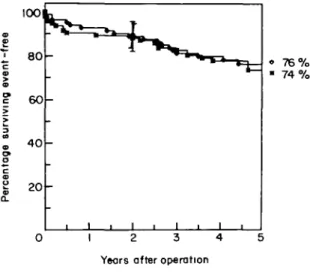
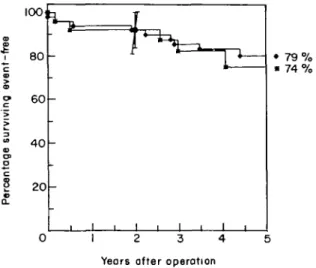
Cumulative yearly event-free rates defined as free from death, thromboembolism, reoperation, valve dysfunction, endocarditis and major bleeding are shown in Fig. 5. No significant difference (P>0-2) is seen between the two groups with BS and SJM prostheses. The detailed event-free rates according to prosthesis type and location did not show any significant difference and are given in Figs 6 and 7.
FUNCTIONAL RESULTS
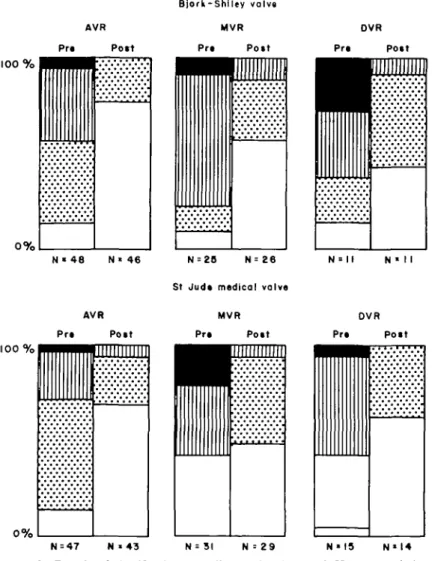
Of the patients with BS prostheses 68% were in class I and 28% in class II of the NYHA postopera-tively. Corresponding figures for the SJM group were 65% in class I and 30% in class II (Fig. 8). Therefore, postoperatively 96% and 95% of patients in the BS and SJM groups were in NYHA classes I or II, respectively. The percentage of patients in sinus rhythm pre- and postoperatively was 73 and 79 in BS vs 75 and 88 in SJM patients.
76 % 74%
Years after operation
—•— 8 4 8 0 7 6 7 3 8 9 6 8 6 3 5 6 5 3 4 0 31 B-S —•— 94 85 83 82 81 78 74 66 54 44 29 SJM
Figure 5 Cumulative yearly event-free rates (event = death,
reoperation, thromboembolism, major bleeding, valve dys-function, infectious endocarditis). The small numbers below the time axis indicate patients at risk. The sections indicated in the curves show the 95% confidence limits.
Normalization of a preoperatively abnormal car-diothoracic ratio occurred in 37% of BS and 41 % of SJM patients (Table 3).
Discussion
Two prostheses of quite different design were compared in a randomized prospective study in patients eligible to receive a mechanical valve substitute. Despite differences in valve area and haemodynamic flow patterns1"1, clinical results with the two prostheses were nearly identical in our population.
Operative and early (4 weeks) mortality in our total population was 2-2%, which is lower than figures from other centres15'7'13'. This is probably due to the fact that only few patients with ischaemic heart disease, with ejection fraction below 50% and in NYHA class IV were included. All these factors are known to influence perioperative mortality and postoperative prognosis'5'. There was no significant difference in mortality between the two groups of patients. Similarly, late annual mortality in both groups was low, being 2-4% for patients with BS, and 2-2% for patients with SJM prostheses. This compares favourably with data reported from Duncan et al.m, who found a yearly mortality rate
100]
J
8
O Q_
Years after operation
—•— 48 46 44 44 42 41 39 36 33 24 19 Aortal valves
—«— 25 23 22 20 19 19 17 15 13 10 7 Mitrdvalvu
Figure 6 Cumulative yearly event-free rates (event = death,
reoper-ation, thromboembolism, major bleeding, valve dysfunction, infectious endocarditis) for BS prostheses, separated into aortic and mitral valves. The small numbers below the time axis indicate patients at risk. The sections indicated in the curves show the 95% confidence limits.
100
Years after operation
—•— 47, 43 43 42 42 42 39 36 29 22 12 Aortol vatvti —"— 32 29 28 28 27 24 23 19 15 14 II Mitral volvti Figure 7 Cumulative yearly event-free rates (event = death,
reoper-ation, thromboembolism, major bleeding, valve dysfunction, infectious endocarditis) for SJM prostheses, separated into aortic and mitral valves. The small numbers below the time axis indicate patients at risk. The sections indicated in the curves show 95% confidence limits.
100 %
o%
N « 4 8 N = Z 6
St Judt medical valve
N » II N • I I p • • • • • • • • 0 % AVR rt Pott ''''''''''' MVR Pr» V . Pott
rnnnnTi
p OVR '• Pott N • 4 3 N = 31 N = 2 9 N • 15 N « I 4Figure 8 Functional classification according to the New York Heart Association (NYHA) before and after operation in two groups of patients with Bjork-Shiley (BS) and St Jude Medical (SJM) heart valve prostheses. AVR = aortic valve replacement; MVR = mitral valve replacement; DVR = double valve replacement. D=classl; • = class II: D =class III; • =class IV.
Table 3 Pre- and postoperative rhythm- and chest X-ray findings in patients with BS and SJM prostheses
BS SJM
% patients in sinus rhythm pre- and
post-operatively 73/79 75/88 % patients with a CTR
<0-5pre-andpost-operatively 17/54 30/71
replacement with the SJM prosthesis and with find-ings from Sethia and coworkers'131, who reported a yearly mortality of 2-9% in 729 patients with the standard BS valve.
Thromboembolic events occurred with an equally low incidence in the BS (1-4% per year) and SJM group (20% per year). These findings are in con-trast with those reported by Horstkotte et al.p\ who
found a thromboembolic rate of 12-5% in the first year after mitral valve replacement with the BS prosthesis, but no thromboemboli with the SJM
mitral valve. However, in their study group allo-cation was not performed in a randomized fashion, so the BS group included more patients with mitral regurgitation, accompanying valve disease, long history of symptoms, prior valve surgery and atrial fibrillation. In a later publication, the same authors reported a lower thromboembolic rate of 2-82 and 1 -93 per 100 patient-years after BS mitral or aortic valve replacement, respectively, which was still higher than their figures found after valve replace-ment with the SJM prosthesis (0-93% mitral, 0-73% aortic)1'1. Other authors found, as we did, a similar incidence of thromboembolism in different mech-anical valves. In a prospective study, Chesebro et a/.(4! found an incidence of thromboembolism, ranging from 1 -2 to 1 -8% per year in patients after valve replacement with the Starr-Edwards (SE), BS or SJM prostheses. Chaux et alP] described com-parable rates of thromboembolism with the BS and the SE prostheses. In another prospective study, Douglas et a/.'6' observed a thromboembolic rate of 2-8% per patient-year after aortic valve replace-ment with the SJM prosthesis, which was not significantly higher than the 1-5% recorded after implantation of an aortic porcine heterograft.
When our data were treated with the actuarial method, 93% of patients with BS and 90% of patients with SJM prostheses were free of thrombo-embolic events after 5 years. These figures are comparable to those of Sethia et a/.'13', who observed a freedom from thromboembolic events in 94% of their patients with BS prostheses after 4 years. Seven of the 13 thromboembolic events in our study occurred with adequate anticoagulation (four of five in the BS group and three of eight in the SJM group). Analysis of thromboembolic events according to valve location showed no significant differences between valve types.
A paravalvular leak occurred in seven of our patients (four BS and three SJM), necessitating reoperation in three patients (one BS, two SJM). This corresponds to an annual reoperation rate of 0-4% in the BS group and 0-8% in the SJM group. These figures again compare well to those reported by Sethia et alP\ who found a reoperation rate of 0-8% per year in his patients receiving BS prostheses.
The functional results were equally good in both groups. In the BS group, 60% of patients were pre-operatively in NYH A classes III or IV, but only 4% were in NYHA class III after valve replacement. In the SJM group, 39% of all patients were pre-operatively in NYHA classes III and IV and only
5% were in NYHA class III after surgery. Similar functional results were reported by Duncan'71 and Horstkotte181. This equally good functional result was achieved in both groups despite the fact that patients receiving a BS prosthesis were preoperatively more symptomatic.
Thus, cumulative complication rates were simi-larly low and equally excellent functional results were achieved despite a difference of the pre-operative functional state of patients in the two groups. As regards all other relevant variables, the two groups were comparable. This was achieved by using several randomization subgroups according to underlying disease, preoperative heart rhythm and concomitant surgery. This is also the reason for the different number of patients in the two groups.
The rather small number of patients in the dif-ferent subgroups in this study makes a statistical analysis of our data difficult. However, due to the low event rate expected one would have to include over 3000 patients in each group to detect a statisti-cally significant difference between two groups with a power of 0-8 and a P value of 005. Therefore it did not seem reasonable to plan a much larger study, because even a multicentre approach would not have significantly altered the weak statistical power1151.
From the results of this randomized prospective study, there seems to be no clinical relevance for the manufacturers' claim of a lesser degree of transvalvular regurgitation in the BS nor a lower thrombogenicity in SJM prostheses.
References
[1] Bjork VO. A new tilting disc valve prosthesis. Scand J ThoracSurgl969;3: 1-12.
[2] Bjork VO, Henze A. Ten years experience with the Bjark-Shiley tilting disc valve. J Thorac Cardiovasc Surg 1979; 78: 331-42.
[3] Chaux A, Czer LSC, Matloff JM, DeRobertis M, Stewart ME, Bateman TM. The St Jude Medical bileaflet valve prosthesis: a 5 year experience. J Thorac Cardiovasc Surg 1984; 88: 706-17.
[4] Chesebro JH, Fuster V, Elveback LR, McGoon DC, Pluth JR, Puga FJ. Trail of combined warfarin plus dipyridamole or aspirin therapy in prosthetic heart valve replacement: danger of aspirin compared with dipyridamole. Am J Cardiol 1983; 51: 1537-41. [5] Czer LSC, Matloff J, Chaux A, DeRobertis M,
Yoganathan A, Gray R. A 6 year experience with the St Jude Medical valve: hemodynamic performance, surgi-cal results, biocompatibility and follow-up. J Am Coll Cardiol 1985; 6-904-12.
[6] Douglas PS, Hirshfeld JW, Edte RN, Harken AH, Stephenson LW, Edmunds LH Jr. Clinical comparison
of St Jude and porcine aortic valve prostheses. Circulation 1985; 72(Suppl II): II135-9.
[7] Duncan JM, Cooley DA, Livesay JJ el al. St Jude Medical valve: early clinical results in 253 patients. Texas Heart Inst 1983; 10: (I).
[8] Horstkotte D, Haerten K, Heyer JA, Seipel L, Bircks W, Loogen F. Preliminary results in mitral valve replace-ment with the St Jude Medical prosthesis: comparison with the Bjork-Shiley valve. Circulation 1981; 64 (Suppl II): 203-9.
[9] Horstkotte D, Korfer R, Seipel L, Bircks W, Loogen F. Late complications in patients with Bjork-Shiley and St Jude Medical heart valve replacement. Circulation 1983; 68 (Suppl II): 175-84.
[10] Kaplan EL, Meier P. Nonparametric estimation from incomplete observation. J Amer Statist Ann 1958; 53: 457-81.
[11] Me Clung JA, Stein JH, Ambrose JA, Hermann MV, Reed GE. Prosthetic heart valves: A review. Progr Cardiovasc Dis 1983; 26: 237-70.
[12] NieoloffDM, Emery RW, Arom K.V el al. Clinical and hemodynamic results with the St Jude Medical cardiac valve prosthesis: a three year experience. J Thorac Cardiovasc Surg 1981; 82:674-83.
[13] Sethia BB, Turner MA, Lewis S, Rodger RA, Bain WH. Fourteen years' experience with the Bjork-Shiley tilting disc prosthesis. J Thorac Cardiovasc Surg 1986; 91: 350-61.
[14] Stinson EB, Griepp RB, Oyer PE, Shumway NE. Long term experience with porcine aortic valve xenografts. J Thorac Cardiovasc Surg 1977; 73: 54-63.
[15] Gail M, Gart JJ. The determination of sample sizes for use with the exact conditional test in 2 x 2 comparative trials. Biometrics 1973; 29:441-8.