ABSTRACT: For this 2020 International Consensus on Cardiopulmonary Resuscitation and Emergency Cardiovascular Care Science With
Treatment Recommendations, the Education, Implementation, and Teams Task Force applied the population, intervention, comparator, outcome, study design, time frame format and performed 15 systematic reviews, applying the Grading of Recommendations, Assessment, Development, and Evaluation guidance. Furthermore, 4 scoping reviews and 7 evidence updates assessed any new evidence to determine if a change in any existing treatment recommendation was required. The topics covered included training for the treatment of opioid overdose; basic life support, including automated external defibrillator training; measuring implementation and performance in communities, and cardiac arrest centers; advanced life support training, including team and leadership training and rapid response teams; measuring cardiopulmonary resuscitation performance, feedback devices, and debriefing; and the use of social media to improve cardiopulmonary resuscitation application.
Robert Greif, MD, MME, Chair
Farhan Bhanji, MD, MSc (Ed), Co-Chair
Blair L. Bigham, MD, MSc Janet Bray, RN, PhD Jan Breckwoldt, MD, MME Adam Cheng, MD Jonathan P. Duff, MD, MEd Elaine Gilfoyle, MD, MMEd Ming-Ju Hsieh, MD, MSc, PhD Taku Iwami, MD, PhD Kasper G. Lauridsen, MD Andrew S. Lockey, MBChB, PhD
Matthew Huei-Ming Ma, MD, PhD Koenraad G. Monsieurs, MD, PhD Deems Okamoto, MD Jeffrey L. Pellegrino, PhD, MPH Joyce Yeung, PhD, MBChB Judith C. Finn, PhD, RN On behalf of the Education,
Implementation, and Teams Collaborators
© 2020 American Heart Association, Inc., European Resuscitation Council, and International Liaison Committee on Resuscitation.
Education, Implementation, and Teams
2020 International Consensus on Cardiopulmonary Resuscitation
and Emergency Cardiovascular Care Science With Treatment
Recommendations
Circulation
https://www.ahajournals.org/journal/circ
Key Words: AHA Scientific
Statements ◼ basic life support
◼ education ◼ opioid overdose
Patient Outcomes as a Result of a Member of the Resuscitation Team Attending an
ALS Course (EIT 4000: SysRev) ………...…...S267 Use of Social Media………S268
First Responder Engaged by Technology
(EIT 878: SysRev) ………...S268 Topics Not Reviewed in 2020……….…S270 Acknowledgments………..S270 Disclosures………...S271 References………S272
T
he 2020 International Consensus onCardio-pulmonary Resuscitation (CPR) and Emergency Cardiovascular Care Science With Treatment Recommendations (CoSTR) is the fourth in a series of
annual summary publications from the International Liaison Committee on Resuscitation (ILCOR). This 2020 CoSTR for education, implementation, and teams (EIT) includes new topics addressed by systematic reviews (SysRevs) performed within the past 12 months. It also includes updates of the EIT treatment recommenda-tions published from 2010 through 2019,1–6 as needed,
that are based on additional evidence evaluations. As a result, this 2020 CoSTR for EIT represents the most comprehensive update since 2010. The 3 major types of evidence evaluation supporting this 2020 publica-tion are the SysRev, the scoping review (ScopRev), and the evidence update (EvUp).
The SysRev is a rigorous process following strict methodology to answer a specific question, and each of these ultimately resulted in generation of the task force CoSTR included in this publication. The SysRevs were performed by an expert systematic reviewer or by the EIT Task Force, and many have resulted in separate published SysRevs.
To begin the SysRev, the question to be answered was phrased in terms of the PICOST (population, intervention, comparator, outcome, study design, time frame) format. The methodology used to
identify the evidence was based on the Preferred
Reporting Items for Systematic Reviews and Meta-Analyses (PRISMA).7 The approach used to evaluate
the evidence was based on that proposed by the Grading of Recommendations, Assessment, Devel-opment, and Evaluation (GRADE) Working Group.8
Using this approach for each of the predefined outcomes, the task force rated as high, moderate, low, or very low the certainty/confidence in the es-timates of effect of an intervention or assessment across a body of evidence. Randomized controlled trials (RCTs) began the analysis as high-certainty evi-dence, and observational studies began the analy-sis as low-certainty evidence; examination of the
CONTENTS
Abstract...S223 Training for Treatment of Opioid Overdose...S225
Opioid Overdose First Aid Education
(EIT 4001: ScopRev)...S225 BLS Including AED Training…...S226
Willingness to Perform Bystander
CPR (EIT 626: ScopRev) ...…...S226 Prehospital Termination of Resuscitation
(EIT 642: SysRev) …...S227 In-Hospital TOR (EIT 4002: SysRev) ...…S232 Deliberate Practice and Mastery
Learning (EIT 4004: EvUp) ...…S233 Layperson Training (EIT 4009: EvUp) ...…S233 Timing for Retraining (EIT 628: EvUp) …...S234 Measuring Implementation/Performance in
Communities, Cardiac Arrest Centers…... S234 System Performance Improvements
(EIT 640: SysRev) …...S234 Community Initiatives to Promote BLS
Implementation (EIT 641: ScopRev) ……...…S237 Cardiac Arrest Centers (EIT 624: SysRev,
2019 CoSTR) …...………...……..S238 Out-of-Hospital CPR Training in Low-Resource Settings (EIT 634: ScopRev) ………....…S238 Disparities in Education (EIT 4003: EvUp) …..S240 ALS Training, Including Team and Leadership
Training, and METs and RRTs………..…S240 Spaced Learning (EIT 1601: SysRev) ……..…S240 EMS Experience and Exposure (EIT 437:
SysRev) …...………...S249 Cognitive Aids During Resuscitation
Education (EIT 629: SysRev) …………..……..S250 Team and Leadership Training (EIT 631:
SysRev) ………...………...…S254 Learning Formats Preceding Face-to-Face
Training in Advanced Courses (formerly: Precourse Preparation for Advanced Courses
(EIT 637: SysRev) ………...…S258 Rapid Response Systems in Adults (EIT 638: SysRev) ………..S261 End-of-Course Testing Versus Continuous Assessment (EIT 643: SysRev) ………….……S263 Virtual Reality, Augmented Reality, and
Gamified Learning (EIT 4005: EvUp) …...…S263 In Situ Training (EIT 4007: EvUp) ………S263 High-Fidelity Manikins for ALS Training
(EIT 623: EvUp) ………...…….…S264 Measuring CPR Performance, Feedback Devices, and Debriefing……...………S264
Debriefing of Resuscitation Performance
(EIT 645: SysRev) …………...……….S264 CPR Feedback Devices During Training
(EIT 648: SysRev) ………..S266
evidence using the GRADE approach could result in downgrading or upgrading the certainty of evi-dence. For additional information, refer to Evidence Evaluation Process and Management of Potential Conflicts of Interest in this supplement.9,9a Disclosure
information for writing group members is listed in Ap-pendix 1. Disclosure information for peer reviewers is listed in Appendix 2.
Where a pre-2015 CoSTR treatment recommenda-tion was not updated, the language used differs from that used in the GRADE approach, because GRADE was not used before 2015.10–12
It important to note that GRADE, which was de-signed for clinical studies, was applied across different types of literature to maintain consistency throughout the ILCOR review process. There were challenges in ap-plying GRADE to the evaluation of educational stud-ies, and ILCOR will continue to consider alternative ap-proaches for future evidence reviews.
Draft 2020 CoSTRs for EIT were posted on the ILCOR website13 for public comment between
Decem-ber 31, 2019, and February 18, 2020, with comments accepted through March 3, 2020. The 14 EIT Task Force draft CoSTR statements received 15 277 views and 18 comments. All comments were reviewed by the EIT Task Force, but none of the comments led to any change in the treatment recommendations.
This summary statement contains the final wording of the CoSTR statements as approved by the ILCOR task forces and by the ILCOR member councils after re-view and consideration of comments posted online in response to the draft CoSTRs. Within this publication, each topic includes the PICOST as well as the CoSTR, an expanded section on justification and evidence-to-decision framework highlights, and a list of knowledge gaps requiring future research studies. An evidence-to-decision table is included for each CoSTR in Appendix A in the Supplemental Materials.
The second major type of evidence evaluation performed to support this 2020 CoSTR for EIT is a ScopRev. ScopRevs are designed to identify the ex-tent, range, and nature of evidence on a topic or a question, and they were performed by topic ex-perts in consultation with the EIT Task Force. The task force assessed the identified evidence and de-termined its value and implications for resuscitation practice or research. The rationale for the ScopRev, the summary of evidence, and task force insights are all highlighted in the body of this publication. The most recent treatment recommendation is included. The task force notes whether the ScopRev identified substantive evidence that may result in a change in ILCOR treatment recommendations. If sufficient evidence was identified, the task force suggested consideration of a future SysRev to supply sufficient detail to support the development of an updated
CoSTR. All ScopRevs are included in their entirety in Appendix B in the Supplemental Materials.
The third type of evidence evaluation supporting this CoSTR for EIT is an EvUp. EvUps are generally performed for topics previously reviewed by ILCOR, to identify new studies published after the most recent ILCOR evidence evaluation, typically through use of search terms and methodologies from previous reviews. Several EvUps for new topics deemed to be important but missing from the existing reviews were also undertaken (by using a PubMed/ Medline search only) by one or more of the member resus-citation councils. The EvUps were performed by task force members, collaborating experts, or members of Council writing groups. The EvUps are cited in the body of this publication with a note as to whether the evidence sug-gested the need to consider a SysRev. The existing ILCOR treatment recommendation was reiterated. In this publi-cation, no change in ILCOR treatment recommendations resulted from an EvUp; if substantial new evidence was identified, the task force recommended consideration of a SysRev. All EvUps are included in their entirety in Appendix C in the Supplemental Materials.
The following topics have been reviewed:
Training for Treatment of Opioid Overdose
• Opioid overdose first aid education (EIT 4001: ScopRev)
Basic Life Support (BLS) Including Automated Ex-ternal Defibrillator (AED) Training
• Willingness to perform bystander CPR (EIT 626: ScopRev)
• Prehospital termination of resuscitation (TOR) (EIT 642: SysRev)
• In-hospital termination of resuscitation (TOR) (EIT 4002: SysRev)
• Deliberate practice and mastery learning (EIT 4004: EvUp)
• Layperson training (EIT 4009: EvUp) • Timing for retraining (EIT 628: EvUp)
Measuring Implementation/Performance in Com-munities, Cardiac Arrest Centers
• System performance improvements (EIT 640: SysRev)
• Community initiatives to promote BLS implemen-tation (EIT 641: ScopRev)
• Cardiac arrest centers (EIT 624: SysRev, 2019 CoSTR)
• Out-of-hospital CPR training in low-resource set-tings (EIT 634: ScopRev)
• Disparities in education (EIT 4003: EvUp)
Advanced Life Support (ALS) Training, Including Team and Leadership Training, and Medical Emer-gency Teams (METs) and Rapid Response Teams (RRTs)
• Spaced learning (EIT 1601: SysRev)
• Emergency medical services (EMS) experience and exposure (EIT 437: SysRev)
• Cognitive aids during resuscitation education (EIT 629: SysRev)
• Team and leadership training (EIT 631: SysRev) • Precourse preparation for advanced courses (EIT
637: SysRev)
• Rapid response systems (RRSs) in adults (EIT 638: SysRev)
• End-of-course testing versus continuous assess-ment (EIT 643: SysRev)
• Virtual reality, augmented reality, and gamified learning (EIT 4005: EvUp)
• In situ training (EIT 4007: EvUp)
• High-fidelity manikins for ALS training (EIT 623: EvUp)
Measuring CPR Performance, Feedback Devices, and Debriefing
• Debriefing of resuscitation performance (EIT 645: SysRev)
• CPR feedback devices during training (EIT 648: SysRev)
• Patient outcomes as a result of a member of the resuscitation team attending an ALS course (EIT 4000: SysRev)
Use of Social Media
• First responder engaged by technology (EIT 878: SysRev)
TRAINING FOR TREATMENT OF OPIOID
OVERDOSE
Opioid Overdose First Aid Education (EIT
4001: ScopRev)
Rationale for Review
In 2015, the ALS Task Force recommended the use of naloxone for individuals in cardiac arrest caused by opioid toxicity (strong recommendation, very low quality of evidence).14,15 Because of lack of evidence,
in 2015 the BLS Task Force did not make a treatment recommendation for using naloxone for suspected opioid overdose. However, the BLS Task Force did sug-gest offering opioid overdose response education, with or without naloxone distribution, to persons at risk for opioid overdose in any setting (weak recom-mendation, very low certainty evidence).16,17 The EIT
Task Force chose to identify the scope of current opi-oid overdose response education programs reporting outcomes to recommend further SysRevs or identify gaps in the existing literature on education of the use of naloxone in possible opioid overdose.
Population, Intervention, Comparator, Outcome, Study Design, and Time Frame
• Population: First aid providers responding to opi-oid overdose
• Intervention: Education on response or care of an individual in an opioid overdose emergency • Comparator: Any other or no specialized education • Outcome: Any clinical or educational outcome; sur-vival, first aid provided, skills, attitude, knowledge • Study design: RCTs and nonrandomized stud-ies (interrupted time serstud-ies, controlled before-and-after studies, cohort studies) were included. Studies that did not specifically answer the question, unpublished studies (eg, conference abstracts, trial protocols), and studies only pub-lished in abstract form, unless accepted for publi-cation, were excluded.
• Time frame: All years and all languages were included if there was an English abstract; literature search was updated to November 13, 2019.
Summary of Evidence
The full ScopRev is included in Supplement Appendix B-1.
We found insufficient data to warrant consideration of a SysRev comparing one educational intervention with another or with no education.
Eight18–25 out of 59 studies finally identified, from a
systematic search of 2057, used a comparator group. The 1 RCT reported first aid/naloxone use at 8 of 13 witnessed overdoses within 3 months after interven-tions; 2 of the 5 overdoses witnessed by an individual in the facilitator-trained group administered naloxone compared with 0 of 3 individuals in the comparison group who received only a pamphlet.18
Task Force Insights
The EIT Task Force identified several limitations in the evidence relating to opioid overdose education: incon-sistent reporting of educational interventions makes comparison between studies challenging. The use of the Guideline for Reporting Evidence-Based Practice Educational Interventions and Teaching checklist for educational interventions would help standardize fu-ture analysis.26
With only 1 RCT18 and 7 other studies with control
groups,19–25 a lack of experimental rigor limits
com-parison and the strength of any future recommenda-tions.
First aid and survival outcomes were self-reported by people generally coming in for a refill of their prescrip-tion for naloxone. The verifiability of this data were not reported. A prospective means to validate self-reported use of first aid/naloxone in these emergencies should be developed. For example, if EMS was called, corroborat-ing the status of the poisoned victim, naloxone adminis-tration, and outcome could help establish validity. This is challenging because there is debate about the need for hospitalization after reversal of the overdose.
Brief training (less than 15 minutes) for people who use opioids nonmedically without knowing
first aid skills appears beneficial for survival, per-haps because of personal and social experience with drugs. Stand-alone education (16–60 minutes) with skill training on administering first aid/naloxone for people who use opioids medically and nonmedically and for first responders is associated with improved outcomes for poisoned victims. The EIT Task Force found no evidence to change the current treatment recommendation.
Treatment Recommendation
This treatment recommendation from the BLS Task Force (below) is unchanged from 2015.16,17
We suggest offering opioid overdose response education, with or without naloxone distribution, to persons at risk for opioid overdose in any set-ting (weak recommendation, very low quality of evi-dence). In making these recommendations, we place greater value on the potential for lives saved by rec-ommending overdose response education, with or without naloxone, and lesser value on the costs as-sociated with naloxone administration, distribution, or education.
BLS INCLUDING AED TRAINING
Willingness to Perform Bystander CPR
(EIT 626: ScopRev)
Rationale for Review
The 2010 CoSTR included a narrative review on this topic and described both positive and negative fac-tors impacting the willingness of bystanders (both lay rescuers and healthcare providers) to provide CPR.1,2 The 2015 CoSTR recommended the use of
BLS training interventions that focus on high-risk populations, on the basis of their willingness to be trained and the fact that there is little harm and high potential benefit (strong recommendation, low-cer-tainty evidence).3,4
This topic of willingness of bystanders to perform CPR was chosen for a 2020 ScopRev by the EIT Task Force because of the low incidence of provision of CPR and AED use by bystanders in most areas of the world.27–30 Understanding the barriers and facilitators of
bystander CPR and AED might lead to increased use of AEDs. These facilitators or barriers to performing CPR can be categorized into personal factors, CPR knowl-edge, and procedural issues.31
Population, Intervention, Comparator, Outcome, Study Design, and Time Frame
• Population: Out-of-hospital cardiac arrest (OHCA) bystanders (laypersons)
• Intervention: Factors increasing the willingness of bystanders to perform CPR
• Comparator: Factors that decrease the willingness of bystanders to perform CPR
• Outcome: Resulting in bystander CPR performance in an actual situation and willingness to provide CPR in an actual situation
• Study design: RCTs and nonrandomized studies (eg, interrupted time series, controlled before-and-after studies, cohort studies) investigating factors associated with an increase or decrease in bystander CPR in actual settings. Exclusion crite-ria were simulation studies, unpublished studies (eg, conference abstracts, trial protocols), letters, editorials, comments, case reports, SysRevs, any gray literature, or studies overlapping other ILCOR SysRevs/ScopRevs (eg, dispatcher-instructed CPR, community initiatives to improve CPR, etc).
• Time frame: All years and all languages were included if there was an English abstract; literature search was updated to January 4, 2020.
Summary of Evidence
The full ScopRev is included in Supplement Appendix B-2.
We found insufficient data to warrant consider-ation of a SysRev. Studies had significant heterogeneity among study populations, study methodologies, defini-tions of factors associated with willingness to provide CPR, outcome measures used, and outcomes reported. There were no RCTs and 18 observational studies31–48
reporting factors associated with the willingness of ac-tual bystanders to perform CPR.
Task Force Insights
The EIT Task Force decided to perform a ScopRev with a narrative summary to gain insight into factors associ-ated with bystanders’ actions in actual emergencies.
On the basis of this ScopRev and the discussion of the task force, it was suggested that although the 2010 treatment recommendation remains valid, the follow-ing proposals should be given further consideration:
• All BLS training, as well as regional and national education programs for lay rescuers, should include information to overcome potential barriers to CPR faced by lay rescuer (eg, panic, disagree-able physical characteristics of the victim, CPR on a female patient)
• When providing CPR instructions, EMS dispatch-ers should recognize lay rescudispatch-ers’ pdispatch-ersonal factors (emotional barriers and physical factors that may make them reluctant to perform CPR) and support them in starting and continuing CPR.
Treatment Recommendation
This treatment recommendation (below) is unchanged from 2010.1,2
To increase willingness to perform CPR, laypeople should receive training in CPR. This training should
include the recognition of gasping or abnormal breath-ing as a sign of cardiac arrest when other signs of life are absent. Laypeople should be trained to start resus-citation with chest compressions in adult and pediatric victims. If unwilling or unable to perform ventilation, rescuers should be instructed to continue compression-only CPR. EMS dispatchers should provide CPR instruc-tions to callers who report cardiac arrest. When provid-ing CPR instructions, EMS dispatchers should include recognition of gasping and abnormal breathing.
Prehospital Termination of Resuscitation
(EIT 642: SysRev)
Rationale for Review
There has been no recent ILCOR recommendation ad-dressing prehospital TOR rules after OHCA. Individual TOR rules have been developed and implemented in a variety of EMS systems, but there has been little study of the impact of these rules in prehospital practice. A SysRev addressing the question “Do prehospital TOR rules reliably predict in-hospital outcome following OHCA?” has been completed.
Population, Intervention, Comparator, Outcome, Study Design, and Time Frame
• Population: Adults and children in cardiac arrest who do not achieve return of spontaneous circula-tion (ROSC) in the out-of-hospital environment • Intervention: TOR rules
• Comparator: In-hospital outcomes (died/survived), and favorable/unfavorable neurological outcome • Outcome: Ability of TOR to predict death in
hos-pital (critically important) and unfavorable neuro-logical outcome (critically important)
• Study design:Cross-sectional or cohort studies are eligible for inclusion. Unpublished studies (eg, con-ference abstracts, trial protocols) were excluded. • Time frame: All years and all languages were
included if there was an English abstract. The search was completed on July 10, 2019.
• International Prospective Register of Systematic Reviews (PROSPERO) registration CRD42019 131010
Consensus on Science
The SysRev identified 34 studies49–82 addressing the use
of TOR rules. To facilitate improved insight into context and usefulness of the various TOR rules, studies were grouped as follows across the 2 outcomes: 1) prediction of death in-hospital and 2) prediction of poor neuro-logical outcome.
For the Critically Important Outcome of Prediction of Death in Hospital
a) Studies reporting the derivation and internal vali-dation of a TOR rule to predict death after arrival at hospital
b) Studies reporting external validation of a TOR rule to predict death after arrival at hospital
c) Studies reporting clinical validation of a TOR rule to predict death after arrival at hospital
Studies Reporting the Derivation and Internal Validation of a TOR Rule to Predict Death in Hospital. We identified very low-certainty evidence (downgraded for risk of bias, inconsistency, indirect-ness, and imprecision) from 12 nonrandomized
stud-ies.49,52,57,58,61,66,67,76,77,80–82 These studies derived and
internally validated 15 distinct TOR rules to predict death after arrival at hospital. Studies by Lee et al66
and Yoon et al80 derived multiple TOR rules. There was
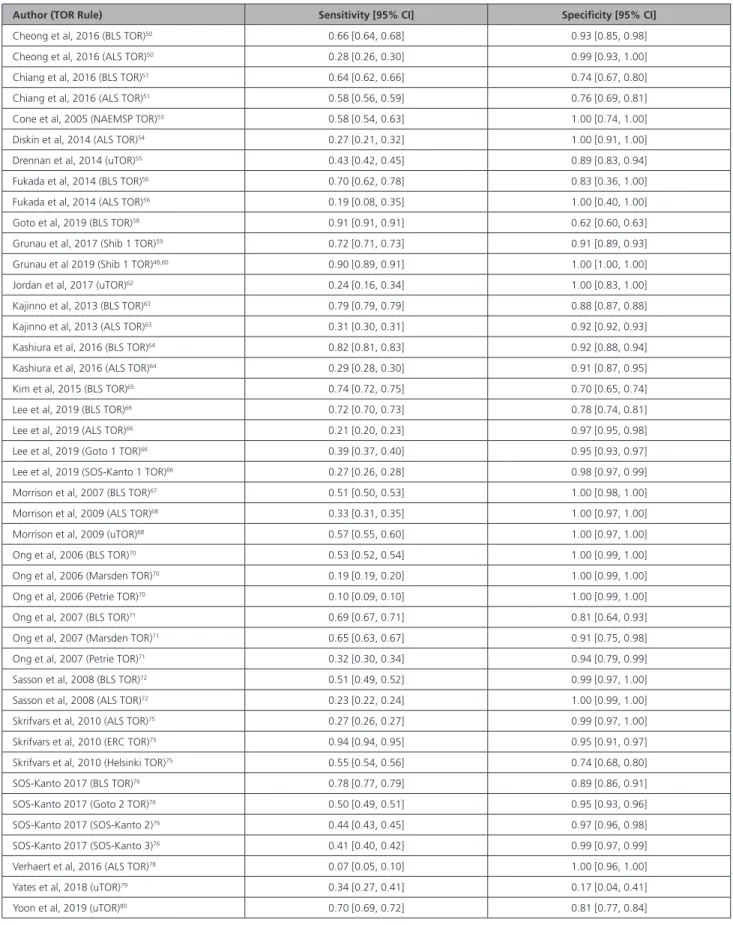
considerable heterogeneity in patient population, clini-cian population, and EMS system design; thus, meta-analysis was not appropriate. Reported sensitivities and specificities of included papers are listed in Table 1.
Studies Reporting External Validation of a TOR Rule to Predict Death in Hospital. We identified very low-certainty evidence (downgraded for risk of bias, inconsistency, indirectness, and imprecision) from Table 1. Sensitivity and Specificity of Derivation and Internal Validation Studies (Death)
Author (TOR Rule) Sensitivity [95% CI] Specificity [95% CI]
Bonnin et al, 1993 (no-ROSC TOR)49 0.77 [0.74, 0.79] 0.93 [0.86, 0.98] Chiang et al, 2016 (tCPA TOR)52 0.17 [0.15, 0.20] 1.00 [0.91, 1.00] Glober et al, 2019 (Glob1 TOR)57 0.14 [0.13, 0.16] 1.00 [0.98, 1.00] Goto et al, 2019 (Goto1 TOR)58 0.11 [0.11, 0.11] 1.00 [0.99, 1.00] Haukoos et al, 2004 (Haukoos1 TOR)61 0.68 [0.64, 0.71] 0.92 [0.78, 0.98] Lee et al, 2019 (KOCARC1 TOR)66 0.31 [0.29, 0.32] 0.97 [0.96, 0.99] Lee et al, 2019 (KOCARC2 TOR)66 0.32 [0.31, 0.34] 0.98 [0.96, 0.99] Marsden et al, 1995 (Marsden TOR)81 0.58 [0.53, 0.63] 1.00 [0.03, 1.00] Morrison et al, 2007 (ALS TOR)67 0.51 [0.50, 0.53] 1.00 [0.98, 1.00] Petrie et al, 2001 (Petrie TOR)82 0.39 [0.38, 0.40] 0.98 [0.97, 0.99] SOS-Kanto, 2017 (SOS_Kanto1 TOR)76 0.50 [0.49, 0.50] 0.95 [0.93, 0.96] Verbeek et al, 2002 (BLS TOR)77 0.65 [0.62, 0.69] 1.00 [0.75, 1.00] Yoon et al, 2019 (KoCARC1 TOR)80 0.53 [0.51, 0.54] 0.92 [0.89, 0.94] Yoon et al, 2019 (KoCARC2 TOR)80 0.53 [0.51, 0.54] 0.89 [0.86, 0.91] Yoon et al, 2019 (KoCARC3 TOR)80 0.39 [0.38, 0.41] 0.95 [0.93, 0.97]
ALS indicates advanced life support; BLS, basic life support; ROSC, return of spontaneous circulation; and TOR, termination of resuscitation.
Table 2. Sensitivity and Specificity of External Validation Studies (Death)
Author (TOR Rule) Sensitivity [95% CI] Specificity [95% CI]
Cheong et al, 2016 (BLS TOR)50 0.66 [0.64, 0.68] 0.93 [0.85, 0.98]
Cheong et al, 2016 (ALS TOR)50 0.28 [0.26, 0.30] 0.99 [0.93, 1.00]
Chiang et al, 2016 (BLS TOR)51 0.64 [0.62, 0.66] 0.74 [0.67, 0.80]
Chiang et al, 2016 (ALS TOR)51 0.58 [0.56, 0.59] 0.76 [0.69, 0.81]
Cone et al, 2005 (NAEMSP TOR)53 0.58 [0.54, 0.63] 1.00 [0.74, 1.00]
Diskin et al, 2014 (ALS TOR)54 0.27 [0.21, 0.32] 1.00 [0.91, 1.00]
Drennan et al, 2014 (uTOR)55 0.43 [0.42, 0.45] 0.89 [0.83, 0.94]
Fukada et al, 2014 (BLS TOR)56 0.70 [0.62, 0.78] 0.83 [0.36, 1.00]
Fukada et al, 2014 (ALS TOR)56 0.19 [0.08, 0.35] 1.00 [0.40, 1.00]
Goto et al, 2019 (BLS TOR)58 0.91 [0.91, 0.91] 0.62 [0.60, 0.63]
Grunau et al, 2017 (Shib 1 TOR)59 0.72 [0.71, 0.73] 0.91 [0.89, 0.93]
Grunau et al 2019 (Shib 1 TOR)48,60 0.90 [0.89, 0.91] 1.00 [1.00, 1.00]
Jordan et al, 2017 (uTOR)62 0.24 [0.16, 0.34] 1.00 [0.83, 1.00]
Kajinno et al, 2013 (BLS TOR)63 0.79 [0.79, 0.79] 0.88 [0.87, 0.88]
Kajinno et al, 2013 (ALS TOR)63 0.31 [0.30, 0.31] 0.92 [0.92, 0.93]
Kashiura et al, 2016 (BLS TOR)64 0.82 [0.81, 0.83] 0.92 [0.88, 0.94]
Kashiura et al, 2016 (ALS TOR)64 0.29 [0.28, 0.30] 0.91 [0.87, 0.95]
Kim et al, 2015 (BLS TOR)65 0.74 [0.72, 0.75] 0.70 [0.65, 0.74]
Lee et al, 2019 (BLS TOR)66 0.72 [0.70, 0.73] 0.78 [0.74, 0.81]
Lee et al, 2019 (ALS TOR)66 0.21 [0.20, 0.23] 0.97 [0.95, 0.98]
Lee et al, 2019 (Goto 1 TOR)66 0.39 [0.37, 0.40] 0.95 [0.93, 0.97]
Lee et al, 2019 (SOS-Kanto 1 TOR)66 0.27 [0.26, 0.28] 0.98 [0.97, 0.99]
Morrison et al, 2007 (BLS TOR)67 0.51 [0.50, 0.53] 1.00 [0.98, 1.00]
Morrison et al, 2009 (ALS TOR)68 0.33 [0.31, 0.35] 1.00 [0.97, 1.00]
Morrison et al, 2009 (uTOR)68 0.57 [0.55, 0.60] 1.00 [0.97, 1.00]
Ong et al, 2006 (BLS TOR)70 0.53 [0.52, 0.54] 1.00 [0.99, 1.00]
Ong et al, 2006 (Marsden TOR)70 0.19 [0.19, 0.20] 1.00 [0.99, 1.00]
Ong et al, 2006 (Petrie TOR)70 0.10 [0.09, 0.10] 1.00 [0.99, 1.00]
Ong et al, 2007 (BLS TOR)71 0.69 [0.67, 0.71] 0.81 [0.64, 0.93]
Ong et al, 2007 (Marsden TOR)71 0.65 [0.63, 0.67] 0.91 [0.75, 0.98]
Ong et al, 2007 (Petrie TOR)71 0.32 [0.30, 0.34] 0.94 [0.79, 0.99]
Sasson et al, 2008 (BLS TOR)72 0.51 [0.49, 0.52] 0.99 [0.97, 1.00]
Sasson et al, 2008 (ALS TOR)72 0.23 [0.22, 0.24] 1.00 [0.99, 1.00]
Skrifvars et al, 2010 (ALS TOR)75 0.27 [0.26, 0.27] 0.99 [0.97, 1.00]
Skrifvars et al, 2010 (ERC TOR)75 0.94 [0.94, 0.95] 0.95 [0.91, 0.97]
Skrifvars et al, 2010 (Helsinki TOR)75 0.55 [0.54, 0.56] 0.74 [0.68, 0.80]
SOS-Kanto 2017 (BLS TOR)76 0.78 [0.77, 0.79] 0.89 [0.86, 0.91]
SOS-Kanto 2017 (Goto 2 TOR)76 0.50 [0.49, 0.51] 0.95 [0.93, 0.96]
SOS-Kanto 2017 (SOS-Kanto 2)76 0.44 [0.43, 0.45] 0.97 [0.96, 0.98]
SOS-Kanto 2017 (SOS-Kanto 3)76 0.41 [0.40, 0.42] 0.99 [0.97, 0.99]
Verhaert et al, 2016 (ALS TOR)78 0.07 [0.05, 0.10] 1.00 [0.96, 1.00]
Yates et al, 2018 (uTOR)79 0.34 [0.27, 0.41] 0.17 [0.04, 0.41]
Yoon et al, 2019 (uTOR)80 0.70 [0.69, 0.72] 0.81 [0.77, 0.84]
ALS indicates advanced life support; BLS, basic life support; ERC, European Resuscitation Council; TOR, termination of resuscitation; and uTOR, universal termination of resuscitation.
24 nonrandomized studies.50,51,53–56,58–60,62–68,70–72,75,76,78–80
These studies externally validated 14 distinct TOR rules to predict death after arrival at hospital. There was con-siderable heterogeneity across TOR variables, patient populations, clinician populations, and EMS systems; thus, meta-analysis was not appropriate. However, per-formance of 3 TOR rules (BLS TOR rule, ALS TOR rule, universal TOR rule) was reported in multiple papers (see below). Reported sensitivities and specificities of included papers are listed in Table 2.
We identified very low-certainty evidence (down-graded for risk of bias, inconsistency, indirectness, and imprecision) from 13 nonrandomized stud-ies50,51,56,58,63–66,68,70–72,76 reporting the accuracy of the BLS
TOR rule to predict in-hospital death. There was consid-erable heterogeneity across patient populations, clini-cian populations, and EMS systems; thus, meta-analysis was not appropriate. We calculated estimates of effect per 1000 patients based on the range of sensitivities, specificities, and prevalence in the studies (Table 2).
On the basis of the lowest prevalence of 88.3%,66
the estimate of false positives (TOR rule predicts death, but patient will survive) per 1000 patients tested ranged from 0 to 36. On the basis of the highest prevalence of 98.6%,71 the estimate of false positives per 1000
pa-tients tested ranged from 0 to 4.
We identified very low-certainty evidence (down-graded for risk of bias, inconsistency, indirectness, and imprecision) from 11 nonrandomized stud-ies50,51,54,56,63,64,66,68,72,75,78 reporting the accuracy of the
ALS TOR rule to predict in-hospital death. There was considerable heterogeneity across patient populations, clinician populations, and EMS systems; thus, meta-analysis was not appropriate. We calculated estimates of effect per 1000 patients based on the range of sensitivi-ties, specificisensitivi-ties, and prevalence in the studies (Table 2). On the basis of the lowest prevalence of 84.9%,78
the estimate of false positives (TOR rule predicts death, but patient will survive) per 1000 patients tested ranged from 0 to 36. On the basis of the highest prevalence of 99.0%,75 the estimate of false positives (TOR rule
pre-dicts death, but patient will survive) per 1000 patients tested ranged from 0 to 3.
We identified very low-certainty evidence (down-graded for risk of bias, inconsistency, indirectness, and imprecision) from 6 nonrandomized studies55,59,62,68,79,80
reporting the accuracy of the universal TOR rule to pre-dict in-hospital death. There was considerable heteroge-neity across patient populations, clinician populations, and EMS systems; thus, meta-analysis was not appropri-ate. We calculated estimates of effect per 1000 patients based on the range of sensitivities, specificities, and prevalence in the studies (Table 2). On the basis of the lowest prevalence of 82.0%,62 the estimate of false
posi-tives (TOR rule predicts death, but patient will survive) per 1000 patients tested ranged from 0 to 149. On the
basis of the highest prevalence of 97.6%,55 the estimate
of false positives (TOR rule predicts death, but patient will survive) per 1000 patients tested ranged from 0 to 9.
Studies Reporting Clinical Validation of a TOR Rule to Predict Death in Hospital. We identified very low-certainty evidence (downgraded for indirect-ness) from 1 nonrandomized study69 reporting a clinical
validation of the universal TOR rule to predict in-hos-pital death. Sensitivity was 0.64 (95% CI, 0.61–0.68), and specificity was 1.00 (95% CI, 0.92–1.00). Of 954 patients enrolled, the BLS TOR rule recommended transport in 367 cases. Of these, 44 survived to dis-charge and 323 died in hospital. Of the remaining 586, 388 had resuscitation terminated in the field. Of 198 cases transported to hospital despite termination being recommended, no patient survived.
For the Critically Important Outcome of Prediction of Poor Neurological Outcome
a) Studies reporting the derivation and internal vali-dation of a TOR rule to predict poor neurological outcome
b) Studies reporting external validation of a TOR rule to predict poor neurological outcome
c) Studies reporting clinical validation of a TOR rule to predict poor neurological outcome
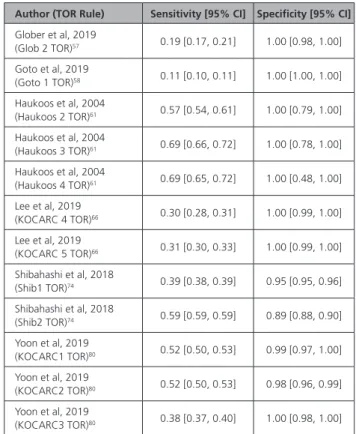
Table 3. Sensitivity and Specificity of Derivation and Internal Validation Studies (Poor Neurological Outcome)
Author (TOR Rule) Sensitivity [95% CI] Specificity [95% CI]
Glober et al, 2019 (Glob 2 TOR)57 0.19 [0.17, 0.21] 1.00 [0.98, 1.00] Goto et al, 2019 (Goto 1 TOR)58 0.11 [0.10, 0.11] 1.00 [1.00, 1.00] Haukoos et al, 2004 (Haukoos 2 TOR)61 0.57 [0.54, 0.61] 1.00 [0.79, 1.00] Haukoos et al, 2004 (Haukoos 3 TOR)61 0.69 [0.66, 0.72] 1.00 [0.78, 1.00] Haukoos et al, 2004 (Haukoos 4 TOR)61 0.69 [0.65, 0.72] 1.00 [0.48, 1.00] Lee et al, 2019 (KOCARC 4 TOR)66 0.30 [0.28, 0.31] 1.00 [0.99, 1.00] Lee et al, 2019 (KOCARC 5 TOR)66 0.31 [0.30, 0.33] 1.00 [0.99, 1.00] Shibahashi et al, 2018 (Shib1 TOR)74 0.39 [0.38, 0.39] 0.95 [0.95, 0.96] Shibahashi et al, 2018 (Shib2 TOR)74 0.59 [0.59, 0.59] 0.89 [0.88, 0.90] Yoon et al, 2019 (KOCARC1 TOR)80 0.52 [0.50, 0.53] 0.99 [0.97, 1.00] Yoon et al, 2019 (KOCARC2 TOR)80 0.52 [0.50, 0.53] 0.98 [0.96, 0.99] Yoon et al, 2019 (KOCARC3 TOR)80 0.38 [0.37, 0.40] 1.00 [0.98, 1.00]
TOR indicates termination of resuscitation.
Studies Reporting the Derivation and Internal Validation of a TOR Rule to Predict Poor Neurological Outcome. We identified very low-certainty evidence (downgraded for risk of bias, inconsistency, indirectness, and imprecision) from 6 nonrandomized studies57,58,61,66,74,80 These studies
derived and internally validated 12 distinct TOR rules to predict poor neurological outcome. Studies by Haukoos et al,61 Lee et al,66 Shibahashi et al,74 and Yoon et al80
derived multiple TOR rules. There was considerable het-erogeneity in patient population, clinician population, and EMS system design; thus, meta-analysis was not appropriate. Reported sensitivities and specificities of included papers are listed in Table 3.
Studies Reporting External Validation of a TOR Rule to Predict Poor Neurological Outcome. We identified very low-certainty evidence (downgraded for risk of bias, inconsistency, indirectness, and imprecision) from 9 nonrandomized studies50,63–66,73,75,76,80; externally
validating 10 distinct TOR rules to predict poor neuro-logical outcome. There was considerable heterogeneity across TOR rule variables, patient populations, clinician populations, and EMS systems; thus, meta-analysis was
not appropriate. However, performance of 2 TOR rules (BLS TOR, ALS TOR) was reported in multiple papers (see below). Reported sensitivities and specificities of included papers are listed in Table 4.
We identified very low-certainty evidence (down-graded for risk of bias, inconsistency, indirectness, and imprecision) from 6 nonrandomized studies50,63–66,76
reporting the accuracy of the BLS TOR rule to predict poor neurological outcome. There was considerable heterogeneity across patient populations, clinician populations, and EMS systems; thus, meta-analysis was not appropriate. We calculated estimates of ef-fect per 1000 patients based on the range of sen-sitivities, specificities, and prevalence in the studies (Table 4).
On the basis of the lowest prevalence of 92.1%,66
the estimate of false positives (TOR predicts poor neu-rological outcome, but patient has favorable neurologi-cal outcome) per 1000 patients tested ranged from 0 to 6. On the basis of the highest prevalence of 98.0%,50
the estimate of false positives per 1000 patients tested ranged from 0 to 1.
We identified very low-certainty evidence (down-graded for risk of bias, inconsistency, indirectness, and Table 4. Sensitivity and Specificity of External Validation Studies (Poor Neurological Outcome)
Author (TOR Rule) Sensitivity [95% CI] Specificity [95% CI]
Cheong et al, 2016 (BLS TOR)50 0.66 [0.64, 0.68] 1.00 [0.92, 1.00]
Cheong et al, 2016 (ALS TOR)50 0.27 [0.25, 0.29] 1.00 [0.92, 1.00]
Kajino et al, 2013 (BLS TOR)63 0.78 [0.78, 0.78] 0.97 [0.96, 0.97]
Kajino et al, 2013 (ALS TOR)63 0.30 [0.30, 0.30] 0.98 [0.97, 0.99]
Kashiura et al, 2016 (BLS TOR)64 0.81 [0.80, 0.82] 0.97 [0.94, 0.99]
Kashiura et al, 2016 (ALS TOR)64 0.28 [0.27, 0.29] 0.94 [0.87, 0.98]
Kim et al, 2015 (BLS TOR)65 0.72 [0.71, 0.73] 0.90 [0.85, 0.94]
Lee et al, 2019 (BLS TOR)66 0.71 [0.70, 0.72] 0.93 [0.89, 0.95]
Lee et al, 2019 (ALS TOR)66 0.21 [0.20, 0.22] 0.99 [0.97, 1.00]
Lee et al, 2019 (Goto 1 TOR)66 0.27 [0.26, 0.28] 0.98 [0.97, 0.99]
Lee et al, 2019 (SOS-Kanto 1 TOR)66 0.39 [0.37, 0.40] 0.95 [0.93, 0.97]
SOS-Kanto 2017 (BLS TOR)76 0.77 [0.76, 0.78] 0.96 [0.94, 0.98]
SOS-Kanto 2017 (ALS TOR)76 0.49 [0.48, 0.50] 0.98 [0.96, 0.99]
SOS-Kanto 2017 (SOS-Kanto 1)76 0.49 [0.48, 0.50] 0.97 [0.95, 0.99]
SOS-Kanto 2017 (SOS-Kanto 2)76 0.44 [0.43, 0.44] 0.99 [0.97, 1.00]
SOS-Kanto 2017 (SOS-Kanto 3)76 0.40 [0.39, 0.41] 0.99 [0.98, 1.00]
Ruygrok et al, 2008 (ALS TOR)73 0.24 [0.21, 0.27] 1.00 [0.92, 1.00]
Ruygrok et al, 2008 (uTOR)73 0.34 [0.31, 0.38] 1.00 [0.92, 1.00]
Ruygrok et al, 2008 (Haukoos 3 TOR)73 0.06 [0.04, 0.08] 1.00 [0.92, 1.00]
Skrifvars et al, 2010 (ALS TOR)75 0.27 [0.26, 0.27] 1.00 [0.97, 1.00]
Skrifvars et al, 2010 (ERC TOR)75 0.94 [0.94, 0.95] 0.96 [0.93, 0.98]
Skrifvars et al, 2010 (Helsinki TOR)75 0.55 [0.54, 0.56] 0.79 [0.73, 0.85]
Yoon et al, 2019 (uTOR)80 0.69 [0.68, 0.71] 0.94 [0.91, 0.96]
ALS indicates advanced life support; BLS, basic life support; ERC, European Resuscitation Council; TOR, termination of resuscitation; and uTOR, universal termination of resuscitation rule.
imprecision) from 6 nonrandomized studies50,63,64,66,73,75
reporting the accuracy of the ALS TOR rule to predict poor neurological outcome. There was considerable heterogeneity across patient populations, clinician pop-ulations, and EMS systems; thus, meta-analysis was not appropriate. We calculated estimates of effect per 1000 patients based on the range of sensitivities, specificities, and prevalence in the studies.
On the basis of the lowest prevalence of 92.1%,66
the estimate of false positives (TOR rule predicts poor neurological outcome, but patient has favorable neu-rological outcome) per 1000 patients tested ranged from 0 to 6. On the basis of the highest prevalence of 98.0%,50 the estimate of false positives per 1000
pa-tients tested ranged from 0 to 1.
Studies Reporting Clinical Validation of a TOR Rule to Predict Poor Neurological Outcome. We identified very low-certainty evidence (downgraded for indirectness) from 1 nonrandomized study69
reporting a clinical validation of the universal TOR rule to predict poor neurological outcome. Sensitivity was 0.63 (95% CI, 0.61–0.68), and specificity was 1.00 (95% CI, 0.92–1.00). Of 953 patients included, the BLS TOR rule recommended transport in 367 cases. Of these, 17 survived with poor neurological outcome (Cerebral Performance Category 3 or 4) and 323 died in hospital.
Treatment Recommendations
We conditionally recommend the use of TOR rules to assist clinicians in deciding whether to discontinue re-suscitation efforts out of hospital or to transport to hos-pital with ongoing CPR (conditional recommendation/ very low-certainty evidence).
Justification and Evidence-to-Decision Framework Highlights
The evidence-to-decision table is included in Supple-ment Appendix A-1. The majority of studies describe ei-ther the derivation and internal validation of individual TOR rules or the external validation of previously pub-lished TOR rules. We identified only 1 study address-ing clinical validation (the use of a TOR rule in clinical practice) of a TOR rule by emergency medical techni-cians with defibrillators. Robust evidence to support the widespread implementation of TOR rules in clinical practice is therefore weak. Despite several studies re-porting a specificity of 1.0, the task force acknowledges that implementation of a TOR rule, in isolation, may result in missed survivors.
The task force recognizes that TOR is common prac-tice in many EMS systems. We support the principle of discontinuing resuscitation when treatment is futile be-cause it preserves the dignity of the recently deceased, reduces risk for EMS providers, and protects scarce healthcare resources. However, the task force also
acknowledges that identification of futile cases is chal-lenging and is often informed by both clinical guide-lines and clinician insight.
The task force advocates the adoption of TOR guide-lines that take into account the patients’ prior wishes and/or expectations, consideration of patient preexist-ing comorbidities, and quality of life both before and after the cardiac arrest event. Such TOR guidelines may be informed by the inclusion of an evidence-based TOR rule; however, the task force believes a TOR rule should not be the sole determinant of when to discontinue re-suscitation.
In those EMS systems that do implement prehospital TOR rules, the EMS system must ensure that there is no conflict with legislation prohibiting nonphysicians from discontinuing resuscitation and must have appropriate governance arrangements to monitor practice. Where an evidence-based TOR rule is included to inform practice, the EMS system should consider the train-ing needs of EMS crews in communicattrain-ing bad news and supporting the relatives of the recently deceased, in addition to consideration of the generalizability of the chosen TOR rule to its healthcare system. In some healthcare systems, it may be appropriate for EMS sys-tems to communicate with organ donation teams be-fore implementing change.
The task force acknowledges that prehospital TOR may not be feasible in some instances. In some lo-cations, the legal infrastructure may require EMS cli-nicians to provide resuscitation in all but a very few circumstances (eg, in the presence of rigor mortis). In other areas, it may not be culturally acceptable for nonphysicians to make a clinical decision to stop resuscitation in the prehospital environment. Where this is the case, or where clinical governance arrange-ments are insufficient to monitor practice, we sug-gest transport to hospital with ongoing CPR may be preferable.
The 2010 CoSTR recommended validated TOR rules in adults,1,2 but the topic was not addressed
in 2015. This 2020 CoSTR for EIT softens the rec-ommendation, taking into consideration the social acceptability of excluding potential survivors from in-hospital treatment and the very limited clinical validation of such rules.
Knowledge Gaps
There is little evidence addressing use of TOR rules in clinical practice. Studies are required to address the fol-lowing:
• Use of TOR rules in actual clinical practice • Compliance with out-of-hospital TOR rules
• Implementation strategies of TOR for EMS that are based on evidence
• Health economic implications of TOR implementation • Societal perceptions and acceptance of TOR rules
• TOR rules specific for children
• Impact of TOR rules on non–heart-beating organ donation
In-Hospital TOR (EIT 4002: SysRev)
Rationale for Review
There are no current ILCOR recommendations on clini-cal decision rules to terminate resuscitation during hospital cardiac arrest (IHCA). Almost half of all in-hospital resuscitation attempts are terminated without ROSC.83 Knowing when to terminate resuscitation is,
therefore, an important clinical question. The EIT Task Force defined clinical decision rules as cardiac arrest characteristics to be applied during resuscitation to pre-dict survival (ROSC, survival to hospital discharge) and thereby terminate resuscitation if deemed futile. Mea-sures of prediction were negative predictive value, sen-sitivity, specificity, and positive predictive value.
Population, Intervention, Comparator, Outcome, Study Design, and Time Frame
• Population: Adults and children with IHCA • Intervention: Use of any clinical decision rule • Comparator: No clinical decision rule
• Outcome: No ROSC, death before hospital dis-charge, survival with unfavorable neurological out-come, and death within 30 days
• Study design: RCTs and nonrandomized stud-ies (non-RCTs, interrupted time serstud-ies, controlled before-and-after studies, cohort studies) were eli-gible for inclusion. Unpublished studies (eg, con-ference abstracts, trial protocols), animal studies, simulation studies, and studies not in English were excluded.
• Time frame: All years until November 11, 2019
Consensus on Science
We found 3 studies investigating the usability of the UN10 rule to predict survival to hospital discharge on the basis of the unwitnessed arrest, a nonshockable rhythm, and 10 minutes of CPR without ROSC.84–86
All studies were cohort studies, and no studies used randomization or prospective implementation of a clin-ical decision rule.
For the critical outcomes of positive predictive value and sensitivity in predicting death before hospital dis-charge for adults with IHCA, we identified very low-certainty evidence from 3 historical cohort studies.84–86
investigating the UN10 rule (downgraded for risk of bias, indirectness, imprecision, and inconsistency). Be-cause of clinical heterogeneity in study cohorts, no meta-analysis was conducted. Positive predictive values and sensitivities are reported in Table 5.
For the important outcomes of specificity and nega-tive predicnega-tive value in predicting death before hospital discharge for adults with IHCA, we identified very low-certainty evidence from 3 historical cohort studies.84–86
investigating the UN10 rule (downgraded for risk of bias, indirectness, imprecision, and inconsistency). Specificities and negative predictive values are reported in Table 5.
For the important outcomes of positive predictive val-ue, specificity, sensitivity, and negative predictive values in predicting survival to hospital discharge with unfavorable neurological outcome for adults with IHCA, we identified very low-certainty evidence from 1 observational study86
investigating the UN10 rule (downgraded for risk of bias, indirectness, and imprecision). The study reported a posi-tive predicposi-tive value of 95.2% (95% CI, 94.9%–95.6%), a specificity of 95.3% (95% CI, 95.0%–95.6%), a sensi-tivity of 18.8% (95% CI, 18.5%–19.0%), and a negative predictive value of 19.1% (95% CI, 18.8%–19.3%).86
We identified no studies predicting no ROSC or death within 30 days. We identified no studies on chil-dren with IHCA.
Treatment Recommendations
We did not identify any clinical decision rule that was able to reliably predict death after IHCA. We recom-mend against using the UN10 rule as a sole strategy to terminate in-hospital resuscitation (strong recommen-dation, very low-certainty evidence).
Justification and Evidence-to-Decision Framework Highlights
The evidence-to-decision table is included in Supplement Appendix A-2. In making this recommendation, the EIT Task Force considered the following: several other scores have been developed that aim at predicting the chance of survival on the basis of prearrest factors only, includ-ing the GO-FAR score87 and comorbidity scores.88 While
these scores may be suitable to trigger do-not-resusci-tate discussions, they are not aimed at deciding when to terminate resuscitation during a resuscitation attempt and were therefore not included in this review.
The Resuscitation Predictor Scoring Scale89 aimed to
identify patients with low likelihood of surviving a car-diac arrest after 15 minutes of resuscitation. This score was not included in the review because the score aimed Table 5. Positive Predictive Values, Specificity, Sensitivity, and
Negative Predictive Values for Prediction of Death Before Hospital Discharge
Positive Predictive
Value Specificity Sensitivity
Negative Predictive Value Van Walraven, 199984 100% (95% CI, 97.1% to 100%) 100% (95% CI, 97.1% to 100%) 12.2% (95% CI, 10.3%– 14.4%) 10.8% (95% CI, 8.9–12.8%) Van Walraven, 200185 98.9% (95% CI, 96.5%– 99.7%) 99.1% (95% CI, 97.1%– 99.8%) 14.4% (95% CI, 12.4%– 16.0%) 17.0% (95% CI, 15.3–18.7) Petek, 201986 93.7% (95% CI, 93.3%– 94.0%) 94.6% (95% CI, 94.3%– 94.9%) 19.1% (95% CI, 18.8%– 19.3%) 22.0% (95% CI, 21.9%– 22.0%)
at identifying patients with low likelihood but not pa-tients with no likelihood of surviving the cardiac arrest. Several studies (primarily prehospital) have looked at other factors such as end-tidal carbon dioxide (CO2) and echocardiographic findings to terminate resuscitation. These have been included in reviews by the ILCOR ALS Task Force. End-tidal carbon dioxide and echocardiograph-ic findings may be considered together with other factors to decide when to terminate in-hospital resuscitation.
All identified studies were based on historical co-horts and carry a risk of a self-fulfilling prophecy bias as clinicians may have terminated resuscitation on pa-tients who potentially had a chance of surviving in the observed studies. Prospective studies are needed to reli-ably assess the effect of such clinical decision rules.
Two of the studies84,85 included patients resuscitated
in the 1980s and 1990s, when resuscitation practices differed from present time and when reported survival rates were lower than now.90 The third study86 included
patients resuscitated between 2000 and 2016, but a large proportion of the arrests occurred before 2010. As previously stated, survival rates are now higher than in previous decades.
The task force prioritized a perfect positive predictive value (no survivors among those predicted to be dead) for any clinical prediction rule because of the risk of terminating resuscitation of a patient who could have survived. The task force discussed that it is reasonable not to terminate resuscitation as long as the patient has a shockable rhythm. No single clinical factor or no single decision rule has been identified as sufficient to terminate resuscitation. Therefore, the EIT Task Force members suggested that a decision to terminate an IHCA resuscitation should continue to be based on a combination of factors that are known to be associated with a low chance of survival, eg, end-tidal carbon di-oxide, cardiac standstill on echocardiography, duration of resuscitation, patient age, and patient comorbidities.
ILCOR has not previously made a treatment recom-mendation on an in-hospital TOR rule. Unfortunately, the existing evidence is insufficient to recommend an in-hospital TOR rule. Clinicians have to rely on clinical examination, their experience, and the patient’s condi-tions and wishes to inform their decision to terminate resuscitation efforts.
Knowledge Gaps
• There are no clinical decision tools to predict the absence of ROSC during in-hospital resuscitation. • There are clinical decision tools that combine
existing decision tool elements such as resuscita-tion duraresuscita-tion and cardiac arrest rhythm with end-tidal carbon dioxide and/or findings on cardiac ultrasound.
• No studies were found on the use of a clinical deci-sion tool to terminate resuscitation for pediatric IHCA.
• There is a lack of prospective clinical validation studies and randomized trials investigating the use of a clinical decision tool to terminate resuscitation during IHCA.
• It is unknown how the use of a clinical decision tool affects resuscitation practices, cost benefit, or how it affects survival outcomes.
Deliberate Practice and Mastery Learning
(EIT 4004: EvUp)
One EvUp (Supplement Appendix C-1) identified sev-eral studies that suggest the need for consideration of a SysRev, especially because no former assessment of this educational strategy has been done by ILCOR and no treatment recommendation has been made as of January 31, 2020.
Population, Intervention, Comparator, Outcome, Study Design, and Time Frame
• Population: Students/healthcare providers taking BLS or ALS training
• Intervention: Use of deliberate practice and/or mastery learning
• Comparator: No such teaching strategies
• Outcome: Improve knowledge/skill performance at course conclusion, knowledge/skill retention beyond course conclusion, clinical performance in actual resuscitations, or patient outcomes cally important); intact neurological outcome (criti-cally important)
• Study design: Cross-sectional or cohort studies were eligible for inclusion. Unpublished studies (eg, conference abstracts, trial protocols) were excluded.
• Time frame: All articles published before 2013 were excluded, and all languages were included if there was an English abstract. The search was completed on October 22, 2019.
An EvUp was conducted for 2020 to identify recent published evidence. A search conducted in PubMed yielded 30 studies, and 12 were identified as relevant. See the complete EvUp in Supplement Appendix C-1.
Treatment Recommendation
The EvUp did not enable a treatment recommendation to be made.
Layperson Training (EIT 4009: EvUp)
An EvUp was performed (Supplement Appendix C-2) and identified several studies suggesting the need to consider a SysRev. To date, no SysRev on the training of laypeople has been done by ILCOR, and no treatment
recommendation has been made as of January 31, 2020.
Population, Intervention, Comparator, Outcome, Study Design, and Time Frame
• Population: Laypeople (nonprofessional responders) • Intervention: Participating in CPR training
• Comparator: Compared with no training
• Outcome: Change willingness to perform CPR in actual resuscitations, skill performance quality, and/or patient outcomes
• Study design: Cross-sectional or cohort studies are eligible for inclusion. Unpublished studies (eg, con-ference abstracts, trial protocols) were excluded. • Time frame: All articles published between January
1, 2018, and October 10, 2019, and all languages were included if there was an English abstract. A search conducted in PubMed yielded 372 studies, and 25 were identified as relevant. See Supplement Ap-pendix C-2 for the full EvUp.
Treatment Recommendation
The EvUp did not enable a treatment recommendation to be made.
Timing for Retraining (EIT 628: EvUp)
The topic of timing for retraining was last reviewed in 2015.3,4 An EvUp was performed (Supplement
Appen-dix C-3) with several studies identified that suggest the need for consideration of a SysRev. The 2015 treatment recommendation3,4 will then be reevaluated.
Population, Intervention, Comparator, Outcome, Study Design, and Time Frame
• Population: Students who are taking BLS courses • Intervention: Any specific interval for update or
retraining
• Comparator: Compared with standard practice (ie, 12 or 24 monthly)
• Outcome: Improve patient outcomes, skill perfor-mance in actual resuscitations, skill perforperfor-mance at 1 year, skill performance at course conclusion, and cognitive knowledge
• Study design: Cross-sectional or cohort studies are eligible for inclusion. Unpublished studies (eg, con-ference abstracts, trial protocols) were excluded. • Time frame: All articles published between January
1, 2014, and January 7, 2020, and all languages were included if there was an English abstract An EvUp was conducted for 2020 by the RCA. A search conducted in PubMed and Embase yielded 1002 studies, and 5 were identified as relevant. See Supple-ment Appendix C-3 for the complete EvUp.
Treatment Recommendation
The treatment recommendation from 2015 (below) is unchanged.3,4
There is insufficient evidence to recommend the optimum interval or method for BLS retraining for lay-people. Because there is evidence of skills decay within 3 to 12 months after BLS training and evidence that frequent training improves CPR skills, responder con-fidence, and willingness to perform CPR, we suggest that individuals likely to encounter cardiac arrest con-sider more frequent retraining (weak recommendation, very low-quality evidence).
MEASURING IMPLEMENTATION/
PERFORMANCE IN COMMUNITIES,
CARDIAC ARREST CENTERS
System Performance Improvements (EIT
640: SysRev)
Rationale for Review
The task force considered improvements at the system level of health care that would have the greatest poten-tial to increase the survival rate after cardiac arrest. Stud-ies associated with system performance improvement for personnel in organizations or systems caring for patients with cardiac arrest were included. System performance
improvement was defined as hospital-level,
community-level, or country-level improvement related to structure, care pathways, process, and quality of care.
Population, Intervention, Comparator, and Outcome
• Population: Resuscitation systems who are caring for patients in cardiac arrest in any setting
• Intervention: System performance improvements • Comparator: Compared with no system
perfor-mance improvements
• Outcome: Survival with favorable neurological out-come at discharge, survival to hospital discharge, skill performance in actual resuscitations, survival to admission, and system-level improvement • Study Designs: RCTs and nonrandomized
stud-ies (non-RCTs, interrupted time serstud-ies, controlled before-and-after studies, cohort studies, case-control studies). All years and all languages were included as long as there was an English abstract associated with system performance improvement for personnel in organizations or systems caring for patients with cardiac arrest. System
perfor-mance improvement is defined as hospital-level,
community-level, or country-level improvement related to structure, care pathways, process, and quality of care.
• Exclusion: Unpublished studies (eg, conference abstracts, trial protocols), letters, editorials, com-ments, and case reports.
• Time Frame: The new search included studies from November 1, 2013, to November 14, 2019.
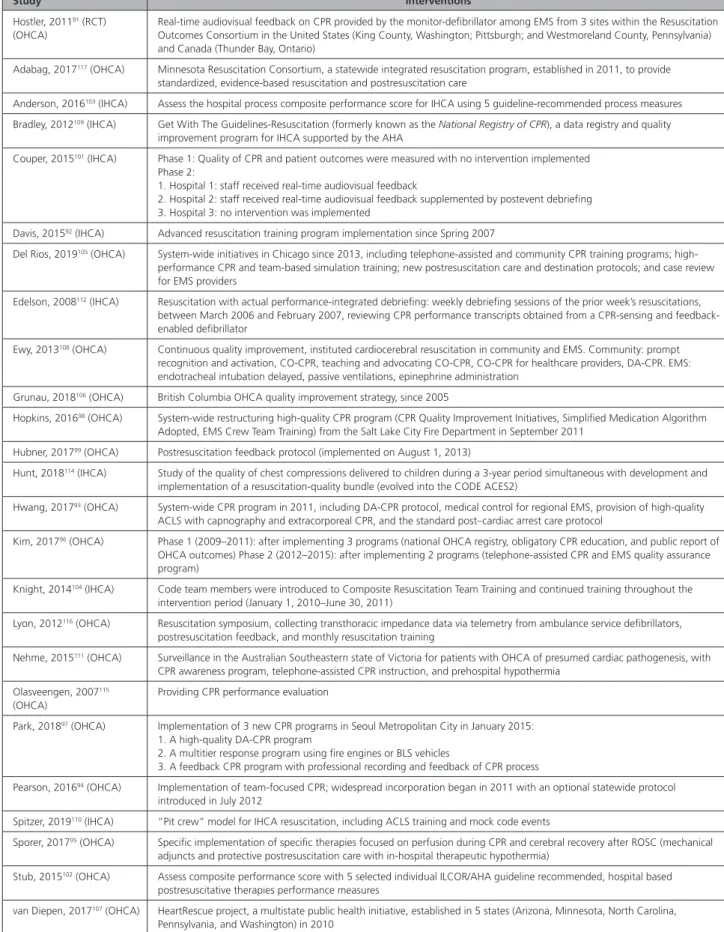
Table 6. Interventions Among Included Studies
Study Interventions
Hostler, 201191 (RCT)
(OHCA)
Real-time audiovisual feedback on CPR provided by the monitor-defibrillator among EMS from 3 sites within the Resuscitation Outcomes Consortium in the United States (King County, Washington; Pittsburgh; and Westmoreland County, Pennsylvania) and Canada (Thunder Bay, Ontario)
Adabag, 2017117 (OHCA) Minnesota Resuscitation Consortium, a statewide integrated resuscitation program, established in 2011, to provide
standardized, evidence-based resuscitation and postresuscitation care
Anderson, 2016103 (IHCA) Assess the hospital process composite performance score for IHCA using 5 guideline-recommended process measures
Bradley, 2012109 (IHCA) Get With The Guidelines-Resuscitation (formerly known as the National Registry of CPR), a data registry and quality
improvement program for IHCA supported by the AHA
Couper, 2015101 (IHCA) Phase 1: Quality of CPR and patient outcomes were measured with no intervention implemented
Phase 2:
1. Hospital 1: staff received real-time audiovisual feedback
2. Hospital 2: staff received real-time audiovisual feedback supplemented by postevent debriefing 3. Hospital 3: no intervention was implemented
Davis, 201592 (IHCA) Advanced resuscitation training program implementation since Spring 2007
Del Rios, 2019105 (OHCA) System-wide initiatives in Chicago since 2013, including telephone-assisted and community CPR training programs;
high-performance CPR and team-based simulation training; new postresuscitation care and destination protocols; and case review for EMS providers
Edelson, 2008112 (IHCA) Resuscitation with actual performance-integrated debriefing: weekly debriefing sessions of the prior week’s resuscitations,
between March 2006 and February 2007, reviewing CPR performance transcripts obtained from a CPR-sensing and feedback-enabled defibrillator
Ewy, 2013108 (OHCA) Continuous quality improvement, instituted cardiocerebral resuscitation in community and EMS. Community: prompt
recognition and activation, CO-CPR, teaching and advocating CO-CPR, CO-CPR for healthcare providers, DA-CPR. EMS: endotracheal intubation delayed, passive ventilations, epinephrine administration
Grunau, 2018106 (OHCA) British Columbia OHCA quality improvement strategy, since 2005
Hopkins, 201698 (OHCA) System-wide restructuring high-quality CPR program (CPR Quality Improvement Initiatives, Simplified Medication Algorithm
Adopted, EMS Crew Team Training) from the Salt Lake City Fire Department in September 2011
Hubner, 201799 (OHCA) Postresuscitation feedback protocol (implemented on August 1, 2013)
Hunt, 2018114 (IHCA) Study of the quality of chest compressions delivered to children during a 3-year period simultaneous with development and
implementation of a resuscitation-quality bundle (evolved into the CODE ACES2)
Hwang, 201793 (OHCA) System-wide CPR program in 2011, including DA-CPR protocol, medical control for regional EMS, provision of high-quality
ACLS with capnography and extracorporeal CPR, and the standard post–cardiac arrest care protocol
Kim, 201796 (OHCA) Phase 1 (2009–2011): after implementing 3 programs (national OHCA registry, obligatory CPR education, and public report of
OHCA outcomes) Phase 2 (2012–2015): after implementing 2 programs (telephone-assisted CPR and EMS quality assurance program)
Knight, 2014104 (IHCA) Code team members were introduced to Composite Resuscitation Team Training and continued training throughout the
intervention period (January 1, 2010–June 30, 2011)
Lyon, 2012116 (OHCA) Resuscitation symposium, collecting transthoracic impedance data via telemetry from ambulance service defibrillators,
postresuscitation feedback, and monthly resuscitation training
Nehme, 2015111 (OHCA) Surveillance in the Australian Southeastern state of Victoria for patients with OHCA of presumed cardiac pathogenesis, with
CPR awareness program, telephone-assisted CPR instruction, and prehospital hypothermia
Olasveengen, 2007115
(OHCA)
Providing CPR performance evaluation
Park, 201897 (OHCA) Implementation of 3 new CPR programs in Seoul Metropolitan City in January 2015:
1. A high-quality DA-CPR program
2. A multitier response program using fire engines or BLS vehicles
3. A feedback CPR program with professional recording and feedback of CPR process
Pearson, 201694 (OHCA) Implementation of team-focused CPR; widespread incorporation began in 2011 with an optional statewide protocol
introduced in July 2012
Spitzer, 2019110 (IHCA) “Pit crew” model for IHCA resuscitation, including ACLS training and mock code events
Sporer, 201795 (OHCA) Specific implementation of specific therapies focused on perfusion during CPR and cerebral recovery after ROSC (mechanical
adjuncts and protective postresuscitation care with in-hospital therapeutic hypothermia)
Stub, 2015102 (OHCA) Assess composite performance score with 5 selected individual ILCOR/AHA guideline recommended, hospital based
postresuscitative therapies performance measures
van Diepen, 2017107 (OHCA) HeartRescue project, a multistate public health initiative, established in 5 states (Arizona, Minnesota, North Carolina,
Pennsylvania, and Washington) in 2010
(Continued )