HAL Id: tel-01198613
https://tel.archives-ouvertes.fr/tel-01198613
Submitted on 14 Sep 2015
HAL is a multi-disciplinary open access archive for the deposit and dissemination of sci-entific research documents, whether they are pub-lished or not. The documents may come from teaching and research institutions in France or abroad, or from public or private research centers.
L’archive ouverte pluridisciplinaire HAL, est destinée au dépôt et à la diffusion de documents scientifiques de niveau recherche, publiés ou non, émanant des établissements d’enseignement et de recherche français ou étrangers, des laboratoires publics ou privés.
graminearum : consequences of the presence of
deoxynivalenol (DON) in crop residues on the soil
microflora and soil fauna
Muhammad Abid
To cite this version:
Muhammad Abid. Ecological role of mycotoxins produced by Fusarium graminearum : consequences of the presence of deoxynivalenol (DON) in crop residues on the soil microflora and soil fauna. Agri-cultural sciences. Université de Bourgogne, 2012. English. �NNT : 2012DIJOS116�. �tel-01198613�
UMR 1347 Agroécologie INRA/Université de Bourgogne/AgroSup Dijon
THÈSE
Pour obtenir le grade de
Docteur de l’Université de Bourgogne
Discipline: Sciences Vie
Spécialité : Ecologie Microbienne
Présentée par
Muhammad ABID
Le 11 Décembre 2012
Ecological role of mycotoxins produced by Fusarium graminearum:
consequences of the presence of deoxynivalenol (DON) in crop
residues on the soil microflora and soil fauna
Directeur de thèse Christian STEINBERG
Jury :
Corinne LEYVAL Directeur de Recherche, CNRS, Nancy Rapporteur Thierry MATEILLE Directeur de Recherche, IRD, Montpellier Rapporteur Sylvain JEANDROZ Professeur, Université de Bourgogne, Dijon Examinateur Florence FORGET-RICHARD Directeur de Recherche, INRA, Bordeaux Examinateur Pierre MANGIN Ingénieur d'Etude, INRA, UE Dijon Examinateur Christian STEINBERG Directeur de Recherche, INRA, Dijon Directeur de thèse
2
Dedicated To
3
Acknowledgements
First and foremost, I pay utmost gratitude to my supervisor Dr. Christian Steinberg, whose encouragement, and radiant guidance made this thesis a reality. He served as an inspiration to me as I hurdle all the obstacles in the completion of this research work and the preparation of this manuscript. His undying efforts and experience paved my way through the difficult and tiresome path of research. Despite his tight schedules, he always provided me substantial guidance and valuable suggestions throughout my PhD, and never stopped inspiring me for hard work.
I wish to extend my thanks to Dr. Philippe Lemanceau, director of Agroécologie (INRA, Dijon) for welcoming me and providing me with a great opportunity to work in this prestigious research laboratory. I express my feelings of most sincere gratitude and devout appreciations to all the jury members, Dr. Corinne Leyval, Dr. Thierry Mateille, Dr.
Sylvain Jeandroz and Dr. Florence Forget-Richard as well as Pierre Mangin for taking
out time from their busy schedules in accepting and evaluating my research work and for the comments and suggestions that will help to improve the quality of this work and also my approach towards the overall research work.
I am really thankful to the members of my thesis steering committee Dr. Dirk Redecker, Dr.
Roland Marmeisse and Dr. Hanna Friberg for their useful suggestions and guidance during
the course of my PhD research work. Their experience, ideas and analysis of my work during the meetings paved my way through the difficult and tiresome path of research.
I wish to extend my warmest thanks to Pierre Mangin and Laurent Falchetto for their help and cooperation during the field experimentation at Epoisses.
I truly acknowledge Dr. Véronique Edel-Hermann for her keen interest in my research work. Her sympathetic attitude, logical way of thinking and scientific understandings inspired me a lot. I am really very thankful to Nadine Gautheron for here help, encouragement and for sharing her extensive experience and knowledge throughout my PhD. I am really grateful to Léon Fayolle, Elodie Gauthron, Cécile Héraud and Julie Laurent for their help, interest, technical assistance and kind company during the research work. I am grateful to my other team members Sébastien Aimé, Dr. Chantal Olivain, Dr. Rémi Chaussod, Dr.
Claude Alabouvette and Johan Leplat for their appreciation and encouragement.
I would like to thank all my friends Ashfaq Shah, Muhmmad Anees, Hamid Manzoor,
Sabir Hussain, Amjad Ali, Farhan Hafeez, Sajjad Haider, Shamshir Hussain, Ahsan Mehmood, Farrukh Azeem, Ahmed Shehzad, Rana Atif and Malik Farast for their help,
4
encouragement and supporting behavior throughout my stay in Dijon. I am also thankful to all other friends in France and in Pakistan with whom I had a nice time.
I found no words on my command to express my gratitude and profound admiration to my loving parents who were always a source of inspiration and encouragement for me. It is because of their sincere efforts and enlightening wishes since my first step in school that have been a source of motivation for me to accomplish this task. In the end, I feel incomplete if I do not extend my thanks to my brothers and sister for their love, affection and prayers which enabled me to acquire this long adhered aim.
I would like to acknowledge Higher Education Commission (HEC) of Pakistan for providing me the opportunity to realize a doctoral project in France by awarding the doctoral scholarship grant and SFERE (Paris France) for their help in the management of my stay in France.
Muhammad Abid
Dijon, France
5
ABSTRACT
Fusarium graminearum is a plant pathogenic fungus, causing devastating disease “Fusarium head blight” (FHB) in cereals including wheat and maize. It also contaminates the grains with mycotoxins including deoxynivalenol (DON) which are toxic to human and animals. This disease has resulted in the serious losses in grain yield and quality. We established through a first bibliographic review that during off season fungus survives saprophytically on the crop residues (ecological habitat) and serves as primary inoculum for the next season crop. However, we noticed also that the literature was poor about the role mycotoxins could play in the establishment of F. graminearum in such a habitat. The main aim of this thesis was therefore to test whether the presence of mycotoxins in the crop residues gives an advantage to F. graminearum to survive and develop a primary inoculum in the presence of the whole soil biota including fungi, bacteria, protozoa, nematodes and earthworms. We studied the impact of DON on the soil communities in the field as well as in microcosms, in wheat as well as in maize residues under tillage and no-tillage conditions. The disease development and the yield were noted in the field experiment. Some DON resistant active fungal decomposers and nitrogen fixing bacteria were picked and the dynamics of F. graminearum was observed by accelerating decomposition of crop residue in their presence, in the presence or absence of DON.
During this study, the dynamic and survival of F. graminearum and total fungal and bacterial communities were examined by using quantitative real time polymerase chain reaction (qPCR) as well as by plate counting. At the same time, the structures of microbial communities were determined by using terminal restriction fragment length polymorphism analysis (T-RFLP). The DON resistance of isolated fungal decomposers and nitrogen fixers was tested by using minimal inhibitory concentration test (MIC). Nematodes and earthworms were quantified through binocular observations. The fate of DON was determined by quantifying the mycotoxin by high performance liquid chromatography (HPLC).
The results suggested that DON in crop residues showed an impact on the biotic components of the soil but the impact depended on the communities and on the location of the residues (on surface or incorporated in the soil). The molecular biomass shows that the fungal and bacterial densities were significantly affected by the presence of DON. The presence of DON played significant role on the structure of bacterial and protozoan community while the nematodes and fungal communities remained unaffected. MIC results showed that the susceptibility of some competitive fungal strains towards DON was dependent on the dose of mycotoxin. The earthworms (Lumbricus terrestris) were not affected by the presence of mycotoxin. The degradation of DON in the residues was dependent on the time, the location of residues and the soil biota.
The quantification of F. graminearum suggested that the presence of DON gave no advantage in the survival and development of primary inoculum during the decomposition of crop residues in the soil. We conclude that fungal decomposers can be selected on their enzymatic potential towards organic matter more than on the DON resistance to increase the degradation of the straw left at the surface and limit the subsequent development of F. graminearum.
6
RÉSUMÉ
Fusarium graminearum est un champignon pathogène des plantes, responsable de la fusariose de l'épi (plus connue sous le nom de Fusarium Head Blight : FHB) sur céréales, notamment sur le blé et le maïs. En interaction avec la plante, le champignon produit des mycotoxines, parmi lesquellse le déoxynivalénol (DON), dont la finalité pour le champignon producteur est méconnue mais qui sont toxiques pour les humains et les animaux. Ainsi la qualité des grains contribue fortement aux pertes de rendement observées et les résidus contaminés restent au champ. Une première revue bibliographique (Leplat et al 2012) a mis en évidence l'importance des résidus de culture (habitat écologique) pour la survie saprophyte du champignon, pour sa reproduction sexuée et pour l'établissement de l'inoculum primaire susceptible d'infecter la prochaine culture. Une seconde revue bibliographique a souligné les lacunes en ce qui concerne le rôle que les mycotoxines pourraient jouer dans la survie de F. graminearum dans un cet habitat.
L'objectif principal de cette thèse était donc de vérifier si la présence de mycotoxines dans les résidus de récolte donne un avantage compétitif à F. graminearum vis-à-vis des composantes biotiques du sol et des résidus et notamment les champignons, les bactéries, les protozoaires, les nématodes et les vers de terre. L'impact du DON sur ces différentes communautés a été évalué dans des résidus de maïs et de blé, au champ et en microcosmes, en condition de labour et de travail superficiel du sol. Le développement de la maladie et ses conséquences sur le rendement ont été observés dans l'expérience de terrain à l'Unité Expérimentale de l'INRA de Dijon.
Au cours de cette étude, la survie et les dynamiques de développement de la souche modèle d'étude F. graminearum MIAE00376 et des communautés fongiques et bactériennes ont été mesurées en utilisant la réaction de polymérisation en chaîne en temps réel (Q-PCR) ainsi que par comptage sur boîtes. Dans le même temps, l'évolution des structures des communautés microbiennes a été déterminée par analyse du polymorphisme de longueur des fragments de restriction terminaux (T-RFLP). Les nématodes et les vers de terre ont été quantifiés par extraction et observations à l'œil ou a la loupe binoculaire. Le DON introduit dans le sol et les résidus a été extrait et quantifié au cours du temps par chromatographie liquide haute performance (CLHP). Des dynamiques de population de la souche MIAE00376 associée à différents microorganismes isolés de paille en décomposition et sélectionnés pour leur résistance au DON, à des bactéries fixatrice d'azote et à des Fusarium sp. appartenant au complexe fongique du FHB ont été mesurées en microcosmes de paille en présence ou non de DON
Les résultats suggèrent que le DON dans les résidus de culture a une incidence sur les composantes biotiques du sol, mais l'impact dépend des communautés et de la localisation des résidus (en surface ou incorporés dans le sol). La biomasse moléculaire montre que les densités bactériennes et fongiques ont été significativement affectées par la présence de DON. La présence de DON a joué un rôle significatif sur la structure des communautés bactériennes et protozoaires, plus faible sur les communautés fongiques et nul sur les nématodes voire positif sur les vers de terre.
Il est conclu que le DON est rapidement inaccessible en profondeur et un peu moins rapidement en surface (immobilisation ou dégradation), qu'il ne confère pas d'avantage compétitif au champignon producteur et que la gestion de l'habitat privilégié que constituent les résidus de culture pour F. graminearum peut être envisagée par le travail du sol en favorisant la décomposition rapide des résidus, par le labour ou l'utilisation d'organismes décomposeurs indigènes ou introduits.
7
List of Abbreviations
ANOVA Analysis of variance CFU Colony Forming Unit
d.w. Dry weight
DNA Deoxyribose Nucleic Acid
dNTP Deoxyribonucleotide triphosphate LOD Limit of detection
EC European Commission
EDTA Ethylenediaminetetraacetic acid
EU European Union
FHB Fusarium head blight
HPLC High Performance Liquid Chromatography INRA Institut National de la Recherche Agronomique ITS Internal Transcribed Spacer
LOD Limit of detection LOQ Limit of quantification
MIC Minimal inhibitory concentration
OD Optical density
PCA Principal Component Analysis PCR Polymerase chain reaction PVPP Polyvinyl polypyrrolidone Q-PCR Real-time quantitative PCR
rDNA Ribosomal DNA
SDS Sodium dodecyl sulfate
T-RFLP Terminal restriction fragment length polymorphism TRFs Terminal restriction fragments
8
Table of Contents
GENERAL INTRODUCTION ... 12
CHAPTER 1: ECOLOGICAL ROLE OF MYCOTOXINS ... 20
1- Introduction: ... 21
2- Major Mycotoxins: ... 23
3- Molecular basis of Trichothecenes: ... 28
4-Factors affecting the production of Trichothecene B: ... 31
5- Ecological role of mycotoxins: ... 32
5.1- Mycotoxins in the multitrophic interaction in soil: ... 32
5.2- Do mycotoxins help in disease production or fungal development and colonization on plants? ... 35
5.3 - Do mycotoxins help in fungal survival under environmental stress? ... 36
5.4- Do mycotoxins help in competition with other organisms? ... 37
5.5-Are mycotoxins needed for the saprophytic survival? ... 39
6-Detoxification of mycotoxins: ... 40
7- Conclusion and research prospects: ... 41
CHAPTER 2: MATERIALS AND METHODS ... 42
1 - Fusarium graminearum strain MIAE00376: ... 43
2 - Production of conidial suspension: ... 43
3 - Chemotyping of Fusarium graminearum strain MIAE00376: ... 43
4 - Soil ... 46
4.1- Field experiments ... 46
4.2- Microcosm experiments ... 46
5 - Production of the field Inoculum: ... 46
5.1 - Maize inoculum: ... 46
5.2 - Nylon made bags: ... 47
6 - Earthworms (Lumbricus terrestris) collection: ... 48
7 - Extraction and quantification of nematodes: ... 49
8 - Direct counts of bacteria and fungi (Colony Forming Units): ... 49
9 10 - Fungal, bacterial, protozoan and nematode community structure analysis by
terminal restriction fragment length polymorphism (T-RFLP): ... 52
11- Quantification of bacteria, fungi and F. graminearum by real time polymerase chain reaction: ... 55
12 - Preparation of deoxynivalenol (DON) solution: ... 56
13 - Extraction and quantification of DON from soil, straw, soil-straw mixture and maize residues: ... 57
14 - Minimum inhibitory concentration test: ... 58
14.1- Radial growth measurement: ... 58
14.2- Optical density measurement: ... 58
14.2.1- Preparation of liquid minimal medium: ... 58
14.2.2- Fungal growth measurement: ... 59
14.2.3- Bacterial growth measurement: ... 59
14.3- Data analysis: ... 60
CHAPTER 3: SURVIVAL OF FUSARIUM GRAMINEARUM IN SOIL AND MYCOTOXIN CONTAMINATED CROP RESIDUES ACCORDING TO THE TILLAGE SYSTEM ... 61
1-Introduction: ... 62
2-Materials and Methods: ... 66
2.1- Preparation of field: ... 67
2.2- Preparation of nylon bags: ... 70
2.3- Establishment of experiment: ... 70
2.4 – Sampling, samples processing and analyses: ... 70
2.5-Disease development on the wheat crop: ... 71
3- Results: ... 72
3.1- Process of decomposition: ... 72
3.2- Structural changes in microbial and microfaunal communities colonizing the maize stubbles: ... 72
3.2.1-Fungal Community structures: ... 73
3.2.2-Bacterial community structure: ... 73
3.2.3-Protozoan community structure: ... 73
3.2.4- Nematodes community structure: ... 74
3.3- Fate of DON in maize crop residues in the field: ... 78
3.4- Quantification of F. graminearum, fungi and bacteria: ... 81
3.5- Disease development on the wheat crop: ... 85
4-Discussion: ... 88
10 CHAPTER 4: FATE OF DON AND ITS IMPACT ON THE SOIL MICROFLORA
AND SOIL FAUNA COMMUNITIES ... 94
1. Introduction: ... 95
2. Materials and methods: ... 98
2.1- Soil and straw preparation: ... 98
2.2- Preparation of microcosms: ... 98
2.3- Sampling, samples processing and analyses: ... 99
3- Results: ... 101
3.1- Visual observation of decomposition process: ... 101
3.2- Fate of DON in wheat straw in soil: ... 101
3.3- Structural changes in the microbial and microfaunal communities: ... 103
3.3.1- Bacterial community structure: ... 104
3.3.2- Fungal community structure: ... 104
3.3.3- Protozoa community structure: ... 105
3.3.4- Nematode community structure: ... 105
3.4- Impact of DON on the microbial and faunal densities ... 110
3.4.1-Effect of DON on earthworms: ... 110
3.4.2- Effect of DON on nematodes: ... 111
3.4.3 -Effect of DON on fungal and bacterial biomass: ... 111
3.4.4 - Fusarium graminearum biomass in relation with DON: ... 112
3.4.5 - Colony Forming Unit (CFU): ... 112
4- Discussions: ... 120
4.1-Fate of DON: ... 120
4.2-Impact of DON on the microbial and micro-faunal community structures: ... 121
4.3- Impact of DON on the soil microflora and faunal densities: ... 122
5-Conclusions: ... 125
CHAPTER-5: POPULATION DYNAMICS OF FUSARIUM GRAMINEARUM IN THE PRESENCE OF DECOMPOSERS AND DEOXYNIVALENOL ... 127
1-Introduction: ... 128
2-Materials and Methods: ... 130
2.1- Minimal Inhibition Concentration test for screening: ... 130
2.2- Preparation of microcosms and analyses: ... 132
2.2.1-Inoculum production: ... 132
2.2.2-Straw treatments and microcosms preparation: ... 132
2.3 -Sampling and samples processing and analyses: ... 133
3-Results: ... 135
3.1-Minimal inhibition concentrations: ... 135
3.2-Population dynamics of Fusarium graminearum: ... 136
3.3- Concentration of DON: ... 137
11
5-Conclusion: ... 142
GENERAL DISCUSSION ... 144
CONCLUSIONS AND PERSPECTIVES ... 150
REFERENCES ... 156
12
General Introduction
13
General Introduction
Studies of plant pathogenic fungi generally focus on infection processes, disease development and other concerns in plant–microorganism interactions, but the saprotrophic period of these pathogens’ life cycle is not so well–known. Most soil fungi are decomposers or saprotrophs that feed on decaying organic material. Actually they play a key role in the decomposition of organic polymers that takes place in the soil. Fungi are considered as the primary decomposers in forests, where litter contains high concentrations of complex polymers. Fungi have a unique role in the degradation of plant–derived woody substrates containing lignocellulose, i.e. cellulose complexed with lignin (Finlay, 2007; Sinsabaugh, 2005). They also play an important role in arable soils by breaking down and recycling plant residues, primarily cellulose and hemicellulose (Stromberg, 2005). Among them, some plant pathogenic fungi take place and their role should be considered. Indeed, plant pathogenic fungi are categorised as either biotrophs or necrotrophs, and as either obligate pathogens or facultative saprotrophs. For example, the disease cycle of the deleterious fungus Fusarium graminearum (Fig. 1), the anamorph stage of Gibberella zeae (Schwein.) Petch, is well– studied (Trail, 2009). In a previous review, (Goswami and Kistler, 2004) provided an update on the pathogenesis, genetics, evolution and genomics of F. graminearum but the ecological requirements of its saprotrophic stage are less well–understood.
Fusarium head blight, root rot and foot rot (crown rot) are diseases that cause significant yield loss in several crops worldwide such as wheat (Fig. 2), maize , oat (Avena sativa L.), barley (Hordeum vulgare L.) and rice (Parry et al., 2007; Pereyra and Dill-Macky, 2008; Trail et al., 2003). Yield losses caused by Fusarium head blight in Northern and Central America from 1998 to 2002 were evaluated to 2.7 billions of dollars (Nganje et al., 2002). Several species are involved in the fungal complex that causes these diseases. Many of them also produce mycotoxins, such as deoxynivalenol, commonly known as DON, and its acetylated forms 3– acetyl–4–deoxynivalenol and 15–acetyl–4–deoxynivalenol, nivalenol and zearalenone, these mycotoxins being commonly known as 3-ADON, 15-ADON, NIV and ZEA respectively (Desjardins and Proctor, 2007). These mycotoxins are of major concern because of their effect on human and animal health and because they persist during storage and are heat resistant ((JEFCA), 2001). The threshold of these mycotoxins in foodstuffs is regulated in Europe since 2007 (CE n°1881/2006 and n°1116/2007).
14 Fig. 1: Macroscopic and microscopic pictures of Fusarium graminearum, the causal agent of
Fusarium head blight (photograph: courtesy of J. Leplat). Macroscopic pictures were taken after growth on potato dextrose agar. The undersurface shows the typical carmine red color of F. graminearum species. The microscopic picture shows macroconidia with the typical spindle shape which gives its name to the Fusarium genus. The cylindrical shape of the macroconidia, i.e., dorsal and ventral surfaces parallel, and the foot shape of the basal cell are typical of F. graminearum species.
15
Among the species involved in the complex causing Fusarium disease on wheat, F. graminearum predominates in many parts of the world (Bottalico, 1998; Bottalico and Perrone, 2002; Parry et al., 2007).
Like the other Fusarium species in the complex, F. graminearum survives saprophitically on crop residues in the absence of its hosts (Sutton, 1982). Fusarium head blight severity and deoxynivalenol contamination significantly increase with the density of residues left from the preceding crop (Blandino et al., 2010). Moreover, surface residues provide a substrate for active growth of F. graminearum for a longer period of time than buried residues (Pereyra et al., 2004). Burying F. graminearum–infested crop residues deeper in the soil can efficiently reduce F. graminearum populations; however, the pathogen may survive for several years. During the decomposition process, the chemical composition and the availability of the plant material changes as some resources are used up while others are made available for saprotrophic growth. For F. graminearum to survive over time, it has to be able to use available resources and to compete with the different organisms that are invading the material, each of them being specific for each of the decomposition stages. To develop control strategies of F. graminearum primary inoculum, a better understanding of the complex interactions that determine its ability to grow and compete for crop residues is needed.
A review was performed in collaboration with Johann Leplat who worked on the saproptrophic survival of F. graminearum (Leplat 2012; Leplat et al 2012). The major conclusions were that
1) temperature, water, light and O2 availabilities are key conditions for F.
graminearum growth and the development of its sexual reproduction structures on crop residues, although the fungus can resist for a long time under extreme conditions,
2) F. graminearum survival is enhanced by important quantities of available crop residues and by rich residues, while sexual reproduction structures appear on poor residues, 3) F. graminearum seems to be a poor competitor over time for residues decomposition. The survival of this fungus could be controlled by the enhancement of the decomposition processes by other organisms. In addition, the development of F. graminearum on crop residues could be limited thanks to antagonistic fungi or thanks to soil animals growing at the expense of F. graminearum–infested residues, and
4) agricultural practices are key factors for the control of F. graminearum survival. A suitable crop rotation and an inversion tillage can limit the risk of Fusarium head blight development.
16
Most of the factors regulating the survival of F. graminearum interact and the combat the fungus must be taken to address these factors is illustrated in the schematic Fig. 3 (Leplat et al 2012). However, one point was not really considered in that review which focused mainly on the pathogenic fungus and less on the other soil inhabitants. Indeed, F. graminearum can produce huge amount of different mycotoxins in planta. At harvest, part of them is exported with the grains, what causes a major problem for human and animal health through the consumption of these contaminated grains. However part of them which is contained in small contaminated grains, spines, glumes, lemmas and pieces of straw returns back to the soil as crop residues.
The questions are:
What could be the impact of these mycotoxins on soil biotic components and what is their fate?
Does F. graminearum get a competitive advantage of this mycotoxins during its saprophytic phase?
In the present PhD work, we tried to answer these questions in the frame of a national project supported by the National Agency for Research (ANR; www.agence-nationale-recherche.fr) and coordinated by Dr. Florence FORGET (INRA-UPR 1264 MycSA Bordeaux). The project DON&Co (ANR 2010 CESA 01204) officially started the 1st March 2011 but the kick off meeting was held in November 2010. The title of this project is: "Production of mycotoxins in wheat: from the diversity of the Fusarium community to the toxicological impact of mycotoxins". In addition to the group of F. FORGET, the consortium includes six other partners (Arvalis-Institut du Végétal; INRA-UMR 1290 BIOGER-Grignon; INRA-UR 66 pharmacologie-toxicologie-Toulouse; ENVT-Toulouse et INRA-AgroSup-Université de Bourgogne-UMR 1347 Agroecologie, Dijon).
The project DON&Co aims at understanding how the composition of the Fusarium and Microdochium complexes impact the levels and type of trichothecenes accumulated in the grain and consequently its toxicity?
17 F. graminearum Competition and antagonism Crop residues Plant of origin Quantity Preceding crop Substrate +/-O2availability
+/-Fig. 3: Saprotrophic survival of Fusarium graminearum. Crop residues are the main habitat of
F. graminearum. On the one hand, they provide spatial and trophic resources the fungus has to exploit in interaction with the rest of the microflora and the soil fauna. On the other hand, they buffer the impact of environmental factors, including agricultural practices (Leplat et al 2012).
18
Diversity of Fusarium and Microdochium in relation with the types and levels of mycotoxins in the grains.
An analysis of the mechanisms of production and regulation of toxins by different chemotypes of F. graminearum and F. culmorum to understand the biological significance of toxin production in planta.
An analysis of the impact of agronomic factors (waste management, rotation, tillage system, fungicide) on the balance between species or between populations (chemotypes) within the Fusarium and Microdochium complexes. A deeper focus concerns the type of interactions between toxigenic Fusarium and crop residues. Toxicity to the consumer related to multicontaminations of cereals by DON and its
acetylated derivatives.
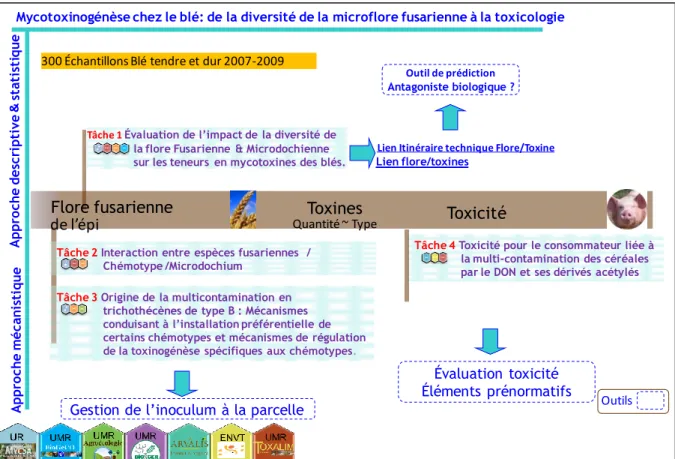
A flow diagram illustrates the joints and complementarities between the various tasks of the project (Fig. 4). My PhD work is part of task 3.
I should mention that the Conseil Regional de Bourgogne contributed to the financial support of field experiments to promote the regional research for innovation in the frame of Le Plan d'Actions Régional pour l'Innovation (PARI)-Agrale 7: Impacts des pratiques agricoles sur le fonctionnement géochimique des sols et la qualité de l’environnement.
The present document will give first a general overview of what are mycotoxins and will focus more on Fusarium mycotoxins. Following this literature review, we limited our research using one strain of F. graminearum and one mycotoxin, the deoxynivalenol, as study models. A chapter is dedicated to the materials and methods used to address the above mentioned questions. Then we will explain how we dealt successively with a field approach and a microcosm approach using both classical microbiology, molecular biology and biochemistry tools. A general discussion will consider all the findings for each of the approaches to provide the answers on the one hand the impact of deoxynivalenol on bacteria, fungi, protozoa, nematodes and earthworms present in soil and residues and secondly to define the putative competitive advantage the mycotoxinogenic fungus gets from this molecule released into its surrounding environment.
19 300 Échantillons Blé tendre et dur 2007-2009
App ro ch e de sc ri pt ive &st at is ti q u e Toxicité Toxines Flore fusarienne Quantité ~ Type
Tâche 1 Évaluation de l’impact de la diversité de
la flore Fusarienne & Microdochienne sur les teneurs en mycotoxines des blés.
Tâche 2Interaction entre espèces fusariennes /
Chémotype /Microdochium
Tâche 3Origine de la multicontamination en
trichothécènes de type B : Mécanismes conduisant à l’installation préférentielle de certains chémotypes et mécanismes de régulation de la toxinogénèse spécifiques aux chémotypes.
Ap p ro ch e m é ca n is ti q u e Lien flore/toxines Outil de prédiction Antagoniste biologique ?
Lien Itinéraire technique Flore/Toxine
Tâche 4Toxicité pour le consommateur liée à
la multi-contamination des céréales par le DON et ses dérivés acétylés
Évaluation toxicité Éléments prénormatifs
Gestion de l’inoculum à la parcelle Outils
Mycotoxinogénèse chez le blé: de la diversité de la microflore fusarienne à la toxicologie
de l’épi
Fig. 4: Joints and complementarities between the various tasks of the project DON&Co
supported by the ANR.
20
Chapter 1: Ecological role of mycotoxins
21
Ecological role of mycotoxins
1- Introduction:
The chemical machinery of a fungus produces different kind of metabolites and enzymes, which are necessary to perform the basic metabolic processes and the production of energy. Apart from these basic needed compounds, some low molecular weight organic compounds are also produced which are known as secondary metabolites. These chemical compounds are not needed for the basic requirements of the producer (Fox and Howlett, 2008). The fungal secondary metabolites may include the pharmaceutically beneficial compounds as penicillin (Demain, 1999), plant growth regulators as gibberellins (Candau et al., 1992) and as well as the harmful compounds (for human and animals) known as “Mycotoxins”. These are the poisons produced by a moderate number of filamentous fungi also known as molds (Bhatnagar et al., 2002; Yu and Keller, 2005). Mycotoxins are dangerous to the vertebrates and reported to produce many severe diseases (known as Mycotoxicosis) in human and animals (Pestka, 2010; Richard, 2007). These chemicals may be acute to chronic poisons depending on their types, even in very low quantity to the high dose (Bryden, 2007; Döll and Dänicke, 2011).
The significance of mycotoxins was realized in 1961, with the discovery of first mycotoxin known as aflatoxin. In 1960, the brutal disease of young turkey birds known as Turkey X disease killed 100,000 turkeys on the consumption of mold contaminated feed. This was the first time that the proper cause of this disease by mold contaminated food was recognized (Desjardins and Hohn, 1997). However, they have always been dangerous to human and domestic animals in the past. The history of diseases caused by the consumption of these mycotoxins producing molds contaminated food is very old. One of the famous examples is Ergotism. Its epidemics called “St. Anthony’s Fire”, led to the death of thousands of humans in Europe in the Middle Ages (Dotz, 1980). Ergotism is caused by utilization of cereal grains (usually rye), infected with toxin producing fungi Claviceps purpurea, which produces toxins known as Ergot alcaloids. Alimentary toxic aleukia (ATA) is another notorious example which caused the death of more than 100,000 people in USSR from 1942 to 1948 (Pitt, 2000). Later investigations showed that ATA was caused by eating Fusarium spp. infected grains which were contaminated by T-2 mycotoxin.
22
The discovery of mycotoxins opened a new era of importance in the health of Human and animals and since then hundreds of mycotoxins have been discovered. These mycotoxigenic (toxin producing) fungi are present all around the world and causing the great loss to the world’s agriculture (Goswami and Kistler, 2004). The disease caused by these molds, reduces the seed vigor, crop yield, grain quality, make them poisonous to human use, which leads to the great economic loss for a farmer as well as to a country (Windels, 2000; Wu, 2007). These mycotoxins are produced in the cereals, fruits as well as in vegetables, in the field, during transportation, storage and processing (Drusch and Ragab, 2003; Goswami and Kistler, 2004; Moss, 2008). The problem of mycotoxins fluctuates from year to year by the changes in the environmental conditions favorable for the production of mycotoxins and the development of the producing fungi (Logrieco et al., 2002). The world scientists, decided to limit the mycotoxin in food stuff consuming for the human and animal, in order to avoid the adverse effects. European Union (EU) has set the limits for most commonly found Agro-economical important mycotoxins in different crops including cereals as wheat, maize, oats (The commission of the European communities, 2007).The text (CE 1126/2007) published by these EU commission is provided in Annexe at the end of thesis.
The cereal diseases caused by the toxin producing fungi got the world’s attention as the grains contaminated with mycotoxin reduce the quality as well as the production (Placinta et al., 1999). About 25% of the world’s food is contaminated by mycotoxin annually. This phenomenon causes a great loss every year to the cereal producers and exporters. These fungal toxins are constant threat to the economic losses and the regular danger to the health of human beings and animals. Once they are produced in the food, it is difficult to eliminate them during cooking and industrial processing as they are highly stable to heat (Bullerman and Bianchini, 2007). The vertebrates including animals and human being are greatly affected by the presence of mycotoxins in the food. The disease symptoms caused by mycotoxins is known as “Mycotoxicosis”. The investigations show that mycotoxins may cause very serious effects on the eukaryotic cells. They may inhibit the protein synthesis, DNA and RNA synthesis, disturb the mitochondrial function, affect the normal cell division (Bin-Umer et al., 2011; De Walle et al., 2010; Kouadio et al., 2007) and may lead to severe diseases in human and animals. T-2 toxins are found to induce maternal and fetal toxicity in pregnant mice and rats (Doi et al., 2008). Mycotoxins may cause acute and chronic poisoning to vertebrates. The adverse effects of mycotoxins on human and animal health are highly important topic of research since decades. They may produce disturbance in the immunity system, liver damage,
23
diarrhea, vomiting, cancer and many other sever diseases (Fokunang et al., 2006; Peraica et al., 1999; Placinta et al., 1999; Reddy et al., 2010; Ross et al., 1992; Shephard, 2008; Wild and Gong, 2010). The mycotoxins are not only present in the food and feed stuff, they are even reported in the indoor air and indoor environment damp including homes and buildings, and can cause the health risk by inhalation (Hendry and Cole, 1993; Jarvis and Miller, 2005; Robbins et al., 2000).
In this review, we will investigate the ecological role of mycotoxins in the environment shared by micro to macro world and prokaryotes to eukaryotes on the basis of the research conducted up to date.
2- Major Mycotoxins:
More than 300 fungal secondary metabolites are declared as mycotoxins due to their harmful effects on vertebrates. Most of these mycotoxins are produced by the fungal species belonging to three genera i.e. Fusarium, Aspergillus and Penicillium. All the species related to these three genera are not toxigenic. Fusarium is known as the field fungi due to the production of mycotoxins in the field while Aspergillus and Penicillium are called storage fungi as generally these two genera are known for the production of toxins postharvest or during the food storage. The list of some frequently found important mycotoxins and their major producers are given in the Table 1.
No doubt all the mycotoxins have their importance but the mycotoxins produced on the cereal are considered more important and extensive data is available on them. These mycotoxins are produced during the growth of crop while standing in the field, so very difficult to avoid them from food chain. Among the cereal mycotoxins, trichothecenes, zearalenone and fumonisins are considered most important cereal mycotoxins from animals and human health point because of both their toxicity and their frequency of presence in the cereals (González-Osnaya and Farrés, 2011; Luo et al., 1990; Omurtag, 2008; Thuvander et al., 1999). European Union has established the limits for some extensively found mycotoxins including deoxynivalenol (DON), zearalenone (ZEA) and fumonisins (FUM) (The commission of the European communities, 2007).
Trichothecenes are a large group of agriculturally important mycotoxins containing more than 150 members which are mainly produced by different Fusarium species. Trichothecenes are accumulated in the kernels of Fusarium spp infected spikelets of many cereal crops including wheat, maize, barley, rye and oat etc and rendering them inapt for the consumption of human
24
and animals (Nielsen et al., 2009). Trichothecenes are simple to complex mycotoxins and divided in four types (A, B, C and D) based on the substitution pattern of EPT (12,13-epoxytrichothec-9-ene) (reviewed by McCormick et al., (2011)). Type A trichothecenes (TCTA) and Type B trichothecenes (TCTB) are the most frequently found important trichothecenes produced by different Fusarium spp (Table 1). Most of them are related to Fusarium head blight (FHB) disease (Foroud and Eudes, 2009). Type A trichothecenes are considered more toxic than Type B trichothecenes as T-2 is considered about 10 times more toxic than DON (Thuvander et al., 1999). These mycotoxins are reported in all the regions of the world due to the producing fungal adaptation to the different environments in USA, Asia and Europe (Ward et al., 2008; Yli-Mattila, 2011; Yli-Mattila et al., 2011). Different countries including USA, Canada and European Union made the legislations against certain frequently founds mycotoxins of this group. The most frequently found Type A trichothecenes includes T-2 toxin (T-2), HT-2 toxin (HT-2) and 4,15-diacetoxyscirpenol (4,15-DAS) (Mateo et al., 2002). The most frequently found major Type B trichothecenes includes nivalenol (NIV), deoxynivalenol (DON), 3-O-acetyl DON (3 ADON) and 15- O-acetyl DON (15 ADON) (Fig. 1).
DON
15 ADON 3 ADON
NIV
Fig. 1: Molecular structures of Trichothecene-B produced by F. graminearum and F.
25
The most commonly reported mycotoxin in the cereal crop is DON and considered one of the most important member of trichothecenes (Foroud and Eudes, 2009). DON is produced by Fusarium graminearum and F. culmorum on several cereal crops under wide range of environments (Doohan et al., 2003). These fungi are associated to the production of the notorious FHB disease of cereal. FHB has appeared in many outbreaks and caused high losses in different ages all around the world. DON interrupts the protein synthesis, reduces nutritional efficiency, reduces immunity system, causes diarrhea and vomiting etc (Fokunang et al., 2006; Placinta et al., 1999; Sobrova et al., 2010; Wild and Gong, 2010). In the Fusarium-infected cereals DON is also followed by very important type B trichothecenes i.e. NIV and 3ADON and 15 ADON but they occur at lower levels than DON. European Union (EU) has made the legislations against the consumption of DON in our cereal food products. The maximum limit for DON in unprocessed cereals other than durum wheat, oats and corn at 1250 µg / Kg (1250 ppb) and for maize at 1750 µg / Kg (1750 ppb) for human consumption. Higher doses are accepted for animal feeding (The commission of the European communities, 2007).
In trichothecene type A T-2 and HT-2 toxins are also of the main mycotoxins. They are very stable compounds and produced by F. poae, F. sporotrichoides, and F. acuminatum. T-2 toxin, inhibits both protein synthesis and mitochondrial translation (Bin-Umer et al., 2011) and produces many disease symptoms in animals as alimentary toxic aleukia (ATA), weight loss, decreases in leukocyte count and blood cell and can seriously damage the liver and stomach (Weber et al., 2010). The combined temporary tolerable daily intake (TDI) for T-2 and HT-2 is established at 0.06 μg / Kg body weight (Scientific Committee on Food on Fusarium-toxins, 2002).
Zearalenone (ZEA) is also one of the most commonly found mycotoxins produced by Fusarium species (Table 1) and co-occurs with trichothecenes in cereals (González-Osnaya and Farrés, 2011). It is mainly produced by F. graminearum, F. culmorum and F. langsethiae. It is a non-steroidal estrogenic fungal toxin towards animals and is associated to the grains infected by FHB in cereal crops. EU has made the legislations also for ZEA due to its frequent presence in the food and threat to the animals. The limit for ZEA is 100 µg/Kg (100ppb) in unprocessed cereals other than corn and is 200 µg / Kg in unprocessed maize to (200 ppb) (The commission of the European communities, 2007).
Fumonisins is a group of mycotoxins mainly divided in four types (i.e. A, B, C and P) on the basis of their chemical structure. Fumonisins are found all around the world (Marasas, 1996)
26
and are produced by many Fusarium species including Fusarium verticillioides, F. moniliforme and F. subglutinans in Europe (Marasas, 2001; Visconti and Doko, 1994). Fumonisins produce the mycotoxicoses in animals through the interruption of sphingolipid metabolism by hindering ceramide synthetase (Marasas et al., 2004).These mycotoxins are reported on many cereals including wheat, maize, barley and sorghum (Visconti and Doko, 1994) but more often in maize. Its limit in Europe is fixed at 2000 ppb for unprocessed maize and at 200 ppb for the processed maize-based foods and baby foods for infants and young children (The commission of the European communities, 2007).
27
Mycotoxin
Major fungi
Reference
Deoxynivalenol (DON) Fusarium graminearum, F. culmorum (Audenaert et al., 2009; Gang et al., 1998; Manka et
al., 1985; Mirocha et al., 1989; Mirocha et al., 1994) 3- O-acetyl deoxynivalenol (3ADON) F. graminearum, F. culmorum (Audenaert et al., 2009; Manka et al., 1985; Mirocha
et al., 1989; Mirocha et al., 1994)
15- O-acetyl deoxynivalenol (15ADON) F. graminearum, F. culmorum (Audenaert et al., 2009; Mirocha et al., 1989)
Nivalenol (NIV) F. graminearum, F. culmorum, F.poae (Gang et al., 1998; Mirocha et al., 1994; Thrane et
al., 2004)
Zearalenone (ZEA) F. graminearum, F. culmorum, F. sporotrichioides, (Greenhalgh et al., 1983; Manka et al., 1985) Fumonisins ( FB1, FB2,F B3) F. proliferatum, F. verticillioides ( Marasas, 2001; Ross et al., 1992; Visconti and
Doko, 1994)
T-2 toxins (T-2) F. sporotrichioides, F. poae, F. acuminatum, F. langsethiae (Rabie et al., 1986; Thrane et al., 2004)
HT-2 toxins (HT-2) F. sporotrichioides, F. poae, F. langsethiae (Thrane et al., 2004)
Diacetoxyscirpenol (DAS) F. sporotrichioides, F. poae, F. langsethiae (Thrane et al., 2004) Moniliformin (MON) F. subglutinans, F. acuminatum, F. concolor, F. equiseti,
F. semitectum, F. acuminatum, F. concolor, F. oxysporum
(Irzykowska et al., 2012; Lew et al., 1996; Marasas et al., 1986; Rabie et al., 1982)
Enniatin (EN) F. langsethiae, F. tricinctum (Meca et al., 2010; Thrane et al., 2004)
Beauvericin (BEA) F. sporotrichioides, F. poae (Thrane et al., 2004)
Aflatoxin (B1, B2, G1, G2) Aspergillus. flavus, A. parasiticus, A. nomius (Elshafie et al., 2002; Olsen et al., 2008; Yu et al., 1995)
Ochratoxin A A. ochraceus, A. carbonarius (Kapetanakou et al., 2009)
Patulin Penicillium expansum, P.patulum (Abrunhosa et al., 2001; Aziz and Moussa, 2002;
Northolt et al., 1978) Table 1: Some commonly found mycotoxins and major producer fungi.
28
3- Molecular basis of Trichothecenes:
The biosynthesis of mycotoxins is a complex process and mainly depends on the genetics of fungi. It can be affected by various factors including the environmental conditions and the nature of the substrate and the external (biotic or abiotic) stress (Paterson and Lima, 2011). The amount of mycotoxin produced cannot be estimated by the growth of fungi in the kernels as all the environmental conditions must be taken into account (Shim et al., 2003).
The fungal genetics have a fundamental importance in the mycotoxin type and the amount of mycotoxin production on the same substrate (Vogelgsang et al., 2008). There can be different chemotypes within the same species producing specific mycotoxins as well as the different species can produce the same chemicals (Reynoso et al., 2011; Yli-Mattila and Gagkaeva, 2010). The geographical area determines the chemical phenotype of mycotoxin producing fungi. Various trichothecene chemotypes are reported to be associated with FHB in the different parts of the world: 3ADON chemotype of F. graminearum population is dominant in the major wheat growing area in the North America and is rapidly replacing 15ADON chemotype (Ward et al., 2008). In Europe 15ADON is reported as the more dominating chemotype (Jennings et al., 2004; Prodi et al., 2009; Yli-Mattila, 2010). 3ADON and 15-ADON are more commonly found together in Japan (Suga et al., 2008). The biosynthesis of trichothecene in Fusarium is controlled by 15 Tri genes located at three different loci: a 12-gene core Tri cluster locus, a two 12-gene TRI1-TRI16 locus and a single 12-gene TRI101 locus (Alexander et al., 2009; Merhej et al., 2011). These genes play their roles at different steps of the pathway of trichothecene biosynthesis which starts from farnesyl pyrophosphate (FPP) and results in the formation of trichothecene through a series of reactions (Fig. 2). Calonectrine protein is formed from FPP through a cyclization by the functioning of Tri5, Tri4, Tri101, Tri11 and Tri3 (Alexander et al., 2011; Alexander et al., 2009; Brown et al., 2002; Lee et al., 2002). These steps are common in the both T-2 toxin producing F. sporotrichioides and Trichothecene B (TCTB) producing F. graminearum. The involevement of Tri13 and Tri7 leads to the formation of 3,4,15-Triacetoxyscirpenol. FsTri1, FsTri16 and Tri8 lead to the formation of T-2 toxin in F. sporotrichioides. In F. graminaerum FgTri1 genes makes the way to the formation of TCTB either from calonectrine or from 3,4,15-triacetoxyscirpenol (Brown et al., 2001, 2002; Lee et al., 2002). Tri6 and Tri10 genes are regarded as regulators genes for the other genes and their deletion in F. graminearum is reported to reduce the pathogenicity in plants (Seong et al., 2009).The functioning of Tri7 and
29
Tri13 genes determine the Chemotype NIV while these are not active in DON producing strains (Brown et al., 2002; Lee et al., 2002). Tri8 gene is found to behave differently in 3-ADON and 153-ADON chemotypes in F. graminearum. In 33-ADON chemotypes Tri8 gene deacetyl 3,15-Acetyl DON at 15 carbon atom to form 3ADON and in 15ADON chemotype it deacetyl 3,15-Acetyl DON at 3 carbon atom to convert it into 15ADON (Alexander et al., 2011).
30
DON
3 ADON 15 ADON
4,15-diANIV
TRI8 TRI7 TRI3 TRI4 TRI6 TRI5 TRI10 TRI9 TRI11 TRI12 TRI13 TRI14 TRI16 TRI11 24 kb
Farnesyl pyrophosphate
trichodiene
isotrichodermol
isotrichodiol
isotrichodermin
15-decalonectrin
calonectrin
3,15-diacetoxyscirpenol
3,4,15-triacetoxyscirpenol
3-acetylnesolaniol
3-acetyl T -2 toxin
T-2 Toxin
Tri5 Tri4Tri-6
Tri-10
? Tri101Tri11 Tri3 Tri13
FsTri1 Tri7 FsTri16 Tri8 FgTri1 FgTri1
Trichothecene B
7,8-dihydroxycalonectrin
7,8-dihydroxy-TAS
(3,15-ADON)
Tri13 3,15-diANIVTri 7 3,4,15-triANIV
4-ANIV
NIV
FgTri8Trichothecene A
?
?
?
?
?
?
trichotriol
? RegulatorsFig. 2: A proposed biosynthetic pathway of trichothecene B and T-2 toxin in F. graminearum and F. sporotrichioides and the genes involved at
31
4-Factors affecting the production of Trichothecene B:
Generally, fungicides are considered to control the growth of pathogen in order to reduce the disease, ultimately the mycotoxins but by the time they have increased the fungal adaptation to them (Becher et al., 2010). In practical, fungicides are found in complex relationship with the disease development and the mycotoxin production (Magan et al., 2002). The use of some fungicides acts as a stress for fungus and enhance the production of mycotoxins (Mesterhazy et al., 1999; Moss, 2008). Prothioconazole fungicide can induce H2O2 in the plant cells which
triggers the DON production (Audenaert et al., 2011). The biological components of the environments affect the production of mycotoxins as the presence of other fungi in the neighborhood can change the production of mycotoxins (Cooney et al., 2001; Xu et al., 2007). Apart from the genetics of the fungi, the genetic variability of host plants has also key importance in the disease production and the mycotoxin production (Mesterhazy et al., 1999) . The environmental factors including temperature and the water activity have also a great contribution in the production of mycotoxins by a fungal strain. In the literature, the studies are based on the production of mycotoxins in the in-vitro conditions. The temperature, humidity as well as the pH may increase or decrease the fungal growth and development as well as the production of mycotoxins (Garcia et al., 2011; Kokkonen et al., 2010; Lasram et al., 2010; Mateo et al., 2002; Medina and Magan, 2011; Mylona and Magan, 2011; Pose et al., 2010; Price et al., 2005; Ramirez et al., 2006; Schmidt-Heydt et al., 2008; Spadaro et al., 2010). The filamentous fungi may have different optimal temperature and humidity for the toxin production than for the optimal conditions required for its mycelia growth. (Ramirez et al., 2006) studied that F. graminearum showed highest growth at 25°C on water activity (aw) 0.995 while DON production was maximum at degrees 30°C on the same water activity. The optimal water activity (aw) for the growth of fungus was from 0.900 to 0.995 but for mycotoxin fabrication was from 0.950 to 0.995. The acidic pH usually favours the mycotoxin production (Keller et al., 1997; Spadaro et al., 2010). The acidic pH in the de-germed maize kernel favours the production FB1 mycotoxins than germed tissue in which the pH becomes basic (Shim et al., 2003). In an in vitro study (Merhej et al., 2010) demonstrated that Tri genes are stimulated as the pH goes from neutral to acidic and stimulates the production of trichothecene B (TCTB).
The increase in the resistance in the plants may decrease the production of the disease which ultimately can be helpful in the reduction of the accumulation of mycotoxins. The
32
composition of the substrate is the major factor in the mycotoxin production (Bouras and Strelkov, 2010; Kheiralla et al., 1992; Kokkonen et al., 2005; Mateo et al., 2002; Vogelgsang et al., 2008).The phase of the kernel development can have an effect on the production of mycotoxins. The embryonic stage of grains (presence of amylopectin) induces Fumonisin B1 (FB1) production by F. verticillioides and it is not produced in its absence (Bluhm and Woloshuk, 2005). Some plant molecules are also reported to activate the production of mycotoxins as polyamines trigger TRI genes expression and to increase the trichothecenes biosynthesis in F. graminearum (Gardiner et al., 2009). Sugar (sucrose, 1-kestose and nystose) activates Tri4 and Tri5 expressions and increases DON and 3ADON production in F. graminearum (Jiao et al., 2008).
5- Ecological role of mycotoxins:
5.1- Mycotoxins in the multitrophic interaction in soil:
It is foremost important to know the place of the mycotoxins in the environment to understand their possible role. Filamentous fungi are reported all around the world in the wide range of environment and produce disease in cereals as well as in fruits and vegetables in the field on the standing crops, after harvest and during storage (Olsen et al., 2008; Pietri et al., 2004; Placinta et al., 1999; Reddy et al., 2010). The disease incidence and the mycotoxin production varies from year to year and region to region.
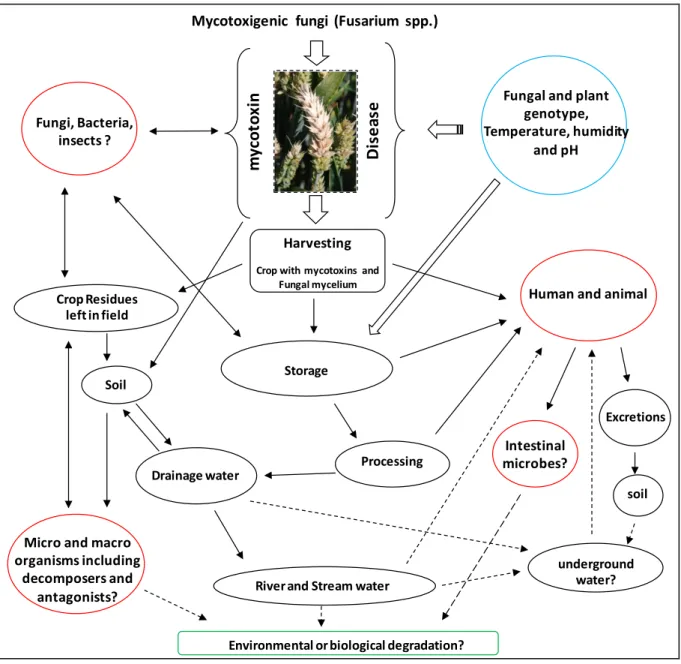
Once the mycotoxins are produced they can get opportunity to flow in the environment. The production of mycotoxins in the field (as cereals) is difficult to control due to the open environmental conditions. Mycotoxins from the plants (i.e. grains, spike, spikelets, leaves and stem) enter to the environment shared by plants, vertebrates, micro and macro fauna and flora and even the producer themselves. One part of mycotoxins remains in the crop residue in the fields and the other goes to storage, milling and processing. The flow in the environment depends on the stability to adverse environmental conditions as temperature, pH, and solubility. Most of the mycotoxins are usually found resistant to the high temperature and adverse environmental conditions (Bullerman and Bianchini, 2007; Lauren and Smith, 2001) and are more or less soluble in the water. These properties make them to flow easily in the environment.
33
The crop residues in the field contaminated with mycotoxins are potentially dangerous to the environment. The rain water may solubilize the mycotoxins and take them to the field soil and drainage water (Fig. 3). A very few research is done in this potential environmental issue. Zearalenone (ZEA) is reported in the field soil and drainage water from the wheat contaminated with F. graminearum (Hartmann et al., 2008). The water samples collected animal feed processing mills and animal farms have also confirmed the presence of mycotoxins in the water which may be a threat to the environment (Aragon et al., 2011; Gajêcka et al., 2011; Gromadzka et al., 2009). The samples collected from various rivers of Switzerland confirmed the presence of deoxynivalenol and zearalenone (Bucheli et al., 2008). DON and ZEA were also recovered from the streams of United States (Wettstein et al., 2010). This may be dangerous to the water life of the river when in high quantity but this is still a question to be addressed.
The fungal toxins are found to be not only dangerous to the animals who consume them but they could also be transferred to humans by animal milk (Signorini et al., 2012) which goes back to the environment and make them risk for human health. Even a significant amount of DON is reported in the eggs of hens which were fed on the DON contaminated cereal feed (Sypecka et al., 2004) which is the indirect exposure of humans to the mycotoxins. Mycotoxins are also recovered from animal feces and human urine (Warth et al., 2012). During the last few decades, of most part of research on mycotoxin focused on their effects on human and animals. Unfortunately, the role of mycotoxins in the life of fungi and their need for the producer fungi is not fully elicited and is still a mystery. By definition, mycotoxins are secondary metabolites and are not needed for the normal growth, development, energy production, the metabolic activity and the reproduction of their producers (Fox and Howlett, 2008; Karlovsky, 2008). As they are not needed for the primary functions of a fungi, so their role in the life of fungi becomes a big question.
Fungi may contest against other organisms in their ecology in diverse ways including growing faster than competitors, sporulation under stress conditions, hindrance for competitors, colonization of diverse hosts and substrates. We will try to summarize how these mycotoxins can help the fungi in life under the light of some basic but important questions and research taken place up to date.
34 Processing
Soil
River and Stream water
underground water? Di se as e Harvesting
Crop with mycotoxins and Fungal mycelium
Human and animal
Intestinal
microbes?
Fungal and plant genotype, Temperature, humidity and pH m yc o to xi n Drainage water
Mycotoxigenic fungi (Fusarium spp.)
Environmental or biological degradation? Storage Crop Residues left in field Excretions soil Fungi, Bacteria, insects ?
Micro and macro organisms including
decomposers and antagonists?
Fig. 3: Possible flow of mycotoxins in the environment (black coloured circles), its
interaction with other organisms (red coloured circles) .The conditions which can favour mycotoxin production (blue coloured circle). Single end arrow represents the flow of mycotoxin or mycotoxin+producer fungi while two end arrow shows the competition between mycotoxigenic fungus and the other organisms. The question marks and the dotted arrows indicate the need for further research in these places.
35
5.2- Do mycotoxins help in disease production or fungal development and
colonization on plants?
In general, most of the mycotoxin producing fungi are plant pathogens. So, the general perception is that mycotoxin helps in the production of disease. The role of mycotoxin in the primary infection is investigated extensively. All the reports shows that mycotoxins are not involved in the primary fungal infection on the plants for the disease production. The mycotoxin non producing mutants showed the same disease production as the mycotoxin producing wild type fungi (Bai et al., 2002). On the other hand, mycotoxin producing pathogens are found more virulent than their mutagens. In some studies NIV and DON are reported to play a significant role in the virulence of pathogen fungus and help in colonization in the plant tissue. In Fusarium spp. trichothecenes producing genes are activated and the mycotoxin production is increased during the colonization of stem and grains in cereals. (Bai et al., 2002; Desjardins et al., 1996; Hallen-Adams et al., 2011; Harris et al., 1999; Mesterhazy et al., 1999; Mudge et al., 2006). Wang et al., (2006) described that disrupted DON production in F. graminearum decreases the aggressiveness on wheat, barley and triticale seedling root infection. Mycotoxin producing fungi are found more aggressive than the mycotoxin non producing fungi. F. culmorum isolates producing DON were found more aggressive than the isolates producing NIV in wheat crop (Muthomi et al., 2002). This indicates that chemotype of a fungus also has a significant importance in the aggressiveness of a pathogen during disease development process. Previously it was also reported that hydrogen peroxide (H2O2) which may induce the programmed cells death is induced in the
plant cells in response to the release of DON by fungus (Desmond et al., 2008; Gechev and Hille, 2005). The fungal toxins activate the cell death in the host cells which may help colonization the fungus (Desmond et al., 2008).
This discussion concludes that the mycotoxins are not involved in the production of disease but increase the aggressiveness of pathogen which helps the fungus rapid colonization. This rapid colonization may give an advantage to mycotoxin producer fungus over the other competitors during plant infection. Thus the fungus may occupy large part of plant material before it becomes ecological habitats in the soil which possibly help the fungus during its subsequent saprophytic survival.
36
5.3 - Do mycotoxins help in fungal survival under environmental stress?
This is one of the most important question comes in our mind about the role of mycotoxins in the fungal life which was completely ignored previously. The production of mycotoxins is affected by many environmental and biological stresses as we described earlier. Various environmental stresses increase the production of mycotoxins. This gives us a clue about the role of mycotoxins in the fungal life under stress. This hypothesis can be supported by the research argument which indicates that the sporulation and secondary metabolites are genetically connected and controlled by the common factors. For example the asexual spore production and the mycotoxins i.e. sterigmatocystin and aflatoxin production in Aspergillus spp. are related to the same genetic basis (Hicks et al., 1997; Kale et al., 1994; Kale et al., 2003). A direct relationship was observed in the conidia production of Claviceps purpurea and toxic alkaloids on agar plates (Pažoutová et al., 1977). It has also been investigated that the genes (FCC1) involved in the signal transduction are the same for regulating fumonisin biosynthesis as well as fungal conidia formation in F. verticillioides (Shim and Woloshuk, 2001).
The correlation between mycotoxins production and sporulation points out hypothesis that mycotoxins might be involved in the survival of fungus under adverse conditions. The production of secondary metabolites including many Fusarium and Penicillium mycotoxins and the sporulation are regulated by the same signaling G-proteins signalling pathways (reviewed by Brodhagen and Keller, (2006)). Zearalenone takes part directly or indirectly in formation of perithecia in Gibberella zeae (teleomorph of F. graminearum) (Wolf and Mirocha, 1973, 1977). The stress may stimulate the production of zearalenone (Kim et al., 2005) and can serve as a fungal tool for survival in the adverse conditions. On the other side, this perithecia formation was found to be highly dependent on mycotoxin dose. A high dose of zearalanone may inhibit the spore formation of the producer fungi (Mirocha and Swanson, 1983). This may help in the increasing fungal inoculum for infection and help in survival. Further investigations are needed in this regards in order to suggest the better control of fungi producing environmental threat.