RESEARCH OUTPUTS / RÉSULTATS DE RECHERCHE
Author(s) - Auteur(s) :
Publication date - Date de publication :
Permanent link - Permalien :
Rights / License - Licence de droit d’auteur :
Institutional Repository - Research Portal
Dépôt Institutionnel - Portail de la Recherche
researchportal.unamur.be
University of Namur
Does Aid Induce Brain Drain? The Effect of Foreign Aid on Migration Selection Ugarte Ontiveros, Darwin; Verardi, Vincenzo
Publication date:
2010
Link to publication
Citation for pulished version (HARVARD):
Ugarte Ontiveros, D & Verardi, V 2010 'Does Aid Induce Brain Drain? The Effect of Foreign Aid on Migration Selection'.
General rights
Copyright and moral rights for the publications made accessible in the public portal are retained by the authors and/or other copyright owners and it is a condition of accessing publications that users recognise and abide by the legal requirements associated with these rights. • Users may download and print one copy of any publication from the public portal for the purpose of private study or research. • You may not further distribute the material or use it for any profit-making activity or commercial gain
• You may freely distribute the URL identifying the publication in the public portal ?
Take down policy
If you believe that this document breaches copyright please contact us providing details, and we will remove access to the work immediately and investigate your claim.
Does Aid Induce Brain Drain? The
Effect of Foreign Aid on Migration
Selection
CRED WP 2010/12
Darwin Ugarte and Vincenzo Verardi
Center for Research in the Economics of Development
University of Namur
Does aid induce brain drain? The effect of
foreign aid on migration selection
∗
Darwin Ugarte
†and Vincenzo Verardi
‡.
November 16, 2010
Abstract
Recent evidence suggests that aid induces migration. However, total migra-tion is quite general from a policy perspective since what explains the welfare consequences of migration is the extent of emigration selection. In this paper we ask whether skilled or unskilled migration is more sensitive to aid and to the different mechanisms through which aid may affect self-selection among interna-tional emigrants. We show that aid induces positive selection. And that the effect on skilled migration is larger than the effect on unskilled migration. As possible mechanisms to explain the relation, we find that aid induces skilled migration by reducing transaction and information costs, by improving the distribution of schooling, and by helping to overcome liquidity constraints.
KEYWORDS: Foreign aid, International migration, Self-selection, Brain drain. JEL CLASSIFICATION: F35, F22, C23
1
Introduction
The international mobility of workers is perceived by several authors as a key issue in economic development. South to north migration has increased over time and reached very high levels. To give a broad idea of the situation, estimates from the Organization
∗We would like to thank Jean-Philippe Platteau, Jean-Marie Baland, Fr´ed´eric Docquier, Ruxanda
Berlinschi, Fredrik Sj¨oholm and Alice McCathie for insightful comments that improved this paper as well as our colleagues at CRED and ECARES. The usual disclaimer applies.
†University of Namur (CRED). E-mail: [email protected].
‡University of Namur (CRED) and Universit´e Libre de Bruxelles (ECARES and CKE). E-mail:
[email protected]. Vincenzo Verardi is Associated Researcher of the FNRS and gratefully acknowl-edges their financial support.
for Economic Co-operation and Development (OECD, 2008), reveal that more than one half of OECD countries have a stock of immigrants that exceeds 10% of their total population. Many of these immigrants come from developing countries (LDCs) and are relatively low skilled workers (i.e. with less than a tertiary education attainment). However, as highlighted by Docquier and Marfouk (2006), the share of skilled migrants is increasing over time. They estimate that between 1990 and 2000, the proportion of skilled over total migrants raised from 25% to 29%.
The selection of international emigrants by education level is a central issue for both research and policy analysis since its extents explains the migration’s positive and neg-ative consequences for both sending and receiving countries. To caricature, we could summarize the debate by asserting that migration hosting countries are interested in managing low-skilled (and illegal) immigration while migration sending countries are interested in retaining human capital by reducing the outflow of the highly skilled. The desire of reducing low-skilled migration in OECD countries rests on the fact that, as suggested by Drinkwater et al. (2007), the gains from immigration (the so-called immi-gration surplus) increase proportionally to the level of training of the immigrants. The reason is that low skilled immigration lowers the low-skilled wage in hosting countries (Borjas, 2003) and, by filling the shortage of low skilled-workers, it reduces the working possibilities for lowly qualified native workers (Borjas, 2006). Furthermore, less skilled migrants pay less taxes and have a higher propensity to receive welfare benefits than native households, Lee and Miller (2000). They increase therefore the net tax burden on the natives.
In order to deal with these disequilibria, it has been suggested that, to reduce un-wanted migration, it could be necessary for OECD countries to target some of their de-velopment aid specifically to migration (see for example B¨ohning and Schloeter-Paredes, 1994, IOM and UNCTAD, 1996, Stalker, 2002, Lowell and Findlay, 2006, and OECD, 2008). The underlying idea being that aid would act against the alleged root causes of migration.
From the perspective of LDCs, the problem is different. They are concerned by the emigration of the highly skilled. Even if the debate is ongoing, see Mountford (1997), and Beine et al. (2001), most authors view brain drain as a threat for four main reasons. First, following Bhagwati and Hamada (1974), through skilled migration LDCs would indirectly finance (part of) the human capital formation of foreign countries. Second, highly skilled individuals do not participate in their home country economic activity. Third, skilled migration induces distortions on the sending labour market, which results in a decrease in welfare. Finally, based on the endogenous growth literature, Haque and Kim (1995) and Wong and Yip (1999), suggest that brain drain reduces human capital formation and consequently long-term growth.
Given the fear of LDCs of losing their most skilled workers and the general negative perception of brain drain, many international organizations have proposed to using foreign aid as a policy alternative to reduce skilled migration (see UNCTAD, 2007, and Lowell and Findlay, 2006).
To summarize, international organizations see aid as a powerful tool to diminish both unskilled and skilled migration and, thus, meet the migratory objectives of both rich and poor countries.
The evidence about the effectiveness of this instrument to reduce migration suggests an opposite effect. Examples are case studies such as Faini and Venturini (1993) for Greece, Portugal, Spain and Turkey, Rotte and Vogler (2000) for Germany, and recently Berth´elemy et al. (2009), who in a cross-section sample by estimating jointly aid and migration in a simultaneous equation system show that aid and migration are complements. However, total migration is quite general from a policy perspective since what explains the welfare consequences of migration for both sending and receiving countries is the extent of emigration selection. By contrast, there has been practically no systematic empirical assessment to check what kind of migration (skilled and/or unskilled) aid effectively reduces. As a consequence, the relation between aid and migration selection remains rife with open questions.
In this paper we assess the effectiveness of foreign aid to reach its migration objec-tives, and investigate the impact of aid on the schooling gap between emigrants and non emigrants (migration selection), and on the skill composition of emigrants (i.e. skilled, and unskilled migration). Using the migration database constructed by Defoort (2008) and linking it to the international aid database (available from the OECD) we find ev-idence that on average aid is associated with the migration of the more educated. Our finding is that 1% of GDP increase in aid induces (in the short run) a 7% increase in skilled migration, and an increase in the selection rate of around 3% (i.e. the ratio high to low skilled among emigrants and non emigrants). The effect on skilled migration in the long-run is much larger: a 1% of GDP increase in aid leads to an increase of the steady-state skilled migration of about 11%. These results are robust to different identification strategies and specifications. The effect on the unskilled migration rate is small (2.5% in case of a 1% of GDP increase in aid).
We also test some specific mechanisms to clarify the influence of aid on the selection path of emigrants. Settled on the academic background provided by Roy (1951) and Borjas (1987), a growing literature featuring evidence on the determinants of the varia-tion in the quality of internavaria-tional immigrants by educavaria-tion level, such as Chiquiar and Hanson (2008), Fern´andez-Huertas (forthcoming) and Grogger and Hanson (2010), find that the major determinants of self selection among emigrants are the distribution of income in the host and home country, and pecuniary and non-pecuniary moving costs, which in turn depend on the skill level. In this framework, it is probable that inter-national cooperation may influence the self-selection of emigrants, by helping to reduce transaction costs (by providing opportunities for the highly skilled to migrate thanks to the attribution of scholarship grants), and reduce informational costs (by providing information on the donor countries). Through the different projects in LDCs, besides of providing information, aid also may create networks and screen high level professionals (by providing direct contacts and opportunities for high quality native professionals to be hired abroad). Moreover, since the costs to migrate may decrease (or increase)
in skill level and aid may increase education at home, see Dreher et al. (2008), it is very likely that international aid will encourage (or diminish) the emigration of the highly skilled by improving the distribution of schooling in LDCs. Aid also may modify incentives to migrate (by supporting growth, contributing to finance national incomes and thus increase wages)1. Whether skilled or unskilled are more sensible to better economic conditions is an empirical question.
At the present, when testing the complemental relation between aid and migration, Berth´elemy et al. (2009) suggest that skilled migrants are more sensitive to bilateral aid, whereas unskilled migrants are more affected by total aid. In a panel data frame-work, we test more specific mechanisms and show that the immediate effect of aid is positive selection, and that skilled migration is more responsive than unskilled to aid and to the different mechanisms through which aid may affect international migration. As explained in section 5, due to data restrictions, we limit ourselves to test only direct effects. We hence test the effect of technical cooperation (i.e. the part of aid consisting in financing scholarships, tuition fees, ticket flights, living allowances, etc). Here we as-sume overstaying of the fellows and conceive technical cooperation as a way to overcome budget constraints and reduce transaction and information costs for the most skilled. Second, we test the possibility of a positive effect coming from strong links between receipt and donor countries. Good relations are proxied by the proportion of bilateral to total aid. We assume that, the larger this proportion for a receipt-donor countries pair, the better the relations between them (compared to remaining donors). More bilateral contacts thus reduce information costs easing migration. Third, we analyze the effect of project aid, that is those funds used to implement specific projects in which allocation, financing and management are controlled by the donors. This category of aid provides direct contacts and opportunities for potential emigrants to work in donor countries. Fourth, we test the effect of the categories of aid delivered to improve educa-tion. We assume that these categories improve the distribution of schooling. Whether
1Since the link between aggregate aid and growth is weak, we consider in the analysis those
more educated people are more prone to honor migration costs and thus emigrate, that is costs are decreasing in skill level, is an empirical question. Finally, we test the ef-fect of categories of aid which were shown to be more likely to support growth. These categories of aid are developmental aid (Minoiu and Reddy , 2010), net aid (Gomanee et al., 2005), and short run impact aid (Clemens et al., 2004). We assume that they contribute to improve economic conditions in receipt countries, an thus induce (skilled or unskilled) migration by helping to overcome budget constraints.
The remainder of the paper is organized as follows: in section 2 we provide a de-scription of the data as well as some stylized facts. Section 3 presents the empirical methodology designed. Section 4 displays the results. Some mechanisms are sketched out and tested in section 5, whereas in section 6 we conclude.
2
Data and stylized facts
To measure migration we rely on Docquier and Marfouk (2006), and define the migration rate for country i, as the ratio of the total number of working age individuals (older than 25) with education level k, who were born in country i but live abroad, divided by the total number of individuals (older than 25) of country i with education level k. We consider that k is high (h) for tertiary education attainment, and low (l) for less than tertiary level attainment. Note that in this definition, migration is considered as percentage of the total labour force born in sending countries. From a practical viewpoint, this “migration rate” (mki,t) for a level of education k is estimated by
mki,t = M k i,t Mk i,t+ Ni,tk (1) where Mk
i,t is the number of individuals of country i at time t (aged 25 or more)
with a level k of education who migrated and Ni,tk is the number of these individu-als who did not migrate. This ratio has been estimated by Docquier and Marfouk (2006) for a large panel of countries for the years 1990 and 2000 for different
educa-tion levels. Defoort (2008) has extended this dataset to a broader period ranging from 1975 to 2000 for a set of 195 countries (with 5 years intervals). However, given the complications associated with identifying foreigners in receiving countries (information on the origin and skill of immigrants comes from national population censuses), they calculate migration rates considering only the six major receivers (Australia, Canada, France, Germany, the United Kingdom and the United States). These countries ac-count for approximately 85% of South to North skilled migration (see Defoort, 2008). Interestingly, these countries are also among the major aid donors, and account for ap-proximately 60% of the total aid from the Development Assistance Committee (DAC) countries. Thus, the skilled migration rate (mh
i,t), from Defoort (2008), is our first
vari-able of interest. Moreover, we calculate the unskilled migration rate (mli,t), which is the ratio of the proportion of migrants (Ml
i,t) from country i at time t with training level
l (obtained by subtracting Mi,th from Mi,tk) over the total number of nationals with low level education (Nl
i,t). Following Docquier et al. (2007), a rise in the migration rate by
education level k could be due to a rise in the level of migration among all education level or to a specific rise in the ratio of the proportion of k level educated emigrants by the same proportion among non-emigrants (represented by the selection rate). Thus to consider these global migration effects we also consider as dependent variable the total migration rate (mki,t, for all k education level), also available from Defoort (2008)2. In this way, the size of migration flows by education level is measured by the skilled migration rate, unskilled migration rate, and total migration rate.
Note that since only the population aged 25 years or over is considered in Defoort (2008)’s dataset, it excludes from the sample a large number of students who migrated to complete their education. One drawback of these migration indicators is that this rate does not discriminate between place of training or date of departure. In addition since it is constructed on population censuses, they do not take into account illegal immigrants. It can therefore be that the actual level of migration is higher than what
2Total, skilled and unskilled migration rates are monotonically transformed by ln[m/1-m], following
is measured. This should however not be a major concern for our empirical findings since, as we explain later, we control for country and time fixed effects.
Another measure we use is the selection rate. This variable can be seen as a measure of the difference in the skill ratio between emigrants and non migrants. It is defined by
si,t = ln Mh ij,t Ml ij,t Nh i,t Nl i,t ! (2) where si,t is the selection rate of sending country i to the hosting country j, in this
case represented by the six major receivers, at time t. The numerator in equation (2) represents the skill ratio for emigrants, i.e. the share of skilled and unskilled emigrants in receiving country j. The denominator represents the skill ratio for non migrants, i.e. the share of skilled and unskilled non migrants. Positive values of the selection rate means that emigrants are more educated than their non-migrant counterparts.
As far as foreign aid is concerned, we consider the Official Development Assistance (ODA) from the OECD. ODA is defined as the flow of grants and loans from donors and multilateral institutions, provided by official or executive agencies, to countries of the DAC list. As it is commonly done in the literature, we quantify the ODA by considering the net disbursements as a percentage of the Gross Domestic Product. Our key variable of interest is “bilateral ODA” from the six donors for which migration rates are available3, which is defined as the flows given directly by the government of one
country to another.
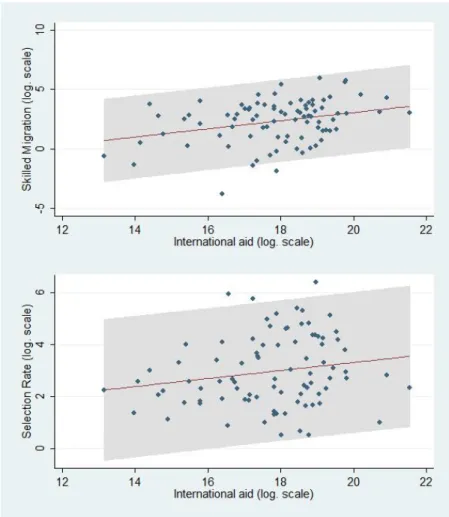
Before moving to the econometric analysis, it is interesting to look at the link between international aid and migration using some raw data. For this purpose, we plot, in Figure 1, the averaged over time skilled and selection rate (towards the 6 major migrant receivers) of all LDCs against the international aid they receive (from the same 6 major countries). The scale of both axes is logarithmic and 95% confidence intervals are shaded. The upper panel of Figure 1 presents the relation between aid and skilled
3However, by considering aid provided by all donors leads to identical results, which is expected
migration. It turns out to be, as we expected, upward sloping. The lower panel of Figure 1 presents the selection rate. Here again the slope of the regression line is, as anticipated, positive. From this very preliminary analysis, it seems hence that aid and the migration of workers belonging to the upper tail of the education distribution are positively linked. We therefore expect that the more international aid, the more educated are more likely to emigrate.
[Insert Graph here]
After these interesting stylized facts, we now move to a more complete econometric analysis.
3
Empirical Analysis
3.1
General specification
In our empirical analysis, we test for the link between international aid and our variables of interest by estimating parameter γ in the relation
Yit= γAidit+ Xitβ + δi+ τt+ εit with i = 1 . . . n and t = 1 . . . .T (3)
Subscript i and t denote country and year respectively, Yitare the migration variables
of interest (i.e. skilled migration mh
it, unskilled migration mlit, total migration mkit, and
selection rate sit), Aidit is the ratio of international aid on Gross Domestic Product
(GDP), Xit is a matrix of control variables and δi and τt are the individual and time
fixed effects respectively. As far as aid is concerned, to ensure consistency with the dependent variable, we only consider aid provided by the 6 major receivers of migrants. The variables considered in Xitare those generally perceived in the literature as inducing
migration (with the exception of the time invariant ones that are accounted for in the individual fixed effects). The variables included on Xitare: i) the lag of country i’s total
network or diaspora effect, note that by controlling for fixed effects, this variable turns out to be a good proxy for the change in migration policies of donor countries with respect to country i since it conveys information on the gap between the total number of migrants of country i (in year t) with respect to the time invariant number of migrants from country i; ii) total population in the country of origin to capture the country i’s size and potential migration; iii) the relative level of development and its squared value (proxied by the Real GDP per capita) to capture a potential “inverted-U” relationship between development and migration; iv) the percentage of individuals (over 25) with tertiary level education living in country i to control for the level of education in sending countries and (v) the Freedom House index as an aggregate indicator of social stability that measure the degree of freedom, political rights and civil liberties. The description and the source of these variables are presented in Table 1A in appendix.
It could be argued that by controlling for the level of education and income in period t, we could be biasing the results in favour of a positive effect of aid on migration by removing an eventual indirect channel through which aid could influence migration. To cope with this, we considered all control variables one (and five) year lagged, and the generality of the results remain unaffected. We also considered aid in t − 1 to grasp an eventual lag in the effect. Here, again the generality of the results does not change. Nevertheless, in section 4.3 we consider a more complete dynamic model to deal for a series of possible leads and lags.
Empirical studies on migration generally try to identify the causes of resettlements by calling on gravity models to separate pull effects (i.e. migration outcomes associated with the characteristics of the receiving countries) from push effects (i.e. migration outcomes associated with the characteristics of sending countries). Here, the goal is different. Our objective is to test whether international aid, coming from a given set of OECD countries (which is the same for all aid receivers), modifies the skill composition of emigrants (towards them). Therefore the overall pull effect will be controlled for by introducing receiving country fixed effects. Additional “gap measures” such as the
difference in the income level (in the migration equations), and in the distribution of income between sending and hosting countries (in the selection equation), are controlled by the time dummies. Any policy change from the donors towards international aid and migration in general (independently of countries), and fixed determinants of migration like transportation costs (geographic distance or land border), and cultural ties (past colonies and common language) are controlled by the country and time fixed effect. The within estimator permit us also to control for illegal migrants by assuming that the proportion of legal migrants is a normally distributed fraction of the total number of migrants. So, deviations with respect to the mean (which is absorbed by the fixed effects) will feed in the error term.
However simple two-way (country and time) fixed effects estimation is probably not well suited here since the estimated parameter associated to aid might suffer from an endogeneity bias. This bias is likely to exist since aid is considered, as stated in the in-troduction, as a policy tool to reduce migration. The causality could hence be reversed. Several case studies give evidence showing that this bias is likely to be important. La-comba and Boni (2008), for example, show how Spain uses ODA to curb Morocco’s immigration. Similarly Dayton-Johnson and Katseli (2006), show how the UK chan-nels aid to Malawi with the purpose of reducing inflows of skilled migrants to Britain. Given this endogeneity bias we need to call on instrumental variables estimation (IV).
3.2
Coping with endogeneity
The IV is a very powerful tool to correct for the endogeneity bias. However, for a satis-factory result, it is necessary to find good instruments, i.e. in our case, variables that are highly correlated with aid but independent of ε in eq. (3). The literature on the sources of variation in aid offers several possible candidates for exogenous sources of variation in aid. Unfortunately, most of them also explain migration directly and are therefore not independent of the error term. Furthermore, most of these are constant over time and are consequently not appropriate in a fixed effect framework. Nevertheless, we have
identified a set of variables that could be helpful in this context.
The instruments we consider are related to “good policy”. The idea that aid is more effective if a country has better economic policies, as suggested by Burnside and Dollar (2000), has influenced the assignment requirements in donor countries and has been considered as a criterion in aid allocation policies. Evidence in favour of good policy and performance requirements in aid assignment is presented by Berth´elemy and Tichit (2004) and Birdsall et al. (2003).
Thus, the first instrument we consider is the ratio of the external debt over GDP. This variable proxies the quality of macroeconomic policies implemented. The second we use is inflation. This variable proxies both good monetary policy and good economic performance. We believe both instruments to be exogenous since, though increasing the future burden of debt and the annual percentage change in the consumer price index, they do not induce any contemporaneous migration. They should furthermore not be weak since donors are reluctant to provide aid to countries with poor macroeconomic policies.
To test for the quality of our instruments, we use state of the art tests for underiden-tification, weak instruments and overidentification (all the test considered are robust to heteroskedasticity). More precisely, the underidentification test is used to assess if instruments are irrelevant. The test statistic is a Kleibergen-Paap rank LM statistic which is distributed as a χ2
L where L is the number of instruments. The null hypothesis
is that there is underidentification and instrumenting is inefficient. The weak instru-ments test is used to assess if instruinstru-ments are sufficiently correlated with the right hand side endogenous variable (if this should not be the case, doubts could be casted on the validity of the results). The test statistic is a Kleibergen-Paap rank Wald F-statistic4.
The critical values are non standard but available from Stock and Yogo (2005). Two null hypotheses can be tested using this statistic. The first is that the relative bias of instrumental variables with respect to that of OLS is smaller than 5% (which is quite
demanding since, as a rule of thumb, instruments are generally not considered as weak if the relative bias is smaller than 20%). Second, that the relative size of the Wald test based on the IV statistic is smaller than 10% (as before, instruments are generally not considered as weak if the size is smaller than 20%).
Finally, to test for the “exogeneity” of the instruments we use the well-known Hansen test. The joint null hypothesis is that the instruments are orthogonal to the errors. Under the null, the test statistic is distributed as a χ2L−k where k is the number of endogenous explanatory variables and L, the number of instruments. A rejection of the null points toward an endogeneity of the instruments.
A second objection that could be raised is that migration persistence might influence the results and that some of the explanatory variables might not be strictly exogenous as they could be related to lags of the dependent variable. We therefore also consider a dynamic panel data model using the system GMM methodology developed by Blundell and Bond (1998).
3.3
Coping with persistence
In the previous subsection we only considered the possible endogeneity of aid. However, it could be argued that other biases could arise due to the correlation of other explana-tory variables with the contemporaneous or the lagged error. An omitted variable bias could hence arise from failing to control for the persistence of migration. There are many channels through which past migration may impact current migration incentives. For example, following Munshi (2003), past migration may induce additional migration by increasing the probability of getting a job upon arrival at the destination country thanks to diasporas. Past migration flows can also influence migration rates through family-reunification policies. Similarly, as explained by Goldin (1994), the voting power of naturalized immigrants may affect immigration-policy outcomes of receiving countries and consequently determine the structure of migration. Thus, neglecting persistence may bias the results in migration’s specifications.
Taking into account dynamics in the modelling also allows to control for changes in some of the explanatory variables that might otherwise be difficult to measure (such as screening policy changes with respect to each country, income differentials and un-employment rates). Dynamic models have the additional advantage of coping with a potential lack of strict exogeneity of some of the control variables that might be correlated with past errors (i.e. predetermined) or correlated with current errors (i.e. endogenous). And permit us also to cope the endogeneity in aid calling on alternative set of instruments. To control for persistence, we consider a dynamic panel model of the type5:
mit = ρmit−1+ γAidit+ Xitβ + δi + τt+ εit with i = 1 . . . n and t = 1 . . . .T (4)
As usual in dynamic panel data, this equation cannot be estimated by calling on a within estimator since the demeaned lagged migration rate (mit−1− ¯mi.) is not
inde-pendent of the demeaned error term (εit− ¯εi.), where ¯mi. and ¯εi. are the time average
of respectively the migration rate and the error term. To address this issue, we use the “system GMM” estimator proposed by Blundell and Bond (1998).
Originally, to deal with dynamic panel fixed effects, Arellano and Bond (1991) pro-posed a “difference GMM” estimator that consists in taking the first difference of all variables and regressing differences on differences to remove the country fixed effects. To cope with endogeneity, they suggest to instrument all differenced variables that are not strictly exogenous with all their available lags in levels. One problem with this estimator is that if the variables are close to a random walk, lagged levels are weak instruments for first differences. Arellano and Bover (1995) and Blundell and Bond (1998) hence suggest extending this estimator to a “system GMM” by adding a series
5The selection equation it is not estimated by a dynamic model since there is not enough evidence
for persistence as the selection rate failed to pass the Arellano-Bond test for autoregressive correlation in time, AR(1). Consequently, a dynamic estimator is not suited for this variable.
of orthogonality conditions to the “difference GMM” estimator. More precisely, vari-ables in levels are instrumented with suitable lags of their own first differences. The idea is that instead of taking the difference of the regressors to remove the fixed effects and then instrumenting the transformed variable, it is possible to transform (difference) the instruments (to make them exogenous to the fixed effects) and subsequently use this transformed instrument to cope with endogeneity. In our setup, we consider the lag of the migration rate and foreign aid as potentially endogenous and the number (stock) of migrants, the level of education and income as predetermined6. For obvious reasons
of availability of data and time length between periods (i.e. 5 years), we only consider one and two period lagged differences as instruments. The standard errors (robust to heteroskedasticity and arbitrary patterns of autocorrelation within individuals) are re-ported in parentheses using the Windmeijer (2005) finite-sample correction. We only present the results associated with the two-step GMM. However the results of the one step system-GMM are broadly identical.
4
Results
We present our results in Table 1. The structure of the table is the following: there are four blocks of three columns. Each block corresponds to one of the dependent variables described above (i.e. selection rate, skilled migration rate, unskilled migration rate and total migration rate). In each block the estimated coefficients associated with each of the estimators considered, Fixed Effects (FE), two stages least squares (IV) and System GMM (GMM), are reported in separate columns. The standard errors of the coefficients (that are robust to heteroskedasticity and clustered by country) are presented just below the estimated parameters between brackets. To simplify the reading, we identify significant parameters at level 1%, 5% and 10% with respectively three, two and one star.
At the bottom of the table, we report some test statistics and measures of goodness of fit. More specifically we report i) the within R2 for the two-way fixed effect model;
ii) the Kleibergen-Paap rank LM test statistic for underifientification, the Hansen J test statistic for overidentifying restrictions and the Kleibergen-Paap rank Wald test statistic for weakness of instruments in two-stages least squares and iii) the Hansen C test statistic for the validity of the additional instruments used in the “system GMM” estimator with respect to the simple “difference GMM”. For the GMM estimator, we also present the Arellano-Bond z test statistic for autocorrelation to check if a dynamic panel estimator is well suited.
[Insert Table 1 here]
From Table 1, it emerges that foreign bilateral aid is positively correlated with skilled migration and the self selection of emigrants in LDCs. An increase in bilateral development assistance of 1% of GDP of sending countries leads to an increase in skilled migration of about 7%, and to an increase in the selection rate of about 3%, i.e. foreign aid is positively correlated with the self selection of emigrants belonging to the upper tail of the education distribution. As far as the long-run effect of a change in policy is considered (estimated by 1−ργ following Pesaran and Smith, 2006), we see that a 1% of GDP increase in total bilateral aid produces a rise in the steady-state skilled migration of 10.25%. The regression related to unskilled migration, reported in the third block, show that higher levels of foreign aid are also associated with less educated emigrants, though the effect is about half of that coming from skilled migration. Fourth block shows that aid is positively associated to total migration, which brings additional evidence to the complementarity between aid and migration. And suggests, following Docquier et al. (2007), that aid induces skilled migration by both widening the schooling gap and rising the level of migration among all education level.
As can be seen from the tests at the bottom of the table, our instruments are both strong and exogenous, and IV estimation allows us to significantly reduce the size of the fixed effect endogeneity downward bias. The estimated effects of bilateral aid obtained
using “system-GMM” are comparable in sign and in significativity to those obtained with IV. The autoregressive term is significant and of size 0.5 approximately for skilled, and 0.7 for unskilled migration. The remaining tests allow us to conclude that our results are not overidentified and that the use of both lags and difference instruments are correct.
The sign of the additional regressors is in line with the literature on the determinants of migration. The coefficient associated to the lag of the number of immigrants provides additional support for the importance of social networks in explaining migration flows. The sign of this coefficient for the selection rate is negative and thus in agreement with the recent findings of McKenzie and Rapoport (2007). Negative self-selection seems to occur in regions with high migration networks and vice versa. Regarding the effects of education, we find that an increase in the level of education at home generates a less than proportional increase in the education level of emigrants. Similar results were found by Docquier et al. (2007). Concerning income, the sign and significance of the coefficients related to the linear and a quadratic term of the real income per worker in the skilled and unskilled migration equation, suggest an inverted U-shaped relation between development and skilled migration but not between development and unskilled migration. As far as country size is concerned, our findings confirm that it is a key determinant of migration, the sign states that an increase in population generates a less than proportional increase in emigration. Finally, regarding the socio political environment, the estimated coefficients associated with the Freedom index suggests that skilled migrants are more sensitive to civil liberties (in a country) than unskilled ones. To test the robustness of our results, we first re-estimate our empirical models with ten year horizons. We also add a large number of covariates to our initial model. For the sake of clarity we only present, in Table 2, the coefficients associated to aid. Complete tables are available from the authors upon request. The description and the source of the data for these variables are summarized in Table 1A in the appendix. The additional variables considered are: i) life expectancy and mortality rate, as additional measures
of economic development in sending countries, ii) potential migratory population, i.e. population between 15 and 59 year old, to control for prospective demographic push effect, iii) internal conflicts and ethnical tensions, to control for the driving effect of insecurity in sending countries, iv) foreign direct investment inflows and trade openness to take into account the fact that economic liberalization is believed to offset migration by generating development, v) and an alternative measure of democracy (to the Freedom House index), the well-known Polity IV index of democracy.
[Insert Table 2 here]
As can be seen in Table 2, the results found in Table 1 about the effect of aid on our migration rates and the selection rate are not sensitive to these changes in specifications. But in some cases unskilled migration is not significant with IV.
5
Analysis of the mechanisms
In this section we try to identify the link between aid and migration and suggest some mechanisms through which foreign aid may exert an effect on the size and skill compo-sition of emigrants.
The mechanisms driving the composition of migration with respect to skill level have been studied for a long time. Borjas (1987), stated that different self-selection patterns with respect to education levels may be observed depending on whether the wage skill profile is steeper at origin or destination. By assuming constant migration costs in the skill level of individuals, Borjas (1987) concludes that in countries with relatively high returns to education and earnings inequality, immigrants are drawn primarily from the lower half of the skill distribution of their home country. In addition to income differentials, recent work by Chiquiar and Hanson (2005), Fern´andez-Huertas (forthcoming), highlight that different self-selection patterns with respect to education levels may also be observed depending on migration costs. These authors show that depending on the size and distribution of migration costs with respect to skill, emigrants
may come from the lower, intermediate or upper half of the education distribution even if earnings inequality is high in sending countries7.
In this framework, it is unlikely that international cooperation may influence the se-lection of emigrants by affecting the distribution of rewards to skill in LDCs. However, aid my help to ease migration costs in several ways: i) Aid may reduce transaction costs by providing opportunities for the highly skilled to migrate thanks to the attribution of scholarship grants, and ii) reduce informational costs by providing information on donor countries, as aid creates bridges between the receiving and the donor countries. iii) Aid may also create networks and screen high level professionals by providing direct contacts and opportunities for top workers to get a job abroad. iv) Moreover, since the structure of migration costs with respect to skill level can give rise to different migra-tion patterns, and aid may increase educamigra-tion at home (see for example Dreher et.al, 2008). Consequently, it is plausible that international aid will encourage (diminish) the emigration of the highly educated, in case the cost is decreasing (increasing) in skill levels, by improving the distribution of schooling in LDCs. v) Finally, although international cooperation may not influence the wage skill profile, aid may modify in-centives to migrate by supporting growth, contributing to finance national incomes and thus increase wages (see details below). There is evidence showing that if aid does fosters development, it induces migration, see Rotte and Vogler (2000) and Berth´elemy et al. (2009). However, the aggregate effect on self-selection is unknown, an increase in LDCs’ wages may help willing unskilled or skilled emigrants to bear the costs of migration (overcome budget constraints), but it may also incentivate people to stay at home. Whether skilled or unskilled are more sensible to changes in income it is an em-pirical question. Orrenius and Zavodny (2005), for example, find that better economic conditions in Mexico provide a greater disincentive to migrate among undocumented skilled Mexicans than among the undocumented unskilled.
7Similarly, McKenzie and Rapoport (2007) enhance the role of migration costs and suggest that
high (low) migration networks, by reducing (increasing) costs, induce negative (positive) selection. At cross country level, Grogger and Hanson (2010) highlight the role of absolute wages differences and fixed costs in influencing selectivity of international migration flows, see also Belot and Hatton (2008).
In this section, hereafter we present some results supporting each of these possible mechanisms that may explain the effect of aid on migration selection. The approach adopted follows that of the aid effectiveness literature. Aid pursues multiple objectives when granted to developing countries, and different types of aid are likely to have differ-ent economic outcomes, some of them associated to migration. Therefore, we disaggre-gate aid into specific-purpose categories that are more likely affecting the mechanisms described previously and test the direct effect of aid categories on migration8.
We start by testing the effect of aid on migration seeing it as a tool to overcome liquidity constraints and reduce transaction costs, mainly for the highly skilled, through the attribution of scholarship grants, tuition fees, tickets flight, etc., by donor countries. This brings an undeniable opportunity and incentives for many students and profession-als to go abroad. Recently, the IOM (2008) stated that international students represent around 20% of the skilled migration. To test this mechanism we check for the direct effect of bilateral technical cooperation on the selection rate and on the skill composition of emigrants. During the period 1990-2006 technical cooperation represented annually in average 24% of ODA net disbursements, OECD (2007). We assume that overstaying is rather high (the OECD (2008) states that at best 15-20% of granted graduates may be staying on in OECD countries).
We also test the effect of aid on migration by considering the bilateral relation between donor and recipient countries either by projects or by diplomatic vias, which creates opportunities for contacts between both countries, easing access to information about requirements and labour market conditions in donor countries, and reducing procedure costs to the attainment of legal permissions. Hence, we expect that the better the relations between donor and recipient countries, the higher the reduction in these transaction and information costs (specially for educated workers) and the easier the ways to migrate. To test this mechanism, we use as an indicator of the closeness
8Since we cannot consider aid as exogenous, testing indirect mechanisms while taking care of the
endogeneity between aid and migration, turned highly demanding in terms of excluded restrictions, either by estimating two stage least squares with two endogenous variables (aid and the mechanism, e.g. income) or a system of three equations. Thus we leave open this endeavor for future research.
between donor and recipient countries, the proportion of bilateral aid from donor j to total aid received from all DAC donors. Higher values of this ratio for a specific recipient-donor pair may be understood as better links for that pair, compared to all remaining donors. Furthermore, we test the effect of aid considering it as mechanism to provide information, create networks and screen high level native professionals. We use for that project aid (funds used to implement specific projects in which allocation, financing and management are controlled by the donors). More project interventions may be related to better information for natives on donor countries, more contacts and networks, and more opportunities for the top educated workers to be employed abroad. Moreover, since migration costs may decrease (increase) in the skill level of indi-viduals, we test the direct effect of the categories of aid which may improve the skill distribution at home and thus induce (diminish) skilled migration. We consider for that, aid targeted to education and its 5 year lag since the effect may not be immediate. This category corresponds to aid related with education plus technical cooperation. We add technical cooperation, since it includes resources aimed at the transfer of skills (train-ing, research, inter-university cooperation) and of technologies, which may improve the quality of students and professionals in LDCs.
Finally, another specific mechanism through which aid may influence self-selection is by modifying incentives to migrate via income. It is however still not clear what is the efficiency of aggregate aid in sustaining growth (see Rajan and Subramanian, 2008). Some authors have presented evidence showing that categories of aid related with the support of development exert a positive effect on growth, see Clemens et al. (2004), Gomanee et al. (2005), Minoiu and Reddy (2010). As a consequence assuming that aid targeted exclusively to promote development is supporting growth, contributing to financing the gross national income in recipient countries and thus increasing wages, aid may (dis)incentive new emigrants. For testing the effect of developmental aid on migration selection we use many proxies.
et al. (2005), is defined as ODA disbursements minus food aid and humanitarian non food aid9. We also consider ii) Developmental aid which, following Minoiu and Reddy
(2010), is defined as the part of ODA disbursements highly associated with development enhancement. This variable is not readily available but is generally proxied by the aid donated by Scandinavian countries. And, iii) Early impact aid which, according to Clemens et al. (2004), is defined as the part of aid that has short-term effects. Broadly speaking, early-impact aid is budgetary support while long-run aid is related to infrastructure investments and social aid. iv) It could be argued that the results may be managed by the use of bilateral flows instead of total aid as explanatory variable. Hence, as a complement, we consider total inflows of aid (ODA) from overall DAC donors. v) We also focus on Chang et al. (1999) and their criticism on the potential overstating in the level of assistance by ODA. We hence examine the effect of aid measured by the Effective Development Assistance (EDA) from DAC donors, i.e. the sum of grants and the grant equivalents of official loans.
The instrument setup, following the order described above, is as follows: Instruments used for technical cooperation are the external debt to GDP, inflation and the annual growth of M2 (Good policy). Instruments used for the proportion of bilateral to total aid are population density (Economic interests, availability of natural resources) and population 65 years old on (Development). Instruments used for project aid are M2 to GDP (good environment to finance projects), Government Fractionalization and Cor-ruption (A fractionalized and corrupt government creates incentives to provide project aid, for a benevolent donor. And creates incentives to provide budget support in ex-change for political concessions for a self-interested donor. See Bueno de Mesquita and Smith, 2007). Instruments used for aid to education are the external debt to GDP, inflation (Good policy), and the gross primary school enrollment (Need for aid to edu-cation). Instruments used for Net aid, Developmental aid, as well as for Total aid are the proportion of external debt to GDP, and inflation (Good policy). Instruments used
9Note that Gomanee et al. (2005) also excludes Technical Cooperation, but we still include it
for EDA and Early impact aid are the proportion of external debt to GDP, the anual growth of M2 (Good policy).
All instruments for equations corresponding to net aid, developmental aid, early-impact aid, project aid, total aid, and EDA, pass the statistical tests of under, weak and overidentification. However the mix of instruments used for remaining equations are rather weak (first-stage F-stat slightly larger than 10)10. Thus, following Stock and
Yogo (2005), by using IV, these estimates may exhibit severe finite-sample biases, and their finite-sample distribution may be very different from their asymptotic distribution, misrepresenting the size of tests and the range of confidence intervals. To address this we opt to use in addition to IV, the Fuller’s modified limited information maximum-likelihood estimator (Fliml), Fuller (1977). As shown by Hahn et al. (2004), Flores-Lagunes (2007), these estimators perform better overall with weak instruments. The Fliml estimator belongs to the so called k-class estimators and sets k = λ − ˜α/(N − L), where λ is the liml eigenvalue, L = number of instruments, and ˜α corresponds to the Fuller parameter constant. The Fuller estimator with ˜α=1 yields the best unbiased estimator and is recommended when one wants to test hypotheses; the Fuller with ˜α=4 estimator minimizes the mean squared error of the estimator. We report estimations based on both Fuller constants 1 and 4. Panel A of Table 3 shows that using either of these Fuller estimators produces estimates that are quite similar to the IV estimates.
The structure of Table 3 is as follows: there are three blocks corresponding to our three dependent variables of interest. In each block the coefficients of aid associated with each of the estimators considered are reported in separate columns. There are two sections, panel A contains the variables estimated by the Fuller’s limited information maximum-likelihood estimator. Whereas inside panel B we find estimations based on FE, IV and GMM, respectively. Below the estimated parameters between brackets robust standard errors are presented, followed by either the Kleibergen-Paap rk Wald F statistic for weak instruments in case IV is implemented, or the Hansen C statistic
10Although these values succeed the rule of thumb criterion of around 10, we are aware of our results
in case GMM is implemented.
[Insert Table 3 here]
As can be seen in the first block, technical cooperation and our three proxies for developmental aid present a significative and positive effect on the selection rate, there-fore they are expanding the education gap between emigrants and non emigrants in LDCs. However, bilateral relations and project aid don’t feature any effect on the se-lection rate, since their effect on skilled migration is very small for bilateral relations and non significant for project aid. Likewise, aid targeted to education doesn’t feature any significant effect on the selection rate. This result suggests that aid to education by improving the skill distribution is supporting the flow of highly educated emigrants and improving the level of educated natives (non-emigrants) simultaneously. Thus, the aggregate effect on the difference in the skill ratio between emigrants and non migrants is not distinguishable.
In the second and third block we can evidence that the coefficients corresponding to technical cooperation, the proxy for bilateral relations, aid to education, and our proxies for developmental aid, are positively associated to skilled migration, but not to unskilled migration. Project aid is non significant, suggesting that the network and screenning mechanism is not influencing either skilled or unskilled migration. Therefore, foreign aid through technical cooperation, likewise major formal links between donors and recipient countries, may help to reduce transaction and information costs for highly educated workers and in this way ease skilled migration. Furthermore, the significativity and sign of the coefficients associated to aid targeted to education show that migration costs are decreasing in skill levels, that is in case aid improves education, it facilitates the honor of costs just for educated people and induce thus skilled migration. The sign of the lag of aid to education suggests that an increase in the education level of the population (via aid) in developing countries increases skilled migration in the short run, but in the medium run (here five years) it will reduce the education level of emigrants11.
11Docquier et al. (2007) suggest that an increase in the education level generates a less than
Finally, considering the coefficients associated to aid targeted to development, rows 2 to 4 of Panel B shows that skilled workers are more responsive to better economic conditions than unskilled workers, that is the immediate effect of an increase in aid would be to contribute the overcoming of budget constraints to skilled emigrants.
These results are slightly contradictory to the findings in Berth´elemy et al. (2009), since they suggest that unskilled people are more sensible to changes in income (by relaxing budget constraints). This conclusion comes from their larger effect of total aid on unskilled migration compared to the effect on skilled migration. Thereby, in rows 5 and 6 of Panel B we use total aid (ODA) and EDA coming from all DAC donors as explanatory variables, as can be seen the results are similar to that obtained using bilateral proxies, that is a larger and more significant effect of aid on skilled migration than on unskilled migration. Hence, based in overall our results, we state that the immediate effect of foreign aid is an increase in the flow of skilled emigrants and a widening of the education gap between emigrants and natives (brain drain).
6
Conclusions
The skill characteristics of emigrants, self-selection, determine the characteristics for the impact of migration. Many international agencies and OECD countries suggest using official aid programs to improve development and reduce push factors behind both skilled and unskilled migration.
Using recently compiled panel data on international migration by education attain-ment (from Defoort, 2008) we analyzed the impact of aid on the skill bias of migration (self-selection), and on the skill composition of emigrants (skilled and unskilled migra-tion). The empirical results point toward a significant relation between aid and positive self-selection among international emigrants. The effect on skilled migration is larger and more significant than the effect on unskilled migration.
an effect on the skill composition of migration. We found that technical cooperation exerts a role in reducing transaction and information costs for educated people, since it is positively linked with skilled migration and the positive selection of emigrants. We also found that better receipt-donor bilateral relations (by reducing information costs) are also favouring skilled migration. Likewise, aid targeted to improve education level in sending countries, by easing the honor of migration costs, also induces skilled migration in developing countries. This may suggest that costs are decreasing in skill level (Chiquiar and Hanson, 2005). Finally, we found that the immediate effect of aid targeted to development would be to contribute the overcoming of budget constraints to skilled migrants. This result suggests that skilled migrants are more sensitive to changes in income than unskilled migrants.
In consequence, given the result of this analysis, we remain skeptical as to the idea supported by international agencies that retention of skilled workers can be achieved via aid. However, data availability issues only allow us to study a reduced form. We therefore consider this paper a starting point for much needed further research on this topic.
References
[1] Arellano, M., Bond, S., 1991. Some tests of specification for panel data: Monte Carlo evidence and an application to employment equations. Review of Economic Studies 58, 277-97.
[2] Arellano, M., Bover, O., 1995. Another look at the instrumental variables estima-tion of error components models. Journal of Econometrics 68, 29-51
[3] Barro, R., Lee, J., 2001. International data on educational attainment: updates and implications. Oxford Economic Papers 53, 541-563.
[4] Beck, T., Clarke, G., Groff, A., Keefer, P., Walsh, P., 2001. New tools in com-parative political economy: The Database of Political Institutions. World Bank Economic Review 15, 165-176 (Updated 2010),
[5] Beine, M., Docquier, F., Rapoport, H., 2001. Brain drain and economic growth: theory and evidence. Journal of Development Economics 64, 275-289
[6] Belot, M., and Hatton, T., 2008. Immigrant Selection in the OECD. CEPR Work-ing Paper No. 6675.
[7] Berth´elemy, J.C., Tichit, A., 2004. Bilateral donors’ aid allocation decisions: a three-dimensional panel analysis. International Review of Economics and Finance 13, 253-274.
[8] Berth´elemy, J.C., Beuran, M., Maurel, M., 2009. Aid and Migration: Substitutes or Complements?. World Development 37, 1589-1599.
[9] Bhagwati, J.N., Hamada, K., 1974. The Brain drain, international integration of markets for professionals and unemployment: A theoretical analysis. Journal of Development Economics 1, 19-42.
[10] Birdsall, N., Claessens, S., and Diwan, I., 2003. Policy selectivity foregone: debt and donor behavior in Africa. World Bank Economic Review 17, 409-435.
[11] Blundell, R., Bond, S., 1998. Initial conditions and moment restrictions in dynamic panel data models. Journal of Econometrics 87, 115-143.
[12] B¨ohning, W.R., Schloeter-Paredes, M.L., 1994. Aid in place of migration?. Inter-national labour Office. Geneva, ILO
[13] Borjas, G.J., 1987. Self-Selection and the earnings of immigrants. American Eco-nomic Review 77, 531-553.
[14] Borjas, G.J., 2003. The labour demand curve is downward sloping: Reexamining the impact of immigration on the labour market. Quarterly Journal of Economics 118, 1335-1374.
[15] Borjas, G.J., 2006. Native internal migration and the labour market impact of immigration. Journal of Human Resources 41, 221-258.
[16] Bueno de Mesquita, B., Smith, A., 2007. Foreign Aid and Policy Concessions. Journal of Conflict Resolution 51, 251-284.
[17] Burnside, C., and Dollar, D., 2000. Aid, policies and growth. American Economic Review 90, 847-868.
[18] Chang, C.C., Fernandez-Arias, E., Serven, L., 1999. Measuring aid flows: a new approach. Policy Research Working Paper 2050. World Bank, Development Eco-nomics Research Group.
[19] Chiquiar, D., Hanson, G.H., 2005. International migration, self-selection, and the distribution of wages: Evidence from Mexico and the United States. Journal of Political Economy 113, 239-281.
[20] Clemens, M.A., Radelet, S., Bhavnani, R., 2004. Counting chickens when they hatch: The short term effect of aid on growth. Center for Global Development Working Paper 44.
[21] Cohen, D., Soto, M., 2007. Growth and human capital: good data, good results. Journal of Economic Growth 12, 51-76.
[22] Dayton-Johnson, J., Katseli, L., 2006. Migration, aid and trade: Policy coherence for Development. OECD Development Centre Policy Brief 28.
[23] Defoort, C., 2008. Long trends in international migration: An analysis of the 6 main receiving countries. Population 63, 285-317.
[24] Docquier, F., Marfouk, A., 2006. International migration by educational attain-ment, 1990-2000 (Release 1.1). In: Ozden, C., Schiff, M., International Migration, Remittances and Development, McMillan and Palgrave: N.Y. Chapter 5.
[25] Docquier, F., Lohest, O., Marfouk, A., 2007. Brain drain in developing countries. World Bank Economic Review 21, 193-218.
[26] Dreher, A., Nunnenkamp, P., and Thiele, R., 2008. Does aid for education educate children? Evidence from Panel Data. The World Bank Economic Review 22, 291-314.
[27] Drinkwater, S., Levine, P., Lotti, E., Pearlman, J., 2007. The immigration surplus revisited in a General Equilibrium Model with endogenous growth. Journal of Regional Science 47, 569-601.
[28] Faini, R., Venturini, A., 1993. Trade, aid and migration: Some basic policy issues. European Economic Review 37, 435-442.
[29] Fern´andez-Huertas, Jesus, forthcoming. New Evidence on Emigration Selection. Review of Economics and Statistics.
[30] Flores-Lagunes, A., 2007. Finite sample evidence of IV estimators under weak instruments. Journal of Applied Econometrics 22, 677-694.
[31] Fuller, W., 1977. Some properties of a modification of the limited information estimator. Econometrica 45, 93954.
[32] Goldin, C., 1994. The political economy if immigration restriction in the U.S., 1890 to 1921. In: Goldin, C., and Lebecap, G., The Regulated Economy: A Historical Approach to Political Economy. University of Chicago Press.
[33] Gomanee, K., Girma, S., and Morrissey, O., 2005. Aid and growth in Sub-saharan Africa: Accounting for transmission mechanisms. UNU-WIDER Research Paper 60.
[34] Grogger, J., and Hanson, G., 2010. Income Maximization and the Sorting of Emi-grants across Destination Countries. Journal of Development Economics.
[35] Hahn, J., Hausman, J. and Kuersteiner, G., 2004. Estimation with weak instru-ments: accuracy of higher-order bias and MSE approximations. Econometrics Jour-nal 7, 272-306.
[36] Haque, N.U., Kim, S.J., 1995. Human capital flight: Impact of migration on income and growth. IMF Staff Papers 42, 577-607.
[37] Heston, A., Summers, R., Aten, B., 2006. Penn World Table Version 6.2, Center for International Comparisons of Production. Income and Prices at the University of Pennsylvania.
[38] IOM, 2008. World Migration, Managing labour mobility in the evolving economy. International Organization for Migration World Migration Report Series Vol 4. [39] IOM., UNCTAD., 1996. Foreign Direct Investment, Trade and Aid: An alternative
to Migration. Joint New Release, 19 November. International Organization for Migration and United Nations Conference on Trade and Development.
[40] Lacomba, J., Boni, A., 2008. The role of emigration in foreign aid policies: The case of Spain and Morocco. International Migration 46, 123-150.
[41] Lee, R., Miller, T., 2000. Immigration, social security, and broader fiscal impacts. American Economic Review 90, 350-354.
[42] Lowell, L., Findlay, A.M., 2006. Migration of highly skilled persons from develop-ing countries: impact and policy responses. Synthesis report for the International labour Office ILO.
[43] McKenzie, D., Rapoport, H., 2007. Network effects and the dynamics of migra-tion and inequality: Theory and evidence from Mexico. Journal of Development Economics 84, 1-24.
[44] Minoiu, C., Reddy, S., 2010. Development aid and economic growth: A positive long-run relation. The Quarterly Review of Economics and Finance 50, 27-39. [45] Mountford, A., 1997. Can a brain drain be good for growth in the source economy?.
Journal of Development Economics 53, 287-303.
[46] Munshi, K., 2003. Networks in the modern economy: Mexican migrants in the U.S. labour market. Quarterly Journal of Economics 118, 549-599.
[47] OECD, 2007. International Migration Outlook. OECD, Paris. [48] OECD, 2008. International Migration Outlook. OECD, Paris.
[49] Orrenius, P.M., Zavodny, M., 2005. Self-selection among undocumented immi-grants from Mexico. Journal of Development Economics 78, 215240.
[50] Pesaran, H., Smith, R., 2006. Macroeconometric modelling with a global perspec-tive. Manchester School 74, 24-49.
[51] Rajan, R.G., Subramanian, A., 2008. Aid and growth: What does the cross-country evidence really show?. The Review of Economics and Statistics 90, 643-665 [52] Rotte, R., Vogler, M., 2000. The effects of development on migration: Theoretical
issues and new empirical evidence. Journal of Population 13, 485-508.
[53] Roy, A. D., 1951. Some Thoughts on the Distribution of Earnings. Oxford Eco-nomic Papers 3, 135-146.
[54] Stalker, P., 2002. Migration Trends and Migration Policy in Europe. International Migration 40, 151-79.
[55] Stock, J.H., Yogo, M., 2005. Testing for weak instruments in linear IV regression. In: Stock, J.H., and Andrews, D.W.K., Identification and Inference for Economet-ric Models: A Festschrift in Honor of Thomas Rothenberg, Cambridge University Press, Cambridge 2005, Chapter 5, 80-108
[56] UNCTAD, 2007. Least Developed Countries Report 2007: Knowledge, technologi-cal learning and innovation for Development. United Nations Conference on Trade and Development
[57] Windmeijer, F., 2005. A finite sample correction for the variance of linear efficient two-step GMM estimators. Journal of Econometrics 126, 25-51.
[58] Wong, K., Yip, C.K., 1999. Education, economic growth and brain drain. Journal of Economic Dynamics Control 23, 699-796.
A
Appendix
Variable Description Source
Total Migra-tion rate
The log of the fraction of immigrants in the six OECD countries considered.
Defoort, 2008 Selection rate The log of the relative proportion of highly skilled among the
immi-grants (in the six OECD countries) with respect to the highly skilled among permanents (Own calculation).
Defoort, 2008
Skilled Migra-tion rate
The log of the proportion of immigrants with tertiary education at-tainment in the six OECD countries.
Defoort, 2008 Unskilled
Mi-gration rate
The log of the proportion of immigrants with less than tertiary edu-cation attainment in the six OECD countries (Own calculation).
Defoort, 2008 Bilateral Aid
to GDP
Net disbursements of Official Development Assistance (ODA) , in-cluding grants and loans, provided by the six donor countries consid-ered (as a % of GDP, both in current U.S. dollars).
OECD, DAC
Lag Migrants The lagged value of the log of the total number of immigrants in the six OECD countries.
Defoort, 2008 Education Log of the proportion of higher school complete in the total
popula-tion.
Barro and Lee, 2000, Cohen and Soto, 2007 Population Log of the Total population resident in a country (in thousands). UNPD
continued from previous page
Variable Description Source
Real GDP per capita
Log of the Real GDP per capita in 2000 constant prices (in interna-tional dollars).
PWT, 6.2 Freedom
House
Freedom House 7 points Index. It considers political rights and civil liberties. A rating of 1 indicates the highest degree of freedom and 7 the lowest. Freedom in the world, 2008 Life Ex-pectancy
Log of the number of years a newborn infant would live if prevailing patterns of mortality throughout his life.
WDI, 2007 Mortality rate Log of the Infant mortality rate, that is the number of infants who
die before reaching one year of age, per 1000 live births in a given year.
WDI, 2007
Population 15-59
Proportion of people aged between 15 and 59 years old. UNDP Internal
con-flicts
An index of political violence in a country. The highest rating means there is no armed or civil opposition to the government. The lowest rating means the country is embroiled in an on-going civil war.
ICRG
Ethnic Ten-sions
An index of the degree of tension within a country attributable to racial, nationality, or language divisions. Higher ratings means the tensions are minimal.
ICRG
FDI Net inflows of Foreign direct investment (as a % of GDP, both in current U.S. dollars).
WDI, 2007 Openess Log of the sum of exports and imports of goods and services measured
as a share of the GDP.
WDI, 2007 Polity IV The institutionalized Democracy indicator (0-10). Larger values
mean better competitiveness of executive recruitment, better con-straints on executive, and better civil political participation.
Polity IV project External debt
to GDP
Total debt owed to nonresidents (as a % of GDP, both in current U.S. dollars).
WDI, 2007 Inflation Annual percentage change in the consumer price index of acquiring
a fixed basket of goods and services.
WDI, 2007 M2 growth Average annual growth rate in money and quasi money (in %). WDI, 2007 Primary
edu-cation
The log of the 5 years average of the gross primary school enrollment. WDI, 2003 Old
popula-tion
Proportion of individuals ageing 60 years old (in %). UNDP Density Proportion of people per square kilometers WDI, 2007 M2 to GDP Money and quasi money as a % of the GDP WDI, 2007 Gov.
Frac-tionalization
The probability that two deputies picked at random from among the government parties will be of different parties
DPI, 2009 Corruption An assessment of corruption within the political system. A score of
6 points equates to very low corruption level and a score of 0 points to a very high corruption level.
ICRG
Technical Co-operation
Includes grants related with education or training at home or abroad, and payments to consultants as well as teachers and administrators serving in recipient countries. Measured as a % of GDP. Transformed in disbursements by applying their percentage share (in total com-mitments) to total disbursements from the six donors considered.
OECD, CRS