HAL Id: tel-01198939
https://tel.archives-ouvertes.fr/tel-01198939
Submitted on 14 Sep 2015
HAL is a multi-disciplinary open access archive for the deposit and dissemination of sci-entific research documents, whether they are pub-lished or not. The documents may come from teaching and research institutions in France or abroad, or from public or private research centers.
L’archive ouverte pluridisciplinaire HAL, est destinée au dépôt et à la diffusion de documents scientifiques de niveau recherche, publiés ou non, émanant des établissements d’enseignement et de recherche français ou étrangers, des laboratoires publics ou privés.
Process modeling of innovative design using systems
engineering
Qiang Zhang
To cite this version:
Qiang Zhang. Process modeling of innovative design using systems engineering. Modeling and Simu-lation. Université de Strasbourg, 2014. English. �NNT : 2014STRAD007�. �tel-01198939�
Membre Directeur d Co-directr Rapporteu Rapporteu Co-encadr Laborat N° d’or
École
Proc
(Modélisa
s du jury de thèse: rice de thèse ur externe : ur externe : rant de thès toire de Gé rdre :e Doctora
pDocte
cess Mo
ation de
S M. Emma e : Mme. Cla M. Marc M. Vincese: Mme. Ioa
énie de la
le Mathé
présentéeeur de l’U
Disciplin
Qi
odeling
System
processu
l’Ingé
Soutenue p anuel CAILL aude BARO ZOLGHADR ent CHAPUR ana DENIAU Conceptimatiques
UdS –
THÈS
pour obtenUniversit
ne : Géni
pariang ZH
g of Inno
ms Eng
us de con
énierie Sy
prévue le 2 LAUD Prof ON Prof RI Prof RLAT Prof UD Maî on (LGeCs, Science
INSA –
SE
nir le gradeté de Str
ie Indust
HANG
ovative
gineerin
nception i
ystème )
28 février 2 fesseur fesseur fesseur fesseur ître de Confé Co)es de l'In
ENGEE
e derasbourg
triel
Design
ng
nnovante
2014 Un INS SU Ec érences Unformation
S
g
n using
e en utilis
niversité de S SA Toulouse UPMECA cole des Min niversité de Sn et de l'I
sant
Strasbourg e es d’ Alès Strasbourg EA 3938ngénieurr
Remerciements Qiang ZHANG (2014), Ph.D thesis
Remerciements
Je souhaite remercier M. Emmanuel Caillaud de m’avoir accepté et encouragé à faire cette thèse sous sa direction. Ses conseils, sa vision du sujet, et la confiance qu‘il m‘a accordée ont largement contribué à la réalisation de cette thèse.
Je remercie également Mme. Claude Baron pour m‘avoir encadré durant ces trois et demi années. Malgré la distance géographique, les conseils que elle m‘a prodigués ainsi que nos discussions variées m‘ont fait avancer dans ma réflexion. Tous mes remerciements pour son aide pendant la rédaction des articles et de mon mémoire de thèse.
Je remercie ensuite Mme. Ioana Deniaud d‘avoir co-encadré ma thèse. Je le remercie son encadrement au quotidien dans l’exploration et les discussions tout au long de mes travaux. Merci à vous pour cette expérience particulièrement enrichissante.
Je remercie l‘ensemble des membres du jury, M. Marc Zolghadri et M. Vincent Chapurlat d‘avoir accepté d‘être rapporteurs. Leurs intérêts, leurs conseils pertinents ainsi que leurs remarques constructives à mes travaux ontcontribué à l’amélioration de la qualité de cette thèse.
Je remercie la structure d‘accueil de cette thèse, LGECO, de m’avoir offert des conditions pour réaliser mes travaux. Je remercie mes collègues de LGECO pour les différentes discussions et cette ambiance de travail.
Je remercie ensuite mes amis français et chinois pour leur affection et soutien. En particulier, Danielle Lainé, Wilma.
Je remercie également Qun Cao, pour son soutien, ses encouragements et son aide au quotidien.
Enfin, je tiens à adresser un grand MERCI à mes parents et mes grands-parents pour m’avoir toujours soutenu et encouragé pendant ces années.
Contents Qiang ZHANG (2014), Ph.D thesis
CONTENTS
1 INTRODUCTION ... 1 1.1 BACKGROUND... 1 1.1.1 Importance of innovative design ... 1 1.1.2 Context of innovative design: product development and innovation ... 1 1.2 RESEARCH MOTIVATIONS AND ISSUES ... 3 1.2.1 Research motivations ... 3 1.2.2 Research issues and questions ... 4 1.3 RESEARCH METHODOLOGY ... 7 1.3.1 Research fields ... 7 1.3.2 Theoretical context: Systems engineering ... 9 1.3.3 Research stages and methods ... 10 1.4 THESIS STRUCTURE ... 12 2 UNDERSTANDING DESIGN ... 15 2.1 OVERVIEW ... 15 2.2 WHAT IS DESIGN? ... 15 2.2.1 Definition ... 15 2.2.2 Unifying design framework ... 17 2.2.3 Fundamental dimensions ... 18 2.3 DESIGN PROBLEM ... 19 2.3.1 Ill‐defined problem ... 19 2.3.2 Category of design problems ... 21 2.4 DESIGNER ... 22 2.5 DESIGN PROCESS ... 24 2.5.1 Design stage ... 25 2.5.2 Characteristics of design process ... 28 2.6 CONCLUSION ... 30 3 MODELING OF DESIGN ... 32 3.1 OVERVIEW ... 32 3.2 CLASSIFICATION FRAMEWORK ... 32 3.3 DESIGN PARADIGM ... 34 3.3.1 The rational problem‐solving paradigm ... 34 3.3.2 The reflective practice paradigm ... 37 3.3.3 Discussion ... 38 3.4 PROCEDURAL MODEL ... 39 3.4.1 Design‐focused model ... 39Contents Qiang ZHANG (2014), Ph.D thesis 3.4.3 Discussion ... 48 3.5 ACTIVITY‐BASED MODEL ... 49 3.5.1 Activity precedence model... 49 3.5.2 Activity dependence model ... 50 3.5.3 Dynamic activity model ... 51 3.5.4 Discussion ... 52 3.6 CONCLUSION ... 52 4 UNDERSTANDING INNOVATION ... 54 4.1 OVERVIEW ... 54 4.2 DEFINITION ... 55 4.3 CHARACTERIZATION OF INNOVATION ... 57 4.3.1 Components of innovation ... 57 4.3.2 Classification of innovation ... 58 4.4 MODELING OF INNOVATION PROCESS ... 62 4.4.1 The coverage of the innovation process ... 62 4.4.2 The evolution of innovation process models ... 65 4.5 DISCUSSION ... 66 4.6 CONCLUSION ... 68 5 ANALYSIS AND REPRESENTATION OF INNOVATIVE DESIGN ... 70 5.1 OVERVIEW ... 70 5.2 COMPARING INNOVATION AND DESIGN FOR DEFINING INNOVATIVE DESIGN ... 71 5.2.1 The theoretical comparison between design and innovation ... 71 5.2.2 The relationship between design and innovation ... 74 5.2.3 Definition of innovative design ... 76 5.3 THE NATURE OF INNOVATIVE DESIGN ... 77 5.3.1 Innovative design problem ... 77 5.3.2 Innovative design process ... 79 5.4 DESCRIPTIVE MODEL FOR INTERPRETING INNOVATIVE DESIGN ... 82 5.4.1 Constructing the basic framework of innovative design ... 84 5.4.2 Modifying the basic framework by considering the innovation process ... 87 5.4.3 Modifying the basic framework by introducing the designer and the environment space ... 90 5.4.4 Integrated descriptive model of innovative design ... 94 5.5 CONCLUSION ... 95 6 MANAGEMENT SUPPORT FOR INNOVATIVE DESIGN ... 97 6.1 OVERVIEW ... 97 6.2 MANAGEMENT CHALLENGES: UNCERTAINTY ... 98 6.3 MANAGEMENT SUPPORT ... 101 6.3.1 Control ... 101 6.3.2 Flexibility ... 102
Contents Qiang ZHANG (2014), Ph.D thesis 6.4 EMPIRICAL DESIGN... 104 6.4.1 Research questions ... 104 6.4.2 Research methodology ... 106 6.4.3 Empirical findings ... 110 6.5 MANAGERIAL INSIGHTS ... 114 6.6 CONCLUSION ... 116 7 PROCESS MODELING OF INNOVATIVE DESIGN FOR MANAGEMENT SUPPORT ...118 7.1 OVERVIEW ... 118 7.2 PROCEDURAL PROCESS MODEL OF INNOVATIVE DESIGN ... 119 7.2.1 Theoretical basis: Combing the rational problem‐solving paradigm and the reflective practice paradigm... 119 7.2.2 Modeling innovative design ... 123 7.3 ACTIVITY‐BASED ADAPTIVE PROCESS MODEL OF INNOVATIVE DESIGN ... 129 7.3.1 Theoretical basis: Framing innovative design as complex adaptive systems ... 130 7.3.2 Adaptive model framework and model elements ... 132 7.3.3 Expert evaluation to adapt the model ... 137 7.4 CONCLUSION AND DISCUSSION ... 145 8 VERIFICATION AND REFLECTION ...147 8.1 VERIFICATION OF PROCEDURAL PROCESS MODEL ... 147 8.1.1 Verification framework ... 147 8.1.2 Case description and data synthesis ... 148 8.1.3 Results analysis ... 151 8.2 SIMULATION OF ACTIVITY‐BASED ADAPTIVE PROCESS MODEL ... 152 8.2.1 Simulation Framework ... 152 8.2.2 Case description and model inputs ... 153 8.2.3 Simulation results and managerial insights ... 154 8.3 CONCLUSION ... 158 9 CONCLUSION ...159 9.1 RESEARCH CONTRIBUTIONS ... 159 9.2 LIMITATIONS ... 162 9.3 OPPORTUNITIES FOR FURTHER RESEARCH ... 162 REFERENCE ...166 ANNEXES ...179 PUBLICATION LIST ...188
List of figures Qiang ZHANG (2014), Ph.D thesis
LIST OF FIGURES
FIGURE 1.1 DESIGN, PRODUCT DEVELOPMENT AND INNOVATION ... 2
FIGURE 1.2 RESEARCH ISSUES OF THIS DISSERTATION ... 5
FIGURE 1.3 THE RELATED RESEARCH FIELDS ... 8
FIGURE 1.4 DRM, DESIGN RESEARCH METHODOLOGY ... 10
FIGURE 1.5 THESIS STRUCTURE ... 14
FIGURE 2.1 THE UNIFYING DESIGN FRAMEWORK ... 17
FIGURE 2.2 FUNDAMENTAL DIMENSIONS OF DESIGN ... 19
FIGURE 2.3 SIX PERSPECTIVES OF ITERATION IN THE DESIGN PROCESS ... 29
FIGURE 3.1 THE CLASSIFICATION FRAMEWORK OF DESIGN MODELING ... 33
FIGURE 3.2 THE VIEWS OF RATIONAL PROBLEM‐SOLVING PARADIGM ON THREE DIMENSIONS OF DESIGN ... 35
FIGURE 3.3 THE VIEWS OF REFLECTIVE PRACTICE PARADIGM ON THREE DIMENSIONS OF DESIGN ... 37
FIGURE 3.4 THE DESIGN CYCLE OF THE REFLECTIVE PRACTICE PARADIGM ... 38
FIGURE 3.5 ARCHER’S MODEL OF THE DESIGN PROCESS ... 40
FIGURE 3.6 FRENCH’S MODEL OF THE DESIGN PROCESS ... 40
FIGURE 3.7 CROSS’S INTEGRATIVE MODEL OF THE DESIGN PROCESS ... 42
FIGURE 3.8 THE FBS MODEL ... 43
FIGURE 3.9 ASYMMETRIC STRUCTURE OF SPACES C AND K ... 43
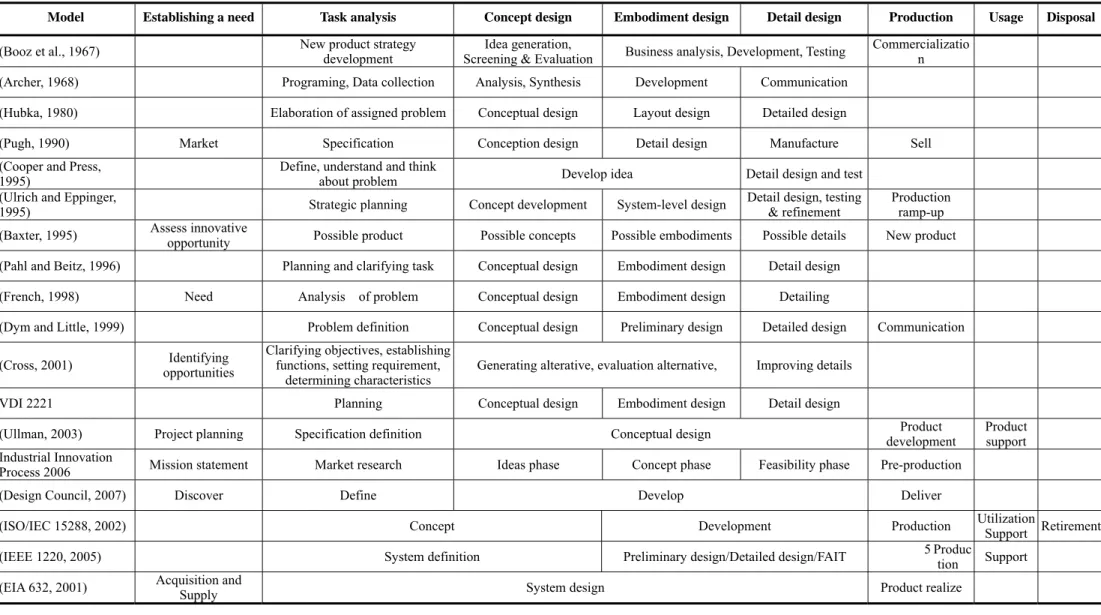
FIGURE 3.10 COMPARISON OF SYSTEM LIFE CYCLE MODELS ... 45
FIGURE 3.11 THE STAGE‐GATE PROCESS MODEL ... 46
FIGURE 3.12 TYPES OF DEPENDENCIES AND DSM REPRESENTATION OF DEPENDENCES ... 50
FIGURE 4.1 COMPONENTS OF INNOVATION ... 57
FIGURE 4.2 THE MULTI‐DIMENSIONAL CLASSIFICATION OF INNOVATION ... 58
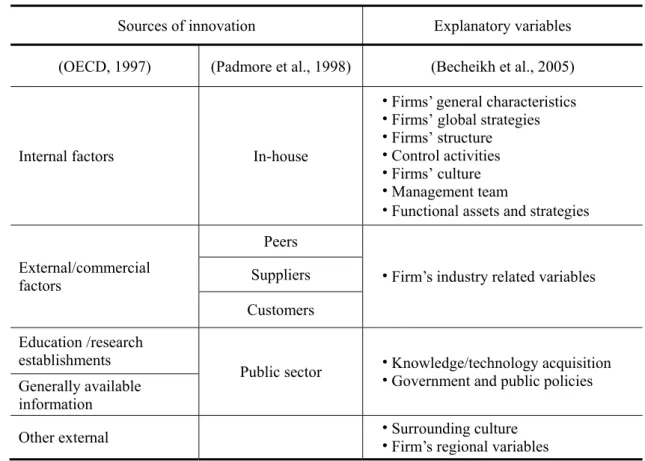
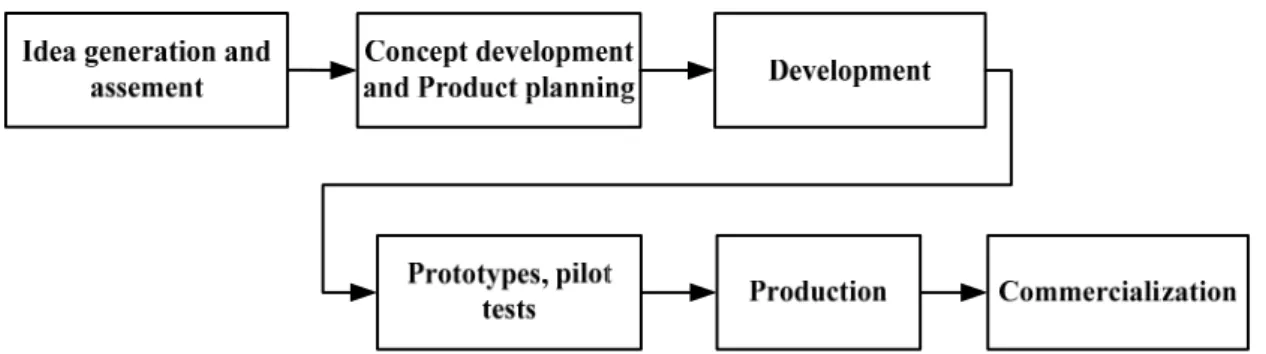
FIGURE 4.3 OPERATIONALIZED TYPOLOGY OF INNOVATIVENESS ... 60 FIGURE 4.4 THE SOURCES OF INNOVATION ... 61 FIGURE 4.5 THE MAIN STAGES OF INNOVATION PROCESS ... 63 FIGURE 5.1 COMPARISON FRAMEWORK OF INNOVATION AND DESIGN ... 71 FIGURE 5.2 INTERDEPENDENCY BETWEEN DESIGN AND INNOVATION ... 73 FIGURE 5.3 REQUIREMENTS OF INNOVATION ... 73
FIGURE 5.4 TRAITS OF CREATIVE PEOPLE (DESIGNER) ... 73
FIGURE 5.5 FOUR TYPES OF THE RELATIONSHIP BETWEEN DESIGN AND INNOVATION ... 75
List of figures Qiang ZHANG (2014), Ph.D thesis
FIGURE 5.7 TRIGGERS OF EXPANDING PRODUCT IDENTITY ... 80
FIGURE 5.8 RESEARCH FRAMEWORK OF THE DESCRIPTIVE MODEL OF INNOVATIVE DESIGN ... 83
FIGURE 5.9 ORIGINAL BASIC FRAMEWORK OF INNOVATIVE DESIGN BASED ON THE FBS MODEL ... 86
FIGURE 5.10 CHAINED‐LINKED MODEL ... 88
FIGURE 5.11 NEW BASIC FRAMEWORK OF INNOVATIVE DESIGN ... 88 FIGURE 5.12 CIRCULAR MODEL OF INNOVATION ... 90 FIGURE 5.13 INITIAL CIRCULAR MODEL OF INNOVATIVE DESIGN ... 90 FIGURE 5.14 SITUATEDNESS AS THE INTERACTION OF THREE WORLDS ... 92 FIGURE 5.15 EXTERNAL WORLD OF THE DESIGNER ... 92 FIGURE 5.16 SITUATED MODEL OF INNOVATIVE DESIGN ... 93 FIGURE 5.17 DESCRIPTIVE MODEL OF INNOVATIVE DESIGN ... 94 FIGURE 6.1 RELATIONSHIP BETWEEN DIFFERENT UNCERTAINTIES AND DESIGNS ... 99 FIGURE 6.2 FOUR DIMENSIONS OF INNOVATIVE DESIGN ... 103 FIGURE 6.3 THEORETICAL RESEARCH FRAMEWORK ... 106 FIGURE 6.4 UNCERTAINTY ASSESSMENTS FOR EACH PROJECT ... 109
FIGURE 7.1 THE BASIC PROCESS FRAMEWORK OF INNOVATIVE DESIGN IN THE PROJECT‐LEVEL ... 124
FIGURE 7.2 THE CIRCULAR MODEL OF INNOVATION ... 127
FIGURE 7.3 THE PROCEDURAL PROCESS MODEL OF INNOVATIVE DESIGN ... 128
FIGURE 7.4 FRAMING INNOVATIVE DESIGN AS A CAS ... 132
FIGURE 7.5 THE MODEL FRAMEWORK OF ACTIVITY‐NETWORK ADAPTIVE PROCESS MODEL ... 133
FIGURE 7.6 THE MODEL OF DESIGN ACTIVITY AND DESIGN SITUATION ... 134 FIGURE 7.7 THE PROFILE OF THE PROBABILITY OF ACHIEVING DESIGN TARGETS ... 137 FIGURE 7.8 ALTERNATIVE PROFILES OF THE PROBABILITY OF ACHIEVING DESIGN TARGETS ... 137 FIGURE 7.9 PROBABILITY OF SUCCESSFULLY SATISFYING DESIGN TARGETS ... 144 FIGURE 8.1 THE VERIFICATION FRAMEWORK OF THE PROCEDURAL PROCESS MODEL ... 147 FIGURE 8.2 THE WHOLE AUTOMOBILE DEVELOPMENT AND DESIGN PROCESS ... 150
FIGURE 8.3 THE SIMULATION FRAMEWORK OF THE ACTIVITY‐BASED ADAPTIVE MODEL ... 153
FIGURE 8.4 ACTIVITY‐BASED DSM FOR THE OVERALL VEHICLE DESIGN ... 154
FIGURE 8.5 CURRENT DESIGN PROCESS ARCHITECTURE ... 155
FIGURE 8.6 THE MOST FREQUENT DESIGN PROCESS ARCHITECTURE ... 155
FIGURE 8.7 INFORMATION VALUE PROFILE INCREASING THE PROBABILITY OF SATISFYING EACH DESIGN TARGET IN THIS SIMULATION ... 157
List of tables Qiang ZHANG (2014), Ph.D thesis
LIST OF TABLES
TABLE 2.1 THE DESIGN PROBLEM CATEGORIES ... 21 TABLE 2.2 DESCRIPTION OF DESIGN STAGES ... 26 TABLE 2.3 A COMPARISON OF DESIGN STAGES OF DESIGN PROCESS MODELS ... 27 TABLE 4.1 DEFINITIONS OF INNOVATION ... 55 TABLE 4.2 WORD FREQUENCY COUNT BASED ON DISCIPLINES AND ATTRIBUTES... 59 TABLE 4.3 THE SOURCES AND EXPLANATORY VARIABLES OF INNOVATION ... 61 TABLE 4.4 A COMPARISON OF STAGES OF INNOVATION PROCESS MODELS ... 64TABLE 5.1 THE PROFILE OF ITERATIONS OF INNOVATIVE DESIGN ... 81
TABLE 5.2 DEFINITIONS OF THE KEY CONCEPTS ON VERMAAS AND DORST’S VIEW ... 85
TABLE 5.3 EIGHT ELEMENTARY PROCESSES OF THE FBS MODEL ... 85
TABLE 5.4 RELEVANT DEFINITIONS AND REASONS OF THE EXTERNAL WORLD ... 93
TABLE 6.1 BRIEF DESCRIPTION OF FIVE AUTOMOBILE DESIGN PROJECTS ... 107
TABLE 6.2 PROJECT PRACTICES OF CASE STUDIES IN TERMS OF CONTROL AND FLEXIBILITY ... 109
TABLE 6.3 FLEXIBLE PRACTICES IN CASE STUDIES WITH RESPECT FLEXIBILITY ... 111
TABLE 6.4 PROPORTION OF DESIGNERS WITH GENERATION EXPERIENCE IN PROJECTS 2‐5 ... 113
TABLE 7.1 APPROPRIATENESS OF USING PARADIGMS FOR RESEARCH GOALS, OBJECTS AND SUBJECTS IN THIS DISSERTATION ... 120
TABLE 7.2 DESIGN TARGETS OF INNOVATIVE DESIGN ... 139
TABLE 7.3 THE CORRESPONDING RELATIONSHIP BETWEEN DESIGN STAGES AND DESIGN TARGETS ... 141
TABLE 8.1 THE BRIEF DESCRIPTION OF TWO AUTOMOBILE INNOVATIVE DESIGN PROJECTS ... 149
TABLE 8.2 THE MARKETPLACE AND ECONOMIC INDICATORS OF THE TWO PROJECTS ... 149
TABLE 8.3 THE COMPARISON OF PROCESS STAGES ... 150
TABLE 8.4 THE COMPARISON OF DESIGN ACTIVITY ... 150
1. Introduction Qiang ZHANG (2014), Ph.D thesis
1 INTRODUCTION
1.1 Background
1.1.1 Importance of innovative design
Companies wish to differentiate offering by design in a relevant, meaningful and valued way. This strategy implies two questions: Where does a core idea around a differentiated, meaningful and valued offering come from? What is its relationship with design?
The first question refers to innovation strategy. Harsh competition has led to increased emphasis on innovation. Managers consider innovation as the main source of differentiation and competitive advantage. Innovation applies ideas and new knowledge to the production of goods and services to improve product quality and process performance. Innovation thus has become to a crucial dimension of business strategy.
The second question mostly concerns design strategy. Currently, design is increasingly recognized by managers as a strategy tool to be responsible for the sustainable competitiveness. Design turns news ideas into practical and attractive propositions for users or customers. With this, companies can develop products and services that truly matter customer’s life and thereby improve the business influence. Design not only plays a key role in developing brands (Brunner et al., 2008), but also is “one of the primary idea generators for the creation of viable business platforms” (Best, 2008).
With the background of innovation, design can be understood as being the essence of innovation, since design itself always introduces something new. Therefore, it is suggested to build design-driven innovation (Brunner et al., 2008). In other words, innovative design is consider as the means of innovation strategy toward business success.
1.1.2 Context of innovative design: product development and innovation
Through the change of business strategy as discussed above, it actually reflects the change of the relationship between design, product development and innovation. Historically, the three terms are distinguished from the process steps included (Marxt and Hacklin, 2005). As seen in Figure 1.1(a), design emerges as a discrete functional sub activity, to be integrated at specific stages of the product development process (Perks et al., 2005). Design activities are classed into four stages: task clarification, conceptual design,
1. Introduction Qiang ZHANG (2014), Ph.D thesis
embodiment design and detail design (Pahl and Beitz, 1996). Product development includes the generation of product ideas and production. Product innovation mainly focuses on the entire process from preliminary investigation to market introduction. Within the view, design is treated as a downstream step in which designers develops an already idea or concept to attract consumers, rather than play an earlier role in the work of innovation (Tim, 2008).
Figure 1.1 Design, product development and innovation
Currently, in response to the design-driven innovation, it is suggested that design should be the process leader of product development process (Von Stamm 2008; Perks et al., 2005), as shown in Figure 1.1 (b). It results in the evolution of the relationship between design, product development and innovation. Design in the situation is seen as the main force of innovation. The boundaries of design activities are increasingly extended to product development with considering the whole product life cycle (Herbert, 2011). At the stage of idea generation, designers interact directly with the market in order to get initial product idea or concept. Designers also provide supports or even take participate in the production and market introduction stage. It is obvious that these roles beyond those tasks demanded by traditional design activity. As Marxt and Hacklin said, design, product development and innovation maybe are the same in the end (Marxt and Hacklin, 2005).
1. Introduction Qiang ZHANG (2014), Ph.D thesis
1.2 Research motivations and issues
1.2.1 Research motivations
As discussed in Section1.1, design is the essential part of the process of product innovation, and has an important role in generating long-term firm success. However, as one of the most distinguished and purposed activities, design does not have any unified for it. In design research, several researchers, from different experiences and observations, have expressed their views on design, such as the problem-solving process (Simon, 1999), the reflective practices (Schön, Donald A., 1995), the decision-making process (Von Stamm, 2008), the evolution process between concept and knowledge (Hatchuel and Weil, 2003) etc.
Although there is no agreement on the answers to design, certain aspects generally can be noted which have a strong bearing on design. According to Simon (1999), design aims at changing existing situations into preferred ones. Firstly it establishes requirements based on human needs, and then transforms them into performance specifications and functions, which are then mapped and converted into a design solution (using creativity, scientific principles and technical knowledge) that can be economically manufactured and produced. Design process thus can be considered as a series of actions and staged gateways that guide and control research and development, which typically include both the technical process (design activities) and non-technical process (organizational activities).
What made some companies, such as BMW, Apple and IDEO, have ‘better’ design performance than others? Good innovative design does not emerge by accident, but rather as the result of a managed design process (Bruce and Bessant, 2002). Therefore, the main question “how to design and manage these activities that heavily influence design efficiency and performance?” is of great interest to both individuals and organizations.
Different from routine design in which design prototypes with variables and structures do not change, innovative design requires some degree of innovation. It is commonly viewed that innovation requires loose setting, free environment and a lack of strict boundaries. Innovative design thus inclines to focus on how process factors such as flexibility, informality, and feedback influence innovation.
Despite the importance of innovation, the uncertainty caused by innovation present a great challenge to the design team. For an innovative design with market uncertainty and technology uncertainty, the resulting capabilities of the design and the exact means to achieve the expected goal are uncertain. And even greater challenge comes from the changing or emergent information during this process. In such environments, the design
1. Introduction Qiang ZHANG (2014), Ph.D thesis
team knows these events are possible, but do not know whether they will happen. That is, these cases are applicable in case of “variable” and “foreseen uncertainty” (Pich et al. 2002). Moreover, in the case of innovative design, it causes radical expansion or change of product identity, and tries to break away from existing rules and to generate new rules (Le Masson et al., 2010). During this process, it applies the creative ideas or creatively applies the existing ideas to create a product, process or service for a customer and market (Zhang et al. 2011). It is impossible to recognize all relevant influence factors and their functional relationships, even the unexpected emerging events during operation. Innovative design thus may involve unforeseen uncertainty and chaos, even a blend of types.
Without the ability to control these uncertainties, it will lead to different risks of design failure. Thus, a certain amount of process control is also required to secure the effective use of resources and the achievement of design project goals. Meanwhile, it also requires a high level of autonomy and an open environment to encourage innovation. Therefore, as for innovative design, the main question above becomes “Can companies carry out control and provide structures for activities of innovative design while at the same time encouraging more innovation?” That is, companies must weigh the benefits and cost of the integration between control and innovation to ensure that reduce more risks that they create.
A well-managed innovative design process can have the ability to encourage innovation by rapidly adopting new technological and market information, and to embrace environmental turbulence by structuralizing the process. In contrast, a poorly-managed process can severely harm the design result. This thesis is motivated by the commercial importance discussed in Section 1.1 and the operational contradiction. Therefore, this thesis will argue that:
The motivation is necessarily abstract to encompass the content of this thesis. It is analyzed and decomposed further in the following sections.
1.2.2 Research issues and questions
According to the research motivation in the preceding section, the primary goal of this dissertation is a series of useful process models to help designers and managers effectively managing innovative design for balancing innovation and control in a way that constructs
The well-managed innovative design process may be modeled by the systematic method. The models can balance innovation and control, each respectively influencing process creativity and process reliability.
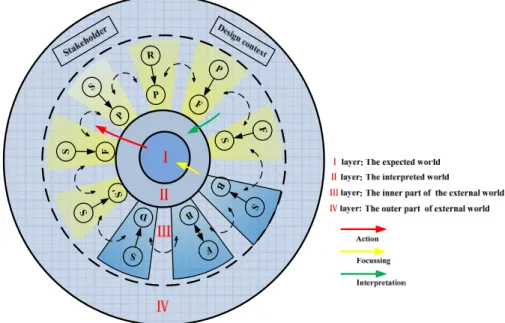
1. desig with unde mode deco and m 1.2.2 comp organ shou basis direc elem theor these Introduction gn process the logic erstand and eling, as il mposed int managemen Definition & Analysis Analyze Definition & An Process Definition Characteristic Define Definiti 2.1 Process im prehensive nizations. B uld clarify th s. The bene cting researc Questi In the litera ments of inn retical and p e changes re Questi Questi what ch and makes cal research analyze, th llustrated in to three ma nt support, w Understanding nalysis cs F ion and ana
mprovement understand Before discu he scope an efits of offe ch efforts. S on 1: What ature, there novative de practical asp equire a reco on 1-1: How on 1-2: Wit haracteristic daily decis h sequence hen describ n Figure 1 ain research which are su Desc g P Mode Genera Proce De igure 1.2 Re alysis t requires ding of inno ussing how nd the cont ering a form So the first q is innovativ exist sever esign, desig pects, have onsideration w do we de thin the new cs does inno sions. To b e of innov be and fina 1.2. In this h issues: def ummarized cription Process el Insight ate Guide ess Description escriptive Model esearch issu process un ovative desi w to support tent of inno mal definiti question of ve design? ral definitio gn and inn greatly cha n of the def fine innova w definition ovative desi build these p vative desig ally support dissertatio efinition and as followin Descriptive model ues of this d nderstanding ign is impo t and impro ovative desi ion can def
this thesis i ons of innov novation, as anged in the finition of in ative design ns and unde ign have? Qian process mo gn, compa innovative on, the rese
d analysis, ng: Manageme Support Concept framew Proces Model Model Proces architect Managem dissertation g (Whitney ortant for b ove innovati ign to cons fine the sco
is: vative desig s well as t e past two d nnovative de to incorpor erstanding o ng ZHANG (201 odels, in ac anies shoul e design by earch motiv process de ent t Presc ptual work ss ess cture Com & Sc ment Support y, 1990). H both individ ive design, struct the d ope and the
gn. However their relatio decades. Wh esign? Hen rate these ch of innovativ 14), Ph.D thesis cordance ld firstly y process vation is escription criptive model mpare chedule Having a duals and it firstly iscussion e content, r, as core onship in hether do ce, hanges? ve design,
1. 1.2.2 and e impr desig build ident mode resea activ the i desig unde proce could divid 1.2.2 proce conc In te recom struc gene mode innov disse Introduction Process 2.2 Companies evaluate im rove the des gn results. A d a detailed, tify improv el incorpor arch questio Questi As for the s vities should innovative gners better erstand whi ess or desig d influence ded into thre
Questi in unde Questi during Questi Manag 2.3 As discuss ess to balan erned with erms of con mmended ctures and th tic base to els raise the vation, som ertation wil s descriptio s should un mprovement sign perform A descriptiv , common u vement opp rating these on is: ion 2: How start point t d be done, b design pro r find succ ich process gn activity c e the proce ee sub-ques ion 2-1: W erstanding t ion 2-2: W g this proces ion 2-3: Wh gement supp sed in Sect nce control a how to bala ntrol, traditi sequence o he division construct t e question a me authors l show how n nderstand w opportuniti mance, and ve process understandin ortunities. T analysis r w should we o answer th by a visual f ocess and cessful facto es may ge can improv ess perform tions: What are fun
the patterns When and w
ss?
hat are the f
ort tion 1.2.1, and innovat ance contro ional model of activitie of work an the entire p as to what identify so w process m
well the inno ies. It involv evaluating model can ng of the pr This disser requirement describe th his question form, could achieve th ors of inno enerate crea ve the desig mance. Ther ndamental p s involved in where coul factors affec companies tion. Thus, i ol and innov ls of design es in a sy nd responsi process of i extent they ome flexibl models to ovative desi ves identify the impact n support th rocess and t rtation will ts. Therefor he process o , documenti d assist desig he focused ovative des ative outpu gn performa refore, the processes of n the proces d innovatio cting the su s try to co in this disse vation durin n process p ystematic w ibilities. Th innovative y foster or h le practices support the Qian ign process ying key pro of environ his analysis hereby faci develop a re, within t f innovative ing what, ho gners and m collaborati sign, and to ut, we need nce, and wh main ques f innovative ss? on emerge, ccess of inn onstruct an ertation, man g the innov prescribe a way, empha hese represe design. How hamper inno s to increas e balance b ng ZHANG (201 in order to ocesses whi nmental fact , by which ilitate the m descriptive this issue, t e design? ow and whe managers un ion. Then, o aid comp d to identif which proces stion above e design to proceed a novative des appropriat anagement s vative design design proc asizing hie entations ca wever, thes ovation. In se innovati between con 14), Ph.D thesis o identify ich could tors upon h it could modeler to e process the main en design nderstand to help panies to fy which ss factors e can be facilitate and grow sign? te design support is n process. cess as a erarchical an offer a se design terms of ion. This ntrol and
1. Introduction Qiang ZHANG (2014), Ph.D thesis
innovation. Thus, the main research question of the research issue “management support” is:
Question 3: How do we model the innovative design process in a systematic method to stand by management support?
Many companies prescribe standard, high-level processes that aim to ensure good practices such as proper evaluation and review activities. Such prescriptions highlight the particular perceptive and understanding of this process. Although these documentations have limited utility and cannot be applied into other cases, they are useful in promoting the development of the shared understanding. Hence, as a start point of management support, this dissertation will develop a procedural process model that prescribes the innovative design stages and their process structure to balance control and innovation. So the first two sub-questions of Question 3 are:
Question 3-1: What design stages should be performed in the procedural level? Question 3-2: What structure do we employ in the procedural level to balance
control and innovation of innovative design?
Based on the procedural process model, in order to make the schedule and realistic commitment, given a series of goals or objectives, design managers must determine an appropriate way to balance innovation and control, namely appropriate process architecture. Different process architectures mean that companies adopt different paths to reach the expected goal. Hence, this dissertation will propose an adaptive activity-based process model to capture process behaviors of innovative design. It aims to provide a simulation support in which alternative process architectures to balance control and innovation may be explored. This model can be used as the basis of the approach of design process optimization. Therefore, the adaptive activity-based process model focuses on the following sub-question.
Question 3-3: How do we model and generate alternative process architectures to balance innovation and control?
1.3 Research Methodology
1.3.1 Research fields
In order to achieve research objectives and answer research questions in the preceding section, five major research fields are explored in our study, consisting of design, innovation, product development and system theory and systems engineering, as shown in Figure 1.3. In this dissertation, these research fields provide theoretical methods for the
1. proce of de mode the m gene desig the r theor proce conte desig scope recon gene and p meth desig innov mana Introduction ess modelin Innovative esign, such eling as we mature field
ral, and pro gn. Moreove role of desi
retical basis Innovation ess, plays ent and sco gn. In addit e have grea nsideration rate useful performance Since innov hods of PD, gn. Firstly, t vative opp agement of ng of innova design, as a as design d ell as creativ d yet, the r ovides relat er, through ign in innov s of the defi , as the ult a very imp ope of innov tion, innova atly changed of innovat insights for e conditions vative desig , particularl the fuzzy fr ortunities d f PD is also ative design Figure 1 a kind of de definitions vity in desig related rese ted method the review vation and nition and a timate goal portant role vation deter ation itself d in the past tive design. r describing s to innovat gn is the ke ly new prod ront end of during the useful to h n. .3 The relat esign, could and classif gn. Althoug earch contri ds and mode in the field product de analysis of i and the dr e in definin rmine the d is not a ne t two decad . Moreover and explain tive design. ey process o duct develop PD can con innovative how to deal ed research d benefit fro fication, des gh the desig ibutes to un els to the p of design, w evelopment. innovative d rive force o ng and mo definition an ew phenom des. These c r, the proce ning a board of product d pment, can ntribute to t e design p l with unce Qian h fields om related th sign paradig gn research nderstand in process mod we could an These obs design. of the whol deling inno nd character enon, its po changes nec ess theory o d class of pr developmen be also ad the study of process. Se rtainties tha ng ZHANG (201 heories and gms, design is not cons nnovative d deling of in nalyze the c servations c le innovativ ovative des ristics of in osition, con cessarily res of innovati rocesses, se nt (PD), mo dopted by in f how to ca econdly, un at innovativ 14), Ph.D thesis methods n process idered as design in nnovative change of can lay a ve design sign. The nnovative ntent and sult in the on could equences, odels and nnovative apture the ncertainty ve design
1. Introduction Qiang ZHANG (2014), Ph.D thesis
faces; thirdly, planning and schedule techniques of PD provide basic frameworks and models to construct the process architecture of innovative design.
Additionally, systems theory has the potential to provide a trans-disciplinary framework for a simultaneously critical and normative exploration of the relationships between our perceptions and the reality. Instead of focusing on the components, systems approach views the world in terms of irreducibly integrated systems. The attention is drawn to the interacting and integrated systems. Therefore, the methods and concepts of systems theory can offer us the system thinking perspectives and systematic methodology to comprehensively analyze and model innovative design.
1.3.2 Theoretical context: Systems engineering
As illustrated in Figure 1.3, systems engineering, as the basis of process modeling for innovative design, plays the role of theoretical context to connect the four domains above.
Systems engineering, as an effective way to manage complexity and change, has been recognized as a preferred mechanism to establish the agreement for the creation of products or services. The fundamental purposes of systems engineering are to guarantee that the system matches real needs through proper specification of demands, to predict the properties and behavior of the system, and to guarantee them through the design of an appropriate architecture(Meinadier, 1998).
Additionally, it is also a cooperative and interdisciplinary process for solving problems that aims to ensure a proper compromise between system strategy and constraints (AFIS, 2010). Compliance with the processes and recommendations in the systems engineering standard, designers can develop feasible and cost-effective systems by defining a complete and consistent set of requirements. Besides, systems can satisfy not only the nominal requirements with respect to cost, time and risk constraints, but also each stakeholder.
Finally, Systems engineering has much wider concerns than addressing the product system, and also encompasses social interaction and organizational systems. Any successful product and design are not isolated from its environments. Innovative design needs multi-discipline human’s involvement to generate more creative ideas. And it requires addressing all needs of stakeholder, including project and organization.
Therefore, in order to achieve the research goal “developing well-managed innovative design process to balance innovation and control by process modeling”, systems engineering provides operational and management standards, methods and models for innovative design.
1. Introduction Qiang ZHANG (2014), Ph.D thesis
1.3.3 Research stages and methods
Design research methodology (DRM) is proposed by Blessing and Chakrabarti (Blessing and Chakrabarti, 2009) to help design research to become more effective and efficient. The DRM consists of four stages: Research Clarification, Descriptive Study I, Prescriptive Study and Descriptive Study II, as shown in Figure 1.4.
Figure 1.4 DRM, Design Research Methodology
In this dissertation, we follow the research stages to precede our study. According to the research stages, the section discusses research methods and ideas that are applied in each stage of the research.
• Research clarification: Literature review
In this stage, the research goals are developed and the related theory basis is synthesized by literatures reviews.
In Section 1.2, research issues and questions have been established. In the following study, we firstly attempt to build up a deeper understanding of design in terms of design problem, designer and design process, and then review existing design models. Thirdly, we do so review the literature in the field of innovation, for factors that influence the success of innovative design. Comparing the diverse range of models and modeling approaches with the desired situation of innovative design, we can find advantages and disadvantages of the existing models that support our assumptions, and thereby formulate realistic and worthwhile research goals.
1. Introduction Qiang ZHANG (2014), Ph.D thesis
• Descriptive Study I: Definition and analysis + Process description
Having a clear research goals, the descriptive study I stage aims to develop a detailed understanding of innovative design. That is, this stage should focus on the two research issues: “definition and analysis” that respond to Questions 1-1 and 1-2 in Section 1.2.2 ; and “process description” that answer Questions 2-1, 2-2 and 2-3 in Section 1.2.2.
With regard to the first research issue, the relationship between design and innovation is firstly discussed by the theoretical comparison. Their relationship determines how to define innovative design and its desired situation. Then, within the new definition of innovative design, a series of problems about the nature of innovative design is discussed. Such as, what is the innovative design problem? Are there special characteristics that are different from other design? Similarly, what stages should this innovative design process include? What characteristics?
The second crucial research issue of this stage is to describe the innovative design process. The purpose is to make the description detailed enough to determine which elements and process can improve the process performance as efficiently and effectively as possible. Therefore, we construct the descriptive model of innovative design for interpreting these elements and processes in this research stage.
• Prescriptive Study: Management support
The main focus of the prescriptive study is to develop prescriptive models which distill the theories into pragmatic approaches or descriptions of best practice. In short, this stage should realize the third and most important research issue “management support” to balance control and innovation.
This research content is divided into three parts. The first part is to study project practices that respectively support innovation and control by literature reviews. However, only by literature reviews, it cannot provide enough insights to consider how to balance innovation and control in practices. Hence, we observe and analyze how these project practices to be applied into a series of innovative design project of an automobile company, and compare these projects to highlight managerial insights about how to balance innovation and control.
Based on these managerial insights, the second part is to develop the prescriptive procedural process model to answer Questions 3-1 and 3-2 in Section 1.2.2. In the project-level, we construct the basic process framework of innovative design based on the Vee model, which builds up a formal process for innovative design; in the operation-level, we develop a circular model that tries to map flexible practices introduced into process
1. Introduction Qiang ZHANG (2014), Ph.D thesis
elements of innovative design.
However, the procedural process model is too general to guide the detail operation of designers and managers. Therefore, we move down into the activity-level to construct the process architecture of innovative design in the third part. This part attempts to answer Questions 3-3 in Section 1.2.2. Since the assumptions of traditional activity-based techniques and models do not adequately reflect the realities of innovative design (e.g. design activities and their interactions and variable are known a priori; the expected goal can be achieved by these known design activities), we adopt basic ideas of the complex adaptive systems to dynamically develop the activity-based adaptive process model.
Descriptive Study II: Verification
This descriptive study II discusses how empirical studies can be used to verify the application and impact of the procedural process model and the activity-based model that have been proposed in the prescriptive study.
Since the procedural process model is a general conceptual framework, its verification is to identify whether the procedural model can be used for management support to balance innovation and control, and to evaluate the assumptions behind the model process. To achieve these goals, we apply this procedural model into a series of innovative design project with different performance in an automobile company. By comparing design processes of these projects with the procedural model, we can evaluate that whether the procedural model has the expected effect on management support.
With regard to the adaptive activity-based model, its verification is to identify whether this model can successfully construct the process architecture of innovative design. Hence, we use a discrete-event simulation to construct the process architecture of an innovative design project based on the adaptive process model. By comparing the simulation result with the current design process used by the automobile company, it not only can verify the activity-based adaptive model, but also highlight several related managerial insights.
1.4 Thesis structure
This dissertation proceeds in nine chapters, as shown in Figure 1.5. Based on the analysis of design research methodology in the previous section, the research parts are analyzed as follows: the research clarification stage includes Chapters 1-4; Chapter 5 focuses on the descriptive study I; Chapters 6 and 7 correspond to the prescriptive study; Chapter 8 solves the verification problems of the descriptive study II. More details:
1. Introduction Qiang ZHANG (2014), Ph.D thesis
and the research methodology is discussed.
Chapter 2 concerns on the understanding of design in terms of design problem, designer and design process. It indicates that design is a complex human activities, and involves a collection of many different logically connected knowledge and disciplines. And there is no definition that can be widely accepted.
Chapter 3 reviews published models of design and product development based on the level of model abstraction (the design paradigm, the procedural model and the activity-based model). It is argued that design paradigms provide us with the theoretical foundation of process modeling, and there is no single procedural model and activity-based model that can provide an adequate description and prescription of innovative design.
Chapter 4 focuses on the synthesis of innovation. We compare definitions of innovation to identify the commonplaces. Based on these commonplaces, we construct the multi-dimensional classification to characterize innovation and identify key components of innovation. And then we review innovation process models. Finally, we synthesize three aspects of changes for innovation.
In Chapter 5, drawing on the literature review about design and innovation, as well as the theoretical comparison between the both, the definition of innovative design is proposed. Then, the nature of innovative design is analyzed. Finally, the descriptive model of innovative design is developed step by step.
Chapter 6 provides the practical basis of process modeling of innovation design. After analyzing management challenges that the innovative design project faces, we identify project practices that support flexibility and control. Then an empirical study is performed to investigate how to deal with these practices. This study demonstrates that innovation and flexibility can coexist, and provides managerial insights about how to deal with the balance. Chapter 7 introduces the procedural process model and the activity-based adaptive model of innovative design. The former model is developed in two levels: in the project-level, the basic process framework of innovative design based on the Vee model is developed; in the operation-level, a circular model that maps flexible practices into process elements of innovative design is constructed. The latter model considers innovative design as the complex adaptive system to dynamically construct the process architecture.
Chapter 8 verifies the procedural process model and the activity-based adaptive model by a series of case studies.
In Chapter 9, research contributions and limitations are reviewed, and opportunities for further work are highlighted.
1. Introduction Fig ure 1.5 The esis structure Qian e ng ZHANG (20114), Ph.D thesis
2. Understanding design Qiang ZHANG (2014), Ph.D thesis
2 UNDERSTANDING DESIGN
2.1 Overview
People always have designed things. One of the basic characteristics of human being is that they make a range of tools and other artifacts to achieve their purpose (Cross, 2008). Here are some of human activities are characterized as design: architectural design, software design, service design, product design, information system design, engineering design, fashion design, game design etc. Therefore, the nature point to begin any discussion of the term “design” is to state what design is.
Design as one of the most distinguished and purposed activities, while the extensive research undertaken since the 1950s, does not have any unified structure or organization for it. Although there is no single model or explanation that can furnish a perfect definition of design, these researches provide us with the powerful base to understand and explain design. In this chapter, we attempt to review the related research works in the field of design, in which we firstly adopt a unifying design framework and identify fundamental dimensions of design, and then understand and analyze design.
Discuss proceeds as follows. Firstly, the unifying design framework and the fundamental dimensions of design are developed by reviewing definitions of design in Section 2.2. Then, the fundamental dimension of design-the design problem, the designer and the design process- are respectively discussed in Sections 2.3, 2.4 and 2.5.
2.2 What is design?
2.2.1 Definition
In a traditional understanding, design is often associated with a person who is involved in both the design and the production of an object. Resulting from the division of work and the need for specialization, the concept began to change. Consequently, two strands of design evolved, respectively “design as art” and “design as engineering” (Von Stamm, 2008). In many fields, the term design still connotes art, such as the fashion design of clothing, interior design of house (Maier and Fadel, 2009). In this dissertation, we intend only to emphasize design as engineering, which includes products, machines, structures, and the like. An artist’s practicing activities when creating a work of art cannot be considered as our subject.
2. Understanding design Qiang ZHANG (2014), Ph.D thesis
In current design research, several researchers, from different experiences and observations, have expressed their views on design. Clearly, although design has been performed for many centuries, does not have any unified definition for it. Some of these viewpoints are expressed below:
Design is reflective conversation with the materials of a design situation (Schön, Donald A., 1995).
Design can be defined as a goal-oriented, constrained, decision-making, exploration and learning activity that operates within a situation that depends on the designer’s perception of the situation and results in the description of a future engineering system (Gero and Kannengiesser, 2004).
Design can be modeled as the interplay between two interdependent spaces with different structure and logics: the space of concepts (C) and the space of knowledge (K) (Hatchuel and Weil, 2003).
Design is the conscious decision-making process by which information (an idea) is transformed into an outcome, be it tangible (product) or intangible (service) (Von Stamm, 2008).
Design is conceiving and giving form to artifacts that solve problems (Ulrich, 2011).
These definitions of design reflect various viewpoints of these proponents. Some view it as a rational problem-solving process, others as a reflective process or a decision-making
process, and still others as an evolving process between knowledge and concept. The rational problem solving approach in design is the combination of practice-based phase
models of the design process, a model of the designer as an information processor from the field of cognitive psychology, and some thinking on the nature of the design problem (Dorst, 1997). The reflective process argues that the design process cannot be simply grasped by any design approach, but that the work of designers much resembles the work of an artist who applies different kinds of methods and knowledge in a flexible manner. In design process, designers observe and interpret what they are ‘seeing’, and then decide on new actions. The decision theory considers design as a decision-making process (Hazelrigg, 1996). Accordingly, if one wants to understand design, one ought to study how best to make decisions, which is the province of several fields of mathematics, particularly the application of utility theory.
Although there is no agreement on the answers to the definition of design, certain aspects generally can be noted which have a strong bearing on design. These include: purpose, constraints, reflection, information process, exploration, function, transformation,
2. Understanding design Qiang ZHANG (2014), Ph.D thesis
situation, and knowledge. Taking account of these key words and trying to integrate and unify the definition, design can be described as:
2.2.2 Unifying design framework
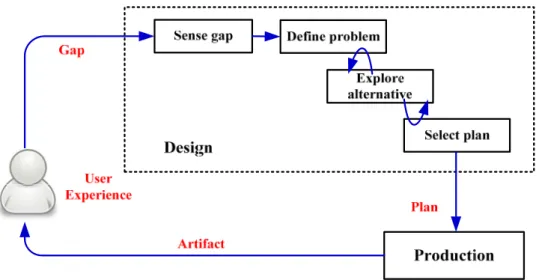
As we discussed above, design refers to different things in different definitions. From engineering design to software design to product design, design objects in these domains vary, and the techniques and methods used by these domains are highly specialized. Therefore, to analyze these perspectives and models, a unifying design framework across these domains is necessary. According to this integrated definition above, design is a problem-solving process through which the needs are transformed into design solutions. Ulrich proposes a unifying design framework to describe this process (Ulrich, 2011), as shown in Figure 2.1. In this framework design is one part of the problem-solving process beginning with the gap of user experiences, leading a plan for an artifact, and finally resulting in the production of this artifact. The problem-solving process includes the design and the production of the artifact. Hence, in this dissertation, we adopt Ulrich’s design framework as the unifying design framework to discuss.
Figure 2.1 The unifying design framework (Ulrich, 2011)
As illustrated in Figure 2.1, design transforms a gap into a plan. In this process, it can be decomposed into four steps: sense gap, define problem, explore alternative and select
Design is a process of establishing requirements based on needs and dissatisfaction with the current state of artifact, transforming them into performance specification and functions, which are then mapped and converted into design solutions (using creativity, scientific principles and technical knowledge) that can be economically manufactured and produced.
2. Understanding design Qiang ZHANG (2014), Ph.D thesis
plan. Design begins with the recognition of the gap between the user experience and the current state of artifact. The gap is the motivation of design. Problem definition is to explain this gap by designers. Within a professional design process, problem definition can be expressed in the form of requirement list, design specification or customer needs. Given the problem, designers explore possible alternatives. Because it usually exists several available problem solutions, designers need to perform some sort of evaluation and select from these alternatives. The plan can be represented with drawing, compute model or design documents. Finally, production transforms the plan to an artifact.
2.2.3 Fundamental dimensions
Based on the unifying design framework above, the quality of design outcomes (i.e. plan) is influenced by at least three characteristics of the design process: (1) does the designer sense the gap between the user experience and the current state of artifact? Then does the designer define the problem consistent with the gap? In other words, does the designer understand the design problem? (2) Is the scope of exploration represented in a way that includes possible good design solutions? (3) Does the design find an appropriate and satisfied design solution within the solution space that has been defined? In Ulrich’s words, “Did the designer understand this problem, and frame it in a way that exploration could potentially lead to a good solution, find such a solution within the solution space, and deliver an artifact consistent with the plan? ” (Ulrich, 2011)
According to the analysis above, to characterize design, three dimensions of design should be described as follows (Dorst, 1997; Ullman, 1992), as illustrated in Figure 2.2:
Design problem being solved, as evidenced by what the initial and final design state are.
Designer, that is, who is performing the design (their characteristics and the constraints on them).
Design process itself, focusing on how to transform from the gap between the user experience and the current state of artifact to the design plan.
Two of these three dimensions are often ignored by classical design theories. Classical design theories and methodologies emphasize effectiveness and efficiency of the design process. However, recent empirical studies have proved that the definition of design problem and the designer are also the determinant elements (Cross, 2004; Dorst, 1997; Ullman, 1992; Valkenburg and Dorst, 1998). So we also should emphasize the “design problem” and “designer” dimensions. The following sections (Sections 2.3, 2.4 and 2.5) present the three dimensions to understand well design in detail.
2. Understanding design Qiang ZHANG (2014), Ph.D thesis
Figure 2.2 Fundamental dimensions of design
2.3 Design problem
Design problems range from relatively small component design to the design of large scale system such as automobile and space shuttles. These design problems originate as some form of problem statement provided to the designer by the user (the client, the company management and other stakeholders) (Cross, 2008), and vary in their form and contents. For example, it can be expressed in the form of a design brief, a customer needs list and other documents.
2.3.1 Ill-defined problem
Design problems are widely considered as an ill-defined problem (Cross, 2001), in contrast to well-defined or well-structured problem. The well-defined problems have clear goals, and known ways of generating the expected results. In order to characterize design problem in a uniform, we identify the generic characteristics of the ill-defined problem: ambiguity, complexity of problem structure and situated problem.
(1) Ambiguity
Ambiguity refers to the lack of clarity or consistency in the formulation of design problems (Yan and Stephen, 1998).This phenomenon is reflected in several aspects: Firstly, when the problem is initially set, the goals are usually not clear, and many constraints and criteria are unknown. And the design context is often messy and complex, and poorly understood. Thus, there is no definitive formulation of the design problem (Cross, 2001). In addition, the design problem is not inherently consistent. There exist several conflicts and inconsistency that need to be solved during the design process. Thirdly, the lack of definitive solution also causes the ambiguity of design problems.
When facing ambiguity, the ways of formulating design problems are dependent on the ways of solving it. It is usually possible to perform some steps to improve the initial
2. Understanding design Qiang ZHANG (2014), Ph.D thesis
definition of the problem by gathering information from the clients and research. In Dorst and Cross’s words, design problem and design solution evolve together (Dorst and Cross, 2001). The way the solution is conceived influences the way the problem is conceived.
(2) Complexity of problem structure
Most design problems involve multiple functional requirements that require multi-disciplinary knowledge. The dependence relationships of requirements and the interactions of various disciplinary knowledge result in the complexity of problem structure. If the object of a design problem is a complex product that involves multiple functions, components, relationships between these components, it exacerbates the complexity.
The kind of complexity would result in two effects for design (Yan and Stephen, 1998): Firstly, it is difficult to accurately and comprehensively understand and solve the design problem for designers. For instance, while making decisions on the ways in which components are integrated together to form a coherent whole, it requires knowledge of these component’s core concepts, the way in which these components are integrated and linked each other (Hobday, 1998). As a result, designers may not explore enough all possible alternative solutions.
Secondly, even if possible alternative solutions are generated, the quantity of these solutions could greatly raise the coordination problem for designers, especially for an original alternative. Additionally, the larger the number of components, the more difficult the decision choices would be (technology, the technology chosen).
(3) Situated problem
Because design problem cannot be clarified at the beginning of the design process, it needs a much deeper restructuration and interpretation by designers in a multistep problem-solving process (Dorst, 2006). It means that the design process and the very structure of ill-structured problem are determined by actions that designers take. In Schön’s words, designers’ perceptions on the world outside have very important influences on the world under construction (Schön, 1995). Designer observes and interprets what they are ‘seeing’, and then decide on new actions, instead of simply performing the recommended actions. Furthermore, because design encourages designers to be aware of what they are doing from the perceived design situation and remembered design activities (Reymen et al., 2006), it results in the learning activities and the generation of new knowledge. These activities illustrate that the design problem is seen through the eyes of designers in the current design situation, that is to say, the situated problem-solving.
2. Understanding design Qiang ZHANG (2014), Ph.D thesis
2.3.2 Category of design problems
A design is strongly influenced by lifestyle, training and experience of designers, and creativity and effort a designer puts into a design varies, depending on the type of design problem (Evbuomwan et al., 1996). In the design research, to categorize different design problems has been proven to be useful for both analysis and construction of design tools, methods and techniques. We discuss the variety of design problem in this section.
In the field of engineering design, the classification of design problem is generally related to the design output’s distance from the current design’s diagram (Howard et al., 2008). Several researchers propose different classifications for design problems (see Table 2.1). The columns are organized to exhibit the closely related design problems. These types are ordered by increasing the level of originality from left to right. Heading that originates from Evbuomwan et al.’s classification (e.g. routine design, redesign and non-routine design) were chosen to describe the level of originality of each design problem.
Table 2.1 The design problem categories
In Table 2.1, it is observed that several authors (e.g. Ullman and Belkadi) distinguish three design types according to the initial state of the design problem. In this case, designers begin with their works with the assumption that the design output is either creative, innovative or routine, and then do their efforts based on this assumption. Gero’s classification depends on the state space of potential designs and the value range of design variables. Pahl and Beitz emphasize the novelty of the solution principle and technology to distinguish different types of design problems.
Although these authors use different or similar terms to describe these types, there seems to be a general acceptance of the classification of design problem into routine design, redesign and non-routine design. By synthesizing definitions of these classifications above, three types of design problems can be defined as follows.
(1) Routine design. It represents that the goal and the knowledge of design variables,
Level of originality
Low High
Routine design Redesign Non-routine design (Gero, 1990) Routine design Innovative design, Creative design (Pahl and Beitz, 1996) Adaptive design Variant design, Original design
(Ullman, 2003) Configuration Selection, Redesign Original (Belkadi, 2006) Routine Desig Innovative Design, Creative Design
2. Understanding design Qiang ZHANG (2014), Ph.D thesis
design strcuture are known in advance. There exists a design plan with sub-problem decomposition, alternatives and prototypical solutions. Moreover, the autonomy and the creativity are limited. It emphasize that how to choose the best solution from these existing solutions in order to satisfy the new problem in the same context. (2) Redesign. It consists of two subtypes: variant design and adaptive design. The two
types involve the modification of an existing design to satisfy new requirements or improve its performance.
(3) Non-routine design can be termed as original design, and includes innovative design and creative design.
• Innovative design. It still refers to the known product. In this case, the goal and the relative knowledge of the product are known. However, because of new design variables or features, the design plan and the concrete design activities are not determined in advance.
• Creative design. It creates new variables and features by inventing completely new solution principles. There is no similarity to those of the existing design problem and design plan a priori for the problem under consideration. Therefore, knowledge and the design plan are not known. Designers have a larger autonomy to perform their activities and utilize creativity. Modeling, simulation, prototype and experiment are utilized for developing new knowledge.
In reality, it is often not possible to define precisely the boundaries between the three types of design. For example, a complexity product is composed by different sub-systems. One of sub-systems maybe corresponds to innovative design, while another is routine design. Therefore, this should be considered to be only a broad classification.
2.4 Designer
We know that designers perceive and interpret design problem differently, depending on individual and group prerequisites and characteristics of the current situation (Dorst and Cross, 2001). Therefore, how do designers think when trying to solve a design problem? This question of design thinking is of great importance for both research and practice in design and related fields.
In the literature, there are several perspectives of research that have focused on different aspects of design thinking. Three perspectives are identified: the normative perspective, the empirical perspective and the design-as-an-art-perspective (Stempfle and Badke-Schaub, 2002). In order to understand better behaviors and decisions of designers, it
2. Understanding design Qiang ZHANG (2014), Ph.D thesis
is firstly necessary to distinguish main points and disadvantages of these perspectives, and then discuss the way to solve design problems.
The normative perspective is dominated by systematic design methodologists, such as Pahl and Beitz (1996), Cross (2001). These researchers have proposed a systematic method to support design activity in engineering and product design in order to obtain the optimum result. These works are based on the rational analysis of design tasks and their requirements. This leads to an assumption that design theories and methods are independent of the detailed properties of designers are meant to support. Within this perspective, the designer is an objective reality.
However, the empirical perspective argues that designers rarely follow the methodology described by design methodologists. They criticize that the design methodologies originate from the empirical studies in design. Moreover, these design methodologies accounts of design neglect many of the specific factors and constraints designers need to cope with their dairy work, such as the economic constraints, time pressure and teamwork (Stempfle and Badke-Schaub, 2002).
The last perspective, the design-as-an-art-perspective, argues that designers not only do not strictly perform design activities according to the design methodology, but also apply different kinds of methods in a flexible manner in a process of appreciation, action and re-appreciation, and constantly reflection on the current design tasks and design situation (Schön, Donald A., 1995; Valkenburg and Dorst, 1998). Within this view, the designer is an active person.
Although the three perspectives have contributed to our understanding of design thinking, every perspective has its specific shortcomings. The normative perspective neglects to focus on what the designers actually do, while the empirical perspective is not always theory-based. Although the design-as-an-art-perspective provides a novel way of considering the designer, the related methods are not still clear.
Hence, the successive question to be explored is how designers to solve ill-defined design problems. In an experimental research study, Lawson (1994) compares the way in which designers and scientist solved the same problem. He found that designers solve the problem by synthesis (i.e. the solution-focused approach), whereas scientists solve the problem by analysis. Some other researchers suggest that designers tend to use conjectures about solution concepts as means of developing their perceptions of the problem (Darke, 1984; Schön, Donald A., 1995). That is so-called “the co-evolution process between design problem and design solution” explained by Dorst and Cross ( 2001).