HAL Id: hal-02423369
https://hal.archives-ouvertes.fr/hal-02423369
Submitted on 24 Dec 2019HAL is a multi-disciplinary open access archive for the deposit and dissemination of sci-entific research documents, whether they are pub-lished or not. The documents may come from teaching and research institutions in France or abroad, or from public or private research centers.
L’archive ouverte pluridisciplinaire HAL, est destinée au dépôt et à la diffusion de documents scientifiques de niveau recherche, publiés ou non, émanant des établissements d’enseignement et de recherche français ou étrangers, des laboratoires publics ou privés.
Social creativity in the collaborative design of a digital
resource embedding mathematics into a story
Nataly Essonnier, Chronis Kynigos, Jana Trgalova
To cite this version:
Nataly Essonnier, Chronis Kynigos, Jana Trgalova. Social creativity in the collaborative design of a digital resource embedding mathematics into a story. Eleventh Congress of the European Society for Research in Mathematics Education, Utrecht University, Feb 2019, Utrecht, Netherlands. �hal-02423369�
Social creativity in the collaborative design of a digital resource
embedding mathematics into a story
Nataly Essonnier1, Chronis Kynigos2 and Jana Trgalova1
1
Claude Bernard University, S2HEP laboratory, Lyon, France; [email protected],
2National and Kapodistrian University of Athens, CTI & Press “Diophantus”, Greece;
Our research was carried out in the framework of the MC2 European project ( http://www.mc2-project.eu/, 2013-2016) aiming at developing a socio-technical environment for the design of digital resources fostering creative mathematical thinking. Through a network of theories, we conceptualise and study social creativity that occurs during collaborative design of a digital resource embedding mathematics into a story. We focus on factors that trigger, or hinder social creativity and that influenced a group of designers, made up of mathematics teachers, teacher educators and researchers with diverse expertise, broadening perspectives, supported by a socio-technical environment during the design process.
Keywords: Process of collaborative design, social creativity, digital resource.
Introduction
Our research is motivated by promoting creativity in teachers and students, collaborative work and the use of digital artefacts to solve real world or interdisciplinary problems, and considering mathematics teachers as designers (Kynigos & Kolovou, 2018). It was carried out in the framework of the MC2 European project (http://www.mc2-project.eu/, 2013-2016) aiming at developing a socio-technical environment facilitating and enhancing the design of digital resources, called c-books (c for creative), and fostering students’ creative mathematical thinking. The technical part of the environment consisted of the so called C-book technology embedding an authoring tool and a collaborative tool called CoICode1. Four communities of designers established in four partner countries, France, Greece, Spain and United Kingdom, constituted the social part of the environment. The French community, on which the paper focuses, brought together educational designers from diverse mathematical fields with manifold expertise and knowledge (researchers, teachers, software designers, etc.) because the process of designing purposeful mathematical activities in multi-representational technical environment is complex. An aspect of this complexity comes from the interrelated processes of learning to purposefully use a new technology, of designing tasks for students to initiate purposeful mathematical activity, of collating the various artefacts for the activity, of supporting students to learn to use technology, and of articulating the teacher’s role in supporting the students to navigate their respective routes through the various artefacts to include interaction with the technology (Clark-Wilson & Timotheus, 2013, p. 48). In this paper, we aim at highlighting factors that foster or hinder social creativity (SC) in the
1 CoICode is a communication environment part of the C-book technology, offering a workspace within which
collaborative design of c-books. Studying these complex design processes required several theoretical perspectives leading us to network theories and concepts. We start by explaining our theoretical framework and the conceptualisation of social creativity. We pursue by refining our research questions and by exposing our methodology before presenting an analysis of one case study. We conclude with some salient results.
Theoretical framework
Collaborative design of creative digital educational resources within a socio-technical environment is a complex human activity intertwining manifold interactions and elements which are difficult to capture without any relevant lenses.
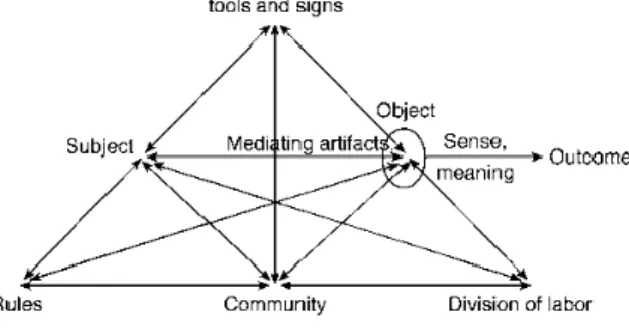
As a first lens, within the activity theory (AT), Engeström (1987)’s model of activity structure (Figure 1) helps us focus on particular elements, called entities, that intervene in the design activity:
subject that is the group of designers, object that is the c-book being designed, community with
which the designers’ group interacts, mostly the designers of the C-book technology, rules that govern the design process, division of labour that occurs among the designers, tools and signs, such as artefacts used by the designers, mostly the C-book technology including the CoICode collaborative workspace, and outcome that is the designed resource, as well as learning that can occur during the design process. Engeström (1987)’s model highlights also interactions between these entities, which allows to describe and understand the context of the design process.
Figure 1. The structure of an activity system (Engeström, 1987, p. 78)
Engeström (2001) expands his model and sheds light and awareness on the interactions occurring between different individual activity systems, i. e., when the subject is a single designer. It is illustrated by the minimal structure of two interacting individual activity systems (ibid.) which allows to bring to the fore the modifications of the object. The object moves from an initial state of un-reflected, situationally given “raw material” (object 1) to a collectively meaningful object constructed by the activity system (object 2), and to a potentially shared or jointly constructed object (object 3). However, the models do not allow us to understand the nature of the entities. In order to capture the nature of the subject and community entities, we draw on the concepts of
community of practice (CoP) (Wenger, 1998) and community of interest (CoI) (Fischer, 2001).
Besides, the designers belong to various “worlds” according to their domains of expertise. These worlds have boundaries that “can be seen as a socio-cultural difference leading to discontinuity in action or interaction” (Akkerman & Bakker, 2011, p. 133). It is therefore important, while studying collaborative resource design, to pay particular attention to what happens on those boundaries. The
boundary crossing approach (BC) (ibid.) enables to enlighten the weight of boundaries in the creative design process and the arising mechanisms of identification, coordination, reflection and
transformation through the concepts of boundary object (Star & Griesemer, 1989) and broker,
bound to interactions between subject – community – (artefact or object or outcome), or between two or more individual activity systems. Finally, in order to highlight the role of the teachers (subjects) involved in the design, their personal resources (artefacts) brought into play in the design, and the trajectory of the digital resource being designed, i.e. its different versions from mother
resources to daughter resource (Hammoud, 2012) (from object to outcome), we draw on the
documentational approach to didactics (DAD) (Gueudet & Trouche, 2009). To sum up, the AT was our main framework allowing to connect all others through the entities of the Engeström’s activity system model. Based on this, we have been able to conceptualise our understanding of social creativity.
As a matter of fact, different types of creativity are reported in literature. We have chosen the
little-c little-creativity (Craft, 2000), whilittle-ch is when a person realizes a new or improved way to approalittle-ch an
issue or accomplish a task. We draw also on the componential tradition of creativity assessment (Hennessey and Amabile 1999) to assess it and on the concept of communities of interest (CoI) for characterising our communities of designers. Thus, within the MC2 project, we define social creativity (SC) as the generation of ideas which: (a) stem from a combination of two or more individual activity systems, (b) result from various interactions among the CoI members, the C-book technology and tools, (c) are externalized in and through specific digital artefacts (including the
c-books), and (d) are considered by the CoI members to be novel, appropriate and usable (Daskolia,
2015). Moreover, creativity, social or individual, can be modelled through phases of divergent (novel ideas) and convergent thinking (appropriate and usable ideas) (Csikszentmihalyi 1996) constituting a creativity cycle. Social creativity is characterised by the reification of creative ideas collectively elaborated, i.e. elaborated by at least two CoI members.
Research questions
In this paper, we address the following research questions: in the collaborative digital resource design activity,
what interactions between rules, community and division of labour promote or hinder SC?
what types of objects have the potential to become boundary objects, under which conditions and how can they stimulate SC?
which members have the potential to become brokers, under what conditions and what is their role in stimulating SC?
Methodology
Our methodology relies on one case study, i.e., we analyse the collaborative design of one particular c-book within the French CoI. The data was mostly collected via CoICode that keeps traces of interactions in the form of ideas posted by each designer (Figure 3), but also through minutes of manifold meetings, exchanged emails and the designed c-books. Although the methodology comprises quantitative and qualitative methods, in this paper we only focus on the qualitative analyses aiming at getting a deeper insight into social creativity processes. The data analysis was
processed in two phases. First, we use the AT to describe in detail the design activity context through the activity system entities in order to situate and understand the collaborative design context of the group of designers. Second, we use our network of theories to qualitatively analyse data and bring to the fore factors impacting the social creativity taking place among the designers.
A snippet of the collaborative design of the c-book ‘Ski’
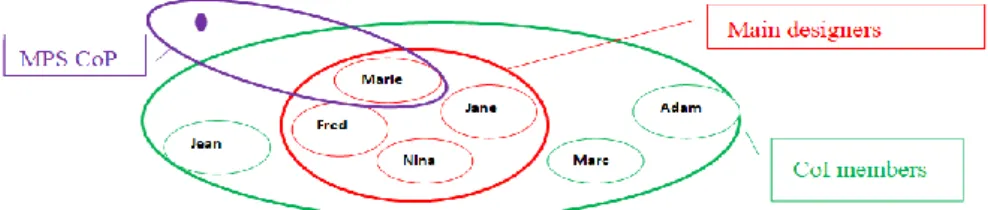
In this section, we analyse a few episodes of the collaborative design process of a c-book on ski touring. From the AT perspective, the object of the design process was to create meaningful mathematical activities linked to the risks of provoking an avalanche while practicing ski touring to foster students’ mathematical learning and creativity (purposeful activities). The group of designers (subject, Figure 2) was composed of seven members of the French CoI (community), all closely related to mathematics education with knowledge on mathematics, technology and pedagogy, and sharing a constructivist background.
Figure 2: The designers of the c-book ‘ski touring’
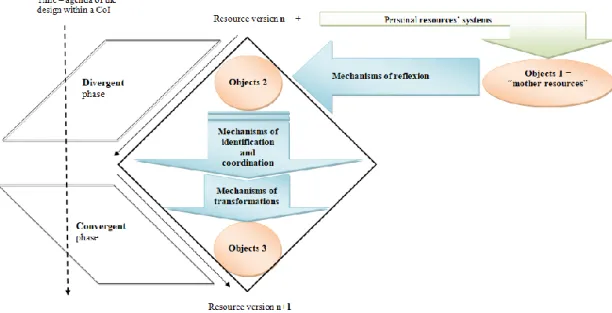
Four members acted as the main designers: Nina (secondary mathematics and physics teacher and PhD student, with a good knowledge of the C-book technology (artefacts)) who moderated the group, Marie (researcher and mathematics teacher educator, expert in mathematical modelling), Fred (mathematics teacher educator, interested in real problems), and Jane (mathematics teacher educator, interested in digital technology in mathematics education) who played the role of a reviewer. The other three members, Marc (expert of digital technology such as dynamic geometry systems), Jean and Adam intervened on request or during CoI meetings (division of labour). The main designers’ group was constituted in a way that at least one of them was at ease with digital technologies and especially with the C-book technology (rules). The designed c-book (outcome) should be used by a teacher of an associated CoP, called MPS, which Marie belongs to (rules). This CoP reflects on the use of mathematics for solving interdisciplinary problems with Grade 10 students. In order to bring to the fore the trajectory of the c-book design process through its versions, we combined documentational approach to didactics, activity theory, social creativity and boundary crossing approach. We could identify four versions of the c-book. The initial version was constituted by Marie’s personal resources on the theme of avalanche and skiing (mother resources = objet 1), as she has already worked on this topic within the MPS CoP and experimented some activities with Grade 10 students. From her numerous resources, Marie selected several that she instrumentalised through CoICode posts (object 2) (reflection mechanism = perspective making). Then, a divergence phase was initiated by a brainstorming amongst the CoI members. It generated nine new directions on real situations and mathematical notions (reflection mechanism =
designers. The creative ideas were related to real situations such as the avalanche risk depending on a slope leading to considering angles, the measurement of the angle of a snowy slope with ski poles that requires knowledge of trigonometry, the shape of snow crystals leading to working on geometric figures, transformations and sequences. This phase was followed by a phase of convergence (identification, coordination and transformation mechanisms) characterised by the collective elaboration of some of these ideas with, for instance, some artefacts already known within the French CoI, such as GeoGebra or Cinderella, in order to simulate an avalanche to encourage students to make conjectures about the risks, or programming an avalanche victim search device in order to make students understand the notion of algorithm (objects 3). The two phases constituted a creativity cycle. They led to the second version of the c-book pictured through a defined structure and content based on the preparation of a ski tour as a guideline for the story that would guarantee a unity for the c-book. In the following creativity cycle, the creative ideas were mainly bound to the technology and designers’ technical knowledge, such as suggesting guidelines how to use GeoGebra for creating snowflakes, devising relevant feedback for students in different ways to enrich the milieu of the c-book activities by using widgets that were not familiar within the French CoI, or considering the copy/paste possibilities inside the Chat tool to enable interactions between students or between the students and the teacher (social aspects). During the third creativity cycle, the main concern of the designers was the usability of the c-book by the teachers and students from Grade 10 to 12. The designers were also concerned by giving a unity between all the activities thanks to a story on ski touring and avalanche risk. Hence, the focus of the designers changed from one cycle to the other. In addition, we noticed that a divergent phase was often initiated by a review of the c-book version at stake by the reviewer or by a critical feedback from some CoI members, less involved in the design, during a meeting (reflection mechanism). Each version was the result of a creativity cycle, i.e., a divergent phase followed by a convergent one as modelled in Figure 3.
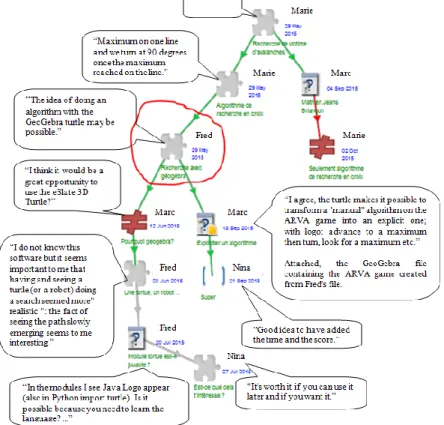
Furthermore, we observed that the first creativity cycle generated ten creative ideas out of 14 ideas judged as creatives by the designers, which was more than in the other cycles. The analysis of this cycle highlights a positive effect of the compulsory use of CoICode (rules) during brainstorming amongst the designers. This was not the case in the other cycles where the designers used also other media to communicate and to record their interactions, such as emails or minutes from the diverse meetings. Indeed, when the CoI members used CoICode, they had to read the ideas of the others and to react on them. Each post in CoICode obliged a designer to reflect on his/her own ideas. The latter had to choose if the idea was new or rather a reaction to another one, and what kind of reaction (opposition, contribution or alternative). Such a structured reflexion turned out to boost SC. Finally, in order to have a deeper understanding of SC we studied the path of a creative idea, i.e. its collective elaboration. The creative idea we analysed (circled with red in Figure 4) was chosen because of its strong collective elaboration. This idea was preceded by Marie’s suggestion to create an activity on algorithms bound to the search of a victim of an avalanche (mother resource). Then, Fred’s creative idea proposed to work on algorithm with the “GeoGebra turtle”. Fred was referring to explicit algorithm (reflection mechanism). This suggestion sparkled the negotiations between Marc and Fred who expressed different perspectives of a widget around the idea of a "turtle" to model an avalanche victim research device. Marc understood and proposed a widget designed by the Greek CoI using logo language. But Fred did not know this widget. He knew another widget using Java Logo language, which could enable to create explicit algorithm but he was hesitating. Thus, they seemed to share a common frame of reference around turtle and logo, which enabled them to understand each other. The word “turtle” became a boundary object between them.
Nevertheless, from the meetings’ minutes, Nina the moderator found that Fred was in trouble because he could not manage to finalize his widget with GeoGebra (creative idea) that should allow students to work implicitly on algorithms. Hence, Nina asked Marc to help Fred. She identified difficulties (identification mechanism), and to overcome them, she solicited another member of the CoI (coordination mechanism). Marc, expert of GeoGebra, designed the widget, limited the time and added a score to foster affective aspects (transformation mechanism = hybridization, daughter resource). Moreover, Marc was eager to create an explicit algorithm with a widget designed within the Greek CoI, but he did not master the logo language required for working with the latter. He therefore asked the technological expert from the Greek CoI how to write the algorithm and he eventually created a new widget (transformation mechanism = hybridization, daughter resource). He thus played a role of broker looking for knowledge in another CoI (community).
Conclusion
The analysis of the process of design of the c-book “ski” shows that some rules impacted positively social creativity among the c-book designers. One of such rules applies to the constitution of the designers’ community that should be as diversified as possible. The diversity should be understood in terms of complementary expertise of its members (pedagogical, mathematical and especially technical) broadening the discussion meaning, but also in terms of roles to be assigned (moderator, designer and reviewer, division of labour). Indeed, the reviewer fostered a divergent phase and the moderator facilitated a convergent phase, supporting creativity cycle. In addition, the use of CoICode to communicate during brainstorming seemed also to enhance SC.
In addition, we noticed that some words (e.g., turtle) allowed the designers to propose various ideas in different perspectives from other contexts, from other cultures. Such words became boundary
objects widening the CoI perspective. Therefore, within a CoI that designs c-books, we can say that
potential boundary objects are malleable, transformable objects, compatible with the object of the design and belonging to the designers’ common frame of reference. Boundary objects helped to extend the common frame of reference between the designers (coordination) by enlarging their perspectives.
We found that the brokers, who were members of the CoI, were able to identify the missing knowledge for the c-book design, to look for it and then, to share this new knowledge within the French CoI. Thus, in our context, we can say that a broker is a member of the CoI who identifies missing knowledge within the CoI, then can find it in another related professional world in order to bring it to the CoI. Thus, the broker acts as a coordination mechanism allowing the CoI members to extend their common frame of reference with new knowledge.
References
Akkerman, S. F., & Bakker, A. (2011). Boundary crossing and boundary objects. Review of
educational research, 81(2), 132–169.
Clark-Wilson, A. & Timotheus, J. (2013). Designing tasks within a multi-representational technological environment: An emerging rubric. In C. Margolinas (Ed.), ICMI study 22 task
Craft, A. (2000). Creativity across the primary curriculum: Framing and developing practice. London: Routledge / Falmer.
Csikszentmihalyi, M. (1996). Creativity: Flow and the psychology of discovery and invention. New York: HarperCollins.
Daskolia, M. (Dir.) (2015). D2.2: Operational definitions and criteria for measuring social
creativity in the design of digital educational resources for CMT. Deliverable of the MC Squared
project. FP7, ICT-2013.8.1. Accessed 17 September 2016 from http://mc2-project.eu/index.php/dissemination
Engeström, Y. (1987). Learning by expanding: An activity-theoretical approach to developmental
research. Helsinki: Orienta-Konsultit.
Engeström, Y. (2001). Expansive learning at work: Toward an activity theoretical reconceptualization. Journal of Education and Work, 14(1), 133–156.
Essonnier, N. (2018). Etude de la conception collaborative de ressources numériques
mathématiques au sein d’une communauté d’intérêt. Doctoral dissertation, Université C.
Bernard-Lyon 1, France.
Fischer, G. (2001). Communities of interest: Learning through the interaction of multiple
Knowledge Systems. Paper presented at 24th Annual Information Systems Research Seminar in
Scandinavia (IRIS 24), Ulvik, Norway.
Gueudet, G., & Trouche, L. (2009). Towards new documentation systems for mathematics teachers? Educational Studies in Mathematics, 71(3), 199–218.
Hammoud, R. (2012). Le travail collectif des enseignants en chimie comme levier pour la mise en
œuvre de démarches d'investigation et le développement de connaissances professionnelles.
Doctoral dissertation, Université C. Bernard-Lyon 1, Université Libanaise.
Hennessey, B. A., & Amabile T. M. (1999). Consensual assessment. In M. A. Runco, & S. R. Pritzker (Eds.), Encyclopedia of Creativity (pp. 34–36). New York: Academic Press. Kynigos, C., & Kolovou, A. (2018). Teachers as designers of digital educational resources for
creative mathematical thinking. In Fan L., Trouche L., Qi C., Rezat S., Visnovska J. (Eds.)
Research on Mathematics Textbooks and Teachers’ Resources. ICME-13 Monographs. Springer,
Cham.
Star, S. L., & Griesemer, J. R. (1989). Institutional ecology, ‘translations’ and boundary objects: amateurs and professionals in Berkeley’s Museum of Vertebrate Zoology, 1907-1939. Social
Studies of Science, 19(3), 387–420.
Wenger, E. (1998). Communities of practice: Learning, meaning, identity. Cambridge: Cambridge university press