HAL Id: hal-02917707
https://hal.archives-ouvertes.fr/hal-02917707
Submitted on 19 Aug 2020
HAL is a multi-disciplinary open access
archive for the deposit and dissemination of
sci-entific research documents, whether they are
pub-lished or not. The documents may come from
teaching and research institutions in France or
abroad, or from public or private research centers.
L’archive ouverte pluridisciplinaire HAL, est
destinée au dépôt et à la diffusion de documents
scientifiques de niveau recherche, publiés ou non,
émanant des établissements d’enseignement et de
recherche français ou étrangers, des laboratoires
publics ou privés.
Hydroxide-Induced Degradation of Olefin Metathesis
Catalysts: A Challenge for Metathesis in Alkaline Media
Alexandre Goudreault, Daniel Walden, Daniel Nascimento, Adrian Botti,
Stephan Steinmann, Carine Michel, Deryn Fogg
To cite this version:
Alexandre Goudreault, Daniel Walden, Daniel Nascimento, Adrian Botti, Stephan Steinmann, et
al.. Hydroxide-Induced Degradation of Olefin Metathesis Catalysts: A Challenge for Metathesis in
Alkaline Media. ACS Catalysis, American Chemical Society, 2020, 10 (6), pp.3838-3843.
�10.1021/ac-scatal.9b05163�. �hal-02917707�
Hydroxide-Induced Degradation of Olefin Metathesis Catalysts: A Chal-lenge for Metathesis in Alkaline Media
Alexandre Y. Goudreault,
aDaniel M. Walden,
bDaniel L. Nascimento,
aAdrian G. Botti,
aStephan N.
Stein-mann,
bCarine Michel,*
band Deryn E. Fogg*
aa
Center for Catalysis Research & Innovation, and Department of Chemistry and Biomolecular Sciences, University of Ottawa, ON,
Canada, K1N 6N57.
bUniv. Lyon, ENS de Lyon, CNRS UMR 5182, Université Claude Bernard Lyon 1, Laboratorie de Chimie,
F-69342 Lyon, France
Supporting Information Placeholder
ABSTRACT:
Hydroxide ion is shown to be a potent disruptor of Ru-catalyzed olefin metathesis, in a study of the Hoveyda
cata-lyst HII. Addition of [N
nBu
4
][OH] immediately terminates metathesis via HII, an effect traced to formation of bis(hydroxide)
complex HII-OH. The latter was synthesized for direct study. HII-OH initiates very slowly on reaction with olefins, and
de-composes in the first cycle of metathesis. Computational analysis reveals rapid bimolecular coupling between HII-OH and its
four-coordinate methylidene derivative. Importantly, fully decomposed catalyst also accelerates decomposition of HII-OH. The
H-bonding capacity of the hydroxide ligand is proposed as a powerful driving force for decomposition.
Keywords. olefin metathesis, catalyst decomposition, N-heterocyclic carbene, water, aqueous metathesis, hydrogen-bonding, chemical biology
Ruthenium-catalyzed olefin metathesis offers exceptionally
powerful methodologies for the assembly of carbon-carbon
bonds.
1In many applications in total synthesis,
2,3pharmaceu-tical manufacturing,
4and chemical biology,
5-7metathesis is
carried out on densely-functionalized substrates bearing
polar functional groups, in the presence of variable amounts
of water.
We speculated that hydroxide ion might pose a
common, unrecognized challenge to catalyst function under
such conditions. At the extreme is the metathetical
modifica-tion of proteins in water buffered to pH >7, a forefront
appli-cation that necessitates use of the Ru complex in high
stoi-chiometric excess.
6While clever strategies have been
de-signed to accelerate metathesis relative to catalyst
degrada-tion,
7the basis of the problem remains ambiguous.
Under-standing the unintended, non-metathetical reactivity of the
Ru=CHR bond under such conditions is thus of both
fun-damental and practical importance. The present work was
aimed at assessing the impact of hydroxide on the
productivi-ty and fate of the second-generation Hoveyda catalyst HII,
an exemplary, widely used metathesis catalyst.
Prominent among the decomposition pathways now known
to disrupt Ru-catalyzed metathesis are those enabled by
nucleophiles and Bronsted base (Scheme 1). Nucleophiles
have been shown to attack the methylidene carbon of
Ru-1,
8,9while Bronsted bases readily deprotonate the
metallacy-clobutane (MCB) intermediate Ru-2.
10,11The potential
engagement of hydroxide ion in either manifold was
antici-pated.
12-14Unexpectedly, however, a potent new
decomposi-tion pathway was identified, which appears unique to
Ru-hydroxide species. Here we describe transformation of HII
into bis-hydroxide complex HII-OH, and bimolecular
de-composition of HII-OH during the first cycle of metathesis.
Scheme 1. Decomposition of Metathesis-Active Species
by (a) Nucleophiles; (b) Bronsted Base. L = H
2IMes; Red
Arrows Indicate Sites of Attack.
Our attention was first drawn to the potential of hydroxide
ion to hinder metathesis in studies of the impact of Bronsted
base on metathesis productivity.
10,15Yields were negatively
affected by the presence of strongly basic enolate anions,
10but dropped even further when water was added as a
sacrifi-cial proton source.
15(In contrast, sacrifical phenols restored
metathesis activity). Likewise suggestive was a preliminary
survey of the impact of common contaminants on metathesis
Ru Cl Cl L Ru Cl Cl L R Ru-1 Ru-2 R Nu-CH3
(a) H-Nu: (b) Base
H H + metathesis-inactive Ru products base•HCl + R (a) (b)
productivity. These experiments examined the impact of
additives on turnover numbers (TON) in cyclization of
diethyl diallylmalonate (DDM, A; Figure 1), with the
ra-tionale that any agents capable of disrupting this
exceptional-ly facile ring-closing metathesis (RCM) reaction merit
atten-tion. As shown in Figure 1a, either water or morpholine C (a
basic contaminant present in technical grade toluene)
16caused TONs to drop by approximately half, but a 50%
fur-ther decrease occurred when both water and morpholine
were present.
The premise that hydroxide ion might be responsible was
tested via a knockdown experiment, in which [N
nBu
4
][OH]
(a THF-soluble source of hydroxide ion)
17was added during
RCM. Metathesis activity immediately ceased (Figure 1b;
red line), even at catalyst loadings 20x higher than those used
in the original screen. To assess whether this drop reflects
attack on the active species Ru-1 or Ru-2, or on the
precata-lyst HII, a second experiment was carried out, in which
hy-droxide was added prior to substrate. RCM activity (blue
line) was completely suppressed. This suggests that
hydrox-ide ion attacks HII to yield a ruthenium product that is either
completely inactive, or decomposes in the first cycle of
me-tathesis.
Figure 1.
Impact of additives on RCM. (a) Water, morpholine
C, or both. (b)
[N
nBu
4
][OH] (2 equiv vs Ru).
Synthesis of the putative hydroxide complex was undertaken
for closer examination. Accordingly, aqueous [N
nBu
4
][OH]
was added to a solution of HII in THF (Scheme 2).
18As use
of 1 equiv hydroxide per Ru resulted in 50% consumption of
HII, a 2:1 stoichiometry was employed. A colour change
from green to red occurred over the time of mixing, and
1H
NMR analysis revealed a new singlet for the benzylidene
proton at 14.04 ppm (cf. 16.72 ppm for HII). Reaction was
complete in <10 min even on 200 mg scale, and
bis-hydroxide HII-OH was isolated in ca. 85% yield. Complete
selectivity for salt metathesis was evident, as expected from
reactions of related Ru alkylidenes with aryloxide ion,
19but
in contrast with reactions of hydroxide with Ru-CO
com-plexes, which yield Ru formates via attack on the carbonyl
ligand.
12a,bWith the exception of the Ru=CHAr signal, the chemical
shifts and multiplicities of all proton signals for HII-OH
accord closely with those for HII. An additional singlet was
observed for the Ru-OH protons at 1.1 ppm, the assignment
of which was confirmed by
exchange with degassed D
2O.
20The structure depicted for HII-OH in Scheme 2 is that
pre-dicted by density functional theory (DFT) analysis:
specifi-cally, a distorted trigonal bipyramidal geometry,
21with an
HO–Ru–OH angle of 139.1° (Table S2). In comparison, the
Cl–Ru–Cl angle for HII is nearly 20° larger (computed:
155.1°; crystallographic:
22156.5°).
Scheme 2. Synthesis of HII-OH.
Consistent with the knockdown behaviour seen in Figure 1b,
HII-OH proved unreactive toward DDM. Even with 10
mol% of HII-OH at 60 °C, <3% RCM was evident after 2 h
(cf. 100% within 15 min at RT with 1 mol% HII as catalyst).
Slow initiation of HII-OH is not surprising, given the
induc-tive withdrawal of electron density from the Ru center by the
oxygen ligands. The compressed HO–Ru–OH angle may
also be relevant, as Ru metathesis catalysts with cis-anionic
geometries are known to initiate very slowly.
23Computational analysis of the initiation step, undertaken
using ethylene as a model olefin (Scheme S4a),
24revealed a
higher energy barrier to cycloaddition for HII-OH, relative
to HII (20.9 kcal/mol, vs. 16.7 kcal/mol). The resulting
metallacyclobutane is trigonal bipyramidal in both cases, but
intramolecular H-bonding of the OH ligands (ca. 2 Å)
stabi-lizes a cis-anionic geometry for HII-OH, in contrast with the
trans-anionic geometry seen for HII (Scheme S4b).
While this energy difference accounts for slower reaction of
HII-OH, it does not account for the complete loss of
me-tathesis activity. We infer that HII-OH is considerably more
susceptible to decomposition. In examining the relevant
pathways, we first considered those established for HII and
related catalysts (see Introduction). Nucleophilic attack by
hydroxide on the benzylidene carbon (cf. Scheme 1a) is
expected to liberate the aldehyde HC(O)Ar (Ar = o-C
6H
4-O
iPr).
25This aldehyde is indeed detected, but in minor,
variable amounts, depending on rates of mixing.
26The
alter-native possibility, in which a hydroxide ligand deprotonates
the MCB Ru-3 (cf. Scheme 1b), is unlikely given the ca. 41
kcal/mol barrier calculated by
DFT analysis (Scheme S5). A
potent new decomposition pathway thus appears to be
operative. Given that the sole difference between HII and
HII-OH lies in the nature of the anionic ligands (and
given that
related Ru(OAr)
2and Ru(k
2-O
2C
6R
4) exhibit notably high
metathesis productivity),
19the hydroxide groups appears to
play a critical, negative role.
To gain deeper insight,
we reacted HII-OH with ethylene,
using a sealed NMR tube to retain any volatile products
(Scheme 3). Loss of the [Ru]=CHAr signal for HII-OH was
complete within 24 h. Unexpectedly, however, only ca. 50%
of the HII-OH complex had participated in metathesis, as
judged from the combined yields of styrenyl ether D
(Scheme 3a) and propenes E/E’
(
Scheme 3b). These
pro-penes are presumed to form via b-elimination from
the MCB
Ru-3,
a
well-established decomposition pathway for HII
27,28and
other metathesis catalysts.
29The computed barrier to
elimination of E/E’ from Ru-3 is comparable to that for
cyclo-reversion (15.9 vs. 17.0 kcal/mol, respectively).
The fact that these organic products account for only 50% of
the starting HII-OH is puzzling. As Ru(OH) complexes are
known to form hydroxy-bridged dimers with remarkable
facility,
30,31we queried whether bimolecular coupling might
consume HII-OH prior to metathesis. We recently reported
that HII and related metathesis catalysts decompose via
dimerization of RuCl
2(H
2IMes)(=CH
2), Ru-1.
29In the case
of HII-OH, slow initiation limits the concentration of the
corresponding hydroxo complex Ru-4. This disfavours
ho-mo-coupling of two Ru-4 molecules, but opens the door to
hetero-coupling with the large excess of HII-OH present
(Figure 2, bottom). Trapping of HII-OH upon formation of
Ru-4 could account for the engagement of only 50%
HII-OH in metathesis.
32Scheme 3. Products Generated in the First Cycle of
Me-tathesis. (a) Via Metathesis Exchange. (b) Via MCB
De-composition.
aa
Path (a) is quantified from the yield of D; Path (b) from the
yield of E+E’ (4% each).
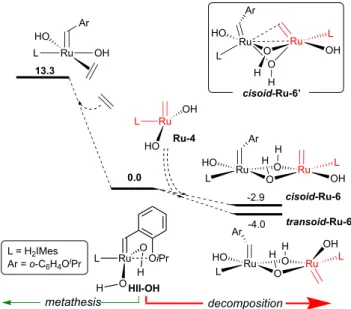
DFT calculations indicate that hetero-coupling of HII-OH is
indeed thermodynamically favoured relative to ethylene
binding. The latter is endergonic by 13.3 kcal/mol. Because
these calculations are based on gas-phase entropies, however,
they greatly exaggerate the entropic penalty to dimerization.
If we adopt one proposed correction factor, and add 50% of
the gas-phase entropy to account for the change from perfect
gas to perfect solution,
33the heterodimer is –12.4 kcal/mol
more stable than HII-OH + Ru-4, whereas the ethylene
complex lies at +14.9 kcal/mol. Hetero-dimerization is thus
greatly favoured relative to ethylene binding (the requisite
first step for formation of D and Ru-4). Consistent with this
picture, kinetics experiments indicate that decomposition is
first order in [Ru] (Figure S2). That is, formation of Ru-4 is
rate-limiting.
Two conformers of the anticipated
29,34,35heterodimer are
predicted to be thermodynamically favoured with respect to
HII-OH + Ru-4. These are transoid- and cisoid-Ru-6, of
which the former is the more stable (DG –4.0 kcal/mol).
Liberation of styrenyl ether D from transoid-Ru-6 is
inhib-ited by the relative disposition of the two ylidene groups on
opposite sides of the Ru
2(µ-OH)
2plane. Precedents from
the chloride system
29suggest that elimination of D from
cisoid-Ru-6 could be feasible, if the methylidene ligand can
adopt the conformation shown in cisoid-Ru-6’ (inset, Figure
2). However, the proportion of D liberated via the sum of
metathesis and decomposition should then approach 100%.
The observed 40% yield of D argues against such an
elimina-tion pathway. Instead, the cumulative data suggest that while
bimolecular coupling is thermodynamically favoured relative
to metathesis, C=C coupling and elimination is inhibited.
Figure 2. Competing reaction pathways for HII-OH: ethylene
binding, vs. hetero-coupling with Ru-4. Gibbs free energies
(kcal/mol)
computed
at
the
PBE-D3M(BJ)/cc-pVQZ+ECP28MDF/PCM(Benzene)
//
M06L/cc-pVDZ+ECP28MDF) level of theory. The free energy for the
heterodimer is underestimated, owing to exaggeration of the
entropic penalty to dimerization: see text.
OiPr + Ru OH HO H2IMes Ru OH HO H2IMes + Ru-4 Ru-5 Ar E
(a) metathesis exchange (40%) + (b) MCB decomposition (8%)
D + anthracene (internal standard) HII-OH Ru HO OH H2IMes Ar Ru-3 Ar = o-C6H4OiPr C6D6, RT 1 atm Ru O O H2IMes OiPr H H Ar E’ HII-OH Ru O O L OiPr H H Ru Ru O O H H HO Ar L OH L 0.0 Ru Ru O O H H HO Ar L OH L transoid-Ru-6 -2.9 -4.0 Ru OH HO L cisoid-Ru-6 Ru Ru O O HO Ar L OH L H H L = H2IMes Ar = o-C6H4OiPr Ru-4 13.3 Ru HO Ar L OH cisoid-Ru-6’ metathesis decomposition
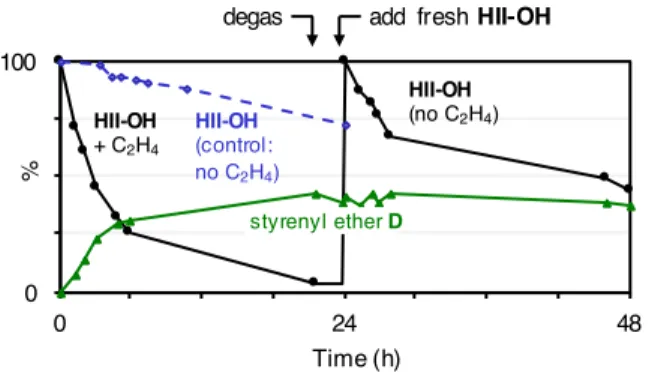
To confirm that decomposed Ru-OH species can trap HII-OH,
we added fresh catalyst to a solution of the decomposed material
(Figure 3). Disappearance of the fresh HII-OH was indeed
much faster than in the control reaction of HII-OH under N
2.
(As expected, however, it is slower than decomposition of
HII-OH under ethylene). Importantly, the corresponding
experi-ment with HII caused negligible decomposition of fresh HII
(Figure S3). The H-bonding capacity of the hydroxide ligands
thus appears to be critical in promoting attack of decomposed
Ru-OH species on fresh catalyst.
Figure 3. Accelerating effect of decomposed catalyst on the
decomposition of OH. Black: (left) Decomposition of
HII-OH under C
2H
4; (right) impact of decomposed HII-OH on
fresh precatalyst. Green: proportion of D formed during
exper-iments indicated with black lines
).
While coupling of HII-OH with Ru-4 is thus plausible, we were
unable to detect the alkylidene protons of Ru-6 by NMR
analy-sis, or to observe agglomerated species by DOSY-NMR. This, as
well as the steady degradation in NMR signal-to-noise ratios
over the 24 h timescale of decomposition (Figure S11) is
con-sistent with rapid transformation of Ru-6 into paramagnetic
products. Paramagnetism may result from the versatile
coordi-nation modes and redox properties of the hydroxide ligand,
30,31although multisite alkylidene binding is also feasible.
36,37The foregoing demonstrates that hydroxide ion is an
unex-pectedly potent disruptor of Ru-catalyzed olefin metathesis.
Termination is traced to the slow initiation and rapid
de-composition of the bis(hydroxide) complex HII-OH. A
notable feature is the capacity of the decomposed Ru species
to sequester and decompose the precatalyst HII-OH,
behav-iour that arises from the H-bonding capacity of the
hydrox-ide ligand. These results highlight previously unrecognized
challenges to metathesis under conditions that can generate
hydroxide, and more particularly metathesis in alkaline
wa-ter.
ASSOCIATED CONTENT
The Supporting Information is available free of charge on the
ACS Publications website.
PDF file: experimental and computational details, NMR spectra
xyz files: computed xyz coordinates and energies
AUTHOR INFORMATION
Corresponding Authors
*[email protected], [email protected]
ACKNOWLEDGMENT
The University of Ottawa, CNRS, and ENS Lyon are thanked
for support via the International Associated Laboratory
‘Fun-damental Catalysis for Green Chemistry’ (FUNCAT). The
Natural Sciences and Engineering Research Council of Canada
(NSERC), the SYSPROD project and AXELERA Pôle de
Compétitivité for financial support (PSMN Data Center) are
thanked for financial support.
REFERENCES
(1) (a) Grela, K., Olefin Metathesis-Theory and Practice. Wiley: Hoboken, NJ, 2014. (b) Grubbs, R. H.; Wenzel, A. G., Handbook of
Metathesis. 2nd ed.; Wiley-VCH: Weinheim, 2015.
(2) Cossy, J.; Arseniyadis, S.; Meyer, C., Metathesis in Natural
Product Synthesis: Strategies, Substrates and Catalysts. Wiley-VCH:
Weinheim, 2010.
(3) Furstner, A., Metathesis in Total Synthesis. Chem. Commun.
2011, 47, 6505–6511.
(4) (a) Higman, C. S.; Lummiss, J. A. M.; Fogg, D. E. Olefin Metathesis at the Dawn of Uptake in Pharmaceutical and Specialty Chemicals Manufacturing. Angew. Chem., Int. Ed. 2016, 55, 3552–3565. (b) Fandrick, K. R.; Savoie, J.; Jinhua, N. Y.; Song, J. J.; Senanayake, C. H., Challenges and Opportunities for Scaling the Ring-Closing Metathesis Reaction in the Pharmaceutical Industry. In Olefin Metathesis – Theory and
Practice, Grela, K., Ed. Wiley: Hoboken, 2014; pp 349-366. (c) Farina, V.;
Horváth, A., Ring-Closing Metathesis in the Large-Scale Synthesis of Pharmaceuticals. In Handbook of Metathesis, Grubbs, R. H.; Wenzel, A. G., Eds. Wiley-VCH: Weinheim, 2015; Vol. 2, pp 633–658.
(5) For selected recent examples, see: (a) Bhushan, B.; Lin, Y. A.; Bak, M.; Phanumartwiwath, A.; Yang, N.; Bilyard, M. K.; Tanaka, T.; Hudson, K. L.; Lercher, L.; Stegmann, M.; Mohammed, S.; Davis, B. G., Genetic Incorporation of Olefin Cross-Metathesis Reaction Tags for Protein Modification. J. Am. Chem. Soc. 2018, 140, 14599–14603. (b) Lu, X.; Fan, L.; Phelps, C. B.; Davie, C. P.; Donahue, C. P., Ruthenium Promoted On-DNA Ring-Closing Metathesis and Cross-Metathesis.
Bioconjugate Chem. 2017, 28, 1625–1629. (c) Grison, C. M.; Burslem, G.
M.; Miles, J. A.; Pilsl, L. K. A.; Yeo, D. J.; Imani, Z.; Warriner, S. L.; Webb, M. E.; Wilson, A. J., Double Quick, Double Click Reversible Peptide "Stapling". Chem. Sci. 2017, 8, 5166–5171. (d) Cromm, P. M.; Spiegel, J.; Kuchler, P.; Dietrich, L.; Kriegesmann, J.; Wendt, M.; Goody, R. S.; Waldmann, H.; Grossmann, T. N., Protease-Resistant and Cell-Permeable Double-Stapled Peptides Targeting the Rab8a GTPase. ACS Chem. Biol.
2016, 11, 2375–2382. For recent and seminal early reviews, see: (e)
Vinogradova, E. V., Organometallic Chemical Biology: An Organometallic Approach to Bioconjugation. Pure Appl. Chem. 2017, 89, 1619–1640. (f) Chalker, J. M.; Bernardes, G. J. L.; Lin, Y. A.; Davis, B. G., Chemical Modification of Proteins at Cysteine: Opportunities in Chemistry and Biology. Chem. – Asian J. 2009, 4, 630–640. (g) Binder, J. B.; Raines, R. T., Olefin Metathesis for Chemical Biology. Curr. Opin. Chem. Biol. 2008, 12, 767–773. See also refs 6, 7.
(6) Isenegger, P. G.; Davis, B. G., Concepts of Catalysis in Site-Selective Protein Modifications. J. Am. Chem. Soc. 2019, 141, 8005−8013.
(7) Lin, Y. A.; Davis, B. G., The Allylic Chalcogen Effect in Olefin Metathesis. Beilstein J. Org. Chem. 2010, 6, 1219–1228.
(8) Nucleophilic amines can abstract the alkylidene ligand, as shown in Scheme 1a: (a) Lummiss, J. A. M.; Botti, A. G. G.; Fogg, D. E., Isotopic Probes for Ruthenium-Catalyzed Olefin Metathesis. Catal. Sci.
Technol. 2014, 4, 4210–4218. (b) Lummiss, J. A. M.; Ireland, B. J.;
Sommers, J. M.; Fogg, D. E., Amine-Mediated Degradation in Olefin Metathesis Reactions that Employ the Second-Generation Grubbs Catalysts. ChemCatChem 2014, 6, 459–463. For nucleophilic attack of a
0 100 0 24 48 % Time (h) HII-OH (control: no C2H4) HII-OH + C2H4
add fresh HII-OH
styrenyl ether D HII-OH
(no C2H4)
free carbene at a methylidene carbon, see: (c) Rufh, S.; Goudreault, A. Y.; Foscato, M.; Jensen, V. R.; Fogg, D. E., Rapid Decomposition of Olefin Metathesis Catalysts by a Truncated N-Heterocyclic Carbene (NHC): Unprecedentedly Efficient Catalyst Quenching and NHC Vinylation ACS
Catal. 2018, 8, 11822−11826.
(9) Nucleophilic phosphines can likewise abstract the [Ru]=CHR carbon. For a mechanistic study demonstrating this pathway for broad range of PR3-stabilized benzylidene and indenylidene metathesis
precatalysts, see: (a) McClennan, W. L.; Rufh, S. A.; Lummiss, J. A. M.; Fogg, D. E., A General Decomposition Pathway for Phosphine-Stabilized Metathesis Catalysts: Lewis Donors Accelerate Methylidene Abstraction. J.
Am. Chem. Soc. 2016, 138, 14668−14677. For isolation of the [Ru]–
CH2PCy3 intermediate in the first-generation Grubbs system, see: (b)
Lummiss, J. A. M.; McClennan, W. L.; McDonald, R.; Fogg, D. E., Donor-Induced Decomposition of the Grubbs Catalysts: An Intercepted Intermediate Organometallics 2014, 33, 6738–6741. For the key observation of [MePCy3]Cl, see: (c) Hong, S. H.; Wenzel, A. G.; Salguero,
T. T.; Day, M. W.; Grubbs, R. H., Decomposition of Ruthenium Olefin Metathesis Catalysts. J. Am. Chem. Soc. 2007, 129, 7961–7968. For elimination of the corresponding ylid, see: (d) Galan, B. R.; Pitak, M.; Keister, J. B.; Diver, S. T., Isocyanide-Promoted Ylidene Transfer to Phosphorus: Rearrangement in the First-Generation Grubbs Complex.
Organometallics 2008, 27, 3630–3632. For other examples, see: (e)
Werner, H.; Stuer, W.; Weberndorfer, B.; Wolf, J., Hydrido(carbonyl) and Hydrido(carbene) Complexes of Ruthenium. Eur. J. Inorg. Chem. 1999, 1707–1713. (f) Hansen, S. M.; Rominger, F.; Metz, M.; Hofmann, P., The First Grubbs-Type Metathesis Catalyst with Cis Stereochemistry: Synthesis of (h2-dtbpm)RuCl
2(=CHCH=CMe2) From a Novel,
Coordinatively Unsaturated Dinuclear Ruthenium Dihydride. Chem. – Eur.
J. 1999, 5, 557–566.
(10) Bailey, G. A.; Lummiss, J. A. M.; Foscato, M.; Occhipinti, G.; McDonald, R.; Jensen, V. R.; Fogg, D. E., Decomposition of Olefin Metathesis Catalysts by Brønsted Base: Metallacyclobutane Deprotonation as a Primary Deactivating Event. J. Am. Chem. Soc. 2017, 139, 16446– 16449.
(11) Ireland, B. J.; Dobigny, B. T.; Fogg, D. E., Decomposition of a Phosphine-Free Metathesis Catalyst by Amines and Other Nitrogen Bases: Metallacyclobutane Deprotonation as a Major Deactivation Pathway. ACS
Catal. 2015, 5, 4690−4698.
(12) Precedents for nucleophilic attack by hydroxide ion on ligands at Ru centres are found in contexts ranging from the water-gas shift reaction (WGSR) in aqueous alkaline media, to catalyst synthesis, to water oxidation catalysis. Selected examples: (a) Sinha, A.; Ghatak, T.; Bera, J. K., Hydroxycarbonyl Complexes as Key Intermediates in the Base-Assisted Reduction of Ruthenium Carbonyls. Dalton Trans. 2010, 39, 11301– 11313. (b) Sentets, S.; Rodriguez Martinez, M. d. C.; Vendier, L.; Donnadieu, B.; Huc, V.; Lugan, N.; Lavigne, G., Instant “Base-Promoted” Generation of Roper's-type Ru(0) Complexes Ru(CO)2(PR3)3 from a
Simple Carbonylchlororuthenium(II) Precursor. J. Am. Chem. Soc. 2005,
127, 14554–14555. (c) Wang, Y.; Zhan, S.; Ahlquist, M. S. G., Nucleophilic
Attack by OH2 or OH–: A Detailed Investigation on pH-Dependent
Performance of a Ru Catalyst. Organometallics 2019, 38, 1264–1268. (13) An important difference should be noted between decomposition by hydroxide itself, vs. hydroxide in methanol (a medium once widely used for metathesis in biologically-relevant contexts, the impact of which was discussed in: (a) Camm, K. D.; Fogg, D. E., From Drug Cocktails to Tissue Engineering: Synthesis of ROMP Polymers for Biological Applications. In NATO Sci. Ser. II, Imamoglu, Y.; Dragutan, V., Eds. Springer Verlag: Berlin, 2007; Vol. 243, pp 285–303). The latter conditions convert the catalysts to methoxide complexes, which decompose to Ru hydrides via b-elimination. See: (b) Beach, N. J.; Lummiss, J. A. M.; Bates, J. M.; Fogg, D. E., Reactions of Grubbs Catalysts with Excess Methoxide: Formation of Novel Methoxyhydride Complexes.
Organometallics 2012, 31, 2349–2356. (c) Dinger, M. B.; Mol, J. C.,
Degradation of the First-Generation Grubbs Metathesis Catalyst with Primary Alcohols, Water, and Oxygen. Formation and Catalytic Activity of Ruthenium(II) Monocarbonyl Species. Organometallics 2003, 22, 1089– 1095. For exploitation of this effect in tandem catalysis, see: (d) Schmidt,
B., In situ Conversion of a Ru Metathesis Catalyst to an Isomerization Catalyst. Chem. Commun. 2004, 742–743.
(14) As noted by a referee, exchange of chloride for fluoride also has a deactivating effect, which can be countered by addition of (TMS)2O to
remove fluoride anions. See: Osman, S.; Koide, K., Ruthenium-Catalyzed Olefin Metathesis after Tetra-N-Butylammonium Fluoride-Mediated Desilylation. Tetrahedron Letters 2012, 53, 6637–6640.
(15) Santos, A. G.; Bailey, G. A.; dos Santos, E. N.; Fogg, D. E., Overcoming Catalyst Decomposition in Acrylate Metathesis: Poly-phenol Resins as Enabling Agents for Phosphine-Stabilized Metathe-sis Catalysts.
ACS Catal. 2017, 7, 3181−3189.
(16) Nicola, T.; Brenner, M.; Donsbach, K.; Kreye, P., First Scale-Up to Production Scale of a Ring Closing Metathesis Reaction Forming a 15-Membered Macrocycle as a Precursor of an Active Pharmaceutical Ingredient. Org. Process Res. Dev. 2005, 9, 513–515.
(17) The [NnBu
4][OH] reagent was employed as a solution in
degassed water, rather than as its alternative formulation as a solution in methanol, to circumvent formation of methoxide derivatives which rapidly decompose via b-elimination. See: (a) Beach, N. J.; Lummiss, J. A. M.; Bates, J. M.; Fogg, D. E., Reactions of Grubbs Catalysts with Excess Methoxide: Formation of Novel Methoxyhydride Complexes.
Organometallics 2012, 31, 2349–2356. (b) Dinger, M. B.; Mol, J. C.,
Degradation of the First-Generation Grubbs Metathesis Catalyst with Primary Alcohols, Water, and Oxygen. Formation and Catalytic Activity of Ruthenium(II) Monocarbonyl Species. Organometallics 2003, 22, 1089– 1095.
(18) The ammonium salt was used, as reaction with excess KOH yielded an equilibrium mixture. Similar behaviour was reported in salt metathesis with KBr and KI. See: J. Wappel, C. A. Urbina-Blanco, M. Abbas, J. H. Albering, R. Saf, S. P. Nolan, C. Slugovc, Halide Exchanged Hoveyda-Type Complexes in Olefin Metathesis. Beilstein J. Org. Chem.
2010, 6, 1091–1098.
(19) Catecholates, O2C6X4 (X = H, F, Cl, Br): (a) Monfette, S.;
Camm, K. D.; Gorelsky, S. I.; Fogg, D. E., Electronic Effects of the Anionic Ligand in Ruthenium-Catalyzed Olefin Metathesis. Organometallics 2009,
28, 944–946. (b) Monfette, S.; Fogg, D. E., Ruthenium Metathesis
Catalysts Containing Chelating Aryloxide Ligands. Organometallics 2006,
25, 1940–1944. Perfluoroaryloxide, OC6F5: (c) Conrad, J. C.; Amoroso,
D.; Czechura, P.; Yap, G. P. A.; Fogg, D. E., The First Highly Active, Halide-Free Ruthenium Catalyst for Olefin Metathesis. Organometallics
2003, 22, 3634–3636. (d) Conrad, J. C.; Parnas, H. H.; Snelgrove, J. L.;
Fogg, D. E., Highly Efficient Ru-Pseudohalide Catalysts for Olefin Metathesis. J. Am. Chem. Soc. 2005, 127, 11882–11883.
(20) For detailed characterization data, see SI.
(21) Tau parameter analysis reveals a distorted trigonal bipyramidal geometry for Ru-1, as compared to distorted square pyramidal for HII (tau = 0.61 or 0.39, respectively; cf. values of 0 for a perfect square pyramid, and 1 for a perfect trigonal bipyramid). See: Addison, A. W.; Rao, T. N.; Reedijk, J.; Van Rijn, J.; Verschoor, G. C., Synthesis, Structure, and Spectroscopic Properties of Copper(II) Compounds Containing Nitrogen-Sulfur Donor Ligands. J. Chem. Soc., Dalton Trans. 1984, 1349–1356.
(22) Garber, S. B.; Kingsbury, J. S.; Gray, B. L.; Hoveyda, A. H., Efficient and Recyclable Monomeric and Dendritic Ru-Based Metathesis Catalysts. J. Am. Chem. Soc. 2000, 122, 8168–8179.
(23) For an explicit discussion, see: (a) Kotyk, M. W.; Gorelsky, S. I.; Conrad, J. C.; Carra, C.; Fogg, D. E., Geometric and Electronic Structure of a C1-Symmetric Ru-Aryloxide Metathesis Catalyst: An Experimental and
Computational Study. Organometallics 2009, 28, 5424–5431. For early experimental evidence in cis-Cl2 systems, see: (b) Barbasiewicz, M.;
Szadkowska, A.; Bujok, R.; Grela, K., Structure and Activity Peculiarities of Ruthenium Quinoline and Quinoxaline Complexes: Novel Metathesis Catalysts. Organometallics 2006, 25, 3599–3604. (c) Ung, T.; Hejl, A.; Grubbs, R. H.; Schrodi, Y. Organometallics 2004, 23, 5399–5401. (d) Slugovc, C.; Perner, B.; Stelzer, F.; Mereiter, K. Organometallics 2004, 23, 3622–3626. (e) Ben-Asuly, A.; Tzur, E.; Diesendruck, C. E.; Sigalov, M.; Goldberg, I.; Lemcoff, N. G. Organometallics 2008, 27, 811–813. For a computational study, see: (f) Benitez, D.; Goddard, W. A., III, The Isomerization Equilibrium between Cis and Trans Chloride Ruthenium
Olefin Metathesis Catalysts from Quantum Mechanics Calculations. J. Am.
Chem. Soc. 2005, 127, 12218–12219.
(24) Ashworth, I. W.; Hillier, I. H.; Nelson, D. J.; Percy, J. M.; Vincent, M. A., Olefin Metathesis by Grubbs–Hoveyda Complexes: Computational and Experimental Studies of the Mechanism and Substrate-Dependent Kinetics. ACS Catal. 2013, 3, 1929-1939.
(25) Also established in sterically congested first-generation catalysts of the Grubbs class is alkylidene deprotonation by bound aryloxide, liberating the phenol and generating a Ru carbyne. See: ref 19c and: Coalter, J. N.; Bollinger, J. C.; Eisenstein, O.; Caulton, K. G., R-Group Reversal of Isomer Stability for RuH(X)L2(CCHR) vs. Ru(X)L2(CCH2R):
Access to Four-Coordinate Ruthenium Alkylidenes (Carbenes) and Alkylidynes (Carbynes). New J. Chem. 2000, 24, 925–927.
(26) Small, variable proportions of water may also be relevant. Formation of benzaldehyde was earlier reported in a mass spectrometric study in which GII was exposed to water, and was attributed to nucleophilic attack by water on the benzylidene carbon. See: Kim, M.; Eum, M. S.; Jin, M. Y.; Jun, K. W.; Lee, C. W.; Kuen, K. A.; Kim, C. H.; Chin, C. S., Reactions of Ruthenium Benzylidenes with H2O to give Benzaldehyde and (Aqua)ruthenium complex. J. Organomet. Chem. 2004,
689, 3535–3540. While standard anhydrous conditions were employed in
the present work, and water was not detected by 1H NMR analysis,
H-bonding to the hydroxide ligands is expected to promote water binding, and this could also shift the location of the water signal.
(27) Romero, P. E.; Piers, W. E., Mechanistic Studies on 14-Electron Ruthenacyclobutanes: Degenerate Exchange with Free Ethylene. J. Am.
Chem. Soc. 2007, 129, 1698–1704.
(28) Nizovtsev, A. V.; Afanasiev, V. V.; Shutko, E. V.; Bespalova, N. B., Metathesis Catalysts Stability And Decomposition Pathway. NATO Sci.
Ser. II 2007, 243, 125–135.
(29) Bailey, G. A.; Foscato, M.; Higman, C. S.; Day, C. S.; Jensen, V. R.; Fogg, D. E., Bimolecular Coupling as a Vector for Decomposition of Fast-Initiating Olefin Metathesis Catalysts. J. Am. Chem. Soc. 2018, 140, 6931–6944.
(30) Nelson, D. J.; Nolan, S. P., Hydroxide Complexes of the Late Transition Metals: Organometallic Chemistry and Catalysis. Coord. Chem.
Rev. 2017, 353, 278–294.
(31) Roesky, H. W.; Singh, S.; Yusuff, K. K. M.; Maguire, J. A.; Hosmane, N. S., Organometallic Hydroxides of Transition Elements.
Chem. Rev. 2006, 106, 3813–3843.
(32) We exclude the possibility of homocoupling of Ru-4, given the low concentration of this species anticipated at any time, and because the observation of only 50% of the arene “tag” in the organic products D and
E/E’ requires interception of 50% of the starting HII-OH via
heterocoupling.
(33) For addition of 50% of the gas-phase entropy as a correction factor, see: (a) Wertz, D. H. Relationship between the Gas-Phase Entropies of Molecules and their Entropies of Solvation in Water and 1-Octanol. J.
Am. Chem. Soc. 1980, 102, 5316–5322, and later: e.g., (b) Cooper, J.;
Ziegler, T. A Density Functional Study of SN2 Substitution at
Square-Planar Platinum(II) Complexes. Inorg. Chem. 2002, 41, 6614–6622. Our choice to retain gas-phase entropies is validated by a recent study benchmarking this and other approximations against ab initio molecular dynamics calculations. See: (c) Besora, M.; Vidossich, P.; Lledos, A.; Ujaque, G.; Maseras, F., Calculation of Reaction Free Energies in Solution: A Comparison of Current Approaches. J. Phys. Chem. A 2018, 122, 1392−1399. Even with the approximations built into this choice, an association constant of >800 is computed for the dimer, a value more than 10 orders of magnitude greater than that for ethylene binding at room temperature.
(34) Engel, J.; Smit, W.; Foscato, M.; Occhipinti, G.; Törnroos, K. W.; Jensen, V. R., Loss and Reformation of Ruthenium Alkylidene: Connecting Olefin Metathesis, Catalyst Deactivation, Regeneration, and Isomerization. J. Am. Chem. Soc. 2017, 139, 16609–16619.
(35) Leitao, E. M.; van der Eide, E. F.; Romero, P. E.; Piers, W. E.; McDonald, R., Kinetic and Thermodynamic Analysis of Processes Relevant to Initiation of Olefin Metathesis by Ruthenium Phosphonium Alkylidene Catalysts. J. Am. Chem. Soc. 2010, 132, 2784–2794.
(36) Carty, A. J.; MacLaughlin, S. A.; Taylor, N. J., Ru4(CO)10(C=CHPri)(OH)(PPh2): A Tetranuclear Ruthenium Carbonyl
Cluster with µ4-Vinylidene and Face-Bridging Hydroxo-Groups; X-Ray
Crystal Structures Of Ru4(CO)10(C=CHPri)(OR)(PPh2) (R = H or Et). J. Chem. Soc., Chem. Commun. 1981, 476–477.
(37) Hahn, J. E., Transition Metal Complexes Containing Bridging Alkylidene Ligands. In Progress in Inorganic Chemistry, Lippard, S. J., Ed. John Wiley & Sons: Hoboken, NJ, 1984; Vol. 31, pp 205–264.
![Figure 1. Impact of additives on RCM. (a) Water, morpholine C, or both. (b) [N n Bu 4 ][OH] (2 equiv vs Ru)](https://thumb-eu.123doks.com/thumbv2/123doknet/14655639.738498/3.918.472.811.346.466/figure-impact-additives-rcm-water-morpholine-bu-equiv.webp)