PEOPLE’S DEMOCRATIC REPUBLIC OF ALGERIA
MINISTRY OF HIGHER EDUCATION AND SCIENTIFIC RESEARCH
FRERES MENTOURI UNIVERSITY, CONSTANTINE
Faculty of Letters and Languages
Department of Letters and English Language
Implementing Discourse Qualifying Devices to Improve
Students' Stylistic Interpretation of Literary Texts
A Case Study of First Year LMD Students of English at
skra
Bi
niversity of
U
heider
K
Mohamed
Thesis submitted to the Department of Letters and English Language in fulfilment of
the requirements for the degree of 'Doctorat Es-Sciences' in Comparative Stylistics
By Mr. Ramdane MEHIRI Supervisor: Dr. Amel BAHLOUL
Board of Examiners
Chairperson: Prof. Zahri HAROUNI Mentouri University (Constantine)
Supervisor: Dr. Amel BAHLOUL EL Hadj Lakhdar University (Batna)
Member: Prof. Ahmed MOUMENE Mentouri University (Constantine)
Member: Prof. Youcef BEGHOUL Mentouri University (Constantine)
Member: Dr. Saliha CHELLI Mohamed Kheider University (Biskra)
Member: Dr. Nadir KAOULI EL Hadj Lakhdar University (Batna)
6
201
,
th8
June
Thesis defended on
I Dedication
I dedicate this modest work, with all my love and respect, to My late parents: Mouloud and Turkia ZAIM, for everything
My late grand-mother: Achoura LAGHA, for her affection, patience and care, My wife: Faiza KHELIFI, for her constant support and encouragement, My sons: Miloud, Noureddine and Mohamed Ali, and my daughter: Amina,
My brothers and sisters
My extended family in Tolga and Lichana, All my post-graduate teachers,
All my post-graduate mates, Biskra University teachers,
My country: Algeria, its flag and its national anthem, Mohamed KHEIDER, martyr and son of Tolga,
II Declaration
I, Ramdane MEHIRI, do hereby solemnly declare that the work I presented in this thesis is my own, and has not been submitted before to any other institution or university for a degree.
I assert that all information in this document has been obtained and presented in accordance with academic rules and ethical conduct. I also assert that, as required by these rules and conduct, I have fully cited and referenced all material and results that are not original to this work.
This work was carried out and completed at Mohamed KHEIDER University of Biskra, Algeria.
Certified:
Mr. Ramdane MEHIRI
Teacher, the Department of English
Signature of Candidate:
III
Acknowledgements
I would first of all like to thank my advisor Dr. Amel BAHLOUL for her efforts to read, correct, help, and above all offer suggestions to improve each chapter in this work. Her guidance throughout the process has been invaluable, and I really appreciate the support she has offered me since the day I first met her in Batna University. Without her guidance, this thesis could not have been completed. Dr. Amel BAHLOUL, for me, has been the main source of motivation and encouragement. Her benevolent spirit and cheerful mood made me look at things from different angles, and at my research with a scrutinising eye.
My thanks go to the members of the board of examiners: Prof. Zahri HAROUNI, Prof. Ahmed MOUMENE, Prof. Youcef BEGHOUL, Dr. Saliha CHELLI, and Dr. Nadir KAOULI for accepting to read, evaluate and comment on this thesis.
I am also grateful to the teachers, administrators, and students of the English Department in Mohamed KHEIDER University of Biskra for their support in managing the data collection. Special thanks go to my friends and colleagues Dr. Ahmed Chaouki HOADJLI and Mr. Salim KERBOA who have discussed with me topics relevant to questionnaires and tests, and have urged me to collect data and analyse them empirically. I would also like to thank Dr. Adel Chala and Mr. Ahmed Abid for their assistance in the statistics study and use of the SPSS software; Prof. Sane Yagi, Dr. Issa TÖzÜn, Dr. Bachir Bouhania, and Dr. Aziz Mostefaoui for the comments they provided me on the data collection methods. I also wish to thank my friends and colleagues for encouraging me to tackle this work.
Finally, I would like to thank my wife who always encouraged and helped me during this study. We have been married for few years now, and I bear witness that she has always been a good woman and a faithful companion.
IV Abstract
Many first year EFL students in our university find it difficult to analyse and interpret texts. Although some of them show certain proficiency when they deal with comprehension questions, they seem to be unable to call for any background knowledge or show an awareness of text or discourse hanging-devices. The present study examined whether explicit instruction in stylistics and discourse devices improved the stylistic interpretation of literary texts by first year students of English. The study employed an intervention strategy that introduced some discourse devices to a section (sample) of 39 students who participated simultaneously in the study as the control and experimental groups. This section received instruction on coherence, cohesion, situationality and intertextuality for a period of 15 hours through 5 weeks after it had taken a pretest on the old model of exams. A posttest was then taken on the new model of exams and ANOVA tests were used to check the improvement of the students' stylistic interpretation of literary texts and overall achievement before and after the intervention. Prior to the intervention, the thirty-nine students responded to a questionnaire and the teachers of the course were interviewed to provide the researchers with insights into different aspects of the classroom situation and the programme of the first year. The analysis of the data gathered resulted in important differences in the stylistic analysis and general comprehension of texts by the students in the posttest, attaining better scores than they did in the pretest. The teachers' responses in the interviews, the students' answers to the questionnaires and the scores achieved indicated that it is important to include the teaching of discourse devices in the first year Literary Texts programme.
Key Words: First year EFL students, discourse devices, stylistic interpretation, literary texts, intervention strategy, Literary Texts programme.
V
List of Abbreviations and Acronyms
ANOVA: Analysis of Variance
BAC: Baccalaureate (the last secondary school exam) CBA: Competency-Based-Approach
EFL: English as a Foreign Language Ells: English language learners ESP: English for Specific Purposes
ICTs: Information and Communication Technologies LMD: Licence-Master-Doctorat (system)
MA: Master of Art (Magister)
MEC: Ministry of Education and Culture (Brazil) MOOCs: Massive Open Online Courses
OFSTED: Office for Standards in Education PhD: Doctor of Philosophy (Doctorate degree)
VI List of Tables
Table Page
2.1 Wang's examples showing the borderline between themes and rhemes …. 78
3.1 Wright's view of modern student-teacher relationship………... 98
3.2 Definitions of learning as proposed by Pritchard………. 109
3.3 A framework of course development processes as suggested by Kathleen Graves………... 115
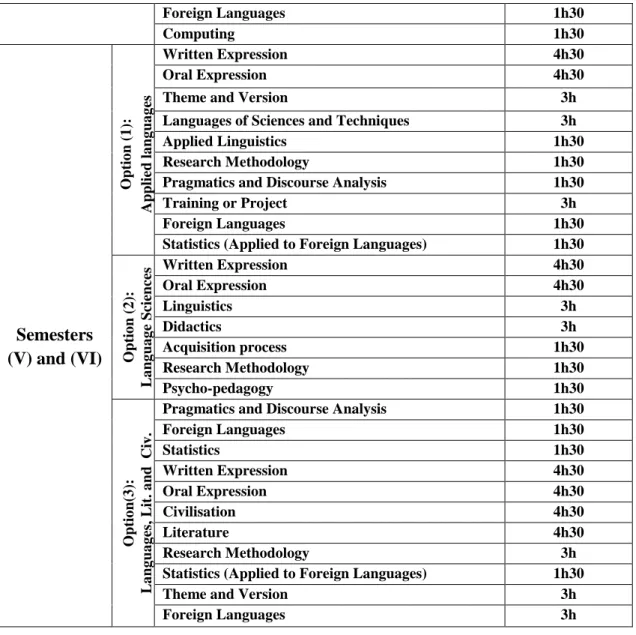
4.1 Time allotment in the licence curriculum………...…….. 130
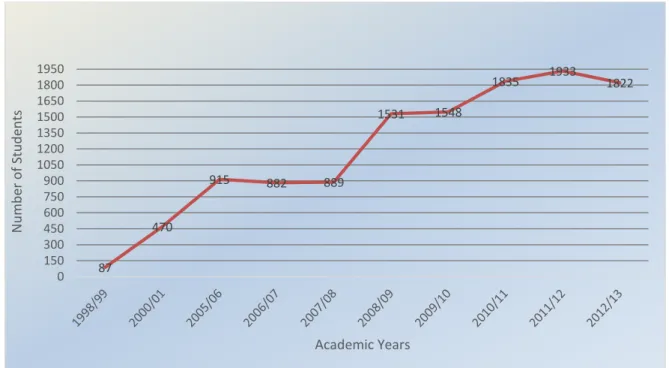
4.2 Number of students in the English department………...……. 133
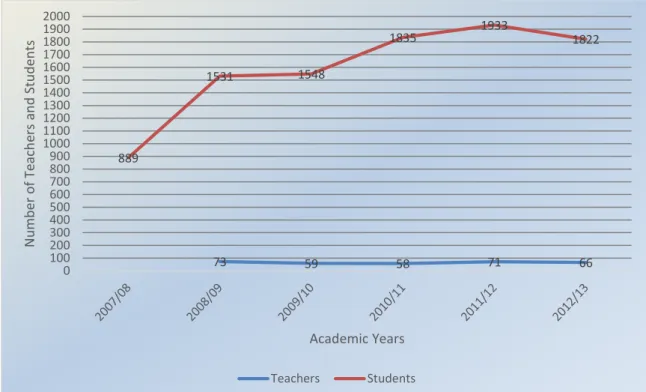
4.3 Number of students per year (from 2007 to 2013)………... 136
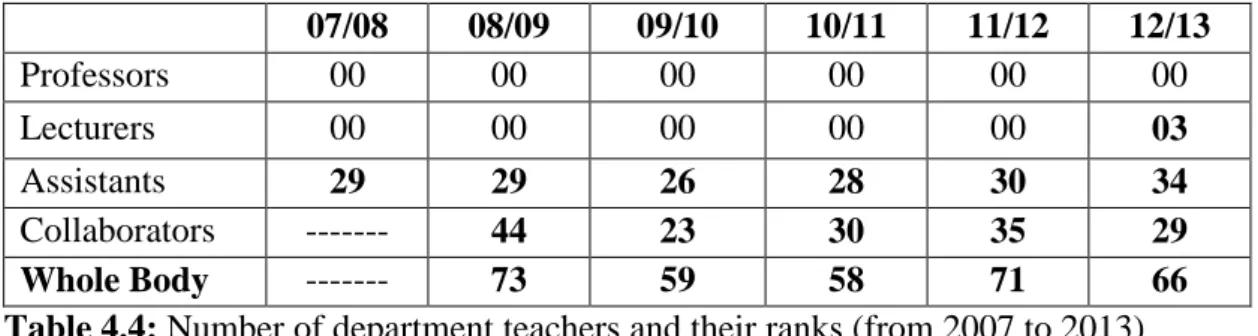
4.4 Number of department teachers and their ranks (from 2007 to 2013) …… 138
4.5 Statistics on higher education in Algeria, Morocco and Tunisia………..…. 151
6.1 Length of time spent in studying English………. 215
6.2 Students' attitudes towards the current materials………... 217
6.3 Categorisation of actions and activities suggested by the students……….. 221
6.4 Frequency of teacher's classroom practices as seen by students………….. 232
6.5 Categorisation of teaching and learning needs suggested by the students... 235
6.6 The "Text Analysis1/ Text Analysis2" Dichotomy………... 237
6.7 Grid for inventing the students' own literary text analysis model………… 237
6.8 An overview of the interviewees' features……… 242
6.9 ANOVA results for the pre-test and posttest students' marks……... 258
6.10 Tukey (HSD) / Analysis of differences between the modalities with an interval of confidence at 95%... 259
6.11 Recapitulation of means and groups/ levels differences……….. 259
6.12 ANOVA results for the pre-test and posttest marks of males and females.. 260
6.13 Tukey (HSD) / Analysis of differences between the modalities with an interval of confidence at 95% ……….. 261
6.14 Recapitulation of means and groups/ levels differences……….. 261
6.15 ANOVA results for the pre-test and posttest students' written production.. 262
6.16 Tukey (HSD) / Analysis of differences between the modalities with an interval of confidence at 95%... 263
6.17 Recapitulation of means and groups/ levels differences……….. 263
6.18 ANOVA results for the students' Scores in the posttest activities………... 264
6.19 Fisher (LSD) / Analysis of differences between the modalities with an interval of confidence at 95%... 265
VII List of Figures
Figure Page
4.1 Time allotted to Literary Texts in semesters 1, 2, 3 and 4…………. 132
4.2 Time allotted to Literary Texts in semesters 5 and 6………. 132
4.3 Number of students in the English department……….. 134
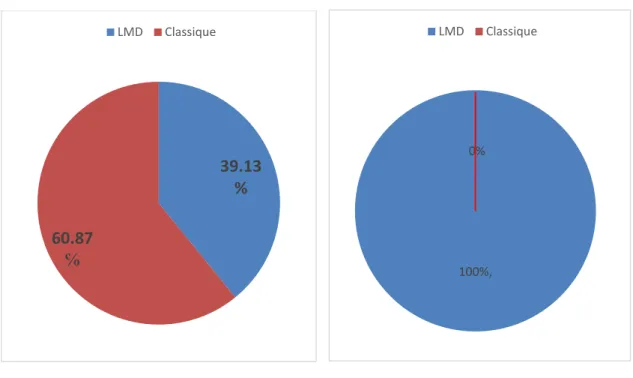
4.4 Status of the LMD student population in 2007……….. 135
4.5 Status of the LMD student population in 2013……….. 135
4.6.1 Increase of the LMD student population between 2007 and 2013… 137 4.6.2 Increase of the LMD student population between 2007 and 2013… 137 4.7.1 Whole body of teachers and students (2007/2013)……… 140
4.7.2 Whole body of teachers and students (2007/2013)……… 140
4.8 General scheme of the LMD system……….. 142
4.9 Map of the Big Maghreb and its location in the world……….. 150
4.10 Map of Bologna and its location in Italy………... 151
6.1 Students' sex (Percentages)……… 214
6.2 Students' age range (Percentages)……….. 214
6.3 Students' choices of English Major (Percentages)………. 214
6.4 Students' BAC streams (Percentages)……… 214
6.5 Extent of liking English (degree and percentage)……….. 216
6.6 Students' attitudes towards their learning environment………. 218
6.7 Students' attitudes towards the lack of qualified teachers………….. 219
6.8 Students' most preferred literary genre……….. 222
6.9 The most difficult practice as considered by students………... 223
6.10 The sources of difficulty in classroom practices……… 224
6.11 Students' classification of activities in terms of importance……….. 225
6.12 Students' ranking of problems in terms of difficulty………. 226
6.13 Students' classification of sources of knowledge in terms of use at home………... 228
6.14 Students' attitudes towards teacher's feedback………... 229
6.15 Students' feelings towards teacher's help………... 230
6.16 Frequency of teacher's classroom practices as seen by students…… 231
6.17 Students' conception of a good text analysis………. 234
6.18 Students' ideal literary text analysis model……… 239
6.19 A sample plan for analysing qualitative data………. 244
6.20 The principles of analysing qualitative data……….. 244
6.21 Graph of means showing the students' improvement……… 258
6.22 Graph of means showing the female students' improvement………. 260
6.23 Graph of means showing students' improvement in written production……….. 262
6.24 Graph of means showing students' scores in the posttest activities... 264
VIII Table of Contents Dedication ………... I Declaration ………..… II Acknowledgements ………..…... III Abstract ………..…. IV
List of Abbreviations and Acronyms ……….. V
List of Tables ………..… VI
List of Figures ………... VII
Table of Contents ………..….. VIII
General Introduction ………..…..
1. Statement of the Problem ………..….. 02
2. Aim(s) of the Study ………. 03
3. Research Questions ………..…... 04
4. Research Hypotheses ……….….. 04
5. Significance of the Study ……… 05
6. Research Scope and/Limitations ……….… 06
7. Research Methodology ………..…. 07
8. Research Organisation ………..…….. 07
9. Demystification of Terms and Anticipation of Criticism ………..……. 09
9. 1. The Style ………..…… 10
9. 2. The Case………..……. 10
9. 3. The Sample……….……. 12
9. 4. The "Participants"……….……… 13
PART ONE: LITERATURE REVIEW……….………. Chapter 1: History and Emergence of Stylistics ………..…... Introduction ………..…... 16
1.1. The Definition of Style ………...….. 1.1.1. Style as a Concept ………..…... 1.1.2. Style as a Varying Element ………..…. 1.1.3. Style as a Feature of Distinction ………..…. 17 17 19 21 1.2. The Description of Style ………..……. 1.2.1. Leech, Deuchar and Hoogenraad's Approach ………..……. 1.2.2. Leech and Short's Approach ………..……... 1.2.3. Galperin's Approach ………..…….... 23 23 24 25 1.3. The Measurement of Style ………..………. 1.3.1. Labov's approach ………..…….... 25 27 1.3.2. Bell's Approach ………...……...…. 27 1.4. Individual vs. Group Styles ………..………… 1.4.1. Dialects and Idiolects ……….…...…..…..……… 1.4.2. Register: Field, Tenor and Mode ……….……..………... 1.4.3. Formal and Informal language ……….……..…….……..
1.4.4. Speaking and Writing ………..………..……… 29 29 29 30 32
IX
1.5. A Brief History of the Discipline ………..……... 1.5.1. What is Stylistics?...…..………..………… 1.5.2. Early Beginnings and Origins ……….……....………..
33 34 38
1.5.3. Linguistics and Literature ………..………..…. 39
1.6. Stylistics: Functions and Major Types ………..…... 1.6.1. Historical Stylistics …………..………..…... 1.6.2. Linguistic Stylistics …………..………..……... 1.6.3. Literary Stylistics ………..………..…….. 42 43 46 48 1.7. Stylistics and Pedagogy ………..……. 51
Conclusion ………..……. 53
Chapter 2: Discourse Analysis and Text-Hanging /Qualifying Devices …... Introduction ………..….... 56
2.1. What is Discourse? ………..……. 56
2.2. What is Discourse Analysis? ………..…….. 2.2.1. General Overview ………...………..… 2.2.2. Practical Considerations ………..…………..…... 57 57 58 2.3. Rules Governance (Discourse Qualifying Devices) ………..….. 61
2.3. 1. Cohesion and Coherence ……….……. 62
2.3. 2. Situationality and Intertextuality………... 64
2.4. Types of Discourse………… ……….. 64
2.4.1. Spoken and Written Discourses………. 64
2.4.2. Transactional and Interpersonal Discourses………..…… 66
2.4.3. Discourse Styles……….…… 67
2.5. Discourse and the Other Disciplines ………..….. 69
2.5. 1. Discourse and Literature……….….. 69
2.5. 2. Discourse and Linguistics………. 70
2.6. Text and, or Context ……….... 71
2.7. Text, Mood, Theme and Rheme ……….….…. 76
2.8. Text and Meaning ……….…... 79
2.9. Discourse Analysis as a Qualitative Method for Analysing Written Texts... 82
2.10. Discourse Analysis and Case Studies ………. 85
2.11. Discourse Analysis and text Interpretation ……….... 90
Conclusion ………..…. 91
Chapter 3: Innovation and Education ………..….. Introduction ………..…… 94
3.1. What is Innovation?………..… 95
3.2. Major Aspects of Innovation ………..….. 3.2.1. Interaction and Focus ………..………..…… 3.2.2. Alternative Activities ………..………..…… 98 98 100 3.3. Innovation in Today’s Education ………..…... 101
X
3.4. Innovation and the Other Disciplines ………..…. 103
3.5. Innovation and, or Creation ………..…... 105
3.6. Instruction, Intervention, and Implementation ………..…... 3.6.1. Instruction ………..………..…. 3.6.2. Intervention and Implementation ………..…… 108 108 111 3.7. Course Development and Assimilation ………..….. 112
3.8. Implementation as a Paradigmatic Method for Developing Courses …..…… 119
3.9. Implementation and Quasi-Experimental Case Studies ………..…. 121
Conclusion ………..…. 125
PART TWO: FIELD WORK……… Chapter 4: The Research Context ……….….……. Introduction ……….….… 129
4.1. The English Department ………..… 130
4.2. The Enrolment of Students in the English Department ……… 133
4.3. The Increase of the LMD Student Population ………...…... 136
4.4. The Teachers of the English Department ……….... 137
4.5. The L.M.D System ……….…. 140
4.6. The Targeted Audience ………..….. 145
4.7. Teaching in the L.M.D System ………..….. 147
4.8. The LMD Road Map in the Maghreb countries ………... 149
4.9. First Year LMD Literary Texts Programme ………..….. 4.9.1. Describing the Programme ………..….. 4.9.2. Teachers and Students' Roles ………..…….. 153 153 155 4.10. Evaluation of First Year LMD Literary Texts Programme …………..…….. 4.10.1. Defining Evaluation ………..….. 157 157 4.10.2. Pre-requisites and Facets ………. 160
Conclusion ……….…... 163
Chapter 5: The Research Methodology ………..…… Introduction ………..…… 166
5.1. Research Design ………..……. 167
5.2. Implementation ………..….. 170
5.3. The Qualitative Aspect of the Study ………..…….. 171
5.4. The Quantitative Aspect of the Study ………..…… 173
5.5. Research Questions ………..…… 175
5.6. Population and Sampling ………..…... 178
5.7. Variables ………..…… 180 5.8. Hypotheses ………..……. 181 5.9. Instrumentation ………..…….. 183 5.9.1. The Questionnaire ………..……… 183 5.9.1.1. Structure ………..…….. 5.9.1.2. Questions ………..…. 183 184 5.9.1.3. Format ………..…. 187
XI 5.9.2. The Interview ………..…... 193 5.9.2.1. Questions ………..……. 193 5.9.2.2. Validation ………..…… 194 5.9.3. The Tests ………..….. 195 5.10. Data Collection ………..… 197 5.11. Data Analysis ………..…... 199 5.11. 1. Qualitative Analysis ………..…. 199 5.11. 2. Quantitative Analysis ………... 200 5. 12. Ethical Issues ………..…... 201 Conclusion ……….….. 204
Chapter 6: The Research Findings ………..…… Introduction ………..…… 206
Section 1: Questionnaire Findings ……….….. 207
6.1. 1. Description of the Questionnaire ………..……….. 208
6.1.2. Analysis and Interpretation of the Questionnaire Data ………..…….. 213
6.1.2.1. General / Personal information ………..……... 213
6.1.2.2. Specific / Classroom information ………..…... 221
6.1.2.3. The Ideal Literary Text Analysis Inventory ………..……... 236
Summary of the Questionnaire Findings ………..….. 239
Section 2: Interview Findings ………..……..…... 241
6.2.1. Description of the Interview……….….. 241
6.2.2. Analysis and Interpretation of the Interview Data………. 243
6.2.2. 1. The Programme' Suitability to Teachers' Methods and Aims …..….. 245
6.2.2. 2. The Programme's Attractiveness and/Design ………...….. 246
6.2.2. 3. The Programme's Organisation (Content) ……….……. 247
6.2. 2. 4. Joint Materials to the Programme and their Significance ……….… 248
6.2. 2. 5. The Authenticity of the Programme's Communication ………….… 249
6.2. 2. 6. Teachers and Students' Interest in the Programme ……….... 052
6.2. 2. 7. The Programme Availability for Students ………..….. 251
6.2. 2. 8. The Suitability of the Programme's Level for First Year Classes..… 252
6.2. 2. 9. The Programme's Exhaustiveness and Consistency ………..… 253
Summary of the Interview Findings ………...……. 254
Section 3: Pre-test and Post-test Findings ………..……. 256
6.3.1. The One-Way Analysis of Variance ………..…... 257
6.3.2. Students' Achievement in the Pretest and the Posttest ………..…… 258
6.3.3. Males and Females' Improvement in the Pretest and Posttest ……….... 260
6.3.4. Students' Written Production Improvement in the Pretest and the Posttest .. 261
6.3.5. Students' Scores in the Post-test Activities/Sections ………...….. 062
Summary of the Pre-test and Post-test Findings ..………... 265
Section 4: Discussion of the Results in Relation to the Questions and Hypotheses ………. Conclusion ……….…….. 267 272 General Conclusion... 275
XII
References………...… 283
Appendices Appendix A
Appendix A1: Consent letter for Teachers for Interview Validation Appendix A2: Teacher’s Consent Form
Appendix B
Appendix B1: Consent Letter for Teachers for Interview Giving Appendix B2: Teacher’s Consent Form
Appendix B3: The Teachers' Interview Appendix C
Appendix C1: Consent letter for Teachers for "Item Pool" Assessment Appendix C2: Teacher’s Consent Form
Appendix C3: A Questionnaire for First Year LMD Students
Appendix D
Appendix D1: First Year LMD Literary Texts Programme (Chapters and/ Items)
Appendix D2: First Year LMD Literary Texts Programme (Yearly Distribution)
Appendix E
Appendix E1: The Intervention/Implementation Course Appendix E0: The Intervention Exam Model
Appendix F: The Old Exam Model (Term 2) Appendix G
Appendix G1: Pre-test Students' Scores Appendix G2:Post-test Students' Scores
Appendix H: Samples of Students' Text Interpretations
صخلم
GENERAL
2
General Introduction 1. Statement of the Problem
In Literary Texts courses, as in most teaching/learning situations, the teacher and the learner play collaborative roles. These roles are different in terms of what each partner is supposed to perform as well as in terms of the items intended to be taught. This belief, as far as we are concerned, should be highly considered so as to fully achieve successful language lessons. The significance of teacher-students classroom interaction derives from the assumption that the Licence-Master-Doctorat (LMD) system and the Competency-Based-Approach (CBA) techniques acknowledge more learners' involvement in the overall teaching/learning operation. The LMD system and the CBA techniques have only recently been implemented, and thus opinions about them are still inconclusive. We press on the idea that the LMD system is a new one because it was first introduced in our context in 2004, and since then it has been intended to bring about radical changes in our pedagogical arena. In addition, it came, at least in the view of some Algerian educationalists, to put an end to a full-length period of experiences with many teaching methodologies such as the Audio-lingual and the Communicative methods, which were used between the early 1960s and the late 1990s, and which were dependable on different procedures to deal with literature. These methods, besides the CBA techniques, were all deliberately designed to guarantee ample students' achievement in language classes. However, we believe that none of them is adequate enough to cater for developing students' interpretative skills and urge them to learn through their mistakes. Given its real role as an important element in the teaching of foreign languages, it is assumed that:
3
1. "Literary Texts" is an integral part in language classes, not a passive instance whereby students do not receive any amount of learning. Therefore, effective teaching of literary texts needs more practice than theory.
2. More text reading enhances learning opportunities both in the classroom and outside it. Reading is the main source of vocabulary and structures which may not be taught by the teacher.
3. Students' learning styles are personal stamps; that is, their growth goes hand in hand with the individual's experience and his/her familiarity with the skill. Here, students' willingness is a crucial criterion.
4. Students' learning speed depends largely on how good they perceive the target language literature(s) and the features of the main writing styles.
5. Students' "good achievement" cannot be realised unless these students are encouraged to make efforts in all the courses being studied.
2. Aim(s) of the Study
By reviewing some literature on the important role of literary texts in foreign language learning, this research aims to investigate this area, with a special focus on the factors which prevent students from handling it. In addition, the research targets other areas of relevant interest to make students avoid confusion, over generalisation, and blunders. Namely, the purpose of this study is to elucidate the relationship between language learning and the teaching of literary texts on the one hand, and the implementation of discourse devices as a new paradigm in interpreting literary texts to insure integration amongst students on the other. By integration is meant the quality of appreciation of texts from different sources and literary trends. That is, the diversity of ideas as well as styles of writers may lead to optional outcomes; i.e. the integration and involvement of students. Therefore, the research questions addressed in relation to the
4 3. Research Questions
1. Why do our students fail to produce acceptable stylistic interpretations of literary texts?
2. How do students perceive the stylistic interpretation of literary texts and its components?
3. What can be done to develop the students' stylistic interpretative competencies? 4. Are the teachers of Literary Texts aware of the usefulness of discourse qualifying devices in the study of texts?
5. In what way is the teachers' feedback designed to improve the students' interpretative production?
4. Research Hypotheses
Our decision to carry out this research is that there are real difficulties facing students in areas linked in a way or in another to linguistics. What at first interested us and attracted our attention to the topic of trying out something new to help first year LMD students were our constant observations of the issue of writing, which in return has given rise to other phenomena such as the failure to analyse and interpret texts. This latter pushed us to assume that the teachers and the students would answer the questionnaire and the interview items, as well as the tests objectively, and that their answers would fit the hypotheses below:
1. We hypothesise that our students are unaware of any stylistic techniques to use when interpreting literary texts.
2. We also hypothesise that students are unfamiliar with the stylistic interpretation of literary texts and its components.
5
3. We put forward that the unawareness of the usefulness of discourse qualifying devices in the study of texts, on the part of some teachers, slows down the amelioration of the students' interpretative skills.
4. We advance that a systematic and a well-organised feedback may lead to an optimal assimilation of the stylistic interpretative techniques. 5. Cooperative tasks are sometimes useful and enjoyable, especially when teachers intend to teach rules or techniques requiring more practice than theory.
5. Significance of the Study
Because determining the factors which make poor text interpretation happen to our students is still unreachable, there is a large space to test this phenomenon and find out its sources. These latter may constitute a firm ground for suggesting new techniques to advance the current Literary Texts Programmes. Algerian Ministry of Higher Education’s efforts to improve learning through the introduction of the LMD system implies that there is an intention to teach specific competencies such as reading, analysing and paraphrasing. This research may support the aforementioned efforts in a way or in another, and its findings could help to design not only syllabuses but also teaching materials. Moreover, this research may sustain the development of real literary competence in the English language classes.
A better understanding of the literatures of a language will benefit many different, yet interacting, groups. The results of this research will inform those involved in the teaching and the learning of literary texts how the depths of human thought can be decoded through deep comprehension of pieces of writing. Implementing linguistic tools such as discourse qualifying devices (Rules Governance) may provide relevant information that will assist their understanding and will, at the same time, enlarge their interests in examining other related areas.
6
The relative newness of the subject matter in this study, the recentness of the theoretical background, as well as the intention of realizing an empirical work in the context of Biskra University necessarily draws the limits of this work and shows, although indirectly, the nature of the approach we want to apply. The study contends that the interpretation of literary texts through the implementation of discourse devices might create a new practical model, one that goes beyond the current descriptive methodologies used by the teachers and the students at our English Department.
6. Research Scope and/Limitations
The focus of this study is to spot light on the failure of students to produce acceptable stylistic interpretations of literary texts as a major phenomenon rather than a detailed investigation of a single technique to be used. The nature of this scope does not allow the deep exploration of the situation as experienced by each student individually, but it is on the overall problem, with a considerable number of students, i.e. a minimum that allows for a case study. Here, it needs to be restated that the work is brand-new and has never been carried out at our English Division before.
In fact, the study is specifically and deliberately centred on:
1- Spotting light on the factors which prevent students from effecting acceptable text interpretations.
2- Categorising these factors on a stylistics basis (Cohesive, intentional, informative). 3- Providing solutions to cater for improving the students' interpretative skills.
4- Proposing a model to teach Literary Texts in our English Classes (1st year LMD). 5- Encouraging students to learn English language through interpreting texts in a non-threatening and more positive atmosphere. Based on their modest experience, the researchers already know that first year students are fresh learners and they need help: they need more time and practice.
7 7. Research Methodology
This study attempts to record whether the implementation of discourse (an explicit instruction) in the teaching of English literary texts improves the interpretative production and recognition skills of First year LMD students. The current study uses qualitative and quantitative components in a mixed method. Qualitative data will be collected to record teachers and students’ attitudes towards the intervention or implementation, while quantitative methods will be used to compare achievement test scores between the experimental and control groups.
The researchers then intend to use an intervention strategy that introduces discourse devices to a section (sample) of students. This section studies the points included in the present programme with an introduction to discourse analysis and some analytical techniques after it takes a pretest. Another test (posttest) is taken immediately after the intervention. The researchers also plan to distribute a questionnaire to this section of students and to interview the teachers of the course to provide insights into what to incorporate in the intervention lessons and what would be included or ameliorated in the programme of the first year. The teachers and the students will respond anonymously to the questionnaires and interviews.
8. Research Organisation
This research paper involves six chapters divided into two parts: theoretical background and field work. The paper opens with a general introduction which is designed to present the work from a theoretical orientation perspective, i.e. it provides the reader with a glance over the major points, the gradual move of the titles, the research methodology and organisation.
Chapter one, History and Emergence of Stylistics, is devoted to a discussion of Stylistics as a new discipline. This is preceded by a detailed identification of style as a
8
term, as a genre, and as an individual stamp which finds its place within the classification of language in terms of variation. The various types of stylistics will be explored, culminating at a proposed arrangement, along with a description of the main characteristics that distinguish each type from the other types.
In introducing discourse analysis, Chapter two, Discourse Analysis and Text-Hanging Devices, presents some basic aspects of discourse with a special focus on its types as well as its governance rules. After explaining some preliminary notions, "Discourse Analysis" as a procedure for analysing texts will be shown in some detail. Chapter three, Innovation and Education, is a go-between the theoretical and the practical parts of the present work. It justifies the implementation of discourse devices in the teaching of literary texts by the researchers both as their touch in the work and as their legitimate role as partners in the LMD system. Thus, Innovation stands for the ideas developed and the efforts made by the researchers to remedy a local issue.
Chapter four, The Research Context, focuses on the context of the research, i.e. the identification of the setting (the English department) or the level meant by the investigation. It will also describe the different issues related to the enrolment of the students and their increasing numbers, which may give to the reader a picture of the connections that can be found between the introduction of the LMD system and the students' achievements, especially in the Literary Texts course. In addition, this chapter will lay down a significant evaluation of the present Literary Texts Programme in order to sort out the uncovered parts, and to reveal the inconsistency of other elements. The major topic of Chapter five, The Research Methodology, consists of a sketch of the different steps of the research methodology. In this chapter, the central objective is to speak about the approach or approaches (qualitative and quantitative) adopted, and what makes this approach/ these approaches appropriate for the analysis of our case. A
9
foundational approach to this research is to check whether the first year LMD students, in Literary Texts course, receive information and techniques about interpreting texts or not, and to check their reception of general understanding of concepts regarding literature, literary movements, and genres as far as the current programme is concerned. This will be done through a pilot study (questionnaires to the experimental group). The type of the questionnaire design, the data collection and data analysis procedures, and the verification process all unite to determine the suitable lines of inquiry of this work. Therefore, it is clear from the beginning that the study is both qualitative and quantitative; it is qualitative by nature (a case) and is quantitative because the researchers want to reinforce and consolidate findings (testing). Chapter six, The Research Findings, involves the results and full-length discussions. These latter will be accompanied by comparisons with the research hypotheses so as to validate the findings.
The present work; however, ends up with a general conclusion and some recommendations. These two will then remind the reader that a stylistic interpretation and analysis of a literary text is always dependent on the study of data above and beyond the text, for what the reader and analyst look for is to find meaning and expand their knowledge of the world. Moreover, it shall be pointed out that some of this knowledge comes from the analysis of texts other than the text under examination. 9. Demystification of Terms and Anticipation of Criticism
Writing a research thesis in the social sciences often requires choosing the appropriate style, strategy, method, population and sample. Almost inevitably these choices raise questions about how researchers would justify, step by step, every single action they take to avoid bias and harsh criticism. Then, researchers should be more vigilant and more persuasive in the manner in which they answer those questions, for it
01
has become a great concern for academics, today, to set clear the component of planning and implementing research.
9.1 The Style
There are many writing styles in the academic field. These styles may be used in their original fields or beyond, but researchers should respect some general characteristics. The APA style (American Psychological Association) is commonly used in the social sciences; whereas, the MLA (Modern Language Association) is used in the humanities (Lipson, 2006, p. 7). Choosing a writing style may also depend on a compromise between researchers and their supervisors; a compromise in which they consider mainly the domain or specialisation. Weidenborner and Caruso (1986) stated that " In choosing a system of documentation, scholars should ask their instructors about an appropriate one; most instructors of language and literature, for instance, follow the MLA style which was devised in 1984" (p.154). In this thesis, the researchers chose the APA style because English language teaching and learning makes an integral part of the social sciences.
9.2 The Case
The Case Study in this thesis is the researchers' own choice; i.e. it started with a recurrent observation of students' failure to study texts and interpret them although these students dealt with different texts and did a series of corresponding exercises and activities. Then, the decision to address this deficiency called for implementing a particular strategy; a strategy that could help the researchers to find solutions and could take into consideration some specific principles. Cohen and Manion maintained that:
00
The case study researcher typically observes the characteristics of an individual unit – a child, a class, a school or a community. The purpose of such observation is to probe deeply and to analyse intensely the multifarious phenomena that constitute the life cycle of the unit. (Cited in Biggam, 2008, p. 83)
Moreover, in many fields, case studies are said to have in common the principles of "singularity, particularity, depth, contextualization, triangulation, induction, interpretation and analysis" (Duff, 2008, pp. 21-23). In this thesis, the researchers, from the beginning, were aware of the singularity and particularity of the case, limiting the scope of the study to the groups they were teaching. As for the principles of depth and triangulation, they agreed on using three data collection methods: the interview, the questionnaire and the tests. The results of these methods were interpreted and analysed qualitatively and quantitatively despite the fact that it was a case study. If some scholars think that qualitative research is utterly exempt from using numbers and statistics," A number of qualitative studies involve numbers in the form of frequencies of occurrence of certain phenomena and are analysed by such statistical methods as chi-square" (Perry, J.r.,2005, p.75). Besides this, for the "contextualisation" and "induction" principles were important, the researchers started the practical part of the thesis (see Chapter 4) with an examination of the social and pedagogical context in which the present work is being produced. Factors such as the teachers of the department, the number of students, the LMD system, the targeted audience and the LMD road map in the Maghreb countries were all discussed and several values, aspirations and expectations were sorted out.
02 9.3 The Sample
As any researchers in the field of social sciences, we could not collect data from the whole category (first year students) that we wanted to research. It was not also easy for us to work with the other groups of the same population for many different reasons. As a result, we relied on getting evidence from the nearest portion of students. It is then fairly common that "We may be forced by circumstances to use the only sample that can be reached - an opportunity sample" although the most frequently used are random samples (Swetnam, 2004, p.43). With an opportunity or a convenience sample, researchers are required to spend much less time and to make much less effort than probability samples (Schonlau, Fricker, Jr. and Elliott, 2002, pp. 8-9). The use of probability sampling indicates that the researcher tries to find a representative section of people or events in the population he wants to study (Descombe, 2007, p. 13). The choice of the case study as a strategy and the use of a convenience sample (no randomness is guaranteed), among other practices, show that the researchers relied on a quasi-experimental design. In a quasi-experimental design, only a few conditions of a true experiment are fulfilled (Leedy, 1980, p.172; Marczyk, DeMatteo, and Festinger, 2005, p. 137). There are many cases where quasi-experimental designs are used, but:
The most common case is when a group is tested for the influence of a variable and compared with a non-identical group with known differences (control group) which has not been subjected to the variable. Another, in the absence of a control group, is repeated testing over time of one group, with and without the variable (i.e. the same group acts as its own control at different times). (Walliman, 2001, p.94)
03
The second case in the above quotation was the case in the present study. As it was mentioned earlier, the same section of students received the instruction and was tested before and after the intervention.
9.4 The Participants
Throughout the whole thesis, the term that the researchers used frequently to refer to the people who participated in the study is "participants". The term participant is
completely different from "subject" and "respondent". Oliver (2003) stated that "Perhaps the most traditional term in use here is ‘subject’. The use of this term is more
commonly associated with research which tends to reflect the approach of the natural sciences such as physics and chemistry"(p. 4). Oliver, in this same sense, adds that:
Whereas the term respondent may give the impression of someone who while providing data is not closely involved in the research process, the concept participant suggests a different kind of relationship. If we speak of a person participating in an activity, such as for example the organization of a social event, there is the assumption that the person is fully involved in the process. (ibid, p.6)
The use of the term "Participants" rather than "Subjects" shows clearly that the teachers and the students of the first year are involved, or are, at least, considered to be involved in the study by the researchers. This involvement reveals that these people may offer too much help to the researchers. Moreover, the use of the term "Respondents", which was less frequent than "participants", indicates that the researchers, in some instances of the study, wanted to raise more the standard of objectivity, trying to make the reader feel that the teachers and the students are not so involved that the results of the study may lose consistency. In this study too, the researchers did not use the term "Subjects" because Literary Texts as a social science has nothing to do with the approaches of the natural sciences.
PART ONE:
Chapter 1: History and Emergence of Stylistics
Introduction………. 16
1.1. The Definition of Style……… 17
1.1.1. Style as a Concept………. 17 1.1.2. Style as a Varying Element………..………. 19 1.1.3. Style as a Feature of Distinction………... 21 1.2. The Description of Style………..
1.2.1. Leech, Deuchar and Hoogenraad's Approach………... 1.2.2. Leech and Short's Approach………. 1.2.3. Galperin's Approach……….
23 23 24 25
1.3. The Measurement of Style………... 25
1.3.1. Labov's Approach………... 27
1.3.2. Bell's Approach……….. 27 1.4. Individual vs. Group Styles……….
1.4.1. Dialects and Idiolects………. 1.4.2. Register: Field, Tenor and Mode………... 1.4.3. Formal and Informal language………...
1.4.4. Speaking and Writing………
29 29 29 30 32 1.5. A Brief History of the Discipline (Stylistics)………..
1.5.1. What is Stylistics?... 1.5.2. Early Beginnings and Origins……… 1.5.3. Linguistics and Literature………..
33 34 38 39 1.6. Stylistics: Functions and Major Types………
1.6.1. Historical Stylistics……… 1.6.2. Linguistic Stylistics………... 1.6.3. Literary Stylistics………... 42 43 46 48 1.7. Stylistics and Pedagogy………...
Conclusion………...
51 53
06 Introduction
The aim of this chapter is to introduce the discipline and practice of stylistics. It is structured into seven major titles. The first four titles provide background knowledge on the concept of style, the nature and types of style, as well as its various treatments in both linguistics and literature. Titles 5, 6, and 7 cover a brief history of stylistics, the essential types of stylistics, and the crucial levels of linguistic and literary description of style in text. These include the phonological, the lexical, the syntactical, the psychological, and the sociological levels. It also introduces stylistics as a tool for instruction.
The general aim of this chapter is to equip students and readers with the knowledge needed to get a meaningful conception of new tools of text analysis, especially a literary text. It aims at providing them with an idea of how to define, describe, and measure style; to identify and explain some perspectives on style; to define stylistics and its different dimensions; to identify and explain some types of stylistics; to mention and describe the major levels of linguistic description of a text; to describe the register, tenor, and field in a text; to identify and discuss the point(s) relating in a text; and to be aware of the utility of stylistics in pedagogy. The researchers hope that, in the long run, all of this will lead to much discussion in our department about the needs of students in the Literary Texts course and about the new types of teaching materials that could be used. The researchers recommend the combination of linguistics and literature and its inclusion in the teaching and studying of texts written in English to increase the students' acquisition of knowledge and skills. The researchers have a particular interest in the use of linguistic tools in the teaching and learning of literature.
07 1.1. The Definition of Style
1.1.1. Style as a Concept
Style is a vague and an elusive concept that defies all our definitions. Many people believe that style is easily recognised, and that it is a question of intuition and impressions. However, style is not that easy perception. The study of style has led to the creation of overlapping areas among many disciplines. Studer (2008) stated that "In its most general sense, style makes linguistic expression meaningful and distinctive. In literary texts-the traditional domain of stylistic study - style is understood as a reflection of an author's personality and originality" (p.1). Studer’s statement shows the existence of a mutual concern between linguistics and literature. Style is thus understood as an individual quality, and is looked at as the outcome of several intermingling factors. Spencer (Cited in Enkvist and Gregory, 1964, p. ix ), on the other hand, noted that:
…it would be sanguine to expect the tunnels of the linguists and the literary critics automatically to meet in the middle of the mountain. To the former, the investigation of style is essentially a scientific description of certain types and sets of linguistic structures that occur in a given text, and of their distribution. On the contrary, the literary scholar must be more preoccupied with matters outside the text. That he will study the reader’s responses and his thinking of given textual stimuli with features that lie beyond the text itself but are part of his past experience recalled by stimuli in the text ...
Style, as a term used in this chapter, refers to distinctive linguistic features that characterise personal behaviour and literary genres, and sometimes types of discourse within texts. This distinction stems out of both the belief that the investigation of style is best done at linguistic and literary levels, at a time or synchronically, and the intent of this present work to enable students to interpret literary texts using not only the techniques (discourse devices) we plan to teach them, but also their past experiences as readers and their connections to the world outside. With this focus, the chapter aims
08
mainly at investigating and empirically introducing style as a go-between linguistics and Literary Texts because the description of style, as a term, has often been tied to the notion of stylistics. Studer (2008, p.7) pointed out that:
In their comprehensive bibliography of English stylistics from antiquity to the twentieth century, Bailey and Burton (1968: viii) quote an unpublished dissertation by Leo Rockas to emphasize the difficulty in defining the concept: 'One's notion of style is logically tied up with one's notion of stylistics…Critics will define style in such a way as to rationalize whatever stylistic activity they choose later to indulge'. This statement, we may argue, applies as much today as it did half a century ago.
Although the term "style" is largely used in stylistics, it is found in other fields. In each of these fields, it is given specific characteristics which give to it variegated classifications (Miššíková, 2003, p.18). These classifications are:
1- Style refers to the manner of expression in both writing and speaking. Some people think that style can be good or bad.
2- Style can be seen as variation in language use. In non-literary situations, this variation is termed register which gives individual stamps to spots such as advertising, journalism, sports commentary, and politics. Style may also vary from one genre to another (literature).
3- Style is seen as the set of distinctive features; characteristics of an author such as his/her most preferable words and expressions; his/her language habits or idiolect. Style is the man himself.
4- One clear implication of (3) is that choice of items is what makes a style really distinctive from other styles. The selection of items, their types, and their distribution in the text is determined by such criteria as genre, form, theme, etc.
09
5- Another approach to defining style is to compare a text, for instance, against the linguistic norms of its genre, or its period so as to find out central patterns and features. This approach of looking at style as a deviation from a norm was prevailing in the 1960s.
Relying on the abovementioned classifications, we may come up with certain conclusions regarding the different perceptions of style as a concept. A first perception is that style has to do with how people express themselves in both writing and speaking. A second perception equals style to variation in language use which is named, from a sociolinguistics point of view register or the language of fields such politics, economics, law and so forth. Variation in language use may be termed genre which varies, in literature for instance, from prose to poetry. In addition, style may express individuals' preferences such as the use of words and expressions (idiolect). More importantly, in literature, style is an individual stamp, i.e. a quality of every single author and is considered to be a deviation from a norm.
1.1.2. Style as a Varying Element
Besides the above categorisation, style as conformity, style as period or time, and style as situation are added as further classes (National Open University of Nigeria, 2012, pp. 15-16).
1- Style as conformity refers to the writer's decision to conform to the established style of certain fields. A concrete example of this is professional writing such as the case of research projects.
2- Style as period or time is clearly noticed when we look at a text written in Old or Middle English. The language seems different because its syntax, vocabulary, and spelling are different. These differences are the features that made a given style dominant in a period whether considered synchronically or diachronically.
21
3- As far as conformity is concerned, style can be determined by the context in which it is used. Though some words are considered taboo or vulgar and do not fit some context, they may be used in other situation or circumstance.
From a general point of view, style is the core object of stylistics. Defining it, as previously mentioned, has always been debatable among renowned linguists. The word style may be easily defined by many people and it may be described from diverse directions. Nevertheless, it is not easy to lay down a final sense; one that is recapitulative of all these interpretations. Below are some more examples of definitions and concepts offered by Crystal and Davy (Cited in Dámová, 2007, p.13):
1- Style may refer to some or all of the language habits of one person- as when we talk of Shakespeare’s style (or styles), or the style of James Joyce, or when we discuss questions of disputed authorship…more often, it refers in this way to a selection of language habits, the occasional linguistic idiosyncrasies which characterise an individual’s uniqueness….
2- In a similar way, style may refer to some or all of the habits shared by a group of people at one time, or over a period of time, as when we talk about the style of Augustan poets, the style of Old English “heroic” poetry, the style in which civil service forms are written, or styles of public-speaking….
3- Style is given a more restricted meaning when it is used in an evaluative sense, referring to the effectiveness of a mode of expression. This is implied by such popular definitions of style as “saying the right thing in the most effective way” or as “good manners”….
4- Partly overlapping with the three senses just outlined is the wide spread use of the word “style” to refer solely to literary language. Style has long been associated
20
primarily or exclusively with literature, as a characteristic of “good”, “effective”, or “beautiful” writing….
Leech and Short (Cited in Dámová, 2007, pp. 13-14) also offered some interesting concepts, stressing the fact that style:
…refers to the way in which language is used in a given context, by a person, for a given purpose and so on. To clarify this, we may adopt the Swiss linguist Saussure´s distinction between langue and parole, langue the code or system of rules common to the speakers or writers of a language (such as English), and parole being the particular uses of the system, or selection from this system, that speakers or writers make on this or that occasion.
Style is then a mere language use that is determined by context and purpose. People use language differently due to their different intentions and the situations in which they find themselves. Leech and Short compare language and any particular use of it to Saussure´s langue and parole. That is, language is the overall system and people's styles are paroles. All that speakers and writers of a language are supposed to use is only a matter of appropriate choice from the system which they share with one another.
1.1.3. Style as a Feature of Distinction
The definitions cited above reflect differences in views as well as in ways of perception. This is only because the fields of study are not the same, i.e. the outcomes are dependent on the inputs on the one hand, and are proportional to circumstances on the other hand. On the whole, it is difficult to get into the depths of style; it is difficult to determine its real components and how it is improved throughout the years. Enkvist and Gregory (1964, p. 13) avowed that:
22
It is difficult to tell what constitutes style and how one cultivates style, is style a man or his work, his body, his heart, or soul, or the words he uses, an embellishment, choice, personality, psyche, deviation from norm, set of individual or collective features, or the words he uses, or the way in which he uses them.
Below are also some other definitions of style which reflect the diversity of people’s
views (Vorshney, 1980, pp.358-389) and how each personality perceives the point: 1. Buffon (1753): "Style is the man himself ".
2. Gibbon: "Style is the image of character ". 3. F.L.Lucas: "Style is a means by which a human being gains contact with others; it is personality clothed in words, character embodied in speech ". 4. Emerson: "A man’s style in his mind’s voice ". 5. Murry: "Style is « the flesh, bone and blood » of the writer ". 6. Cleath Brooks and Robert Pen Warren: "this term (style) is usually used with reference to poet’s manner of choosing, ordering, and arranging his words. But, of course when one asks on what grounds certain words are chosen and ordered one is raising the whole problem of form".
Saying that style is a man's character, voice, words, personality, or whatever makes a person different from others, it is still a complex notion. The fact that this notion has been exploited by many disciplines such as aesthetics, linguistics, stylistics and poetics explains the complexity of the term (Mugair, 2013, p.730). However, it can be said that style is a distinctive feature of every single individual. Style distinguishes individuals or makes them distinctive can be explained at many levels: a novelist or a poet is easily detected by the words he uses and how he uses them; a famous politician attracts millions of people by the speeches he delivers; and a beloved actor or actress has a noticeable influence on a large audience all over the world because he or she often plays roles which are appealing to people.
23 1.2. The Description of Style
Style, as we have already mentioned, is seen as the author's particular choice and use of language in order to examine a social phenomenon, to experience an adventure, to report economic depressions and political upheavals; that is, to interpret the world and participate in positive changes. So, the study of style requires "opening a door to fuller appreciation of literature" (Leech, Deuchar and Hoogenraad, 1982, p. 158) besides the discussion of language, including its grammar. In other words, it is not easy to find a single technique for studying style, as it is not easy to measure all the stylistic features of an author in one work. The only accessible and rational approach is to combine our knowledge of the language and our reaction or response to the work so as to describe more fully the author's style and to interpret more assuredly the message intended to be conveyed.
1.2.1. Leech, Deuchar and Hoogenraad's Approach
As an approach or model to analyse literary style, Leech, Deuchar and Hoogenraad (1982, pp.158- 170) suggest the steps below. These steps are in fact supported by examples from three different literary works (D.H.Laurence's The Rainbow, Charles Dickens's Bleak House, Virginia Woolf''s The Waves), but they are here summed up.
* First of all read the passage carefully twice or more.
* Then identify and list features of style under various headings. Here what is meant to be done is the real analysis of language; i.e. we classify the features of style under: lexis (vocabulary: formal or informal, complex or simple, abstract or concrete , etc.) , grammar (simple, compound, or complex sentences, the types of clause and or phrases favoured in the passage, etc.) , figures of speech (metaphor, irony, paradox, etc.), cohesion and context (how sentences and whole discourses are placed within a context, anaphoric and cataphoric relations, etc.).
24
* And then, finally, synthesise these features of style in an interpretation of the meaning and effect of the passage.
This model of analysis combines the selection of major distinctive features or linguistic patterns and the reader's intuition. The results of this kind of analysis consist in a report in which qualitative and quantitative data blend together to lessen subjectivity on the one hand, and to maintain the aesthetic quality of the text or passage. 1.2.2. Leech and Short's Approach
Sometimes, style is treated through a dual approach, the basis of which is the view that style is both form and meaning. The opposite of this view or approach is that style can be considered as one body in which form and content unite. This is called the monist view (Leech and Short, 2007, p. 13). Dualism implies that there are many ways or forms to convey the same message; however, monism sees that any change in form causes a change in content or meaning. Dualism as such may find a strong ground in prose, the genre in which different writers may cover the same theme in different ways or styles. Monism, on the other hand, may find a strong ground in poetry where devices such as metaphor and irony smother sense, and thus suggest many interpretations. Leech and Short (2007), as a substitute to dualism and monism, introduced pluralism, the approach which tries to distinguish meaning at different functional levels of language. Pluralists find that language does not only transmit thoughts and ideas, but it also has referential (newspapers), persuasive or directive (advertising), and casual (conversation) functions (pp. 24-25). What is more, according to this approach, a single utterance may communicate several meanings.
The aforementioned approaches about the description of style should be fused together so as to come up with a full view of style. A multilevel or multifunctional view of style may help anyone to produce practical examination of texts.
25 1.2.3. Galperin's Approach
In addition to Leech and Short's threefold functional classification of style, there have recently been other categorisations. According to Galperin, there are five (05) functional styles which can be subdivided into sub-styles in modern English as follows (Cited in Stylistics of English, Chapter 1, p. 6):
1. The Belles – Lettres Functional Style: this is found mainly in (a) poetry; (b) emotive
prose; and (c) drama.
2. Publicistic Functional Style: this style is strongly felt in (a) oratory; (b) essays; and
(c) articles in newspapers and magazines.
3. The Newspaper Functional Style: in (a) brief news items; (b) advertisements and
announcements; (c) headlines; (d) the editorial, readers are supposed to come across this type of style.
4. The Scientific Prose Style: (a) Exact sciences; (b) humanitarian sciences; and (c)
popular- science prose writing are characterized by this style.
5. The Official Documents Functional Style: this style is more specific in that it is
used in (a) diplomatic documents; (b) business letters; (c) military documents; and (d) legal documents.
1.3. The Measurement of Style
As it was mentioned in the previous sections, we may refer to style as frequency or recurrence of items most preferred by a writer and their distribution in the text. Recurrence implies that there are unusual, distinguishable patterns of language; i.e. choices that are repeated many times, and which can be counted, classified, and thus can be considered as specific features. So, measuring style refers to our own point of view about the text, as readers, especially in terms of those deviations from language norms (Leech and Short, 2007, pp. 34-35). Deviations from the language norms may