DESIGN STUDY FOR A 200 GHZ GYROTRON
R.J. Temkin and S.M. Wolfe
Plasma Fusion Center
Research Report RR-78-9
Design Study for a 200 GHz Gyrotron
by
R.J. Temkin and S.M. Wolfe
Francis Bitter National Magnet Laboratory*
Massachusetts Institute of Technology
Cambridge, Ma. 02139
Plasma Fusion Center Research Report RR-78-9
ABSTRACT
A complete design of a 200 GHz gyrotron is presented using a
combi-nation of analytic expressions and numerical results primarily derived
from the Soviet literature. The design study is divided into two parts:
Part I, which outlines general design principles, and Part II, which gives
specific parameters for a 10kW, 200 GHz gyrotron. In Part I, the major
topics treated are gyrotron cavity design, gyrotron gun design, starting
current, efficiency, constraints on parameter selection and wavelength
scaling of gyrotron parameters. Most of the theoretical expressions used
are taken from a series of Soviet publications on the gyrotron. However,
some new results have been obtained, including some new expressions for
the wavelength scaling of gyrotron parameters. The design criteria have
been applied to predicting the efficiency of gyrotrons operating at the
fundamental (w
c) or second harmonic (2w
c) frequency. In the wavelength
range 0.5 to 5.0 mm, fundamental emission is found to be significantly more
efficient than second harmonic emission. Agreement with the experimental
and theoretical efficiency results of Zaytsev et al. is reasonably good,
indicating that the design procedure is accurate. Prior to constructing
a device, however, more precise calculations of several parameters, such
as beam velocity spread and cavity diffractive Q, is warranted in order to
achieve optimum device performance. In Part II, a complete set of design
parameters is derived for a 10kW, 200 GHz gyrotron. The mirror ratio is
chosen to be 25 and the overall efficiency is predicted to be 32%.
DESIGN STUDY FOR A
200 GHZ GYROTRON
Part I
R.J. TEMKIN, S.M. WOLFE
Francis Bitter National Magnet Laboratory Massachusetts Institute of Technology
Cambridge, Massachusetts 02139 USA
I-]
GYROTRON DESIGN - GENERAL PRINCIPLES
A. Introduction
B. Gyrotron Cavity i) Cavity mode ii) Ohmic
Q, Qom
iii) Diffractive
Q,
QD
iv) Oscillation Frequency, w
v) Magnetic field in Cavity Region, B
C. Gyrotron Gun
i) Definitions
ii) Correlation of Gun and Cavity Parameters iii) Velocity Spread
a) Space charge at the cathode.
b) Thermal velocity of electrons.
c) Surface roughness of the cathode.
D. Starting Current and Efficiency
i) Starting Current ii) Multimode Oscillation iii) Efficiency
E. Design Considerations
i) Cavity Length ii) Mirror Ratio
a) Parameter Scaling with a.
1 -2
F. WIavelength Scaling of Gyrotron Parameters i) Gen'ral Wavelength Scaling
ii) Efficiency vs. Wavelength
1-3
GYROTRON DESIGN
A. Introduction
Soviet workers have outlined many of the design principles for their gyro-trons in a series of publications. Those principles may be summarized by a relatively simple analytic theory which is very useful for preliminary gyrotron design and is applied in the present design study. It should be recognized
that many of the final design parameters must be obtained from more accurate, computer calculations in order to achieve the highest possible device
effi-ciency. The analytic theories used here do serve to define the approximate value of many parameters and so are of great use in preliminary designs.
The gyrotron design may be divided into two major subsystems, the electron gun and the cavity, which are physically distinct units. However, the design of these two subsystems is not independent. All of the parameters for the
design of a gyrotron are evaluated by methods described below. Some parameters, such as the cavity length, require more detailed computer calculations if a
highly optimized device is desired. As a check of the present design
proce-dures, the same methods have been applied to evaluate several experimental Soviet gyrotrons. In particular, we have rederived the scaling laws for gyro-tron parameters vs. wavelength presented by Zaytsev et al. We have also calcu-lated the theoretical efficiency of Zaytsev's gyrotrons and obtain good agree-ment with the published theoretical and experiagree-mental efficiencies. Hence, the analytic approach to gyrotron design is reasonably accurate and has the
advan-tage of great simplicity. In the present study, only operation at the cyclotron fundamental, w r w , is considered.
B. Gyrotron Cavity i) Cavity Mode
1-4
similar to those described and analyzed in the Soviet literature. The cavity shown has no taper, although tapering may improve efficiency and may be in-cluded in later designs. The cavity resonance conditions are taken as those for a right circular cylinder. The mode will be a TEmpq mode. The
trans-th
verse index is X where X is the p zero of J (y) = 0. We assume that
mp mp m
L/X >> 1, where A is the wavelength. This assumption is justified below.
Then,
X
D = 2R = _'pX(1
o o i
In order to further simplify the present discussion, we immediately specialize to the case:
m = 0, q = 1, p arbitrary (2)
The choice m = 0 appears to be the optimum for low mode operation at W = wc
The extension to m + 0 will be obvious from the treatment given here. The choice q = 1 is important for maintaining single mode operation and achieving
high efficiency.
The beam radius, R , must be matched to a maximum in the transverse RF field distribution. This requires:
J (X R /R
)
= maximum Sop e oor J (Xop Re /R) = 0
or Xop Re/R X , 12' - *13, or X
th
1-5
K1 r
R = - R , 1 < r < p (3)
e X
o
op
ii) OHMIC Q, QOM
The theoretical ohmic
Q,
QOM is given, for a TE
mode, by2 (1\ 2 R = . X p \P+ 2) r OM 6 X2 + r2r3 opop
where r = D 0/L and 6 is the skin depth. For L/X >> 1,
QOM
is given to high accuracy by:QOM = R /6 (5)
For a copper cavity at X = 2 mm, 6 = 1.7 x 105 cm. It is important to allow
for a somewhat dogridod Q (M due to surface Imperfectliins, parttcularly at short wavelengths. For example, it may be better to assume
QOM
=AR 0/6 (6)A ::0.5 - 0.8
iii) Diffractive
Q,
Q DThe diffractive Q of the resonator is given by 22
Q = 47T L2 1 (7)
D 2 1 - R R2
where RV, R2 are the electric field reflection amplitude coefficients at the two ends of tae isvthe skin dph mimimum cavity
Q
is given by:I-6
MIN = 4L 2/ 2 (8)
and we may redefine QD as:
QD=
KQMIN
In general, the parameter K varies with cavity shape, mode, length and dia-meter. For the cavity shown in Fig. 1, K is not a strong function of cavity mode and a rough value of K - 3 is obtained. Hence
QD
MIN. The total cavityQ
is given by:+ - (10)
Q QD 0M
and it is important to have
QD
M o achieve high efficiency. iv) Oscillation Frequency, WWhen (X /R
)
>> (Tr/L), then = El 1 + 6 (A /L)2 ( cr 1 cr where cr = 2 c/X 2 X C/D (12) crcr op oFor a right circular cylinder cavity, 6 is given by
6 = 0.125 (13)
and is independent of cavity dimensions. For other cavity shapes, 61 is a function of cavity dimensions and must be obtained from detailed calculations. In the present study, with L/X >> 1, the term 6l(Xcr/L)2 is much less than one
1
-7
3
and can be ignored with an error of less than about two parts in 10 . Inthat case, X ~ A and the cavity is very close to the cutoff condition. Also, cr
Eq. (11) reduces to Eq. (1) in this limit. Eq. (1) was assumed earlier in
order to clarify the discussion of the cavity dimensions. v) Magnetic field in the cavity region, B
The maximum device gain occurs when
w -C = k,,v,, (14)
eB
Here, W = 0 (15)
Ym 0
and k,, = = 7/L /L. y is the relativistic increase in rest electron mass,
mo. Since k,, and w are obtained from the cavity design and v,, from the gun design, Eq. (14) yields B . The value of k,,v,, is relatively small so as to minimize the importance of the Doppler effect in maintaining the resonance
condition as the electrons lose energy in the cavity. That is,
W 2 " L <
The electron gyroradius, r , is given by:
V, C , C$,' ,
r - = - : - (16)
g W W W 2 T
g c C)c
The ratio of r to the beam radius R is:
g e
r 9
-,~ 1 < r <p
R 2T R (X
/X)
X Xr pe o l op Xl
Hence r << R and the electron beam is in the form of a hollow cylinder.
T-8
C. Gyrotron Gun
i) Definitions
A typical gyrotron gun is illustrated schematically in Fig. 2. The
fund-amental parameters of the gun may be defined as follows:
Bk = Magnetic field in the gun region.
B0 = Magnetic field in the cavity region
2Rk = Diameter of emitting strip
Zk = width of emitting strip
d cathode to first anode spacing
V, = First anode to cathode voltage
= Angle between cathode surface and B
The electron beam must also be defined using the following parameters:
VIvI = velocity components in cavity region
vIkvik = velocity components near the cathode
U = total energy of each electron at the cavity
I = Electron current (in statamps unless otherwise indicated) From the above definitions, a number of additional parameters may be defined
or calculated. Assume that the electrons have energy U in the cavity region, where U is the potential difference between cathode and ground. Then,
y and 8 = v/c are given by:
Y = 1 + 511 keV
The mirror ratio, a, is defined by
(18)
a = B /B o k
'-9
The perpendicular electric field near the cathode is given by
V
~
V1E, for d << R (19)
k R R d k
The electrons coming from the emitting strip travel a distance h along the magnetic field during the time required to make one cyclotron orbit, where
h = 2T2 k r1k (20)
The emitter strip area A is given by,
A = 2r R k
and the emitter current density, Jk, is
Jk = I/2u Rk k (21)
The initial height to which an electron rises above the emitter strip is 2rLk where:
r vik (22)
.k W
ck
and wck is the cyclotron frequency in the emitter region. The relative width of the emitter strip is defined using the parameter , where
rk (23)
2rik
and << 1 narrow emitter
T-I0
The perpendicular velocity of the electrons just above the cathode, vk, is given by,
v = C k (24)
-k H k
ii) Correlation of Gun and Cavity Parameters
Some parameters in the gun and cavity regions are correlated via the mirror ratio , a. It is assumed that the electron trajectories between the
gun and cavity are adiabatic. Then,
R = a1/2 R (25)
k e
V = a1/2 vk (26)
v,, =- U - v )lI2 (27)
iii) Velocity Spread
The velocity spread, Av,/v,, must be held to a reasonably small value, of order 10%, in order to achieve high efficiency. An upper limit on the velocity spread is imposed by the condition that all electrons must have sufficient
energy to pass through the high magnetic field region of the cavity. This implies,
2
g =vLk <v,2 o > Av, <v 1 ,(28)
Eq. (28) indicates that the velocity spread in the gun or injector (I) region
2 2
limits the maximum ratio of average v, to v,, in the cavity region. Since a large value of (v,/v,,) is advantageous for energy extraction, a small Av-k/v'k
is rqquired. The degradation of gain in the cavity with increasing velocity spread is generally a more severe restriction than Eq. (28). Since the perpen-dicular velocity in the cavity, v, is approximately linearly related to vik in
the cathode region, according to
1/2 v, = ai. v k
it follows that
k =(29)
V, V 'k
so that velocity spread arising in the injector equals that in the cavity region. Velocity spread arises from several causes, including:
a) Space Charge at the Cathode
The velocity spread arising from space charge at the cathode is given approximately by:
E =- -=T (30)
sc V, I
where I (in statamps) must be separately evaluated in two limits: Narrow p Emitter, << 1. Then: 2 CR k E2k = - k-k(31) p 3 Bk
I -12
2 CRkEk 1/2 3B k (32) kFor $k between 5 and 10 degrees, and 5 5, the quantity in parentheses in Eq. (32) is of order unity so that Eq. (31) and Eq. (32)are very nearly equal. b) Thermal velocity of electrons.
The high temperature of the emitter strip, Tk, can lead to a velocity spread. Using Uk = B k,
AV, 2 1/21 U, /
E - =
3.6 1 +
Ttan2 k (33T V, 4 k 2rik
c) Surface roughness of the cathode.
The major contribution to Av /v, can be the surface roughness of the cathode. Assume the average height of the surface ripple to be a. Then,
AV 2 1/2 a 1/2
E( = = 1.4 1 +
4
tan2k 2r k (34)a V,-4 k
2r-Using Eq. (27), and assuming U = const., we may show that
2 dv,, , dv,
VII 2 v, t
D. Starting Current and Efficiency
i) Starting Current
The starting current, I may be estimated for a) operation using:
1- 13
I (A)(Q xe (X -1) = 2.3 .(35)
where I (A) is in amperes and
st 2 J,(X R /R ) G = I op e o (36) X 2 2(36 op 0 op X = + + ,11 (37) 2 I=
L
(38) all XThe above expression assumes that the magnetic field is tuned to the resonance condition for the TE mode. The effects of multimode operation on the starting
op1
- current have been neglected. The EM fields in the cavity have been assumed to have a Gaussian distribution along z. We estimate that the starting current may be up to 2 to 4 times larger for a sinusoidal field variation.
It is also possible for a device designed to oscillate at w to also oscillate at 2w . The starting current may be estimated from an expression
c
similar to Eq. (35), but is omitted here because the device efficiency will be very small if the device is designed for w operation.
c ii) Multimode Oscillation
A rough but simple estimate of mode competition may be made as follows.
The peak gain for oscillation at w occurs, using Eq.(14), at
1-14
where = X
A D op 0
the gain bandwidth will not exceed k,,v,, since the peak gain occurs at
L = W C + k,,v,,, but there is always absorption, rather than emission, when
w = w c . Hence, if mode TE is set to oscillate, then a second mode, TEbl will not oscillate if
1W op -
W
bi > 2k,,v,,This may be rewritten
Xop ab a
(39)
X L
op
Here we are assuming a high
Q
cavity,Q
>> /k,,v,,Eq. (39) is a rather stringent condition for preventing multimode
oscilla-tion, because the gain bandwidth is somewhat less than k,,v,, and because there is a threshold for oscillation. Another cause of multimode oscillation is simultaneous excitation of a TE and a TE mode. These modes are separated
opl op2
by,
W op2 opl 3 (40)
Wopl L
The gain of the TE mode is smaller than that of the TE mode, so that
op2 opl
the TE mode is not expected to oscillate. op2
iii) Efficiency
The overall efficiency for conversion of beam power to output EM power is denoted q. Only the transverse energy of the electrons may be converted to
I-15
outpqt power. The transverse efficiency,
r,
may be estimated from thetheory of Nusinovich and Erm. n, is a function of two parameters, p, Eq. (38), and I , which, for w operation, is given by:
0 c
3
fS,\4
I = 5.84 I(A)(Q x 10-3 )(L)
-
G (41)where G is defined by Eq. (36).
Given I and o, q, is determined graphically using the theory of Nusinovich and Erm. In final gyrotron designs, the efficiency will be obtained from com-puter calculations of device saturated gain. Using n,, the efficiency for
conversion of electron beam power to internal cavity power, n , is given by:
ek = + (111/S) (42)
When wall losses within the cavity are taken into account, the overall efficiency is,
1
L
2-
-(4 3 )where
Q/QOM
is derived from Eq. (10).E. Design Considerations
In designing the gyrotron, a number of parameters must be specified. The specification of some parameters can lead to constraints on other parameters. Two crucial parameters which must be selected with great care are the cavity length (and shape) and the mirror ratio, a.
i. Cavity Length
1-16
cavity Q and the electron efficiency. Consequently, a final cavity design should rely on careful, computer calculations to optimize the efficiency.
A rough estimate of the cavity length may be obtained by the following argument. The optimum cavity length can be shown, for the gyrotrons of interest here, to be such that L/X >> 1. The cavity dimensions, for a short wavelength device, will be very small. Such a small device will probably have a shape that does not deviate appreciably from a circular cylinder, such as the device shown in Fig. 1, because of the difficulty of fabricating more complex shapes of small dimensions. In that case,
QD = K 4r(L22 )
with K : 2 to 4, Eq. 9. Although these K values seem reasonable, larger K
values are possible. An additional constraint on L is obtained from the condition
QD QOM in order to achieve high efficiency (Eq. 43). We may derive an upper limit on L by setting
Q
Q (44)D -4 OM
'AR /6 1/2
so that < (45)
X 16n K
In practice, the highest efficiency is often obtained by taking the highest possible value of L/X, i.e. by setting L/X equal to the right hand side of Eq. (45). The efficiency is calculated by using L/X in Eqs. (38) and (41)
and using the graphs of Nusinovich and Ern.
We should emphasize that these arguments yield a reasonable value of L/X, but exact calculations appropriate for the actual cavity shape employed are
1-17
required to truly optimize the efficiency. The use of an equality in Eq. (45)
d
is not a strict rule and is not valid at long wavelengths or in harmonic oper-ation.
ii) Mirror Ratio
Many parameters in the gun and cavity region are correlated by the mirror ratio , a. The selection of a is influenced by a number of constraints, as. discussed below. First, it is important to indicate how a variety of paramenters scale with a.
a) Parameter Scaling with a.
The cavity parameters are assumed to be established, including A, , a,
0 -and R . These parameters, together with a, determine a number of gun para-meters. For example,
-l B = a B k o R 1/2R k e vik - a-1/28 ,c 1/2 vk a SA r -ck E, = B a-3/2 ,B -k c k - o (46) cR 2 a-3/2 e - o P 3 , narrow emitter
1-18
k /2r k A = 2R kz 2 h = 27r $k r k d = V /E kwhere the a dependence may be obtained in each case from Eq. (46).
b) Constraints on the gun design.
1) Electric field strength in the cathode region
Electrical breakdown can occur between the cathode and first anode. If the maximum allowed Elk is E-, then
EIa > a -32 ,B0E-max
--(48) or a > (a,B /E, )2/3
- -o -max
2) Emitter current density.
Let the maximum allowed current density at the cathode emitter strip be J . Then, using Eq. (21),
J > I/2irRZ
k max - k k
If we assume that I is fixed, then
> 2 ,ARJ (49)
-e k max
This yields a lower bound on the product a .
3) Velocity spread derived from space charge.
1-19
E max (Av,/v,)max
and using Eqs. (30) and (31), we have
e R2 2/3 >a (maxc R e - /
-(50)
3I
For a wide emitter,
max c' R e B )2/3 >
(-k)-1/3
3I 4
4) Cathode to first anode spacing. The condition d > 2r'k yeilds
XB
a >
(52)
5) Velocity spread derived from surface roughness.
2 2
Assuming 72 tan 2k << 4, then, for a maximum E max, using Eq. (34),
a 42
S> r 2 -(53)
max
-A similar expression may be derived for the limit imposed by the velocity spread arising from the finite cathode temperature. That limit is generally less important than the one imposed by Eq. (53).
6) Conclusions concerning limits on a.
The preceding 5 subsections indicate that constraints are imposed on the value of a and other parameters. In fact, a will have both lower and upper
1-20
bounds. Rather than attempt a comprehensive treatment of the selection of a and related parameters, we postpone such a discussion to the practical, numerical results derived below for a gyrotron of a specific frequency.
F. Wavelength Scaling of Gyrotron Parameters
As a check of the general formalism previously obtained, we compare some of the predictions of that theory with published Soviet theoretical and experi-mental results. In particular, we will compare with the results of Zaytsev
et al. who have published the only data on high frequency gyrotrons. i) General Wavelength Scaling
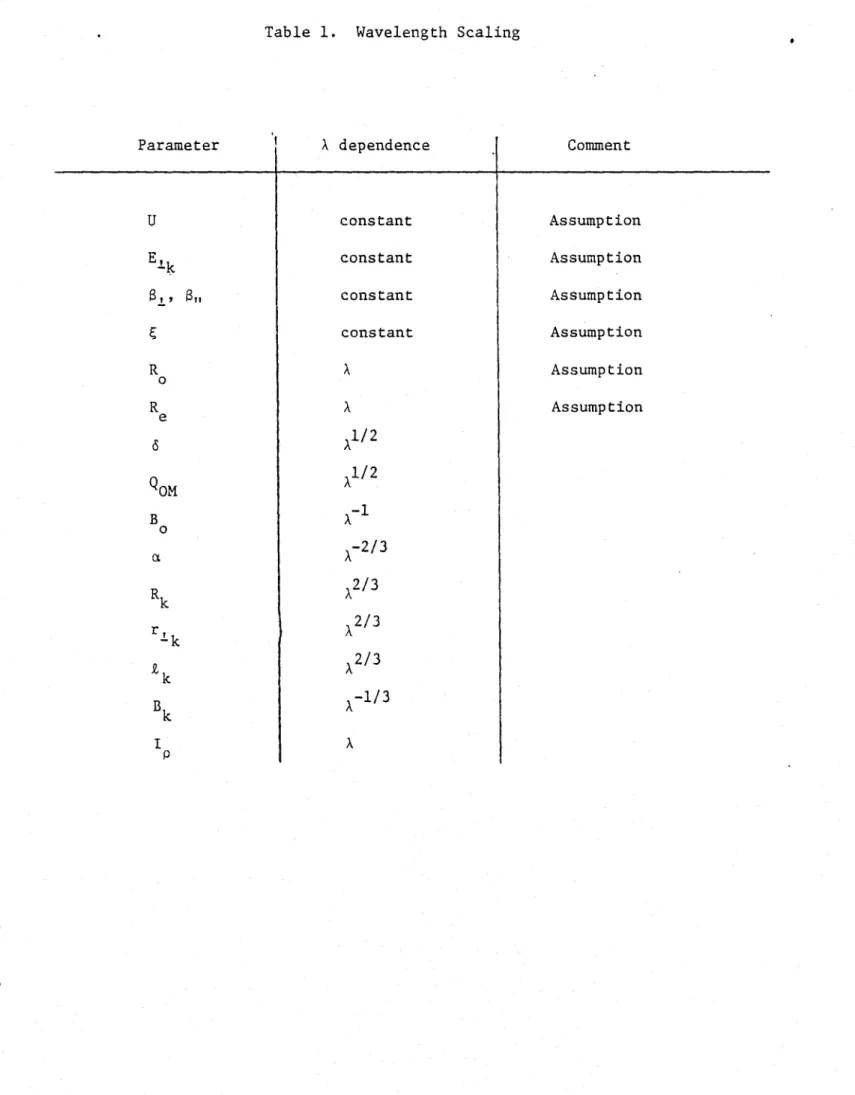
Zaytsev et al. have published a table listing a number of parameters and their scaling with wavelength, X. The parameters that were assumed to be independent of wavelength were:
Electron beam voltage, U = constant
Electric field strength at the cathode, Ek constant R /A = constant 0 R /A = constant e (54) = constant = constant
The constancy of Ek is probably related to high voltage breakdown. The invar-iance of R 0A and R /A is related to maintaining the same cavity mode. Using
Eq. (54) and previous equations we may derive the following results.
The skin depth, 6 A
R
Then Qo X =0 1/2
OM 6 1/2
B
-w z W X-10 c
1-2
1
This .yields, assuming , = constant,
X-2/3 Then 1/2R '-1/3 2/3 1/2 2/3 k 2r k - 2 2rk B -1 B -1/3 k o -3/2 CRe -Bo p 3
These results are listed in Table 1 and they are in agreement with the results of Zaytsev et al., although there are some additional values listed here. The wavelength scaling derived here depends strictly on the initial assumptions. These assumptions are not immutable, and it is possible, for example, to vary the cavity mode or energy, U, with wavelength. However, the derived scaling appears to represent the experience of the Soviet workers
1-22
Table 1. Wavelength Scaling
Parameter X dependence Comment
U constant Assumption E, constant Assumption -' k constant Assumption constant Assumption R 0 Assumption R e Assumption 6 xA1/2 QOM x 1/2 B X-1 0 Rk U AX-2/32' R2/3 r- 2/3 -k 2/3 B X- 1/3 Bk
S-23
ii) -Efficiency vs. Wavelength
As an additional test of the present analysis, we have calculated, using the present theory, the efficiency of gyrotrons similar to those of Zaytsev et al. and have compared the calculated results with their experiments. The results are shown in Fig. 3. The assumed parameters were: U = 30 kV,
I = 1 amp, a /a, - 1.5, a TE0 3 1 cavity mode, and Re/Ro = X1 2
/X
0 3.
The cavitywas assumed to be a right circular cylinder, with diffractive
Q, QD
= 3QMIN'
Calculations were carried out for w and 2 w operation. In each case, the ohmic Q was allowed to be R /6, labelled "minimum losses" in Fig. 3, or 0.6 R0 1,labelled "realistic losses" in Fig. 3. At each wavelength, the cavity length, L, was varied in order to optimize the efficiency.
The present calculated efficiencies agree very well with those listed in the paper by Zaytsev et al. Although they used modes other than the TE 031in
some cases, the variation of efficiency with cavity mode is not very important in low mode operation and is neglected here. The other parameters used here do agree with their experimental values.
In their paper, Zaytsev et al. stressed the good agreement obtained between their experimental and theoretical results. This agreement is evident in
Fig. 3. The highest experimental point in Fig. 3 was obtained at wc, while the lower two experimental points, at short wavelength, were obtained at 2 c
The present theory, as shown in Fig. 3, indicates that the efficiency for
W operation decreases only slowly with wavelength until wavelengths less
than 1 mm are reached. Operation at 2 w is inherently inefficient for operation at short wavelengths.
1-24
G. References
1. A.V. Gaponov, A.L. Gol'denberg, D.P. Grigor'ev, T.B. Pankratova,
M.I. Petelin and V.A. Flyagin, Radiophysics and Quantum Electron, 18, No.2, pp. 204-211, 1975 (English translation).
2. N.I. Zaytsev, T.B. Pankratova, M.I. Petelin and V.A. Flyagin, Radio Eng. Electron, Phys. 19, No.5 pp. 103-107, 1974 (in English).
3. D.V. Kisel', G.S. Kovablev, V.G. Navel'yev, M.I. Petelin and Sh. Ye.
Tsimring, Radio Eng. Electron, Phys. 19, No. 4, pp. 95-100, 1974 (in English).
4. S.N. Vlasov, G.M. Zhislin, I.M. Orlova, M.I. Petelin and G.G. Rogacheva, Radiophysics and Quantum Electron., 12, No. 8, pp. 972-978, 1969
(in English).
5. A.L. Gol'denberg and M.I. Petelin, Radiophysics and Quantum Electron. 16,
No. 1, pp. 106-111, 1973 (in English).
6. G.S. Nusinovich and R.E. Erm, Elektronnaya Tekhnika, Ser. 1, Elektronika SVCh, 1972, No. 2, 55.
00
c'J
0
LL.D0r0Z
~UWD
0
z
0
(9
LiLz
I-0
w
z
0
z
z
0
F-_
0
(D
("4 '-4 U---Mimi(f) U) U V) 0 0 -j SU W) < 0 WcU
w
0 - r -U-U
>
)a
ZL w0
W
p
z
0 -J 0 U -z
<z
W 0 0 IAc
0-00
E
0~ U) (n) U))w
.0 1- w -w 00
:z;
~~
crU)
,- Wct
cr
-0
W0
w
D
0 0 0 N- 0 0 0 0 0DESIGN STUDY FOR A 200 GHZ GYROTRON
Part II
R.J. TEMKIN, S.M. WOLFE
Francis Bitter National Magnet Laboratory Massachusetts Institute of Technology
Cambridge, Massachusetts 02139 USA
II-1
GYROTRON DESIGN - 200 GHZ DEVICE
A. GYROTRON CAVITY
B. GYROTRON GUN
C. OUTPUT POWER
GYROTRON DESIGN - 200 GHZ DEVICE
In this section, we derive the operating parameters of a 200GHz gyrotron, X = 1.5mm, working at w - wc. The design is based on the general design principles described in a preceding section. The beam power is specified as 1 Amp at
30 kV, or 30 kW. With an efficiency of order 30%, an output power of about 10 kW is expected.
A. GYROTRON CAVITY
The cavity will be assumed to be similar in shape to Fig. 1. The working mode is taken to be a TE0 3 1 mode. X03 = 10.173. Assuming L/A >>1, we have D= 4.86 mm and RO = 2.43 mm. The electron beam is assumed to coincide with the second radial E field maximum, p=2. Then, since X1 2 =5.331, Re = 1.27 mm. Use
of the second maximum allows the constriction at the cavity entrance to be small enough for cutoff of the RF field propagating out of the cavity toward
-5 4
the gun. The skin depth 6 = 1.47 x 10 cm. QOM = 1.65 x 10 A. For A : 0.8, 4
QOM = 1.32 x 10 .
We determine the cavity length by setting QD OM 4.13 x 10 3, as in
Eq. (44), and assuming QD 3 Qmin' Eq. (9). Then L/X = 10.5 and L = 15.8 mm.
The value of w/wcr = 1.001, which justifies using the large L/X limit.
The value of y is 1.0587 and 6 is 0.3284. Assume that $,1/,, in the cavity region is 1.5. Then , = 0.2732, ,, = 0.1821.
-l 10 -l
Using L, we obtain k,, = 1.99 cm and k,, v,, = 1.086 x 10 sec . Since
12 -1 12 -l
w 1.257 x 10 sec , w =1.246 x 10 sec and B = 75.01 kG.
II-3
B. Gyrot ron Guii
The gyrotron gun must produce a beam in the cavity region with the proper values of , and 6,, and with a minimal velocity spread. A key parameter in the gun design is the mirror ratio, a. As previously discussed, there are several constraints on the value of a. These may be summarized as follows:
4 E, = 5 x 10 V/cm a > 25 --
max
max = 3A/cm -- 32 E = 0.1 38 > a (narrow emitter)max
38 > ($k ( wide emitter) V >5 kV; d > 2rk -+ a > 16 2 8 -2 Emax = 0.1 a/a > 2.35 x 10 cmIn light of these constraints, we select the following gun parameters:
a = 25 = 1.3
a = 3 pm
The value of E is such that the gun falls into neither the narrow nor the wide emitter regime. However, a rough value of e can still be obtained from the narrow emitter equation since, as previously noted, a similar result for E occurs for large and small E. This will be calculated below.
Using a and the scaling rules of Eq. (46), we obtain B = 3.00 kG,
2
R = 6.35 mm, , = 0.05464, r, = 0.311 mm, E = 1.64 x 10 statvolt/cm or
k k -k k
Ek 4.92 X 10 V/cm, I = 5.69 x 10 10statamps or I = 19.OA. The selected
value of E yields the following parameters: Zk = 0.81 mm, A = 0.32 cm2 and Jk = 3.1 A/cm 2. Let V1 2 8 kV. Then d z 1.63 mm and d/2 rik = 2.6,
11-4
0
d/R k= 0.26. The gun angle $k is usually taken between 5 and 10 . Assuming
k = 7.50, h = 0.80 mm.
The velocity spread arises from several sources. The contribution from space charge at the cathode is e z I/I . I is estimated to be 19A using the narrow emitter approximation or 11.8 A using the wide emitter approximation. Hence E sc s 8.5% from space charge. The cathode temperature is assumed to be
T = 12000C, CT = 2.4%. Using a = 3 pm, E = 9.9%. The total E = 13%. C. Output Power
The starting current for the TE0 3 1 mode may now be estimated. Using
G = 1.89 x 10⁻² and ii = 13.5, Ist = 34 mA. However, the actual Ist may be larger by a factor of 2-4.
The TE031 mode has a resonant frequency close to that of the TE231 mode. For the TE2 3 1 mode, X23 = 9.969. Then
X 03 ~ 23
= 0.020 > 0.017 X0 3
so that simultaneous oscillation of the TE231 and TE031 modes is unlikely. The efficiency is obtained from the graphs of Nusinovich and Erm using
3
i =13.5 and I = 2.0 x 10 . The value found for
n,
is 0.6. Then e = 0.42 and n = 0.32. The output power P =un
IU = 9.6 kW.out
D. Schematic Drawings
The 200 GHz gyrotron located in a Bitter magnet is illustrated schematically in the figure. Other figures illustrate the gyrotron gun and the gyrotron
11l-5
200 GHz Gyrotron Parameters u = 200 GHz A = 1.5 mm I = 1 Amp U = 30 kV TE031 mode X03 = 10.173 D = 2R = 4.86 mm 0 0 Re = 1.27 mm 6 1.47 x 10- 5cm QOM = 1.32 x 10 QD = 4.13 x 10³ L/A = 10.5 L 15.8 nn W/W cr= 1.001cr
y = 1.0587 = 0.3284 a, /,, = 1.5 6, = 0.27326,l
= 0.1821 k,, 1.99 cm 10 -1 k,, v,, = 1.086 x 10 sec 12 -1 = 1.257 x 10 sec w 1.246 x 10 12 sec 1 c B = 75.01 kG 0 r = 0.0658 mm g a = 25 = 1.3 a = 3 Pm B = 3.00 kG R = 6.35 mm k k= 0.05464 ck = 5.28 x 10 10sec r k = 0.311 mm E = 4.92 x 10 4V/cm I0 19 A Pk2 0.81 mm A =0.32 cm2 J = 3.1 A/cm2 V = 8 kV d = 1.63 mm k = 7.50 II = 0.80 mm Tk = 1200 0C c !5 8.5% Sc ET = 2.4% a 9.9% c = 13% G = 1.89 x 10⁻² P = 13.5Q
= 3.15 x 10 I =34 mA Ist I = 2.0 x 10³ 0 T= 0.60 i = 0.42 n = 0.32 Pout = 9.6 kWI
z
0
-40
OZ
w-o
00
114 5i o<
0
0
w
.JC)
SCALE DRAWING OF ELECTRON GUN FOR
200 GHz GYROTRON
Fig. 11-2
z
Iro0;
0