HAL Id: hal-01803112
https://hal.archives-ouvertes.fr/hal-01803112
Submitted on 12 Jun 2018
HAL is a multi-disciplinary open access
archive for the deposit and dissemination of
sci-entific research documents, whether they are
pub-lished or not. The documents may come from
teaching and research institutions in France or
abroad, or from public or private research centers.
L’archive ouverte pluridisciplinaire HAL, est
destinée au dépôt et à la diffusion de documents
scientifiques de niveau recherche, publiés ou non,
émanant des établissements d’enseignement et de
recherche français ou étrangers, des laboratoires
publics ou privés.
Operating reserve in microgrids: an approach to deal
with uncertainty
Fausto Calderón-Obaldía, Amjad Anvari-Moghaddam, Josep Guerrero, Jordi
Badosa, Anne Migan-Dubois, Vincent Bourdin
To cite this version:
Fausto Calderón-Obaldía, Amjad Anvari-Moghaddam, Josep Guerrero, Jordi Badosa, Anne
Migan-Dubois, et al..
Operating reserve in microgrids: an approach to deal with uncertainty.
In-ternational Conference on Smart Energy Systems and Technologies, Sep 2018, Barcelona, Spain.
�10.1109/TSG.2012.2231440�. �hal-01803112�
Operating reserve in microgrids: an approach to deal
with uncertainty
Fausto Calderón-Obaldía
GeePs-LMD-LIMSI Université Paris VI (UPMC)
Paris, France
[email protected] Jordi Badosa
SIRTA
Laboratoire de Météorologie Dynamique
Paris, France
Amjad Anvari-Moghaddam
Department of Energy Technology Aalborg University Aalborg, Denmark [email protected] Anne Migan-Dubois Phemadic GeePs-UPMC Paris, France
[email protected] Josep M. GuerreroDepartment of Energy Technology Aalborg University Aalborg, Denmark [email protected] Vincent Bourdin CTEMO LIMSI Paris, France [email protected]
Summary—
Uncertainty is an unavoidable issue when working with renewable generation and consumption forecasts; and it represents one of the big challenges to overcome in distributed generation schemes. Renewable microgrids are subject to this problem that poses different challenges for their management in terms of power quality, stability, planning and scheduling, among others[1]. Many of the current state-of-the-art energy management systems (EMS) deal with this issue from a predictive perspective. In other words, they perform the planning and scheduling based on forecasts, before the actual net-demand (ND) unveils[2][3][4]. This leads to unavoidable deviations between optimal and real scheduling. In the proposal presented in this work, the forecast-uncertainty problem is tackled in-deferred, once the uncertainty has revealed itself, so it can be taken into account, with certainty, in the optimization and scheduling process performed by the EMS. This objective is achieved by bringing down to microgrid-scale the concept of operating reserve (OR), known in utility-scale power systems, in a sort of closed-loop corrective control variation. The proposed approach allows including the errors between forecasts and real data, in an optimal way within the energy management loop, so that optimal performance can be achieved. In this work, two main objectives are sought: finding out the optimal time interval at which the corrections (optimization and scheduling) should be made; and study the performance and stability of the system when a real-time sizing of the operating reserve is held, based on estimations of forecasts uncertainty.Fig. 1. Microgrid emulation module for experimental tests (Microgrids
group, Aalborg University)
The core (and novelty) of the presented proposal is the inclusion of an extra energy storage (operating reserve), which is not ‘seen’ by the EMS. This element allows all the dispatchable resources in the microgrid to be optimally scheduled. This is achieved thanks to the compensation role assumed by this new element when net-demand deviations (from forecasted values) occur. Given the expected reduced-size of this unit (compared to the main energy storage), its technology can be chosen so that its cycling life is high enough as to consider its marginal cost negligible (i.e. supercapacitors/flywheels [5]). Deviations in ND are reflected as changes on the state-of-charge (SoC) of the OR which are included in the optimization process of the EMS every timestep t. The required capacity of this OR unit is also recalculated every timestep t, based on uncertainty estimations for the next timestep. When uncertainty is such that the total OR capacity is not required for compensation purposes, part of the OR capacity can be assigned to the system to be used as part of the main energy storage, increasing its capacity factor and providing the microgrid with a temporary extra-storage capacity. Net-demand uncertainty estimations are obtained using an analog ensemble method, which is also presented in this work.
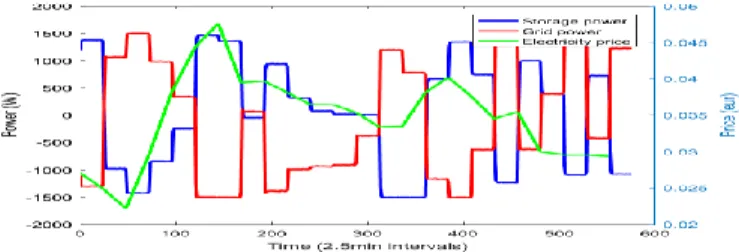
An emulated microgrid consisting on photovoltaic production, household-type consumption, battery energy storage and a bi-directional grid connection is used to perform the tests. Preliminary experiments are performed in the microgrids laboratory of the Energy Technology Department of Aalborg University (Denmark) using a simple EMS as reference. The optimization performed by the EMS is intended to minimize the cost of energy bought from the main grid under a variable electricity-price scenario in Denmark. The system is emulated using fully programmable bi-directional 2.2kW inverters linked to a common bus controlled via dSpace/Matlab (Fig.1). Its output is the optimal power profile for the battery and grid connection, as seen in Fig.2.
The results, under unlimited OR capacity, showed improved performance for two different ND scenarios (summer and winter weeks) with respect to the base case system (Table I).
TABLE I. WEEKLY OPERATION COST Weekly operation
cost(€)
Reference case Proposed approach
Winter week 0.77 0.52 (+32.5%)
Summer week -0.8 -1.05 (+19.3%)
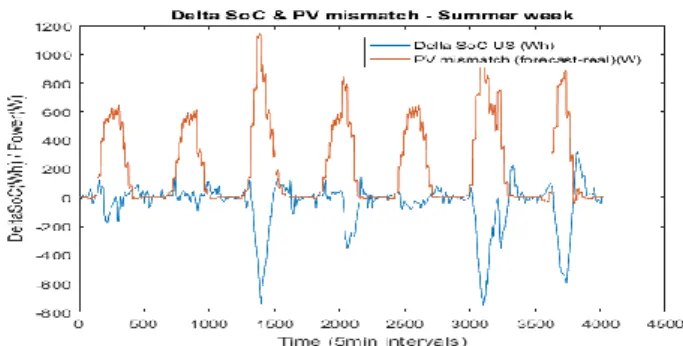
As seen in Fig.3, the SoC of the OR showed stability for a timestep of one hour, for both net-demand scenarios (winter and summer weeks). Ongoing tests are held to validate stability for other timesteps as well as to find out the optimal timestep t (at which optimization and scheduling is performed), under the criteria of performance (operation cost), SoC stability and capital cost. The aforementioned aspects, along with real-time OR sizing tests (aiming to evaluate capital costs and economic feasibility), are the core of the present work.
Assumptions, conditions, limitations and future perspectives for further research on this proposal are also discussed to ponder its validity and usefulness in real-case microgrid systems, as a way to soften the negative effects of uncertainty with the aim to make renewable microgrids and distributed systems a more affordable and reliable source of clean energy.
R
EFERENCES[1] Dalia Eltigani, Syafrudin Masri, “Challenges of integrating renewable energy sources to smart grids: A review,” In Renewable and Sustainable Energy Reviews, vol. 52, pp. 770-780, 2015. (ISSN 1364-0321) [2] Lexuan Meng, Eleonora Riva Sanseverino, Adriana Luna, Tomislav
Dragicevic, Juan C. Vasquez, Josep M. Guerrero, “Microgrid supervisory controllers and energy management systems: A literature review,” In Renewable and Sustainable Energy Reviews, vol. 60, pp. 1263-1273, 2016. (ISSN 1364-0321)
[3] Wencong Su, Jianhui Wang, “Energy Management Systems in Microgrid Operations,” In The Electricity Journal, vol. 25, pp. 45-60, 2012. (ISSN 1040-6190)
[4] R. Palma-Behnke et al., "A Microgrid Energy Management System Based on the Rolling Horizon Strategy," in IEEE Transactions on Smart Grid, vol. 4, no. 2, pp. 996-1006, June 2013. (doi: 10.1109/TSG.2012.2231440)
[5] Xing Luo, Jihong Wang, Mark Dooner, Jonathan Clarke, “Overview of current development in electrical energy storage technologies and the application potential in power system operation,” In Applied Energy, vol. 137, pp. 511-536, 2015. (ISSN 0306-2619)