Publisher’s version / Version de l'éditeur:
Technical Translation (National Research Council of Canada), 1956
READ THESE TERMS AND CONDITIONS CAREFULLY BEFORE USING THIS WEBSITE.
https://nrc-publications.canada.ca/eng/copyright
Vous avez des questions? Nous pouvons vous aider. Pour communiquer directement avec un auteur, consultez la première page de la revue dans laquelle son article a été publié afin de trouver ses coordonnées. Si vous n’arrivez pas à les repérer, communiquez avec nous à [email protected].
Questions? Contact the NRC Publications Archive team at
[email protected]. If you wish to email the authors directly, please see the first page of the publication for their contact information.
NRC Publications Archive
Archives des publications du CNRC
For the publisher’s version, please access the DOI link below./ Pour consulter la version de l’éditeur, utilisez le lien DOI ci-dessous.
https://doi.org/10.4224/20331508
Access and use of this website and the material on it are subject to the Terms and Conditions set forth at Variation in the volume of plaster during and after setting
Ito, S.; Teraoka, I.; Yoshihama, S.
https://publications-cnrc.canada.ca/fra/droits
L’accès à ce site Web et l’utilisation de son contenu sont assujettis aux conditions présentées dans le site LISEZ CES CONDITIONS ATTENTIVEMENT AVANT D’UTILISER CE SITE WEB.
NRC Publications Record / Notice d'Archives des publications de CNRC:
https://nrc-publications.canada.ca/eng/view/object/?id=bbc6cdd4-1916-4ab1-9489-174e4cfe93a2 https://publications-cnrc.canada.ca/fra/voir/objet/?id=bbc6cdd4-1916-4ab1-9489-174e4cfe93a2
Title:
Authors:
Reference:
Translator:
NATIOTJAL RESEARCH COUNCIL OF CANADA
Technical Translation TT-643
Variation in the volume of plaster during and after setting,
Shuyo Ito, Ichiro Teraoka and Seiichiro Yoshihama, Research Laboratory of the Tokyo Shibaura Electric Company, Limited.
K,
Shimizu.Plaster continues to be
an
important building material in Canada and it is therefore the subject of some of the investigations now being carried outin
the Building Materials Sectiona f
the Division of Building Research,In
the necessary and essential library research carried out in association with our laboratory work in connection with plaster problems, reference was found to this paper on the variation in the volume of plaster W i n g and after setting from Japan, Study of the paper showed its value and its relevance to current experimental work being carried out by the Division and in other laboratories in North America,The Division is therefore pleased to be able to include this translation in its series of Technical Trans- lations, by permission of the author, The Division is grate- ful to Mr,
K,
Shimfzu for preparing thf s translation,Ottawa,
VARIATION IN THE VOLUNE OF PLASTER DURING
AND
AFTER SETTING
1,
Introduction
A
part of this study has been published at the Fall
Symposium of Plaster Research Group in Nagoya on October
25,
1951.
The present paper deals with the results of further research*
In
the past only hardening and expansion of plaster due to hydration
have been studied, However, cont~action
takes place at the be-
ginning of hydration and expansion follows, Thus there is con-
siderable difference in true expansion of plaster due to hydration
between measurements made from the extreme of contraction and
measurements made within the range of expansion, The authors have
been able to measure contraction and expansion by means of a
simple optical dilatometer which has been specially designed for
the present work,
2,
Materials Used
The following types of plaster were used:
(a)
a
and
p
type plaster made from crystals which were obtained
from CaSO,, a residue of the manufacture of hydrofluoric acid at
the Kawaguchi Factory of the Shibaura Electric Co,,
Commercial products
Yoshino Plaster Manufactures, Ltd,
Two products were used (both +type).
Equipment
The equipment was designed to measure thermal contrac-
tion and expansion, This can be used to measure expansion and
contraction in plaster due to hydration, The use of this instru-
ment enabled the authors to discover that regular contraction
takes place before expansion which has been the sole subject of
research in the past,,
blain components of t h e equipment a r e shown schemati- c a l l y i n F i g u r e l a I t c o n s i s t s of a h e a t e r ( n o t used i n t h e p r e s e n t work), a q u a r t z g l a s s d i l n t o m e t e r (need n o t be q u a r t z g l a s s i n t h e p r e s e n t work), a s c a l e and a t e l e s c o p e , The inain components of t h e d i l a t o r a e t e r c o n s i s t of t e s t - m a t e r i a l r e c e i v i n g s t a n d and push b a r b o t h made of q u a r t z g l a s s , The b a r i s p l a c e d on r o l l e r s and p r e s s e d l i g h t l y by two rubber bands, The push b a r i s extremely l i g h t and moves sidetT~ays t o t h e r i g h t and l e f t ,
This movement t u r n s t h e r o l l e r s and a m i r r o r a t t a c h e d t o a r o l l e r . The m i r r o r i s placed a t t h e c e n t r e of t h e curved s c a l e and r e - f l e c t s t h e g r a d u a t i o n s on t h e s c a l e - The g r a d u a t i o n i s observed through a t e l e s c o p e r I n t h i s way b o t h c o n t r a c t i o n and expansion can b e a c c u r a t e l y measured, When t h e p l a s t e r which is t o b e t e s t e d is p l a c e d between t h e r e c e i v i n g s t a n d and t h e push b a r , + t h e change i n t h e volume of p l a s t e r is immediately transformed i n - t o t h e r o t a t i o n
o f
t h e ~;:inlor* Thus by t h i s equipmenti t
i sp o s s i b l e t o observe continuously the c o n t r a c t i o n i n volume of p l a s t e r b e f o r e s e t t i n g and t h e expansion a f t e r s e t t i n g *
The following experiments were conducted: ( i ) t h e amount of mixing water i s changed; ( i i ) when s a l t s a r e added,
The r e s u l t s of experiments a r e shown below, Fig. 2 sho1vs t h e change i n volume of c o m l e r c i a l l y a v a i l a b l e Y- and S-
p l a s t e r with standard r ~ ~ o u n t of' mixing water ( s e e e d i t o r ' s n o t e ) ? blnx, Coizte$ Iclax,
EX^+%
T o t a lE-*$
Maxa Temp-Fig,
3
shows t h e chc~nce i n volune ofa-
and @-typep l a s t e r of Shibaura due t o h y d r a t i o n w i t h t h e change i n t h e m o u n t of mixing water added,
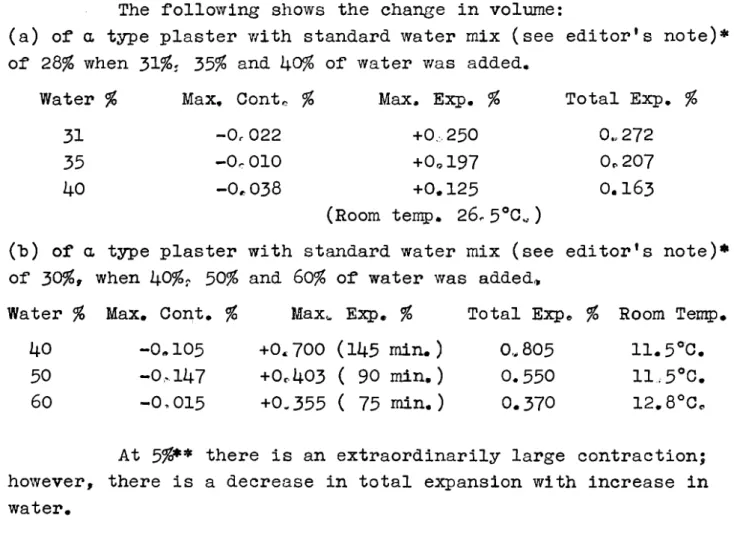
The folloiving shows t h e change i n volume:
( a ) of a type p l a s t e r with standard water mix ( s e e e d i t o r ' s note)" of 28% when
31%:
35% and40$
of water was added,Water $ Max. Cont, $ Max.
Exp.
%
TotalExp.
%
31
-0,022 +0, 250 0,27235 -Or 010 + O m
197
0,20740 -0,038
+o,
125 0,163( ~ o o m temp. 26,5Oc.> )
( b ) of a type p l a s t e r with standard water mix ( s e e e d i t o r ' s n o t e ) * of
3Mr
when 40%: 50% and 60% of water was added,Water
%
Max. Con%*%
Max, Exp,%
TotalExp,
%
Room T ~ w *A t 57@* t h e r e
i s
an e x t r a o r d i n a r i l y l a r g e c o n t r a c t i o n ; however, t h e r e i s a decrease i n t o t a l expansion with i n c r e a s e i n water,Fig,
3
( c ) sho~vs t h e change i n volume of f3-type p l a s t e r with standard water mix ( s e e e d i t o r ' s note)* of 50% with change i n amount of water,Water $ Max, Cont,
%
Max, Exp.%
Total Exp.%
-0,025
+Os337
0,362-or
062 +Om 212 0'274
-0,036 +O, 112 0,148 -0,- 035+o.
060 0,095 -0.012 +01 045 0, 057 ( ~ v e r a g e Room Temp. 1 2 , 2 O ~ , ) * E d i t o r ' s note:- The phrase "standard amount of mixing water" and"standard . : ~ a t e r mix1' would appear t o be equivalent t o t h e phrase "standard c o n s i s t encyql,
Figure
4
shows the change in volume with the change in
water of
(B)
and
(c)
type of Yoshino Plaster Manufactures, Ltd,
(a) Change
inthe volume of P-type plaster
(B)with the standard
water
mix
(see editor's note)* of
45,8%
when mount of water is
changed,
Waters Max, Cont.
$Max,
Exp,%
TotalExp.
%
R o o m T e W a
The result shows that measured from the initial position,
the expansion does not decrease in the order of increasing amount
of water,
(b) Shows the change in volume of @-type plaster
(c)
with the
standard water mix (see editorPs
note)* of
48.5%
when the amount
of water is changed.
Water
$Max, Cont,
%
Max.
E q e%
Total E a *
%
Room
The result, as in
(a),shows that the expansion measured
from the initial position does not decrease with the increase in
the amount of water,
Fig.
5
(a) shows the change in volume of Shibaura a-type
plaster with sodium citrate added;
30%
water,
0.01and
0.03%
of
sodium citrate was used,
Sodium citrate
%
Max,
Cant,$ Max, Exp.%
Total
Exp,%Room Temp,
(
80
min,)0,Ol
-0,025
+O*
275
0,300
20. O°Ce
0.03
-0,014+O. 241
0.255
21,
O°Ce
*See footnote on page
4,
Fig.
5
(b) shows the change in volume due to hydration
of Shibaura a-type plaster with
50%
water and
1%sodium citrate*
Fig,
6
shows the change in volume due to hydration of
Shibaura a-type plaster with sodium alginate added.
It is seen
that in all cases there is lengthening in the "apparent completion1'
time,
Water
%
Ratio of
MixMax.
Cant.%
Max,
Exp.%
Total Exp.%
Sodium alginate to
plaster
5,
Analysis
By means of a newly designed dilatometer the authors
measured the change in volume of plaster at the time of setting,
They discovered that the volume contracts during the setting
process and were able to measure the expansion in volume after
setting, The review of the present work shows that the experiments
can be summarized roughly
bysuch
acurve as shown in Fig,
7,
Hydration in plaster is a reaction in which crystalline gy-psum is
evolved and heat is generated as shown in the following equation:
CaSO,
o1/2H20
+
1 4 ~ ~ 0
=CaSO,
2H20
+
X
cal.
In this reaction, plaster dissolves at first, and gypsum crystall-
izes from the supersaturated solution; heat is generated followed
by the development of crystals and expansion proceeds rapidly,
It
appears that after the crystals are fully developed, contraction
In volume due to the drying of solid matter takes place,
(i)
0 -+A:
Momentary contraction to A is observed, It appears
as if plaster is mostly in solution during this period and tenslon
predominates.
( i i ) A + B: This a l s o takes place i n a s h o r t i n t e r v a l of time. Dissolution 1 s r a p i d l y 'akfng place; h e a t
is
a l s o gener- ated,( i i i ) B + C: C r y s t a l l i zatfon of small c r y s t a l s of CaSO, a 2H,O
g r a d u a l l y takes p l a c e and h e a t i s generated i n g r e a t e r quantity,
A t C the c ~ y s t a l l i z a t i o n ceases. I t appears a s i f t h i s is the p o i n t of "apparent comp.le tlon",
( i v ) C + D: Short s t a t i o n a r y s t a t e ,
( v ) D -, E -+ Fu, Development of c r y s t a l s t a k e s p l a c e r a p i d l y ;
volume expands r a p i d l y with t h e generation o f heat, Heat reaches a maximum i n the neighbowhood of Eo The temperature g r a d u a l l y d e c l i n e s , but expansion continues and a t F i t s r a t e begins t o decline, D -+ E t h e curve i s concave up and E -+ F i t i s convex,
( v f ) F -+ G -+
Hs
FromF
the c w v e , whose g r a d i e n t was low,r i s e s a l i t t l e , and reaches a t s maximum a t H,
( v i i ) H + I: Expansion s t a y s a t a constant value f o r a while
then slow c o n t r a c t ion takes place,
N a t u r a l l y the shape of the curve depends on the proper- t i e s of t h e p l a s t e r ; f u r t h e r , depending on the condition under which the p l a s t e r was poured, them. a r e cases where A -+ B can hardly be recognized; st111 i n o t h e r cases, C and D coincide,
F w t h e r examination of t h e diagram suggests t o the authors t h e p o s s i b i l i t y tha% c e r t a i n explanations can be made with regard t o
t h e s t a r t of s e t t i n g , apparenX comp%etion, and completion of s e t t i n g , doe,, p o i n t B indicates the beginning, and p o i n t C
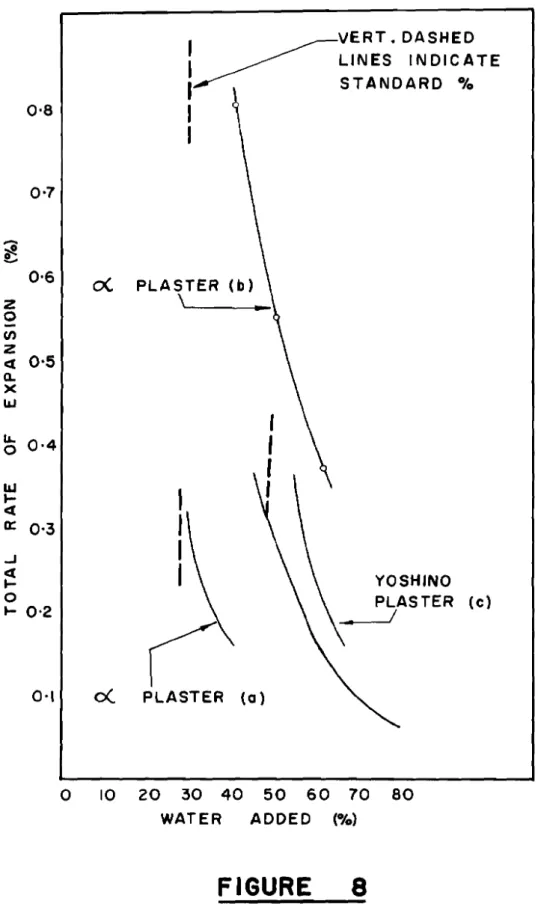
"apparent comple%ioni'. F u r t h e r , i f t h e completion i s i n d i c a t e d by t h e h i g h e s t p o l n t on the thermomete~, i t must l i e somewhere i n the neighbourhood of E, the p o i n t of i n f l e c t i o n , If the com- p l e t i o n i s t o b e taken a s t r u e expansion, p o i n t H must be taken a s the completion af sett5ng. Secondly, i t i s seen from the re- s u l t s of the p r e s e n t experiments t h a t t h e i n c r e a s e i n the amount of water r e s u l t s g e n e r a l l y i n the decrease i n t o t a l expansion ( ~ i g , 8 )
-
t h i s cannot be found from the consideration of contrac- t i o n (-) and expansion ( a ) separately. I t can only be known fromthe sum of absolute values (total expansion),
Further, it was
found that the presence of organic salts has considerable effect
on the change in volume.
6.
Conclusion
Tile authors were able to study the change in volurne of
plaster due to hydration by means of the optical telescope and
using small quantity of test material, Our investigation is
un-
doubtedly incomplete; however, we feel that our investigation
gave us some insight into the problem, Further studies are under-
way on the effect of such factors as heat and strength, and others
on the amount of water added and on the change in volume,
The authors wish to thank the Yoshino Plaster Manufac-
tures,Ltd. for supplying them with test materials.
References
(a) Louis Chassevent, Variation in the volume of plaster during
and after setting, Rev, mat&riaux construction et trav,
publ.,
Ed, C., NO,
407*
276-72,
1949;
NO.
408,
304-308,
1949. @.A.
44:
299, 1950),
(b
) Louis Chassevent, ~atgriaux
construction et trave pml-9
Ed*
C,, No,
4059
188-94,
(c.A. 44;
124491950)*
D I L A T O M E T E R UARTZ T U B E S C U R V E D S C A ( R A D I U S
-
I M U B B E R B A N D S SCREW TO F A S T E N Q U A R T Z T U B E S T H E R M O C O U P L E S U P P O R T I N G S U P P O R T I N G S T A N D DILATOMETER R A I L SQUARTZ GLASS PUSH BAR ELECTRIC FURNACE
/'-
X X CROSS-SECTION- - -
- - - - - - - Y I ---,-
Y Y CROSS-SECTION X - - - - - - - - - - --- Z Z CROSS-SECTION -TEST M A T E R I A L R E C E I V I N G S T A N D O F OUARTZ G L A S S A\
THERMOCOUPLE7
S T E E L R O L L E RFIGURE I
S PLASTER
-
nAxlnun H E A T (WATER ADDED GENERATED IS TYPE) 66.6% MAXIMUM H E A T GENERATED ( Y TYPE) Y PLASTER l l l l l l l # l l 0 10 2 0 3 0 4 0 5 0 6 0 7 0 8 0 9 0 100 110 TlME IN MINUTES-
WATER ADDED 31% WATER ADDED 40°k 0 10 2 0 3 0 4 0 5 0 6 0 7 0 8 0 9 0 TIME IN MINUTESFIGURE
2
FIGURE
30
CHANGE
IN VOLUME OF
CHANGE IN VOLUME
OF
SHJBAURA
COMMERCIAL PLAST ER
DUE
oC
-
T Y P E
PLASTER
WITH CHANGE
TO
HYDRATION WITH
CHANGE
IN THE
AMOUNT
OF WATER
ADDED
FIGURE
3 ( b )
CHANGE
IN
VOLUME
OF
SHIBAURA
d,
-
TYPE
PLASTER
WITH CHANGE
IN THE AMOUNT OF WATER
ADDED,
(STANDARD
WATER MIX OF
& -
TYPE
PLASTER
-
30°h)
-
-
WATER ADDED 4 5 '10L
-
-
-
-
-
-
-
-
---.I.--..---.---_ t'
* W A T E R ADDED 60°/0-
-
W A T E R ADDED 7 0 O/o +WATER ADDED 8o
I I I 1 I 1 1 I 1 I I 8 I r 10 2 0 3 0 40 5 0 6 0 70 8 0 90 100 110 120 130 140 150 T I M E (MINUTES)FIGURE
3(c)
CHANGE
IN
VOLUME
OF
-
TYPE
PLASTER OF
STANDARD
WATER
MIX
5 0 %
WITH
CHANGE
IN
THE
AMOUNT
OF
FIGURE
4(a)
CHANGE
IN
VOLUME OF
(3
-TYPE PLASTER
OF STANDARD
WATER
MIX
OF
45*8°/o
WITH
-
WATER ADDED 60°A
- L
-
,
WATER ADDED 5 5 %-
-
WATER ADDED 65 Oh-
0 10 20 30 40 5 0 60 70 80 90 100 TIME ( MINUTES)FIGURE 4 ( b )
0 10 2 0 3 0 4 0 5 0 6 0 70 8 0 9 0 100 TlME (MINUTES)
FIGURE 5(a)
CHANGE IN VOLUME OF SHIBAURA
oC
-
TYPE PLASTER DUE TO HYDRATIONWHEN SODIUM CITRATE I S ADDED
TlME (MINUTES)
10 2 0 3 0 4 0 5 0 6 0 TO 8 0 9 0 100 110 120 130 140 150
1 1 1 1 1
I
FIGURE
5(b)
CHANGE IN VOLUME OF SHIBAURA
d
- T Y P E PLASTER WITH AN ADDITIONSODIUM ALGINATE : P L A S T E R : 5 : 9 5
(WATER ADDED
SODIUM ALGINATE :
PLASTER : 10 : 9 0 (WATER ADDED 70°/o)
0 2 0 4 0 6 0 8 0 100 1 2 0 1 4 0 160 T I M E (MINUTES)
FIGURE
6
CHANGE
IN VOLUME
OF
SHIBAURA
d
-
TYPE PLASTER DUE TO HYDRATION
WHEN SODIUM ALGINATE IS ADDED
T I M E
bFIGURE
7
H
I
HEAT
G/
GENERATED
0 / / e)'u/
.
C
0
CHANGE
IN
VOLUME OF PLASTER
FIGURE
8
0.8 0.7 h 9 L Oo6 2 0-
V) 2a
0.5 a X W 0 - 4 W b-a
a 0.3 J2
0 t- 0.2 0.1TOTAL
EXPANSION
AND CHANGE
IN
THE AMOUNT
OF
WATER
ADDED
V E R T . DASHED LINES I N D I C A T E STANDARD O/o